MSME Lending Statistics India 2026: Credit Gap, Interest Rates and NPAs
By ClauseAudit Research · 10 sources ·
How large is the MSME credit gap in India?
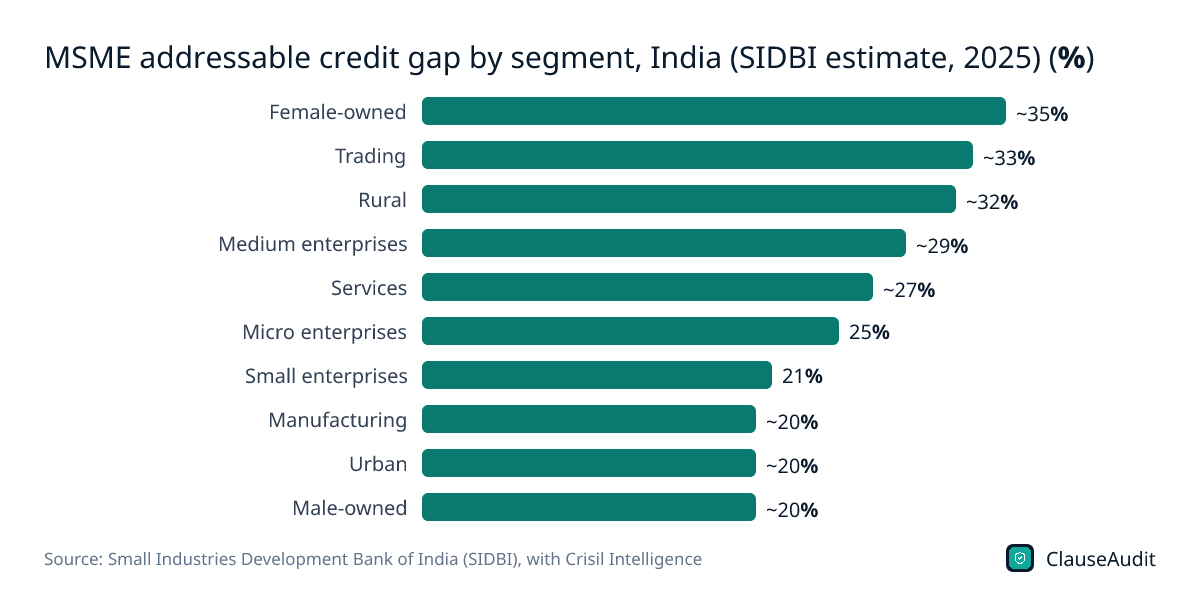
India's MSME sector still has an addressable credit gap of about ₹30 lakh crore, roughly 24% of its total finance demand, according to a May 2025 SIDBI study. Women-owned businesses face the widest gap at about 35%, compared with about 20% for male-owned firms. Only 3.6 crore of 8.7 crore registered MSMEs had ever accessed formal credit by March 2026.
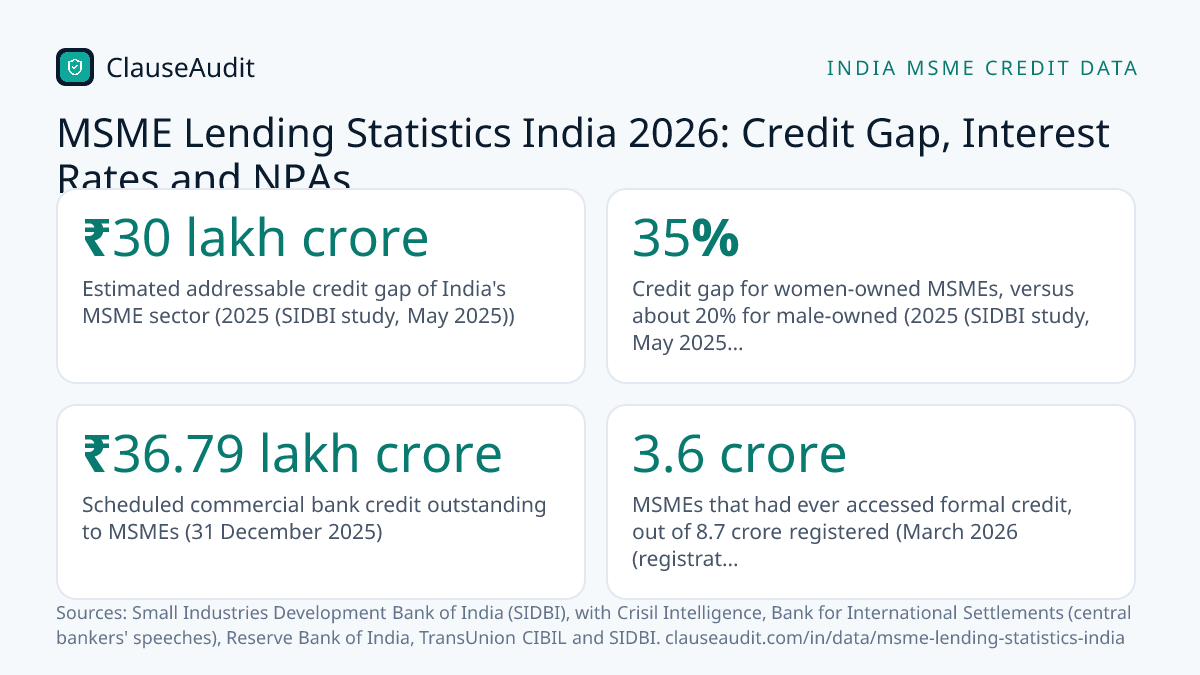
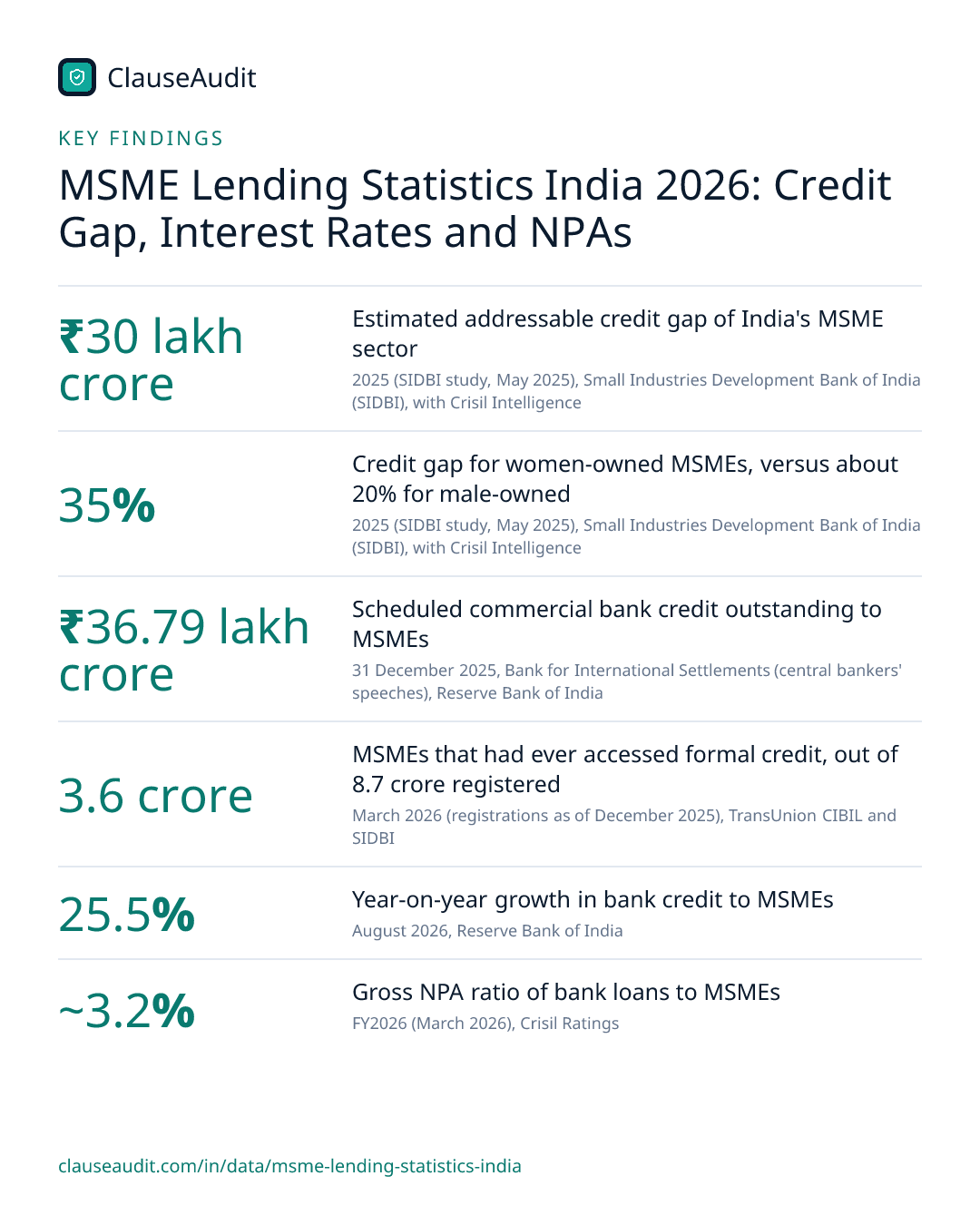
- Estimated addressable credit gap of India's MSME sector (2025 (SIDBI study, May 2025), Small Industries Development Bank of India (SIDBI), with Crisil Intelligence)
- ₹30 lakh crore
- Credit gap for women-owned MSMEs, versus about 20% for male-owned (2025 (SIDBI study, May 2025), Small Industries Development Bank of India (SIDBI), with Crisil Intelligence)
- 35%
- Scheduled commercial bank credit outstanding to MSMEs (31 December 2025, Bank for International Settlements (central bankers' speeches), Reserve Bank of India)
- ₹36.79 lakh crore
- MSMEs that had ever accessed formal credit, out of 8.7 crore registered (March 2026 (registrations as of December 2025), TransUnion CIBIL and SIDBI)
- 3.6 crore
- Year-on-year growth in bank credit to MSMEs (August 2026, Reserve Bank of India)
- 25.5%
- Gross NPA ratio of bank loans to MSMEs (FY2026 (March 2026), Crisil Ratings)
- ~3.2%
- Average spread over repo rate on new repo-linked MSME bank loans (August 2026, Reserve Bank of India)
- 3.36 percentage points
- RBI policy repo rate, the benchmark for most floating MSME loans (From 7 October 2026, Reserve Bank of India)
- 5.50%
Bank lending to small businesses in India is growing fast. Credit to MSMEs was up 25.5% year on year in August 2026, and scheduled commercial banks had ₹36.79 lakh crore outstanding to the sector at the end of December 2025. Yet most registered MSMEs have never borrowed from a bank or NBFC at all.
This page pulls together the official numbers on the credit gap, what MSME loans cost over the repo rate, and how many of those loans go bad. Below the charts, you will find what the figures mean if you run a small firm or work as a registered freelancer, and which loan terms to read before you sign.
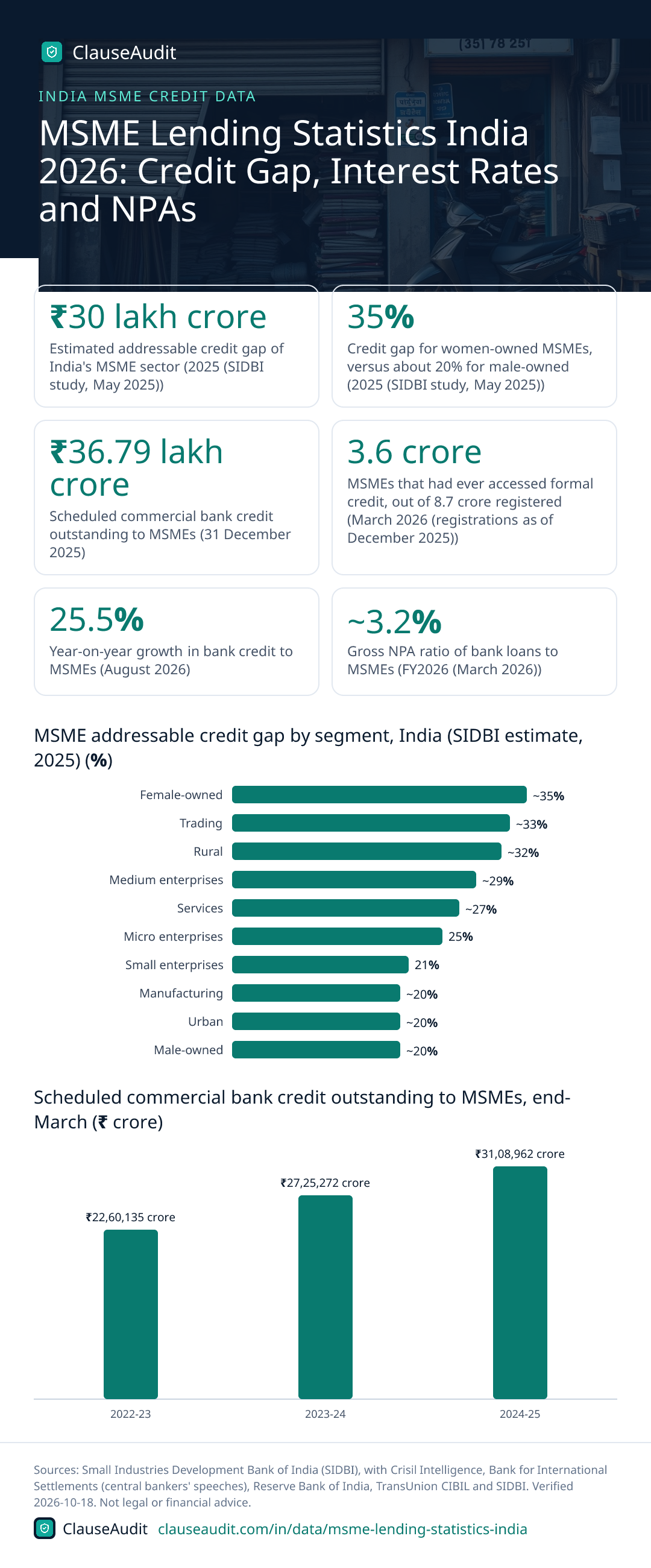
MSME addressable credit gap by segment, India (SIDBI estimate, 2025) (%)
Chart data
| Label | Value |
|---|---|
| Female-owned | ~35% |
| Trading | ~33% |
| Rural | ~32% |
| Medium enterprises | ~29% |
| Services | ~27% |
| Micro enterprises | 25% |
| Small enterprises | 21% |
| Manufacturing | ~20% |
| Urban | ~20% |
| Male-owned | ~20% |
The four cuts overlap, so a rural, women-owned trading firm sits in three of the worst-served groups at once. Small enterprises, manufacturers, urban firms and male-owned firms have the smallest gaps, at about 20-21%.
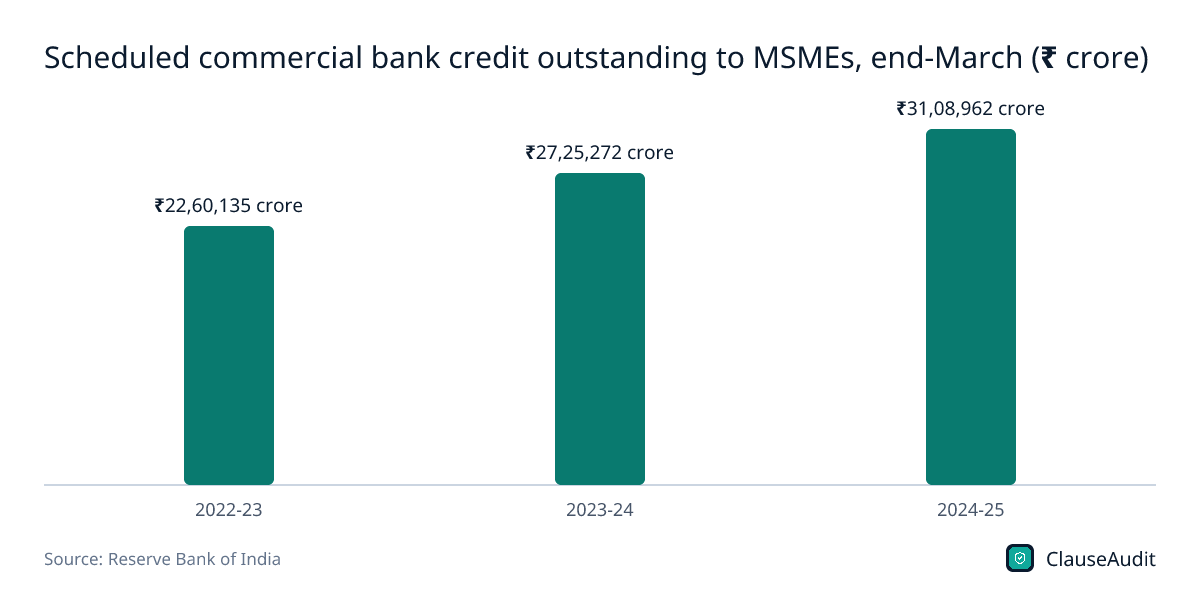
Download this chart (PNG)Scheduled commercial bank credit outstanding to MSMEs, end-March (₹ crore)
Chart data
| Label | Value (₹ crore) |
|---|---|
| 2022-23 | ₹22,60,135 crore |
| 2023-24 | ₹27,25,272 crore |
| 2024-25 | ₹31,08,962 crore |
Outstanding bank credit to MSMEs grew every year in this run, with the biggest jump in 2023-24. It reached ₹36.79 lakh crore by 31 December 2025.
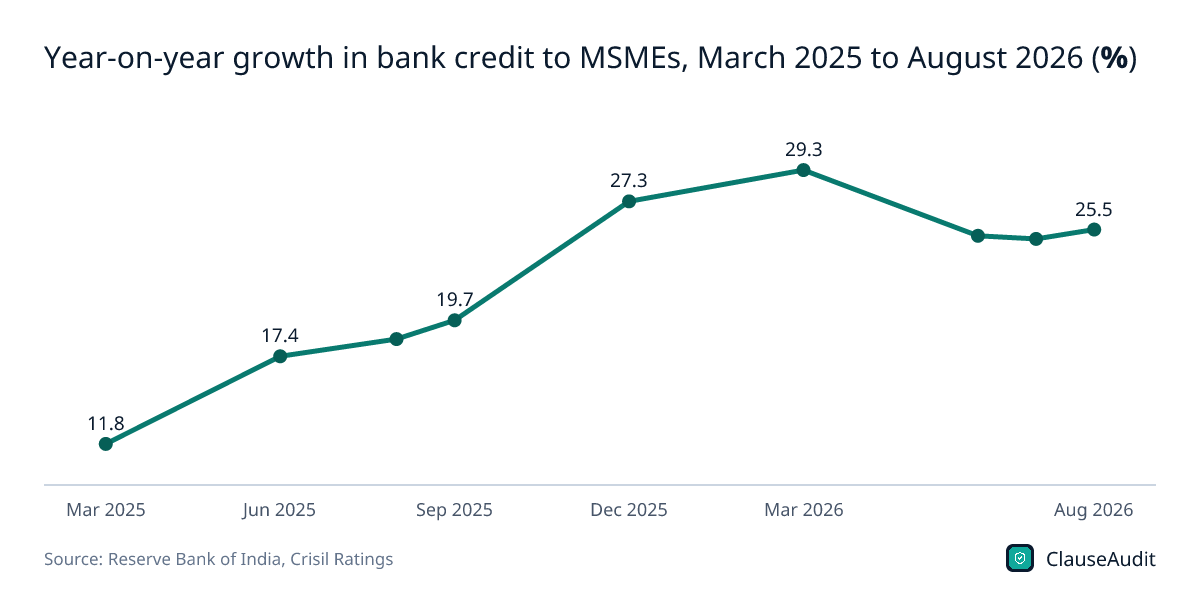
Download this chart (PNG)Year-on-year growth in bank credit to MSMEs, March 2025 to August 2026 (%)
Chart data
| Label | Value (%) |
|---|---|
| Mar 2025 | 11.8 |
| Jun 2025 | 17.4 |
| Aug 2025 | 18.5 |
| Sep 2025 | 19.7 |
| Dec 2025 | 27.3 |
| Mar 2026 | 29.3 |
| Jun 2026 | 25.1 |
| Jul 2026 | 24.9 |
| Aug 2026 | 25.5 |
Growth more than doubled from 11.8% in March 2025 to 29.3% in March 2026. Some of that is real new lending and some is firms being reclassified as MSMEs after the definitions changed on 1 April 2025.
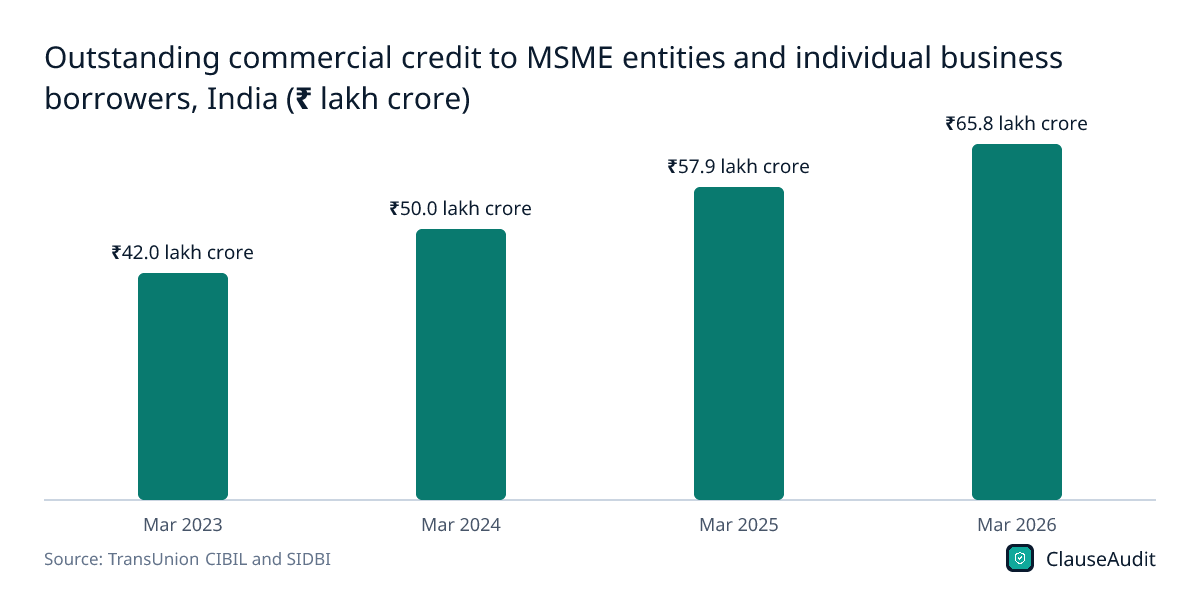
Download this chart (PNG)Outstanding commercial credit to MSME entities and individual business borrowers, India (₹ lakh crore)
Chart data
| Label | Value (₹ lakh crore) |
|---|---|
| Mar 2023 | ₹42.0 lakh crore |
| Mar 2024 | ₹50.0 lakh crore |
| Mar 2025 | ₹57.9 lakh crore |
| Mar 2026 | ₹65.8 lakh crore |
Bureau data covers NBFCs as well as banks, plus business loans taken in an owner's own name, which is why this total is larger than the bank-only figure. Those individual business loans came to ₹18.3 lakh crore in March 2026.
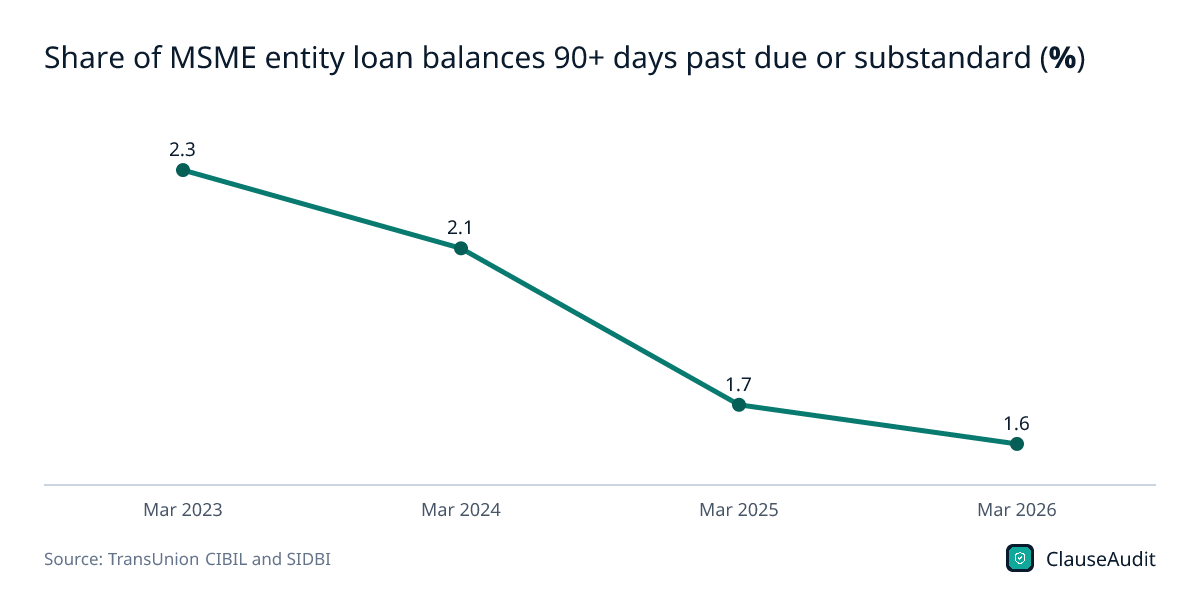
Download this chart (PNG)Share of MSME entity loan balances 90+ days past due or substandard (%)
Chart data
| Label | Value (%) |
|---|---|
| Mar 2023 | 2.3 |
| Mar 2024 | 2.1 |
| Mar 2025 | 1.7 |
| Mar 2026 | 1.6 |
Repayment behaviour has improved steadily since March 2023. The averages hide a weaker pocket: unsecured business loans to entities were 7.2% delinquent in March 2026.
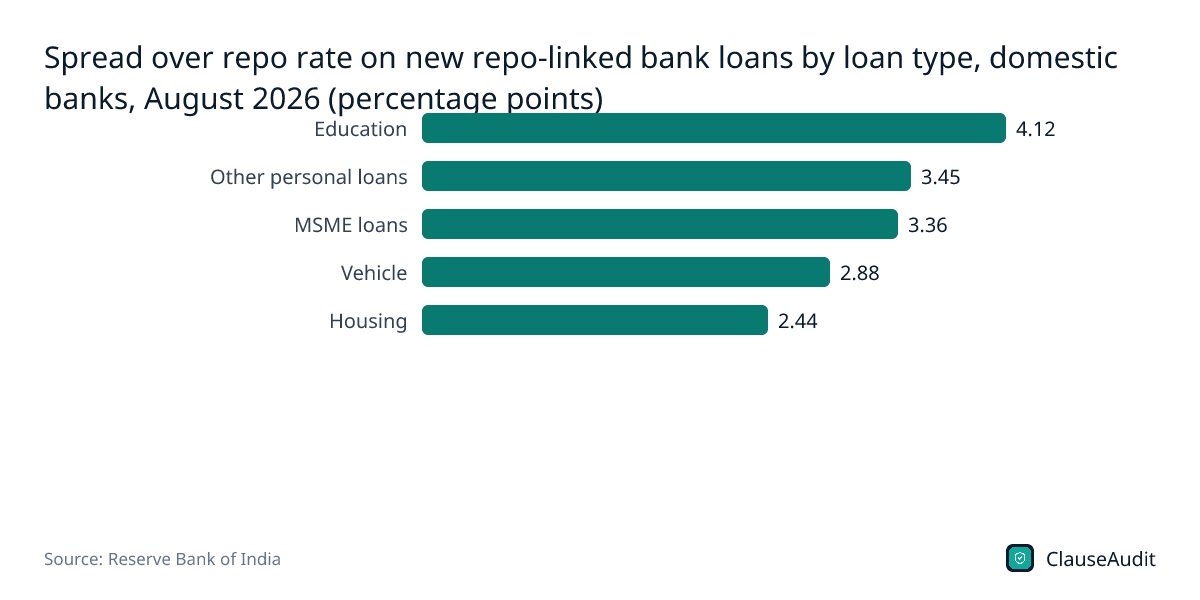
Download this chart (PNG)Spread over repo rate on new repo-linked bank loans by loan type, domestic banks, August 2026 (percentage points)
Chart data
| Label | Value |
|---|---|
| Education | 4.12 |
| Other personal loans | 3.45 |
| MSME loans | 3.36 |
| Vehicle | 2.88 |
| Housing | 2.44 |
Banks charge MSMEs a wider margin over repo than home or car buyers, but less than education borrowers. The spread is added on top of the repo rate, so the October 2026 hike flows through to floating-rate loans at their next reset.
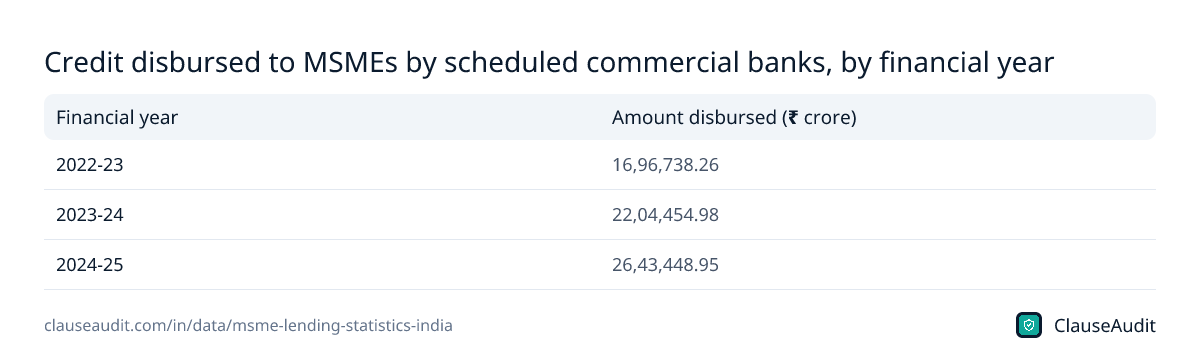
Download this chart (PNG)Credit disbursed to MSMEs by scheduled commercial banks, by financial year
| Financial year | Amount disbursed (₹ crore) |
|---|---|
| 2022-23 | 16,96,738.26 |
| 2023-24 | 22,04,454.98 |
| 2024-25 | 26,43,448.95 |
Source: Press Information Bureau, Ministry of Micro, Small & Medium Enterprises, Significant growth in credit disbursement to MSME sector by Scheduled Commercial Banks (Release ID 2240590). Download as image
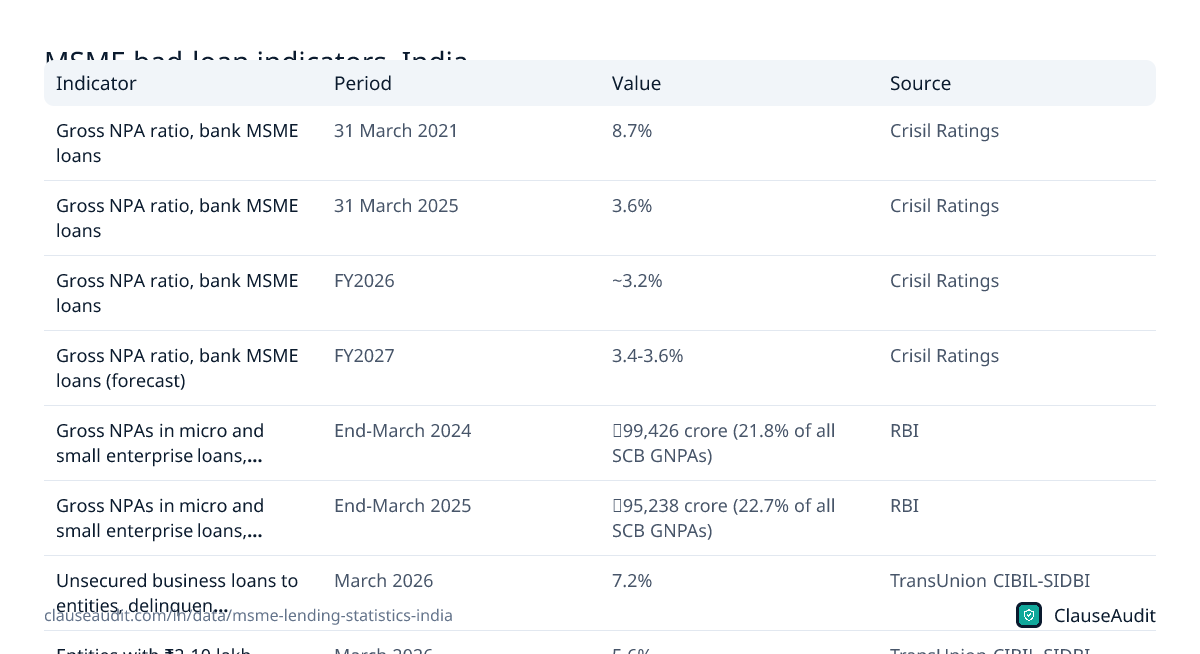
MSME bad-loan indicators, India
| Indicator | Period | Value | Source |
|---|---|---|---|
| Gross NPA ratio, bank MSME loans | 31 March 2021 | 8.7% | Crisil Ratings |
| Gross NPA ratio, bank MSME loans | 31 March 2025 | 3.6% | Crisil Ratings |
| Gross NPA ratio, bank MSME loans | FY2026 | ~3.2% | Crisil Ratings |
| Gross NPA ratio, bank MSME loans (forecast) | FY2027 | 3.4-3.6% | Crisil Ratings |
| Gross NPAs in micro and small enterprise loans, SCBs | End-March 2024 | ₹99,426 crore (21.8% of all SCB GNPAs) | RBI |
| Gross NPAs in micro and small enterprise loans, SCBs | End-March 2025 | ₹95,238 crore (22.7% of all SCB GNPAs) | RBI |
| Unsecured business loans to entities, delinquency | March 2026 | 7.2% | TransUnion CIBIL-SIDBI |
| Entities with ₹2-10 lakh exposure, delinquency | March 2026 | 5.6% | TransUnion CIBIL-SIDBI |
Source: Crisil Ratings, Bank gross NPA to remain controlled at 2.3-2.5% by fiscal end; Crisil Ratings, Banks to keep gross NPAs under control at 2.0-2.2% by March 2027; Reserve Bank of India, Report on Trend and Progress of Banking in India 2024-25, Chapter IV: Commercial Banks; TransUnion CIBIL and SIDBI, MSME Pulse Report, July 2026. Download as image
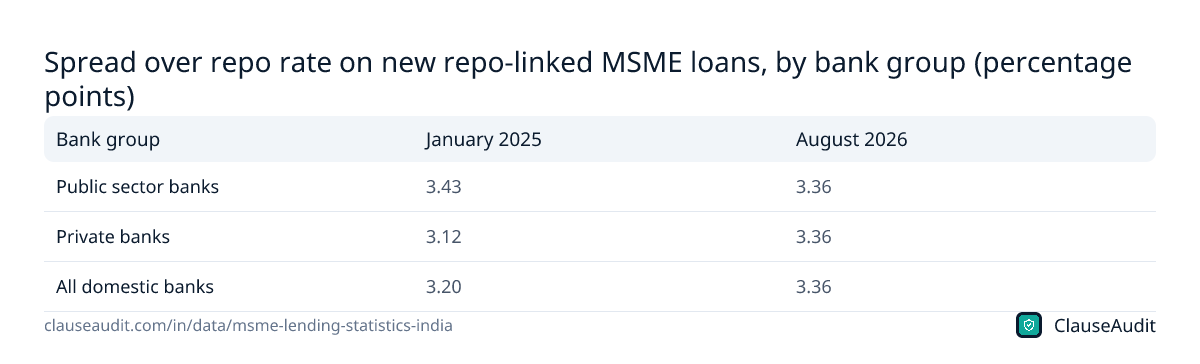
Spread over repo rate on new repo-linked MSME loans, by bank group (percentage points)
| Bank group | January 2025 | August 2026 |
|---|---|---|
| Public sector banks | 3.43 | 3.36 |
| Private banks | 3.12 | 3.36 |
| All domestic banks | 3.20 | 3.36 |
Source: Reserve Bank of India, Monetary Policy Report, October 2026. Download as image
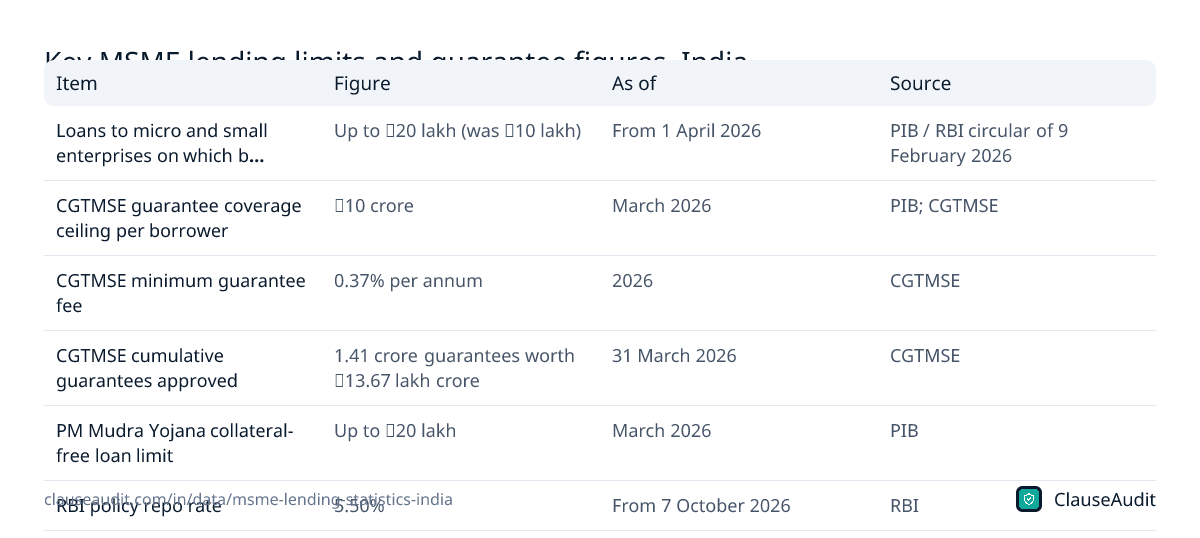
Key MSME lending limits and guarantee figures, India
| Item | Figure | As of | Source |
|---|---|---|---|
| Loans to micro and small enterprises on which banks may not take collateral | Up to ₹20 lakh (was ₹10 lakh) | From 1 April 2026 | PIB / RBI circular of 9 February 2026 |
| CGTMSE guarantee coverage ceiling per borrower | ₹10 crore | March 2026 | PIB; CGTMSE |
| CGTMSE minimum guarantee fee | 0.37% per annum | 2026 | CGTMSE |
| CGTMSE cumulative guarantees approved | 1.41 crore guarantees worth ₹13.67 lakh crore | 31 March 2026 | CGTMSE |
| PM Mudra Yojana collateral-free loan limit | Up to ₹20 lakh | March 2026 | PIB |
| RBI policy repo rate | 5.50% | From 7 October 2026 | RBI |
Source: Press Information Bureau, Ministry of Micro, Small & Medium Enterprises, Significant growth in credit disbursement to MSME sector by Scheduled Commercial Banks (Release ID 2240590); Credit Guarantee Fund Trust for Micro and Small Enterprises (CGTMSE), CGTMSE homepage: cumulative guarantee statistics and announcements; Reserve Bank of India, Monetary Policy Statement, 2026-27: Resolution of the Monetary Policy Committee (MPC), October 5 to 7, 2026; Bank for International Settlements (central bankers' speeches), Reserve Bank of India, Remarks at the inauguration of MSME Day 2026 (speech by Sanjay Malhotra, Governor, Reserve Bank of India, Kochi, 22 June 2026). Download as image
How big is the MSME credit gap in India?
The best current estimate is about ₹30 lakh crore. Crisil Intelligence, working for SIDBI, put addressable debt demand at around ₹64 lakh crore and formal supply from banks and NBFCs at around ₹34 lakh crore. The difference is the gap. Measured against total finance demand of about ₹123 lakh crore, that is roughly 24%.
The other way to see it is by headcount. India had 8.7 crore registered MSMEs as of December 2025, and only 3.6 crore had ever accessed formal credit by March 2026. That is 41%. The rest run on owner savings, family money, supplier credit, or informal lenders charging far more than a bank would.
The gap is not even. Women-owned MSMEs face a gap of about 35%, against about 20% for male-owned firms. Trading businesses and rural firms also sit near the top of the chart. If you fall into one of those groups, give yourself extra time to line up finance, and plan your cash needs as if the first lender may say no.
Why is bank credit to MSMEs growing so fast?
Two things are happening at once. Banks have been lending more to small firms for years: the RBI Governor noted that outstanding MSME credit grew at around 15% a year over the past five financial years. On top of that, the MSME definitions were revised on 1 April 2025, so firms that used to count as larger companies now sit inside the MSME category. Their existing loans moved with them.
That is why growth jumped from 11.8% in March 2025 to 29.3% in March 2026 before settling at 25.5% in August 2026. Some of the jump is a relabelling, not new money reaching first-time borrowers.
For you, the takeaway is simple. Fast headline growth does not mean the door is wide open for a micro firm with no credit history. The credit gap figures show the opposite. Build a record with a small facility first, repay it on time, and larger limits get easier.
What interest rate do banks charge MSMEs in 2026?
Most new floating-rate MSME loans are linked to the RBI repo rate. On loans of this kind issued in August 2026, domestic banks charged an average spread of 3.36 percentage points over repo. Public sector and private banks had converged on the same figure. In January 2025 private banks were cheaper than public sector banks, at 3.12 against 3.43.
The repo rate itself moved in October. The Monetary Policy Committee raised it from 5.25% to 5.50% from 7 October 2026 and shifted its stance to calibrated tightening. If your loan is linked to repo, your rate goes up by the same 0.25 points at the next reset, and a tightening stance leaves room for more rises.
Your own rate will differ from the average. Banks price for credit score, collateral, turnover and how long you have banked with them. The useful habit is to ask the lender to write down the benchmark, the spread, and the reset frequency separately, so you can check every future rate change yourself.
Are MSME loans going bad more often?
Not on the headline numbers. Crisil Ratings puts the gross NPA ratio on bank MSME loans at about 3.2% for FY2026, down from 8.7% in March 2021 and 3.6% in March 2025. TransUnion CIBIL data shows the share of entity loan balances 90 or more days past due or substandard falling from 2.3% in March 2023 to 1.6% in March 2026.
The trend may be turning, though. Crisil forecasts a modest rise to 3.4-3.6% in FY2027, and smaller, unsecured borrowers already look stressed. Entities with ₹2-10 lakh of exposure were 5.6% delinquent in March 2026. Unsecured business loans to entities were at 7.2%.
Why does this matter to a borrower in good standing? Because lenders react to the stress in your segment, not just your own record. When delinquency rises among small, unsecured accounts, banks tighten approvals, ask for guarantees, and add covenants. Getting a facility in place while your numbers look good is usually cheaper than asking for one in a hurry.
Can you get an MSME loan without collateral?
More often than before. From 1 April 2026, banks may not take collateral on loans up to ₹20 lakh to micro and small enterprises, double the earlier ₹10 lakh limit. PM Mudra Yojana loans are also collateral-free up to ₹20 lakh.
Above that, the CGTMSE scheme lets banks lend without collateral by buying a guarantee, with cover of up to ₹10 crore per borrower. By 31 March 2026 it had approved 1.41 crore guarantees worth ₹13.67 lakh crore. The fee starts at 0.37% per annum and is often passed on to you, so ask whether it is included in the quoted rate.
Collateral-free does not always mean guarantee-free. Some lenders still ask a director or partner to sign a personal guarantee, which puts your home and savings on the line even though the business pledged nothing. Read that document as carefully as the loan agreement itself.
What a freelancer or small business owner should do with these numbers
- Register on Udyam if you have not. Priority-sector rules, collateral limits and guarantee schemes all key off MSME status, and lenders check it.
- Check your CIBIL commercial report, not only your personal score. Fix errors before you apply, because entities with ₹2-10 lakh of exposure were 5.6% delinquent in March 2026, and lenders watch that band closely.
- Ask for the rate in three parts: benchmark, spread and reset date. Compare the spread with the 3.36 percentage point average for August 2026.
- Price in the October rise. With repo at 5.50%, model your EMI after one more increase and see whether your cash flow still holds.
- Chase your receivables. Late customer payments are the most common reason a sound small business misses an EMI, so use the MSMED Act payment rules where they apply to you.
- Read every guarantee, prepayment and default clause before you sign, not after the first missed payment.
How ClauseAudit helps
The interest rate gets the attention, but the loan agreement decides what happens when rates rise, when a payment slips, or when you want to repay early. Those clauses are where small borrowers lose the most money.
Upload your term loan, working capital or NBFC agreement and the automated review flags the terms that usually hurt Indian MSMEs, explains each in plain English, and suggests wording you can raise with the lender.
- Rate and reset: is the rate tied to repo or another benchmark, what is the spread, and can the lender change the spread on its own?
- Penal charges and late fees: how much is charged on an overdue EMI, and from which day?
- Personal guarantee: does a director or partner guarantee the loan, and is the guarantee limited or unlimited?
- Prepayment and foreclosure: is there a charge to repay early on a floating-rate loan?
- Events of default and cross-default: can one late payment or a missed covenant make the whole loan due at once?
- Fees: are processing, documentation and any CGTMSE guarantee fee listed in full?
Frequently asked questions
What is the MSME credit gap in India?
A SIDBI study published in May 2025 estimates the addressable credit gap at about ₹30 lakh crore, or roughly 24% of total finance demand. It is the difference between what MSMEs could viably borrow, around ₹64 lakh crore, and what banks and NBFCs actually supply, around ₹34 lakh crore. It is the latest published estimate as of October 2026.
How many MSMEs in India have access to formal credit?
Only 3.6 crore MSMEs had ever accessed formal credit as of March 2026, out of 8.7 crore registered as of December 2025. That is about 41%. The figures come from the TransUnion CIBIL and SIDBI MSME Pulse report for July 2026. The rest mostly rely on their own funds, family, supplier credit or informal lenders.
Why is the credit gap higher for women-owned MSMEs?
SIDBI puts the gap for women-owned MSMEs at about 35%, against about 20% for male-owned ones. Common reasons include fewer assets held in women's names to offer as collateral, shorter formal credit histories, and the fact that most women-run firms are micro businesses, which lenders serve less well.
What is the interest rate on MSME loans in 2026?
It depends on your profile, but on new repo-linked MSME loans in August 2026 domestic banks charged an average of 3.36 percentage points over the repo rate. The repo rate was raised to 5.50% from 7 October 2026, so floating-rate loans linked to it will reset higher at their next reset date.
What is the NPA ratio for MSME loans?
Crisil Ratings estimates the gross NPA ratio on bank MSME loans at about 3.2% for FY2026, down from 8.7% in March 2021. It expects a modest rise to 3.4-3.6% in FY2027. Stress is higher among small unsecured borrowers: unsecured business loans to entities were 7.2% delinquent in March 2026.
How fast is bank credit to MSMEs growing?
Bank credit to MSMEs grew 25.5% year on year in August 2026, according to provisional RBI data. Growth peaked at 29.3% in March 2026. Part of that rise reflects firms moving into the MSME category after the definitions were revised on 1 April 2025, so not all of it is new lending.
What is the collateral-free loan limit for MSMEs?
From 1 April 2026, banks may not take collateral on loans up to ₹20 lakh to micro and small enterprises, up from ₹10 lakh. PM Mudra Yojana loans are also collateral-free up to ₹20 lakh. Larger loans can be covered by a CGTMSE guarantee of up to ₹10 crore per borrower.
Who pays the CGTMSE guarantee fee?
The fee is charged to the lending institution, starting at 0.37% per annum, but banks often pass it on to the borrower as a separate charge or inside the rate. Ask the lender to show it as its own line in the sanction letter so you can compare offers on the full cost.
Use this data
Every chart and card below is free to reuse under CC BY 4.0. Download what you need and link back to this page.
 Stat cards
 Key findings card
 Infographic
 MSME addressable credit gap by segment, India (SIDBI estimate, 2025) (%)
 Scheduled commercial bank credit outstanding to MSMEs, end-March (₹ crore)
 Year-on-year growth in bank credit to MSMEs, March 2025 to August 2026 (%)
 Outstanding commercial credit to MSME entities and individual business borrowers, India (₹ lakh crore)
 Share of MSME entity loan balances 90+ days past due or substandard (%)
 Spread over repo rate on new repo-linked bank loans by loan type, domestic banks, August 2026 (percentage points)
 Credit disbursed to MSMEs by scheduled commercial banks, by financial year
 MSME bad-loan indicators, India
 Spread over repo rate on new repo-linked MSME loans, by bank group (percentage points)
 Key MSME lending limits and guarantee figures, India
Embed the infographic
Free to share on your site, blog or slides under CC BY 4.0. Please keep the credit link.
Sources and method
Every number on this page comes from the sources below, each opened and read on or before October 18, 2026. A second, independent review checked every figure against its source and corrected anything that did not match. Figures that could not be confirmed were left out.
- Small Industries Development Bank of India (SIDBI), with Crisil Intelligence, Understanding Indian MSME Sector: Progress and Challenges (May 2025 (released 13 May 2025))
- Bank for International Settlements (central bankers' speeches), Reserve Bank of India, Remarks at the inauguration of MSME Day 2026 (speech by Sanjay Malhotra, Governor, Reserve Bank of India, Kochi, 22 June 2026) (Delivered 22 June 2026; posted 30 June 2026)
- TransUnion CIBIL and SIDBI, MSME Pulse Report, July 2026 (July 2026 (data to March 2026))
- Reserve Bank of India, Monetary Policy Report, October 2026 (7 October 2026)
- Reserve Bank of India, Monetary Policy Statement, 2026-27: Resolution of the Monetary Policy Committee (MPC), October 5 to 7, 2026 (7 October 2026)
- Reserve Bank of India, Report on Trend and Progress of Banking in India 2024-25, Chapter IV: Commercial Banks (29 December 2025)
- Crisil Ratings, Banks to keep gross NPAs under control at 2.0-2.2% by March 2027 (17 April 2026)
- Crisil Ratings, Bank gross NPA to remain controlled at 2.3-2.5% by fiscal end (6 October 2025)
- Press Information Bureau, Ministry of Micro, Small & Medium Enterprises, Significant growth in credit disbursement to MSME sector by Scheduled Commercial Banks (Release ID 2240590) (16 March 2026)
- Credit Guarantee Fund Trust for Micro and Small Enterprises (CGTMSE), CGTMSE homepage: cumulative guarantee statistics and announcements (Data as on 31 March 2026; accessed 19 October 2026)
Cite this page
ClauseAudit, “MSME Lending Statistics India 2026: Credit Gap, Interest Rates and NPAs”, updated October 18, 2026, https://clauseaudit.com/in/data/msme-lending-statistics-india. Free to reuse with a link back (CC BY 4.0).
This page summarises published data and law as checked on October 18, 2026. Figures are updated as new editions are released, and your own situation may differ. It is general information, not legal, tax or financial advice.