MSME Delayed Payment Statistics India 2026: Samadhaan and ODR Portal Data
By ClauseAudit Research · 6 sources ·
How big is the MSME delayed payment problem in India?
Delayed payment is still a large, slow problem for India's small businesses. As of 18 October 2026, micro and small enterprises had filed 2,56,892 applications on MSME Samadhaan claiming Rs 55,244.26 crore, and Rs 20,458.59 crore was still pending. New complaints now go through the MSME ODR Portal.
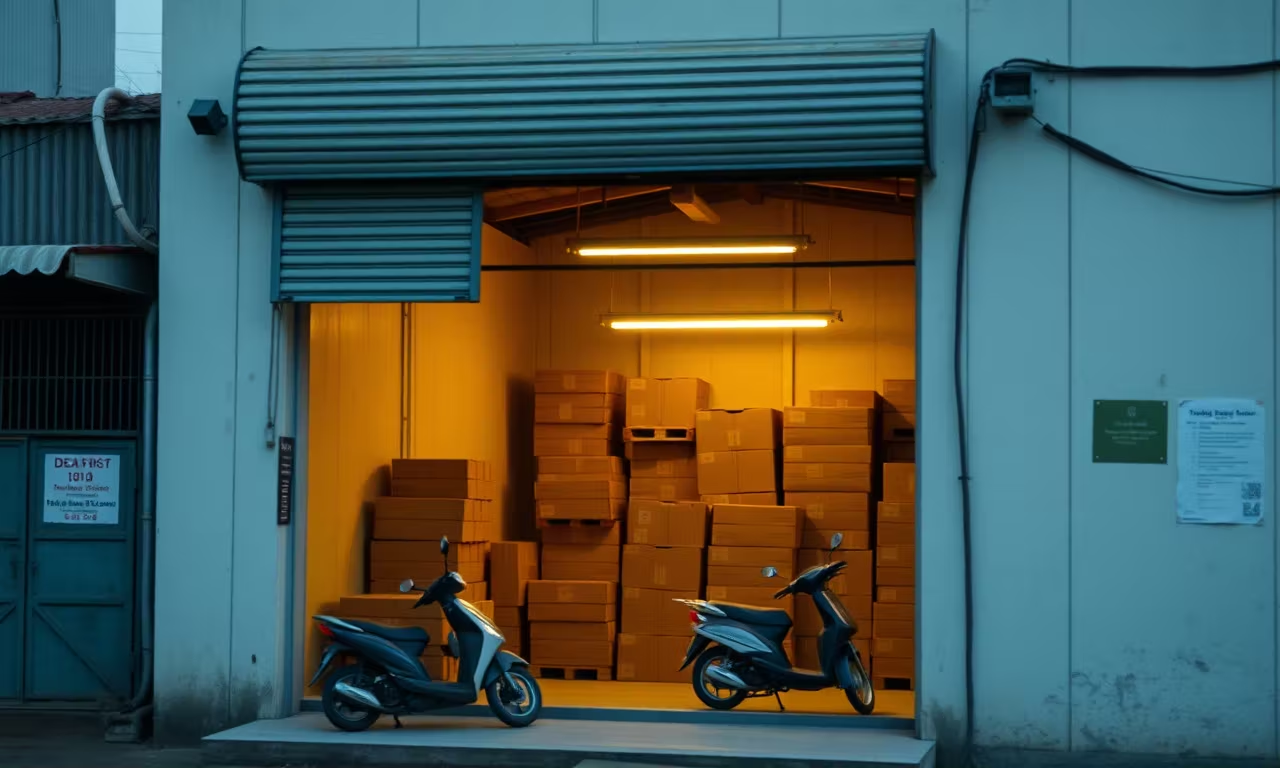
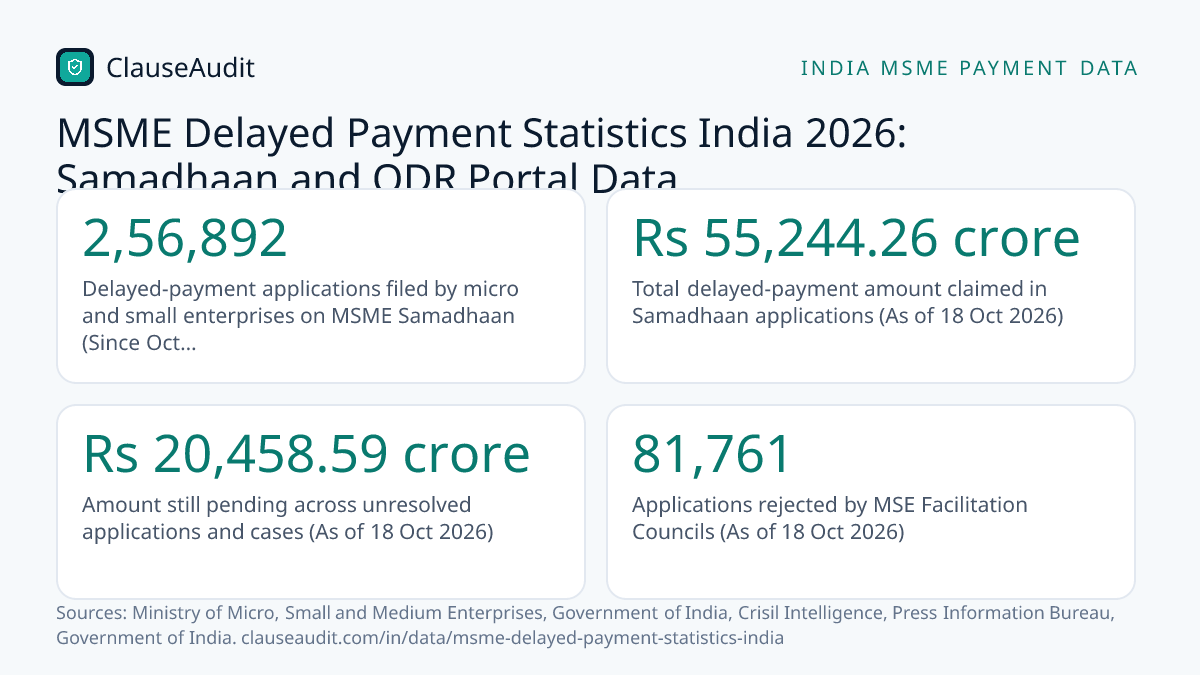
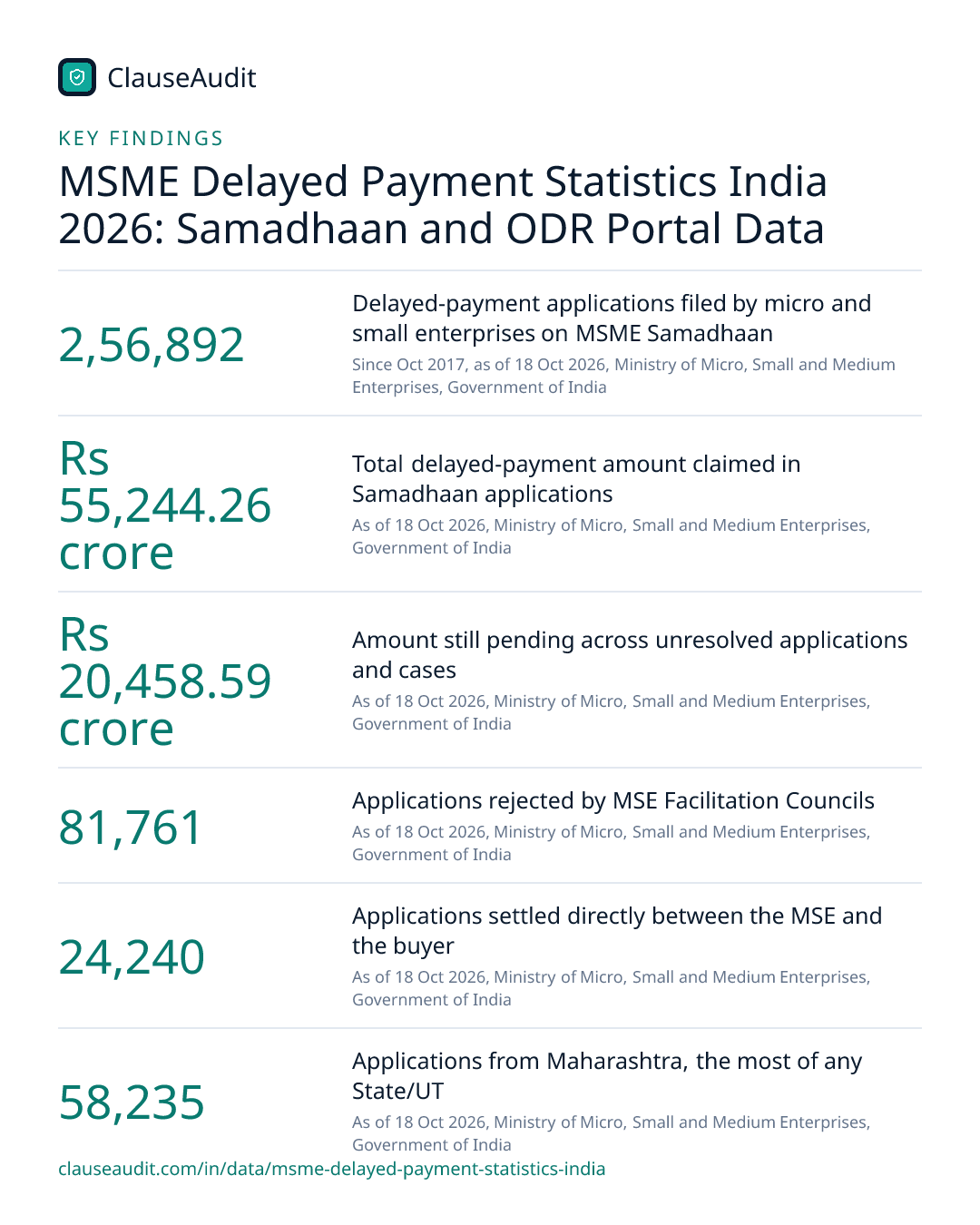
- Delayed-payment applications filed by micro and small enterprises on MSME Samadhaan (Since Oct 2017, as of 18 Oct 2026, Ministry of Micro, Small and Medium Enterprises, Government of India)
- 2,56,892
- Total delayed-payment amount claimed in Samadhaan applications (As of 18 Oct 2026, Ministry of Micro, Small and Medium Enterprises, Government of India)
- Rs 55,244.26 crore
- Amount still pending across unresolved applications and cases (As of 18 Oct 2026, Ministry of Micro, Small and Medium Enterprises, Government of India)
- Rs 20,458.59 crore
- Applications rejected by MSE Facilitation Councils (As of 18 Oct 2026, Ministry of Micro, Small and Medium Enterprises, Government of India)
- 81,761
- Applications settled directly between the MSE and the buyer (As of 18 Oct 2026, Ministry of Micro, Small and Medium Enterprises, Government of India)
- 24,240
- Applications from Maharashtra, the most of any State/UT (As of 18 Oct 2026, Ministry of Micro, Small and Medium Enterprises, Government of India)
- 58,235
- Share of Samadhaan applications unresolved for over a year (about 40,580) (As of 14 Aug 2026, Crisil Intelligence)
- 16%
- MSE Facilitation Councils set up across States and UTs (August 2026, Press Information Bureau, Government of India)
- 161
If you run a micro or small business in India, or invoice as a Udyam-registered freelancer, you probably know the feeling. The work is delivered, the invoice is sent, and then nothing. MSME Samadhaan is the government's record of what happens when sellers stop waiting and file a formal claim.
This page pulls together the portal's live figures as of 18 October 2026: how many claims were filed, how much money is involved, which states and buyers show up most, and how claims end. Below the numbers you'll find what they mean for your own invoices and what to put in your contract before the next job starts.
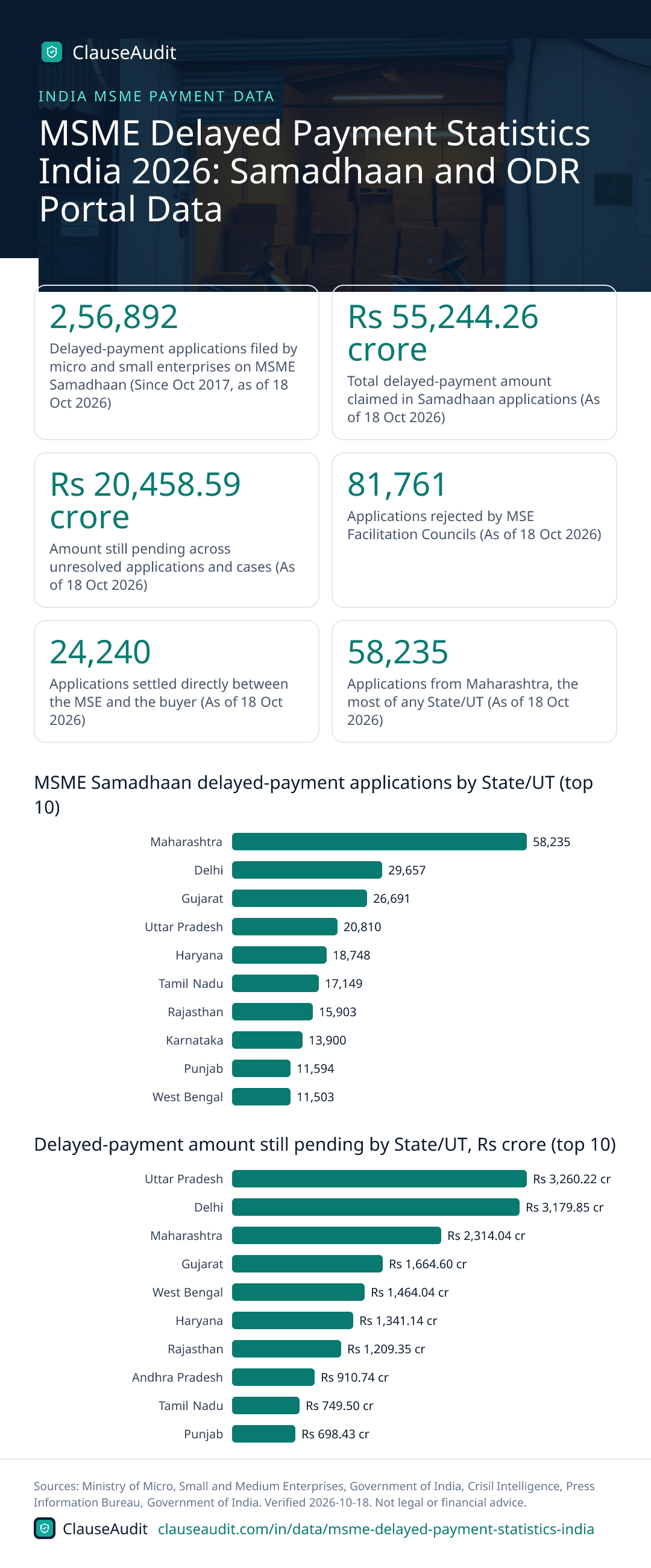
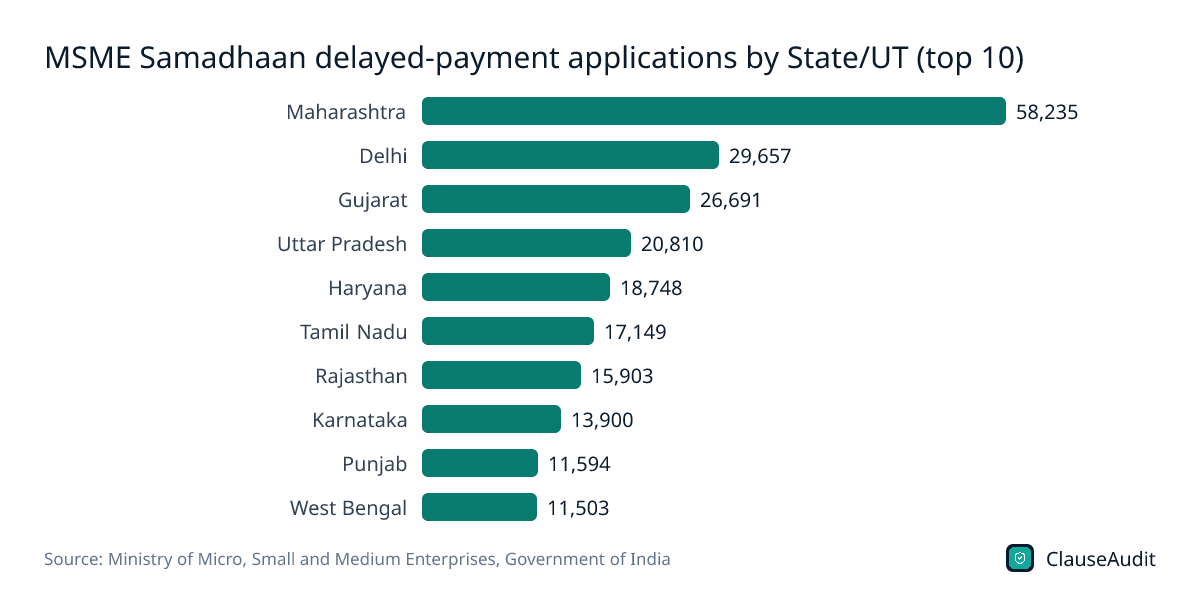
MSME Samadhaan delayed-payment applications by State/UT (top 10)
Chart data
| Label | Value |
|---|---|
| Maharashtra | 58,235 |
| Delhi | 29,657 |
| Gujarat | 26,691 |
| Uttar Pradesh | 20,810 |
| Haryana | 18,748 |
| Tamil Nadu | 17,149 |
| Rajasthan | 15,903 |
| Karnataka | 13,900 |
| Punjab | 11,594 |
| West Bengal | 11,503 |
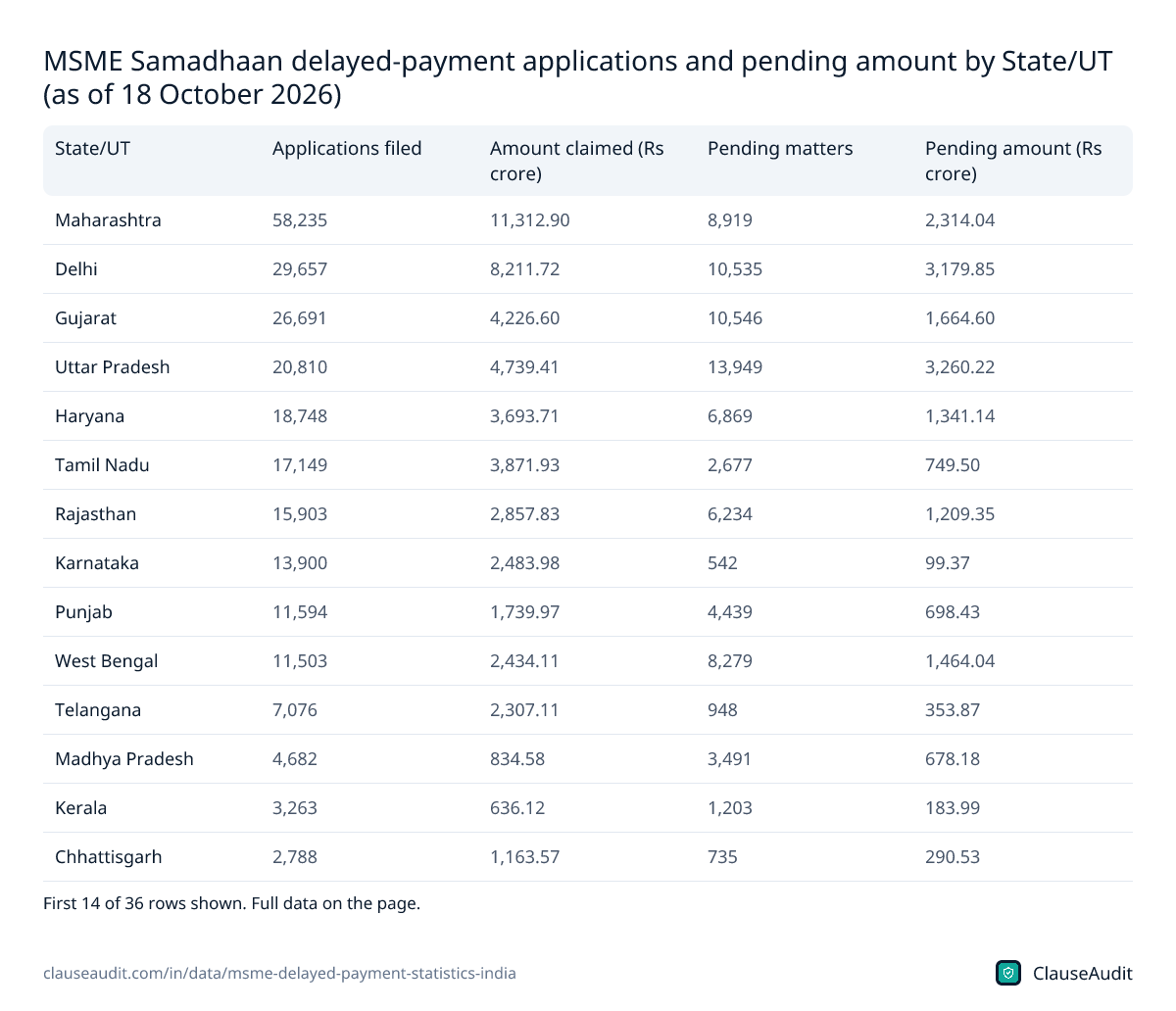
Maharashtra leads with 58,235 applications, far ahead of Delhi at 29,657. High counts probably reflect industrial activity and awareness of the portal as well as bad payers, so read this as a map of where sellers push back as well as where buyers pay late.
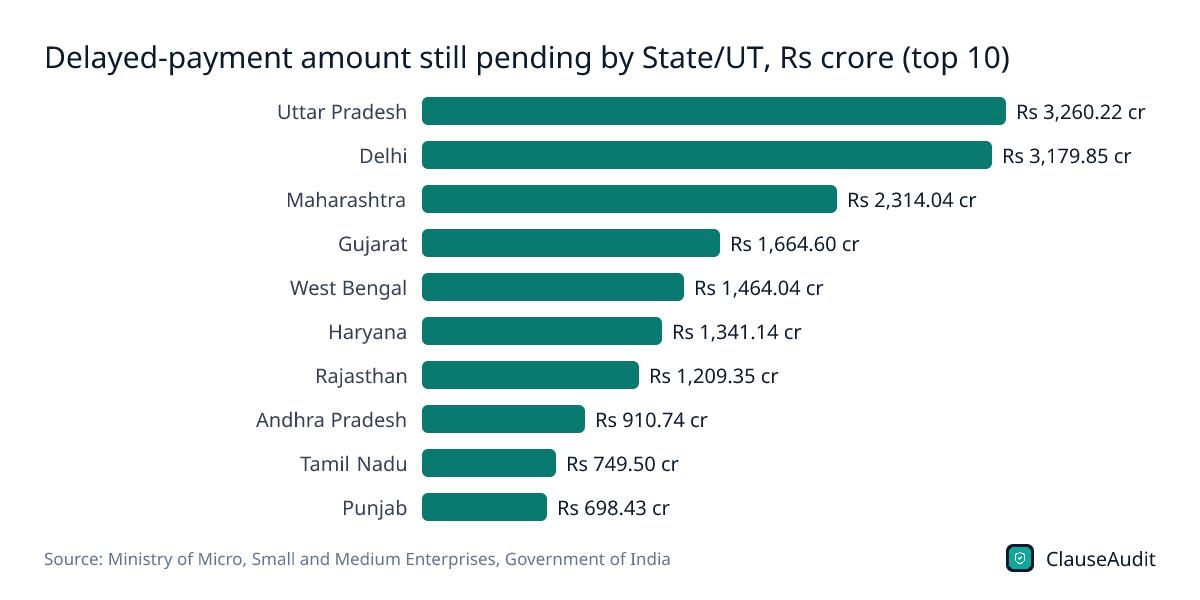
Download this chart (PNG)Delayed-payment amount still pending by State/UT, Rs crore (top 10)
Chart data
| Label | Value |
|---|---|
| Uttar Pradesh | Rs 3,260.22 cr |
| Delhi | Rs 3,179.85 cr |
| Maharashtra | Rs 2,314.04 cr |
| Gujarat | Rs 1,664.60 cr |
| West Bengal | Rs 1,464.04 cr |
| Haryana | Rs 1,341.14 cr |
| Rajasthan | Rs 1,209.35 cr |
| Andhra Pradesh | Rs 910.74 cr |
| Tamil Nadu | Rs 749.50 cr |
| Punjab | Rs 698.43 cr |
The pending ranking looks different from the filing ranking. Uttar Pradesh has Rs 3,260.22 crore stuck, the most of any State/UT, while Karnataka filed 13,900 applications but has only Rs 99.37 crore still pending.
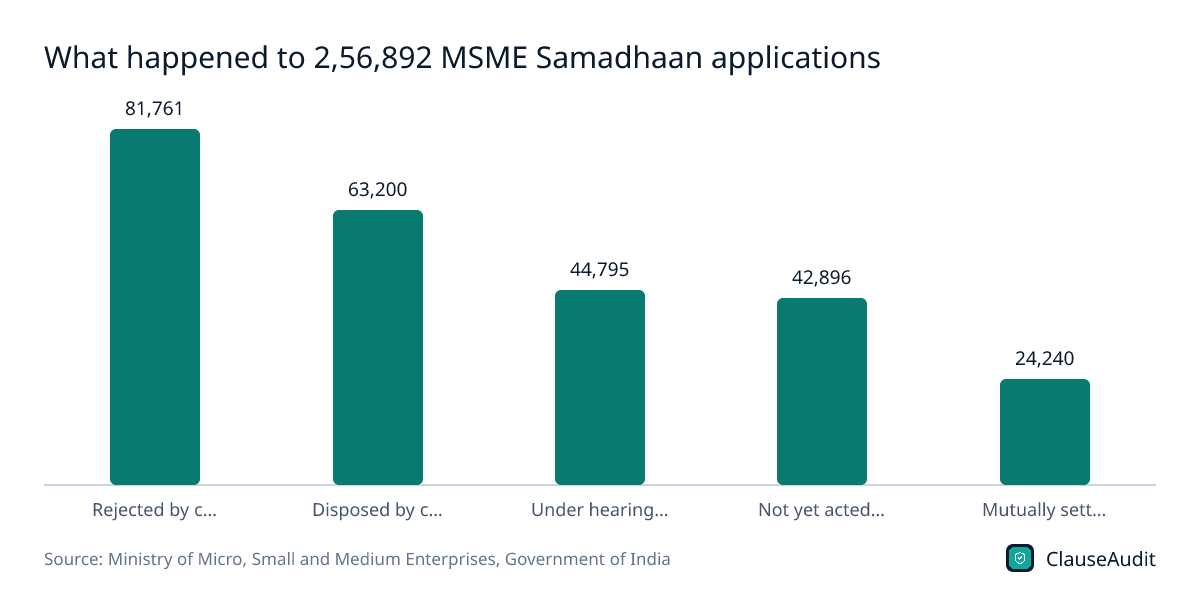
Download this chart (PNG)What happened to 2,56,892 MSME Samadhaan applications
Chart data
| Label | Value |
|---|---|
| Rejected by council | 81,761 |
| Disposed by council | 63,200 |
| Under hearing as cases | 44,795 |
| Not yet acted on by council | 42,896 |
| Mutually settled | 24,240 |
Rejections are the single largest outcome at 81,761 applications, ahead of the 63,200 disposed by councils. The dashboard doesn't say why, but eligibility and paperwork are things you can sort out before you file.
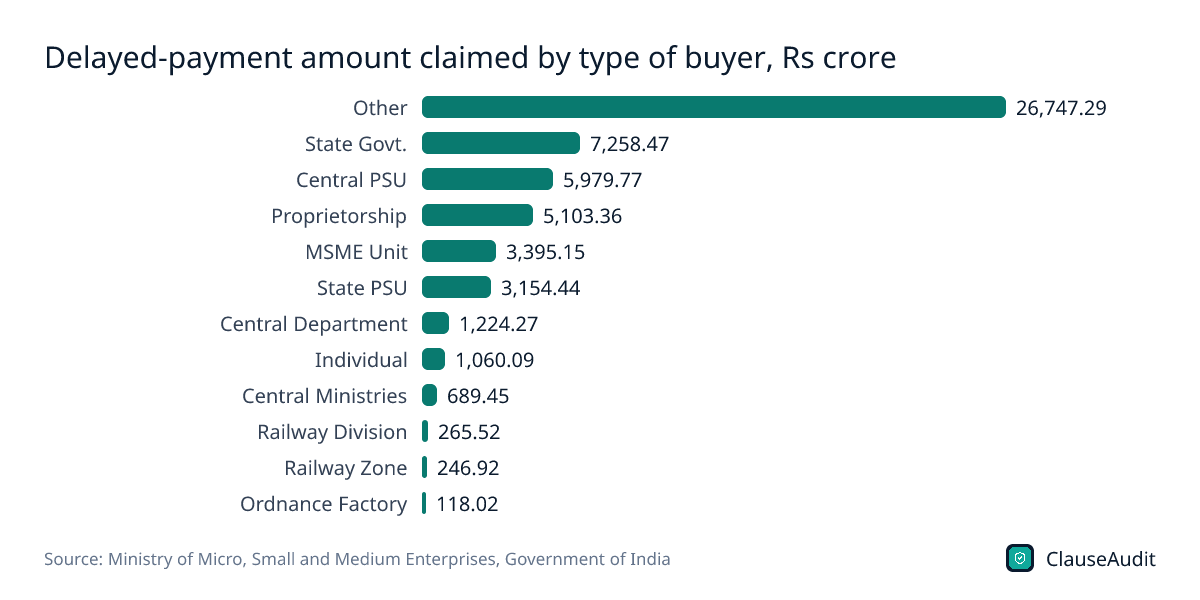
Download this chart (PNG)Delayed-payment amount claimed by type of buyer, Rs crore
Chart data
| Label | Value |
|---|---|
| Other | 26747.29 |
| State Govt. | 7258.47 |
| Central PSU | 5979.77 |
| Proprietorship | 5103.36 |
| MSME Unit | 3395.15 |
| State PSU | 3154.44 |
| Central Department | 1224.27 |
| Individual | 1060.09 |
| Central Ministries | 689.45 |
| Railway Division | 265.52 |
| Railway Zone | 246.92 |
| Ordnance Factory | 118.02 |
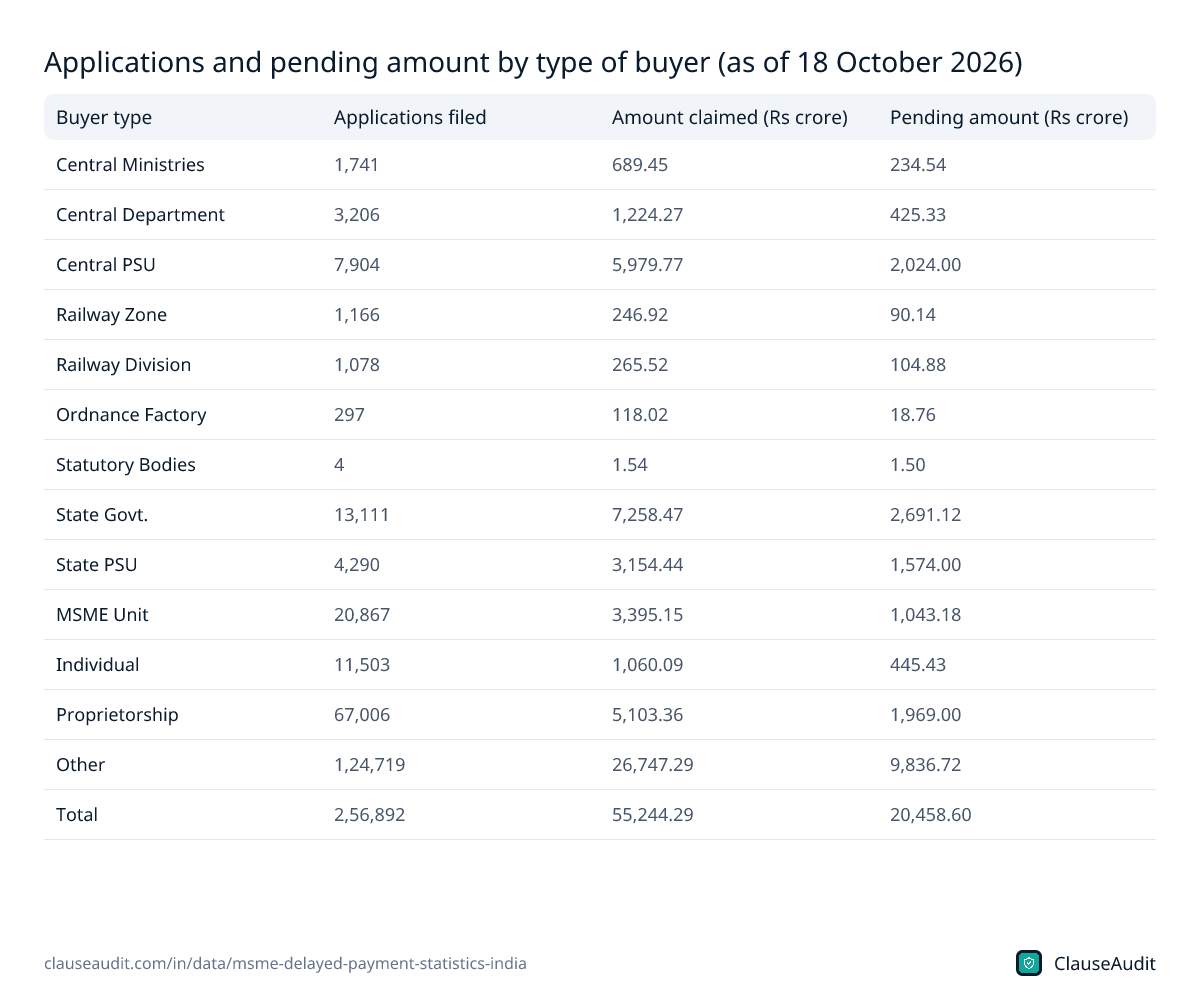
Government buyers are not a small part of this. State governments account for Rs 7,258.47 crore of claims and Central PSUs for Rs 5,979.77 crore, so a public-sector purchase order does not guarantee prompt payment.
Download this chart (PNG)MSME Samadhaan delayed-payment applications and pending amount by State/UT (as of 18 October 2026)
| State/UT | Applications filed | Amount claimed (Rs crore) | Pending matters | Pending amount (Rs crore) |
|---|---|---|---|---|
| Maharashtra | 58,235 | 11,312.90 | 8,919 | 2,314.04 |
| Delhi | 29,657 | 8,211.72 | 10,535 | 3,179.85 |
| Gujarat | 26,691 | 4,226.60 | 10,546 | 1,664.60 |
| Uttar Pradesh | 20,810 | 4,739.41 | 13,949 | 3,260.22 |
| Haryana | 18,748 | 3,693.71 | 6,869 | 1,341.14 |
| Tamil Nadu | 17,149 | 3,871.93 | 2,677 | 749.50 |
| Rajasthan | 15,903 | 2,857.83 | 6,234 | 1,209.35 |
| Karnataka | 13,900 | 2,483.98 | 542 | 99.37 |
| Punjab | 11,594 | 1,739.97 | 4,439 | 698.43 |
| West Bengal | 11,503 | 2,434.11 | 8,279 | 1,464.04 |
| Telangana | 7,076 | 2,307.11 | 948 | 353.87 |
| Madhya Pradesh | 4,682 | 834.58 | 3,491 | 678.18 |
| Kerala | 3,263 | 636.12 | 1,203 | 183.99 |
| Chhattisgarh | 2,788 | 1,163.57 | 735 | 290.53 |
| Uttarakhand | 2,500 | 568.07 | 1,420 | 310.35 |
| Andhra Pradesh | 1,671 | 1,091.71 | 1,304 | 910.74 |
| Odisha | 1,605 | 444.30 | 1,251 | 395.34 |
| Jharkhand | 1,558 | 698.38 | 1,055 | 489.54 |
| Himachal Pradesh | 1,331 | 213.84 | 1,224 | 181.03 |
| Chandigarh | 1,276 | 205.88 | 244 | 54.96 |
| Assam | 1,092 | 230.28 | 259 | 65.46 |
| Dadra & Nagar Haveli and Daman & Diu | 994 | 302.20 | 545 | 49.89 |
| Goa | 850 | 198.92 | 148 | 76.41 |
| Bihar | 838 | 186.11 | 298 | 116.25 |
| Jammu and Kashmir | 693 | 299.10 | 345 | 168.02 |
| Puducherry | 268 | 66.41 | 187 | 46.29 |
| Meghalaya | 83 | 23.35 | 0 | 0.00 |
| Andaman and Nicobar Islands | 64 | 6.61 | 5 | 0.12 |
| Manipur | 23 | 94.55 | 22 | 94.54 |
| Tripura | 17 | 2.10 | 1 | 0.01 |
| Nagaland | 16 | 88.26 | 5 | 2.37 |
| Sikkim | 8 | 8.06 | 8 | 8.06 |
| Arunachal Pradesh | 3 | 2.59 | 2 | 2.10 |
| Mizoram | 3 | 0.00 | 2 | 0.00 |
| Lakshadweep | 0 | 0.00 | 0 | 0.00 |
| Ladakh | 0 | 0.00 | 0 | 0.00 |
Source: Ministry of Micro, Small and Medium Enterprises, Government of India, MSME Samadhaan: State Pending Report. Download as image
Applications and pending amount by type of buyer (as of 18 October 2026)
| Buyer type | Applications filed | Amount claimed (Rs crore) | Pending amount (Rs crore) |
|---|---|---|---|
| Central Ministries | 1,741 | 689.45 | 234.54 |
| Central Department | 3,206 | 1,224.27 | 425.33 |
| Central PSU | 7,904 | 5,979.77 | 2,024.00 |
| Railway Zone | 1,166 | 246.92 | 90.14 |
| Railway Division | 1,078 | 265.52 | 104.88 |
| Ordnance Factory | 297 | 118.02 | 18.76 |
| Statutory Bodies | 4 | 1.54 | 1.50 |
| State Govt. | 13,111 | 7,258.47 | 2,691.12 |
| State PSU | 4,290 | 3,154.44 | 1,574.00 |
| MSME Unit | 20,867 | 3,395.15 | 1,043.18 |
| Individual | 11,503 | 1,060.09 | 445.43 |
| Proprietorship | 67,006 | 5,103.36 | 1,969.00 |
| Other | 1,24,719 | 26,747.29 | 9,836.72 |
| Total | 2,56,892 | 55,244.29 | 20,458.60 |
Source: Ministry of Micro, Small and Medium Enterprises, Government of India, MSME Samadhaan: Respondent Category Report (All Category Amount Report); Ministry of Micro, Small and Medium Enterprises, Government of India, MSME Samadhaan: Pending Amount Report. Download as image
What do these numbers mean for a freelancer or small business?
Picture a two-person design studio in Pune that invoices a mid-sized manufacturer. The client is friendly, the work is approved over WhatsApp, and the invoice says 'payable on receipt'. Months later it's still unpaid, and the studio has no signed document saying when payment was due or that the work was accepted.
That studio is exactly who the portal is meant to help, and exactly who struggles to use it. The law gives you a deadline and interest, but a council still has to see the paper trail. The 81,761 rejections are a reminder that a claim is only as strong as the records behind it.
The backlog also changes how you should price work. If 42,896 applications are still waiting for a council to act, recovery through the system can take a long time. So treat the formal route as a backstop, not a cash-flow plan. Ask for an advance, break big jobs into milestones, and stop work when a milestone payment slips instead of carrying a growing unpaid balance.
For employees of small firms, this matters too. When a business is owed money by its biggest customer, salaries and vendor payments are usually the first thing to slip. Late payment travels down the chain.
How big is the MSME delayed payment problem in India?
Big enough that the government built a dedicated tracking portal for it. Since MSME Samadhaan opened in October 2017, micro and small enterprises have filed 2,56,892 delayed-payment applications claiming Rs 55,244.26 crore. As of 18 October 2026, Rs 20,458.59 crore of that is still pending across 87,691 matters.
Those pending matters split two ways. 42,896 applications have not yet been acted on by a council at all, and 44,795 are cases under hearing. Crisil's analysis of the same data found around 40,580 applications, or 16%, had stayed unresolved for over a year as of 14 August 2026.
Keep in mind what these numbers leave out. They only count sellers who filed. Plenty of small firms never complain because they fear losing the customer, or because they don't qualify. The real backlog of late invoices in the economy is larger than any portal can show.
Which states and buyers have the most delayed payment cases?
Maharashtra tops the filing list with 58,235 applications, followed by Delhi at 29,657 and Gujarat at 26,691. These are states with dense manufacturing and services clusters, so more transactions naturally produce more disputes.
Pending money tells a sharper story. Uttar Pradesh has 13,949 pending matters worth Rs 3,260.22 crore, and Delhi has Rs 3,179.85 crore pending. Compare Karnataka, where only 542 matters and Rs 99.37 crore remain open. If your buyer is based in a state with a long queue, plan for a slower route to recovery.
On the buyer side, the portal's catch-all 'Other' category carries Rs 26,747.29 crore of claims, and proprietorships account for 67,006 applications. But public bodies are well represented too. State governments face 13,111 applications and Central PSUs face 7,904. Selling to a ministry, department or PSU does not take payment risk off the table. It just changes who you chase.
How do MSME Samadhaan applications end?
Not always with a cheque. Of the 2,56,892 applications on the dashboard, 81,761 were rejected by MSE Facilitation Councils, 63,200 were disposed by councils, and 24,240 were settled directly between the seller and the buyer.
Mutual settlement is worth a closer look. Of those settled applications, 22,651 sellers reported the amount they got: Rs 2,382.49 crore against an original claim of Rs 2,756.08 crore. In plain terms, settling usually means accepting less than you asked for, in exchange for getting paid sooner.
The high rejection count is the part you can most control. The portal doesn't publish reasons, but some are well known. The Supreme Court has held that the Act's benefits don't cover supplies made under a contract signed before the seller registered, and a claim with no written proof of payment terms or delivery is weak from the start. A clear contract and clean records give the council much more to work with.
What should you do if a buyer pays late?
- Check your Udyam registration first. The MSMED Act protections apply to micro and small enterprises, and councils check that you were registered when you supplied the goods or services.
- Send a written reminder that cites the invoice, the agreed payment date and the MSMED Act. Some buyers pay once they see you know the rules, especially companies that must disclose unpaid MSME dues in their audited accounts.
- Gather proof: the signed contract or purchase order, invoices, delivery challans or acceptance emails, and any messages where the buyer admits the amount is due.
- File on the MSME ODR Portal (odr.msme.gov.in). The Samadhaan dashboard says all new delayed-payment applications now go there, and the matter is routed to the facilitation council for your state.
- Expect a settlement attempt before arbitration. The council tries conciliation first (the 2026 amendment bill would replace this with time-bound mediation), so decide in advance what settlement figure you would accept.
- Keep working the relationship in parallel. A filing does not stop you from negotiating, and 24,240 applications ended in mutual settlement.
Will the 2026 MSMED amendment change anything?
Possibly. The government's August 2026 backgrounder on the MSMED (Amendment) Bill, 2026 describes reforms aimed at faster resolution, including mediation and arbitration deadlines, and notes that 161 MSE Facilitation Councils have been set up across States and UTs. Crisil compared the bill's potential to what the insolvency code did for credit discipline, if it is executed well.
The catch is in that word 'executed'. More councils and a digital filing route help, but a law can only enforce what you can prove. Your strongest protection is still a contract that states the payment deadline, the interest on late payment and what counts as acceptance, signed before the work starts.
Until the reforms show up in the dashboard numbers, plan as if nothing has changed. Check the portal again in a few months. If the count of applications waiting for council action starts to fall, that's the first real sign the new rules are working. If it keeps climbing, your contract terms and your own follow-up will keep doing most of the work.
How ClauseAudit helps
Most delayed-payment fights are lost or won at the contract stage. If your agreement leaves the payment date vague, ties payment to an undefined approval, or quietly waives interest, the facilitation council has less to work with and the buyer has more room to stall.
Upload your client agreement or purchase order terms to the ClauseAudit freelance analyzer for India. The automated review flags the payment clauses below and explains each one in plain English, with wording you can ask the buyer to change.
- Payment terms that run longer than the MSMED Act allows, or that never state a due date at all
- Payment triggered by 'final approval' or 'client satisfaction' with no deadline for that approval
- Clauses that waive or cap interest on late payment, which the MSMED Act gives you regardless
- Acceptance and deemed-acceptance rules, since the MSMED Act's payment deadline runs from the day of acceptance
- Dispute resolution and arbitration clauses that try to send you to a distant city instead of your state's council
- Set-off and withholding rights that let the buyer deduct disputed amounts from unrelated invoices
Frequently asked questions
What is MSME Samadhaan?
MSME Samadhaan is the Ministry of MSME's delayed-payment monitoring portal. It records claims by micro and small enterprises against buyers who pay late and tracks them through the state facilitation councils. Since it launched in October 2017, sellers have filed 2,56,892 applications through it. New applications are now filed on the MSME ODR Portal instead.
How much MSME money is stuck in delayed payments?
As of 18 October 2026, Rs 20,458.59 crore was still pending across 87,691 unresolved applications and cases on MSME Samadhaan. The total claimed since the portal began is Rs 55,244.26 crore. These figures only cover sellers who filed formal claims, so the real amount owed to small businesses is higher.
Where do I file a delayed payment complaint now?
File on the MSME ODR Portal at odr.msme.gov.in. The MSME Samadhaan dashboard states that all new delayed-payment applications are now filed there. You'll need your Udyam registration details, the buyer's details, invoices and proof of supply. The claim goes to the MSE Facilitation Council for your state.
Can freelancers use MSME Samadhaan or the ODR Portal?
Yes, if you are registered on Udyam as a micro or small enterprise and you supplied services to the buyer. Many freelancers and solo consultants qualify. What matters is that you were registered before you signed the contract and did the work. If you're not registered yet, register before your next contract so future invoices are covered.
Why are so many MSME delayed payment applications rejected?
Councils had rejected 81,761 applications as of 18 October 2026. The portal doesn't publish reasons. A known one is eligibility: the Supreme Court has held that MSMED Act benefits don't apply to supplies under a contract signed before the seller registered. Thin paperwork also hurts. A written contract with clear payment and acceptance terms helps.
Which state has the most MSME delayed payment cases?
Maharashtra has the most applications on MSME Samadhaan, with 58,235 filed as of 18 October 2026, followed by Delhi and Gujarat. By money still pending, Uttar Pradesh leads with Rs 3,260.22 crore, ahead of Delhi at Rs 3,179.85 crore. The full state table on this page shows every State and UT.
Do government departments and PSUs pay MSMEs late?
The data says yes, often enough to matter. State governments face 13,111 applications claiming Rs 7,258.47 crore, and Central PSUs face 7,904 applications claiming Rs 5,979.77 crore. A public-sector buyer is not automatically a prompt payer, so the same contract checks apply when you sell to one.
Should I accept a settlement instead of waiting for the council?
It depends on how long you can wait. Sellers who reported mutual settlements recovered Rs 2,382.49 crore against Rs 2,756.08 crore originally claimed, so settling usually means taking less. Weigh that against Crisil's finding that 16% of applications stayed unresolved for over a year as of August 2026.
Use this data
Every chart and card below is free to reuse under CC BY 4.0. Download what you need and link back to this page.
 Stat cards
 Key findings card
 Infographic
 MSME Samadhaan delayed-payment applications by State/UT (top 10)
 Delayed-payment amount still pending by State/UT, Rs crore (top 10)
 What happened to 2,56,892 MSME Samadhaan applications
 Delayed-payment amount claimed by type of buyer, Rs crore
 MSME Samadhaan delayed-payment applications and pending amount by State/UT (as of 18 October 2026)
 Applications and pending amount by type of buyer (as of 18 October 2026)
Embed the infographic
Free to share on your site, blog or slides under CC BY 4.0. Please keep the credit link.
Sources and method
Every number on this page comes from the sources below, each opened and read on or before October 18, 2026. A second, independent review checked every figure against its source and corrected anything that did not match. Figures that could not be confirmed were left out.
- Ministry of Micro, Small and Medium Enterprises, Government of India, MSME Samadhaan - Delayed Payment Monitoring Portal: dashboard (Applications & cases status) (Live dashboard, read 18 October 2026)
- Ministry of Micro, Small and Medium Enterprises, Government of India, MSME Samadhaan: State Pending Report (Live report, read 18 October 2026)
- Ministry of Micro, Small and Medium Enterprises, Government of India, MSME Samadhaan: Respondent Category Report (All Category Amount Report) (Date of Report 18/10/2026)
- Ministry of Micro, Small and Medium Enterprises, Government of India, MSME Samadhaan: Pending Amount Report (Date of Report 18/10/2026)
- Press Information Bureau, Government of India, The Micro, Small and Medium Enterprises Development (Amendment) Bill, 2026: Reforms for a Growing MSME Sector (backgrounder) (August 11, 2026)
- Crisil Intelligence, Executed well, MSME bill can be an IBC moment for delayed payments (press release) (August 17, 2026)
Cite this page
ClauseAudit, “MSME Delayed Payment Statistics India 2026: Samadhaan and ODR Portal Data”, updated October 18, 2026, https://clauseaudit.com/in/data/msme-delayed-payment-statistics-india. Free to reuse with a link back (CC BY 4.0).
This page summarises published data and law as checked on October 18, 2026. Figures are updated as new editions are released, and your own situation may differ. It is general information, not legal, tax or financial advice.