Contract Dispute Resolution Statistics India 2026: Arbitration, Lok Adalat, Commercial Courts and Cheque Bounce
By ClauseAudit Research · 14 sources ·
What do the latest arbitration statistics for India show?
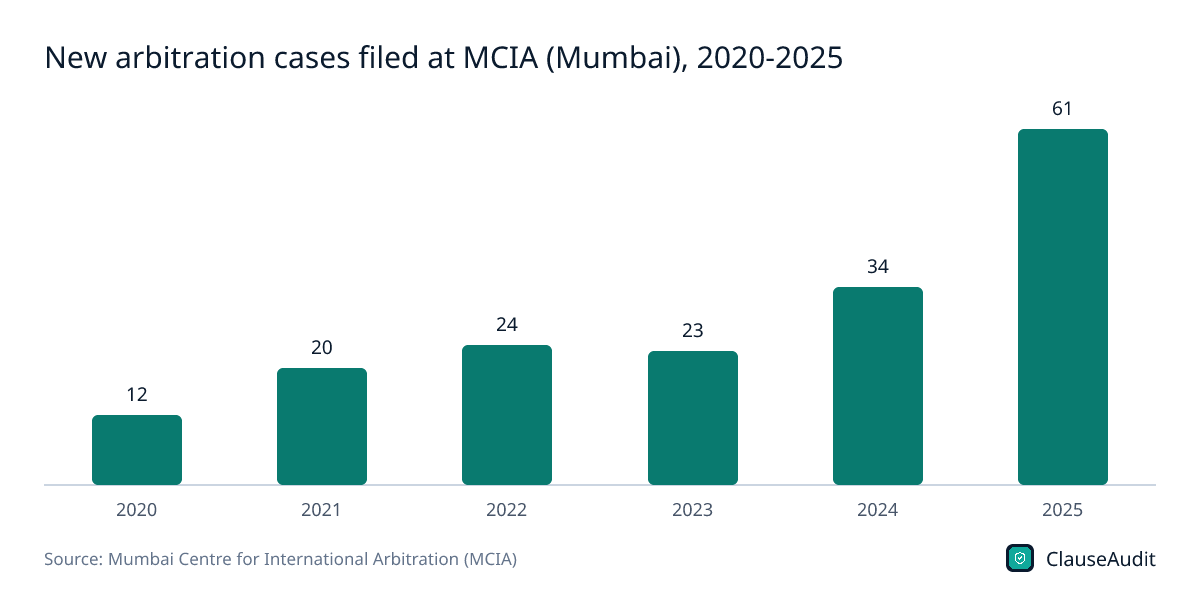
Institutional arbitration in India is growing fast but is still small next to the courts. MCIA in Mumbai received 61 new arbitrations in 2025, up 79.5%, and 58 Indian parties appeared in new ICC cases, 10th worldwide. The courts carry the real load: 44,74,576 cheque bounce cases were pending in July 2025.
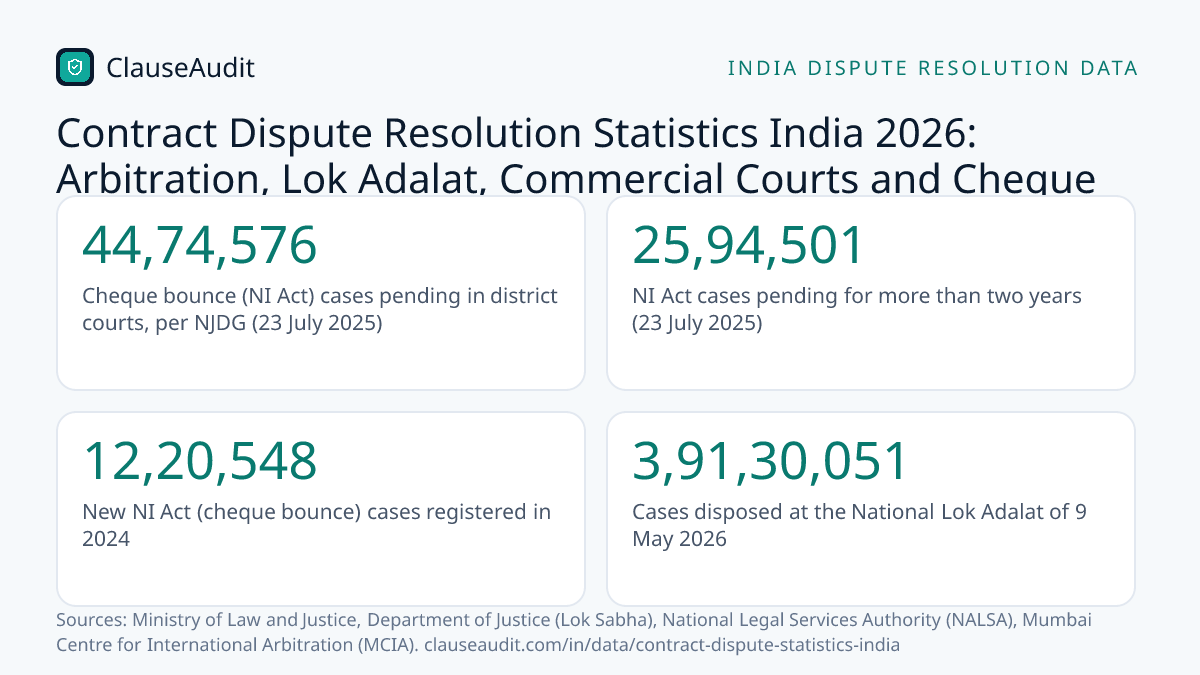
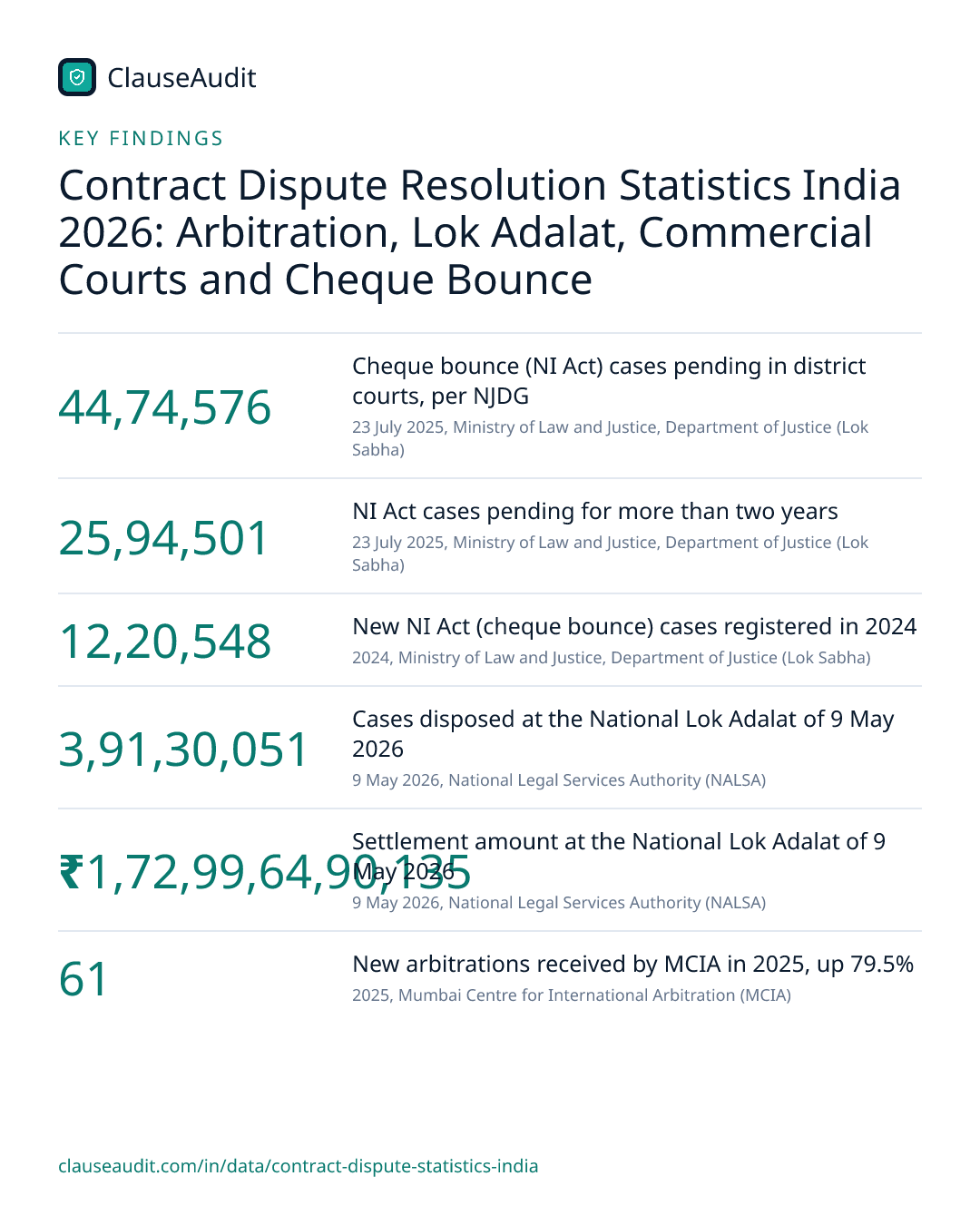
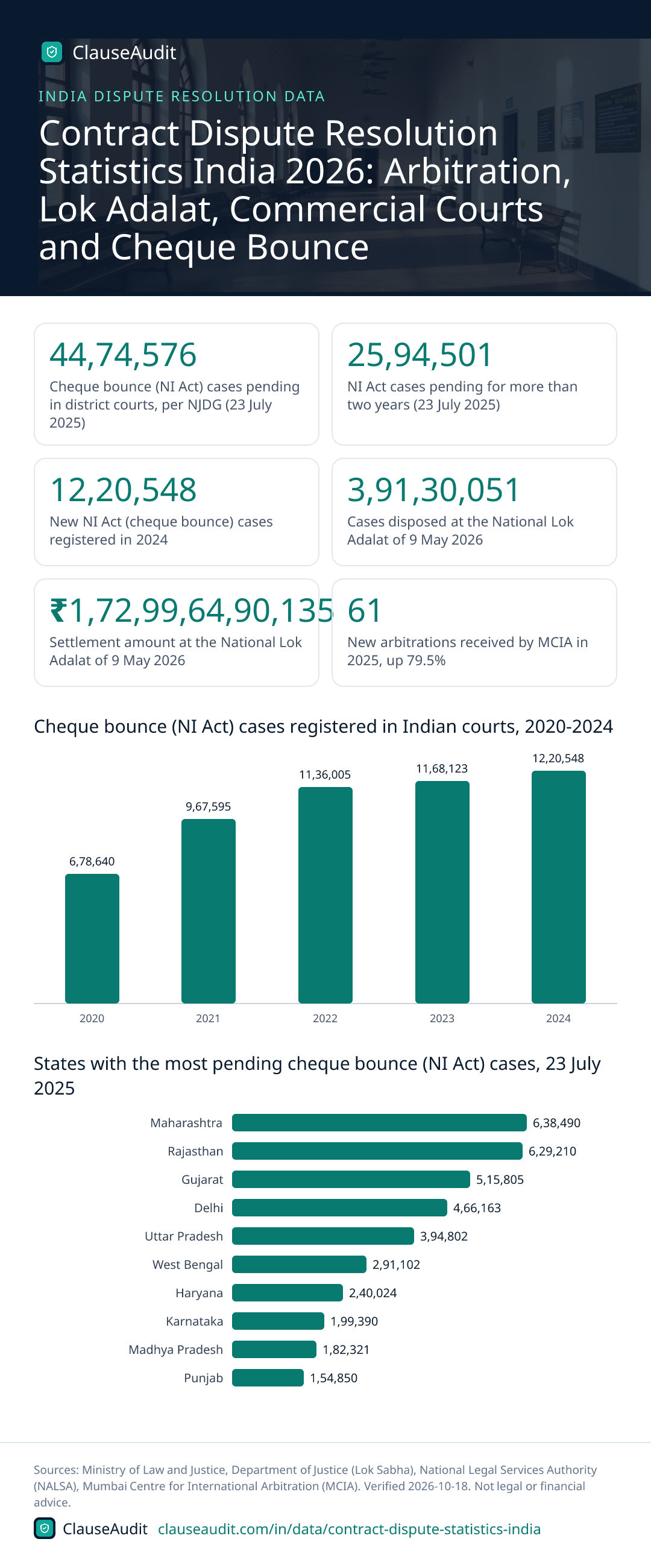
- Cheque bounce (NI Act) cases pending in district courts, per NJDG (23 July 2025, Ministry of Law and Justice, Department of Justice (Lok Sabha))
- 44,74,576
- NI Act cases pending for more than two years (23 July 2025, Ministry of Law and Justice, Department of Justice (Lok Sabha))
- 25,94,501
- New NI Act (cheque bounce) cases registered in 2024 (2024, Ministry of Law and Justice, Department of Justice (Lok Sabha))
- 12,20,548
- Cases disposed at the National Lok Adalat of 9 May 2026 (9 May 2026, National Legal Services Authority (NALSA))
- 3,91,30,051
- Settlement amount at the National Lok Adalat of 9 May 2026 (9 May 2026, National Legal Services Authority (NALSA))
- ₹1,72,99,64,90,135
- New arbitrations received by MCIA in 2025, up 79.5% (2025, Mumbai Centre for International Arbitration (MCIA))
- 61
- Indian parties in new ICC arbitrations, 10th worldwide (2025, International Chamber of Commerce (ICC))
- 58
- Time to enforce a commercial contract through Indian courts (World Bank) (Doing Business 2020, World Bank)
- 1,445 days
When a client stops paying or a supplier walks away from a deal, you have four realistic routes in India: a civil or commercial suit, a cheque bounce complaint, a Lok Adalat settlement, or arbitration. Each one moves at a very different speed, and the numbers below show where the queues are longest.
The short version: the courts are slow, cheque bounce cases pile up faster than they clear, Lok Adalats settle huge volumes when both sides are willing, and arbitration is growing from a small base. The clause you sign decides which route you are stuck with, so read this before your next contract, not after the dispute.
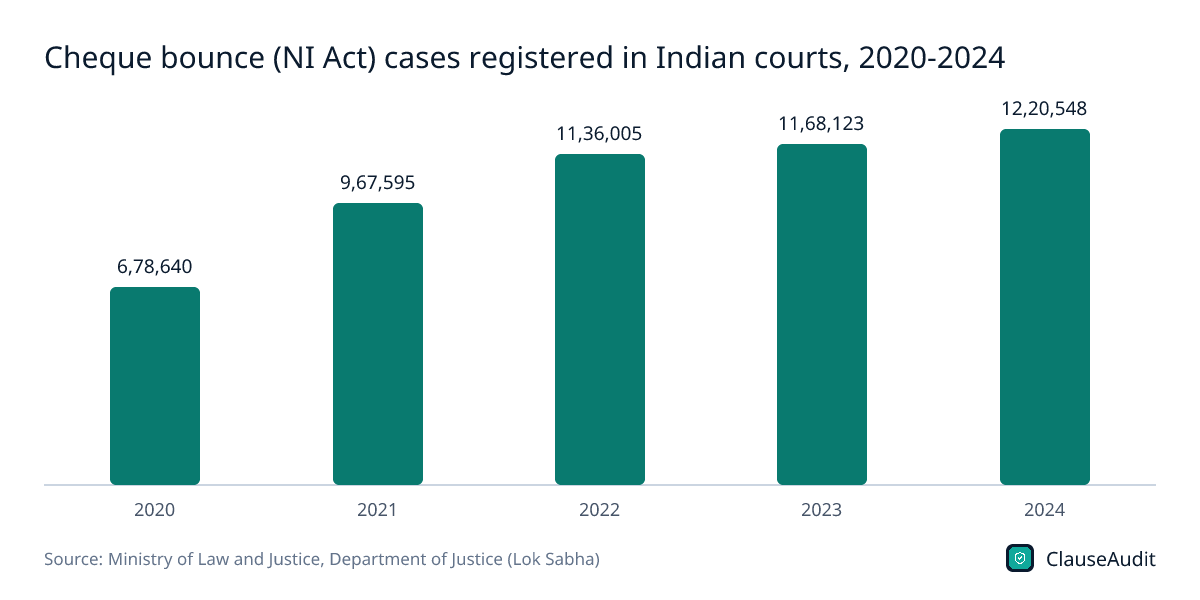
Cheque bounce (NI Act) cases registered in Indian courts, 2020-2024
Chart data
| Label | Value |
|---|---|
| 2020 | 6,78,640 |
| 2021 | 9,67,595 |
| 2022 | 11,36,005 |
| 2023 | 11,68,123 |
| 2024 | 12,20,548 |
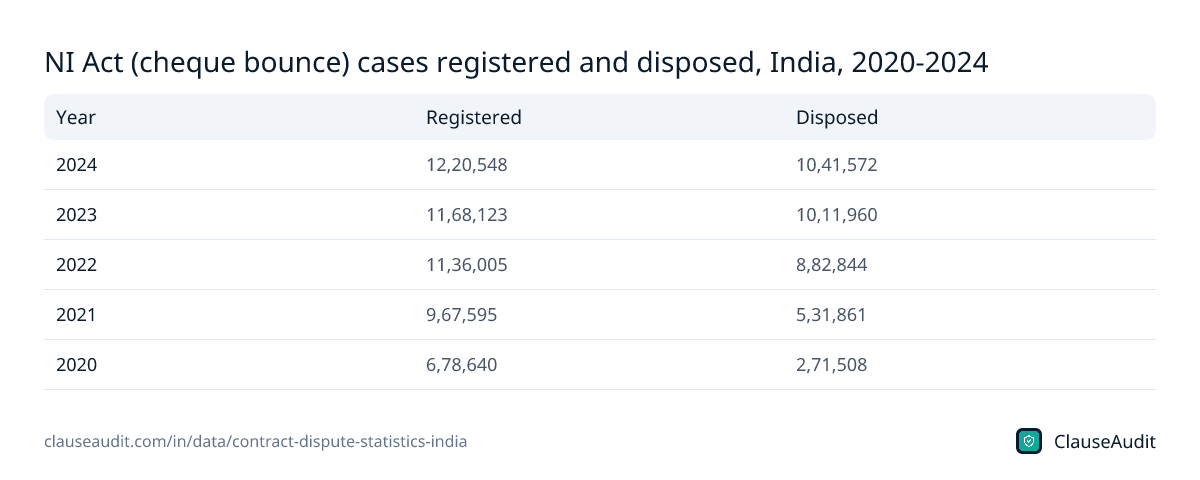
New cheque bounce filings nearly doubled from 6,78,640 in 2020 to 12,20,548 in 2024. Courts disposed of 10,41,572 in 2024, so the backlog kept growing even in a good year.
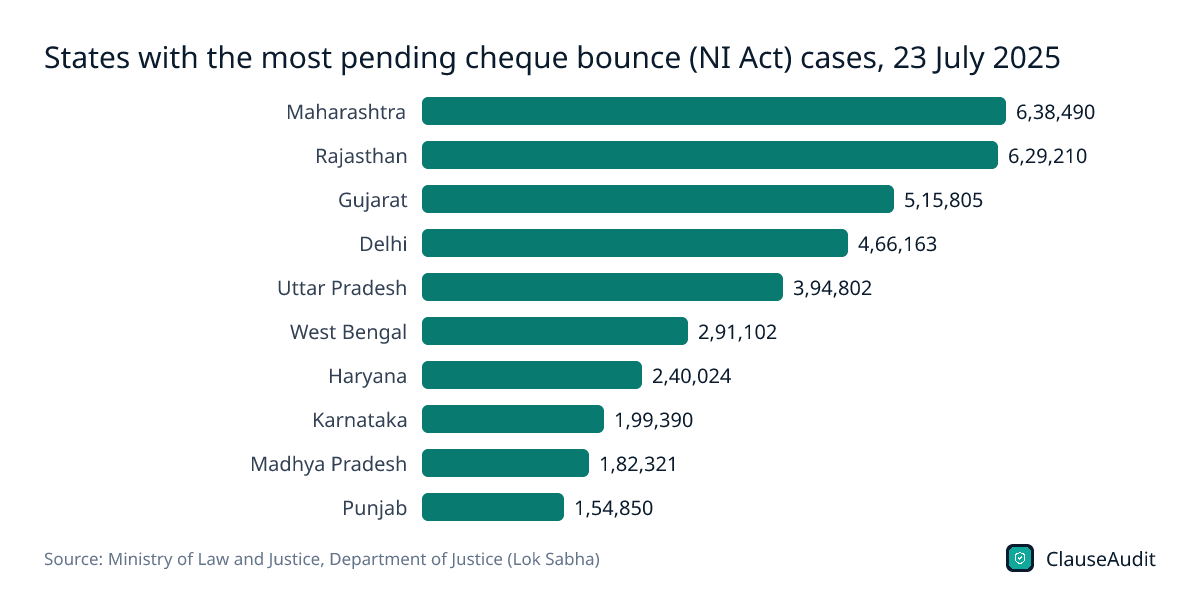
Download this chart (PNG)States with the most pending cheque bounce (NI Act) cases, 23 July 2025
Chart data
| Label | Value |
|---|---|
| Maharashtra | 6,38,490 |
| Rajasthan | 6,29,210 |
| Gujarat | 5,15,805 |
| Delhi | 4,66,163 |
| Uttar Pradesh | 3,94,802 |
| West Bengal | 2,91,102 |
| Haryana | 2,40,024 |
| Karnataka | 1,99,390 |
| Madhya Pradesh | 1,82,321 |
| Punjab | 1,54,850 |
Maharashtra and Rajasthan each have more than six lakh pending cases. If your counterparty is based in a high-backlog state, a cheque complaint filed there will likely take longer.
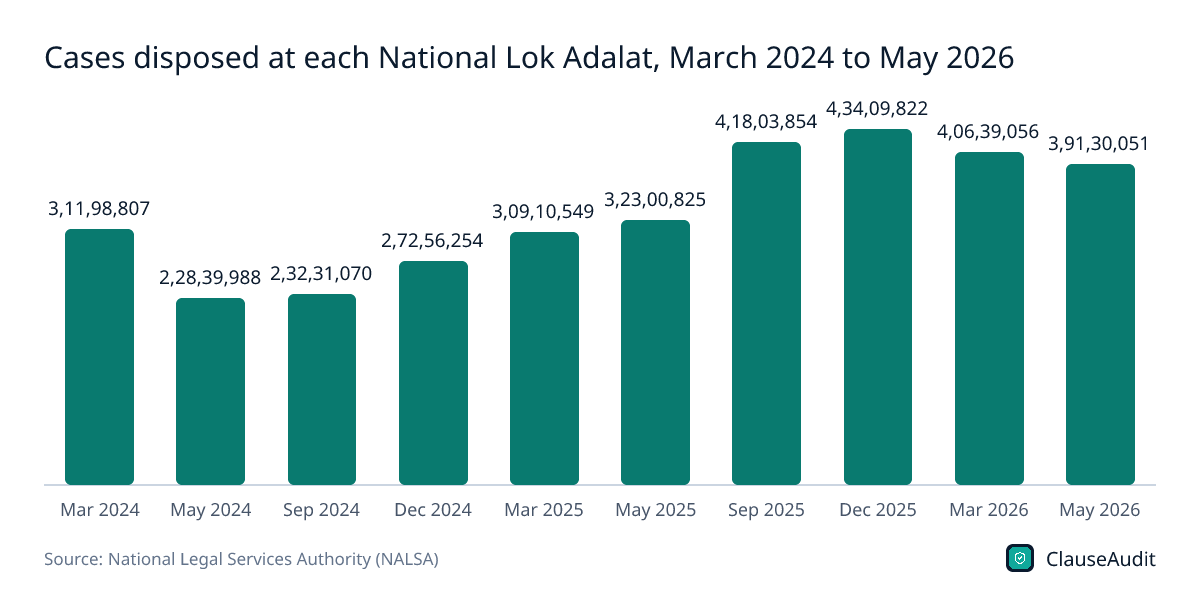
Download this chart (PNG)Cases disposed at each National Lok Adalat, March 2024 to May 2026
Chart data
| Label | Value |
|---|---|
| Mar 2024 | 3,11,98,807 |
| May 2024 | 2,28,39,988 |
| Sep 2024 | 2,32,31,070 |
| Dec 2024 | 2,72,56,254 |
| Mar 2025 | 3,09,10,549 |
| May 2025 | 3,23,00,825 |
| Sep 2025 | 4,18,03,854 |
| Dec 2025 | 4,34,09,822 |
| Mar 2026 | 4,06,39,056 |
| May 2026 | 3,91,30,051 |
Most of these disposals are pre-litigation matters such as bank and utility dues settled before anyone files a case. Volume per session rose through 2025 and has held near four crore since.
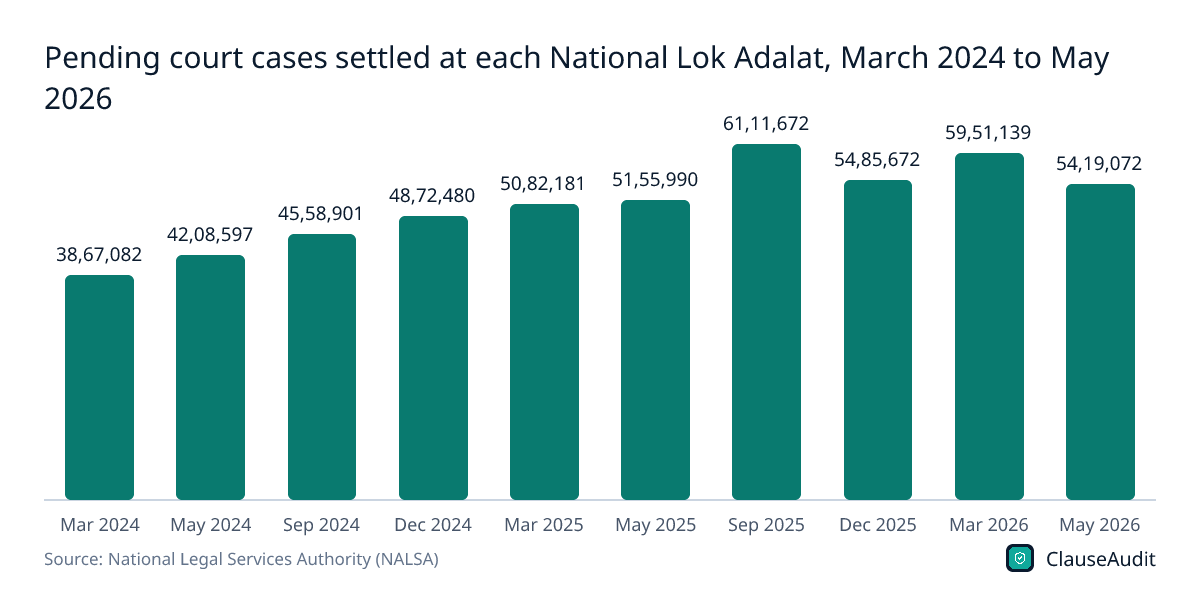
Download this chart (PNG)Pending court cases settled at each National Lok Adalat, March 2024 to May 2026
Chart data
| Label | Value |
|---|---|
| Mar 2024 | 38,67,082 |
| May 2024 | 42,08,597 |
| Sep 2024 | 45,58,901 |
| Dec 2024 | 48,72,480 |
| Mar 2025 | 50,82,181 |
| May 2025 | 51,55,990 |
| Sep 2025 | 61,11,672 |
| Dec 2025 | 54,85,672 |
| Mar 2026 | 59,51,139 |
| May 2026 | 54,19,072 |
This is the figure that matters if your case is already in court. Pending cases settled per session went from 38,67,082 in March 2024 to 54,19,072 in May 2026.
Download this chart (PNG)New arbitration cases filed at MCIA (Mumbai), 2020-2025
Chart data
| Label | Value |
|---|---|
| 2020 | 12 |
| 2021 | 20 |
| 2022 | 24 |
| 2023 | 23 |
| 2024 | 34 |
| 2025 | 61 |
MCIA filings went from 12 in 2020 to 61 in 2025. The jump is real, but the totals show institutional arbitration is still a small slice of Indian commercial disputes.
Download this chart (PNG)Where the 1,445 days to enforce a contract in India go (World Bank DB2020)
Chart data
| Label | Value |
|---|---|
| Filing and service | 45 |
| Trial and judgment | 1095 |
| Enforcement of judgment | 305 |
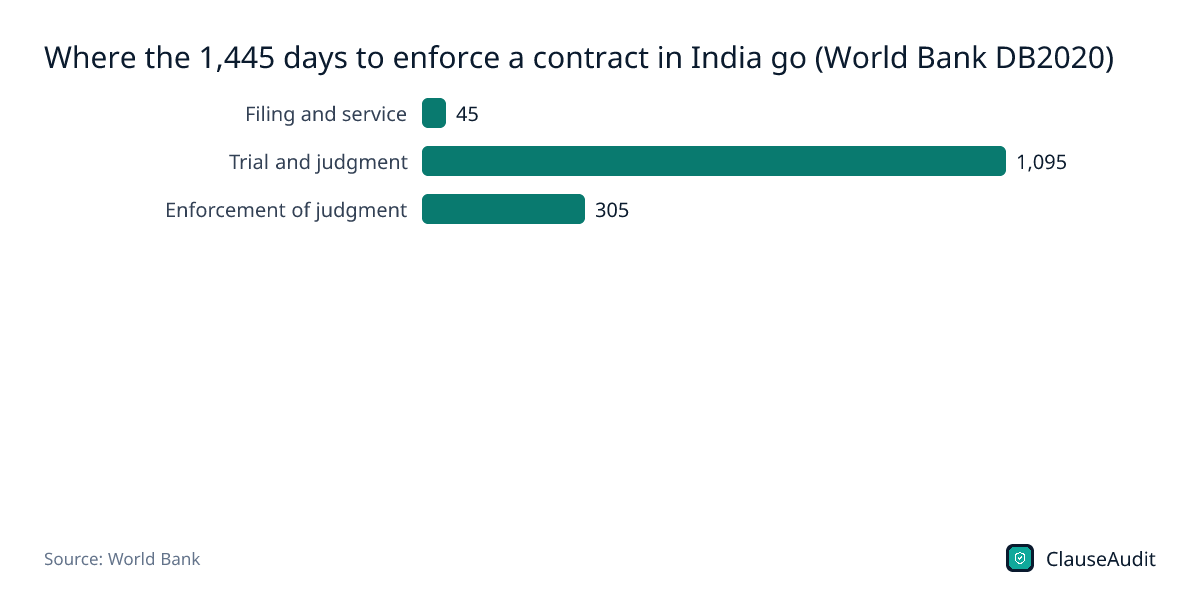
Trial and judgment took 1,095 of the 1,445 days in the World Bank study. Winning was not the end either: enforcing the judgment added another 305 days.
Download this chart (PNG)NI Act (cheque bounce) cases registered and disposed, India, 2020-2024
| Year | Registered | Disposed |
|---|---|---|
| 2024 | 12,20,548 | 10,41,572 |
| 2023 | 11,68,123 | 10,11,960 |
| 2022 | 11,36,005 | 8,82,844 |
| 2021 | 9,67,595 | 5,31,861 |
| 2020 | 6,78,640 | 2,71,508 |
Source: Ministry of Law and Justice, Department of Justice (Lok Sabha), Lok Sabha Unstarred Question No. 1031, 'Cases Registered under NIA, 1881' (with Annexure-I and Annexure-II, NJDG data). Download as image
National Lok Adalat disposals by calendar year (sum of four NALSA session reports each)
| Year | Sessions | Total cases disposed | Pending court cases disposed |
|---|---|---|---|
| 2025 | 8 Mar, 10 May, 13 Sep, 13 Dec | 14,84,25,050 | 2,18,35,515 |
| 2024 | 9 Mar, 11 May, 14 Sep, 14 Dec | 10,45,26,119 | 1,75,07,060 |
Source: National Legal Services Authority (NALSA), Disposal of National Lok Adalat held on 09.03.2024 (All Types of Cases); National Legal Services Authority (NALSA), Disposal of National Lok Adalat held on 11.05.2024 (All Types of Cases); National Legal Services Authority (NALSA), Disposal of National Lok Adalat held on 14.09.2024 (All Types of Cases); National Legal Services Authority (NALSA), Disposal of National Lok Adalat held on 14.12.2024 (All Types of Cases); National Legal Services Authority (NALSA), Disposal of National Lok Adalat held on 08.03.2025 (All Types of Cases); National Legal Services Authority (NALSA), Disposal of National Lok Adalat held on 10.05.2025 (All Types of Cases); National Legal Services Authority (NALSA), Disposal of National Lok Adalat held on 13.09.2025 (All Types of Cases); National Legal Services Authority (NALSA), Disposal of National Lok Adalat held on 13.12.2025 (All Types of Cases). Download as image
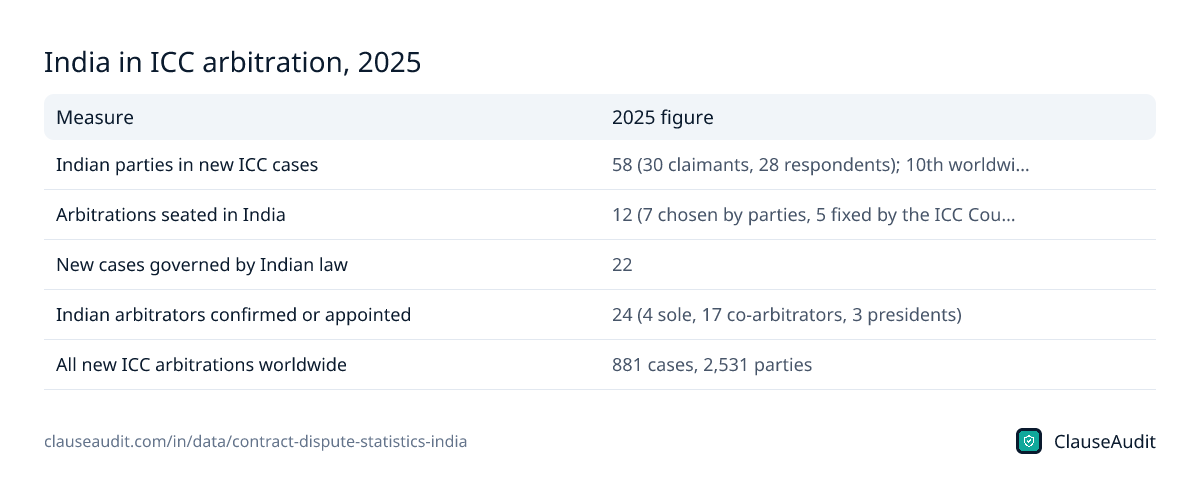
India in ICC arbitration, 2025
| Measure | 2025 figure |
|---|---|
| Indian parties in new ICC cases | 58 (30 claimants, 28 respondents); 10th worldwide |
| Arbitrations seated in India | 12 (7 chosen by parties, 5 fixed by the ICC Court) |
| New cases governed by Indian law | 22 |
| Indian arbitrators confirmed or appointed | 24 (4 sole, 17 co-arbitrators, 3 presidents) |
| All new ICC arbitrations worldwide | 881 cases, 2,531 parties |
Source: International Chamber of Commerce (ICC), ICC Dispute Resolution 2025 Statistics. Download as image
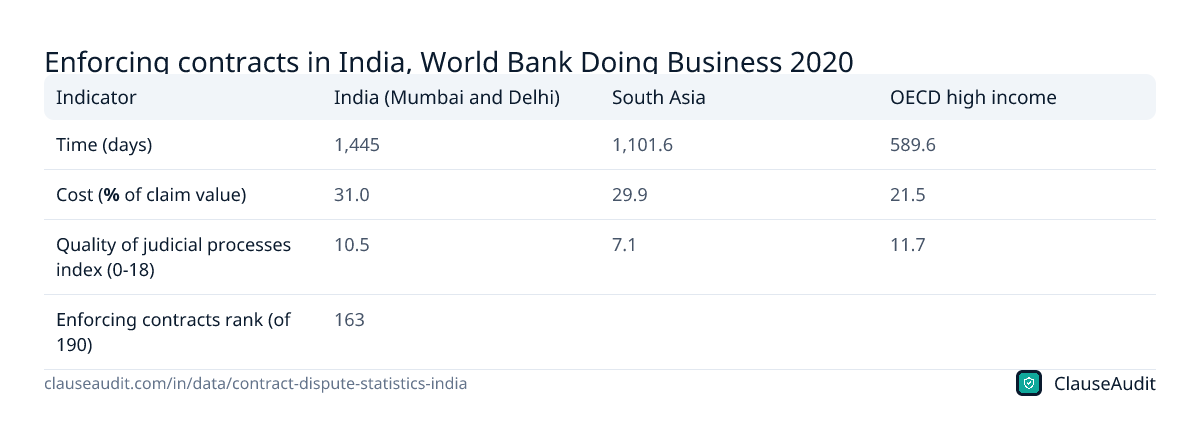
Enforcing contracts in India, World Bank Doing Business 2020
| Indicator | India (Mumbai and Delhi) | South Asia | OECD high income |
|---|---|---|---|
| Time (days) | 1,445 | 1,101.6 | 589.6 |
| Cost (% of claim value) | 31.0 | 29.9 | 21.5 |
| Quality of judicial processes index (0-18) | 10.5 | 7.1 | 11.7 |
| Enforcing contracts rank (of 190) | 163 |
Source: World Bank, Doing Business 2020 Economy Profile: India (Enforcing Contracts). Download as image
How long does it take to enforce a contract in India?
The last World Bank measurement put it at 1,445 days for a standard commercial case in Mumbai and Delhi. That compared with 1,101.6 days for South Asia and 589.6 days for high-income OECD economies, and India ranked 163 of 190 on enforcing contracts. The cost averaged 31.0% of the claim value.
Two caveats. The figures come from Doing Business 2020, and the World Bank stopped the series in 2021, so nothing newer exists on the same basis. Commercial courts and online filing have changed some steps since. Still, the split is telling: 45 days to file and serve, 1,095 days for trial and judgment, then 305 more to actually collect.
For a freelancer or small business, the cost figure is the one to sit with. If nearly a third of a claim can go on fees and time, a mid-sized unpaid invoice is often not worth suing over. That is why the payment terms, advance and late-fee wording you agree up front matter more than your right to sue later.
Why are so many cheque bounce cases pending in India?
Because filings keep outrunning disposals. Courts registered 12,20,548 new cheque bounce cases in 2024 and disposed of 10,41,572. As of 23 July 2025 there were 44,74,576 cases pending in district courts, and 25,94,501 of them, about 58%, had been pending for more than two years.
The backlog is concentrated. Maharashtra had 6,38,490 pending cases, Rajasthan 6,29,210 and Gujarat 5,15,805. Delhi, a much smaller territory, had 4,66,163.
Many businesses ask a client for a post-dated or security cheque and treat it as a guarantee. It helps, because a bounced cheque is a criminal complaint and that pressure brings many people to the table. But if the other side digs in, you join a queue where more than half the cases are over two years old. Treat a cheque as pressure, not as payment. An advance or milestone billing protects you better.
A practical example: a design studio finishes a website, the client hands over a security cheque for the final payment, and the cheque bounces. The studio can send a legal demand and file a complaint, and many clients pay at that point. If this one does not, the studio is now waiting in a district court queue of lakhs, while the unpaid work sits on its books. A larger advance at the start would have cost one awkward conversation instead.
Is Lok Adalat a good option for a contract dispute?
For money claims where both sides are willing to settle, often yes. The National Lok Adalat of 9 May 2026 disposed of 3,91,30,051 cases in one day, with settlements worth ₹1,72,99,64,90,135, about ₹17,299.65 crore. Of those cases, 3,37,10,979 were pre-litigation matters and 54,19,072 were already pending in court.
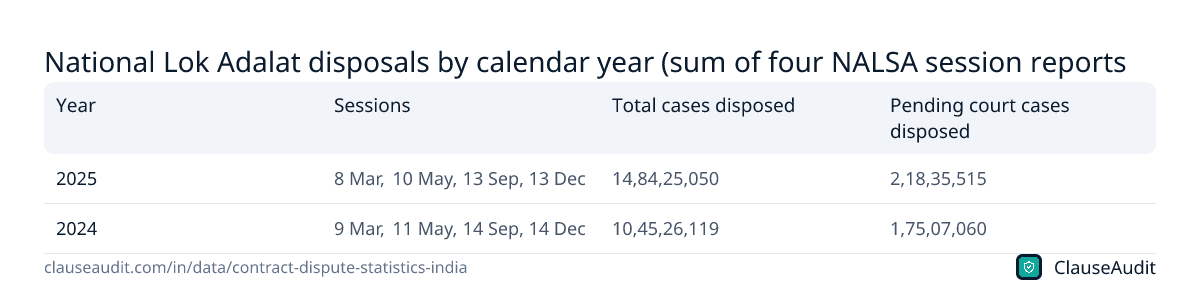
Year on year, the four sessions of 2025 disposed of 14,84,25,050 cases, against 10,45,26,119 in 2024. Pending court cases settled went from 1,75,07,060 to 2,18,35,515.
The catch is consent. A Lok Adalat cannot force a result. If the other side does not turn up or will not agree, your matter goes back where it was. When it works, the award is final and there is no appeal, so only settle for a figure you can live with. Cheque bounce matters are a common fit because the amount is fixed and the drawer has a reason to close the case.
You do not need a case already filed to use it. Your District Legal Services Authority can take a pre-litigation application, call the other side, and list the matter at the next National Lok Adalat. For a small business chasing a fixed sum, that is often the cheapest serious step after a legal notice.
Is arbitration faster than court in India?
It can be, but mostly for larger commercial contracts with a proper clause behind them. The Mumbai Centre for International Arbitration received 61 new cases in 2025, up 79.5% on the year before. At the ICC, 58 Indian parties appeared in new cases in 2025, 30 as claimants and 28 as respondents, putting India 10th worldwide. Only 12 ICC arbitrations were seated in India and 22 were governed by Indian law, out of 881 new cases.
Those totals are tiny next to the lakhs of cases in district courts, and that tells you who uses arbitration: companies with contracts large enough to justify tribunal and institution fees. For a small invoice dispute, an arbitration clause can cost more than the claim.
The bigger risk is a vague clause. A line that only says disputes go to arbitration, with no institution, no seat and no method for appointing the arbitrator, often sends both sides to court first just to get a tribunal formed. That defeats the point.
If you are the smaller party, read the cost terms closely. A clause that splits all fees equally, or names a foreign institution and seat, can make even a strong claim too expensive to bring. Ask for a seat in your own city, a sole arbitrator, and an institution whose fee schedule you have actually looked at.
What freelancers and small businesses should do before signing
- Get paid early. An advance or milestone billing beats any dispute route on these numbers.
- Write a clear due date and late fee. Vague terms like payment on approval give the other side room to delay.
- If you are registered as an MSME, say so in the contract and on invoices. The MSMED Act gives you a faster council route for delayed payments.
- Match the dispute clause to the deal size. For small contracts, a mediation or negotiation step followed by a court in your own city is often more practical than arbitration.
- If you do choose arbitration, name the institution, the seat, one arbitrator and who pays the fees.
- Check where the courts sit. A clause giving exclusive jurisdiction to the other party's city means you travel for every hearing.
- Keep a paper trail: signed scope, invoices, emails approving work. Settlements at Lok Adalat and in arbitration move faster when the facts are not in doubt.
How ClauseAudit helps
Most disputes are decided by clauses written long before anyone fell out: when payment is due, what happens if it is late, and where a fight has to happen. Those are the lines people skim.
Upload your service, freelance or vendor contract and the automated review flags the payment and dispute terms that tend to hurt the smaller party in India, explains each in plain English, and suggests wording you can send back.
- Payment terms: is there a fixed due date, or does payment depend on approval or the client's own payment cycle?
- Late fee and interest: is there a rate for overdue invoices, and does the contract try to cut down the interest the MSMED Act already gives you?
- Advance and security: is there a deposit, milestone billing or security cheque, and what happens to it on termination?
- Dispute resolution: does the clause name an arbitration institution, a seat and how the arbitrator is chosen, or is it left vague?
- Jurisdiction: which city's courts have exclusive jurisdiction, and is it yours or theirs?
- Liability and termination: is your liability capped, and are you paid for work done if the client ends the contract early?
Frequently asked questions
How many cheque bounce cases are pending in India?
As of 23 July 2025, district courts had 44,74,576 cheque bounce cases pending under the Negotiable Instruments Act, based on NJDG data given in the Lok Sabha. Of these, 25,94,501 had been pending for more than two years. The data leaves out Jammu and Kashmir, Ladakh, Mizoram and Manipur.
How long does a cheque bounce case take in India?
There is no official average, but the backlog gives a fair idea. About 58% of pending cheque bounce cases had been in court for more than two years as of July 2025. Many cases close sooner through settlement, either privately or at a Lok Adalat, because the person who issued the cheque wants the complaint withdrawn.
Can a cheque bounce case be settled at Lok Adalat?
Yes. Cheque bounce cases are among the most common matters taken to Lok Adalats, because the amount is fixed and both sides usually gain from closing the case. Both parties must agree to the terms. Once they do, the award is final and binding like a court decree, and there is no appeal from it.
How many cases did the National Lok Adalat of May 2026 settle?
The National Lok Adalat held on 9 May 2026 disposed of 3,91,30,051 cases, according to NALSA. That included 3,37,10,979 pre-litigation matters and 54,19,072 cases already pending in court. The settlement amount was ₹1,72,99,64,90,135, about ₹17,299.65 crore.
Is arbitration cheaper than going to court in India?
Not always. You pay the arbitrator and often an institution, while court fees are set by the state. Arbitration tends to pay off for larger commercial contracts where speed and privacy matter. For a small unpaid invoice, a demand notice, an MSME council claim or a Lok Adalat settlement is often cheaper.
How many arbitration cases does MCIA handle?
The Mumbai Centre for International Arbitration received 61 new arbitrations in 2025, up 79.5% from 34 in 2024, according to its annual report. Filings were 12 in 2020, which shows how quickly institutional arbitration is growing in India, even if the totals are still small.
How does India rank on enforcing contracts?
In the World Bank's Doing Business 2020 report, India ranked 163 of 190 on enforcing contracts. A standard commercial case took 1,445 days and cost 31.0% of the claim. The World Bank discontinued the series in 2021, so these are the last comparable figures available.
What should a dispute resolution clause in an Indian contract say?
It should say how disputes are first raised, for example written notice and a short negotiation period, then the final forum. If that is arbitration, name the institution, the seat, the number of arbitrators and the language. If it is court, name the city. Vague clauses often lead to a separate court fight before the real one starts.
Use this data
Every chart and card below is free to reuse under CC BY 4.0. Download what you need and link back to this page.
 Stat cards
 Key findings card
 Infographic
 Cheque bounce (NI Act) cases registered in Indian courts, 2020-2024
 States with the most pending cheque bounce (NI Act) cases, 23 July 2025
 Cases disposed at each National Lok Adalat, March 2024 to May 2026
 Pending court cases settled at each National Lok Adalat, March 2024 to May 2026
 New arbitration cases filed at MCIA (Mumbai), 2020-2025
 Where the 1,445 days to enforce a contract in India go (World Bank DB2020)
 NI Act (cheque bounce) cases registered and disposed, India, 2020-2024
 National Lok Adalat disposals by calendar year (sum of four NALSA session reports each)
 India in ICC arbitration, 2025
 Enforcing contracts in India, World Bank Doing Business 2020
Embed the infographic
Free to share on your site, blog or slides under CC BY 4.0. Please keep the credit link.
Sources and method
Every number on this page comes from the sources below, each opened and read on or before October 18, 2026. A second, independent review checked every figure against its source and corrected anything that did not match. Figures that could not be confirmed were left out.
- National Legal Services Authority (NALSA), Disposal of National Lok Adalat held on 09.03.2024 (All Types of Cases) (National Lok Adalat of 09.03.2024; report listed on https://nalsa.gov.in/national-lok-adalat-report/)
- National Legal Services Authority (NALSA), Disposal of National Lok Adalat held on 11.05.2024 (All Types of Cases) (National Lok Adalat of 11.05.2024; report listed on https://nalsa.gov.in/national-lok-adalat-report/)
- National Legal Services Authority (NALSA), Disposal of National Lok Adalat held on 14.09.2024 (All Types of Cases) (National Lok Adalat of 14.09.2024; report listed on https://nalsa.gov.in/national-lok-adalat-report/)
- National Legal Services Authority (NALSA), Disposal of National Lok Adalat held on 14.12.2024 (All Types of Cases) (National Lok Adalat of 14.12.2024; report listed on https://nalsa.gov.in/national-lok-adalat-report/)
- National Legal Services Authority (NALSA), Disposal of National Lok Adalat held on 08.03.2025 (All Types of Cases) (National Lok Adalat of 08.03.2025; report listed on https://nalsa.gov.in/national-lok-adalat-report/)
- National Legal Services Authority (NALSA), Disposal of National Lok Adalat held on 10.05.2025 (All Types of Cases) (National Lok Adalat of 10.05.2025; report listed on https://nalsa.gov.in/national-lok-adalat-report/)
- National Legal Services Authority (NALSA), Disposal of National Lok Adalat held on 13.09.2025 (All Types of Cases) (National Lok Adalat of 13.09.2025; report listed on https://nalsa.gov.in/national-lok-adalat-report/)
- National Legal Services Authority (NALSA), Disposal of National Lok Adalat held on 13.12.2025 (All Types of Cases) (National Lok Adalat of 13.12.2025; report listed on https://nalsa.gov.in/national-lok-adalat-report/)
- National Legal Services Authority (NALSA), Disposal of National Lok Adalat held on 14.03.2026 (All Types of Cases) (National Lok Adalat of 14.03.2026; report listed on https://nalsa.gov.in/national-lok-adalat-report/)
- National Legal Services Authority (NALSA), Disposal of National Lok Adalat held on 09.05.2026 (All Types of Cases) (National Lok Adalat of 09.05.2026; report listed on https://nalsa.gov.in/national-lok-adalat-report/)
- Ministry of Law and Justice, Department of Justice (Lok Sabha), Lok Sabha Unstarred Question No. 1031, 'Cases Registered under NIA, 1881' (with Annexure-I and Annexure-II, NJDG data) (Answered 25 July 2025 (NJDG data dated 21.07.2025 and 23.07.2025))
- Mumbai Centre for International Arbitration (MCIA), MCIA Annual Report 2025 (2025 edition (covers calendar year 2025; published 2026))
- International Chamber of Commerce (ICC), ICC Dispute Resolution 2025 Statistics (2025 Statistics, Copyright 2026 (ICC Publication No. DRS004EN))
- World Bank, Doing Business 2020 Economy Profile: India (Enforcing Contracts) (Doing Business 2020 (data as of 1 May 2019; series discontinued in 2021, archived))
Cite this page
ClauseAudit, “Contract Dispute Resolution Statistics India 2026: Arbitration, Lok Adalat, Commercial Courts and Cheque Bounce”, updated October 18, 2026, https://clauseaudit.com/in/data/contract-dispute-statistics-india. Free to reuse with a link back (CC BY 4.0).
This page summarises published data and law as checked on October 18, 2026. Figures are updated as new editions are released, and your own situation may differ. It is general information, not legal, tax or financial advice.