Pending Court Cases in India 2026: NJDG Statistics by Court and State
By ClauseAudit Research · 4 sources ·
How many cases are pending in India's courts?
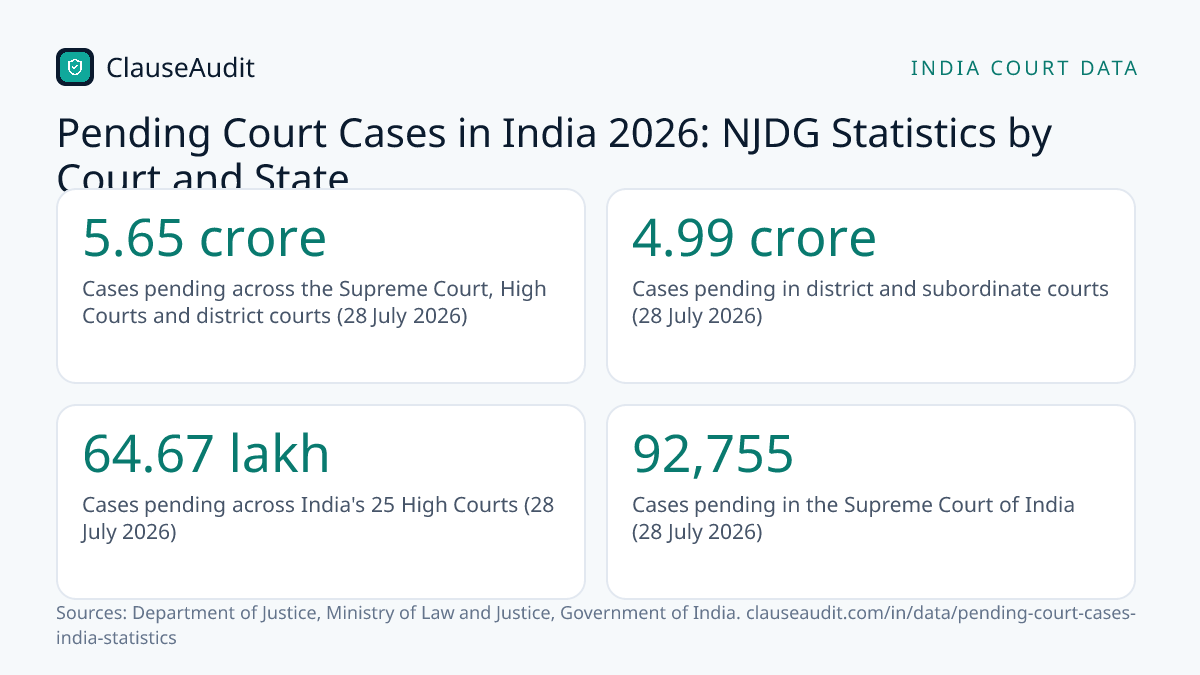
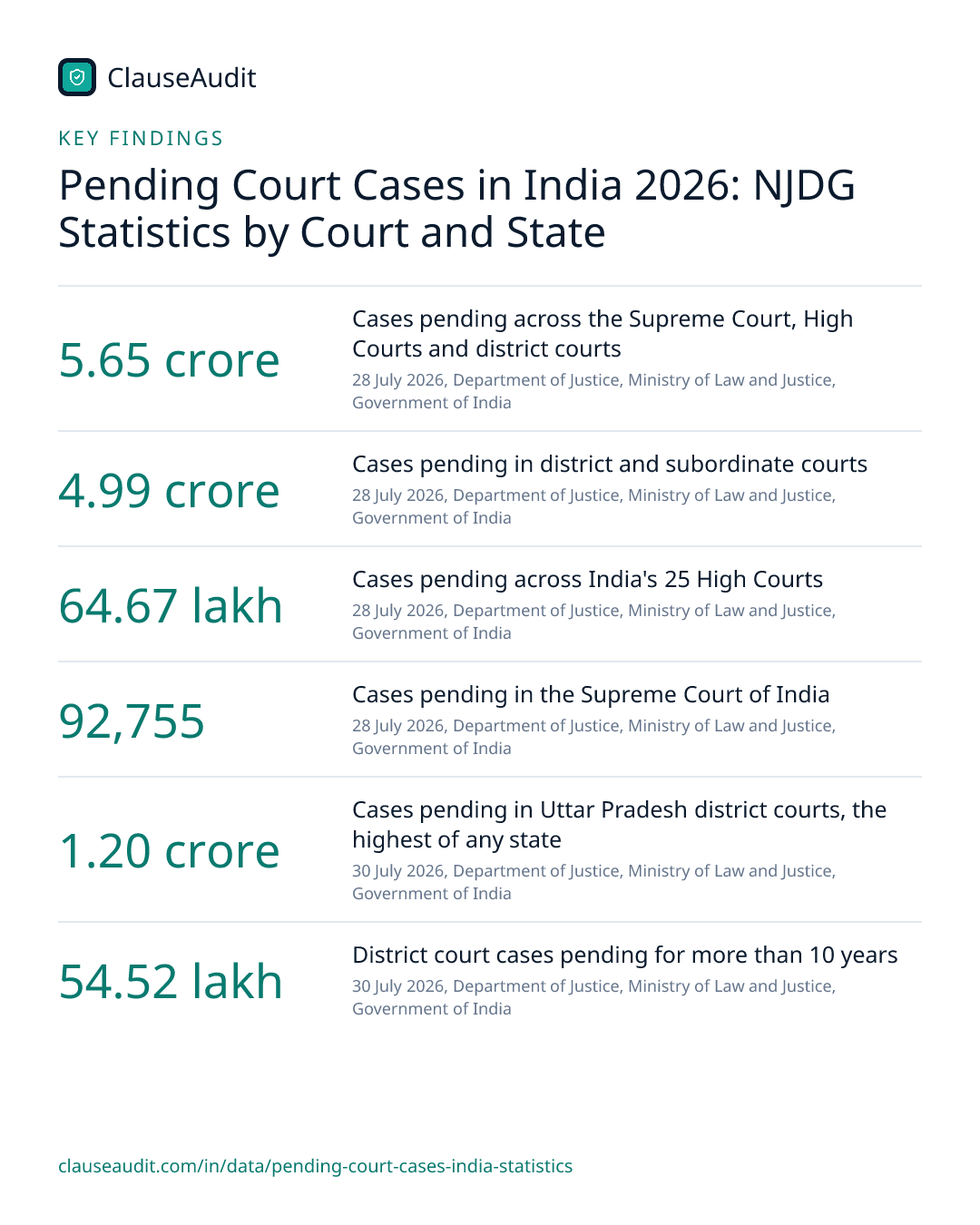
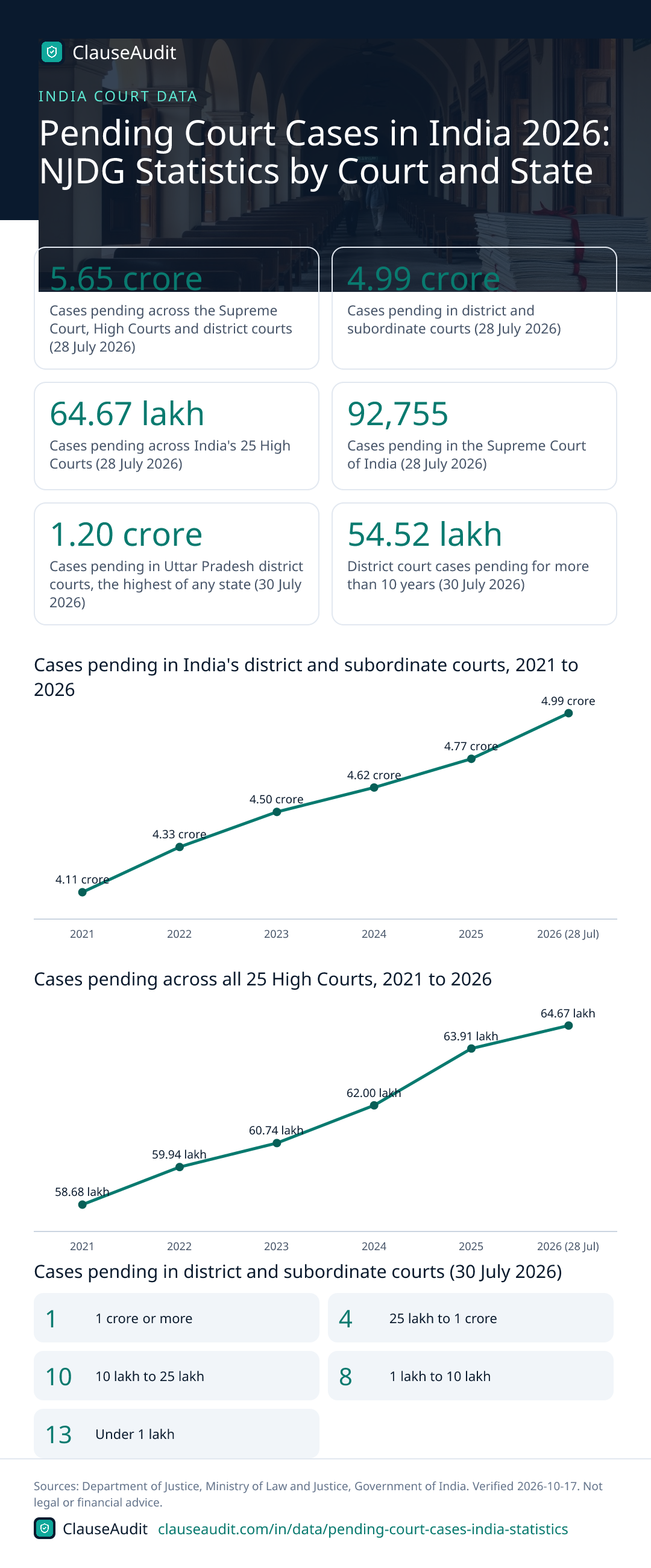
About 5.65 crore cases were pending in Indian courts on 28 July 2026, according to NJDG data given to Parliament. District and subordinate courts held 4.99 crore of them, the 25 High Courts 64.67 lakh and the Supreme Court 92,755. Uttar Pradesh's district courts alone carried 1.20 crore on 30 July.
- Cases pending across the Supreme Court, High Courts and district courts (28 July 2026, Department of Justice, Ministry of Law and Justice, Government of India)
- 5.65 crore
- Cases pending in district and subordinate courts (28 July 2026, Department of Justice, Ministry of Law and Justice, Government of India)
- 4.99 crore
- Cases pending across India's 25 High Courts (28 July 2026, Department of Justice, Ministry of Law and Justice, Government of India)
- 64.67 lakh
- Cases pending in the Supreme Court of India (28 July 2026, Department of Justice, Ministry of Law and Justice, Government of India)
- 92,755
- Cases pending in Uttar Pradesh district courts, the highest of any state (30 July 2026, Department of Justice, Ministry of Law and Justice, Government of India)
- 1.20 crore
- District court cases pending for more than 10 years (30 July 2026, Department of Justice, Ministry of Law and Justice, Government of India)
- 54.52 lakh
- Share of High Court cases pending for more than 10 years (30 July 2026, Department of Justice, Ministry of Law and Justice, Government of India)
- 25%
India's courts were carrying about 5.65 crore pending cases in late July 2026. Most of that weight sits at the bottom of the system, in the district and subordinate courts where ordinary money claims, cheque bounce cases and property fights begin.
The figures below come from Lok Sabha replies by the Department of Justice, which quote the National Judicial Data Grid (NJDG). After the charts, we look at what the backlog means if you run a business, freelance or work on contract, and how to write agreements that keep you out of the queue.
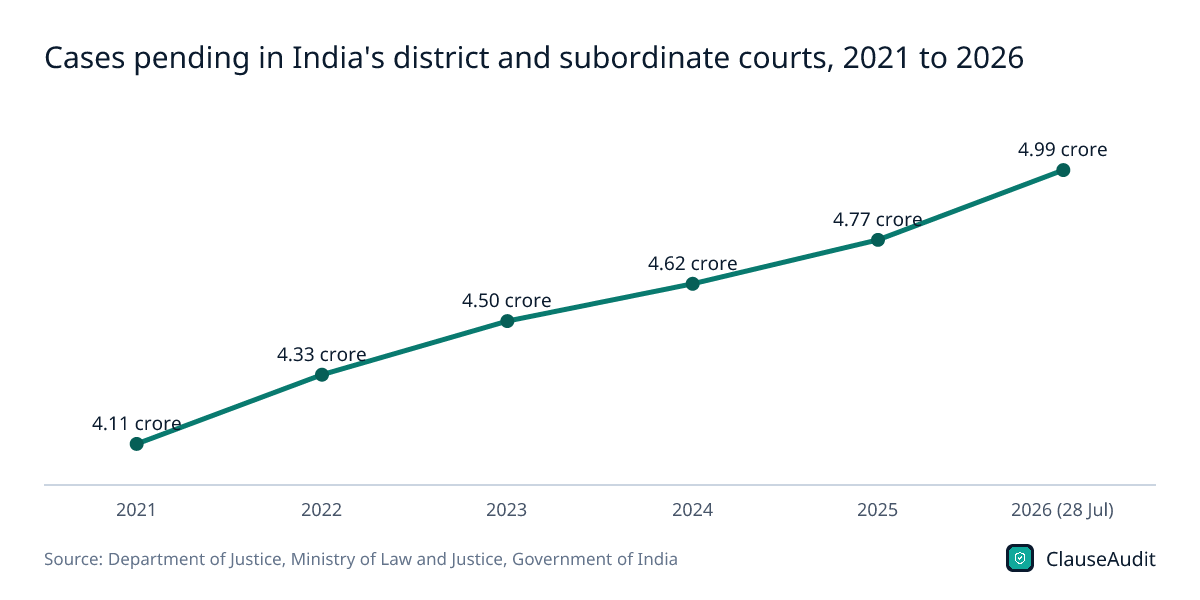
Cases pending in India's district and subordinate courts, 2021 to 2026
Chart data
| Label | Value |
|---|---|
| 2021 | 4.11 crore |
| 2022 | 4.33 crore |
| 2023 | 4.50 crore |
| 2024 | 4.62 crore |
| 2025 | 4.77 crore |
| 2026 (28 Jul) | 4.99 crore |
The district court backlog rose every year shown, from 4.11 crore in 2021 to 4.99 crore by 28 July 2026, an increase of 21.6%. Put simply, more cases come in each year than the courts manage to finish.
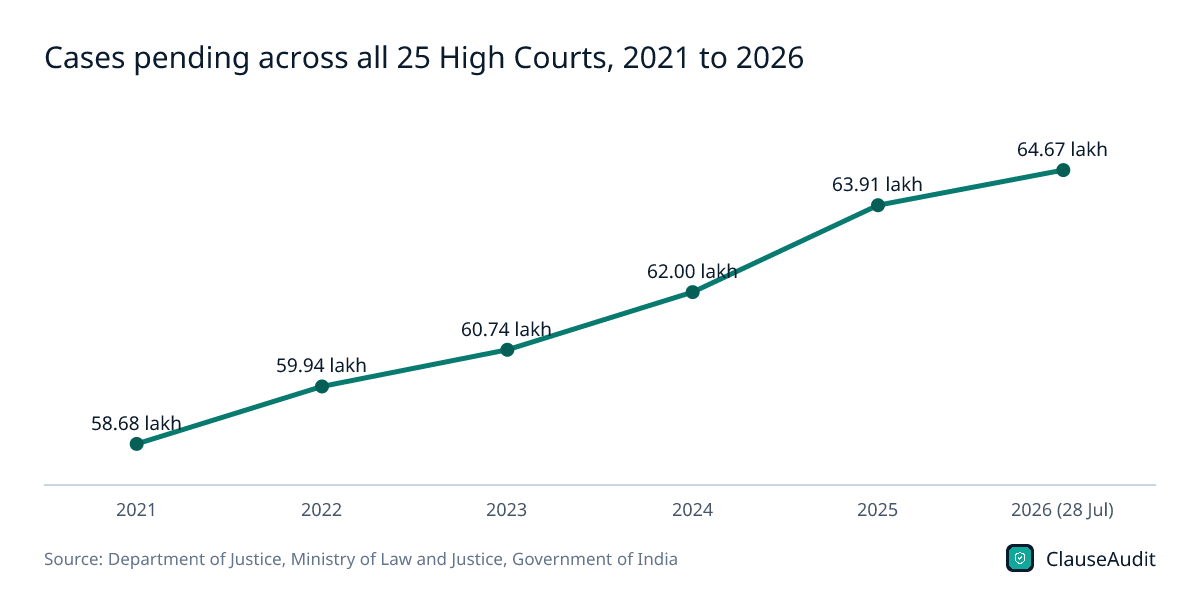
Download this chart (PNG)Cases pending across all 25 High Courts, 2021 to 2026
Chart data
| Label | Value |
|---|---|
| 2021 | 58.68 lakh |
| 2022 | 59.94 lakh |
| 2023 | 60.74 lakh |
| 2024 | 62.00 lakh |
| 2025 | 63.91 lakh |
| 2026 (28 Jul) | 64.67 lakh |
High Court pendency climbed more slowly but never fell, reaching 64.67 lakh in July 2026. Appeals from the district courts and writ petitions both feed this number.
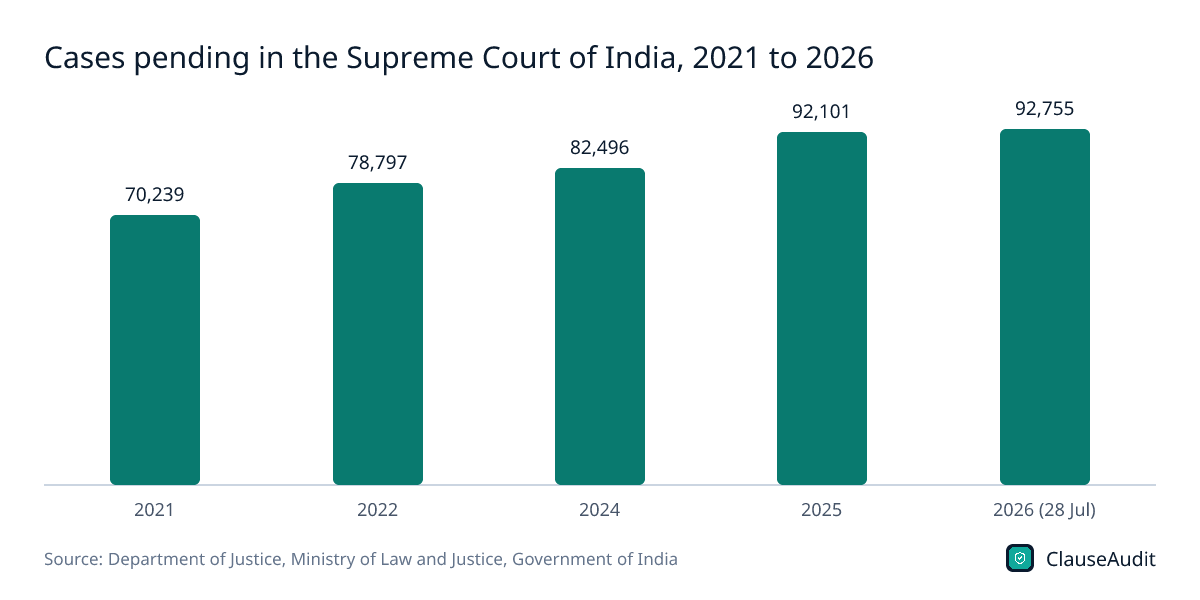
Download this chart (PNG)Cases pending in the Supreme Court of India, 2021 to 2026
Chart data
| Label | Value |
|---|---|
| 2021 | 70,239 |
| 2022 | 78,797 |
| 2024 | 82,496 |
| 2025 | 92,101 |
| 2026 (28 Jul) | 92,755 |
The Supreme Court is a small share of the total, but its count jumped from 82,496 in 2024 to 92,101 in 2025. Two official snapshots two days apart in July 2026 gave 92,755 and 95,954.
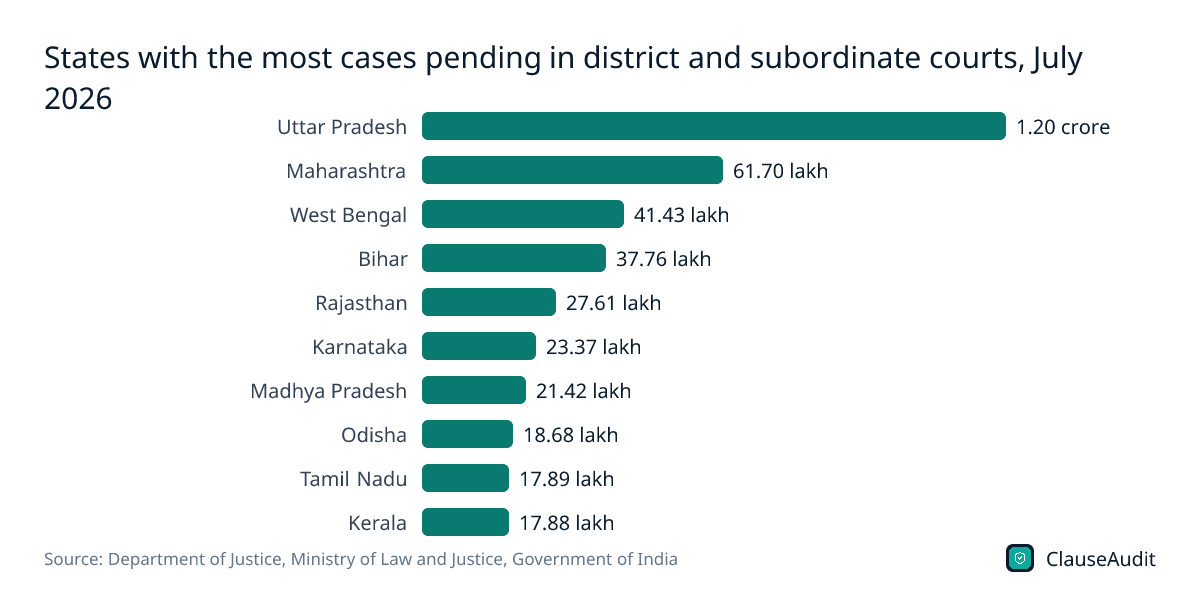
Download this chart (PNG)States with the most cases pending in district and subordinate courts, July 2026
Chart data
| Label | Value |
|---|---|
| Uttar Pradesh | 1.20 crore |
| Maharashtra | 61.70 lakh |
| West Bengal | 41.43 lakh |
| Bihar | 37.76 lakh |
| Rajasthan | 27.61 lakh |
| Karnataka | 23.37 lakh |
| Madhya Pradesh | 21.42 lakh |
| Odisha | 18.68 lakh |
| Tamil Nadu | 17.89 lakh |
| Kerala | 17.88 lakh |
Uttar Pradesh stands apart with 1.20 crore pending cases, about 24% of the national district court total. Maharashtra is a distant second at 61.70 lakh.
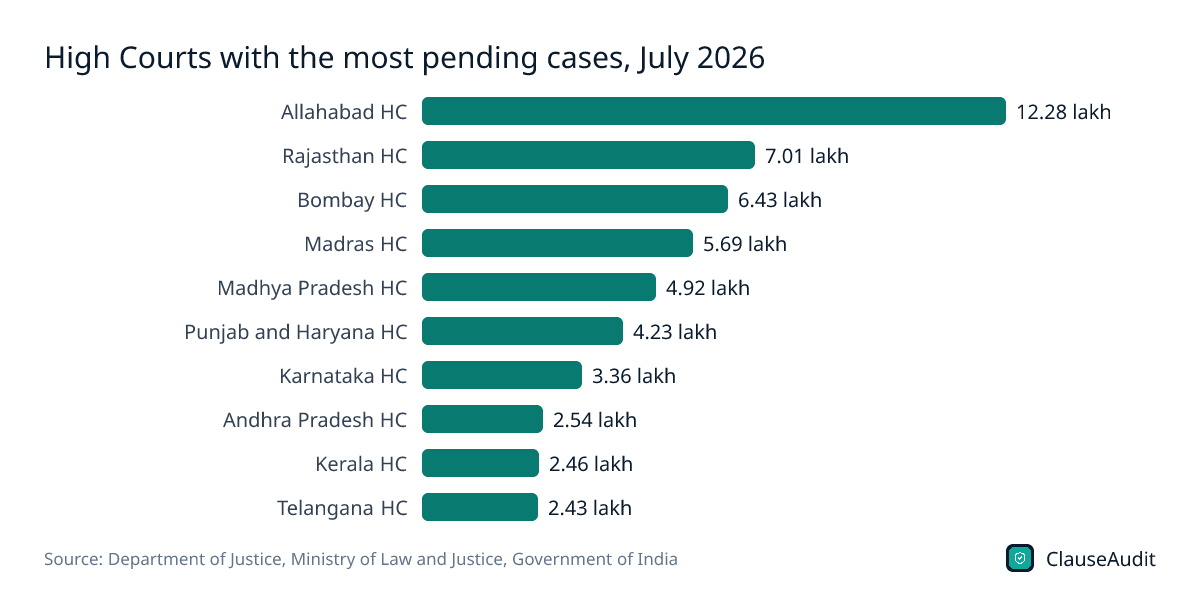
Download this chart (PNG)High Courts with the most pending cases, July 2026
Chart data
| Label | Value |
|---|---|
| Allahabad HC | 12.28 lakh |
| Rajasthan HC | 7.01 lakh |
| Bombay HC | 6.43 lakh |
| Madras HC | 5.69 lakh |
| Madhya Pradesh HC | 4.92 lakh |
| Punjab and Haryana HC | 4.23 lakh |
| Karnataka HC | 3.36 lakh |
| Andhra Pradesh HC | 2.54 lakh |
| Kerala HC | 2.46 lakh |
| Telangana HC | 2.43 lakh |
Allahabad High Court's 12.28 lakh pending cases put it far ahead of Rajasthan (7.01 lakh) and Bombay (6.43 lakh). If your appeal goes to Allahabad, expect a long wait.
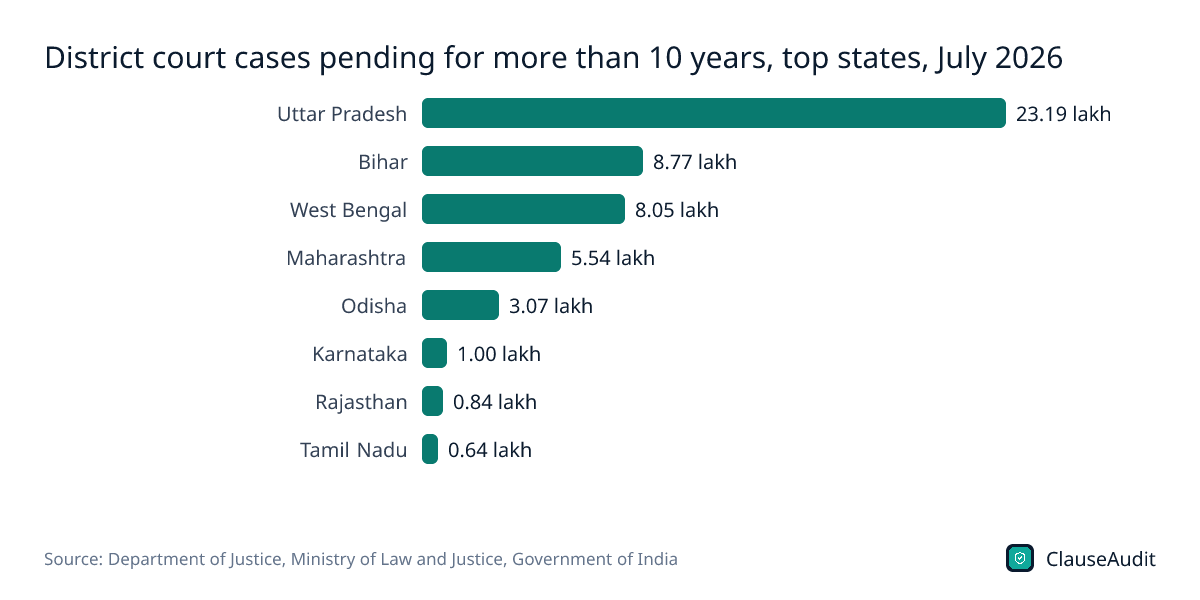
Download this chart (PNG)District court cases pending for more than 10 years, top states, July 2026
Chart data
| Label | Value |
|---|---|
| Uttar Pradesh | 23.19 lakh |
| Bihar | 8.77 lakh |
| West Bengal | 8.05 lakh |
| Maharashtra | 5.54 lakh |
| Odisha | 3.07 lakh |
| Karnataka | 1.00 lakh |
| Rajasthan | 0.84 lakh |
| Tamil Nadu | 0.64 lakh |
Age matters as much as volume. Uttar Pradesh alone has 23.19 lakh district cases older than 10 years, and Bihar, West Bengal and Maharashtra hold most of the rest.
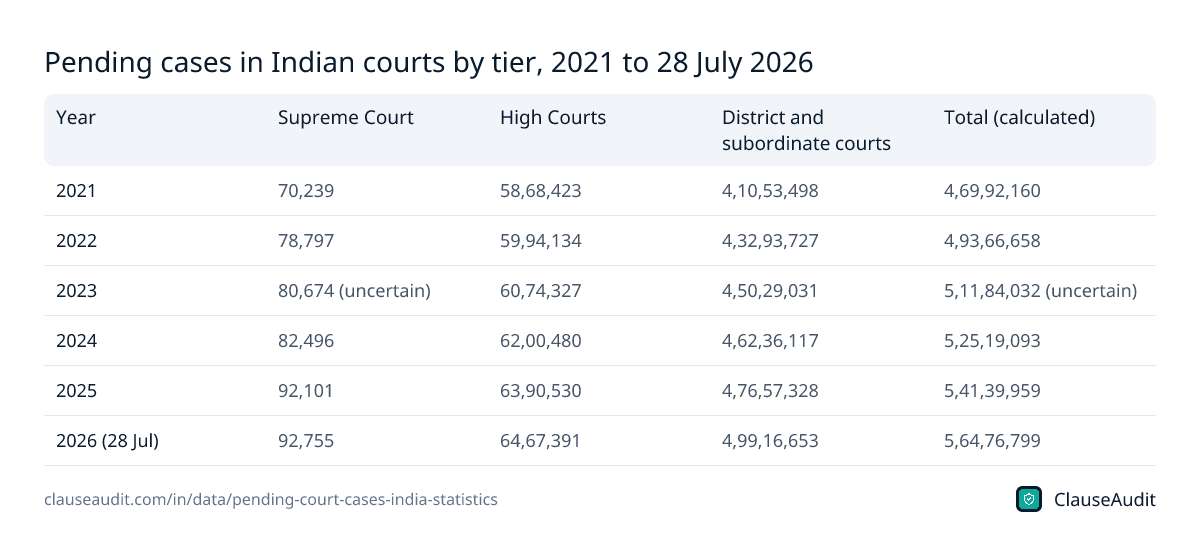
Download this chart (PNG)Pending cases in Indian courts by tier, 2021 to 28 July 2026
| Year | Supreme Court | High Courts | District and subordinate courts | Total (calculated) |
|---|---|---|---|---|
| 2021 | 70,239 | 58,68,423 | 4,10,53,498 | 4,69,92,160 |
| 2022 | 78,797 | 59,94,134 | 4,32,93,727 | 4,93,66,658 |
| 2023 | 80,674 (uncertain) | 60,74,327 | 4,50,29,031 | 5,11,84,032 (uncertain) |
| 2024 | 82,496 | 62,00,480 | 4,62,36,117 | 5,25,19,093 |
| 2025 | 92,101 | 63,90,530 | 4,76,57,328 | 5,41,39,959 |
| 2026 (28 Jul) | 92,755 | 64,67,391 | 4,99,16,653 | 5,64,76,799 |
Source: Department of Justice, Ministry of Law and Justice, Government of India, Lok Sabha Unstarred Question No. 3295, "Case Pendency in Judiciary", answered 07.08.2026 (Annexures I and II, NJDG data); Department of Justice, Ministry of Law and Justice, Government of India, Lok Sabha Unstarred Question No. 2362, "Pendency of Cases", answered 13.02.2026 (Annexures I and II, NJDG data as on 31.12.2025). Download as image
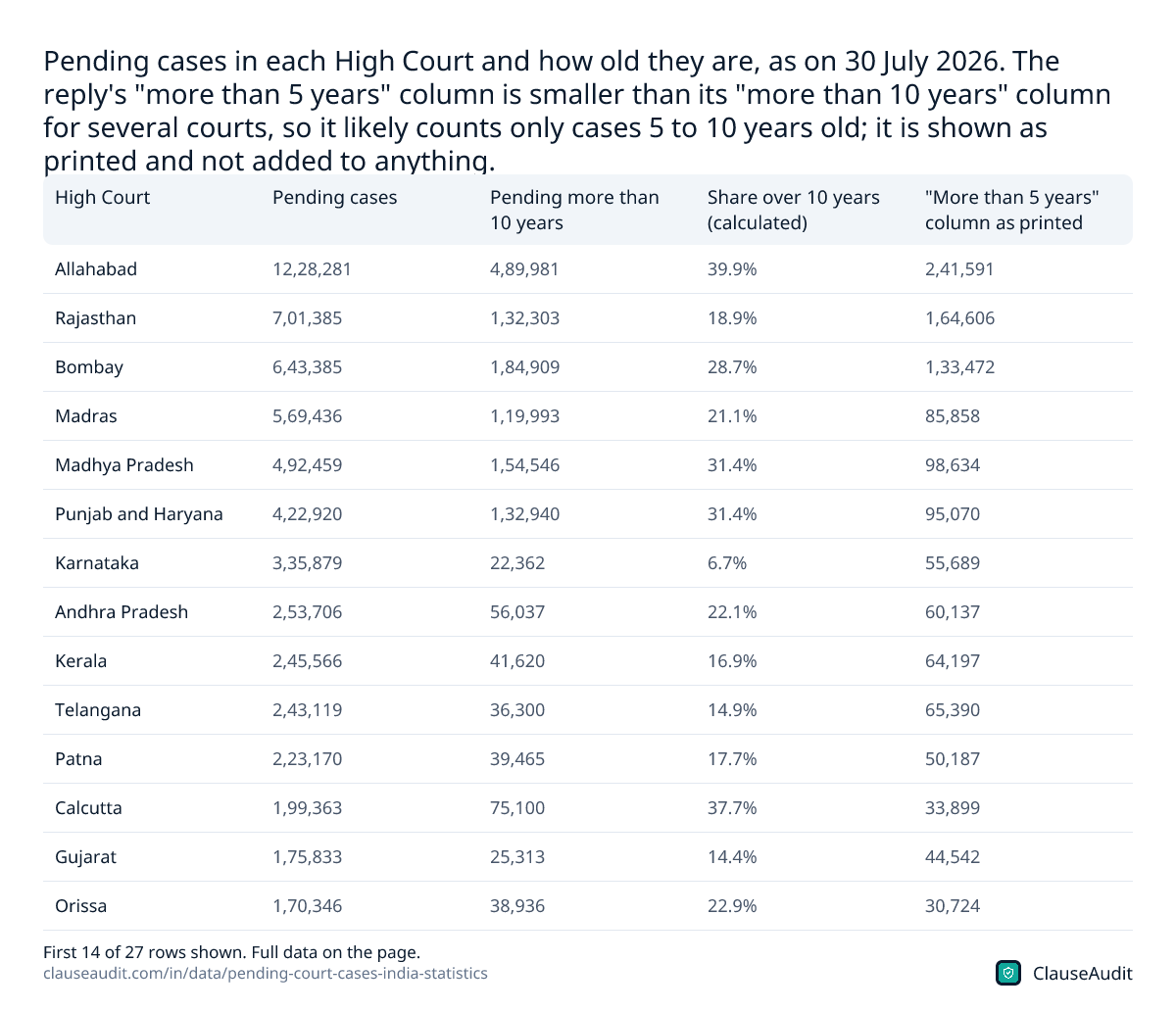
Pending cases in each High Court and how old they are, as on 30 July 2026. The reply's "more than 5 years" column is smaller than its "more than 10 years" column for several courts, so it likely counts only cases 5 to 10 years old; it is shown as printed and not added to anything.
| High Court | Pending cases | Pending more than 10 years | Share over 10 years (calculated) | "More than 5 years" column as printed |
|---|---|---|---|---|
| Allahabad | 12,28,281 | 4,89,981 | 39.9% | 2,41,591 |
| Rajasthan | 7,01,385 | 1,32,303 | 18.9% | 1,64,606 |
| Bombay | 6,43,385 | 1,84,909 | 28.7% | 1,33,472 |
| Madras | 5,69,436 | 1,19,993 | 21.1% | 85,858 |
| Madhya Pradesh | 4,92,459 | 1,54,546 | 31.4% | 98,634 |
| Punjab and Haryana | 4,22,920 | 1,32,940 | 31.4% | 95,070 |
| Karnataka | 3,35,879 | 22,362 | 6.7% | 55,689 |
| Andhra Pradesh | 2,53,706 | 56,037 | 22.1% | 60,137 |
| Kerala | 2,45,566 | 41,620 | 16.9% | 64,197 |
| Telangana | 2,43,119 | 36,300 | 14.9% | 65,390 |
| Patna | 2,23,170 | 39,465 | 17.7% | 50,187 |
| Calcutta | 1,99,363 | 75,100 | 37.7% | 33,899 |
| Gujarat | 1,75,833 | 25,313 | 14.4% | 44,542 |
| Orissa | 1,70,346 | 38,936 | 22.9% | 30,724 |
| Delhi | 1,26,177 | 20,581 | 16.3% | 21,654 |
| Himachal Pradesh | 1,05,243 | 8,541 | 8.1% | 32,273 |
| Chhattisgarh | 73,887 | 6,234 | 8.4% | 17,047 |
| Jharkhand | 73,368 | 14,938 | 20.4% | 14,076 |
| Gauhati | 65,244 | 4,859 | 7.4% | 18,828 |
| Uttarakhand | 63,425 | 6,360 | 10.0% | 17,075 |
| Jammu & Kashmir and Ladakh | 44,557 | 6,106 | 13.7% | 7,328 |
| Manipur | 6,276 | 133 | 2.1% | 969 |
| Meghalaya | 2,009 | 7 | 0.3% | 88 |
| Tripura | 1,613 | 1 | 0.1% | 13 |
| Sikkim | 323 | 4 | 1.2% | 12 |
| Supreme Court of India | 95,954 | 9,425 | 9.8% | 14,352 |
| Total (25 High Courts) | 64,66,970 | 16,17,569 | 25.0% | 13,53,359 |
Source: Department of Justice, Ministry of Law and Justice, Government of India, Lok Sabha Unstarred Question No. 3371, "Cases Pendency and e-Courts Project", answered 07.08.2026 (Annexures I and II, NJDG data as on 30.07.2026). Download as image
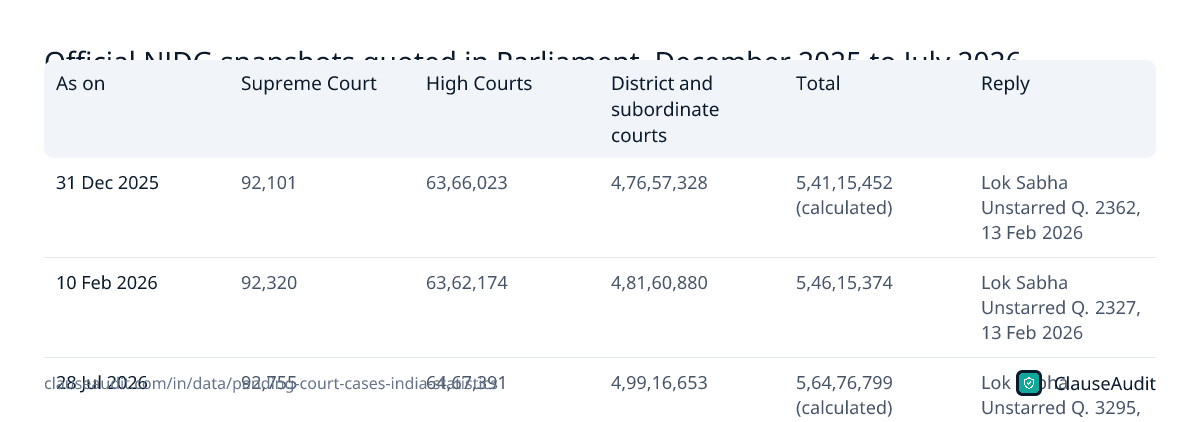
Official NJDG snapshots quoted in Parliament, December 2025 to July 2026
| As on | Supreme Court | High Courts | District and subordinate courts | Total | Reply |
|---|---|---|---|---|---|
| 31 Dec 2025 | 92,101 | 63,66,023 | 4,76,57,328 | 5,41,15,452 (calculated) | Lok Sabha Unstarred Q. 2362, 13 Feb 2026 |
| 10 Feb 2026 | 92,320 | 63,62,174 | 4,81,60,880 | 5,46,15,374 | Lok Sabha Unstarred Q. 2327, 13 Feb 2026 |
| 28 Jul 2026 | 92,755 | 64,67,391 | 4,99,16,653 | 5,64,76,799 (calculated) | Lok Sabha Unstarred Q. 3295, 7 Aug 2026 |
| 30 Jul 2026 | 95,954 | 64,66,970 | 4,99,11,920 | 5,64,74,844 (calculated) | Lok Sabha Unstarred Q. 3371, 7 Aug 2026 |
Source: Department of Justice, Ministry of Law and Justice, Government of India, Lok Sabha Unstarred Question No. 2362, "Pendency of Cases", answered 13.02.2026 (Annexures I and II, NJDG data as on 31.12.2025); Department of Justice, Ministry of Law and Justice, Government of India, Lok Sabha Unstarred Question No. 2327, "Justice Delivery System through Digitization", answered 13.02.2026 (NJDG data as on 10.02.2026); Department of Justice, Ministry of Law and Justice, Government of India, Lok Sabha Unstarred Question No. 3295, "Case Pendency in Judiciary", answered 07.08.2026 (Annexures I and II, NJDG data); Department of Justice, Ministry of Law and Justice, Government of India, Lok Sabha Unstarred Question No. 3371, "Cases Pendency and e-Courts Project", answered 07.08.2026 (Annexures I and II, NJDG data as on 30.07.2026). Download as image
Cases pending in district and subordinate courts (30 July 2026) by State
- 11 crore or more
- 425 lakh to 1 crore
- 1010 lakh to 25 lakh
- 81 lakh to 10 lakh
- 13Under 1 lakh
How many cases are pending in Indian courts in 2026?
The short answer is about 5.65 crore, counted across all three tiers on 28 July 2026. The exact sum from the government's reply is 5,64,76,799. District and subordinate courts account for 4.99 crore of that, High Courts for 64.67 lakh and the Supreme Court for 92,755.
Don't be thrown if you see slightly different figures elsewhere. NJDG updates daily, so every quoted number is a snapshot. Two replies tabled in Parliament on the same day used data from 28 July and 30 July 2026, and the Supreme Court count moved from 92,755 to 95,954 between them. Both are official.
The trend is the part worth noticing. Every tier is higher than it was in 2021. The district courts went from 4.11 crore pending cases in 2021 to 4.99 crore, a rise of 21.6%. Whatever the reasons, a dispute filed today joins a longer line than one filed five years ago.
Which states and High Courts have the biggest backlog?
Uttar Pradesh dominates. Its district courts had 1,19,90,328 cases pending on 30 July 2026, roughly a quarter of all district court cases in the country. Maharashtra (61.70 lakh), West Bengal (41.43 lakh) and Bihar (37.76 lakh) follow.
Growth varies a lot. West Bengal's district backlog stood at 23,84,020 in 2021 and 41,42,621 in July 2026. A few states went the other way: Gujarat fell from 19,52,262 to 16,14,861, and Kerala from 20,89,147 to 17,87,816. So the state map is not just a population map.
Among High Courts, Allahabad carries 12.28 lakh pending cases, and 39.9% of them are more than 10 years old. Calcutta is smaller but almost as stale, with 37.7% of its cases past the decade mark. Karnataka High Court sits at 6.7%, which shows how different the experience can be depending on where your appeal lands.
How long do court cases take in India?
The figures quoted in Parliament don't give an average time to judgment, but the age of pending cases tells you plenty. On 30 July 2026, 54.52 lakh district court cases had been pending for more than 10 years. That is 10.9% of everything in those courts.
It gets worse higher up. In the High Courts, 25% of pending cases were older than 10 years. In the Supreme Court, 9,425 cases had crossed that line.
Most district court cases are younger than 10 years, and a well-documented money claim can move faster than a land or family dispute. But if you plan a business on the assumption that a court will enforce your contract within a year or two, these numbers say you should have a backup plan. And a district court win can be appealed, which restarts the clock in a court that may be just as busy.
What does the court backlog mean for freelancers and small businesses?
Picture a graphic designer in Lucknow who is owed for three months of work by a client in the same city. Her contract says nothing about advances, interest or how disputes get settled. Her real options are a legal notice, a long wait and a suit in a district system already holding 1.20 crore cases. Faced with that, writing the money off can start to look sensible.
The lesson is practical. In India, the contract has to do most of the enforcement work before anything goes wrong, because the court route is slow and expensive for small amounts. That means getting paid in stages, keeping the right to pause work, and agreeing in advance on a faster way to settle a fight.
If you were registered on Udyam as a micro or small enterprise when you signed the contract, you may also be able to take a delayed payment claim to the Micro and Small Enterprises Facilitation Council in your state, which is often quicker than a regular suit. Check whether your contract's payment terms line up with that law before you sign. A client who knows you can use that route is also more likely to pay on time.
- Ask for an advance or milestone payments so your unpaid exposure stays small.
- Put a clear due date and a late payment interest rate in writing.
- Keep a right to suspend work or withhold handover of files until invoices are paid.
- Agree on mediation or arbitration, with a named city and institution, before a dispute starts.
- Keep a paper trail: signed scope, email approvals and dated invoices make any claim faster.
Is arbitration faster than going to court in India?
Often, yes, if the clause is written well. A vague line like "disputes shall be referred to arbitration" can itself end up in court, with the parties arguing over who appoints the arbitrator and where hearings happen.
A usable clause names the seat (the legal home of the arbitration), the institution or appointment process, a sole arbitrator for smaller claims, the language and how costs are shared. A short mediation step before arbitration can also settle many disputes cheaply.
Keep your expectations honest. Arbitration awards are still enforced through the courts, and a party that wants to delay can challenge an award. The gain is that the main fight happens outside the queue. For a business owner, that can mean months instead of years.
How to check pending cases on NJDG
NJDG is public, and you can look up both the big picture and your own matter.
- Open the National Judicial Data Grid on the eCourts website and pick the tier you want: district courts, High Courts or the Supreme Court.
- Use the dashboard to filter by state, district or court complex, and by civil or criminal cases, to see pendency and case age.
- To track one case, use the eCourts case status search with the CNR number, or search by party name, case number or advocate.
- Check the next hearing date and recent orders, and save copies of orders as you go.
- If you are deciding where to sue, compare the age of pending cases in the courts that could hear your matter. Volume alone can mislead.
How ClauseAudit helps
With crores of cases waiting, the cheapest dispute is the one your contract prevents or settles quickly. An automated review of your client agreement, vendor contract or service agreement flags the clauses that decide how fast you get paid and where a fight would end up, explained in plain English.
Upload the document and you'll see each risky clause, why it matters under Indian law, and what to ask for instead.
- Payment terms: due dates, advances, milestones and whether payment hangs on vague client approval
- Late payment interest and your right to pause work or hold deliverables when invoices go unpaid
- Dispute resolution: whether there is a mediation step and a properly drafted arbitration clause with a seat and institution
- Jurisdiction clauses that force you to litigate in the other side's city
- Liability caps and indemnities that could turn a small disagreement into a large claim
- Termination and kill fee terms, so you are paid for work done if the project ends early
Frequently asked questions
How many cases are pending in India in 2026?
About 5.65 crore cases were pending across the Supreme Court, High Courts and district courts on 28 July 2026, according to NJDG data in a Lok Sabha reply. The exact total was 5,64,76,799. Because NJDG updates daily, figures quoted on other dates will differ slightly.
How many cases are pending in the Supreme Court of India?
The Supreme Court had 92,755 pending cases on 28 July 2026, per one Lok Sabha reply. Another reply from the same day, using data from 30 July 2026, gave 95,954. Both come from NJDG snapshots, and the gap simply reflects the two different dates.
Which state has the most pending cases in India?
Uttar Pradesh, by a wide margin. Its district and subordinate courts had 1.20 crore cases pending on 30 July 2026, about 24% of the national district court total. Maharashtra was second with 61.70 lakh. Allahabad High Court also has the largest High Court backlog at 12.28 lakh.
How many cases have been pending for more than 10 years?
In district courts, 54.52 lakh cases were older than 10 years on 30 July 2026, about 10.9% of the total. In the High Courts the share was 25%. Uttar Pradesh alone accounted for 23.19 lakh of the decade-old district cases.
Is the backlog of cases in India growing?
Yes. District court pendency rose from 4.11 crore in 2021 to 4.99 crore by July 2026, up 21.6%. High Court pendency went from 58.68 lakh to 64.67 lakh over the same period. Each year in the series was higher than the one before.
What is NJDG?
The National Judicial Data Grid is the government's public database of case data from courts across India, built under the eCourts project. It shows pending and disposed cases by court, state and case age, and it is the source the Department of Justice quotes when answering questions in Parliament.
Should I sue a client who has not paid me?
Start with a written demand and check your contract for a mediation or arbitration clause, since that may be faster. If you are a registered micro or small enterprise, a delayed payment claim before the state Micro and Small Enterprises Facilitation Council is another route. Weigh the amount owed against the time a suit could take.
Can a contract say which court will hear a dispute?
Partly. Parties can agree that one of the courts that already has jurisdiction will hear their disputes, for example the courts of a named city connected to the deal. They cannot give jurisdiction to a court that has none. Read these clauses closely, because they can make you litigate far from home.
Use this data
Every chart and card below is free to reuse under CC BY 4.0. Download what you need and link back to this page.
 Stat cards
 Key findings card
 Infographic
 Cases pending in India's district and subordinate courts, 2021 to 2026
 Cases pending across all 25 High Courts, 2021 to 2026
 Cases pending in the Supreme Court of India, 2021 to 2026
 States with the most cases pending in district and subordinate courts, July 2026
 High Courts with the most pending cases, July 2026
 District court cases pending for more than 10 years, top states, July 2026
 Pending cases in Indian courts by tier, 2021 to 28 July 2026
 Pending cases in each High Court and how old they are, as on 30 July 2026. The reply's "more than 5 years" column is smaller than its "more than 10 years" column for several courts, so it likely counts only cases 5 to 10 years old; it is shown as printed and not added to anything.
 Official NJDG snapshots quoted in Parliament, December 2025 to July 2026
Embed the infographic
Free to share on your site, blog or slides under CC BY 4.0. Please keep the credit link.
Sources and method
Every number on this page comes from the sources below, each opened and read on or before October 17, 2026. A second, independent review checked every figure against its source and corrected anything that did not match. 36 of 36 State entries were confirmed; any that could not be are marked "Not yet confirmed" and left out of every count and chart.
- Department of Justice, Ministry of Law and Justice, Government of India, Lok Sabha Unstarred Question No. 3295, "Case Pendency in Judiciary", answered 07.08.2026 (Annexures I and II, NJDG data) (7 August 2026 (Lok Sabha Monsoon Session 2026 replies, compiled September 2026))
- Department of Justice, Ministry of Law and Justice, Government of India, Lok Sabha Unstarred Question No. 3371, "Cases Pendency and e-Courts Project", answered 07.08.2026 (Annexures I and II, NJDG data as on 30.07.2026) (7 August 2026 (Lok Sabha Monsoon Session 2026 replies, compiled September 2026))
- Department of Justice, Ministry of Law and Justice, Government of India, Lok Sabha Unstarred Question No. 2362, "Pendency of Cases", answered 13.02.2026 (Annexures I and II, NJDG data as on 31.12.2025) (13 February 2026 (Lok Sabha Budget Session 2026, Part 1 replies))
- Department of Justice, Ministry of Law and Justice, Government of India, Lok Sabha Unstarred Question No. 2327, "Justice Delivery System through Digitization", answered 13.02.2026 (NJDG data as on 10.02.2026) (13 February 2026 (Lok Sabha Budget Session 2026, Part 1 replies))
Cite this page
ClauseAudit, “Pending Court Cases in India 2026: NJDG Statistics by Court and State”, updated October 17, 2026, https://clauseaudit.com/in/data/pending-court-cases-india-statistics. Free to reuse with a link back (CC BY 4.0).
This page summarises published data and law as checked on October 17, 2026. Figures are updated as new editions are released, and your own situation may differ. It is general information, not legal, tax or financial advice.