Paycheck Deduction Laws by State: What Your Employer Can Legally Take Out
By ClauseAudit Research · 11 sources ·
What are the wage deduction laws by state?
Most states require your written consent before an employer takes money out of your pay. In 29 states the rule is written employee authorization, and 9 more allow only deductions named in the law. Court garnishments are separate: for ordinary debts, federal law caps them at 25% of disposable pay.

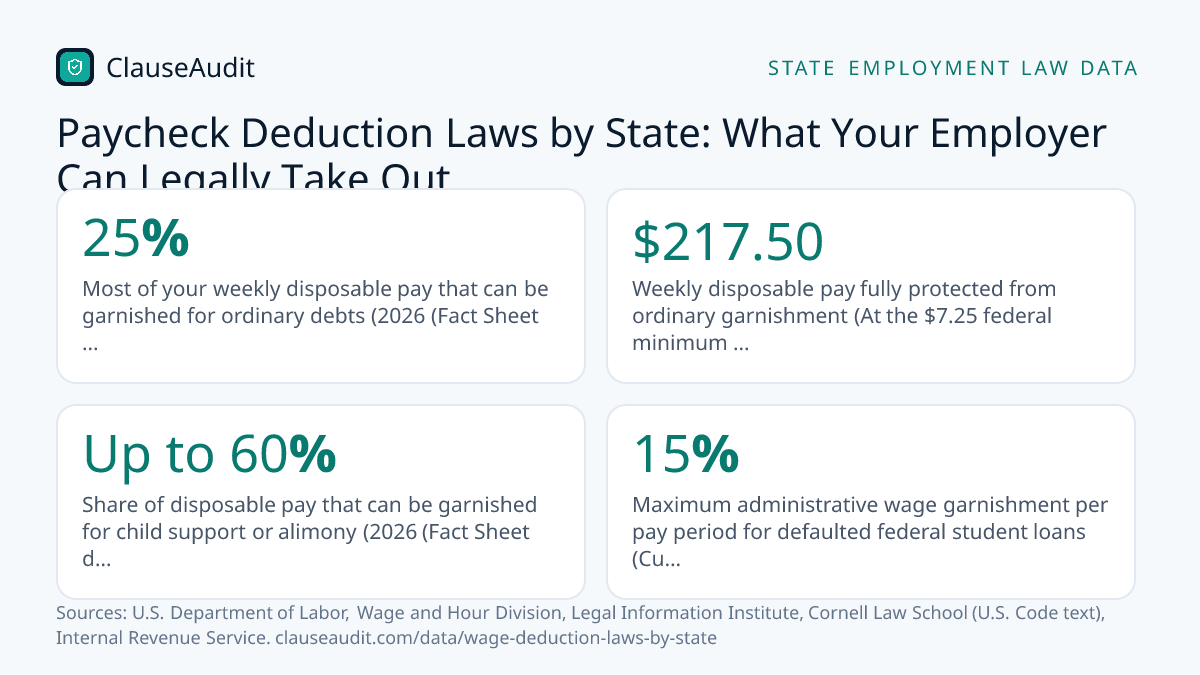
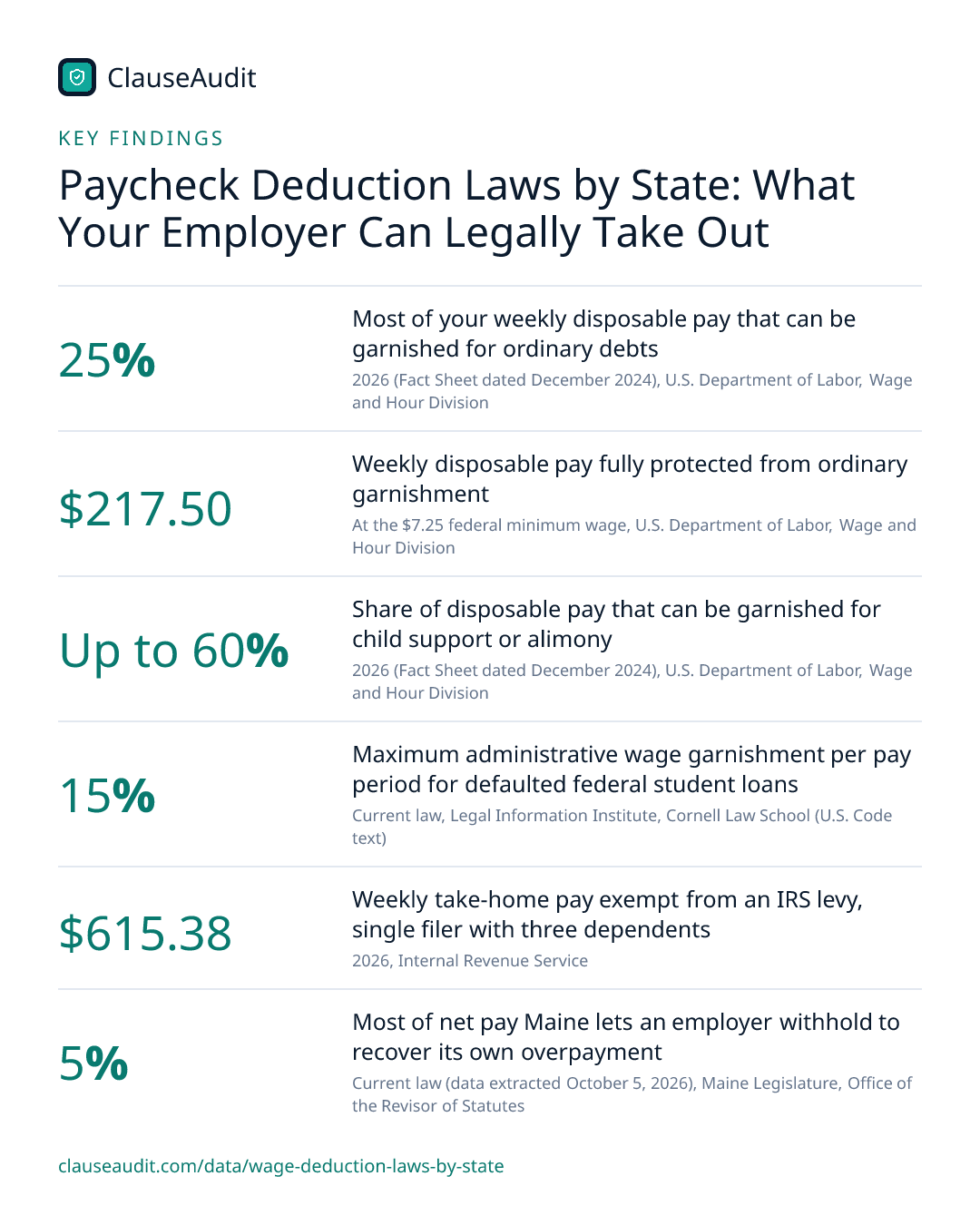
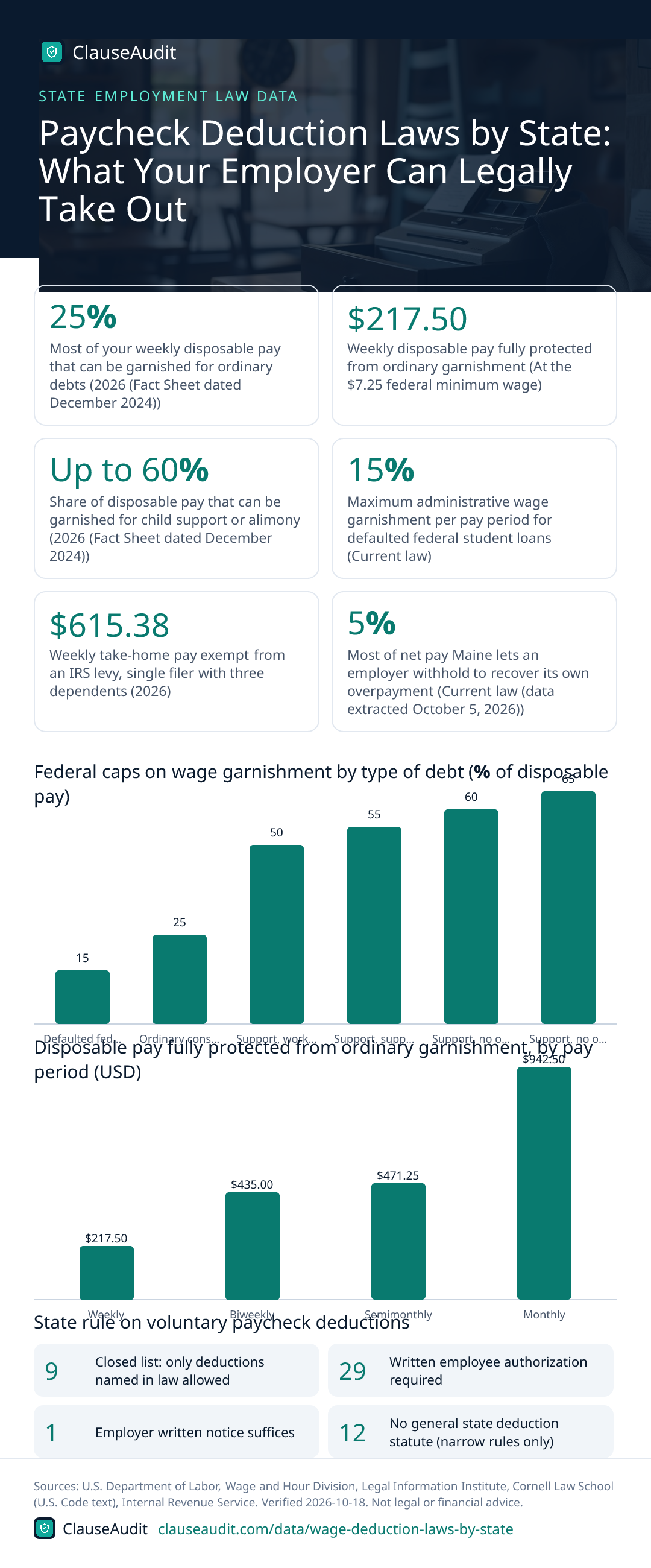
- Most of your weekly disposable pay that can be garnished for ordinary debts (2026 (Fact Sheet dated December 2024), U.S. Department of Labor, Wage and Hour Division)
- 25%
- Weekly disposable pay fully protected from ordinary garnishment (At the $7.25 federal minimum wage, U.S. Department of Labor, Wage and Hour Division)
- $217.50
- Share of disposable pay that can be garnished for child support or alimony (2026 (Fact Sheet dated December 2024), U.S. Department of Labor, Wage and Hour Division)
- Up to 60%
- Maximum administrative wage garnishment per pay period for defaulted federal student loans (Current law, Legal Information Institute, Cornell Law School (U.S. Code text))
- 15%
- Weekly take-home pay exempt from an IRS levy, single filer with three dependents (2026, Internal Revenue Service)
- $615.38
- Most of net pay Maine lets an employer withhold to recover its own overpayment (Current law (data extracted October 5, 2026), Maine Legislature, Office of the Revisor of Statutes)
- 5%
- Minnesota employer liability for an unlawful deduction for loss, theft or damage (2025 Minnesota Statutes, Minnesota Office of the Revisor of Statutes)
- 2x
Taxes come out of every paycheck. That part is not up for debate. The fights start over everything else: the uniform you were told to buy, the register that came up short on a busy Saturday, the laptop that cracked, the advance your boss now wants back all at once.
If your employer can legally take that money depends heavily on where you work. We sorted all 50 states and DC by how they treat voluntary deductions, then laid out the federal limits on garnishments and tax levies that apply everywhere. Below is what the rules mean in practice and what to do when a deduction looks wrong.
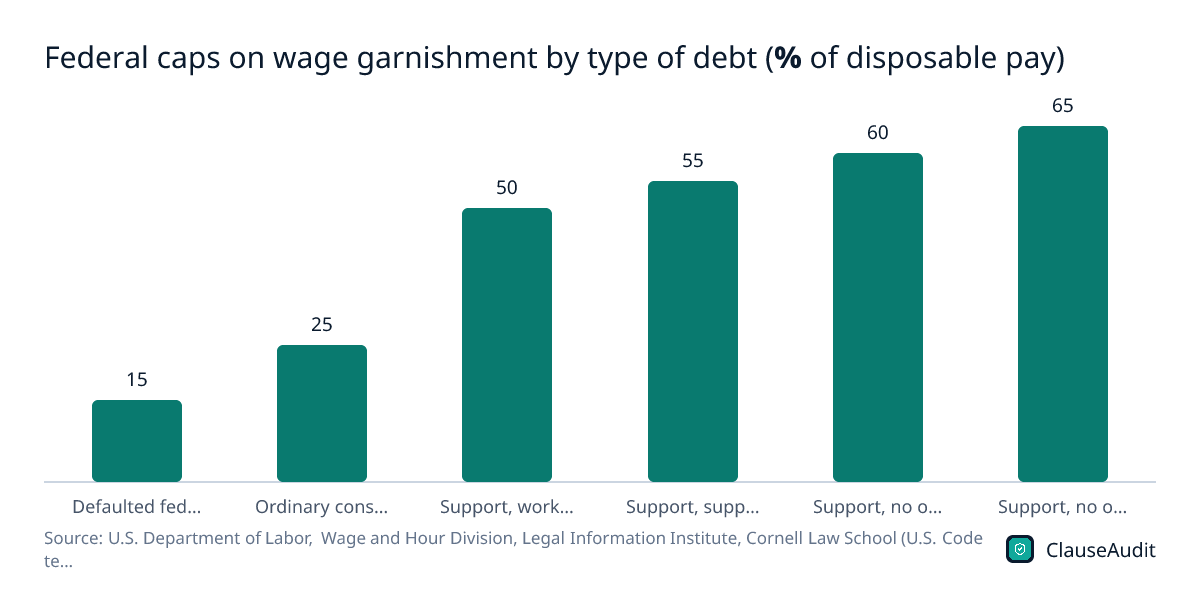
Federal caps on wage garnishment by type of debt (% of disposable pay)
Chart data
| Label | Value |
|---|---|
| Defaulted federal student loans (administrative) | 15 |
| Ordinary consumer debts | 25 |
| Support, worker supports another family | 50 |
| Support, supporting another family, 12+ weeks behind | 55 |
| Support, no other family | 60 |
| Support, no other family, 12+ weeks behind | 65 |
These caps apply to court orders and government collection, not to deductions your employer starts on its own. Support orders can take far more than an ordinary creditor: up to 60% versus 25%.
Download this chart (PNG)Disposable pay fully protected from ordinary garnishment, by pay period (USD)
Chart data
| Label | Value (USD) |
|---|---|
| Weekly | $217.50 |
| Biweekly | $435.00 |
| Semimonthly | $471.25 |
| Monthly | $942.50 |
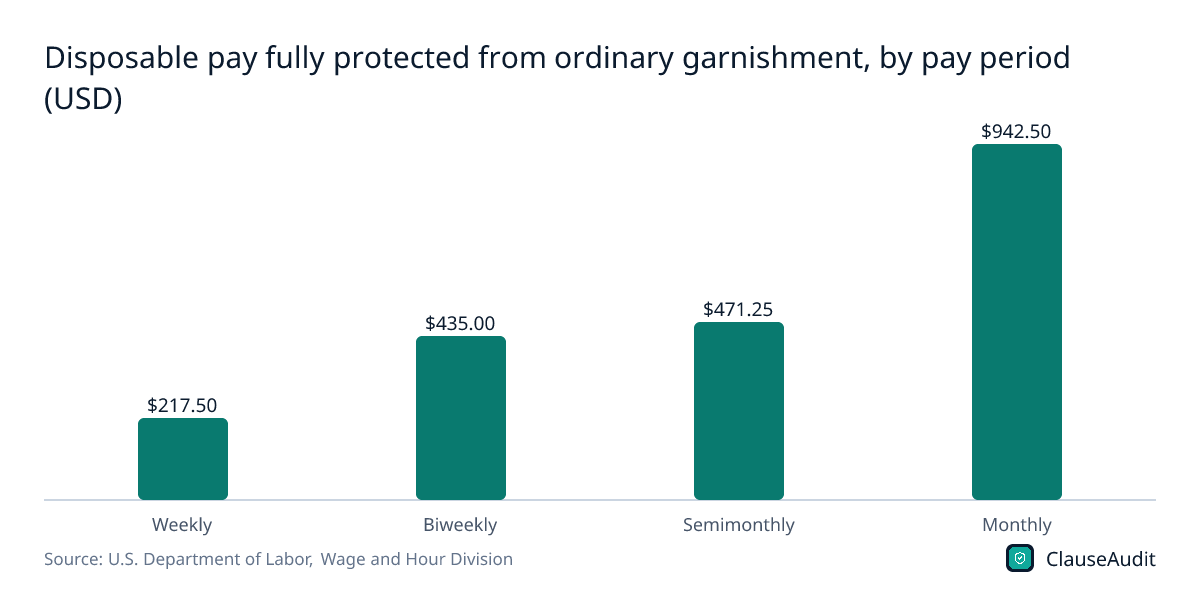
If your weekly disposable pay is $217.50 or less, an ordinary creditor gets nothing. The protected floor scales with your pay period, so it is $942.50 for monthly pay.
Download this chart (PNG)Weekly take-home pay exempt from an IRS wage levy in 2026, single filer (USD per week)
Chart data
| Label | Value (USD per week) |
|---|---|
| 0 dependents | $309.62 |
| 1 dependent | $411.54 |
| 2 dependents | $513.46 |
| 3 dependents | $615.38 |
| 4 dependents | $717.30 |
| 5 dependents | $819.22 |
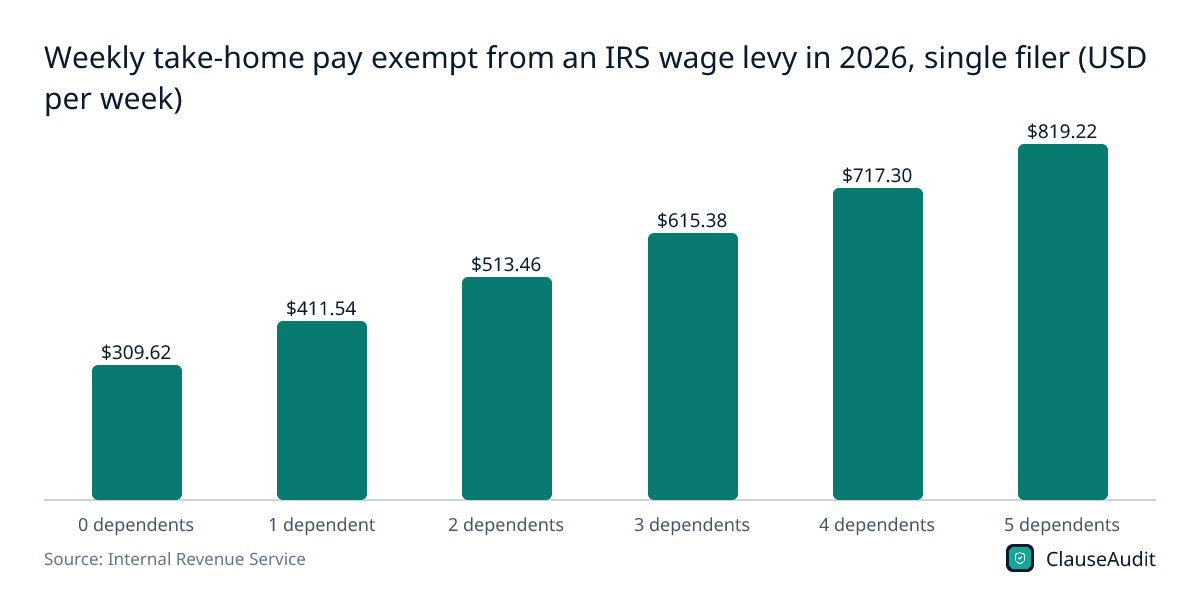
The IRS uses its own table instead of the 25% rule. A single filer with no dependents keeps $309.62 a week, and each dependent raises the amount you keep.
Download this chart (PNG)How states regulate voluntary paycheck deductions (50 states + DC) (jurisdictions)
Chart data
| Label | Value (jurisdictions) |
|---|---|
| Closed list: only deductions named in law allowed | 9 |
| Written employee authorization required | 29 |
| Employer written notice suffices | 1 |
| No general state deduction statute (narrow rules only) | 12 |
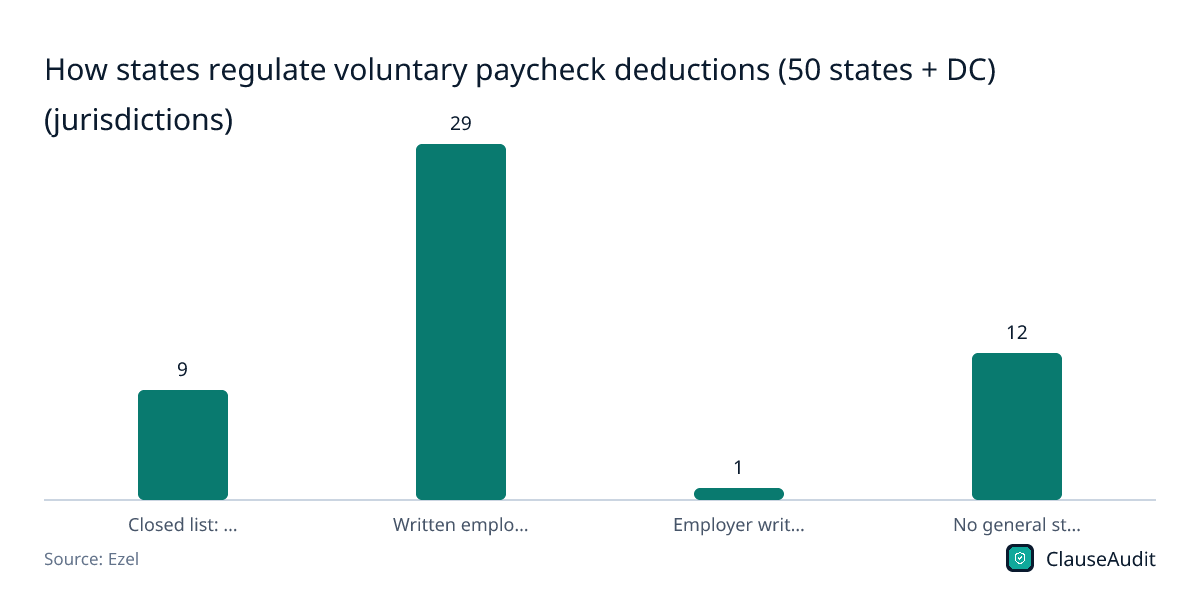
Written employee authorization is the most common approach, used in 29 states. The 12 jurisdictions with no general statute still sit under the federal minimum wage floor.
Download this chart (PNG)State caps on how much of one paycheck can go to repaying overpayments or advances (% of pay per pay period)
Chart data
| Label | Value |
|---|---|
| Maine (employer-error overpayment, % of net pay) | 5 |
| Michigan (payroll-error overpayment, no-consent route, % of gross) | 15 |
| Illinois (cash-advance repayment, % of gross) | 15 |
| Delaware (cash advance or goods repayment, % of gross) | 15 |
| New Hampshire (accidental overpayment, % of gross) | 20 |
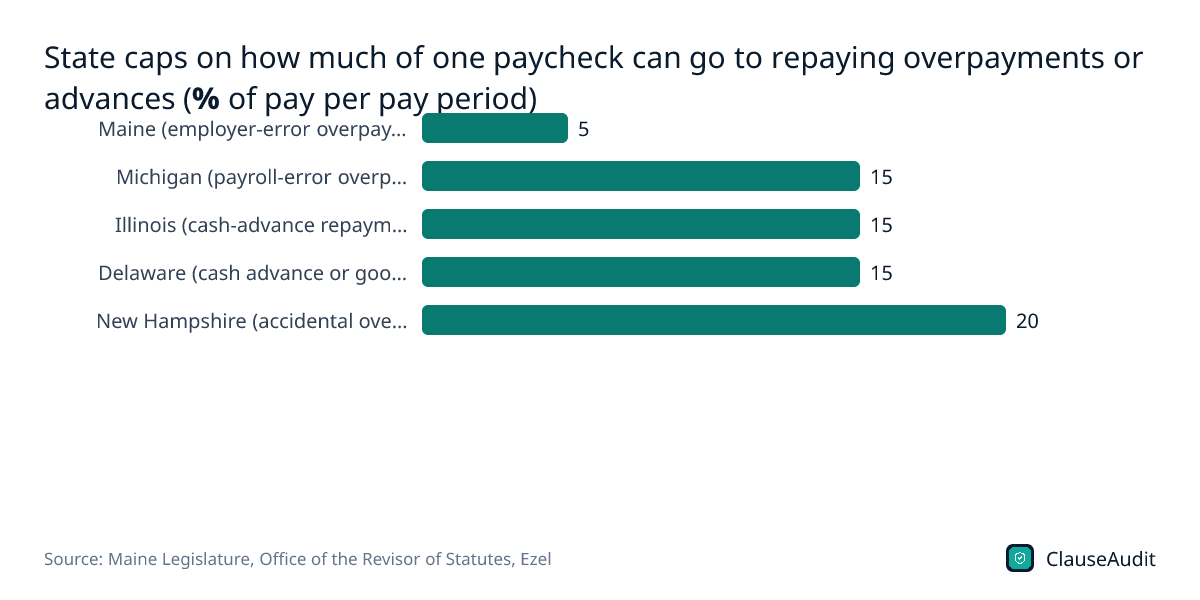
Even when an employer really did overpay you, several states stop it from clawing everything back in one check. Maine is the strictest at 5% of net pay, and these caps measure different things, so compare them with care.
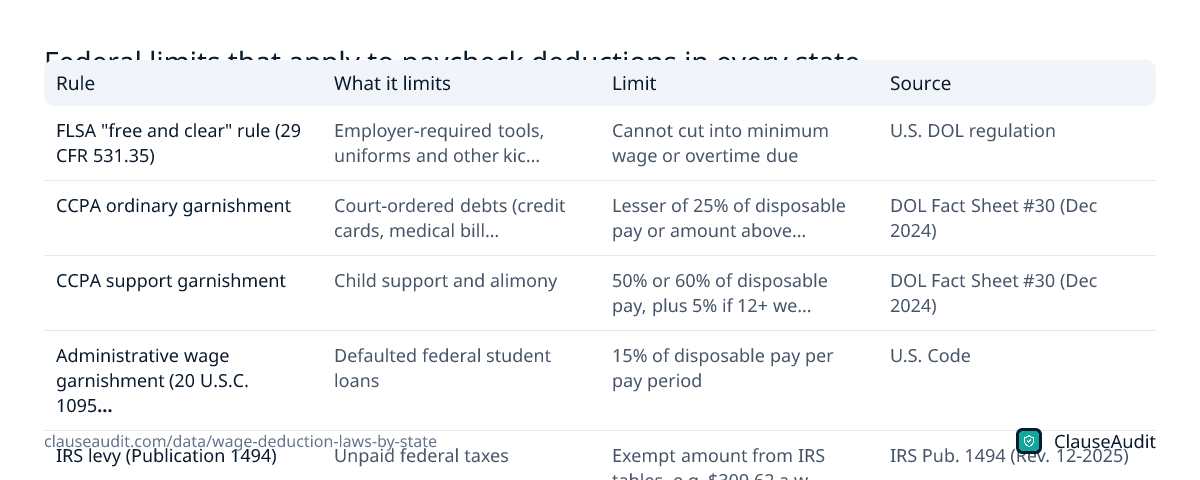
Download this chart (PNG)Federal limits that apply to paycheck deductions in every state
| Rule | What it limits | Limit | Source |
|---|---|---|---|
| FLSA "free and clear" rule (29 CFR 531.35) | Employer-required tools, uniforms and other kickbacks | Cannot cut into minimum wage or overtime due | U.S. DOL regulation |
| CCPA ordinary garnishment | Court-ordered debts (credit cards, medical bills, etc.) | Lesser of 25% of disposable pay or amount above $217.50 a week | DOL Fact Sheet #30 (Dec 2024) |
| CCPA support garnishment | Child support and alimony | 50% or 60% of disposable pay, plus 5% if 12+ weeks in arrears | DOL Fact Sheet #30 (Dec 2024) |
| Administrative wage garnishment (20 U.S.C. 1095a) | Defaulted federal student loans | 15% of disposable pay per pay period | U.S. Code |
| IRS levy (Publication 1494) | Unpaid federal taxes | Exempt amount from IRS tables, e.g. $309.62 a week for a single filer with no dependents (2026) | IRS Pub. 1494 (Rev. 12-2025) |
Source: Legal Information Institute, Cornell Law School (e-CFR text), 29 CFR § 531.35, "Free and clear" payment; "kickbacks"; U.S. Department of Labor, Wage and Hour Division, Fact Sheet #30: Wage Garnishment Protections of the Consumer Credit Protection Act (CCPA); Legal Information Institute, Cornell Law School (U.S. Code text), 20 U.S.C. § 1095a, Wage garnishment requirement; Internal Revenue Service, Publication 1494, Tables for Figuring Amount Exempt from Levy on Wages, Salary, and Other Income (2026). Download as image
State rule on voluntary paycheck deductions by state
- 9Closed list: only deductions named in law allowed
- 29Written employee authorization required
- 1Employer written notice suffices
- 12No general state deduction statute (narrow rules only)
- Closed list: only deductions named in law allowed9
- Written employee authorization required29
- Employer written notice suffices1
- No general state deduction statute (narrow rules only)12
| State | Employee consent rule | Shortages, breakage, damage | Main law | Source |
|---|---|---|---|---|
| Alabama | No general state rule; Alabama DOL refers deduction questions to the federal Wage and Hour Division | No state rule; federal FLSA minimum-wage floor applies | None (federal FLSA) | None (federal FLSA) |
| Alaska | Written agreement for amounts owed to the employer; signed written direction for third-party deductions | Shortages and missing property only if the employee admits in writing; damage only if clearly willful and acknowledged in writing | 8 AAC 15.160 | 8 AAC 15.160 |
| Arizona | Prior written authorization (revocable in writing), unless law requires the deduction | No specific rule; employer may withhold amounts in a reasonable good-faith wage dispute | A.R.S. § 23-352 | A.R.S. § 23-352 |
| Arkansas | No general statute; a rule applies only when a deduction would cut pay below minimum wage or overtime | May never take pay below minimum wage for breakage, cash or inventory shortages, or fines | Ark. DOL rule, 11 CAR § 11-702 | Ark. DOL rule, 11 CAR § 11-702 |
| California | Express written authorization, or required by law, or CBA benefit contributions | Shortage, breakage or equipment loss only if caused by a dishonest or willful act or gross negligence | Cal. Lab. Code §§ 221, 224; IWC Wage Orders | Cal. Lab. Code §§ 221, 224; IWC Wage Orders |
| Colorado | Only listed categories: law-required, written agreements for loans, goods or equipment, and revocable voluntary authorizations | Only theft-related shortages reported to police; refund with interest if no charges within 90 days or acquittal | C.R.S. § 8-4-105 | C.R.S. § 8-4-105 |
| Connecticut | Written authorization on a form approved by the Labor Commissioner | No self-help for shortages or breakage without an approved authorization | Conn. Gen. Stat. § 31-71e | Conn. Gen. Stat. § 31-71e |
| Delaware | Signed authorization for a lawful purpose that benefits the employee | Cash/inventory shortages and property damage barred even with a signed agreement (Reg. 1328) | 19 Del. C. § 1107; 19 DE Admin. Code 1328 | 19 Del. C. § 1107; 19 DE Admin. Code 1328 |
| District of Columbia | No broad signed-authorization statute; deductions cannot cut covered pay below the DC minimum wage | Agency guidance bars deductions for damaged company equipment; employer pays required uniforms | D.C. Code §§ 32-1301 to -1312; 7 DCMR ch. 9 | D.C. Code §§ 32-1301 to -1312; 7 DCMR ch. 9 |
| Florida | No general statute; the employment agreement and the federal FLSA govern | No general state rule; day laborers cannot be charged for required safety equipment | Fla. Stat. ch. 448 (Labor Pool Act §§ 448.20-448.26) | Fla. Stat. ch. 448 (Labor Pool Act §§ 448.20-448.26) |
| Georgia | No general statute; only union-dues deductions need written, revocable authorization | No state rule | O.C.G.A. §§ 34-6-25, 34-6-26 | O.C.G.A. §§ 34-6-25, 34-6-26 |
| Hawaii | Written authorization (or required by statute or court process) | Fines, specified shortages and breakage barred even with written consent | Haw. Rev. Stat. § 388-6 | Haw. Rev. Stat. § 388-6 |
| Idaho | Written authorization for a lawful purpose (or required by law) | No specific list; a signature cannot validate an otherwise unlawful deduction | Idaho Code § 45-609 | Idaho Code § 45-609 |
| Illinois | Express written consent given freely at the time the deduction is made | Shortages and damage need that time-of-deduction consent; cash-advance repayment capped at 15% of gross per check | 820 ILCS 115/9; 56 Ill. Adm. Code 300 | 820 ILCS 115/9; 56 Ill. Adm. Code 300 |
| Indiana | Signed, revocable written wage assignment for a purpose listed in the statute | Cash shortages, breakage, damage and theft are not listed purposes | Ind. Code § 22-2-6-2 | Ind. Code § 22-2-6-2 |
| Iowa | Written authorization for a lawful purpose that benefits the employee | Shared-till shortages, non-willful breakage or damage, tips and most protective equipment cannot be deducted | Iowa Code § 91A.5 | Iowa Code § 91A.5 |
| Kansas | Signed authorization for a lawful purpose benefiting the employee; signed agreement for loans, overpayments, merchandise or uniforms | No general loss deduction; deductions may not cut pay below minimum wage | K.S.A. 44-319 | K.S.A. 44-319 |
| Kentucky | Express written authorization (or authorized by law) | Fines, shared-till shortages, breakage and certain bad-check losses barred | KRS 337.060 | KRS 337.060 |
| Louisiana | No general consent rule; fines on employees are prohibited | A charge only up to actual damage when the employee willfully or negligently damages employer property | La. R.S. 23:635 | La. R.S. 23:635 |
| Maine | Only listed purposes: loans, advances, employer merchandise, specified insurance, company housing | Cash and inventory shortages, bad checks, property damage and logo uniforms are not deductible debts | 26 M.R.S. §§ 629, 635 | 26 M.R.S. §§ 629, 635 |
| Maryland | Court order, express written authorization, Commissioner approval, or other law | No separate statutory loss list; one of the same four routes is required | Md. Code, Lab. & Empl. § 3-503 | Md. Code, Lab. & Empl. § 3-503 |
| Massachusetts | No general signed-authorization rule; only a valid set-off of a clear, established debt | Employer cannot deduct unilaterally for losses it attributes to the worker | M.G.L. c. 149, §§ 148, 150 | M.G.L. c. 149, §§ 148, 150 |
| Michigan | Full, free written consent given without fear of discharge | Employer-benefit deductions need consent for each paycheck and cannot cut pay below the state minimum wage | MCL 408.477 | MCL 408.477 |
| Minnesota | For losses or debts: written authorization given after the loss arises; purchases and loans may be pre-authorized | Barred unless post-loss written consent or a court judgment; employer liable for twice the deduction | Minn. Stat. § 181.79 | Minn. Stat. § 181.79 |
| Mississippi | No general statute | No state rule | Miss. Code § 71-1-45 (wage assignments only) | Miss. Code § 71-1-45 (wage assignments only) |
| Missouri | No general statute; deductions cannot take pay below minimum wage | No state rule | RSMo ch. 290 | RSMo ch. 290 |
| Montana | Only deductions provided for by law plus reasonable board, room and incidentals | Shortages and damage are not a permitted deduction category | Mont. Code Ann. § 39-3-204 | Mont. Code Ann. § 39-3-204 |
| Nebraska | Written agreement required; verbal consent is not enough | Loss recovery needs a written agreement or court order | Neb. Rev. Stat. § 48-1230 | Neb. Rev. Stat. § 48-1230 |
| Nevada | Written authorization for a specific purpose, pay period and amount; no blanket advance authorizations | Employer needs a reasonable basis plus that specific written authorization | NRS 608.110; NAC 608.160 | NRS 608.110; NAC 608.160 |
| New Hampshire | Written authorization for a purpose the statute lists | Employer loss or damage charges cannot be shifted through payroll; overpayment deductions max 20% of gross | RSA 275:48 | RSA 275:48 |
| New Jersey | Only categories listed in N.J.S.A. 34:11-4.4 | Shortages, breakage, damage and unreturned property are not on the list; consent cannot add them | N.J.S.A. 34:11-4.4 | N.J.S.A. 34:11-4.4 |
| New Mexico | Written authorization signed by employer and employee | Employer-benefit deductions (shortages, breakage) cannot cut pay below minimum wage | NMSA § 50-4-2; 11.1.4 NMAC | NMSA § 50-4-2; 11.1.4 NMAC |
| New York | Voluntary written authorization, after written notice, for listed benefit purposes | Shortages, breakage and damage are outside the allowed list | N.Y. Lab. Law § 193 | N.Y. Lab. Law § 193 |
| North Carolina | Signed authorization stating the reason and amount; advance notice if the amount is unknown | Cash/inventory shortage or damage deductions need 7 days' written notice | N.C. Gen. Stat. § 95-25.8; 13 NCAC 12 .0305 | N.C. Gen. Stat. § 95-25.8; 13 NCAC 12 .0305 |
| North Dakota | Written authorization (recurring) or written authorization citing the source (one-time) | Damage, breakage, shortage or negligence deductions need consent at the time of the deduction | N.D.C.C. § 34-14-04.1 | N.D.C.C. § 34-14-04.1 |
| Ohio | No comprehensive statute; fringe-benefit deductions need a written agreement | No deduction for destroyed or damaged wares or tools without an express contract | Ohio Rev. Code §§ 4113.15, 4113.19 | Ohio Rev. Code §§ 4113.15, 4113.19 |
| Oklahoma | Written payroll-deduction agreement signed before the deduction | Breakage or cash/inventory shortage only if the employee was the sole party responsible | 40 O.S. § 165.2; OAC 380:30-1-7 | 40 O.S. § 165.2; OAC 380:30-1-7 |
| Oregon | Voluntary written authorization for the employee's benefit, recorded in the employer's books | Shortages, breakage, damage and required uniforms or tools not deductible even with a signature (BOLI rules) | ORS 652.610(3) | ORS 652.610(3) |
| Pennsylvania | Only deductions allowed by law or listed in the Department of Labor & Industry regulation; many need written authorization | No general shortage or damage deduction on the list | 43 P.S. § 260.3; 34 Pa. Code § 9.1 | 43 P.S. § 260.3; 34 Pa. Code § 9.1 |
| Rhode Island | Prior written or electronic employee approval | Spoilage, breakage, shortages, losses and fines can never be authorized | R.I. Gen. Laws § 28-14-3.2 | R.I. Gen. Laws § 28-14-3.2 |
| South Carolina | Employer's written notice of the amount and terms; no employee signature required | Same notice rule applies; no separate loss rule | S.C. Code § 41-10-40(C) | S.C. Code § 41-10-40(C) |
| South Dakota | No general statute | In a wage dispute, only a debt the employee concedes may be subtracted | SDCL § 60-11-13 | SDCL § 60-11-13 |
| Tennessee | No general statute; offsets for advances, loans or card charges need a pre-signed agreement and 14 days' notice | No state rule | Tenn. Code Ann. § 50-2-110 | Tenn. Code Ann. § 50-2-110 |
| Texas | Written authorization for a lawful purpose (or court order or law) | No separate rule; written authorization needed | Tex. Lab. Code § 61.018 | Tex. Lab. Code § 61.018 |
| Utah | Express written authorization (or law, court order, adjudicated offset, retirement plan) | Requires written authorization or an adjudicated offset | Utah Code § 34-28-3 | Utah Code § 34-28-3 |
| Vermont | Written authorization for goods or services; express written consent for required apparel | Claimed damages and cash-register shortages prohibited | 21 V.S.A. § 342; Vermont Minimum Wage Rules | 21 V.S.A. § 342; Vermont Minimum Wage Rules |
| Virginia | Written and signed authorization (except taxes or as required by law) | No separate rule; signed authorization needed | Va. Code § 40.1-29(D) | Va. Code § 40.1-29(D) |
| Washington | Express written authorization in advance, for the employee's benefit | Till shortages, bad checks, walkouts and breakage not deductible during employment | WAC 296-126-028 | WAC 296-126-028 |
| West Virginia | Written authorization for listed benefits; other charges need a Commissioner-form wage assignment | Wage assignments must leave 75% of net wages exempt | W. Va. Code § 21-5-3; 42 CSR 5 | W. Va. Code § 21-5-3; 42 CSR 5 |
| Wisconsin | For losses: written authorization after the incident and before the deduction | Faulty work, loss, theft or damage only with post-incident consent, a joint fault finding, or a court ruling | Wis. Stat. § 103.455 | Wis. Stat. § 103.455 |
| Wyoming | Only enumerated offsets; benefit deductions need written authorization | Cash shortages only with written verification and sole register access | Wyoming Labor Standards rules, ch. 1 | Wyoming Labor Standards rules, ch. 1 |
Can my employer take money out of my paycheck without permission?
In most of the country, no. Taxes, court orders and deductions required by law come out automatically. For almost anything else, the employer needs something from you first, and the strictness of that requirement is what separates the states.
The largest group, 29 states, requires written employee authorization. A verbal yes in a hallway does not count. Some go further about the form: Nevada wants the authorization tied to a specific purpose, pay period and amount, and it bans blanket sign-offs in advance. Connecticut wants the authorization on a form approved by the Labor Commissioner.
Another 9 states run a closed list. New Jersey, New York, Pennsylvania and Maine are in this group. Only deductions the statute names are allowed. In New Jersey, for example, your signature cannot add a new category, so if shortages are not on the list, signing a form agreeing to cover them does not make the deduction legal.
South Carolina stands alone. There, the employer's written notice of the amount and terms is enough, and no employee signature is required. Then there are 12 jurisdictions with no general deduction statute at all, including Florida, Georgia and Alabama. That does not mean anything goes. The federal FLSA still bars deductions for tools, uniforms and similar employer costs when they would cut into minimum wage or overtime you are owed.
Can an employer make you pay for a cash shortage or broken equipment?
State rules split sharply here. Picture a server who drops a tray of glasses, or a cashier who shares a till with coworkers and gets charged when the drawer is light.
A long list of states bans these deductions outright, even with your signature. Delaware bars shortage and damage deductions under its Regulation 1328. Hawaii bars fines, specified shortages and breakage. Oregon's labor bureau treats shortages, breakage and required tools as off limits. Rhode Island says spoilage, breakage, shortages and fines can never be authorized. Washington bars till shortages, walkouts and breakage during employment.
Other states allow it only under tight conditions. California permits a shortage or breakage deduction only when the loss came from a dishonest or willful act or gross negligence. Oklahoma requires that you were the sole person responsible. Minnesota and Wisconsin require written consent given after the loss happens, so a clause you signed on day one does not cover it. Minnesota backs that up hard: an employer that deducts unlawfully owes 2x the amount taken.
If you were docked for a loss, check if you had sole control of the register or equipment, if you signed anything after the incident, and what your state's row in the table above says.
How much of my paycheck can be garnished?
Garnishment is different from an employer deduction. A court or agency orders your employer to send part of your pay to someone else, and your employer has little choice but to comply. Federal law sets the ceiling.
For ordinary debts like credit cards or medical bills, the limit is the lesser of 25% of your disposable earnings or the amount above 30 times the federal minimum wage. At $7.25 an hour, that means weekly disposable pay of $217.50 or less cannot be garnished at all. Disposable earnings means pay after legally required deductions such as taxes, not after voluntary ones like retirement savings or health premiums.
Child support and alimony are treated far more harshly. Up to 50% can be taken if you support another spouse or child, 60% if you do not, and another 5% if you are more than 12 weeks behind. Defaulted federal student loans can be collected administratively at 15% of disposable pay per pay period, with written notice mailed at least 30 days before. The IRS works from its own exemption table: in 2026 a single filer with three dependents keeps $615.38 a week.
Many states protect more than these federal floors. If a garnishment notice arrives, read the exemption claim form that comes with it before the deadline passes.
Can my employer take back an overpayment or advance all at once?
Payroll mistakes happen, and in most places the employer can recover a genuine overpayment. The question is how fast. A few states cap the bite per paycheck so a mistake you did not make does not wipe out your rent money.
Maine limits recovery of an employer-error overpayment to 5% of net pay per period and only reaches back 3 years before discovery. New Hampshire caps accidental overpayment deductions at 20% of gross. Illinois caps cash-advance repayment at 15% of gross per check, and Delaware applies a 15% cap to repaying advances or goods. Tennessee requires a pre-signed agreement plus 14 days' notice before offsetting advances or loans.
If you get an overpayment notice, ask for the calculation in writing, confirm the amount is right, and ask for a repayment schedule. Agreeing to a schedule in writing is usually better than having the whole amount vanish from one check.
What to do if a deduction looks wrong
- Pull your pay stub and the original authorization, if any. Note the date you signed it and what it actually lists.
- Find your state's row in the table above. Check the consent rule and the shortages and damage column, since those answer most disputes.
- Ask payroll or HR in writing what the deduction is for and what document authorizes it. Keep a copy of the request and the reply.
- If you signed a general authorization at hiring, ask if your state requires fresh consent after the loss or at the time of the deduction. Illinois, Minnesota, North Dakota and Wisconsin all do for some deduction types.
- If the employer will not fix it, file a wage claim with your state labor department. Claim deadlines vary, so do not wait months.
- Before you take a new job, read the offer letter and handbook for repayment, equipment and uniform clauses. That is where most of these deductions get their start.
How ClauseAudit helps
Most improper deductions trace back to something you signed at hiring: a payroll authorization buried in onboarding paperwork, an equipment policy, or a repayment clause in the offer letter. Upload your employment contract or offer letter and our automated review flags the terms that let an employer take money from your pay, and tells you which ones may not hold up in your state.
- Blanket payroll deduction authorizations signed in advance, which some states do not honor for losses
- Clauses that make you pay for cash shortages, breakage or damaged equipment
- Training, relocation or sign-on bonus repayment terms and how they would come out of your final check
- Uniform, tool and equipment charges that could cut into minimum wage or overtime
- Overpayment and advance recovery terms, including how much can be taken per paycheck
- Final pay and offset language that lets the employer hold back wages when you leave
Frequently asked questions
Is it legal for my employer to deduct money from my paycheck for mistakes?
It depends on the state and on the kind of mistake. Many states, including Delaware, Hawaii, Oregon, Rhode Island and Washington, bar deductions for shortages or breakage even if you signed something. California allows them only for dishonest or willful acts or gross negligence. In states with no general statute, the federal minimum wage floor is often the only limit.
Does signing a payroll deduction form at hiring make every deduction legal?
No. In closed-list states like New Jersey and New York, your signature cannot authorize a deduction the law does not name. Minnesota and Wisconsin require consent after a loss happens for loss deductions, and Illinois wants consent given at the time of the deduction. A blanket form signed on your first day may be worthless for those purposes.
Can my employer make me pay for my uniform?
Under the federal FLSA, an employer cannot charge you for required uniforms if the cost would push your pay below minimum wage or cut into overtime owed. Some states go further. Oregon treats required uniforms and tools as non-deductible, and Maine does not allow deductions for logo uniforms. Vermont requires express written consent for required apparel.
How much of my paycheck can be garnished for credit card debt?
Federal law caps ordinary garnishment at the lesser of 25% of your disposable earnings or the amount above 30 times the federal minimum wage. At $7.25 an hour, weekly disposable pay of $217.50 or less is fully protected. Your state may protect more, so check the exemption form that comes with the garnishment notice.
How much can be taken for child support?
Up to 50% of disposable pay if you are supporting another spouse or child, and up to 60% if you are not. Another 5% can be added when payments are more than 12 weeks behind. That is far higher than the 25% cap for ordinary consumer debts.
What happens if my employer makes an illegal deduction?
You can usually recover the money through a wage claim with your state labor department or in court. Some states add penalties. In Minnesota, an employer that makes an unlawful deduction for loss, theft or damage is liable for twice the amount deducted. Keep your pay stubs and any written communication about the deduction.
Can my employer recover an overpayment from my next paycheck?
Often yes, but some states limit how much can come out at once. Maine caps it at 5% of net pay per period, and New Hampshire caps accidental overpayment deductions at 20% of gross. Michigan allows a no-consent route capped at 15% of gross. Ask for the calculation in writing and request a repayment schedule.
Does the IRS follow the same garnishment limits?
No. An IRS levy uses its own exemption tables instead of the 25% rule. For 2026, a single filer with no dependents keeps $309.62 a week, and a single filer with three dependents keeps $615.38. Everything above the exempt amount can go to the IRS until the levy is released.
Use this data
Every chart and card below is free to reuse under CC BY 4.0. Download what you need and link back to this page.
 Stat cards
 Key findings card
 Infographic
 Federal caps on wage garnishment by type of debt (% of disposable pay)
 Disposable pay fully protected from ordinary garnishment, by pay period (USD)
 Weekly take-home pay exempt from an IRS wage levy in 2026, single filer (USD per week)
 How states regulate voluntary paycheck deductions (50 states + DC) (jurisdictions)
 State caps on how much of one paycheck can go to repaying overpayments or advances (% of pay per pay period)
 Federal limits that apply to paycheck deductions in every state
Embed the infographic
Free to share on your site, blog or slides under CC BY 4.0. Please keep the credit link.
Sources and method
Every number on this page comes from the sources below, each opened and read on or before October 18, 2026. A second, independent review checked every figure against its source and corrected anything that did not match. 51 of 51 state entries were confirmed; any that could not be are marked "Not yet confirmed" and left out of every count and chart.
- U.S. Department of Labor, Wage and Hour Division, Fact Sheet #30: Wage Garnishment Protections of the Consumer Credit Protection Act (CCPA) (December 2024)
- Legal Information Institute, Cornell Law School (U.S. Code text), 20 U.S.C. § 1095a, Wage garnishment requirement (Current U.S. Code as viewed October 2026)
- Legal Information Institute, Cornell Law School (e-CFR text), 29 CFR § 531.35, "Free and clear" payment; "kickbacks" (Current e-CFR as viewed October 2026)
- Internal Revenue Service, Publication 1494, Tables for Figuring Amount Exempt from Levy on Wages, Salary, and Other Income (2026) (Rev. 12-2025 (tables for 2026))
- Maine Legislature, Office of the Revisor of Statutes, 26 M.R.S. § 635, Overcompensation by employer (Data extracted October 5, 2026)
- Minnesota Office of the Revisor of Statutes, Minn. Stat. § 181.79, Wage deductions for faulty workmanship, loss, theft or damage (2025 Minnesota Statutes)
- Ezel, Employee Wage Deduction Requirements: 50-State Survey (Statutes checked July 13, 2026)
- Ezel, Employee Wage Deduction Requirements in Michigan (Statute checked July 13, 2026)
- Ezel, Employee Wage Deduction Requirements in Illinois (Statute checked July 13, 2026)
- Ezel, Employee Wage Deduction Requirements in Delaware (Statute checked July 13, 2026)
- Ezel, Employee Wage Deduction Requirements in New Hampshire (Statute checked July 13, 2026)
Cite this page
ClauseAudit, “Paycheck Deduction Laws by State: What Your Employer Can Legally Take Out”, updated October 18, 2026, https://clauseaudit.com/data/wage-deduction-laws-by-state. Free to reuse with a link back (CC BY 4.0).
This page summarises published data and law as checked on October 18, 2026. Figures are updated as new editions are released, and your own situation may differ. It is general information, not legal, tax or financial advice.