Pay Frequency and Payday Laws by State (2026)
By ClauseAudit Research · 8 sources ·
What are the pay frequency requirements by state?
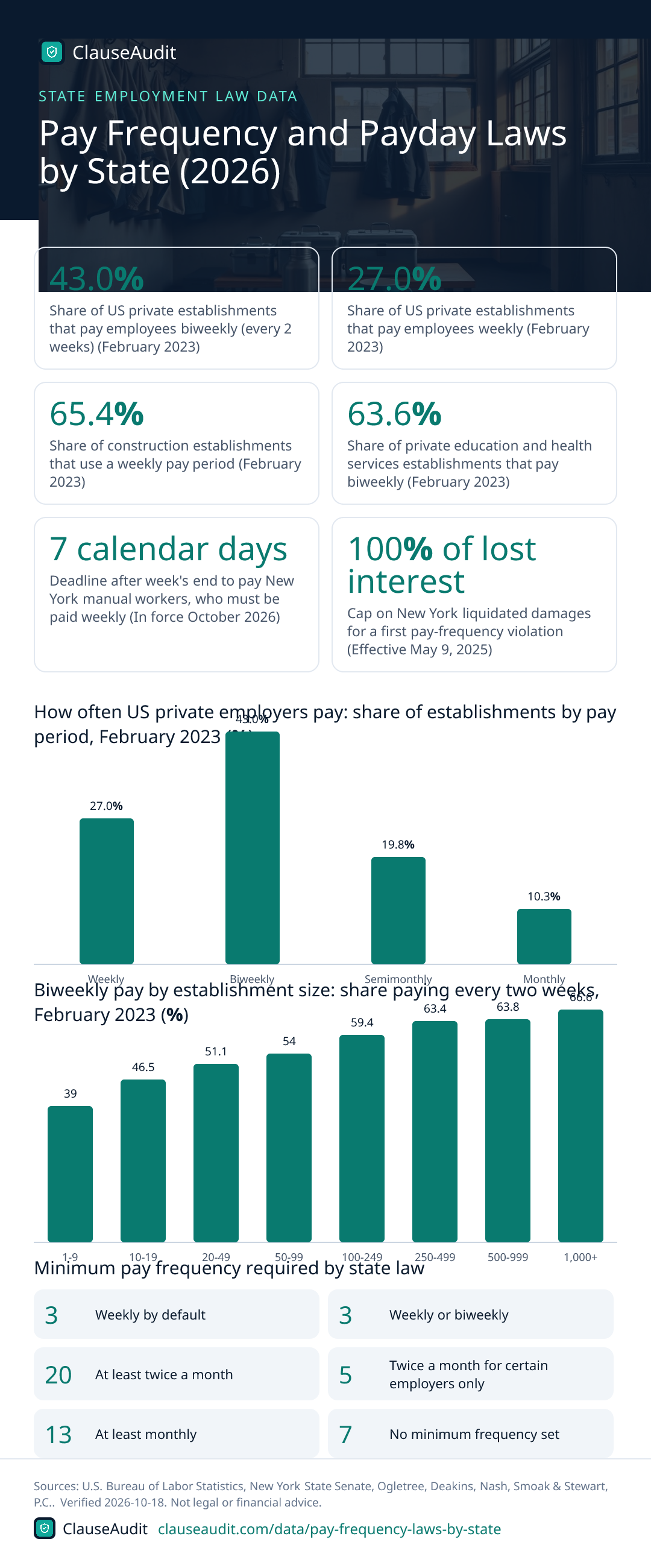
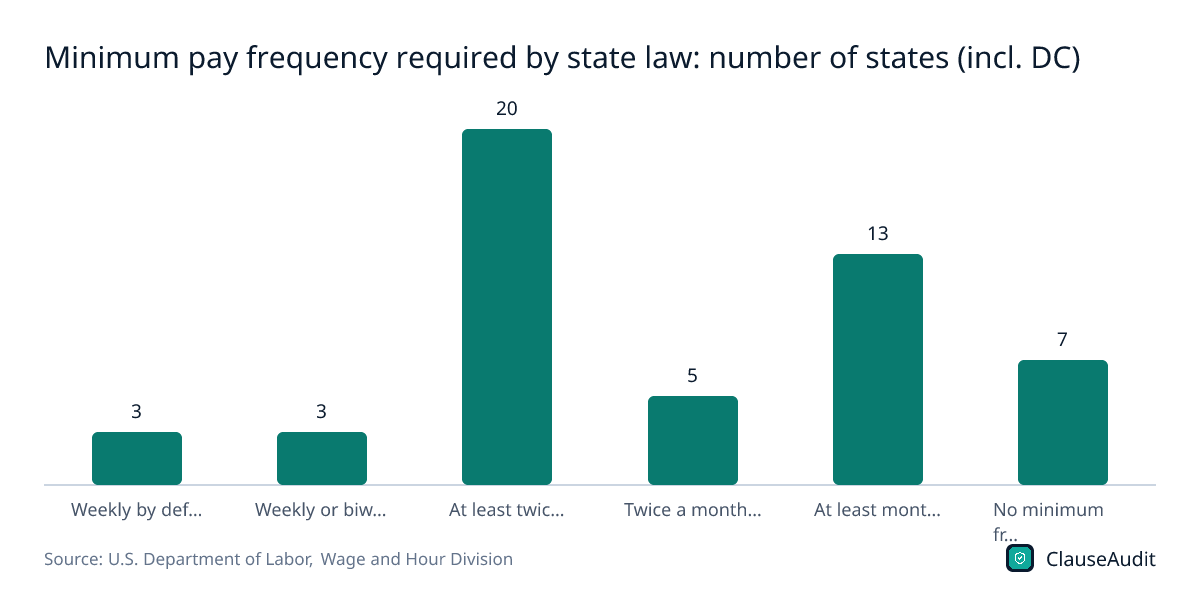
About half the states require at least two paydays a month. By our count, 20 jurisdictions (DC included) set a twice-a-month floor, 13 allow monthly pay and 3 require weekly pay. Seven set no minimum, and two of those, Alabama and Florida, have no payday law. Biweekly is the most common schedule, at 43.0% of private establishments in February 2023.

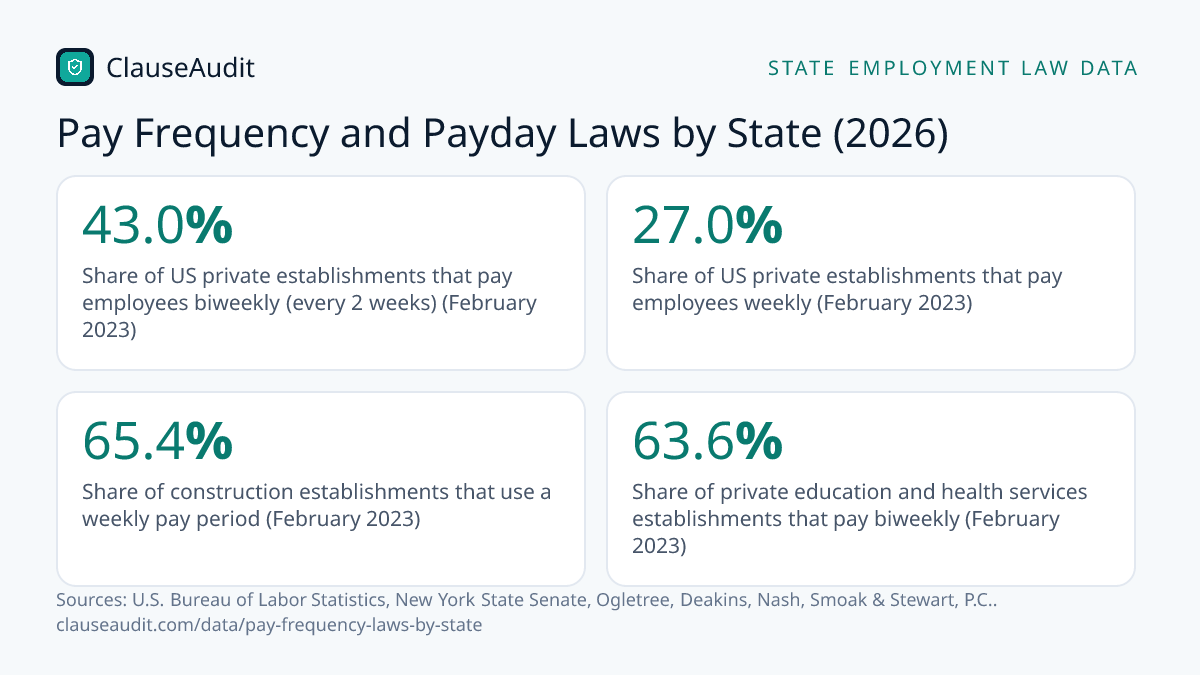
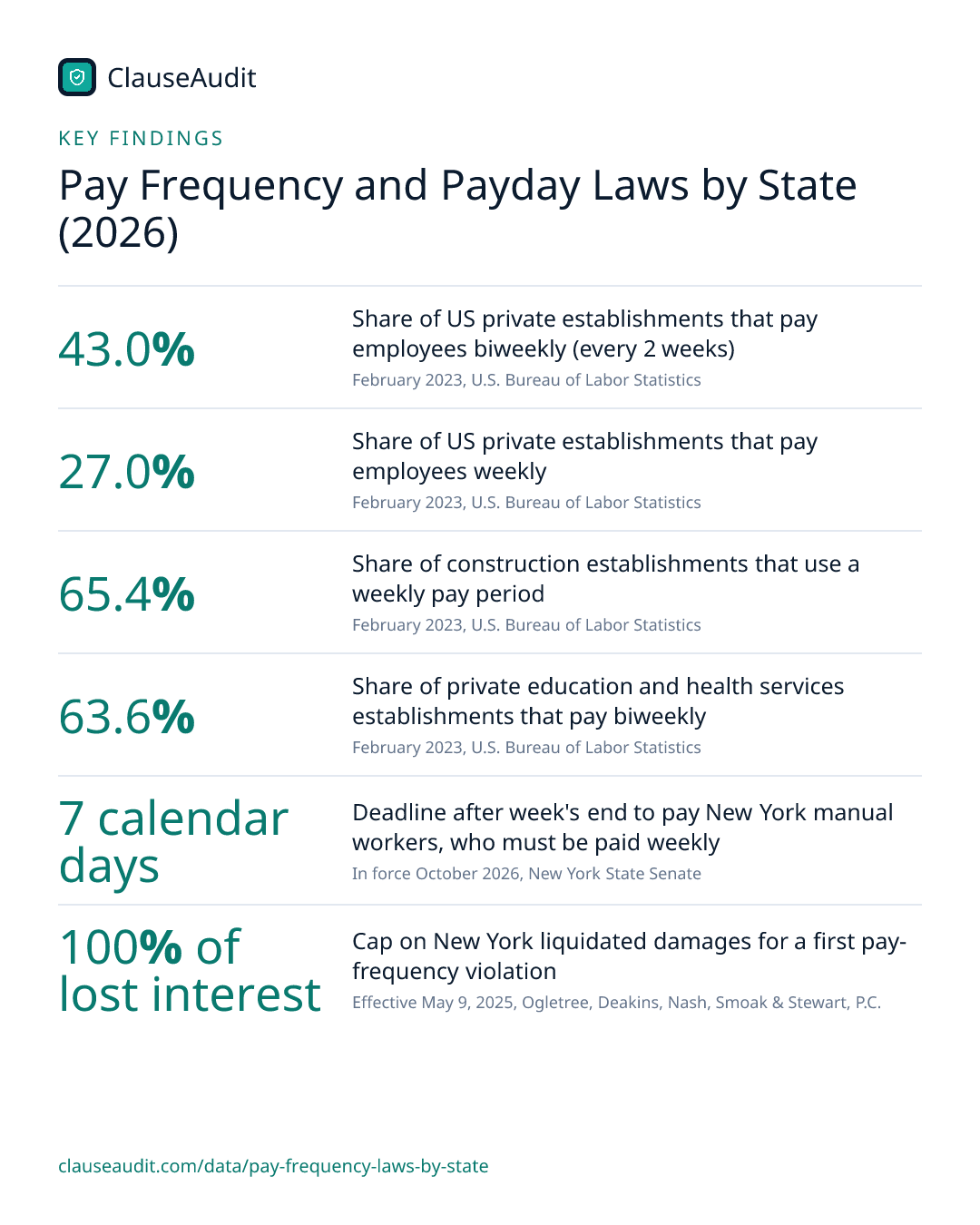
- Share of US private establishments that pay employees biweekly (every 2 weeks) (February 2023, U.S. Bureau of Labor Statistics)
- 43.0%
- Share of US private establishments that pay employees weekly (February 2023, U.S. Bureau of Labor Statistics)
- 27.0%
- Share of construction establishments that use a weekly pay period (February 2023, U.S. Bureau of Labor Statistics)
- 65.4%
- Share of private education and health services establishments that pay biweekly (February 2023, U.S. Bureau of Labor Statistics)
- 63.6%
- Deadline after week's end to pay New York manual workers, who must be paid weekly (In force October 2026, New York State Senate)
- 7 calendar days
- Cap on New York liquidated damages for a first pay-frequency violation (Effective May 9, 2025, Ogletree, Deakins, Nash, Smoak & Stewart, P.C.)
- 100% of lost interest
- Longest gap Minnesota allows between paydays for wages, salary and gratuities (2025 Minnesota Statutes, Minnesota Office of the Revisor of Statutes)
- 31 days
- States the US DOL lists with no payday regulation: Alabama and Florida (DOL table revised January 1, 2023, U.S. Department of Labor, Wage and Hour Division)
- 2 states
Your paycheck schedule isn't just a payroll preference. In most states it's a legal floor, and the floor varies a lot. New York makes employers pay manual workers every week. Oregon allows up to 35 days between paydays. Alabama and Florida don't set a rule at all.
This page maps the minimum pay frequency in all 50 states and DC, along with how employers actually schedule pay in practice. Below the charts, you'll find what the rules mean if you're starting a job, running payroll, or freelancing, and what to look for in an offer letter before you sign.
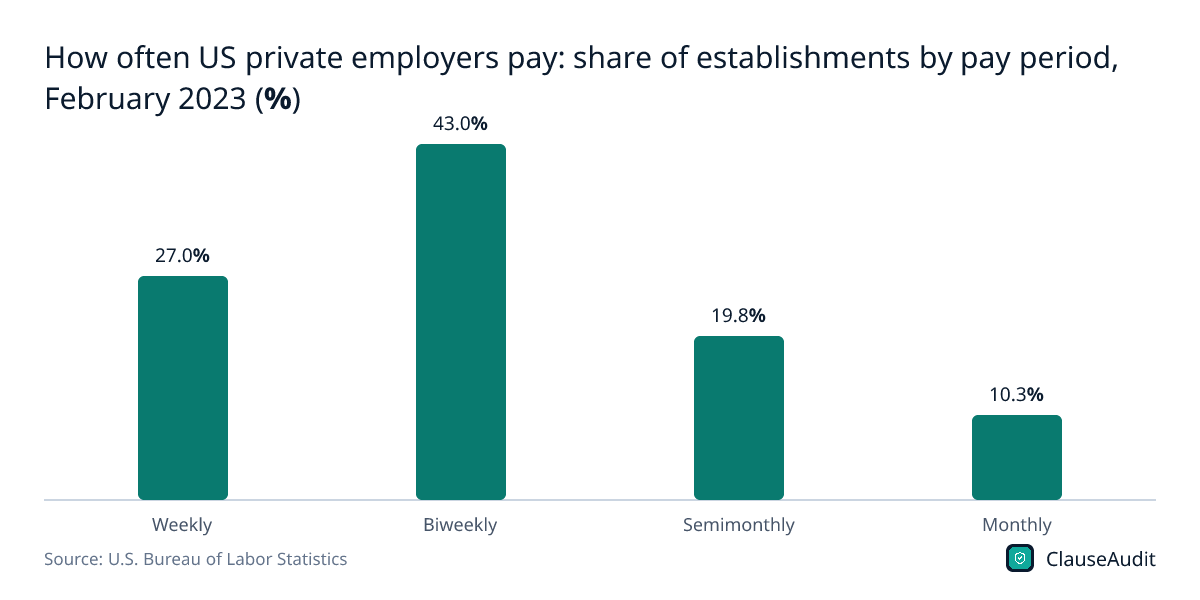
How often US private employers pay: share of establishments by pay period, February 2023 (%)
Chart data
| Label | Value (%) |
|---|---|
| Weekly | 27.0% |
| Biweekly | 43.0% |
| Semimonthly | 19.8% |
| Monthly | 10.3% |
Biweekly wins, with 43.0% of private establishments paying every two weeks in February 2023. Monthly pay is the outlier at 10.3%, which fits, since many state laws push employers toward at least two paydays a month.
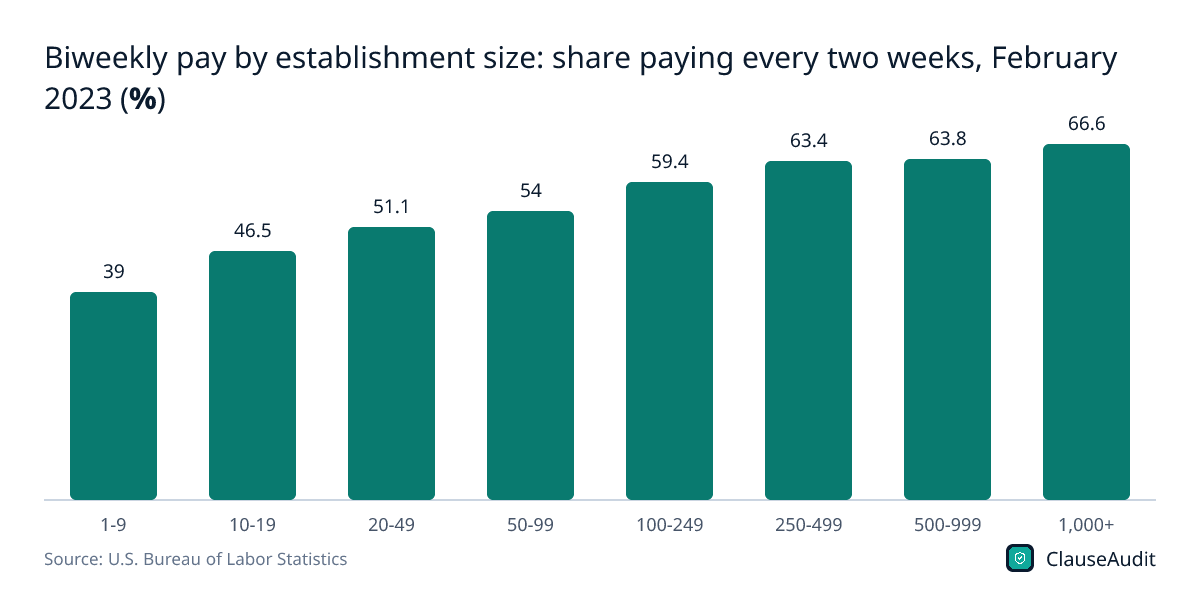
Download this chart (PNG)Biweekly pay by establishment size: share paying every two weeks, February 2023 (%)
Chart data
| Label | Value (%) |
|---|---|
| 1-9 | 39 |
| 10-19 | 46.5 |
| 20-49 | 51.1 |
| 50-99 | 54 |
| 100-249 | 59.4 |
| 250-499 | 63.4 |
| 500-999 | 63.8 |
| 1,000+ | 66.6 |
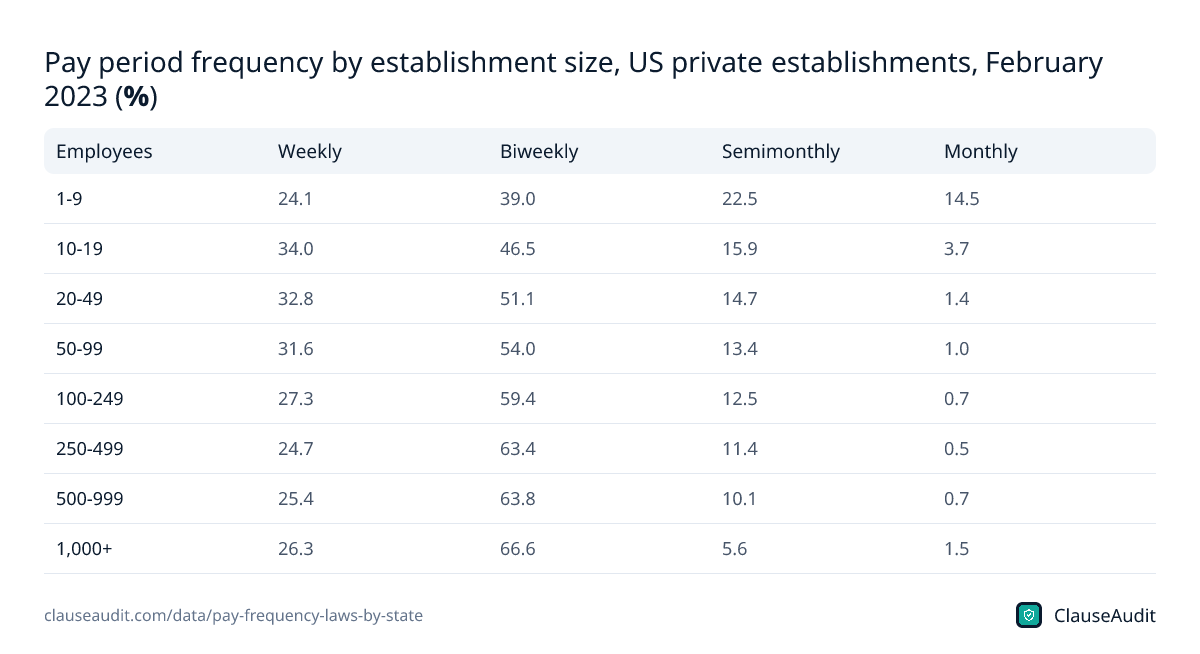
The bigger the employer, the more likely you get paid every two weeks: 39.0% of the smallest worksites versus 66.6% of those with 1,000+ employees. Small shops lean on monthly and semimonthly pay more than anyone.
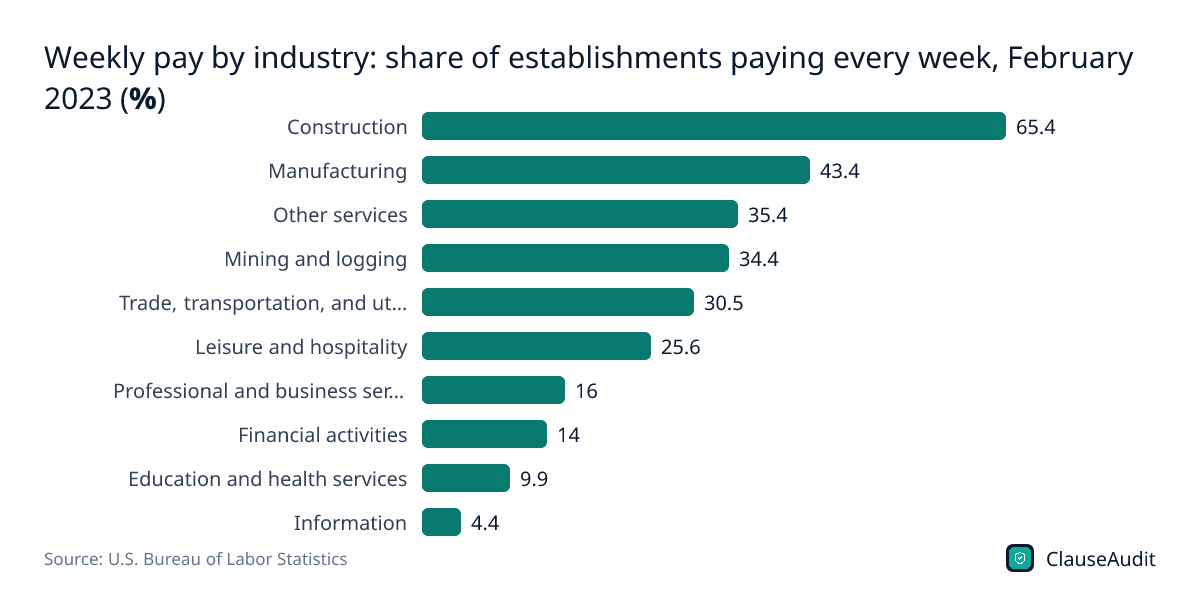
Download this chart (PNG)Weekly pay by industry: share of establishments paying every week, February 2023 (%)
Chart data
| Label | Value |
|---|---|
| Construction | 65.4 |
| Manufacturing | 43.4 |
| Other services | 35.4 |
| Mining and logging | 34.4 |
| Trade, transportation, and utilities | 30.5 |
| Leisure and hospitality | 25.6 |
| Professional and business services | 16 |
| Financial activities | 14 |
| Education and health services | 9.9 |
| Information | 4.4 |
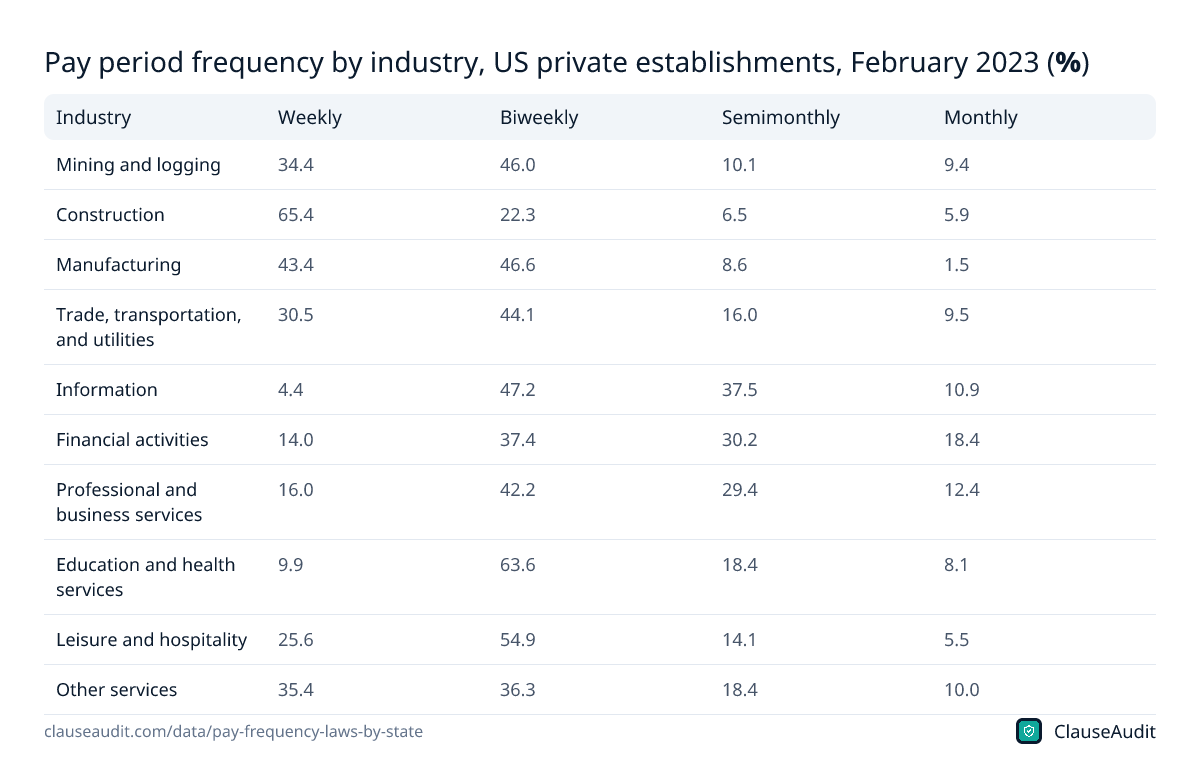
Construction stands apart, with 65.4% of establishments paying weekly. Crews and trades are used to Friday paychecks, and in New York, manual workers have to be paid weekly by law.
Download this chart (PNG)Minimum pay frequency required by state law: number of states (incl. DC)
Chart data
| Label | Value |
|---|---|
| Weekly by default | 3 |
| Weekly or biweekly | 3 |
| At least twice a month | 20 |
| Twice a month for certain employers only | 5 |
| At least monthly | 13 |
| No minimum frequency set | 7 |
Twice a month is the most common legal floor, at 20 jurisdictions. The 5 states in the middle bucket only regulate certain employers, such as corporations or listed industries, so many workers there have no set minimum.
Download this chart (PNG)Pay period frequency by establishment size, US private establishments, February 2023 (%)
| Employees | Weekly | Biweekly | Semimonthly | Monthly |
|---|---|---|---|---|
| 1-9 | 24.1 | 39.0 | 22.5 | 14.5 |
| 10-19 | 34.0 | 46.5 | 15.9 | 3.7 |
| 20-49 | 32.8 | 51.1 | 14.7 | 1.4 |
| 50-99 | 31.6 | 54.0 | 13.4 | 1.0 |
| 100-249 | 27.3 | 59.4 | 12.5 | 0.7 |
| 250-499 | 24.7 | 63.4 | 11.4 | 0.5 |
| 500-999 | 25.4 | 63.8 | 10.1 | 0.7 |
| 1,000+ | 26.3 | 66.6 | 5.6 | 1.5 |
Source: U.S. Bureau of Labor Statistics, Length of pay periods in the Current Employment Statistics survey. Download as image
Pay period frequency by industry, US private establishments, February 2023 (%)
| Industry | Weekly | Biweekly | Semimonthly | Monthly |
|---|---|---|---|---|
| Mining and logging | 34.4 | 46.0 | 10.1 | 9.4 |
| Construction | 65.4 | 22.3 | 6.5 | 5.9 |
| Manufacturing | 43.4 | 46.6 | 8.6 | 1.5 |
| Trade, transportation, and utilities | 30.5 | 44.1 | 16.0 | 9.5 |
| Information | 4.4 | 47.2 | 37.5 | 10.9 |
| Financial activities | 14.0 | 37.4 | 30.2 | 18.4 |
| Professional and business services | 16.0 | 42.2 | 29.4 | 12.4 |
| Education and health services | 9.9 | 63.6 | 18.4 | 8.1 |
| Leisure and hospitality | 25.6 | 54.9 | 14.1 | 5.5 |
| Other services | 35.4 | 36.3 | 18.4 | 10.0 |
Source: U.S. Bureau of Labor Statistics, Length of pay periods in the Current Employment Statistics survey. Download as image
Minimum pay frequency required by state law by state
- 3Weekly by default
- 3Weekly or biweekly
- 20At least twice a month
- 5Twice a month for certain employers only
- 13At least monthly
- 7No minimum frequency set
- Weekly by default3
- Weekly or biweekly3
- At least twice a month20
- Twice a month for certain employers only5
- At least monthly13
- No minimum frequency set7
| State | Minimum frequency | Rule | Main exceptions | Source |
|---|---|---|---|---|
| Alabama | No requirement | No state payday-frequency law | - | None |
| Alaska | Semimonthly or monthly, at employee's election | Employer must set monthly or semi-monthly pay periods at the employee's election | Monthly if agreed in an annual initial contract of employment | AS 23.05.140(a) |
| Arizona | Semimonthly | Two or more fixed paydays each month, not more than 16 days apart | Out-of-state centralized payroll may pay certain exempt and other listed employees monthly | A.R.S. § 23-351(A) |
| Arkansas | Semimonthly (corporations) | Corporations doing business in the state must pay wage workers at least twice a month | Employers with $500,000+ annual gross income may pay certain exempt managers/executives earning over $25,000 monthly; no general rule for non-corporate employers | Ark. Code § 11-4-401 |
| California | Semimonthly | Wages due at least twice each calendar month on paydays designated in advance | Exceptions by occupation (see the Labor Commissioner's table) | Cal. Lab. Code §§ 204, 207 |
| Colorado | Monthly | Pay periods no longer than one calendar month or 30 days, whichever is longer; payday within 10 days after period closes | Different schedule by mutual agreement | C.R.S. § 8-4-103(1)(a) |
| Connecticut | Weekly or biweekly | Wages due weekly or once every two weeks on a regular payday; pay period may end no more than 8 days before payday | Labor Commissioner may approve longer intervals (paid at least once each calendar month) under § 31-71i | Conn. Gen. Stat. § 31-71b(a)(1) |
| Delaware | Monthly | Regular paydays designated in advance, at least once each calendar month; paid within 7 days after pay period closes | - | 19 Del. C. § 1102 |
| District of Columbia | Semimonthly | At least twice each calendar month on regular paydays designated in advance | Bona fide administrative, executive and professional employees may be paid monthly; collective bargaining agreements may differ | D.C. Code § 32-1302 |
| Florida | No requirement | No state payday-frequency law | - | None |
| Georgia | Semimonthly | Pay periods must divide each month into at least two equal periods | Excludes farm, sawmill and turpentine industries and officials/department heads on monthly or yearly salaries | O.C.G.A. § 34-7-2 |
| Hawaii | Semimonthly | Wages paid at least twice a month on paydays designated in advance; due within 7 days after pay period ends | Monthly pay by secret-ballot election of a majority of employees; director may approve less frequent paydays | HRS § 388-2 |
| Idaho | Monthly | Wages paid at least once during each calendar month on regular paydays designated in advance | - | Idaho Code § 45-608(1) |
| Illinois | Semimonthly | Wages paid at least semi-monthly; due within 13 days after end of a semi-monthly or bi-weekly period | Executive, administrative and professional employees may be paid monthly | 820 ILCS 115/3, 115/4 |
| Indiana | Semimonthly or biweekly | Pay at least semimonthly, or biweekly if requested; wages earned up to 10 business days before payment | - | Ind. Code § 22-2-5-1 |
| Iowa | Monthly, semimonthly or biweekly | At least monthly, semimonthly or biweekly installments on regular paydays at consistent intervals; payday within 12 days (excl. Sundays and holidays) of period end | May be varied by written agreement; separate rules for commissions | Iowa Code § 91A.3(1) |
| Kansas | Monthly | Wages paid at least once during each calendar month on regular paydays designated in advance | - | K.S.A. § 44-314(a) |
| Kentucky | Semimonthly | Pay as often as semimonthly all wages earned to a day not more than 18 days before payment | - | KRS § 337.020 |
| Louisiana | Twice monthly (listed industries) | Manufacturers with 10+ employees, oil-boring and mining operations and public service corporations must pay at least twice each month | Applies only to listed employers; clerical staff and salesmen excluded except at public service corporations | La. R.S. 23:633 |
| Maine | Every 16 days | Wages paid in full at regular intervals not to exceed 16 days | Statutory exceptions apply (see § 621-A) | 26 M.R.S. § 621-A(1) |
| Maryland | Biweekly or semimonthly | Regular pay periods; pay at least once every 2 weeks or twice a month | Administrative, executive and professional employees may be paid less often | Md. Code, Lab. & Empl. § 3-502 |
| Massachusetts | Weekly or biweekly | Wages paid weekly or bi-weekly | Certain executive, administrative and professional employees and weekly-salaried employees may be paid bi-weekly or semi-monthly, or monthly if they elect; agricultural workers monthly | M.G.L. c. 149, § 148 |
| Michigan | Weekly, biweekly, semimonthly or monthly | Default twice-monthly schedule; regular weekly/biweekly paydays within 14 days, or monthly pay periods paid within 15 days of period end | Hand harvesters paid by the second day after the work week unless agreed otherwise | MCL § 408.472 |
| Minnesota | Every 31 days | All wages, including salary, earnings and gratuities, paid at least once every 31 days on a regular payday | Commissions at least every 3 months (§ 181.101); employees on transitory projects (such as road and sewer construction, land clearing, forest products) at intervals of not more than 15 days (§ 181.10) | Minn. Stat. §§ 181.101, 181.10 |
| Mississippi | Biweekly or twice monthly (listed employers) | Manufacturers with 50+ employees and public service corporations must pay every two weeks or twice each month | Applies only to listed employers; bona fide executive, administrative and professional employees excluded | Miss. Code § 71-1-35 |
| Missouri | Semimonthly (corporations) | Corporations and railroad operators must pay wages at least semimonthly | Executive, administrative and professional employees and commissioned salespeople may be paid monthly; no general rule for other employers | Mo. Rev. Stat. § 290.080 |
| Montana | No fixed frequency | If no pay period is established, it is presumed to be semimonthly; wages may not be withheld more than 10 business days after due | - | Mont. Code Ann. § 39-3-204 |
| Nebraska | Employer designates | Wages paid on regular days designated by the employer or agreed with the employee; 30 days' written notice before changing paydays | - | Neb. Rev. Stat. § 48-1230(1) |
| Nevada | Semimonthly | Wages in private employment due semimonthly | Out-of-state payroll employers may pay certain executive, administrative, professional, outside sales and supervisory employees monthly | NRS § 608.060 |
| New Hampshire | Weekly or biweekly | Wages paid within 8 days after the work week (weekly) or 15 days (biweekly) | Commissioner may permit another schedule on written petition, but at least once each calendar month | RSA 275:43 |
| New Jersey | Semimonthly | Wages paid in full at least twice during each calendar month on regular paydays designated in advance | Bona fide executive, supervisory and other special classifications may be paid monthly | N.J.S.A. 34:11-4.2 |
| New Mexico | Semimonthly | Regular paydays not more than 16 days apart | Professional, administrative, executive and outside sales employees may be paid monthly (not if under a CBA) | N.M. Stat. § 50-4-2 |
| New York | Weekly (manual workers) | Manual workers paid weekly, no later than 7 calendar days after the end of the week; clerical and other workers at least semi-monthly | Semi-monthly pay for manual workers only with approval | N.Y. Lab. Law § 191 |
| North Carolina | No fixed frequency | Pay periods may be daily, weekly, bi-weekly, semi-monthly or monthly; wages due on the regular payday | Bonuses and commissions may be paid as infrequently as annually if set in advance | N.C. Gen. Stat. § 95-25.6 |
| North Dakota | Monthly | Wages paid at least once each calendar month on regular agreed paydays designated in advance | - | N.D. Cent. Code § 34-14-02 |
| Ohio | Semimonthly | First-half wages paid by the 1st of the next month; second-half wages by the 15th | Employers may pay daily or weekly instead | Ohio Rev. Code § 4113.15(A) |
| Oklahoma | Semimonthly | Wages paid at least twice each calendar month on regular paydays designated in advance | Exempt employees, public employees and certain foundation employees paid at least once each calendar month | 40 O.S. § 165.2 |
| Oregon | Every 35 days | Regular payday may not extend beyond 35 days from the start of work or the last regular payday | - | ORS § 652.120 |
| Pennsylvania | Employer designates | Wages paid on regular paydays designated in advance by the employer; no minimum frequency set | Employer must tell employees the time and place of payment at hiring (§ 260.4) | 43 P.S. § 260.3 |
| Rhode Island | Weekly | Most employers must pay weekly | Director may permit less frequent pay (at least twice a month) on petition under § 28-14-2.2; childcare providers may be paid every two weeks | R.I. Gen. Laws §§ 28-14-2, 28-14-2.2 |
| South Carolina | Employer designates | Employers must tell each employee in writing at hiring the time and place of payment; no minimum frequency set | Notice rule does not apply to employers with fewer than five employees at all times during the preceding twelve months, or to employers of domestic labor in private homes (§ 41-10-20) | S.C. Code §§ 41-10-20, 41-10-30(A) |
| South Dakota | Monthly | Wages paid at least once each calendar month, or on regular agreed paydays designated in advance | - | SDCL § 60-11-9 |
| Tennessee | Monthly | Private-employment wages due not less frequently than once per month; monthly payers pay by the 5th of the next month | Applies only to private employers with five or more employees; government employers excluded (§ 50-2-103(b)) | Tenn. Code Ann. § 50-2-103(a); Pub. Ch. 617 (2026) |
| Texas | Semimonthly | Non-exempt employees paid at least twice a month, with pay periods of as nearly equal days as possible | FLSA overtime-exempt employees may be paid once a month | Tex. Lab. Code § 61.011 |
| Utah | Semimonthly | Regular paydays with pay periods no longer than semimonthly; paid within 10 days after period closes | Employees hired on a yearly salary may be paid monthly | Utah Code § 34-28-3 |
| Vermont | Weekly | Wages paid each week, covering work up to six days before payment | Biweekly or semimonthly allowed after written notice to employees | 21 V.S.A. § 342(a) |
| Virginia | Biweekly or semimonthly (hourly) | Hourly employees paid at least once every two weeks or twice each month; salaried employees at least once each month | Executive personnel excluded; employees earning over 150% of the state average weekly wage may agree to monthly pay | Va. Code § 40.1-29(B) |
| Washington | Monthly | All wages paid on an established regular payday at no longer than monthly payment intervals | - | WAC 296-126-023(3) |
| West Virginia | Semimonthly (max 19 days) | Employers settle with employees at least twice every month, with no more than 19 days between settlements | Unless otherwise provided by special agreement | W. Va. Code § 21-5-3(a) |
| Wisconsin | Monthly (31 days) | Wages paid at least monthly, covering wages earned no more than 31 days before payment | Logging and farm labor at least quarterly; CBA, school and UW System exceptions | Wis. Stat. § 109.03(1) |
| Wyoming | Semimonthly (listed industries) | Railroads, mines, refineries, oil and gas operations, factories, mills and workshops pay first-half wages by the 1st and second-half wages by the 15th | Agricultural operations exempt; no general rule for other employers | Wyo. Stat. § 27-4-101 |
How often does an employer have to pay you?
It depends on your state, your job type and sometimes the size of your employer. The single most common rule is twice a month. In our count, 20 jurisdictions, including California, Texas, Illinois and DC, require at least that for most hourly workers.
A smaller group goes further. Rhode Island and Vermont require weekly pay by default, and New York requires it for manual workers, who must be paid no later than 7 calendar days after the week ends. Connecticut, Massachusetts and New Hampshire allow weekly or biweekly pay.
At the loose end, 13 states let employers pay as rarely as once a month. Minnesota caps the gap at 31 days and Oregon at 35 days. Then there are the states that don't set a number. Pennsylvania, Nebraska and South Carolina only require a regular payday the employer picks and announces. Alabama and Florida have no payday regulation at all.
One caution: the rules usually describe the minimum for non-exempt, hourly staff. Many states let salaried executives and professionals be paid less often. In Texas, overtime-exempt employees can be paid once a month. Illinois allows monthly pay for executive, administrative and professional staff.
Is biweekly pay legal in every state?
Almost everywhere, yes. A paycheck every two weeks always lands at least two paydays in any calendar month, so it clears the twice-a-month floor. It's also the most common schedule, used by 43.0% of private establishments in February 2023.
The tricky states are the weekly ones. Vermont allows biweekly pay only after the employer gives written notice. Rhode Island requires weekly pay unless the state director approves a different schedule. In New York, a manual worker on a biweekly schedule is a legal problem unless the employer has state approval.
Watch the gap between the end of the pay period and payday, too. Connecticut says the pay period can end no more than 8 days before payday. Illinois wants wages paid within 13 days after a pay period ends. West Virginia allows no more than 19 days between settlements. A schedule can be biweekly and still break the lag rule.
What happens if your employer pays late or too rarely?
Federal law sets a baseline everywhere: minimum wage and overtime must be paid on the regular payday. State payday laws add the rest, and most let you file a wage claim with the state labor department.
New York shows how fast the stakes can change. After a 2019 appeals court ruling, manual workers paid every two weeks sued for damages equal to the wages paid late, even though every dollar arrived. Since May 9, 2025, a first pay-frequency violation is capped at 100% of lost interest on the delayed wages. A repeat violation after a prior finding still means damages of 100% of the late wages.
If your paychecks are late or less frequent than your state allows, keep your pay stubs and write down each payday. Ask HR in writing for the schedule. If nothing changes, your state labor department is the usual first stop, and the deadline to file a claim can be short.
Do payday laws apply to freelancers and contractors?
No. Pay frequency laws protect employees. If you invoice clients as an independent contractor, your contract does most of the work of setting when you get paid. State payday laws don't step in, though a few places, including New York State and Illinois, have separate freelance payment laws that set a default deadline when the contract is silent.
That makes the payment clause worth more than people think. Contractors in trades used to weekly pay, where 65.4% of construction establishments paid their employees every week in February 2023, sometimes sign subcontracts that pay monthly or only when the general contractor gets paid. Read that clause before you sign, not after the first invoice sits for two months.
Also ask if you're really a contractor at all. If the client controls your hours and treats you like staff, you may be a misclassified employee, and the state payday law may apply to you after all.
What to check in an offer letter or employment contract
- The pay schedule in writing. Look for weekly, biweekly, semimonthly or monthly, plus the actual payday. Pennsylvania and South Carolina both require employers to tell you at hiring.
- Your exempt or non-exempt status. Exempt staff can often be paid monthly in states that require twice-monthly pay for everyone else.
- A right to change paydays. Nebraska requires 30 days' written notice before an employer changes paydays. A contract that lets the employer change your schedule at will deserves a question.
- How commissions and bonuses are paid. Minnesota requires commissions at least every three months, and North Carolina allows bonuses and commissions as rarely as once a year if the schedule is set in advance.
- Your first paycheck. A new hire on a monthly cycle can wait several weeks for the first check. Ask the date so you can plan rent.
For employers: picking a schedule that holds up in every state
If you have staff in more than one state, payroll has to meet the strictest rule that applies to each worker. A monthly schedule that works in Washington or Colorado breaks the law in California, Illinois or Texas for hourly staff.
Small businesses are the most likely to run monthly payroll. Among establishments with 1 to 9 employees, only 39.0% paid biweekly in February 2023, compared with 66.6% of those with 1,000 or more. If you're small and growing into new states, check the rule before your first hire there.
Keep an eye on changes, too. Tennessee's Public Chapter 617, effective July 1, 2026, changed the rules for employers that pay once a month, requiring those wages by the 5th of the next month. Connecticut added biweekly pay in 2016, yet the federal summary table still lists it as weekly only. Read the statute, not just a summary.
How ClauseAudit helps
Pay frequency rarely shows up in a dispute until a check is late. ClauseAudit's automated review reads your offer letter or employment contract and flags the pay terms that don't line up with your state's rules or leave the employer room to change them.
You get a plain-English summary of each clause, a risk rating and a suggested fix you can bring to HR before you sign.
- Pay schedule and payday: is it stated, and does it meet your state's minimum?
- Exempt classification language that lets the employer pay you monthly
- Clauses that let the employer change paydays or pay periods without notice
- Commission and bonus timing, including clawbacks and 'discretionary' wording
- Salary modification rights that let the employer cut or delay pay
- Final paycheck and deduction terms when you leave
Frequently asked questions
Which states require weekly pay?
Rhode Island and Vermont require weekly pay by default, and New York requires it for manual workers. Vermont employers can switch to biweekly or semimonthly pay after giving written notice. Rhode Island employers need the state director's approval to pay less often. Connecticut, Massachusetts and New Hampshire allow weekly or biweekly pay.
Can my employer pay me once a month?
In 13 states, yes, for most workers. Colorado, Washington, Kansas and Idaho are among them. Minnesota caps the gap at 31 days and Oregon at 35 days. In twice-a-month states like California and Texas, monthly pay is usually limited to exempt or professional staff. Check whether your role is classified as exempt.
Which states have no payday law?
The U.S. Department of Labor lists 2 states with no payday regulation: Alabama and Florida. Several others, including Pennsylvania, Nebraska, North Carolina and South Carolina, require a regular payday but leave the frequency to the employer. Federal law still requires minimum wage and overtime to be paid on the regular payday.
What is the difference between biweekly and semimonthly pay?
Biweekly means every two weeks, usually on the same weekday, so two months in most years bring a third check. Semimonthly means twice a month on set dates, such as mid-month and the last day, so checks never bunch up. Both meet a twice-a-month legal floor. Biweekly is more common, used by 43.0% of private establishments in February 2023 versus 19.8% for semimonthly.
How fast must New York pay manual workers?
Weekly, and no later than 7 calendar days after the end of the week in which the wages were earned. Clerical and other workers must be paid at least semi-monthly. An employer can pay manual workers semi-monthly only with state approval. Since May 9, 2025, a first violation is limited to lost interest on the late wages.
Can my employer change my payday?
Usually yes, as long as the new schedule still meets your state's minimum. Some states add notice rules. Nebraska requires 30 days' written notice before changing paydays, and Vermont requires written notice before moving off weekly pay. If your contract says nothing, ask HR to confirm any change in writing.
Do pay frequency laws cover salaried employees?
Often only partly. Many states carve out executive, administrative and professional employees. Texas lets overtime-exempt staff be paid monthly, Illinois allows monthly pay for executive, administrative and professional employees, and Utah allows monthly pay for staff hired on a yearly salary. Hourly, non-exempt workers get the strongest protection.
Does Tennessee require semi-monthly pay in 2026?
It depends on how your employer pays. The state's FAQ and the federal summary table still say semi-monthly, but Public Chapter 617, effective July 1, 2026, amended the rules for employers that pay once a month. Those employers must pay by the 5th of the next month. Check your offer letter for the pay schedule.
Use this data
Every chart and card below is free to reuse under CC BY 4.0. Download what you need and link back to this page.
 Stat cards
 Key findings card
 Infographic
 How often US private employers pay: share of establishments by pay period, February 2023 (%)
 Biweekly pay by establishment size: share paying every two weeks, February 2023 (%)
 Weekly pay by industry: share of establishments paying every week, February 2023 (%)
 Minimum pay frequency required by state law: number of states (incl. DC)
 Pay period frequency by establishment size, US private establishments, February 2023 (%)
 Pay period frequency by industry, US private establishments, February 2023 (%)
Embed the infographic
Free to share on your site, blog or slides under CC BY 4.0. Please keep the credit link.
Sources and method
Every number on this page comes from the sources below, each opened and read on or before October 18, 2026. A second, independent review checked every figure against its source and corrected anything that did not match. 51 of 51 state entries were confirmed; any that could not be are marked "Not yet confirmed" and left out of every count and chart.
- U.S. Bureau of Labor Statistics, Length of pay periods in the Current Employment Statistics survey (Data for February 2023; page last modified August 4, 2023)
- U.S. Department of Labor, Wage and Hour Division, State Payday Requirements (Last revised January 1, 2023)
- New York State Senate, New York Labor Law § 191, Frequency of payments (Section text as last revised September 22, 2014; read October 2026)
- Ogletree, Deakins, Nash, Smoak & Stewart, P.C., New York's 2025-26 Budget Includes Immediate Labor Law Reforms, Important Changes to Pay Frequency Laws (May 13, 2025)
- Minnesota Office of the Revisor of Statutes, Minnesota Statutes § 181.101, Wages; how often paid (2025 Minnesota Statutes)
- Tennessee Secretary of State, Public Chapter No. 617 (Senate Bill 2024), amending Tenn. Code Ann. § 50-2-103 (Passed March 9, 2026; effective July 1, 2026)
- FindLaw (Thomson Reuters), Connecticut General Statutes § 31-71b (Current as of January 1, 2025)
- Minnesota Office of the Revisor of Statutes, Minnesota Statutes § 181.10, Wages paid every 15 days (2025 Minnesota Statutes)
Cite this page
ClauseAudit, “Pay Frequency and Payday Laws by State (2026)”, updated October 18, 2026, https://clauseaudit.com/data/pay-frequency-laws-by-state. Free to reuse with a link back (CC BY 4.0).
This page summarises published data and law as checked on October 18, 2026. Figures are updated as new editions are released, and your own situation may differ. It is general information, not legal, tax or financial advice.