Overtime Laws by State (2026): Daily Overtime, Weekly Thresholds and Mandatory Overtime
By ClauseAudit Research · 17 sources ·
What are the overtime laws by state?
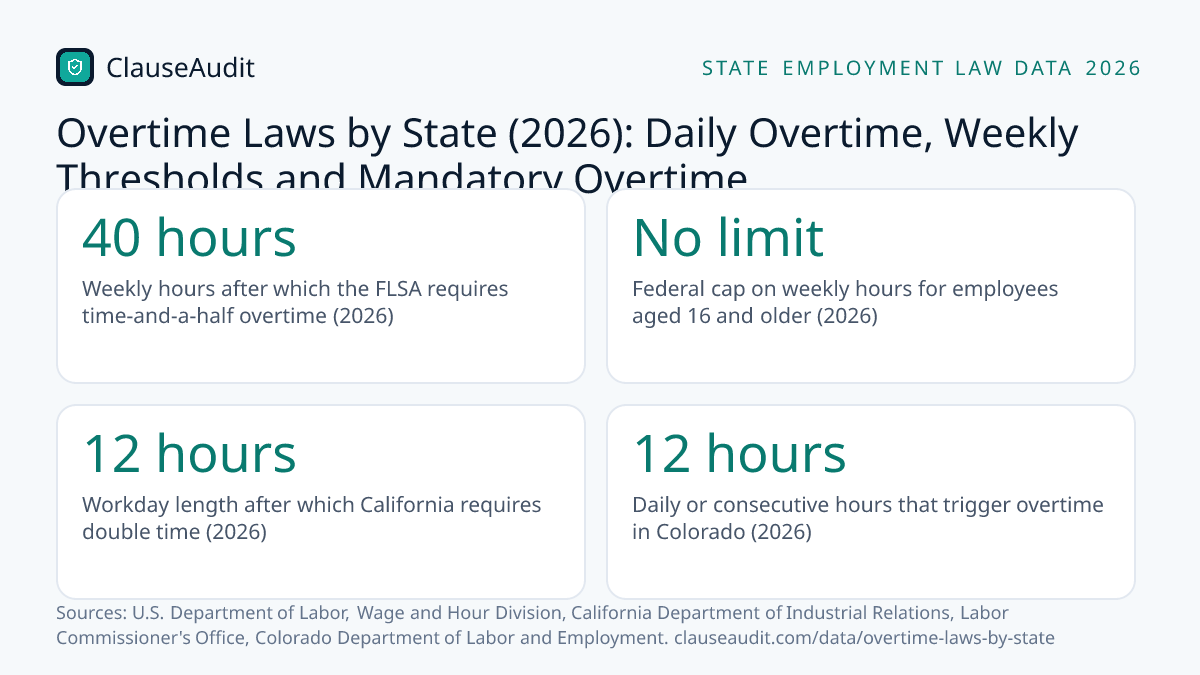
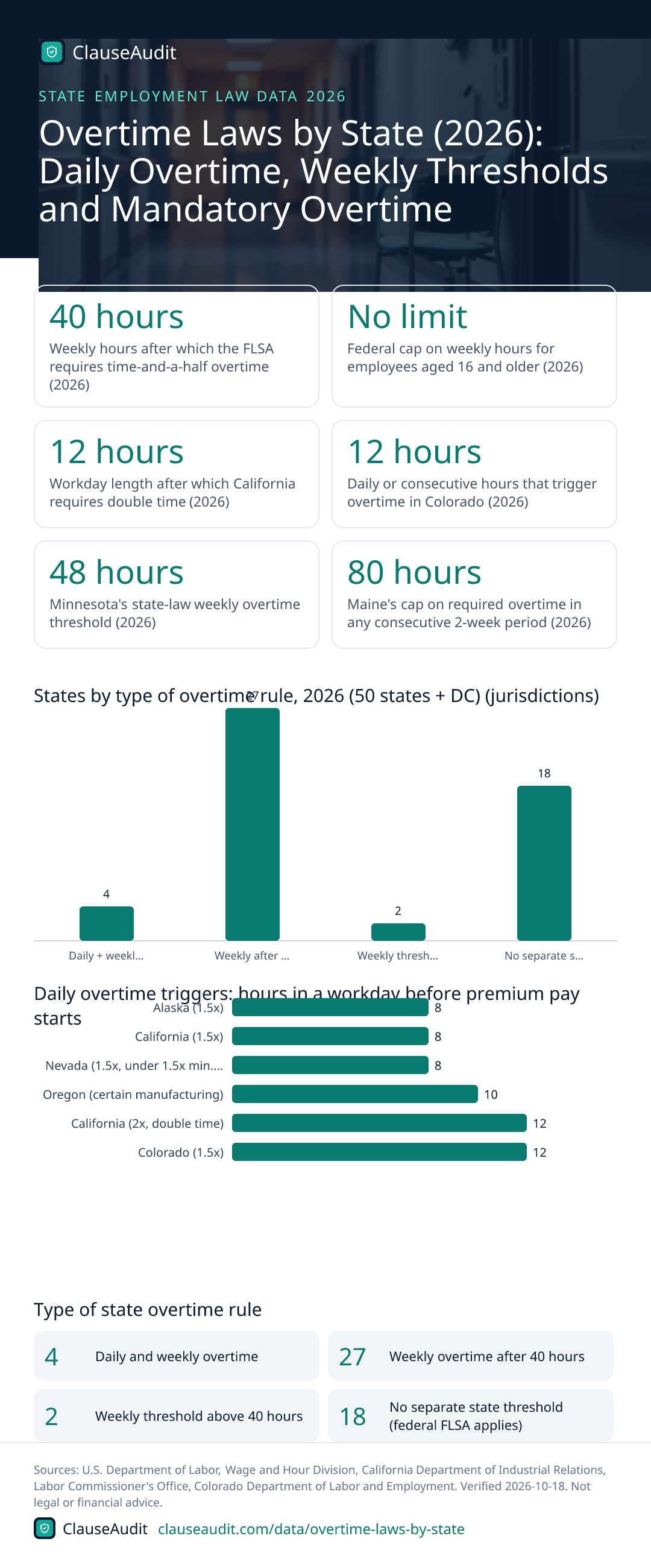
Federal law applies in every state: most hourly workers earn time-and-a-half after 40 hours in a workweek. Only 4 states (Alaska, California, Colorado and Nevada) add daily overtime, and California pays double time after 12 hours in a day. Federal law sets no cap on weekly hours for workers 16 and older.

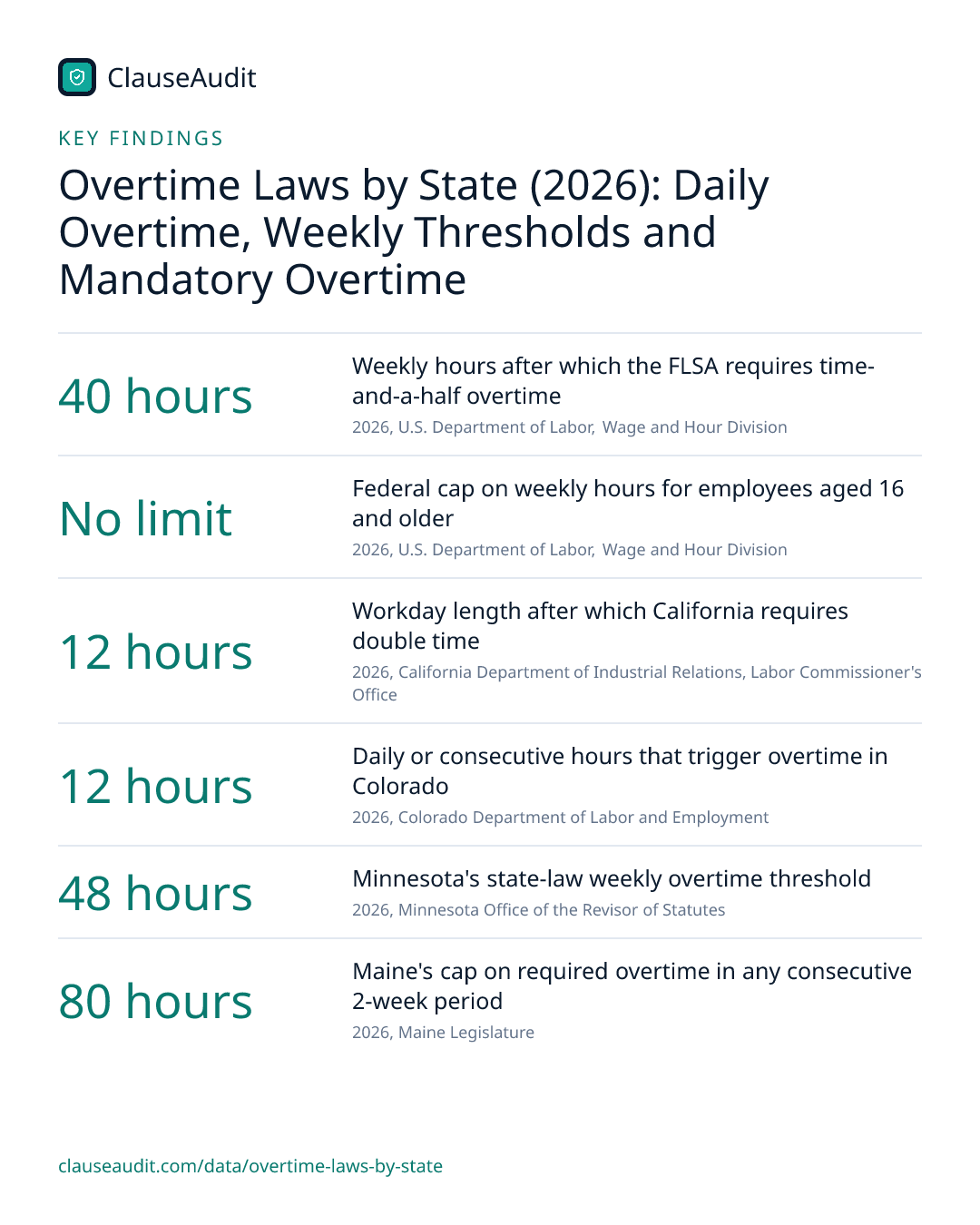
- Weekly hours after which the FLSA requires time-and-a-half overtime (2026, U.S. Department of Labor, Wage and Hour Division)
- 40 hours
- Federal cap on weekly hours for employees aged 16 and older (2026, U.S. Department of Labor, Wage and Hour Division)
- No limit
- Workday length after which California requires double time (2026, California Department of Industrial Relations, Labor Commissioner's Office)
- 12 hours
- Daily or consecutive hours that trigger overtime in Colorado (2026, Colorado Department of Labor and Employment)
- 12 hours
- Minnesota's state-law weekly overtime threshold (2026, Minnesota Office of the Revisor of Statutes)
- 48 hours
- Maine's cap on required overtime in any consecutive 2-week period (2026, Maine Legislature)
- 80 hours
- Federal minimum salary for most exempt white-collar employees (2026, U.S. Department of Labor)
- $684 per week
- California's minimum annual salary for overtime-exempt employees (2026, California Department of Industrial Relations)
- $70,304
Overtime in the US runs on two layers. The federal Fair Labor Standards Act gives most hourly workers time-and-a-half once they pass 40 hours in a workweek, no matter where they live. States can add to that, and a few do, but none can take it away from someone the federal law covers.
Where states differ is in the extras. A handful count overtime by the day, not just the week. Some set a higher salary bar before an employer can call you exempt. And a small group limit how much overtime an employer can force on you, mostly in health care. This page shows where each state lands and what to check in your offer letter before you sign.
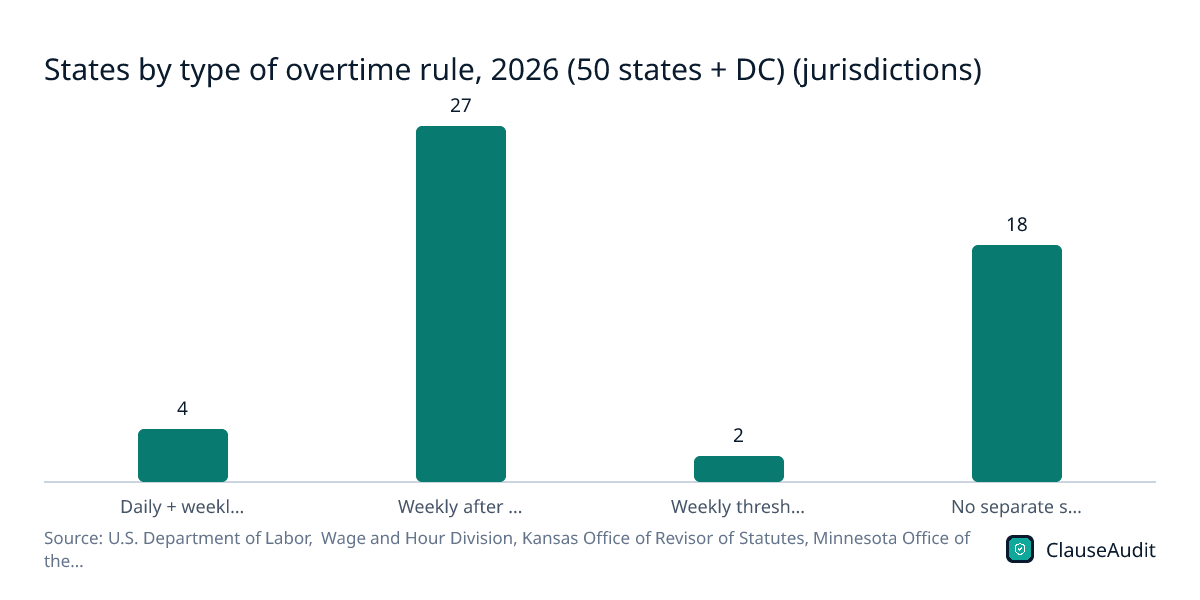
States by type of overtime rule, 2026 (50 states + DC) (jurisdictions)
Chart data
| Label | Value (jurisdictions) |
|---|---|
| Daily + weekly overtime | 4 |
| Weekly after 40 hours | 27 |
| Weekly threshold above 40 | 2 |
| No separate state threshold (FLSA applies) | 18 |
Most jurisdictions, 27 of them, write the 40-hour week into their own law, though a few add extras like 7th-day or Sunday pay. The 18 with no state threshold still follow the federal rule, so the practical gap between those two groups is small.
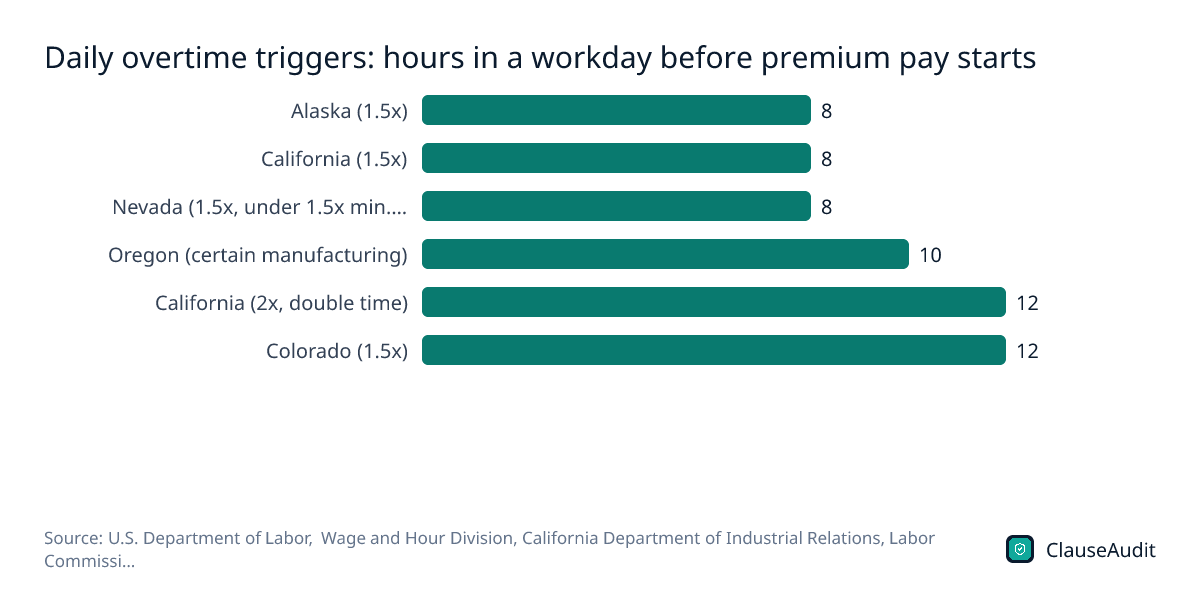
Download this chart (PNG)Daily overtime triggers: hours in a workday before premium pay starts
Chart data
| Label | Value |
|---|---|
| Alaska (1.5x) | 8 |
| California (1.5x) | 8 |
| Nevada (1.5x, under 1.5x min. wage) | 8 |
| Oregon (certain manufacturing) | 10 |
| California (2x, double time) | 12 |
| Colorado (1.5x) | 12 |
Daily overtime is rare, and the triggers vary a lot. An 8-hour trigger in California or Alaska pays far more often than Colorado's 12-hour trigger, which mainly catches long shifts.
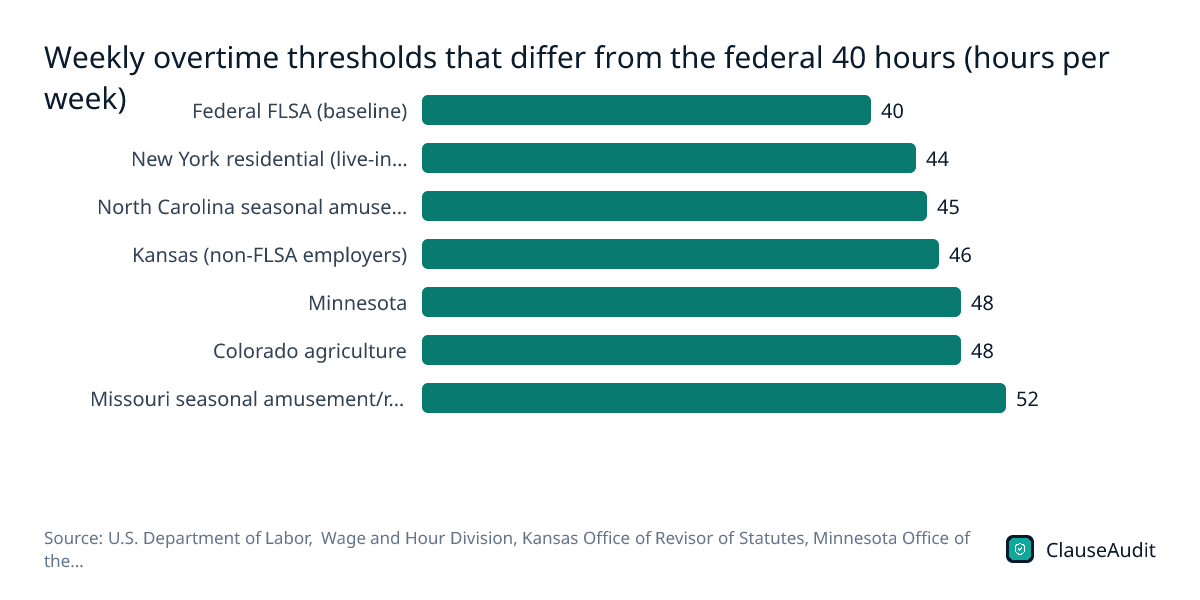
Download this chart (PNG)Weekly overtime thresholds that differ from the federal 40 hours (hours per week)
Chart data
| Label | Value |
|---|---|
| Federal FLSA (baseline) | 40 |
| New York residential (live-in) workers | 44 |
| North Carolina seasonal amusements | 45 |
| Kansas (non-FLSA employers) | 46 |
| Minnesota | 48 |
| Colorado agriculture | 48 |
| Missouri seasonal amusement/recreation | 52 |
Most thresholds above 40 are industry carve-outs, often for jobs federal overtime law also exempts, so the state number can be the one that counts. Minnesota and Kansas are different: if your employer is covered by the FLSA, the 40-hour line still applies.
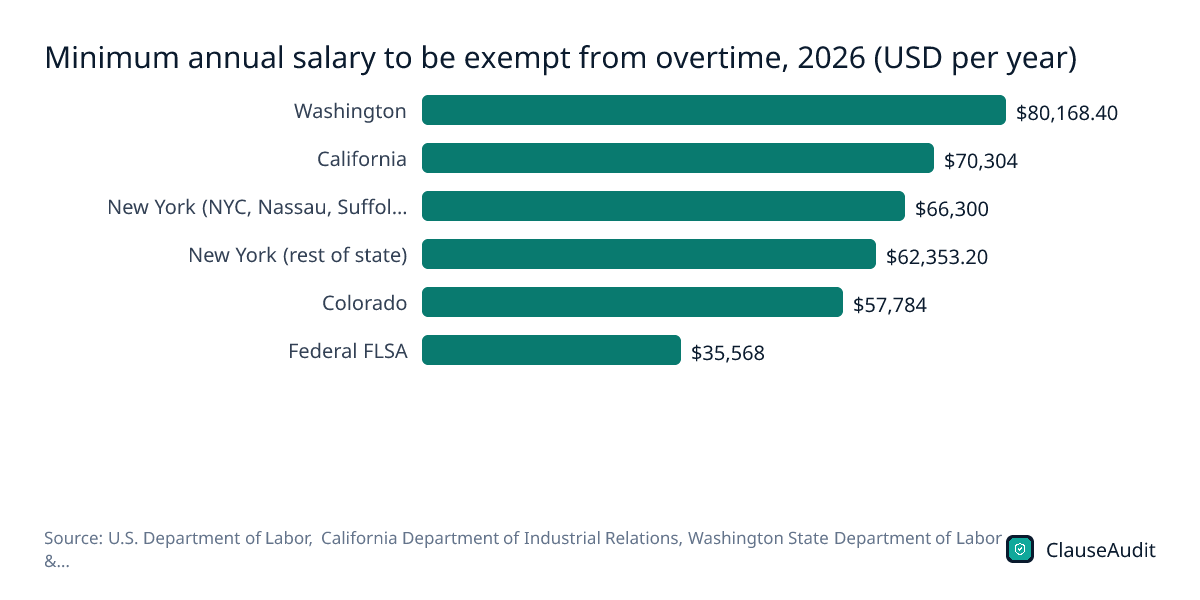
Download this chart (PNG)Minimum annual salary to be exempt from overtime, 2026 (USD per year)
Chart data
| Label | Value |
|---|---|
| Washington | $80,168.40 |
| California | $70,304 |
| New York (NYC, Nassau, Suffolk, Westchester) | $66,300 |
| New York (rest of state) | $62,353.20 |
| Colorado | $57,784 |
| Federal FLSA | $35,568 |
The federal floor of $35,568 is less than half of Washington's $80,168.40. A salaried manager who counts as exempt in Texas might be owed overtime for the same job in Seattle or Los Angeles.
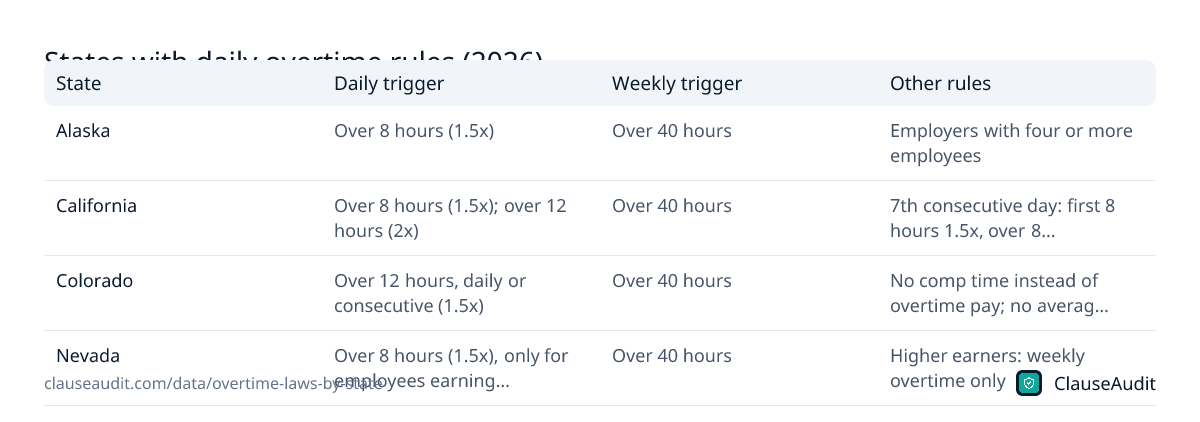
Download this chart (PNG)States with daily overtime rules (2026)
| State | Daily trigger | Weekly trigger | Other rules |
|---|---|---|---|
| Alaska | Over 8 hours (1.5x) | Over 40 hours | Employers with four or more employees |
| California | Over 8 hours (1.5x); over 12 hours (2x) | Over 40 hours | 7th consecutive day: first 8 hours 1.5x, over 8 hours 2x |
| Colorado | Over 12 hours, daily or consecutive (1.5x) | Over 40 hours | No comp time instead of overtime pay; no averaging across weeks |
| Nevada | Over 8 hours (1.5x), only for employees earning under 1.5x the state minimum wage | Over 40 hours | Higher earners: weekly overtime only |
Source: U.S. Department of Labor, Wage and Hour Division, State Minimum Wage Laws; California Department of Industrial Relations, Labor Commissioner's Office, Overtime FAQ; Colorado Department of Labor and Employment, COMPS Order Poster & Notice (Colorado Overtime & Minimum Pay Standards); Alaska Department of Labor and Workforce Development, Wage and Hour Frequently Asked Questions. Download as image
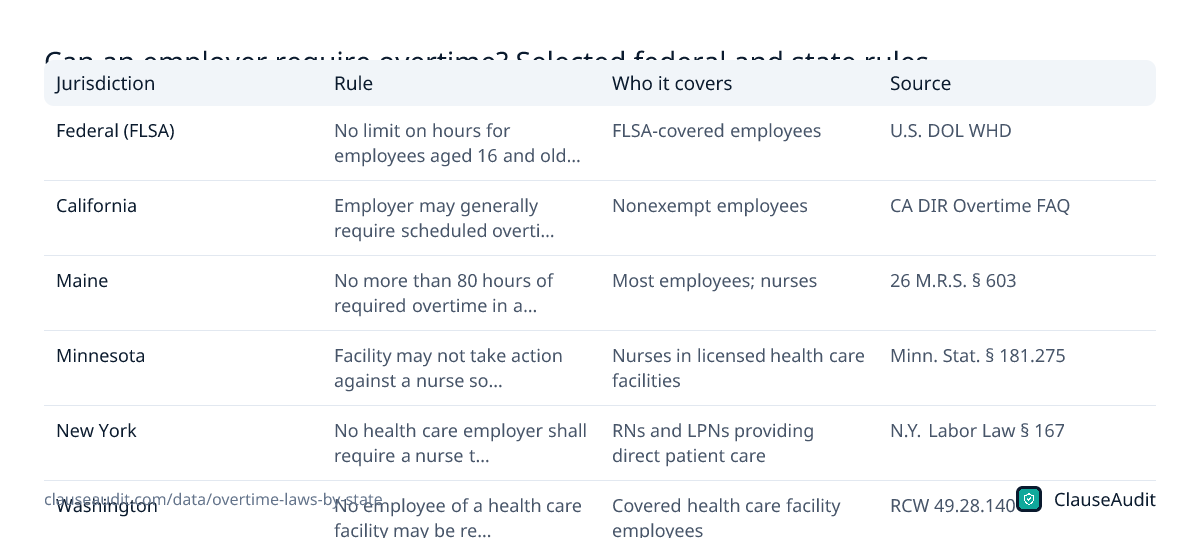
Can an employer require overtime? Selected federal and state rules
| Jurisdiction | Rule | Who it covers | Source |
|---|---|---|---|
| Federal (FLSA) | No limit on hours for employees aged 16 and older; overtime must be paid | FLSA-covered employees | U.S. DOL WHD |
| California | Employer may generally require scheduled overtime but cannot discipline for refusing work on the 7th day of the workweek | Nonexempt employees | CA DIR Overtime FAQ |
| Maine | No more than 80 hours of required overtime in any consecutive 2-week period; nurses may not be disciplined for refusing more than 12 consecutive hours | Most employees; nurses | 26 M.R.S. § 603 |
| Minnesota | Facility may not take action against a nurse solely for declining extra hours the nurse judges could endanger patient safety | Nurses in licensed health care facilities | Minn. Stat. § 181.275 |
| New York | No health care employer shall require a nurse to work more than regularly scheduled hours, except listed emergencies | RNs and LPNs providing direct patient care | N.Y. Labor Law § 167 |
| Washington | No employee of a health care facility may be required to work overtime, with listed exceptions | Covered health care facility employees | RCW 49.28.140 |
Source: U.S. Department of Labor, Wage and Hour Division, Overtime Pay; California Department of Industrial Relations, Labor Commissioner's Office, Overtime FAQ; Maine Legislature, 26 M.R.S. § 603 Limitation on mandatory overtime; Minnesota Office of the Revisor of Statutes, Minnesota Statutes § 181.275 Regulating nurses' overtime; New York State Senate, New York Labor Law § 167 Restrictions on consecutive hours of work for nurses; Washington State Legislature, RCW 49.28.140 Health care facility employees: overtime. Download as image
Type of state overtime rule by state
- 4Daily and weekly overtime
- 27Weekly overtime after 40 hours
- 2Weekly threshold above 40 hours
- 18No separate state threshold (federal FLSA applies)
- Daily and weekly overtime4
- Weekly overtime after 40 hours27
- Weekly threshold above 40 hours2
- No separate state threshold (federal FLSA applies)18
Which states have daily overtime?
Only four do: Alaska, California, Colorado and Nevada. In most of the country, a 10-hour Monday followed by a short week earns you nothing extra as long as the week stays at or under 40 hours. In these four states, the long day itself can trigger premium pay.
California is the strictest. Time-and-a-half starts after 8 hours in a workday, and double time starts after 12. The seventh consecutive day in a workweek has its own rule: the first 8 hours pay 1.5x and anything past that pays 2x. If you work a string of long shifts in California, those rules stack quickly.
Alaska also starts at 8 hours a day, but only for employers with four or more employees. Colorado waits until 12 hours, counted per day or as 12 consecutive hours, and it bans employers from swapping comp time for overtime pay. Nevada's daily rule only applies to people earning under 1.5 times the state minimum wage. Earn 1.5 times the minimum or more and you are back to weekly overtime only.
Oregon sits just outside this group. It pays premium wages after 10 hours a day, but only in certain manufacturing settings like mills, factories and canneries. Most Oregon workers count overtime by the week.
Does federal overtime still apply if my state sets a higher threshold?
Usually, yes. Minnesota's state law sets overtime at 48 hours a week, and Kansas sets it at 46 for employers outside the FLSA. Those numbers look worse for workers, but they mostly apply to small businesses the federal law doesn't reach. If your employer is covered by the FLSA, you are owed overtime after 40 hours, and the federal rule wins.
The same logic covers the 18 jurisdictions with no state overtime threshold at all, including Texas, Florida and Georgia. Workers there are not left without overtime. They just rely on the federal law and the U.S. Department of Labor to enforce it. Virginia is a twist on this: it has no separate threshold, but its law lets workers sue under state law for FLSA overtime violations, with a 3-year window.
The industry carve-outs are worth knowing if you work in one. New York residential workers who live in get premium pay after 44 hours. Seasonal amusement businesses get a longer week in North Carolina (45 hours) and Missouri (52 hours). Federal law exempts many seasonal amusement businesses from overtime, so in those jobs the state number may be the only rule. If you take a summer job at a park or resort, ask which rule your employer uses.
Can my employer make me work mandatory overtime?
In most jobs, yes. The FLSA has no limit on how many hours employees aged 16 and older can work in a week. It only says the extra hours must be paid. Refusing scheduled overtime can get you disciplined or fired in most states, especially if you work at will.
The real limits are narrow. Maine caps required overtime at 80 hours in any consecutive 2-week period for most employees, and protects nurses who refuse more than 12 consecutive hours. California lets employers require overtime but bars discipline for refusing to work the seventh day of the workweek. New York limits mandatory overtime for nurses, Washington restricts it for many health care facility staff, and Minnesota protects nurses who decline extra hours they believe would put patients at risk.
If you have caregiving duties or a second job, don't rely on the law to protect your evenings. Get your schedule expectations in writing before you accept. A line such as "you may be asked to work additional hours as business needs require" gives your employer wide room, so ask how often that has meant weekends in practice.
Am I exempt from overtime because I'm paid a salary?
Not automatically. For the common white-collar exemptions you need two things: a salary at or above the threshold, and job duties that fit an executive, administrative or professional role. Pay a receptionist a salary and they are still owed overtime.
The federal floor is $684 per week. Several states set the bar much higher. California requires at least $70,304 a year for 2026, Colorado $57,784, and New York $66,300 in New York City, Nassau, Suffolk and Westchester. If your offer letter calls the role exempt but the salary sits below your state's number, that label is likely wrong.
Titles like coordinator or associate deserve a second look. Check the salary first, then ask what you will actually spend your days doing.
What overtime rules mean for freelancers and the businesses that hire them
Overtime laws protect employees, not independent contractors. If you invoice a client as a freelancer, there is no time-and-a-half for a long week. Your protection is your rate and your scope. A fixed-fee project with unlimited revisions can turn into many unpaid hours with no legal backstop. Build that time into your quote. Cap revision rounds, say what counts as a change in scope, and set an hourly rate for anything outside it.
Businesses face the reverse risk. Labeling a full-time, closely supervised worker a contractor doesn't remove overtime liability if a state agency or court decides the person was really an employee. Back overtime, plus penalties and interest, can make up a large share of what a misclassification case costs.
For a business, the safer move is to match the contract to reality. If you set the hours and the tools, treat the person as an employee and track their time.
What to do if your overtime pay looks wrong
- Keep your own record of start times, end times and breaks each day, especially in a daily-overtime state.
- Compare your pay stub against both the weekly rule and, in Alaska, California, Colorado or Nevada, the daily rule.
- If you are salaried and called exempt, check your salary against your state's threshold and your duties against the job description.
- Ask your employer in writing which overtime rule they apply and how they define the workweek.
- Contact your state labor department or the U.S. Department of Labor's Wage and Hour Division if the answer doesn't add up.
- Note any wage claim deadline in your state so a late complaint doesn't cost you back pay.
How ClauseAudit helps
Overtime problems often start in the offer letter. A job gets labeled exempt, the schedule is left vague, or the pay section says salary covers all hours worked. Our automated review reads your employment contract and flags the clauses that affect what you get paid for extra time.
Upload the offer or paste the text, pick your state, and you get a plain-English report on each clause with a suggested change you can raise before you sign.
- Exempt or nonexempt classification, and whether the salary clears your state's threshold
- Hours and schedule language, including on-call time and required overtime
- Pay clauses that say salary covers all hours worked
- Comp time offered in place of overtime pay
- Workweek definition and pay period timing
- Arbitration and class-action waiver clauses that limit how you can bring a wage claim
Frequently asked questions
How many hours before overtime kicks in?
For most hourly workers, overtime starts after 40 hours in a workweek under federal law, in every state. Four states also pay daily overtime. Alaska and California start at 8 hours in a day, Colorado at 12, and Nevada at 8 hours only for workers earning under 1.5 times the state minimum wage.
Does California pay double time?
Yes. California pays double time for hours worked past 12 in a single workday. On the seventh consecutive day of a workweek, the first 8 hours are paid at 1.5x and every hour after that is paid at 2x. It is the only state on this list with a double-time rule.
Can I be fired for refusing overtime?
In most states, yes. Federal law places no limit on weekly hours for workers aged 16 and older, so employers can usually require overtime as long as they pay for it. Exceptions are narrow: Maine caps required overtime at 80 hours in a 2-week period, and several states protect nurses and health care staff.
Is Minnesota overtime really after 48 hours?
Minnesota's own law sets overtime at 48 hours a week. But if your employer is covered by the federal FLSA, which includes most mid-size and larger businesses, you are still owed overtime after 40 hours. The 48-hour state rule mainly matters for smaller employers outside federal coverage.
Do salaried employees get overtime?
Some do. A salary alone doesn't make you exempt. You also need to earn above the threshold and do executive, administrative or professional work. The federal floor is $684 per week, while California sets $70,304 a year for 2026. If you fall short on pay or duties, you may be owed overtime.
Can my employer give me comp time instead of overtime pay?
Private employers generally have to pay overtime in cash. Colorado says this outright: time off cannot replace overtime pay. Washington allows an exception when the employee asks for compensating time off instead of premium pay. If your contract offers comp time in place of overtime, ask how it squares with your state's rule.
Do freelancers get overtime?
No. Overtime laws cover employees, not independent contractors. If you invoice clients as a contractor, your rate and contract terms are your only protection against long weeks. If a client controls your schedule and tools like an employer would, you may be misclassified and owed overtime as an employee.
Which states have no state overtime law?
The 18 jurisdictions with no separate state threshold include Alabama, Florida, Georgia, Texas and Tennessee. Workers there still get overtime after 40 hours under federal law if their employer is covered. They just enforce it through the U.S. Department of Labor or a federal claim rather than a state agency.
Use this data
Every chart and card below is free to reuse under CC BY 4.0. Download what you need and link back to this page.
 Stat cards
 Key findings card
 Infographic
 States by type of overtime rule, 2026 (50 states + DC) (jurisdictions)
 Daily overtime triggers: hours in a workday before premium pay starts
 Weekly overtime thresholds that differ from the federal 40 hours (hours per week)
 Minimum annual salary to be exempt from overtime, 2026 (USD per year)
 States with daily overtime rules (2026)
 Can an employer require overtime? Selected federal and state rules
Embed the infographic
Free to share on your site, blog or slides under CC BY 4.0. Please keep the credit link.
Sources and method
Every number on this page comes from the sources below, each opened and read on or before October 18, 2026. A second, independent review checked every figure against its source and corrected anything that did not match. 51 of 51 state entries were confirmed; any that could not be are marked "Not yet confirmed" and left out of every count and chart.
- U.S. Department of Labor, Wage and Hour Division, State Minimum Wage Laws (Updated July 1, 2026)
- U.S. Department of Labor, Wage and Hour Division, Overtime Pay (Undated web page, accessed October 18, 2026)
- U.S. Department of Labor, US Department of Labor announces technical amendment restoring regulations on exemptions for executive, administrative, professional employees (May 14, 2026)
- California Department of Industrial Relations, Labor Commissioner's Office, Overtime FAQ (Undated web page, accessed October 18, 2026)
- California Department of Industrial Relations, News Release 2025-118: 2026 minimum wage and exempt salary (December 5, 2025)
- Washington State Department of Labor & Industries, Washington's minimum wage going up to $17.13 an hour in 2026 (September 30, 2025)
- Colorado Department of Labor and Employment, COMPS Order Poster & Notice (Colorado Overtime & Minimum Pay Standards) (Effective 1/1/2026)
- New York State Department of Labor, Minimum Wage Frequently Asked Questions (Undated web page (2026 thresholds effective January 1, 2026), accessed October 18, 2026)
- Minnesota Office of the Revisor of Statutes, Minnesota Statutes § 177.25 Overtime (Current statute, accessed October 18, 2026)
- Kansas Office of Revisor of Statutes, K.S.A. 44-1204 Minimum wages and maximum hours (Current statute, accessed October 18, 2026)
- Kansas Office of Revisor of Statutes, K.S.A. 44-1202 Definitions (Current statute, accessed October 18, 2026)
- Maine Legislature, 26 M.R.S. § 603 Limitation on mandatory overtime (Current statute, accessed October 18, 2026)
- Washington State Legislature, RCW 49.28.140 Health care facility employees: overtime (Current statute, accessed October 18, 2026)
- New York State Senate, New York Labor Law § 167 Restrictions on consecutive hours of work for nurses (Current statute, accessed October 18, 2026)
- Minnesota Office of the Revisor of Statutes, Minnesota Statutes § 181.275 Regulating nurses' overtime (Current statute, accessed October 18, 2026)
- Virginia Legislative Information System, Code of Virginia § 40.1-29.2 Employer liability (Current statute (history through 2026, c. 1040), accessed October 18, 2026)
- Alaska Department of Labor and Workforce Development, Wage and Hour Frequently Asked Questions (Undated web page, accessed October 18, 2026)
Cite this page
ClauseAudit, “Overtime Laws by State (2026): Daily Overtime, Weekly Thresholds and Mandatory Overtime”, updated October 18, 2026, https://clauseaudit.com/data/overtime-laws-by-state. Free to reuse with a link back (CC BY 4.0).
This page summarises published data and law as checked on October 18, 2026. Figures are updated as new editions are released, and your own situation may differ. It is general information, not legal, tax or financial advice.