At-Will Employment by State: Which Exceptions Each State Recognizes (2026)
By ClauseAudit Research · 8 sources ·
Which states are at-will employment states?
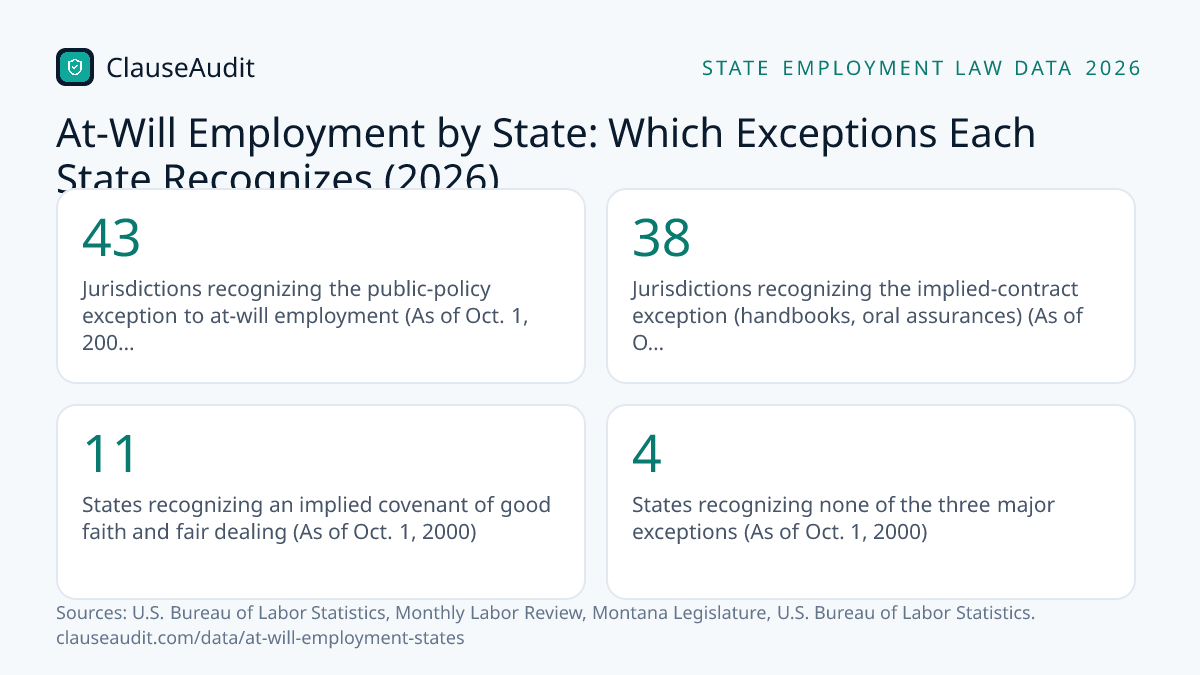
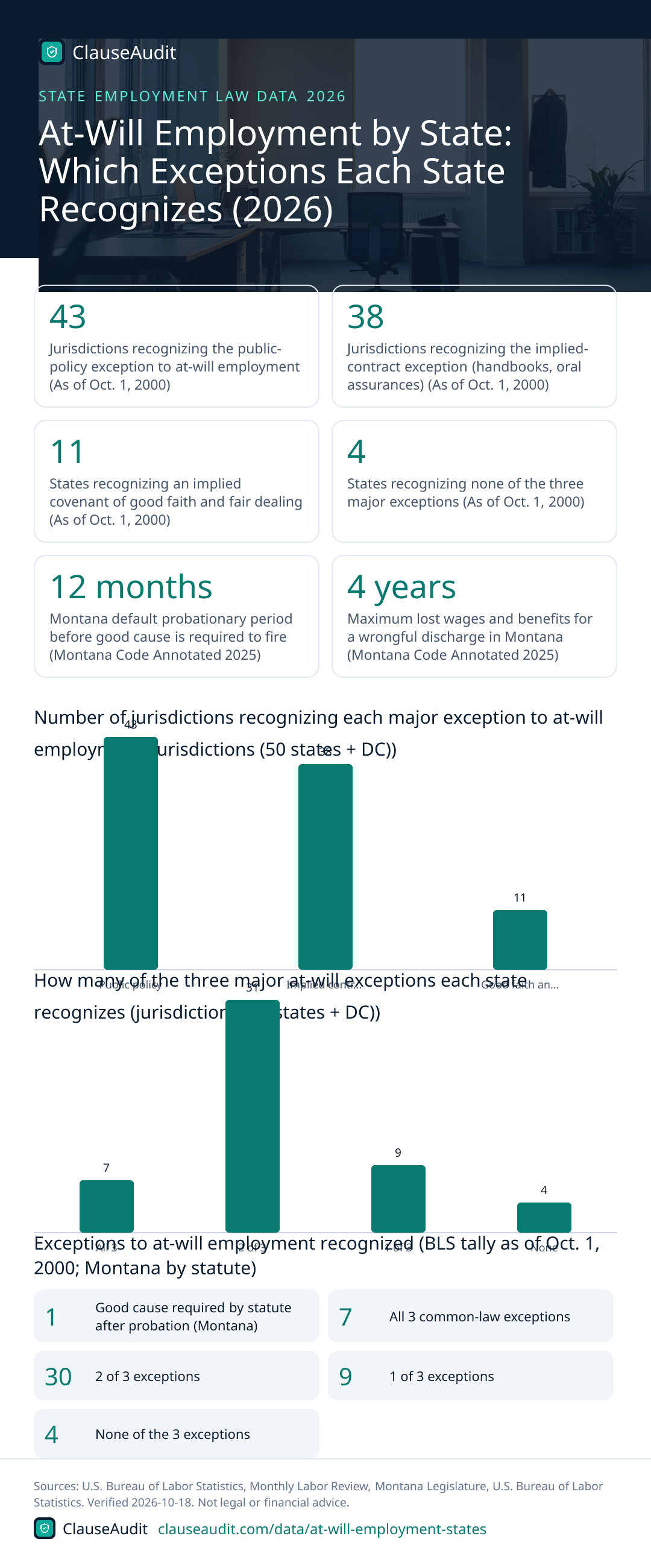
Every state except Montana follows at-will employment, so either side can usually end the job at any time. The doctrine has limits, though. In the BLS state tally as of Oct. 1, 2000, 43 jurisdictions recognized the public-policy exception and 38 recognized the implied-contract exception. Only 11 states recognized a good-faith covenant.

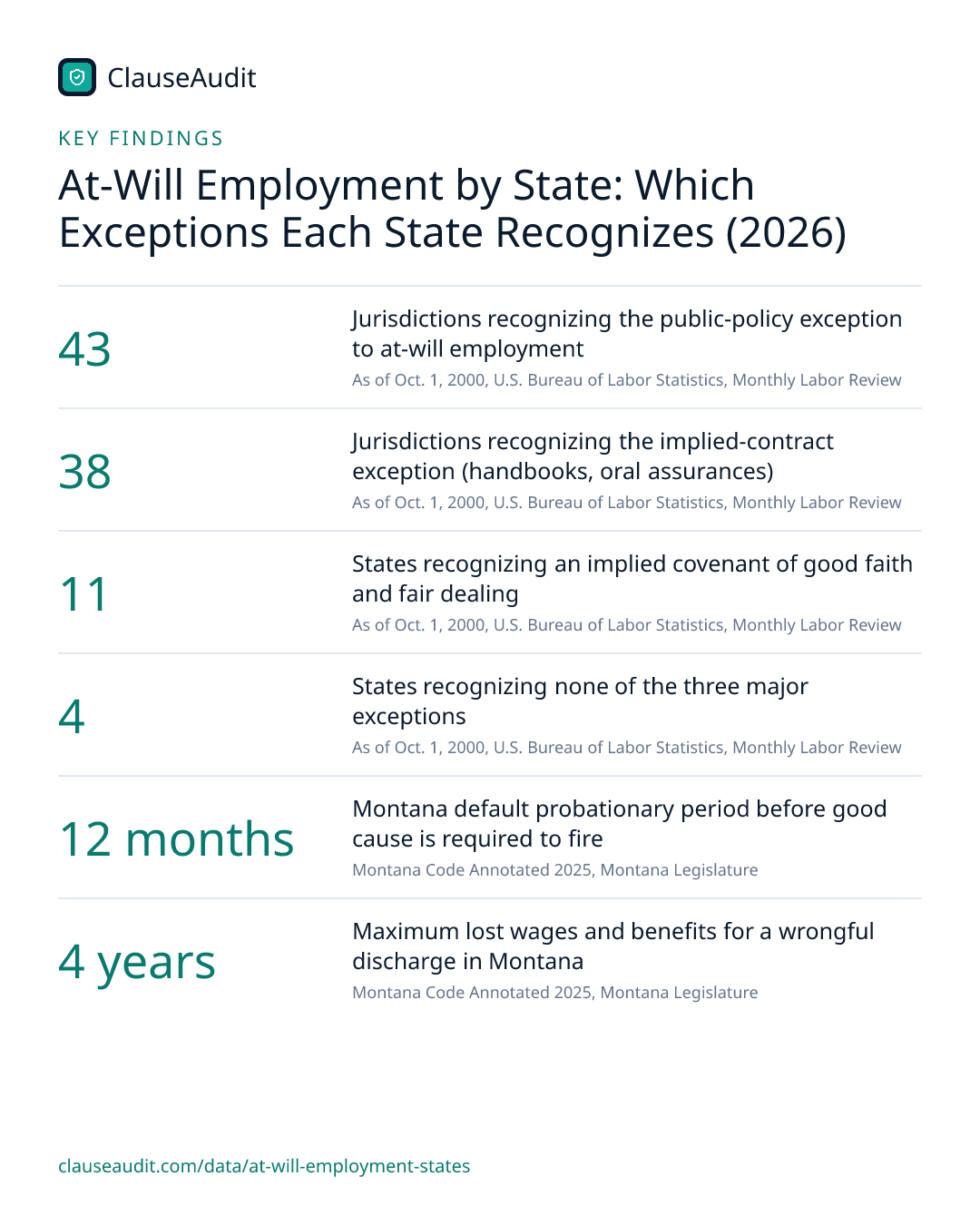
- Jurisdictions recognizing the public-policy exception to at-will employment (As of Oct. 1, 2000, U.S. Bureau of Labor Statistics, Monthly Labor Review)
- 43
- Jurisdictions recognizing the implied-contract exception (handbooks, oral assurances) (As of Oct. 1, 2000, U.S. Bureau of Labor Statistics, Monthly Labor Review)
- 38
- States recognizing an implied covenant of good faith and fair dealing (As of Oct. 1, 2000, U.S. Bureau of Labor Statistics, Monthly Labor Review)
- 11
- States recognizing none of the three major exceptions (As of Oct. 1, 2000, U.S. Bureau of Labor Statistics, Monthly Labor Review)
- 4
- Montana default probationary period before good cause is required to fire (Montana Code Annotated 2025, Montana Legislature)
- 12 months
- Maximum lost wages and benefits for a wrongful discharge in Montana (Montana Code Annotated 2025, Montana Legislature)
- 4 years
- Share of U.S. wage and salary workers represented by a union (2025, U.S. Bureau of Labor Statistics)
- 11.2%
At-will employment is the default rule across the country. Your employer can let you go for a good reason, a bad reason or no reason at all, as long as the reason isn't illegal. You can quit the same way. Montana is the one state that breaks from this by statute, requiring good cause once you finish a probationary period.
The real differences between states sit in the exceptions courts have carved out. Some states let you sue if you were fired for refusing to break the law. Others treat promises in a handbook as a binding contract. A few go further and read a duty of fair dealing into every job. Your state's mix decides how much a written promise from your employer is worth.
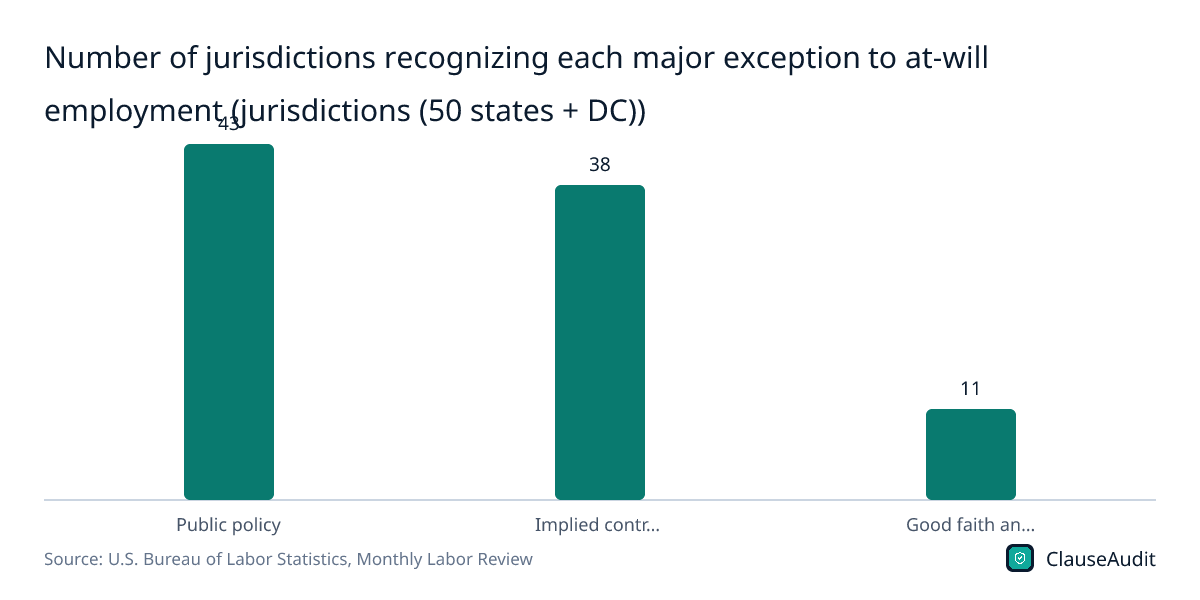
Number of jurisdictions recognizing each major exception to at-will employment (jurisdictions (50 states + DC))
Chart data
| Label | Value (jurisdictions (50 states + DC)) |
|---|---|
| Public policy | 43 |
| Implied contract | 38 |
| Good faith and fair dealing | 11 |
The public-policy exception was the most widely accepted in the 2000 tally, at 43 jurisdictions. The good-faith covenant is the rare one at 11 states, which is why a claim built on it only works in a handful of places.
Download this chart (PNG)How many of the three major at-will exceptions each state recognizes (jurisdictions (50 states + DC))
Chart data
| Label | Value (jurisdictions (50 states + DC)) |
|---|---|
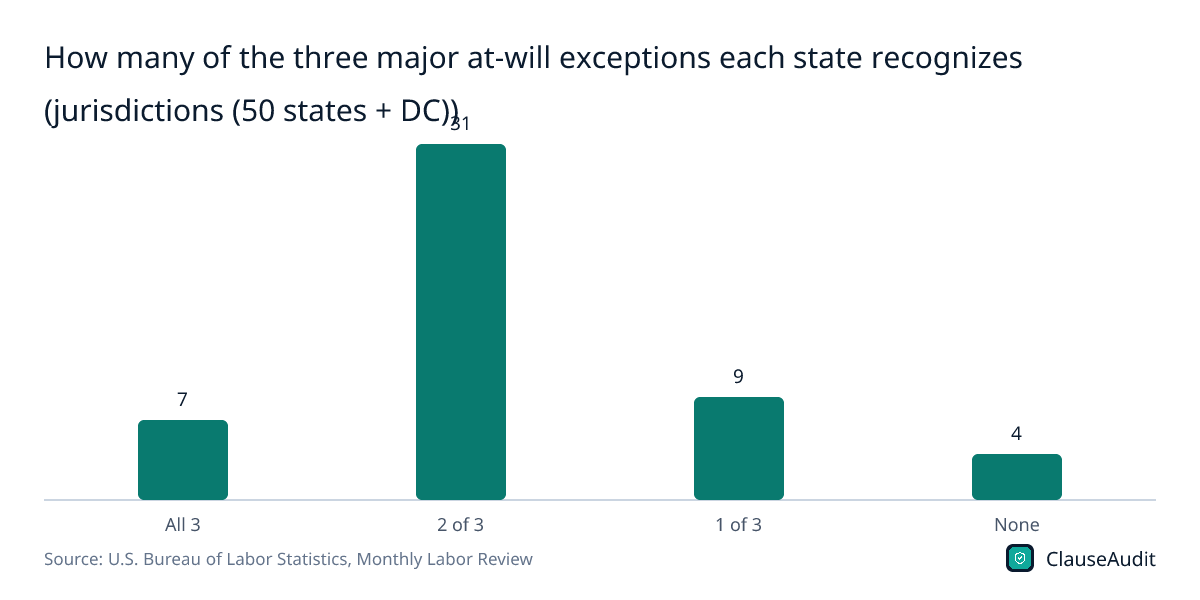
| All 3 | 7 |
| 2 of 3 | 31 |
| 1 of 3 | 9 |
| None | 4 |
Most jurisdictions sit in the middle, with 31 recognizing two of the three exceptions. Florida, Georgia, Louisiana and Rhode Island recognized none, though federal and state anti-discrimination and anti-retaliation laws still apply there.
Download this chart (PNG)Key time limits in Montana's Wrongful Discharge From Employment Act (months)
Chart data
| Label | Value |
|---|---|
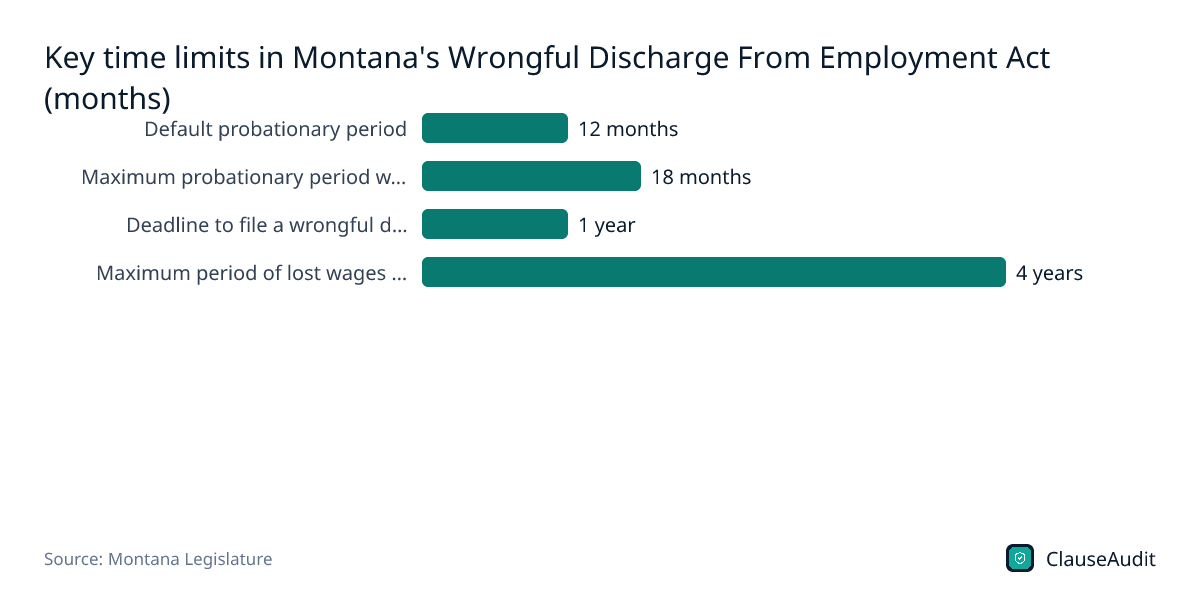
| Default probationary period | 12 months |
| Maximum probationary period with extensions | 18 months |
| Deadline to file a wrongful discharge claim | 1 year |
| Maximum period of lost wages awarded | 4 years |
Montana's protection starts after a default probationary period of 12 months, which an employer can stretch to 18 months. If you are fired without good cause, you have 1 year to file, and lost wages are capped at 4 years.
Download this chart (PNG)Union membership rates by sector, 2025 (%)
Chart data
| Label | Value (%) |
|---|---|
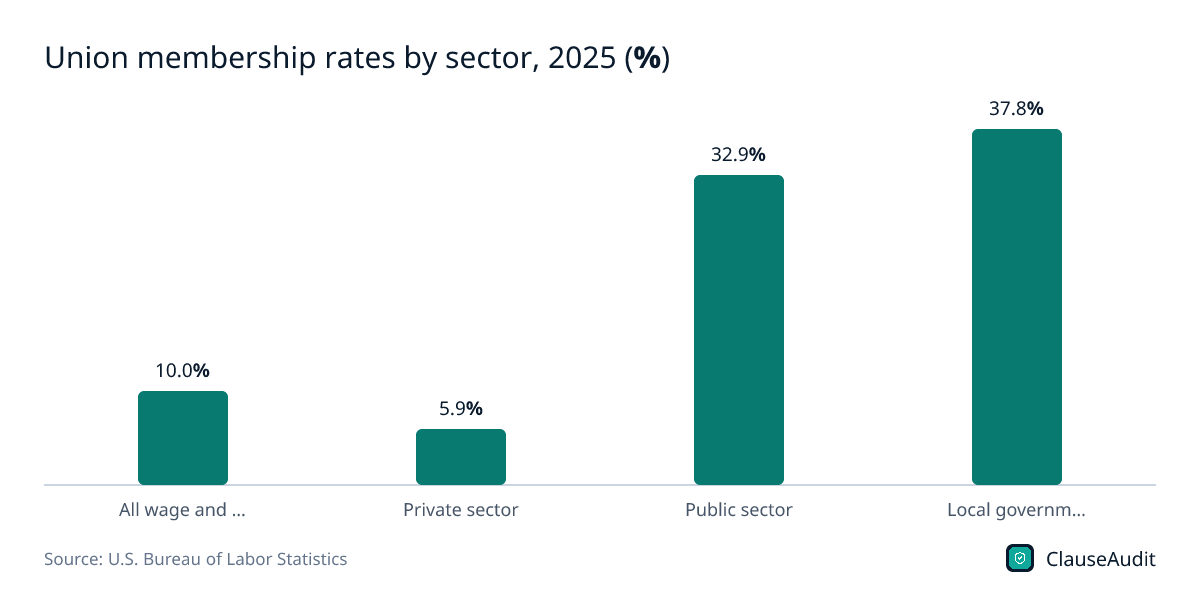
| All wage and salary workers | 10.0% |
| Private sector | 5.9% |
| Public sector | 32.9% |
| Local government | 37.8% |
Union contracts are the other common way out of at-will terms, because they often require just cause for discipline. Only 5.9% of private-sector workers were union members in 2025, compared with 32.9% in the public sector.
Download this chart (PNG)When a discharge is wrongful in Montana (Mont. Code Ann. 39-2-904, 2025)
| Ground | What the statute says |
|---|---|
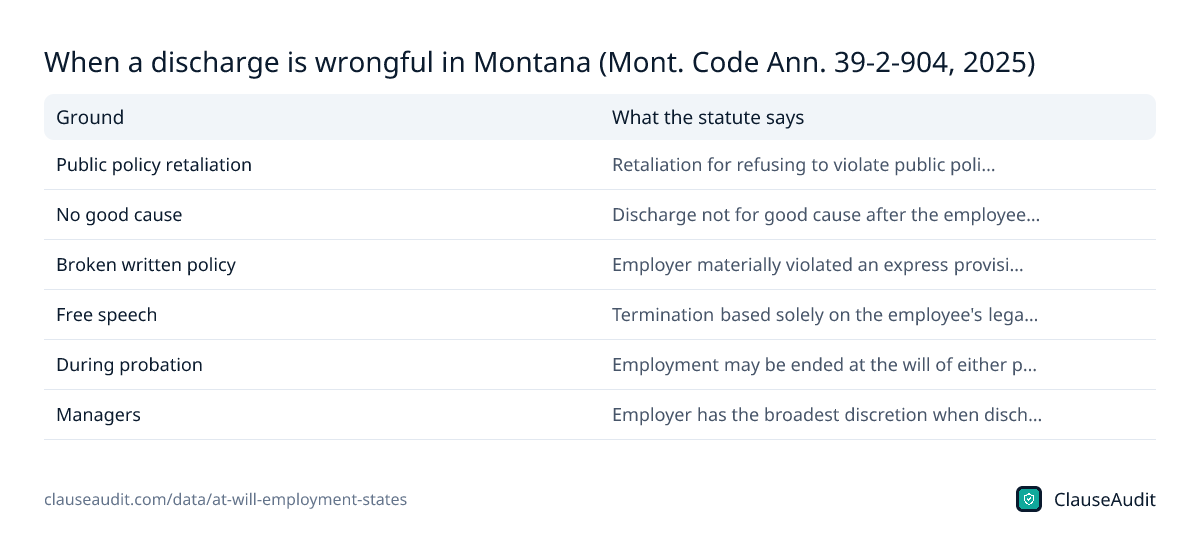
| Public policy retaliation | Retaliation for refusing to violate public policy or for reporting a violation of public policy |
| No good cause | Discharge not for good cause after the employee completed the employer's probationary period |
| Broken written policy | Employer materially violated an express provision of its own written personnel policy |
| Free speech | Termination based solely on the employee's legal expression of free speech, including social media |
| During probation | Employment may be ended at the will of either party for any reason or no reason |
| Managers | Employer has the broadest discretion when discharging managerial or supervisory employees |
Source: Montana Legislature, Mont. Code Ann. 39-2-904, Elements of wrongful discharge. Download as image
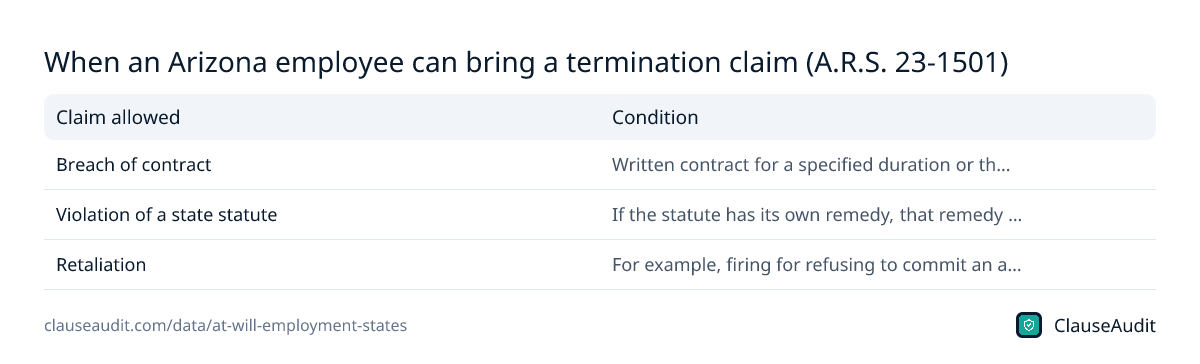
When an Arizona employee can bring a termination claim (A.R.S. 23-1501)
| Claim allowed | Condition |
|---|---|
| Breach of contract | Written contract for a specified duration or that expressly restricts the right to terminate, signed by both parties, or set out in a handbook/manual stating it is a contract, or in a writing signed by the party to be charged |
| Violation of a state statute | If the statute has its own remedy, that remedy is exclusive |
| Retaliation | For example, firing for refusing to commit an act that would violate the Arizona Constitution or state statutes |
Source: Arizona State Legislature, Ariz. Rev. Stat. 23-1501, Severability of employment relationships; protection from retaliatory discharges; exclusivity of statutory remedies in employment. Download as image
Exceptions to at-will employment recognized (BLS tally as of Oct. 1, 2000; Montana by statute) by state
- 1Good cause required by statute after probation (Montana)
- 7All 3 common-law exceptions
- 302 of 3 exceptions
- 91 of 3 exceptions
- 4None of the 3 exceptions
- Good cause required by statute after probation (Montana)1
- All 3 common-law exceptions7
- 2 of 3 exceptions30
- 1 of 3 exceptions9
- None of the 3 exceptions4
Which states are not at-will employment states?
Strictly speaking, only Montana. Its Wrongful Discharge From Employment Act says that once you complete the employer's probationary period, you can only be fired for good cause. The default probation is 12 months if the employer sets nothing, and it can be extended, but the total can't pass 18 months.
Every other state starts from at-will. That doesn't mean the rule is the same everywhere. A worker in California, where courts recognized all three major exceptions in the BLS tally, has more ways to challenge a firing than a worker in Georgia, where courts recognized none of them.
Arizona is a special case. The BLS exhibit shows all three exceptions, but the state's 1996 Employment Protection Act narrowed them. Today an Arizona claim generally needs a signed written contract, a violation of a state statute or one of the listed retaliation grounds. A friendly handbook line usually won't be enough.
What are the exceptions to at-will employment?
Courts have built three main exceptions. Each one answers a different question about why you were let go.
- Public policy: you can't be fired for doing something the law protects or refusing to do something the law forbids. Think of a warehouse worker fired for refusing to falsify safety logs, or a nurse fired for reporting patient abuse. As of Oct. 1, 2000, 43 jurisdictions recognized this.
- Implied contract: if your employer's handbook, offer letter or a manager's clear assurance promised you'd only be fired for cause, a court may hold them to it. 38 jurisdictions recognized this one.
- Good faith and fair dealing: the employer can't fire you in bad faith, such as letting you go right before a big commission comes due just to avoid paying it. Only 11 states recognized it: Alabama, Alaska, Arizona, California, Delaware, Idaho, Massachusetts, Montana, Nevada, Utah and Wyoming.
Can you be fired for no reason in an at-will state?
Yes, in most cases. No reason is a legal reason under the at-will rule. What your employer can't do is fire you for an illegal reason, and that line holds in every state, including the four that recognized none of the common-law exceptions.
Illegal reasons come mostly from statutes, not from the exceptions on this page. At most employers, firing someone because of race, sex, age, disability or religion breaks federal law. So does firing someone for filing a wage complaint, taking protected medical leave or reporting fraud. Many states add their own list on top.
The practical problem is proof. An employer rarely says the illegal part out loud. If you think the stated reason is cover, write down dates, names and what was said while it's fresh. Save performance reviews and emails to your personal records where your company policy allows it. A lawyer can tell you quickly whether the timeline points to retaliation.
Does your employment contract override at-will status?
It can, in either direction. This is where most people lose protection without noticing.
A contract that sets a fixed term, such as a set end date for the job, or that lists the only reasons you can be fired, can replace at-will status. Under the implied-contract exception, even a handbook can do it in many states. That is exactly why many employers put an at-will disclaimer in the offer letter and the handbook, often with a line saying no manager can change it except in a signed writing from an officer.
Read those disclaimers closely. If a recruiter told you the role was secure, or that people only get let go for cause, and the document says the opposite, the document usually wins. Ask for the promise in writing before you sign, signed by someone with authority.
Union contracts are the other route. Collective bargaining agreements often require just cause for discipline and discharge. In 2025, 11.2% of wage and salary workers were represented by a union, so most people are relying on their individual paperwork.
Do at-will rules apply to freelancers and contractors?
Not directly. At-will employment is a rule about employees. If you work as an independent contractor, your client relationship is governed by the contract you signed, and the termination clause in that contract is what decides how the work can end.
That cuts both ways. Many freelance agreements let the client end the project at any time on short written notice, which works a lot like at-will without any of the exceptions courts built for employees. You won't have a public-policy claim if a client drops you for a weak reason. What you can have is a clause that pays you for work already done and a kill fee if the project stops early.
So read the termination section before you start. Look for how much notice the client has to give, whether you get paid for work in progress, and who owns drafts that were never delivered. If the client can walk away tomorrow, ask for a deposit up front and payment tied to milestones instead of a single final approval.
One more check: if a client controls your hours, tools and daily tasks like an employer would, you may be misclassified. In that case employee protections, including the exceptions on this page, could apply to you after all.
What should workers and employers do with this?
If you're a worker, look up your state in the table, then check three things in your own paperwork: whether it says at-will, whether it promises anything about cause or notice, and whether the notice periods are equal. A contract asking you for a month's notice while the employer can fire you on the spot is legal in most states, but it's worth pushing back on.
If you run a business, be consistent. A handbook that promises progressive discipline, steps you then skip, is how implied-contract claims start in the 38 jurisdictions that recognized them as of Oct. 1, 2000. Keep the at-will language, train managers not to promise job security, and document the real reasons for each termination. In Montana, treat the probationary period as your evaluation window, because good cause applies once it ends.
Remember the age of the data. The state-by-state tally is the most recent government count we could find, and it is current only as of Oct. 1, 2000. Courts have ruled on these doctrines since, so confirm your state's current position before relying on it in a dispute.
How ClauseAudit helps
At-will status is decided as much by your offer letter and contract as by your state. Upload yours and the automated review flags the clauses that quietly shape how and when you can be let go.
You get each risky clause explained in plain English, with a suggested change you can bring to the negotiation.
- At-will language and any carve-outs that promise termination only for cause
- Notice periods, and whether the employer's notice matches what it asks of you
- Probationary period length and what changes when it ends
- Severance terms, including whether pay depends on signing a release
- Bonus, commission and equity clauses that disappear if you're fired before a payout date
- Mandatory arbitration and class-action waivers that limit how you can bring a wrongful firing claim
Frequently asked questions
Is every state an at-will employment state?
All states except Montana use at-will employment as the default. Montana's Wrongful Discharge From Employment Act requires good cause to fire an employee who has finished the employer's probationary period, which defaults to 12 months. Everywhere else, the employer can end the job without cause unless a contract, union agreement or legal exception says otherwise.
Which states recognize none of the at-will exceptions?
In the BLS tally as of Oct. 1, 2000, Florida, Georgia, Louisiana and Rhode Island recognized none of the three major common-law exceptions. That doesn't make every firing legal there. Federal and state anti-discrimination and anti-retaliation laws still protect workers in those states.
What is the public-policy exception?
It stops an employer from firing you for a reason that offends a clear public policy, usually set by a statute or constitution. Common examples are being fired for refusing to break the law, serving on a jury or reporting illegal conduct. It is the most widely accepted exception, recognized in 43 jurisdictions as of Oct. 1, 2000.
Can an employee handbook change at-will status?
In many states, yes. Under the implied-contract exception, recognized in 38 jurisdictions as of Oct. 1, 2000, a handbook or clear oral assurance that you'll only be fired for cause can become enforceable. Many employers block this with a written disclaimer stating that employment stays at-will and the handbook isn't a contract.
Is California an at-will state?
Yes. California follows at-will employment by default, but it was one of the states recognizing all three major exceptions in the BLS tally: public policy, implied contract and the covenant of good faith and fair dealing. That gives California workers more grounds to challenge a firing than workers in most states.
How long do you have to file a wrongful discharge claim in Montana?
You must file within 1 year after the discharge. If you win, the award for lost wages and fringe benefits is capped at 4 years, with interim earnings deducted. Montana also gives employers the broadest discretion when discharging managers and supervisors, so the protection is stronger for regular staff.
Does at-will employment apply to union workers?
Usually not in the same way. Collective bargaining agreements often require just cause for discipline and discharge, plus a grievance process. In 2025, the union membership rate was 10.0% for all wage and salary workers, and 37.8% in local government, so public employees are far more likely to have this protection.
Can my employer fire me for no reason if my contract says at-will?
Generally yes. An at-will clause means either side can end the job without cause. The employer still can't fire you for an illegal reason such as discrimination or retaliation, and some states add the exceptions on this page. Check whether anything else in the contract, like a fixed term or a cause list, cuts against the at-will line.
Use this data
Every chart and card below is free to reuse under CC BY 4.0. Download what you need and link back to this page.
 Stat cards
 Key findings card
 Infographic
 Number of jurisdictions recognizing each major exception to at-will employment (jurisdictions (50 states + DC))
 How many of the three major at-will exceptions each state recognizes (jurisdictions (50 states + DC))
 Key time limits in Montana's Wrongful Discharge From Employment Act (months)
 Union membership rates by sector, 2025 (%)
 When a discharge is wrongful in Montana (Mont. Code Ann. 39-2-904, 2025)
 When an Arizona employee can bring a termination claim (A.R.S. 23-1501)
Embed the infographic
Free to share on your site, blog or slides under CC BY 4.0. Please keep the credit link.
Sources and method
Every number on this page comes from the sources below, each opened and read on or before October 18, 2026. A second, independent review checked every figure against its source and corrected anything that did not match. 51 of 51 state entries were confirmed; any that could not be are marked "Not yet confirmed" and left out of every count and chart.
- U.S. Bureau of Labor Statistics, Monthly Labor Review, The employment-at-will doctrine: three major exceptions (Charles J. Muhl), Exhibit 1: Recognition of employment-at-will exceptions, by State, as of Oct. 1, 2000 (January 2001)
- Montana Legislature, Mont. Code Ann. 39-2-904, Elements of wrongful discharge (Montana Code Annotated 2025)
- Montana Legislature, Mont. Code Ann. 39-2-905, Remedies (Montana Code Annotated 2025)
- Montana Legislature, Mont. Code Ann. 39-2-910, Probationary period (Montana Code Annotated 2025)
- Montana Legislature, Mont. Code Ann. 39-2-911, Limitation of actions (Montana Code Annotated 2025)
- Montana Legislature, Mont. Code Ann. 39-2-912, Exemptions (Montana Code Annotated 2025)
- Arizona State Legislature, Ariz. Rev. Stat. 23-1501, Severability of employment relationships; protection from retaliatory discharges; exclusivity of statutory remedies in employment (Current Arizona Revised Statutes (read 2026-10-18))
- U.S. Bureau of Labor Statistics, Union Members, 2025 (news release) (February 18, 2026)
Cite this page
ClauseAudit, “At-Will Employment by State: Which Exceptions Each State Recognizes (2026)”, updated October 18, 2026, https://clauseaudit.com/data/at-will-employment-states. Free to reuse with a link back (CC BY 4.0).
This page summarises published data and law as checked on October 18, 2026. Figures are updated as new editions are released, and your own situation may differ. It is general information, not legal, tax or financial advice.