Does Severance Reduce Unemployment Benefits? State-by-State Rules
By ClauseAudit Research · 6 sources ·
Does severance affect unemployment?
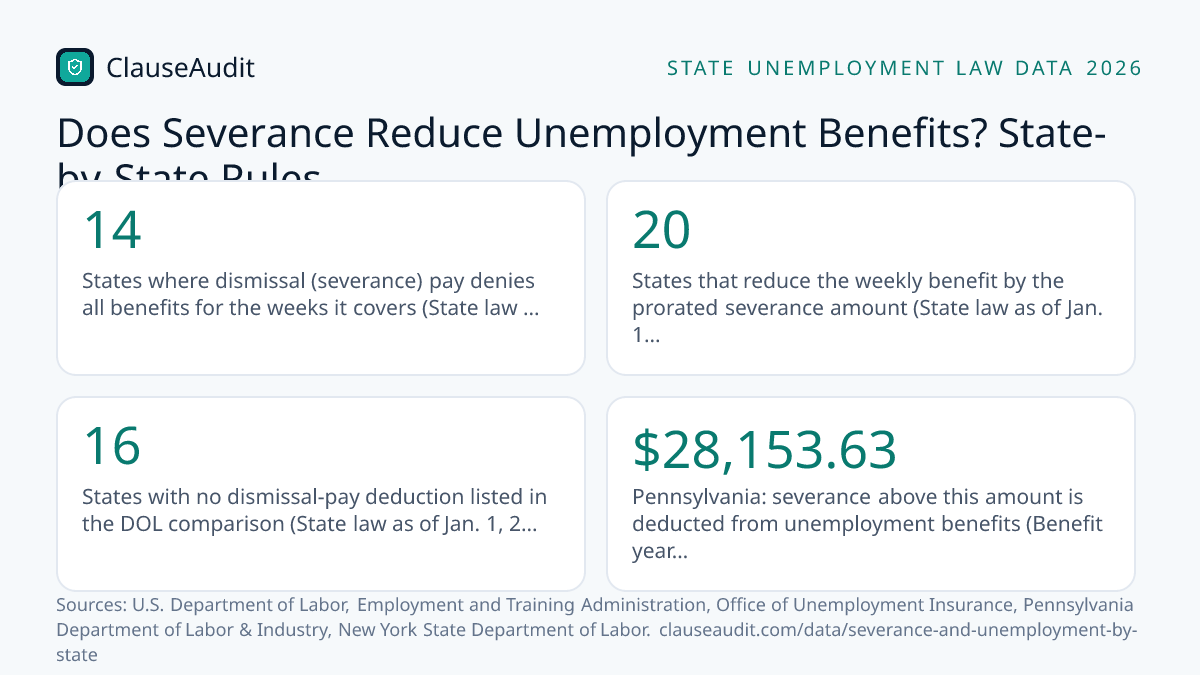
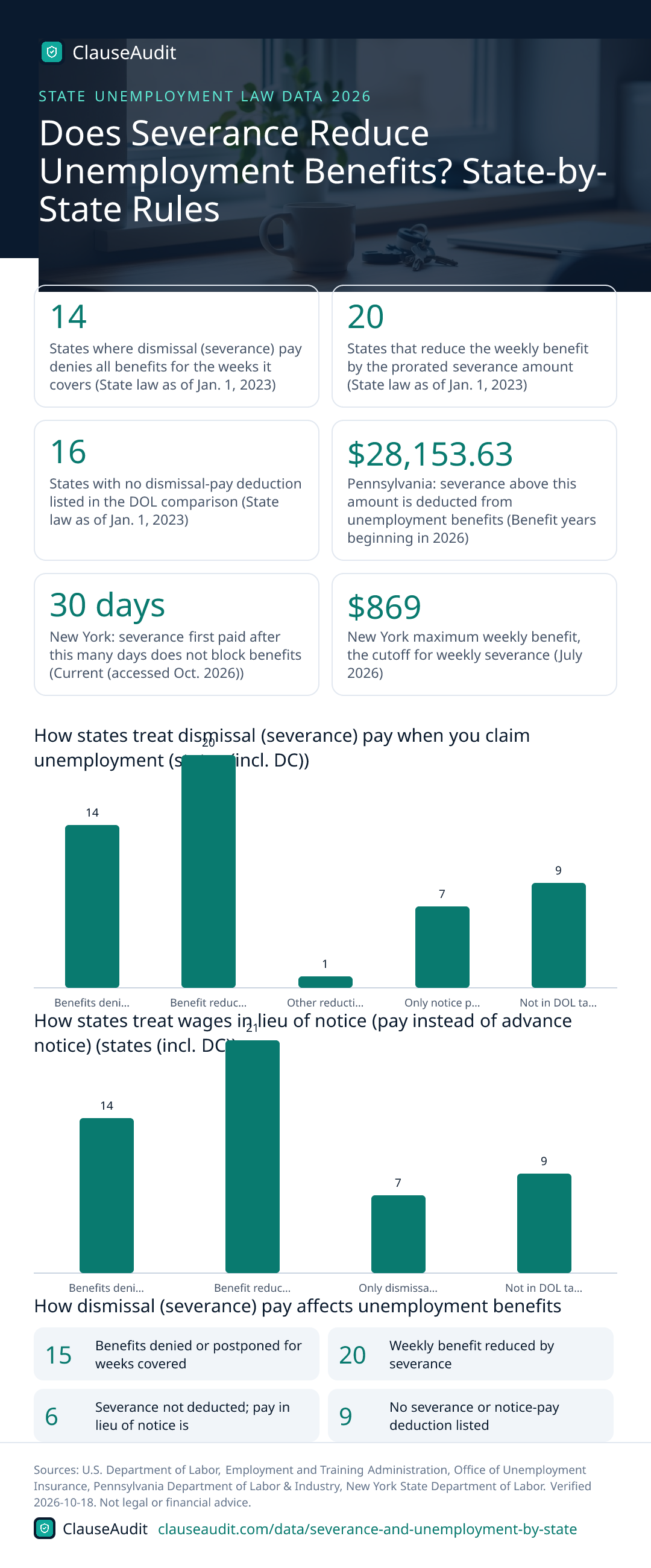
Often, yes. In 14 states, severance pay blocks all unemployment benefits for the weeks it covers, and 20 more cut your weekly benefit by the prorated amount, according to the Labor Department's review of state law as of Jan. 1, 2023. California is a clear exception: severance there does not reduce benefits at all.

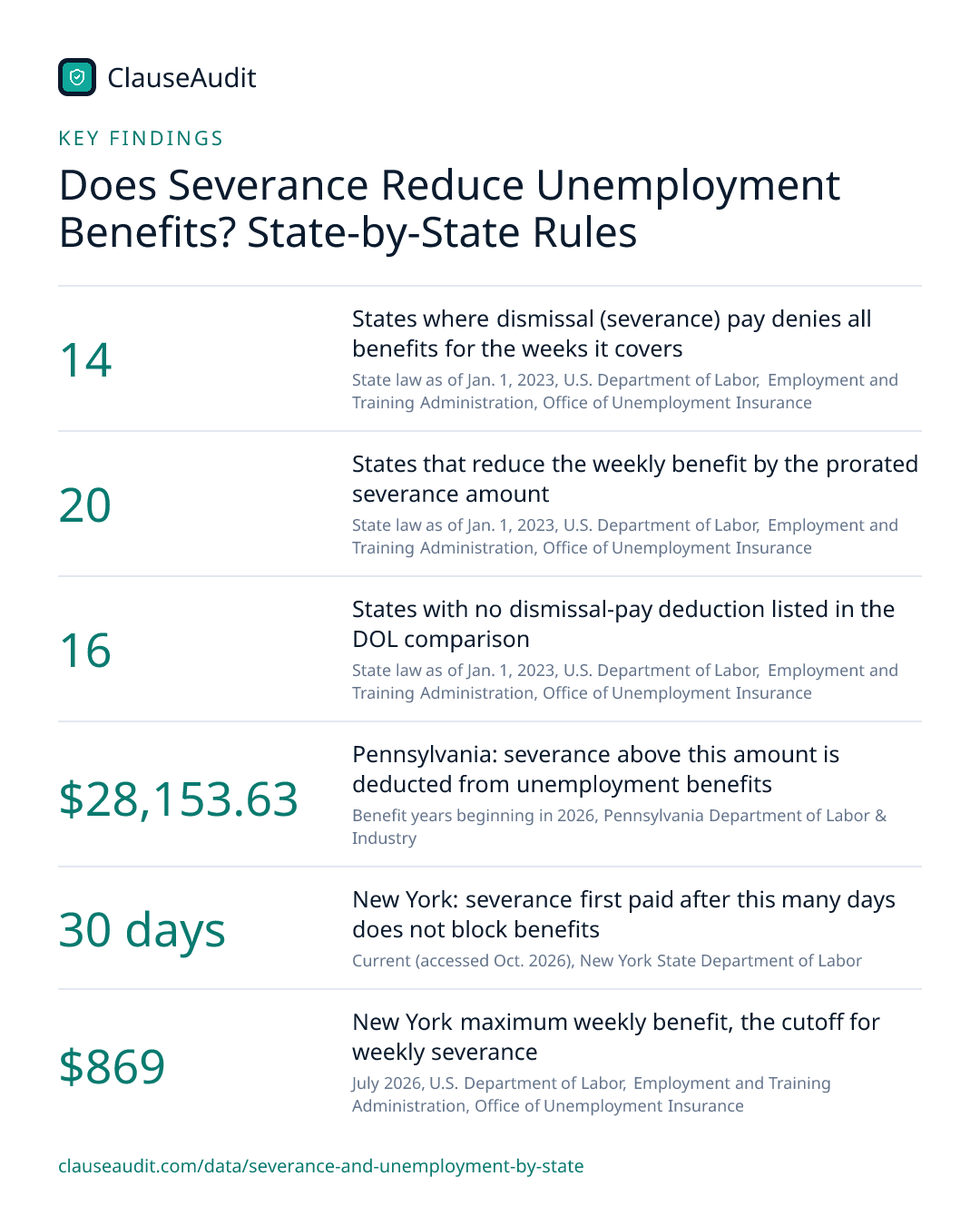
- States where dismissal (severance) pay denies all benefits for the weeks it covers (State law as of Jan. 1, 2023, U.S. Department of Labor, Employment and Training Administration, Office of Unemployment Insurance)
- 14
- States that reduce the weekly benefit by the prorated severance amount (State law as of Jan. 1, 2023, U.S. Department of Labor, Employment and Training Administration, Office of Unemployment Insurance)
- 20
- States with no dismissal-pay deduction listed in the DOL comparison (State law as of Jan. 1, 2023, U.S. Department of Labor, Employment and Training Administration, Office of Unemployment Insurance)
- 16
- Pennsylvania: severance above this amount is deducted from unemployment benefits (Benefit years beginning in 2026, Pennsylvania Department of Labor & Industry)
- $28,153.63
- New York: severance first paid after this many days does not block benefits (Current (accessed Oct. 2026), New York State Department of Labor)
- 30 days
- New York maximum weekly benefit, the cutoff for weekly severance (July 2026, U.S. Department of Labor, Employment and Training Administration, Office of Unemployment Insurance)
- $869
- Rhode Island: longest period severance pay can be allocated over (State law as of Jan. 1, 2023, U.S. Department of Labor, Employment and Training Administration, Office of Unemployment Insurance)
- 26 weeks
- Wisconsin: termination pay over this amount in a 32+ hour week ends eligibility (State law as of Jan. 1, 2023, U.S. Department of Labor, Employment and Training Administration, Office of Unemployment Insurance)
- $500
You lost your job, your employer offered a severance package, and now you want to know if taking it costs you unemployment. The honest answer is that it depends on your state, and on how the money is described and paid.
Most states treat severance as pay for the weeks after you leave. That means your benefits stop or shrink until the severance runs out. A smaller group treats it as a reward for past service and leaves your benefits alone. The map and table below show where each state falls, and the sections that follow explain what that means for your claim.
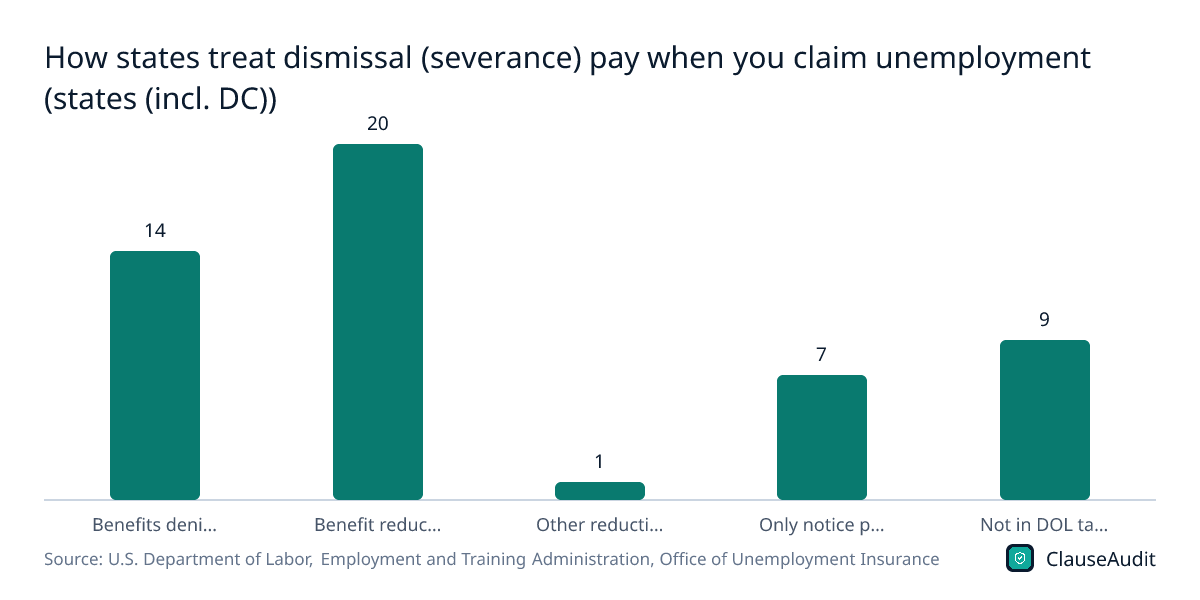
How states treat dismissal (severance) pay when you claim unemployment (states (incl. DC))
Chart data
| Label | Value (states (incl. DC)) |
|---|---|
| Benefits denied for weeks paid | 14 |
| Benefit reduced by prorated amount | 20 |
| Other reduction (Indiana, code R) | 1 |
| Only notice pay listed | 7 |
| Not in DOL table | 9 |
Denial and reduction cover most of the 51 jurisdictions, so most people should expect severance to touch their claim. The 16 states in the last two columns are not a promise; they simply had no dismissal-pay deduction listed by the Labor Department.
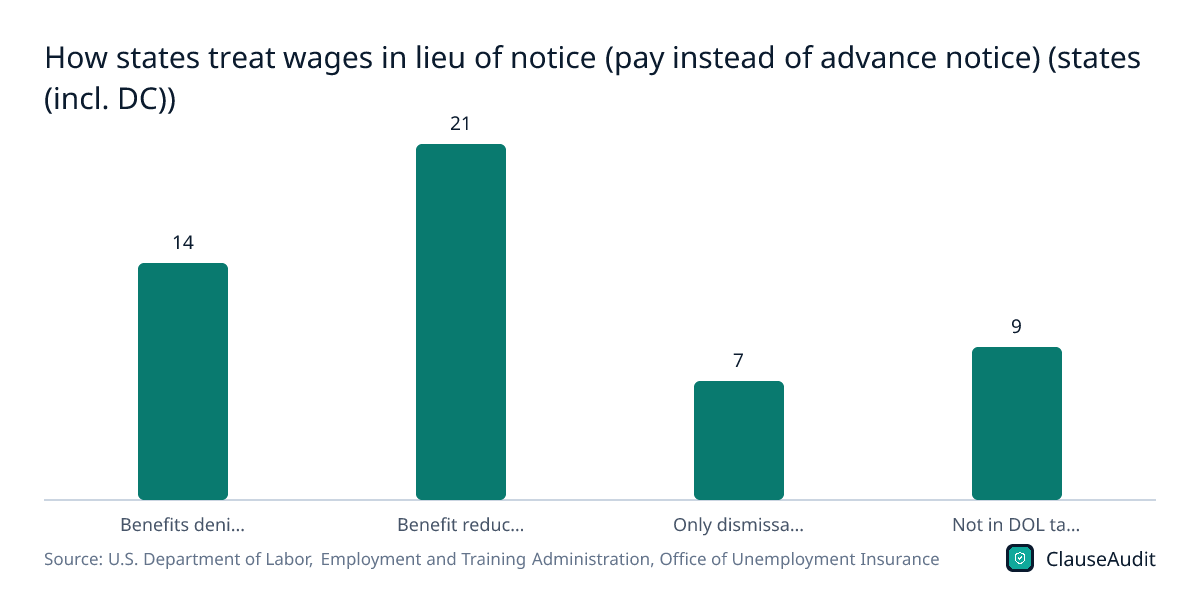
Download this chart (PNG)How states treat wages in lieu of notice (pay instead of advance notice) (states (incl. DC))
Chart data
| Label | Value (states (incl. DC)) |
|---|---|
| Benefits denied for weeks paid | 14 |
| Benefit reduced by prorated amount | 21 |
| Only dismissal pay listed | 7 |
| Not in DOL table | 9 |
Pay in lieu of notice is treated more harshly than severance. It is reduced in 21 states, one more than severance, because it plainly replaces wages for a period you would have worked.
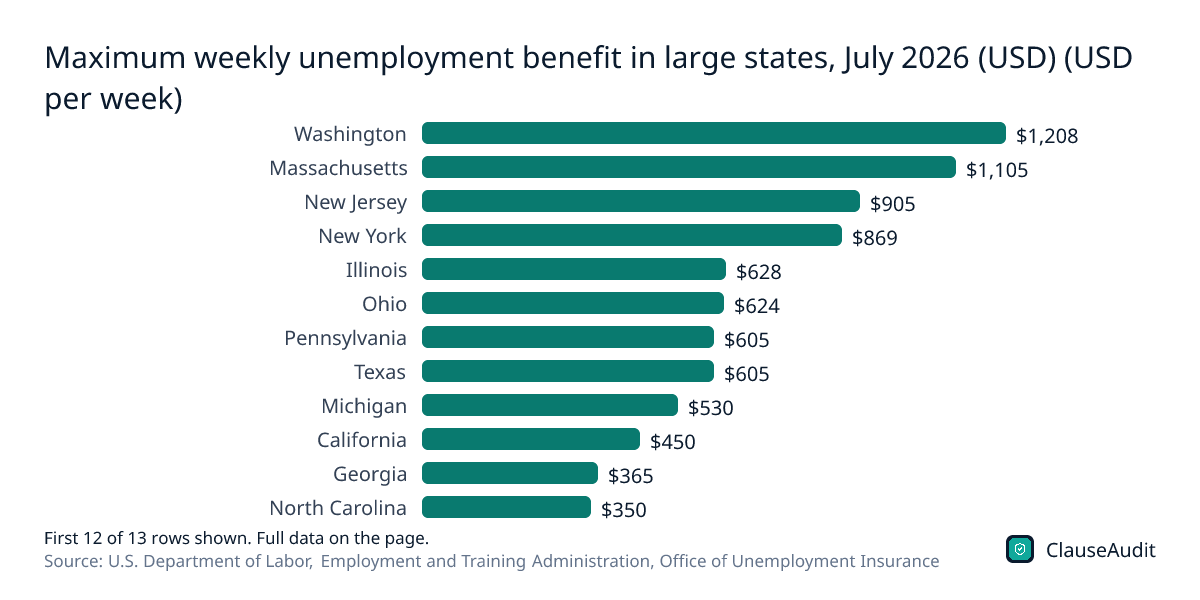
Download this chart (PNG)Maximum weekly unemployment benefit in large states, July 2026 (USD) (USD per week)
Chart data
| Label | Value |
|---|---|
| Washington | $1,208 |
| Massachusetts | $1,105 |
| New Jersey | $905 |
| New York | $869 |
| Illinois | $628 |
| Ohio | $624 |
| Pennsylvania | $605 |
| Texas | $605 |
| Michigan | $530 |
| California | $450 |
| Georgia | $365 |
| North Carolina | $350 |
| Florida | $275 |
These caps put severance in perspective. A Florida claimant can get at most $275 a week, so even a modest severance check will usually exceed it, while New York uses its $869 maximum as the line that decides whether weekly severance blocks benefits.
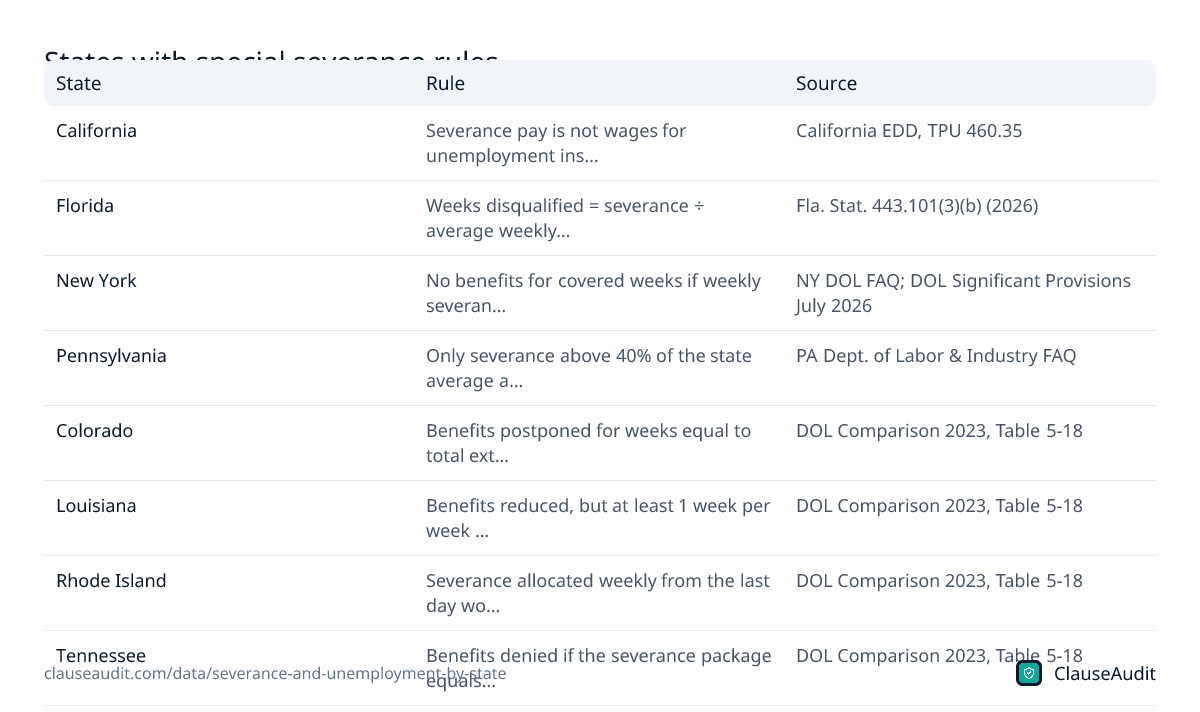
Download this chart (PNG)States with special severance rules
| State | Rule | Source |
|---|---|---|
| California | Severance pay is not wages for unemployment insurance purposes, so it does not reduce benefits. | California EDD, TPU 460.35 |
| Florida | Weeks disqualified = severance ÷ average weekly wage from that employer, rounded down, from the separation week. | Fla. Stat. 443.101(3)(b) (2026) |
| New York | No benefits for covered weeks if weekly severance exceeds the maximum weekly benefit ($869) and the first payment is within 30 days of the last day worked. | NY DOL FAQ; DOL Significant Provisions July 2026 |
| Pennsylvania | Only severance above 40% of the state average annual wage ($28,153.63 for 2026) is deducted. | PA Dept. of Labor & Industry FAQ |
| Colorado | Benefits postponed for weeks equal to total extra pay divided by usual weekly wage. | DOL Comparison 2023, Table 5-18 |
| Louisiana | Benefits reduced, but at least 1 week per week a base-period employer paid severance equal to or above the weekly benefit. | DOL Comparison 2023, Table 5-18 |
| Rhode Island | Severance allocated weekly from the last day worked for up to 26 weeks. | DOL Comparison 2023, Table 5-18 |
| Tennessee | Benefits denied if the severance package equals the salary the person would have earned while working. | DOL Comparison 2023, Table 5-18 |
| Wisconsin | Ineligible in any week with 32 or more hours of termination pay totaling over $500. | DOL Comparison 2023, Table 5-18 |
Source: California Employment Development Department, Benefit Determination Guide, Total and Partial Unemployment TPU 460.35; The Florida Senate, 2026 Florida Statutes, Section 443.101 Disqualification for benefits; New York State Department of Labor, Dismissal/Severance Pay and Pensions Frequently Asked Questions; U.S. Department of Labor, Employment and Training Administration, Office of Unemployment Insurance, Significant Provisions of State Unemployment Insurance Laws, Effective July 2026; Pennsylvania Department of Labor & Industry, Severance & Pension Pay Deductions FAQs; U.S. Department of Labor, Employment and Training Administration, Office of Unemployment Insurance, Comparison of State Unemployment Insurance Laws 2023, Chapter 5 Nonmonetary Eligibility, Table 5-18. Download as image
How dismissal (severance) pay affects unemployment benefits by state
- 15Benefits denied or postponed for weeks covered
- 20Weekly benefit reduced by severance
- 6Severance not deducted; pay in lieu of notice is
- 9No severance or notice-pay deduction listed
- Benefits denied or postponed for weeks covered15
- Weekly benefit reduced by severance20
- Severance not deducted; pay in lieu of notice is6
- No severance or notice-pay deduction listed9
- Not yet confirmed1
| State | Dismissal / severance pay | Wages in lieu of notice | Special rule | Source |
|---|---|---|---|---|
| Alabama | Not listed as deductible | Not listed as deductible | State not listed in DOL Table 5-18 | U.S. Department of Labor, Comparison of State Unemployment Insurance Laws 2023, Table 5-18 (law as of Jan. 1, 2023) |
| Alaska | Weekly benefit reduced by the weekly prorated amount | Weekly benefit reduced by the weekly prorated amount | No special rule noted in DOL table | U.S. Department of Labor, Comparison of State Unemployment Insurance Laws 2023, Table 5-18 (law as of Jan. 1, 2023) |
| Arizona | All benefits denied for the week(s) paid | All benefits denied for the week(s) paid | DOL: claimant is not considered unemployed while receiving either payment. | U.S. Department of Labor, Comparison of State Unemployment Insurance Laws 2023, Table 5-18 (law as of Jan. 1, 2023) |
| Arkansas | All benefits denied for the week(s) paid | All benefits denied for the week(s) paid | No special rule noted in DOL table | U.S. Department of Labor, Comparison of State Unemployment Insurance Laws 2023, Table 5-18 (law as of Jan. 1, 2023) |
| California | Not wages; does not reduce benefits | Weekly benefit reduced by the weekly prorated amount | EDD Benefit Determination Guide TPU 460.35: severance pay is not wages for unemployment insurance purposes. | Powell v. California Unemployment Insurance Appeals Board, 63 Cal. 2d 103 (1965) |
| Colorado | Benefits postponed (DOL code A) | Weekly benefit reduced by the weekly prorated amount | DOL: benefits postponed for a number of weeks equal to the total additional pay divided by the usual weekly wage. | U.S. Department of Labor, Comparison of State Unemployment Insurance Laws 2023, Table 5-18 (law as of Jan. 1, 2023) |
| Connecticut | All benefits denied for the week(s) paid | All benefits denied for the week(s) paid | DOL: dismissal-pay rule does not apply to severance or accrued leave pay based on service in the Armed Forces. | U.S. Department of Labor, Comparison of State Unemployment Insurance Laws 2023, Table 5-18 (law as of Jan. 1, 2023) |
| Delaware | Weekly benefit reduced by the weekly prorated amount | Not listed as deductible | No special rule noted in DOL table | U.S. Department of Labor, Comparison of State Unemployment Insurance Laws 2023, Table 5-18 (law as of Jan. 1, 2023) |
| District of Columbia | Weekly benefit reduced by the weekly prorated amount | Not listed as deductible | No special rule noted in DOL table | U.S. Department of Labor, Comparison of State Unemployment Insurance Laws 2023, Table 5-18 (law as of Jan. 1, 2023) |
| Florida | Benefits denied for severance ÷ average weekly wage weeks | Weekly benefit reduced by the weekly prorated amount | Fla. Stat. 443.101(3)(b) and (3) closing paragraph: weeks disqualified = severance divided by average weekly wage from that employer, rounded down, starting with the separation week; if the pay is less than the benefit, benefit is reduced by it. | Fla. Stat. § 443.101(3) (2026) |
| Georgia | All benefits denied for the week(s) paid | All benefits denied for the week(s) paid | No special rule noted in DOL table | U.S. Department of Labor, Comparison of State Unemployment Insurance Laws 2023, Table 5-18 (law as of Jan. 1, 2023) |
| Hawaii | Not listed as deductible | Not listed as deductible | State not listed in DOL Table 5-18 | U.S. Department of Labor, Comparison of State Unemployment Insurance Laws 2023, Table 5-18 (law as of Jan. 1, 2023) |
| Idaho | Not listed as deductible | Not listed as deductible | State not listed in DOL Table 5-18 | U.S. Department of Labor, Comparison of State Unemployment Insurance Laws 2023, Table 5-18 (law as of Jan. 1, 2023) |
| Illinois | Not listed as deductible | Weekly benefit reduced by the weekly prorated amount | No special rule noted in DOL table | U.S. Department of Labor, Comparison of State Unemployment Insurance Laws 2023, Table 5-18 (law as of Jan. 1, 2023) |
| Indiana | Reduction (code 'R') | Weekly benefit reduced by the weekly prorated amount | DOL table marks dismissal pay 'R' (code not defined in the key): excludes the greater of the first $3 or 1/5 of the weekly benefit from other than a base-period employer. | U.S. Department of Labor, Comparison of State Unemployment Insurance Laws 2023, Table 5-18 (law as of Jan. 1, 2023) |
| Iowa | Weekly benefit reduced by the weekly prorated amount | Weekly benefit reduced by the weekly prorated amount | No special rule noted in DOL table | U.S. Department of Labor, Comparison of State Unemployment Insurance Laws 2023, Table 5-18 (law as of Jan. 1, 2023) |
| Kansas | Weekly benefit reduced by the weekly prorated amount | Not listed as deductible | No special rule noted in DOL table | U.S. Department of Labor, Comparison of State Unemployment Insurance Laws 2023, Table 5-18 (law as of Jan. 1, 2023) |
| Kentucky | Not listed as deductible | Weekly benefit reduced by the weekly prorated amount | No special rule noted in DOL table | U.S. Department of Labor, Comparison of State Unemployment Insurance Laws 2023, Table 5-18 (law as of Jan. 1, 2023) |
| Louisiana | Weekly benefit reduced by the weekly prorated amount | Weekly benefit reduced by the weekly prorated amount | DOL: reduction, but not less than 1 week for each week a base-period employer provided severance pay equal to or above the weekly benefit amount. | U.S. Department of Labor, Comparison of State Unemployment Insurance Laws 2023, Table 5-18 (law as of Jan. 1, 2023) |
| Maine | Weekly benefit reduced by the weekly prorated amount | Weekly benefit reduced by the weekly prorated amount | No special rule noted in DOL table | U.S. Department of Labor, Comparison of State Unemployment Insurance Laws 2023, Table 5-18 (law as of Jan. 1, 2023) |
| Maryland | Weekly benefit reduced by the weekly prorated amount | Weekly benefit reduced by the weekly prorated amount | No special rule noted in DOL table | U.S. Department of Labor, Comparison of State Unemployment Insurance Laws 2023, Table 5-18 (law as of Jan. 1, 2023) |
| Massachusetts | Not yet confirmed: check the source | U.S. Department of Labor, Comparison of State Unemployment Insurance Laws 2023, Table 5-18 (law as of Jan. 1, 2023) | ||
| Michigan | Weekly benefit reduced by the weekly prorated amount | Weekly benefit reduced by the weekly prorated amount | No special rule noted in DOL table | U.S. Department of Labor, Comparison of State Unemployment Insurance Laws 2023, Table 5-18 (law as of Jan. 1, 2023) |
| Minnesota | Weekly benefit reduced by the weekly prorated amount | Weekly benefit reduced by the weekly prorated amount | No special rule noted in DOL table | U.S. Department of Labor, Comparison of State Unemployment Insurance Laws 2023, Table 5-18 (law as of Jan. 1, 2023) |
| Mississippi | Not listed as deductible | Not listed as deductible | State not listed in DOL Table 5-18 | U.S. Department of Labor, Comparison of State Unemployment Insurance Laws 2023, Table 5-18 (law as of Jan. 1, 2023) |
| Missouri | Not listed as deductible | Weekly benefit reduced by the weekly prorated amount | No special rule noted in DOL table | U.S. Department of Labor, Comparison of State Unemployment Insurance Laws 2023, Table 5-18 (law as of Jan. 1, 2023) |
| Montana | Not listed as deductible | Not listed as deductible | State not listed in DOL Table 5-18 | U.S. Department of Labor, Comparison of State Unemployment Insurance Laws 2023, Table 5-18 (law as of Jan. 1, 2023) |
| Nebraska | All benefits denied for the week(s) paid | All benefits denied for the week(s) paid | No special rule noted in DOL table | U.S. Department of Labor, Comparison of State Unemployment Insurance Laws 2023, Table 5-18 (law as of Jan. 1, 2023) |
| Nevada | All benefits denied for the week(s) paid | All benefits denied for the week(s) paid | No special rule noted in DOL table | U.S. Department of Labor, Comparison of State Unemployment Insurance Laws 2023, Table 5-18 (law as of Jan. 1, 2023) |
| New Hampshire | Weekly benefit reduced by the weekly prorated amount | Weekly benefit reduced by the weekly prorated amount | No special rule noted in DOL table | U.S. Department of Labor, Comparison of State Unemployment Insurance Laws 2023, Table 5-18 (law as of Jan. 1, 2023) |
| New Jersey | Not listed as deductible | All benefits denied for the week(s) paid | No special rule noted in DOL table | U.S. Department of Labor, Comparison of State Unemployment Insurance Laws 2023, Table 5-18 (law as of Jan. 1, 2023) |
| New Mexico | Weekly benefit reduced by the weekly prorated amount | Weekly benefit reduced by the weekly prorated amount | No special rule noted in DOL table | U.S. Department of Labor, Comparison of State Unemployment Insurance Laws 2023, Table 5-18 (law as of Jan. 1, 2023) |
| New York | No benefits for covered weeks if weekly severance is above the maximum weekly benefit rate ($869 as of July 2026) | Not listed as deductible | NY DOL: no benefits for weeks covered if the weekly prorated severance exceeds the maximum weekly benefit rate and the first payment comes within 30 days of the last day worked. | New York State Department of Labor, Dismissal/Severance Pay and Pensions FAQ (accessed Oct. 18, 2026) |
| North Carolina | All benefits denied for the week(s) paid | All benefits denied for the week(s) paid | No special rule noted in DOL table | U.S. Department of Labor, Comparison of State Unemployment Insurance Laws 2023, Table 5-18 (law as of Jan. 1, 2023) |
| North Dakota | Not listed as deductible | Not listed as deductible | State not listed in DOL Table 5-18 | U.S. Department of Labor, Comparison of State Unemployment Insurance Laws 2023, Table 5-18 (law as of Jan. 1, 2023) |
| Ohio | Weekly benefit reduced by the weekly prorated amount | Weekly benefit reduced by the weekly prorated amount | DOL: dismissal-pay rule does not apply to severance or accrued leave pay based on service in the Armed Forces. | U.S. Department of Labor, Comparison of State Unemployment Insurance Laws 2023, Table 5-18 (law as of Jan. 1, 2023) |
| Oklahoma | Not listed as deductible | Not listed as deductible | State not listed in DOL Table 5-18 | U.S. Department of Labor, Comparison of State Unemployment Insurance Laws 2023, Table 5-18 (law as of Jan. 1, 2023) |
| Oregon | Not listed as deductible | Not listed as deductible | State not listed in DOL Table 5-18 | U.S. Department of Labor, Comparison of State Unemployment Insurance Laws 2023, Table 5-18 (law as of Jan. 1, 2023) |
| Pennsylvania | Amount above 40% of state average annual wage is deducted | Not listed as deductible | PA DLI: only severance above 40% of the state average annual wage ($28,153.63 for benefit years beginning in 2026) is deducted, allocated to the weeks right after separation. | Pennsylvania Department of Labor & Industry, Severance & Pension Pay Deductions FAQs (accessed Oct. 18, 2026) |
| Rhode Island | All benefits denied for the week(s) paid | Not listed as deductible | DOL: severance allocated weekly from the last day worked for up to 26 weeks; if the employer sets no number of weeks, it is allocated using the weekly benefit amount. | U.S. Department of Labor, Comparison of State Unemployment Insurance Laws 2023, Table 5-18 (law as of Jan. 1, 2023) |
| South Carolina | Not listed as deductible | Not listed as deductible | State not listed in DOL Table 5-18 | U.S. Department of Labor, Comparison of State Unemployment Insurance Laws 2023, Table 5-18 (law as of Jan. 1, 2023) |
| South Dakota | Weekly benefit reduced by the weekly prorated amount | Weekly benefit reduced by the weekly prorated amount | No special rule noted in DOL table | U.S. Department of Labor, Comparison of State Unemployment Insurance Laws 2023, Table 5-18 (law as of Jan. 1, 2023) |
| Tennessee | All benefits denied for the week(s) paid | All benefits denied for the week(s) paid | DOL: benefits denied if the severance package equals the salary the individual would have received if still working. | U.S. Department of Labor, Comparison of State Unemployment Insurance Laws 2023, Table 5-18 (law as of Jan. 1, 2023) |
| Texas | All benefits denied for the week(s) paid | All benefits denied for the week(s) paid | No special rule noted in DOL table | U.S. Department of Labor, Comparison of State Unemployment Insurance Laws 2023, Table 5-18 (law as of Jan. 1, 2023) |
| Utah | Weekly benefit reduced by the weekly prorated amount | Weekly benefit reduced by the weekly prorated amount | No special rule noted in DOL table | U.S. Department of Labor, Comparison of State Unemployment Insurance Laws 2023, Table 5-18 (law as of Jan. 1, 2023) |
| Vermont | All benefits denied for the week(s) paid | All benefits denied for the week(s) paid | No special rule noted in DOL table | U.S. Department of Labor, Comparison of State Unemployment Insurance Laws 2023, Table 5-18 (law as of Jan. 1, 2023) |
| Virginia | Weekly benefit reduced by the weekly prorated amount | Weekly benefit reduced by the weekly prorated amount | DOL: dismissal pay counts only when the employer allocates it to specific pay periods. | U.S. Department of Labor, Comparison of State Unemployment Insurance Laws 2023, Table 5-18 (law as of Jan. 1, 2023) |
| Washington | Weekly benefit reduced by the weekly prorated amount | Weekly benefit reduced by the weekly prorated amount | DOL: deductible pay includes negotiated settlements or proceeds for early termination of an employment contract; previously accrued compensation except severance pay counts when assigned to a period by bargaining or trade practice. | U.S. Department of Labor, Comparison of State Unemployment Insurance Laws 2023, Table 5-18 (law as of Jan. 1, 2023) |
| West Virginia | Not listed as deductible | All benefits denied for the week(s) paid | No special rule noted in DOL table | U.S. Department of Labor, Comparison of State Unemployment Insurance Laws 2023, Table 5-18 (law as of Jan. 1, 2023) |
| Wisconsin | Weekly benefit reduced by the weekly prorated amount | Not listed as deductible | DOL: dismissal pay counts only when allocated by close of week, payable at the full wage rate, with notice; ineligible in a week with 32+ hours of termination pay totaling over $500. | U.S. Department of Labor, Comparison of State Unemployment Insurance Laws 2023, Table 5-18 (law as of Jan. 1, 2023) |
| Wyoming | All benefits denied for the week(s) paid | All benefits denied for the week(s) paid | No special rule noted in DOL table | U.S. Department of Labor, Comparison of State Unemployment Insurance Laws 2023, Table 5-18 (law as of Jan. 1, 2023) |
Does severance pay affect unemployment benefits?
In most states it does, at least for a while. Out of 50 states plus DC, the Labor Department lists 14 that deny all benefits for any week covered by dismissal pay and 20 that subtract the weekly prorated amount from your benefit. Indiana uses its own reduction formula.
The difference between those two groups matters. In a denial state, a week of severance means a week with no benefit check. In a reduction state, you may still get a partial check if your weekly severance is smaller than your benefit amount.
The remaining 16 states either deduct only pay in lieu of notice or have no deduction listed in the federal table. California is the clearest of these: its agency says severance is not wages for unemployment purposes, so it does not cut your benefit. For the other states, check with the agency before assuming you're safe.
Does it matter if severance is a lump sum or paid over time?
Yes, and this is where the details of your agreement start to count. Many states spread the severance across the weeks it is meant to cover, in one check or as salary continuation.
A few examples show how much the rules vary. Florida divides your severance by your average weekly wage from that employer, rounds down, and disqualifies you for that many weeks from the week you were let go. Rhode Island allocates severance week by week from your last day worked for up to 26 weeks. Virginia counts dismissal pay only when the employer allocates it to specific pay periods. Wisconsin makes you ineligible in any week with 32 or more hours of termination pay totaling over $500.
Pennsylvania takes a different approach. For benefit years beginning in 2026, only severance above $28,153.63 is deducted, which is 40% of the state's average annual wage. If your package comes in under that line, none of it is deducted.
New York has a timing test. If your first severance payment comes more than 30 days after your last day of work, it does not block benefits. If it comes sooner, you lose benefits only for weeks when the weekly severance exceeds the state's maximum weekly benefit, which was $869 as of July 2026.
Is pay in lieu of notice treated differently from severance?
Often, yes. Pay in lieu of notice is money your employer gives you instead of letting you work out a notice period. States see it as wages for time you would have worked, so it is more likely to reduce benefits than severance is.
The federal table shows 14 states that deny benefits for weeks covered by notice pay and 21 that reduce the weekly benefit. In 7 states, only notice pay is listed as deductible. California is one: severance there is safe, but pay in lieu of notice reduces your weekly benefit.
So the label on the payment matters. A lump sum called a severance or release payment can be treated differently from the same amount called notice pay. If you live in a state that splits the two, ask your employer how the payment will be described in the agreement and on your final pay records.
Should you file for unemployment while you're getting severance?
In most cases, file right away. A severance package usually delays or trims benefits rather than cancelling your claim, and filing late can cost you weeks you were entitled to. In a denial state, your benefits typically start once the covered weeks end.
Report the severance accurately on your claim, including the amount, the dates and how it is paid. Leaving it off can lead to an overpayment you have to repay, plus penalties in some states. If the agency's decision looks wrong, you can appeal, but the deadline is short, so read the notice the day it arrives.
How much unemployment is at stake next to your severance?
It helps to put the two numbers side by side. Unemployment benefits are capped, and the caps are low compared with most salaries. As of July 2026, the maximum weekly benefit is $1,208 in Washington, $905 in New Jersey, $605 in Texas, $450 in California and $275 in Florida, before any dependents' allowance.
That means a week of severance is usually worth far more than a week of benefits. If you're in a denial state like Texas, each blocked week is worth at most $605, and you are being paid severance during those weeks anyway. The bigger question is timing: your checks start once the covered weeks end.
The calculation changes when severance is small or paid slowly. A modest weekly payment in a reduction state can leave you with a partial benefit check on top. Before you negotiate, work out your state's weekly maximum and compare it with what the package pays per week. That tells you whether a bigger lump sum, a longer payout or a different label would leave you better off.
What employers and workers should check before signing
If you're an employee, the agreement controls most of what the unemployment office will look at: how much, when it is paid, and what it is called. If you run a business, the way you draft severance decides how much help your former staff can get from the state, and that shapes how fair the package feels.
- Find your state on the map and note whether it denies, reduces or does not deduct severance.
- Check whether the payment is labeled severance, a release payment or pay in lieu of notice.
- Look at the payment schedule. A lump sum and salary continuation can be allocated differently.
- In New York, note when the first payment lands relative to your last day; the 30-day mark matters.
- In Pennsylvania, compare the total to the $28,153.63 threshold for 2026 benefit years.
- Ask whether accrued vacation is paid separately, since some states treat it on its own terms.
- Make sure nothing in the agreement asks you to give up or delay filing for unemployment.
How ClauseAudit helps
Your severance agreement decides most of what the unemployment office will ask about. Upload it, or the employment contract that promises severance, and the automated review flags the clauses that affect your payout and your claim.
Each flagged clause comes with a plain-English explanation and a suggested change you can raise before you sign.
- How the payment is labeled: severance, release payment or pay in lieu of notice
- Payment timing and schedule, lump sum versus salary continuation
- Release of claims language and what rights you are giving up in exchange for the money
- Any clause that discourages or delays an unemployment filing, or asks you not to contest the employer's account
- Clawback terms that make you repay severance if you break a non-compete or non-disparagement clause
- Whether accrued vacation and final wages are paid separately from the severance amount
Frequently asked questions
Can I collect unemployment and severance at the same time?
Sometimes. In the 20 states that reduce benefits by the prorated severance amount, you may still get a partial check if your weekly severance is lower than your benefit. In the 14 states that deny benefits for covered weeks, you usually wait until the severance period ends. California does not reduce benefits for severance at all.
Does severance affect unemployment in California?
No. California's Employment Development Department treats severance pay as something other than wages for unemployment purposes, so it does not reduce your benefits. Pay in lieu of notice is different: it does reduce your weekly benefit by the prorated amount. Read your agreement to see which label your employer used.
How does severance affect unemployment in New York?
New York blocks benefits for weeks covered by severance only if two things are true: the weekly severance is more than the maximum weekly benefit ($869 as of July 2026), and your first payment arrives within 30 days of your last day of work. If either condition is not met, severance does not stop your benefits.
Does Pennsylvania deduct severance from unemployment?
Only part of it. For benefit years that begin in 2026, Pennsylvania deducts severance above $28,153.63, which is 40% of the state's average annual wage. Anything below that line is not deducted. If your package is larger, the excess is allocated to weeks after you leave and reduces your benefits for those weeks.
How does Florida handle severance pay?
Florida divides your severance by your average weekly wage from that employer and rounds down. The result is the number of weeks you are disqualified, counted from the week you were let go. Florida's maximum weekly benefit was $275 as of July 2026, so severance tends to outweigh benefits for those weeks anyway.
Should I wait until my severance runs out before filing?
Usually not. Filing promptly protects your claim date, and the agency will apply your state's severance rule on its own. Waiting can mean losing weeks of benefits you would have been owed once the severance period ended. Report the severance honestly when you file so you don't end up with an overpayment to repay.
Does a lump-sum severance payment count differently?
It can. Many states spread a lump sum over the weeks it is meant to cover, just as they would with salary continuation. Rhode Island allocates severance weekly from your last day worked for up to 26 weeks, and Virginia counts dismissal pay only when the employer assigns it to specific pay periods.
My state isn't listed as deducting severance. Am I in the clear?
Not necessarily. The Labor Department table reflects state law as of Jan. 1, 2023, and 16 states have no dismissal-pay deduction listed. That absence is not a guarantee. Some of those states still deduct pay in lieu of notice, and rules change. Check your state agency's own guidance or call before you rely on it.
Use this data
Every chart and card below is free to reuse under CC BY 4.0. Download what you need and link back to this page.
 Stat cards
 Key findings card
 Infographic
 How states treat dismissal (severance) pay when you claim unemployment (states (incl. DC))
 How states treat wages in lieu of notice (pay instead of advance notice) (states (incl. DC))
 Maximum weekly unemployment benefit in large states, July 2026 (USD) (USD per week)
 States with special severance rules
Embed the infographic
Free to share on your site, blog or slides under CC BY 4.0. Please keep the credit link.
Sources and method
Every number on this page comes from the sources below, each opened and read on or before October 18, 2026. A second, independent review checked every figure against its source and corrected anything that did not match. 50 of 51 state entries were confirmed; any that could not be are marked "Not yet confirmed" and left out of every count and chart.
- U.S. Department of Labor, Employment and Training Administration, Office of Unemployment Insurance, Comparison of State Unemployment Insurance Laws 2023, Chapter 5 Nonmonetary Eligibility, Table 5-18 (2023 edition (state law as of January 1, 2023); most recent edition listed by DOL as of Oct. 2026)
- U.S. Department of Labor, Employment and Training Administration, Office of Unemployment Insurance, Significant Provisions of State Unemployment Insurance Laws, Effective July 2026 (July 2026)
- Pennsylvania Department of Labor & Industry, Severance & Pension Pay Deductions FAQs (Accessed October 18, 2026 (2026 benefit-year figures))
- New York State Department of Labor, Dismissal/Severance Pay and Pensions Frequently Asked Questions (Accessed October 18, 2026)
- California Employment Development Department, Benefit Determination Guide, Total and Partial Unemployment TPU 460.35 (Accessed October 18, 2026)
- The Florida Senate, 2026 Florida Statutes, Section 443.101 Disqualification for benefits (2026 Florida Statutes)
Cite this page
ClauseAudit, “Does Severance Reduce Unemployment Benefits? State-by-State Rules”, updated October 18, 2026, https://clauseaudit.com/data/severance-and-unemployment-by-state. Free to reuse with a link back (CC BY 4.0).
This page summarises published data and law as checked on October 18, 2026. Figures are updated as new editions are released, and your own situation may differ. It is general information, not legal, tax or financial advice.