Mini-WARN Acts and Mandatory Severance by State: Layoff Notice Rules (2026)
By ClauseAudit Research · 27 sources ·
Which states have a mini WARN Act?
A minority of states add their own layoff notice laws on top of federal WARN, and several are stricter. New Jersey, New York and Nebraska require 90 days of notice instead of the federal 60 calendar days, and New Jersey and Maine go further by requiring severance of 1 week of pay per year worked.

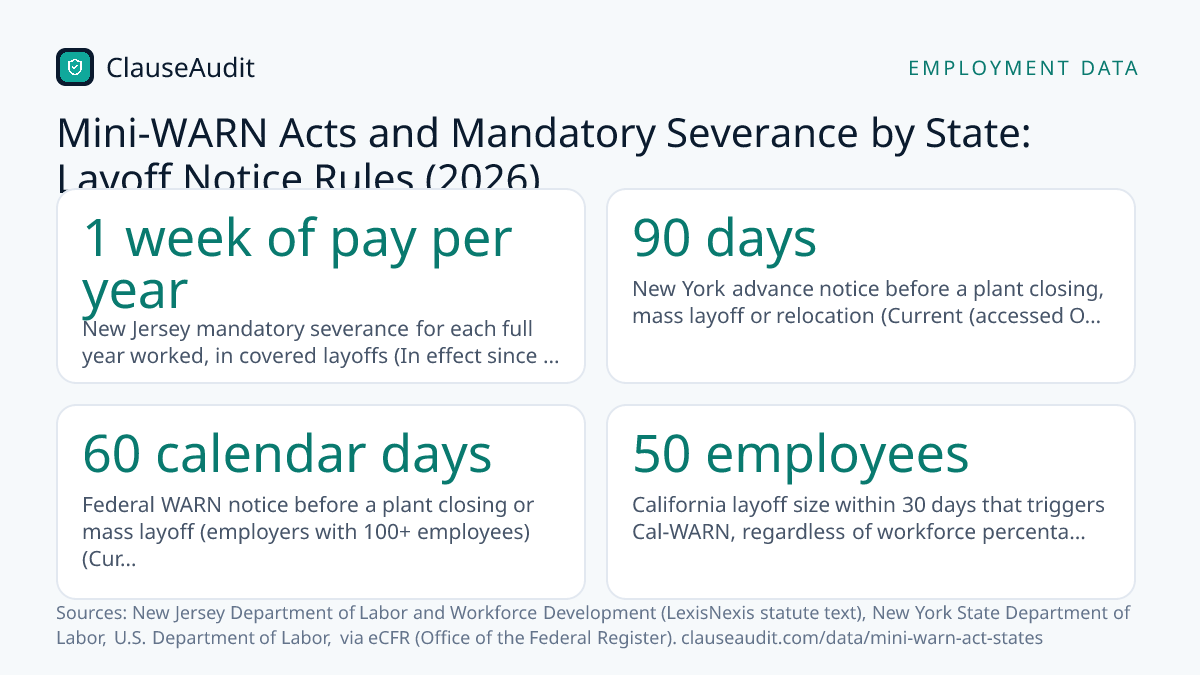
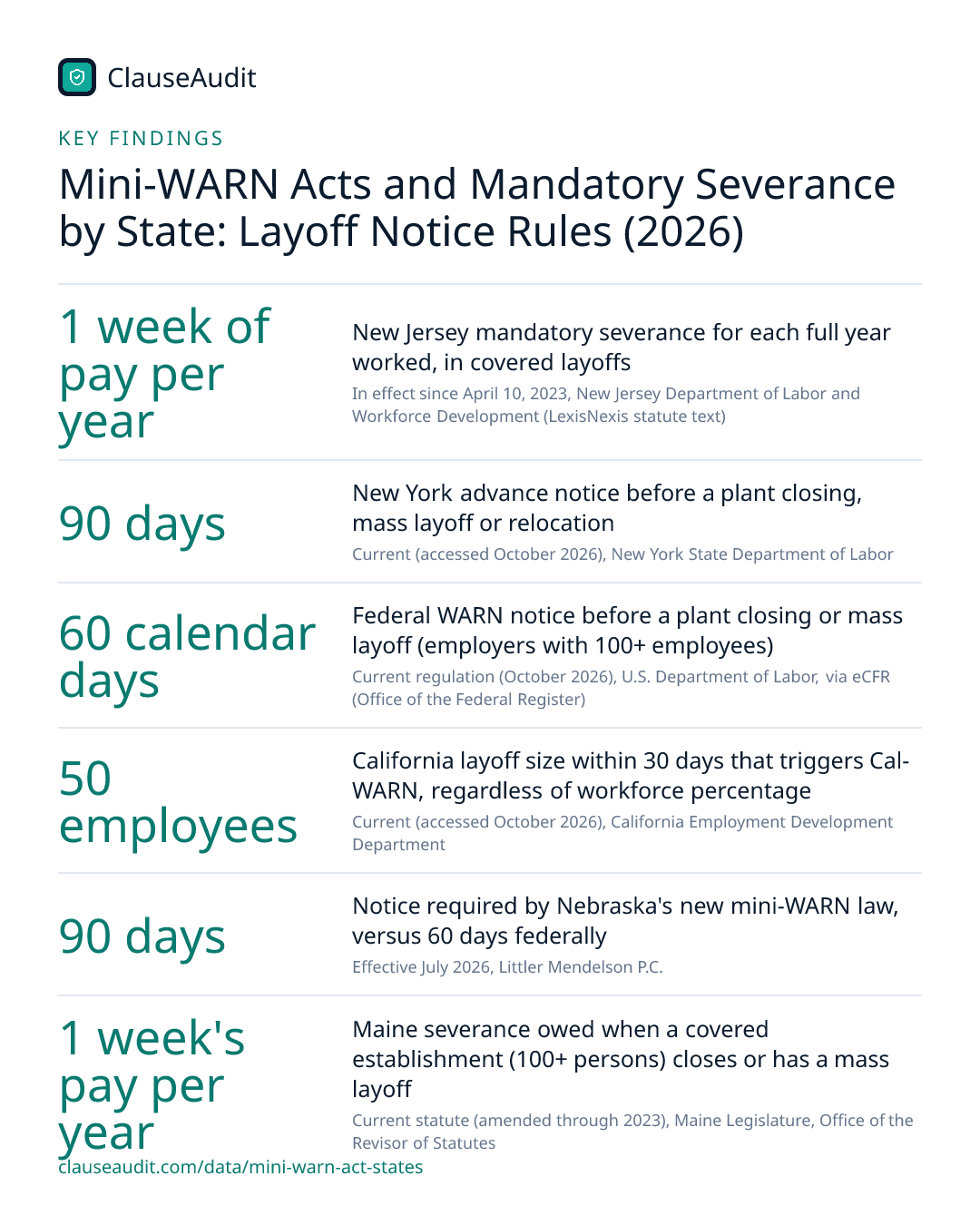
- New Jersey mandatory severance for each full year worked, in covered layoffs (In effect since April 10, 2023, New Jersey Department of Labor and Workforce Development (LexisNexis statute text))
- 1 week of pay per year
- New York advance notice before a plant closing, mass layoff or relocation (Current (accessed October 2026), New York State Department of Labor)
- 90 days
- Federal WARN notice before a plant closing or mass layoff (employers with 100+ employees) (Current regulation (October 2026), U.S. Department of Labor, via eCFR (Office of the Federal Register))
- 60 calendar days
- California layoff size within 30 days that triggers Cal-WARN, regardless of workforce percentage (Current (accessed October 2026), California Employment Development Department)
- 50 employees
- Notice required by Nebraska's new mini-WARN law, versus 60 days federally (Effective July 2026, Littler Mendelson P.C.)
- 90 days
- Maine severance owed when a covered establishment (100+ persons) closes or has a mass layoff (Current statute (amended through 2023), Maine Legislature, Office of the Revisor of Statutes)
- 1 week's pay per year
- Iowa employer-size threshold for its 30-day layoff notice law (Iowa Code 2026, Iowa Legislature)
- 25 employees
- Washington mini-WARN employer threshold (STABLE Act, effective July 27, 2025) (Current (RCW through 2026 c 86), Washington State Legislature)
- 50 employees
The federal WARN Act gives workers 60 calendar days of notice before a plant closing or mass layoff, but only at employers with 100 or more employees. A handful of states decided that was not enough. Their own versions, usually called mini-WARN acts, cover smaller employers, count smaller layoffs, or demand longer notice.
Two states go a step further and make the employer pay. In New Jersey and Maine, a covered layoff comes with mandatory severance of 1 week of pay for each year you worked. This page explains where those rules apply, what they mean for you, and what to look for in your own contract.
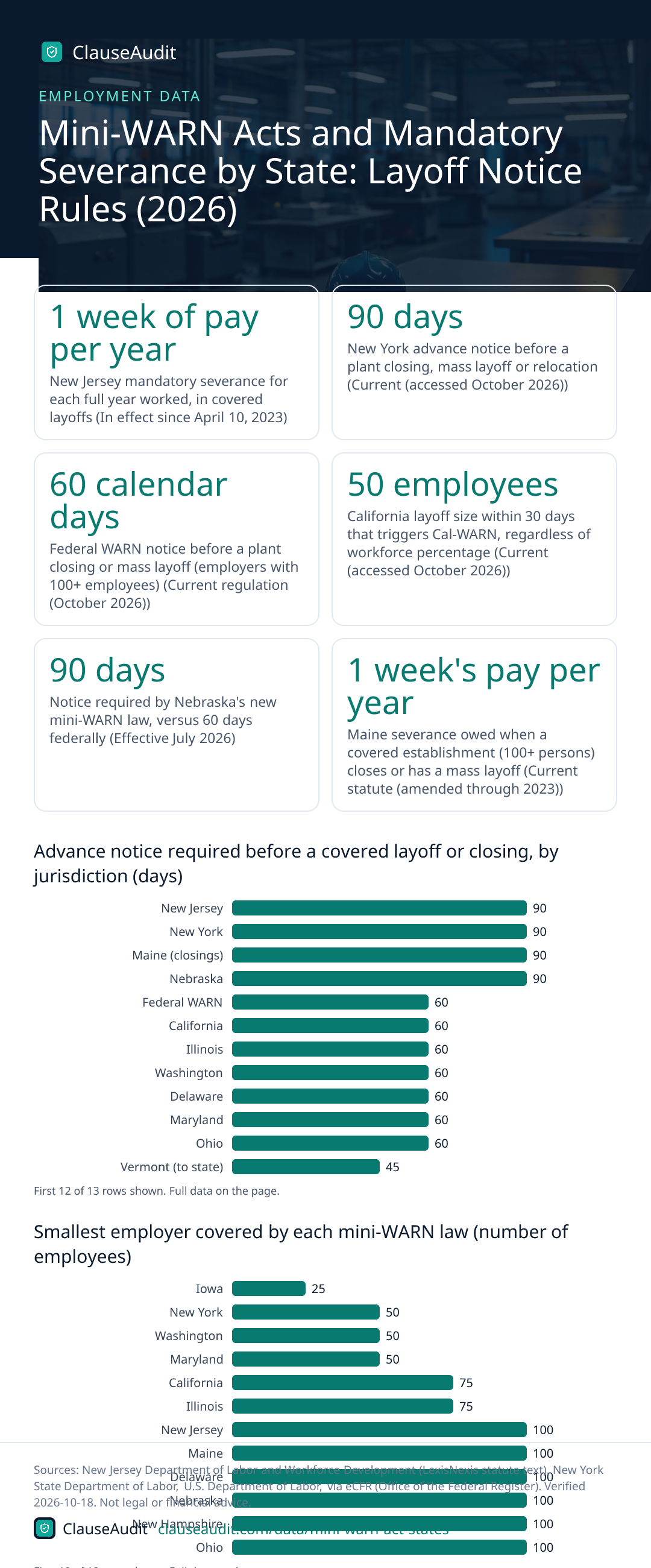
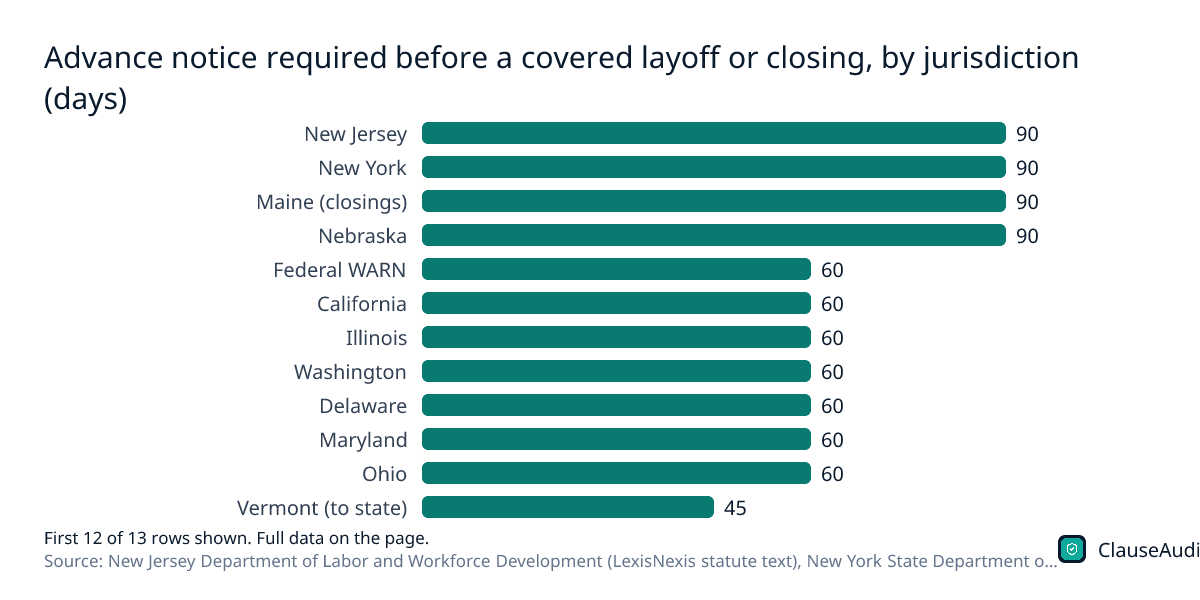
Advance notice required before a covered layoff or closing, by jurisdiction (days)
Chart data
| Label | Value |
|---|---|
| New Jersey | 90 |
| New York | 90 |
| Maine (closings) | 90 |
| Nebraska | 90 |
| Federal WARN | 60 |
| California | 60 |
| Illinois | 60 |
| Washington | 60 |
| Delaware | 60 |
| Maryland | 60 |
| Ohio | 60 |
| Vermont (to state) | 45 |
| Iowa | 30 |
Federal law sets the floor at 60 days, and most mini-WARN states match it. New Jersey, New York and Nebraska stretch it to 90 days, while Iowa asks for only 30.
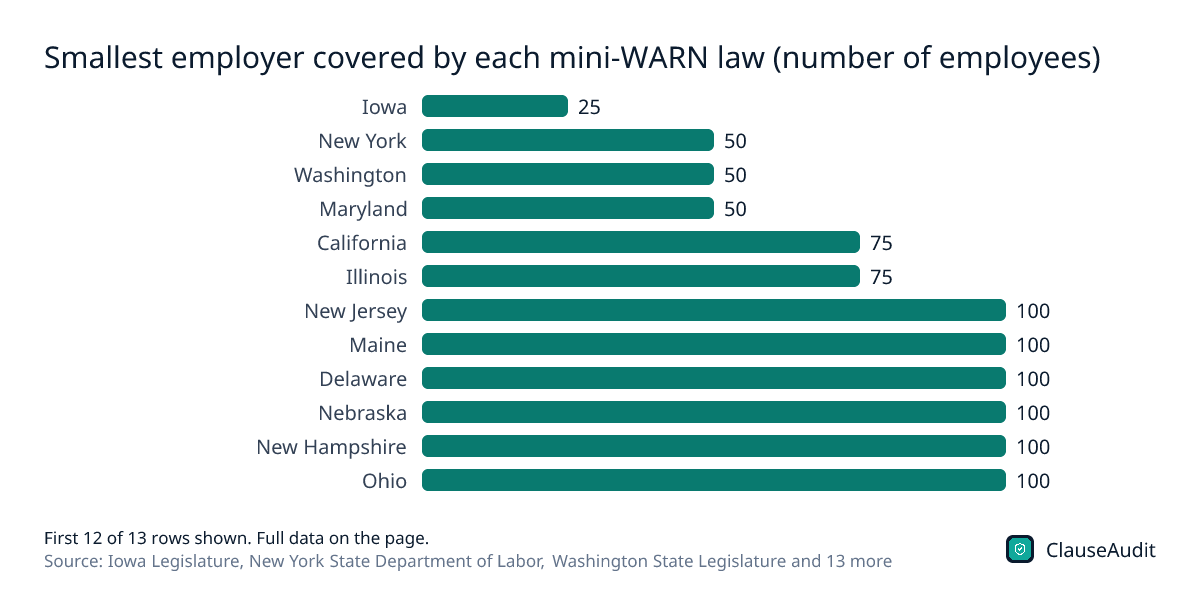
Download this chart (PNG)Smallest employer covered by each mini-WARN law (number of employees)
Chart data
| Label | Value |
|---|---|
| Iowa | 25 |
| New York | 50 |
| Washington | 50 |
| Maryland | 50 |
| California | 75 |
| Illinois | 75 |
| New Jersey | 100 |
| Maine | 100 |
| Delaware | 100 |
| Nebraska | 100 |
| New Hampshire | 100 |
| Ohio | 100 |
| Federal WARN | 100 |
This is where state laws bite hardest. Iowa reaches employers with as few as 25 employees, and New York, Washington and Maryland start at 50, half the federal cutoff.
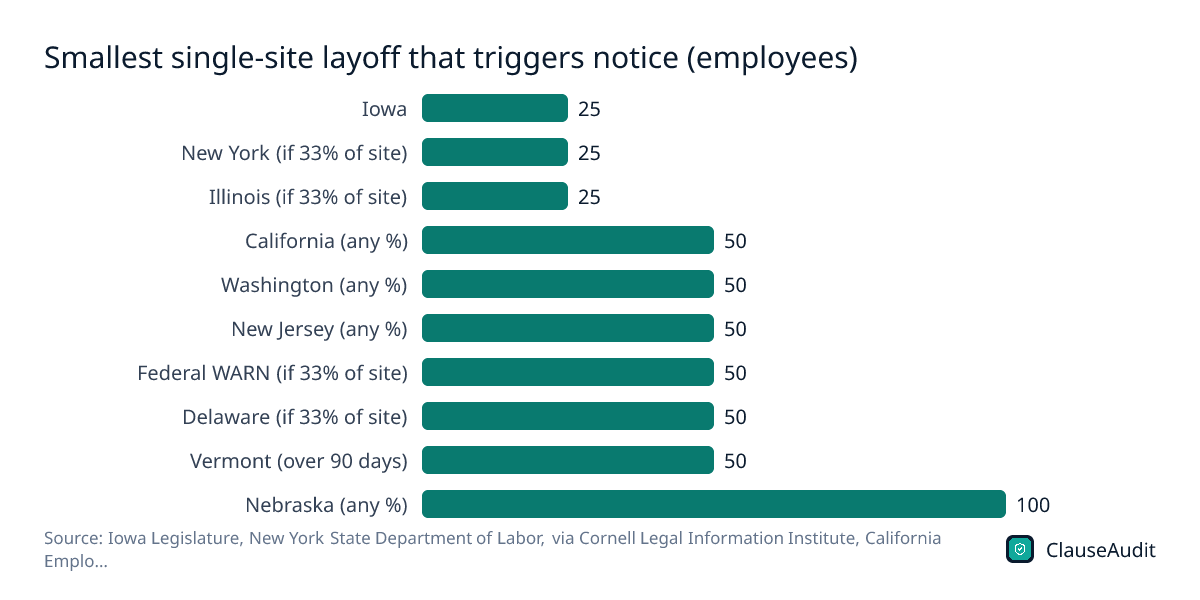
Download this chart (PNG)Smallest single-site layoff that triggers notice (employees)
Chart data
| Label | Value |
|---|---|
| Iowa | 25 |
| New York (if 33% of site) | 25 |
| Illinois (if 33% of site) | 25 |
| California (any %) | 50 |
| Washington (any %) | 50 |
| New Jersey (any %) | 50 |
| Federal WARN (if 33% of site) | 50 |
| Delaware (if 33% of site) | 50 |
| Vermont (over 90 days) | 50 |
| Nebraska (any %) | 100 |
Watch the percentage test. California, Washington and New Jersey count a layoff of 50 at a site no matter how big the site is, while federal law also requires a cut under 500 to hit 33% of the workforce.
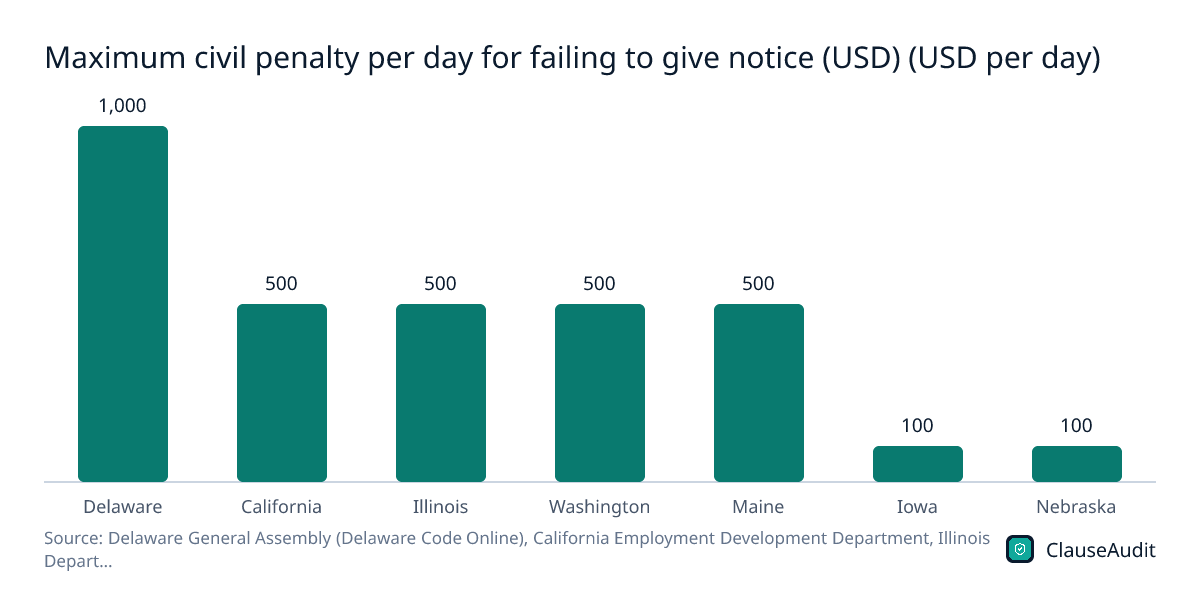
Download this chart (PNG)Maximum civil penalty per day for failing to give notice (USD) (USD per day)
Chart data
| Label | Value (USD per day) |
|---|---|
| Delaware | 1,000 |
| California | 500 |
| Illinois | 500 |
| Washington | 500 |
| Maine | 500 |
| Iowa | 100 |
| Nebraska | 100 |
Daily fines look small next to payroll, but they stack on top of back pay. Delaware is the steepest at $1,000 per day or $100 per day per dislocated worker, whichever is greater.
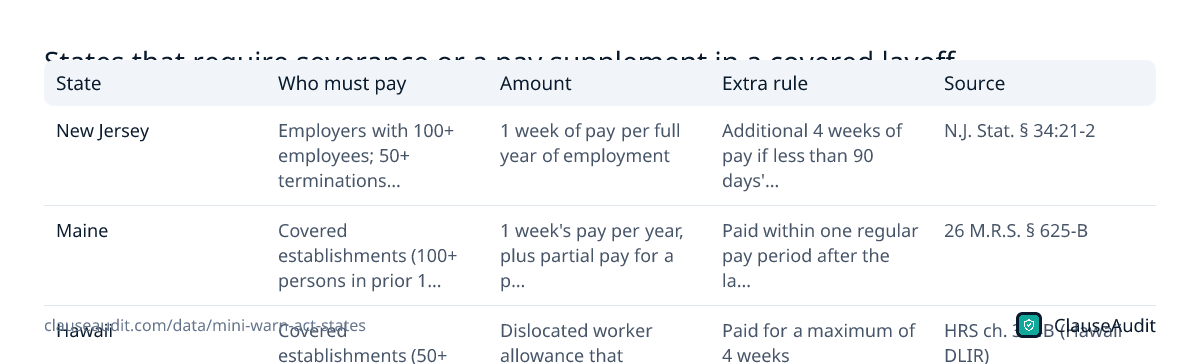
Download this chart (PNG)States that require severance or a pay supplement in a covered layoff
| State | Who must pay | Amount | Extra rule | Source |
|---|---|---|---|---|
| New Jersey | Employers with 100+ employees; 50+ terminations at or reporting to an establishment | 1 week of pay per full year of employment | Additional 4 weeks of pay if less than 90 days' notice | N.J. Stat. § 34:21-2 |
| Maine | Covered establishments (100+ persons in prior 12 months) that close or have a mass layoff | 1 week's pay per year, plus partial pay for a partial year | Paid within one regular pay period after the last full day of work | 26 M.R.S. § 625-B |
| Hawaii | Covered establishments (50+ persons) closing, partially closing or relocating | Dislocated worker allowance that supplements unemployment benefits | Paid for a maximum of 4 weeks | HRS ch. 394B (Hawaii DLIR) |
Source: New Jersey Department of Labor and Workforce Development (LexisNexis statute text), N.J. Stat. §§ 34:21-1 and 34:21-2 (Millville Dallas Airmotive Plant Job Loss Notification Act), as amended by P.L. 2019, c. 423; Maine Legislature, Office of the Revisor of Statutes, 26 M.R.S. § 625-B, Severance pay due to closing, substantial shutdown or relocation of a covered establishment; Hawaii Department of Labor and Industrial Relations, Workforce Development Council, The WARN Act and Dislocated Worker Laws (HRS ch. 394B). Download as image
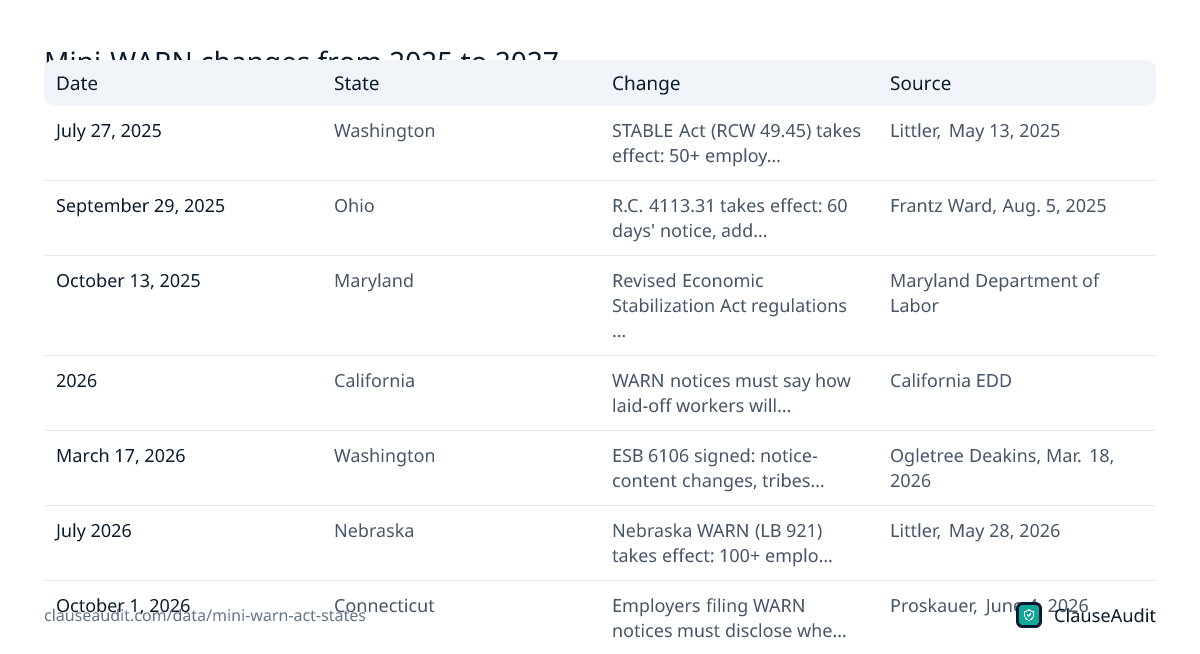
Mini-WARN changes from 2025 to 2027
| Date | State | Change | Source |
|---|---|---|---|
| July 27, 2025 | Washington | STABLE Act (RCW 49.45) takes effect: 50+ employers, 60 days' notice | Littler, May 13, 2025 |
| September 29, 2025 | Ohio | R.C. 4113.31 takes effect: 60 days' notice, added state and local recipients | Frantz Ward, Aug. 5, 2025 |
| October 13, 2025 | Maryland | Revised Economic Stabilization Act regulations take effect | Maryland Department of Labor |
| 2026 | California | WARN notices must say how laid-off workers will be supported | California EDD |
| March 17, 2026 | Washington | ESB 6106 signed: notice-content changes, tribes excluded; effective immediately | Ogletree Deakins, Mar. 18, 2026 |
| July 2026 | Nebraska | Nebraska WARN (LB 921) takes effect: 100+ employers, 90 days' notice | Littler, May 28, 2026 |
| October 1, 2026 | Connecticut | Employers filing WARN notices must disclose whether layoffs relate to AI or other technological change | Proskauer, June 4, 2026 |
| January 1, 2027 | California | SB 951: extra notice content for layoffs caused by AI or automation | Littler, Oct. 2, 2026 |
Source: Littler Mendelson P.C., Washington Enacts Mini-WARN Act Requiring Notice for Certain Layoffs and Closures; Frantz Ward LLP, Ohio Enacts New Mini-WARN Law; Maryland Department of Labor, Maryland Economic Stabilization Act (WARN) - employer page; California Employment Development Department, Worker Adjustment and Retraining Notification (WARN); Ogletree Deakins, Washington Governor Ferguson Signs Mini-WARN Act Amendments Bill; Littler Mendelson P.C., Nebraska Enacts State Mini-WARN Act; Proskauer Rose LLP (Law and the Workplace), Connecticut Enacts New AI Law: What Employers Need To Know; Littler Mendelson P.C., California Amends its WARN Act (Again). Download as image
State layoff notice and severance rules by state
- 2State notice law plus mandatory severance or pay supplement
- 11Mandatory state notice law (mini-WARN)
- 1Extra disclosure in federal WARN filings only
- 2Voluntary notice or reporting only
- 31No state law; federal WARN applies
- State notice law plus mandatory severance or pay supplement2
- Mandatory state notice law (mini-WARN)11
- Extra disclosure in federal WARN filings only1
- Voluntary notice or reporting only2
- No state law; federal WARN applies31
- Not yet confirmed4
| State | Covered employers | What triggers notice | Notice period | Severance, penalties and extras | Source |
|---|---|---|---|---|---|
| Alabama | Federal WARN only (100+ employees) | Federal WARN triggers | Federal 60 days | - | 29 U.S.C. § 2101 et seq. |
| Alaska | Federal WARN only (100+ employees) | Federal WARN triggers | Federal 60 days | - | 29 U.S.C. § 2101 et seq. |
| Arizona | Federal WARN only (100+ employees) | Federal WARN triggers | Federal 60 days | - | 29 U.S.C. § 2101 et seq. |
| Arkansas | Federal WARN only (100+ employees) | Federal WARN triggers | Federal 60 days | - | 29 U.S.C. § 2101 et seq. |
| California | 75+ full- and part-time employees at an establishment (prior 12 months) | Layoff of 50+ in 30 days (any %), plant closure (any number), relocation of 100+ miles | 60 days | Back pay and benefits up to 60 days; civil penalty up to $500/day | Cal. Lab. Code §§ 1400-1408 |
| Colorado | Federal WARN only (100+ employees) | Federal WARN triggers | Federal 60 days | - | 29 U.S.C. § 2101 et seq. |
| Connecticut | Employers that file federal WARN notices with the CT Department of Labor | Follows federal WARN triggers | Federal 60 days | From Oct. 1, 2026, WARN filings must disclose whether layoffs relate to AI or other technological change | SB 5 (2026), Connecticut Artificial Intelligence Responsibility and Transparency Act |
| Delaware | 100+ employees (excluding part-time), or 100+ working 2,000+ hours/week | Plant closing of 50+; mass layoff of 50+ (33% of site) or 500+; relocation of 50+ miles | 60 days | Back pay up to 60 days; civil penalty $1,000/day or $100/day per worker, whichever is greater | 19 Del. C. §§ 1901-1909 |
| District of Columbia | Federal WARN only (100+ employees) | Federal WARN triggers | Federal 60 days | - | 29 U.S.C. § 2101 et seq. |
| Florida | Federal WARN only (100+ employees) | Federal WARN triggers | Federal 60 days | - | 29 U.S.C. § 2101 et seq. |
| Georgia | Federal WARN only (100+ employees) | Federal WARN triggers | Federal 60 days | - | 29 U.S.C. § 2101 et seq. |
| Hawaii | Not yet confirmed: check the source | HRS ch. 394B | |||
| Idaho | Federal WARN only (100+ employees) | Federal WARN triggers | Federal 60 days | - | 29 U.S.C. § 2101 et seq. |
| Illinois | 75+ full-time employees | Mass layoff of 25+ full-time (33% of site) or 250+; plant closing | 60 days | Back pay and benefits up to 60 days; civil penalty up to $500/day | 820 ILCS 65 |
| Indiana | Federal WARN only (100+ employees) | Federal WARN triggers | Federal 60 days | - | 29 U.S.C. § 2101 et seq. |
| Iowa | 25+ employees (excluding part-time) | Business closing or mass layoff of 25+ employees at a single site in 30 days | 30 days | Civil penalty up to $100/day | Iowa Code ch. 84C |
| Kansas | Federal WARN only (100+ employees) | Federal WARN triggers | Federal 60 days | - | 29 U.S.C. § 2101 et seq. |
| Kentucky | Federal WARN only (100+ employees) | Federal WARN triggers | Federal 60 days | - | 29 U.S.C. § 2101 et seq. |
| Louisiana | Federal WARN only (100+ employees) | Federal WARN triggers | Federal 60 days | - | 29 U.S.C. § 2101 et seq. |
| Maine | Covered establishment with 100+ persons (prior 12 months) | Closing or relocation; mass layoff (33% and 50+, or 500+) | 90 days for closings and relocations; mass layoffs reported to state within 7 days | Severance of 1 week's pay per year of service; fines $500/day (notice) and up to $1,000 per employee (severance) | 26 M.R.S. § 625-B |
| Maryland | 50+ employees | Layoff of at least 25% of workforce or 15+ employees, whichever is greater, over 3 months | 60 days | Revised regulations effective Oct. 13, 2025 | Md. Code, Lab. & Empl. §§ 11-301 to 11-305 (Economic Stabilization Act) |
| Massachusetts | - | - | No mandatory state notice period | State law defines advance notice of a plant closing as voluntary; federal WARN applies | M.G.L. c. 151A, § 71A |
| Michigan | Not yet confirmed: check the source | MCL 450.731 et seq. | |||
| Minnesota | - | State encourages early notice of plant closings (50+ job losses), substantial layoffs or relocations | No mandatory state notice period | Employers giving federal WARN notice must report names, addresses and occupations of affected employees to the state | Minn. Stat. § 116L.976 |
| Mississippi | Federal WARN only (100+ employees) | Federal WARN triggers | Federal 60 days | - | 29 U.S.C. § 2101 et seq. |
| Missouri | Federal WARN only (100+ employees) | Federal WARN triggers | Federal 60 days | - | 29 U.S.C. § 2101 et seq. |
| Montana | Federal WARN only (100+ employees) | Federal WARN triggers | Federal 60 days | - | 29 U.S.C. § 2101 et seq. |
| Nebraska | 100+ employees (excluding part-time) | Business closing or mass layoff of 100+ full-time at a single site (no % test) | 90 days | Civil penalty up to $100/day, enforced by the Department of Labor only; no private suit | LB 921 (2026), Nebraska Worker Adjustment and Retraining Notification Act |
| Nevada | Federal WARN only (100+ employees) | Federal WARN triggers | Federal 60 days | - | 29 U.S.C. § 2101 et seq. |
| New Hampshire | 100+ employees (excluding part-time), or 100+ working 3,000+ hours/week | Plant closing; mass layoff of 25+ (33% of full-time) or 250+ | 60 days | Back pay up to 60 days or half the days employed, whichever is shorter | RSA 275-F |
| New Jersey | 100+ employees | Termination, transfer or mass layoff causing 50+ job losses at or reporting to an NJ establishment in 30 days | 90 days | Mandatory severance of 1 week of pay per full year; plus 4 weeks of pay if notice is short | N.J. Stat. § 34:21-1 et seq. (as amended by P.L. 2019, c. 423) |
| New Mexico | Federal WARN only (100+ employees) | Federal WARN triggers | Federal 60 days | - | 29 U.S.C. § 2101 et seq. |
| New York | 50+ full-time employees in New York | Plant closing of 25+; mass layoff of 25+ (33% of site) or 250+ | 90 days | Back wages and benefits; civil penalty | N.Y. Lab. Law § 860 et seq.; 12 NYCRR Part 921 |
| North Carolina | Federal WARN only (100+ employees) | Federal WARN triggers | Federal 60 days | - | 29 U.S.C. § 2101 et seq. |
| North Dakota | Federal WARN only (100+ employees) | Federal WARN triggers | Federal 60 days | - | 29 U.S.C. § 2101 et seq. |
| Ohio | Employers covered by federal WARN (100+ employees) | Plant closing or mass layoff; state text adds 50+ at a single site in any 30-day period | 60 days | Notice also to ODJFS and chief elected officials of the municipality and county | Ohio Rev. Code § 4113.31 |
| Oklahoma | Federal WARN only (100+ employees) | Federal WARN triggers | Federal 60 days | - | 29 U.S.C. § 2101 et seq. |
| Oregon | Federal WARN only (100+ employees) | Federal WARN triggers | Federal 60 days | - | 29 U.S.C. § 2101 et seq. |
| Pennsylvania | Federal WARN only (100+ employees) | Federal WARN triggers | Federal 60 days | - | 29 U.S.C. § 2101 et seq. |
| Rhode Island | Federal WARN only (100+ employees) | Federal WARN triggers | Federal 60 days | - | 29 U.S.C. § 2101 et seq. |
| South Carolina | Federal WARN only (100+ employees) | Federal WARN triggers | Federal 60 days | Former shutdown-posting rule (§ 41-1-40) repealed effective March 31, 2010 | 29 U.S.C. § 2101 et seq. |
| South Dakota | Federal WARN only (100+ employees) | Federal WARN triggers | Federal 60 days | - | 29 U.S.C. § 2101 et seq. |
| Tennessee | Not yet confirmed: check the source | Tenn. Code Ann. §§ 50-1-601 to -604 (Plant Closing and Reduction in Operations Act) | |||
| Texas | Federal WARN only (100+ employees) | Federal WARN triggers | Federal 60 days | - | 29 U.S.C. § 2101 et seq. |
| Utah | Federal WARN only (100+ employees) | Federal WARN triggers | Federal 60 days | - | 29 U.S.C. § 2101 et seq. |
| Vermont | Employers with 50+ employees affected | Closing or mass layoff of 50+ employees over a 90-day period | 45 days to the state; 30 days to local officials and bargaining units | Must pay all unpaid wages and compensation owed to laid-off workers | 21 V.S.A. §§ 411-418 (Notice of Potential Layoffs Act) |
| Virginia | Federal WARN only (100+ employees) | Federal WARN triggers | Federal 60 days | - | 29 U.S.C. § 2101 et seq. |
| Washington | 50+ employees in Washington (excluding part-time) | Business closing of 50+; mass layoff of 50+ in 30 days (no % test) | 60 days | Back pay up to 60 days; civil penalty up to $500/day; employees on paid family/medical leave cannot be included in a mass layoff | RCW 49.45 |
| West Virginia | Federal WARN only (100+ employees) | Federal WARN triggers | Federal 60 days | - | 29 U.S.C. § 2101 et seq. |
| Wisconsin | Not yet confirmed: check the source | Wis. Stat. § 109.07; Wis. Admin. Code DWD ch. 279 | |||
| Wyoming | Federal WARN only (100+ employees) | Federal WARN triggers | Federal 60 days | - | 29 U.S.C. § 2101 et seq. |
What is a mini-WARN act?
A mini-WARN act is a state law that copies the idea behind the federal WARN Act and then changes the numbers. The federal rule covers employers with 100 or more employees and requires 60 calendar days of notice. A mass layoff under federal law means 50 or more employees who make up at least 33% of the site, or 500 or more.
State versions tighten one or more of those dials. New York covers private employers with 50 or more full-time employees and requires 90 days of notice. Iowa covers employers with 25 or more employees, though it asks for only 30 days. Washington's STABLE Act, in effect since July 27, 2025, covers employers with 50 or more employees and drops the percentage test entirely.
When both laws apply, the employer has to satisfy both. In practice that means meeting whichever rule is stricter on each point, so a New York employer gives 90 days even though federal law would accept 60.
Which states require severance pay when you are laid off?
Most people assume severance is a gift. Usually it is. No federal law requires it, and in most states an employer can lay you off with nothing beyond your final paycheck. New Jersey and Maine are the exceptions.
In New Jersey, employers with 100 or more employees that cut 50 or more jobs at or reporting to a New Jersey site within 30 days owe each affected worker 1 week of pay for each full year of employment. If the employer gives less than the required 90 days of notice, workers get an additional 4 weeks of pay on top. Say you worked there 4 full years. That is 4 weeks of pay, and short notice adds another 4 weeks. The money is owed by statute, so it does not depend on what your offer letter said.
Maine applies the same 1 week's pay per year rule to eligible workers when a covered establishment with 100 or more persons closes or has a mass layoff, and adds partial pay for a partial year. Unpaid severance can cost the employer up to $1,000 per affected employee in fines.
How much notice does your employer have to give before a layoff?
It depends on where you work, not where the company is headquartered. Federal law and most mini-WARN states, including California, Illinois, Washington, Delaware, Maryland and Ohio, require 60 days. New Jersey, New York and Nebraska require 90 days, and Maine requires 90 days for closings and relocations. Vermont requires 45 days of notice to the state and 30 days to local officials and bargaining units.
Notice is not the same as pay, but the two connect. If an employer skips notice, the usual remedy is back pay and benefits for up to 60 days in most states. Some employers hand out pay in lieu of notice to cover that gap, which is legal in many cases but should be spelled out in writing.
Maine is the odd one on mass layoffs. Closings and relocations need 90 days, but a mass layoff only has to be reported to the state no later than 7 days after it happens. Workers there lean on the severance rule rather than on advance warning.
Does a small or mid-size business have to give layoff notice?
If you run a company with fewer than 100 employees, it is easy to assume WARN is someone else's problem. In several states it is not. Iowa's law reaches employers with 25 or more employees. New York, Washington and Maryland start at 50, and California and Illinois start at 75. California counts part-time staff toward that 75, so a busy retail or restaurant group can cross the line sooner than it expects.
The trigger matters as much as the headcount. Maryland looks at a layoff of at least 25% of the workforce or 15 employees, whichever is greater, over 3 months. New York counts a plant closing of 25 or more. Washington counts 50 or more job losses in any 30-day period, so trimming a little at a time inside that window will not keep you under the line.
The cost of getting it wrong adds up quickly. Back pay and benefits for up to 60 days per worker is the usual exposure, and civil penalties sit on top. Iowa and Nebraska cap the fine at $100 per day, while California, Illinois, Washington and Maine allow up to $500 per day. For a planned reduction, the cheapest path is almost always to send notice early and to the right people: employees, the state labor agency, and local officials where the law requires it.
What changed in 2025 and 2026
This area of law moved fast. Ohio's law took effect September 29, 2025, adding state and local recipients for notices. Maryland's revised regulations took effect October 13, 2025. Nebraska passed its own law, LB 921, which took effect in July 2026 and requires 90 days of notice from employers with 100 or more employees.
Notice content is changing too. California notices must now describe how laid-off workers will be supported. From October 1, 2026, Connecticut employers filing WARN notices must disclose whether the layoffs relate to AI or other technological change, and California's SB 951 adds similar content for AI and automation layoffs from January 1, 2027.
What should you do if a layoff is coming?
- Find out which state's law covers your worksite. If you work remotely, ask which office you report to, since several laws count employees at or reporting to an establishment.
- Count the cut. A layoff of 50 at a California, Washington or New Jersey site triggers notice regardless of percentage, while federal law also looks at the 33% test.
- Check the date on the notice against the required period. Short notice in New Jersey adds 4 weeks of pay.
- Read any severance agreement before signing. Statutory severance in New Jersey or Maine is owed by law, so be wary of a release that asks you to give up claims in exchange for money you were already entitled to.
- If you run a business near the thresholds, track headcount by site and plan layoffs at least 90 days out in the strictest states where you operate.
How ClauseAudit helps
State law sets the minimum, but your employment contract or severance agreement decides much of what you actually walk away with. An automated review of your offer letter, contract or separation agreement flags the clauses that matter when jobs are cut.
Upload the document and you get a plain-English read of each risky term, why it matters in your state, and what to ask for instead.
- Severance terms: whether pay is promised in writing or left to the employer's discretion
- Notice period: whether the employer's notice to you matches what it demands from you
- Release of claims: whether a severance deal asks you to waive pay a state law already guarantees
- Pay in lieu of notice: how it is calculated and whether benefits continue
- Termination clause: what counts as a layoff versus a for-cause firing
- Non-compete and non-solicit terms that could limit your next job after a layoff
Frequently asked questions
Which states have mini-WARN acts?
States with their own mandatory layoff notice laws include California, New York, New Jersey, Illinois, Iowa, Maine, Maryland, Delaware, Washington, Vermont, Ohio, New Hampshire and Nebraska, among others. The rules differ widely, so check the state table on this page for the covered employers, triggers and notice periods where you work.
Does the WARN Act require severance pay?
No. The federal WARN Act only requires 60 calendar days of notice. If an employer fails to give it, workers can recover back pay and benefits for the missed period. Mandatory severance comes from state law, and only New Jersey and Maine require it in covered layoffs, at 1 week of pay per year worked.
How is New Jersey's mandatory severance calculated?
Covered workers get 1 week of pay for each full year of employment. The law applies to employers with 100 or more employees when 50 or more people lose their jobs at or reporting to a New Jersey establishment within 30 days. If the employer gives less than 90 days of notice, workers get an additional 4 weeks of pay.
How many employees does a company need for WARN to apply?
Federal WARN applies at 100 or more employees. Several states go lower: Iowa covers employers with 25 or more, New York, Washington and Maryland start at 50, and California and Illinois start at 75. California counts both full- and part-time employees, which pulls in more businesses.
Does the California WARN Act apply to small layoffs?
Cal-WARN covers establishments with 75 or more employees in the preceding 12 months. A layoff of 50 or more within 30 days triggers 60 days of notice regardless of percentage, and a plant closure is covered no matter how many people are affected. Relocations of at least 100 miles are also covered.
What happens if my employer does not give WARN notice?
In most states you can recover back pay and benefits for up to 60 days. Many states also add civil penalties. California, Illinois, Washington and Maine allow up to $500 per day, and Delaware charges $1,000 per day or $100 per day per dislocated worker, whichever is greater. Nebraska's penalty is enforced only by the state.
Can an employer pay me instead of giving notice?
Many employers pay wages and benefits for the notice period instead of keeping you at work. That generally covers the back pay exposure, but it does not erase New Jersey's or Maine's separate severance requirement. Get the terms in writing and compare them against your state's rules before you sign any release.
Is Nebraska's new WARN law in effect?
Yes. Nebraska's LB 921 was signed April 14, 2026 and took effect in July 2026. It requires 90 days of notice from employers with 100 or more employees, excluding part-time staff, for closings or mass layoffs of 100 or more full-time workers at a single site. There is no private lawsuit; the Department of Labor enforces it.
Use this data
Every chart and card below is free to reuse under CC BY 4.0. Download what you need and link back to this page.
 Stat cards
 Key findings card
 Infographic
 Advance notice required before a covered layoff or closing, by jurisdiction (days)
 Smallest employer covered by each mini-WARN law (number of employees)
 Smallest single-site layoff that triggers notice (employees)
 Maximum civil penalty per day for failing to give notice (USD) (USD per day)
 States that require severance or a pay supplement in a covered layoff
 Mini-WARN changes from 2025 to 2027
Embed the infographic
Free to share on your site, blog or slides under CC BY 4.0. Please keep the credit link.
Sources and method
Every number on this page comes from the sources below, each opened and read on or before October 18, 2026. A second, independent review checked every figure against its source and corrected anything that did not match. 47 of 51 state entries were confirmed; any that could not be are marked "Not yet confirmed" and left out of every count and chart.
- U.S. Department of Labor, via eCFR (Office of the Federal Register), 20 CFR Part 639 - Worker Adjustment and Retraining Notification (definitions, 639.3; notice timing, 639.5) (eCFR text as of October 1, 2026)
- New Jersey Department of Labor and Workforce Development (LexisNexis statute text), N.J. Stat. §§ 34:21-1 and 34:21-2 (Millville Dallas Airmotive Plant Job Loss Notification Act), as amended by P.L. 2019, c. 423 (Current through L. 2023, c. 28; amendments effective April 10, 2023)
- New York State Department of Labor, Worker Adjustment and Retraining Notification (WARN) (Undated web page, accessed October 2026)
- New York State Department of Labor, via Cornell Legal Information Institute, 12 NYCRR 921-1.1 Definitions (New York WARN regulations) (Current regulation text, accessed October 2026)
- California Employment Development Department, Worker Adjustment and Retraining Notification (WARN) (Web page with 'New for 2026' notice-content update, accessed October 2026)
- Littler Mendelson P.C., California Amends its WARN Act (Again) (October 2, 2026)
- Illinois Department of Labor, Conciliation and Mediation Division, Worker Adjustment and Retraining Notification Act (WARN) (Undated web page, accessed October 2026)
- Iowa Legislature, Iowa Code Chapter 84C, Iowa Worker Adjustment and Retraining Notification Act (Iowa Code 2026)
- Maine Legislature, Office of the Revisor of Statutes, 26 M.R.S. § 625-B, Severance pay due to closing, substantial shutdown or relocation of a covered establishment (Current text, amended through PL 2023, c. 52)
- Maryland Department of Labor, Maryland Economic Stabilization Act (WARN) - employer page (Revised regulations effective Oct. 13, 2025)
- Delaware General Assembly (Delaware Code Online), Delaware Code Title 19, Chapter 19, Delaware Worker Adjustment and Retraining Notification Act (Current text (81 Del. Laws c. 312, as amended))
- Washington State Legislature, RCW Chapter 49.45, Mass Layoffs and Business Closings (STABLE Act) (Current through 2026 c 86)
- Washington Employment Security Department, WARN requirements (Undated web page, accessed October 2026)
- Littler Mendelson P.C., Washington Enacts Mini-WARN Act Requiring Notice for Certain Layoffs and Closures (May 13, 2025)
- Ogletree Deakins, Washington Governor Ferguson Signs Mini-WARN Act Amendments Bill (March 18, 2026)
- Vermont Department of Labor, WARN Act and Notice of Potential Layoffs Act (Undated web page, accessed October 2026)
- Frantz Ward LLP, Ohio Enacts New Mini-WARN Law (August 5, 2025)
- Duane Morris LLP, Ohio Employers Be WARNed: New Mini-WARN Law Expands Notice Obligations for Covered Mass Layoffs (August 7, 2025)
- Littler Mendelson P.C., Nebraska Enacts State Mini-WARN Act (May 28, 2026)
- Proskauer Rose LLP (Law and the Workplace), Connecticut Enacts New AI Law: What Employers Need To Know (June 4, 2026)
- Minnesota Office of the Revisor of Statutes, Minnesota Statutes § 116L.976, Notice of plant closings and substantial layoffs (Minnesota Statutes 2025)
- South Carolina Legislature, South Carolina Code of Laws Title 41, Chapter 1 (editor's note: §§ 41-1-40, 41-1-50 repealed) (Current Code of Laws, accessed October 2026)
- Barnes & Thornburg LLP (republished by The National Law Review), The State of Employment Law: 13 States Have Mini-WARN Acts (June 23, 2025)
- J.J. Keller & Associates (Compliance Network), Plant closing - Tennessee (Undated web page, accessed October 2026)
- Hawaii Department of Labor and Industrial Relations, Workforce Development Council, The WARN Act and Dislocated Worker Laws (HRS ch. 394B) (Notice dated Jan. 2024; page could not be opened in full in October 2026)
- Wisconsin Department of Workforce Development, Overview of Wisconsin's Business Closing and Mass Layoff Law (Wis. Stat. § 109.07) (Undated web page; could not be opened in full in October 2026)
- New Hampshire General Court, New Hampshire RSA Chapter 275-F, Worker Adjustment and Retraining Notification (Current RSA text, accessed October 2026)
Cite this page
ClauseAudit, “Mini-WARN Acts and Mandatory Severance by State: Layoff Notice Rules (2026)”, updated October 18, 2026, https://clauseaudit.com/data/mini-warn-act-states. Free to reuse with a link back (CC BY 4.0).
This page summarises published data and law as checked on October 18, 2026. Figures are updated as new editions are released, and your own situation may differ. It is general information, not legal, tax or financial advice.