Average Severance Package 2026: Weeks per Year of Service and What Companies Actually Pay
By ClauseAudit Research · 14 sources ·
What is the average severance package?
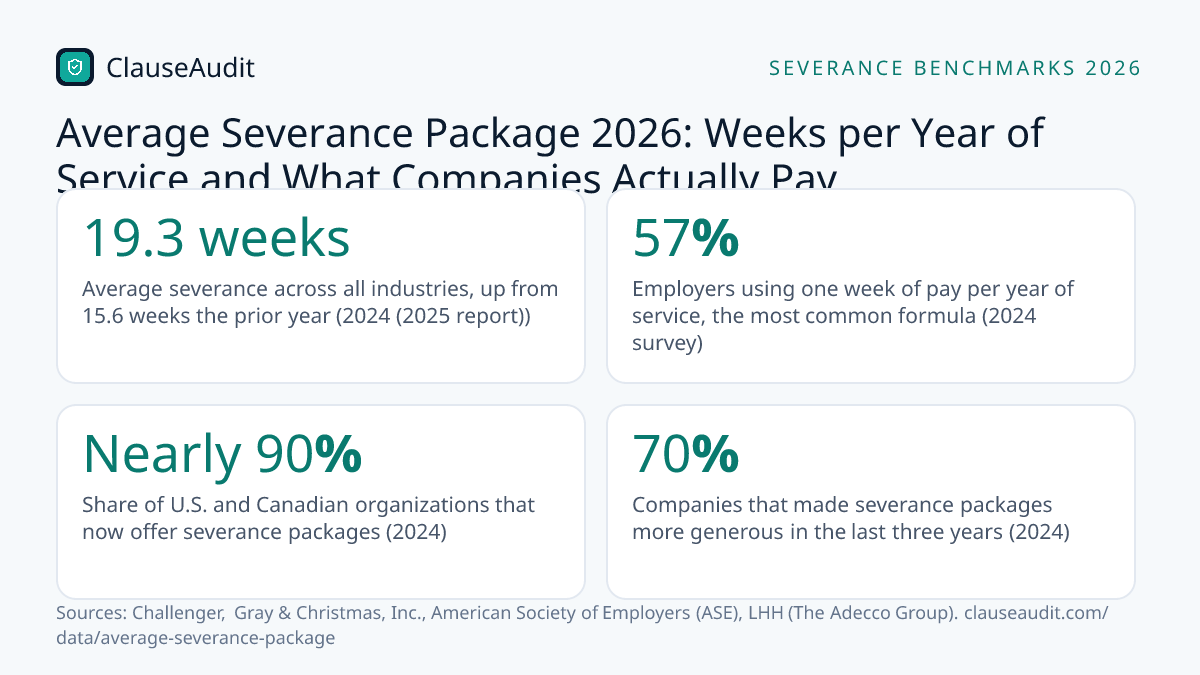
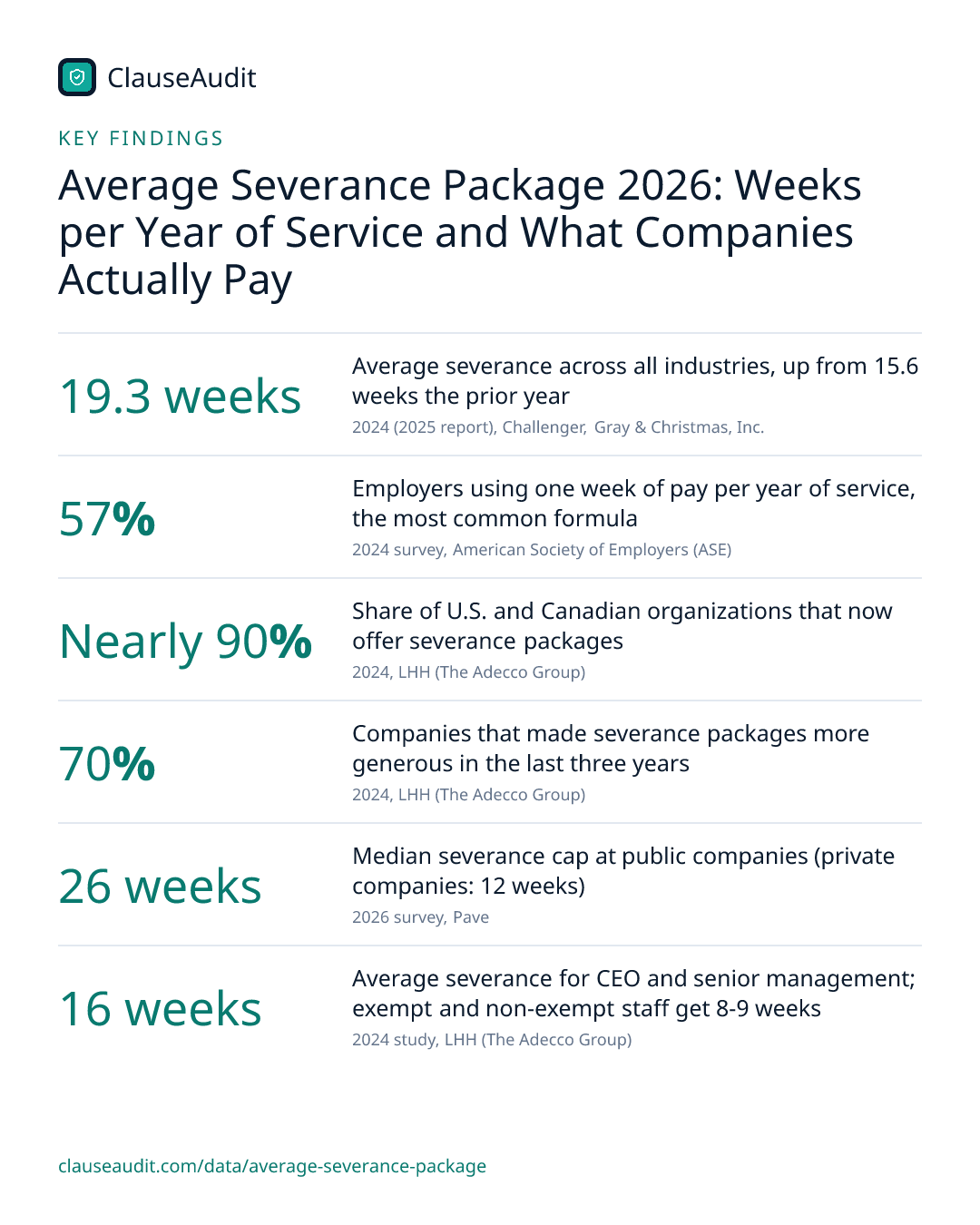
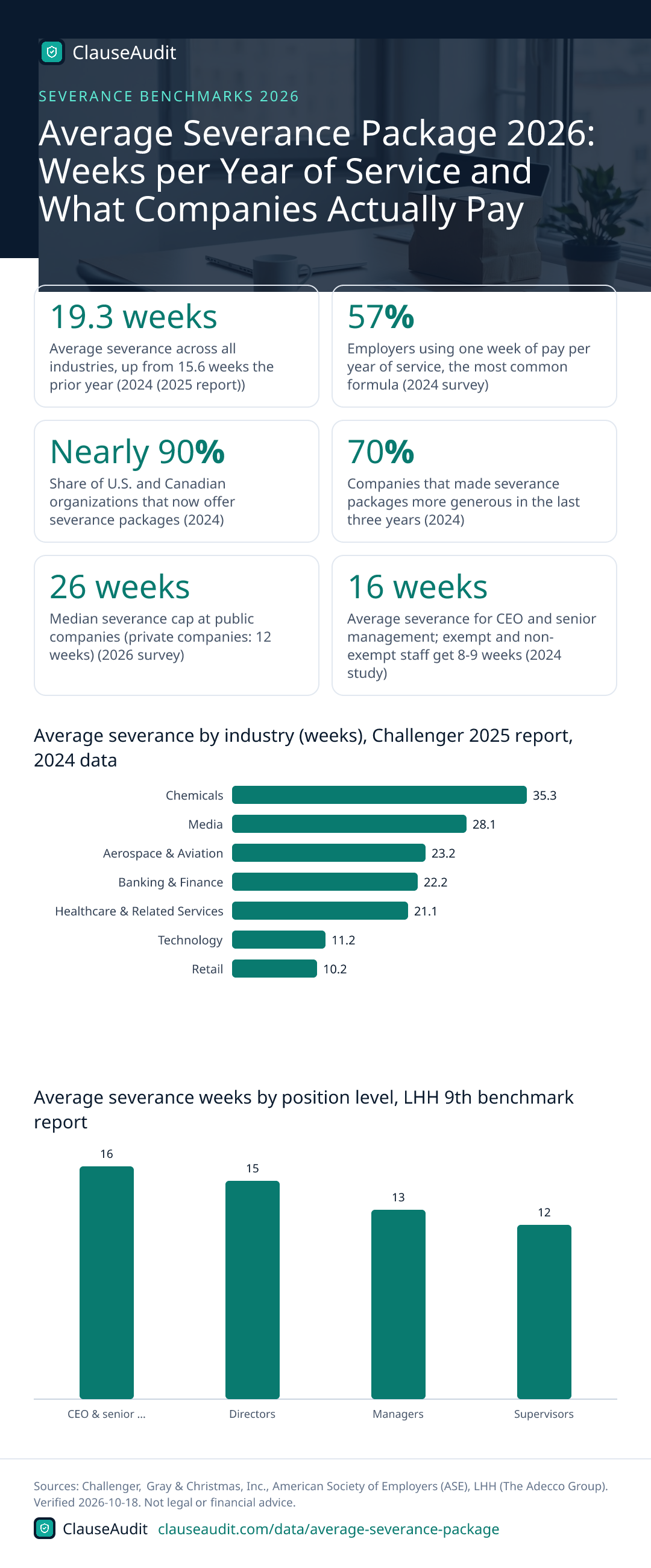
The average U.S. severance package was 19.3 weeks of pay in Challenger's 2025 report, which covers people let go in 2024, up from 15.6 weeks the year before. The most common formula is one week of pay per year of service, used by 57% of employers in a 2024 survey of Michigan organizations. Senior roles get far more.

- Average severance across all industries, up from 15.6 weeks the prior year (2024 (2025 report), Challenger, Gray & Christmas, Inc.)
- 19.3 weeks
- Employers using one week of pay per year of service, the most common formula (2024 survey, American Society of Employers (ASE))
- 57%
- Share of U.S. and Canadian organizations that now offer severance packages (2024, LHH (The Adecco Group))
- Nearly 90%
- Companies that made severance packages more generous in the last three years (2024, LHH (The Adecco Group))
- 70%
- Median severance cap at public companies (private companies: 12 weeks) (2026 survey, Pave)
- 26 weeks
- Average severance for CEO and senior management; exempt and non-exempt staff get 8-9 weeks (2024 study, LHH (The Adecco Group))
- 16 weeks
- Flat federal income tax withholding rate on severance (37% above $1 million) (2026, Internal Revenue Service)
- 22%
- Lifetime cap on severance pay for federal employees (Current rule, U.S. Office of Personnel Management)
- 52 weeks
Severance is not a fixed number. It is a deal your employer offers, usually built from your years of service and your job level, and it comes with conditions attached. That is why two people let go on the same day can walk out with very different checks.
This page pulls together the most recent employer surveys and federal rules so you can tell if your offer is ordinary, light or generous. Then it walks through what to read in the agreement before you sign away your right to sue.
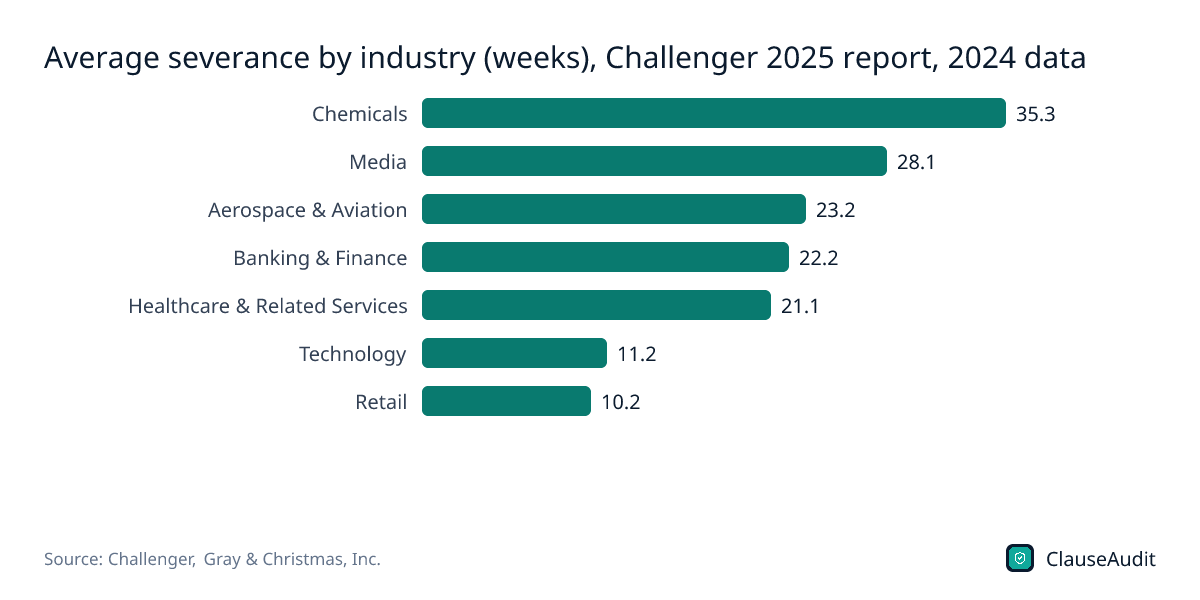
Average severance by industry (weeks), Challenger 2025 report, 2024 data
Chart data
| Label | Value |
|---|---|
| Chemicals | 35.3 |
| Media | 28.1 |
| Aerospace & Aviation | 23.2 |
| Banking & Finance | 22.2 |
| Healthcare & Related Services | 21.1 |
| Technology | 11.2 |
| Retail | 10.2 |
Industry matters more than most people expect. Chemicals averaged 35.3 weeks while Retail averaged 10.2, so compare your offer against your own sector, not the overall figure.
Download this chart (PNG)Average severance weeks by position level, LHH 9th benchmark report
Chart data
| Label | Value |
|---|---|
| CEO & senior management | 16 |
| Directors | 15 |
| Managers | 13 |
| Supervisors | 12 |
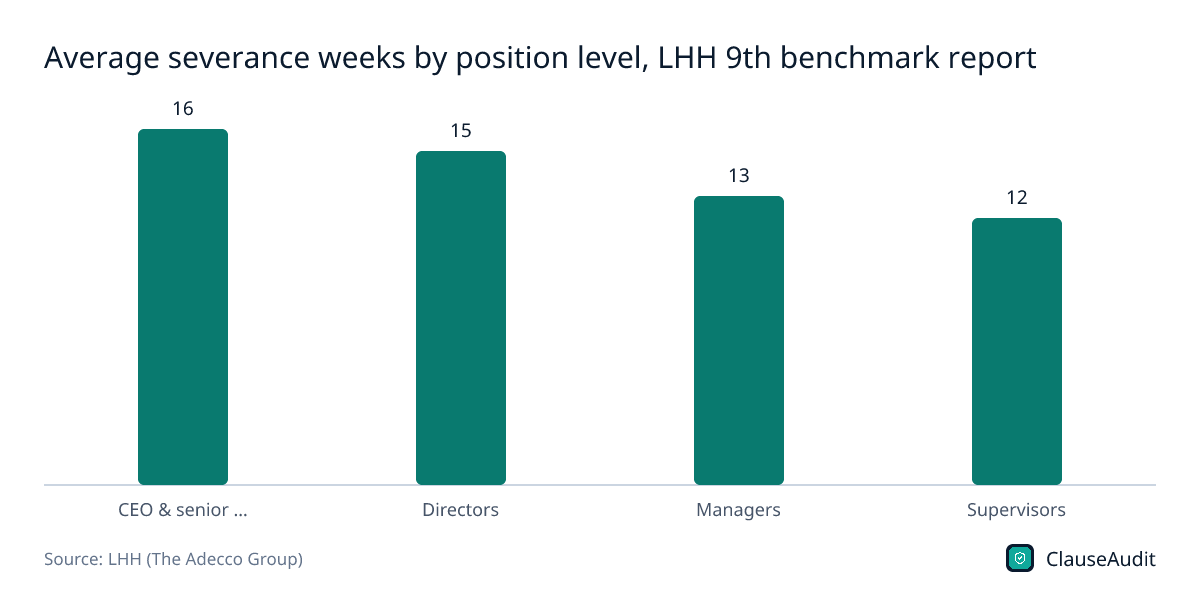
LHH's averages climb steadily with seniority, from 12 weeks for supervisors to 16 weeks for CEOs and senior management. Rank-and-file exempt and non-exempt staff sit lower, at 8-9 weeks.
Download this chart (PNG)How organizations calculate severance (share of organizations) (%)
Chart data
| Label | Value |
|---|---|
| Position level and years of service | 39 |
| Age, service, level, marketability | 20 |
| Flat weeks by position level | 19 |
| Flat weeks for all employees | 11 |
| Flat weeks per year of service for all | 7 |
| No set formula | 4 |
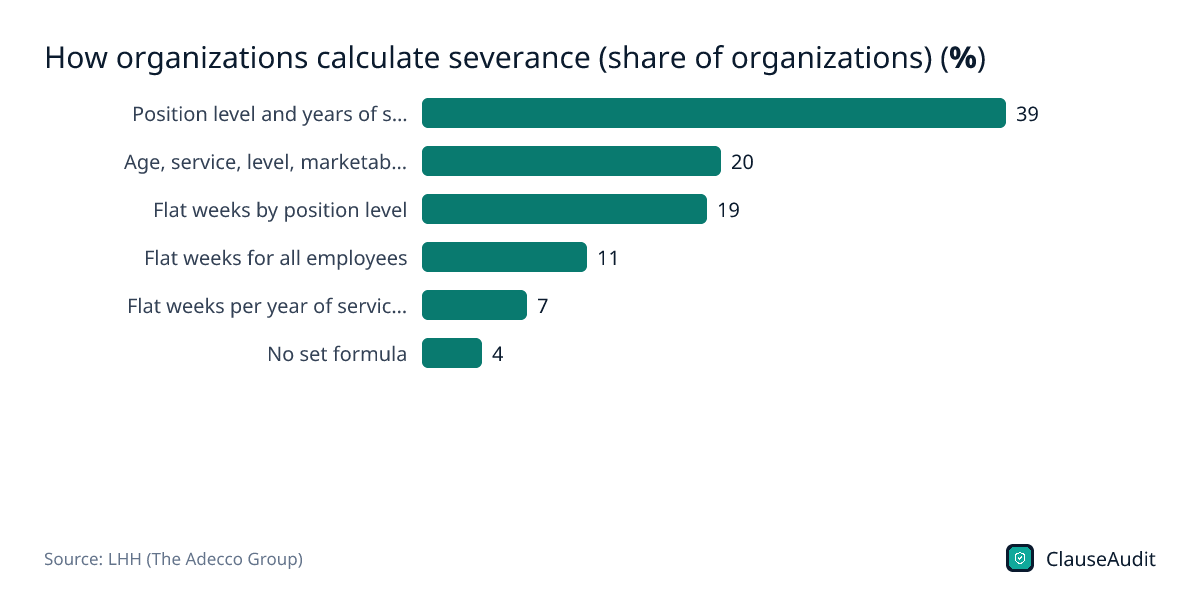
The most common approach, at 39%, mixes position level with years of service. Only 4% of organizations say they have no set formula, so most employers can tell you how your number was worked out.
Download this chart (PNG)Main basis for calculating severance (share of employers, multiple answers) (%)
Chart data
| Label | Value (%) |
|---|---|
| Years of service | 76 |
| Salary/pay | 38 |
| Position | 32 |
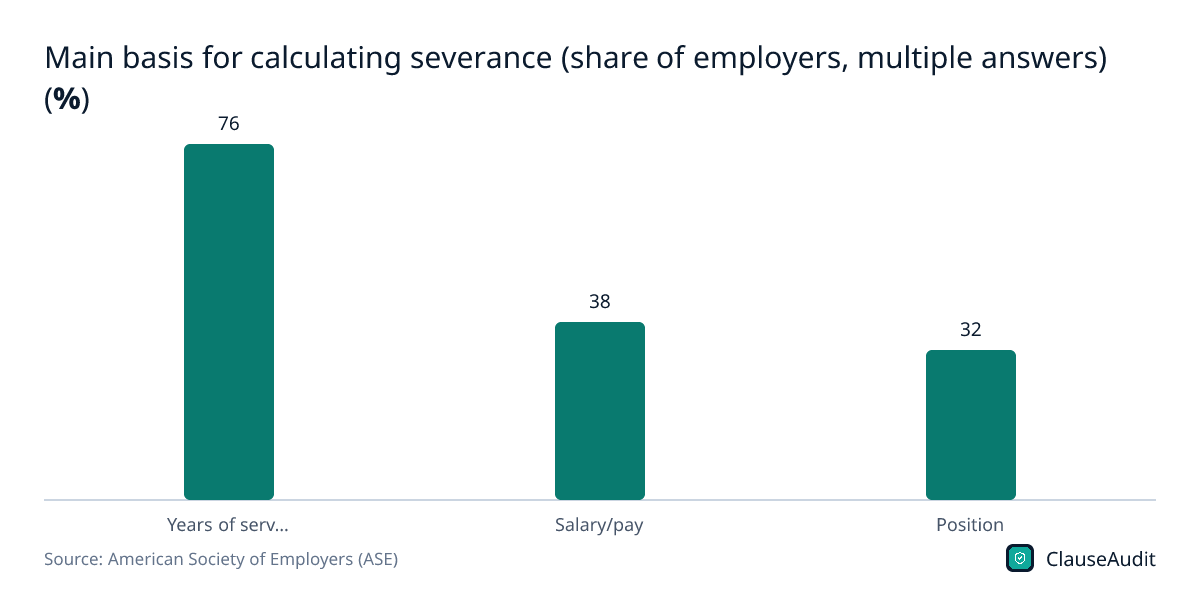
Years of service is a main basis for severance at 76% of the Michigan employers surveyed. Salary and position matter too, and many employers weigh more than one factor.
Download this chart (PNG)Federal employee basic severance allowance by years of service (weeks of basic pay)
Chart data
| Label | Value |
|---|---|
| 1 year | 1 |
| 5 years | 5 |
| 10 years | 10 |
| 15 years | 20 |
| 20 years | 30 |
| 25 years | 40 |
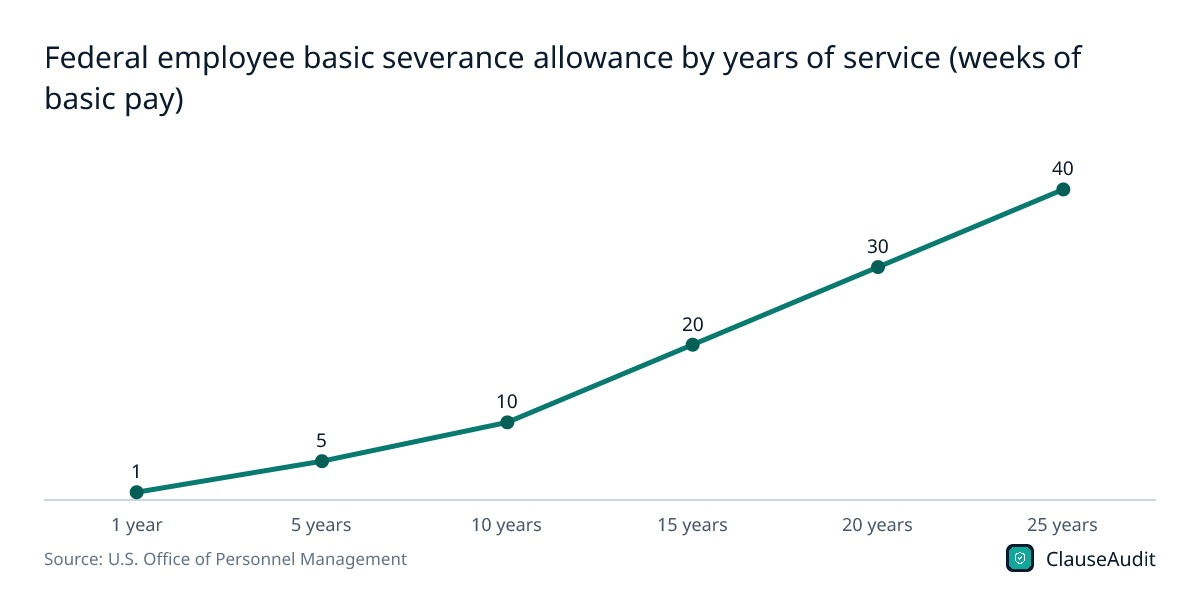
Federal workers earn one week per year through 10 years, then two weeks per year after that, so the curve bends upward at the 10-year mark. The lifetime cap is 52 weeks.
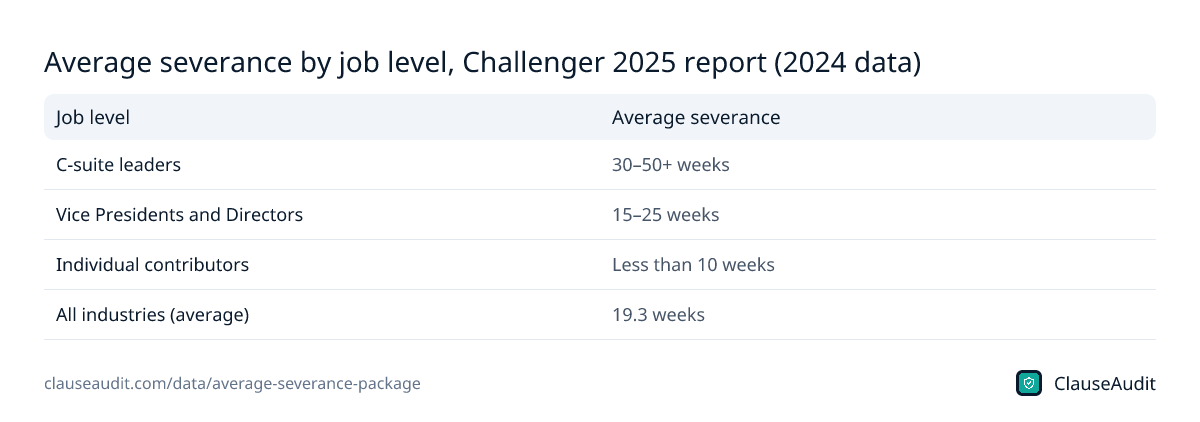
Download this chart (PNG)Average severance by job level, Challenger 2025 report (2024 data)
| Job level | Average severance |
|---|---|
| C-suite leaders | 30–50+ weeks |
| Vice Presidents and Directors | 15–25 weeks |
| Individual contributors | Less than 10 weeks |
| All industries (average) | 19.3 weeks |
Source: Challenger, Gray & Christmas, Inc., Benchmarking Severance in 2025: What “Competitive” Really Looks Like (summary of the 2025 Severance & Salary Benchmarking Report, 2024 data); Challenger, Gray & Christmas, Inc., 2025 Severance & Salary Benchmarking Report (report landing page). Download as image
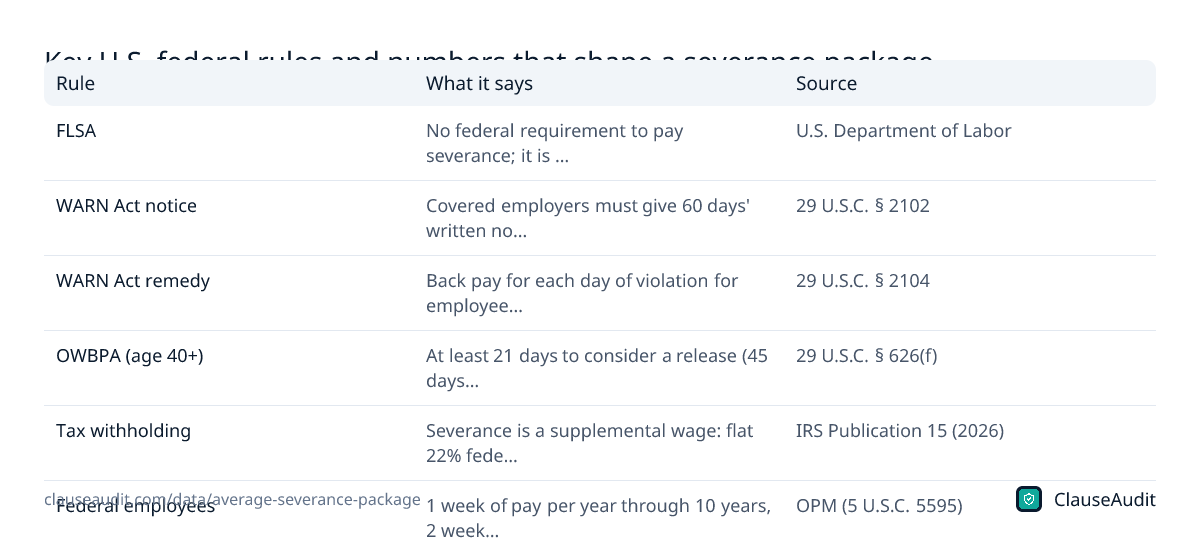
Key U.S. federal rules and numbers that shape a severance package
| Rule | What it says | Source |
|---|---|---|
| FLSA | No federal requirement to pay severance; it is a matter of agreement between employer and employee | U.S. Department of Labor |
| WARN Act notice | Covered employers must give 60 days' written notice before a plant closing or mass layoff | 29 U.S.C. § 2102 |
| WARN Act remedy | Back pay for each day of violation for employees who lose jobs without required notice | 29 U.S.C. § 2104 |
| OWBPA (age 40+) | At least 21 days to consider a release (45 days in a group program) and 7 days to revoke after signing | 29 U.S.C. § 626(f) |
| Tax withholding | Severance is a supplemental wage: flat 22% federal withholding, 37% on amounts over $1 million in a year | IRS Publication 15 (2026) |
| Federal employees | 1 week of pay per year through 10 years, 2 weeks per year after; 52-week lifetime cap | OPM (5 U.S.C. 5595) |
Source: U.S. Department of Labor, Severance Pay; Legal Information Institute, Cornell Law School (U.S. Code text), 29 U.S. Code § 2102 (WARN Act notice required before plant closings and mass layoffs); Legal Information Institute, Cornell Law School (U.S. Code text), 29 U.S. Code § 2104 (WARN Act administration and enforcement; back pay); Legal Information Institute, Cornell Law School (U.S. Code text), 29 U.S. Code § 626(f) (Older Workers Benefit Protection Act waiver requirements); Internal Revenue Service, Publication 15 (2026), (Circular E), Employer's Tax Guide; U.S. Office of Personnel Management, Fact Sheet: Severance Pay (federal employees, 5 U.S.C. 5595). Download as image
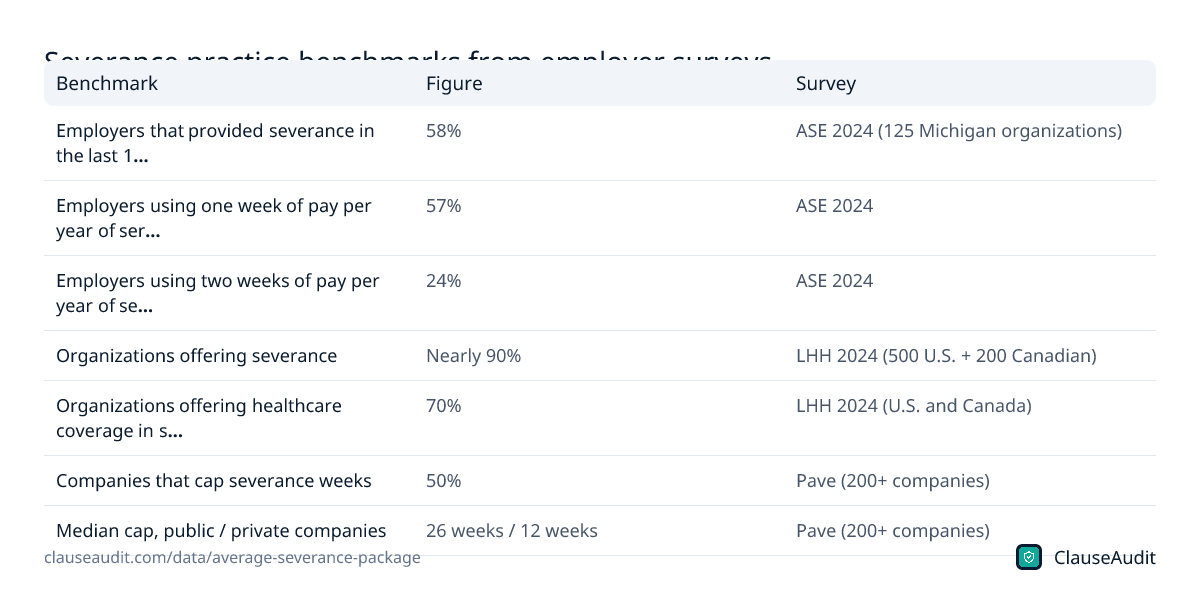
Severance practice benchmarks from employer surveys
| Benchmark | Figure | Survey |
|---|---|---|
| Employers that provided severance in the last 12 months | 58% | ASE 2024 (125 Michigan organizations) |
| Employers using one week of pay per year of service | 57% | ASE 2024 |
| Employers using two weeks of pay per year of service | 24% | ASE 2024 |
| Organizations offering severance | Nearly 90% | LHH 2024 (500 U.S. + 200 Canadian) |
| Organizations offering healthcare coverage in severance | 70% | LHH 2024 (U.S. and Canada) |
| Companies that cap severance weeks | 50% | Pave (200+ companies) |
| Median cap, public / private companies | 26 weeks / 12 weeks | Pave (200+ companies) |
Source: American Society of Employers (ASE), ASE Releases Results to the 2024 Severance Pay, Policies, & Practices Survey; LHH (The Adecco Group), New LHH Report Reveals Rise in Severance in North America Amid Increased Market Volatility (Severance & Separation Benefits 2024 Benchmarks Study); LHH (The Adecco Group), Severance Package Costs & Liabilities: What C-Suites Need to Know Now (Severance & Separation Benefits 2024 Benchmark Study); Pave, Severance Pay: What a Typical Severance Package Looks Like. Download as image
How much severance is normal?
The headline number is 19.3 weeks. That is Challenger's all-industry average for people laid off or terminated in 2024, and it jumped from 15.6 weeks the year before.
Be careful with that average, though. It is pulled up by executives. Challenger puts C-suite leaders at 30-50+ weeks, vice presidents and directors at 15-25 weeks, and individual contributors at less than 10 weeks. If you are a staff engineer, a nurse or an account manager, the less-than-10-weeks band is your real benchmark, not 19.3.
LHH's numbers tell the same story from a different survey. CEOs and senior management averaged 16 weeks, directors 15, managers 13 and supervisors 12, while exempt and non-exempt employees typically got 8-9 weeks.
Offering severance at all is now the norm. Nearly 90% of U.S. and Canadian organizations in LHH's 2024 study offer packages, and 70% made them more generous over the last three years. So a flat refusal to offer anything is out of step with what most employers do.
How is severance pay calculated?
Most employers start with time served. In the American Society of Employers 2024 survey of 125 Michigan organizations, 57% used one week of pay per year of service, and 24% used two weeks per year. Years of service was a main factor for 76% of them.
Here is what that looks like. With 5 years on the job, one week per year gets you 5 weeks of pay. At two weeks per year, the same tenure gets you 10 weeks. The formula your company picks can double your check.
Seniority is the other lever. LHH found 39% of organizations combine position level with years of service, and 19% give a flat number of weeks by position level. Some also add minimums and maximums. Pave's survey found 50% of companies cap severance weeks, with a median cap of 26 weeks at public companies and 12 weeks at private ones.
Ask HR for the written severance plan, if one exists. If the company follows a policy and your offer comes in under it, you have a concrete reason to push back. If there is no plan, ask how your number was worked out. A vague answer is a sign the amount has some give in it.
Is severance pay required by law?
Usually not. The U.S. Department of Labor says the Fair Labor Standards Act does not require severance. It is a matter of agreement between you and your employer, which is why your offer letter, employment contract or company severance plan matters so much.
There are exceptions that act like severance. Under the WARN Act, covered employers must give 60 days' written notice before a plant closing or mass layoff. If they skip it, affected employees can recover back pay for each day of the violation. Some employers count pay owed in place of WARN notice toward the severance figure, so ask how much of your offer is a legal obligation the company owed you anyway.
Federal employees are the other exception. They have a statutory formula: one week of basic pay per year through 10 years, two weeks per year after that, plus a 2.5% age adjustment for each full 3 months over age 40, up to a 52-week lifetime cap.
What do you give up when you sign?
Severance is almost never free money. In exchange, you sign a release that waives your right to sue over the job and how it ended. Read the release before you look at the dollar figure.
If you are 40 or older, federal law gives you time. The Older Workers Benefit Protection Act requires at least 21 days to consider the release, or 45 days when the layoff is part of a group program, plus 7 days to revoke after you sign. An agreement that gives you only the afternoon to decide does not meet that standard for an age waiver.
Watch for terms that reach past your last day:
- A non-disparagement clause that bars you from criticizing the company, with no matching promise from them.
- A new or extended non-compete or non-solicit tucked into the release.
- A clawback that makes you repay everything if you breach any term.
- Payment in installments that stops if you take another job.
- Silence on health coverage. LHH found 70% of organizations include healthcare coverage in severance, so ask if yours does not mention it.
How much of your severance will you actually keep?
The IRS treats severance as supplemental wages. Employers can withhold federal income tax at a flat 22% or use the aggregate method instead. Once your supplemental wages for the year pass $1 million, the part above that is withheld at 37%. Social Security and Medicare taxes also come out.
Withholding is not your final tax bill. A lump sum paid late in the year can push you into a higher bracket, while a smaller payment spread across a lean year may leave you owed a refund. If the amount is large, ask whether it can be split across two tax years and run the numbers before you agree to a payment schedule.
Can you negotiate a severance package?
Often, yes. The data gives you the talking points. If your tenure and level put you above the formula the company used, or your industry pays more than your offer, say so in writing and cite the benchmark.
Money is not the only thing you can ask for. Extra weeks of health coverage, a neutral reference, faster vesting, keeping your laptop or dropping a non-compete can be worth as much as cash. Ask for one or two specific changes, give a short reason for each, and keep the tone calm. Companies expect some back and forth, especially when the release is broad.
How ClauseAudit helps with severance
Your severance terms are often set long before you are let go, in the offer letter or employment contract you signed on day one. The release you get at the end then decides what you trade for the money.
Upload either document and the automated review flags the clauses that shrink your payout or limit what you can do next, with plain English explanations and suggested fixes.
- Severance formula, minimums, caps and whether pay depends on signing a release
- Release scope, including the 21-day review and 7-day revocation windows for workers 40 and older
- Non-compete, non-solicit and non-disparagement terms that survive the job
- Clawback and repayment triggers, plus installment terms that stop if you get a new job
- Health coverage, equity vesting and bonus treatment on termination
- Notice periods and whether WARN pay is counted as part of severance
Frequently asked questions
What is the average severance package in 2026?
The latest full benchmark is Challenger's 2025 report, which covers 2024 layoffs. It puts the all-industry average at 19.3 weeks of pay, up from 15.6 weeks the prior year. We found no newer edition as of this page's update. Keep in mind that executives pull the average up, and individual contributors averaged less than 10 weeks.
Is one week of pay per year of service a fair offer?
It is the most common formula. In the ASE 2024 survey of 125 Michigan organizations, 57% of employers used one week per year, while 24% used two weeks per year. So one week per year is typical rather than generous. If you are senior, work in a high-paying industry, or were let go without the notice the law requires, you have room to ask for more.
Do executives get more severance than other employees?
Yes, by a wide margin. Challenger reports C-suite leaders at 30-50+ weeks and vice presidents and directors at 15-25 weeks, compared with less than 10 weeks for individual contributors. LHH found CEOs and senior management averaged 16 weeks while exempt and non-exempt staff got 8-9 weeks. Executive severance terms are often written into the employment contract up front.
Which industries pay the most severance?
Among the industries Challenger published figures for, Chemicals led at 35.3 weeks, followed by Media at 28.1 weeks and Aerospace and Aviation at 23.2 weeks. Technology averaged 11.2 weeks and Retail 10.2 weeks. Banking and Finance averaged 22.2 weeks, with some leaders receiving up to 78 weeks.
Does my employer have to pay severance?
In most cases, no. The Department of Labor says federal law does not require severance, so it depends on your contract, offer letter or company plan. The WARN Act is a key exception: covered employers must give 60 days' written notice before a plant closing or mass layoff, and owe back pay for each day of violation if they do not.
How long do I have to sign a severance agreement?
If you are 40 or older and the agreement waives age discrimination claims, federal law gives you at least 21 days to consider it, or 45 days in a group layoff, plus 7 days to revoke after signing. Younger workers have no federal minimum, but you can still ask for time to review it with a lawyer.
How is severance pay taxed?
Severance counts as supplemental wages. Employers can withhold federal income tax at a flat 22% or use the aggregate method, and amounts above $1 million in a year are withheld at 37%. Social Security and Medicare taxes apply too. Your actual tax depends on your total income for the year, so withholding may not match what you owe.
Is there a cap on severance pay?
Many companies set one. Pave found 50% of companies cap severance weeks, with a median cap of 26 weeks at public companies and 12 weeks at private companies. Federal employees face a 52-week lifetime cap under OPM rules. Check your plan or contract for the cap before you calculate what you expect to receive.
Use this data
Every chart and card below is free to reuse under CC BY 4.0. Download what you need and link back to this page.
 Stat cards
 Key findings card
 Infographic
 Average severance by industry (weeks), Challenger 2025 report, 2024 data
 Average severance weeks by position level, LHH 9th benchmark report
 How organizations calculate severance (share of organizations) (%)
 Main basis for calculating severance (share of employers, multiple answers) (%)
 Federal employee basic severance allowance by years of service (weeks of basic pay)
 Average severance by job level, Challenger 2025 report (2024 data)
 Key U.S. federal rules and numbers that shape a severance package
 Severance practice benchmarks from employer surveys
Embed the infographic
Free to share on your site, blog or slides under CC BY 4.0. Please keep the credit link.
Sources and method
Every number on this page comes from the sources below, each opened and read on or before October 18, 2026. A second, independent review checked every figure against its source and corrected anything that did not match. Figures that could not be confirmed were left out.
- Challenger, Gray & Christmas, Inc., Benchmarking Severance in 2025: What “Competitive” Really Looks Like (summary of the 2025 Severance & Salary Benchmarking Report, 2024 data) (December 30, 2025)
- Challenger, Gray & Christmas, Inc., Severance Pay by Industry: Who's Paying the Most in Severance and Why (2025 Severance & Salary Benchmarking Report, 2024 data) (January 19, 2026)
- Challenger, Gray & Christmas, Inc., 2025 Severance & Salary Benchmarking Report (report landing page) (2025 edition (2024 data))
- LHH (The Adecco Group), New LHH Report Reveals Rise in Severance in North America Amid Increased Market Volatility (Severance & Separation Benefits 2024 Benchmarks Study) (November 18, 2024)
- LHH (The Adecco Group), How Much Severance Should Companies Pay? (citing LHH's 9th Severance and Separation Benchmark Report) (February 14, 2025)
- LHH (The Adecco Group), Severance Package Costs & Liabilities: What C-Suites Need to Know Now (Severance & Separation Benefits 2024 Benchmark Study) (October 28, 2024)
- American Society of Employers (ASE), ASE Releases Results to the 2024 Severance Pay, Policies, & Practices Survey (February 14, 2024)
- Pave, Severance Pay: What a Typical Severance Package Looks Like (January 23, 2026 (updated September 3, 2026))
- U.S. Office of Personnel Management, Fact Sheet: Severance Pay (federal employees, 5 U.S.C. 5595) (Current fact sheet, accessed 2026-10-18)
- Internal Revenue Service, Publication 15 (2026), (Circular E), Employer's Tax Guide (2026 edition (for use in 2026))
- U.S. Department of Labor, Severance Pay (Current page, accessed 2026-10-18)
- Legal Information Institute, Cornell Law School (U.S. Code text), 29 U.S. Code § 626(f) (Older Workers Benefit Protection Act waiver requirements) (Current U.S. Code text, accessed 2026-10-18)
- Legal Information Institute, Cornell Law School (U.S. Code text), 29 U.S. Code § 2102 (WARN Act notice required before plant closings and mass layoffs) (Current U.S. Code text, accessed 2026-10-18)
- Legal Information Institute, Cornell Law School (U.S. Code text), 29 U.S. Code § 2104 (WARN Act administration and enforcement; back pay) (Current U.S. Code text, accessed 2026-10-18)
Cite this page
ClauseAudit, “Average Severance Package 2026: Weeks per Year of Service and What Companies Actually Pay”, updated October 18, 2026, https://clauseaudit.com/data/average-severance-package. Free to reuse with a link back (CC BY 4.0).
This page summarises published data and law as checked on October 18, 2026. Figures are updated as new editions are released, and your own situation may differ. It is general information, not legal, tax or financial advice.