Final Paycheck Laws by State: When You Get Paid After You're Fired or Quit
By ClauseAudit Research · Verified against official sources ·
When is my final paycheck due after I'm fired or quit?
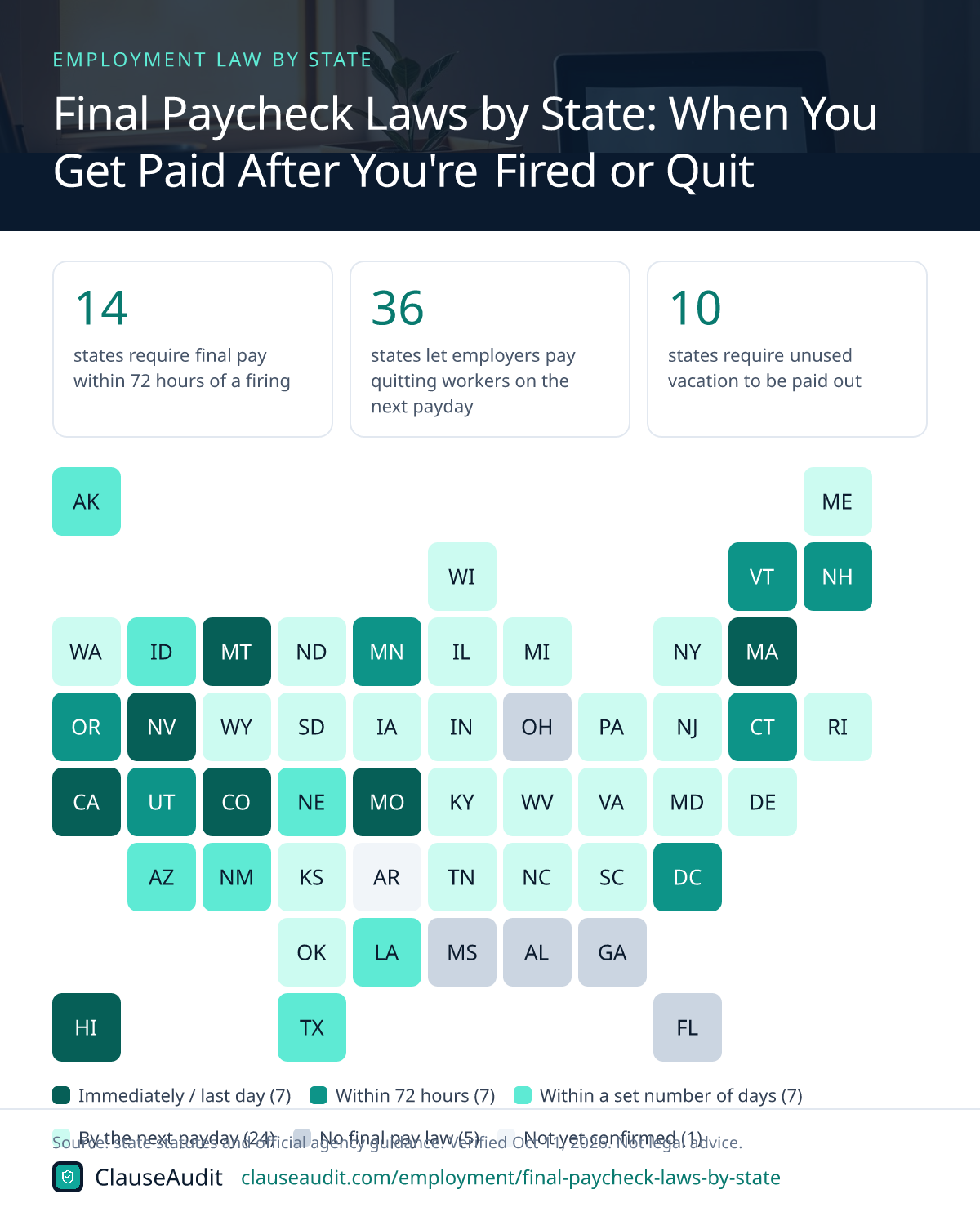
It depends on your state. 14 states require final pay within 72 hours of a firing, including 7 that demand it right away. If you quit, 36 states let the employer wait until the next regular payday. 5 states have no final paycheck law, so the normal payday applies.

- states require final pay within 72 hours of a firing
- 14
- states let employers pay quitting workers on the next payday
- 36
- states require unused vacation to be paid out
- 10
- states have no final paycheck law at all
- 5
Your last paycheck is an easy one for an employer to get wrong. Sometimes it's late, sometimes it's short, and sometimes the unused vacation you counted on never shows up.
The rules come from state law, and they change a lot depending on who ended the job: you or your employer. Below you'll find how the deadlines work, which states pay out vacation, what penalties an employer faces for paying late, and what to do if your money doesn't arrive.
- Immediately / last day7
- Within 72 hours7
- Within a set number of days7
- By the next payday24
- No final pay law5
- Not yet confirmed1
Final paycheck deadlines in every state
| State | If you are fired | If you quit | Unused vacation | Law |
|---|---|---|---|---|
| Alabama | No state law; pay on the next regular payday by practice | No state law | Depends on policy or contract | None (no final pay statute) |
| Alaska | Within 3 working days after termination | By the next regular payday that is at least 3 days after the employer gets notice | Depends on policy or contract | Alaska Stat. § 23.05.140(b), (d) |
| Arizona | Within 7 working days or the end of the next regular pay period, whichever is sooner | No later than the regular payday for the pay period in which employment ended | Depends on policy or contract | A.R.S. § 23-353 |
| Arkansas | Not yet confirmed: check the statute linked in the sources | Ark. Code Ann. § 11-4-405 | ||
| California | Immediately at the time of discharge | Within 72 hours; immediately on the last day if the employee gave at least 72 hours notice | Must be paid | Cal. Lab. Code §§ 201-203, 227.3 |
| Colorado | Immediately; if the payroll office is closed, within 6 hours of its next workday, or 24 hours if payroll is offsite | By the next regular payday | Must be paid | C.R.S. § 8-4-109 |
| Connecticut | By the next business day after discharge | By the next regular payday | Depends on policy or contract | Conn. Gen. Stat. § 31-71c |
| Delaware | On the later of the next regular payday or 3 business days after the last day worked | Same as when fired | Depends on policy or contract | 19 Del. C. § 1103 |
| District of Columbia | By the next working day after discharge | By the next regular payday or within 7 days of quitting, whichever is earlier | Depends on policy or contract | D.C. Code § 32-1303 |
| Florida | No state law | No state law | Depends on policy or contract | None (no final pay statute) |
| Georgia | No final pay law; regular semimonthly payday rules apply | No final pay law | Depends on policy or contract | None for final pay (see O.C.G.A. § 34-7-2 on paydays) |
| Hawaii | At the time of discharge, or by the next working day if conditions prevent immediate payment | By the next regular payday; on the last day if the employee gave one pay period of notice | Depends on policy or contract | Haw. Rev. Stat. § 388-3 |
| Idaho | By the next regular payday or within 10 days (weekends and holidays excluded), whichever is earlier; within 48 hours of a written request | Same as when fired | Depends on policy or contract | Idaho Code §§ 45-606, 45-607 |
| Illinois | At separation if possible, and no later than the next regular payday | Same as when fired | Must be paid | 820 ILCS 115/5 |
| Indiana | By the next regular payday for the pay period in which separation occurred | By the next regular payday | Depends on policy or contract | Ind. Code §§ 22-2-5-1, 22-2-9-2 |
| Iowa | By the next regular payday | Same as when fired | Depends on policy or contract | Iowa Code § 91A.4 |
| Kansas | By the next regular payday | Same as when fired | Depends on policy or contract | K.S.A. § 44-315 |
| Kentucky | By the next normal payday or 14 days after separation, whichever is later | Same as when fired | Depends on policy or contract | KRS § 337.055 |
| Louisiana | By the next regular payday or within 15 days, whichever is first | Same as when fired | Must be paid | La. R.S. 23:631 |
| Maine | No later than the next established payday | Same as when fired | Must be paid (Required only for employers with 11 or more employees (public employers exempt), and only for vacation accrued on or after Jan 1, 2023. A collective bargaining agreement that addresses vacation payout controls instead.) | 26 M.R.S. § 626 |
| Maryland | On or before the day wages would have been paid if employment continued | Same as when fired | Depends on policy or contract | Md. Code, Lab. & Empl. § 3-505 |
| Massachusetts | On the day of discharge | By the next regular payday, or the following Saturday if there is no regular payday | Must be paid | M.G.L. c. 149, § 148 |
| Michigan | Next regular payday under state rules; the statute says as soon as the amount can be determined with due diligence | Same as when fired | Depends on policy or contract | MCL § 408.475; Mich. Admin. Code R 408.9007 |
| Minnesota | Within 24 hours after the employee demands payment | By the next regular payday; if that payday is less than 5 days away, the following payday, but no later than 20 days after the last day | Depends on policy or contract | Minn. Stat. §§ 181.13, 181.14 |
| Mississippi | No final pay law | No final pay law | Depends on policy or contract | None for final pay (see Miss. Code Ann. § 71-1-35 on paydays) |
| Missouri | On the day of discharge | No statute | Depends on policy or contract | Mo. Rev. Stat. § 290.110 |
| Montana | Immediately, unless a written policy extends it to the next payday or 15 days, whichever is first | By the next regular payday or within 15 days, whichever is first | Must be paid | Mont. Code Ann. § 39-3-205 |
| Nebraska | By the next regular payday or within 2 weeks, whichever is sooner | Same as when fired | Must be paid | Neb. Rev. Stat. §§ 48-1229, 48-1230, 48-1231, 48-1232 |
| Nevada | Immediately | By the next regular payday or within 7 days, whichever is earlier | Depends on policy or contract | Nev. Rev. Stat. §§ 608.020-608.040 |
| New Hampshire | Within 72 hours | By the next regular payday; within 72 hours if the employee gave one pay period of notice | Depends on policy or contract | N.H. Rev. Stat. Ann. § 275:44 |
| New Jersey | By the next regular payday | Same as when fired | Depends on policy or contract | N.J.S.A. 34:11-4.3 |
| New Mexico | Within 5 days of discharge; within 10 days if pay is task, piece, or commission based | By the next regular payday | Depends on policy or contract | N.M. Stat. Ann. §§ 50-4-4, 50-4-5 |
| New York | By the next regular payday | Same as when fired | Depends on policy or contract | N.Y. Lab. Law § 191(3) |
| North Carolina | On or before the next regular payday | Same as when fired | Depends on policy or contract | N.C. Gen. Stat. § 95-25.7 |
| North Dakota | By the next regular payday, by certified mail or as agreed | By the next regular payday | Must be paid | N.D. Cent. Code §§ 34-14-03, 34-14-09.2 |
| Ohio | No final pay law; regular semimonthly payday rules apply | No final pay law; regular semimonthly payday rules apply | Depends on policy or contract | None for final pay (see Ohio Rev. Code § 4113.15 on paydays) |
| Oklahoma | By the next regular designated payday | Same as when fired | Depends on policy or contract | 40 O.S. § 165.3 |
| Oregon | By the end of the first business day after discharge | Immediately if 48 hours notice (excluding weekends and holidays); otherwise within 5 business days or the next payday, whichever is first | Depends on policy or contract | Or. Rev. Stat. § 652.140 |
| Pennsylvania | By the next regular payday | Same as when fired | Depends on policy or contract | 43 P.S. § 260.5 |
| Rhode Island | By the next regular payday | Same as when fired | Must be paid | R.I. Gen. Laws § 28-14-4 |
| South Carolina | Within 48 hours or by the next regular payday, which may not be more than 30 days | Same as when fired | Depends on policy or contract | S.C. Code Ann. § 41-10-50 |
| South Dakota | By the next regular payday, or when company property is returned if later | Same as when fired | Depends on policy or contract | S.D. Codified Laws §§ 60-11-10, 60-11-11 |
| Tennessee | By the next regular payday or 21 days after separation, whichever is later | Same as when fired | Depends on policy or contract | Tenn. Code Ann. § 50-2-103(g) |
| Texas | Within 6 calendar days after discharge | By the next regular payday | Depends on policy or contract | Tex. Lab. Code § 61.014 |
| Utah | Within 24 hours of separation | By the next regular payday | Depends on policy or contract | Utah Code § 34-28-5 |
| Vermont | Within 72 hours of discharge | By the next regular payday, or the next Friday if there is none | Depends on policy or contract | 21 V.S.A. § 342(c) |
| Virginia | On or before the date the wages would have been paid if employment continued | Same as when fired | Depends on policy or contract | Va. Code § 40.1-29(B) (final pay timing); § 40.1-29(K) (triple damages); § 40.1-29(P) (good faith defense) |
| Washington | At the end of the established pay period | Same as when fired | Depends on policy or contract | RCW 49.48.010(2) |
| West Virginia | By the next regular payday | Same as when fired | Depends on policy or contract | W. Va. Code § 21-5-4 |
| Wisconsin | By the next regular payday, and never more than 31 days after work was done | Same as when fired | Depends on policy or contract | Wis. Stat. § 109.03(2) |
| Wyoming | By the next regularly scheduled payroll date | Same as when fired | Depends on policy or contract | Wyo. Stat. § 27-4-104 |
How do final paycheck laws work, and is there a federal rule?
Every final pay rule answers two questions: when the money is due, and what happens if the employer misses the date. Many states split the first question in two, with one deadline for workers who are fired or laid off and a second, usually looser one for workers who quit. Others, like New York and Pennsylvania, use the same next-payday rule either way.
The logic behind the split is simple. An employer who decides to end the job knows it's coming and can have the check ready. A worker who quits might give no warning, so many states let payroll wait until the next regular payday.
Your final paycheck covers the wages you earned through your last day, including any overtime. Whether unused vacation counts as wages is a separate question, covered below.
As for federal law, there is no final paycheck deadline. The Fair Labor Standards Act requires minimum wage and overtime, but the U.S. Department of Labor says federal law does not require employers to hand over a final paycheck immediately. It points workers to their state rules.
That's why the 5 states with no final pay statute, such as Alabama and Florida, leave the timing to the employer's normal payday. You are still owed every hour you worked, and federal minimum wage and overtime rules still apply. What you lose is the fast deadline and the state penalty.
How fast do you get paid if you're fired?
This is where the states differ the most. 7 states require payment immediately or on your last day, and 14 states in total require it within 72 hours of a firing.
A few concrete examples from the statutes:
- California: due immediately at the time of discharge (Cal. Lab. Code § 201).
- Massachusetts: due on the day of discharge (M.G.L. c. 149, § 148).
- Colorado: due immediately, or within 6 hours of the start of payroll's next workday if the office is closed, and 24 hours if payroll is offsite (C.R.S. § 8-4-109).
- Oregon: by the end of the first business day after discharge (ORS 652.140).
- Alaska: within 3 working days after termination (AS 23.05.140).
- Texas: within 6 calendar days after discharge (Tex. Lab. Code § 61.014).
- New York and Pennsylvania: by the next regular payday.
When is your last paycheck due if you quit?
If you resign, expect to wait longer. 36 states let employers pay a worker who quits on the next regular payday, the same date you would have been paid anyway.
Giving notice can speed things up in some states. In California, final pay is due within 72 hours of quitting, but if you gave at least 72 hours of notice it's due on your last day. Oregon requires immediate payment when you give 48 hours of notice (excluding weekends and holidays); otherwise it's due within 5 business days or the next payday, whichever comes first. New Hampshire moves the deadline to 72 hours if you gave one full pay period of notice.
Other states set an outer limit. Minnesota normally uses the next payday, but if that payday is less than 5 days away the employer can use the following one, and payment can never come later than 20 days after your last day. Nevada requires payment by the next payday or within 7 days, whichever is earlier.
One firing, four different deadlines
Picture the same situation in four states. You're let go on a Monday afternoon, and your employer runs payroll every other Friday, with the next payday 11 days away.
In California, the check is due that Monday, at the time of discharge. Every day it's late adds a day of wages to what the employer owes, up to 30 days.
In Oregon, you should have it by the end of Tuesday, the first business day after discharge. In Texas, the employer has until Sunday, 6 calendar days later. In New York, it can wait the full 11 days until the next regular payday, and that's perfectly legal.
Now flip it and say you quit with no notice. California gives the employer 72 hours. Texas, Oregon and New York all land on the next regular payday or close to it, though Oregon caps the wait at 5 business days if that comes first.
The point: a coworker's experience in another state tells you very little about your own deadline. Look up the rule for the state where you work before you assume anything.
Do employers have to pay out unused vacation?
Only 10 states require accrued, unused vacation to be paid out when you leave. California is the best known: under Labor Code § 227.3, vested vacation is treated as wages and must be paid at your final rate. Illinois, Massachusetts, Colorado, Maine, Montana and Nebraska are among the other states that require payout.
Everywhere else, payout depends on your employer's written policy or your employment contract. If the handbook promises payout, that promise is what your claim rests on. If the policy says unused time is forfeited at separation, you may have no claim.
So read the PTO section of your offer letter or handbook before you resign. In states where payout follows policy, a short phrase like "accrued vacation is not paid upon termination" can decide the issue.
What happens if your employer pays late?
Penalties are what give these deadlines teeth, and they range from mild to severe. Some depend on intent: Oregon and Kansas apply their penalty only when the failure is willful, and Oklahoma's liquidated damages don't cover wages in a genuine dispute. Either way, the unpaid wages themselves are still owed.
Here is how the penalty looks in a few states:
- California: a waiting time penalty of one day's wages for each day late, up to 30 days (Lab. Code § 203).
- Nevada: wages continue at the same rate until paid, up to 30 days.
- Minnesota: one day's average earnings for each day late, up to 15 days.
- Massachusetts: mandatory triple damages plus attorney fees.
- Arizona: you can sue for up to three times the unpaid wages.
- Colorado: after a written demand, the unpaid amount plus a penalty of 2 times the unpaid wages or $1,000, whichever is greater, and more if the violation is willful.
- Pennsylvania: liquidated damages of 25% of the unpaid wages or $500, whichever is greater.
What to do if your final paycheck is late or missing
Most unpaid final wage disputes end with a written request. Here is the order that tends to work:
- Check the deadline for your state and situation, fired or quit, in the state table on this page, or run your dates through the free final paycheck calculator.
- Collect your records: last day worked, pay stubs, hours, commission statements, and the vacation or PTO policy.
- Send a short written demand by email or letter stating the amount owed and the legal deadline. In several states, including Alaska, Colorado, Missouri and Utah, the penalty clock depends on a demand, so put it in writing and keep a copy.
- If the deadline passes, file a wage claim with your state labor department.
- For larger amounts, talk to an employment lawyer. Many wage statutes, including those in Illinois, Massachusetts and New York, let a winning employee recover attorney fees.
Frequently asked questions
Can my employer hold my final paycheck until I return company property?
Check your state's rule before you assume so. Most final pay deadlines in our dataset say nothing about returning a laptop or badge. South Dakota is the notable exception: final pay is due by the next regular payday, or when company property is returned if that comes later. If your state has no such condition, the regular deadline applies.
How long does an employer have to give a final paycheck in Texas?
If you are fired in Texas, your final pay is due within 6 calendar days after discharge under Texas Labor Code § 61.014. If you quit, it's due by the next regular payday. Texas does not require unused vacation to be paid out unless your employer's policy or agreement promises it.
What is the California waiting time penalty?
If a California employer pays final wages late, it owes a waiting time penalty of one day's wages for each day the payment is late, up to 30 days, under Labor Code § 203. For a full-time worker that can add up to about a month of pay, which is why California employers tend to take the deadline seriously.
Does quitting without notice affect my final paycheck?
It can change the timing, not the wages you earned. In California, quitting without notice gives the employer 72 hours instead of paying on your last day. In Oregon, no notice means up to 5 business days or the next payday, whichever comes first. You still earned every hour you worked, and those wages are still owed.
Is a layoff treated the same as being fired?
Usually it follows the firing deadline. Final pay statutes tend to turn on who ended the job, so a layoff started by the employer is treated like a discharge, while a resignation follows the quitting rule. Many states, including New York, Pennsylvania and Illinois, use the same deadline either way. Check the exact wording for your state.
Do I get paid for unused sick leave when I leave a job?
The payout rules on this page cover vacation, not sick leave. States like California and Massachusetts require accrued vacation to be paid at separation, but sick leave falls under separate state laws and your employer's policy. If your employer uses one combined PTO bank, read the policy closely and ask your state labor department how it's treated.
Can my employer pay my final paycheck by direct deposit?
Your state's deadline is about when the wages reach you, so a direct deposit that lands on time meets it. If you're unsure, ask payroll how and when the final payment will arrive. North Dakota requires an employer that discharges someone to pay by certified mail to an address the employee designates, or another way they agree, on the regular payday for the period worked.
What if my state has no final paycheck law?
In states like Alabama, Florida, Georgia and Mississippi, there's no special deadline for final pay. Your employer typically pays on the next regular payday, and you're still owed all wages earned. If the money doesn't come, you can pursue unpaid minimum wage or overtime under federal law, or bring a claim based on your pay agreement.
Find your exact final pay date
Enter your state, your last day, and how the job ended. The free calculator shows when your final paycheck is due and what the employer owes if it's late.
Open the final paycheck calculatorUse this infographic
Free to share on your site, blog or slides under CC BY 4.0. Please keep the credit link.
How we built this data
We built this dataset from the law in each state, then had a second, independent review re-check every entry against primary sources and correct anything that did not match. Each row links to its source.
Of the 51 entries, 42 were confirmed directly against the statute itself or the state agency that enforces it. 8 rest on several secondary sources that agree, usually because the official site could not be reached or because there is no statute to read where the answer is that no law exists. 1 could not be confirmed; they are marked "Not yet confirmed" in the table and left out of every count and chart. Data verified on October 11, 2026.
Sources
- Alabama: U.S. Department of Labor, State Payday Requirements
- Alaska: Alaska Legislature, Alaska Statutes
- Arizona: Arizona State Legislature, Arizona Revised Statutes
- Arkansas: Arkansas Code via Justia (Act 853 of 2019)
- California: California Legislative Information, Labor Code
- Colorado: Colorado Department of Labor and Employment, INFO #3A (Jan. 2026)
- Connecticut: Connecticut General Assembly, General Statutes
- Delaware: Delaware Code Online, Title 19, Chapter 11
- District of Columbia: Council of the District of Columbia, D.C. Code
- Hawaii: Hawaii State Legislature, Hawaii Revised Statutes
- Idaho: Idaho Legislature, Idaho Statutes
- Illinois: Illinois General Assembly, Wage Payment and Collection Act
- Indiana: Indiana General Assembly, Indiana Code
- Iowa: Iowa Legislature, Iowa Code 2026
- Kansas: Kansas Office of Revisor of Statutes
- Kentucky: Kentucky General Assembly, Kentucky Revised Statutes
- Louisiana: Louisiana State Legislature, Revised Statutes
- Maine: Maine Legislature, Maine Revised Statutes
- Maryland: Maryland General Assembly, Labor and Employment Article
- Massachusetts: Massachusetts Legislature, General Laws
- Michigan: Michigan Legislature, Michigan Compiled Laws
- Minnesota: Minnesota Office of the Revisor of Statutes
- Missouri: Missouri Revisor of Statutes
- Montana: Montana Legislature, Montana Code Annotated 2025
- Nebraska: Nebraska Legislature, Nebraska Revised Statutes
- Nevada: Nevada Legislature, Nevada Revised Statutes
- New Hampshire: New Hampshire General Court, Revised Statutes
- New Jersey: New Jersey Department of Labor and Workforce Development
- New Mexico: New Mexico Department of Workforce Solutions
- New York: New York State Senate, Labor Law
- North Carolina: North Carolina General Assembly, General Statutes
- North Dakota: North Dakota Legislative Branch, Century Code
- Ohio: Ohio Legislature, Ohio Revised Code
- Oklahoma: Oklahoma State Courts Network, Oklahoma Statutes
- Oregon: Oregon State Legislature, Oregon Revised Statutes
- Pennsylvania: Pennsylvania General Assembly, Wage Payment and Collection Law (Act 329 of 1961)
- Rhode Island: Rhode Island General Assembly, General Laws
- South Carolina: South Carolina Legislature, Code of Laws
- South Dakota: South Dakota Legislature, Codified Laws
- Tennessee: Tennessee Department of Labor and Workforce Development
- Texas: Texas Legislature, Texas Constitution and Statutes (Labor Code ch. 61)
- Utah: Utah State Legislature, Utah Code
- Vermont: Vermont General Assembly, Vermont Statutes
- Virginia: Virginia Law Library, Code of Virginia
- Washington: Washington State Legislature, Revised Code of Washington
- West Virginia: West Virginia Legislature, West Virginia Code
- Wisconsin: Wisconsin State Legislature, Wisconsin Statutes
- Wyoming: Wyoming Legislature, Wyoming Statutes Title 27
Cite this data
ClauseAudit, “Final Paycheck Laws by State: When You Get Paid After You're Fired or Quit”, updated October 11, 2026, https://clauseaudit.com/employment/final-paycheck-laws-by-state. Free to reuse with a link back (CC BY 4.0).
This page summarises the law as verified on October 11, 2026. Laws change, cities and counties can add their own rules, and the details of your situation matter. It is general information, not legal advice.