Non-Compete Law Changes in 2025 and 2026, State by State
By ClauseAudit Research · Verified against official sources ·
What changed in non-compete laws in 2026?
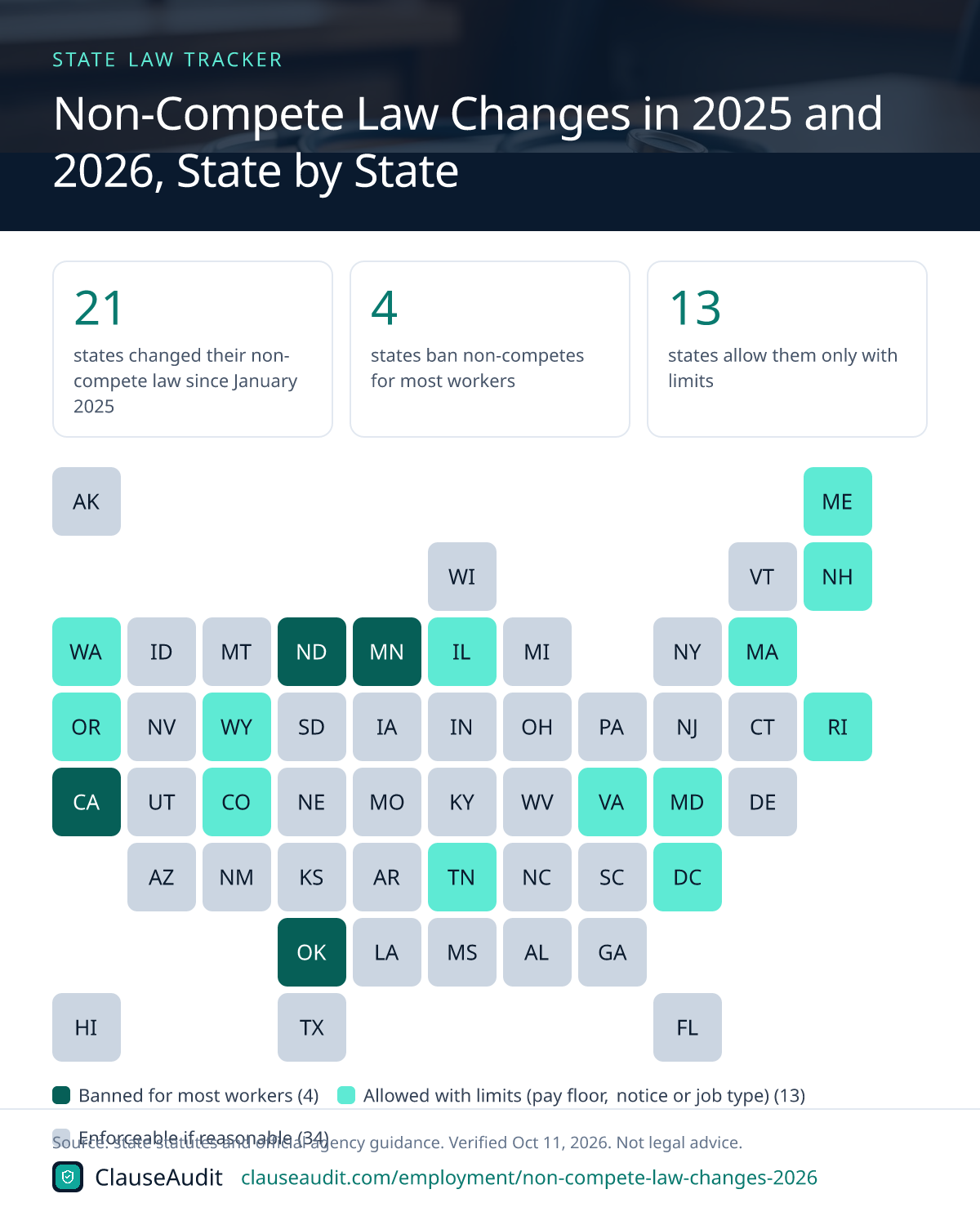
There is still no nationwide ban. The FTC rule was set aside in court and removed from federal regulations in February 2026, so change is happening state by state. 21 states have changed their non-compete laws since January 2025, many for health care. Today 4 states ban them for most workers and 13 jurisdictions allow them only with limits.

- states changed their non-compete law since January 2025
- 21
- states ban non-competes for most workers
- 4
- states allow them only with limits
- 13
- the federal FTC ban was vacated and removed in 2026
- Gone
If you signed a non-compete a few years ago, the rules around it may have moved under your feet. The federal ban you probably heard about in 2024 never took effect. Meanwhile, state legislatures have been busy, and most of the new laws point in one direction: fewer people can be bound.
Not all of them, though. Florida and Kansas made restrictive covenants easier to enforce in 2025. This page explains what changed, who it protects, whether it reaches a contract you already signed, and what to do if your employer is enforcing a clause the law no longer allows. The full state table is below, so here we focus on the patterns and the practical steps.
- Banned for most workers4
- Allowed with limits (pay floor, notice or job type)13
- Enforceable if reasonable34
Non-compete law changes from January 2025 to today
| State | What changed | Effective | Law |
|---|---|---|---|
| Washington | ESHB 1155 replaces the pay-threshold system with a near-total ban on noncompetition covenants for employees and independent contractors, and it reaches agreements signed before the law starts. Employers must make a reasonable effort to tell affected workers in writing by October 1, 2027 that their covenants are void. Until June 29, 2027 the old RCW 49.62 rules still apply (2026 thresholds $126,858.83 for employees and $317,147.09 for contractors). | 2027-06-30 | RCW ch. 49.62, as amended by ESHB 1155 (Laws of 2026, ch. 149) |
| Maryland | Two changes. 2024 Md. Laws ch. 378 (HB 1388) makes non-competes void for employees licensed under the Health Occupations Article who give direct patient care and earn $350,000 or less, and limits them to one year and 10 miles above that; Section 3 applies these health care rules only to contracts executed on or after July 1, 2025. HB 1016 (ch. 301 of 2026) extends the ban to licensed architects whose employer moves most of its workforce out of Maryland or is based outside Maryland, from October 1, 2026. | 2026-10-01 | Md. Code, Lab. & Empl. § 3-716 |
| Maine | LD 2200 (Public Law 2025, ch. 718) bars employers from requiring or allowing a non-compete with a health care practitioner who has no ownership interest in the employer. Any permitted non-compete must recognize a patient's right to choose a practitioner. It applies to agreements entered into or renewed on or after the effective date. | 2026-07-29 | Me. Rev. Stat. tit. 26, § 599-A (as amended by P.L. 2025, ch. 718) |
| New Hampshire | SB 402 (2026, ch. 55) extends New Hampshire's ban on clauses restricting medical practice to physician associates, for contracts entered into or renewed on or after the effective date. A 2025 law had already extended the protection to advanced practice registered nurses. | 2026-07-07 | N.H. RSA 328-D (physician associates), RSA 329:31-a |
| Virginia | Two rounds of amendments. From July 1, 2025 (SB 1218) the ban covers every employee entitled to FLSA overtime, whatever they earn. From July 1, 2026 (SB 170, 2026 Acts ch. 883, plus companion chapters) a non-compete cannot be enforced against an employee fired without cause unless severance or other pay, disclosed at signing, is provided, and employers may not enter into, enforce or threaten to enforce a non-compete with a health care professional licensed by the Boards of Medicine, Nursing, Counseling, Optometry, Psychology or Social Work. | 2026-07-01 | Va. Code § 40.1-28.7:8 |
| Tennessee | HB 1034 (Public Chapter 934) bars employers from requiring, requesting or enforcing a non-compete with an employee whose annualized pay is under $70,000. It also creates a rebuttable presumption that a restraint of two years or less after employment ends is reasonable, with longer terms presumed unreasonable. It applies to agreements entered into, renewed or amended on or after July 1, 2026. | 2026-07-01 | Tenn. Code Ann. §§ 50-1-210, 50-1-211 (2026 Tenn. Pub. Acts ch. 934) |
| South Dakota | SL 2026, ch. 196 amends SDCL § 53-9-11.2. In contracts entered on or after July 1, 2026, a term that bars a community services provider (defined in § 27B-1-17) from serving people with developmental disabilities after the relationship ends is voidable. The existing exceptions (sale of a practice, and limited non-solicits of current patients or clients that meet § 53-9-11 limits) apply to these providers too. Health care practitioner non-competes have been voidable since July 1, 2023. | 2026-07-01 | S.D. Codified Laws § 53-9-11.2 (SL 2026, ch. 196, § 1) |
| Iowa | HF 2254 requires the Board of Regents to adopt a policy barring University of Iowa Hospitals and Clinics from putting non-compete clauses in employment contracts with physicians, physician assistants, advanced registered nurse practitioners, registered and licensed practical nurses, and pharmacists entered into, extended or renewed on or after the effective date. | 2026-06-02 | Iowa Code § 262.9(43) (HF 2254, 2026) |
| Utah | HB 270 bans post-employment non-competes for most licensed health care workers entered on or after May 6, 2026, with exceptions for a mutually agreed severance arrangement and the sale of a business, and voids non-solicits that stop workers from telling patients where they now practice. SB 111 voids most non-competes for veterinarians except owners of at least 5 percent. Separately, a 2025 law barred health care staffing platforms from using non-competes. | 2026-05-06 | Utah Code §§ 34-51-102, 34-51-201(1)(b), 34-51-202, 34-51-203 (H.B. 270, 2026); § 34-51-201(3) (S.B. 111, 2026) |
| California | New law effective January 1, 2026 voids non-compete clauses that stop health care providers from competing with a physician or dental practice after leaving, in arrangements involving private equity groups or hedge funds. | 2026-01-01 | Cal. Health & Safety Code § 1190 et seq. |
| Texas | SB 1318 tightens physician non-competes and adds rules for dentists, nurses (professional and vocational) and physician assistants. For all of them the buyout can be no more than total annual salary and wages at separation, the restriction can last no more than one year after the job ends, and it can reach no more than five miles from the main practice location. Only for physicians, the covenant is void if the physician is involuntarily discharged without good cause. Applies to covenants entered into or renewed on or after September 1, 2025. | 2025-09-01 | Tex. Bus. & Com. Code §§ 15.50, 15.501 (SB 1318, 89th Leg.) |
| Colorado | SB 25-083 removes physicians, advanced practice registered nurses and dentists from the highly compensated worker exception, so their non-competes and practice-restricting non-solicits are void. Departing providers may tell prior patients about their new practice. It also sets a formula cap on the length of sale-of-business non-competes for minority owners who got their stake for services. | 2025-08-06 | Colo. Rev. Stat. § 8-2-113 (2025 Colo. Sess. Laws ch. 366) |
| Florida | The CHOICE Act (HB 1219, ch. 2025-213) makes covered non-compete agreements of up to four years enforceable for employees earning more than twice the annual mean wage of the relevant county, and covered garden leave agreements of up to four years. Employees must get seven days to review and written notice of the right to counsel. Courts must issue a preliminary injunction unless the employee shows by clear and convincing evidence the agreement is unenforceable. Health care practitioners are excluded. | 2025-07-01 | Fla. Stat. §§ 542.41-542.45 (Laws of Fla. ch. 2025-213) |
| Wyoming | SF 107 (Enrolled Act 87) makes any covenant not to compete that restricts a person's right to be paid for skilled or unskilled labor void, except in a sale of a business, to protect trade secrets, for executive and management personnel and their professional staff, and for limited recovery of relocation and training costs (100 percent under two years of service, 66 percent from two to three, 33 percent from three to four). Physician non-competes are void. | 2025-07-01 | Wyo. Stat. § 1-23-108 |
| Indiana | Not yet confirmed: check the statute linked in the sources | Ind. Code § 25-22.5-5.5-2.3 | |
| Kansas | SB 241 amends K.S.A. 50-163. Written non-solicitation covenants are conclusively presumed enforceable if they fit set limits: owner covenants up to four years after the business relationship ends, employee customer non-solicits limited to material contact customers for up to two years, and employee no-recruit covenants that either last two years or less or protect confidential information, trade secrets, customer or supplier relationships, goodwill, or loyalty. Workers may still raise any legal defense. If a non-solicitation or no-recruit covenant outside these presumptions is overbroad, the court must narrow it and enforce it as modified. The act does not apply to non-competes (K.S.A. 50-163(e)(6)), which stay under Kansas common law. | 2025-07-01 | K.S.A. 50-163 (2025 Kan. Sess. Laws ch. 74) |
| Oregon | SB 951 (2025) makes non-competes that restrict the practice of medicine or nursing void between a medical licensee and the entity it works for, with exceptions. HB 3410 (2025, emergency clause, signed July 24, 2025) rewrote those exceptions: a licensee owning at least 1.5% of the entity; agreements with a professional medical entity that documents a recruitment investment of at least 20% of annual salary, limited to 5 years for clinical care in a health professional shortage area or 3 years for licensees who do not provide clinical care; and a separate exception for licensees who do not engage directly in providing medical services, health care services or clinical care. The limits now reach agreements made before, on or after the law took effect. | 2025-06-09 | SB 951 (2025), as amended by HB 3410 (2025) |
| Louisiana | Act 273 of the 2024 Regular Session (SB 165), effective January 1, 2025, limits physician non-competes to three years for primary care physicians and five years for other physicians, measured from the effective date of the initial contract. Later contracts with the same employer after that initial term cannot include a non-compete. If the physician leaves early, the restriction is limited to the parish of the principal practice plus up to two contiguous parishes, for no more than two years. It exempts physicians employed by rural hospitals and by rural federally qualified health centers. For contracts already in effect, the three- or five-year term starts January 1, 2025. | 2025-01-01 | La. Rev. Stat. § 23:921(M), (N), (O) (Act 273 of 2024) |
| Illinois | Public Act 103-0915 amends the Freedom to Work Act so that non-competes and non-solicits entered into after January 1, 2025 cannot be enforced against licensed mental health professionals for mental health services to veterans and first responders, when enforcement is likely to raise cost or difficulty for those patients. | 2025-01-01 | 820 ILCS 90/10(f) |
| Pennsylvania | The Fair Contracting for Health Care Practitioners Act (Act 74 of 2024) generally voids non-competes of more than one year for covered health care practitioners, voids them entirely when the practitioner is dismissed, and requires employers to notify patients when a practitioner leaves. | 2025-01-01 | Act of July 17, 2024, P.L. 846, No. 74 (Cl. 35), Fair Contracting for Health Care Practitioners Act, Sections 1-7 (unconsolidated; enacted from HB 1633) |
| Arkansas | Act 232 of 2025 (SB 139), approved March 4, 2025, added Ark. Code § 4-75-101(k): a non-compete that restricts a physician (MD or DO) from practicing within the physician's scope of practice is void. Under § 4-75-101(h), the section does not apply to covenants ancillary to non-employment contracts such as the sale of a business or franchise agreements. | See source | Ark. Code Ann. § 4-75-101(h), (j), (k) (Act 232 of 2025, SB 139) |
| Montana | MCA § 28-2-724 (enacted 2023, Ch. 479) voids contract terms that, after the job or relationship ends, stop a covered health care provider from practicing, treating the employer's patients or soliciting them. Three 2025 laws (Ch. 104, 131 and 698, L. 2025) amended it. The current text covers physicians, physician assistants, psychologists, naturopathic physicians, registered nurses and APRNs, social workers, professional counselors, addiction counselors, marriage and family therapists and behavioral health peer support specialists. Exceptions: sale or purchase of a practice, and physician repayment provisions that decrease over time. | See source | Mont. Code Ann. § 28-2-724 (amended by Ch. 104, Ch. 131 and Ch. 698, L. 2025) |
Is there a federal non-compete ban in 2026?
No. The FTC issued a nationwide rule in April 2024 that would have voided most non-competes. A federal court in Texas set it aside in August 2024 in Ryan, LLC v. FTC, before it ever took effect. The FTC voted to drop its appeals on September 5, 2025, and the rule was formally removed from the Code of Federal Regulations on February 12, 2026 (91 FR 6507).
That does not mean federal regulators have walked away. The FTC now goes after individual employers instead of the whole market. It reached a consent order with Gateway Services in 2025, and secondary sources report a similar order with Rollins, the parent of Orkin, in June 2026. Those orders bind the companies involved, not your employer.
Congress has a bill, the Workforce Mobility Act (S. 2031), that would limit non-competes nationwide. It is pending and is not law. For now, the answer to almost every non-compete question depends on your state.
Which states changed their non-compete laws in 2025 and 2026?
The broadest changes came in a handful of states that rewrote the rules for most workers, not just one profession.
Wyoming went first. Since July 1, 2025, a covenant not to compete is void unless it falls into an exception: the sale of a business, protecting trade secrets, executive and management staff and their professional staff, or a sliding repayment of relocation and training costs. Physician non-competes are void outright. The law only covers contracts signed on or after that date.
Virginia has tightened twice. Since July 1, 2025, its ban reaches every employee entitled to overtime under the federal Fair Labor Standards Act, whatever they earn, though people paid mainly through commissions or bonuses fall outside that rule. Since July 1, 2026, an employer cannot enforce a non-compete against someone fired without cause unless it pays severance or other money that was disclosed at signing. The 2026 law also bars non-competes with health care professionals licensed by the Virginia Boards of Medicine, Nursing, Counseling, Optometry, Psychology or Social Work. The civil penalty is $10,000 per violation.
Tennessee added a pay floor. From July 1, 2026, an employer cannot require, request or enforce a non-compete with an employee whose annualized pay is under $70,000. A restraint of two years or less is presumed reasonable; anything longer is presumed unreasonable.
Washington made the biggest move. ESHB 1155, signed March 23, 2026, replaces the pay-threshold system with a near-total ban for employees and independent contractors starting June 30, 2027. Until then the old thresholds still apply ($126,858.83 for employees in 2026), which is why Washington still counts as limited in the current counts.
Why are states banning non-competes for doctors and nurses?
Most of the activity is in health care. Several of the new laws are written around patients. Colorado lets departing providers tell prior patients about their new practice. Utah voids non-solicits that stop workers from telling patients where they now practice. Pennsylvania makes employers notify patients when a practitioner leaves. The result is a patchwork, so check the exact profession and employer type.
Some states ban health care non-competes outright for covered workers. Colorado removed physicians, advanced practice nurses and dentists from its high-earner exception on August 6, 2025. Utah barred most new health care non-competes from May 6, 2026. Maine bans them for practitioners with no ownership stake from July 29, 2026. Arkansas made physician non-competes void in 2025, and Montana's law covers physicians, nurses, physician assistants and many behavioral health providers.
Others cap them instead. Texas limits doctors, dentists, nurses and physician assistants to one year and five miles, with a buyout no higher than a year's pay, for covenants signed or renewed since September 1, 2025. Pennsylvania caps practitioner non-competes at one year and voids them if the employer dismisses the practitioner. Louisiana limits physician non-competes to three years for primary care and five for other physicians. Maryland voids them for licensed health care workers who give direct patient care and earn $350,000 or less, in contracts signed since July 1, 2025.
A few are narrow. Iowa's 2026 law covers only University of Iowa Hospitals and Clinics. California's 2026 rule targets practice deals involving private equity groups or hedge funds. Reports of a 2025 Indiana physician change disagree with each other, and we could not confirm them from the statute text, so Indiana is left out of our count.
Does a new law apply to the non-compete you already signed?
Usually not. Most of these laws apply to agreements signed, and often renewed, on or after the effective date. Wyoming's ban does not touch contracts signed before July 1, 2025. Tennessee's applies to agreements entered into, renewed or amended from July 1, 2026. Texas, Maine and New Hampshire use similar entered-or-renewed language.
Washington is the big exception. Its 2027 ban voids covenants regardless of when they were signed, and employers must make a reasonable effort to tell affected current and former workers in writing by October 1, 2027. Louisiana also reached back in a different way: for physician contracts already in place, the three- or five-year limit started running on January 1, 2025.
Watch for renewals. If your employer asks you to sign a fresh agreement, a promotion letter or an updated handbook acknowledgment, that new paper may fall under the newer, stricter law. Read it before you sign, and keep a copy of both versions.
What to do if your employer enforces a non-compete the law no longer allows
- Find the date you signed or last renewed the agreement. That date decides which version of your state's law applies.
- Check your status today against the right rule. In Tennessee that means your annualized pay. In Virginia it means whether you are overtime eligible, or whether you were fired without cause.
- Look for an exception that might still apply: a sale of a business, an ownership stake, an executive role, or a training cost repayment clause.
- Do not ignore a cease-and-desist letter. Answer it in writing, or have a lawyer answer, and point to the statute that voids the clause.
- If you live in Virginia, know that the law allows a $10,000 civil penalty per violation, which can change how hard an employer pushes.
- If you are in Florida and earn more than twice the annual mean wage of the relevant county, act quickly. Under the CHOICE Act a court must grant a preliminary injunction unless you prove by clear and convincing evidence that the agreement is unenforceable.
- Talk to an employment lawyer in your state before you start a competing job.
Exceptions that survive most of the new bans
Even strong bans leave doors open. The sale of a business is the most common exception; Arkansas, Utah and Wyoming all keep it. Ownership matters too. Oregon's 2025 law for medical licensees, as rewritten by HB 3410, does not protect someone holding at least 1.5 percent of the employer, and Maine's ban covers only practitioners without an ownership interest.
Non-solicitation clauses are a separate fight. Washington's new law still allows customer non-solicits, but only for 18 months after you leave. Kansas went the other way in 2025, presuming many non-solicits enforceable and requiring judges to narrow overbroad non-solicitation covenants instead of throwing them out; its new law does not cover non-competes. So a clause that is void as a non-compete may survive as a non-solicit.
Pending bills to watch (not law yet)
These proposals get a lot of coverage, but none of them is law as of October 11, 2026. New York's Senate passed S4641A in June 2025 and S9759 on June 3, 2026; both sit in Assembly committee. New Jersey has S1407/A1829 pending. Illinois HB 1642 would raise the pay threshold. Connecticut's HB 5492 cleared committee but was tabled on April 2, 2026 and did not pass. At the federal level, the Workforce Mobility Act is still waiting in Congress.
If one of these passes, check its effective date and whether it reaches existing contracts before you change any plans.
Frequently asked questions
Is the FTC non-compete ban in effect?
No. The rule was issued in April 2024 but a federal court set it aside in August 2024, before it took effect. The FTC dropped its appeals in September 2025 and removed the rule from federal regulations on February 12, 2026. The agency now brings cases against individual employers, so your rights depend on state law.
Which states have banned non-competes?
4 states ban non-competes for most workers: California, Minnesota, North Dakota and Oklahoma. Washington will join them in practice on June 30, 2027, when its near-total ban starts and reaches agreements signed before that date. Until then, Washington enforces non-competes only for workers above its pay thresholds, which were $126,858.83 for employees in 2026.
Can a hospital make a nurse or doctor sign a non-compete?
It depends on the state and the role. Colorado, Utah and Maine ban most health care non-competes for covered workers. Texas caps them at one year and five miles. Pennsylvania limits practitioners to one year and voids the clause if the employer dismisses them. Check whether your license type and employer are covered.
Does Washington's new non-compete ban apply to old contracts?
Yes. From June 30, 2027, Washington voids noncompetition covenants regardless of when they were signed. Employers must make a reasonable effort to notify affected current and former workers in writing by October 1, 2027. Until then, the existing pay thresholds apply, so a covenant may still be enforceable today.
What is Tennessee's new non-compete salary threshold?
From July 1, 2026, Tennessee employers cannot require, request or enforce a non-compete with an employee whose annualized pay is under $70,000. It applies to agreements entered into, renewed or amended on or after that date. For everyone else, a restriction of two years or less is presumed reasonable.
Did any state make non-competes easier to enforce?
Yes. Florida's CHOICE Act, passed in 2025, lets employers hold high earners to non-competes of up to four years and requires courts to grant fast injunctions in most cases. Kansas also changed its law in 2025 to presume many non-solicitation covenants enforceable and make judges narrow overbroad non-solicitation covenants; that law does not apply to non-competes.
Can I be held to a non-compete if I was fired?
In some states, no. Since July 1, 2026, Virginia bars enforcement against an employee fired without cause unless the employer provides severance disclosed at signing. Texas frees physicians discharged without good cause, and Pennsylvania voids practitioner non-competes after dismissal. In other states, read your statute and contract closely.
How many states changed their non-compete laws recently?
By our count, 21 states have changed their non-compete rules since January 2025, based on statutes we could confirm. Most changes protect health care workers, while Wyoming, Virginia, Tennessee and Washington made broader changes. Entries we could not confirm from a primary source, such as reported 2025 changes in Indiana, are left out of the count.
Check your own non-compete
Paste your agreement and see whether its length, scope and pay requirements match your state's current rules, with plain-English notes on what to push back on.
Check my non-competeUse this infographic
Free to share on your site, blog or slides under CC BY 4.0. Please keep the credit link.
How we built this data
We built this dataset from the law in each state, then had a second, independent review re-check every entry against primary sources and correct anything that did not match. Each row links to its source.
Of the 22 entries, 20 were confirmed directly against the statute itself or the state agency that enforces it. 1 rest on several secondary sources that agree, usually because the official site could not be reached or because there is no statute to read where the answer is that no law exists. 1 could not be confirmed; they are marked "Not yet confirmed" in the table and left out of every count and chart. Data verified on October 11, 2026.
Sources
- Federal Register, 91 FR 6507 (Feb. 12, 2026)
- Washington: Washington State Legislature, ESHB 1155 session law (Laws of 2026, ch. 149)
- Maryland: Maryland General Assembly, HB 1016 (2026) and Lab. & Empl. § 3-716
- Maine: Maine Revised Statutes, Office of the Revisor of Statutes
- New Hampshire: New Hampshire General Court, bill status
- Virginia: Code of Virginia, Virginia Legislative Information System
- Tennessee: Tennessee General Assembly, HB 1034 bill page
- South Dakota: South Dakota Codified Laws § 53-9-11.2, South Dakota Legislature
- Iowa: Iowa Legislature, HF 2254 enrolled bill
- Utah: Utah State Legislature, HB 270 (2026)
- California: California Legislative Information, SB 351 (2025)
- Texas: Texas Legislature Online, SB 1318 (89R) enrolled text
- Colorado: Colorado General Assembly, SB25-083
- Florida: The Florida Senate, HB 1219 (2025)
- Wyoming: Wyoming Legislature, Enrolled Act No. 87 (SF0107)
- Indiana: Indiana General Assembly, SB 475 (2025)
- Kansas: Kansas Legislature, SB 241
- Oregon: Oregon Legislature, SB 951 (2025); HB 3410 details from law-firm summaries
- Louisiana: Louisiana State Legislature, R.S. 23:921
- Illinois: Illinois General Assembly, Illinois Freedom to Work Act
- Pennsylvania: Pennsylvania General Assembly, Act 74 of 2024
- Arkansas: Arkansas State Legislature
- Montana: Montana Code Annotated 2025, § 28-2-724 (Montana Legislature)
Cite this data
ClauseAudit, “Non-Compete Law Changes in 2025 and 2026, State by State”, updated October 11, 2026, https://clauseaudit.com/employment/non-compete-law-changes-2026. Free to reuse with a link back (CC BY 4.0).
This page summarises the law as verified on October 11, 2026. Laws change, cities and counties can add their own rules, and the details of your situation matter. It is general information, not legal advice.