Pay Transparency Laws by State: Who Has to Show You the Salary Range
By ClauseAudit Research · Verified against official sources ·
Which states require salary ranges in job postings?
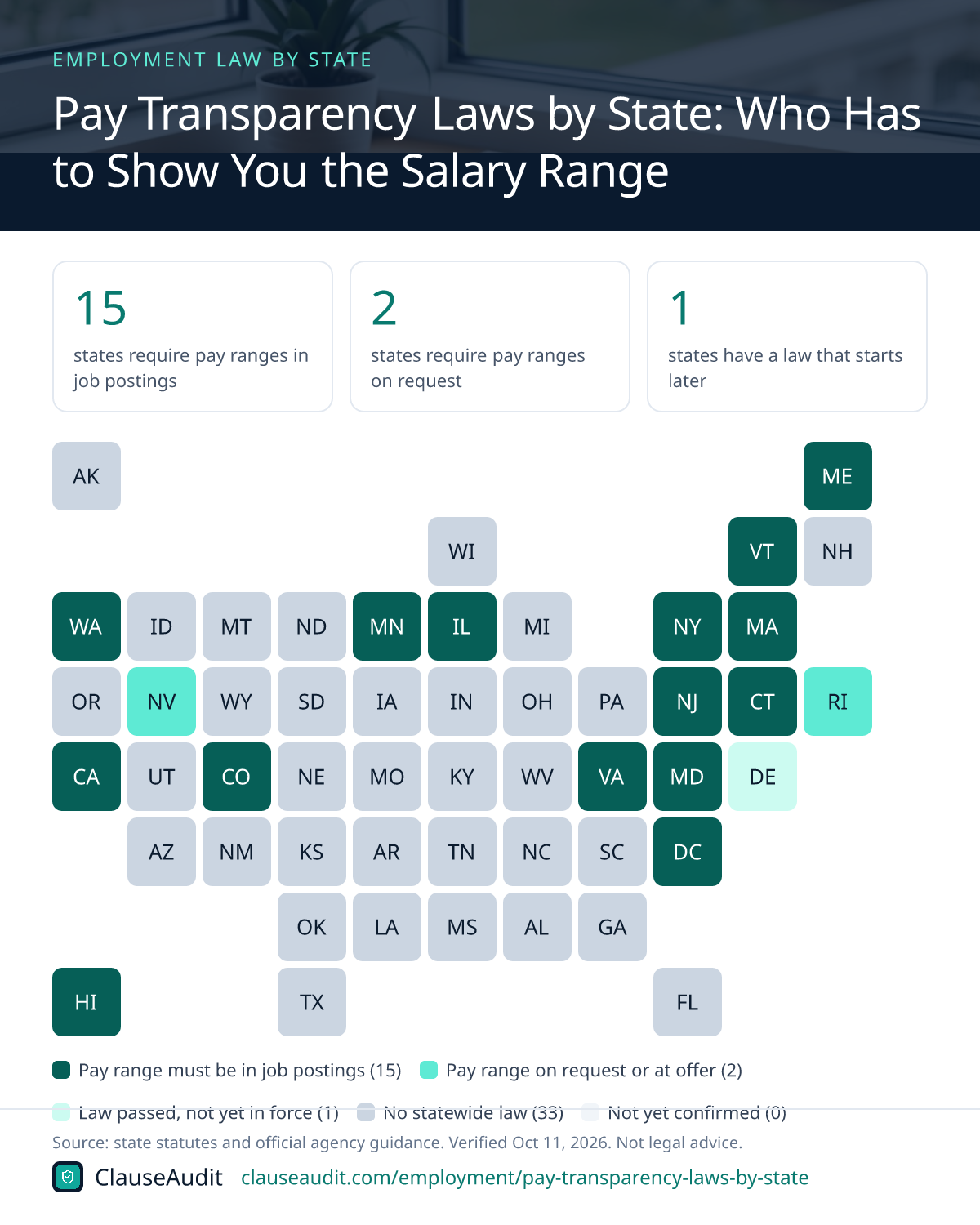
It depends on where the job is. 15 states, counting Washington, DC, require pay or a pay range in job postings, and 2 more make employers share it when you ask. 1 more state has passed a posting law that starts later. The other 33 have no statewide rule, though a few cities and counties add their own.

- states require pay ranges in job postings
- 15
- states require pay ranges on request
- 2
- states have a law that starts later
- 1
- states have no pay transparency law
- 33
A posted salary range is the most useful number you will see before your first interview. It tells you whether the job is worth your time, and it gives you a starting point when the offer letter arrives.
Your right to see that number depends on state law, and sometimes city law. Below you will find how the rules work, which places added them in 2026, how remote roles are treated, and what to do when an employer skips the range.
- Pay range must be in job postings15
- Pay range on request or at offer2
- Law passed, not yet in force1
- No statewide law33
- Not yet confirmed0
Pay transparency laws in every state
| State | Requirement | Employers covered | In force from | Law |
|---|---|---|---|---|
| Alabama | No statewide law | |||
| Alaska | No statewide law | |||
| Arizona | No statewide law | |||
| Arkansas | No statewide law | |||
| California | Include the pay scale in any job posting; give the pay scale to an applicant on reasonable request and to current employees for their own position on request. | 15+ employees | 2023-01-01 | Cal. Lab. Code § 432.3 |
| Colorado | Disclose the hourly or salary compensation or range, plus a general description of benefits, in each posting; notify employees of promotional opportunities. | 1+ employees (at least one in Colorado) | 2021-01-01 | Colo. Rev. Stat. § 8-5-201 |
| Connecticut | Include the wage or wage range and a general description of benefits in every internal or public job advertisement. If no posting was made available, give an applicant the wage range and benefits description on request or before any discussion of compensation or offer, whichever is earliest. Give employees the range and benefits description on hire, on a position change, or on first request. Covers in-state positions and out-of-state positions that report directly to a Connecticut supervisor, office or worksite. | 1+ employees | 2026-10-01 | Conn. Gen. Stat. § 31-40z, as amended by Public Act 26-12 (HB 5003), § 2 |
| Delaware | Disclose a good-faith hourly or salary compensation range and a general description of benefits and other compensation in internal and external job postings. If no posting was made available, give the same information before any offer or discussion of compensation and at any time on request. | 26+ employees | 2027-09-26 | 19 Del. C. § 709C (85 Del. Laws ch. 228, formerly HS 2 for HB 105, 153rd General Assembly) |
| District of Columbia | Include the minimum and maximum projected salary or hourly pay in each job listing and position description, and disclose healthcare benefits before the first interview. | 1+ employees | 2024-06-30 | D.C. Code § 32-1453.01 |
| Florida | No statewide law | |||
| Georgia | No statewide law | |||
| Hawaii | Disclose an hourly rate or salary range that reasonably reflects actual expected compensation in job listings. | 50+ employees | 2024-01-01 | Haw. Rev. Stat. § 378-2.4 |
| Idaho | No statewide law | |||
| Illinois | Include the pay scale and benefits, or a hyperlink to them, in each job posting; announce promotion opportunities to current employees. | 15+ employees | 2025-01-01 | 820 ILCS 112/10(b-25) |
| Indiana | No statewide law | |||
| Iowa | No statewide law | |||
| Kansas | No statewide law | |||
| Kentucky | No statewide law | |||
| Louisiana | No statewide law | |||
| Maine | Include the prospective pay range in each job posting, or state that the job is paid only by commission (employers with 10+ employees). Any employer must give an employee the pay range for their current position on request. Any employer must keep a record of each position an employee holds and their pay history in it for as long as they are employed, plus 3 years after their employment ends. | 10+ employees (posting rule); request and record rules apply to all employers | 2026-07-29 | 26 M.R.S. § 622-A (PL 2025, c. 771; LD 54 / HP 18) |
| Maryland | Disclose the wage range and a general description of benefits and other compensation in each public or internal posting; disclose on request. | 1+ employees | 2024-10-01 | Md. Code, Lab. & Empl. § 3-304.2 |
| Massachusetts | Disclose the pay range in job postings; give it to an employee offered a promotion or transfer and to any employee or applicant on request. | 25+ employees in Massachusetts | 2025-10-29 | Mass. Gen. Laws ch. 149, § 105F |
| Michigan | No statewide law | |||
| Minnesota | Disclose the starting salary range and a general description of benefits and other compensation in each job posting. | 30+ employees in Minnesota | 2025-01-01 | Minn. Stat. § 181.173 |
| Mississippi | No statewide law | |||
| Missouri | No statewide law | |||
| Montana | No statewide law | |||
| Nebraska | No statewide law | |||
| Nevada | Provide the wage or salary range to an applicant who has completed an interview; provide it to an employee who applies for a promotion or transfer on request. | 1+ employees | 2021-10-01 | Nev. Rev. Stat. § 613.133 |
| New Hampshire | No statewide law | |||
| New Jersey | Disclose the hourly wage or salary (or a range of it), a general description of benefits, and other compensation programs in each posting for new jobs and transfer opportunities; make reasonable efforts to tell current employees in affected departments about promotional opportunities. | 10+ employees over 20 calendar weeks (counting employees inside or outside NJ) that do business, employ persons, or take applications in NJ | 2025-06-01 | P.L.2024, c.91 (S2310), N.J.S.A. 34:6B-23 |
| New Mexico | No statewide law | |||
| New York | Disclose the compensation or range of compensation, and the job description if one exists, in any advertisement for a job, promotion, or transfer. | 4+ employees | 2023-09-17 | N.Y. Lab. Law § 194-b |
| North Carolina | No statewide law | |||
| North Dakota | No statewide law | |||
| Ohio | No statewide law | |||
| Oklahoma | No statewide law | |||
| Oregon | No statewide law | |||
| Pennsylvania | No statewide law | |||
| Rhode Island | Provide the wage range to an applicant on request (the statute says employers 'should' provide it before discussing compensation); provide it to an employee at hire, on moving into a new position, and on request during employment. | 1+ employees | 2023-01-01 | R.I. Gen. Laws § 28-6-22 |
| South Carolina | No statewide law | |||
| South Dakota | No statewide law | |||
| Tennessee | No statewide law | |||
| Texas | No statewide law | |||
| Utah | No statewide law | |||
| Vermont | Include the compensation or range of compensation in advertisements for jobs, promotions, or transfers that are physically in Vermont or remote roles predominantly serving a Vermont office. | 5+ employees | 2025-07-01 | Vt. Stat. Ann. tit. 21, § 495o |
| Virginia | Disclose the wage, salary, or a good faith wage or salary range in every public and internal posting for a job, promotion, transfer or other employment opportunity. Do not seek or rely on salary history. | No minimum size stated in the statute | 2026-07-01 | Va. Code § 40.1-28.7:12 (2026 Acts cc. 996, 1063; HB 636 / SB 215) |
| Washington | Disclose the wage scale or salary range and a general description of benefits and other compensation in each job posting. | 15+ employees | 2023-01-01 | Wash. Rev. Code § 49.58.110 |
| West Virginia | No statewide law | |||
| Wisconsin | No statewide law | |||
| Wyoming | No statewide law |
Which states require salary ranges in job postings?
Right now 15 states, counting DC, require pay information in the job posting itself. Colorado's rule, in force since 2021, is the oldest in our table, and it reaches almost every employer with even one worker in the state. Maryland and DC also cover employers of any size.
Most other states set a headcount floor. New York applies at 4 employees. Vermont starts at 5, New Jersey and Maine at 10, California, Illinois and Washington at 15, Massachusetts at 25 workers in the state, Minnesota at 30 in-state workers, and Hawaii at 50.
2026 was a busy year. Virginia's posting rule took effect on July 1, 2026, with no minimum employer size in the statute. Maine's took effect on July 29, 2026. Connecticut, which had only an on-request rule since 2021, began requiring ranges in internal and public job ads on October 1, 2026, for employers of any size.
Delaware has passed a posting law for employers with 26 or more workers, but it does not start until September 26, 2027. Until then, Delaware employers have no posting duty under it.
What counts as a good faith pay range?
Many of these laws do not let an employer post "$40,000 to $400,000" and call it done. The range has to reflect what the employer actually expects to pay.
California's law, as amended by SB 642, defines the pay scale from January 1, 2026 as the good faith range the employer reasonably expects to pay. Hawaii requires a range that reasonably reflects actual expected pay. Minnesota requires a starting salary range that is not open ended, so "$60,000 and up" does not comply there. DC and New York City both ask for a good faith minimum and maximum.
Several states want more than salary. Colorado, Illinois, Maryland, Minnesota, New Jersey, Washington and now Connecticut require a general description of benefits too. Illinois lets employers link to the pay and benefits information instead of printing it. DC goes a step further: employers there must explain healthcare benefits before the first interview.
A fixed number can also be enough. Virginia allows a set wage or salary instead of a range, and New York allows compensation or a range.
Do pay transparency laws apply to remote jobs?
Often, yes, but the hook varies by state. The law usually follows where the work happens or who the role reports to, not where the company is headquartered.
Connecticut's 2026 amendment covers in-state jobs and also out-of-state positions that report directly to a Connecticut supervisor, office or worksite. Vermont covers jobs physically in Vermont and remote roles that mainly serve a Vermont office. New York City's rule reaches jobs performed at least partly in the city. Illinois applies to postings for roles tied to Illinois.
Delaware's future law will cover non-international remote positions offered by Delaware-based employers once it takes effect in 2027.
If you are applying to a fully remote role and the posting has no range, look at where your manager sits and which office the job serves. That detail may decide which state's law applies.
Which places only require pay on request?
2 states use an on-request model instead of a posting rule. Nevada requires employers to give the range to an applicant who has completed an interview, and to employees seeking a promotion or transfer who ask. Rhode Island requires employers to share the wage range when an applicant asks, and says they should provide it before discussing pay.
Some posting states also give current employees rights. California employees can ask for the pay scale for their own position. Maine lets any employee ask for the range for their current job. Massachusetts requires the range for an employee offered a promotion or transfer.
Local rules matter too. Our table tracks 8 city and county laws. New York City requires a good faith minimum and maximum in ads from employers with 4 or more workers, on top of the state rule. Toledo, Ohio requires employers with 15 or more workers to give the pay scale to an applicant with a conditional offer who asks. Ithaca and Westchester County in New York also require ranges in postings from employers with 4 or more workers. A few other city ordinances appear in our table marked unconfirmed, so check the local code before you rely on them.
What can you do if an employer leaves out the pay range?
Start by asking. Many missing ranges are oversights, and several states give employers a chance to fix them before any penalty applies.
Washington lets an employer correct a noncompliant posting within five business days of notice before liability attaches, for postings through July 27, 2027. Virginia gives employers a 15 business day cure period for posting and good faith range violations. After that, Virginia allows private suits within one year, and its Attorney General can seek penalties of up to $1,000 for a first violation and $5,000 for later ones. Connecticut's 2026 amendment extended the time to bring a claim to two years and removed punitive damages.
- Screenshot the posting with the date, job title and location visible.
- Check which state or city law applies, using where the job is performed or who it reports to.
- Ask the recruiter in writing for the pay range for the role.
- If the employer refuses or ignores you, contact your state labor department about a complaint.
- Talk to an employment lawyer if you lost a job opportunity over it or a pattern of violations exists.
How to use a posted salary range in negotiation
A range is an anchor, and it cuts both ways. The employer has told you, in writing, what it expects to pay. Use that.
Say a Colorado posting lists $85,000 to $105,000 plus a benefits summary. If you meet every listed requirement and bring something extra, asking for $100,000 or more is reasonable. If the offer comes in at $85,000, you can point to the posted range and explain why your experience puts you higher in it.
- Save the posting before you apply. Ranges sometimes change.
- Compare the range with your current pay and with ranges for similar roles in the same state.
- Place yourself in the range based on the stated requirements, not on what you hope for.
- Ask for the benefits description if the state requires one and the posting skipped it.
- When the offer arrives, check that the base salary, bonus and benefits match what was posted.
- Read the offer letter for clauses that let the employer change pay later.
Is there a federal pay transparency law?
No federal law requires employers to post salary ranges. That is why the rules differ so much from one state to the next.
Two federal laws still matter. The Equal Pay Act of 1963 bars employers from paying men and women differently for substantially equal work. The National Labor Relations Act protects most private sector employees who talk with coworkers about their pay, so a policy forbidding those conversations may itself be a problem.
Some states pair their range rules with salary history limits. Virginia's new law, for example, also bars employers from seeking or relying on your past pay. If an interviewer asks what you earn now, a posted range gives you a better answer: the number the employer already said it would pay.
Frequently asked questions
Do employers have to post salary ranges in every state?
No. 15 states, counting DC, require pay information in job postings, and 2 more require employers to share it on request. 1 more state has a posting law that has not started yet. In the remaining 33 states there is no statewide rule, so an employer can leave the range out unless a city ordinance applies.
Which states added pay transparency laws in 2026?
Virginia's posting law took effect July 1, 2026, and covers public and internal postings with no minimum employer size in the statute. Maine's took effect July 29, 2026, for employers with 10 or more workers. Connecticut moved from an on-request rule to a posting rule on October 1, 2026, covering employers of any size.
Can I ask for the salary range before an interview?
Yes, you can always ask. In some places the employer must answer. Rhode Island requires employers to share the wage range when an applicant asks. Connecticut requires it on request, or before any pay discussion or offer, when no posting was made. Nevada's duty starts once you have completed an interview.
Does a pay transparency law cover a remote job?
Often it does. Connecticut covers out-of-state roles that report to a Connecticut supervisor, office or worksite. Vermont covers remote roles that mainly serve a Vermont office. New York City covers jobs performed at least partly in the city. Check where your manager sits and which office the role supports.
What is a good faith salary range?
It is the range the employer honestly expects to pay for the role when it posts the job. California defines its pay scale this way from 2026, and Hawaii requires a range that reasonably reflects expected pay. Minnesota bars open-ended ranges, so a posting that only says "$60,000 and up" does not meet its rule.
What happens if an employer does not post the pay range?
It depends on the state. Virginia's Attorney General can seek up to $1,000 for a first violation and $5,000 for later ones, and workers can sue within one year after a 15 business day cure period. Washington gives employers five business days to fix a posting after notice. Start by asking the employer in writing.
Do pay ranges have to include benefits?
In several states, yes. Colorado, Illinois, Maryland, Minnesota, New Jersey, Washington and Connecticut require a general description of benefits along with pay. Illinois allows a link to that information. In DC, employers must explain healthcare benefits before the first interview. Other states require only the pay figure or range.
Is there a federal law requiring salary ranges in job ads?
No. Pay range rules come from states and some cities. Federal law still protects you in related ways: the Equal Pay Act of 1963 bars sex-based pay gaps for substantially equal work, and the National Labor Relations Act protects most private sector workers who discuss pay with coworkers.
Do small businesses have to post salary ranges?
Sometimes. Colorado, Maryland, DC and Connecticut cover employers of nearly any size, and Virginia's statute names no minimum. Other states set thresholds: 4 employees in New York, 5 in Vermont, 10 in New Jersey and Maine, 15 in California, Illinois and Washington, and 50 in Hawaii.
Got an offer letter? Check it before you sign.
Upload your offer or employment contract and see which pay, bonus and termination terms deserve a second look, explained in plain English.
Review my employment contractUse this infographic
Free to share on your site, blog or slides under CC BY 4.0. Please keep the credit link.
How we built this data
We built this dataset from the law in each state, then had a second, independent review re-check every entry against primary sources and correct anything that did not match. Each row links to its source.
Of the 51 entries, 20 were confirmed directly against the statute itself or the state agency that enforces it. 31 rest on several secondary sources that agree, usually because the official site could not be reached or because there is no statute to read where the answer is that no law exists. Data verified on October 11, 2026.
Sources
- California: California Legislative Information
- Colorado: Colorado General Assembly, SB19-085 (Equal Pay for Equal Work Act)
- Connecticut: Connecticut General Assembly, Public Act 26-12
- Delaware: Delaware General Assembly, Laws of Delaware Vol. 85, Ch. 228
- District of Columbia: Council of the District of Columbia, D.C. Code
- Hawaii: Hawaii State Legislature
- Illinois: Illinois General Assembly
- Maine: Maine Revisor of Statutes
- Maryland: Maryland General Assembly
- Massachusetts: Massachusetts General Court
- Minnesota: Minnesota Office of the Revisor of Statutes
- Nevada: Nevada Legislature
- New Jersey: New Jersey Legislature
- New York: New York State Senate
- Rhode Island: Rhode Island General Assembly
- Vermont: Vermont General Assembly
- Virginia: Code of Virginia (Virginia Legislative Information System)
- Washington: Washington State Legislature
- West Virginia: West Virginia Legislature, bill history for HB 5116 (2026 Regular Session)
- Wyoming: Wyoming Legislature, 2026 bill list
Cite this data
ClauseAudit, “Pay Transparency Laws by State: Who Has to Show You the Salary Range”, updated October 11, 2026, https://clauseaudit.com/employment/pay-transparency-laws-by-state. Free to reuse with a link back (CC BY 4.0).
This page summarises the law as verified on October 11, 2026. Laws change, cities and counties can add their own rules, and the details of your situation matter. It is general information, not legal advice.