Unpaid Wage Claim Deadlines by State: How Long You Have to Recover Owed Pay
By ClauseAudit Research · 20 sources ·
What is the time limit to claim unpaid wages?
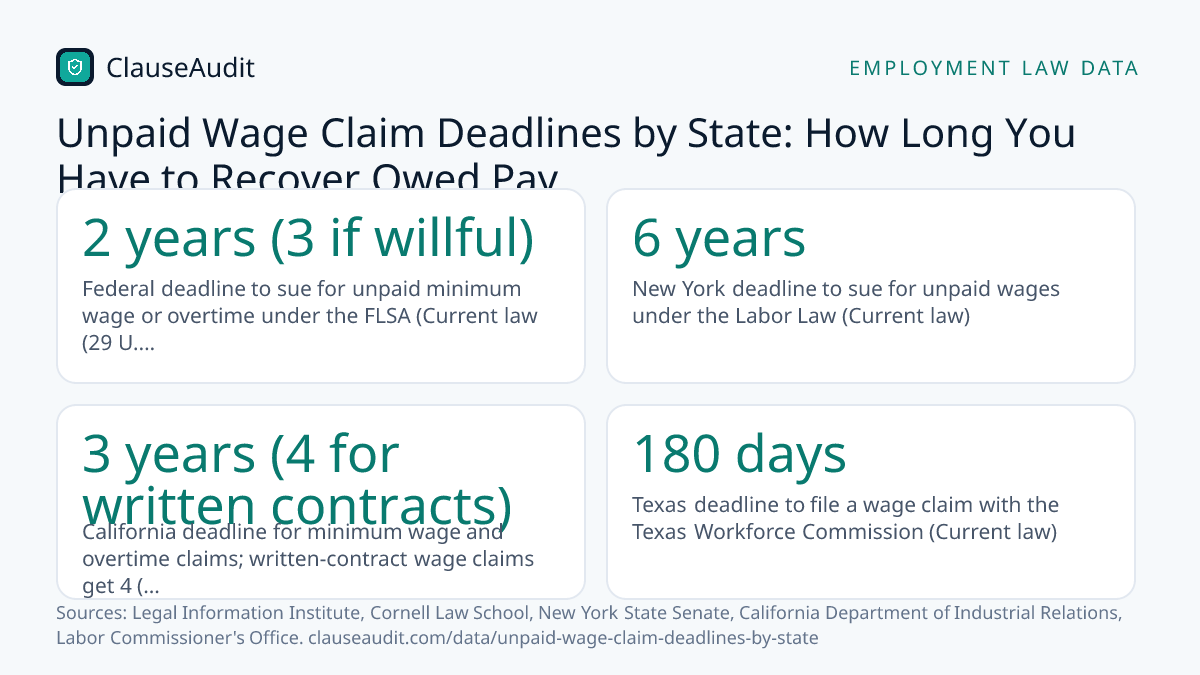
Usually 2 to 3 years, but it depends on your state and where you file. Federal FLSA claims for minimum wage or overtime must be filed within 2 years (3 if willful). New York allows 6 years and California 3 years (4 for written contracts), while a Texas Workforce Commission claim must be filed within 180 days.

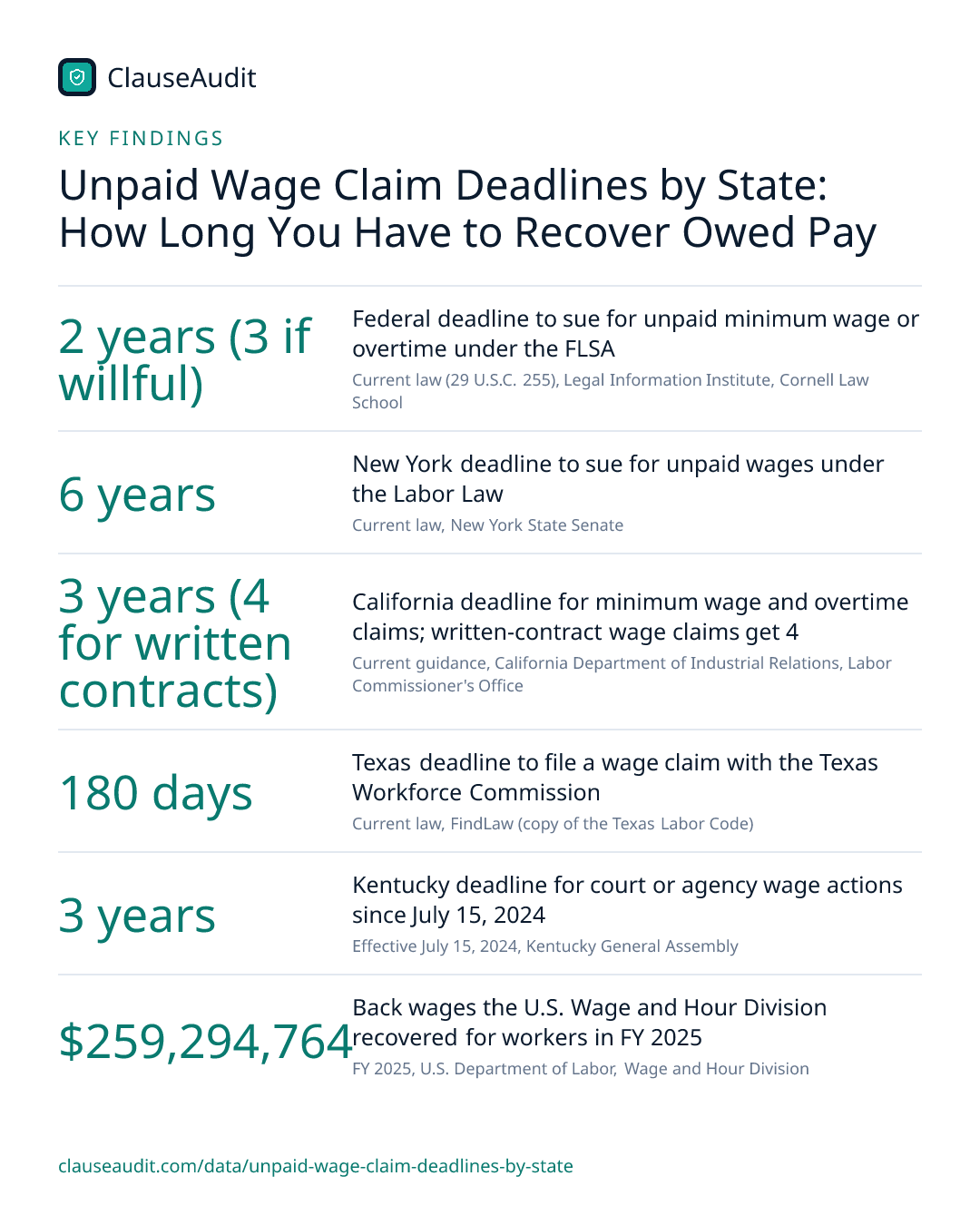
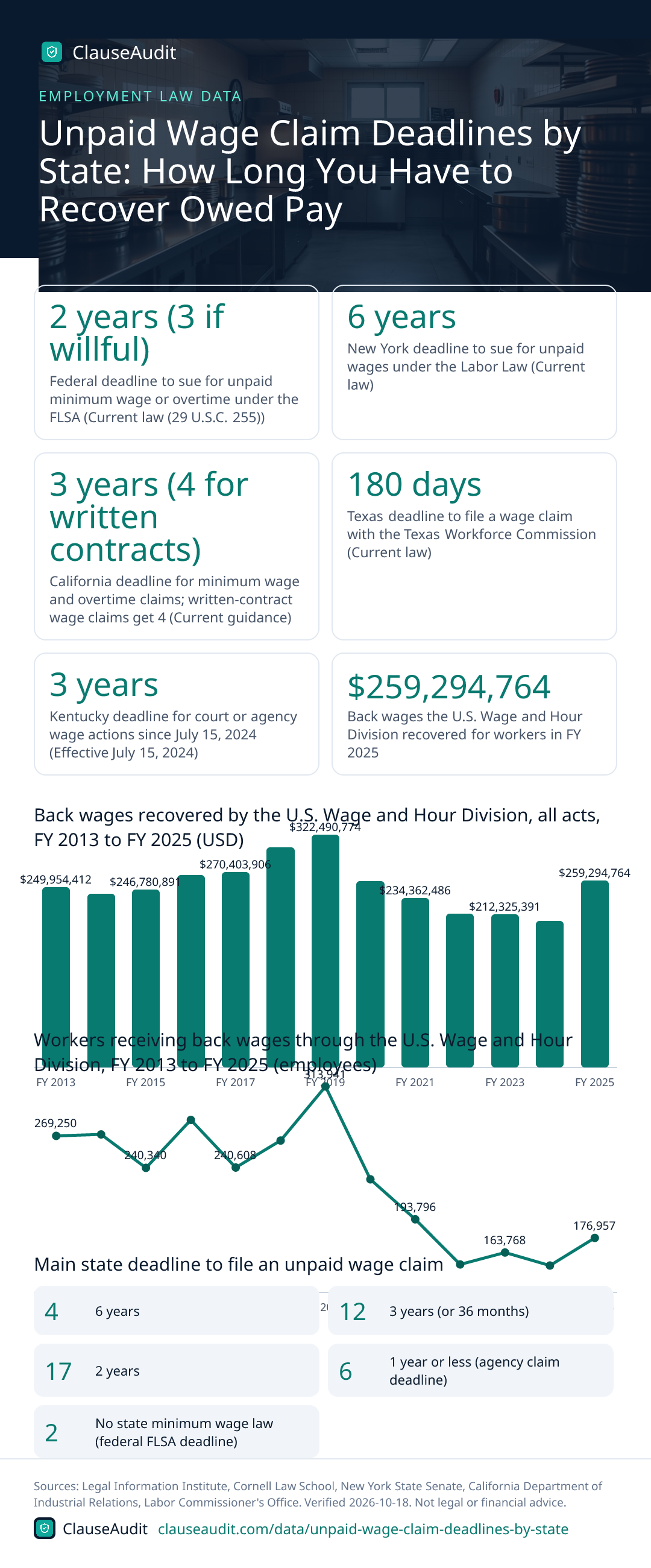
- Federal deadline to sue for unpaid minimum wage or overtime under the FLSA (Current law (29 U.S.C. 255), Legal Information Institute, Cornell Law School)
- 2 years (3 if willful)
- New York deadline to sue for unpaid wages under the Labor Law (Current law, New York State Senate)
- 6 years
- California deadline for minimum wage and overtime claims; written-contract wage claims get 4 (Current guidance, California Department of Industrial Relations, Labor Commissioner's Office)
- 3 years (4 for written contracts)
- Texas deadline to file a wage claim with the Texas Workforce Commission (Current law, FindLaw (copy of the Texas Labor Code))
- 180 days
- Kentucky deadline for court or agency wage actions since July 15, 2024 (Effective July 15, 2024, Kentucky General Assembly)
- 3 years
- Back wages the U.S. Wage and Hour Division recovered for workers in FY 2025 (FY 2025, U.S. Department of Labor, Wage and Hour Division)
- $259,294,764
- Workers who received back wages through the Wage and Hour Division in FY 2025 (FY 2025, U.S. Department of Labor, Wage and Hour Division)
- 176,957
If your employer shorted a paycheck, skipped your overtime or never sent your last check, the law gives you a window to get that money back. The window is not the same everywhere. A Texas worker filing with the state agency has 180 days. A New York worker who sues has 6 years.
Most people also have two clocks running at once: one for filing with a state labor agency and a longer one for going to court. This page shows both for every state we could confirm, and explains which deadline to watch first and what to do before it runs out.
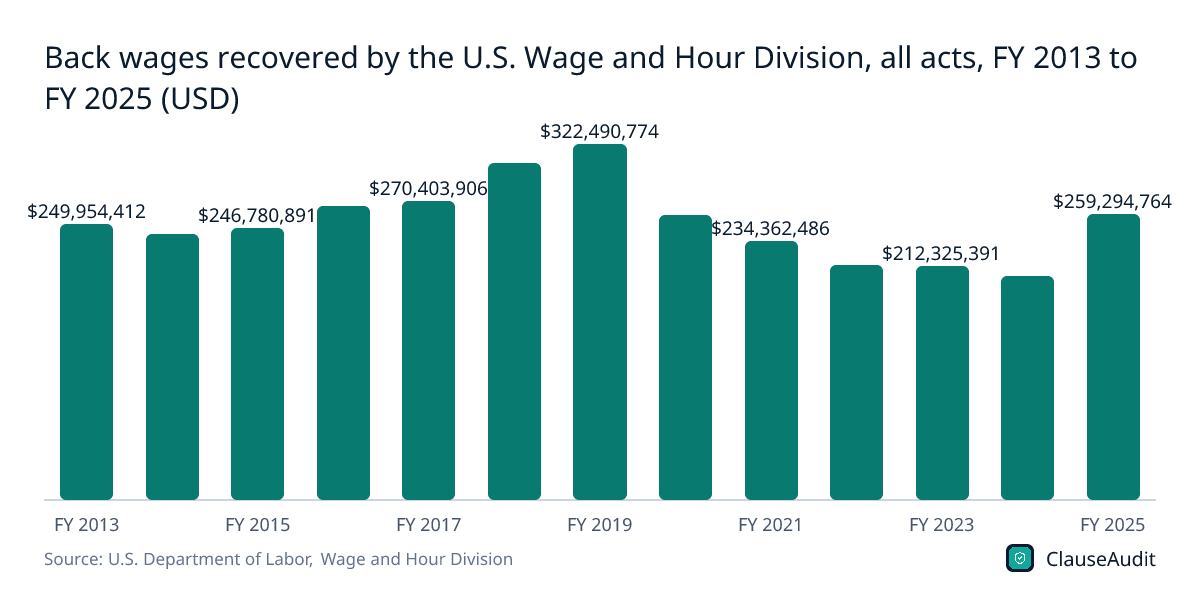
Back wages recovered by the U.S. Wage and Hour Division, all acts, FY 2013 to FY 2025 (USD)
Chart data
| Label | Value (USD) |
|---|---|
| FY 2013 | $249,954,412 |
| FY 2014 | $240,831,606 |
| FY 2015 | $246,780,891 |
| FY 2016 | $266,566,178 |
| FY 2017 | $270,403,906 |
| FY 2018 | $304,914,114 |
| FY 2019 | $322,490,774 |
| FY 2020 | $257,829,604 |
| FY 2021 | $234,362,486 |
| FY 2022 | $213,161,638 |
| FY 2023 | $212,325,391 |
| FY 2024 | $202,676,115 |
| FY 2025 | $259,294,764 |
Federal recoveries peaked at $322,490,774 in FY 2019, slid for several years, then rebounded to $259,294,764 in FY 2025. Even at the peak, that money reached only the workers whose cases the agency took on.
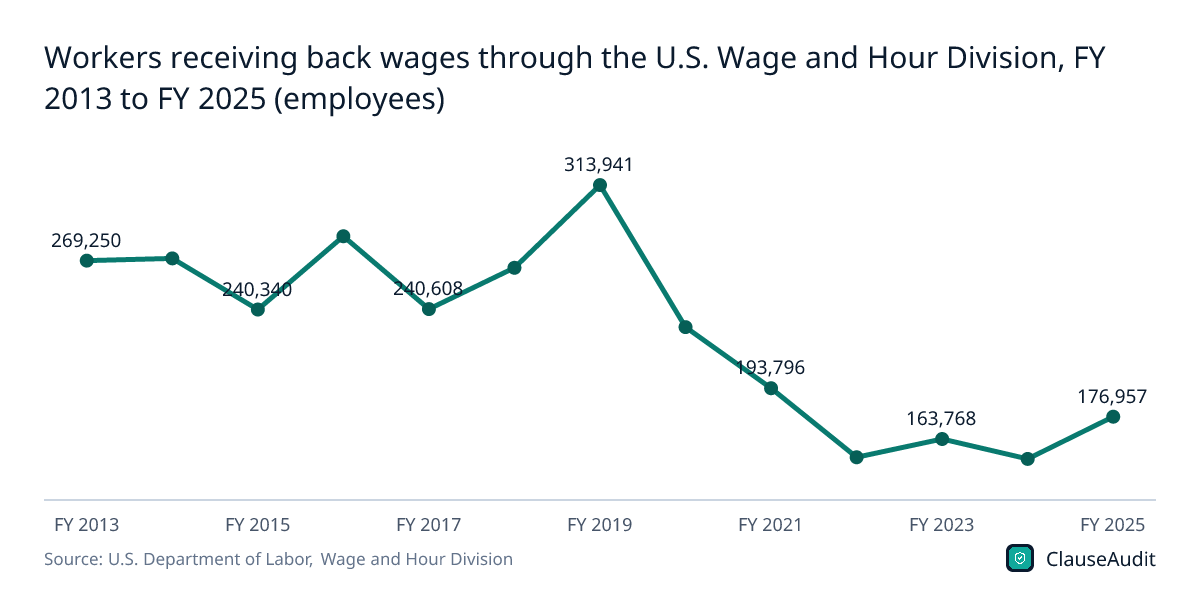
Download this chart (PNG)Workers receiving back wages through the U.S. Wage and Hour Division, FY 2013 to FY 2025 (employees)
Chart data
| Label | Value (employees) |
|---|---|
| FY 2013 | 269,250 |
| FY 2014 | 270,570 |
| FY 2015 | 240,340 |
| FY 2016 | 283,677 |
| FY 2017 | 240,608 |
| FY 2018 | 265,027 |
| FY 2019 | 313,941 |
| FY 2020 | 229,934 |
| FY 2021 | 193,796 |
| FY 2022 | 152,970 |
| FY 2023 | 163,768 |
| FY 2024 | 151,989 |
| FY 2025 | 176,957 |
The number of workers paid back fell from 313,941 in FY 2019 to 151,989 in FY 2024 before ticking up to 176,957 in FY 2025. Fewer federal cases means more workers have to chase owed pay on their own, inside their state's deadline.
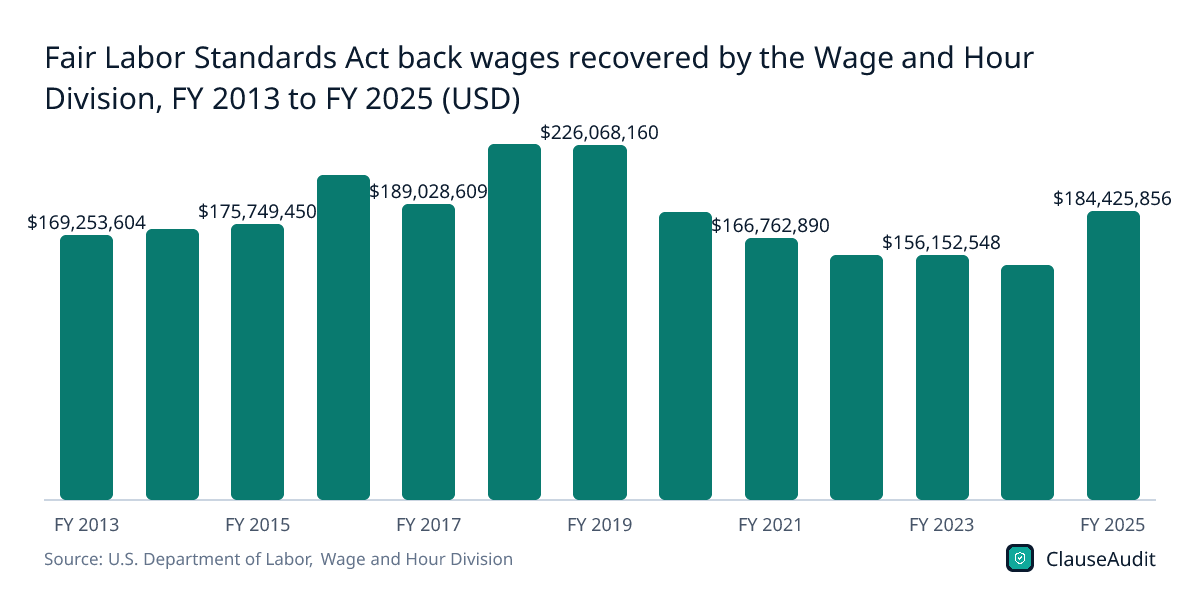
Download this chart (PNG)Fair Labor Standards Act back wages recovered by the Wage and Hour Division, FY 2013 to FY 2025 (USD)
Chart data
| Label | Value (USD) |
|---|---|
| FY 2013 | $169,253,604 |
| FY 2014 | $173,070,846 |
| FY 2015 | $175,749,450 |
| FY 2016 | $207,019,504 |
| FY 2017 | $189,028,609 |
| FY 2018 | $226,998,396 |
| FY 2019 | $226,068,160 |
| FY 2020 | $183,582,973 |
| FY 2021 | $166,762,890 |
| FY 2022 | $156,052,923 |
| FY 2023 | $156,152,548 |
| FY 2024 | $149,957,029 |
| FY 2025 | $184,425,856 |
Minimum wage and overtime cases under the FLSA make up most of the federal total, with $184,425,856 recovered in FY 2025. These are the claims the 2 year (3 if willful) federal deadline applies to.
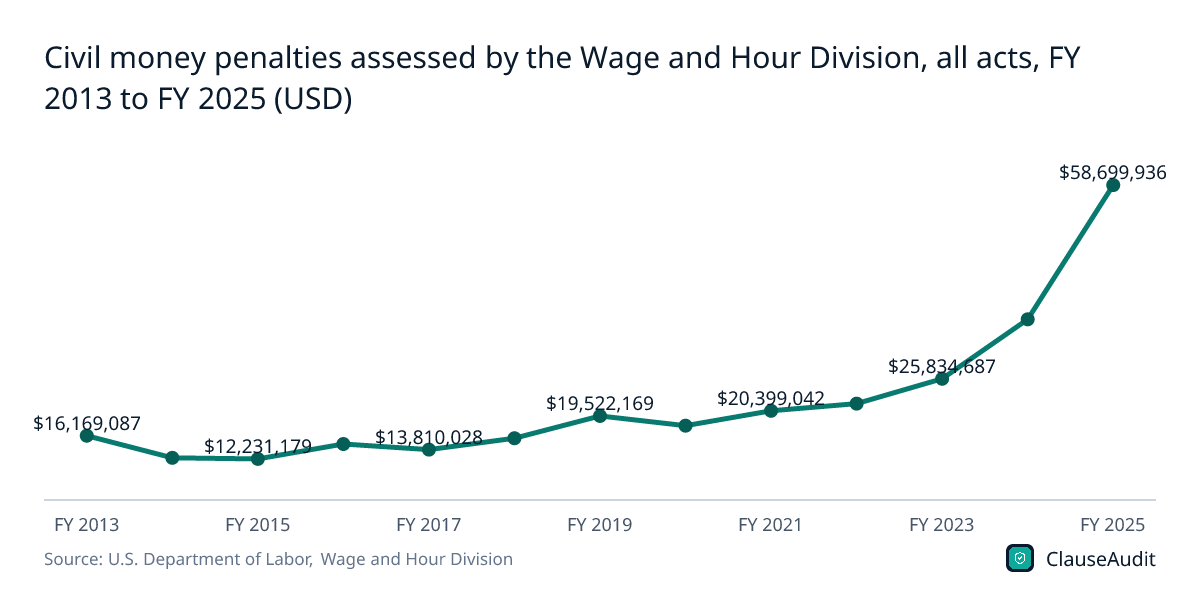
Download this chart (PNG)Civil money penalties assessed by the Wage and Hour Division, all acts, FY 2013 to FY 2025 (USD)
Chart data
| Label | Value (USD) |
|---|---|
| FY 2013 | $16,169,087 |
| FY 2014 | $12,416,855 |
| FY 2015 | $12,231,179 |
| FY 2016 | $14,761,891 |
| FY 2017 | $13,810,028 |
| FY 2018 | $15,741,194 |
| FY 2019 | $19,522,169 |
| FY 2020 | $17,871,969 |
| FY 2021 | $20,399,042 |
| FY 2022 | $21,613,896 |
| FY 2023 | $25,834,687 |
| FY 2024 | $35,920,310 |
| FY 2025 | $58,699,936 |
Civil money penalties climbed from $16,169,087 in FY 2013 to $58,699,936 in FY 2025. Penalties go to the government, not to you, so they never replace filing your own claim on time.
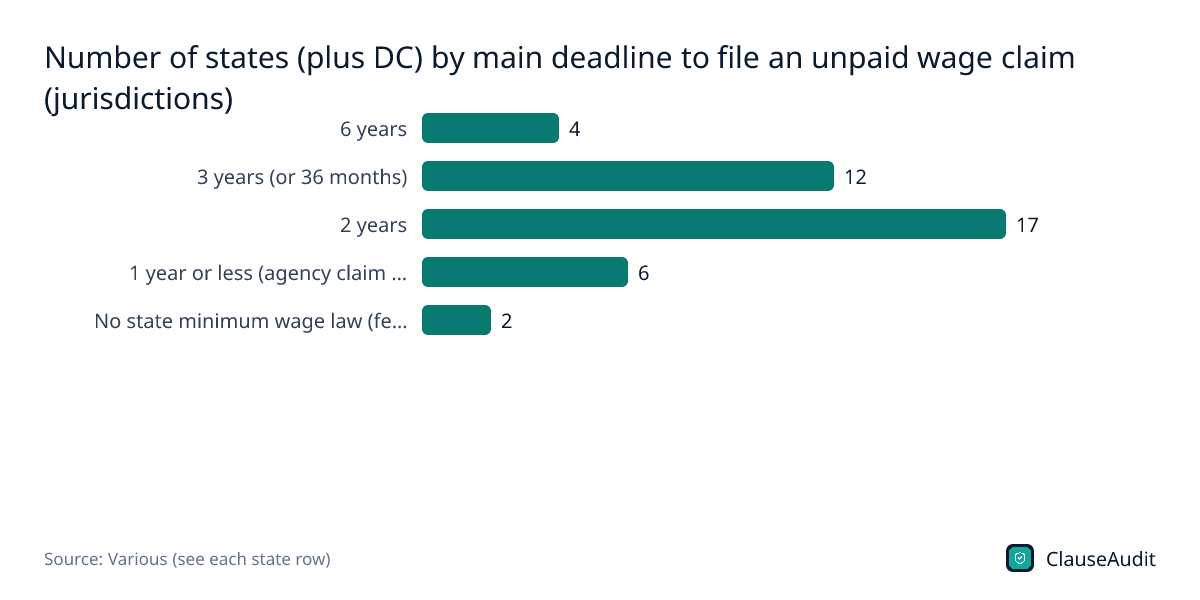
Download this chart (PNG)Number of states (plus DC) by main deadline to file an unpaid wage claim (jurisdictions)
Chart data
| Label | Value |
|---|---|
| 6 years | 4 |
| 3 years (or 36 months) | 12 |
| 2 years | 17 |
| 1 year or less (agency claim deadline) | 6 |
| No state minimum wage law (federal FLSA deadline) | 2 |
State labor agency wage claim deadlines and dollar limits (selected states)
| State | Agency claim deadline | Dollar limit | Law |
|---|---|---|---|
| Texas | 180 days after wages became due | - | Tex. Lab. Code 61.051(c) |
| Montana | 180 days after default or delay in payment | - | MCA 39-3-207 |
| Arizona | 1 year from accrual | Up to $12,000 | A.R.S. 23-356(A) |
| Utah | 1 year after the day wages were earned | - | Utah Code 34-28-9(1)(e) |
| Iowa | 1 year after wages became due and payable | - | Iowa Code 91A.10(1) |
| Illinois | 1 year after wages were due | - | 820 ILCS 115/11 |
| Michigan | 12 months after the violation | - | MCL 408.481(1) |
| Maryland | 2 years after wages became due | - | Md. Dept. of Labor claim form |
| North Dakota | 2 years after wages are due | $125 to $15,000 | N.D.C.C. 34-14-09(1) |
| New Hampshire | 36 months after wages were due | - | RSA 275:51, V |
| Washington | 3 years before the complaint (investigation lookback) | - | RCW 49.48.083 |
Source: FindLaw (copy of the Texas Labor Code), Texas Labor Code 61.051, Filing Wage Claim; Montana Legislature, MCA 39-3-207, Period within which employee may recover wages and penalties; Arizona State Legislature, A.R.S. 23-356, Wage claims; FindLaw (copy of the Utah Code), Utah Code 34-28-9; Iowa Legislature, Iowa Code sections 614.1 and 91A.10; Illinois Legal Aid Online, How far back can I collect my unpaid wages?; FindLaw (copy of the Michigan Compiled Laws), MCL 408.481; Maryland Department of Labor, Employment Standards Service Wage Claim Form; North Dakota Legislative Branch, North Dakota Century Code chapter 34-14; NH Liberty Alliance bill tracker (bill text), HB 1168 (2026), relative to wage claims, RSA 275:51, V; Washington State Legislature, RCW 49.48.083. Download as image
Main state deadline to file an unpaid wage claim by state
- 46 years
- 123 years (or 36 months)
- 172 years
- 61 year or less (agency claim deadline)
- 2No state minimum wage law (federal FLSA deadline)
- 6 years4
- 3 years (or 36 months)12
- 2 years17
- 1 year or less (agency claim deadline)6
- No state minimum wage law (federal FLSA deadline)2
- Not yet confirmed10
| State | Court deadline | Labor agency claim deadline | Law | Source |
|---|---|---|---|---|
| Alabama | No state minimum wage law; federal FLSA claims: 2 years (3 if willful) | - | - | U.S. Department of Labor, Wage and Hour Division, State Minimum Wage Laws (updated July 1, 2026) |
| Alaska | 2 years (minimum wage, overtime, liquidated damages) | - | AS 23.10.130 | AS 23.10.130 |
| Arizona | Not confirmed | 1 year from accrual (Department claims up to $12,000) | A.R.S. 23-356(A) | A.R.S. 23-356(A) |
| Arkansas | 2 years | - | Ark. Code 11-4-218(g) | Ark. Code 11-4-218(g) |
| California | 3 years (minimum wage, overtime, meal and rest breaks, sick leave, deductions, reimbursements); 4 years (written contract); 2 years (oral promise above minimum wage) | Same periods apply to Labor Commissioner wage claims | Cal. Labor Commissioner guidance | Cal. Labor Commissioner guidance |
| Colorado | 2 years (3 years if willful) | - | C.R.S. 8-4-122 | C.R.S. 8-4-122 |
| Connecticut | 2 years | Filing a complaint with the Labor Commissioner pauses the 2-year clock | Conn. Gen. Stat. 52-596 | Conn. Gen. Stat. 52-596 |
| Delaware | 2 years (wages, salary, overtime, and related damages and penalties) | - | 10 Del. C. 8111 | 10 Del. C. 8111 |
| District of Columbia | 3 years (from last occurrence if the violation is continuous) | Filing an administrative complaint pauses the 3-year clock | D.C. Code 32-1308(c) | D.C. Code 32-1308(c) |
| Florida | 2 years (wages and overtime); 4 years for state minimum wage claims under s. 448.110 (5 years if willful) | 15-day written notice to the employer required before a minimum wage suit; the clock is paused during those 15 days | Fla. Stat. 95.11(5)(d), 95.11(3)(p), 95.11(2)(d), 448.110 | Fla. Stat. 95.11(5)(d), 95.11(3)(p), 95.11(2)(d), 448.110 |
| Georgia | 2 years (wages, overtime, and related damages and penalties) | - | O.C.G.A. 9-3-22 | O.C.G.A. 9-3-22 |
| Hawaii | 6 years (general limitation period for contract debts and personal actions) | - | HRS 657-1 | HRS 657-1 |
| Idaho | 2 years (12 months for claims for additional pay for a period already paid) | Same deadline applies to claims filed with the Idaho Department of Labor | Idaho Code 45-614 | Idaho Code 45-614 |
| Illinois | Not confirmed | 1 year after the wages or final compensation were due (Illinois Department of Labor claim) | 820 ILCS 115/11 | 820 ILCS 115/11 |
| Indiana | 2 years (employment actions, including wages, except those based on a written contract) | - | Ind. Code 34-11-2-1 | Ind. Code 34-11-2-1 |
| Iowa | 2 years | 1 year from the date wages became due and payable (Iowa Labor Commissioner complaint) | Iowa Code 614.1(8); 91A.10(1) | Iowa Code 614.1(8); 91A.10(1) |
| Kansas | Not yet confirmed: check the source | K.S.A. 60-512 (FindLaw copy) | ||
| Kentucky | 3 years (court or administrative action under KRS Chapter 337) | Same 3-year deadline | KRS 337.385(5) | KRS 337.385(5) |
| Louisiana | Not yet confirmed: check the source | U.S. Department of Labor, Wage and Hour Division, State Minimum Wage Laws (updated July 1, 2026) | ||
| Maine | 6 years (general limitation period for civil actions) | - | 14 M.R.S. 752 | 14 M.R.S. 752 |
| Maryland | 3 years (Wage & Hour Law and Wage Payment & Collection Law) | 2 years from the date wages became due (Employment Standards Service claim) | Md. Dept. of Labor wage claim form | Md. Dept. of Labor wage claim form |
| Massachusetts | 3 years after the violation | Filing a complaint with the Attorney General pauses the clock | M.G.L. c. 149, 150 | M.G.L. c. 149, 150 |
| Michigan | Not confirmed | 12 months after the alleged violation (30 days for complaints under section 13(2)) | MCL 408.481(1) | MCL 408.481(1) |
| Minnesota | 2 years (3 years if willful) | - | Minn. Stat. 541.07(5) | Minn. Stat. 541.07(5) |
| Mississippi | No state minimum wage law; federal FLSA claims: 2 years (3 if willful) | - | - | U.S. Department of Labor, Wage and Hour Division, State Minimum Wage Laws (updated July 1, 2026) |
| Missouri | 3 years | - | RSMo 290.527 | RSMo 290.527 |
| Montana | Not confirmed | Complaint within 180 days of default or delay in payment; recovers up to 2 years of wages (3 years for repeated violations) | MCA 39-3-207 | MCA 39-3-207 |
| Nebraska | Not yet confirmed: check the source | Workplace Fairness, Filing a Wage and Hour Claim - Nebraska | ||
| Nevada | 2 years (minimum wage civil action) | Not confirmed | NRS 608.260 | NRS 608.260 |
| New Hampshire | Not confirmed | 36 months from the date the wages were due (Department of Labor wage claim) | RSA 275:51, V | RSA 275:51, V |
| New Jersey | 6 years (unpaid wages, overtime, retaliation) | Same 6 years; a claim is commenced when filed with the Department and served on the employer | N.J.S.A. 34:11-56a25.1 | N.J.S.A. 34:11-56a25.1 |
| New Mexico | Not yet confirmed: check the source | Workplace Fairness, Filing a Wage and Hour Claim - New Mexico | ||
| New York | 6 years | - | N.Y. Labor Law 198(3) | N.Y. Labor Law 198(3) |
| North Carolina | 2 years | - | N.C.G.S. 95-25.22(f) | N.C.G.S. 95-25.22(f) |
| North Dakota | Not confirmed | 2 years from the date wages are due (claims of $125 to $15,000) | N.D.C.C. 34-14-09(1) | N.D.C.C. 34-14-09(1) |
| Ohio | 2 years (minimum wage and overtime under R.C. 2305.11); 3 years for constitutional minimum wage claims | - | R.C. 2305.11; Ohio Const. art. II, 34a | R.C. 2305.11; Ohio Const. art. II, 34a |
| Oklahoma | Not yet confirmed: check the source | Workplace Fairness, Filing a Wage and Hour Claim - Oklahoma | ||
| Oregon | 2 years for overtime, premium pay and related penalties; other unpaid wage claims not confirmed | - | ORS 12.110(3) | ORS 12.110(3) |
| Pennsylvania | 3 years after the wages were due and payable | Same 3-year limit for administrative proceedings | 43 P.S. 260.9a(g) | 43 P.S. 260.9a(g) |
| Rhode Island | 3 years | - | R.I. Gen. Laws 28-14-19.2(g) | R.I. Gen. Laws 28-14-19.2(g) |
| South Carolina | 3 years after the wages become due | - | S.C. Code 41-10-80(C) | S.C. Code 41-10-80(C) |
| South Dakota | Not yet confirmed: check the source | SDCL 60-11-7, South Dakota Legislature | ||
| Tennessee | Not yet confirmed: check the source | U.S. Department of Labor, Wage and Hour Division, State Minimum Wage Laws (updated July 1, 2026) | ||
| Texas | Not confirmed | 180 days after the wages became due (Texas Workforce Commission wage claim; jurisdictional) | Tex. Lab. Code 61.051(c) | Tex. Lab. Code 61.051(c) |
| Utah | Not confirmed | 1 year after the day the wages were earned (Utah Labor Commission wage claim) | Utah Code 34-28-9(1)(e) | Utah Code 34-28-9(1)(e) |
| Vermont | Not yet confirmed: check the source | U.S. Department of Labor, Wage and Hour Division, State Minimum Wage Laws (updated July 1, 2026) | ||
| Virginia | 3 years | Filing an administrative complaint pauses the clock | Va. Code 40.1-29(M) | Va. Code 40.1-29(M) |
| Washington | Not confirmed | 3 years: L&I may not investigate violations older than 3 years before the complaint | RCW 49.48.083 | RCW 49.48.083 |
| West Virginia | Not yet confirmed: check the source | W. Va. Code 21-5-12 (FindLaw copy) | ||
| Wisconsin | 2 years | Suits on wage claims filed with the Department of Workforce Development: 2 years after the claim is filed | Wis. Stat. 893.44 | Wis. Stat. 893.44 |
| Wyoming | Not yet confirmed: check the source | U.S. Department of Labor, Wage and Hour Division, State Minimum Wage Laws (updated July 1, 2026) |
How long do you have to file an unpaid wage claim?
Start with the federal floor. Under the Fair Labor Standards Act, you have 2 years to sue for unpaid minimum wage or overtime, or 3 if the employer broke the law on purpose. That applies in every state, including Alabama and Mississippi, which have no state minimum wage law at all.
State law often gives you more time, and it can cover pay the FLSA does not, such as a promised bonus, commission, or a final paycheck that never arrived. You can usually use whichever law gives you the better deal.
One detail trips people up. In most places the clock does not start when you quit. It starts on each payday that came up short. If you were underpaid for years and only act now, the oldest paychecks may already be out of reach while the recent ones are still claimable. Every month you wait, another paycheck can fall off the back end.
A quick example. Say your manager has been clocking you out before closing cleanup for years. Under the FLSA you can recover the last 2 years of that unpaid time, or 3 if you can show the employer knew it was wrong. In New York, a state claim could reach back 6 years. Same work, very different check, based on where you file.
Which states give you the most time to recover unpaid wages?
New York and New Jersey lead with 6 years. Hawaii and Maine also reach 6 years, though through their general limitation periods rather than a wage statute. California gives 3 years for minimum wage, overtime and break claims, 4 years when the pay was promised in a written contract, and 2 years for an oral promise above minimum wage. Kentucky moved to a 3 year deadline for court and agency actions effective July 15, 2024.
The short end is mostly about agency claims. Texas requires a Texas Workforce Commission claim within 180 days after the wages became due, and that deadline is jurisdictional, so a late claim gets dismissed. Montana also uses 180 days for a complaint, though it can recover up to 2 years of wages (3 years for repeated violations). Arizona, Utah, Iowa and Illinois give 1 year for agency claims, and Michigan gives 12 months.
Ten states show as not yet confirmed on the map. If you work in one of them, plan around the federal deadline of 2 years (3 if willful) and get local advice quickly. State law there may allow more time, but do not count on it.
Should you file with the state labor agency or go to court?
An agency claim is free, you do not need a lawyer, and the agency does the investigating. The tradeoff is time and size. Agency windows are often shorter than court deadlines, and some cap the amount. Arizona's Department handles claims up to $12,000. North Dakota takes claims of $125 to $15,000. Maryland gives 2 years for an agency claim but 3 years in court.
In several places, filing with the agency pauses the court clock. Connecticut, Massachusetts, Virginia, Washington and the District of Columbia all work this way, which means a quick agency filing can protect your right to sue later.
Court is slower and may need a lawyer, but it usually allows a longer look back and can bring extra damages on top of the wages. Many wage lawyers take strong cases without an upfront fee, so a free consultation costs you nothing but an hour.
What should you do right now if your employer owes you pay?
- Write down every payday that came up short and what you think you were owed. Each one has its own deadline.
- Save pay stubs, schedules, timesheets, texts and emails about hours or pay. Screenshot anything on a work app before you lose access.
- Find your shortest deadline first. That is usually the state agency claim, and in Texas or Montana it can be 180 days.
- Ask for the money in writing. Keep it short and factual: dates, amounts, and a date you expect payment.
- Do not let promises run out your clock. An employer saying it will sort things out next month does not stop your deadline.
- File before the earliest deadline, then talk to a wage lawyer if the amount is large or the employer pushes back.
Do freelancers and contractors get the same deadlines?
Usually not. Wage claim laws protect employees. If you are a true independent contractor and a client will not pay an invoice, your claim is normally a breach of contract claim, and the deadline comes from your state's general contract rules instead of the wage tables on this page.
Two things change that picture. First, a written agreement often buys you more time than a handshake deal. California's split of 4 years for written contracts and 2 years for oral promises shows how much paper can matter. Second, if a company controls your hours and work like an employer, you may be misclassified, and wage laws, with their extra damages, may cover you after all.
Watch for this in practice: a client who sets your schedule, supplies your tools and pays you a fixed amount on a regular schedule looks a lot like an employer. If that is your situation, compare your setup against the misclassification tests before you decide which deadline applies.
Either way, the same habit protects you: get the pay terms in writing before you start, and send a written demand the moment a payment is late.
What the federal enforcement numbers tell you
The U.S. Wage and Hour Division recovered $259,294,764 in back wages for 176,957 workers in FY 2025. That sounds like a lot until you see the trend: in FY 2019 it recovered $322,490,774 for 313,941 workers.
The lesson is practical. The federal agency reaches a small share of the people who are underpaid, and its caseload has shrunk. For most workers, getting paid back depends on filing their own claim, with the state or in court, before the deadline passes.
How ClauseAudit helps
Most wage disputes start with a vague line in the offer letter or employment contract. If the rate, the pay schedule or the bonus terms are unclear, proving what you were owed gets harder, and the clock keeps running while you argue about it.
Run your contract through our automated review before you sign, or pull it back out when pay goes missing. It flags the clauses that decide if you can recover owed pay and how fast.
- Pay rate and basis: hourly, salary or day rate, and if you are labeled exempt from overtime
- Pay schedule: the payday, how often you are paid, and when final pay is due after you leave
- Bonus and commission terms: when they count as earned and whether the employer can cancel them at will
- Deductions: what the employer can take out of your pay for equipment, training or shortages
- Arbitration and claim limits: if you must arbitrate and if the contract tries to shorten the time to bring a claim
- Governing law: which state's wage rules and deadlines the employer says will apply
Frequently asked questions
What is the statute of limitations for unpaid wages under federal law?
Under the Fair Labor Standards Act, you have 2 years from each short payday to sue for unpaid minimum wage or overtime. If the employer's violation was willful, meaning it knew or did not care whether it was breaking the law, the deadline extends to 3 years. State law may give you longer.
How far back can I claim unpaid wages?
It depends on your state and the type of claim. Federal claims reach back 2 years, or 3 for willful violations. New York and New Jersey allow 6 years. California allows 3 years for minimum wage and overtime and 4 years for pay promised in a written contract. Each paycheck has its own clock, so older ones expire first.
How long do I have to file a wage claim in Texas?
A wage claim with the Texas Workforce Commission must be filed no later than 180 days after the wages became due. The deadline is jurisdictional, so the agency cannot hear a late claim. If you miss it, a federal FLSA lawsuit for minimum wage or overtime may still be possible within 2 years (3 if willful).
What is the deadline for a California wage claim?
California gives you 3 years for minimum wage, overtime, meal and rest break, sick leave and reimbursement claims. Pay promised in a written contract gets 4 years, and an oral promise of pay above minimum wage gets 2 years. The same periods apply if you go to court or file with the Labor Commissioner.
Does filing with the state labor department stop the clock?
In some states, yes. Connecticut, Massachusetts, Virginia, Washington and the District of Columbia pause the court deadline while an agency complaint is pending. In New Jersey, a claim counts as started once it is filed with the Department and served on the employer. Elsewhere, do not assume the clock stops. Check your state's row in the table.
Does the deadline start when I quit or when I was underpaid?
In most states the clock starts on each payday when you were shorted, not on your last day. That means older underpayments can expire while you are still working there. Final paychecks are the exception that starts later, since that pay comes due only after you leave.
Can my employment contract shorten the time I have to file?
Some contracts try, often inside an arbitration clause or a section on disputes. Whether a shorter contract deadline holds up depends on your state and on the law your claim falls under. Read the dispute section before you sign, and if it sets a short window, ask a lawyer before relying on the longer statutory deadline.
I am a freelancer and a client will not pay. Do wage claim deadlines apply to me?
Usually not, because wage claim laws cover employees. An unpaid invoice is normally a breach of contract claim with its own state deadline. A written contract often gives you more time than an oral deal. If the client treated you like an employee, you may be misclassified and wage laws could apply.
Use this data
Every chart and card below is free to reuse under CC BY 4.0. Download what you need and link back to this page.
 Stat cards
 Key findings card
 Infographic
 Back wages recovered by the U.S. Wage and Hour Division, all acts, FY 2013 to FY 2025 (USD)
 Workers receiving back wages through the U.S. Wage and Hour Division, FY 2013 to FY 2025 (employees)
 Fair Labor Standards Act back wages recovered by the Wage and Hour Division, FY 2013 to FY 2025 (USD)
 Civil money penalties assessed by the Wage and Hour Division, all acts, FY 2013 to FY 2025 (USD)
 Number of states (plus DC) by main deadline to file an unpaid wage claim (jurisdictions)
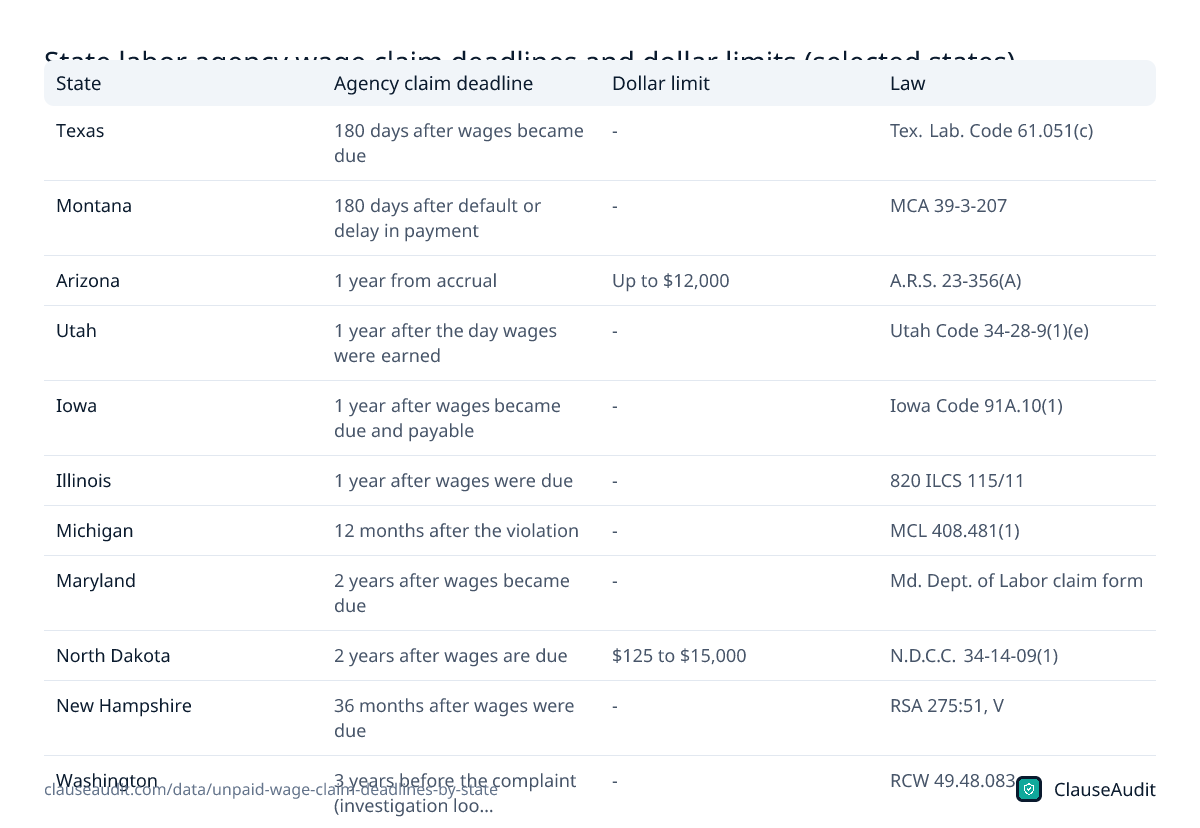 State labor agency wage claim deadlines and dollar limits (selected states)
Embed the infographic
Free to share on your site, blog or slides under CC BY 4.0. Please keep the credit link.
Sources and method
Every number on this page comes from the sources below, each opened and read on or before October 18, 2026. A second, independent review checked every figure against its source and corrected anything that did not match. 41 of 51 state entries were confirmed; any that could not be are marked "Not yet confirmed" and left out of every count and chart.
- Legal Information Institute, Cornell Law School, 29 U.S. Code 255 - Statute of limitations (Current U.S. Code text, accessed 2026-10-18)
- U.S. Department of Labor, Wage and Hour Division, Wage and Hour Division Data (FY 2025 data)
- U.S. Department of Labor, Wage and Hour Division, WHD Enforcement Statistics: All Acts (FY 2013 to FY 2025)
- U.S. Department of Labor, Wage and Hour Division, WHD Enforcement Statistics: Fair Labor Standards Act (FY 2013 to FY 2025)
- U.S. Department of Labor, Wage and Hour Division, State Minimum Wage Laws (Updated July 1, 2026)
- New York State Senate, New York Labor Law Section 198 (Current consolidated law, accessed 2026-10-18)
- California Department of Industrial Relations, Labor Commissioner's Office, How to File a Wage Claim (Accessed 2026-10-18)
- FindLaw (copy of the Texas Labor Code), Texas Labor Code 61.051, Filing Wage Claim (Accessed 2026-10-18)
- Kentucky General Assembly, KRS 337.385 (Effective July 15, 2024)
- Montana Legislature, MCA 39-3-207, Period within which employee may recover wages and penalties (Montana Code Annotated 2025)
- Arizona State Legislature, A.R.S. 23-356, Wage claims (Accessed 2026-10-18)
- FindLaw (copy of the Utah Code), Utah Code 34-28-9 (Accessed 2026-10-18)
- Iowa Legislature, Iowa Code sections 614.1 and 91A.10 (Iowa Code 2026)
- Illinois Legal Aid Online, How far back can I collect my unpaid wages? (Reviewed May 9, 2024)
- FindLaw (copy of the Michigan Compiled Laws), MCL 408.481 (Accessed 2026-10-18)
- Maryland Department of Labor, Employment Standards Service Wage Claim Form (Rev 1/23)
- North Dakota Legislative Branch, North Dakota Century Code chapter 34-14 (Accessed 2026-10-18)
- NH Liberty Alliance bill tracker (bill text), HB 1168 (2026), relative to wage claims, RSA 275:51, V (Signed May 8, 2026; Chapter 50; effective July 7, 2026)
- Washington State Legislature, RCW 49.48.083 (Includes 2026 amendments)
- Various (see each state row), State statutes and agency sources listed in the state table on this page (Accessed 2026-10-18)
Cite this page
ClauseAudit, “Unpaid Wage Claim Deadlines by State: How Long You Have to Recover Owed Pay”, updated October 18, 2026, https://clauseaudit.com/data/unpaid-wage-claim-deadlines-by-state. Free to reuse with a link back (CC BY 4.0).
This page summarises published data and law as checked on October 18, 2026. Figures are updated as new editions are released, and your own situation may differ. It is general information, not legal, tax or financial advice.