Minimum Salary for Exempt Employees by State (2026): Overtime Exemption Thresholds
By ClauseAudit Research · 16 sources ·
What is the minimum exempt salary by state in 2026?
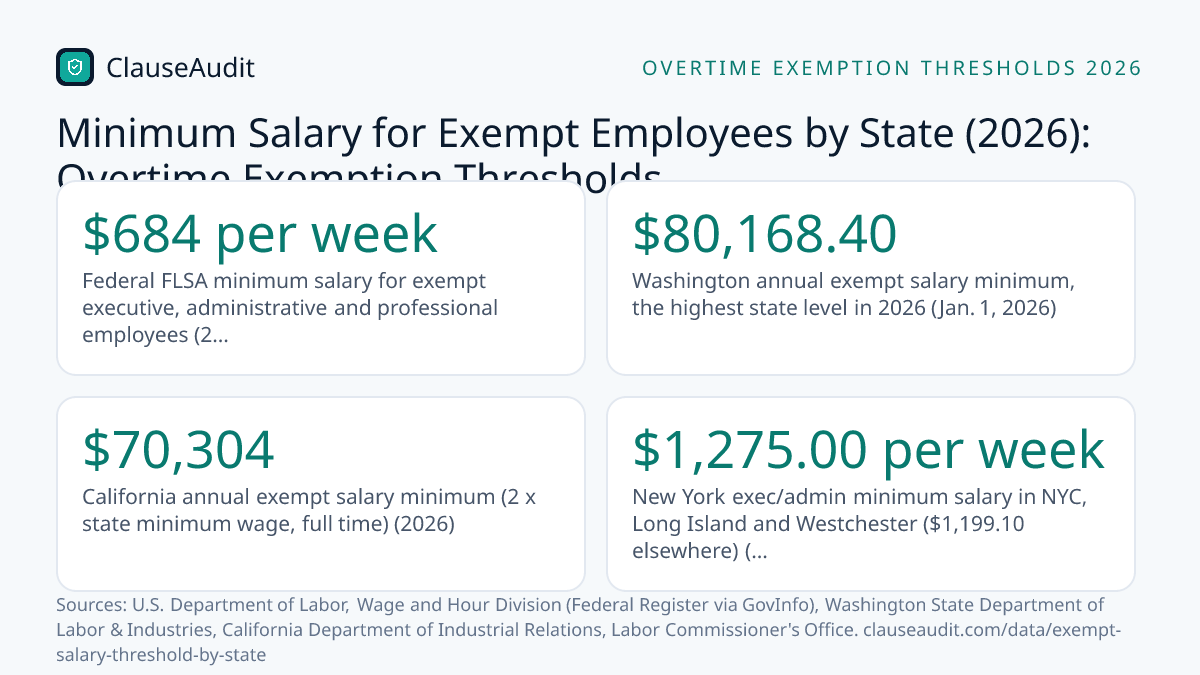
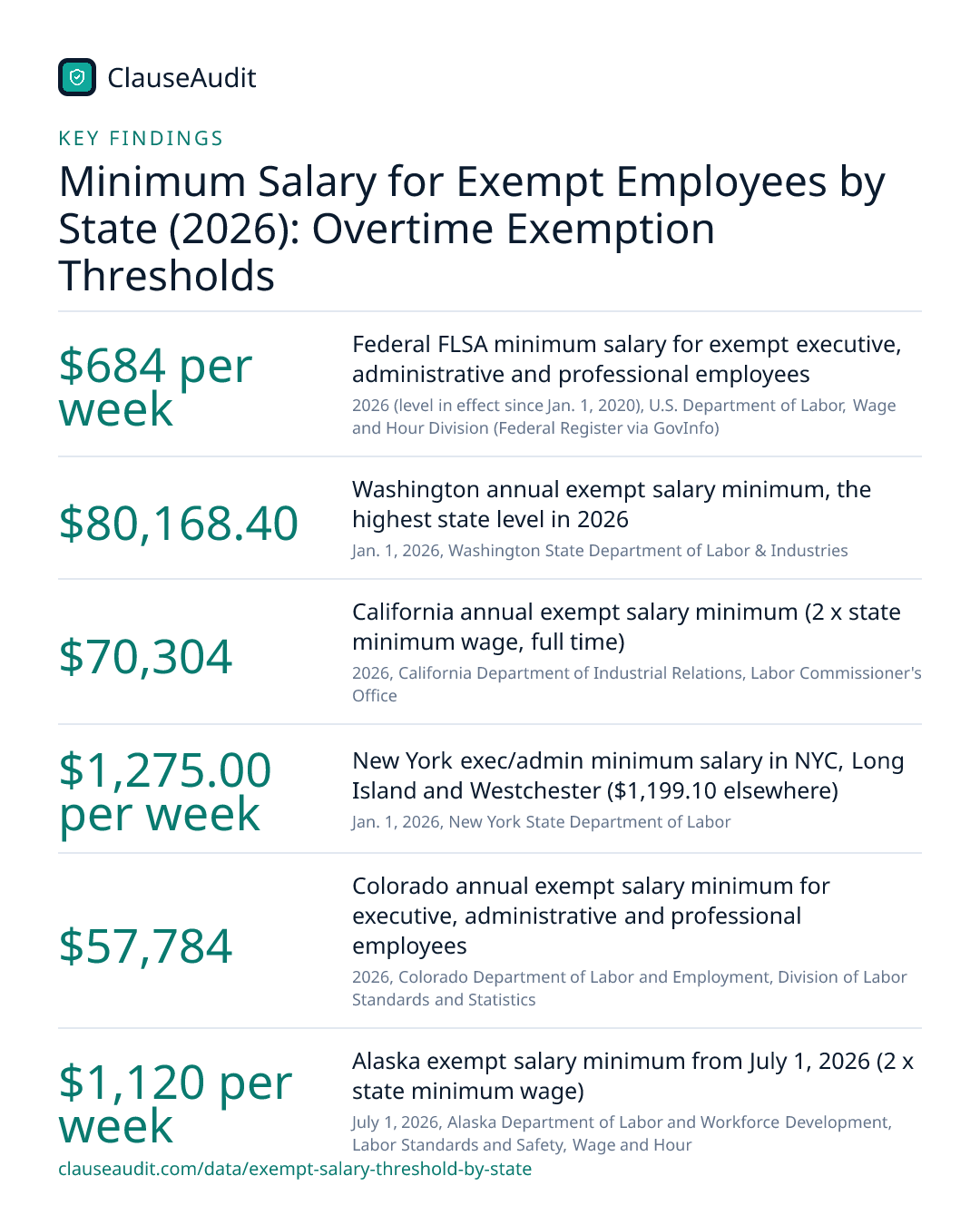
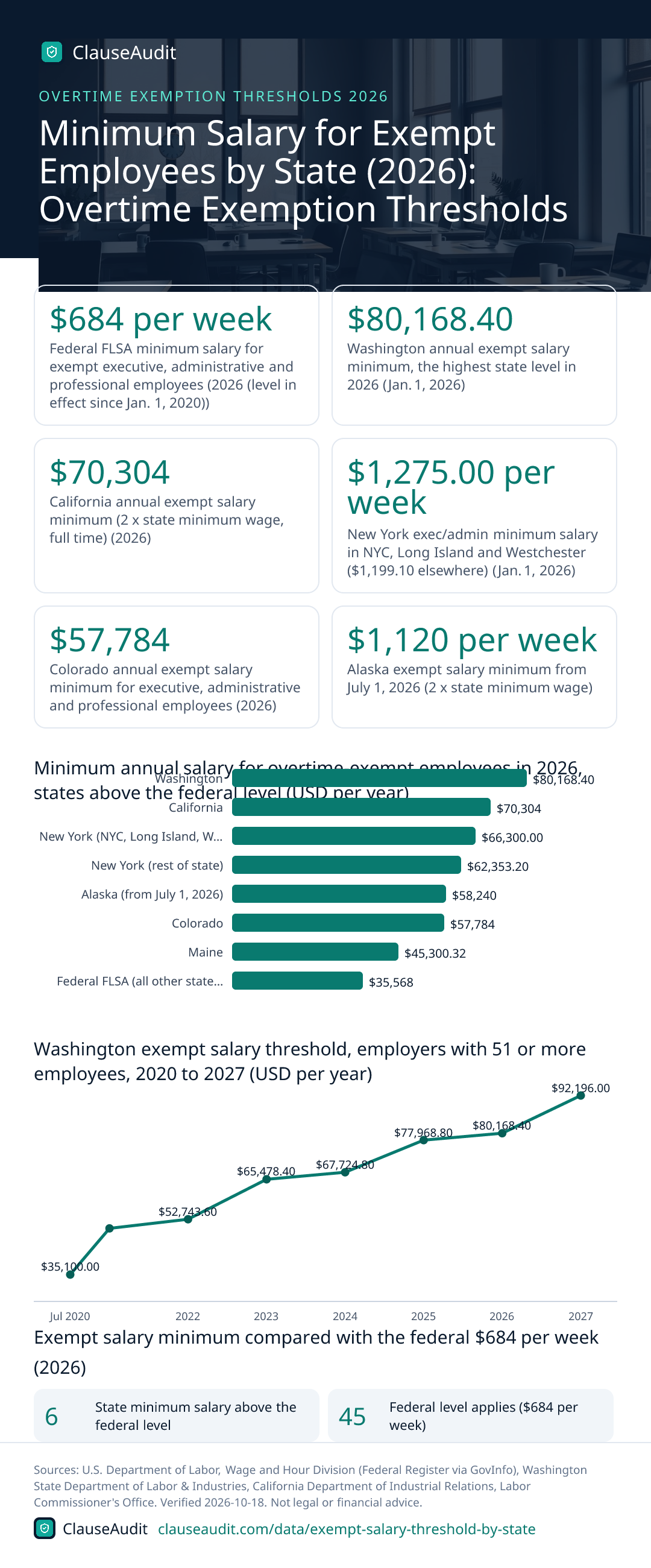
The federal minimum salary for exempt employees in 2026 is $684 per week, or $35,568 a year, and it is the rule in most states. Six states require more. Washington is highest at $80,168.40 a year, then California at $70,304. New York, Alaska, Colorado and Maine also set floors above the federal level.

- Federal FLSA minimum salary for exempt executive, administrative and professional employees (2026 (level in effect since Jan. 1, 2020), U.S. Department of Labor, Wage and Hour Division (Federal Register via GovInfo))
- $684 per week
- Washington annual exempt salary minimum, the highest state level in 2026 (Jan. 1, 2026, Washington State Department of Labor & Industries)
- $80,168.40
- California annual exempt salary minimum (2 x state minimum wage, full time) (2026, California Department of Industrial Relations, Labor Commissioner's Office)
- $70,304
- New York exec/admin minimum salary in NYC, Long Island and Westchester ($1,199.10 elsewhere) (Jan. 1, 2026, New York State Department of Labor)
- $1,275.00 per week
- Colorado annual exempt salary minimum for executive, administrative and professional employees (2026, Colorado Department of Labor and Employment, Division of Labor Standards and Statistics)
- $57,784
- Alaska exempt salary minimum from July 1, 2026 (2 x state minimum wage) (July 1, 2026, Alaska Department of Labor and Workforce Development, Labor Standards and Safety, Wage and Hour)
- $1,120 per week
- Maine exempt salary minimum, or $45,300.32 per year (Jan. 1, 2026, Maine Department of Labor)
- $871.16 per week
- Washington annual exempt minimum for employers with 51+ employees from Jan. 1, 2027 (Jan. 1, 2027, Washington State Department of Labor & Industries)
- $92,196.00
Being paid a salary does not, by itself, take you out of overtime. To treat you as exempt, your employer has to pay at least a set minimum salary and your actual duties have to fit an executive, administrative or professional role. Miss either test and the overtime rules apply.
The federal floor is $684 per week. Most of the country uses it, but six states set their own, higher numbers, and a few of them move every January. If you work in one of those states, the federal figure is the wrong one to check your offer against.
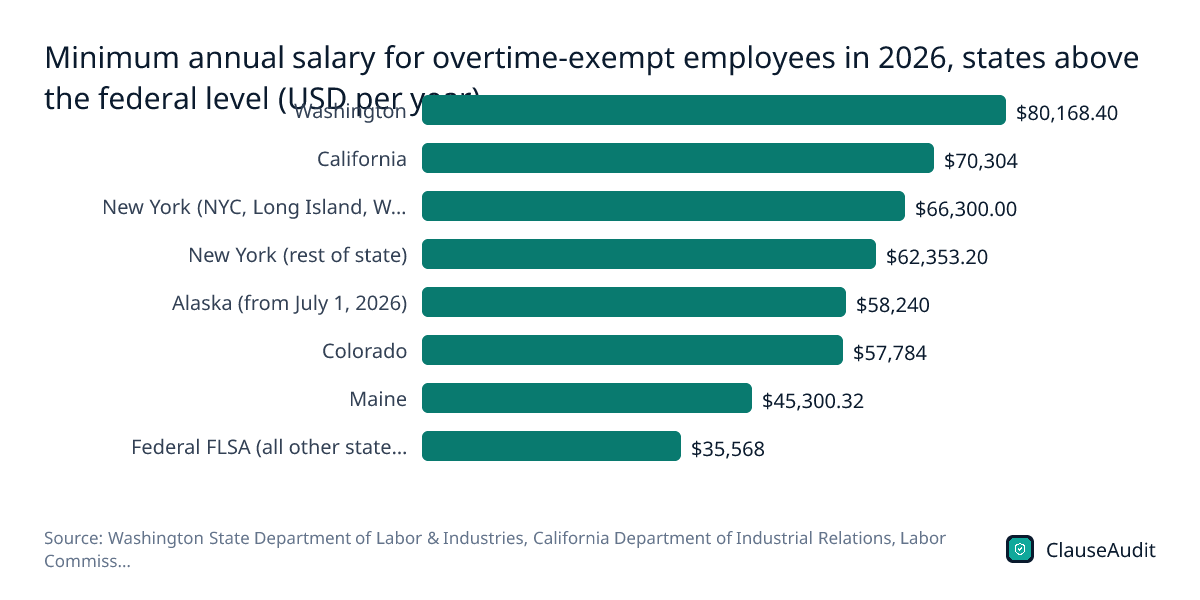
Minimum annual salary for overtime-exempt employees in 2026, states above the federal level (USD per year)
Chart data
| Label | Value |
|---|---|
| Washington | $80,168.40 |
| California | $70,304 |
| New York (NYC, Long Island, Westchester) | $66,300.00 |
| New York (rest of state) | $62,353.20 |
| Alaska (from July 1, 2026) | $58,240 |
| Colorado | $57,784 |
| Maine | $45,300.32 |
| Federal FLSA (all other states) | $35,568 |
The gap between states is wide. Washington's $80,168.40 sits far above the federal $35,568, so the same job title can be exempt in one state and overtime-eligible in another.
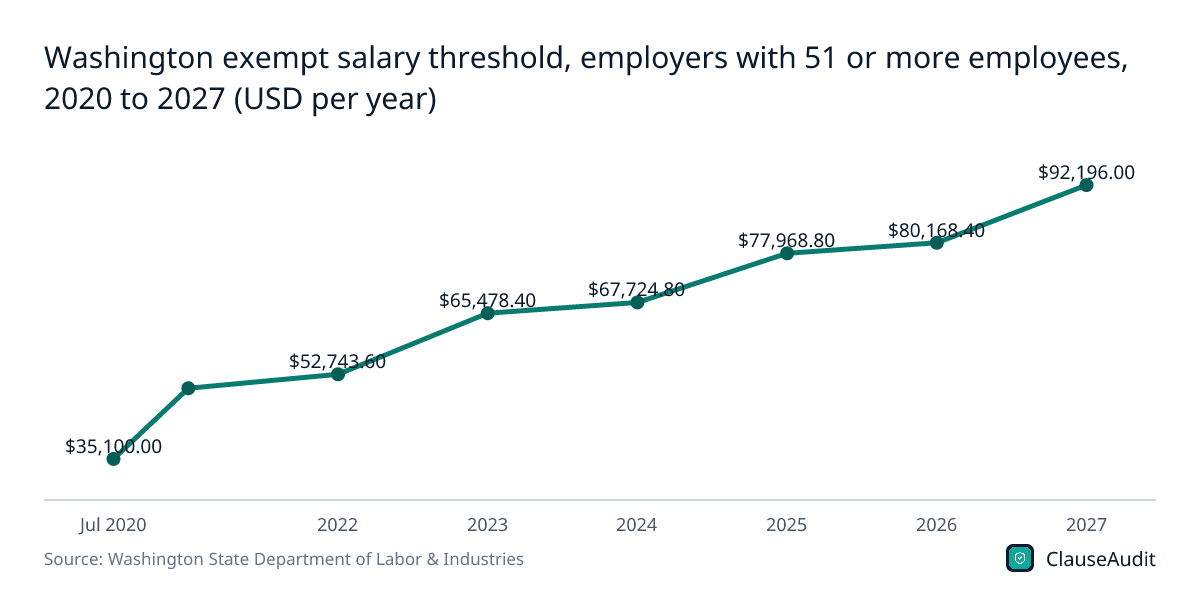
Download this chart (PNG)Washington exempt salary threshold, employers with 51 or more employees, 2020 to 2027 (USD per year)
Chart data
| Label | Value (USD per year) |
|---|---|
| Jul 2020 | $35,100.00 |
| 2021 | $49,831.60 |
| 2022 | $52,743.60 |
| 2023 | $65,478.40 |
| 2024 | $67,724.80 |
| 2025 | $77,968.80 |
| 2026 | $80,168.40 |
| 2027 | $92,196.00 |
Washington has raised its threshold every year on a set schedule, from $35,100.00 in July 2020 to $92,196.00 for larger employers in 2027. If you are salaried there, expect your employer to revisit pay or classification each January.
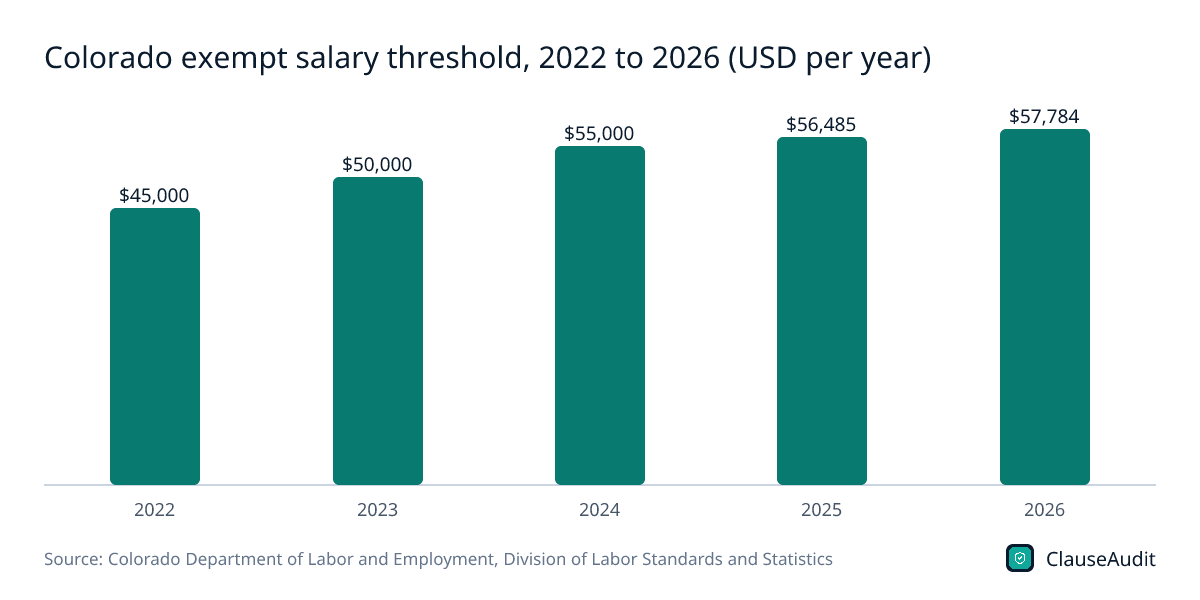
Download this chart (PNG)Colorado exempt salary threshold, 2022 to 2026 (USD per year)
Chart data
| Label | Value (USD per year) |
|---|---|
| 2022 | $45,000 |
| 2023 | $50,000 |
| 2024 | $55,000 |
| 2025 | $56,485 |
| 2026 | $57,784 |
Colorado stepped up in round numbers until 2024, reaching $55,000. Since 2025 the level moves with inflation, which is why the jumps are now smaller: $56,485, then $57,784 in 2026.
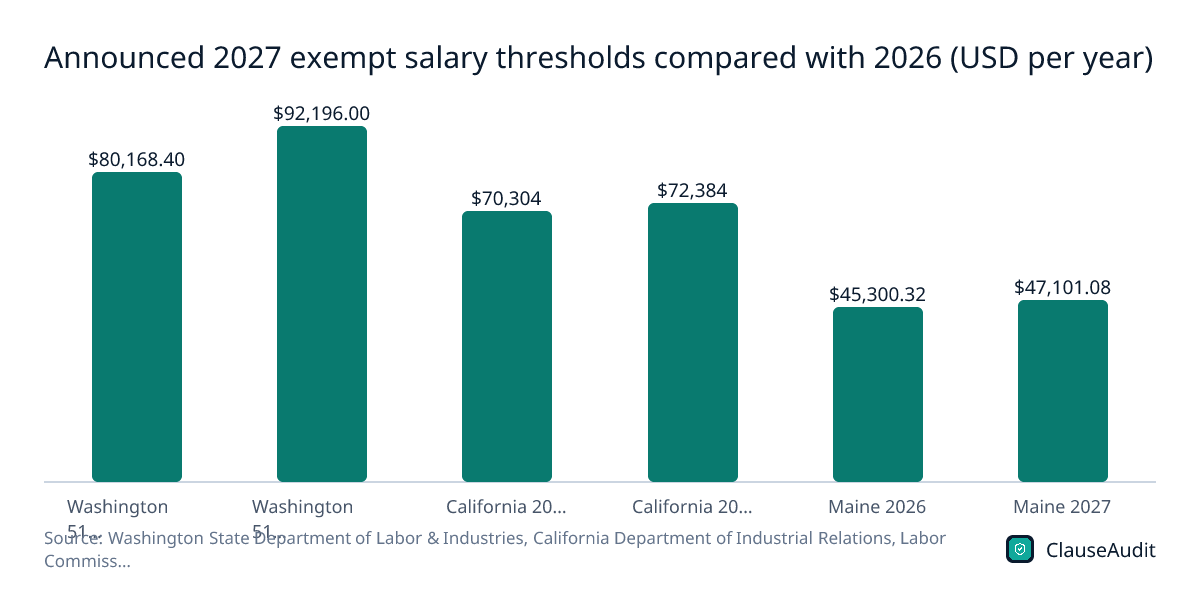
Download this chart (PNG)Announced 2027 exempt salary thresholds compared with 2026 (USD per year)
Chart data
| Label | Value (USD per year) |
|---|---|
| Washington 51+ employees, 2026 | $80,168.40 |
| Washington 51+ employees, 2027 | $92,196.00 |
| California 2026 | $70,304 |
| California 2027 | $72,384 |
| Maine 2026 | $45,300.32 |
| Maine 2027 | $47,101.08 |
All three states in this chart go up on January 1, 2027. Washington's jump for employers with 51 or more workers is the biggest, to $92,196.00.
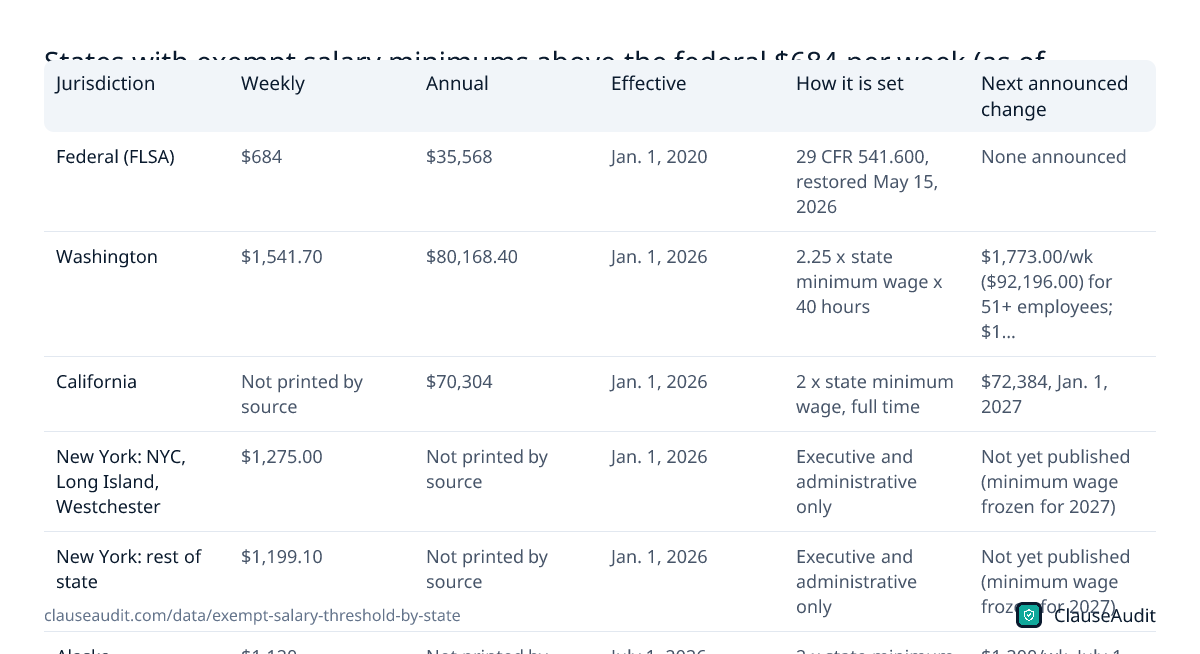
Download this chart (PNG)States with exempt salary minimums above the federal $684 per week (as of October 18, 2026)
| Jurisdiction | Weekly | Annual | Effective | How it is set | Next announced change |
|---|---|---|---|---|---|
| Federal (FLSA) | $684 | $35,568 | Jan. 1, 2020 | 29 CFR 541.600, restored May 15, 2026 | None announced |
| Washington | $1,541.70 | $80,168.40 | Jan. 1, 2026 | 2.25 x state minimum wage x 40 hours | $1,773.00/wk ($92,196.00) for 51+ employees; $1,595.70/wk ($82,976.40) for 1-50, Jan. 1, 2027 |
| California | Not printed by source | $70,304 | Jan. 1, 2026 | 2 x state minimum wage, full time | $72,384, Jan. 1, 2027 |
| New York: NYC, Long Island, Westchester | $1,275.00 | Not printed by source | Jan. 1, 2026 | Executive and administrative only | Not yet published (minimum wage frozen for 2027) |
| New York: rest of state | $1,199.10 | Not printed by source | Jan. 1, 2026 | Executive and administrative only | Not yet published (minimum wage frozen for 2027) |
| Alaska | $1,120 | Not printed by source | July 1, 2026 | 2 x state minimum wage x 40 hours | $1,200/wk, July 1, 2027 |
| Colorado | $1,111.23 | $57,784 | Jan. 1, 2026 | Prior year adjusted by inflation | Inflation-adjusted each year |
| Maine | $871.16 | $45,300.32 | Jan. 1, 2026 | Above 3,000 x state minimum wage | $905.79/wk ($47,101.08), Jan. 1, 2027 |
Source: U.S. Department of Labor, Wage and Hour Division (Federal Register via GovInfo), Defining and Delimiting the Exemptions for Executive, Administrative, Professional, Outside Sales, and Computer Employees; Implementation of Federal Court Judgments (91 FR 27833, FR Doc. 2026-09839); Washington State Department of Labor & Industries, Salary threshold implementation schedule (Publication F700-207-000); California Department of Industrial Relations, Labor Commissioner's Office, California's minimum wage set to increase to $16.90 per hour on January 1, 2026 (Release 2025-118); California Department of Industrial Relations, ICYMI: California's minimum wage set to increase to $17.40 per hour on January 1, 2027 (Release 2026-66); New York State Department of Labor, Minimum Wage Frequently Asked Questions; New York State Department of Labor, Your New York State Minimum Wage; Alaska Department of Labor and Workforce Development, Labor Standards and Safety, Wage and Hour, General Industry notice: Alaska wage and hour changes (salary exempt three-part test); Colorado Department of Labor and Employment, Division of Labor Standards and Statistics, 2026 PAY CALC Order, 7 CCR 1103-14; Colorado Department of Labor and Employment, Division of Labor Standards and Statistics, INFO #1: Key Wage and Hour Rights and Responsibilities in Colorado: the COMPS and PAY CALC Orders (2026); Maine Department of Labor, Maine's Minimum Wage $15.10 Per Hour Beginning Tomorrow, Including for Agricultural Workers; Maine Department of Labor, Maine's Minimum Wage to Increase to $15.70 Per Hour in 2027. Download as image
Other pay floors for exemptions: highly compensated, computer and U.S. territory levels
| Rule | Amount | Period | Source |
|---|---|---|---|
| Federal highly compensated employee (HCE) total annual compensation | $107,432 (with at least $684/week salary) | Since Jan. 1, 2020 | 29 CFR 541.601, Federal Register May 15, 2026 |
| Federal level in CNMI, Guam, Puerto Rico, U.S. Virgin Islands | $455 per week | Current | 29 CFR 541.600 |
| Federal level in American Samoa | $380 per week | Current | 29 CFR 541.600 |
| Colorado highly compensated employee | $130,014 annually | 2026 | Colorado 2026 PAY CALC Order, 7 CCR 1103-14 (effective Feb. 1, 2026) |
| Colorado highly technical computer employee | $34.85 per hour or the EAP salary | 2026 | Colorado 2026 PAY CALC Order, 7 CCR 1103-14 (effective Feb. 1, 2026) |
| California computer software employee | $58.85/hour; $10,214.44/month; $122,573.13/year | 2026 | California DIR, October 2026 |
| California computer software employee | $61.03/hour; $10,592.37/month; $127,108.34/year | From Jan. 1, 2027 | California DIR, October 2026 |
Source: U.S. Department of Labor, Wage and Hour Division (Federal Register via GovInfo), Defining and Delimiting the Exemptions for Executive, Administrative, Professional, Outside Sales, and Computer Employees; Implementation of Federal Court Judgments (91 FR 27833, FR Doc. 2026-09839); Colorado Department of Labor and Employment, Division of Labor Standards and Statistics, 2026 PAY CALC Order, 7 CCR 1103-14; California Department of Industrial Relations, Office of the Director - Research, Overtime Exemption for Computer Software Employees, Effective January 1, 2027. Download as image
Exempt salary minimum compared with the federal $684 per week (2026) by state
- 6State minimum salary above the federal level
- 45Federal level applies ($684 per week)
- State minimum salary above the federal level6
- Federal level applies ($684 per week)45
| State | Weekly minimum | Annual minimum | How it is set | Effective | Next announced change | Source |
|---|---|---|---|---|---|---|
| Alabama | $684 (federal) | $35,568 (federal) | Federal FLSA level; no higher state salary level | Jan. 1, 2020 (federal) | None announced | 29 U.S.C. § 213(a)(1); 29 CFR 541.600 |
| Alaska | $1,120 | Source prints weekly only | 2 x state minimum wage ($14.00) for the first 40 hours | July 1, 2026 | $1,200/week, July 1, 2027 | AS 23.10.055(b) |
| Arizona | $684 (federal) | $35,568 (federal) | Federal FLSA level; no higher state salary level | Jan. 1, 2020 (federal) | None announced | 29 U.S.C. § 213(a)(1); 29 CFR 541.600 |
| Arkansas | $684 (federal) | $35,568 (federal) | Federal FLSA level; no higher state salary level | Jan. 1, 2020 (federal) | None announced | 29 U.S.C. § 213(a)(1); 29 CFR 541.600 |
| California | Set monthly; source prints annual only | $70,304 | 2 x state minimum wage ($16.90) for full-time work | Jan. 1, 2026 | $72,384, Jan. 1, 2027 | Cal. Labor Code § 515(a) |
| Colorado | $1,111.23 | $57,784 | Prior year's level adjusted by inflation | Jan. 1, 2026 | Inflation-adjusted each year | 7 CCR 1103-1 (COMPS Order) Rule 2.5.1; 7 CCR 1103-14 (PAY CALC Order) |
| Connecticut | $684 (federal) | $35,568 (federal) | Federal FLSA level; no higher state salary level | Jan. 1, 2020 (federal) | None announced | 29 U.S.C. § 213(a)(1); 29 CFR 541.600 |
| Delaware | $684 (federal) | $35,568 (federal) | Federal FLSA level; no higher state salary level | Jan. 1, 2020 (federal) | None announced | 29 U.S.C. § 213(a)(1); 29 CFR 541.600 |
| District of Columbia | $684 (federal) | $35,568 (federal) | Federal FLSA level; no higher state salary level | Jan. 1, 2020 (federal) | None announced | 29 U.S.C. § 213(a)(1); 29 CFR 541.600 |
| Florida | $684 (federal) | $35,568 (federal) | Federal FLSA level; no higher state salary level | Jan. 1, 2020 (federal) | None announced | 29 U.S.C. § 213(a)(1); 29 CFR 541.600 |
| Georgia | $684 (federal) | $35,568 (federal) | Federal FLSA level; no higher state salary level | Jan. 1, 2020 (federal) | None announced | 29 U.S.C. § 213(a)(1); 29 CFR 541.600 |
| Hawaii | $684 (federal) | $35,568 (federal) | Federal FLSA level; no higher state salary level | Jan. 1, 2020 (federal) | None announced | 29 U.S.C. § 213(a)(1); 29 CFR 541.600 |
| Idaho | $684 (federal) | $35,568 (federal) | Federal FLSA level; no higher state salary level | Jan. 1, 2020 (federal) | None announced | 29 U.S.C. § 213(a)(1); 29 CFR 541.600 |
| Illinois | $684 (federal) | $35,568 (federal) | Federal FLSA level; no higher state salary level | Jan. 1, 2020 (federal) | None announced | 29 U.S.C. § 213(a)(1); 29 CFR 541.600 |
| Indiana | $684 (federal) | $35,568 (federal) | Federal FLSA level; no higher state salary level | Jan. 1, 2020 (federal) | None announced | 29 U.S.C. § 213(a)(1); 29 CFR 541.600 |
| Iowa | $684 (federal) | $35,568 (federal) | Federal FLSA level; no higher state salary level | Jan. 1, 2020 (federal) | None announced | 29 U.S.C. § 213(a)(1); 29 CFR 541.600 |
| Kansas | $684 (federal) | $35,568 (federal) | Federal FLSA level; no higher state salary level | Jan. 1, 2020 (federal) | None announced | 29 U.S.C. § 213(a)(1); 29 CFR 541.600 |
| Kentucky | $684 (federal) | $35,568 (federal) | Federal FLSA level; no higher state salary level | Jan. 1, 2020 (federal) | None announced | 29 U.S.C. § 213(a)(1); 29 CFR 541.600 |
| Louisiana | $684 (federal) | $35,568 (federal) | Federal FLSA level; no higher state salary level | Jan. 1, 2020 (federal) | None announced | 29 U.S.C. § 213(a)(1); 29 CFR 541.600 |
| Maine | $871.16 | $45,300.32 | Must exceed 3,000 x state minimum wage ($15.10) or the federal level, whichever is higher | Jan. 1, 2026 | $905.79/week ($47,101.08), Jan. 1, 2027 | Maine DOL news release (Dec. 31, 2025); 2027 figure from release of Sept. 18, 2026 |
| Maryland | $684 (federal) | $35,568 (federal) | Federal FLSA level; no higher state salary level | Jan. 1, 2020 (federal) | None announced | 29 U.S.C. § 213(a)(1); 29 CFR 541.600 |
| Massachusetts | $684 (federal) | $35,568 (federal) | Federal FLSA level; no higher state salary level | Jan. 1, 2020 (federal) | None announced | 29 U.S.C. § 213(a)(1); 29 CFR 541.600 |
| Michigan | $684 (federal) | $35,568 (federal) | Federal FLSA level; no higher state salary level | Jan. 1, 2020 (federal) | None announced | 29 U.S.C. § 213(a)(1); 29 CFR 541.600 |
| Minnesota | $684 (federal) | $35,568 (federal) | Federal FLSA level; no higher state salary level | Jan. 1, 2020 (federal) | None announced | 29 U.S.C. § 213(a)(1); 29 CFR 541.600 |
| Mississippi | $684 (federal) | $35,568 (federal) | Federal FLSA level; no higher state salary level | Jan. 1, 2020 (federal) | None announced | 29 U.S.C. § 213(a)(1); 29 CFR 541.600 |
| Missouri | $684 (federal) | $35,568 (federal) | Federal FLSA level; no higher state salary level | Jan. 1, 2020 (federal) | None announced | 29 U.S.C. § 213(a)(1); 29 CFR 541.600 |
| Montana | $684 (federal) | $35,568 (federal) | Federal FLSA level; no higher state salary level | Jan. 1, 2020 (federal) | None announced | 29 U.S.C. § 213(a)(1); 29 CFR 541.600 |
| Nebraska | $684 (federal) | $35,568 (federal) | Federal FLSA level; no higher state salary level | Jan. 1, 2020 (federal) | None announced | 29 U.S.C. § 213(a)(1); 29 CFR 541.600 |
| Nevada | $684 (federal) | $35,568 (federal) | Federal FLSA level; no higher state salary level | Jan. 1, 2020 (federal) | None announced | 29 U.S.C. § 213(a)(1); 29 CFR 541.600 |
| New Hampshire | $684 (federal) | $35,568 (federal) | Federal FLSA level; no higher state salary level | Jan. 1, 2020 (federal) | None announced | 29 U.S.C. § 213(a)(1); 29 CFR 541.600 |
| New Jersey | $684 (federal) | $35,568 (federal) | Federal FLSA level; no higher state salary level | Jan. 1, 2020 (federal) | None announced | 29 U.S.C. § 213(a)(1); 29 CFR 541.600 |
| New Mexico | $684 (federal) | $35,568 (federal) | Federal FLSA level; no higher state salary level | Jan. 1, 2020 (federal) | None announced | 29 U.S.C. § 213(a)(1); 29 CFR 541.600 |
| New York | $1,275.00 (NYC, Long Island, Westchester); $1,199.10 (rest of state) | Source prints weekly only | Executive and administrative exemptions; rises with the state minimum wage | Jan. 1, 2026 | Not yet published; minimum wage unchanged Jan. 1, 2027 | 12 NYCRR Part 142 |
| North Carolina | $684 (federal) | $35,568 (federal) | Federal FLSA level; no higher state salary level | Jan. 1, 2020 (federal) | None announced | 29 U.S.C. § 213(a)(1); 29 CFR 541.600 |
| North Dakota | $684 (federal) | $35,568 (federal) | Federal FLSA level; no higher state salary level | Jan. 1, 2020 (federal) | None announced | 29 U.S.C. § 213(a)(1); 29 CFR 541.600 |
| Ohio | $684 (federal) | $35,568 (federal) | Federal FLSA level; no higher state salary level | Jan. 1, 2020 (federal) | None announced | 29 U.S.C. § 213(a)(1); 29 CFR 541.600 |
| Oklahoma | $684 (federal) | $35,568 (federal) | Federal FLSA level; no higher state salary level | Jan. 1, 2020 (federal) | None announced | 29 U.S.C. § 213(a)(1); 29 CFR 541.600 |
| Oregon | $684 (federal) | $35,568 (federal) | Federal FLSA level; no higher state salary level | Jan. 1, 2020 (federal) | None announced | 29 U.S.C. § 213(a)(1); 29 CFR 541.600 |
| Pennsylvania | $684 (federal) | $35,568 (federal) | Federal FLSA level; no higher state salary level | Jan. 1, 2020 (federal) | None announced | 2021 Act 70 (HB 336); 29 CFR 541.600 |
| Rhode Island | $684 (federal) | $35,568 (federal) | Federal FLSA level; no higher state salary level | Jan. 1, 2020 (federal) | None announced | 29 U.S.C. § 213(a)(1); 29 CFR 541.600 |
| South Carolina | $684 (federal) | $35,568 (federal) | Federal FLSA level; no higher state salary level | Jan. 1, 2020 (federal) | None announced | 29 U.S.C. § 213(a)(1); 29 CFR 541.600 |
| South Dakota | $684 (federal) | $35,568 (federal) | Federal FLSA level; no higher state salary level | Jan. 1, 2020 (federal) | None announced | 29 U.S.C. § 213(a)(1); 29 CFR 541.600 |
| Tennessee | $684 (federal) | $35,568 (federal) | Federal FLSA level; no higher state salary level | Jan. 1, 2020 (federal) | None announced | 29 U.S.C. § 213(a)(1); 29 CFR 541.600 |
| Texas | $684 (federal) | $35,568 (federal) | Federal FLSA level; no higher state salary level | Jan. 1, 2020 (federal) | None announced | 29 U.S.C. § 213(a)(1); 29 CFR 541.600 |
| Utah | $684 (federal) | $35,568 (federal) | Federal FLSA level; no higher state salary level | Jan. 1, 2020 (federal) | None announced | 29 U.S.C. § 213(a)(1); 29 CFR 541.600 |
| Vermont | $684 (federal) | $35,568 (federal) | Federal FLSA level; no higher state salary level | Jan. 1, 2020 (federal) | None announced | 29 U.S.C. § 213(a)(1); 29 CFR 541.600 |
| Virginia | $684 (federal) | $35,568 (federal) | Federal FLSA level; no higher state salary level | Jan. 1, 2020 (federal) | None announced | 29 U.S.C. § 213(a)(1); 29 CFR 541.600 |
| Washington | $1,541.70 | $80,168.40 | 2.25 x state minimum wage x 40 hours | Jan. 1, 2026 | $92,196.00 (51+ employees) / $82,976.40 (1-50), Jan. 1, 2027 | WAC 296-128-545 |
| West Virginia | $684 (federal) | $35,568 (federal) | Federal FLSA level; no higher state salary level | Jan. 1, 2020 (federal) | None announced | 29 U.S.C. § 213(a)(1); 29 CFR 541.600 |
| Wisconsin | $684 (federal) | $35,568 (federal) | Federal FLSA level; no higher state salary level | Jan. 1, 2020 (federal) | None announced | 29 U.S.C. § 213(a)(1); 29 CFR 541.600 |
| Wyoming | $684 (federal) | $35,568 (federal) | Federal FLSA level; no higher state salary level | Jan. 1, 2020 (federal) | None announced | 29 U.S.C. § 213(a)(1); 29 CFR 541.600 |
What is the minimum salary to be exempt from overtime in 2026?
Under federal law it is $684 per week, which works out to $35,568 for a full year. That figure covers the executive, administrative and professional exemptions, sometimes called the white-collar or EAP exemptions.
Your state can set a higher floor, and when it does, the higher number wins. Six states do: Washington, California, New York, Alaska, Colorado and Maine. Everywhere else, the federal number is the one to use.
Two details trip people up. First, the salary has to be paid on a salary basis, meaning a fixed amount that doesn't shrink because you had a slow week. Second, the salary is only half the test. A receptionist with a big salary is still not an executive. Duties count as much as dollars.
Did the federal salary threshold go up?
No. The Department of Labor tried. A 2024 rule would have raised the floor to $844 and then $1,128 per week, but federal courts in Texas threw it out on Nov. 15 and Dec. 30, 2024. The Fifth Circuit dismissed the appeals in May 2026, and on May 15, 2026 the Department put the $684 figure back into the regulations.
So if you read in 2024 that you would be getting overtime or a raise, it didn't last. The $844 step applied for a few months in 2024 before the court ruling wiped it out, and the $1,128 step never took effect. Today the number is back to the $684 that first took effect on Jan. 1, 2020. The federal highly compensated employee level also stays where it was, at $107,432 in total yearly pay.
Which states set a higher exempt salary threshold?
Each of the six uses its own formula, and that matters because it tells you how the number will move.
Washington ties its floor to the state minimum wage: 2.25 times it for a 40-hour week, which gives $1,541.70 a week in 2026. California uses twice the state minimum wage for full-time work. With the 2026 rate at $16.90 an hour, that comes to $70,304. Alaska also doubles the state minimum wage, and since that wage rose to $14.00 on July 1, 2026, the floor is now $1,120 a week.
New York splits by region. Executive and administrative staff in New York City, Long Island and Westchester need at least $1,275.00 a week. The rest of the state needs $1,199.10. New York has no state salary level for professionals, so engineers, accountants and similar roles fall back to the federal $684.
Colorado adjusts its $57,784 floor for inflation each year. Maine requires a salary above 3,000 times its minimum wage, which lands at $871.16 a week in 2026.
The pattern is simple once you see it. When a state's floor is pegged to its minimum wage, every minimum wage increase quietly raises the exempt line too. That is why a salary that cleared the bar last year can fall short this year without anyone touching your pay. If you live in one of these six states, put a reminder in your calendar for each January (July in Alaska) and check the new figure against your offer letter or your last raise.
What these numbers mean for you
- If you are a salaried worker: compare your pay to your state's figure, not the federal one. A California manager earning a bit under $70,304 cannot be treated as exempt, no matter what the offer letter says.
- If you work remotely: the state where you physically do the work usually controls. A salary that clears the federal floor for a company in Texas may fall short if you live in Washington.
- If you run a business: budget for January. Raising someone just past the line is often cheaper than paying overtime, but only if their duties also qualify.
- If you are offered part-time salaried work in California: the state's floor is built on full-time pay, so a prorated salary below it is a red flag.
- If you write code in California: there is a separate, higher floor for computer software employees, $122,573.13 a year in 2026.
What changes in 2027, and how should you plan?
Several increases are already on the books. On Jan. 1, 2027, California goes to $72,384 and Maine to $47,101.08. Washington sets two levels by employer size: $92,196.00 for employers with 51 or more workers and $82,976.40 for those with 50 or fewer. Alaska moves to $1,200 a week on July 1, 2027.
New York had not published 2027 figures as of October 2026, and its minimum wage will not rise on Jan. 1, 2027. Colorado will publish an inflation-adjusted number.
Employers have three choices when a threshold rises: raise the salary, reclassify the role as non-exempt and track hours, or restructure the job. Workers should watch for the second option. A switch to hourly pay can be legal, but it should come with a written change and a clear overtime rate, not a quiet cut to your base.
Business owners should also look past the salary line. Bonuses, title changes and new duties all affect whether a role still qualifies, so review the job description at the same time you review pay.
What should you do if you think you are misclassified?
Start with records. Keep your pay stubs, your offer letter and a simple log of the hours you actually work. Then compare your salary to your state's floor for the year in question, since the number changes over time.
Next, look at your duties honestly. Do you manage people, make real decisions, or use advanced training in your daily work? If your job is mostly routine tasks, a title like coordinator or specialist won't save the exemption.
If both tests point the wrong way, you may be owed back overtime. Your state labor department or the federal Wage and Hour Division can take a complaint, and many employment lawyers review wage claims at no upfront cost. Check your contract first, though. An arbitration clause can change where and how you bring that claim.
How ClauseAudit helps
Exempt status is usually decided in a few lines of your offer letter or employment agreement. Our automated review reads those lines and flags the ones that put your overtime pay at risk.
Upload your agreement and you get a plain-English list of the terms to question before you sign or before your next review.
- Whether the contract labels you exempt or non-exempt, and whether the salary meets your state's 2026 floor
- Clauses that let the employer adjust or reduce your salary at will
- Language saying your salary covers all hours worked, including overtime
- Part-time or prorated salary terms that could drop pay below the threshold
- Mandatory arbitration and class-action waivers that limit how you can bring a wage claim
- Job duties and title descriptions that don't match the exemption claimed
Frequently asked questions
What is the federal exempt salary threshold in 2026?
It is $684 per week, or $35,568 a year for a full-year worker. This level first took effect on Jan. 1, 2020. A 2024 rule that raised it was struck down in court, and the Department of Labor restored the $684 figure to the regulations on May 15, 2026.
Which state has the highest exempt salary threshold?
Washington. In 2026 the floor is $1,541.70 a week, or $80,168.40 a year, for all employers. It rises again on Jan. 1, 2027, to $92,196.00 for employers with 51 or more workers and $82,976.40 for smaller ones. Small employers here means 50 or fewer workers.
What is the exempt salary in California for 2026?
California requires at least $70,304 a year for its executive, administrative and professional exemptions. That is twice the state minimum wage of $16.90 for full-time work. It goes up to $72,384 on Jan. 1, 2027. Computer software employees have a separate floor of $122,573.13 a year in 2026.
Does New York's threshold apply to professionals?
No. New York's state salary level covers only the executive and administrative exemptions: $1,275.00 a week in New York City, Long Island and Westchester, and $1,199.10 elsewhere. Professional employees fall under the federal $684 per week for employers covered by federal law.
If I earn more than the threshold, am I automatically exempt?
No. Salary is only one of the tests. Your main duties also have to match an executive, administrative or professional role, and your pay has to be a fixed salary rather than one that rises and falls with hours. A well-paid worker doing routine tasks can still be owed overtime.
Can my employer switch me from salaried to hourly?
Usually yes, as long as the change applies going forward and you are paid at least minimum wage plus overtime for extra hours. Employers often do this when a state threshold rises. Ask for the change in writing, including your new hourly rate and how overtime will be calculated.
Which threshold applies if I work remotely for an out-of-state company?
Generally the law of the state where you do the work. If you live and work in Colorado for a company based elsewhere, Colorado's $57,784 floor is the one to check. Your contract's choice-of-law clause doesn't usually override state wage protections, though it may affect where a dispute is heard.
What is the federal highly compensated employee threshold?
It is $107,432 in total annual compensation, with at least $684 a week paid as salary. Workers above it face a lighter duties test for exemption, though they still must perform some office or non-manual work. Colorado sets its own highly compensated level at $130,014 for 2026.
Use this data
Every chart and card below is free to reuse under CC BY 4.0. Download what you need and link back to this page.
 Stat cards
 Key findings card
 Infographic
 Minimum annual salary for overtime-exempt employees in 2026, states above the federal level (USD per year)
 Washington exempt salary threshold, employers with 51 or more employees, 2020 to 2027 (USD per year)
 Colorado exempt salary threshold, 2022 to 2026 (USD per year)
 Announced 2027 exempt salary thresholds compared with 2026 (USD per year)
 States with exempt salary minimums above the federal $684 per week (as of October 18, 2026)
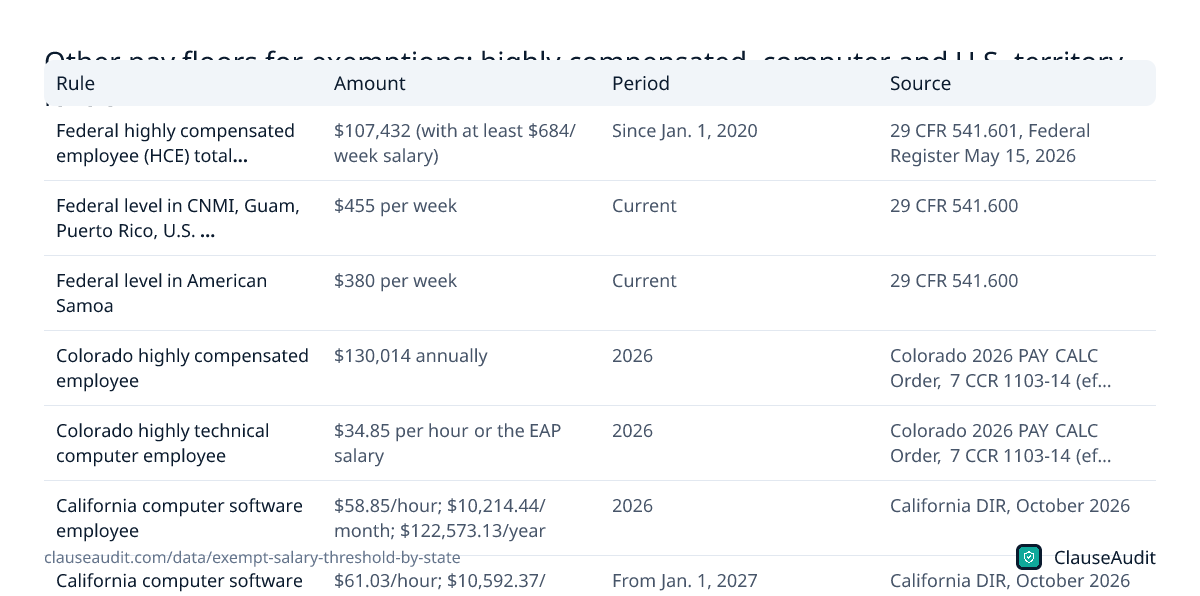 Other pay floors for exemptions: highly compensated, computer and U.S. territory levels
Embed the infographic
Free to share on your site, blog or slides under CC BY 4.0. Please keep the credit link.
Sources and method
Every number on this page comes from the sources below, each opened and read on or before October 18, 2026. A second, independent review checked every figure against its source and corrected anything that did not match. 51 of 51 state entries were confirmed; any that could not be are marked "Not yet confirmed" and left out of every count and chart.
- U.S. Department of Labor, Wage and Hour Division (Federal Register via GovInfo), Defining and Delimiting the Exemptions for Executive, Administrative, Professional, Outside Sales, and Computer Employees; Implementation of Federal Court Judgments (91 FR 27833, FR Doc. 2026-09839) (May 15, 2026)
- Washington State Department of Labor & Industries, Salary threshold implementation schedule (Publication F700-207-000) (October 2026 [10-2026])
- California Department of Industrial Relations, Labor Commissioner's Office, California's minimum wage set to increase to $16.90 per hour on January 1, 2026 (Release 2025-118) (December 5, 2025)
- California Department of Industrial Relations, ICYMI: California's minimum wage set to increase to $17.40 per hour on January 1, 2027 (Release 2026-66) (August 13, 2026)
- California Department of Industrial Relations, Office of the Director - Research, Overtime Exemption for Computer Software Employees, Effective January 1, 2027 (October 2026)
- New York State Department of Labor, Minimum Wage Frequently Asked Questions (Undated web page, read 2026-10-18)
- New York State Department of Labor, Your New York State Minimum Wage (Undated web page showing rates as of 01/01/2027, read 2026-10-18)
- Colorado Department of Labor and Employment, Division of Labor Standards and Statistics, INFO #1: Key Wage and Hour Rights and Responsibilities in Colorado: the COMPS and PAY CALC Orders (2026) (December 18, 2025)
- Colorado Department of Labor and Employment, Division of Labor Standards and Statistics, 2026 PAY CALC Order, 7 CCR 1103-14 (Adopted December 8, 2025; effective February 1, 2026)
- Maine Department of Labor, Maine's Minimum Wage $15.10 Per Hour Beginning Tomorrow, Including for Agricultural Workers (December 31, 2025)
- Maine Department of Labor, Maine's Minimum Wage to Increase to $15.70 Per Hour in 2027 (September 18, 2026)
- Alaska Department of Labor and Workforce Development, Labor Standards and Safety, Wage and Hour, General Industry notice: Alaska wage and hour changes (salary exempt three-part test) (2026 letter (undated PDF, read 2026-10-18))
- Alaska Department of Labor and Workforce Development, Employment Practices and Working Conditions, Wage and Hour Pamphlet 100 (AS 23.10.055) (Current edition, read 2026-10-18)
- Ogletree Deakins, Three Wage-and-Hour Issues for Employers to Prioritize for 2026 (November 7, 2025)
- Barnes & Thornburg LLP, The State of Employment Law: Six States Set a Higher Bar for Overtime Exemption (April 2, 2025)
- SHRM (article by Littler Mendelson), Pennsylvania Repeals Rule Increasing Exempt Salary Threshold (July 19, 2021)
Cite this page
ClauseAudit, “Minimum Salary for Exempt Employees by State (2026): Overtime Exemption Thresholds”, updated October 18, 2026, https://clauseaudit.com/data/exempt-salary-threshold-by-state. Free to reuse with a link back (CC BY 4.0).
This page summarises published data and law as checked on October 18, 2026. Figures are updated as new editions are released, and your own situation may differ. It is general information, not legal, tax or financial advice.