Non-Compete Salary Thresholds by State (2026): The Pay Floor Below Which Your Non-Compete Is Void
By ClauseAudit Research · 39 sources ·
What is the non-compete salary threshold by state?
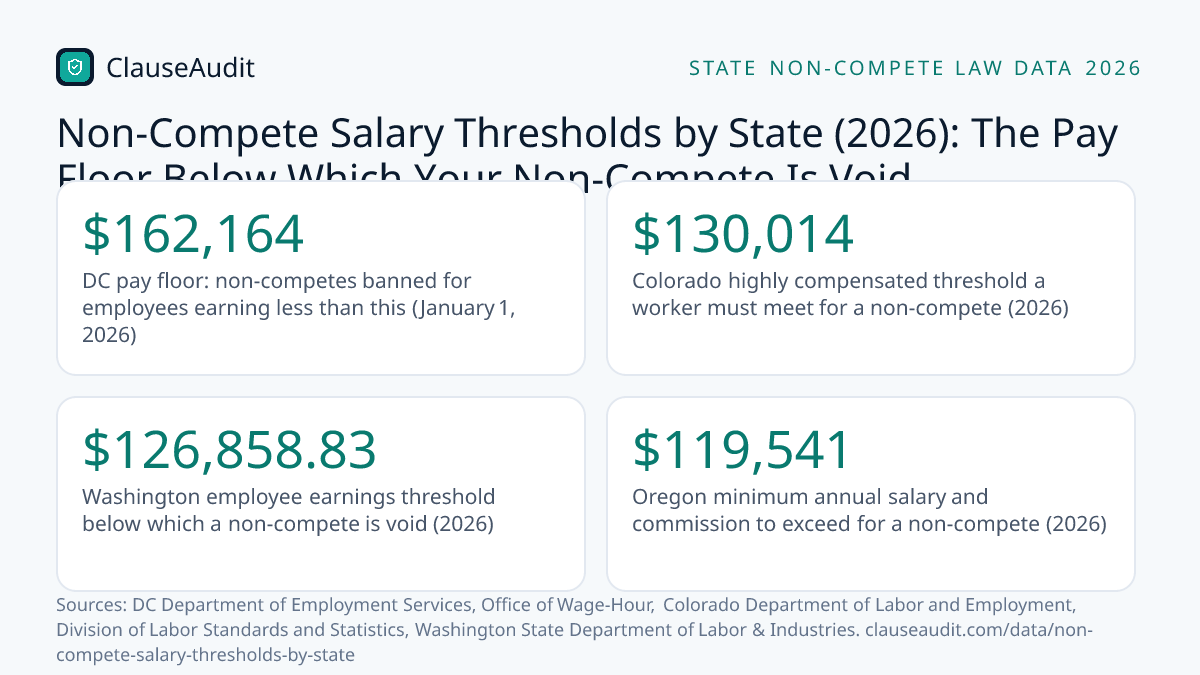
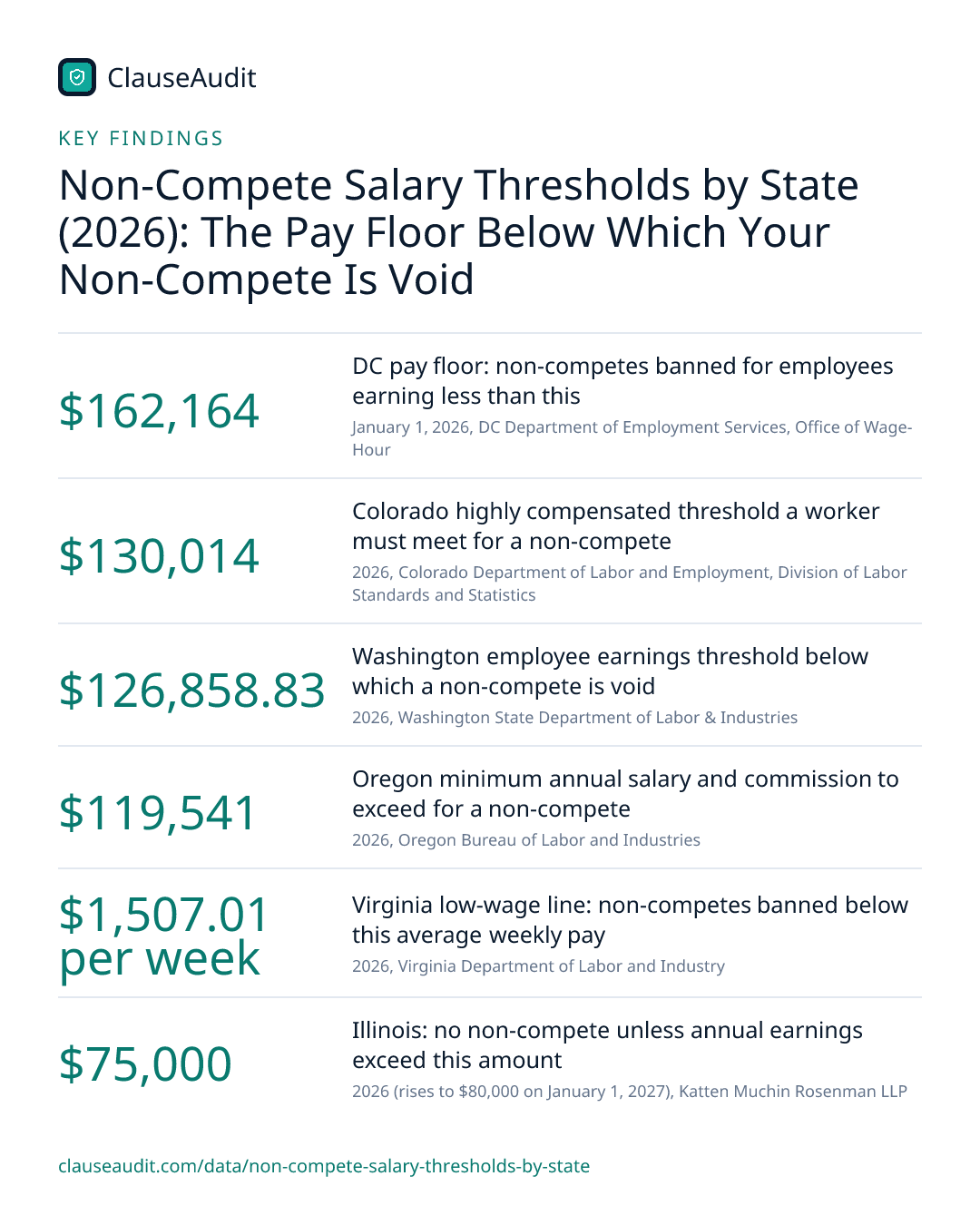
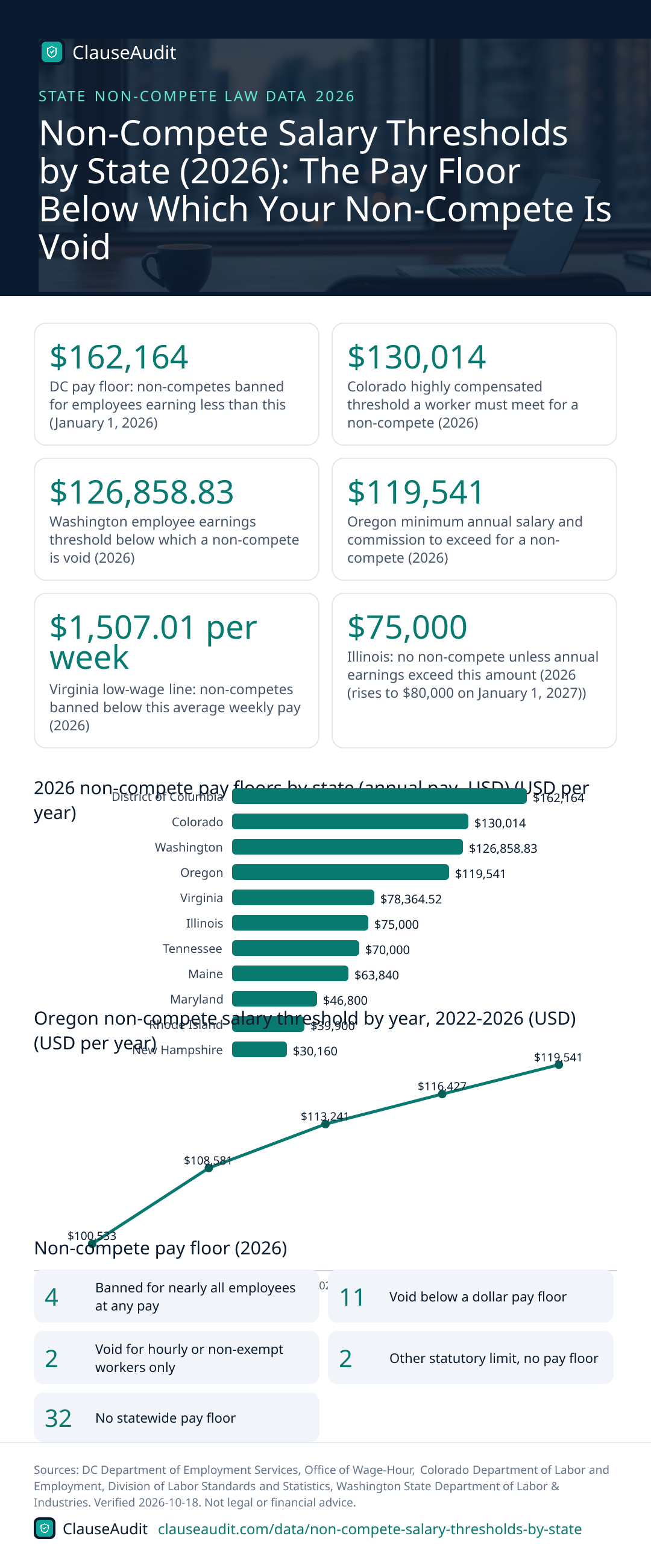
Only some states set one, and where they do, a non-compete signed by someone paid below the floor is void. DC has the highest 2026 floor at $162,164. Colorado ($130,014), Washington ($126,858.83) and Oregon ($119,541) follow, then Virginia ($1,507.01 a week), Illinois ($75,000) and Tennessee ($70,000). Most states have no pay floor at all.

- DC pay floor: non-competes banned for employees earning less than this (January 1, 2026, DC Department of Employment Services, Office of Wage-Hour)
- $162,164
- Colorado highly compensated threshold a worker must meet for a non-compete (2026, Colorado Department of Labor and Employment, Division of Labor Standards and Statistics)
- $130,014
- Washington employee earnings threshold below which a non-compete is void (2026, Washington State Department of Labor & Industries)
- $126,858.83
- Oregon minimum annual salary and commission to exceed for a non-compete (2026, Oregon Bureau of Labor and Industries)
- $119,541
- Virginia low-wage line: non-competes banned below this average weekly pay (2026, Virginia Department of Labor and Industry)
- $1,507.01 per week
- Illinois: no non-compete unless annual earnings exceed this amount (2026 (rises to $80,000 on January 1, 2027), Katten Muchin Rosenman LLP)
- $75,000
- Tennessee's new pay floor below which non-competes are void (Effective July 1, 2026, State of Tennessee, Secretary of State (Acts of the 114th General Assembly))
- $70,000
- Date Washington's near-total non-compete ban replaces its salary threshold (Signed March 23, 2026, Washington State Legislature)
- June 30, 2027
A non-compete salary threshold is a pay line written into state law. Earn less than it, and your employer generally cannot hold you to a non-compete, no matter what you signed. Earn more, and the clause may stand, subject to the state's other rules.
The lines vary a lot. In 2026 DC sits at $162,164 while New Hampshire works out to about $30,160 a year, and most states have no floor at all. Several of these numbers reset every January, so a figure you looked up last year may already be stale. Below we explain how to read your state's floor, what counts as pay, and what to do with your contract.
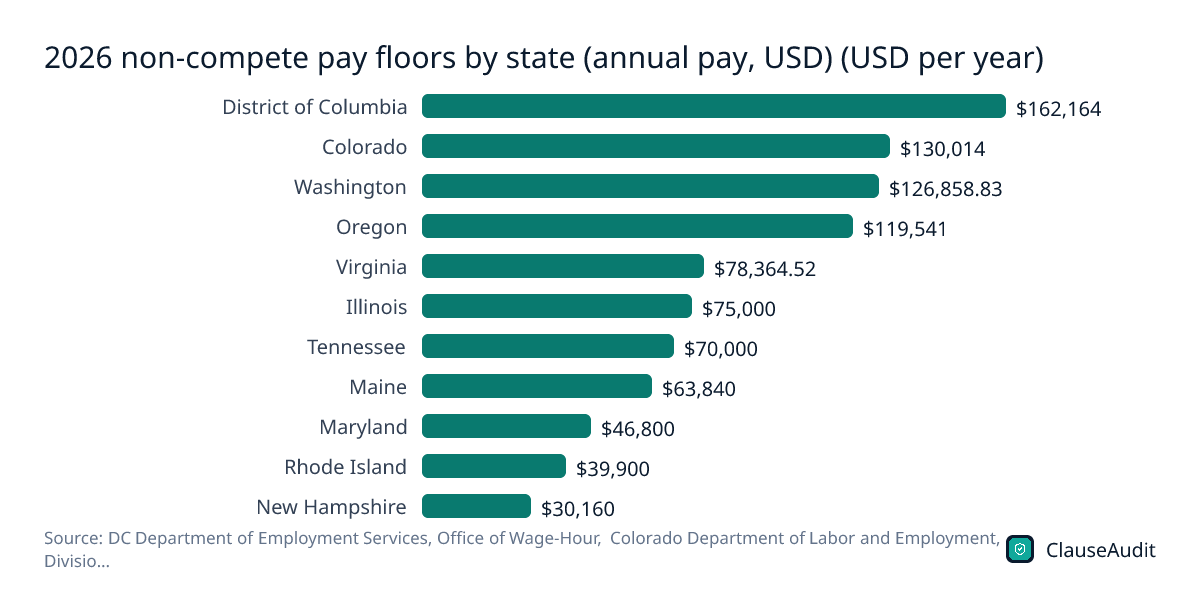
2026 non-compete pay floors by state (annual pay, USD) (USD per year)
Chart data
| Label | Value |
|---|---|
| District of Columbia | $162,164 |
| Colorado | $130,014 |
| Washington | $126,858.83 |
| Oregon | $119,541 |
| Virginia | $78,364.52 |
| Illinois | $75,000 |
| Tennessee | $70,000 |
| Maine | $63,840 |
| Maryland | $46,800 |
| Rhode Island | $39,900 |
| New Hampshire | $30,160 |
The top of the chart is mostly states that index the floor to inflation, so these numbers climb every year. The bottom group ties the line to the poverty level or the minimum wage, which protects lower-paid workers but rarely reaches salaried professionals.
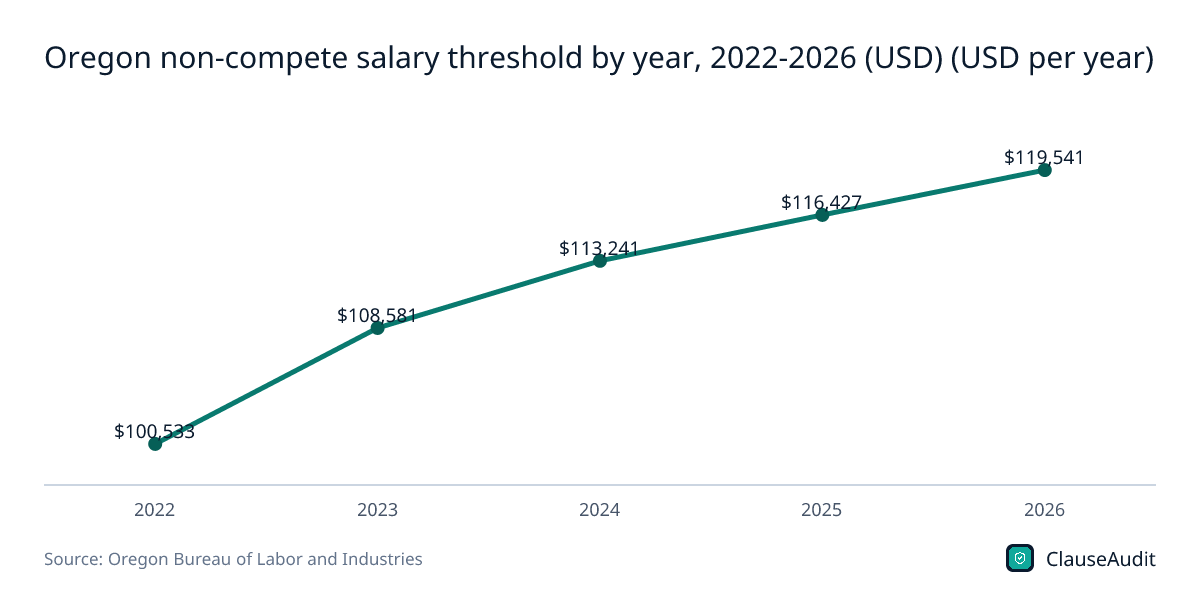
Download this chart (PNG)Oregon non-compete salary threshold by year, 2022-2026 (USD) (USD per year)
Chart data
| Label | Value (USD per year) |
|---|---|
| 2022 | $100,533 |
| 2023 | $108,581 |
| 2024 | $113,241 |
| 2025 | $116,427 |
| 2026 | $119,541 |
Oregon's floor went from $100,533 in 2022 to $119,541 in 2026. A worker who cleared the line comfortably when they signed can find their raise has not kept up.
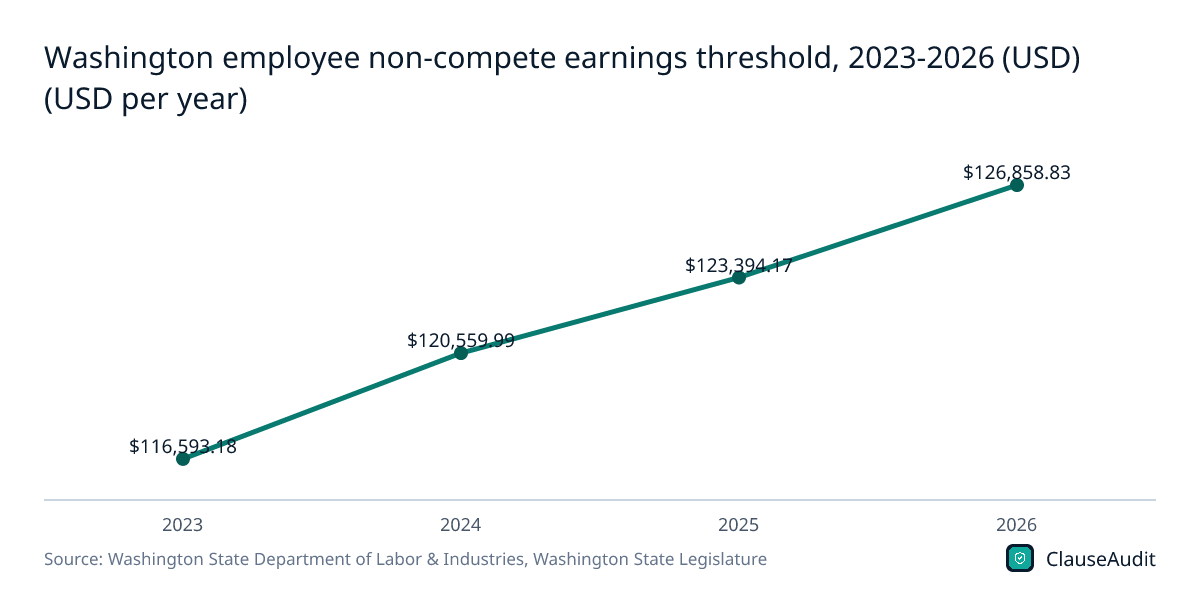
Download this chart (PNG)Washington employee non-compete earnings threshold, 2023-2026 (USD) (USD per year)
Chart data
| Label | Value (USD per year) |
|---|---|
| 2023 | $116,593.18 |
| 2024 | $120,559.99 |
| 2025 | $123,394.17 |
| 2026 | $126,858.83 |
Washington's employee threshold rose every year to $126,858.83 in 2026. The yearly climb ends when the near-total ban takes over on June 30, 2027.
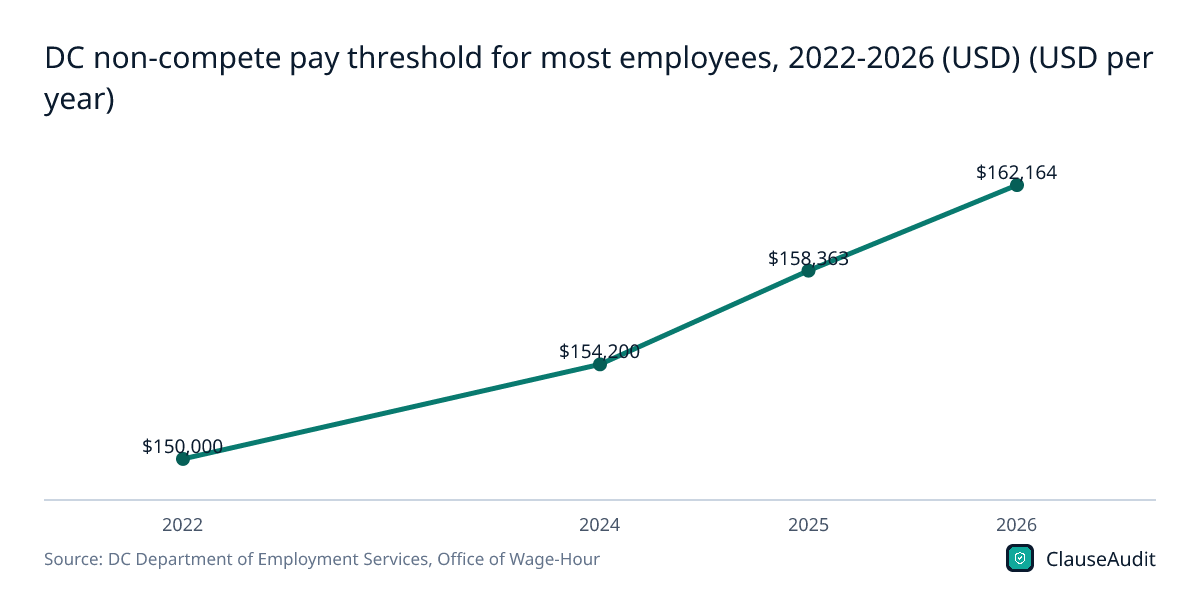
Download this chart (PNG)DC non-compete pay threshold for most employees, 2022-2026 (USD) (USD per year)
Chart data
| Label | Value (USD per year) |
|---|---|
| 2022 | $150,000 |
| 2024 | $154,200 |
| 2025 | $158,363 |
| 2026 | $162,164 |
DC started at $150,000 in 2022 and reached $162,164 in 2026. It remains the highest general floor in the country.
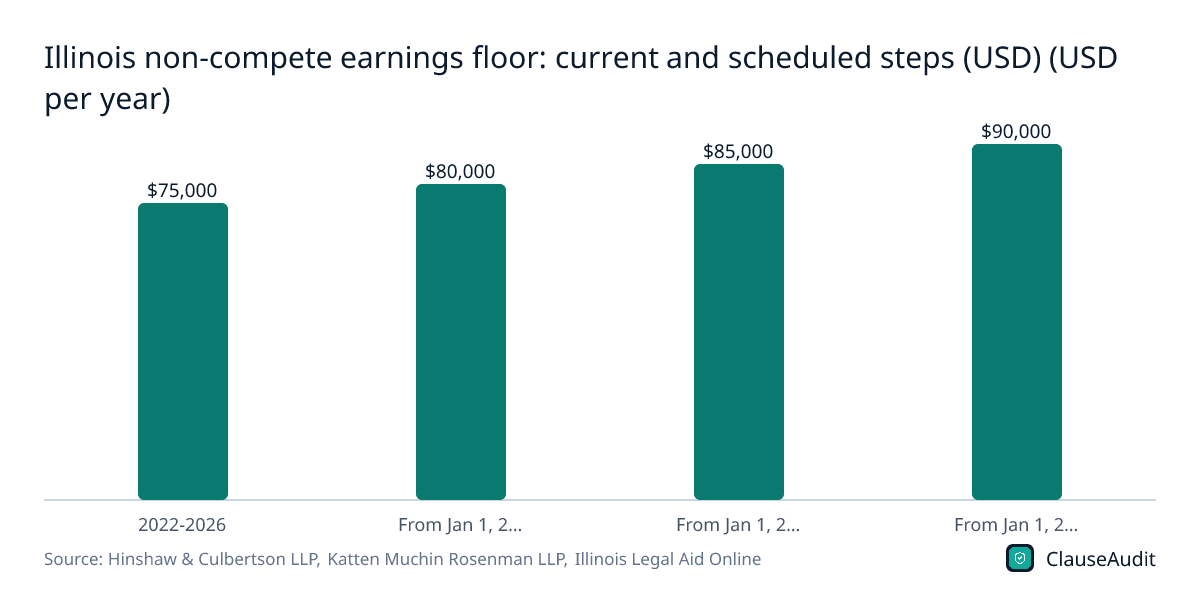
Download this chart (PNG)Illinois non-compete earnings floor: current and scheduled steps (USD) (USD per year)
Chart data
| Label | Value (USD per year) |
|---|---|
| 2022-2026 | $75,000 |
| From Jan 1, 2027 | $80,000 |
| From Jan 1, 2032 | $85,000 |
| From Jan 1, 2037 | $90,000 |
Illinois uses fixed steps instead of yearly indexing. The floor moves to $80,000 on January 1, 2027, so check which amount applied on the date you signed.
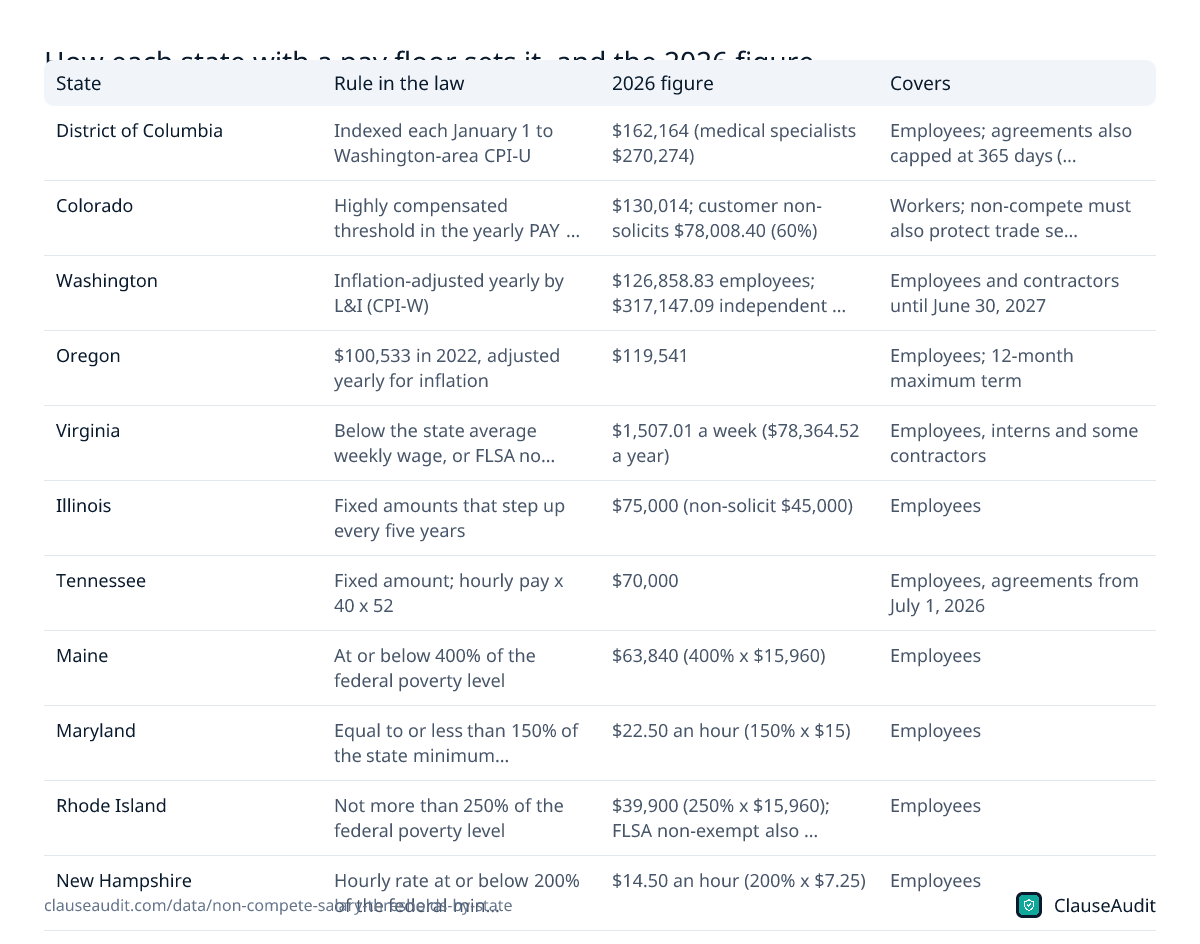
Download this chart (PNG)How each state with a pay floor sets it, and the 2026 figure
| State | Rule in the law | 2026 figure | Covers |
|---|---|---|---|
| District of Columbia | Indexed each January 1 to Washington-area CPI-U | $162,164 (medical specialists $270,274) | Employees; agreements also capped at 365 days (730 for medical specialists) |
| Colorado | Highly compensated threshold in the yearly PAY CALC Order (EAP salary x 2.25) | $130,014; customer non-solicits $78,008.40 (60%) | Workers; non-compete must also protect trade secrets |
| Washington | Inflation-adjusted yearly by L&I (CPI-W) | $126,858.83 employees; $317,147.09 independent contractors | Employees and contractors until June 30, 2027 |
| Oregon | $100,533 in 2022, adjusted yearly for inflation | $119,541 | Employees; 12-month maximum term |
| Virginia | Below the state average weekly wage, or FLSA non-exempt | $1,507.01 a week ($78,364.52 a year) | Employees, interns and some contractors |
| Illinois | Fixed amounts that step up every five years | $75,000 (non-solicit $45,000) | Employees |
| Tennessee | Fixed amount; hourly pay x 40 x 52 | $70,000 | Employees, agreements from July 1, 2026 |
| Maine | At or below 400% of the federal poverty level | $63,840 (400% x $15,960) | Employees |
| Maryland | Equal to or less than 150% of the state minimum wage | $22.50 an hour (150% x $15) | Employees |
| Rhode Island | Not more than 250% of the federal poverty level | $39,900 (250% x $15,960); FLSA non-exempt also covered | Employees |
| New Hampshire | Hourly rate at or below 200% of the federal minimum wage | $14.50 an hour (200% x $7.25) | Employees |
| Massachusetts | No dollar floor; FLSA non-exempt employees covered | Federal EAP salary level $684 a week ($35,568) | Agreements on or after October 1, 2018 |
| Nevada | No dollar floor; employees paid solely hourly (exclusive of tips) | Not a dollar figure | Hourly employees since October 1, 2021 |
Source: DC Department of Employment Services, Office of Wage-Hour, District of Columbia Prohibition on Non-Compete Clauses, Public Notice (2026); Colorado Department of Labor and Employment, Division of Labor Standards and Statistics, 2026 Publication and Yearly Calculation of Adjusted Labor Compensation (PAY CALC) Order, 7 CCR 1103-14; Epstein Becker & Green, P.C. (Daniel R. Levy, Gianna Dano), Raising the Cost of Noncompetes: 2026 State Noncompete Salary Threshold Changes; Washington State Department of Labor & Industries, Non-Compete Agreements (earnings thresholds, RCW 49.62); Oregon Bureau of Labor and Industries, Noncompetition Agreements (minimum salary and commission requirements by year); Oregon Revised Statutes (via oregon.public.law), ORS 653.295 Noncompetition agreements; Virginia Department of Labor and Industry, Notice of the Average Weekly Wage for 2026; Code of Virginia (Virginia Legislative Information System), Va. Code § 40.1-28.7:8 Covenants not to compete prohibited; low-wage employees and health care professionals; Katten Muchin Rosenman LLP, Illinois Enacts Restrictions on the Use of Non-Compete Agreements: What Employers Need to Know; State of Tennessee, Secretary of State (Acts of the 114th General Assembly), Public Chapter No. 934 (House Bill No. 1034), covenants not to compete; Maine Legislature, Maine Revised Statutes, 26 M.R.S. § 599-A Restrictions on noncompete agreements; U.S. Department of Health and Human Services, ASPE, Poverty Guidelines (2026); Maryland General Assembly, Md. Code, Labor and Employment § 3-716; Maryland Department of Labor, Employment Standards Service, Maryland Minimum Wage and Overtime Law; New Hampshire General Court bill text (via NH Liberty Alliance bill archive), SB 197 (2019), Chapter 201, final version: noncompete agreements for low-wage employees (RSA 275:70-a); Epstein Becker & Green, P.C., Massachusetts Passes New Law Governing Non-Competition Agreements (Act Now Advisory); Fisher Phillips, Nevada Bans Noncompetition Agreements for Hourly Workers; U.S. Department of Labor, Wage and Hour Division, Earnings thresholds for the Executive, Administrative, and Professional exemption; Fair Competition Law blog, chart by Beck Reed Riden LLP, Updated Restrictive Covenant Low-Wage Threshold Criteria Chart (January 21, 2026). Download as image
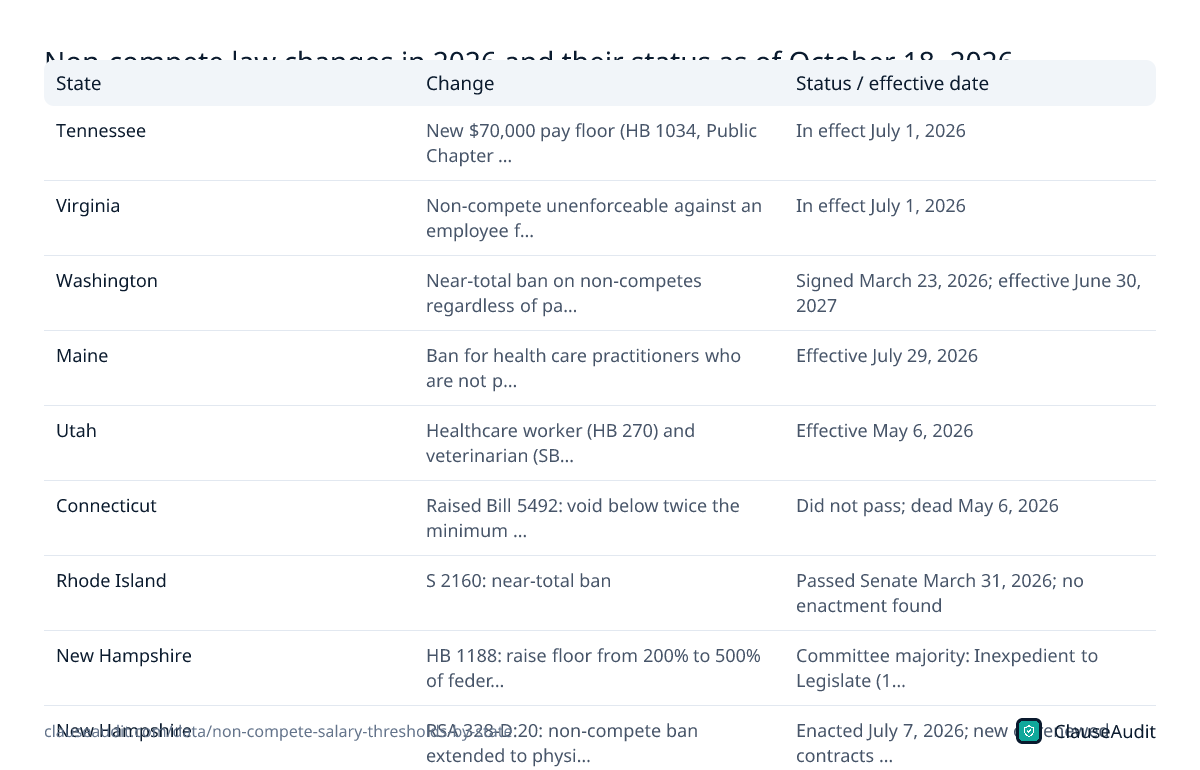
Non-compete law changes in 2026 and their status as of October 18, 2026
| State | Change | Status / effective date |
|---|---|---|
| Tennessee | New $70,000 pay floor (HB 1034, Public Chapter 934) | In effect July 1, 2026 |
| Virginia | Non-compete unenforceable against an employee fired without cause unless severance is paid (SB 170) | In effect July 1, 2026 |
| Washington | Near-total ban on non-competes regardless of pay (ESHB 1155) | Signed March 23, 2026; effective June 30, 2027 |
| Maine | Ban for health care practitioners who are not part owners | Effective July 29, 2026 |
| Utah | Healthcare worker (HB 270) and veterinarian (SB 111) limits | Effective May 6, 2026 |
| Connecticut | Raised Bill 5492: void below twice the minimum wage | Did not pass; dead May 6, 2026 |
| Rhode Island | S 2160: near-total ban | Passed Senate March 31, 2026; no enactment found |
| New Hampshire | HB 1188: raise floor from 200% to 500% of federal minimum wage | Committee majority: Inexpedient to Legislate (11-9, Feb 10, 2026); did not become law |
| New Hampshire | RSA 328-D:20: non-compete ban extended to physician assistants | Enacted July 7, 2026; new or renewed contracts after that date |
| Ohio | SB 11: full non-compete ban | Pending in Senate Judiciary Committee as of April 9, 2026; not enacted |
Source: State of Tennessee, Secretary of State (Acts of the 114th General Assembly), Public Chapter No. 934 (House Bill No. 1034), covenants not to compete; Covington & Burling LLP, Inside Jobs blog, Non-Compete Roundup Summer 2026: New Limitations on Restrictive Covenants; Mayer Brown, Recent Developments in US Noncompete Law; Washington State Legislature, HB 1155 (2025-26): Prohibiting noncompetition agreements and clarifying nonsolicitation agreements, bill summary; BillTrack50, CT HB05492 (2026) bill detail; JD Supra (law firm article), Pending Non-Compete Bans and Wage Thresholds: 2026 Legislative Developments; New Hampshire General Court bill text (via NH Liberty Alliance bill archive), HB 1188 (2026) as introduced: relative to noncompete agreements for low-wage employees; PolicyRisk state bill tracker, IN SB 132 (2026) bill page; Citizens Count (New Hampshire), HB 1188 (2026). Download as image
Non-compete pay floor (2026) by state
- 4Banned for nearly all employees at any pay
- 11Void below a dollar pay floor
- 2Void for hourly or non-exempt workers only
- 2Other statutory limit, no pay floor
- 32No statewide pay floor
- Banned for nearly all employees at any pay4
- Void below a dollar pay floor11
- Void for hourly or non-exempt workers only2
- Other statutory limit, no pay floor2
- No statewide pay floor32
| State | 2026 pay floor (void at or below) | How it is set | 2026 change or pending bill | Source |
|---|---|---|---|---|
| Alabama | None | No statewide pay floor in statute | None found in 2026 | Beck Reed Riden 2026 threshold chart (Jan 21, 2026), cross-checked with Covington (Jul 31, 2026) and Mayer Brown (Oct 2026) roundups |
| Alaska | None | No statewide pay floor in statute | None found in 2026 | Beck Reed Riden 2026 threshold chart (Jan 21, 2026), cross-checked with Covington (Jul 31, 2026) and Mayer Brown (Oct 2026) roundups |
| Arizona | None | No statewide pay floor in statute | None found in 2026 | Beck Reed Riden 2026 threshold chart (Jan 21, 2026), cross-checked with Covington (Jul 31, 2026) and Mayer Brown (Oct 2026) roundups |
| Arkansas | None | No statewide pay floor in statute | None found in 2026 | Beck Reed Riden 2026 threshold chart (Jan 21, 2026), cross-checked with Covington (Jul 31, 2026) and Mayer Brown (Oct 2026) roundups |
| California | Banned at any pay | Void for employees regardless of pay (sale-of-business exceptions) | Stay-or-pay limits from January 1, 2026 (AB 692) | Cal. Bus. & Prof. Code § 16600 |
| Colorado | Under $130,014 (customer non-solicits under $78,008.40) | Highly compensated threshold in the PAY CALC Order; covenant must also protect trade secrets | Up from $127,091 in 2025 | C.R.S. § 8-2-113; 7 CCR 1103-14 |
| Connecticut | None | No statewide pay floor in statute | Raised Bill 5492 (void below twice minimum wage) died May 6, 2026 | BillTrack50, CT HB05492 (dead May 6, 2026); no threshold state per Beck Reed Riden 2026 chart |
| Delaware | None | No statewide pay floor in statute | None found in 2026 | Beck Reed Riden 2026 threshold chart (Jan 21, 2026), cross-checked with Covington (Jul 31, 2026) and Mayer Brown (Oct 2026) roundups |
| District of Columbia | Under $162,164 (medical specialists under $270,274) | Indexed yearly to Washington-area CPI-U | Up from $158,363 in 2025 | D.C. Code § 32-581.01 to .05 |
| Florida | No floor; higher pay unlocks stronger enforcement | CHOICE Act covers employees earning more than twice the county annual mean wage | CHOICE Act effective July 1, 2025 | Fla. Stat. §§ 542.41-542.45 |
| Georgia | None | No statewide pay floor in statute | None found in 2026 | Beck Reed Riden 2026 threshold chart (Jan 21, 2026), cross-checked with Covington (Jul 31, 2026) and Mayer Brown (Oct 2026) roundups |
| Hawaii | None | No statewide pay floor in statute | None found in 2026 | Beck Reed Riden 2026 threshold chart (Jan 21, 2026), cross-checked with Covington (Jul 31, 2026) and Mayer Brown (Oct 2026) roundups |
| Idaho | None | No statewide pay floor in statute | None found in 2026 | Beck Reed Riden 2026 threshold chart (Jan 21, 2026), cross-checked with Covington (Jul 31, 2026) and Mayer Brown (Oct 2026) roundups |
| Illinois | $75,000 or less (non-solicits $45,000 or less) | Fixed amounts in the Freedom to Work Act | Rises to $80,000 (non-solicits $47,500) on January 1, 2027 | 820 ILCS 90/10 |
| Indiana | None | No statewide pay floor in statute | SB 132 (under $150,000) died in committee in 2026 | Beck Reed Riden 2026 threshold chart (Jan 21, 2026), cross-checked with Covington (Jul 31, 2026) and Mayer Brown (Oct 2026) roundups |
| Iowa | None | No statewide pay floor in statute | None found in 2026 | Beck Reed Riden 2026 threshold chart (Jan 21, 2026), cross-checked with Covington (Jul 31, 2026) and Mayer Brown (Oct 2026) roundups |
| Kansas | None | No statewide pay floor in statute | None found in 2026 | Beck Reed Riden 2026 threshold chart (Jan 21, 2026), cross-checked with Covington (Jul 31, 2026) and Mayer Brown (Oct 2026) roundups |
| Kentucky | None | No statewide pay floor in statute | None found in 2026 | Beck Reed Riden 2026 threshold chart (Jan 21, 2026), cross-checked with Covington (Jul 31, 2026) and Mayer Brown (Oct 2026) roundups |
| Louisiana | None | No statewide pay floor in statute | None found in 2026 | Beck Reed Riden 2026 threshold chart (Jan 21, 2026), cross-checked with Covington (Jul 31, 2026) and Mayer Brown (Oct 2026) roundups |
| Maine | At or below $63,840 | 400% of the federal poverty level ($15,960 for one person in 2026) | Health care practitioner ban effective July 29, 2026 | 26 M.R.S. § 599-A |
| Maryland | At or below $22.50 an hour | 150% of the $15 state minimum wage | None found in 2026 | Md. Code, Lab. & Empl. § 3-716 |
| Massachusetts | No dollar floor; FLSA non-exempt employees | Also students/interns, workers 18 or younger, and those fired without cause | S 1336 (full ban) pending | M.G.L. c. 149, § 24L |
| Michigan | None | No statewide pay floor in statute | None found in 2026 | Beck Reed Riden 2026 threshold chart (Jan 21, 2026), cross-checked with Covington (Jul 31, 2026) and Mayer Brown (Oct 2026) roundups |
| Minnesota | Banned at any pay | Any covenant not to compete is void (sale-of-business exception) | None found in 2026 | Minn. Stat. § 181.988 |
| Mississippi | None | No statewide pay floor in statute | None found in 2026 | Beck Reed Riden 2026 threshold chart (Jan 21, 2026), cross-checked with Covington (Jul 31, 2026) and Mayer Brown (Oct 2026) roundups |
| Missouri | None | No statewide pay floor in statute | None found in 2026 | Beck Reed Riden 2026 threshold chart (Jan 21, 2026), cross-checked with Covington (Jul 31, 2026) and Mayer Brown (Oct 2026) roundups |
| Montana | None | No statewide pay floor in statute | Physician non-compete limits extended January 1, 2026; no pay floor | Nukk-Freeman & Cerra, 2026 Restrictive Covenant Roundup (May 13, 2026) |
| Nebraska | None | No statewide pay floor in statute | None found in 2026 | Beck Reed Riden 2026 threshold chart (Jan 21, 2026), cross-checked with Covington (Jul 31, 2026) and Mayer Brown (Oct 2026) roundups |
| Nevada | No dollar floor; employees paid solely hourly | Hourly wage basis, exclusive of tips | None found in 2026 | NRS 613.195 |
| New Hampshire | At or below $14.50 an hour (about $30,160 a year) | 200% of the $7.25 federal minimum wage | HB 1188 (raise to 500%) died in 2026. New RSA 328-D:20 (enacted July 7, 2026) bans non-competes for physician assistants | RSA 275:70-a |
| New Jersey | None | No statewide pay floor in statute | SB 1407/A 1829 pending; not enacted | Beck Reed Riden 2026 threshold chart (Jan 21, 2026), cross-checked with Covington (Jul 31, 2026) and Mayer Brown (Oct 2026) roundups |
| New Mexico | None | No statewide pay floor in statute | None found in 2026 | Beck Reed Riden 2026 threshold chart (Jan 21, 2026), cross-checked with Covington (Jul 31, 2026) and Mayer Brown (Oct 2026) roundups |
| New York | None | No statewide pay floor in statute | SB 4641 (under $500,000) pending; not enacted | Beck Reed Riden 2026 threshold chart (Jan 21, 2026), cross-checked with Covington (Jul 31, 2026) and Mayer Brown (Oct 2026) roundups |
| North Carolina | None | No statewide pay floor in statute | HB 269 (under $75,000) pending; not enacted | Beck Reed Riden 2026 threshold chart (Jan 21, 2026), cross-checked with Covington (Jul 31, 2026) and Mayer Brown (Oct 2026) roundups |
| North Dakota | Banned at any pay | Contracts restraining a lawful profession or trade are void, with sale-of-business exceptions | None found in 2026 | N.D.C.C. § 9-08-06 |
| Ohio | None | No statewide pay floor in statute | SB 11 (full ban) pending in Senate Judiciary Committee; not enacted | Beck Reed Riden 2026 threshold chart (Jan 21, 2026), cross-checked with Covington (Jul 31, 2026) and Mayer Brown (Oct 2026) roundups |
| Oklahoma | Banned at any pay | Employee non-competes void; sale-of-business exceptions may apply | None found in 2026 | 15 O.S. § 219A |
| Oregon | $119,541 or less | $100,533 (2022) adjusted yearly for inflation | Up from $116,427 in 2025 | ORS 653.295 |
| Pennsylvania | None | No statewide pay floor in statute | None found in 2026 | Beck Reed Riden 2026 threshold chart (Jan 21, 2026), cross-checked with Covington (Jul 31, 2026) and Mayer Brown (Oct 2026) roundups |
| Rhode Island | Not more than $39,900, or any FLSA non-exempt employee | 250% of the federal poverty level for individuals | S 2160 (near-total ban) passed Senate March 31, 2026; not enacted | R.I. Gen. Laws §§ 28-59-2, 28-59-3 |
| South Carolina | None | No statewide pay floor in statute | None found in 2026 | Beck Reed Riden 2026 threshold chart (Jan 21, 2026), cross-checked with Covington (Jul 31, 2026) and Mayer Brown (Oct 2026) roundups |
| South Dakota | None | No statewide pay floor in statute | None found in 2026 | Beck Reed Riden 2026 threshold chart (Jan 21, 2026), cross-checked with Covington (Jul 31, 2026) and Mayer Brown (Oct 2026) roundups |
| Tennessee | Under $70,000 annualized compensation | Fixed amount; hourly rate x 40 x 52 | New law effective July 1, 2026 | Tenn. Code Ann. § 50-1-211 (Pub. Ch. 934) |
| Texas | None | No statewide pay floor in statute | None found in 2026 | Beck Reed Riden 2026 threshold chart (Jan 21, 2026), cross-checked with Covington (Jul 31, 2026) and Mayer Brown (Oct 2026) roundups |
| Utah | None | No statewide pay floor in statute | Healthcare worker and veterinarian limits effective May 6, 2026 | Covington, Non-Compete Roundup Summer 2026 (Jul 31, 2026) |
| Vermont | None | No statewide pay floor in statute | Pay-floor bill pending; not enacted | Beck Reed Riden 2026 threshold chart (Jan 21, 2026), cross-checked with Covington (Jul 31, 2026) and Mayer Brown (Oct 2026) roundups |
| Virginia | Under $1,507.01 a week ($78,364.52 a year), or any FLSA non-exempt employee | Below the Commonwealth's average weekly wage | Severance required to enforce after a without-cause firing, from July 1, 2026 | Va. Code § 40.1-28.7:8 |
| Washington | $126,858.83 or less (contractors $317,147.09) | Inflation-adjusted yearly by L&I | Near-total ban regardless of pay from June 30, 2027 (ESHB 1155) | RCW 49.62.020, .030, .040 |
| West Virginia | None | No statewide pay floor in statute | None found in 2026 | Beck Reed Riden 2026 threshold chart (Jan 21, 2026), cross-checked with Covington (Jul 31, 2026) and Mayer Brown (Oct 2026) roundups |
| Wisconsin | None | No statewide pay floor in statute | None found in 2026 | Beck Reed Riden 2026 threshold chart (Jan 21, 2026), cross-checked with Covington (Jul 31, 2026) and Mayer Brown (Oct 2026) roundups |
| Wyoming | No pay floor | Void for skilled or unskilled labor except executives, management and their professional staff, trade secrets, and sale of a business | Applies to contracts from July 1, 2025 | W.S. 1-23-108 |
What is a non-compete salary threshold?
It is the minimum pay a worker must earn before a state lets an employer enforce a non-compete against them. Lawmakers added these floors because non-competes were showing up in contracts for cashiers, warehouse staff and junior office workers who had no trade secrets to protect and no real power to refuse.
States set the line in different ways. DC, Colorado, Washington and Oregon tie it to inflation or a yearly state order, which is why their figures change each year. Illinois and Tennessee use fixed dollar amounts. Maine and Rhode Island use multiples of the federal poverty level. Maryland and New Hampshire use multiples of a minimum wage, so their floors are hourly rates. Virginia uses the state's average weekly wage, $1,507.01 a week in 2026.
A few states skip the dollar figure entirely. Massachusetts protects FLSA non-exempt employees, and Nevada protects employees paid solely by the hour. At the other end, California, Minnesota, North Dakota and Oklahoma ban employee non-competes at any pay, so a salary threshold never comes into it.
Is my non-compete void if I earn less than the threshold?
In the states with a floor, generally yes, as long as your pay is under the line that applied when the agreement was made. Colorado also checks your pay again when the employer tries to enforce it. Picture a marketing coordinator in Oregon who signs a non-compete in 2026 with a salary well under $119,541, the state's 2026 figure. The restriction fails the pay test before a court even looks at how broad it is.
Now take a product manager in Colorado whose salary sits comfortably above $130,014. She clears the threshold, but Colorado also requires the covenant to protect trade secrets. Earning enough is only the first gate, not the last one.
Watch the wording each state uses. DC protects employees earning less than $162,164. Oregon's salary must exceed its figure. Illinois voids non-competes for anyone earning $75,000 or less. Someone paid exactly the threshold amount can land on different sides depending on the state.
What counts as pay for the threshold?
This is where a lot of disputes start. Some states count base salary plus commission. Oregon, for example, refers to annual salary and commission. Others look at total earnings or annualized compensation. Tennessee converts hourly pay by multiplying the rate by 40 hours and 52 weeks, so an hourly employee is measured on that annualized figure.
Bonuses, equity and benefits are the gray zone. A sign-on bonus might push your first-year pay over the line on paper while your regular salary sits below it. If your pay is close to the floor, look at the statute's exact wording, or ask an employment lawyer which pieces count in your state.
Which states changed their non-compete rules in 2026?
Tennessee added a $70,000 floor for agreements from July 1, 2026. Virginia, from the same date, made non-competes unenforceable against employees fired without cause unless severance is paid. Washington signed a near-total ban on March 23, 2026 that takes effect June 30, 2027, replacing its salary threshold. Maine added a ban for health care practitioners who are not part owners.
Other proposals stalled. Connecticut's bill to void non-competes below twice the minimum wage died, and New Hampshire's bill to raise its floor did not become law. Rhode Island, Ohio, New York and New Jersey had bills in motion with no enactment found as of October 2026. If you work in those states, treat the current rule as the rule until a new law actually passes.
Which state's threshold applies if I work remotely or move?
Usually the law of the state where you live and work carries the most weight, but your contract may say otherwise. Many employers add a choice-of-law clause naming their home state, often one with no pay floor, and a venue clause sending any fight to their local courts.
Some states push back on that. California, for example, will not let an employer use another state's law to enforce a non-compete against someone working there. Other states are less clear, and the answer can depend on where you were living when you signed.
If you move after signing, keep a copy of the agreement and note the date and your pay at the time. Those facts (the state, the date and your pay) decide most threshold questions. A move from a state with no floor into Oregon or Illinois does not necessarily void an older agreement, so it is worth getting a lawyer's view before you accept a competing offer.
What to do before you sign a non-compete
- Find your state's floor in the table above and compare it to your guaranteed base pay, not your hoped-for bonus.
- Check the date. Many floors change on January 1, and Illinois steps up to $80,000 on January 1, 2027.
- Look for a non-solicit clause too. Illinois uses a separate $45,000 floor for non-solicits, and Colorado uses 60% of its threshold for customer non-solicits.
- If you are a contractor, read the contract anyway. Washington applies a separate $317,147.09 threshold to independent contractors.
- If your pay is under the line, ask the employer to remove the clause rather than relying on it being void later. A short written change costs them nothing.
- If you earn above the floor, negotiate the scope: a shorter term, a narrower list of competitors and a defined geography.
What employers and small businesses should check
If you hire across state lines, one template non-compete will not fit. A clause that may hold up for a senior engineer in Texas, which has no pay floor, is void for an engineer on the same salary in DC if that salary is under $162,164. Several states also penalize employers who put unlawful non-competes in front of workers, so keeping a void clause in the template is not harmless.
Review your offer letters each January when the indexed floors reset. For roles near the line, a confidentiality agreement and a narrow customer non-solicit often protect what you actually care about without the enforcement risk.
How ClauseAudit helps
Upload your offer letter or employment agreement and the automated review pulls out every restrictive covenant, then checks it against your state's rules, including the 2026 pay floors on this page.
You get a plain English summary of which clauses look unenforceable, which look risky, and what to ask for before you sign.
- Non-compete term, geography and the list of restricted competitors
- Your stated base pay and commission compared with your state's pay floor
- Customer and employee non-solicit clauses, which can have their own floors
- Choice-of-law and venue clauses that try to move the contract to a friendlier state
- Severance terms tied to the restriction after a without-cause firing
- Confidentiality and IP assignment clauses that act like a hidden non-compete
Frequently asked questions
Which state has the highest non-compete salary threshold?
DC has the highest general floor in 2026. Non-competes are banned for employees earning less than $162,164, and for medical specialists the line is $270,274. The figure is indexed to inflation every January 1. Even above the line, DC caps a permitted non-compete at 365 days for most employees.
What is the Colorado non-compete salary threshold for 2026?
Colorado's highly compensated threshold is $130,014 for 2026, set by the yearly PAY CALC Order. It rose from $127,091 in 2025. Customer non-solicits use 60% of that figure, $78,008.40. Clearing the pay line is not enough on its own: the non-compete must also protect trade secrets.
What is the Washington non-compete salary threshold in 2026?
For employees it is $126,858.83, and for independent contractors it is $317,147.09. A non-compete with someone earning at or below those amounts is void. That system ends on June 30, 2027, when a near-total ban takes effect regardless of pay.
What is the Illinois non-compete salary threshold?
Illinois bars non-competes for employees earning $75,000 or less, and non-solicits for those earning $45,000 or less. Both rise on January 1, 2027, to $80,000 and $47,500. The amounts are fixed in the Freedom to Work Act and step up every five years rather than every year.
Does Tennessee have a non-compete salary threshold now?
Yes. Starting July 1, 2026, Tennessee voids non-competes for employees paid under $70,000 in annualized compensation. Hourly pay is converted by multiplying the rate by 40 hours and 52 weeks. The law applies to agreements made on or after that date, so older contracts follow the prior rules.
Does Virginia's low-wage rule use a dollar amount?
Virginia uses the state's average weekly wage. In 2026 that is $1,507.01 a week, or $78,364.52 a year over 52 weeks. Employees below it are protected, and so is any FLSA non-exempt employee regardless of pay. From July 1, 2026, a worker fired without cause also cannot be held to a non-compete unless severance is paid.
What if my state has no salary threshold?
Most states have none. That does not make every non-compete enforceable. Courts in those states still ask whether the restriction is reasonable in length, geography and scope, and whether it protects a real business interest. A broad clause can still fail, but you will have to argue the point instead of pointing to a pay line.
Does a salary threshold apply to independent contractors?
Usually the floors are written for employees. Washington is the clearest exception, with a separate $317,147.09 threshold for contractors until June 30, 2027. Virginia's rule also reaches some contractors. If you freelance, check the actual wording of your state's law, and remember that a client can still ask for a non-solicit.
Use this data
Every chart and card below is free to reuse under CC BY 4.0. Download what you need and link back to this page.
 Stat cards
 Key findings card
 Infographic
 2026 non-compete pay floors by state (annual pay, USD) (USD per year)
 Oregon non-compete salary threshold by year, 2022-2026 (USD) (USD per year)
 Washington employee non-compete earnings threshold, 2023-2026 (USD) (USD per year)
 DC non-compete pay threshold for most employees, 2022-2026 (USD) (USD per year)
 Illinois non-compete earnings floor: current and scheduled steps (USD) (USD per year)
 How each state with a pay floor sets it, and the 2026 figure
 Non-compete law changes in 2026 and their status as of October 18, 2026
Embed the infographic
Free to share on your site, blog or slides under CC BY 4.0. Please keep the credit link.
Sources and method
Every number on this page comes from the sources below, each opened and read on or before October 18, 2026. A second, independent review checked every figure against its source and corrected anything that did not match. 51 of 51 state entries were confirmed; any that could not be are marked "Not yet confirmed" and left out of every count and chart.
- DC Department of Employment Services, Office of Wage-Hour, District of Columbia Prohibition on Non-Compete Clauses, Public Notice (2026) (January 2026 (2026 notice))
- DC Department of Employment Services, Office of Wage-Hour, District of Columbia Prohibition on Non-Compete Clauses, Public Notice (2025, updated) (2025 notice)
- DC Department of Employment Services, Office of Wage-Hour, Non-Compete Clause Public Notice (FY 2024) (2024 notice)
- Colorado Department of Labor and Employment, Division of Labor Standards and Statistics, 2026 Publication and Yearly Calculation of Adjusted Labor Compensation (PAY CALC) Order, 7 CCR 1103-14 (Adopted December 8, 2025; effective February 1, 2026)
- Legal Information Institute, Cornell Law School (reproducing Colorado DLSS rule), 7 CCR 1103-14-1 [Effective 1/1/2025] Statement of Purpose, Requirements, and Calculations (2025 PAY CALC Order) (Version effective January 1, 2025)
- Washington State Department of Labor & Industries, Non-Compete Agreements (earnings thresholds, RCW 49.62) (2026 thresholds table (page undated; read 2026-10-18))
- Washington State Legislature, HB 1155 (2025-26): Prohibiting noncompetition agreements and clarifying nonsolicitation agreements, bill summary (Status as of October 18, 2026 (C 149 L 26))
- Oregon Bureau of Labor and Industries, Noncompetition Agreements (minimum salary and commission requirements by year) (2026 table (page undated; read 2026-10-18))
- Oregon Revised Statutes (via oregon.public.law), ORS 653.295 Noncompetition agreements (Current text as read 2026-10-18)
- State of Tennessee, Secretary of State (Acts of the 114th General Assembly), Public Chapter No. 934 (House Bill No. 1034), covenants not to compete (Passed April 20, 2026; effective July 1, 2026)
- Virginia Department of Labor and Industry, Notice of the Average Weekly Wage for 2026 (January 6, 2026)
- Code of Virginia (Virginia Legislative Information System), Va. Code § 40.1-28.7:8 Covenants not to compete prohibited; low-wage employees and health care professionals (Current text as read 2026-10-18)
- Katten Muchin Rosenman LLP, Illinois Enacts Restrictions on the Use of Non-Compete Agreements: What Employers Need to Know (August 30, 2021)
- Hinshaw & Culbertson LLP, Frequently Asked Questions About the Illinois Freedom to Work Act (June 9, 2021)
- Illinois Legal Aid Online, Can my employer make me sign a non-compete agreement? (Last revised May 20, 2025)
- Maine Legislature, Maine Revised Statutes, 26 M.R.S. § 599-A Restrictions on noncompete agreements (Current text as read 2026-10-18 (through PL 2025, c. 718))
- U.S. Department of Health and Human Services, ASPE, Poverty Guidelines (2026) (2026 guidelines (Federal Register, January 15, 2026))
- Maryland General Assembly, Md. Code, Labor and Employment § 3-716 (Current text as read 2026-10-18)
- Maryland Department of Labor, Employment Standards Service, Maryland Minimum Wage and Overtime Law (Read 2026-10-18)
- New Hampshire General Court bill text (via NH Liberty Alliance bill archive), SB 197 (2019), Chapter 201, final version: noncompete agreements for low-wage employees (RSA 275:70-a) (2019 (Chapter 201, Laws of 2019))
- New Hampshire General Court bill text (via NH Liberty Alliance bill archive), HB 1188 (2026) as introduced: relative to noncompete agreements for low-wage employees (2026 session, as introduced)
- Epstein Becker & Green, P.C. (Daniel R. Levy, Gianna Dano), Raising the Cost of Noncompetes: 2026 State Noncompete Salary Threshold Changes (January 28, 2026)
- Fair Competition Law blog, chart by Beck Reed Riden LLP, Updated Restrictive Covenant Low-Wage Threshold Criteria Chart (January 21, 2026) (January 21, 2026)
- Covington & Burling LLP, Inside Jobs blog, Non-Compete Roundup Summer 2026: New Limitations on Restrictive Covenants (July 31, 2026)
- Mayer Brown, Recent Developments in US Noncompete Law (October 2026)
- Nukk-Freeman & Cerra, P.C., Attention Employers: 2026 Restrictive Covenant Roundup (May 13, 2026)
- JD Supra (law firm article), Pending Non-Compete Bans and Wage Thresholds: 2026 Legislative Developments (April 9, 2026)
- BillTrack50, CT HB05492 (2026) bill detail (Status: dead as of May 6, 2026)
- Epstein Becker & Green, P.C., Massachusetts Passes New Law Governing Non-Competition Agreements (Act Now Advisory) (September 10, 2018)
- Fisher Phillips, Nevada Bans Noncompetition Agreements for Hourly Workers (August 9, 2021)
- The Florida Senate, Florida Statutes § 542.43 (CHOICE Act definitions) (2025 Florida Statutes)
- Minnesota Office of the Revisor of Statutes, Minn. Stat. § 181.988 Covenants not to compete void in employment agreements (Current text as read 2026-10-18)
- North Dakota Legislative Branch, Century Code chapter 9-08, N.D.C.C. § 9-08-06 In restraint of business void - Exceptions (Current chapter PDF as read 2026-10-18)
- California Department of Justice, Office of the Attorney General, Attorney General Bonta Reminds Employers and Workers That Noncompete Agreements Are Unlawful (March 15, 2022)
- Pactlio, Non-Compete Law by State: The 2026 Complete Guide (June 17, 2026 (updated September 22, 2026))
- Wyoming Legislature, Enrolled Act No. 87 (SF0107), W.S. 1-23-108 (2025 General Session)
- U.S. Department of Labor, Wage and Hour Division, Earnings thresholds for the Executive, Administrative, and Professional exemption (Read 2026-10-18)
- PolicyRisk state bill tracker, IN SB 132 (2026) bill page (Status: Failed; last committee action 1/5/2026 (read 2026-10-18))
- Citizens Count (New Hampshire), HB 1188 (2026) (Status: died, did not become law (read 2026-10-18))
Cite this page
ClauseAudit, “Non-Compete Salary Thresholds by State (2026): The Pay Floor Below Which Your Non-Compete Is Void”, updated October 18, 2026, https://clauseaudit.com/data/non-compete-salary-thresholds-by-state. Free to reuse with a link back (CC BY 4.0).
This page summarises published data and law as checked on October 18, 2026. Figures are updated as new editions are released, and your own situation may differ. It is general information, not legal, tax or financial advice.