Stay-or-Pay and Training Repayment Laws by State (2026)
By ClauseAudit Research · 18 sources ·
What are the stay or pay laws by state?
A handful of states now restrict stay-or-pay terms. Connecticut bans employment promissory notes for every employer from October 1, 2026. New York's ban becomes operative December 19, 2026, with fines of $1,000 to $5,000 per violation. California's ban covers contracts from January 1, 2027. Colorado and Wyoming allow repayment only within set limits.

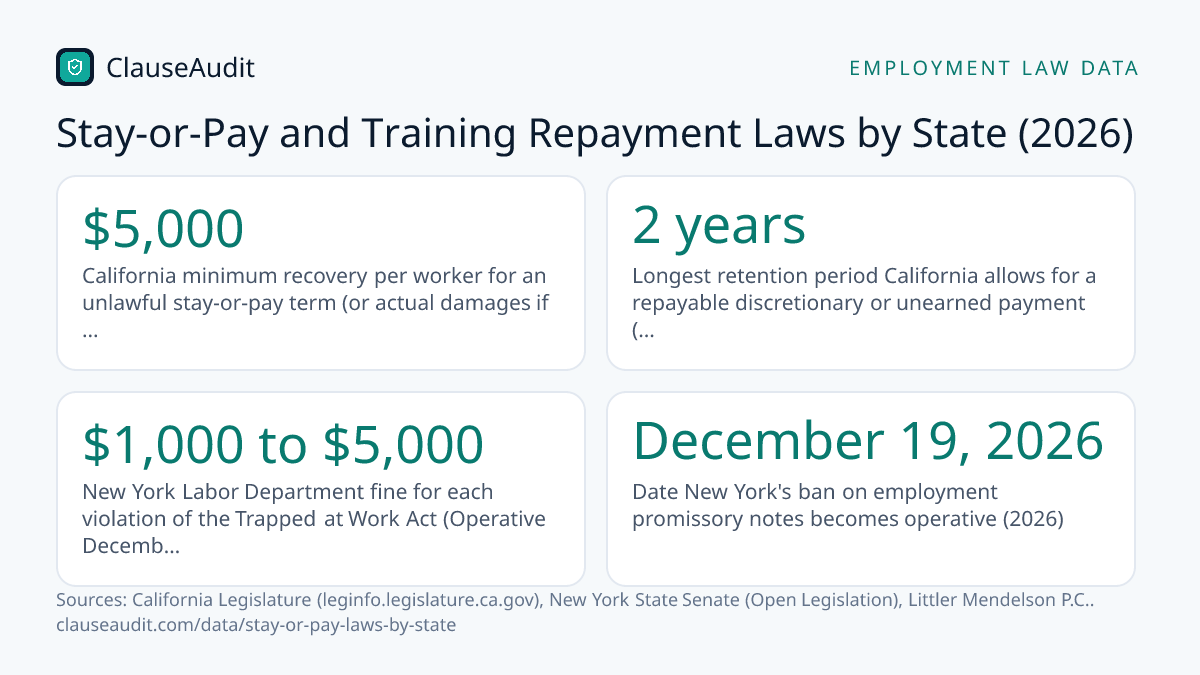
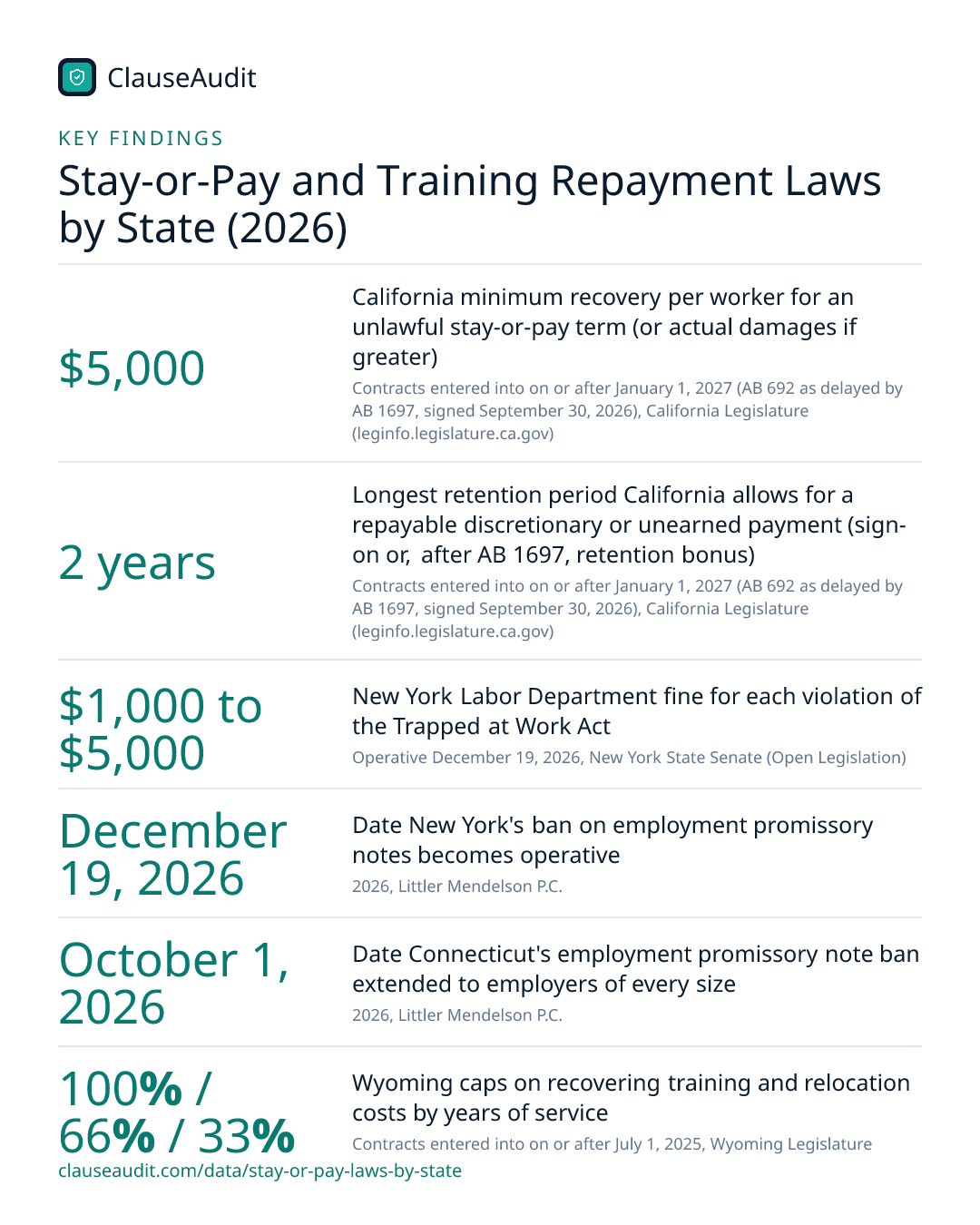
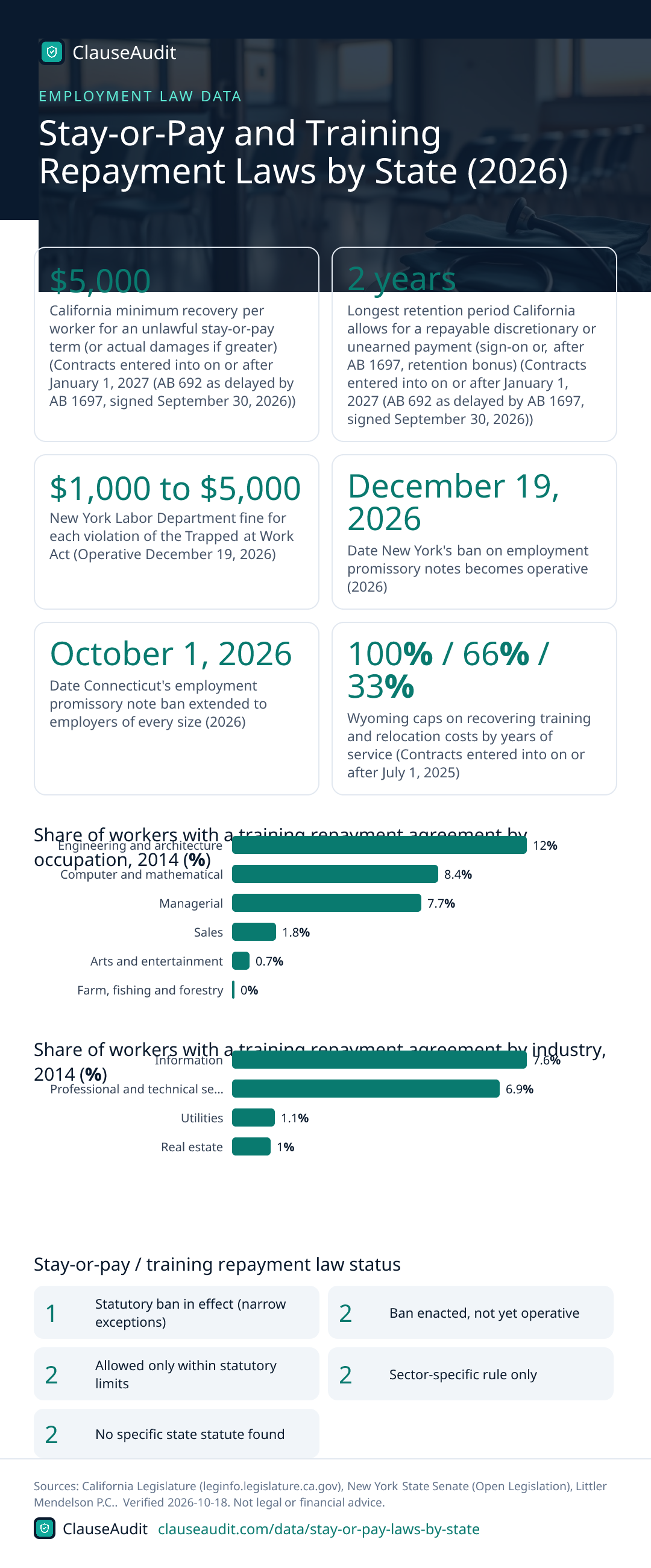
- California minimum recovery per worker for an unlawful stay-or-pay term (or actual damages if greater) (Contracts entered into on or after January 1, 2027 (AB 692 as delayed by AB 1697, signed September 30, 2026), California Legislature (leginfo.legislature.ca.gov))
- $5,000
- Longest retention period California allows for a repayable discretionary or unearned payment (sign-on or, after AB 1697, retention bonus) (Contracts entered into on or after January 1, 2027 (AB 692 as delayed by AB 1697, signed September 30, 2026), California Legislature (leginfo.legislature.ca.gov))
- 2 years
- New York Labor Department fine for each violation of the Trapped at Work Act (Operative December 19, 2026, New York State Senate (Open Legislation))
- $1,000 to $5,000
- Date New York's ban on employment promissory notes becomes operative (2026, Littler Mendelson P.C.)
- December 19, 2026
- Date Connecticut's employment promissory note ban extended to employers of every size (2026, Littler Mendelson P.C.)
- October 1, 2026
- Wyoming caps on recovering training and relocation costs by years of service (Contracts entered into on or after July 1, 2025, Wyoming Legislature)
- 100% / 66% / 33%
- Share of surveyed US workers reporting a training repayment agreement, 2020 (2020 (Cornell National Social Survey), ProMarket (Stigler Center, University of Chicago Booth School of Business))
- 8.7%
- Total penalties HCA agreed to pay California, Colorado and Nevada over nurse TRAPs (July 24, 2025, California Department of Justice, Office of the Attorney General)
- $2,900,000
A stay-or-pay clause says you owe your employer money if you leave before a set date. It might be dressed up as a training repayment agreement, a promissory note, a sign-on bonus clawback or a relocation payback. The effect is the same: quitting gets expensive.
States have started to push back. Some ban these terms outright, some cap how much an employer can claim back, and two only regulate one line of work. The map and table show where each state stands. This page explains what those rules mean when the paper is in front of you, and what to ask for before you sign.
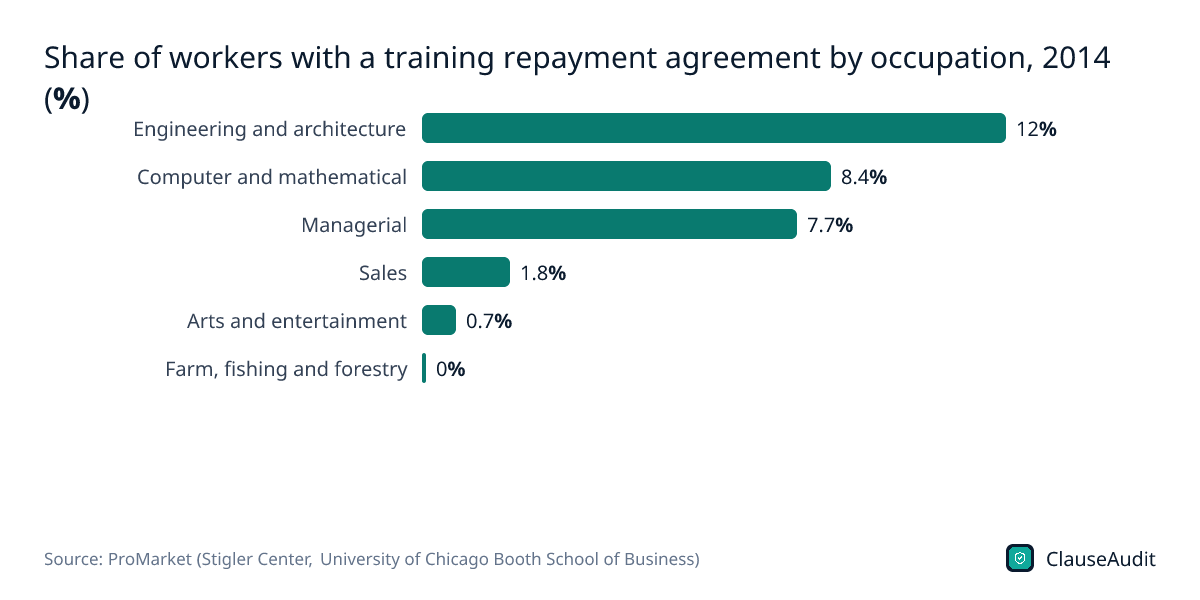
Share of workers with a training repayment agreement by occupation, 2014 (%)
Chart data
| Label | Value |
|---|---|
| Engineering and architecture | 12% |
| Computer and mathematical | 8.4% |
| Managerial | 7.7% |
| Sales | 1.8% |
| Arts and entertainment | 0.7% |
| Farm, fishing and forestry | 0% |
Engineering and architecture led at 12%, while farm, fishing and forestry workers reported 0%. These agreements cluster in jobs where employers say they invest in skills.
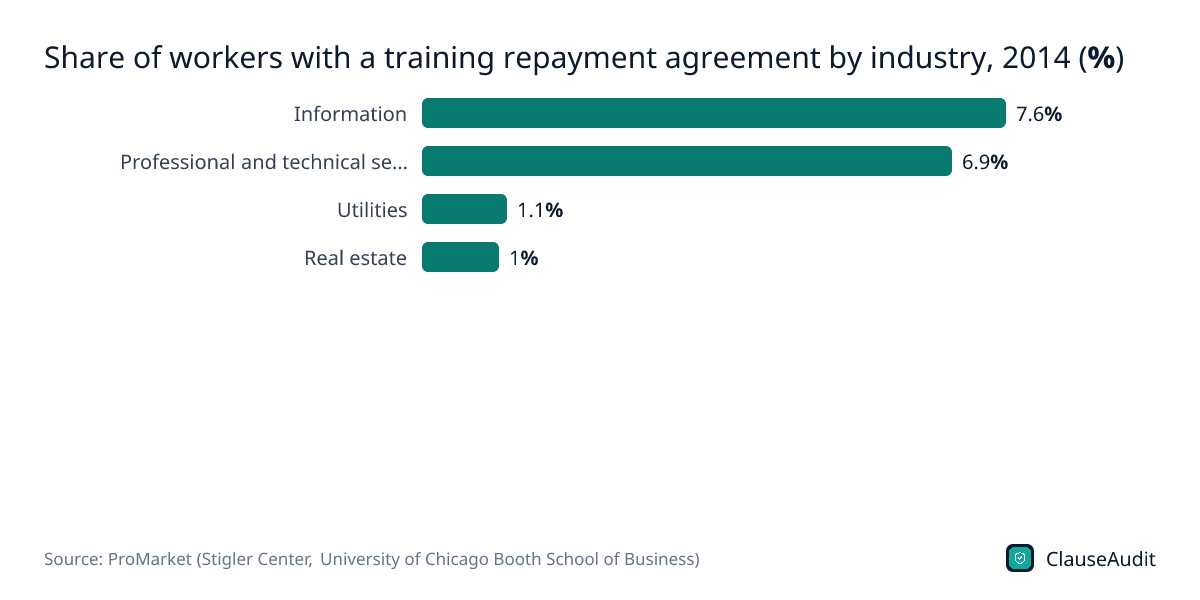
Download this chart (PNG)Share of workers with a training repayment agreement by industry, 2014 (%)
Chart data
| Label | Value |
|---|---|
| Information | 7.6% |
| Professional and technical services | 6.9% |
| Utilities | 1.1% |
| Real estate | 1% |
Information (7.6%) and professional and technical services (6.9%) top the list. Real estate sits at 1%, so the risk depends a lot on your field.
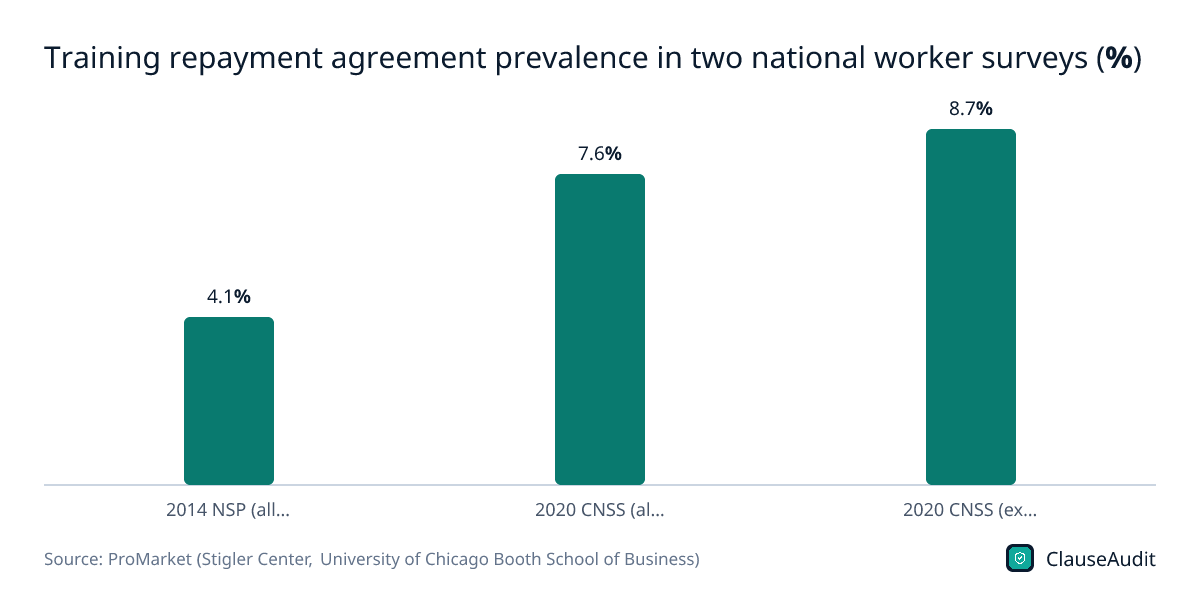
Download this chart (PNG)Training repayment agreement prevalence in two national worker surveys (%)
Chart data
| Label | Value (%) |
|---|---|
| 2014 NSP (all workers) | 4.1% |
| 2020 CNSS (all respondents) | 7.6% |
| 2020 CNSS (excluding don't know/refused) | 8.7% |
The 2020 figure of 8.7% is higher than the 4.1% from 2014, but the surveys asked different questions and the 2020 sample was small. Treat it as a sign these terms are not rare, not as proof of a trend.
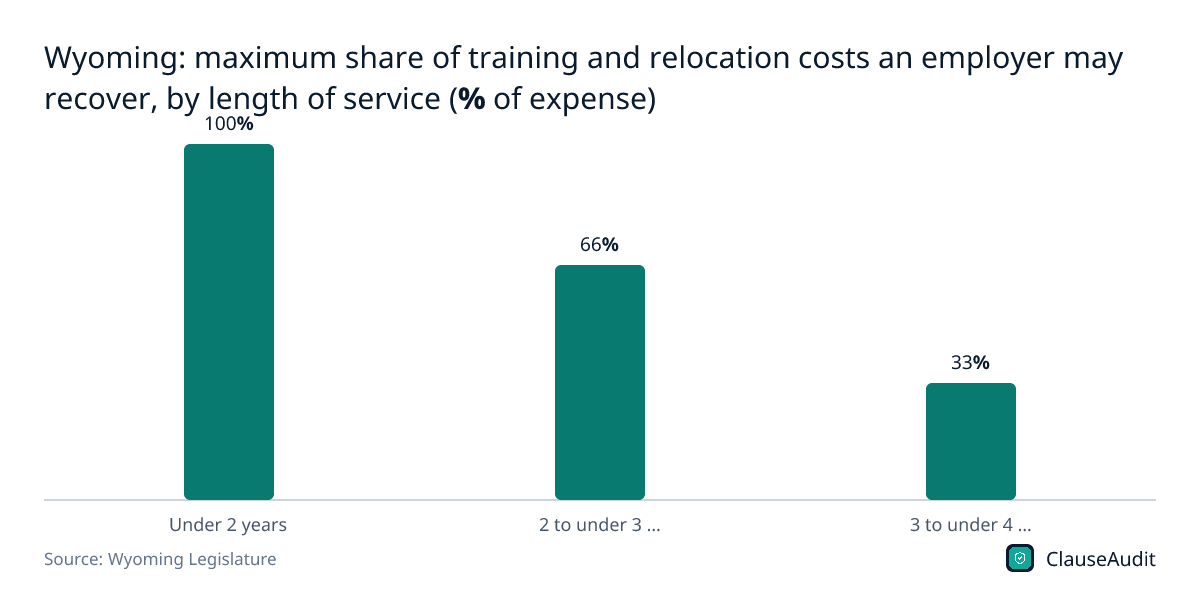
Download this chart (PNG)Wyoming: maximum share of training and relocation costs an employer may recover, by length of service (% of expense)
Chart data
| Label | Value (% of expense) |
|---|---|
| Under 2 years | 100% |
| 2 to under 3 years | 66% |
| 3 to under 4 years | 33% |
Wyoming lets an employer recover up to 100% of costs if you leave in under two years, then 66%, then 33%. After four years of service, the schedule allows no recovery at all.
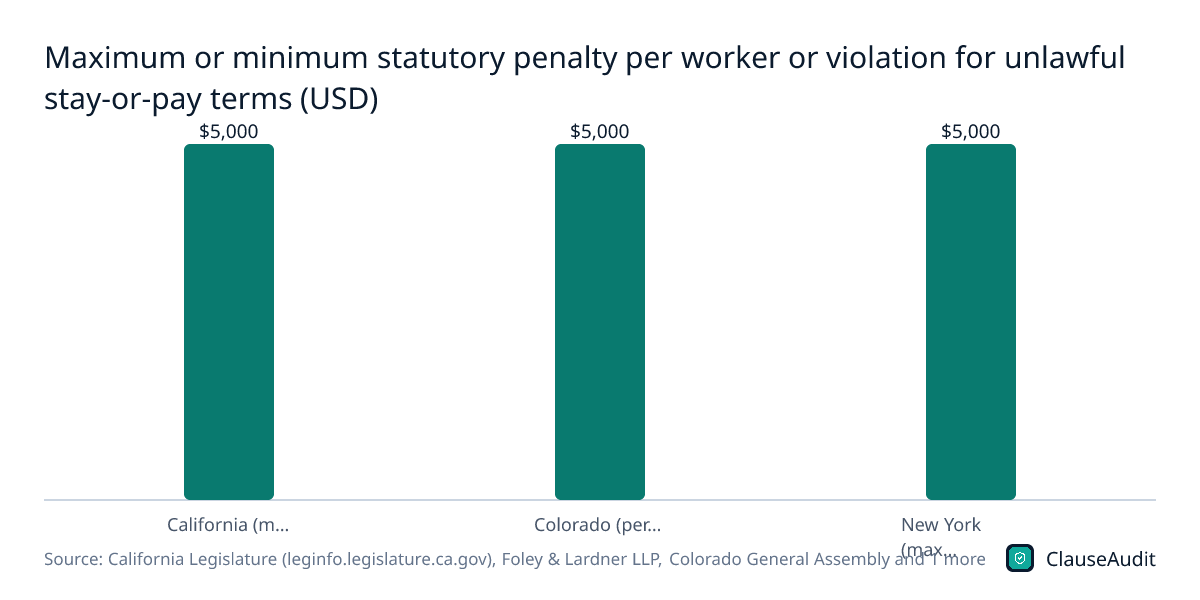
Download this chart (PNG)Maximum or minimum statutory penalty per worker or violation for unlawful stay-or-pay terms (USD)
Chart data
| Label | Value (USD) |
|---|---|
| California (minimum per worker, or actual damages if greater; contracts from Jan. 1, 2027) | $5,000 |
| Colorado (per worker harmed, void covenants) | $5,000 |
| New York (maximum per violation) | $5,000 |
All three figures are $5,000, but they work differently. California's is a floor you can sue for, Colorado's is a penalty per worker harmed, and New York's is the top of a fine range paid to the state.
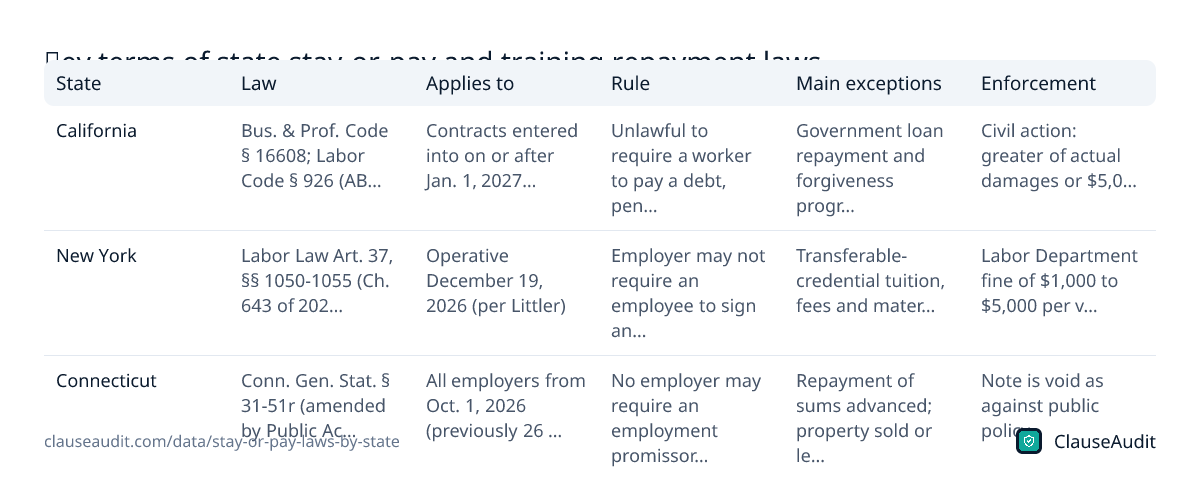
Download this chart (PNG)Key terms of state stay-or-pay and training repayment laws
| State | Law | Applies to | Rule | Main exceptions | Enforcement |
|---|---|---|---|---|---|
| California | Bus. & Prof. Code § 16608; Labor Code § 926 (AB 692, as amended by AB 1697, signed Sept. 30, 2026) | Contracts entered into on or after Jan. 1, 2027 (delayed from Jan. 1, 2026 by AB 1697; not yet operative) | Unlawful to require a worker to pay a debt, penalty, fee or cost if employment ends; such terms are void | Government loan repayment and forgiveness programs; government grant-funded recruitment or retention programs; transferable-credential tuition (separate agreement, prorated); approved apprenticeships; discretionary or unearned payments such as sign-on or retention bonuses with retention period of two years or less (AB 1697 removed the outset-of-employment requirement); certain securities broker-dealer, insurance producer and investment adviser compensation agreements; advanced paid time off up to 40 hours on voluntary separation; residential property | Civil action: greater of actual damages or $5,000 per worker, plus injunctive relief and attorney's fees |
| New York | Labor Law Art. 37, §§ 1050-1055 (Ch. 643 of 2025, amended by Ch. 16 of 2026) | Operative December 19, 2026 (per Littler) | Employer may not require an employee to sign an employment promissory note as a condition of employment; such notes are null and void | Transferable-credential tuition, fees and materials (separate, prorated, no repayment if terminated except for misconduct); voluntary property sale or lease; bonuses and relocation not tied to job performance (unless terminated other than for misconduct or job misrepresented); sabbaticals; collective bargaining programs | Labor Department fine of $1,000 to $5,000 per violation |
| Connecticut | Conn. Gen. Stat. § 31-51r (amended by Public Act 26-12) | All employers from Oct. 1, 2026 (previously 26 or more employees) | No employer may require an employment promissory note as a condition of employment; such a note is void | Repayment of sums advanced; property sold or leased; educational sabbaticals; collective bargaining programs | Note is void as against public policy |
| Colorado | C.R.S. 8-2-113(3)(a) (HB 22-1317) | Effective Aug. 10, 2022 | Recovery of education and training costs allowed only for training distinct from normal on-the-job training, limited to reasonable costs | Recovery must decrease proportionately over the two years after training | Actual damages and $5,000 penalty per worker harmed for void covenants |
| Wyoming | W.S. 1-23-108(a)(iii) (SF 107, 2025) | Contracts entered into on or after July 1, 2025 | Recovery of relocation, education and training expense allowed on a sliding scale | Up to 100% under 2 years, 66% at 2 to under 3 years, 33% at 3 to under 4 years | Not stated in the act |
Source: California Legislature (leginfo.legislature.ca.gov), Assembly Bill No. 692, Chapter 703 (adds Bus. & Prof. Code § 16608 and Labor Code § 926); Jackson Lewis P.C., California Workplace Law Blog, An In-Depth Look at California's Stay-or-Pay Rules After AB 1697 (Susan E. Groff and Rachel L. Szela); Foley & Lardner LLP, A Reprieve, Not a Reversal: California Revises Its Stay-or-Pay Law (Rashad X. Abdallah); New York State Senate, Senate Bill S4070B, Trapped at Work Act (adds Labor Law Article 37, §§ 1050-1055), Chapter 643 of 2025; New York State Senate (Open Legislation), Assembly Bill A9452, chapter amendment to the Trapped at Work Act, Chapter 16 of 2026; Littler Mendelson P.C., New York Enacts Chapter Amendment to Trapped at Work Act, Clarifying Scope, Creating Targeted Exceptions, and Delaying Effective Date; Connecticut Employment Law Blog (Shipman & Goodwin LLP), Employment Law Checklist Project: No Employment Promissory Notes (With Some Exceptions) - Conn. Gen. Stat. § 31-51r; Littler Mendelson P.C., Public Act No. 26-12 Is a Gamechanger for Connecticut Workplace Compliance; Colorado General Assembly, House Bill 22-1317, Concerning Restrictive Employment Agreements (amends C.R.S. 8-2-113), signed act; Wyoming Legislature, Senate File 0107, Enrolled Act No. 87 (creates W.S. 1-23-108). Download as image
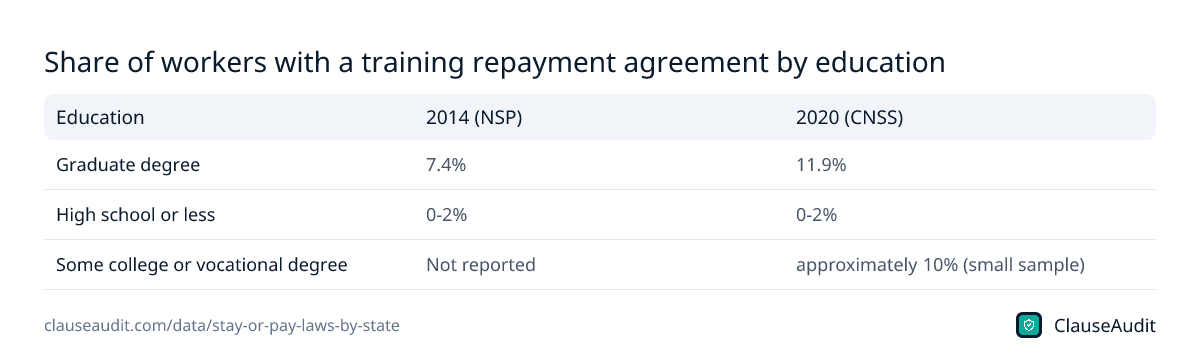
Share of workers with a training repayment agreement by education
| Education | 2014 (NSP) | 2020 (CNSS) |
|---|---|---|
| Graduate degree | 7.4% | 11.9% |
| High school or less | 0-2% | 0-2% |
| Some college or vocational degree | Not reported | approximately 10% (small sample) |
Source: ProMarket (Stigler Center, University of Chicago Booth School of Business), First Evidence on the Use of Training Repayment Agreements in the US Labor Force (Prescott, Schwab and Starr). Download as image
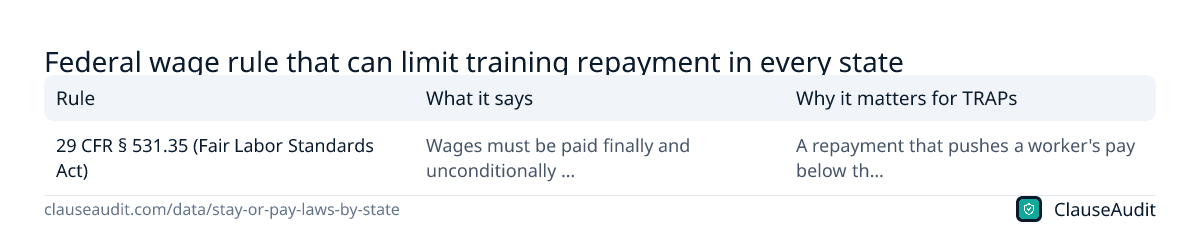
Federal wage rule that can limit training repayment in every state
| Rule | What it says | Why it matters for TRAPs |
|---|---|---|
| 29 CFR § 531.35 (Fair Labor Standards Act) | Wages must be paid finally and unconditionally or "free and clear"; wage requirements are not met where the employee "kicks-back" to the employer | A repayment that pushes a worker's pay below the federal minimum wage or required overtime can conflict with the FLSA |
Source: Legal Information Institute, Cornell Law School (text of the Code of Federal Regulations), 29 CFR § 531.35, Free and clear payment; kickbacks. Download as image
Stay-or-pay / training repayment law status by state
- 1Statutory ban in effect (narrow exceptions)
- 2Ban enacted, not yet operative
- 2Allowed only within statutory limits
- 2Sector-specific rule only
- 2No specific state statute found
- Statutory ban in effect (narrow exceptions)1
- Ban enacted, not yet operative2
- Allowed only within statutory limits2
- Sector-specific rule only2
- No specific state statute found2
- Not yet confirmed42
What is a stay-or-pay agreement?
It is any term that makes you pay your employer if your job ends before a certain point. The classic version is the training repayment agreement, sometimes called a TRAP. You get onboarding or a certification course, and the contract puts a price tag on it that you owe if you quit within, say, two years.
Other versions are harder to spot. A sign-on bonus that must be returned in full if you leave. A relocation package you repay. A promissory note signed on day one for a debt that only comes due if you resign. Some agreements make you owe the money even if you are fired.
The question to ask of any clause is simple. If I leave next month, do I write a check? If yes, you are looking at a stay-or-pay term, whatever it is called.
Which states ban training repayment agreements?
Connecticut has barred employment promissory notes since 1985, but only for employers with 26 or more employees. From October 1, 2026, the ban covers every employer, however small. A note required as a condition of the job is void.
New York's Trapped at Work Act makes employment promissory notes null and void. Littler reads the operative date as December 19, 2026, though some firms put it at February 13, 2027. Each worker forced to sign, or chased for payment, counts as a separate violation, with Labor Department fines of $1,000 to $5,000.
California's ban was meant to start in 2026, but AB 1697 pushed it to contracts entered into on or after January 1, 2027. Once it applies, an employer cannot require you to pay a debt, fee or cost when your job ends, and a worker can recover the greater of actual damages or $5,000. If you sign a California offer before that date, the new law will not cover it.
Where are repayment terms allowed but limited?
Colorado lets an employer recover training costs only for training that goes beyond normal on-the-job learning. The amount must be reasonable and has to shrink in proportion over the two years after the training. A covenant that breaks the rules can cost the employer actual damages plus a $5,000 penalty per worker harmed.
Wyoming uses a sliding scale for relocation, education and training costs in contracts from July 1, 2025: up to 100% if you leave in under two years, 66% between two and three years, and 33% between three and four years.
Two states regulate only one group. Indiana lets public employers recover police training costs, and Pennsylvania has a rule for health care practitioners that bars recovery if the practitioner is dismissed. In the other states we checked, we found no specific statute, so general contract law and federal wage rules decide whether the clause holds up.
Can my employer make me pay back training if my state has no law?
Often they can try, and sometimes they win. Without a statute, a court looks at whether the contract is clear, whether the amount is a fair estimate of a real cost or a penalty in disguise, and whether the training was worth anything outside this one job.
Federal law sets a floor. Under the Fair Labor Standards Act, wages must be paid free and clear. If a repayment, taken out of your final check or demanded soon after, pushes your pay for a week below minimum wage or owed overtime, it can break federal law no matter what the contract says.
State attorneys general also act without a dedicated statute. In 2025, HCA agreed to pay $2,900,000 in penalties to California, Colorado and Nevada over repayment agreements it used with nurses. We found no Nevada stay-or-pay statute, yet Nevada was part of the settlement.
What these laws do not cover
Every ban has exceptions, and employers draft around them. Read the exceptions column in the table before assuming you are protected.
California still allows repayable sign-on or retention bonuses, provided the retention period is no more than 2 years and the payback is prorated. It also allows tuition repayment for a credential you can take to another employer, if it sits in a separate agreement and is prorated. New York carves out similar transferable-credential tuition, plus some bonuses and relocation payments.
So a well-drafted offer can still ask for money back. The difference is that the amount must shrink over time, the deal must be separate and the training must be something you keep.
Watch the dates, too. California's rules turn on when the contract was entered into, so check the signing date on every training or bonus agreement, not just the offer letter. Wyoming's caps apply only to contracts entered into on or after July 1, 2025.
What to do before you sign
Treat the repayment clause like any other price in the deal. It is negotiable. Ask before you accept the offer, when you have the most bargaining power you will ever have in the job.
- Find every clause that mentions repayment, forfeiture, clawback, promissory note or liquidated damages, including in separate training or bonus agreements.
- Ask for the real dollar figure behind the training cost and what it covers. A large flat number attached to a few weeks of shadowing looks like a penalty, not a cost.
- Ask for proration by month, so the amount drops steadily instead of staying full until a cliff date.
- Get it in writing that nothing is owed if you are laid off or fired without cause.
- Ask whether the credential is transferable. If it is not, push hard to strike the repayment term.
- Never agree to repayment by deduction from your final paycheck, and check your state's wage deduction rules.
- If your state bans these terms, or a ban starts soon, say so politely and ask HR to remove the clause rather than argue about it later.
How ClauseAudit helps
Stay-or-pay terms rarely sit under a heading that says so. They hide in bonus letters, training addenda and the fine print of an offer. Upload your offer or employment agreement and the automated review flags every clause that could make you pay to leave, explains it in plain English and suggests what to ask for instead.
- Training repayment terms: amount, what it covers and whether it shrinks over time
- Sign-on, retention and relocation bonus clawbacks and their retention period
- Promissory notes or debts that only come due when you leave
- Whether repayment applies if you are laid off or fired
- Deductions from your final paycheck to collect what you owe
- Governing law and arbitration terms that affect where you can challenge it
Frequently asked questions
Is a training repayment agreement legal?
It depends on your state and the terms. Connecticut voids employment promissory notes, New York's ban is set to apply from December 19, 2026, and California's covers contracts from January 1, 2027. Colorado and Wyoming allow repayment within limits. In most other states, a court weighs whether the amount is reasonable and whether the repayment cuts your pay below federal minimum wage.
Do I have to pay back a sign-on bonus if I quit?
Often yes, if you signed an agreement saying so. Even California, which bans most stay-or-pay terms for contracts from January 1, 2027, still allows repayable sign-on and retention bonuses if the retention period is no longer than 2 years and the amount is prorated. Check if your agreement prorates the payback and if it applies when you are let go.
When does California's stay-or-pay law take effect?
AB 1697, signed September 30, 2026, delayed it. The ban now applies to contracts entered into on or after January 1, 2027. Agreements signed before that date are judged under existing California law. Once the new law applies, a worker can sue for the greater of actual damages or $5,000, plus attorney's fees.
What is New York's Trapped at Work Act?
It bars employers from requiring an employment promissory note as a condition of the job and makes such notes void. Littler reads the operative date as December 19, 2026, though some firms say February 13, 2027. The Labor Department can fine $1,000 to $5,000 per violation, and each affected employee counts separately. Transferable-credential tuition and some bonuses are exempt.
Can my employer take training costs out of my last paycheck?
Be careful here. Federal law requires wages to be paid free and clear, so a deduction that drops your pay below minimum wage or owed overtime can be unlawful. Many states also limit what an employer can deduct without written consent. A contract clause alone does not make the deduction legal.
How common are training repayment agreements?
Survey estimates are modest but not tiny. A 2020 survey found 8.7% of workers who gave a yes or no answer reported one, up from 4.1% in a 2014 survey, though the researchers warn the two surveys are not directly comparable. In 2014, engineering and architecture had the highest rate, at 12%.
Do I owe training costs if I am fired or laid off?
Read the clause closely, because many are written to apply however the job ends. California's ban, once it applies, covers any ending of employment. New York's tuition exception does not allow repayment if you are terminated, except for misconduct. In other states, ask to add a line saying nothing is owed if you are let go without cause.
Are nurses protected from training repayment agreements?
Nurses have been a focus of enforcement. In 2025, HCA agreed to pay $2,900,000 in penalties to California, Colorado and Nevada over repayment agreements used with nurses. Pennsylvania also has a rule for some health care practitioners, covering physicians, nurse practitioners, physician assistants and nurse anesthetists, that bars recovery if the practitioner is dismissed.
Use this data
Every chart and card below is free to reuse under CC BY 4.0. Download what you need and link back to this page.
 Stat cards
 Key findings card
 Infographic
 Share of workers with a training repayment agreement by occupation, 2014 (%)
 Share of workers with a training repayment agreement by industry, 2014 (%)
 Training repayment agreement prevalence in two national worker surveys (%)
 Wyoming: maximum share of training and relocation costs an employer may recover, by length of service (% of expense)
 Maximum or minimum statutory penalty per worker or violation for unlawful stay-or-pay terms (USD)
 Key terms of state stay-or-pay and training repayment laws
 Share of workers with a training repayment agreement by education
 Federal wage rule that can limit training repayment in every state
Embed the infographic
Free to share on your site, blog or slides under CC BY 4.0. Please keep the credit link.
Sources and method
Every number on this page comes from the sources below, each opened and read on or before October 18, 2026. A second, independent review checked every figure against its source and corrected anything that did not match. 9 of 51 state entries were confirmed; any that could not be are marked "Not yet confirmed" and left out of every count and chart.
- California Legislature (leginfo.legislature.ca.gov), Assembly Bill No. 692, Chapter 703 (adds Bus. & Prof. Code § 16608 and Labor Code § 926) (Chaptered October 13, 2025)
- Foley & Lardner LLP, A Reprieve, Not a Reversal: California Revises Its Stay-or-Pay Law (Rashad X. Abdallah) (October 12, 2026)
- Jackson Lewis P.C., California Workplace Law Blog, An In-Depth Look at California's Stay-or-Pay Rules After AB 1697 (Susan E. Groff and Rachel L. Szela) (October 5, 2026)
- New York State Senate, Senate Bill S4070B, Trapped at Work Act (adds Labor Law Article 37, §§ 1050-1055), Chapter 643 of 2025 (Signed December 19, 2025)
- New York State Senate (Open Legislation), Assembly Bill A9452, chapter amendment to the Trapped at Work Act, Chapter 16 of 2026 (Signed February 13, 2026)
- Littler Mendelson P.C., New York Enacts Chapter Amendment to Trapped at Work Act, Clarifying Scope, Creating Targeted Exceptions, and Delaying Effective Date (February 17, 2026)
- Colorado General Assembly, House Bill 22-1317, Concerning Restrictive Employment Agreements (amends C.R.S. 8-2-113), signed act (Signed June 8, 2022; effective August 10, 2022)
- Wyoming Legislature, Senate File 0107, Enrolled Act No. 87 (creates W.S. 1-23-108) (2025 General Session; effective July 1, 2025)
- Littler Mendelson P.C., Public Act No. 26-12 Is a Gamechanger for Connecticut Workplace Compliance (May 21, 2026)
- Connecticut Employment Law Blog (Shipman & Goodwin LLP), Employment Law Checklist Project: No Employment Promissory Notes (With Some Exceptions) - Conn. Gen. Stat. § 31-51r (November 2019)
- Seyfarth Shaw LLP (via JD Supra), Connecticut Expands Scope of Its 'Stay or Pay' Prohibition (May 18, 2026)
- Penn State Pennsylvania Office of Rural Health, Pennsylvania Limits Noncompete for Certain Health Care Workers (Fair Contracting for Health Care Practitioners Act) (August 3, 2024)
- Frost Brown Todd LLP, Understanding SEA 95: Indiana's Police Training Reimbursement Law (June 10, 2025)
- Maryland General Assembly, HB0203 Labor and Employment - Training Repayment Agreements - Prohibition (2026 Regular Session) (Page last updated August 6, 2026)
- ProMarket (Stigler Center, University of Chicago Booth School of Business), First Evidence on the Use of Training Repayment Agreements in the US Labor Force (Prescott, Schwab and Starr) (March 27, 2024)
- California Department of Justice, Office of the Attorney General, Attorney General Bonta Secures $1.53 Million Settlement with One of Nation's Largest Hospital Systems for Unlawful Training Repayment Agreements with Nurses (July 24, 2025)
- Legal Information Institute, Cornell Law School (text of the Code of Federal Regulations), 29 CFR § 531.35, Free and clear payment; kickbacks (Current text as read October 2026)
- Mayer Brown LLP, United States: Employment - 2026 Mid-Year Updates (July 13, 2026)
Cite this page
ClauseAudit, “Stay-or-Pay and Training Repayment Laws by State (2026)”, updated October 18, 2026, https://clauseaudit.com/data/stay-or-pay-laws-by-state. Free to reuse with a link back (CC BY 4.0).
This page summarises published data and law as checked on October 18, 2026. Figures are updated as new editions are released, and your own situation may differ. It is general information, not legal, tax or financial advice.