Cities and Local Governments That Tax Freelancers (2026)
By ClauseAudit Research · 8 sources ·
Which US cities have a local income tax?
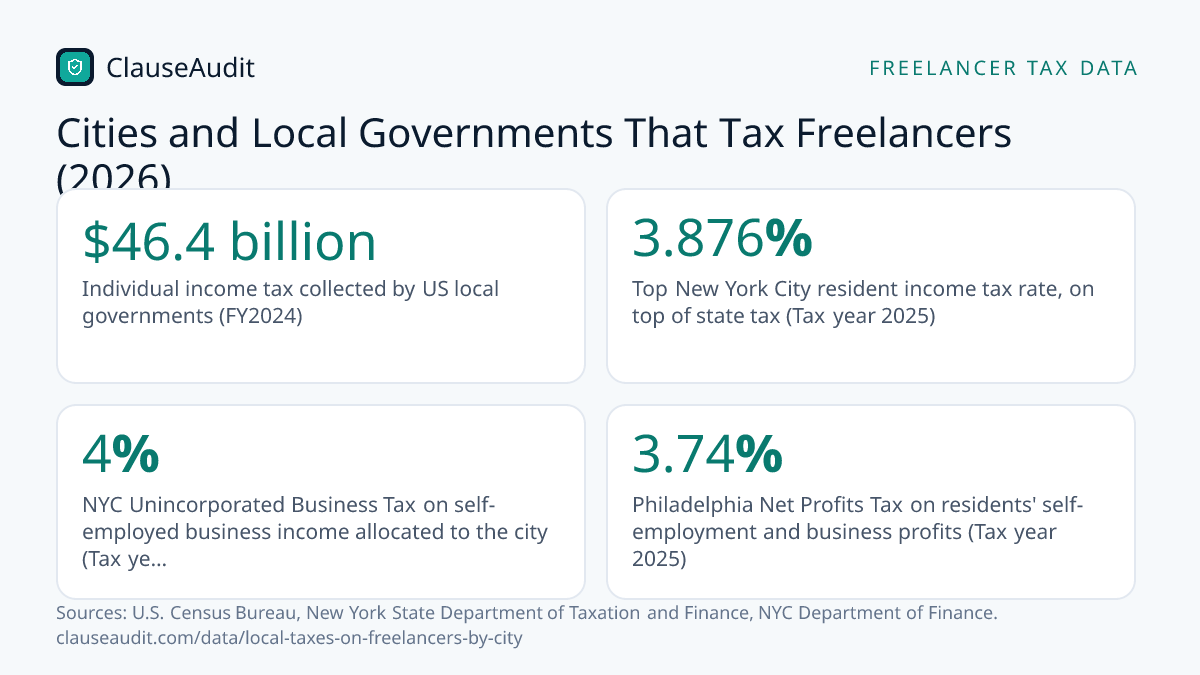
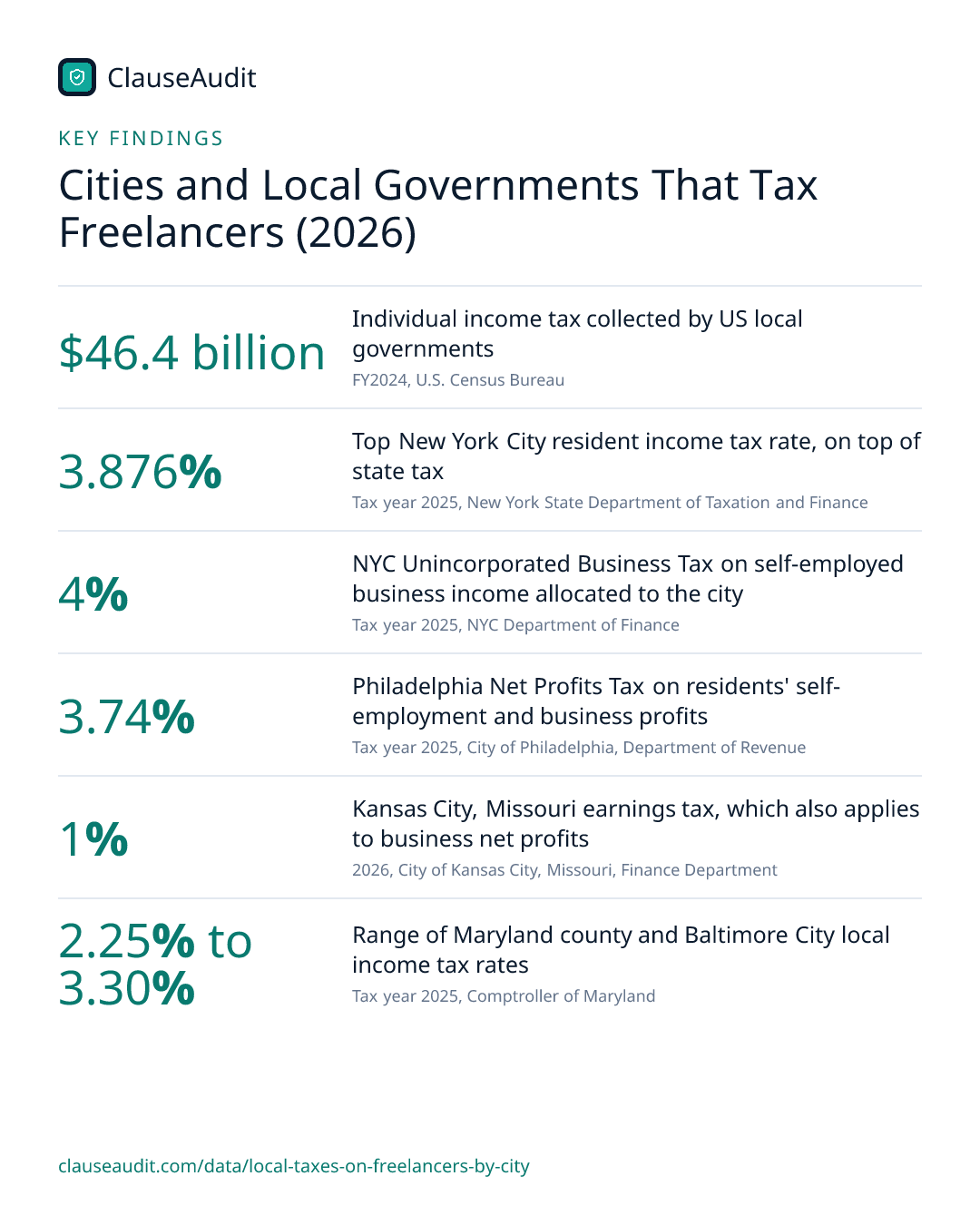
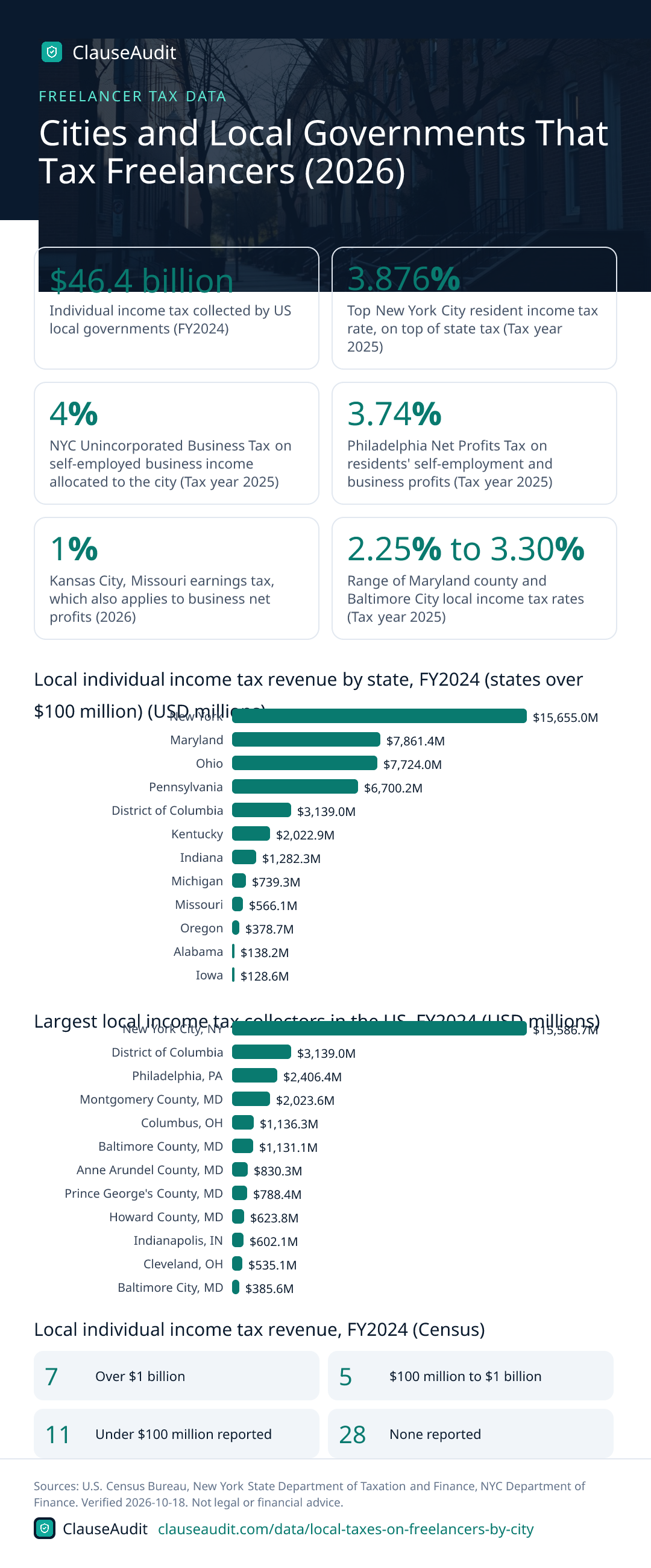
Only a handful of US places tax your income on top of the state, but they matter. Local governments collected $46.4 billion in individual income tax in FY2024. For freelancers the big ones are New York City (up to 3.876%, plus a 4% UBT), Philadelphia (3.74% Net Profits Tax), Kansas City, Missouri (1%), every Maryland county, and 24 Michigan cities.

- Individual income tax collected by US local governments (FY2024, U.S. Census Bureau)
- $46.4 billion
- Top New York City resident income tax rate, on top of state tax (Tax year 2025, New York State Department of Taxation and Finance)
- 3.876%
- NYC Unincorporated Business Tax on self-employed business income allocated to the city (Tax year 2025, NYC Department of Finance)
- 4%
- Philadelphia Net Profits Tax on residents' self-employment and business profits (Tax year 2025, City of Philadelphia, Department of Revenue)
- 3.74%
- Kansas City, Missouri earnings tax, which also applies to business net profits (2026, City of Kansas City, Missouri, Finance Department)
- 1%
- Range of Maryland county and Baltimore City local income tax rates (Tax year 2025, Comptroller of Maryland)
- 2.25% to 3.30%
- Michigan cities that levy taxes related to income (2026, Michigan Department of Treasury)
- 24
- Yonkers resident income tax surcharge, figured on net New York State tax (Tax year 2025, New York State Department of Taxation and Finance)
- 16.75%
Most freelancers plan for two tax bills: federal and state. In some places there is a third. A city, county or school district can take its own cut of your profit, and it rarely sends a reminder before the first deadline passes.
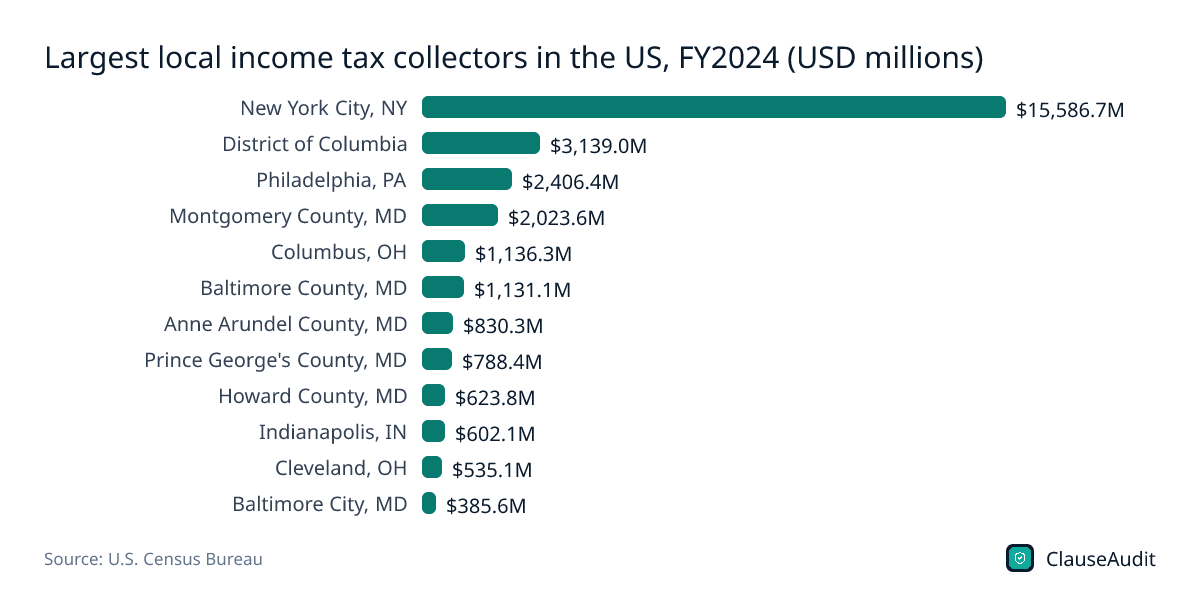
Local income taxes are concentrated in a few states, but the sums are large. US local governments collected $46.4 billion in individual income tax in FY2024, and New York City alone took in $15,586.7 million of it. Below we explain which places matter most if you work for yourself, how these taxes treat self-employment income, and what to set aside.
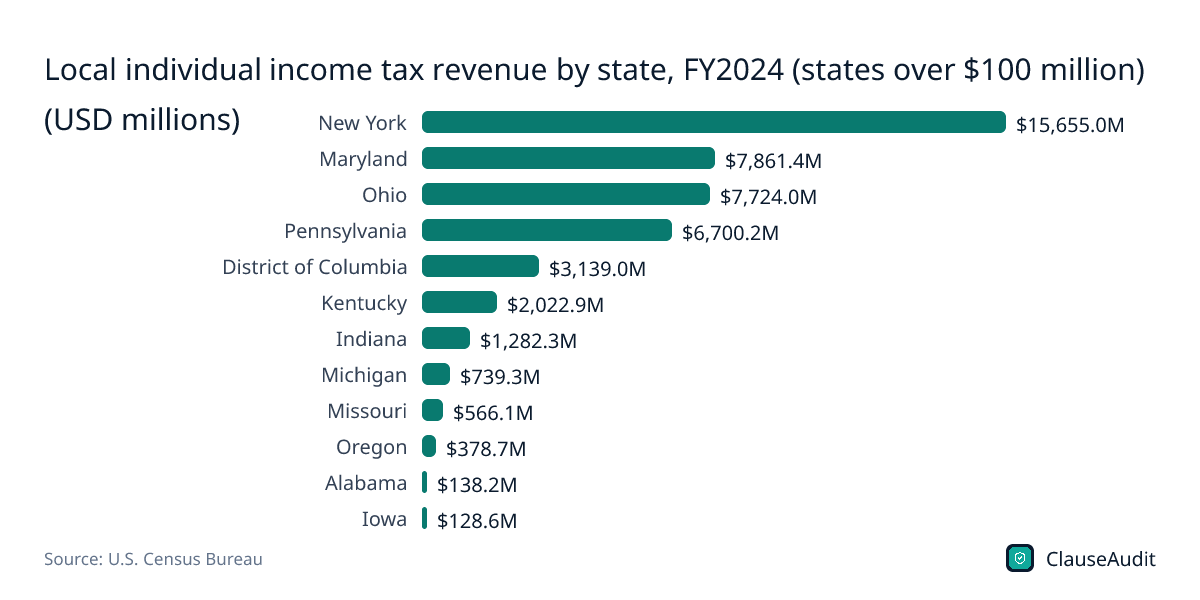
Local individual income tax revenue by state, FY2024 (states over $100 million) (USD millions)
Chart data
| Label | Value |
|---|---|
| New York | $15,655.0M |
| Maryland | $7,861.4M |
| Ohio | $7,724.0M |
| Pennsylvania | $6,700.2M |
| District of Columbia | $3,139.0M |
| Kentucky | $2,022.9M |
| Indiana | $1,282.3M |
| Michigan | $739.3M |
| Missouri | $566.1M |
| Oregon | $378.7M |
| Alabama | $138.2M |
| Iowa | $128.6M |
New York, Maryland, Ohio and Pennsylvania account for most local income tax in the country. If you live in one of them, assume a local return is part of your year until you confirm otherwise.
Download this chart (PNG)Largest local income tax collectors in the US, FY2024 (USD millions)
Chart data
| Label | Value |
|---|---|
| New York City, NY | $15,586.7M |
| District of Columbia | $3,139.0M |
| Philadelphia, PA | $2,406.4M |
| Montgomery County, MD | $2,023.6M |
| Columbus, OH | $1,136.3M |
| Baltimore County, MD | $1,131.1M |
| Anne Arundel County, MD | $830.3M |
| Prince George's County, MD | $788.4M |
| Howard County, MD | $623.8M |
| Indianapolis, IN | $602.1M |
| Cleveland, OH | $535.1M |
| Baltimore City, MD | $385.6M |
New York City collects more than the next several governments combined. Maryland counties fill much of the list because every county levies the tax, not just big cities.
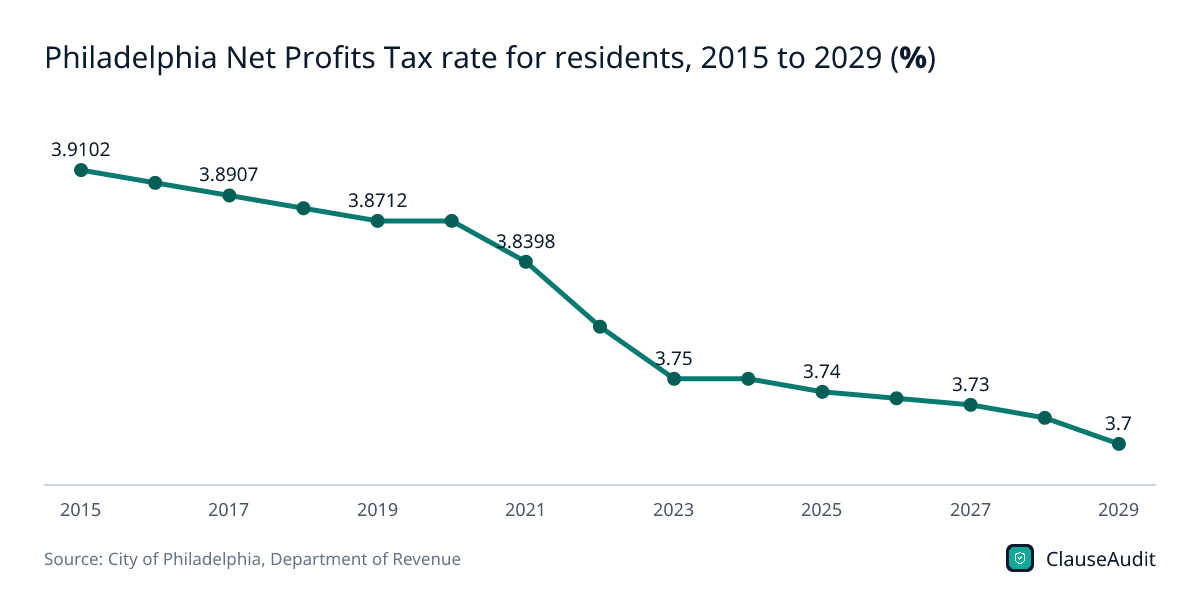
Download this chart (PNG)Philadelphia Net Profits Tax rate for residents, 2015 to 2029 (%)
Chart data
| Label | Value (%) |
|---|---|
| 2015 | 3.9102 |
| 2016 | 3.9004 |
| 2017 | 3.8907 |
| 2018 | 3.8809 |
| 2019 | 3.8712 |
| 2020 | 3.8712 |
| 2021 | 3.8398 |
| 2022 | 3.79 |
| 2023 | 3.75 |
| 2024 | 3.75 |
| 2025 | 3.74 |
| 2026 | 3.735 |
| 2027 | 3.73 |
| 2028 | 3.72 |
| 2029 | 3.7 |
Philadelphia has trimmed its resident rate slowly, from 3.9102% in 2015 to 3.74% in 2025, with 3.735% scheduled for 2026. The cuts are real but small, so budget for roughly the same bite each year.
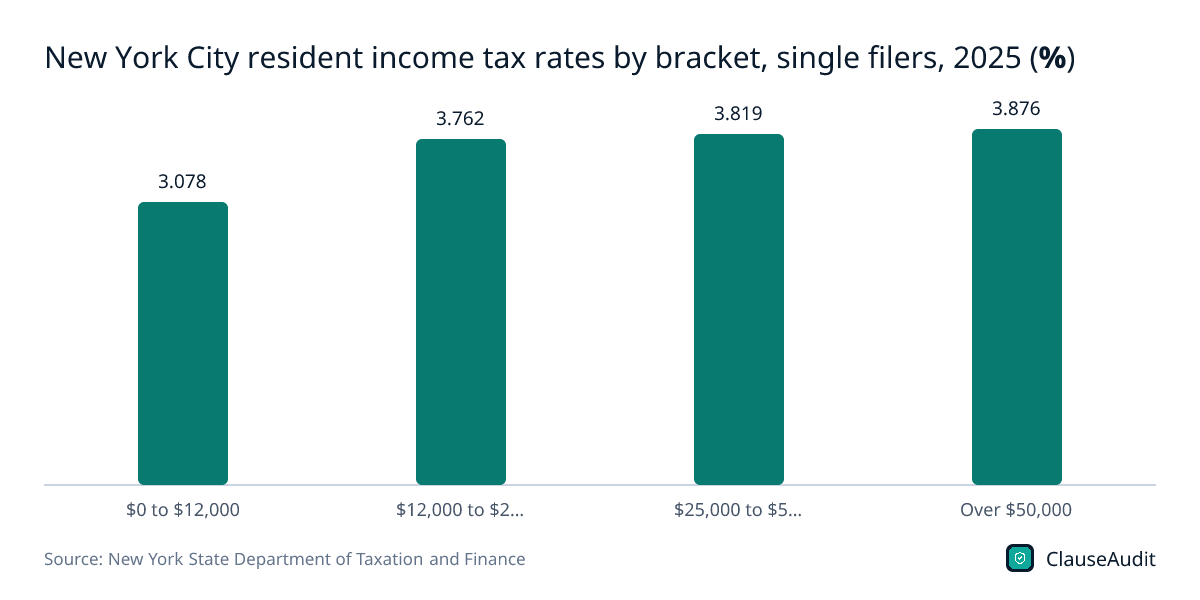
Download this chart (PNG)New York City resident income tax rates by bracket, single filers, 2025 (%)
Chart data
| Label | Value (%) |
|---|---|
| $0 to $12,000 | 3.078 |
| $12,000 to $25,000 | 3.762 |
| $25,000 to $50,000 | 3.819 |
| Over $50,000 | 3.876 |
The brackets climb fast. A single filer hits the top 3.876% rate once NYC taxable income goes over $50,000. Joint filers get there above $90,000.
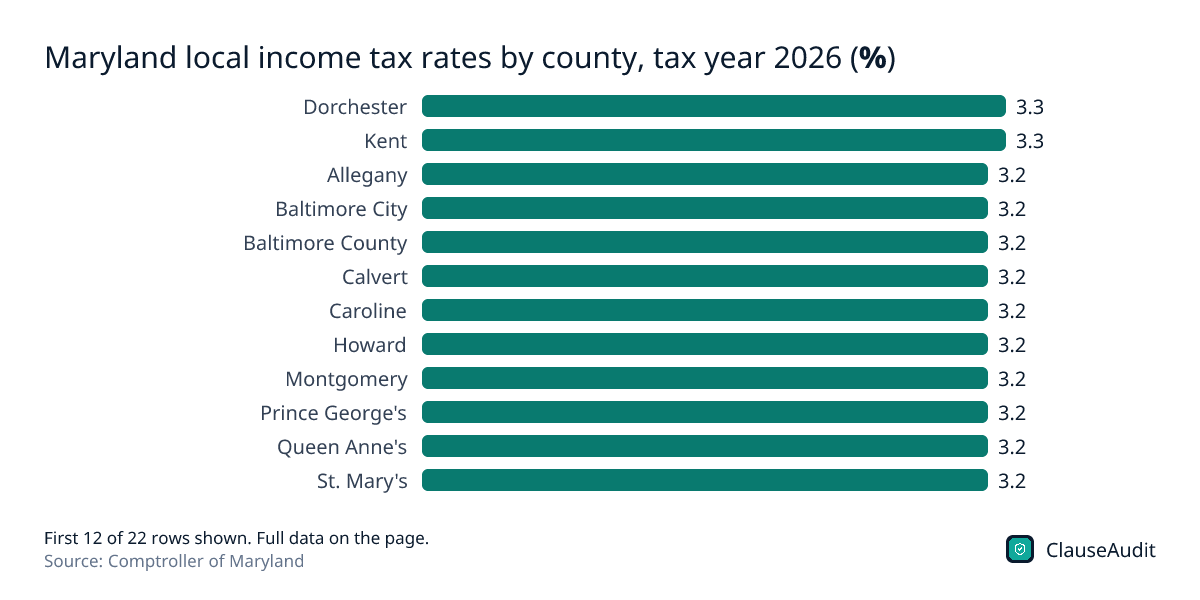
Download this chart (PNG)Maryland local income tax rates by county, tax year 2026 (%)
Chart data
| Label | Value |
|---|---|
| Dorchester | 3.3 |
| Kent | 3.3 |
| Allegany | 3.2 |
| Baltimore City | 3.2 |
| Baltimore County | 3.2 |
| Calvert | 3.2 |
| Caroline | 3.2 |
| Howard | 3.2 |
| Montgomery | 3.2 |
| Prince George's | 3.2 |
| Queen Anne's | 3.2 |
| St. Mary's | 3.2 |
| Somerset | 3.2 |
| Wicomico | 3.2 |
| Harford | 3.06 |
| Carroll | 3.03 |
| Charles | 3.03 |
| Washington | 2.95 |
| Cecil | 2.74 |
| Garrett | 2.65 |
| Talbot | 2.4 |
| Worcester | 2.25 |
Most Maryland counties sit at or near 3.2%. For 2026, the gap between Worcester at 2.25% and Dorchester or Kent at 3.3% is just over a full percentage point of your taxable income.
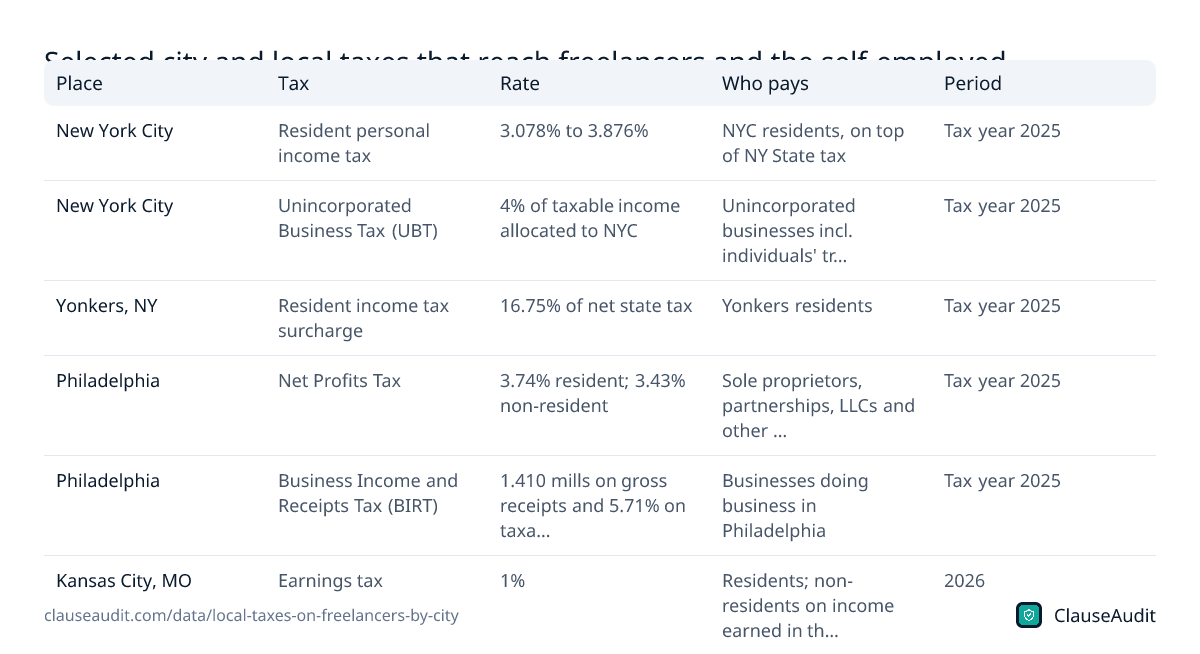
Download this chart (PNG)Selected city and local taxes that reach freelancers and the self-employed
| Place | Tax | Rate | Who pays | Period |
|---|---|---|---|---|
| New York City | Resident personal income tax | 3.078% to 3.876% | NYC residents, on top of NY State tax | Tax year 2025 |
| New York City | Unincorporated Business Tax (UBT) | 4% of taxable income allocated to NYC | Unincorporated businesses incl. individuals' trades and professions; full credit if liability is $3,400 or less | Tax year 2025 |
| Yonkers, NY | Resident income tax surcharge | 16.75% of net state tax | Yonkers residents | Tax year 2025 |
| Philadelphia | Net Profits Tax | 3.74% resident; 3.43% non-resident | Sole proprietors, partnerships, LLCs and other unincorporated businesses | Tax year 2025 |
| Philadelphia | Business Income and Receipts Tax (BIRT) | 1.410 mills on gross receipts and 5.71% on taxable net income | Businesses doing business in Philadelphia | Tax year 2025 |
| Kansas City, MO | Earnings tax | 1% | Residents; non-residents on income earned in the city; business net profits | 2026 |
| Maryland (23 counties and Baltimore City) | Local income tax | 2.25% to 3.30% | Residents, based on where they live | Tax year 2025 |
| Michigan (24 cities) | City income-related taxes | Set by each city | Varies by city | 2026 |
Source: New York State Department of Taxation and Finance, Instructions for Form IT-201, Full-Year Resident Income Tax Return (2025), New York City tax rate schedule and Yonkers worksheet; NYC Department of Finance, Unincorporated Business Tax (UBT); City of Philadelphia, Department of Revenue, Net Profits Tax; City of Philadelphia, Department of Revenue, Tax Rate History; City of Kansas City, Missouri, Finance Department, Have You Paid Your KCMO Earnings Tax (E-Tax)?; Comptroller of Maryland, Maryland Income Tax Rates and Brackets (KB0010014); Michigan Department of Treasury, Which cities impose an income tax?. Download as image
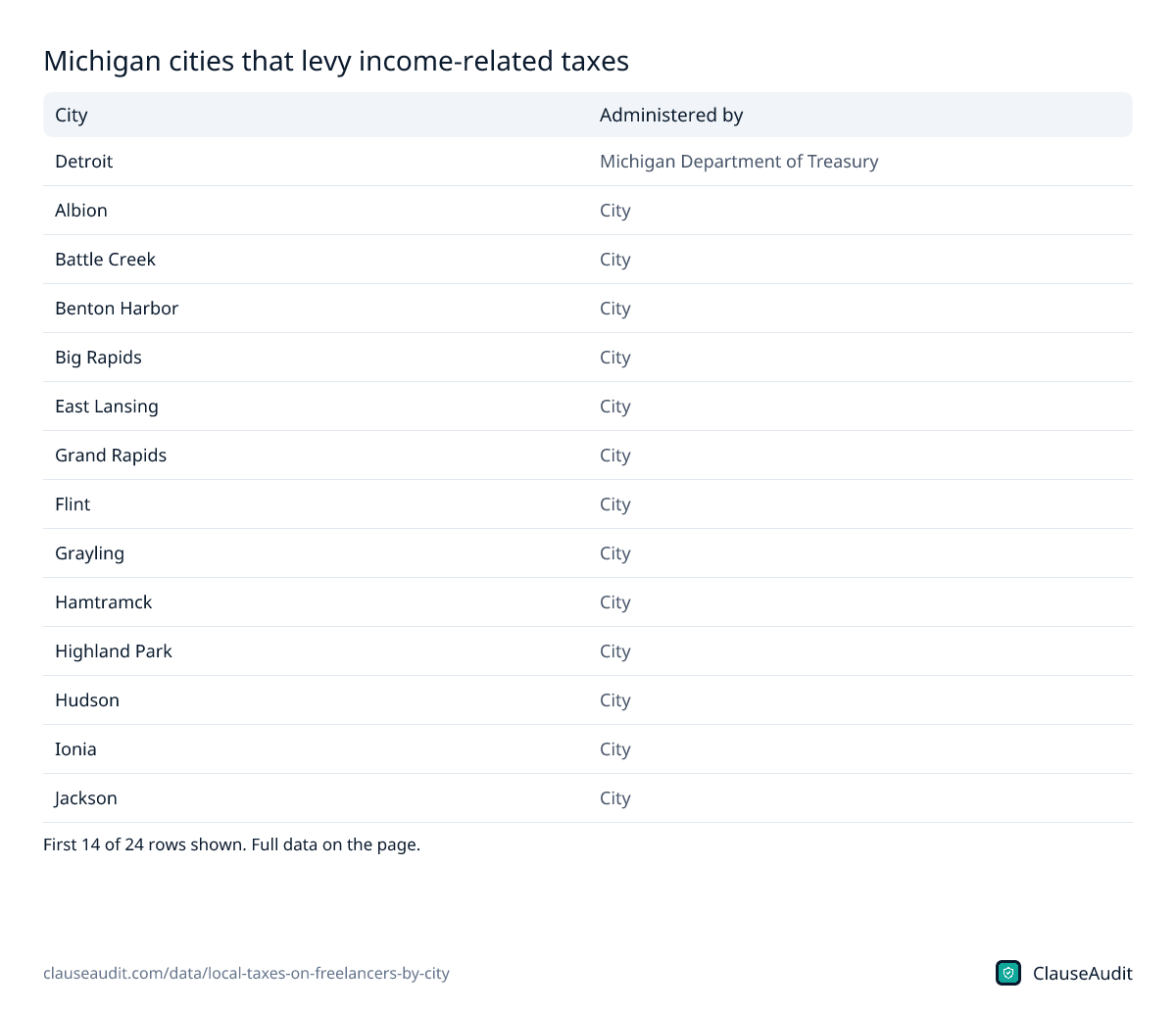
Michigan cities that levy income-related taxes
| City | Administered by |
|---|---|
| Detroit | Michigan Department of Treasury |
| Albion | City |
| Battle Creek | City |
| Benton Harbor | City |
| Big Rapids | City |
| East Lansing | City |
| Grand Rapids | City |
| Flint | City |
| Grayling | City |
| Hamtramck | City |
| Highland Park | City |
| Hudson | City |
| Ionia | City |
| Jackson | City |
| Lansing | City |
| Lapeer | City |
| Muskegon | City |
| Muskegon Heights | City |
| Pontiac | City |
| Port Huron | City |
| Portland | City |
| Saginaw | City |
| Springfield | City |
| Walker | City |
Source: Michigan Department of Treasury, Which cities impose an income tax?. Download as image
Local individual income tax revenue, FY2024 (Census) by state
- 7Over $1 billion
- 5$100 million to $1 billion
- 11Under $100 million reported
- 28None reported
- Over $1 billion7
- $100 million to $1 billion5
- Under $100 million reported11
- None reported28
Which cities have an income tax that hits freelancers?
Fewer than you might fear, but the ones that do are big. New York City, Philadelphia, Kansas City, Missouri, Detroit and the rest of Michigan's 24 taxing cities, Yonkers, and every county in Maryland all reach self-employment income in some form. Ohio, Pennsylvania, Kentucky and Indiana also have widespread local taxes run by cities, counties or school districts.
The key detail for you is that many of these taxes apply to net profit, not just wages. Kansas City says its 1% earnings tax also applies to business net profits. Philadelphia's Net Profits Tax is aimed at sole proprietors, partnerships, LLCs and other unincorporated businesses. New York City layers a business tax on top of its personal income tax.
Most of the country has nothing like this. California, Texas, Florida and many other states show no local income tax at all in the Census data, so if you live there, your local exposure is more likely to come through sales or property taxes.
A quick rule of thumb: if you have ever received a W-2 with a city or school district line filled in, your area probably taxes income. When you switch to freelancing, nobody withholds that tax for you anymore. You owe it directly.
Do freelancers in New York City pay two city taxes?
Often, yes. As an NYC resident you pay the city's personal income tax, which ran from 3.078% to 3.876% for tax year 2025, filed on your New York State return. Separately, the Unincorporated Business Tax charges 4% on self-employment income allocated to the city.
There is relief for smaller operators. If your UBT liability is $3,400 or less, a full credit wipes it out. Between $3,401 and $5,400 you get a partial credit. Residents who pay UBT as sole proprietors can also credit part of it against their city personal income tax, so the two do not stack in full.
Live in Yonkers instead? You owe a resident surcharge of 16.75% of your net New York State tax. It is easy to miss because it is figured as a percentage of another tax rather than of your income.
Put together, a full-time freelancer living in the city can face state tax, city personal income tax and UBT on the same profit. That is why NYC rates often look high to people who move there from places with no local tax at all.
How does Philadelphia tax self-employed people?
Philadelphia's Net Profits Tax was 3.74% for residents and 3.43% for non-residents in tax year 2025. Residents owe it even when the business operates outside the city. Non-residents owe it on business they do in Philadelphia. Corporations are exempt from it.
There is also the Business Income and Receipts Tax, at 1.410 mills on gross receipts and 5.71% on taxable net income for 2025. The city collected $2,406.4 million in income tax in FY2024, third among all local governments in the country, behind only New York City and the District of Columbia.
The rate history matters if you are planning ahead. Resident rates have fallen in most years since 2015 and are scheduled to keep sliding, to 3.735% in 2026, but slowly. Treat the cut as a small bonus rather than something to plan your pricing around.
Where you live versus where your client is
Residence is usually what triggers the tax. Maryland bases its local tax on where you live, not where you work, with county rates from 2.25% to 3.30% for tax year 2025. Kansas City taxes residents on everything they earn and non-residents only on income earned inside the city.
For a remote freelancer, this means a client in Manhattan does not, by itself, put you on the hook for NYC resident tax. But doing physical work inside a taxing city can. A designer living in New Jersey who spends weeks on site in Philadelphia may owe the non-resident rate on that slice of profit.
When in doubt, keep a short log: dates, city, client and what you did there. It takes a minute a week and saves hours if a city ever asks how you split your income.
Why Ohio, Pennsylvania and Kentucky catch so many freelancers off guard
In New York and Philadelphia the tax is well known. In Ohio, Pennsylvania and Kentucky it is spread across hundreds of cities, townships and school districts, which makes it much easier to miss.
Ohio is the clearest case. Columbus alone brought in $1,136.3 million in income tax in FY2024, and Cleveland $535.1 million. Both rank among the largest local income tax collectors in the country. In Ohio the city return is not an afterthought. It is a main event.
Pennsylvania works the same way outside Philadelphia. Pittsburgh's school district and the city each collect their own tax. In Kentucky, the biggest local collectors are Louisville Metro, Lexington-Fayette and the Jefferson County school district. Indiana counties, Iowa school districts and Oregon's Metro and Multnomah County add their own versions.
The practical problem is that each one may have its own form, its own deadline and its own idea of what counts as net profit. If you just moved to one of these states, ask a local preparer which collector handles your address before your first estimated payment is due.
What should a freelancer do about local taxes?
- Look up your exact address, not just your city name. Taxing districts in Ohio, Pennsylvania and Michigan often follow municipal or school district lines.
- Add the local rate to your estimated tax set-aside. Many cities expect quarterly or periodic payments from the self-employed, the same as the state.
- Price it in. If you pay 4% UBT or a 3.74% net profits tax, your rate needs to cover it. A quote that works in a no-tax city can leave you short in Philadelphia.
- Track on-site days in other cities. They support where your income was earned if a non-resident tax question comes up.
- Check before you move. A move across a county or city line can change your local bill, sometimes by a full percentage point or more.
- Keep invoices and contracts organized by client location. Allocation rules, like NYC's for UBT, rely on records of where the work happened.
How ClauseAudit helps
A local tax raises what each project actually costs you to deliver. The contract is where you protect that margin. If the rate is thin, the payment terms are slow, or the client can shift costs onto you, a city tax turns a fair deal into a poor one.
Our automated review reads your freelance agreement and flags the clauses that decide how much of the fee you keep.
- Rate and payment terms: whether the fee is fixed, when it is due, and whether payment hinges on vague approval.
- Late fees and interest: if you can charge for slow payment, since local and state estimates are due on schedule even when clients pay late.
- Tax responsibility clauses: who handles taxes and whether the client can withhold or deduct amounts from your invoice.
- Work location and travel: whether the contract requires on-site work in another city, which can create non-resident tax exposure.
- Expense reimbursement: whether travel and on-site costs are covered or come out of your fee.
- Indemnity and liability: if you take on tax or classification risk that belongs to the client.
Frequently asked questions
Which states have local income taxes?
The largest by revenue in FY2024 were New York, Maryland, Ohio, Pennsylvania and the District of Columbia, followed by Kentucky, Indiana, Michigan, Missouri, Oregon, Alabama and Iowa. About a dozen other states show tiny amounts from a handful of towns. Many states, including California, Texas and Florida, report no local income tax at all.
Does New York City tax freelancers who live outside the city?
The NYC personal income tax applies to residents. The Unincorporated Business Tax is different: it charges 4% on business income allocated to New York City, so a self-employed person doing business in the city can owe it. If your UBT liability is $3,400 or less, a full credit applies.
What is Philadelphia's Net Profits Tax rate?
For tax year 2025 it was 3.74% for residents and 3.43% for non-residents. The scheduled resident rate for 2026 is 3.735%. It applies to sole proprietors, partnerships, LLCs and other unincorporated businesses, and residents owe it even when their business is located outside Philadelphia. Corporations are exempt.
Does the Kansas City earnings tax apply to self-employment income?
Yes. Kansas City, Missouri charges a 1% earnings tax, and the city states that it also applies to the net profits of businesses. Residents pay on all earnings, even from work outside the city. Non-residents pay only on income earned within city limits.
How much is Maryland's county income tax?
Every Maryland county and Baltimore City levies one, with rates from 2.25% to 3.30% for tax year 2025. It is based on where you live, not where you work. Most counties charge around 3.2%. Maryland nonresidents pay a special nonresident tax at 2.25% instead.
Which Michigan cities have an income tax?
Michigan Treasury lists 24 cities that levy income-related taxes, including Detroit, Grand Rapids, Lansing, Flint and Saginaw. Detroit's tax is administered by the state Department of Treasury. The other cities run their own, so forms, due dates and rates differ from one city to the next.
What is the Yonkers income tax surcharge?
Yonkers residents pay a surcharge of 16.75% of their net New York State income tax for tax year 2025. It is calculated on your state tax, not directly on your income, and is reported on the state return. Non-residents who earn wages in Yonkers may owe a separate nonresident earnings tax.
Can I deduct local income tax as a freelancer?
Personal local income taxes generally fall under the federal itemized deduction for state and local taxes, which has a cap, rather than being a business expense. Business-level taxes such as NYC's UBT may be treated differently. Rules shift often, so confirm the treatment with a tax professional before you file.
Use this data
Every chart and card below is free to reuse under CC BY 4.0. Download what you need and link back to this page.
 Stat cards
 Key findings card
 Infographic
 Local individual income tax revenue by state, FY2024 (states over $100 million) (USD millions)
 Largest local income tax collectors in the US, FY2024 (USD millions)
 Philadelphia Net Profits Tax rate for residents, 2015 to 2029 (%)
 New York City resident income tax rates by bracket, single filers, 2025 (%)
 Maryland local income tax rates by county, tax year 2026 (%)
 Selected city and local taxes that reach freelancers and the self-employed
 Michigan cities that levy income-related taxes
Embed the infographic
Free to share on your site, blog or slides under CC BY 4.0. Please keep the credit link.
Sources and method
Every number on this page comes from the sources below, each opened and read on or before October 18, 2026. A second, independent review checked every figure against its source and corrected anything that did not match. 51 of 51 state entries were confirmed; any that could not be are marked "Not yet confirmed" and left out of every count and chart.
- U.S. Census Bureau, 2024 Annual Survey of State and Local Government Finances, Individual Unit Files (24statetypepu.txt, 2024FinEstDAT, Fin_PID_2024) and Technical Documentation (2024 survey; files posted August 4, 2026)
- New York State Department of Taxation and Finance, Instructions for Form IT-201, Full-Year Resident Income Tax Return (2025), New York City tax rate schedule and Yonkers worksheet (2025 tax year edition)
- NYC Department of Finance, Unincorporated Business Tax (UBT) (Accessed October 2026 (2025 forms listed))
- City of Philadelphia, Department of Revenue, Net Profits Tax (Tax Year 2025 rates, accessed October 2026)
- City of Philadelphia, Department of Revenue, Tax Rate History (Revised June 11, 2026)
- City of Kansas City, Missouri, Finance Department, Have You Paid Your KCMO Earnings Tax (E-Tax)? (Accessed October 2026)
- Comptroller of Maryland, Maryland Income Tax Rates and Brackets (KB0010014) (2025 and 2026 tax years, accessed October 2026)
- Michigan Department of Treasury, Which cities impose an income tax? (Accessed October 2026)
Cite this page
ClauseAudit, “Cities and Local Governments That Tax Freelancers (2026)”, updated October 18, 2026, https://clauseaudit.com/data/local-taxes-on-freelancers-by-city. Free to reuse with a link back (CC BY 4.0).
This page summarises published data and law as checked on October 18, 2026. Figures are updated as new editions are released, and your own situation may differ. It is general information, not legal, tax or financial advice.