State Estimated Tax Payment Due Dates and Thresholds by State (2026)
By ClauseAudit Research · 45 sources ·
When are state estimated tax payments due?
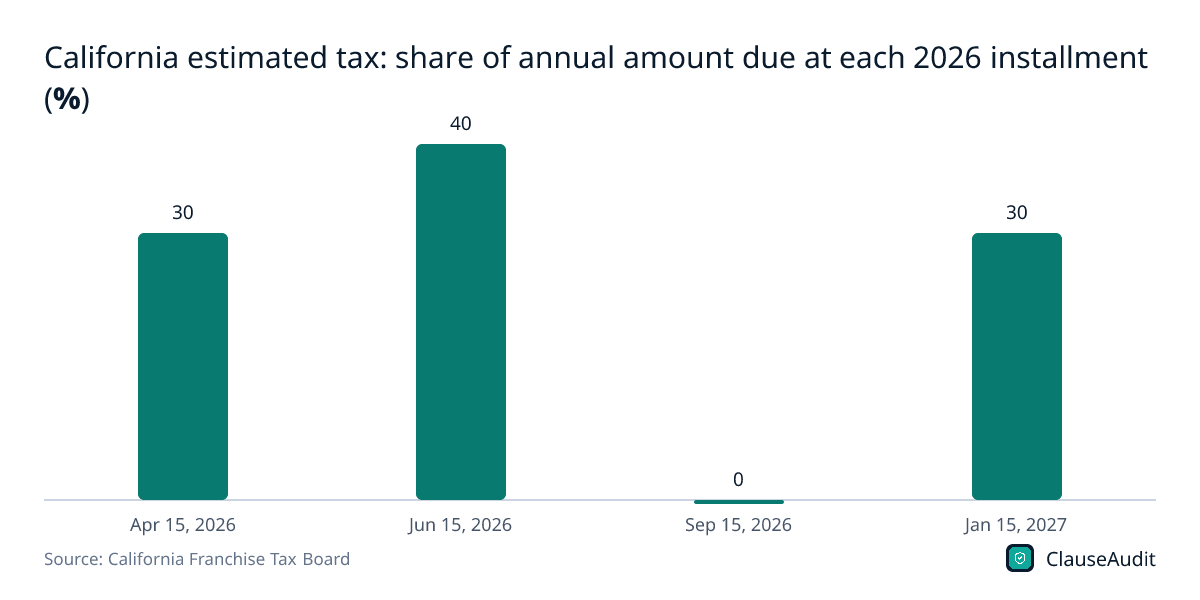
Most states follow the federal calendar: April 15, June 15 and September 15, 2026, then January 15, 2027. A few don't. Virginia's first payment is due May 1, Delaware's April 30, and Iowa pays on the last day of the month. California splits payments 30% / 40% / 0% / 30%, so nothing is due in September.

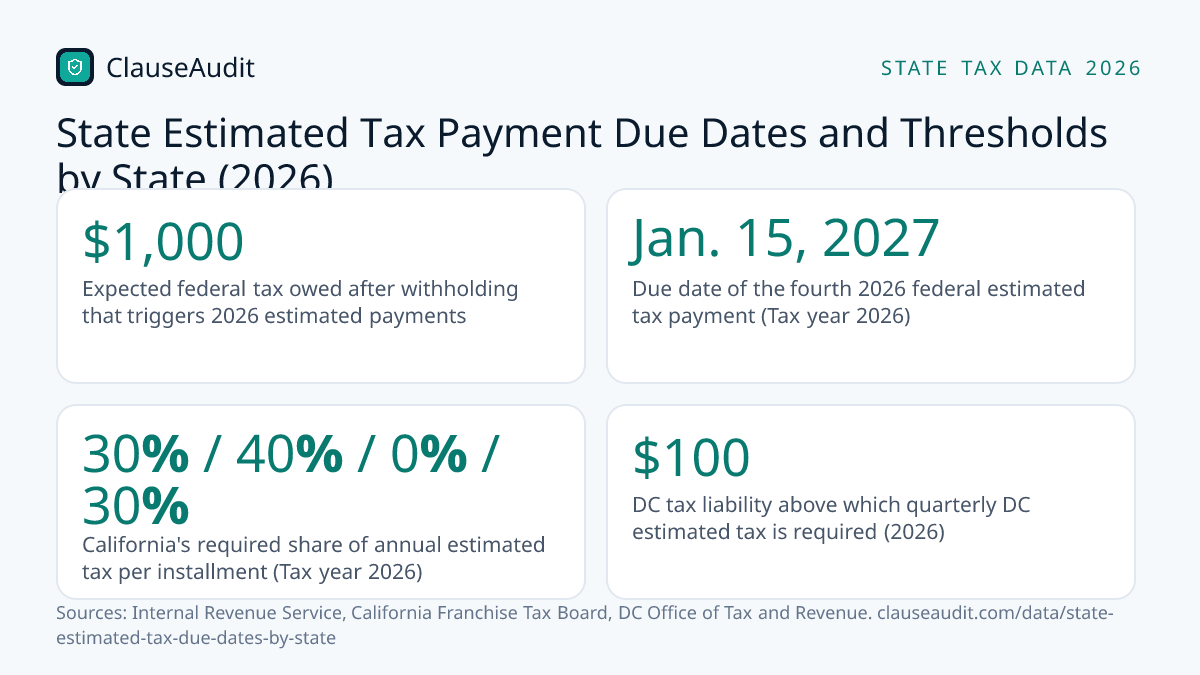
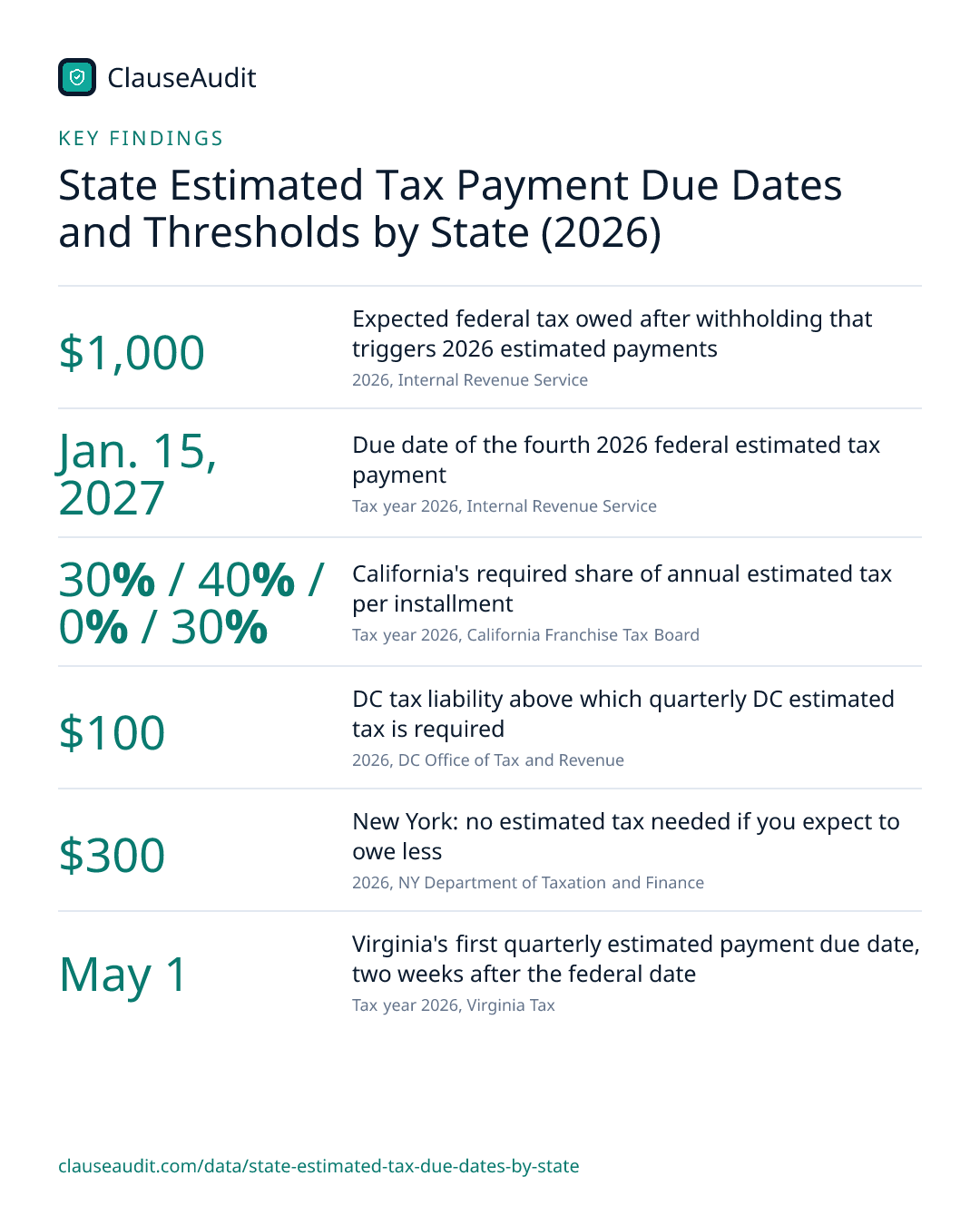
- Expected federal tax owed after withholding that triggers 2026 estimated payments (2026, Internal Revenue Service)
- $1,000
- Due date of the fourth 2026 federal estimated tax payment (Tax year 2026, Internal Revenue Service)
- Jan. 15, 2027
- California's required share of annual estimated tax per installment (Tax year 2026, California Franchise Tax Board)
- 30% / 40% / 0% / 30%
- DC tax liability above which quarterly DC estimated tax is required (2026, DC Office of Tax and Revenue)
- $100
- New York: no estimated tax needed if you expect to owe less (2026, NY Department of Taxation and Finance)
- $300
- Virginia's first quarterly estimated payment due date, two weeks after the federal date (Tax year 2026, Virginia Tax)
- May 1
- Iowa's new estimated tax threshold from tax year 2026, up from $200 (Tax years beginning on or after Jan. 1, 2026, Iowa Department of Revenue)
- $1,000
- Delaware tax due beyond withholding that requires an estimated tax declaration (Tax year 2026, Delaware Division of Revenue)
- $800
If no one withholds tax from your pay, the IRS and most states expect you to pay as you go. The federal trigger is simple: you need estimated payments if you expect to owe at least $1,000 for 2026 after withholding and refundable credits. States set their own triggers, and many are lower.
That gap catches people. A designer in New York can cross the state line at $300 while still sitting under the federal one. This page shows where each state draws the line, which states break from the federal calendar, and what to do about it before the next payment comes due.
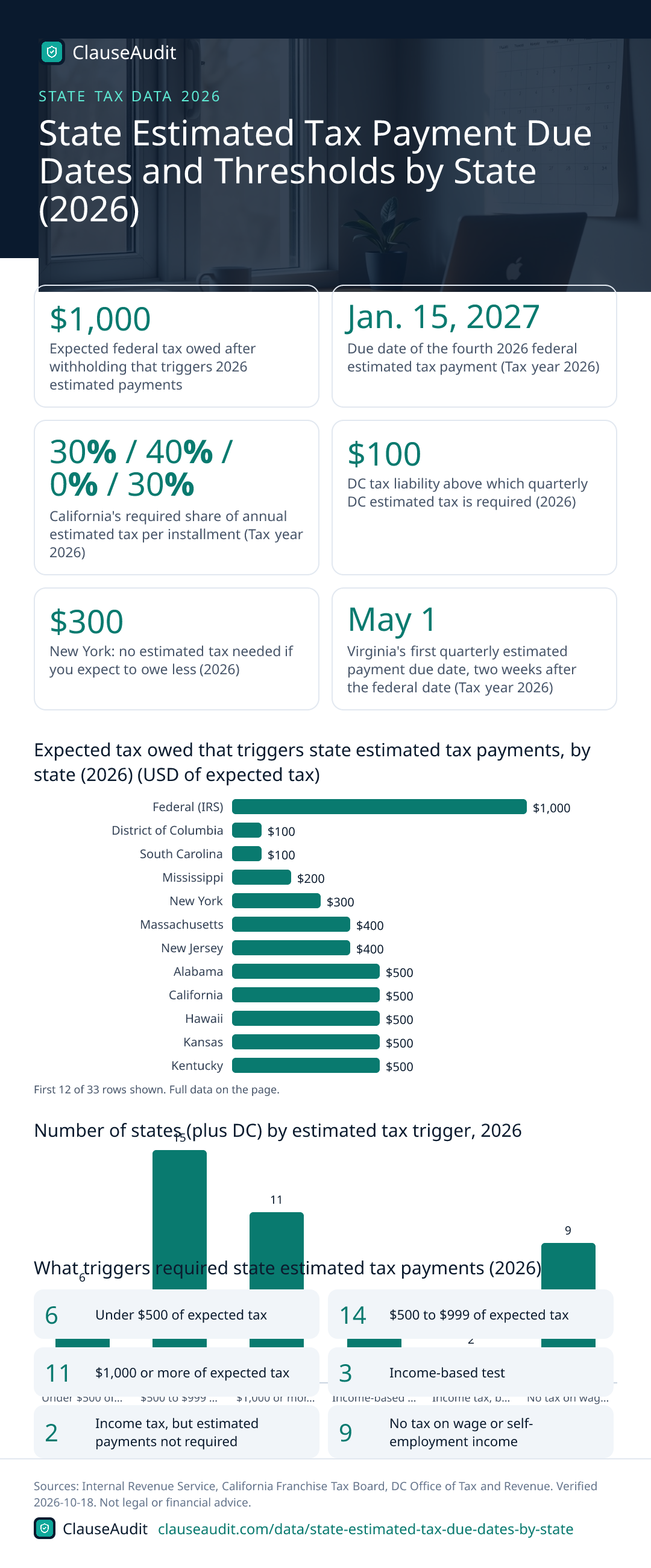
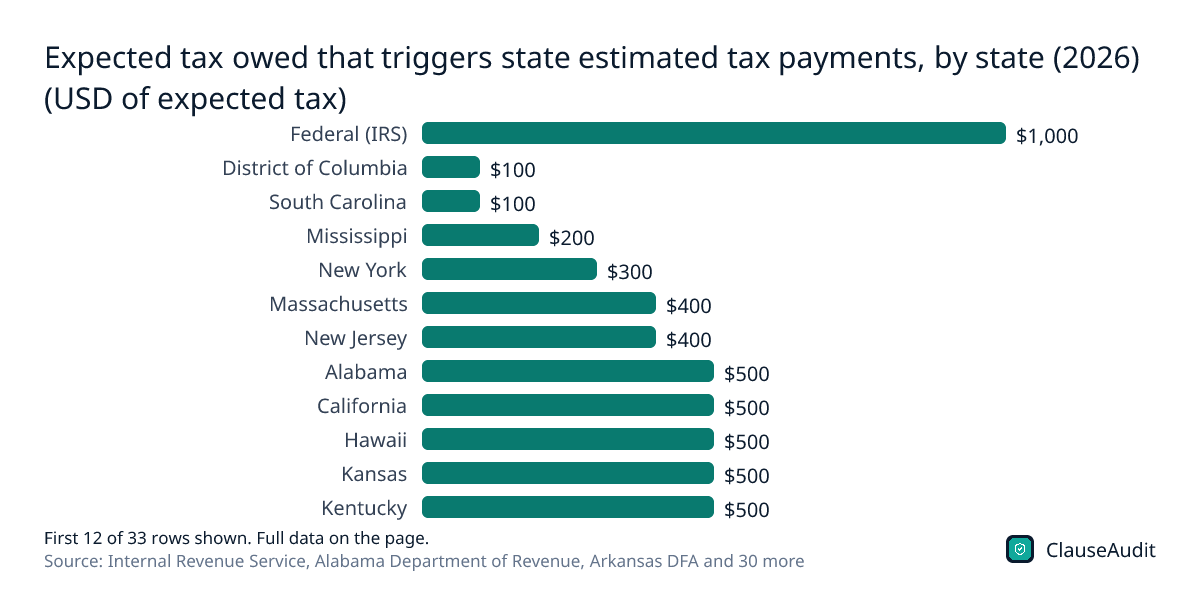
Expected tax owed that triggers state estimated tax payments, by state (2026) (USD of expected tax)
Chart data
| Label | Value |
|---|---|
| Federal (IRS) | $1,000 |
| District of Columbia | $100 |
| South Carolina | $100 |
| Mississippi | $200 |
| New York | $300 |
| Massachusetts | $400 |
| New Jersey | $400 |
| Alabama | $500 |
| California | $500 |
| Hawaii | $500 |
| Kansas | $500 |
| Kentucky | $500 |
| Maryland | $500 |
| Michigan | $500 |
| Minnesota | $500 |
| Montana | $500 |
| Nebraska | $500 |
| Ohio | $500 |
| Oklahoma | $500 |
| Vermont | $500 |
| West Virginia | $600 |
| Delaware | $800 |
| Arkansas | $1,000 |
| Colorado | $1,000 |
| Connecticut | $1,000 |
| Illinois | $1,000 |
| Iowa | $1,000 |
| Maine | $1,000 |
| New Mexico | $1,000 |
| North Carolina | $1,000 |
| North Dakota | $1,000 |
| Oregon | $1,000 |
| Virginia | $1,000 |
The federal $1,000 trigger sits at the top, but most states on this chart set a lower bar. DC and South Carolina start at $100, so even a small side income can count.
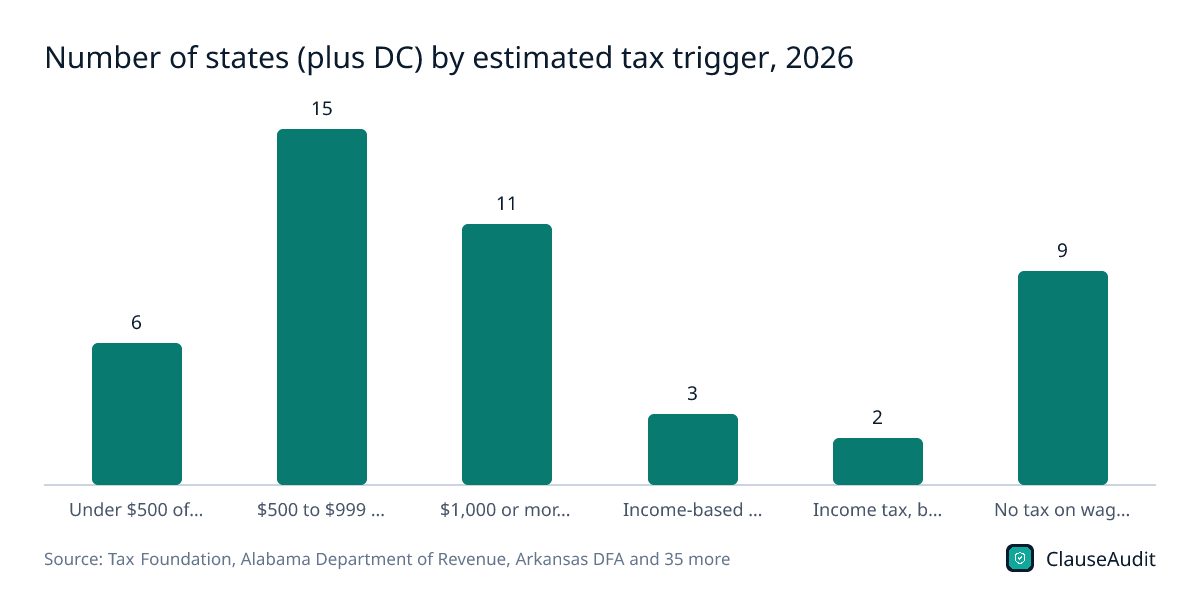
Download this chart (PNG)Number of states (plus DC) by estimated tax trigger, 2026
Chart data
| Label | Value |
|---|---|
| Under $500 of expected tax | 6 |
| $500 to $999 of expected tax | 15 |
| $1,000 or more of expected tax | 11 |
| Income-based test | 3 |
| Income tax, but no estimated payment requirement | 2 |
| No tax on wage or self-employment income | 9 |
The largest group, 15 states, sets the trigger somewhere from $500 to $999. Nine states don't tax wage or self-employment income at all, but federal estimated payments still apply there.
Download this chart (PNG)California estimated tax: share of annual amount due at each 2026 installment (%)
Chart data
| Label | Value (%) |
|---|---|
| Apr 15, 2026 | 30 |
| Jun 15, 2026 | 40 |
| Sep 15, 2026 | 0 |
| Jan 15, 2027 | 30 |
California front-loads the year: most of your annual estimate is due by June 15, 2026. If your income arrives late in the year, plan around that, not around four equal checks.
Download this chart (PNG)Days after April 15 that the first 2026 estimated payment is due
Chart data
| Label | Value |
|---|---|
| Federal (IRS) | Apr 15 |
| Hawaii | Apr 20 |
| Delaware | Apr 30 |
| Iowa | Apr 30 |
| Virginia | May 1 |
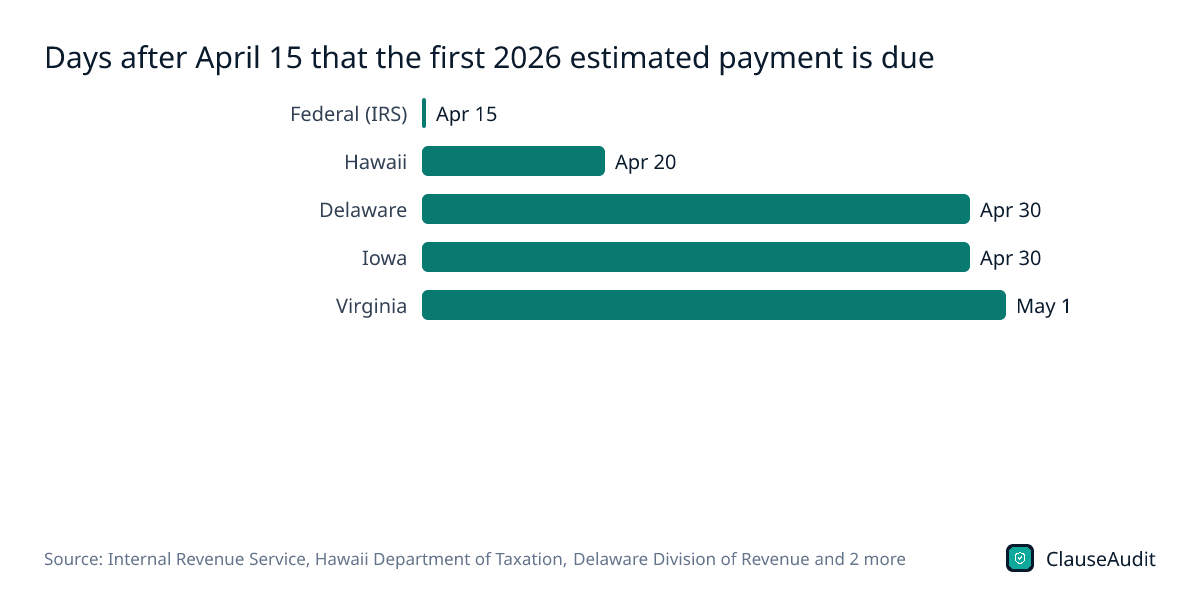
Virginia gives you the longest gap, 16 days past the federal date, and Delaware and Iowa give 15. It's a small window, but it helps if April cash is tight.
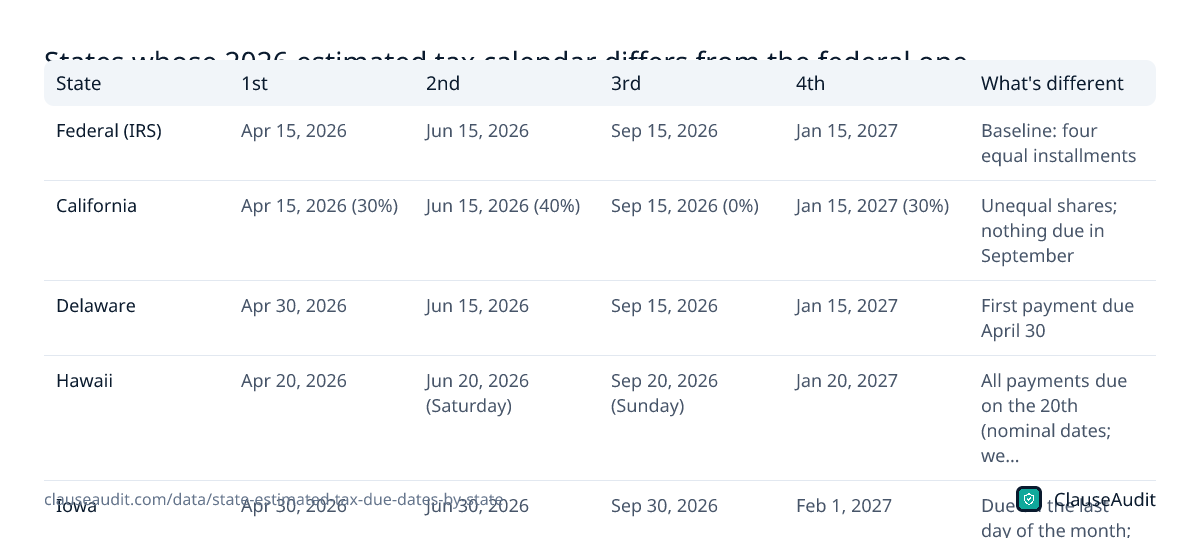
Download this chart (PNG)States whose 2026 estimated tax calendar differs from the federal one
| State | 1st | 2nd | 3rd | 4th | What's different |
|---|---|---|---|---|---|
| Federal (IRS) | Apr 15, 2026 | Jun 15, 2026 | Sep 15, 2026 | Jan 15, 2027 | Baseline: four equal installments |
| California | Apr 15, 2026 (30%) | Jun 15, 2026 (40%) | Sep 15, 2026 (0%) | Jan 15, 2027 (30%) | Unequal shares; nothing due in September |
| Delaware | Apr 30, 2026 | Jun 15, 2026 | Sep 15, 2026 | Jan 15, 2027 | First payment due April 30 |
| Hawaii | Apr 20, 2026 | Jun 20, 2026 (Saturday) | Sep 20, 2026 (Sunday) | Jan 20, 2027 | All payments due on the 20th (nominal dates; weekend shift for June and September 2026 not confirmed) |
| Iowa | Apr 30, 2026 | Jun 30, 2026 | Sep 30, 2026 | Feb 1, 2027 | Due on the last day of the month; moves to the next business day if that falls on a weekend or holiday (Jan 31, 2027 is a Sunday) |
| Virginia | May 1, 2026 | Jun 15, 2026 | Sep 15, 2026 | Jan 15, 2027 | First payment due May 1 |
Source: Internal Revenue Service, Form 1040-ES (2026), Estimated Tax for Individuals; California Franchise Tax Board, California Franchise Tax Board, Estimated tax payments; Delaware Division of Revenue, Delaware Division of Revenue, Declaration of Estimated Income Tax for Individuals 2026 (Revised 11/10/25); Hawaii Department of Taxation, Hawaii Department of Taxation, Form N-11 Instructions (2025); Iowa Department of Revenue, Iowa Department of Revenue, Estimated Income Tax Payments; Virginia Tax, Virginia Tax, Individual Estimated Tax Payments. Download as image
What triggers required state estimated tax payments (2026) by state
- 6Under $500 of expected tax
- 14$500 to $999 of expected tax
- 11$1,000 or more of expected tax
- 3Income-based test
- 2Income tax, but estimated payments not required
- 9No tax on wage or self-employment income
- Under $500 of expected tax6
- $500 to $999 of expected tax14
- $1,000 or more of expected tax11
- Income-based test3
- Income tax, but estimated payments not required2
- No tax on wage or self-employment income9
- Not yet confirmed6
| State | Who must pay | 2026 due dates | Source |
|---|---|---|---|
| Alabama | At least $500 expected tax after withholding and credits | Apr 15, Jun 15, Sep 15, 2026; Jan 15, 2027 | Alabama Department of Revenue, Form 40ES Instructions (2026) |
| Alaska | None (no individual income tax on wages or self-employment income) | None (federal 1040-ES dates still apply) | Tax Foundation, State Individual Income Tax Rates and Brackets, 2026 (Feb. 17, 2026; rates as of Jan. 1, 2026) |
| Arizona | Required if Arizona gross income exceeded $75,000 (single, MFS, HOH) or $150,000 (MFJ) in both 2025 and 2026 | Apr 15, Jun 15, Sep 15, 2026; Jan 15, 2027 | Arizona Department of Revenue, Individual Estimated Tax Payments |
| Arkansas | More than $1,000 expected estimated tax | Apr 15, Jun 15, Sep 15, 2026; Jan 15, 2027 | Arkansas DFA, AR1000ES Estimated Tax Declaration Vouchers (2026) |
| California | At least $500 ($250 if married/RDP filing separately) | Apr 15 (30%), Jun 15 (40%), Sep 15 (0%), 2026; Jan 15, 2027 (30%) | California Franchise Tax Board, Estimated tax payments |
| Colorado | More than $1,000 in net tax expected for 2026 | Apr 15, Jun 15, Sep 15, 2026; Jan 15, 2027 | Colorado Department of Revenue, DR 0104EP 2026 Individual Estimated Income Tax Payment Form |
| Connecticut | $1,000 or more after withholding and PE Tax Credit | Apr 15, Jun 15, Sep 15, 2026; Jan 15, 2027 | Connecticut DRS, Form CT-1040ES 2026 (Rev. 01/26) |
| Delaware | Tax due in excess of withholding expected to exceed $800 | Apr 30, Jun 15, Sep 15, 2026; Jan 15, 2027 | Delaware Division of Revenue, Declaration of Estimated Income Tax for Individuals 2026 (Revised 11/10/25) |
| District of Columbia | DC tax liability expected to be greater than $100 | Apr 15, Jun 15, Sep 15, 2026; Jan 15, 2027 | DC Office of Tax and Revenue, Underpayment of Estimated Tax Interest |
| Florida | None (no individual income tax on wages or self-employment income) | None (federal 1040-ES dates still apply) | Tax Foundation, State Individual Income Tax Rates and Brackets, 2026 (Feb. 17, 2026; rates as of Jan. 1, 2026) |
| Georgia | Required if gross income is expected to exceed (1) exemption for dependents, plus (2) estimated deductions, plus (3) $1,000 of income not subject to withholding | Apr 15, Jun 15, Sep 15; Jan 15 of the next year | Georgia Department of Revenue, IT-511 Individual Income Tax Instruction Booklet (2025) |
| Hawaii | Not yet confirmed: check the source | Hawaii Department of Taxation, Form N-11 Instructions (2025) | |
| Idaho | Not required for individuals (voluntary payments allowed on Form 51) | Not required | Idaho State Tax Commission, Avoid a Tax Debt |
| Illinois | Expected 2026 liability over $1,000 after withholding and credits | Apr 15, Jun 15, Sep 15, 2026; Jan 15, 2027 | Illinois Department of Revenue, IL-1040-ES 2026 |
| Indiana | Not yet confirmed: check the source | Indiana Department of Revenue, Estimated Payments | |
| Iowa | $1,000 or more of tax on income not subject to withholding (for tax years beginning on or after Jan. 1, 2026; was $200) | Apr 30, Jun 30, Sep 30, 2026; Feb 1, 2027 (Jan 31, 2027 is a Sunday; Iowa moves weekend/holiday due dates to the next business day) | Iowa Department of Revenue, Estimated Income Tax Payments |
| Kansas | At least $500 expected tax after withholding and credits | Apr 15, Jun 15, Sep 15, 2026; Jan 15, 2027 | K.S.A. 79-32,101; 79-32,102 |
| Kentucky | More than $500 (no payment required if estimated tax is $500 or less) | Apr 15, Jun 15, Sep 15, 2026; Jan 15, 2027 | KRS 141.305 |
| Louisiana | Not yet confirmed: check the source | La. R.S. 47:116 | |
| Maine | $1,000 or more over withholding and credits, and prior-year liability also $1,000 or more | Apr 15, Jun 15, Sep 15, 2026; Jan 15, 2027 | Maine Revenue Services, Form 1040ES-ME 2026 (Revised July 2026) |
| Maryland | More than $500 of tax in excess of Maryland withholding | Apr 15, Jun 15, Sep 15, 2026; Jan 15, 2027 | Comptroller of Maryland, 2026 Payment Voucher Worksheet for Estimated Tax |
| Massachusetts | More than $400 of tax not covered by withholding and credits | Apr 15, Jun 16, Sep 15, 2026; Jan 15, 2027 (as printed by DOR) | Massachusetts DOR, Estimated Tax Payments (updated Jan. 29, 2026) |
| Michigan | $500 or more for the year after withholding and credits | Apr 15, Jun 15, Sep 15, 2026; Jan 15, 2027 | Michigan Department of Treasury, Am I required to make estimated income tax payments? |
| Minnesota | $500 or more of tax after withholding and credits | Apr 15, Jun 15, Sep 15, 2026; Jan 15, 2027 | Minnesota Department of Revenue, Estimated Tax (updated Jan. 7, 2026) |
| Mississippi | Annual liability over $200 and less than 80% prepaid through withholding | Apr 15, Jun 15, Sep 15; Jan 15 of the next year | Mississippi DOR, 2025 Form 80-100 Resident, Non-Resident and Part-Year Resident Instructions (Rev. 12/25) |
| Missouri | Not yet confirmed: check the source | Section 143.521, RSMo | |
| Montana | More than $500 of tax expected | Apr 15, Jun 15, Sep 15; Jan 15 of the next year | Montana Department of Revenue, Making Estimated Tax Payments |
| Nebraska | Tax expected to exceed withholding and credits by $500 or more | Apr 15, Jun 15, Sep 15; Jan 15 of the next year | Nebraska Department of Revenue, Instructions for Paying Your Estimated Individual Income Tax |
| Nevada | None (no individual income tax on wages or self-employment income) | None (federal 1040-ES dates still apply) | Tax Foundation, State Individual Income Tax Rates and Brackets, 2026 (Feb. 17, 2026; rates as of Jan. 1, 2026) |
| New Hampshire | None (no individual income tax on wages or self-employment income) | None (federal 1040-ES dates still apply) | Tax Foundation, State Individual Income Tax Rates and Brackets, 2026 (Feb. 17, 2026; rates as of Jan. 1, 2026) |
| New Jersey | More than $400 owed after withholding and credits | Apr 15, Jun 15, Sep 15, 2026; Jan 15, 2027 | NJ Division of Taxation, 2026 Form NJ-1040-ES Instructions |
| New Mexico | Penalty applies if tax due exceeds payments and withholding by more than $1,000 | Apr 15, Jun 15, Sep 15; Jan 15 of the next year | NMSA 7-2-12.2 |
| New York | Not needed if you expect to owe less than $300 each of NYS, NYC and Yonkers tax | Apr 15, Jun 15, Sep 15, 2026; Jan 15, 2027 | NY Department of Taxation and Finance, Who must make estimated tax payments? (updated Nov. 19, 2025) |
| North Carolina | $1,000 or more of tax due after withholding and credits | Apr 15, Jun 15, Sep 15; Jan 15 of the next year | North Carolina Department of Revenue, Estimated Income Tax |
| North Dakota | $1,000 or more expected for 2026, 2025 liability $1,000 or more, and federal estimated tax required | Apr 15, Jun 15, Sep 15, 2026; Jan 15, 2027 | North Dakota Office of State Tax Commissioner, Form ND-1ES 2026 |
| Ohio | More than $500 of Ohio tax after credits and withholding | Apr 15, Jun 15, Sep 15, 2026; Jan 15, 2027 | Ohio Department of Taxation, Estimated Payments |
| Oklahoma | Tax expected to exceed withholding by $500 or more | Apr 15, Jun 15, Sep 15; Jan 15 of the next year | Oklahoma Tax Commission, Form OW-8-ES Tax Year 2026 (Revised 6-2025) |
| Oregon | $1,000 or more after all credits and withholding | Apr 15, Jun 15, Sep 15, 2026; Jan 15, 2027 | Oregon Department of Revenue, Publication OR-ESTIMATE 2026 |
| Pennsylvania | Taxable income not subject to withholding expected to exceed $9,500 ($292 in tax) | Apr 15, Jun 15, Sep 15; Jan 15 of the next year | Pennsylvania Department of Revenue, PA Personal Income Tax Guide |
| Rhode Island | Not yet confirmed: check the source | RI Division of Taxation, RI-1040ES 2026 | |
| South Carolina | $100 or more of income tax liability expected | Apr 15, Jun 15, Sep 15, 2026; Jan 15, 2027 | South Carolina DOR, SC1040ES Instructions 2026 |
| South Dakota | None (no individual income tax on wages or self-employment income) | None (federal 1040-ES dates still apply) | Tax Foundation, State Individual Income Tax Rates and Brackets, 2026 (Feb. 17, 2026; rates as of Jan. 1, 2026) |
| Tennessee | None (no individual income tax on wages or self-employment income) | None (federal 1040-ES dates still apply) | Tax Foundation, State Individual Income Tax Rates and Brackets, 2026 (Feb. 17, 2026; rates as of Jan. 1, 2026) |
| Texas | None (no individual income tax on wages or self-employment income) | None (federal 1040-ES dates still apply) | Tax Foundation, State Individual Income Tax Rates and Brackets, 2026 (Feb. 17, 2026; rates as of Jan. 1, 2026) |
| Utah | Not required (voluntary prepayment on Form TC-546) | Not required | Utah State Tax Commission, 2025 TC-40 General Instructions |
| Vermont | Penalties if you owe more than $500 | Apr 15, Jun 15, Sep 15, 2026; Jan 15, 2027 | Vermont Department of Taxes, Form IN-114 (2026) |
| Virginia | Expected tax after withholding and credits more than $1,000 | May 1, Jun 15, Sep 15, 2026; Jan 15, 2027 | Virginia Tax, Individual Estimated Tax Payments |
| Washington | None on wages or self-employment income (capital gains tax only) | None (federal 1040-ES dates still apply) | Tax Foundation, State Individual Income Tax Rates and Brackets, 2026 (Feb. 17, 2026; rates as of Jan. 1, 2026) |
| West Virginia | At least $600 expected tax after withholding | Apr 15, Jun 15, Sep 15; Jan 15 of the next year | West Virginia Tax Division, IT-140ESI Estimated Tax Payments Instructions (Sept 2023) |
| Wisconsin | Not yet confirmed: check the source | Wisconsin DOR, 2026 Form 1-ES Instructions | |
| Wyoming | None (no individual income tax on wages or self-employment income) | None (federal 1040-ES dates still apply) | Tax Foundation, State Individual Income Tax Rates and Brackets, 2026 (Feb. 17, 2026; rates as of Jan. 1, 2026) |
When are state estimated tax payments due in 2026?
For most states, the answer is the same four dates the IRS uses: April 15, June 15 and September 15, 2026, with the last payment on January 15, 2027. If you already have those in your calendar, you're covered for most of the map.
The exceptions are where people slip. Virginia wants its first payment on May 1. Delaware's first payment is due April 30. Iowa runs its whole calendar on the last day of the month, so its dates are April 30, June 30 and September 30, 2026, then February 1, 2027, because January 31 lands on a Sunday.
Massachusetts prints June 16, 2026 for its second payment, a day after the federal date. And California keeps the federal dates but changes how much you pay at each one. More on that below.
Do I need to pay state estimated taxes?
Probably, if you have income nobody withholds from and you live in a state with an income tax. Freelance fees, rental profit and side-project income are the usual sources. The question is how much tax you expect to owe, and each state answers it differently.
Six jurisdictions set the trigger under $500. DC and South Carolina start at $100, Mississippi at $200, New York at $300, and Massachusetts and New Jersey at $400. Fifteen states sit in the $500 to $999 band, which covers places like California, Michigan and Ohio, plus West Virginia at $600 and Delaware at $800. Eleven states use $1,000, the same figure as the federal test.
A few states use a different test. Arizona looks at gross income: you must pay if it topped $75,000 (single) or $150,000 (married filing jointly) in both 2025 and 2026. Pennsylvania asks whether untaxed income will exceed $9,500, which works out to $292 in tax. Idaho and Utah don't require individual estimated payments at all, though they accept them.
What changed for 2026?
Iowa is the big one. For tax years starting on or after January 1, 2026, Iowa raised its trigger to $1,000, up from $200. If you paid small Iowa estimates in past years just to stay safe, you may not need to now. Run the numbers before you skip a payment, though. One strong year can still put you over $1,000.
The other thing to watch is your own income. A year with one big client or a lump-sum project can push you over a state line you've never crossed. Even if your state's line stays put, your exposure might not.
Which states don't require estimated tax payments?
Nine states don't tax wage or self-employment income, so there's no state estimate to send: Alaska, Florida, Nevada, New Hampshire, South Dakota, Tennessee, Texas, Washington and Wyoming. Washington does tax capital gains, so a big stock sale there is a different story. New Hampshire's interest and dividends tax is repealed as of 2025.
Two states have an income tax but don't require individual estimated payments. Idaho and Utah both accept voluntary payments. Utah has a catch: to avoid extension penalties, you need to have prepaid most of your tax by the April due date, so voluntary doesn't mean optional in practice if you plan to file late.
Living in a no-tax state doesn't get you out of federal estimates. A freelancer in Texas who expects to owe at least $1,000 for 2026 still pays on the federal calendar. Moving partway through the year can also put you on two state schedules at once, so check both.
How does California's 30/40/0/30 schedule work?
California doesn't split the year into equal quarters. You pay 30% of your annual estimate by April 15, 2026, 40% by June 15, nothing in September, and the last 30% by January 15, 2027.
Here's what that means in practice. Picture a video editor whose big contracts pay out in October and November. Under California's split, the bulk of her state estimate is due before most of that money shows up. She either pays from savings in spring or underpays and risks a penalty. Someone with steady monthly income barely notices the difference. Someone with lumpy income feels it every June.
If that's your pattern, set aside a bigger share of every spring payment you receive, and don't treat the quiet September as found money. The trigger is $500, or $250 if you're married or a registered domestic partner filing separately.
What should freelancers and small businesses do now?
- Find your state's trigger on the table above and compare it to what you expect to owe after withholding, not to your gross income.
- Estimate what you'll owe for the year, then recheck after each payment date. A slow spring and a busy summer can change the answer.
- Put your state's real dates in your calendar. If you live in Virginia, Delaware, Iowa or Massachusetts, don't copy the federal list.
- If you have a W-2 job too, consider raising withholding there. It can cover a state gap without quarterly checks.
- Look for safe harbors. Colorado and Oklahoma both let you base payments on 70% of current-year tax.
- In Kansas, you can skip the January payment if you file and pay in full by January 31.
- Move a fixed share of every client payment into a separate tax account the day it clears, so the money is there when the date arrives.
Why your contracts matter for estimated tax
Estimated tax assumes you know roughly when money arrives. Your contracts decide that. A client who pays months after delivery, or only after an open-ended approval, can leave you owing a payment on income you haven't received yet.
That's why payment timing deserves the same attention as your rate. If a deposit, milestone payments or a clear due date are in the contract, you can match your tax payments to real cash. If they're not, you end up guessing, and the state doesn't care that your client was slow.
How ClauseAudit helps
Quarterly taxes are easier to plan when you know when you'll be paid. ClauseAudit's automated review reads your freelance or client agreement and flags the terms that push cash later than your tax dates.
Upload the contract and you'll get a plain-English list of the clauses to fix before you sign.
- Payment terms: a fixed due date for each invoice instead of payment on vague approval
- Deposit and milestones: money up front and at set stages, not only at the end
- Late fees and interest: a stated charge if the client pays late
- Kill fee: payment for work done if the client cancels the project
- Tax responsibility: who handles taxes, and how the contract describes your status as an independent contractor
- Rate changes: any right for the client to cut or freeze your rate during the term
Frequently asked questions
What are the 2026 federal estimated tax due dates?
The four federal dates for tax year 2026 are April 15, June 15 and September 15, 2026, and January 15, 2027. You generally need to pay if you expect to owe at least $1,000 for 2026 after withholding and refundable credits. Most states with an income tax use the same four dates.
Which states have the lowest estimated tax threshold?
DC and South Carolina have the lowest confirmed triggers at $100. Mississippi follows at $200, New York at $300, and Massachusetts and New Jersey at $400. In those places, even modest freelance income can require quarterly state payments while you're still under the federal $1,000 line.
Do I have to pay state estimated taxes if my state has no income tax?
Not to the state. Nine states don't tax wage or self-employment income, including Texas, Florida and Nevada. Washington taxes capital gains only. You still owe federal estimated payments if you expect to owe at least $1,000, so keep the federal dates in your calendar.
When is Virginia's first estimated tax payment due?
Virginia's first 2026 payment is due May 1, about two weeks after the federal April 15 date. The rest of its schedule matches the federal one: June 15 and September 15, 2026, and January 15, 2027. Virginia requires payments if you expect to owe more than $1,000 after withholding and credits.
Did Iowa change its estimated tax rules for 2026?
Yes. For tax years beginning on or after January 1, 2026, Iowa's trigger is $1,000 of tax on income not subject to withholding, up from $200. Iowa payments are due on the last day of the month: April 30, June 30 and September 30, 2026, and February 1, 2027.
Why is nothing due in September for California?
California weights its payments as 30% in April, 40% in June, 0% in September and 30% in January. The state collects more early in the year, so there's no September installment. That means the bulk of your annual estimate is due by June 15, 2026.
Is Arizona's estimated tax rule based on income or tax owed?
Income. Arizona requires estimated payments if your Arizona gross income exceeded $75,000 (single, married filing separately or head of household) or $150,000 (married filing jointly) in both 2025 and 2026. It's one of three states on this page with an income-based test rather than a tax-owed trigger.
Can I avoid state estimated payments by changing my withholding?
Often, yes. Most state triggers are measured after withholding, so if you also have a salaried job, raising state withholding there can bring what you owe under the line. Check your state's exact wording on the table first, since some count credits differently.
Use this data
Every chart and card below is free to reuse under CC BY 4.0. Download what you need and link back to this page.
 Stat cards
 Key findings card
 Infographic
 Expected tax owed that triggers state estimated tax payments, by state (2026) (USD of expected tax)
 Number of states (plus DC) by estimated tax trigger, 2026
 California estimated tax: share of annual amount due at each 2026 installment (%)
 Days after April 15 that the first 2026 estimated payment is due
 States whose 2026 estimated tax calendar differs from the federal one
Embed the infographic
Free to share on your site, blog or slides under CC BY 4.0. Please keep the credit link.
Sources and method
Every number on this page comes from the sources below, each opened and read on or before October 18, 2026. A second, independent review checked every figure against its source and corrected anything that did not match. 45 of 51 state entries were confirmed; any that could not be are marked "Not yet confirmed" and left out of every count and chart.
- Internal Revenue Service, Form 1040-ES (2026), Estimated Tax for Individuals (2026 edition)
- Tax Foundation, State Individual Income Tax Rates and Brackets, 2026 (Feb. 17, 2026 (updated Feb. 19, 2026); rates as of Jan. 1, 2026)
- Alabama Department of Revenue, Alabama Department of Revenue, Form 40ES Instructions (2026) (2026 edition)
- Arizona Department of Revenue, Arizona Department of Revenue, Individual Estimated Tax Payments (Current edition as of Oct. 18, 2026)
- Arkansas DFA, Arkansas DFA, AR1000ES Estimated Tax Declaration Vouchers (2026) (2026 edition)
- California Franchise Tax Board, California Franchise Tax Board, Estimated tax payments (Current page (2026 due dates))
- Colorado Department of Revenue, Colorado Department of Revenue, DR 0104EP 2026 Individual Estimated Income Tax Payment Form (2026 edition)
- Connecticut DRS, Connecticut DRS, Form CT-1040ES 2026 (Rev. 01/26) (2026 edition (Rev. 01/26))
- Delaware Division of Revenue, Delaware Division of Revenue, Declaration of Estimated Income Tax for Individuals 2026 (Revised 11/10/25) (2026 edition, revised Nov. 10, 2025)
- DC Office of Tax and Revenue, DC Office of Tax and Revenue, Underpayment of Estimated Tax Interest (Current edition as of Oct. 18, 2026)
- Georgia Department of Revenue, Georgia Department of Revenue, IT-511 Individual Income Tax Instruction Booklet (2025) (2025 edition)
- Hawaii Department of Taxation, Hawaii Department of Taxation, Form N-11 Instructions (2025) (2025 edition)
- Idaho State Tax Commission, Idaho State Tax Commission, Avoid a Tax Debt (Current edition as of Oct. 18, 2026)
- Illinois Department of Revenue, Illinois Department of Revenue, IL-1040-ES 2026 (2026 edition)
- Indiana Department of Revenue, Indiana Department of Revenue, Estimated Payments (Not opened (site blocked); listed for reference only)
- Iowa Department of Revenue, Iowa Department of Revenue, Estimated Income Tax Payments (Current page (rule for tax years beginning on or after Jan. 1, 2026))
- Kansas Statutes, Kansas Statutes, K.S.A. 79-32,101 and 79-32,102 (Statutes as published 2026)
- Kentucky Department of Revenue, Kentucky Department of Revenue, Instructions for Filing Estimated Tax Vouchers (42A740-S4, 9-25), for 2026 (42A740-S4 (9-25), for tax year 2026)
- Louisiana Department of Revenue, Louisiana Department of Revenue, Declaration of Estimated Income Taxes (Not opened (site blocked); listed for reference only)
- Maine Revenue Services, Maine Revenue Services, Form 1040ES-ME 2026 (Revised July 2026) (2026 edition, revised July 2026)
- Comptroller of Maryland, Comptroller of Maryland, 2026 Payment Voucher Worksheet for Estimated Tax (2026 edition)
- Massachusetts DOR, Massachusetts DOR, Estimated Tax Payments (updated Jan. 29, 2026) (Page updated Jan. 29, 2026)
- Michigan Department of Treasury, Michigan Department of Treasury, Am I required to make estimated income tax payments? (Current edition as of Oct. 18, 2026)
- Minnesota Department of Revenue, Minnesota Department of Revenue, Estimated Tax (updated Jan. 7, 2026) (Page updated Jan. 7, 2026)
- Mississippi DOR, Mississippi DOR, 2025 Form 80-100 Resident, Non-Resident and Part-Year Resident Instructions (Rev. 12/25) (2025 edition (Rev. 12/25))
- Missouri DOR, Missouri DOR, MO-1040ES 2026 (Not opened (site blocked); listed for reference only)
- Montana Department of Revenue, Montana Department of Revenue, Making Estimated Tax Payments (Current edition as of Oct. 18, 2026)
- Nebraska Department of Revenue, Nebraska Department of Revenue, Instructions for Paying Your Estimated Individual Income Tax (Current edition as of Oct. 18, 2026)
- NJ Division of Taxation, NJ Division of Taxation, 2026 Form NJ-1040-ES Instructions (2026 edition)
- New Mexico Taxation and Revenue Department, New Mexico Taxation and Revenue Department, Estimated Payments (Current edition as of Oct. 18, 2026)
- NY Department of Taxation and Finance, NY Department of Taxation and Finance, Who must make estimated tax payments? (updated Nov. 19, 2025) (Page updated Nov. 19, 2025)
- North Carolina Department of Revenue, North Carolina Department of Revenue, Estimated Income Tax (Current edition as of Oct. 18, 2026)
- North Dakota Office of State Tax Commissioner, North Dakota Office of State Tax Commissioner, Form ND-1ES 2026 (2026 edition)
- Ohio Department of Taxation, Ohio Department of Taxation, Estimated Payments (Current edition as of Oct. 18, 2026)
- Oklahoma Tax Commission, Oklahoma Tax Commission, Form OW-8-ES Tax Year 2026 (Revised 6-2025) (Tax Year 2026 (revised 6-2025))
- Oregon Department of Revenue, Oregon Department of Revenue, Publication OR-ESTIMATE 2026 (2026 edition)
- Pennsylvania Department of Revenue, Pennsylvania Department of Revenue, PA Personal Income Tax Guide (Current edition as of Oct. 18, 2026)
- RI Division of Taxation, RI Division of Taxation, RI-1040ES 2026 (Not opened (site blocked); listed for reference only)
- South Carolina DOR, South Carolina DOR, SC1040ES Instructions 2026 (2026 edition)
- Utah State Tax Commission, Utah State Tax Commission, 2025 TC-40 General Instructions (2025 instructions)
- Vermont Department of Taxes, Vermont Department of Taxes, Form IN-114 (2026) (2026 edition)
- Virginia Tax, Virginia Tax, Individual Estimated Tax Payments (Current edition as of Oct. 18, 2026)
- West Virginia Tax Division, West Virginia Tax Division, IT-140ESI Estimated Tax Payments Instructions (Sept 2023) (Sept 2023)
- Wisconsin DOR, Wisconsin DOR, 2026 Form 1-ES Instructions (Not opened (site blocked); listed for reference only)
- New York State Department of Taxation and Finance, Estimated tax payment due dates (Current edition as of Oct. 18, 2026)
Cite this page
ClauseAudit, “State Estimated Tax Payment Due Dates and Thresholds by State (2026)”, updated October 18, 2026, https://clauseaudit.com/data/state-estimated-tax-due-dates-by-state. Free to reuse with a link back (CC BY 4.0).
This page summarises published data and law as checked on October 18, 2026. Figures are updated as new editions are released, and your own situation may differ. It is general information, not legal, tax or financial advice.