Freelance Late Payment Statistics 2026: How Often Clients Pay Late, and What Gets Recovered
By ClauseAudit Research · 10 sources ·
What do the latest late payment statistics show?
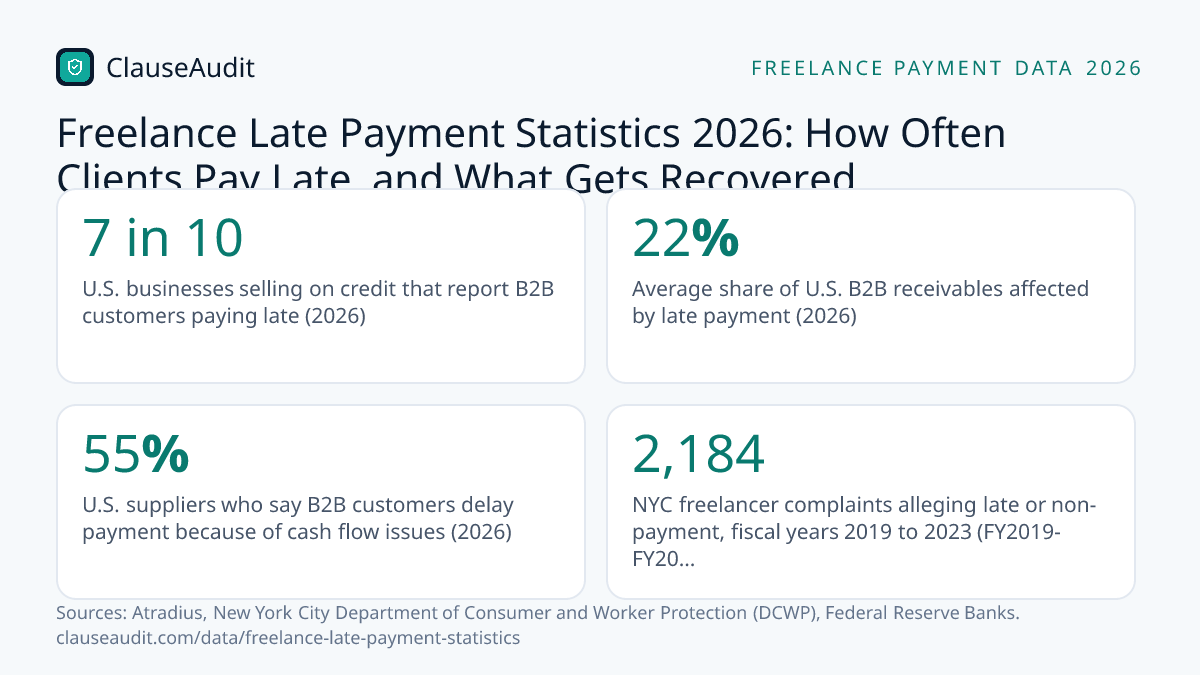
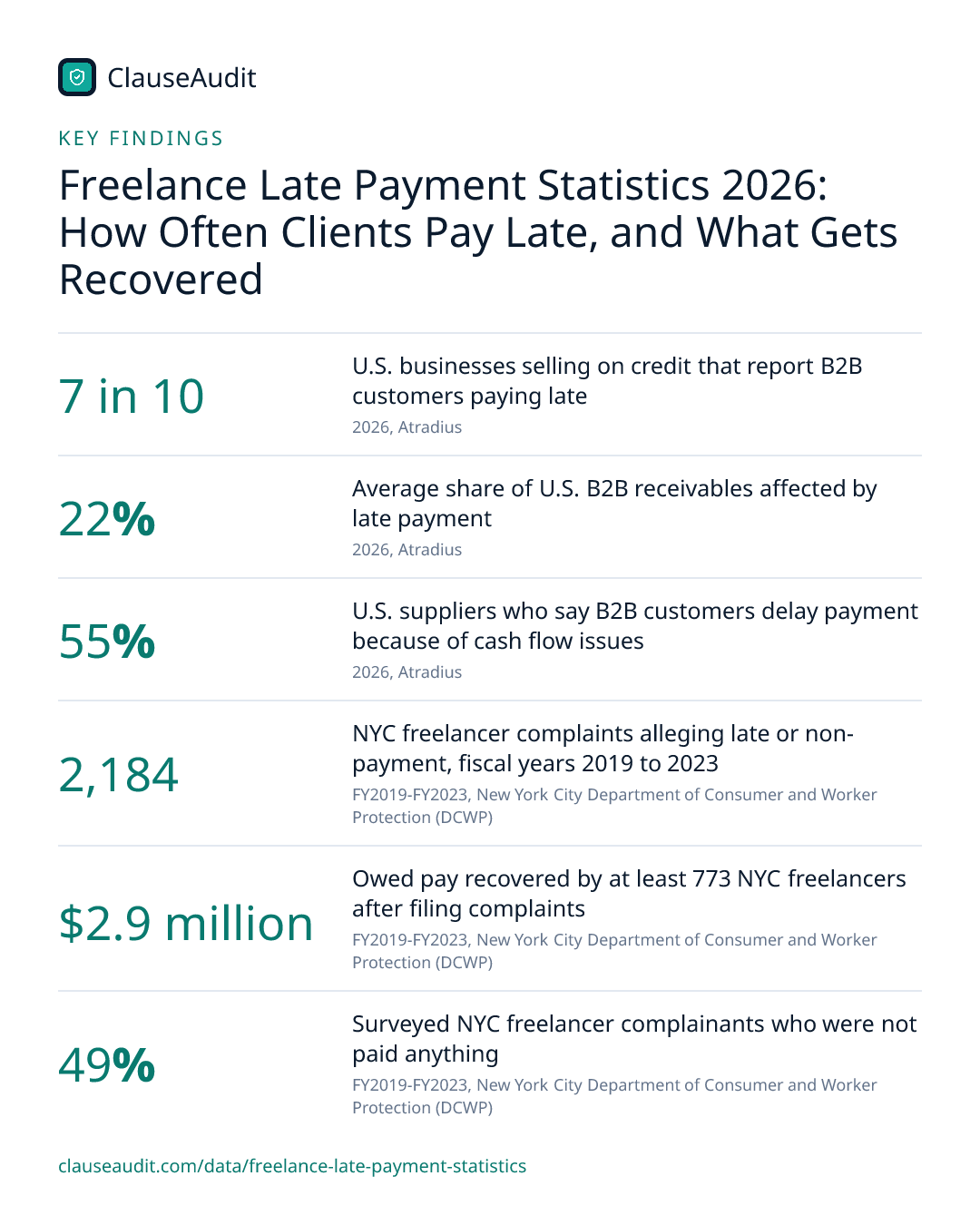
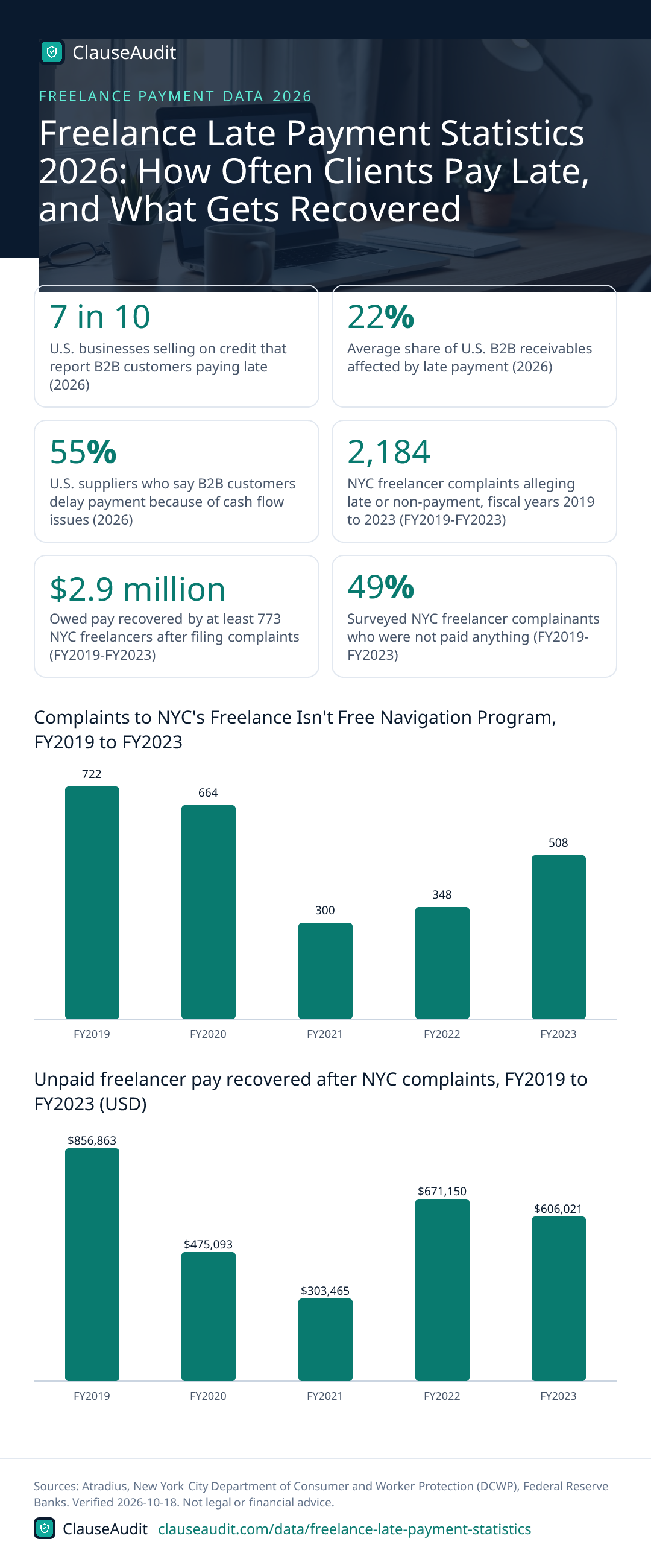
Late payment is normal, not rare. About 7 in 10 U.S. businesses that sell on credit said B2B customers paid late in 2026, and late payments touched 22% of their receivables on average. Freelancers feel it too: New York City logged 2,184 freelancer complaints about late or non-payment from FY2019 to FY2023.

- U.S. businesses selling on credit that report B2B customers paying late (2026, Atradius)
- 7 in 10
- Average share of U.S. B2B receivables affected by late payment (2026, Atradius)
- 22%
- U.S. suppliers who say B2B customers delay payment because of cash flow issues (2026, Atradius)
- 55%
- NYC freelancer complaints alleging late or non-payment, fiscal years 2019 to 2023 (FY2019-FY2023, New York City Department of Consumer and Worker Protection (DCWP))
- 2,184
- Owed pay recovered by at least 773 NYC freelancers after filing complaints (FY2019-FY2023, New York City Department of Consumer and Worker Protection (DCWP))
- $2.9 million
- Surveyed NYC freelancer complainants who were not paid anything (FY2019-FY2023, New York City Department of Consumer and Worker Protection (DCWP))
- 49%
- NYC Freelance Isn't Free complaints alleging unlawful payment practices in 2025 (2025, New York City Department of Consumer and Worker Protection (DCWP))
- 751
- U.S. small employer firms citing uneven cash flow, which includes collecting receivables (2025, Federal Reserve Banks)
- 50%
If a client has ever gone quiet on you after you sent the final invoice, you are in big company. Paying late is so common in U.S. business that most suppliers simply plan around it. The trouble is that a freelancer has far less room to wait than a company with a credit department.
This page pulls together the clearest public numbers we could verify: a 2026 survey of U.S. businesses on how often and how late invoices get paid, and New York City's own records on freelancers who filed complaints because a client paid late or not at all. Below the charts, you will find what those numbers mean for your next contract and what to do before and after an invoice goes overdue.
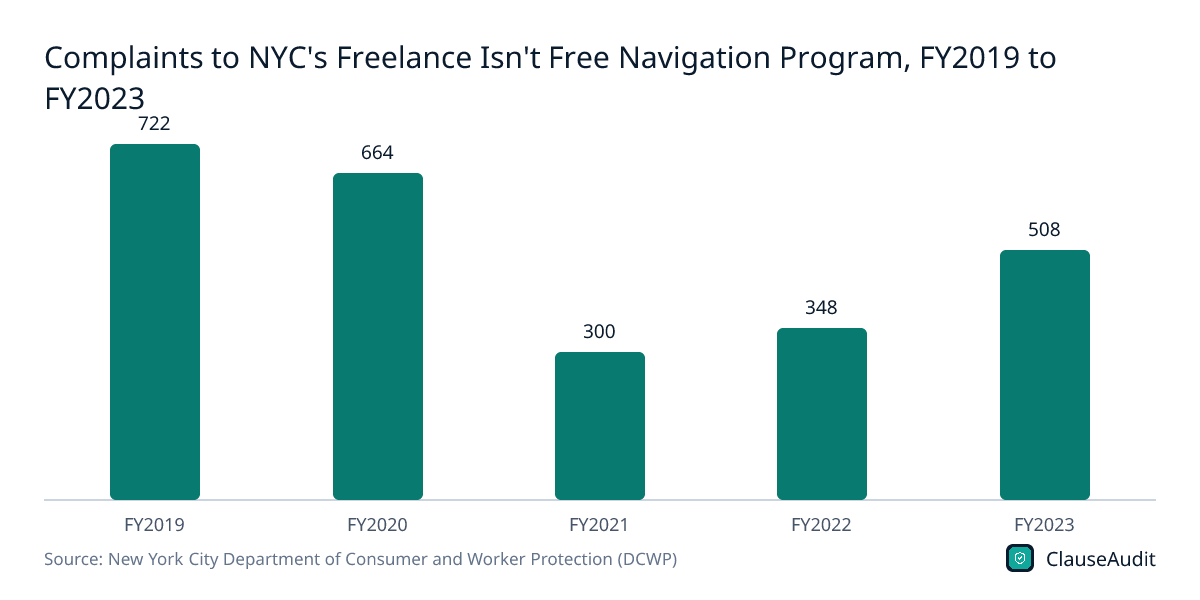
Complaints to NYC's Freelance Isn't Free Navigation Program, FY2019 to FY2023
Chart data
| Label | Value |
|---|---|
| FY2019 | 722 |
| FY2020 | 664 |
| FY2021 | 300 |
| FY2022 | 348 |
| FY2023 | 508 |
Complaints dropped to 300 in FY2021 and climbed back to 508 by FY2023. A lower count in a given year does not mean clients paid better; it can just mean fewer people filed.
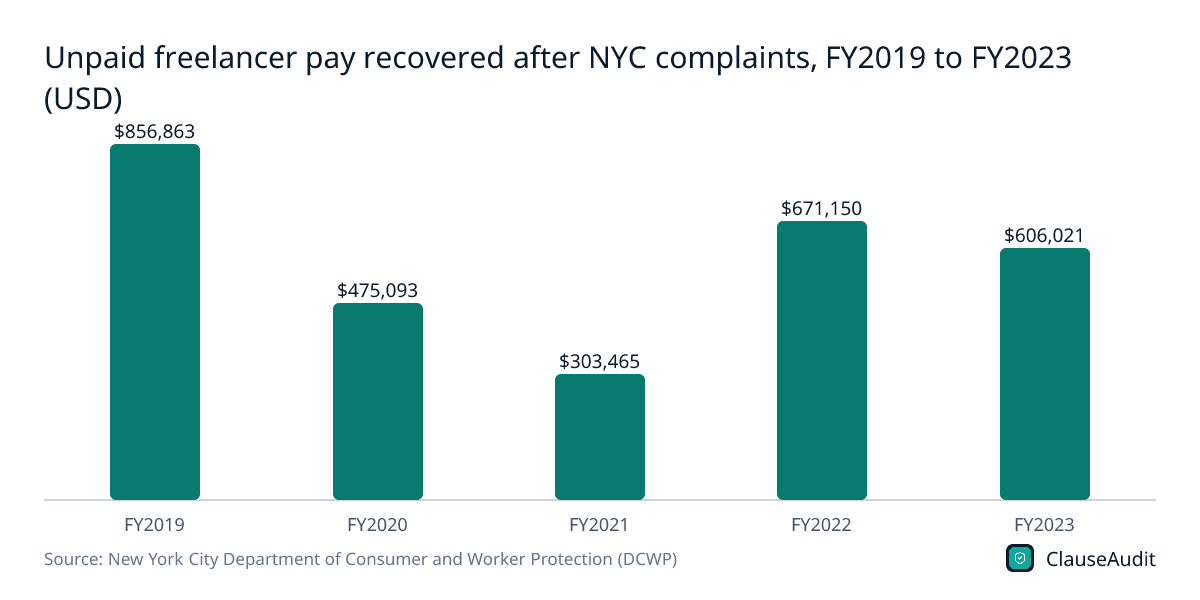
Download this chart (PNG)Unpaid freelancer pay recovered after NYC complaints, FY2019 to FY2023 (USD)
Chart data
| Label | Value (USD) |
|---|---|
| FY2019 | $856,863 |
| FY2020 | $475,093 |
| FY2021 | $303,465 |
| FY2022 | $671,150 |
| FY2023 | $606,021 |
FY2019 brought the largest recovery at $856,863. These amounts are self-reported, and the city says the real totals are likely higher.
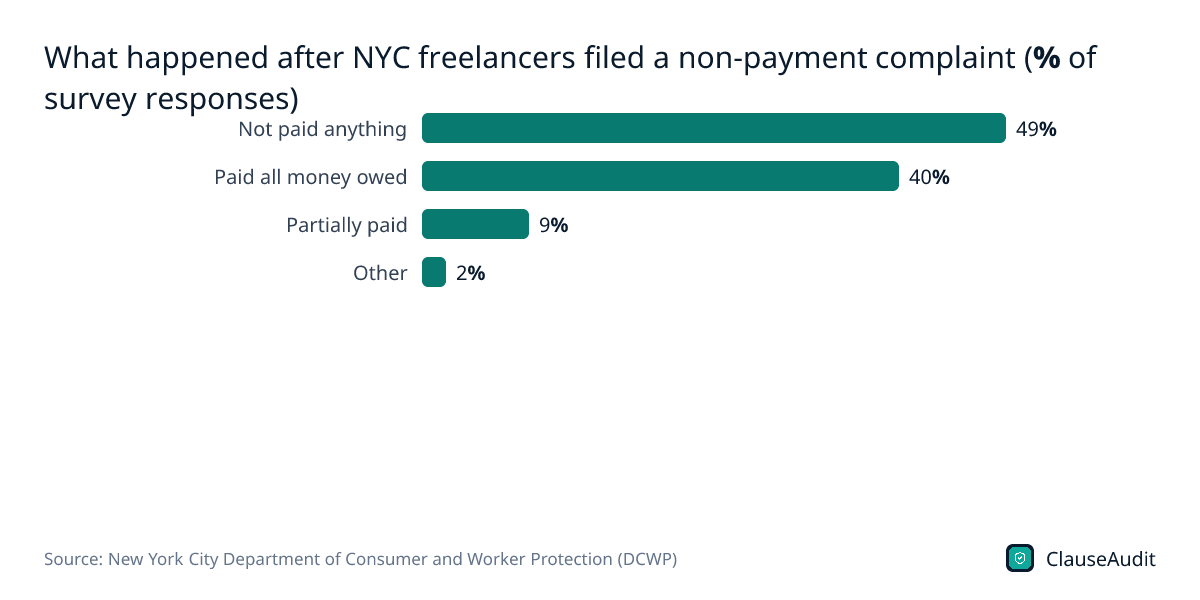
Download this chart (PNG)What happened after NYC freelancers filed a non-payment complaint (% of survey responses)
Chart data
| Label | Value |
|---|---|
| Not paid anything | 49% |
| Paid all money owed | 40% |
| Partially paid | 9% |
| Other | 2% |
Filing a complaint is no guarantee. Close to half of the freelancers surveyed got nothing back, which is why the terms you sign before the work starts carry so much weight.
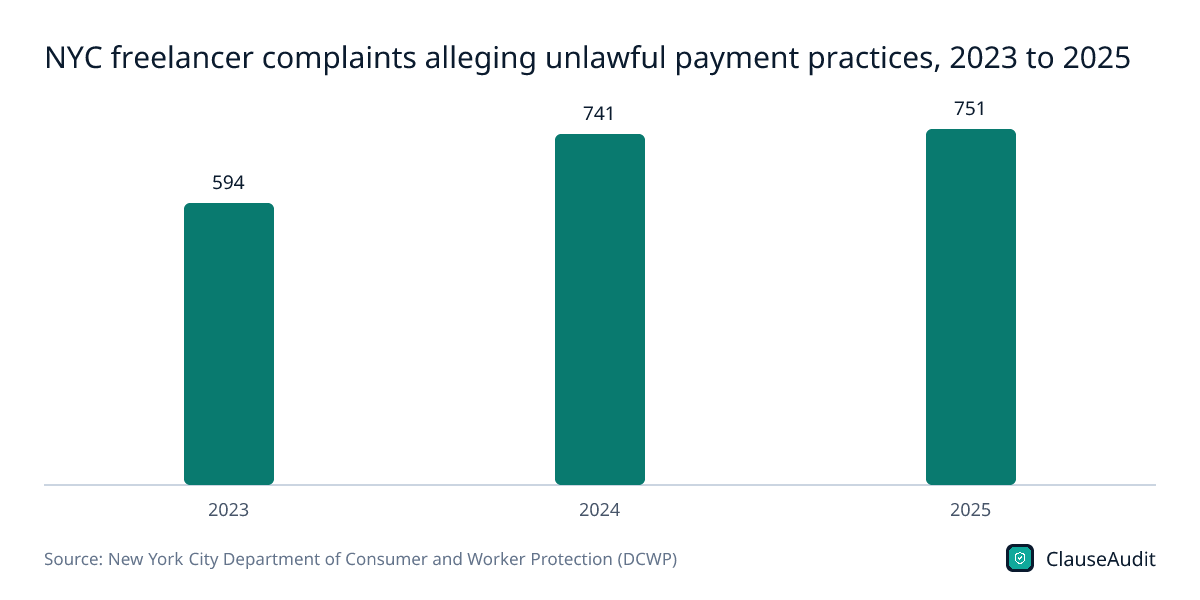
Download this chart (PNG)NYC freelancer complaints alleging unlawful payment practices, 2023 to 2025
Chart data
| Label | Value |
|---|---|
| 2023 | 594 |
| 2024 | 741 |
| 2025 | 751 |
Payment complaints rose from 594 in 2023 to 751 in 2025. The great majority of complaints the program receives are about money.
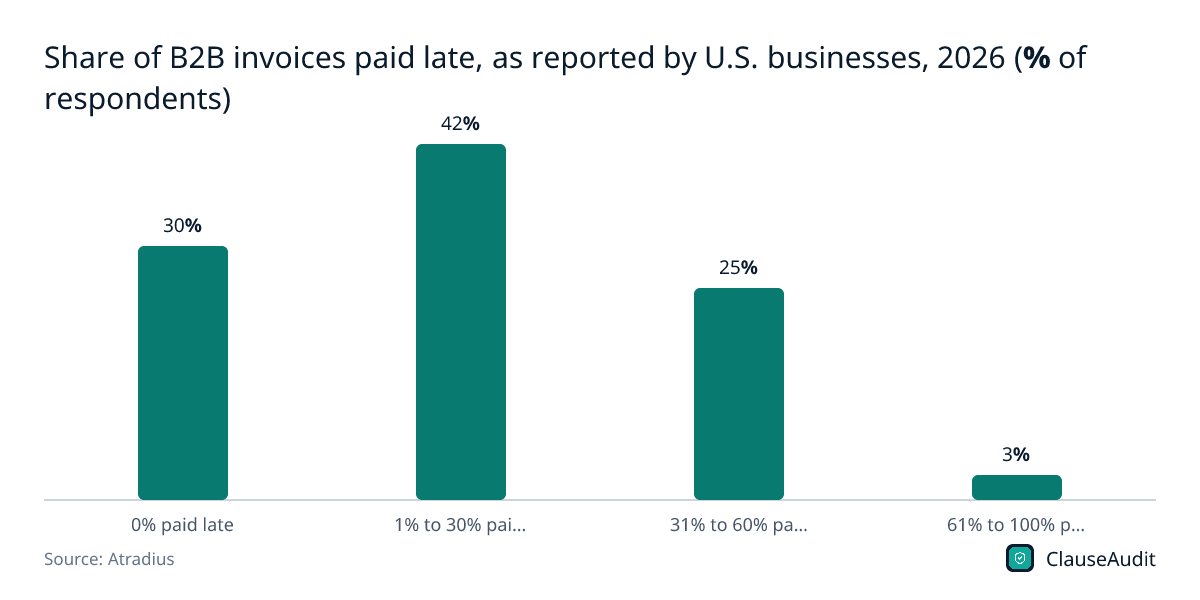
Download this chart (PNG)Share of B2B invoices paid late, as reported by U.S. businesses, 2026 (% of respondents)
Chart data
| Label | Value (% of respondents) |
|---|---|
| 0% paid late | 30% |
| 1% to 30% paid late | 42% |
| 31% to 60% paid late | 25% |
| 61% to 100% paid late | 3% |
Only 30% of U.S. businesses said none of their B2B invoices were paid late. For 25% of them, between 31% and 60% of invoices came in late.
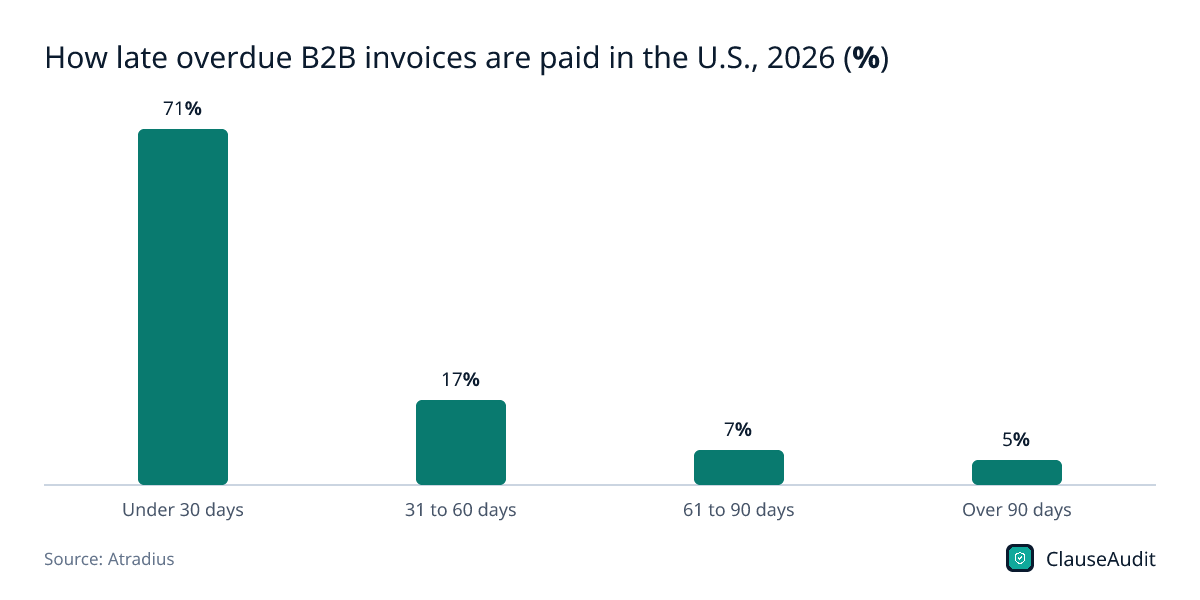
Download this chart (PNG)How late overdue B2B invoices are paid in the U.S., 2026 (%)
Chart data
| Label | Value (%) |
|---|---|
| Under 30 days | 71% |
| 31 to 60 days | 17% |
| 61 to 90 days | 7% |
| Over 90 days | 5% |
Most overdue invoices, 71%, are paid within 30 days of the due date. The 5% that run past 90 days are the ones most likely to turn into a write-off.
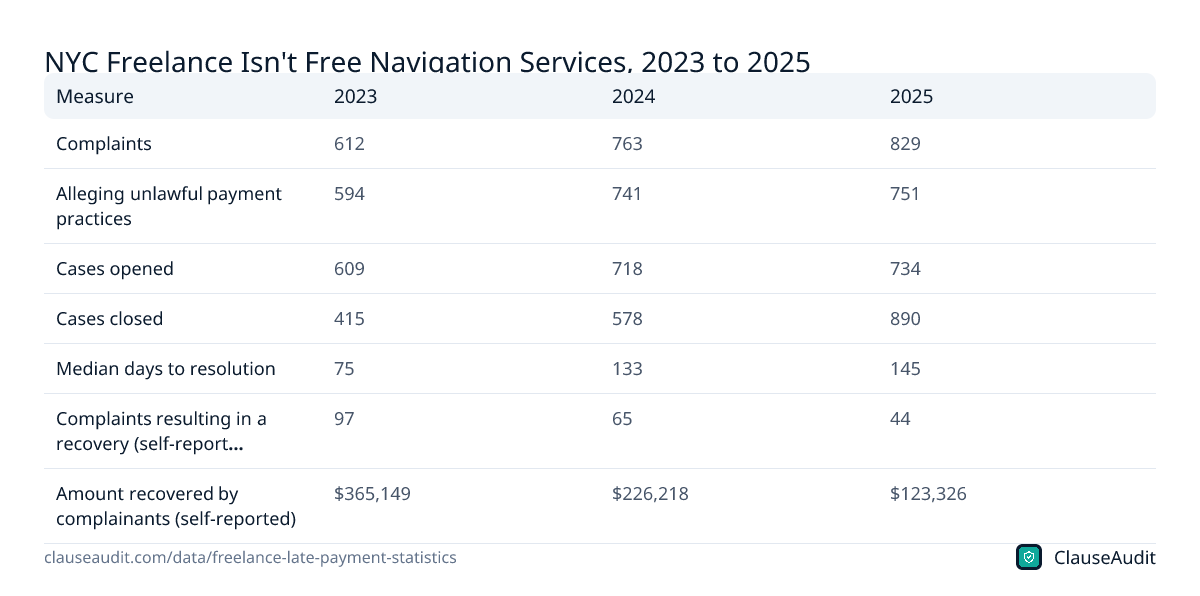
Download this chart (PNG)NYC Freelance Isn't Free Navigation Services, 2023 to 2025
| Measure | 2023 | 2024 | 2025 |
|---|---|---|---|
| Complaints | 612 | 763 | 829 |
| Alleging unlawful payment practices | 594 | 741 | 751 |
| Cases opened | 609 | 718 | 734 |
| Cases closed | 415 | 578 | 890 |
| Median days to resolution | 75 | 133 | 145 |
| Complaints resulting in a recovery (self-reported) | 97 | 65 | 44 |
| Amount recovered by complainants (self-reported) | $365,149 | $226,218 | $123,326 |
Source: New York City Department of Consumer and Worker Protection (DCWP), Worker Protection Metrics - 2023 Data; New York City Department of Consumer and Worker Protection (DCWP), Worker Protection Metrics - 2024 Data; New York City Department of Consumer and Worker Protection (DCWP), Worker Protection Metrics - 2025 Data. Download as image
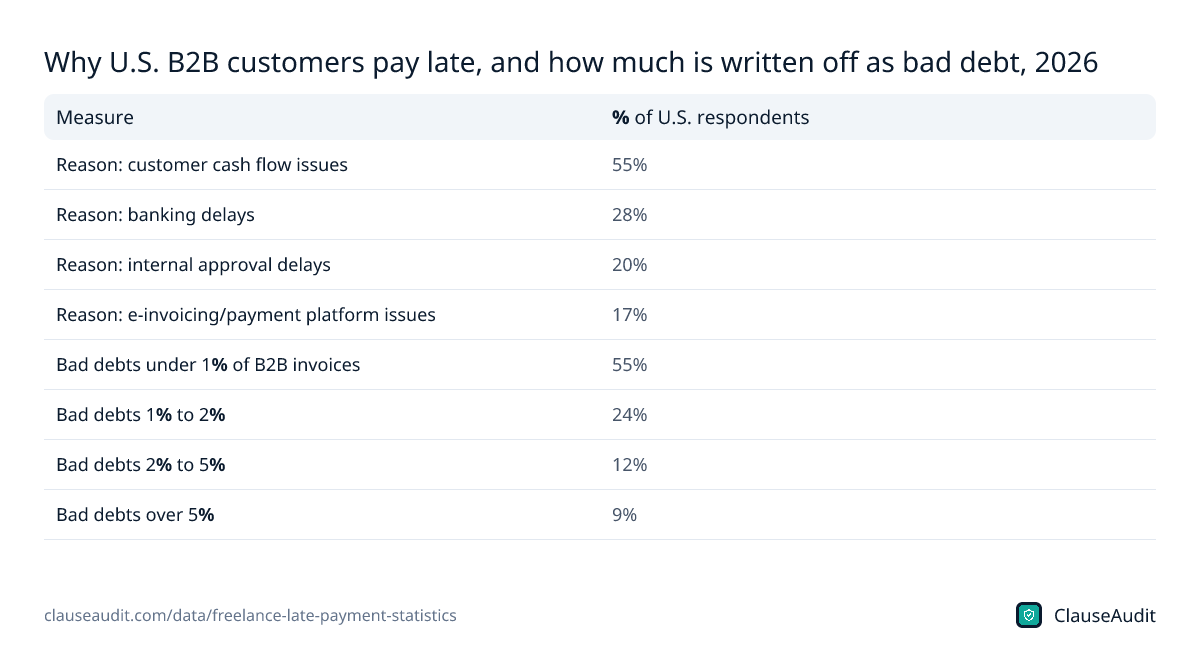
Why U.S. B2B customers pay late, and how much is written off as bad debt, 2026
| Measure | % of U.S. respondents |
|---|---|
| Reason: customer cash flow issues | 55% |
| Reason: banking delays | 28% |
| Reason: internal approval delays | 20% |
| Reason: e-invoicing/payment platform issues | 17% |
| Bad debts under 1% of B2B invoices | 55% |
| Bad debts 1% to 2% | 24% |
| Bad debts 2% to 5% | 12% |
| Bad debts over 5% | 9% |
Source: Atradius, Atradius Payment Practices Barometer: B2B payment practices trends, United States 2026. Download as image
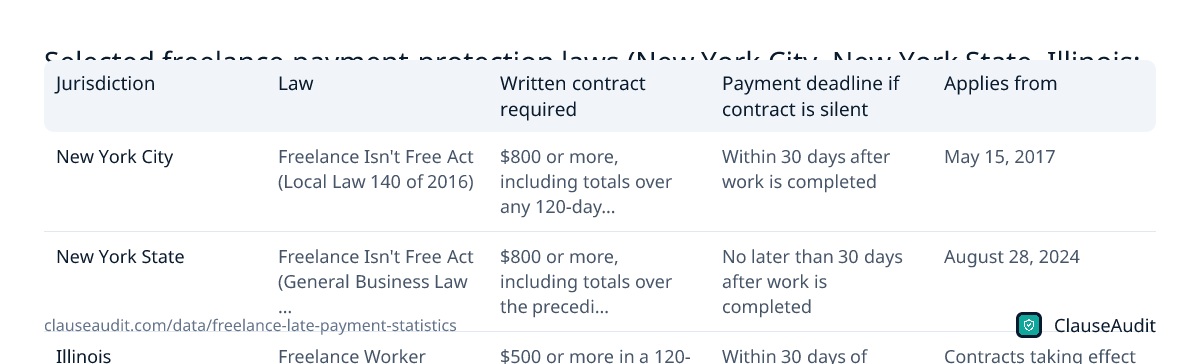
Selected freelance payment-protection laws (New York City, New York State, Illinois; not a complete list of U.S. laws)
| Jurisdiction | Law | Written contract required | Payment deadline if contract is silent | Applies from |
|---|---|---|---|---|
| New York City | Freelance Isn't Free Act (Local Law 140 of 2016) | $800 or more, including totals over any 120-day period | Within 30 days after work is completed | May 15, 2017 |
| New York State | Freelance Isn't Free Act (General Business Law Article 44-A) | $800 or more, including totals over the preceding 120 days | No later than 30 days after work is completed | August 28, 2024 |
| Illinois | Freelance Worker Protection Act | $500 or more in a 120-day period | Within 30 days of completing the services | Contracts taking effect after July 1, 2024 |
Source: New York City Department of Consumer and Worker Protection (DCWP), 5-Year Report on NYC's Freelance Isn't Free Act; New York City Department of Consumer and Worker Protection (DCWP), Freelance Worker Rights; New York State Department of Labor, Freelance Isn't Free Act; Illinois Department of Labor, Freelance Worker Protection Act; New York State Senate (Consolidated Laws of New York), New York General Business Law Article 44-A, Sections 1410-1412 (Freelance Isn't Free Act). Download as image
How often do clients pay freelancers late?
There is no national count of late freelance invoices. No federal agency tracks it. What we do have are two strong proxies, and they point the same way.
The first is the business-to-business picture. In 2026, about 7 in 10 U.S. businesses selling on credit reported customers paying late, and late payments affected 22% of their receivables on average. Your clients are businesses too. If they pay their other suppliers late, they will likely pay you late.
The second is New York City, the one place with years of freelancer-specific records. From FY2019 to FY2023 the city received 2,542 complaints from freelancers, and 2,184 of them alleged late or non-payment. In 2025 alone, 751 of 829 complaints were about unlawful payment practices. Those are only the people who knew the program existed and chose to file. Most freelancers who get stiffed send another reminder email and move on.
Why do clients pay late?
Usually it is not personal. In the 2026 survey, 55% of U.S. suppliers said customers delayed payment because of cash flow problems. That lines up with the Federal Reserve's 2025 survey, where 50% of small employer firms named uneven cash flow, which includes collecting their own receivables, as a challenge. Late payment runs downhill. A client waiting on its own customers will often make you wait too.
Here is how that looks in practice. Say you build a website for a small agency, and the agency is building it for a retail client. The retailer pays the agency weeks late, so the agency pays you late too. Nobody in that chain set out to stiff you. But your contract with the agency is the only thing that decides whether you wait on the retailer or get paid on your own schedule. A clause that says payment is due a set number of days after delivery, not after the end client pays, keeps you out of that chain.
Other reasons are more mundane. Banking delays were cited by 28% of suppliers, internal approval delays by 20%, and invoicing or payment platform problems by 17%. That last group is the one you can fix. An invoice sent to the wrong inbox, missing a purchase order number, or without the vendor form the client's accounts team needs can sit for weeks without anyone deciding not to pay it.
How late is late, and when does it become a loss?
Most late money does show up. Among overdue U.S. B2B invoices in 2026, 71% were paid within 30 days past due, 17% within 31 to 60 days, and 7% within 61 to 90 days. Only 5% ran past 90 days.
That tells you where to put your effort. A polite, firm follow-up in the first month recovers most of it. By the third month the odds turn against you, and the conversation should change from reminders to the remedies in your contract or your local law.
Some never arrive at all. Among NYC freelancers who filed complaints and answered a follow-up survey, 49% were not paid anything, 40% were paid in full and 9% were partly paid. Formal help also takes time. The city's median time to resolve a case grew from 75 days in 2023 to 145 days in 2025.
How much money goes unpaid for good?
For most businesses the final loss is small but real. In the 2026 survey, 55% of U.S. companies wrote off less than 1% of B2B invoices as bad debt. Another 24% lost 1% to 2%, 12% lost 2% to 5%, and 9% lost more than 5%.
A company with hundreds of customers can absorb that. A freelancer with four clients cannot. If one of them never pays a large final invoice, that single write-off can wipe out months of work. Spread across a big client list, bad debt is a rounding error. Concentrated in a small one, it is rent.
The New York City numbers show how hard late recovery can be. Complaints that ended with money back fell from 97 in 2023 to 44 in 2025, and the amount freelancers reported recovering dropped from $365,149 to $123,326 over the same years, even as complaints went up. The program is busier, and each case takes longer. The safest money is still the money your contract secures before you deliver.
Do freelancers have legal protection against late payment?
In some places, yes. New York City's Freelance Isn't Free Act has applied since May 15, 2017. It requires a written contract for work worth $800 or more, counting totals over any 120-day period, and if the contract is silent on timing, payment is due within 30 days after the work is done. New York State added its own version on August 28, 2024.
Illinois passed the Freelance Worker Protection Act for contracts that take effect after July 1, 2024. It requires a written contract for work of $500 or more in a 120-day period and sets payment within 30 days of completing the services when the contract does not say otherwise.
These laws help, and the NYC records show they can get money back. At least 773 freelancers there recovered about $2.9 million between FY2019 and FY2023. This is not a complete list of U.S. laws, so check the rules where you and your client are. Where no statute covers you, your contract is the main rulebook you have, so write the terms in yourself rather than hoping the law fills the gap.
What to do before and after an invoice goes overdue
- Get a signed contract for every project, even small ones. In New York City, New York State and Illinois it may be required anyway.
- Name a payment deadline in days, such as net 30, and say what starts the clock: the invoice date, delivery, or a milestone. Avoid wording like "paid when the client is paid."
- Ask for a deposit before you start. Money already in your account cannot be paid late.
- Bill in milestones on longer projects so one missed payment never covers the whole job.
- Put a late fee or interest clause in writing, and check that the amount is allowed where you and the client are.
- Before you invoice, ask who approves it, where it should go, and if you need a PO number or vendor form.
- Follow up the day an invoice is due, again at one week, and in writing at 30 days with a reference to the contract.
- If you work in New York City, New York State or Illinois, know the complaint process and use it if the client stops answering.
How ClauseAudit helps
Most late payments trace back to a vague line in the contract: no due date, payment tied to an approval nobody defined, or no consequence when the money is late. Those lines are easy to miss when you are excited to start a project.
Upload your freelance contract and the automated review flags the payment terms that leave you waiting, explains them in plain English, and suggests wording you can send back to the client before you sign.
- Payment deadline: is there a fixed number of days, and what event starts the clock?
- Approval and acceptance: does payment depend on the client's undefined final approval?
- Deposit and milestones: is any money paid up front, or is it all due at the end?
- Late fees and interest: is there any consequence for paying late, and is it written clearly?
- Kill fee and termination: are you paid for finished work if the client cancels midway?
- Ownership transfer: do rights in your work pass to the client before or after you are paid?
Frequently asked questions
What percentage of invoices are paid late in the U.S.?
In a 2026 survey of 240 U.S. businesses, late payments affected 22% of B2B receivables on average. About 7 in 10 companies reported at least some late payment, and only 30% said none of their B2B invoices were paid late. The survey covers business suppliers in general, so treat it as a strong signal for freelancers rather than a direct count.
How many freelancers get paid late or not at all?
No national figure exists. The best public record is New York City's, where 2,184 of 2,542 freelancer complaints from FY2019 to FY2023 alleged late or non-payment. In 2025, 751 of 829 complaints were about unlawful payment practices. Those counts only include people who filed, so the real number of affected freelancers is much larger.
If I file a complaint, will I get paid?
Maybe, but do not count on it. Among NYC freelancers who answered a follow-up survey, 40% were paid everything they were owed, 9% were partly paid and 49% got nothing. Complaints still recovered about $2.9 million for at least 773 freelancers over five years, so filing is worth doing. A clear contract before the work starts is better protection.
How long do clients usually take to pay an overdue invoice?
Most pay within a month of the due date. In 2026 survey data on U.S. B2B invoices, 71% of overdue invoices were paid within 30 days past due, 17% within 31 to 60 days, 7% within 61 to 90 days, and 5% after more than 90 days. The longer it runs, the harder it gets to collect.
What is the Freelance Isn't Free Act?
It is a New York City law in effect since May 15, 2017. Clients must use a written contract for freelance work worth $800 or more, including totals over any 120-day period. If the contract does not set a payment date, the client has to pay within 30 days after the work is done. New York State added its own law on August 28, 2024.
Which states protect freelancers from late payment?
This page covers three laws from official government sources: New York City's, New York State's and Illinois's. Illinois covers contracts that take effect after July 1, 2024, requires a written contract for $500 or more in a 120-day period, and sets a 30-day payment default. It is not a complete list, so check your own state and city.
Can I charge a late fee on a freelance invoice?
Usually you can, if the client agreed to it in the contract. A fee you add to an invoice after the fact is much harder to enforce. Write the fee or interest rate into the agreement, state when it starts, and check that the amount is reasonable and allowed where you and your client are based.
Why do businesses pay invoices late?
Cash flow is the main reason. In 2026, 55% of U.S. suppliers said customers delayed payment because of cash flow issues, ahead of banking delays at 28% and internal approval delays at 20%. Many late payments are slow processes rather than refusals, so sending the invoice to the right person with the right paperwork helps.
Use this data
Every chart and card below is free to reuse under CC BY 4.0. Download what you need and link back to this page.
 Stat cards
 Key findings card
 Infographic
 Complaints to NYC's Freelance Isn't Free Navigation Program, FY2019 to FY2023
 Unpaid freelancer pay recovered after NYC complaints, FY2019 to FY2023 (USD)
 What happened after NYC freelancers filed a non-payment complaint (% of survey responses)
 NYC freelancer complaints alleging unlawful payment practices, 2023 to 2025
 Share of B2B invoices paid late, as reported by U.S. businesses, 2026 (% of respondents)
 How late overdue B2B invoices are paid in the U.S., 2026 (%)
 NYC Freelance Isn't Free Navigation Services, 2023 to 2025
 Why U.S. B2B customers pay late, and how much is written off as bad debt, 2026
 Selected freelance payment-protection laws (New York City, New York State, Illinois; not a complete list of U.S. laws)
Embed the infographic
Free to share on your site, blog or slides under CC BY 4.0. Please keep the credit link.
Sources and method
Every number on this page comes from the sources below, each opened and read on or before October 18, 2026. A second, independent review checked every figure against its source and corrected anything that did not match. Figures that could not be confirmed were left out.
- New York City Department of Consumer and Worker Protection (DCWP), 5-Year Report on NYC's Freelance Isn't Free Act (November 1, 2023 (covers FY2019-FY2023; most recent multi-year FIFA report))
- New York City Department of Consumer and Worker Protection (DCWP), Worker Protection Metrics - 2025 Data (2026 (2025 data; PDF dated March 2026))
- New York City Department of Consumer and Worker Protection (DCWP), Worker Protection Metrics - 2024 Data (2024 data edition)
- New York City Department of Consumer and Worker Protection (DCWP), Worker Protection Metrics - 2023 Data (2023 data edition)
- Atradius, Atradius Payment Practices Barometer: B2B payment practices trends, United States 2026 (17 Sep 2026 (2026 edition; survey end of Q2 to mid Q3 2026, 240 U.S. businesses))
- Federal Reserve Banks, 2026 Report on Employer Firms: Findings from the 2025 Small Business Credit Survey (March 2026)
- New York City Department of Consumer and Worker Protection (DCWP), Freelance Worker Rights (Undated web page, accessed 2026-10-18)
- New York State Department of Labor, Freelance Isn't Free Act (Undated web page, accessed 2026-10-18)
- Illinois Department of Labor, Freelance Worker Protection Act (Undated web page, accessed 2026-10-18)
- New York State Senate (Consolidated Laws of New York), New York General Business Law Article 44-A, Sections 1410-1412 (Freelance Isn't Free Act) (Current statute text, accessed 2026-10-19 (definitions: /GBS/1410; written contract: /GBS/1412))
Cite this page
ClauseAudit, “Freelance Late Payment Statistics 2026: How Often Clients Pay Late, and What Gets Recovered”, updated October 18, 2026, https://clauseaudit.com/data/freelance-late-payment-statistics. Free to reuse with a link back (CC BY 4.0).
This page summarises published data and law as checked on October 18, 2026. Figures are updated as new editions are released, and your own situation may differ. It is general information, not legal, tax or financial advice.