Freelance Isn't Free Laws by State and City: Contracts, Payment Deadlines and Penalties
By ClauseAudit Research · Verified against official sources ·
How long does a client have to pay a freelancer?
Under most freelance payment laws, the client must pay by the date in your contract, or within 30 days of finishing the work if no date is set. 3 states and 6 cities have these rules, covering New York, California and Illinois. Elsewhere, your contract terms and ordinary breach of contract law decide.

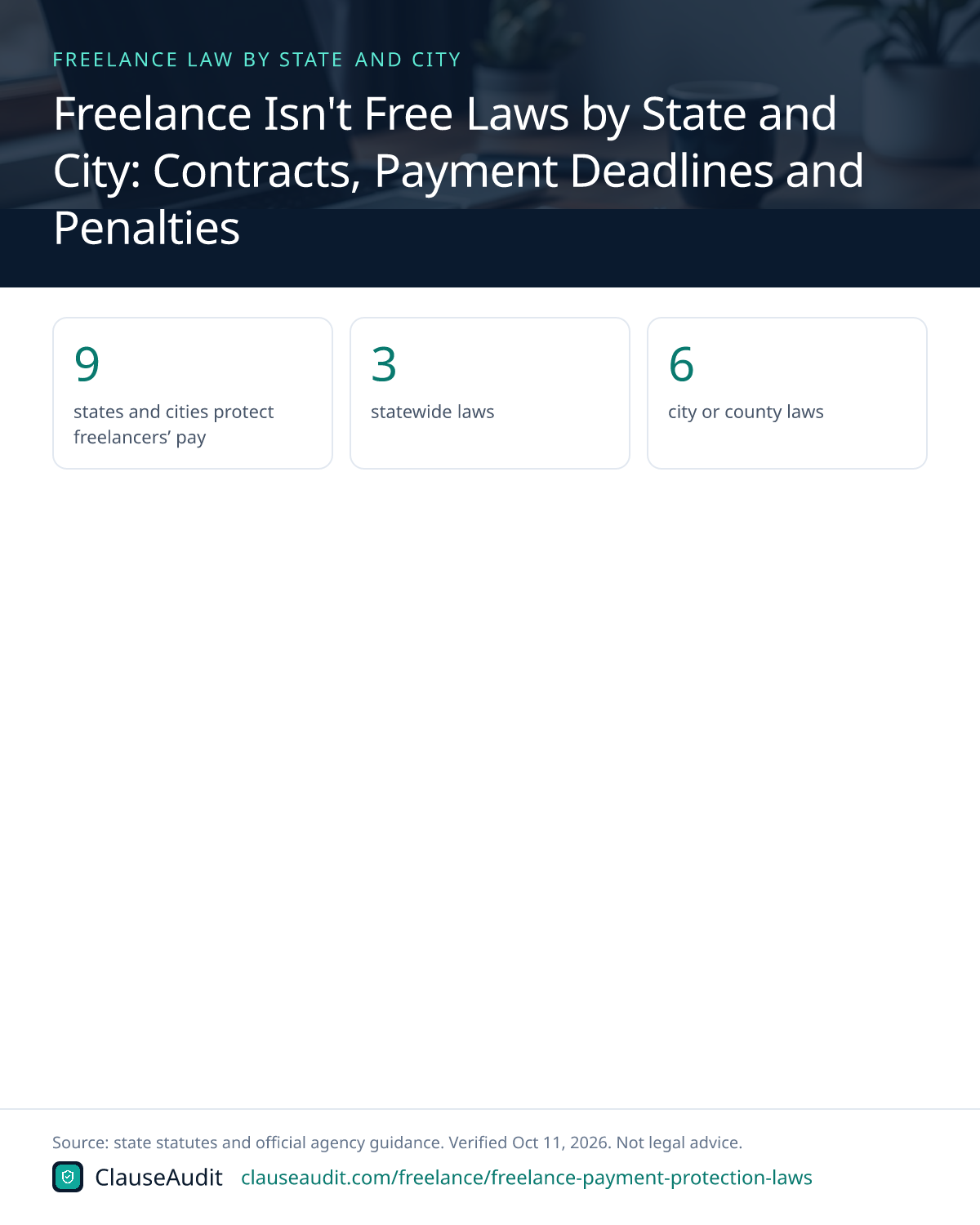
- states and cities protect freelancers’ pay
- 9
- statewide laws
- 3
- city or county laws
- 6
- require a written contract
- 7
You finished the project, sent the invoice and heard nothing for two months. In most of the country, your only real tool is the contract and a small claims form. But if you work in New York, California, Illinois or a handful of cities, the law gives you a payment deadline, a right to a written contract and real money when a client stalls.
These are the Freelance Isn't Free laws and their cousins. We checked each one against its statute or the agency that enforces it. The map and table below list every law we verified. This guide explains how the rules work, which details differ from place to place, and what to do if a client ignores them.
Freelance payment protection laws in the US
| Where | Law | Applies to | Payment deadline | If the client pays late |
|---|---|---|---|---|
| California (statewide) | Freelance Worker Protection Act (SB 988, Stats. 2024, ch. 870) (Cal. Bus. & Prof. Code §§ 18100-18107) | $250 or more for professional services, by itself or aggregated with all contracts between the same parties during the immediately preceding 120 days | On or before the date due under the contract; if the contract does not say, no later than 30 days after completion of the freelancer's services | Civil action by the freelancer or a public prosecutor: up to twice the unpaid amount for late payment, an additional $1,000 if a requested written contract was refused, contract or work value for other violations, plus attorney fees, costs and injunctive relief. |
| Illinois (statewide) | Freelance Worker Protection Act (820 ILCS 193 (Public Act 103-0417)) | $500 or more, by a single contract or aggregated with all contracts between the same parties in the immediately preceding 120 days | By the date in the contract; if no due date is specified, within 30 days of completing the services | Private lawsuit allowed, reported by secondary sources to include double the underpayment plus attorney fees and costs, and $500 statutory damages for refusing a requested written contract. Complaints can also go to the Illinois Department of Labor, and the Attorney General can enforce. |
| New York (statewide) | Freelance Isn't Free Act (General Business Law Article 44-A) (N.Y. Gen. Bus. Law §§ 1410-1415) | $800 or more, by a single contract or by all contracts between the same parties during the immediately preceding 120 days | On or before the date due under the contract; if the contract sets no date, no later than 30 days after completion of the freelancer's services | Private suit: double damages, attorney fees and costs for late or non-payment; $250 statutory damages for no written contract (if requested before work); contract value for retaliation. Attorney General enforcement with civil penalties up to $25,000 for a pattern or practice. |
| Chicago, IL | Chicago wage theft provisions applied to independent contractors (Office of Labor Standards rules) (Chicago Mun. Code § 6-100-050 and OLS rules defining "Worker") | None stated | As set by the agreement between the parties. The ordinance says timely payment follows 820 ILCS 115/4 (Illinois wage-payment timing) but sets no freelance-specific default deadline | Complaint to the Office of Labor Standards (within 3 years) or a civil lawsuit, but not both. The employer owes the unpaid amount plus damages of 2% per month while it stays unpaid, or the Illinois Wage Payment and Collection Act amount if greater (currently 5% per month). Fines of $500 to $1,000 per offense can also apply. |
| Columbus, OH | Freelance Workers (City Code Chapter 2337, created by Ordinance 1016-2023) (Columbus City Code §§ 2337.01-2337.07; ch. 377) | $250 or more, by itself or aggregated with all contracts between the same parties during the immediately preceding 120 days | On or before the date due under the contract; if the contract does not specify, no later than 30 days after completion of the freelancer's work | Complaint to the city Labor Commission (formerly the Wage Theft Prevention and Enforcement Commission), which can issue a written decision; the City may then pursue legal, contractual or equitable remedies. No private damages remedy is set out in the chapter. |
| Los Angeles, CA | Freelance Worker Protections Ordinance (Ordinance No. 187782) (L.A. Mun. Code ch. XVIII, art. 10, §§ 189.100 et seq.) | $600 or more in a calendar year for the same hiring entity, by one job or cumulative jobs, for work performed in the City | On or before the date in the written contract; if no due date or no written contract, no later than 30 calendar days after services are rendered | Civil suit: up to twice the unpaid amount for late payment, an additional $250 if a requested written contract was refused, contract or work value for other violations, plus attorney fees and costs. Complaints to the Office of Wage Standards within 1 year. |
| Minneapolis, MN | Freelance Worker Protections Ordinance (Minneapolis Code of Ordinances §§ 40.700-40.850 (Title 2, Ch. 40, Art. VI; Ord. No. 2020-040)) | $600 or more (actual or reasonably expected) with the same commercial hiring party in a calendar year, or $200 or more for work within 7 consecutive days | No later than the time agreed; if the contract is silent, within 30 days after notice that the work is complete | Report to the Minneapolis Department of Civil Rights within 2 years (3 years if willful). The director may order the amount due but unpaid, liquidated damages up to the greater of double that amount or $500, and up to $250 per violation for a missing written contract. The $250 applies only if the worker asked for a written contract before work began. Repeat violations carry civil fines. |
| New York City, NY | Freelance Isn't Free Act (Local Law 140 of 2016) (N.Y.C. Admin. Code §§ 20-927 to 20-936) | $800 or more, alone or combined with all contracts between the same parties in the preceding 120 days | On or before the date in the contract; if no date, within 30 days after the work is completed | Double damages for late or unpaid fees, $250 for refusing a requested written contract, contract value for retaliation, attorney fees and costs; civil penalties up to $25,000 for a pattern or practice. Complaints go to DCWP or court. |
| Seattle, WA | Independent Contractor Protections Ordinance (Ordinance 126373) (Seattle Mun. Code ch. 14.34) | $600 or more in total compensation (actual or reasonably expected) from the same hiring entity in a calendar year, for work performed at least partly in Seattle | On or before the date due under the contract; if the contract sets no date or method, no later than 30 days after completion of the services | Office of Labor Standards complaint or private lawsuit. Unpaid compensation plus interest at 12% per year, liquidated damages up to twice the unpaid amount, civil penalties and fines, attorney fees. |
How do Freelance Isn't Free laws work?
Almost every law on this page follows the same template, which started in New York City in 2017. Once a job crosses a dollar threshold, the client has to put the deal in writing. The client must pay on the date the contract names. If the contract names no date, the default is 30 days after you finish.
The thresholds are where the laws split apart. California sets the bar at $250 for professional services. Illinois uses $500. New York State and New York City both use $800. In each of those places, the amount can be one contract or every contract with the same client over the past 120 days added together. So three small $300 jobs within 120 days can push you over the line in New York.
Los Angeles, Seattle and Minneapolis count differently. They look at $600 or more from the same client in a calendar year. Seattle and Minneapolis count pay that is reasonably expected, not just what was actually paid. Minneapolis adds a second trigger: $200 or more for work done within 7 consecutive days.
Chicago is the exception to the template. It sets no dollar threshold and no default deadline. Instead, it treats failing to pay an independent contractor what was agreed as wage theft.
Which states and cities have freelance payment protection laws?
9 jurisdictions made our verified list: 3 statewide laws and 6 city laws. 7 of them require a formal written contract. The table below has the details, but a few patterns are worth knowing.
- New York has two layers. The New York City law from 2017 still applies, and a statewide law took effect on August 28, 2024. The state law does not displace the city one.
- California's statewide law (SB 988) covers contracts entered into or renewed on or after January 1, 2025, and only for professional services such as marketing, graphic design, writing and photography. Los Angeles had its own ordinance first; under city rules issued in October 2025, for contracts entered on or after January 1, 2025, it reaches only work the state law does not cover, such as non-professional services.
- Illinois's Freelance Worker Protection Act applies to contracts that took effect after July 1, 2024. Chicago separately treats nonpayment of an independent contractor as wage theft under its labor standards rules.
- Seattle requires written disclosures before work starts and a written payment disclosure, rather than a signed contract.
- Columbus, Ohio requires a written contract for deals of $250 or more in a 120-day window and makes the client keep it for five years.
What happens if a client pays late or refuses a written contract?
This is where these laws earn their reputation. In New York, both the state and city versions let you recover double damages for late or missing payment, plus attorney fees and costs. If you asked for a written contract before work began and the client refused, you can collect $250 in statutory damages on top. The state attorney general can seek civil penalties of up to $25,000 against a client with a pattern of violations.
California allows up to twice the unpaid amount for late payment, plus an extra $1,000 if the client refused a contract you requested. A public prosecutor can also bring the case. Waivers of these rights are void, so a clause saying you give them up does not hold.
Illinois lets you sue for double the underpayment plus costs and reasonable attorney fees. Seattle adds interest at 12% a year and liquidated damages up to twice the unpaid amount. In Minneapolis, the city civil rights department can order liquidated damages up to double the amount owed or $500, whichever is greater.
Chicago's wage theft rule adds 2% of the unpaid amount for each month it stays unpaid, or the higher amount set by the Illinois Wage Payment and Collection Act. Columbus is the outlier: complaints go to the city Labor Commission, and the chapter sets out no private damages claim for the freelancer.
What should you do if a client won't pay?
The steps are similar wherever you work. The difference is how much pressure the law lets you apply.
- Pull your paperwork. Find the contract, emails confirming scope, the invoice and proof of delivery. Note the date you finished the work.
- Work out your deadline. Use the contract due date. If there is none and you are covered by a payment law, count 30 days from completion (in Minneapolis, from your notice that the work was done).
- Send a written demand. Cite the law by name, the amount owed and the date it was due. If your law allows double damages, say so. A client who sees the real cost of waiting has a reason to pay now.
- File with the agency if one exists. New York City complaints go to the Department of Consumer and Worker Protection. Illinois freelancers can complain to the state Department of Labor. Los Angeles has the Office of Wage Standards, Seattle and Chicago have Offices of Labor Standards, and Minneapolis uses its Department of Civil Rights.
- Watch the clock. New York State gives you 2 years for written contract claims and 6 years for payment claims. Illinois allows 2 years after payment was due. A Los Angeles complaint must be filed within 1 year. Minneapolis gives you 2 years to report, or 3 if the violation was willful. In Chicago you must pick either a city complaint or a lawsuit, not both.
- Sue if needed. Small claims court works for modest amounts. Fee shifting in New York, California, Illinois and Seattle makes it easier to find a lawyer for larger ones.
Who is left out of these laws?
Coverage is narrower than the name suggests. New York State excludes sales representatives, lawyers, licensed medical professionals and construction contractors. Illinois excludes construction services and government hiring parties. California covers only professional services and does not apply to government clients or to people hiring for personal or household benefit. So a homeowner who hires you to design a family photo album may fall outside it.
Where the client is matters too. Seattle covers work performed at least partly in the city. Los Angeles looks at work performed in the city. If you and your client are in different cities or states, read the specific law before assuming it protects you.
Is there a federal law that protects freelance pay?
No. There is no federal Freelance Isn't Free Act, so no federal statute gives freelancers a payment deadline or a right to a written contract. The Fair Labor Standards Act sets minimum wage and overtime rules, but it protects employees, not independent contractors.
That gap cuts both ways. If a client controls your hours, tools and methods the way an employer would, you may actually be a misclassified employee. Then federal and state wage laws could apply instead. Our freelance contract checker can flag terms that look more like employment than a contract for services.
What can freelancers outside these states do?
Most of the country has no freelance payment statute, so you have to build the protection into the contract yourself. Copy the parts that work. Put a firm due date on every invoice, such as 15 or 30 days. Add a late fee clause at a rate your state allows. Ask for a deposit before starting, such as half the fee on a fixed price project.
Add a kill fee in case the client cancels midway, and define what counts as acceptance so payment cannot hinge on vague final approval. A clause awarding attorney fees to the winning side gives you the same pull these laws give New York and California freelancers. If a client has not paid and your contract has no late fee, ordinary breach of contract law still lets you sue for the amount owed.
Frequently asked questions
What is the Freelance Isn't Free Act?
It is a law that gives independent contractors a right to a written contract, payment by a set deadline and damages if a client pays late. New York City's version took effect in 2017 and was the first in the country. New York State adopted its own version effective August 28, 2024, and California, Illinois and several cities have similar laws under different names.
Does a client have to pay a freelancer within 30 days?
Only if no payment date is in the contract and a freelance payment law covers you. In New York, California, Illinois and most cities on our list, the default is 30 days after you finish the work (in Minneapolis, after you give notice the work is done). Chicago sets no default. If your contract sets a different date, that date controls. Outside these places, the deadline is whatever your contract says.
Can I get double damages if a client pays me late?
In several places, yes. New York State and New York City allow double damages plus attorney fees for late or missing payment. California allows up to twice the unpaid amount. Illinois allows double the underpayment plus costs and fees. Seattle allows liquidated damages up to twice the unpaid amount, plus 12% annual interest.
Do I need a written contract as a freelancer in California?
Yes, if you provide professional services worth $250 or more to the same client, counting all contracts with them over the previous 120 days. The client must give you a written contract and keep it for four years. If you ask for one and they refuse, you can recover an extra $1,000 on top of other damages.
What is the threshold for the New York Freelance Isn't Free Act?
$800 or more, either in a single contract or added up across all contracts with the same client during the previous 120 days. The statewide law and the New York City law use the same figure. Once you cross it, the client must provide a written contract and pay on time or face double damages.
Does the Illinois Freelance Worker Protection Act cover me?
It covers freelancers who earn $500 or more from one client, alone or combined over 120 days, under contracts that took effect after July 1, 2024. Construction services and government clients are excluded. You are entitled to a written contract and full payment by the contract date, or within 30 days of finishing if none is set.
Can a client make me waive Freelance Isn't Free protections?
Not in California, where the statute says waivers are void. A clause in your contract giving up the right to timely payment or damages would not hold there. In New York State and New York City, a client who retaliates against you for using your rights can owe you the value of the contract. Check the specific statute in your state or city before signing anything that limits your remedies.
What if my state has no freelance payment law?
You can still sue for breach of contract, often in small claims court. Your protection comes from the contract itself, so add a clear due date, a deposit, a late fee your state permits, a kill fee and an attorney fee clause. Those terms recreate much of what the freelance laws provide.
Check your freelance contract before you start
Upload a client agreement and see whether it has a clear due date, a kill fee, fair acceptance terms and the written terms your state or city requires.
Review my freelance contractUse this infographic
Free to share on your site, blog or slides under CC BY 4.0. Please keep the credit link.
How we built this data
We built this dataset from the law in each state, then had a second, independent review re-check every entry against primary sources and correct anything that did not match. Each row links to its source.
Of the 9 entries, 9 were confirmed directly against the statute itself or the state agency that enforces it. Data verified on October 11, 2026.
Sources
- California (statewide): California Legislative Information, SB 988 chaptered text
- Illinois (statewide): Illinois Department of Labor
- New York (statewide): New York State Senate, Consolidated Laws (General Business Law Article 44-A)
- Chicago, IL: City of Chicago BACP, General Employment Requirements Rules (Wage Theft), effective July 1, 2024; Municipal Code of Chicago § 6-100-050
- Columbus, OH: City of Columbus Legistar (Chapter 2337 text)
- Los Angeles, CA: City of Los Angeles Office of Wage Standards (ordinance text and implementing rules)
- Minneapolis, MN: Minneapolis Code of Ordinances (Municode), Title 2, Ch. 40, Art. VI
- New York City, NY: NYC Department of Consumer and Worker Protection (DCWP)
- Seattle, WA: Seattle Office of Labor Standards (Ordinance 126373 text)
Cite this data
ClauseAudit, “Freelance Isn't Free Laws by State and City: Contracts, Payment Deadlines and Penalties”, updated October 11, 2026, https://clauseaudit.com/freelance/freelance-payment-protection-laws. Free to reuse with a link back (CC BY 4.0).
This page summarises the law as verified on October 11, 2026. Laws change, cities and counties can add their own rules, and the details of your situation matter. It is general information, not legal advice.