1099-NEC and 1099-K Thresholds by State (2026)
By ClauseAudit Research · 26 sources ·
What is the 1099-K threshold in each state?
Most states follow the federal 1099-K trigger for 2026: more than $20,000 in payments and more than 200 transactions. A few go lower. Massachusetts uses $600 with any number of transactions, Illinois uses over $1,000 with 4 or more transactions, and Vermont cites $2,000. Nine states have no broad income tax at all.

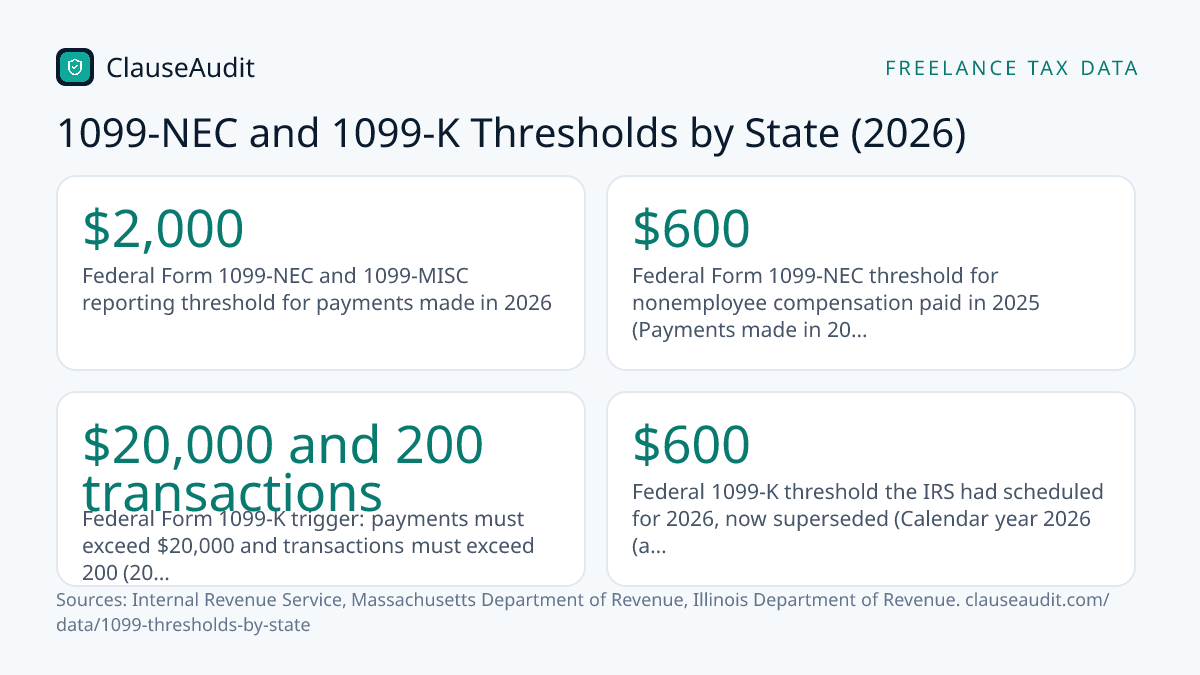
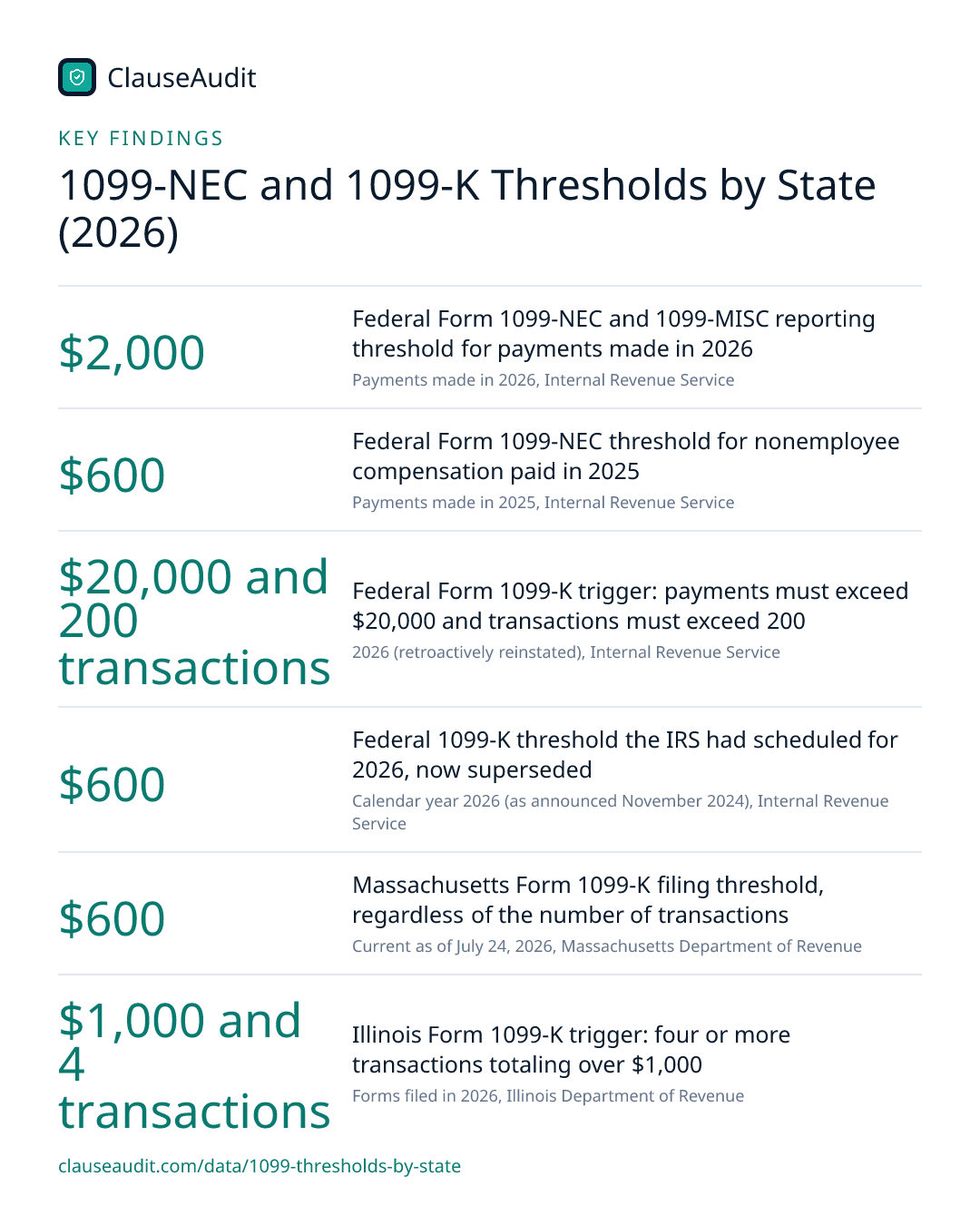
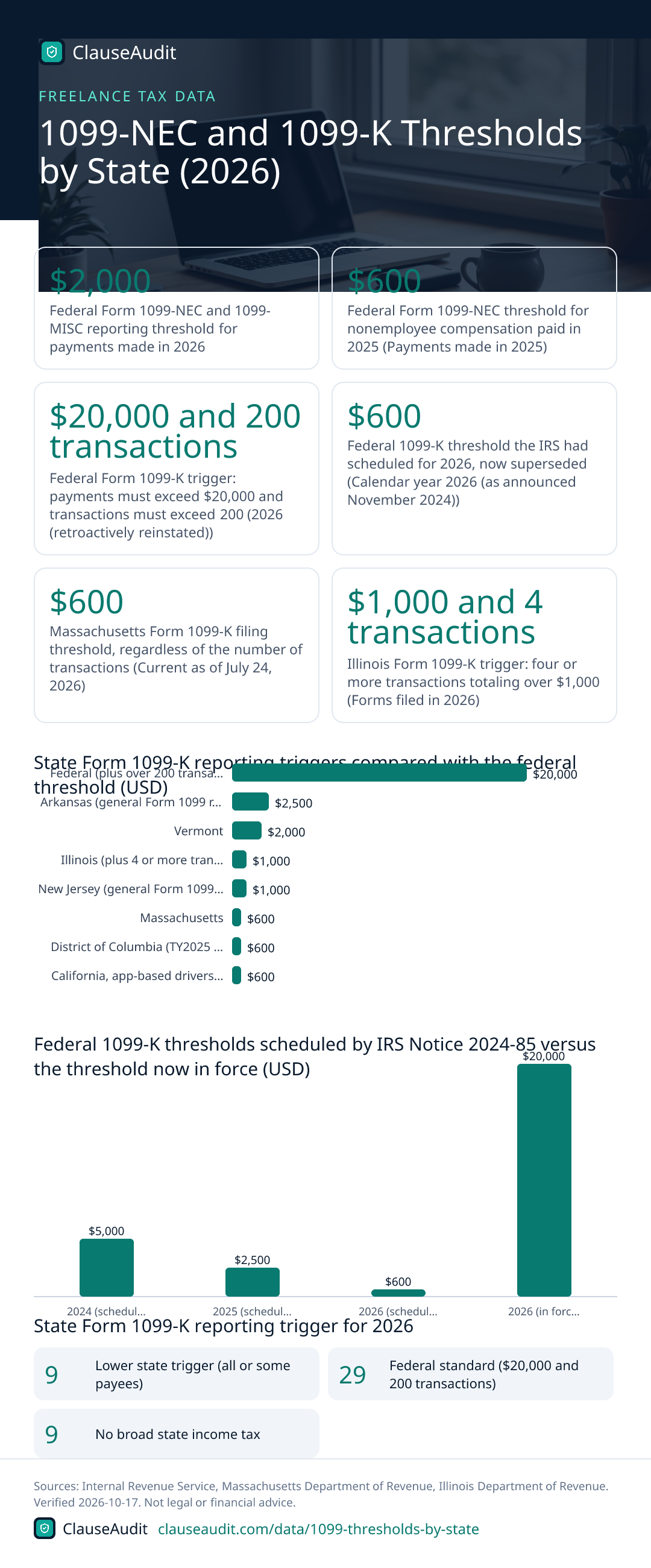
- Federal Form 1099-NEC and 1099-MISC reporting threshold for payments made in 2026 (Payments made in 2026, Internal Revenue Service)
- $2,000
- Federal Form 1099-NEC threshold for nonemployee compensation paid in 2025 (Payments made in 2025, Internal Revenue Service)
- $600
- Federal Form 1099-K trigger: payments must exceed $20,000 and transactions must exceed 200 (2026 (retroactively reinstated), Internal Revenue Service)
- $20,000 and 200 transactions
- Federal 1099-K threshold the IRS had scheduled for 2026, now superseded (Calendar year 2026 (as announced November 2024), Internal Revenue Service)
- $600
- Massachusetts Form 1099-K filing threshold, regardless of the number of transactions (Current as of July 24, 2026, Massachusetts Department of Revenue)
- $600
- Illinois Form 1099-K trigger: four or more transactions totaling over $1,000 (Forms filed in 2026, Illinois Department of Revenue)
- $1,000 and 4 transactions
- California 1099-K threshold that still applies to payments to app-based drivers (Current as of April 3, 2026, California Franchise Tax Board)
- $600
- Jurisdictions (31 states plus DC) in the IRS Combined Federal/State Filing Program (Tax year 2025, Internal Revenue Service)
- 32
The 1099 rules moved twice in two years, and a lot of advice online still quotes the old numbers. For 2026, the federal 1099-K trigger is back to more than $20,000 and more than 200 transactions. The 1099-NEC threshold for contractor pay jumped from $600 to $2,000.
States did not all follow along. A handful still want a form at much lower amounts, and some want it filed with them directly. This page shows where your state lands and what that means for the invoices you send and the contracts you sign.
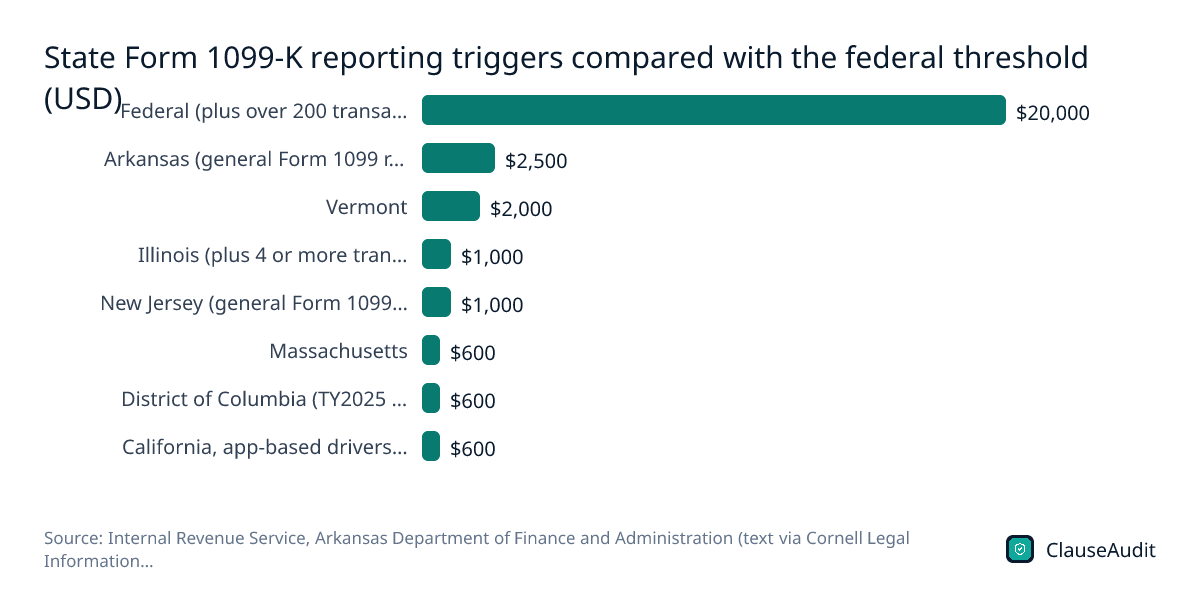
State Form 1099-K reporting triggers compared with the federal threshold (USD)
Chart data
| Label | Value |
|---|---|
| Federal (plus over 200 transactions) | $20,000 |
| Arkansas (general Form 1099 rule) | $2,500 |
| Vermont | $2,000 |
| Illinois (plus 4 or more transactions) | $1,000 |
| New Jersey (general Form 1099 rule) | $1,000 |
| Massachusetts | $600 |
| District of Columbia (TY2025 instructions) | $600 |
| California, app-based drivers only | $600 |
The federal bar dwarfs every state figure, which is the point: if you live in Massachusetts or Illinois, a payment app can send your state a form long before the IRS gets one. Arkansas and New Jersey figures come from general Form 1099 rules, not 1099-K rules by name.
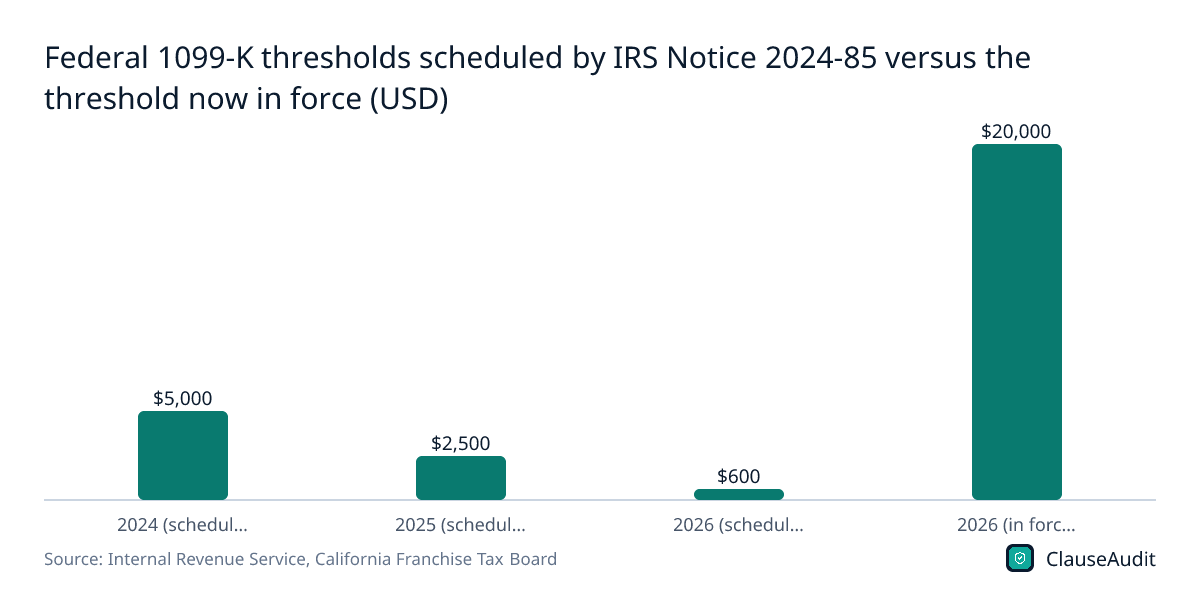
Download this chart (PNG)Federal 1099-K thresholds scheduled by IRS Notice 2024-85 versus the threshold now in force (USD)
Chart data
| Label | Value |
|---|---|
| 2024 (scheduled) | $5,000 |
| 2025 (scheduled) | $2,500 |
| 2026 (scheduled) | $600 |
| 2026 (in force after OBBBA) | $20,000 |
The IRS had planned to step down to $600 by 2026. Those scheduled figures never took hold, and the $20,000 test now applies instead, retroactively.
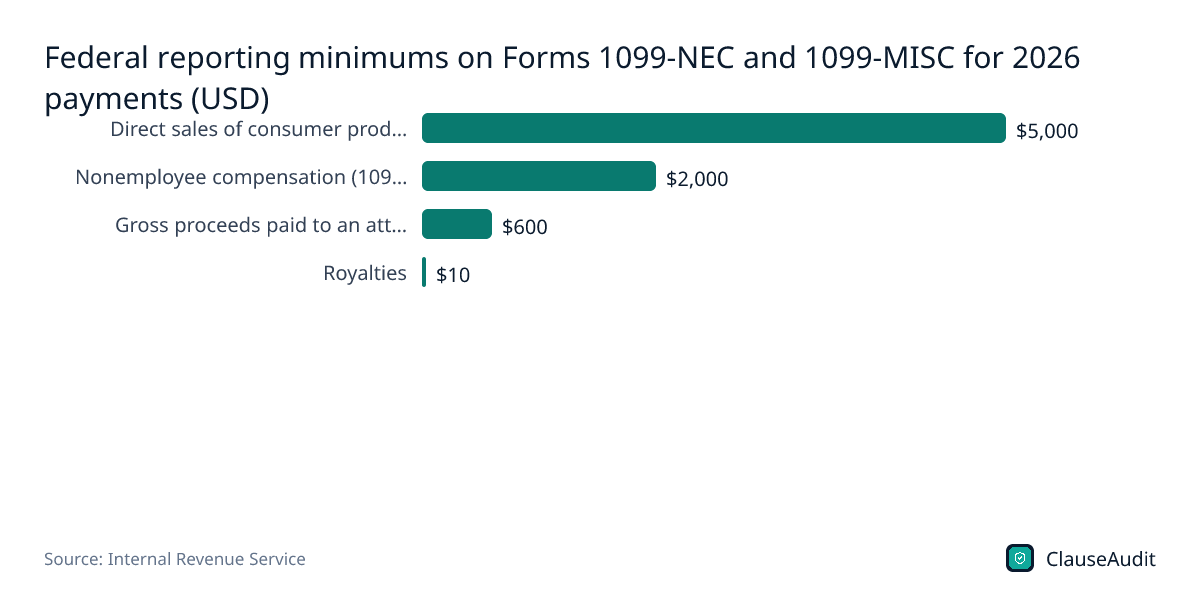
Download this chart (PNG)Federal reporting minimums on Forms 1099-NEC and 1099-MISC for 2026 payments (USD)
Chart data
| Label | Value |
|---|---|
| Direct sales of consumer products for resale | $5,000 |
| Nonemployee compensation (1099-NEC box 1) | $2,000 |
| Gross proceeds paid to an attorney | $600 |
| Royalties | $10 |
Contractor pay now needs $2,000 before a 1099-NEC is required, but royalties still trigger at $10 and attorney payments at $600. Check which box your payment falls in before assuming you are under the line.
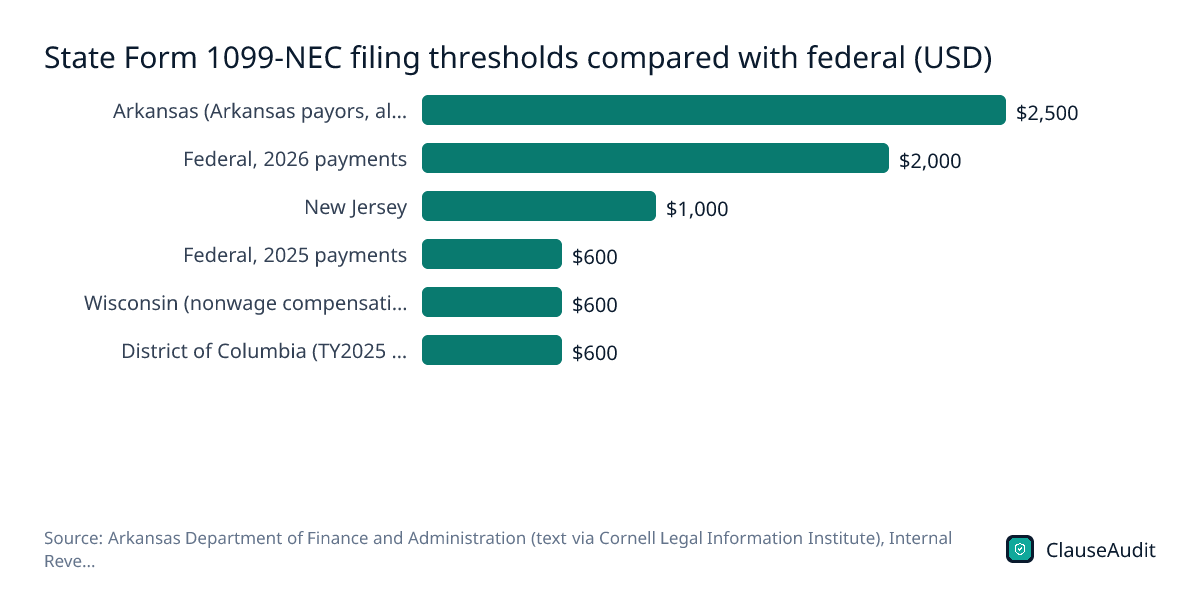
Download this chart (PNG)State Form 1099-NEC filing thresholds compared with federal (USD)
Chart data
| Label | Value |
|---|---|
| Arkansas (Arkansas payors, all Form 1099 payments) | $2,500 |
| Federal, 2026 payments | $2,000 |
| New Jersey | $1,000 |
| Federal, 2025 payments | $600 |
| Wisconsin (nonwage compensation) | $600 |
| District of Columbia (TY2025 instructions) | $600 |
Several states kept lower figures after the federal change. Wisconsin and DC still name $600, and New Jersey names $1,000, so a state copy can be due even when the payment looks small.
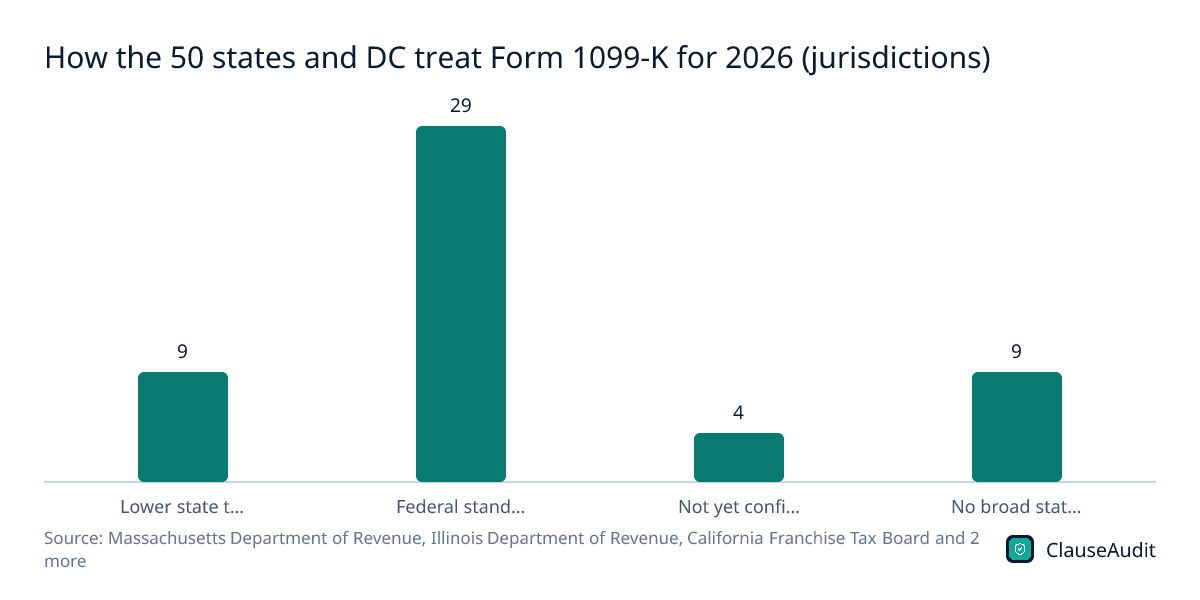
Download this chart (PNG)How the 50 states and DC treat Form 1099-K for 2026 (jurisdictions)
Chart data
| Label | Value (jurisdictions) |
|---|---|
| Lower state trigger (all or some payees) | 9 |
| Federal standard, no lower state rule found | 29 |
| Not yet confirmed against a state source | 4 |
| No broad state income tax | 9 |
Most states with an income tax use the federal 1099-K test. Nine jurisdictions, DC among them, have their own lower trigger for some or all payees, and nine states have no broad income tax to report to.
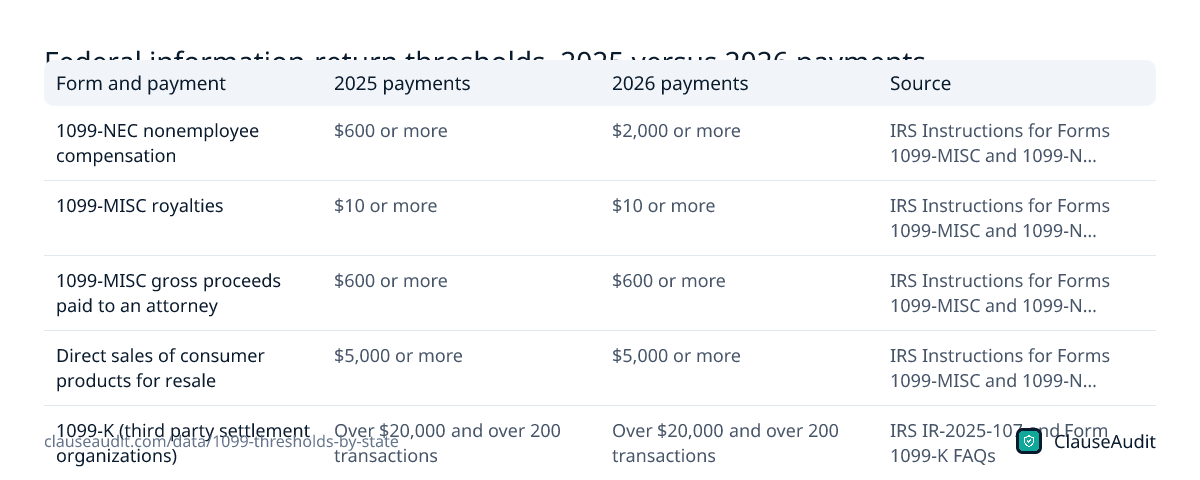
Download this chart (PNG)Federal information-return thresholds, 2025 versus 2026 payments
| Form and payment | 2025 payments | 2026 payments | Source |
|---|---|---|---|
| 1099-NEC nonemployee compensation | $600 or more | $2,000 or more | IRS Instructions for Forms 1099-MISC and 1099-NEC |
| 1099-MISC royalties | $10 or more | $10 or more | IRS Instructions for Forms 1099-MISC and 1099-NEC |
| 1099-MISC gross proceeds paid to an attorney | $600 or more | $600 or more | IRS Instructions for Forms 1099-MISC and 1099-NEC |
| Direct sales of consumer products for resale | $5,000 or more | $5,000 or more | IRS Instructions for Forms 1099-MISC and 1099-NEC |
| 1099-K (third party settlement organizations) | Over $20,000 and over 200 transactions | Over $20,000 and over 200 transactions | IRS IR-2025-107 and Form 1099-K FAQs |
Source: Internal Revenue Service, Instructions for Forms 1099-MISC and 1099-NEC (Rev. April 2025); Internal Revenue Service, Instructions for Forms 1099-MISC and 1099-NEC (Rev. December 2026); Internal Revenue Service, IR-2025-107: IRS issues FAQs on Form 1099-K threshold under the One, Big, Beautiful Bill; dollar limit reverts to $20,000; Internal Revenue Service, Form 1099-K frequently asked questions. Download as image
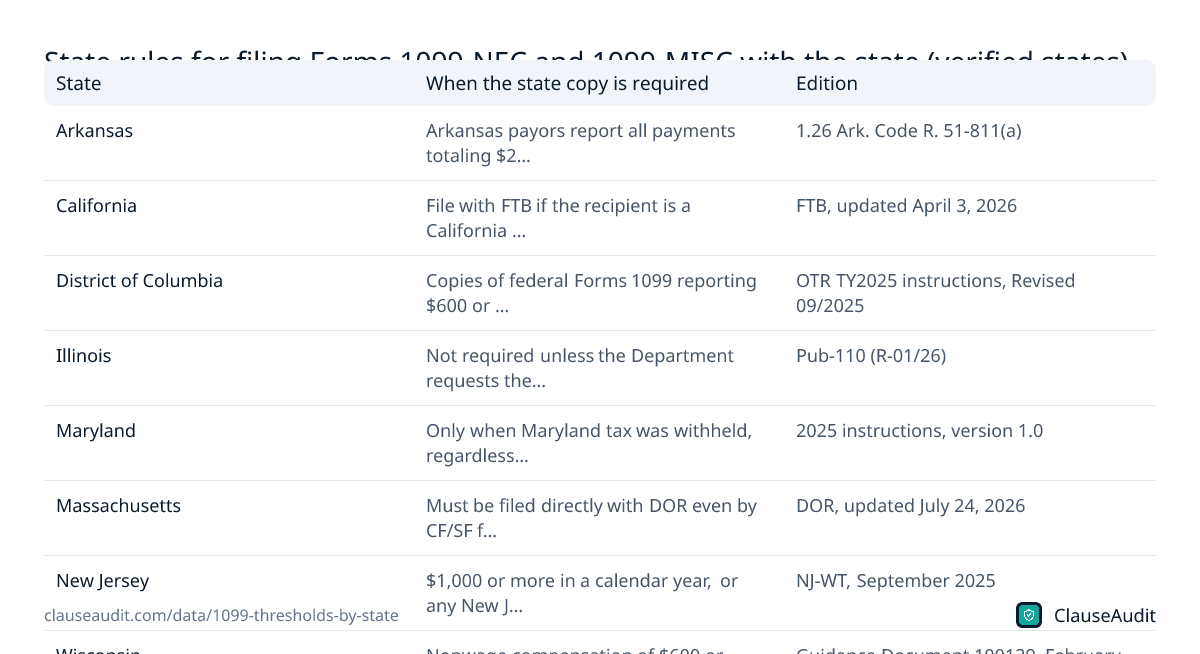
State rules for filing Forms 1099-NEC and 1099-MISC with the state (verified states)
| State | When the state copy is required | Edition |
|---|---|---|
| Arkansas | Arkansas payors report all payments totaling $2,500 or more on Form 1099 | 1.26 Ark. Code R. 51-811(a) |
| California | File with FTB if the recipient is a California resident or the payment is California-source; CF/SF filers with identical amounts do not file separately | FTB, updated April 3, 2026 |
| District of Columbia | Copies of federal Forms 1099 reporting $600 or more paid to a DC resident; separate MyTax.DC.gov filing even for CF/SF filers; due January 31 | OTR TY2025 instructions, Revised 09/2025 |
| Illinois | Not required unless the Department requests them (Form 1099-K has its own rule) | Pub-110 (R-01/26) |
| Maryland | Only when Maryland tax was withheld, regardless of amount | 2025 instructions, version 1.0 |
| Massachusetts | Must be filed directly with DOR even by CF/SF filers; 1099-NEC due January 31 | DOR, updated July 24, 2026 |
| New Jersey | $1,000 or more in a calendar year, or any New Jersey tax withheld; due February 15 | NJ-WT, September 2025 |
| Wisconsin | Nonwage compensation of $600 or more to Wisconsin residents, or to nonresidents for services in Wisconsin, or any Wisconsin tax withheld | Guidance Document 100129, February 20, 2026 |
Source: Arkansas Department of Finance and Administration (text via Cornell Legal Information Institute), 1.26 Ark. Code R. 51-811(a) - Recipients of Income - Generally; California Franchise Tax Board, Guidance for reporting information returns; District of Columbia Office of Tax and Revenue, Tax Year 2025 MyTax 1099/W-2G Instructions; Illinois Department of Revenue, Publication 110, Forms W-2, W-2c, W-2G, and 1099 Filing and Storage Requirements for Employers and Payers, including 1099-K Electronic Filing Requirements; Comptroller of Maryland, 2025 Maryland Employer Reporting of 1099 Instructions and Specifications; Massachusetts Department of Revenue, Form 1099 Filing Requirements; New Jersey Division of Taxation, NJ-WT, New Jersey Income Tax Withholding Instructions; Wisconsin Department of Revenue, Forms W-2 and 1099 Filing by Employers and Others Making Reportable Payments (Guidance Document 100129). Download as image
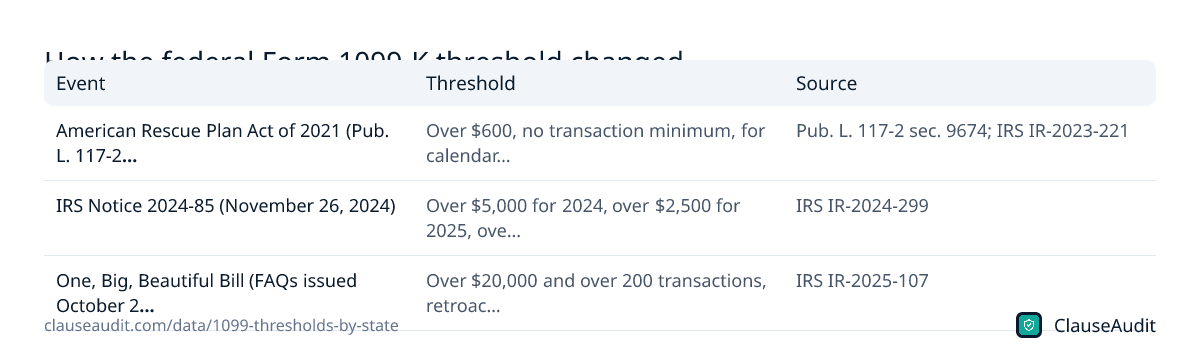
How the federal Form 1099-K threshold changed
| Event | Threshold | Source |
|---|---|---|
| American Rescue Plan Act of 2021 (Pub. L. 117-2, sec. 9674) | Over $600, no transaction minimum, for calendar years after 2021 (never took full effect) | Pub. L. 117-2 sec. 9674; IRS IR-2023-221 |
| IRS Notice 2024-85 (November 26, 2024) | Over $5,000 for 2024, over $2,500 for 2025, over $600 for 2026 and after | IRS IR-2024-299 |
| One, Big, Beautiful Bill (FAQs issued October 23, 2025) | Over $20,000 and over 200 transactions, retroactively reinstated | IRS IR-2025-107 |
Source: U.S. Government Publishing Office (govinfo.gov), American Rescue Plan Act of 2021, Public Law 117-2, Section 9674, Modification of exceptions for reporting of third party network transactions; Internal Revenue Service, IR-2023-221: IRS announces delay in Form 1099-K reporting threshold for third party platform payments in 2023; plans for a threshold of $5,000 for 2024 to phase in implementation; Internal Revenue Service, IR-2025-107: IRS issues FAQs on Form 1099-K threshold under the One, Big, Beautiful Bill; dollar limit reverts to $20,000; Internal Revenue Service, Form 1099-K frequently asked questions; Internal Revenue Service, IR-2024-299: IRS provides transition relief for third party settlement organizations; Form 1099-K threshold is $5,000 for calendar year 2024 (Notice 2024-85). Download as image
State Form 1099-K reporting trigger for 2026 by state
- 9Lower state trigger (all or some payees)
- 29Federal standard ($20,000 and 200 transactions)
- 9No broad state income tax
- Lower state trigger (all or some payees)9
- Federal standard ($20,000 and 200 transactions)29
- No broad state income tax9
- Not yet confirmed4
What is the 1099-K threshold for 2026?
At the federal level, a payment app or card processor sends you a 1099-K only when two things are both true for the year: payments over $20,000, and more than 200 transactions. Hit one and not the other, and no federal form is required.
That test is not new. It was the rule before the American Rescue Plan Act of 2021 tried to cut it to $600. The IRS delayed that cut, then announced a phase-in of $5,000 for 2024, $2,500 for 2025 and $600 for 2026. The One, Big, Beautiful Bill wiped out the phase-in and restored the old test retroactively. California's tax agency describes it as retroactive to 2022.
So if you read in 2024 that you would get a 1099-K for anything over $600 in 2026, that is no longer true at the federal level. It may still be true in your state.
Why does this matter if you are under the line? Because state tax agencies and the IRS compare forms against returns. A 1099-K from Massachusetts or Illinois that your return does not account for can lead to a letter asking you to explain the gap. It is easier to reconcile your app statements once a year than to answer that letter later.
Which states have a lower 1099-K threshold?
Nine places on the map have a lower trigger for some or all payees, and DC is one of them. The clearest ones:
- Massachusetts: $600, with no minimum number of transactions, for anyone with a Massachusetts address. The form goes straight to the Department of Revenue.
- Illinois: more than $1,000 and 4 or more transactions, for payees with an Illinois address, filed through the state's own FIRE system.
- Vermont: the Department of Taxes now cites $2,000.
- California: the federal test for most people, but $600 for app-based drivers.
- District of Columbia: $600 or more on all Forms 1099 under the tax year 2025 instructions, filed separately with the city.
- Arkansas and New Jersey: general Form 1099 rules at $2,500 and $1,000. Maryland and Virginia tie their rule to the federal section 6041(a) minimum and have not published a 2026 dollar figure.
- If your state is not on this list, it either follows the federal test, has no broad income tax, or has a rule we could not yet confirm against a state source. The map marks which is which.
Do I get a 1099-NEC if a client paid me less than $2,000?
Not from the federal rules, for payments made in 2026. The IRS raised the 1099-NEC threshold from $600 to $2,000 for tax years beginning after 2025, and it may be adjusted for inflation starting in 2027. The same $2,000 line now applies to backup withholding.
Here is the part people miss: the threshold decides whether your client has to file a form. It has nothing to do with what you owe. A small project paid by check with no 1099 attached is still income you report.
Your state may also want its own copy. Wisconsin's guidance still names $600 for nonwage pay to Wisconsin residents. New Jersey asks for copies at $1,000 or more, or whenever New Jersey tax was withheld. Maryland only wants them when Maryland tax was withheld. If you have one-off clients scattered across states, you may get forms from some and not others for similar amounts.
Why did I get a 1099-K instead of a 1099-NEC?
Because of how you were paid. When a client pays you by card or through a payment app, the processor handles the reporting on a 1099-K, and the client generally does not issue a 1099-NEC for the same money. When a client pays by check, ACH or wire, the client is the one who files the 1099-NEC.
A quick example. Say you live in Illinois and a client pays you through a payment app in 4 or more payments that add up to more than $1,000. Illinois expects a 1099-K for that. The IRS does not, because you are nowhere near $20,000 and 200 transactions. Same money, two different answers.
That has a practical side. If most of your income runs through a payment app and you stay at 200 transactions or fewer, you may get no federal form at all in 2026, even on a good year. If you live in Massachusetts, you could get a state form at $600. Keep your own books either way. The forms are a cross-check for the tax agency, not a record of what you earned.
One more wrinkle: personal payments on the same app, like splitting a dinner bill or getting paid back for rent, are not business income. If you use one account for both, a state with a low trigger may send a form that overstates your earnings. A separate business account fixes that before it starts.
What should businesses that pay contractors do differently?
Update your vendor process for 2026 payments. The federal 1099-NEC line is $2,000, but that is not the only line that matters. Royalties still trigger at $10, gross proceeds paid to an attorney at $600, and direct sales of consumer products for resale at $5,000.
Then check where your contractors live. The IRS Combined Federal/State Filing Program covers 32 jurisdictions for tax year 2025, 31 states plus DC, and passes your forms along to them. It does not handle everything. Massachusetts wants 1099-K and 1099-NEC filed directly, DC wants all 1099s filed directly, and Maryland says it will not process 1099s that come through the program.
Deadlines differ too. Massachusetts and DC want their copies by January 31. New Jersey's due date is February 15. Collect a W-9 before the first payment so none of this turns into a scramble in January.
What freelancers should do with these numbers
- Find your state on the map and note whether it has a lower trigger.
- Track every payment yourself, including ones under $2,000 that will never show up on a form.
- Note which clients pay through apps and which pay directly, so you know which form to expect from whom.
- If you live in Massachusetts or Illinois, you can get a state 1099-K well below the federal line.
- Give clients a W-9 up front. Without a valid taxpayer ID, a client can withhold tax from your payment once you cross the backup withholding threshold.
How ClauseAudit helps
Tax forms follow the money, and the money follows your contract. The payment clause decides how you get paid, which decides whether a client or a processor reports it, and when.
Run your freelance or contractor agreement through an automated review before you sign. It flags the clauses that shape your tax paperwork and your cash flow, in plain English.
- Payment method: does the contract require payment through a platform or app that takes a fee and issues the 1099-K?
- W-9 and withholding: can the client hold back payment, or withhold tax, if paperwork is late?
- Worker classification: does the language describe an independent contractor, or does it read like a job?
- Expense reimbursement: are expenses billed separately, or folded into the fee you report as income?
- Payment timing and late fees: when is each invoice due, and what happens if the client pays late?
- Set-off rights: can the client deduct disputed amounts from what it owes you?
Frequently asked questions
Is the 1099-K threshold $600 or $20,000 in 2026?
At the federal level it is more than $20,000 and more than 200 transactions. The $600 figure was the IRS's planned threshold for 2026 before the One, Big, Beautiful Bill restored the older test. Some states still use $600, including Massachusetts for all payees and California for app-based drivers.
Do I have to report income if I did not get a 1099?
Yes. The thresholds only decide whether a client or payment processor has to file a form. Every dollar of self-employment income is reportable whether a form shows up or not. Keep invoices, bank deposits and app statements so your own records match what you file.
What is the 1099-NEC threshold for 2026?
For payments made in 2026, a business files a 1099-NEC when it pays a contractor $2,000 or more for services. For 2025 payments the line was $600. The IRS says the $2,000 figure may be adjusted for inflation starting in calendar year 2027.
Which state has the lowest 1099-K threshold?
Among states with a confirmed rule, Massachusetts is the clearest low trigger at $600 with no transaction minimum. DC lists $600 for all Forms 1099 in its tax year 2025 instructions, and California uses $600 only for payments to app-based drivers. Illinois requires more than $1,000 across 4 or more transactions.
Does the Combined Federal/State Filing Program cover every state?
No. It covers 32 jurisdictions, 31 states plus DC, for tax year 2025, and even some of those want direct filing. Massachusetts requires 1099-K and 1099-NEC to be filed directly, DC requires all 1099s directly, and Maryland says it will not process 1099s sent through the program.
Can a client refuse to pay me until I send a W-9?
A client can ask for one and many contracts require it. Without a valid taxpayer ID, a payer may have to apply backup withholding, and for 2026 payments that uses the same $2,000 threshold as the 1099-NEC. Send the W-9 early so it never becomes a reason to hold your invoice.
I live in a state with no income tax. Do state 1099 rules matter to me?
Mostly not. Nine states have no broad state income tax, so there is no state return to match a 1099 against. You still get federal forms when you cross the federal thresholds. If you work for clients in other states, check whether those states want copies for work done there.
Why do some charts show Arkansas and New Jersey with lower 1099-K figures?
Those figures come from each state's general Form 1099 rule, not a rule that names the 1099-K. Arkansas payors report payments totaling $2,500 or more, and New Jersey asks for copies at $1,000 or more. Treat them as signals to check with the state, not as a firm 1099-K trigger.
Use this data
Every chart and card below is free to reuse under CC BY 4.0. Download what you need and link back to this page.
 Stat cards
 Key findings card
 Infographic
 State Form 1099-K reporting triggers compared with the federal threshold (USD)
 Federal 1099-K thresholds scheduled by IRS Notice 2024-85 versus the threshold now in force (USD)
 Federal reporting minimums on Forms 1099-NEC and 1099-MISC for 2026 payments (USD)
 State Form 1099-NEC filing thresholds compared with federal (USD)
 How the 50 states and DC treat Form 1099-K for 2026 (jurisdictions)
 Federal information-return thresholds, 2025 versus 2026 payments
 State rules for filing Forms 1099-NEC and 1099-MISC with the state (verified states)
 How the federal Form 1099-K threshold changed
Embed the infographic
Free to share on your site, blog or slides under CC BY 4.0. Please keep the credit link.
Sources and method
Every number on this page comes from the sources below, each opened and read on or before October 17, 2026. A second, independent review checked every figure against its source and corrected anything that did not match. 47 of 51 state entries were confirmed; any that could not be are marked "Not yet confirmed" and left out of every count and chart.
- Internal Revenue Service, Instructions for Forms 1099-MISC and 1099-NEC (Rev. December 2026) (Rev. December 2026 (for 2026 information returns))
- Internal Revenue Service, Instructions for Forms 1099-MISC and 1099-NEC (Rev. April 2025) (Rev. April 2025)
- Internal Revenue Service, IR-2025-107: IRS issues FAQs on Form 1099-K threshold under the One, Big, Beautiful Bill; dollar limit reverts to $20,000 (October 23, 2025)
- Internal Revenue Service, Form 1099-K frequently asked questions (Last updated September 29, 2026)
- Internal Revenue Service, IR-2024-299: IRS provides transition relief for third party settlement organizations; Form 1099-K threshold is $5,000 for calendar year 2024 (Notice 2024-85) (November 26, 2024)
- Internal Revenue Service, Publication 1220, Specifications for Electronic Filing of Forms 1097, 1098, 1099, 3921, 3922, 5498, and W-2G For Tax Year 2025 (Rev. 5-2026, for Tax Year 2025)
- California Franchise Tax Board, Guidance for reporting information returns (Last updated April 3, 2026)
- Massachusetts Department of Revenue, Form 1099 Filing Requirements (Updated July 24, 2026)
- Illinois Department of Revenue, Publication 110, Forms W-2, W-2c, W-2G, and 1099 Filing and Storage Requirements for Employers and Payers, including 1099-K Electronic Filing Requirements (PUB-110 (R-01/26), January 2026)
- Vermont Department of Taxes, 1099-K Notices (Undated web page, read October 15, 2026)
- Vermont Department of Taxes, New Law Lowers Reporting Threshold for 1099-K Information Reporting (December 19, 2017)
- Comptroller of Maryland, 2025 Maryland Employer Reporting of 1099 Instructions and Specifications (Version 1.0, October 2025)
- Maryland General Assembly, Maryland Code, Tax-General Article, Section 10-825 (Current statute text, read October 15, 2026)
- Virginia General Assembly (Legislative Information System), Code of Virginia Section 58.1-356, Reporting of payments by third-party settlement organizations (Current statute text, read October 15, 2026)
- Virginia Department of Taxation, Did you receive a 1099-K? What you need to know (February 18, 2021)
- District of Columbia Office of Tax and Revenue, Tax Year 2025 MyTax 1099/W-2G Instructions (Revised 09/2025, version 1.0)
- New Jersey Division of Taxation, NJ-WT, New Jersey Income Tax Withholding Instructions (September 2025)
- Arkansas Department of Finance and Administration (text via Cornell Legal Information Institute), 1.26 Ark. Code R. 51-811(a) - Recipients of Income - Generally (Rule text as reproduced by Cornell LII, read October 15, 2026)
- Wisconsin Department of Revenue, Forms W-2 and 1099 Filing by Employers and Others Making Reportable Payments (Guidance Document 100129) (February 20, 2026)
- North Carolina Department of Revenue, Guidance on Information Reporting (Undated web page, read October 15, 2026)
- Thomson Reuters, State tax information reporting: what changed in 2025 and what to expect for 2026 (May 19, 2026)
- Tax Foundation, State Individual Income Tax Rates and Brackets, 2026 (February 17, 2026 (updated February 19, 2026))
- 1099FIRE, State-Specific 1099-K Thresholds: What Businesses Should Know (August 17, 2025)
- 1099kstatemap.us, 1099-K threshold decoder: federal $20,000 vs your state (TY2026) (Row-level 'last verified' dates (May 12, 2026 for Rhode Island and other verified rows; many rows unverified); read October 15, 2026)
- U.S. Government Publishing Office (govinfo.gov), American Rescue Plan Act of 2021, Public Law 117-2, Section 9674, Modification of exceptions for reporting of third party network transactions (Enacted March 11, 2021)
- Internal Revenue Service, IR-2023-221: IRS announces delay in Form 1099-K reporting threshold for third party platform payments in 2023; plans for a threshold of $5,000 for 2024 to phase in implementation (November 21, 2023)
Cite this page
ClauseAudit, “1099-NEC and 1099-K Thresholds by State (2026)”, updated October 17, 2026, https://clauseaudit.com/data/1099-thresholds-by-state. Free to reuse with a link back (CC BY 4.0).
This page summarises published data and law as checked on October 17, 2026. Figures are updated as new editions are released, and your own situation may differ. It is general information, not legal, tax or financial advice.