Self-Employment Tax by State: What Freelancers Really Pay in 2026
By ClauseAudit Research · 19 sources ·
Does self-employment tax vary by state?
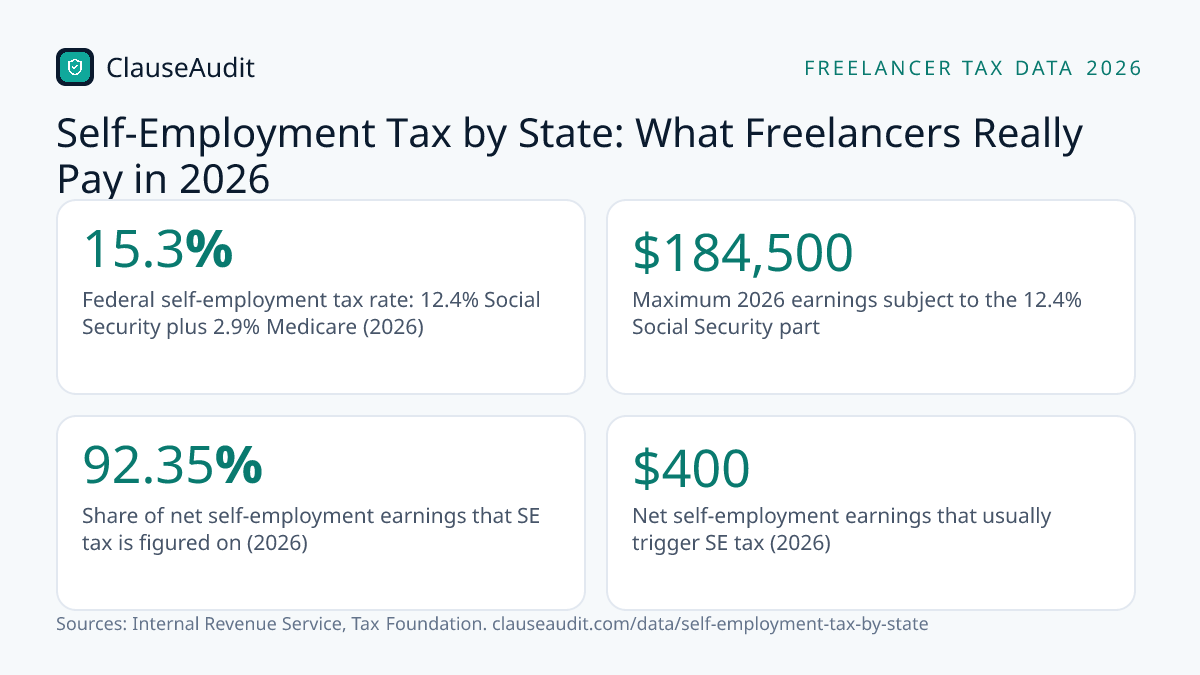
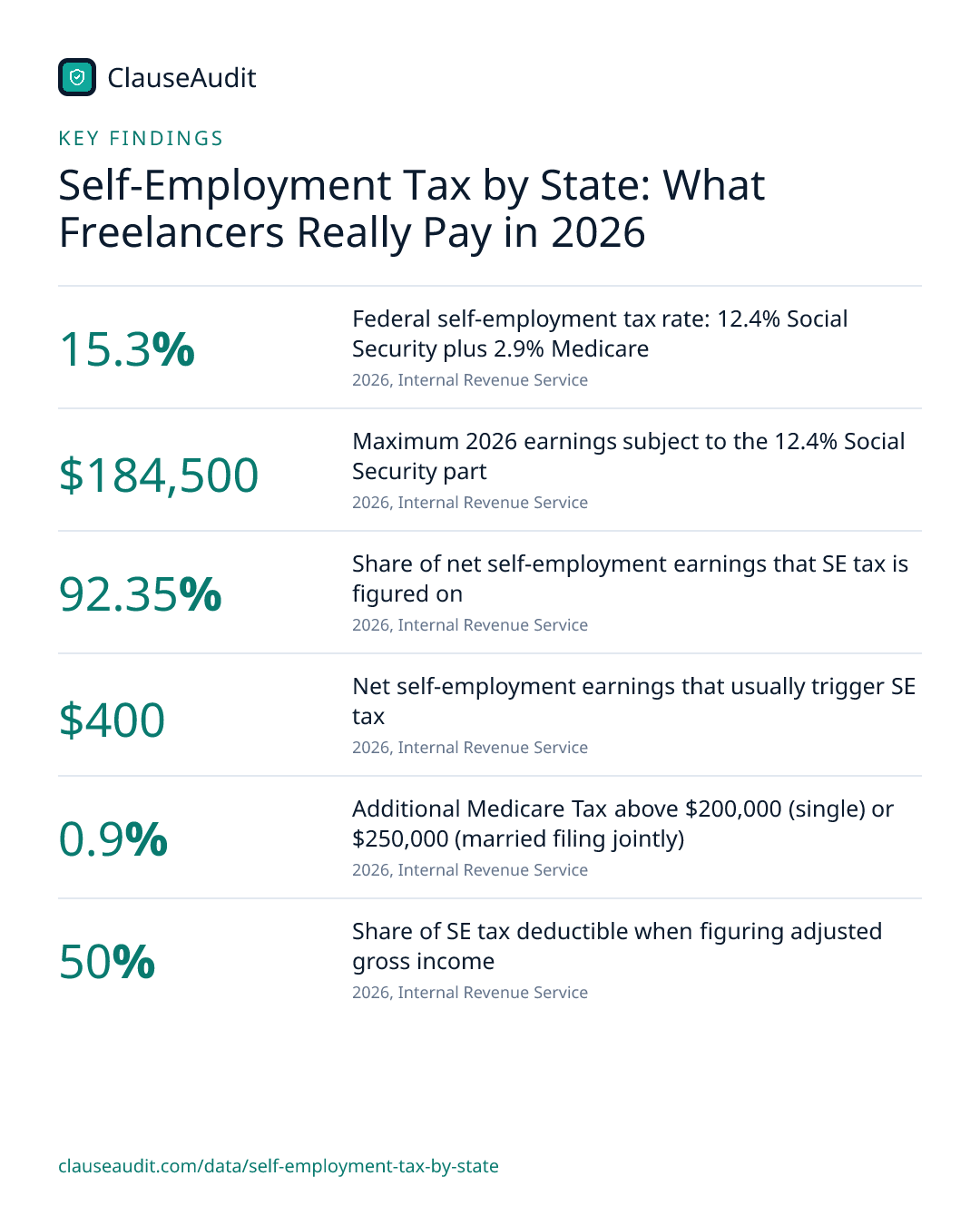
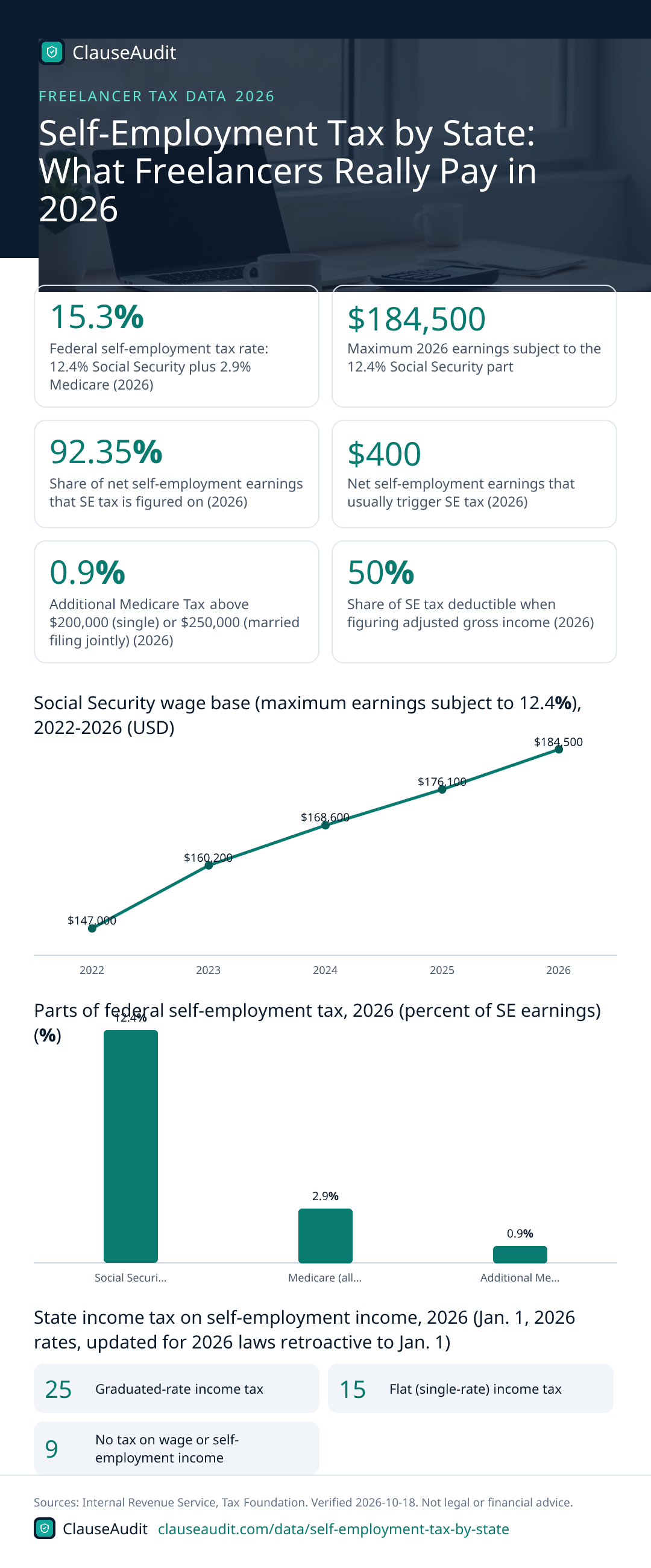
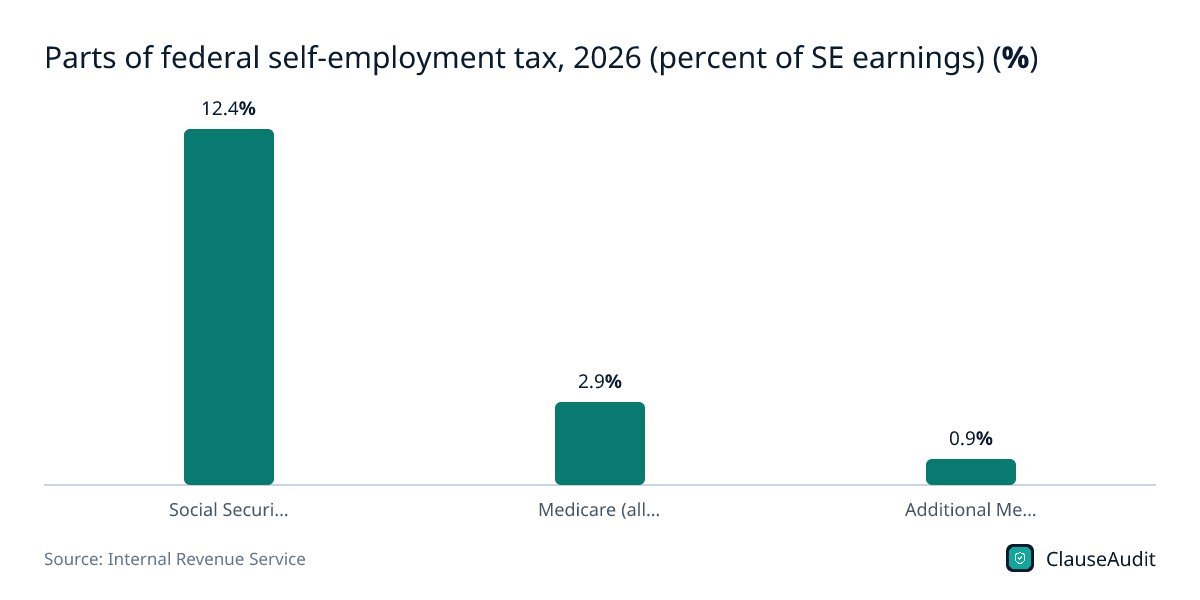
Self-employment tax does not change by state. It is a federal 15.3% tax (12.4% Social Security plus 2.9% Medicare) on 92.35% of your net self-employment earnings, the same in Texas as in California. What does change is state income tax on top: 8 states charge none in 2026, while California's top rate reaches 13.3%.

- Federal self-employment tax rate: 12.4% Social Security plus 2.9% Medicare (2026, Internal Revenue Service)
- 15.3%
- Maximum 2026 earnings subject to the 12.4% Social Security part (2026, Internal Revenue Service)
- $184,500
- Share of net self-employment earnings that SE tax is figured on (2026, Internal Revenue Service)
- 92.35%
- Net self-employment earnings that usually trigger SE tax (2026, Internal Revenue Service)
- $400
- Additional Medicare Tax above $200,000 (single) or $250,000 (married filing jointly) (2026, Internal Revenue Service)
- 0.9%
- Share of SE tax deductible when figuring adjusted gross income (2026, Internal Revenue Service)
- 50%
- States with no individual income tax at all in 2026 (Jan. 1, 2026, Tax Foundation)
- 8 states
- California top state income tax rate, the highest in the US (Jan. 1, 2026, Tax Foundation)
- 13.3%
Search for self-employment tax by state and you might expect a different rate for every state. There is only one. The 15.3% self-employment tax is federal, so a web developer in Florida and a copywriter in Oregon pay it at the same rate, figured the same way.
The real gap between states comes from state income tax, which lands on the same profit. This page shows both layers for 2026: the federal rules every freelancer shares, and the state and city taxes that make where you live matter.
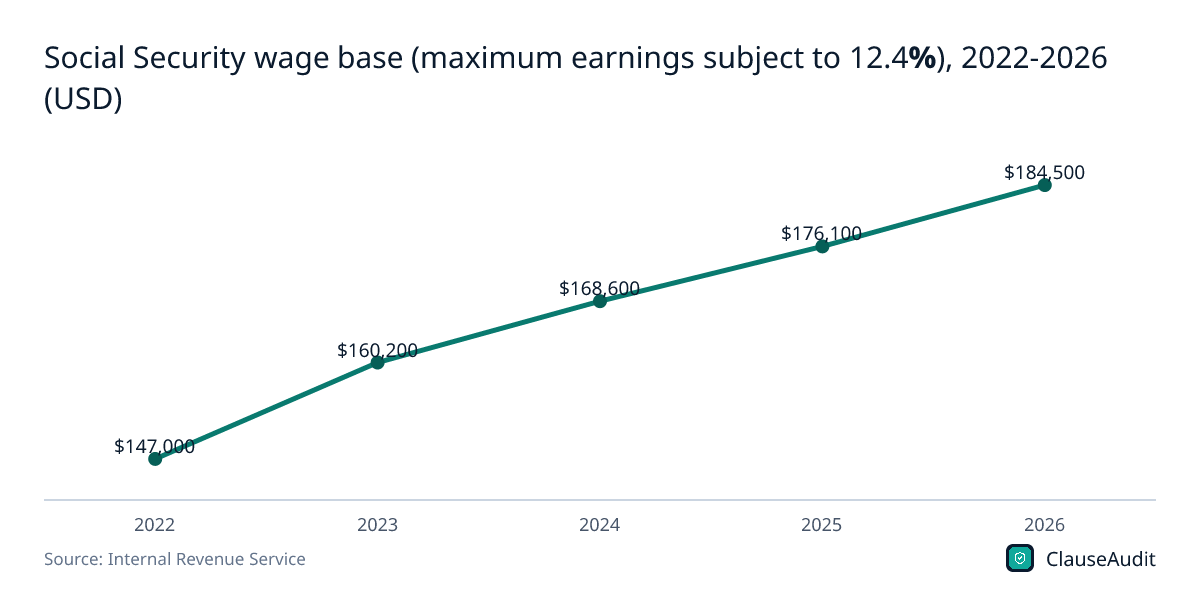
Social Security wage base (maximum earnings subject to 12.4%), 2022-2026 (USD)
Chart data
| Label | Value (USD) |
|---|---|
| 2022 | $147,000 |
| 2023 | $160,200 |
| 2024 | $168,600 |
| 2025 | $176,100 |
| 2026 | $184,500 |
The cap on the Social Security part has climbed every year, from $147,000 in 2022 to $184,500 in 2026. If you earn above the cap, each increase means more of your income gets the full 12.4%.
Download this chart (PNG)Parts of federal self-employment tax, 2026 (percent of SE earnings) (%)
Chart data
| Label | Value (%) |
|---|---|
| Social Security (up to $184,500) | 12.4% |
| Medicare (all SE earnings) | 2.9% |
| Additional Medicare (above threshold) | 0.9% |
Social Security is the big piece, but it stops at the wage base. Medicare never stops, and the extra 0.9% only starts once you pass $200,000 single or $250,000 married filing jointly.
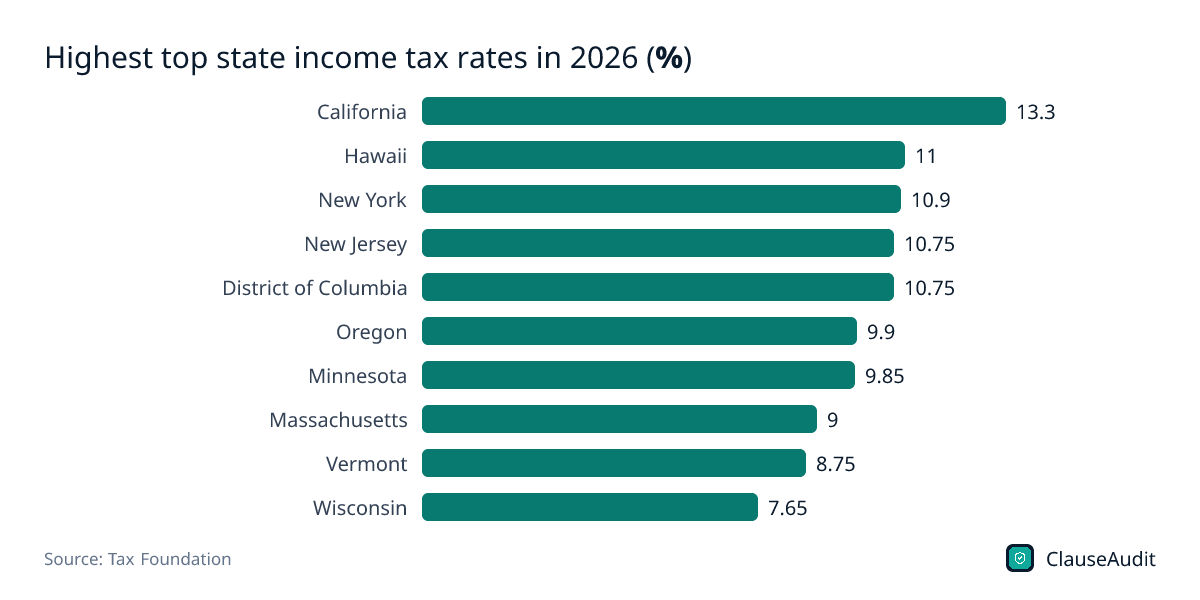
Download this chart (PNG)Highest top state income tax rates in 2026 (%)
Chart data
| Label | Value |
|---|---|
| California | 13.3 |
| Hawaii | 11 |
| New York | 10.9 |
| New Jersey | 10.75 |
| District of Columbia | 10.75 |
| Oregon | 9.9 |
| Minnesota | 9.85 |
| Massachusetts | 9 |
| Vermont | 8.75 |
| Wisconsin | 7.65 |
Headline rates can mislead. New York's top rate starts at $25,000,000 of income, while Oregon's 9.9% starts at $125,000, so a mid-income freelancer may feel Oregon's rate sooner.
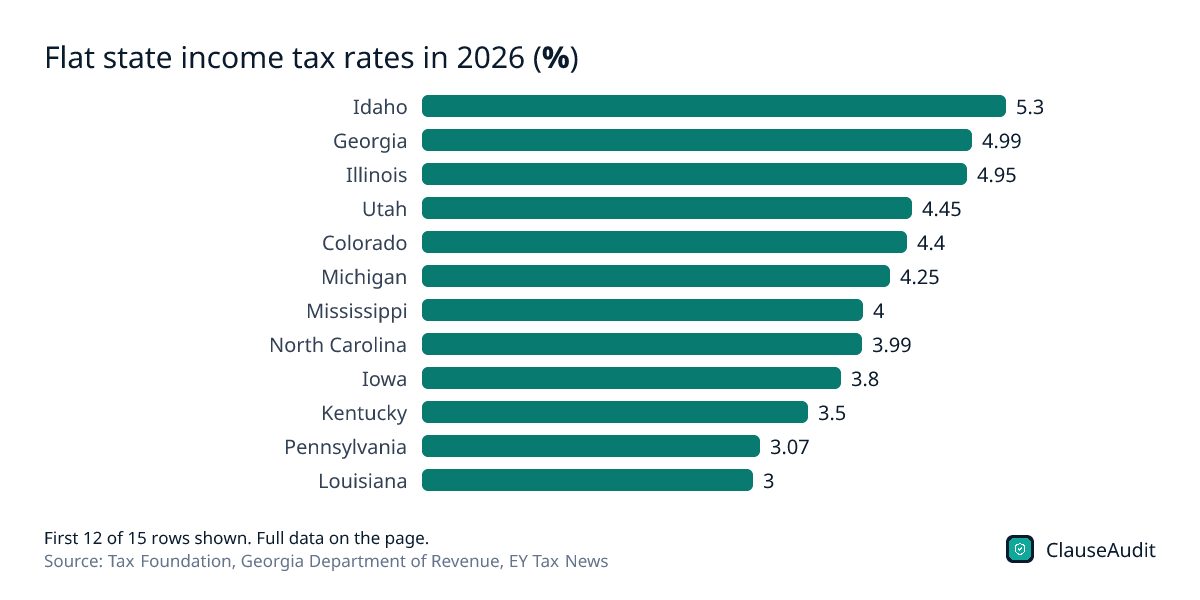
Download this chart (PNG)Flat state income tax rates in 2026 (%)
Chart data
| Label | Value |
|---|---|
| Idaho | 5.3 |
| Georgia | 4.99 |
| Illinois | 4.95 |
| Utah | 4.45 |
| Colorado | 4.4 |
| Michigan | 4.25 |
| Mississippi | 4 |
| North Carolina | 3.99 |
| Iowa | 3.8 |
| Kentucky | 3.5 |
| Pennsylvania | 3.07 |
| Louisiana | 3 |
| Ohio | 3 |
| Indiana | 2.95 |
| Arizona | 2.5 |
In a flat-tax state, your first dollar of profit and your last are taxed alike, which makes planning simple. Ohio is the outlier: business income gets a $250,000 deduction before its 3% rate applies.
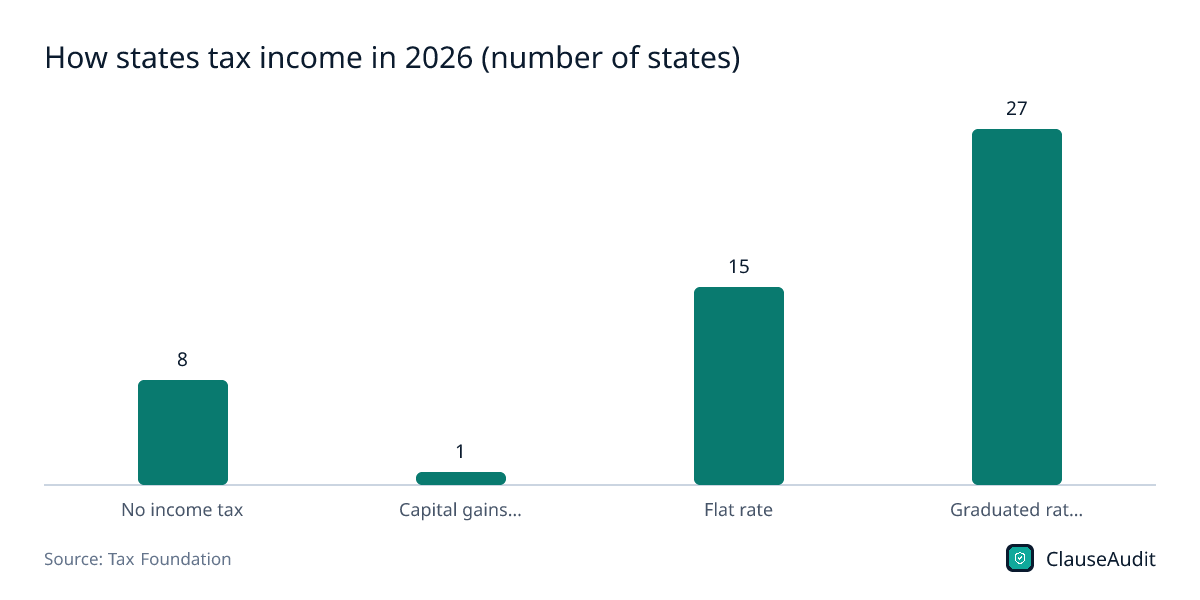
Download this chart (PNG)How states tax income in 2026 (number of states)
Chart data
| Label | Value |
|---|---|
| No income tax | 8 |
| Capital gains only (WA) | 1 |
| Flat rate | 15 |
| Graduated rates (26 states + DC) | 27 |
Most states use graduated brackets. Only 8 skip income tax entirely, and Washington taxes capital gains only, so it has no income tax on freelance earnings for 2026.
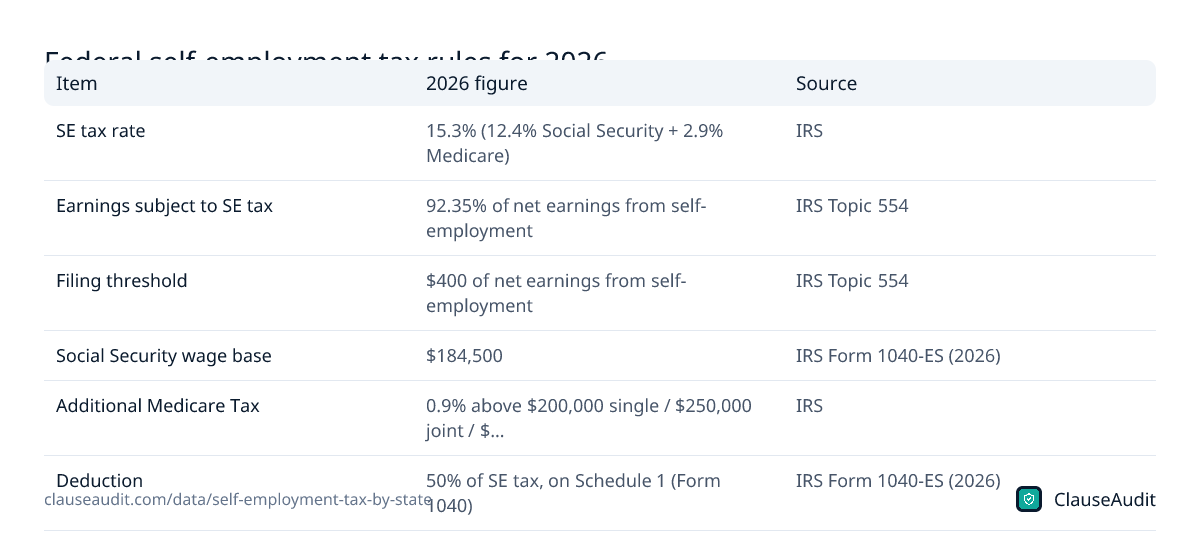
Download this chart (PNG)Federal self-employment tax rules for 2026
| Item | 2026 figure | Source |
|---|---|---|
| SE tax rate | 15.3% (12.4% Social Security + 2.9% Medicare) | IRS |
| Earnings subject to SE tax | 92.35% of net earnings from self-employment | IRS Topic 554 |
| Filing threshold | $400 of net earnings from self-employment | IRS Topic 554 |
| Social Security wage base | $184,500 | IRS Form 1040-ES (2026) |
| Additional Medicare Tax | 0.9% above $200,000 single / $250,000 joint / $125,000 separate | IRS |
| Deduction | 50% of SE tax, on Schedule 1 (Form 1040) | IRS Form 1040-ES (2026) |
Source: Internal Revenue Service, Self-employment tax (Social Security and Medicare taxes); Internal Revenue Service, Topic no. 554, Self-employment tax; Internal Revenue Service, Form 1040-ES (2026), Estimated Tax for Individuals. Download as image
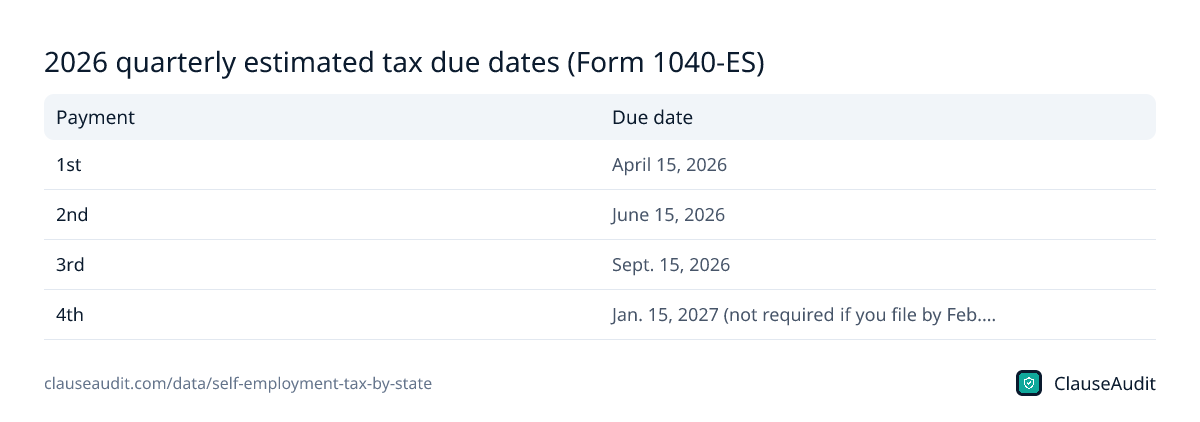
2026 quarterly estimated tax due dates (Form 1040-ES)
| Payment | Due date |
|---|---|
| 1st | April 15, 2026 |
| 2nd | June 15, 2026 |
| 3rd | Sept. 15, 2026 |
| 4th | Jan. 15, 2027 (not required if you file by Feb. 1, 2027 and pay the full balance) |
Source: Internal Revenue Service, Form 1040-ES (2026), Estimated Tax for Individuals. Download as image
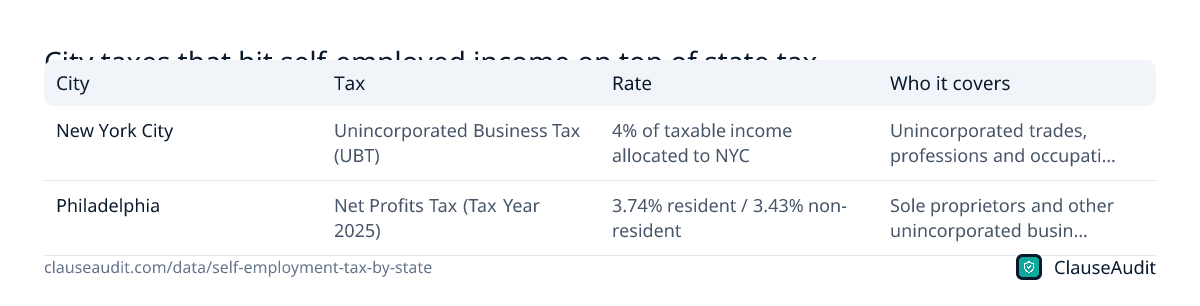
City taxes that hit self-employed income on top of state tax
| City | Tax | Rate | Who it covers |
|---|---|---|---|
| New York City | Unincorporated Business Tax (UBT) | 4% of taxable income allocated to NYC | Unincorporated trades, professions and occupations of an individual |
| Philadelphia | Net Profits Tax (Tax Year 2025) | 3.74% resident / 3.43% non-resident | Sole proprietors and other unincorporated businesses |
Source: NYC Department of Finance, Unincorporated Business Tax (UBT); City of Philadelphia, Department of Revenue, Net Profits Tax. Download as image
State income tax on self-employment income, 2026 (Jan. 1, 2026 rates, updated for 2026 laws retroactive to Jan. 1) by state
- 25Graduated-rate income tax
- 15Flat (single-rate) income tax
- 9No tax on wage or self-employment income
- Graduated-rate income tax25
- Flat (single-rate) income tax15
- No tax on wage or self-employment income9
- Not yet confirmed2
Does self-employment tax change by state?
No. Self-employment tax is Social Security and Medicare for people who work for themselves, and Congress sets it. That is why the state table repeats the same 15.3% on every row. Moving from Illinois to Nevada will not touch it.
It feels steep because, as an employee, your employer pays half of these taxes and you never see it. On your own, you pay both halves. That is the whole 15.3%: 12.4% for Social Security and 2.9% for Medicare.
There are two built-in softeners. You figure the tax on 92.35% of your net earnings, not all of them. And you can deduct 50% of the tax when you work out adjusted gross income, which lowers your income tax, though not the self-employment tax itself. The tax usually applies once your net self-employment earnings reach $400.
How do you calculate self-employment tax in 2026?
You can do a decent estimate on the back of an envelope. Work from profit, not from what clients paid you.
Say you are a photographer who billed a lot this year but also bought a new camera body and paid for editing software. Those costs come off the top before any of the steps below, so every receipt you keep shrinks the base. Then add your state income tax on top of the federal figure, using your state row in the table, to see the full bite.
- Start with net profit: client payments minus deductible business costs like software, equipment and a home office.
- Multiply that by 92.35%. This is the amount the tax applies to.
- Apply 12.4% for Social Security, but only up to $184,500 of combined wages and self-employment earnings for 2026.
- Apply 2.9% for Medicare to all of it. There is no cap.
- If your earnings pass $200,000 single or $250,000 married filing jointly ($125,000 married filing separately), add 0.9% Additional Medicare Tax on the amount above the line.
- Deduct 50% of your self-employment tax on Schedule 1 when you figure adjusted gross income.
What if you freelance on the side of a salaried job?
Plenty of people pick up client work at night or on weekends. The rules are the same, but a few details change the math in your favor or against it.
Your salary counts toward the Social Security cap first. If your paycheck already covers most of the $184,500 limit for 2026, only the freelance earnings that fit in the room left under the cap get the 12.4%. Everything past it pays just the 2.9% Medicare part. If your salary is modest, your side income gets the full rate.
The Additional Medicare Tax works on combined income too. Once wages and self-employment earnings together pass $200,000 single or $250,000 married filing jointly, the extra 0.9% applies to the amount above the line.
Here is a useful shortcut. Instead of sending quarterly payments, you can ask your employer to withhold more from each paycheck to cover the tax on your side income. Withholding is treated as paid evenly through the year, which can save you from an underpayment penalty if you start late.
And watch the floor. If your side work nets less than $400 for the year, you usually owe no self-employment tax on it, though the income still counts for income tax.
Which states are best for self-employed taxes?
If you only count income tax, the winners are the 8 states with none: Alaska, Florida, Nevada, New Hampshire, South Dakota, Tennessee, Texas and Wyoming. Washington belongs on the shortlist too, since its only income tax in 2026 is on capital gains, not on wages or self-employment income.
Keep an eye on Washington, though. A 9.9% tax on incomes above $1 million was enacted in 2026, would not take effect until 2028, and faces repeal Initiative 645 in Nov. 2026.
Next come the low flat-tax states. Arizona charges 2.50%, Indiana 2.95%, and Louisiana 3%. Pennsylvania's 3.07% looks friendly until you add local earned income taxes, which the state rate leaves out.
Low tax is not the same as cheap. A state with no income tax can still have high rents, sales tax on your services, or fewer clients nearby. Run the numbers on your actual costs before you pack.
Where do freelancers pay the most tax?
California has the highest top rate in the country at 13.3%, but it only applies to taxable income over $1,000,000 for single filers. Hawaii follows at 11.00%, then New York at 10.90%, and New Jersey and the District of Columbia at 10.75%.
Where the top bracket starts matters as much as the rate. Hawaii's top rate begins at $325,000 and Minnesota's 9.85% at $203,150. Oregon's 9.9% kicks in at $125,000, which is well within reach for a busy consultant.
Then there are cities. New York City charges a 4% Unincorporated Business Tax on business income allocated to the city, separate from state and city income tax. Philadelphia's Net Profits Tax was 3.74% for residents and 3.43% for non-residents in Tax Year 2025. If you work in either city, your all-in rate can be well above what the state map suggests.
How should freelancers set money aside and pay?
Nobody withholds anything for you, so you pay through quarterly estimated taxes. For 2026 the federal dates are April 15, June 15 and Sept. 15, 2026, with the last payment due Jan. 15, 2027. You can skip that final one if you file by Feb. 1, 2027 and pay the full balance. Your state may use different dates, so check both.
The habit that works: open a separate savings account and move a fixed share of every client payment into it the day the money arrives. Treat that money as already spent. If a client pays in a lump at the end of a project, you still owe on your schedule, not theirs.
This is where your contracts come in. Estimated tax is due on fixed dates whether your client has paid or not. A long payment term or a vague approval clause can leave you owing the IRS on money you have not received yet. Price your rate to cover both halves of payroll tax plus your state's income tax, and push for payment terms that line up with the calendar above.
How ClauseAudit helps
Your tax bill is fixed by law, but your cash flow is set by your contract. An automated review of a freelance agreement flags the terms that decide when money lands, how much of it you keep, and whether the deal looks more like a job than a contract.
Upload or paste the agreement before you sign and check these points first.
- Payment terms: how many days the client has to pay, so you are not short when estimated tax is due.
- Late fees or interest on overdue invoices, and whether the contract allows them at all.
- Payment on approval: whether payment depends on a vague final approval with no deadline.
- Rate and expenses: whether your rate is all-in or the client reimburses costs that would otherwise eat your profit.
- Contractor status: control, hours and exclusivity terms that make the role look like employment while you pay both halves of payroll tax.
- Tax and indemnity language: whether you promise to cover the client's tax costs if your status is ever challenged.
Frequently asked questions
Is self-employment tax different in every state?
No. Self-employment tax is a federal tax, so the 15.3% rate is the same everywhere in the U.S. What varies is state income tax, which you pay on top. In 2026, 8 states have no individual income tax, while California's top rate is 13.3%. Some cities, like New York City and Philadelphia, add their own tax on self-employed income.
What is the self-employment tax rate for 2026?
It is 15.3%: 12.4% for Social Security and 2.9% for Medicare. You figure it on 92.35% of your net self-employment earnings. The Social Security part stops at $184,500 of combined earnings for 2026, while Medicare has no cap. High earners also owe a 0.9% Additional Medicare Tax above $200,000 single or $250,000 married filing jointly.
Do I pay self-employment tax in a state with no income tax?
Yes. Living in Texas, Florida or another no-income-tax state saves you state income tax only. The federal 15.3% self-employment tax still applies to your net earnings, and so does federal income tax. That is why the state table shows the federal tax on every row, including the 8 states with no income tax.
How much do I have to earn before self-employment tax applies?
You usually must pay self-employment tax once your net earnings from self-employment reach $400 for the year. Net means after business expenses, so a side gig that brings in more than that may still fall under the line once costs are taken out. Keep records of expenses so your net figure holds up.
Is there a cap on self-employment tax?
Partly. The 12.4% Social Security part only applies up to $184,500 of combined wages and self-employment earnings in 2026. If you also have a salaried job, those wages count toward the cap first. The 2.9% Medicare part has no cap, and a 0.9% Additional Medicare Tax applies above $200,000 single or $250,000 married filing jointly.
Can I deduct self-employment tax?
You can deduct 50% of your self-employment tax when you figure adjusted gross income, using Schedule 1 of Form 1040. That lowers your income tax. It does not reduce the self-employment tax itself. Business expenses are what lower the profit the tax is figured on, so tracking them matters more.
When are quarterly estimated taxes due in 2026?
Federal estimated payments for 2026 are due April 15, June 15 and Sept. 15, 2026, with the fourth due Jan. 15, 2027. You can skip that last one if you file your return by Feb. 1, 2027 and pay the full balance. States set their own estimated tax dates, so check yours separately.
Do cities tax freelancers too?
Some do. New York City charges a 4% Unincorporated Business Tax on business income allocated to the city, on top of state and city income tax. Philadelphia's Net Profits Tax was 3.74% for residents and 3.43% for non-residents in Tax Year 2025. Pennsylvania, Ohio, Maryland and other states also have local income taxes the state rates leave out.
Which state has the highest income tax for freelancers?
California, with a top rate of 13.3% on taxable income over $1,000,000 for single filers. That top bracket includes a 1 percent mental health services tax. Hawaii is next at 11.00%, then New York at 10.90%. For most freelancers, where the brackets start matters more than the top rate, so check your state's row.
Use this data
Every chart and card below is free to reuse under CC BY 4.0. Download what you need and link back to this page.
 Stat cards
 Key findings card
 Infographic
 Social Security wage base (maximum earnings subject to 12.4%), 2022-2026 (USD)
 Parts of federal self-employment tax, 2026 (percent of SE earnings) (%)
 Highest top state income tax rates in 2026 (%)
 Flat state income tax rates in 2026 (%)
 How states tax income in 2026 (number of states)
 Federal self-employment tax rules for 2026
 2026 quarterly estimated tax due dates (Form 1040-ES)
 City taxes that hit self-employed income on top of state tax
Embed the infographic
Free to share on your site, blog or slides under CC BY 4.0. Please keep the credit link.
Sources and method
Every number on this page comes from the sources below, each opened and read on or before October 18, 2026. A second, independent review checked every figure against its source and corrected anything that did not match. 49 of 51 state entries were confirmed; any that could not be are marked "Not yet confirmed" and left out of every count and chart.
- Internal Revenue Service, Self-employment tax (Social Security and Medicare taxes) (Page last reviewed or updated Jun. 27, 2026)
- Internal Revenue Service, Topic no. 554, Self-employment tax (Page last reviewed or updated Sep. 24, 2026)
- Internal Revenue Service, Form 1040-ES (2026), Estimated Tax for Individuals (2026 edition (Feb. 12, 2026))
- Internal Revenue Service, Publication 15 (2026), (Circular E), Employer's Tax Guide (2026 edition)
- Internal Revenue Service, Publication 15 (2025), (Circular E), Employer's Tax Guide (2025 edition)
- Internal Revenue Service, Publication 15 (2024), (Circular E), Employer's Tax Guide (2024 edition)
- Internal Revenue Service, Publication 15 (2023), (Circular E), Employer's Tax Guide (2023 edition)
- Internal Revenue Service, Publication 15 (2022), (Circular E), Employer's Tax Guide (2022 edition)
- Tax Foundation, State Individual Income Tax Rates and Brackets, 2026 (Feb. 17, 2026 (updated Feb. 19, 2026); rates as of Jan. 1, 2026)
- Tax Foundation, Washington Voters Will Decide Whether to Keep or Reject an Income Tax on High Earners (Oct. 15, 2026)
- NYC Department of Finance, Unincorporated Business Tax (UBT) (Accessed Oct. 18, 2026 (no page date shown))
- City of Philadelphia, Department of Revenue, Net Profits Tax (Accessed Oct. 18, 2026; rates for Tax Year 2025)
- South Carolina Revenue and Fiscal Affairs Office, Fiscal Impact Statement, H. 4216 (signed March 30, 2026) (March 30, 2026)
- Georgia Department of Revenue, Important Tax Updates (2026 Income Tax Changes) (Accessed Oct. 18, 2026)
- EY Tax News, Utah law lowers state income tax rate, retroactive to January 1, 2026 (Apr. 21, 2026)
- Arkansas House of Representatives, Tax cuts passed in special session (May 8, 2026)
- EY Tax News, West Virginia law lowers personal income tax rate retroactive to January 1, 2026 (14 April 2026)
- Tax Foundation, Arkansas income tax cut (2026 state rate cuts) (May 18, 2026)
- EY Tax News, Ohio budget legislation affects some tax provisions (14 July 2025)
Cite this page
ClauseAudit, “Self-Employment Tax by State: What Freelancers Really Pay in 2026”, updated October 18, 2026, https://clauseaudit.com/data/self-employment-tax-by-state. Free to reuse with a link back (CC BY 4.0).
This page summarises published data and law as checked on October 18, 2026. Figures are updated as new editions are released, and your own situation may differ. It is general information, not legal, tax or financial advice.