Worker Misclassification Statistics and Penalties by State (2026)
By ClauseAudit Research · 21 sources ·
What are the penalties for worker misclassification?
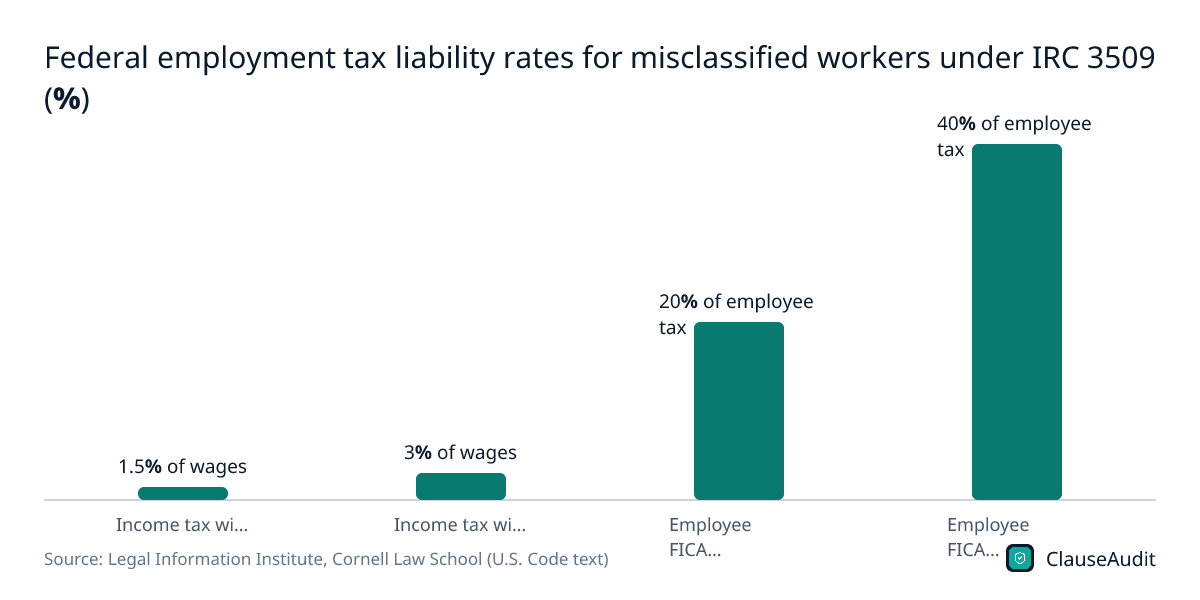
They are steep, and they stack. California can fine a business $5,000 to $25,000 per violation for willful misclassification, and Delaware's construction cap reaches $20,000. The IRS then adds back taxes under IRC 3509, starting at 1.5% of wages for income tax withholding plus 20% of the worker's share of FICA, before any state unemployment claims.

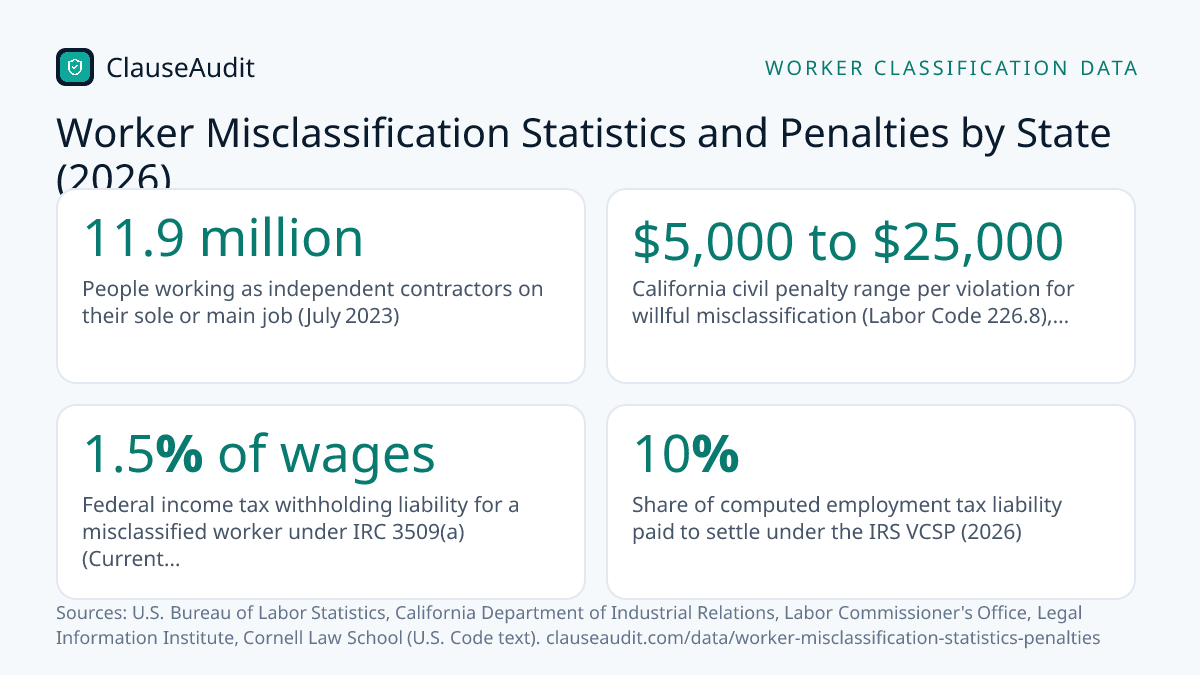
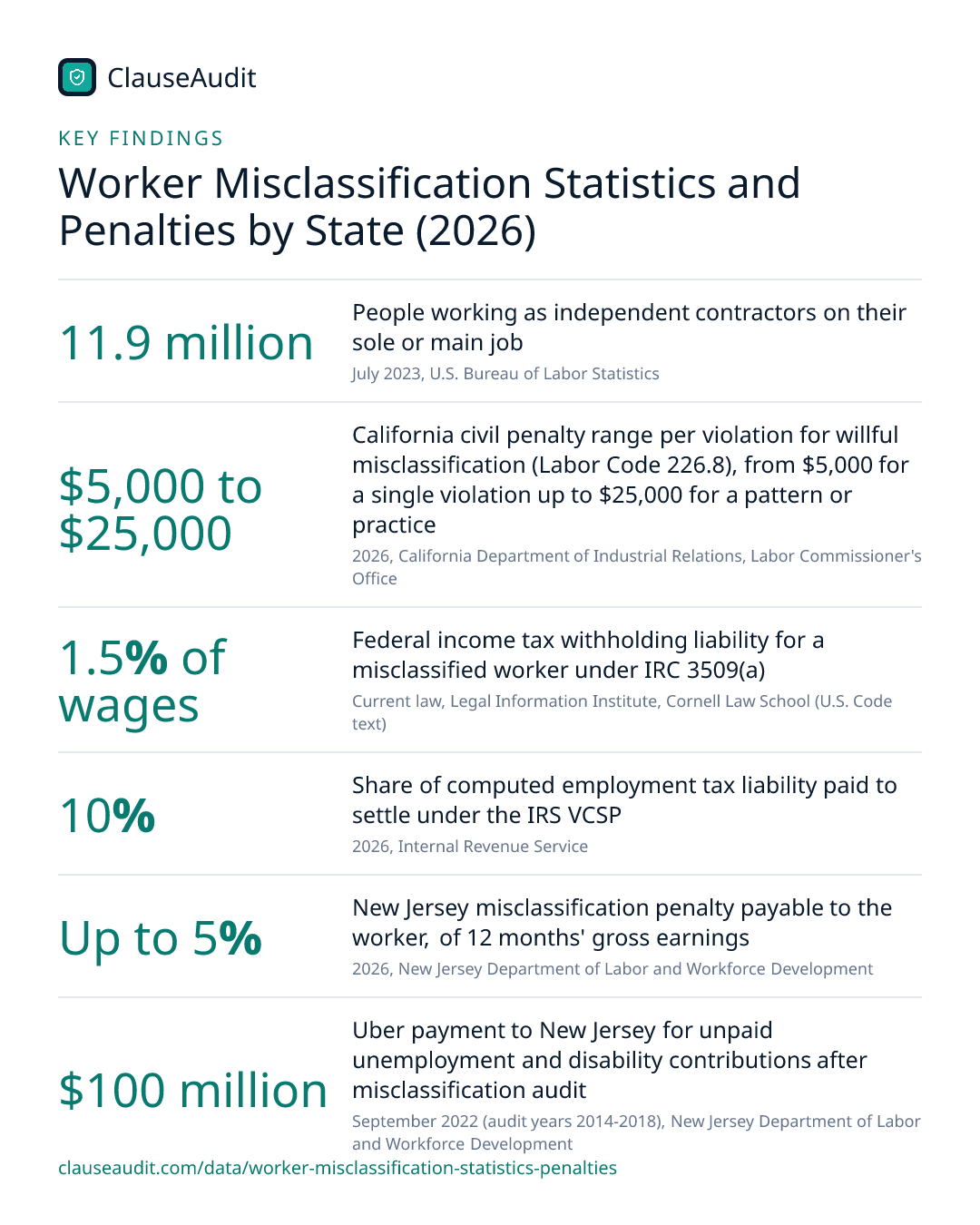
- People working as independent contractors on their sole or main job (July 2023, U.S. Bureau of Labor Statistics)
- 11.9 million
- California civil penalty range per violation for willful misclassification (Labor Code 226.8), from $5,000 for a single violation up to $25,000 for a pattern or practice (2026, California Department of Industrial Relations, Labor Commissioner's Office)
- $5,000 to $25,000
- Federal income tax withholding liability for a misclassified worker under IRC 3509(a) (Current law, Legal Information Institute, Cornell Law School (U.S. Code text))
- 1.5% of wages
- Share of computed employment tax liability paid to settle under the IRS VCSP (2026, Internal Revenue Service)
- 10%
- New Jersey misclassification penalty payable to the worker, of 12 months' gross earnings (2026, New Jersey Department of Labor and Workforce Development)
- Up to 5%
- Uber payment to New Jersey for unpaid unemployment and disability contributions after misclassification audit (September 2022 (audit years 2014-2018), New Jersey Department of Labor and Workforce Development)
- $100 million
- Misclassified worker cases found in New Jersey's 2018 audits (2018, New Jersey Department of Labor and Workforce Development)
- 12,300+
Calling someone a contractor when the law sees an employee is one of the most expensive paperwork mistakes a business can make. The bill rarely comes from one place. A state labor agency can fine you per worker, the IRS can bill you for taxes you never withheld, and the state unemployment fund can audit years of payroll at once.
This page pulls together the confirmed numbers: federal tax rates under IRC 3509, state fines we checked against the statute or agency page, and New Jersey's enforcement record. Below the data you'll find what it means if you hire contractors, or if you are one and suspect you've been put in the wrong box.
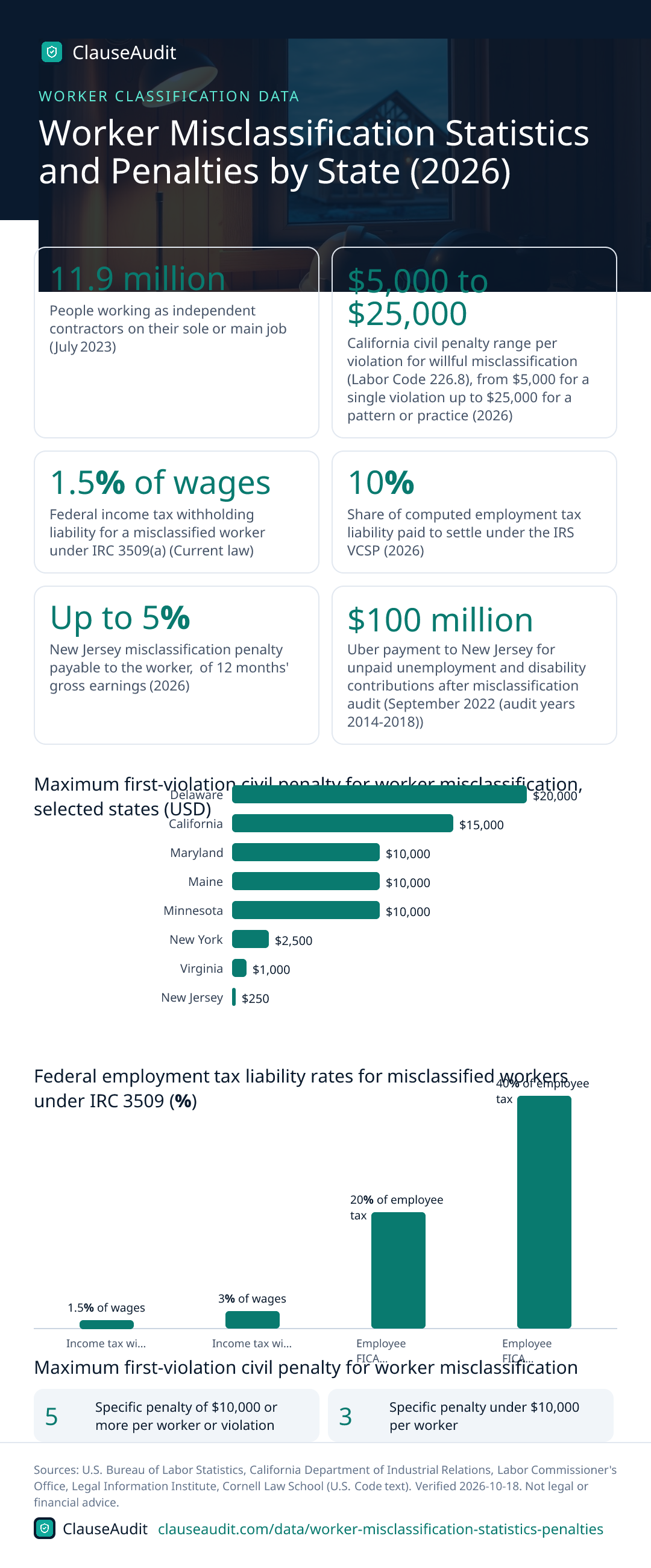
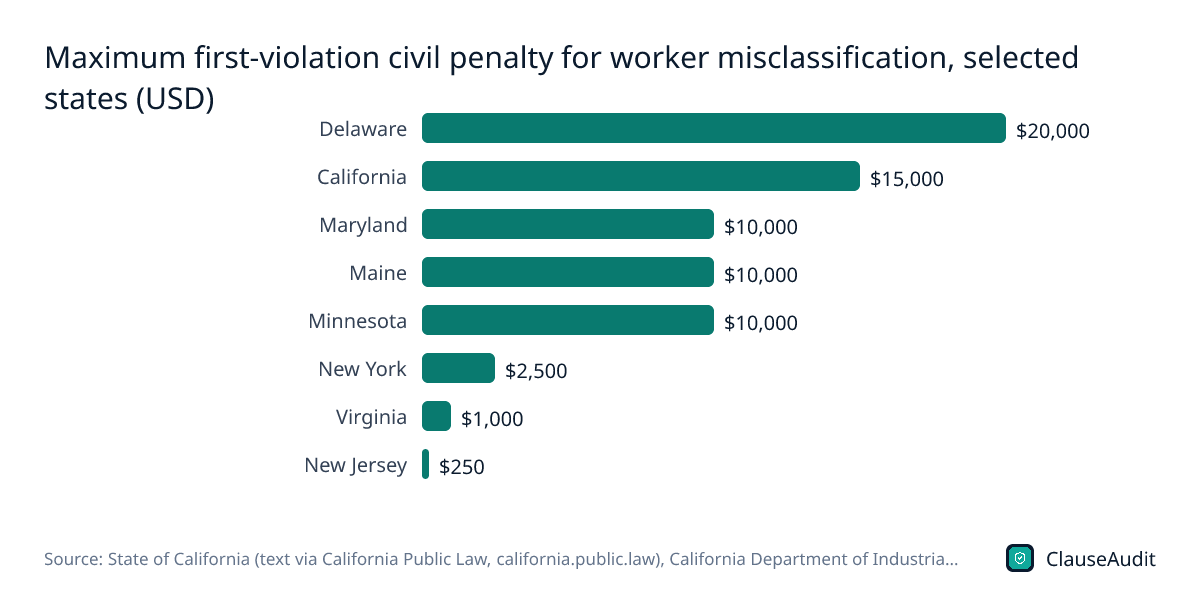
Maximum first-violation civil penalty for worker misclassification, selected states (USD)
Chart data
| Label | Value |
|---|---|
| Delaware | $20,000 |
| California | $15,000 |
| Maryland | $10,000 |
| Maine | $10,000 |
| Minnesota | $10,000 |
| New York | $2,500 |
| Virginia | $1,000 |
| New Jersey | $250 |
Read this chart with the scope column in mind. Delaware and New York only reach construction, while California, Maine, Minnesota, Virginia and New Jersey apply to all employers, so a lower cap can still touch far more businesses.
Download this chart (PNG)Federal employment tax liability rates for misclassified workers under IRC 3509 (%)
Chart data
| Label | Value (%) |
|---|---|
| Income tax withholding (3509(a)) | 1.5% of wages |
| Income tax withholding, no 1099 filed (3509(b)) | 3% of wages |
| Employee FICA share (3509(a)) | 20% of employee tax |
| Employee FICA share, no 1099 filed (3509(b)) | 40% of employee tax |
These rates are the reduced, good-faith rates. Skip the 1099 filings and the federal bill doubles, from 1.5% to 3% of wages and from 20% to 40% of the worker's FICA share.
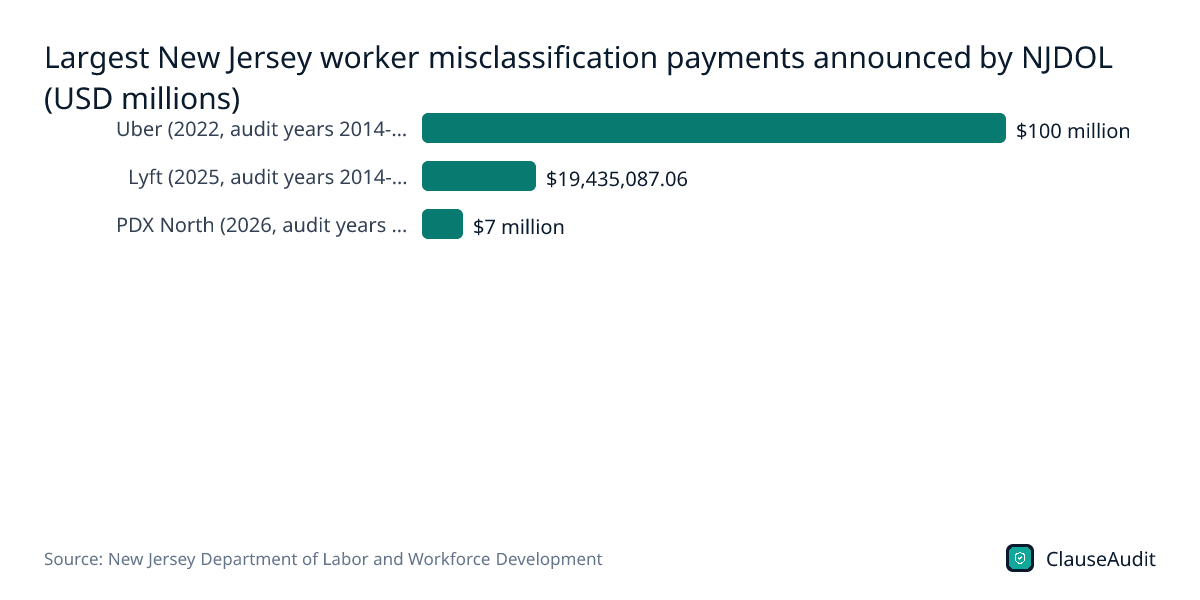
Download this chart (PNG)Largest New Jersey worker misclassification payments announced by NJDOL (USD millions)
Chart data
| Label | Value |
|---|---|
| Uber (2022, audit years 2014-2018) | $100 million |
| Lyft (2025, audit years 2014-2017) | $19,435,087.06 |
| PDX North (2026, audit years 2006-2019) | $7 million |
Each payment covers state unemployment and disability contributions plus interest and penalties. Note how old the audit years are: the Uber payment in 2022 reached back to 2014.
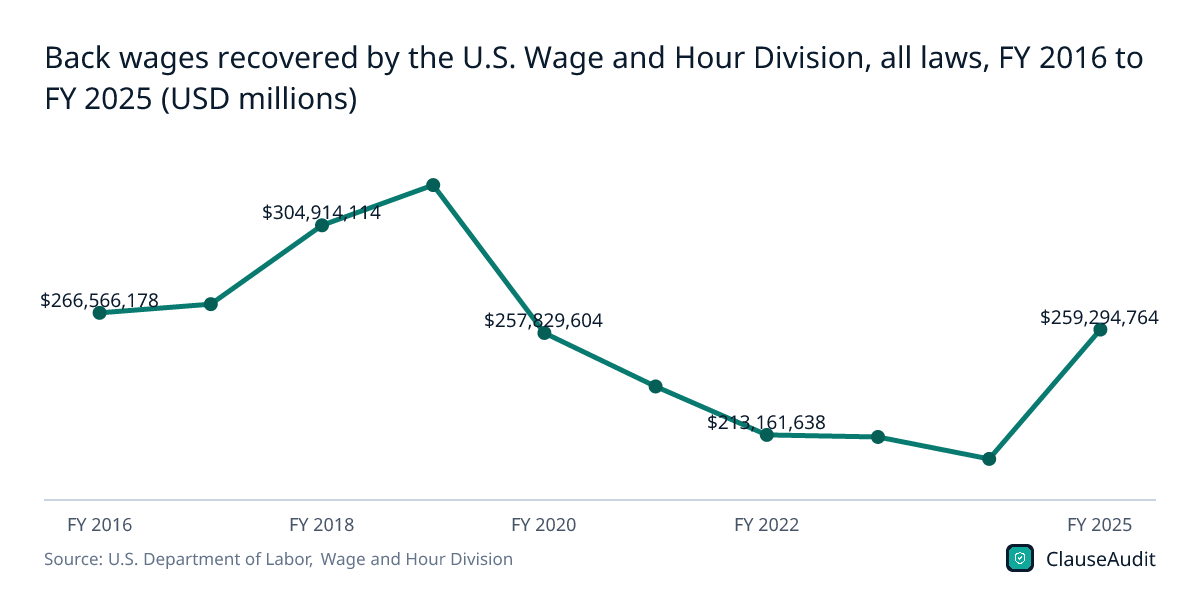
Download this chart (PNG)Back wages recovered by the U.S. Wage and Hour Division, all laws, FY 2016 to FY 2025 (USD millions)
Chart data
| Label | Value (USD millions) |
|---|---|
| FY 2016 | $266,566,178 |
| FY 2017 | $270,403,906 |
| FY 2018 | $304,914,114 |
| FY 2019 | $322,490,774 |
| FY 2020 | $257,829,604 |
| FY 2021 | $234,362,486 |
| FY 2022 | $213,161,638 |
| FY 2023 | $212,325,391 |
| FY 2024 | $202,676,115 |
| FY 2025 | $259,294,764 |
Back wages cover every law the Wage and Hour Division enforces, not just misclassification. The total dipped after FY 2019 and climbed back to $259,294,764 in FY 2025.
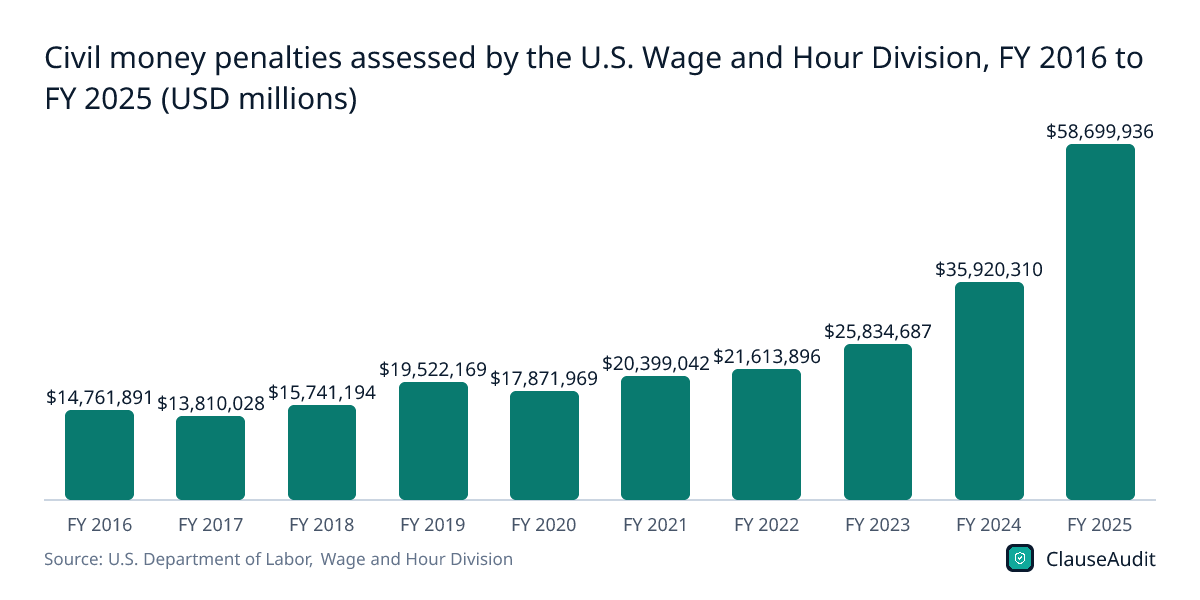
Download this chart (PNG)Civil money penalties assessed by the U.S. Wage and Hour Division, FY 2016 to FY 2025 (USD millions)
Chart data
| Label | Value (USD millions) |
|---|---|
| FY 2016 | $14,761,891 |
| FY 2017 | $13,810,028 |
| FY 2018 | $15,741,194 |
| FY 2019 | $19,522,169 |
| FY 2020 | $17,871,969 |
| FY 2021 | $20,399,042 |
| FY 2022 | $21,613,896 |
| FY 2023 | $25,834,687 |
| FY 2024 | $35,920,310 |
| FY 2025 | $58,699,936 |
Penalties are the steeper trend. Civil money penalties assessed rose from $14,761,891 in FY 2016 to $58,699,936 in FY 2025, which suggests the agency is fining more, not just collecting wages.
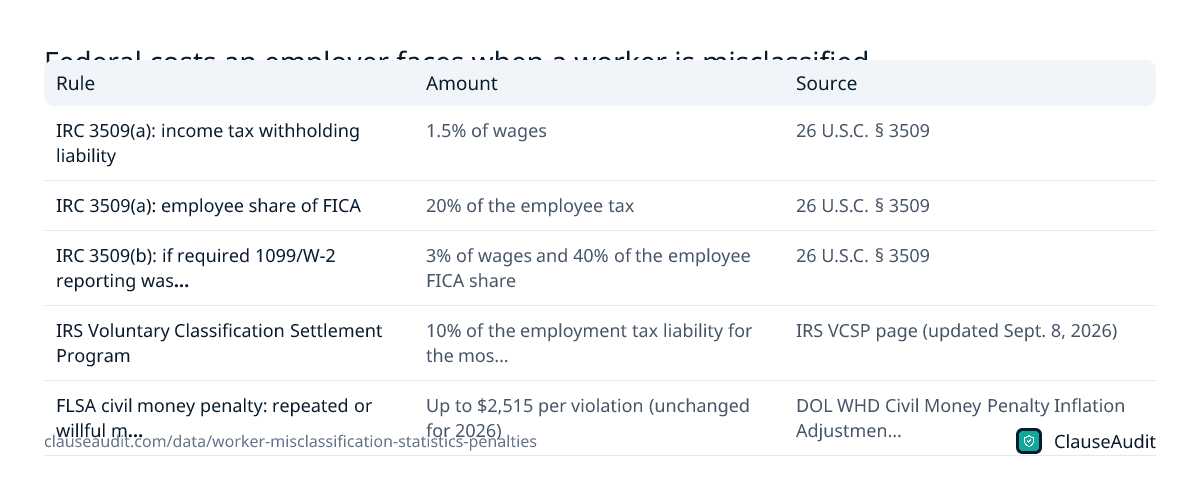
Download this chart (PNG)Federal costs an employer faces when a worker is misclassified
| Rule | Amount | Source |
|---|---|---|
| IRC 3509(a): income tax withholding liability | 1.5% of wages | 26 U.S.C. § 3509 |
| IRC 3509(a): employee share of FICA | 20% of the employee tax | 26 U.S.C. § 3509 |
| IRC 3509(b): if required 1099/W-2 reporting was not met | 3% of wages and 40% of the employee FICA share | 26 U.S.C. § 3509 |
| IRS Voluntary Classification Settlement Program | 10% of the employment tax liability for the most recent tax year, computed at 3509(a) rates; no interest or penalties on that amount | IRS VCSP page (updated Sept. 8, 2026) |
| FLSA civil money penalty: repeated or willful minimum wage or overtime violation | Up to $2,515 per violation (unchanged for 2026) | DOL WHD Civil Money Penalty Inflation Adjustments |
Source: Legal Information Institute, Cornell Law School (U.S. Code text), 26 U.S. Code § 3509, Determination of employer's liability for certain employment taxes; Internal Revenue Service, Voluntary Classification Settlement Program; U.S. Department of Labor, Wage and Hour Division, Civil Money Penalty Inflation Adjustments. Download as image
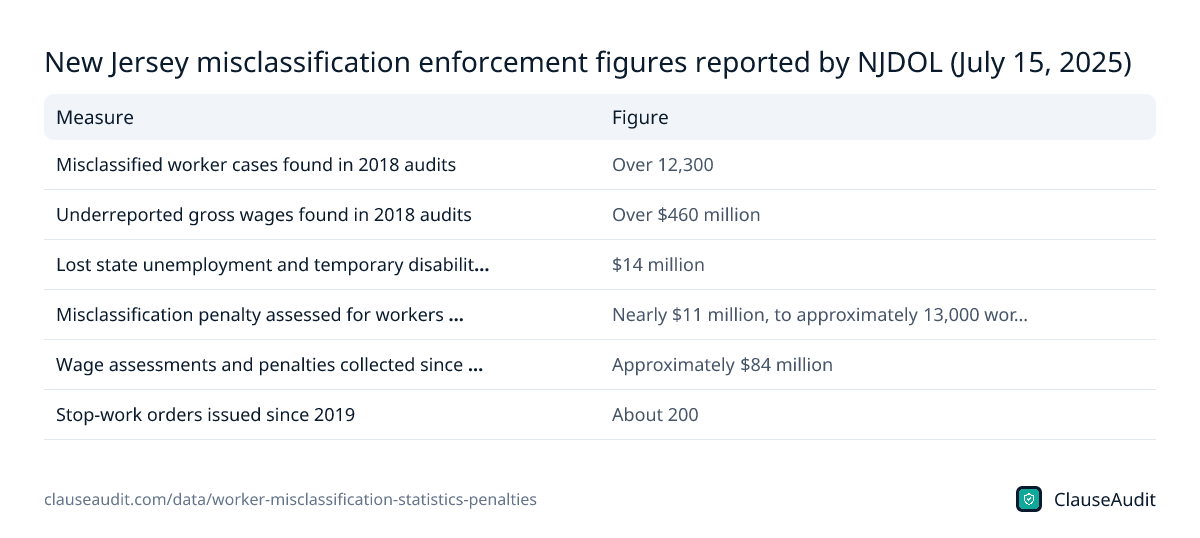
New Jersey misclassification enforcement figures reported by NJDOL (July 15, 2025)
| Measure | Figure |
|---|---|
| Misclassified worker cases found in 2018 audits | Over 12,300 |
| Underreported gross wages found in 2018 audits | Over $460 million |
| Lost state unemployment and temporary disability contributions (2018 audits) | $14 million |
| Misclassification penalty assessed for workers since September 2021 | Nearly $11 million, to approximately 13,000 workers |
| Wage assessments and penalties collected since 2018 | Approximately $84 million |
| Stop-work orders issued since 2019 | About 200 |
Source: New Jersey Department of Labor and Workforce Development, Murphy Administration highlights wins in addressing worker misclassification (press release). Download as image
Maximum first-violation civil penalty for worker misclassification by state
- 5Specific penalty of $10,000 or more per worker or violation
- 3Specific penalty under $10,000 per worker
- Specific penalty of $10,000 or more per worker or violation5
- Specific penalty under $10,000 per worker3
- Not yet confirmed43
What are the penalties for misclassifying an employee as an independent contractor?
There is no single penalty. There are layers, and each agency adds its own.
Start with federal tax. If the IRS reclassifies a worker, IRC 3509 lets it bill the business 1.5% of the worker's wages for income tax that should have been withheld, plus 20% of the employee's share of Social Security and Medicare tax. Those are the lenient rates. If you also failed to file the required 1099s, they rise to 3% of wages and 40% of the employee FICA share. The employer's own half of FICA is owed on top.
Then the state layer. California can assess $5,000 to $15,000 per violation for willful misclassification and $10,000 to $25,000 per violation for a pattern or practice. Minnesota allows up to $10,000 for each misclassified individual. If the worker earned overtime they never got, the federal Fair Labor Standards Act allows a civil money penalty of up to $2,515 per repeated or willful violation, separate from the back pay itself.
Picture a small agency with five "contractors" who work set hours, use company laptops and answer to one manager. In California, five willful violations at the low end is already a five-figure fine before anyone looks at taxes, unpaid overtime or unemployment contributions.
Which states have the toughest misclassification penalties?
On the confirmed list, Delaware has the highest first-violation cap at $20,000, followed by California at $15,000 for a willful violation and Maryland, Maine and Minnesota at $10,000. New York sits at $2,500 per worker, Virginia at $1,000 and New Jersey at $250.
The headline cap is only half the story. Delaware and New York apply their laws to construction only. Delaware counts each misclassified employee as a separate violation, so ten workers means ten fines. New Jersey's per-worker fine looks small, but it also lets the state order the business to pay the worker up to 5% of their gross earnings for the past 12 months, and it can issue stop-work orders.
Repeat offenders pay more almost everywhere. Maryland can double its fine after a prior final order and go up to $20,000 per employee after 3 or more violations. Virginia climbs to $2,500 for a second offense and $5,000 for a third, New York doubles to $5,000 per worker within 5 years, and its criminal fines run up to $25,000 for a first offense and $50,000 for a repeat.
Most states on the map are marked not yet confirmed. That does not mean misclassification is free there. Every state still enforces its own wage, unemployment insurance and workers' compensation rules, and those audits are where many cases start.
How often do misclassification cases get caught?
More often than most owners expect, and sometimes years later. New Jersey's 2018 audits covered about 1 percent of businesses and still found over 12,300 misclassified worker cases and over $460 million in underreported gross wages. Scale that sample rate up and you can see why states treat this as a revenue issue.
New Jersey's biggest cases came out of state payroll audits. Uber paid New Jersey $100 million in 2022 for unpaid unemployment and disability contributions covering audit years 2014 to 2018. PDX North paid $7 million in 2026 for audit years reaching back to 2006.
Federal enforcement is moving the same way. Civil money penalties assessed by the Wage and Hour Division hit $58,699,936 in FY 2025, the highest year on the chart.
What does misclassification cost the worker?
In July 2023, 11.9 million people worked as independent contractors in their sole or main job, about 7.4 percent of total employment. The ones who are misclassified lose things that don't show up on an invoice.
A misclassified worker pays both halves of Social Security and Medicare through self-employment tax. They usually can't collect unemployment when the work ends, have no workers' compensation if they get hurt, and get no overtime pay, however long the week runs. Some states push money back to the worker. In New Jersey, the state has assessed nearly $11 million in misclassification penalties to be paid directly to approximately 13,000 workers since September 2021.
The worker also carries some of the paperwork risk. If the business never filed a 1099, you may have under-reported income yourself. Keep your own records of every payment, even when the client treats the arrangement casually.
If your "client" sets your hours, trains you, supplies your tools and is your only source of income, ask the question. You can file IRS Form SS-8 for a federal ruling, or contact your state labor department.
What should a business do if it has misclassified workers?
Fix it before an auditor does. The IRS Voluntary Classification Settlement Program lets an eligible business reclassify workers going forward and pay 10% of the employment tax liability for the most recent tax year, computed at the reduced 3509(a) rates, with no interest or penalties on that amount. That is a fraction of what an audit can cost.
Do the math honestly. A business with a dozen long-term "contractors" who work like staff is carrying a liability that grows every payroll cycle, and state audits can reach back many years. Waiting rarely makes the number smaller.
Then look at the paperwork, because a contract won't save you on its own. Agencies look at how the work actually happens. Still, the agreement sets the tone, and a contract that reads like an employment handbook is evidence against you.
- Let the contractor control how, when and where the work gets done. Define deliverables, not daily hours.
- Pay by project or milestone against an invoice, not on a payroll schedule.
- Avoid exclusivity clauses and broad non-competes that tie the contractor to you alone.
- Have contractors supply their own tools, insurance and business registration where possible.
- File every required 1099 on time. It keeps you on the lower 3509(a) rates if a worker is later reclassified.
How ClauseAudit helps
Misclassification often starts in the contract itself. A freelance agreement that sets fixed hours, bans other clients and pays on a biweekly schedule reads like a job, and that hurts both sides: the worker loses benefits and the business picks up the risk.
Run the agreement through an automated review before anyone signs. ClauseAudit flags clauses that point toward employee status or push risk onto the contractor, explains each one in plain English, and suggests wording you can send back.
- Control: does the contract dictate hours, location or methods instead of the finished deliverable?
- Exclusivity and non-compete: are you barred from working for other clients during or after the project?
- Payment terms: are you paid per project and invoice, or on a payroll-style schedule with no late fee?
- Rate and expenses: who pays for tools, software and equipment you need for the work?
- Liability and indemnity: does the contract make you cover the client's tax or classification penalties?
- Termination: can the client end the deal at will, like an employer, with no kill fee for work in progress?
Frequently asked questions
What is the penalty for misclassifying an employee in California?
Under Labor Code 226.8, a willful violation carries a civil penalty of $5,000 to $15,000 per violation. If the state finds a pattern or practice of misclassification, the range rises to $10,000 to $25,000 per violation. That sits on top of unpaid wages, overtime, payroll taxes and any federal tax bill.
How much does the IRS charge for misclassifying a worker?
Under IRC 3509(a), the business owes 1.5% of wages for income tax it should have withheld and 20% of the employee's share of FICA, plus its own employer share. If it skipped the required 1099 filings, those rise to 3% of wages and 40% of the employee FICA share, unless it had reasonable cause.
What is the IRS Voluntary Classification Settlement Program?
It's a way for an eligible business to start treating workers as employees going forward and settle past federal employment tax. You pay 10% of the liability for the most recent tax year, figured at the reduced 3509(a) rates, with no interest or penalties on that amount.
Can a worker get money if they were misclassified?
Often, yes. You may be owed unpaid overtime, minimum wage and expense reimbursements, and you may qualify for unemployment once the state rules you were an employee. New Jersey goes further: it can order the business to pay the worker up to 5% of their gross earnings for the previous 12 months.
How do I report an employer for worker misclassification?
For a federal tax ruling, file IRS Form SS-8. For wages, overtime or unemployment, contact your state labor department or file a wage claim. Some states also take misclassification complaints online. Keep copies of your contract, schedules, emails and pay records before you file, in case access ends.
Does signing an independent contractor agreement make me a contractor?
No. Agencies and courts look at how the work actually happens: who controls your schedule and methods, who supplies the tools, whether you can work for others and how you're paid. A contract that says "contractor" helps the business only if the day-to-day relationship matches it.
How many independent contractors are there in the US?
The Bureau of Labor Statistics counted 11.9 million people working as independent contractors on their sole or main job in July 2023, about 7.4 percent of total employment. That is the most recent edition of its Contingent Worker Supplement, so newer counts from private surveys are not directly comparable.
Which states have specific misclassification fines?
Among the states confirmed here, Delaware, California, Maryland, Maine and Minnesota set first-violation caps of $10,000 or more, while New York, Virginia and New Jersey set lower per-worker fines. Delaware and New York apply only to construction. States without a dedicated statute still enforce wage, unemployment and workers' compensation penalties.
Use this data
Every chart and card below is free to reuse under CC BY 4.0. Download what you need and link back to this page.
 Stat cards
 Key findings card
 Infographic
 Maximum first-violation civil penalty for worker misclassification, selected states (USD)
 Federal employment tax liability rates for misclassified workers under IRC 3509 (%)
 Largest New Jersey worker misclassification payments announced by NJDOL (USD millions)
 Back wages recovered by the U.S. Wage and Hour Division, all laws, FY 2016 to FY 2025 (USD millions)
 Civil money penalties assessed by the U.S. Wage and Hour Division, FY 2016 to FY 2025 (USD millions)
 Federal costs an employer faces when a worker is misclassified
 New Jersey misclassification enforcement figures reported by NJDOL (July 15, 2025)
Embed the infographic
Free to share on your site, blog or slides under CC BY 4.0. Please keep the credit link.
Sources and method
Every number on this page comes from the sources below, each opened and read on or before October 18, 2026. A second, independent review checked every figure against its source and corrected anything that did not match. 8 of 51 state entries were confirmed; any that could not be are marked "Not yet confirmed" and left out of every count and chart.
- U.S. Bureau of Labor Statistics, Contingent and Alternative Employment Arrangements, July 2023 (news release) (November 8, 2024 (July 2023 Contingent Worker Supplement, most recent edition))
- Legal Information Institute, Cornell Law School (U.S. Code text), 26 U.S. Code § 3509, Determination of employer's liability for certain employment taxes (Current U.S. Code text, accessed 2026-10-18)
- Internal Revenue Service, Voluntary Classification Settlement Program (Last reviewed or updated September 8, 2026)
- Internal Revenue Service, Independent contractor (self-employed) or employee? (Last reviewed or updated May 19, 2026)
- U.S. Department of Labor, Wage and Hour Division, Civil Money Penalty Inflation Adjustments (2026 adjustments (91 FR 31358, May 27, 2026))
- U.S. Department of Labor, Wage and Hour Division, WHD Enforcement Statistics: All Acts (Data through FY 2025)
- California Department of Industrial Relations, Labor Commissioner's Office, Independent Contractor versus Employee (FAQ) (Updated June 2026)
- New Jersey Department of Labor and Workforce Development, Independent Contractors (My Work Rights) (Undated web page, accessed 2026-10-18)
- New Jersey Department of Labor and Workforce Development, Murphy Administration highlights wins in addressing worker misclassification (press release) (July 15, 2025)
- New Jersey Department of Labor and Workforce Development, Uber pays $100 million in driver misclassification case (press release) (September 13, 2022)
- New Jersey Department of Labor and Workforce Development, Lyft payment in driver misclassification case (press release) (September 18, 2025)
- New Jersey Department of Labor and Workforce Development, $7 million settlement with PDX North, Inc. in worker misclassification case (press release) (March 12, 2026)
- New York State Senate, New York Labor Law § 861-E (Construction Industry Fair Play Act penalties) (Current statute text, accessed 2026-10-18)
- State of Delaware, Delaware Code Title 19, Chapter 35, Workplace Fraud Act (Current Delaware Code, accessed 2026-10-18)
- Maine Legislature, 26 M.R.S. § 591-A, Employee misclassification (Current Maine statutes, accessed 2026-10-18)
- Maryland General Assembly, Md. Code, Labor and Employment § 3-909 (Workplace Fraud Act civil penalties) (Current statute text, accessed 2026-10-18)
- Minnesota Office of the Revisor of Statutes, Minn. Stat. § 181.722, Misrepresentation of employment relationship (2025 Minnesota Statutes)
- Virginia General Assembly (Virginia Law), Va. Code § 58.1-1901, Civil penalties (worker misclassification) (Current Code of Virginia, accessed 2026-10-18)
- Virginia General Assembly (Virginia Law), Va. Code § 58.1-1902, Debarment (Current Code of Virginia, accessed 2026-10-18)
- U.S. Department of Labor, Wage and Hour Division, State Labor Offices (Undated directory, accessed 2026-10-18)
- State of California (text via California Public Law, california.public.law), California Labor Code Section 226.8 (statute text) (Current statute text, accessed 2026-10-19)
Cite this page
ClauseAudit, “Worker Misclassification Statistics and Penalties by State (2026)”, updated October 18, 2026, https://clauseaudit.com/data/worker-misclassification-statistics-penalties. Free to reuse with a link back (CC BY 4.0).
This page summarises published data and law as checked on October 18, 2026. Figures are updated as new editions are released, and your own situation may differ. It is general information, not legal, tax or financial advice.