Gig Economy Statistics 2026: 160+ Numbers on Gig Workers, Pay and Platforms
By ClauseAudit Research · 167 statistics · 82 sources ·
What are the key gig economy statistics for 2026?
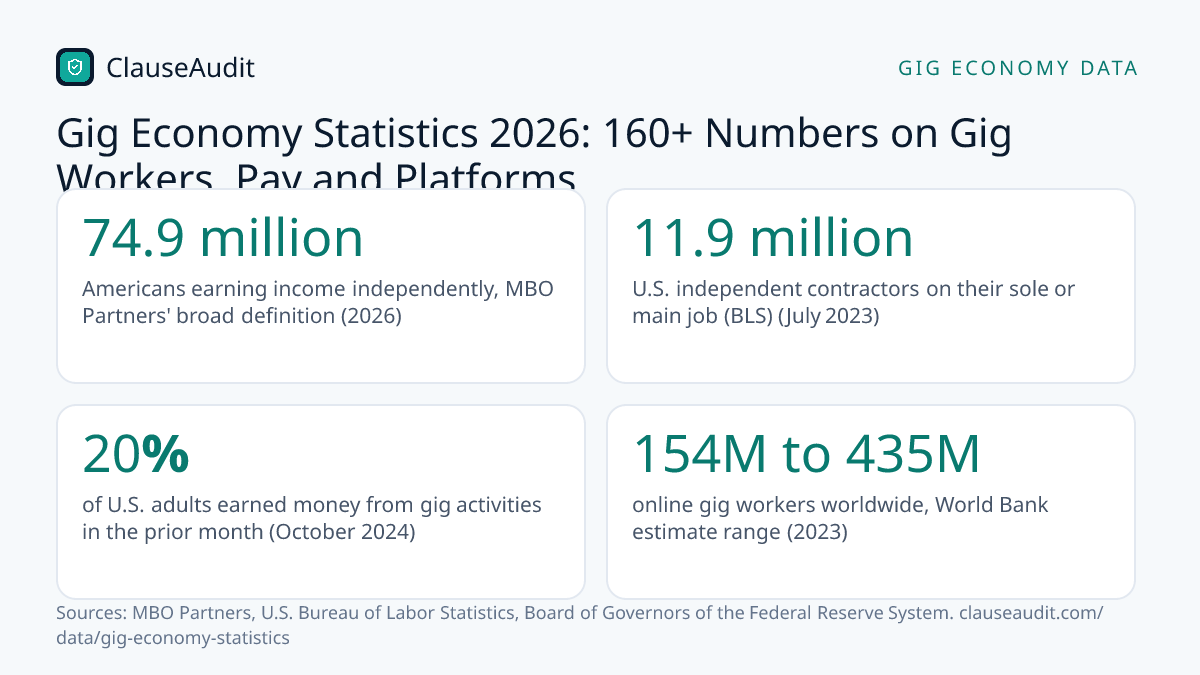
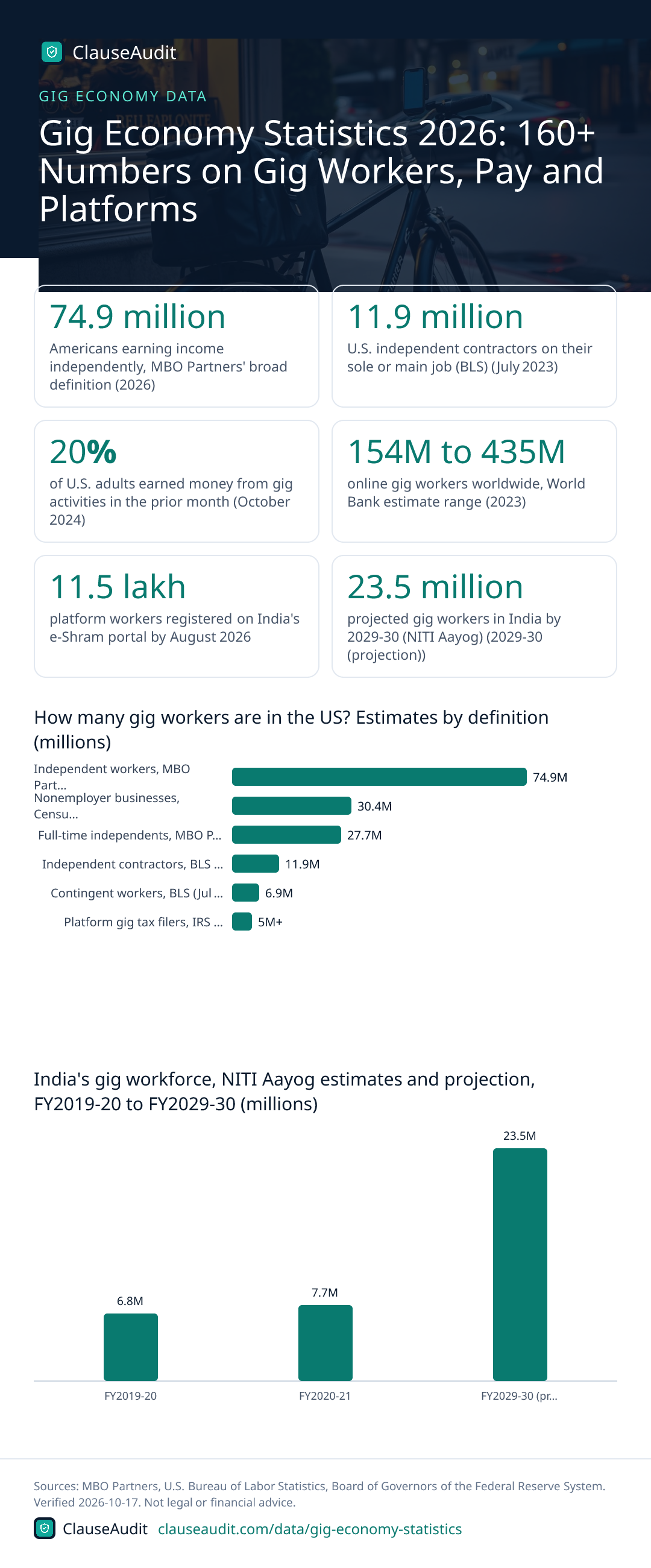
Counts depend on the definition. BLS found 11.9 million Americans worked as independent contractors on their main job in July 2023, and 20% of U.S. adults earned gig income in the month before the Fed's October 2024 survey. MBO Partners counted 74.9 million independent earners in 2026. The World Bank estimates 154 million to 435 million online gig workers worldwide.
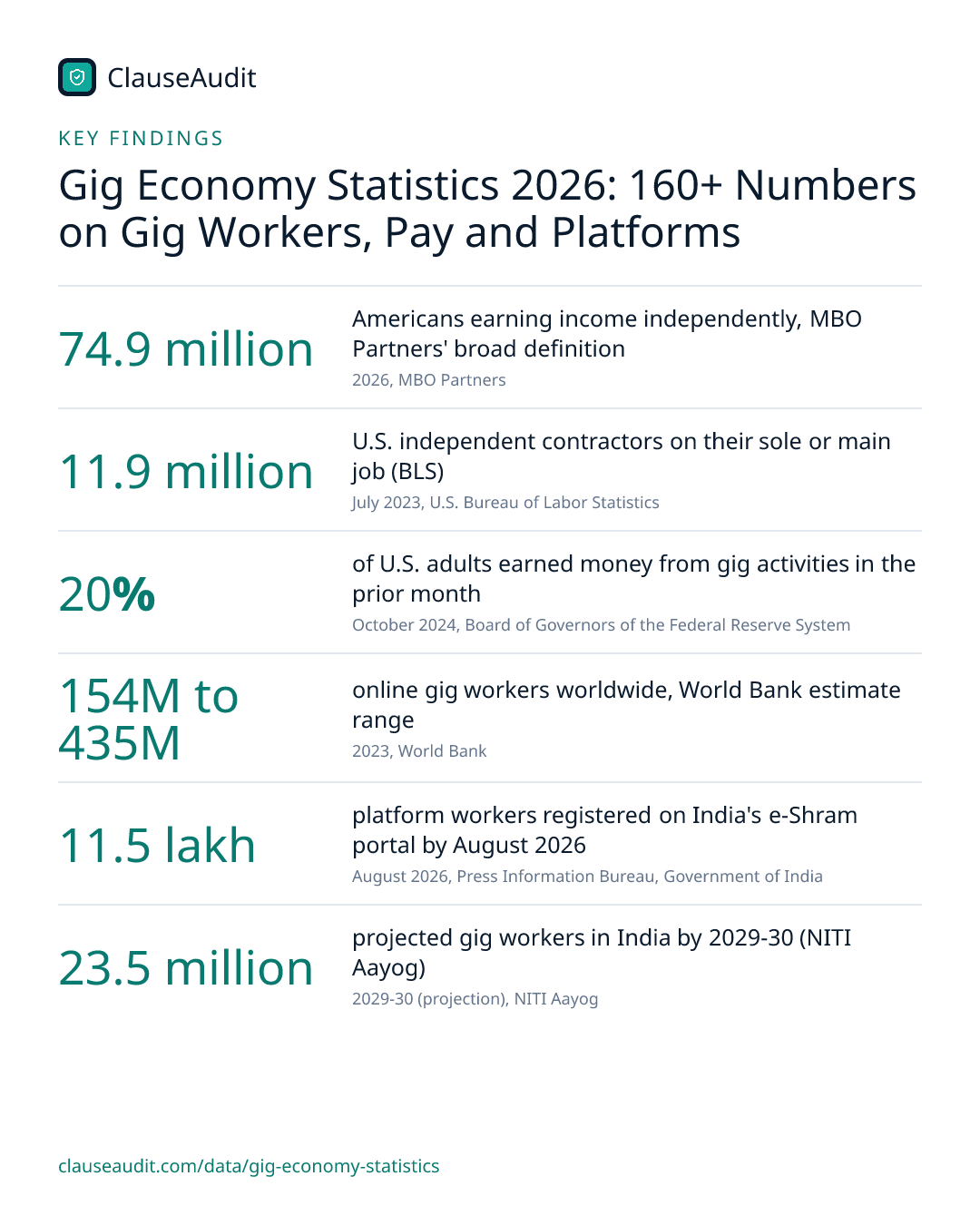
- Americans earning income independently, MBO Partners' broad definition (2026, MBO Partners)
- 74.9 million
- U.S. independent contractors on their sole or main job (BLS) (July 2023, U.S. Bureau of Labor Statistics)
- 11.9 million
- of U.S. adults earned money from gig activities in the prior month (October 2024, Board of Governors of the Federal Reserve System)
- 20%
- online gig workers worldwide, World Bank estimate range (2023, World Bank)
- 154M to 435M
- platform workers registered on India's e-Shram portal by August 2026 (August 2026, Press Information Bureau, Government of India)
- 11.5 lakh
- projected gig workers in India by 2029-30 (NITI Aayog) (2029-30 (projection), NITI Aayog)
- 23.5 million
- of U.S. independent contractors prefer their work arrangement (July 2023, U.S. Bureau of Labor Statistics)
- 80.3%
- NYC freelancer complaints in 2025 alleging late or missing payment (2025, NYC Department of Consumer and Worker Protection)
- 751 of 829
This page collects more than 160 gig economy statistics in twelve groups: workforce size, growth, global platform work, India, platform revenue, earnings, demographics, motivations, benefits, late payment, regulation and the effect of AI on gig demand.
Each figure links to a named source. Most come from government agencies such as the Bureau of Labor Statistics, the Federal Reserve, the IRS, the World Bank and the ILO. The rest come from company filings, academic studies and private surveys such as MBO Partners and Pew. The data was checked on October 17, 2026.
How Many Gig Workers Are in the US? Workforce Size Statistics
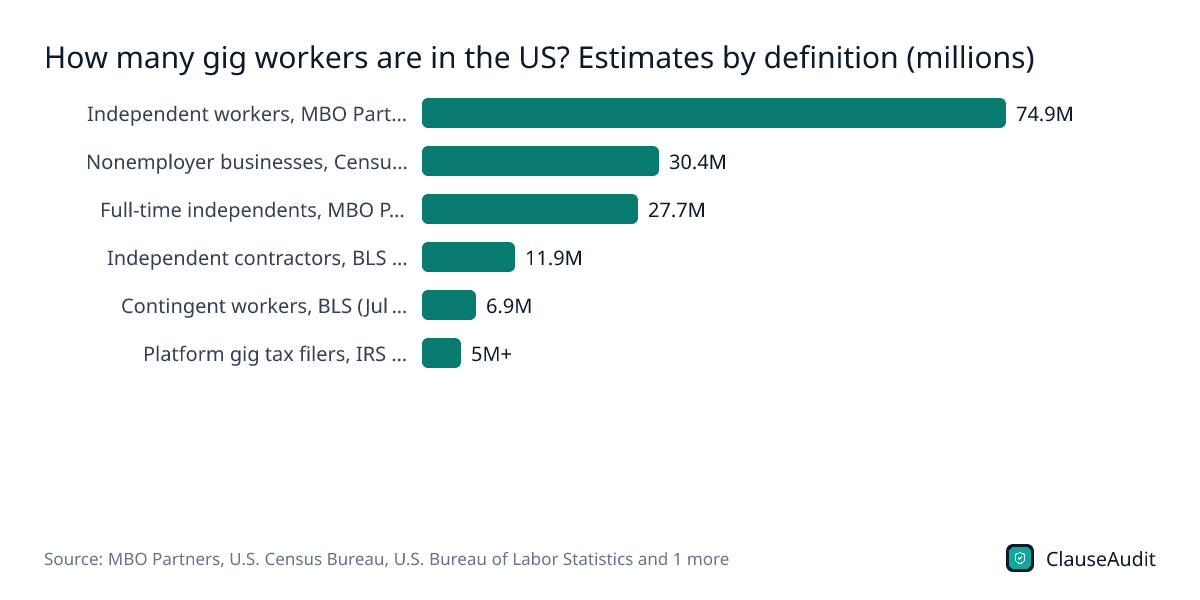
There is no official single count of US gig workers. Estimates run from 2.8 million on-call workers to 74.9 million people with any independent income, so each figure below names its definition.
- 11.9 million Americans worked as independent contractors on their sole or main job in July 2023, the latest BLS Contingent Worker Supplement. (U.S. Bureau of Labor Statistics, Contingent and Alternative Employment Arrangements, July 2023, July 2023)
- 6.9 million workers, or 4.3% of the employed, held contingent jobs that they did not expect to last, up from 3.8% in May 2017. (U.S. Bureau of Labor Statistics, Contingent and Alternative Employment Arrangements, July 2023, July 2023)
- 2.8 million Americans were on-call workers in July 2023, equal to 1.7% of total employment. (U.S. Bureau of Labor Statistics, Contingent and Alternative Employment Arrangements, July 2023, July 2023)
- 20% of U.S. adults earned money from gig activities such as reselling items, short-term rentals or short-term tasks in the month before the Fed's survey. (Board of Governors of the Federal Reserve System, Economic Well-Being of U.S. Households in 2024 (Employment and Gig Work), October 2024)
- 4% of U.S. adults did platform tasks, meaning short jobs arranged through an app or website such as ride-sharing or delivery. (Board of Governors of the Federal Reserve System, Economic Well-Being of U.S. Households in 2024 (Employment and Gig Work), October 2024)
- 74.9 million Americans earned income independently in 2026 under MBO Partners' broad definition, which counts full-time, part-time and occasional independents. (MBO Partners, State of Independence 2026, 2026)
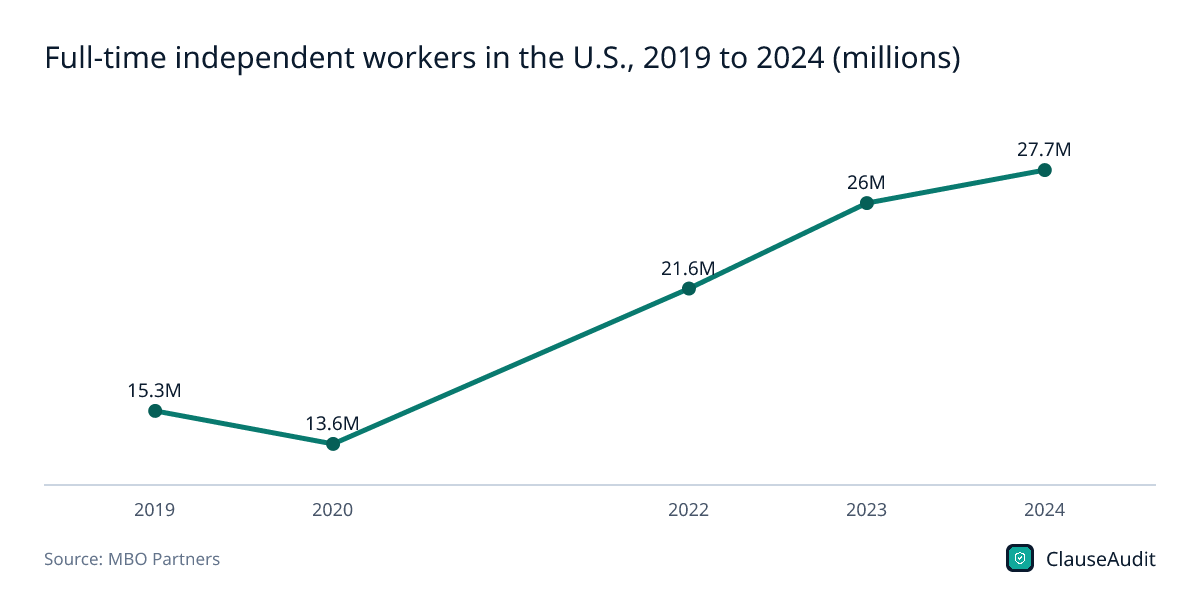
- 27.7 million Americans were full-time independent workers in 2024, up 6.5% from 26 million in 2023, according to MBO Partners. (MBO Partners, State of Independence 2024, 2024)
- 16% of U.S. adults said in 2021 that they had ever earned money from an online gig platform, Pew's most recent edition of this measure. (Pew Research Center, The State of Gig Work in 2021, August 2021)
- 1.6% of U.S. adults performed digital platform work as their primary job in the past week, according to the Entrepreneurship in the Population Survey. (National Bureau of Economic Research, Understanding the Digital Platform Workforce in the US: Evidence from the Entrepreneurship in the Population Survey (Atkins, Brummet and Johnson), 2026 study)
- 4.4% of U.S. adults performed digital platform work at some point over the past six months, nearly three times the primary-job share. (National Bureau of Economic Research, Understanding the Digital Platform Workforce in the US: Evidence from the Entrepreneurship in the Population Survey (Atkins, Brummet and Johnson), 2026 study)
- Less than 5% to over 30% is the range of federal estimates for the share of U.S. workers in nonstandard or contract arrangements, depending on definition and method. (U.S. Government Accountability Office, Work Arrangements: Improved Collaboration Could Enhance Labor Force Data (GAO-24-105651), December 2023)
- At least 5 million Americans received IRS information returns from platform gig work by 2021, according to tax data analysed by IRS and university researchers. (Internal Revenue Service, Statistics of Income, The Evolution of Platform Gig Work, 2012-2024 (Garin, Jackson, Koustas and Miller), IRS SOI working paper, 2021)
- 9.58 million Americans were unincorporated self-employed workers in September 2026 (not seasonally adjusted), per Current Population Survey data on FRED. (Federal Reserve Bank of St. Louis (FRED), from U.S. Bureau of Labor Statistics data, Employment Level - All Industries Self-Employed, Unincorporated (LNU02027714), September 2026)
- Up to 24.8 million independent contractors is the upper-bound U.S. count the Labor Department used in its February 2026 rule analysis, roughly double the 11.9 million BLS survey figure. (U.S. Department of Labor, Federal Register via GovInfo, Employee or Independent Contractor Status Under the Fair Labor Standards Act (proposed rule), 2026 estimate)
Figure 1: How many gig workers are in the US? Estimates by definition (millions)
Chart data
| Label | Value |
|---|---|
| Independent workers, MBO Partners (2026) | 74.9M |
| Nonemployer businesses, Census (2023) | 30.4M |
| Full-time independents, MBO Partners (2024) | 27.7M |
| Independent contractors, BLS (Jul 2023) | 11.9M |
| Contingent workers, BLS (Jul 2023) | 6.9M |
| Platform gig tax filers, IRS data (2021) | 5M+ |
Gig Economy Growth Statistics and Trends Over Time
Private surveys show the independent workforce jumped after 2020 and then leveled off, with 72.7 million counted in 2024. The BLS share of workers contracting on their main job moved more slowly, from 6.9% in 2017 to 7.4% in 2023.
- 74.9 million Americans earned income independently in 2026, a record, according to MBO Partners' annual State of Independence research. (MBO Partners, State of Independence 2026, 2026)
- 72.7 million independent workers were counted in 2024, only slightly above 72.1 million in 2023, signalling a post-pandemic plateau. (MBO Partners, State of Independence 2024, 2023 to 2024)
- 26% annual growth took the independent workforce to 64.6 million in 2022, the peak of the post-pandemic surge. (MBO Partners, State of Independence 2022, 2021 to 2022)
- 69% growth in the total number of U.S. independents between 2020 and 2022, according to MBO Partners. (MBO Partners, State of Independence 2022, 2020 to 2022)
- 27.7 million Americans were full-time independents in 2024, up 6.5% from 26 million in 2023. (MBO Partners, State of Independence 2024, 2024)
- 10% drop in part-time independents in 2024, from 9.5 million to 8.5 million, as workers shifted to full-time or occasional work. (MBO Partners, State of Independence 2024, 2023 to 2024)
- 5.8 million U.S. independent professionals earn more than $100,000 a year, nearly double the number in 2020, MBO Partners estimated in its 2026 study. (MBO Partners, Independent workforce reaches 74.9 million (16th annual State of Independence study), 2026)
- 7.4% of U.S. employment was independent contractors on their main job in July 2023, up from 6.9% in May 2017. (U.S. Bureau of Labor Statistics, Contingent and Alternative Employment Arrangements, July 2023, July 2023)
- 10.6 million Americans were independent contractors on their main job in May 2017, 6.9% of total employment (BLS, 2017 data). (U.S. Bureau of Labor Statistics, Contingent and Alternative Employment Arrangements, May 2017, May 2017)
- 10.3 million Americans were independent contractors in February 2005, already 7.4% of employment, up from 6.4% in 2001 (BLS, 2005 data). (U.S. Bureau of Labor Statistics, Contingent and Alternative Employment Arrangements, February 2005, February 2005)
- 30.4 million U.S. nonemployer businesses, firms with no paid employees, reported $1.8 trillion in receipts in 2023. (U.S. Census Bureau, Census Bureau releases new data on business owner characteristics (2023 Nonemployer Statistics by Demographics), 2023)
- 7.5% of U.S. households earned online platform income in the year to January 2020, before the pandemic dip (JPMorgan Chase Institute, 2021 study). (JPMorgan Chase Institute, The Online Platform Economy through the Pandemic, January 2020)
- 36.6 million Americans were occasional independents in 2023, up from 15.8 million in 2020, a 130% rise in three years. (MBO Partners, State of Independence 2023, 2020 to 2023)
- One-third of U.S. independent professionals served customers outside the United States in 2026, nearly three times the share in 2012, MBO Partners found. (MBO Partners, Independent Workforce Reaches 74.9 Million (2026 State of Independence press release), 2026)
Figure 2: Full-time independent workers in the U.S., 2019 to 2024 (millions)
Chart data
| Label | Value |
|---|---|
| 2019 | 15.3M |
| 2020 | 13.6M |
| 2022 | 21.6M |
| 2023 | 26M |
| 2024 | 27.7M |
Global Gig Economy and Online Platform Work Statistics
Countries measure platform work in different ways, and only 40 of 133 countries in an ILO review had measured it at all. Treat cross-country comparisons as rough.
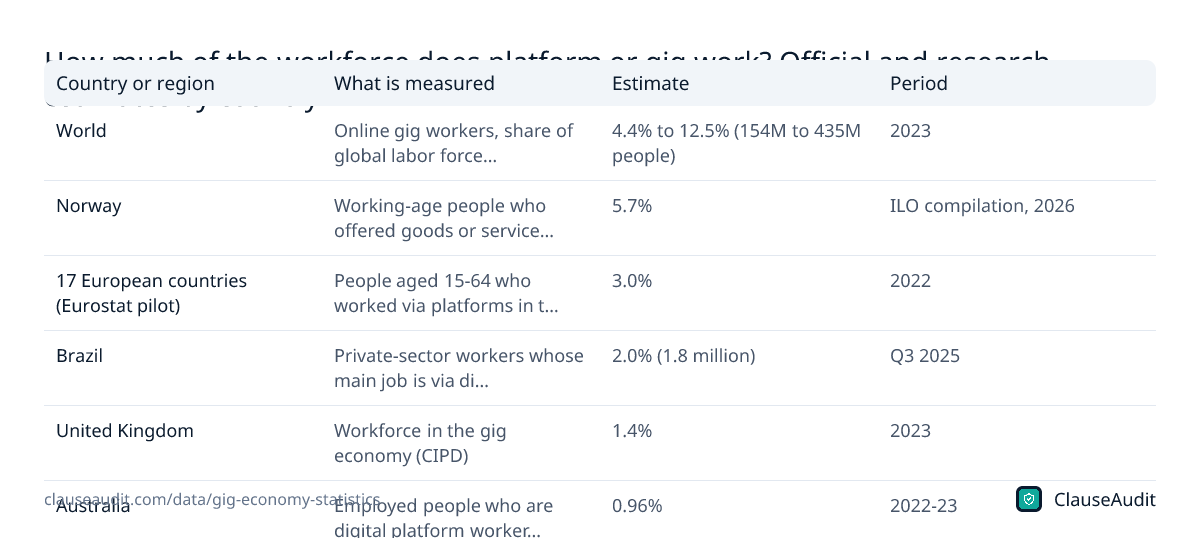
- 154 million to 435 million people worldwide did online gig work, according to 2023 World Bank estimates whose range reflects different measurement methods. (World Bank, Working Without Borders: The Promise and Peril of Online Gig Work (Overview), 2023)
- 4.4 to 12.5 percent of the global labor force consisted of online gig workers, by the World Bank's 2023 estimate. (World Bank, Working Without Borders: The Promise and Peril of Online Gig Work (Overview), 2023)
- 130 percent growth in job postings on the largest online gig platform in Sub-Saharan Africa, versus 14 percent in North America (World Bank, 2023). (World Bank, Demand for Online Gig Work Rapidly Rising in Developing Countries (press release), 2023)
- Over 28 million people in the EU worked through digital labour platforms in 2021, the European Commission estimated; its forecast of 43 million by 2025 has not been confirmed. (European Commission, Commission proposals to improve the working conditions of people working through digital labour platforms, 2021)
- At least 653 active digital labour platforms were identified worldwide by the ILO as of October 2025, down from 777 counted in 2021. (International Labour Organization, Digital labour platforms: Number of platforms and workers (Research Brief), October 2025)
- 136 of the 204 online web-based labour platforms tracked by the ILO are freelance platforms, ahead of 42 microtask platforms. (International Labour Organization, Digital labour platforms: Number of platforms and workers (Research Brief), October 2025)
- 40 of 133 countries answering an ILO review had measured digital platform employment, leaving large data gaps, especially in Africa and the Arab States. (International Labour Organization, Digital labour platforms: Number of platforms and workers (Research Brief), ILO country review, published February 2026)
- 5.7 per cent of Norway's working-age population had offered a good or service via a digital platform, per national survey data compiled by the ILO in 2026. (International Labour Organization, Digital labour platforms: Number of platforms and workers (Research Brief), ILO compilation of national surveys, 2026)
- 3.0% of people aged 15 to 64 in 17 European countries worked through digital platforms in the prior 12 months, in Eurostat's 2022 pilot survey. (Eurostat (European Commission), Experimental statistics on digital platform employment, 2022)
- 0.96% of Australia's employed population were digital platform workers in 2022-23, with food delivery and personal transport the most common tasks. (Australian Bureau of Statistics, Digital platform workers in Australia, 2022-23)
- 1.8 million Brazilians worked mainly through digital service platforms in Q3 2025, equal to 2.0% of private-sector employment and 36.8% more than in 2022. (Instituto Brasileiro de Geografia e Estatística (IBGE), Trabalho por meio de plataformas digitais 2025 (PNAD Contínua thematic module), Q3 2025)
- 7% a year average growth from 2016 to 2024 in Singapore workers who preferred platform work as their main job, according to the Ministry of Manpower. (Ministry of Manpower, Singapore, Global Dialogue on Digital Platform Work (press release), 2016 to 2024)
- 1.4% of the UK workforce, fewer than half a million people, worked in the gig economy, according to a 2023 CIPD report. (Chartered Institute of Personnel and Development (CIPD), Less than half a million people working in UK gig economy, CIPD report shows, 2023)
- 4.53 million people in the UK were self-employed in May to July 2026 (seasonally adjusted), below the 4.96 million annual average for 2019. (Office for National Statistics (UK), LFS: Self-employed: UK: All: 000s: SA (series MGRQ), May-July 2026)
- 195 active delivery platforms were identified worldwide by the ILO as of October 2025, second only to 204 online web-based platforms. (International Labour Organization, Digital labour platforms: Number of platforms and workers (research brief PDF), October 2025)
| Country or region | What is measured | Estimate | Period |
|---|---|---|---|
| World | Online gig workers, share of global labor force (World Bank) | 4.4% to 12.5% (154M to 435M people) | 2023 |
| Norway | Working-age people who offered goods or services via a digital platform (broad definition) | 5.7% | ILO compilation, 2026 |
| 17 European countries (Eurostat pilot) | People aged 15-64 who worked via platforms in the past 12 months | 3.0% | 2022 |
| Brazil | Private-sector workers whose main job is via digital service platforms (IBGE) | 2.0% (1.8 million) | Q3 2025 |
| United Kingdom | Workforce in the gig economy (CIPD) | 1.4% | 2023 |
| Australia | Employed people who are digital platform workers (ABS) | 0.96% | 2022-23 |
India Gig Economy Statistics: Workforce Size, Growth and Social Security
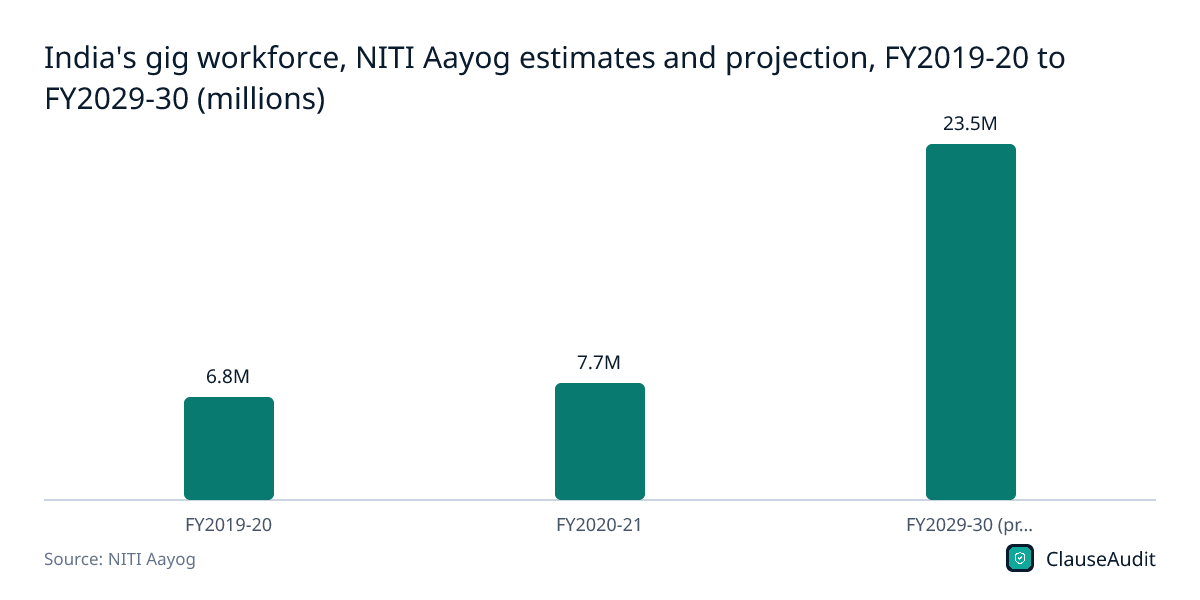
India tracks gig work through NITI Aayog estimates and registrations on the e-Shram portal. Several figures here come from a 2022 NITI Aayog report, and its 2029-30 figure is a projection rather than a count.
- 7.7 million Indians (77 lakh) worked in the gig economy in 2020-21, equal to 2.6% of the non-agricultural workforce and 1.5% of all workers (2022 report). (NITI Aayog, India's Booming Gig and Platform Economy: Perspectives and Recommendations on the Future of Work, 2020-21)
- 6.8 million gig workers (68 lakh) were working in India in 2019-20, forming 2.4% of the non-farm workforce, NITI Aayog estimated in 2022. (NITI Aayog, India's Booming Gig and Platform Economy: Perspectives and Recommendations on the Future of Work, 2019-20)
- 23.5 million gig workers (2.35 crore) are projected for India by 2029-30, or 4.1% of total livelihoods, according to NITI Aayog's 2022 forecast. (NITI Aayog, India's Booming Gig and Platform Economy: Perspectives and Recommendations on the Future of Work, 2029-30 (projection))
- 47% of India's gig work was in medium-skilled jobs, against about 22% high-skilled and 31% low-skilled, in NITI Aayog's 2022 report. (NITI Aayog, India's Booming Gig and Platform Economy: Perspectives and Recommendations on the Future of Work, 2019-20)
- 2.7 million Indian gig workers (26.6 lakh) were in retail trade and sales, the largest sector, with about 13 lakh in transportation (2022 report). (NITI Aayog, India's Booming Gig and Platform Economy: Perspectives and Recommendations on the Future of Work, 2019-20)
- 1-2% of annual turnover is the aggregator contribution the Code on Social Security sets for gig worker welfare, capped at 5% of worker payouts. (Ministry of Finance, Government of India, Economic Survey 2025-26, Chapter 12: Employment and Skill Development, 2025-26)
- 11.5 lakh platform workers (about 1.15 million) had registered on India's e-Shram portal by August 2026, out of 31.89 crore total registrations. (Press Information Bureau, Government of India, 5 Years of e-Shram Portal: Building an Inclusive Social Security Ecosystem, August 2026)
- 3.37 lakh platform and gig workers were registered on e-Shram as of 3 August 2025, so registrations more than tripled within a year. (Press Information Bureau, Government of India, Social Security Boost for India's Gig Workers, August 2025)
- 78,207 platform workers registered on e-Shram in Maharashtra as of 6 August 2025, the most of any state or union territory. (Ministry of Labour and Employment (Lok Sabha), Lok Sabha Unstarred Question No. 3658: Social Security for Online Platform Gig Workers, August 2025)
- 1% to 5% of each payout to a gig worker is the welfare fee Karnataka's 2025 gig workers bill requires aggregators to pay. (PRS Legislative Research, State Legislative Brief: The Karnataka Platform based Gig Workers (Social Security and Welfare) Bill, 2025, August 2025)
- 2 of 11 Indian platforms rated by Fairwork in 2024 (bigbasket and Urban Company) had a minimum wage policy guaranteeing workers the hourly local minimum wage. (Fairwork (Oxford Internet Institute and IIIT Bangalore), Fairwork India Ratings 2024: Labour Standards in the Platform Economy, 2024)
- 56.2% of Indian workers were self-employed in 2025, down from 57.5% in 2024 and 58.2% in 2023, per the Periodic Labour Force Survey. (National Statistics Office, Ministry of Statistics and Programme Implementation (India), Press Note on Periodic Labour Force Survey (PLFS) Annual Report, 2025, 2025)
Figure 4: India's gig workforce, NITI Aayog estimates and projection, FY2019-20 to FY2029-30 (millions)
Chart data
| Label | Value |
|---|---|
| FY2019-20 | 6.8M |
| FY2020-21 | 7.7M |
| FY2029-30 (projected) | 23.5M |
Gig Economy Market Size and Platform Revenue Statistics
Company figures from Uber, Lyft, DoorDash, Upwork, Fiverr and others are the clearest measure of platform volume. Most come from SEC filings, the rest from company releases, and they describe single platforms rather than the whole market.
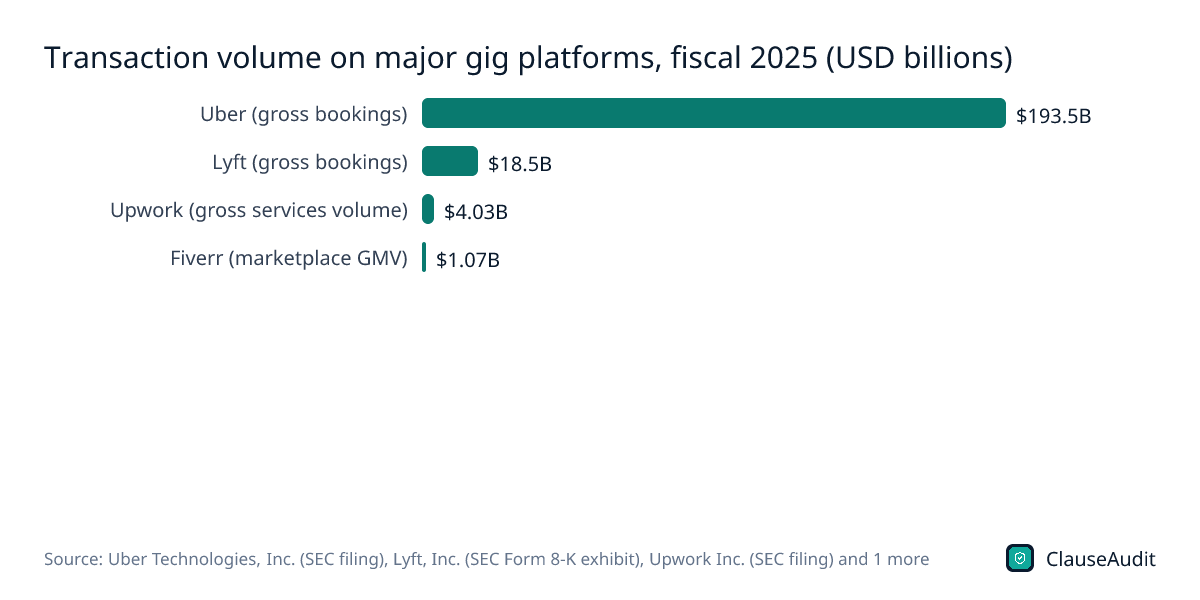
- $193,454 million in gross bookings flowed through Uber's mobility and delivery platform in 2025, up from $162,773 million in 2024. (Uber Technologies, Inc. (SEC filing), Uber Technologies, Inc. Form 10-K for fiscal year 2025, FY2025)
- 19% growth in Uber's overall gross bookings in 2025, an increase of $30.7 billion over 2024. (Uber Technologies, Inc. (SEC filing), Uber Technologies, Inc. Form 10-K for fiscal year 2025, FY2025)
- 202 million monthly active platform consumers used Uber in the fourth quarter of 2025, up 18% year over year. (Uber Technologies, Inc. (SEC filing), Uber Technologies, Inc. Form 10-K for fiscal year 2025, Q4 2025)
- $20 billion or more was earned in total by over 9 million people who dashed for DoorDash in 2025. (DoorDash, Inc. (SEC filing), DoorDash, Inc. Form 10-K for fiscal year 2025, 2025)
- $18.5 billion in gross bookings were recorded by Lyft in 2025, up 15% year over year. (Lyft, Inc. (SEC Form 8-K exhibit), Lyft Reports Record Q4 and Full-Year 2025 Results, FY2025)
- 945.5 million rides were completed on Lyft in 2025, an all-time high and 14% more than in 2024, for 51.3 million annual riders. (Lyft, Inc. (SEC Form 8-K exhibit), Lyft Reports Record Q4 and Full-Year 2025 Results, FY2025)
- $4.0 billion of gross services volume was enabled by Upwork's platforms and workforce solutions in 2025, roughly flat on $4.01 billion in 2024. (Upwork Inc. (SEC filing), Upwork Inc. Form 10-K for fiscal year 2025, FY2025)
- 71% of Upwork's gross services volume in 2025 was generated by clients based in the United States. (Upwork Inc. (SEC filing), Upwork Inc. Form 10-K for fiscal year 2025, FY2025)
- 785,000 active clients hired on Upwork at the end of 2025, down 6% from 832,000 a year earlier. (Upwork Inc. (SEC filing), Upwork Inc. Form 10-K for fiscal year 2025, December 31, 2025)
- $1,073.0 million in marketplace GMV went through Fiverr in 2025, down 2.2%, as annual active buyers fell 13.6% to 3.1 million. (Fiverr International Ltd. (SEC filing), Fiverr International Ltd. Form 20-F for fiscal year 2025, FY2025)
- $342 was Fiverr's annual spend per buyer at the end of 2025, on a marketplace with users in over 160 countries. (Fiverr International Ltd. (SEC filing), Fiverr International Ltd. Form 20-F for fiscal year 2025, December 31, 2025)
- US$15.3 billion was earned by Grab's driver- and merchant-partners on its Southeast Asian platform in 2025, a record and up 19% year over year. (Grab Holdings, Grab's ESG progress in 2025: Rising as one, 2025)
- $380 billion or more has been earned by Airbnb hosts all-time, and the typical U.S. host earned $15.6K in 2025. (Airbnb Newsroom, About Us (company facts), All-time to May 2026)
- 90.36 million employers and freelancers were registered on Freelancer.com in October 2026, drawn from more than 247 countries, regions and territories, per the company's counter. (Freelancer Technology Pty Limited, About Freelancer.com, October 2026)
Figure 5: Transaction volume on major gig platforms, fiscal 2025 (USD billions)
Chart data
| Label | Value |
|---|---|
| Uber (gross bookings) | $193.5B |
| Lyft (gross bookings) | $18.5B |
| Upwork (gross services volume) | $4.03B |
| Fiverr (marketplace GMV) | $1.07B |
Gig Worker Earnings and Freelance Income Statistics
Hourly gig pay depends heavily on how time is counted. Seattle data shows $36.36 per engaged hour but $16.29 per hour of time spent online.
- $949 median weekly earnings of full-time independent contractors in July 2023, compared with $1,132 for workers in traditional arrangements. (U.S. Bureau of Labor Statistics, Contingent and Alternative Employment Arrangements, July 2023, July 2023)
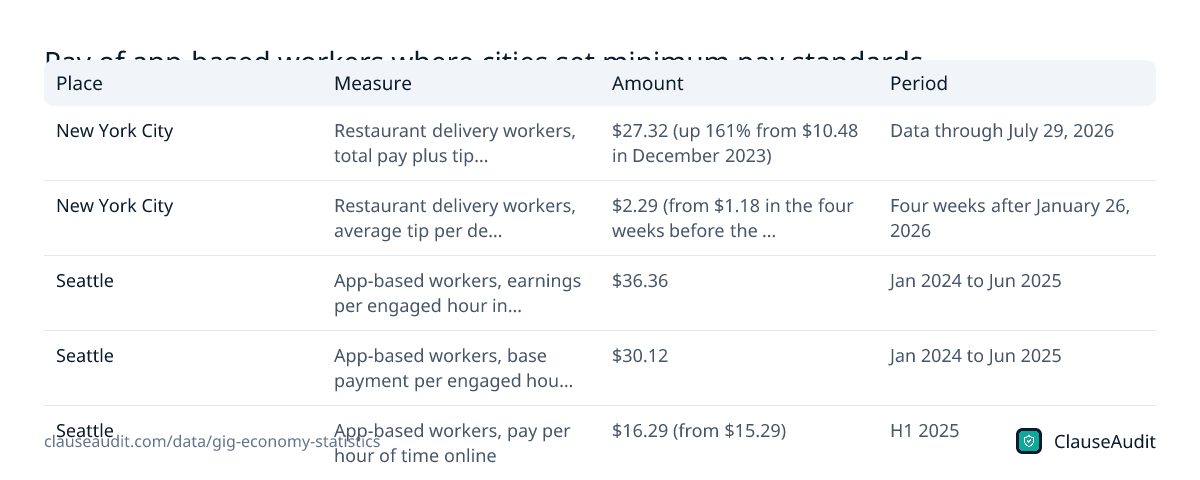
- $27.32 average total hourly earnings, pay plus tips, of NYC app-based restaurant delivery workers in data through July 2026, up 161% from $10.48 in December 2023. (NYC Department of Consumer and Worker Protection, Delivery App Report: new DCWP laws and delivery worker tips and earnings, December 2023 to July 2026)
- $2.29 average tip per delivery for NYC app delivery workers in the four weeks after new tipping laws took effect on January 26, 2026, up from $1.18. (NYC Department of Consumer and Worker Protection, Delivery App Report: new DCWP laws and delivery worker tips and earnings, February 2026)
- $36.36 average earnings per engaged hour, including tips and bonuses, for Seattle app-based workers in the first 18 months of its minimum pay law. (City of Seattle Office of Labor Standards, App-Based Worker Research: SMC 8.37 data report (first 18 months), January 2024 to June 2025)
- $30.12 average base payment per engaged hour to Seattle app-based workers after subtracting mileage expenses, January 2024 to June 2025. (City of Seattle Office of Labor Standards, App-Based Worker Research: SMC 8.37 data report (first 18 months), January 2024 to June 2025)
- $16.29 average pay per hour of time online for Seattle app-based workers in the first half of 2025, up from $15.29 a year earlier. (City of Seattle Office of Labor Standards, App-Based Worker Research: SMC 8.37 data report (first 18 months), H1 2025)
- Around 14% of Seattle app-based workers' compensation came from tips under the minimum pay ordinance, with more than 85% coming from base payments. (City of Seattle Office of Labor Standards, App-Based Worker Research: SMC 8.37 data report (first 18 months), January 2024 to June 2025)
- Almost 6M American independent workers now earn more than $100,000 a year, according to MBO Partners' 2026 State of Independence research. (MBO Partners, State of Independence 2026, 2026)
- 61 percent of U.S. adults doing short-term tasks through an app or website wished their gig pay was more consistent, versus nearly half of all gig workers. (Board of Governors of the Federal Reserve System, Economic Well-Being of U.S. Households in 2024 (Employment and Gig Work), October 2024)
- 12.0% lower average hourly earnings for Brazil's platform workers (R$16.2) than other private-sector workers (R$18.4) in 2025, despite similar monthly pay. (Instituto Brasileiro de Geografia e Estatística (IBGE), Trabalho por meio de plataformas digitais 2025 (PNAD Contínua thematic module), Q3 2025)
- 68 percent of men's wages is what women earned on one major online gig platform reviewed by the World Bank in its 2023 report. (World Bank, Demand for Online Gig Work Rapidly Rising in Developing Countries (press release), 2023)
- 120 percent of the applicable minimum wage for engaged time is the earnings floor California's Proposition 22 (2020) guarantees app-based drivers, plus per-mile expense pay. (California Secretary of State, Proposition 22, Text of Proposed Laws (Official Voter Information Guide, November 3, 2020), Law approved November 2020)
- $45.4 billion in 2024 receipts went to 1,578,508 U.S. taxi and limousine sole proprietorships, an industry that includes ride-hail drivers; the gig share is unknown. (U.S. Census Bureau, The Gig Picture: 2024 Nonemployer Statistics Provide Insight Into the Gig Economy, 2024)
- ₹17,914 was the average monthly earnings of self-employed men in India in 2025, up about 6.0% from ₹16,893 in 2024. (National Statistics Office, Ministry of Statistics and Programme Implementation (India), Press Note on Periodic Labour Force Survey (PLFS) Annual Report, 2025, 2025)
| Place | Measure | Amount | Period |
|---|---|---|---|
| New York City | Restaurant delivery workers, total pay plus tips per hour | $27.32 (up 161% from $10.48 in December 2023) | Data through July 29, 2026 |
| New York City | Restaurant delivery workers, average tip per delivery | $2.29 (from $1.18 in the four weeks before the January 26, 2026 tipping law) | Four weeks after January 26, 2026 |
| Seattle | App-based workers, earnings per engaged hour incl. tips and bonuses | $36.36 | Jan 2024 to Jun 2025 |
| Seattle | App-based workers, base payment per engaged hour after mileage expenses | $30.12 | Jan 2024 to Jun 2025 |
| Seattle | App-based workers, pay per hour of time online | $16.29 (from $15.29) | H1 2025 |
Gig Worker Demographics: Age, Gender, Race and Education
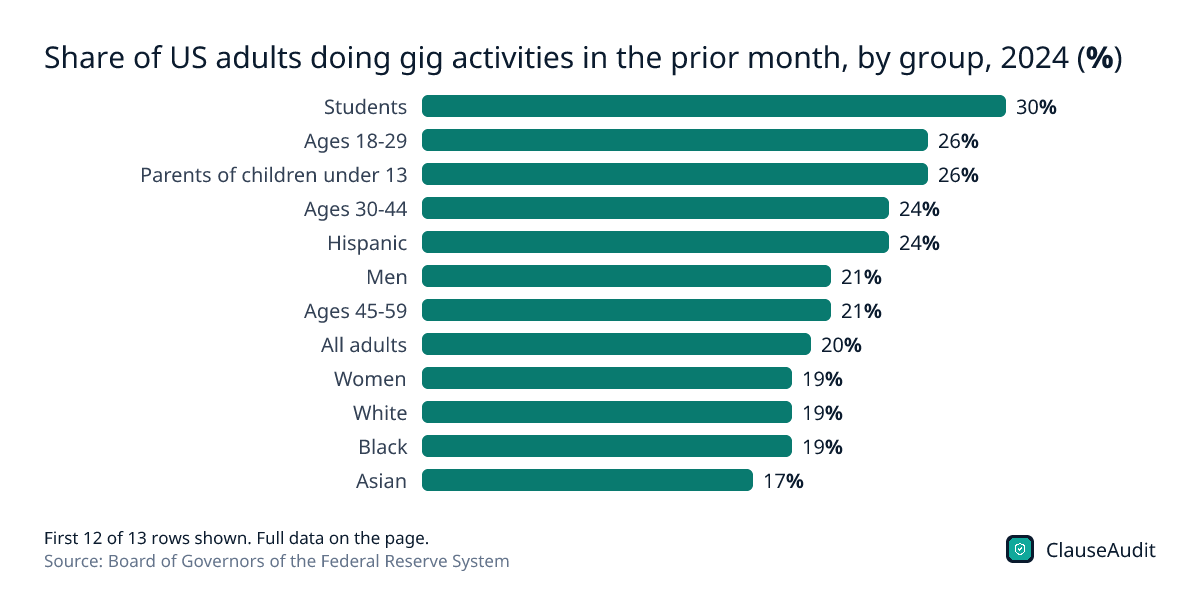
Gig activity is most common among younger adults, students and parents of young children. Independent contractors on their main job skew older, with 36% age 55 or over.
- 26% of U.S. adults ages 18 to 29 did gig activities in the prior month, compared with 12% of adults age 60 and older. (Board of Governors of the Federal Reserve System, Economic Well-Being of U.S. Households in 2024 (Employment and Gig Work), October 2024)
- 24% of Hispanic adults did gig activities in the prior month, above the 19% rate for White and Black adults and 17% for Asian adults. (Board of Governors of the Federal Reserve System, Economic Well-Being of U.S. Households in 2024 (Employment and Gig Work), October 2024)
- 30% of students did gig work in the prior month, as did 26% of parents of children under 13, against 20% of all adults. (Board of Governors of the Federal Reserve System, Economic Well-Being of U.S. Households in 2024 (Employment and Gig Work), October 2024)
- 21% of people who did gig activities said gigs were their main job, so most gig work is a side income rather than a career. (Board of Governors of the Federal Reserve System, Economic Well-Being of U.S. Households in 2024 (Employment and Gig Work), October 2024)
- 96% of people doing gig activities usually spent less than 35 hours a week on them, and 70% spent less than 5 hours. (Board of Governors of the Federal Reserve System, Economic Well-Being of U.S. Households in 2024 (Employment and Gig Work), October 2024)
- 36% of U.S. independent contractors were age 55 or older in July 2023, versus 22% of workers in traditional arrangements. (U.S. Bureau of Labor Statistics, Contingent and Alternative Employment Arrangements, July 2023, July 2023)
- 8.7% of employed men were independent contractors in July 2023, compared with 5.8% of employed women. (U.S. Bureau of Labor Statistics, Contingent and Alternative Employment Arrangements, July 2023, July 2023)
- 30% of U.S. adults ages 18 to 29 said in 2021 they had ever earned money through an online gig platform, versus 16% of all adults. (Pew Research Center, The State of Gig Work in 2021, August 2021)
- 42.3% of U.S. nonemployer businesses (12.9 million of 30.4 million) were owned by women in 2023, with $423.1 billion in receipts. (U.S. Census Bureau, Census Bureau releases new data on business owner characteristics (2023 Nonemployer Statistics by Demographics), 2023)
- 17.5% of U.S. nonemployer businesses (5.3 million) were Hispanic-owned in 2023, with $244.2 billion in receipts. (U.S. Census Bureau, Census Bureau releases new data on business owner characteristics (2023 Nonemployer Statistics by Demographics), 2023)
- 44% of U.S. transportation and delivery platform gig workers were women by 2021, as the platform workforce became younger and more female during COVID. (Internal Revenue Service, Statistics of Income, The Evolution of Platform Gig Work, 2012-2024 (Garin, Jackson, Koustas and Miller), IRS SOI working paper, 2021)
- 38% of Americans over age 65 who are in the workforce work independently, according to MBO Partners' 2024 survey. (MBO Partners, State of Independence 2024, 2024)
- 28.1% of U.S. workers in arts, design, entertainment, sports and media occupations were independent contractors in July 2023, versus 7.4% overall. (U.S. Bureau of Labor Statistics, Table 6. Employed workers with alternative and traditional work arrangements by occupation and industry, July 2023, July 2023)
- 30% of self-employed U.S. adults worked entirely from home in 2025, including 22% of business owners with paid employees. (Board of Governors of the Federal Reserve System, Economic Well-Being of U.S. Households in 2025: Employment and Job Quality, 2025)
Figure 7: Share of US adults doing gig activities in the prior month, by group, 2024 (%)
Chart data
| Label | Value |
|---|---|
| Students | 30% |
| Ages 18-29 | 26% |
| Parents of children under 13 | 26% |
| Ages 30-44 | 24% |
| Hispanic | 24% |
| Men | 21% |
| Ages 45-59 | 21% |
| All adults | 20% |
| Women | 19% |
| White | 19% |
| Black | 19% |
| Asian | 17% |
| Ages 60+ | 12% |
Why People Do Gig Work: Motivations, Satisfaction and Financial Need
Flexibility is the most cited reason for gig work, but many also rely on the income. Survey results below show both sides.
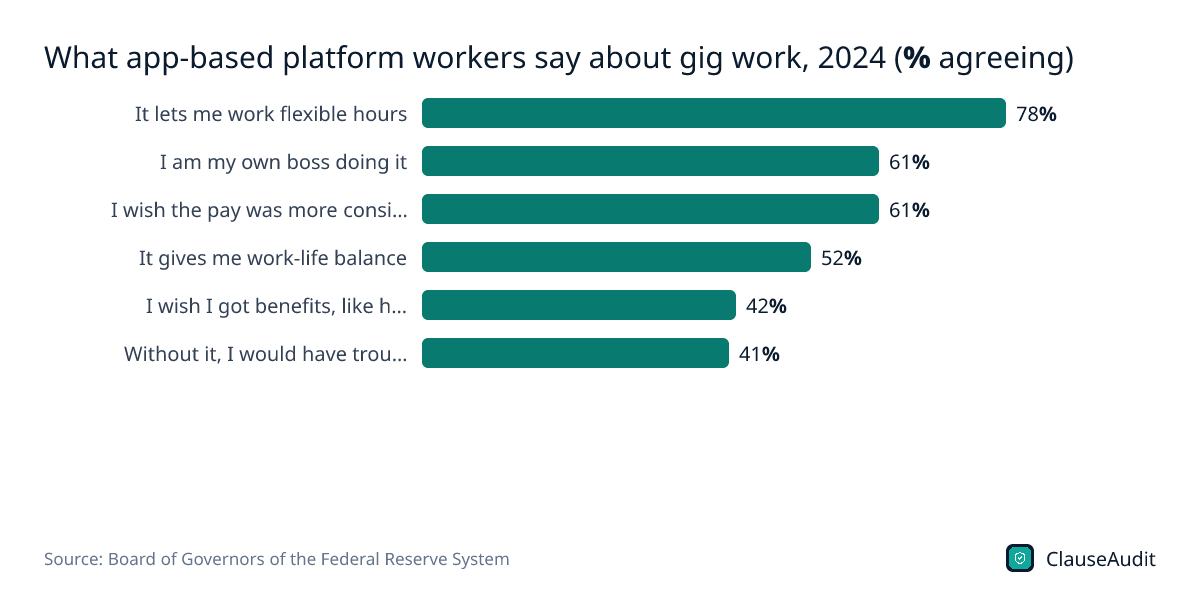
- 61% of U.S. adults doing gig activities agreed with the statement "I am my own boss doing it" in the Federal Reserve 2024 survey. (Board of Governors of the Federal Reserve System, Economic Well-Being of U.S. Households in 2024: Employment and Gig Work, October 2024)
- 78% of adults doing app-based platform tasks said gig work lets them work flexible hours, versus 55% of all gig workers. (Board of Governors of the Federal Reserve System, Economic Well-Being of U.S. Households in 2024: Employment and Gig Work, October 2024)
- 31% of people doing gig activities said they would have trouble making ends meet without that income, rising to 41% for platform tasks. (Board of Governors of the Federal Reserve System, Economic Well-Being of U.S. Households in 2024: Employment and Gig Work, October 2024)
- 61% of app-based platform task workers wished their gig pay was more consistent, versus 49% of all gig workers. (Board of Governors of the Federal Reserve System, Economic Well-Being of U.S. Households in 2024: Employment and Gig Work, October 2024)
- 64% of gig workers said they were doing their preferred type of work, compared with 71% of traditional workers (Gallup, 2018). (Gallup, What Workplace Leaders Can Learn From the Real Gig Economy, 2018)
- 80.3% of U.S. independent contractors preferred their work arrangement to a traditional job in July 2023. (U.S. Bureau of Labor Statistics, Contingent and Alternative Employment Arrangements, July 2023, July 2023)
- 44.8% of contingent workers would have preferred a permanent job in July 2023, while 40.8% preferred their contingent arrangement. (U.S. Bureau of Labor Statistics, Contingent and Alternative Employment Arrangements, July 2023, July 2023)
- 61% of independents said working independently was entirely their choice in 2024; only 10% said it was forced by factors beyond their control. (MBO Partners, State of Independence 2024, 2024)
- 84% of full-time independents said they are happier working on their own than in a traditional job. (MBO Partners, State of Independence 2024, 2024)
- 78% of independents plan to stay independent or build larger businesses, and 61% say schedule flexibility is very important. (MBO Partners, State of Independence 2026, 2026)
- 56% of current or recent online gig platform workers said saving extra money was a major reason for the work (Pew, 2021). (Pew Research Center, The State of Gig Work in 2021, 2021)
- 58% of recent gig platform workers called the income essential (23%) or important (35%) for meeting basic needs (Pew, 2021). (Pew Research Center, The State of Gig Work in 2021, 2021)
- 77% of independent workers reported being very satisfied with independent work in 2023. (MBO Partners, State of Independence 2023, 2023)
- 41.6% of U.S. on-call workers would have preferred a different work arrangement in July 2023, versus 8.3% of independent contractors. (U.S. Bureau of Labor Statistics, Table 9. Preference for arrangement by contingent status and alternative work arrangement, July 2023, July 2023)
Figure 8: What app-based platform workers say about gig work, 2024 (% agreeing)
Chart data
| Label | Value |
|---|---|
| It lets me work flexible hours | 78% |
| I am my own boss doing it | 61% |
| I wish the pay was more consistent | 61% |
| It gives me work-life balance | 52% |
| I wish I got benefits, like health insurance | 42% |
| Without it, I would have trouble making ends meet | 41% |
Gig Worker Benefits, Health Insurance and Retirement Statistics
Gig workers usually arrange their own health insurance, retirement savings and taxes. Federal Reserve and BLS data show where they trail workers in traditional jobs.
- 74.2 percent of independent contractors had health insurance from any source in July 2023, versus 84.9 percent of workers in traditional arrangements. (U.S. Bureau of Labor Statistics, Contingent and Alternative Employment Arrangements, July 2023, July 2023)
- 19.9 percent of workers in contingent jobs had employer-provided health insurance in July 2023, compared with 51.2 percent of workers in noncontingent jobs. (U.S. Bureau of Labor Statistics, Contingent and Alternative Employment Arrangements, July 2023, July 2023)
- 88 percent of U.S. gig workers had health insurance in late 2024, below the 92 percent of adults who did no gig activities. (Board of Governors of the Federal Reserve System, Economic Well-Being of U.S. Households in 2024 (Employment and Gig Work), October 2024)
- 53 percent of gig workers had health insurance through an employer, from another job or a spouse's job; 51 percent had a non-gig main job. (Board of Governors of the Federal Reserve System, Economic Well-Being of U.S. Households in 2024 (Employment and Gig Work), October 2024)
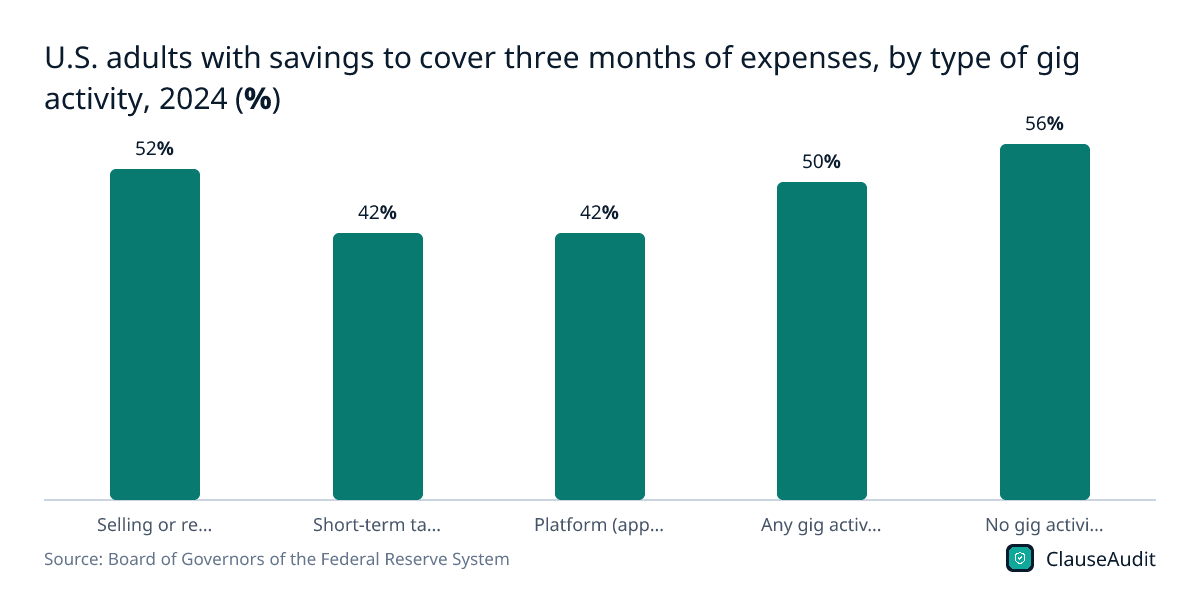
- 50 percent of gig workers had savings to cover three months of expenses in 2024, versus 56 percent of non-gig adults and 42 percent of platform workers. (Board of Governors of the Federal Reserve System, Economic Well-Being of U.S. Households in 2024 (Employment and Gig Work), October 2024)
- 28 percent of U.S. gig workers wished they had health insurance in late 2024, rising to 42 percent among those doing short-term tasks via an app. (Board of Governors of the Federal Reserve System, Economic Well-Being of U.S. Households in 2024 (Employment and Gig Work), October 2024)
- 62.4% of digital platform workers in 17 European countries were not covered for unemployment in 2022, and 56.3% lacked sickness coverage. (Eurostat (European Commission), Experimental statistics on digital platform employment, 2022)
- 25.5% of Brazil's platform car drivers contributed to a social security institute in 2025, versus 59.2% of drivers not working through apps. (Instituto Brasileiro de Geografia e Estatística (IBGE), Trabalho por meio de plataformas digitais 2025 (PNAD Contínua thematic module), Q3 2025)
- 29.4 percentage points higher informality rate among Brazil's app-based workers than among other private-sector workers in 2025. (Instituto Brasileiro de Geografia e Estatística (IBGE), Trabalho por meio de plataformas digitais 2025 (PNAD Contínua thematic module), Q3 2025)
- 100 percent of the average ACA contribution is owed quarterly to California app drivers averaging 25+ engaged hours weekly under Proposition 22 (2020); 15 to 25 hours earns 50 percent. (California Secretary of State, Proposition 22, Text of Proposed Laws (Official Voter Information Guide, November 3, 2020), Law approved November 2020)
- 15.3% self-employment tax rate gig workers pay on net earnings, combining 12.4% for Social Security and 2.9% for Medicare. (Internal Revenue Service, Self-employment tax (Social Security and Medicare taxes), Current IRS rule)
- $7,500 is the 2026 annual IRA contribution limit, up from $7,000, for gig workers saving for retirement without a workplace plan. (Internal Revenue Service, 401(k) limit increases to $24,500 for 2026, IRA limit increases to $7,500 (IR-2025-111), 2026)
- 58% of self-employed U.S. adults said their income varied from month to month in 2025, compared with 28% of people working for someone else. (Board of Governors of the Federal Reserve System, Economic Well-Being of U.S. Households in 2025: Income and Expenses, 2025)
Figure 9: U.S. adults with savings to cover three months of expenses, by type of gig activity, 2024 (%)
Chart data
| Label | Value (%) |
|---|---|
| Selling or renting | 52% |
| Short-term tasks | 42% |
| Platform (app) tasks | 42% |
| Any gig activity | 50% |
| No gig activity | 56% |
Freelance Contract and Late Payment Statistics: Nonpayment, Disputes and Protections
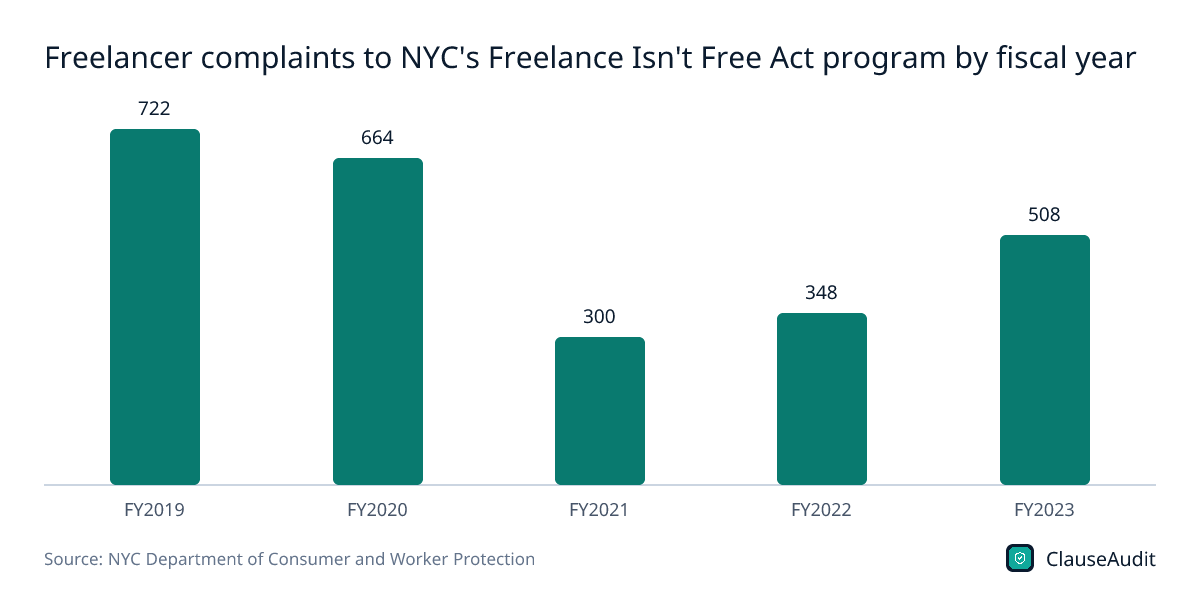
New York City publishes detailed data on freelancer complaints, and most allege late or missing payment. New York City, New York State and Illinois now require written contracts for freelance work above set dollar amounts.
- 2,542 freelancer complaints reached NYC's Freelance Isn't Free Act Navigation Program from fiscal 2019 through 2023. (NYC Department of Consumer and Worker Protection, 5-Year Report on NYC's Freelance Isn't Free Act, FY2019-FY2023)
- 2,184 of those NYC complaints alleged unlawful payment practices such as late payment or nonpayment, far more than retaliation (212) claims. (NYC Department of Consumer and Worker Protection, 5-Year Report on NYC's Freelance Isn't Free Act, FY2019-FY2023)
- 264 NYC freelancer complaints alleged that the hiring party failed to provide a legally required written contract. (NYC Department of Consumer and Worker Protection, 5-Year Report on NYC's Freelance Isn't Free Act, FY2019-FY2023)
- $2.9 million in owed pay was recovered by at least 773 NYC freelancers after complaining to the city, a figure DCWP says is likely undercounted. (NYC Department of Consumer and Worker Protection, 5-Year Report on NYC's Freelance Isn't Free Act, FY2019-FY2023)
- 49% of NYC freelancers who answered DCWP's follow-up survey were not paid anything after complaining; 40% were paid in full and 9% partially. (NYC Department of Consumer and Worker Protection, 5-Year Report on NYC's Freelance Isn't Free Act, FY2019-FY2023)
- More than $275,000 double the amount owed, must be paid by L'Officiel USA to 41 freelancers after NYC's first-of-its-kind Freelance Isn't Free lawsuit settled in 2023. (NYC Department of Consumer and Worker Protection, 5-Year Report on NYC's Freelance Isn't Free Act, 2023)
- $800 or more in freelance work, alone or combined over 120 days, requires a written contract under New York City's Freelance Isn't Free Act. (NYC Department of Consumer and Worker Protection, Freelance Workers: Know Your Rights, 2026)
- $500 in freelance work over a 120-day period triggers Illinois's written contract requirement under the Freelance Worker Protection Act, for contracts taking effect after July 1, 2024. (Illinois Department of Labor, Freelance Worker Protection Act, 2024)
- August 28, 2024 is when New York's statewide Freelance Isn't Free Act took effect, extending NYC-style contract and payment rights across the state. (New York State Department of Labor, Freelance Isn't Free Act, 2024)
- $328 million in back pay was recovered from Uber ($290 million) and Lyft ($38 million) for New York drivers in a 2023 settlement with the state attorney general. (New York State Office of the Attorney General, Attorney General James Secures $328 Million from Uber and Lyft for Taking Earnings from Drivers, November 2023)
- $26 per hour is the minimum Uber and Lyft drivers outside New York City must receive under the 2023 settlement, adjusted annually for inflation. (New York State Office of the Attorney General, Attorney General James Secures $328 Million from Uber and Lyft for Taking Earnings from Drivers, November 2023)
- $61.7 million was paid by Amazon in 2021 to settle FTC charges that it withheld customer tips from Amazon Flex drivers over about two and a half years. (Federal Trade Commission, Amazon To Pay $61.7 Million to Settle FTC Charges It Withheld Some Customer Tips from Amazon Flex Drivers, February 2021)
- 751 of 829 Freelance Isn't Free complaints filed with New York City in 2025 alleged unlawful payment practices such as late or missing pay. (NYC Department of Consumer and Worker Protection, Worker Protection Data 2025, 2025)
- $800 is the threshold for New York State freelance protections, counting one contract or all contracts with the same client over the prior 120 days. (New York State Senate, New York General Business Law Section 1410 (Definitions), Current law)
- Six years is the minimum time New York hiring parties must keep a freelancer's written contract under the state Freelance Isn't Free Act. (New York State Senate, New York General Business Law Section 1412 (Written contracts), Current law)
Figure 10: Freelancer complaints to NYC's Freelance Isn't Free Act program by fiscal year
Chart data
| Label | Value |
|---|---|
| FY2019 | 722 |
| FY2020 | 664 |
| FY2021 | 300 |
| FY2022 | 348 |
| FY2023 | 508 |
Gig Worker Classification, Regulation and Minimum Pay Statistics
Who counts as an employee is still being decided in courts, legislatures and agencies. Cities and states have also set minimum pay rates for app-based work.
- 5.5 million people working through EU digital labour platforms were estimated in 2021 to be wrongly classified as self-employed, the European Commission said. (European Commission, Commission proposals to improve the working conditions of people working through digital labour platforms, 2021)
- 554 Members of the European Parliament voted for the Platform Work Directive in April 2024, against 56 votes and 24 abstentions. (European Parliament, Parliament adopts platform work directive, April 2024)
- 2 years is the period EU member states were given to write the Platform Work Directive into their national legislation. (European Parliament, Parliament adopts platform work directive, 2024 to 2026)
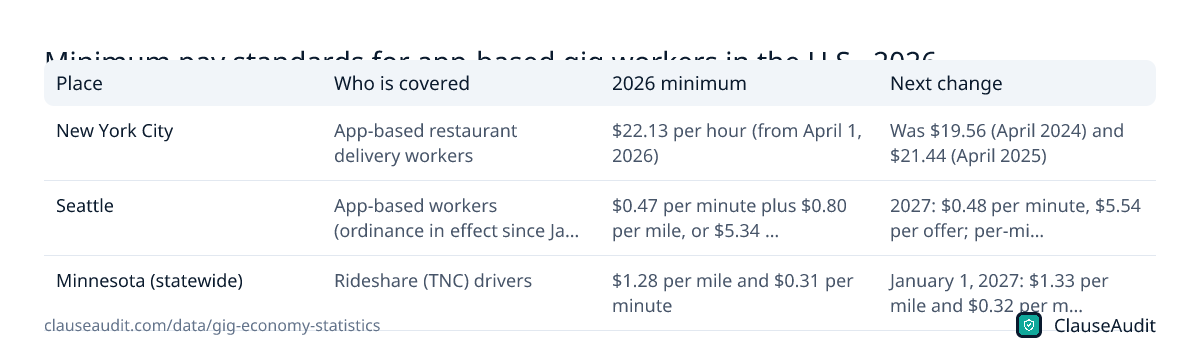
- $22.13 per hour is New York City's minimum pay rate for app-based restaurant delivery workers from the first pay period on or after April 1, 2026. (NYC Department of Consumer and Worker Protection, Minimum Pay Rate for App-Based Delivery Workers, April 2026)
- $19.56 per hour was NYC's delivery worker minimum in April 2024, rising to $21.44 in 2025 and $22.13 in 2026. (NYC Department of Consumer and Worker Protection, Minimum Pay Rate for App-Based Delivery Workers, 2024 to 2026)
- $0.47 per minute, together with $0.80 per mile and a $5.34 per-offer minimum, are Seattle's 2026 app-based worker minimum pay amounts. (City of Seattle Office of Labor Standards, App-Based Worker Minimum Payment Ordinance, 2026)
- $1.33 per mile and $0.32 per minute will be Minnesota's statewide rideshare driver minimum from January 1, 2027, up from $1.28 and $0.31. (Minnesota Department of Labor and Industry, Inflation adjustment: Minnesota TNC minimum compensation effective Jan. 1, 2027, January 2027)
- March 11, 2024 is when the U.S. Labor Department's 2024 independent contractor rule took effect; a new proposed rule was announced on February 26, 2026. (U.S. Department of Labor, Wage and Hour Division, Independent Contractor Status under the FLSA: Rulemaking, 2024 to 2026)
- $20,000 in payments over more than 200 transactions is the threshold at which payment apps and marketplaces must issue a Form 1099-K. (Internal Revenue Service, Understanding your Form 1099-K, Page reviewed June 2026)
- $400 in net self-employment earnings from gig work triggers a federal tax filing requirement, even for side or temporary work. (Internal Revenue Service, Manage taxes for your gig work, 2026)
- January 1, 2020 is when California's AB 5 took effect, presuming workers are employees unless the hiring entity passes all three parts of the ABC test. (California Department of Industrial Relations, Labor Commissioner, Independent contractor versus employee (FAQ), 2020)
- December 16, 2020 is when Proposition 22 began treating qualifying California app-based drivers as independent contractors rather than employees. (California Department of Industrial Relations, Labor Commissioner, Independent contractor versus employee (FAQ), 2020)
- $2,000 is the Form 1099-NEC reporting threshold for nonemployee compensation for tax years beginning after 2025, and it may be inflation-adjusted from 2027. (Internal Revenue Service, Instructions for Forms 1099-MISC and 1099-NEC, Tax years after 2025)
- Five lawsuits challenged the Labor Department's 2024 independent contractor rule, which the department proposed replacing in February 2026. (U.S. Department of Labor, Federal Register via GovInfo, Employee or Independent Contractor Status Under the Fair Labor Standards Act (proposed rule), As of February 2026)
| Place | Who is covered | 2026 minimum | Next change |
|---|---|---|---|
| New York City | App-based restaurant delivery workers | $22.13 per hour (from April 1, 2026) | Was $19.56 (April 2024) and $21.44 (April 2025) |
| Seattle | App-based workers (ordinance in effect since January 13, 2024) | $0.47 per minute plus $0.80 per mile, or $5.34 per offer | 2027: $0.48 per minute, $5.54 per offer; per-mile amount not yet set |
| Minnesota (statewide) | Rideshare (TNC) drivers | $1.28 per mile and $0.31 per minute | January 1, 2027: $1.33 per mile and $0.32 per minute |
AI and the Future of the Gig Economy: Demand Shifts and Projections
Research since ChatGPT's launch finds fewer job posts for writing and image work and more demand for machine learning work, and Upwork reports fast growth in AI consulting. Figures come from academic studies, platform data, international agencies and surveys.
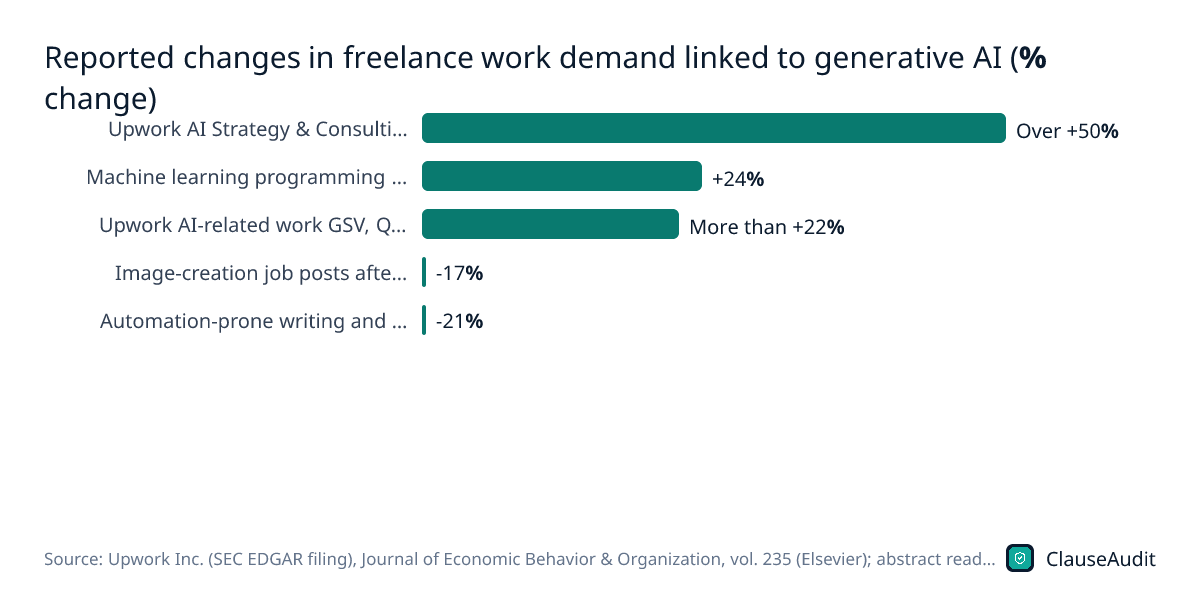
- 20–50% drop in freelance demand for AI-substitutable skills such as writing and translation after ChatGPT's launch, relative to trend, in a 2025 peer-reviewed study. (Journal of Economic Behavior & Organization, vol. 235 (Elsevier); abstract read via OpenAlex record, Winners and losers of generative AI: Early Evidence of Shifts in Freelancer Demand (Teutloff, Einsiedler, Kässi, Braesemann, Mishkin, del Rio-Chanona), abstract, Post-ChatGPT (study published 2025))
- 24% growth in freelance demand for machine learning programming after ChatGPT's launch, while AI-powered chatbot development nearly tripled. (Journal of Economic Behavior & Organization, vol. 235 (Elsevier); abstract read via OpenAlex record, Winners and losers of generative AI: Early Evidence of Shifts in Freelancer Demand (Teutloff, Einsiedler, Kässi, Braesemann, Mishkin, del Rio-Chanona), abstract, Post-ChatGPT (study published 2025))
- 21% decrease in job posts for automation-prone writing and coding work on a global freelancing platform after ChatGPT, per a 2025 Management Science study. (Management Science, vol. 71, no. 10 (INFORMS); abstract read via Crossref record, Who Is AI Replacing? The Impact of Generative AI on Online Freelancing Platforms (Demirci, Hannane, Zhu), abstract, Post-ChatGPT (study published 2025))
- 17% decrease in image-creation job posts on a freelancing platform after image-generating AI tools were introduced. (Management Science, vol. 71, no. 10 (INFORMS); abstract read via Crossref record, Who Is AI Replacing? The Impact of Generative AI on Online Freelancing Platforms (Demirci, Hannane, Zhu), abstract, Post-launch of image AI (study published 2025))
- More than 22% year-over-year growth in Upwork gross services volume from AI-related work in Q2 2026, even as total GSV fell 4%. (Upwork Inc. (SEC EDGAR filing), Upwork second quarter 2026 financial results (press release, Exhibit 99.1 to Form 8-K), Q2 2026)
- Over 50% year-over-year GSV growth in Upwork's AI Strategy & Consulting work category in Q2 2026. (Upwork Inc. (SEC EDGAR filing), Upwork second quarter 2026 financial results (press release, Exhibit 99.1 to Form 8-K), Q2 2026)
- 54% of enterprises expect AI to increase their use of independent talent over the next two years, according to MBO Partners' 2026 research. (MBO Partners, State of Independence 2026, 2026)
- One in four workers worldwide are in an occupation with some generative AI exposure, according to the ILO's 2025 refined global index. (International Labour Organization, Generative AI and Jobs: A Refined Global Index of Occupational Exposure, 2025)
- 3.3% of global employment falls into the highest generative AI exposure category, 4.7% of female employment versus 2.4% of male employment. (International Labour Organization, Generative AI and Jobs: A Refined Global Index of Occupational Exposure, 2025)
- 34% of total employment in high-income countries has generative AI exposure, compared with 11% in low-income countries (ILO, 2025). (International Labour Organization, Generative AI and Jobs: A Refined Global Index of Occupational Exposure, 2025)
- Almost 40 percent of global employment is exposed to AI, rising to about 60 percent of jobs in advanced economies, by the IMF's January 2024 estimate. (International Monetary Fund, AI Will Transform the Global Economy. Let's Make Sure It Benefits Humanity (IMF Blog), January 2024)
- 52% of U.S. workers say they are worried about AI's future impact in the workplace, and 32% expect fewer job opportunities for themselves. (Pew Research Center, U.S. Workers Are More Worried Than Hopeful About Future AI Use in the Workplace, October 2024)
- 2% fewer new monthly contracts went to freelancers in exposed work such as copyediting after ChatGPT's launch, with earnings down about 5%, Brookings researchers report. (Brookings Institution (Xiang Hui and Oren Reshef), Is generative AI a job killer? Evidence from the freelance market, 2022-2023 data (2025 article))
- Nearly 10 hours a week is the average time savings reported by independent professionals who use generative AI, according to MBO Partners' 2026 survey. (MBO Partners, Independent Workforce Reaches 74.9 Million (2026 State of Independence press release), 2026)
Figure 12: Reported changes in freelance work demand linked to generative AI (% change)
Chart data
| Label | Value |
|---|---|
| Upwork AI Strategy & Consulting GSV, Q2 2026 (YoY) | Over +50% |
| Machine learning programming demand after ChatGPT | +24% |
| Upwork AI-related work GSV, Q2 2026 (YoY) | More than +22% |
| Image-creation job posts after image AI | -17% |
| Automation-prone writing and coding job posts after ChatGPT | -21% |
What the numbers mean for gig workers
For most people, gig work is extra income rather than a career. In the Federal Reserve's October 2024 survey, only 21% of people doing gig activities called it their main job, and 70% spent less than 5 hours a week on it. That income still matters: 31% said they would have trouble making ends meet without it, rising to 41% for app-based platform tasks.
Those who contract full time earn less and carry more costs. Full-time independent contractors earned a median $949 a week in July 2023, against $1,132 for workers in traditional jobs. Self-employed workers also pay the 15.3% self-employment tax, and 74.2% of independent contractors had health insurance from any source, compared with 84.9% of traditional workers. Half of gig workers had savings to cover three months of expenses in 2024, against 56% of adults with no gig work.
Satisfaction is high anyway. 80.3% of independent contractors preferred their arrangement to a traditional job, and 78% of platform task workers said gig work let them set flexible hours. The trade is flexibility for less predictable pay: 61% of platform workers wished their pay was more consistent.
Pay rose under pay floors, but payment disputes remain
Where cities set minimum pay, earnings rose. New York City's app-based restaurant delivery workers averaged $27.32 an hour with tips in data through July 2026, up 161% from $10.48 in December 2023, and the city's minimum reached $22.13 an hour in April 2026. Seattle workers averaged $36.36 per engaged hour from January 2024 to June 2025, though only $16.29 per hour of time online in the first half of 2025.
Payment disputes are a separate problem. Of 829 complaints filed under New York City's Freelance Isn't Free Act in 2025, 751 alleged late or missing payment. From fiscal 2019 to 2023, 264 complaints said the client failed to provide a required written contract, and 49% of complainants who answered a city follow-up survey were never paid anything.
What to do with this data
- Get the work in writing. New York City and New York State require a written contract for freelance work of $800 or more, and Illinois sets the line at $500 over 120 days.
- Put a payment date and late terms in the contract, so a missed payment is a clear breach rather than a disagreement.
- Price in taxes and benefits. A rate that matches an employee's pay falls short once the 15.3% self-employment tax, insurance and retirement saving come out; the 2026 IRA limit is $7,500.
- Know your tax thresholds. You must file once net self-employment earnings reach $400, and clients report nonemployee pay on Form 1099-NEC at $2,000 for tax years beginning after 2025.
- Businesses that hire gig workers should check classification. California's AB 5 has applied the ABC test since January 1, 2020, and the Labor Department proposed a new contractor rule on February 26, 2026.
- Keep your records. New York hiring parties must keep a freelancer's written contract for six years, and your own copy is your evidence in a dispute.
Check your gig or freelance contract before you sign
The data on this page points to the same weak spots: no written contract, vague payment terms, and classification language that shifts costs onto the worker. An automated review of your agreement flags those clauses and explains them in plain English, so you know what to ask the client or platform to change.
- Payment amount, due date and late fees, and whether pay depends on subjective approval
- Deposit, milestone payments and a kill fee if the job is cancelled
- Independent contractor language, control over your schedule and who covers expenses
- Who owns the work, including drafts and your pre-existing tools
- Non-solicitation or non-compete terms that limit other clients or platforms
- Termination, deactivation, liability and how disputes are resolved
Frequently asked questions
How many gig workers are there in the US?
It depends on the definition. BLS counted 11.9 million independent contractors on their main job in July 2023, the Federal Reserve found 20% of adults earned gig income in the month before its October 2024 survey, and MBO Partners counted 74.9 million Americans with independent income in 2026.
Is the gig economy growing?
Growth has slowed since the post-pandemic surge. MBO Partners counted 72.7 million independent workers in 2024, only slightly above 72.1 million in 2023, though full-time independents rose 6.5% to 27.7 million. The figure reached a record 74.9 million in 2026.
How much do gig workers make?
Full-time independent contractors earned a median $949 a week in July 2023, versus $1,132 for traditional workers. App-based restaurant delivery workers in New York City averaged $27.32 an hour with tips in data through July 2026.
Do gig workers have health insurance?
Most do, but less often than other workers. 88% of gig workers had health insurance in late 2024, against 92% of adults who did no gig work, and 28% wished they had coverage, rising to 42% for app-based short-term tasks.
How often do freelancers and gig workers go unpaid?
In New York City, 751 of 829 Freelance Isn't Free complaints filed in 2025 alleged late or missing payment. Among complainants who answered a city survey covering fiscal 2019 to 2023, 49% were never paid anything after complaining.
How big is the gig economy worldwide?
The World Bank estimated in 2023 that 154 million to 435 million people do online gig work, 4.4% to 12.5% of the global labor force. The ILO identified at least 653 active digital labour platforms as of October 2025.
How many gig workers are there in India?
NITI Aayog estimated 7.7 million gig workers in India in 2020-21 and projects 23.5 million by 2029-30. By August 2026, 11.5 lakh platform workers had registered on the e-Shram portal.
Use this data
Every chart and card below is free to reuse under CC BY 4.0. Download what you need and link back to this page.
 Stat cards
 Key findings card
 Infographic
 How many gig workers are in the US? Estimates by definition (millions)
 India's gig workforce, NITI Aayog estimates and projection, FY2019-20 to FY2029-30 (millions)
 Share of US adults doing gig activities in the prior month, by group, 2024 (%)
 Freelancer complaints to NYC's Freelance Isn't Free Act program by fiscal year
 Full-time independent workers in the U.S., 2019 to 2024 (millions)
 Transaction volume on major gig platforms, fiscal 2025 (USD billions)
 What app-based platform workers say about gig work, 2024 (% agreeing)
 U.S. adults with savings to cover three months of expenses, by type of gig activity, 2024 (%)
 Reported changes in freelance work demand linked to generative AI (% change)
 Minimum pay standards for app-based gig workers in the U.S., 2026
 How much of the workforce does platform or gig work? Official and research estimates by country
 Pay of app-based workers where cities set minimum pay standards
Embed the infographic
Free to share on your site, blog or slides under CC BY 4.0. Please keep the credit link.
Sources and method
Every number on this page comes from the sources below, each opened and read on or before October 17, 2026. A second, independent review checked every figure against its source and corrected anything that did not match. Figures that could not be confirmed were left out.
- U.S. Bureau of Labor Statistics, Contingent and Alternative Employment Arrangements, July 2023 (November 8, 2024)
- Board of Governors of the Federal Reserve System, Economic Well-Being of U.S. Households in 2024 (Employment and Gig Work) (May 2025 (survey fielded October 2024))
- MBO Partners, State of Independence 2026 (2026)
- MBO Partners, State of Independence 2024 (2024)
- Pew Research Center, The State of Gig Work in 2021 (December 8, 2021)
- National Bureau of Economic Research, Understanding the Digital Platform Workforce in the US: Evidence from the Entrepreneurship in the Population Survey (Atkins, Brummet and Johnson) (2026 (chapter in The Changing Nature of Work))
- U.S. Government Accountability Office, Work Arrangements: Improved Collaboration Could Enhance Labor Force Data (GAO-24-105651) (December 2023)
- Internal Revenue Service, Statistics of Income, The Evolution of Platform Gig Work, 2012-2024 (Garin, Jackson, Koustas and Miller), IRS SOI working paper (June 2026 revision)
- NITI Aayog, India's Booming Gig and Platform Economy: Perspectives and Recommendations on the Future of Work (June 2022)
- Ministry of Finance, Government of India, Economic Survey 2025-26, Chapter 12: Employment and Skill Development (January 2026)
- Press Information Bureau, Government of India, 5 Years of e-Shram Portal: Building an Inclusive Social Security Ecosystem (August 25, 2026)
- Press Information Bureau, Government of India, Social Security Boost for India's Gig Workers (August 30, 2025)
- Ministry of Labour and Employment (Lok Sabha), Lok Sabha Unstarred Question No. 3658: Social Security for Online Platform Gig Workers (Answered August 11, 2025)
- PRS Legislative Research, State Legislative Brief: The Karnataka Platform based Gig Workers (Social Security and Welfare) Bill, 2025 (August 13, 2025)
- Fairwork (Oxford Internet Institute and IIIT Bangalore), Fairwork India Ratings 2024: Labour Standards in the Platform Economy (October 2024)
- NYC Department of Consumer and Worker Protection, 5-Year Report on NYC's Freelance Isn't Free Act (November 1, 2023)
- NYC Department of Consumer and Worker Protection, Freelance Workers: Know Your Rights (Accessed October 2026)
- New York State Office of the Attorney General, Attorney General James Secures $328 Million from Uber and Lyft for Taking Earnings from Drivers (November 2, 2023)
- Federal Trade Commission, Amazon To Pay $61.7 Million to Settle FTC Charges It Withheld Some Customer Tips from Amazon Flex Drivers (February 2, 2021)
- Illinois Department of Labor, Freelance Worker Protection Act (Law effective July 1, 2024)
- New York State Department of Labor, Freelance Isn't Free Act (Effective August 28, 2024)
- MBO Partners, State of Independence 2022 (2022 edition)
- MBO Partners, Independent workforce reaches 74.9 million (16th annual State of Independence study) (September 28, 2026)
- U.S. Bureau of Labor Statistics, Contingent and Alternative Employment Arrangements, May 2017 (June 7, 2018)
- U.S. Bureau of Labor Statistics, Contingent and Alternative Employment Arrangements, February 2005 (July 27, 2005)
- U.S. Census Bureau, Census Bureau releases new data on business owner characteristics (2023 Nonemployer Statistics by Demographics) (November 20, 2025)
- JPMorgan Chase Institute, The Online Platform Economy through the Pandemic (October 2021)
- Uber Technologies, Inc. (SEC filing), Uber Technologies, Inc. Form 10-K for fiscal year 2025 (February 2026)
- DoorDash, Inc. (SEC filing), DoorDash, Inc. Form 10-K for fiscal year 2025 (February 2026)
- Upwork Inc. (SEC filing), Upwork Inc. Form 10-K for fiscal year 2025 (February 13, 2026)
- Fiverr International Ltd. (SEC filing), Fiverr International Ltd. Form 20-F for fiscal year 2025 (March 12, 2026)
- Lyft, Inc. (SEC Form 8-K exhibit), Lyft Reports Record Q4 and Full-Year 2025 Results (February 10, 2026)
- Grab Holdings, Grab's ESG progress in 2025: Rising as one (April 16, 2026)
- Airbnb Newsroom, About Us (company facts) (Last updated May 2026)
- Board of Governors of the Federal Reserve System, Economic Well-Being of U.S. Households in 2024: Employment and Gig Work (May 2025 (survey fielded October 2024))
- Gallup, What Workplace Leaders Can Learn From the Real Gig Economy (August 16, 2018)
- European Parliament, Parliament adopts platform work directive (April 24, 2024)
- NYC Department of Consumer and Worker Protection, Minimum Pay Rate for App-Based Delivery Workers (Rate effective April 1, 2026)
- City of Seattle Office of Labor Standards, App-Based Worker Minimum Payment Ordinance (2026 and 2027 amounts)
- Minnesota Department of Labor and Industry, Inflation adjustment: Minnesota TNC minimum compensation effective Jan. 1, 2027 (August 27, 2026)
- U.S. Department of Labor, Wage and Hour Division, Independent Contractor Status under the FLSA: Rulemaking (Updated 2026)
- Internal Revenue Service, Understanding your Form 1099-K (Last reviewed June 28, 2026)
- Internal Revenue Service, Manage taxes for your gig work (2026)
- California Department of Industrial Relations, Labor Commissioner, Independent contractor versus employee (FAQ) (Current page)
- World Bank, Working Without Borders: The Promise and Peril of Online Gig Work (Overview) (2023)
- World Bank, Demand for Online Gig Work Rapidly Rising in Developing Countries (press release) (September 7, 2023)
- International Labour Organization, Digital labour platforms: Number of platforms and workers (Research Brief) (February 16, 2026)
- Eurostat (European Commission), Experimental statistics on digital platform employment (July 18, 2024)
- Australian Bureau of Statistics, Digital platform workers in Australia (November 13, 2023)
- Instituto Brasileiro de Geografia e Estatística (IBGE), Trabalho por meio de plataformas digitais 2025 (PNAD Contínua thematic module) (September 4, 2026)
- Ministry of Manpower, Singapore, Global Dialogue on Digital Platform Work (press release) (September 29, 2025)
- Chartered Institute of Personnel and Development (CIPD), Less than half a million people working in UK gig economy, CIPD report shows (September 8, 2023)
- NYC Department of Consumer and Worker Protection, Delivery App Report: new DCWP laws and delivery worker tips and earnings (July 2026)
- City of Seattle Office of Labor Standards, App-Based Worker Research: SMC 8.37 data report (first 18 months) (April 2026)
- California Secretary of State, Proposition 22, Text of Proposed Laws (Official Voter Information Guide, November 3, 2020) (2020 (approved November 3, 2020))
- Internal Revenue Service, Self-employment tax (Social Security and Medicare taxes) (Current page, read October 2026)
- Internal Revenue Service, 401(k) limit increases to $24,500 for 2026, IRA limit increases to $7,500 (IR-2025-111) (November 13, 2025)
- Journal of Economic Behavior & Organization, vol. 235 (Elsevier); abstract read via OpenAlex record, Winners and losers of generative AI: Early Evidence of Shifts in Freelancer Demand (Teutloff, Einsiedler, Kässi, Braesemann, Mishkin, del Rio-Chanona), abstract (2025 (online January 28, 2025))
- Management Science, vol. 71, no. 10 (INFORMS); abstract read via Crossref record, Who Is AI Replacing? The Impact of Generative AI on Online Freelancing Platforms (Demirci, Hannane, Zhu), abstract (October 2025 (online January 2025))
- Upwork Inc. (SEC EDGAR filing), Upwork second quarter 2026 financial results (press release, Exhibit 99.1 to Form 8-K) (August 10, 2026)
- International Labour Organization, Generative AI and Jobs: A Refined Global Index of Occupational Exposure (May 20, 2025)
- International Monetary Fund, AI Will Transform the Global Economy. Let's Make Sure It Benefits Humanity (IMF Blog) (January 14, 2024)
- Pew Research Center, U.S. Workers Are More Worried Than Hopeful About Future AI Use in the Workplace (February 25, 2025 (survey October 7-13, 2024))
- MBO Partners, State of Independence 2023 (2023 edition)
- U.S. Department of Labor, Federal Register via GovInfo, Employee or Independent Contractor Status Under the Fair Labor Standards Act (proposed rule) (February 27, 2026)
- MBO Partners, Independent Workforce Reaches 74.9 Million (2026 State of Independence press release) (September 28, 2026)
- International Labour Organization, Digital labour platforms: Number of platforms and workers (research brief PDF) (February 2026)
- Freelancer Technology Pty Limited, About Freelancer.com (Accessed October 2026)
- U.S. Bureau of Labor Statistics, Table 6. Employed workers with alternative and traditional work arrangements by occupation and industry, July 2023 (November 8, 2024)
- U.S. Bureau of Labor Statistics, Table 9. Preference for arrangement by contingent status and alternative work arrangement, July 2023 (November 8, 2024)
- New York State Senate, New York General Business Law Section 1410 (Definitions) (Current law)
- New York State Senate, New York General Business Law Section 1412 (Written contracts) (Current law)
- Federal Reserve Bank of St. Louis (FRED), from U.S. Bureau of Labor Statistics data, Employment Level - All Industries Self-Employed, Unincorporated (LNU02027714) (Series observation September 2026)
- Office for National Statistics (UK), LFS: Self-employed: UK: All: 000s: SA (series MGRQ) (Released September 15, 2026)
- NYC Department of Consumer and Worker Protection, Worker Protection Data 2025 (2026)
- Internal Revenue Service, Instructions for Forms 1099-MISC and 1099-NEC (2026 revision)
- Brookings Institution (Xiang Hui and Oren Reshef), Is generative AI a job killer? Evidence from the freelance market (July 8, 2025)
- National Statistics Office, Ministry of Statistics and Programme Implementation (India), Press Note on Periodic Labour Force Survey (PLFS) Annual Report, 2025 (March 2026)
- U.S. Census Bureau, The Gig Picture: 2024 Nonemployer Statistics Provide Insight Into the Gig Economy (2026)
- European Commission, Commission proposals to improve the working conditions of people working through digital labour platforms (December 9, 2021)
- Board of Governors of the Federal Reserve System, Economic Well-Being of U.S. Households in 2025: Income and Expenses (May 2026)
- Board of Governors of the Federal Reserve System, Economic Well-Being of U.S. Households in 2025: Employment and Job Quality (May 2026)
Cite this page
ClauseAudit, “Gig Economy Statistics 2026: 160+ Numbers on Gig Workers, Pay and Platforms”, updated October 17, 2026, https://clauseaudit.com/data/gig-economy-statistics. Free to reuse with a link back (CC BY 4.0).
This page summarises published data and law as checked on October 17, 2026. Figures are updated as new editions are released, and your own situation may differ. It is general information, not legal, tax or financial advice.