ABC Test States: Worker Classification Tests by State (2026)
By ClauseAudit Research · 5 sources ·
Which states use the ABC test for worker classification?
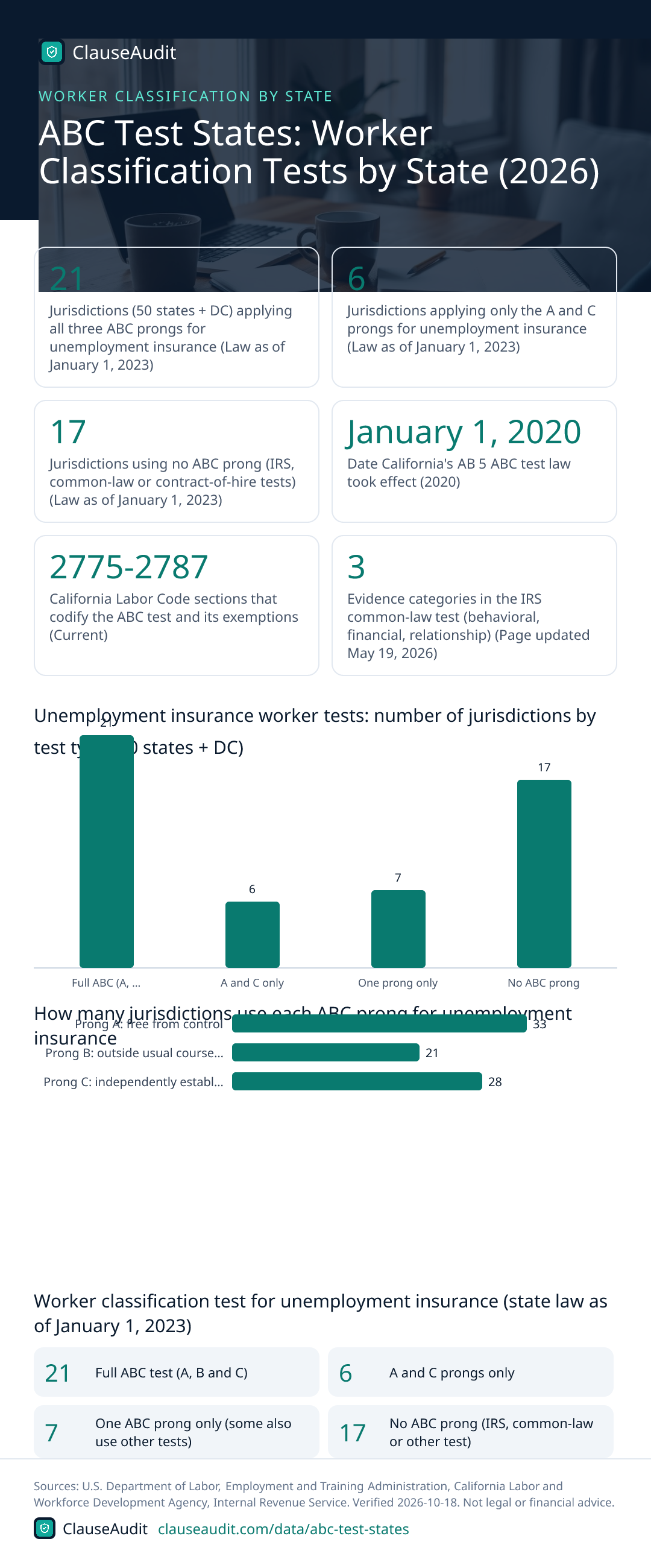
Of the 50 states and DC, 21 apply the full ABC test to decide who counts as an employee for unemployment insurance, based on state law as of January 1, 2023. Six more use only the A and C prongs, and 17 use no ABC prong at all. California also applies it to wage and hour law.

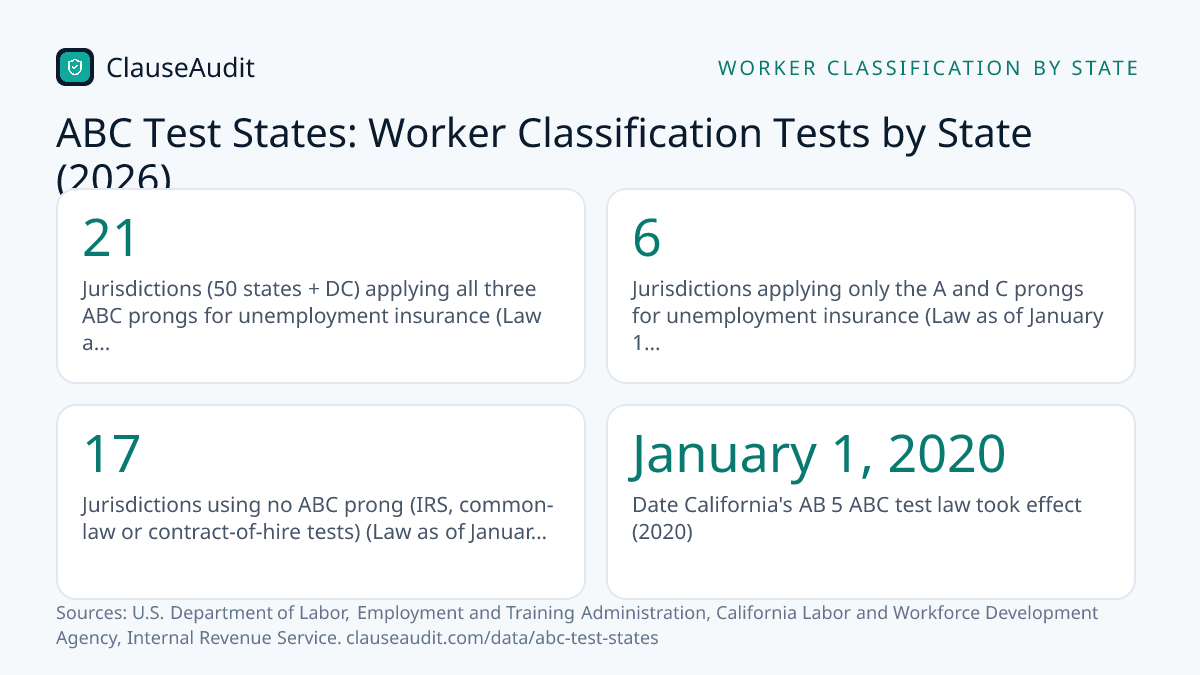
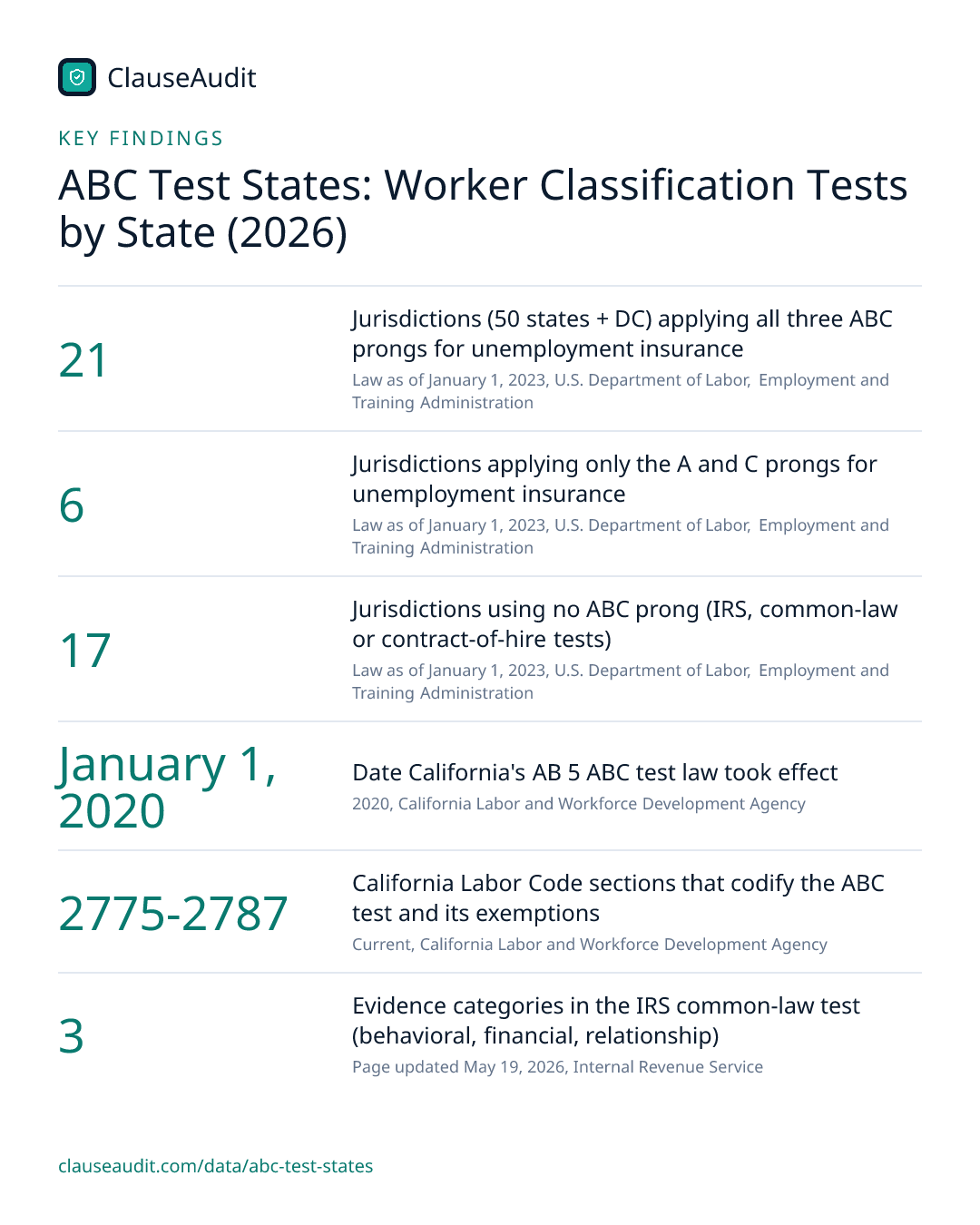
- Jurisdictions (50 states + DC) applying all three ABC prongs for unemployment insurance (Law as of January 1, 2023, U.S. Department of Labor, Employment and Training Administration)
- 21
- Jurisdictions applying only the A and C prongs for unemployment insurance (Law as of January 1, 2023, U.S. Department of Labor, Employment and Training Administration)
- 6
- Jurisdictions using no ABC prong (IRS, common-law or contract-of-hire tests) (Law as of January 1, 2023, U.S. Department of Labor, Employment and Training Administration)
- 17
- Date California's AB 5 ABC test law took effect (2020, California Labor and Workforce Development Agency)
- January 1, 2020
- California Labor Code sections that codify the ABC test and its exemptions (Current, California Labor and Workforce Development Agency)
- 2775-2787
- Evidence categories in the IRS common-law test (behavioral, financial, relationship) (Page updated May 19, 2026, Internal Revenue Service)
- 3
- Comment deadline on DOL proposal to rescind the 2024 FLSA contractor rule (Proposed February 27, 2026, U.S. Department of Labor, Wage and Hour Division (Federal Register))
- April 28, 2026
The ABC test is the strictest way a state can sort workers into employees and independent contractors. It starts by assuming you are an employee. The business then has to prove three things, and if it misses even one, you are on payroll as far as the state is concerned.
The map shows which test each state uses for unemployment insurance, the area where the ABC test is most common. Below it, we explain what each prong really asks, why a contract alone will not settle the question, and what freelancers and the businesses that hire them should check before anyone signs.
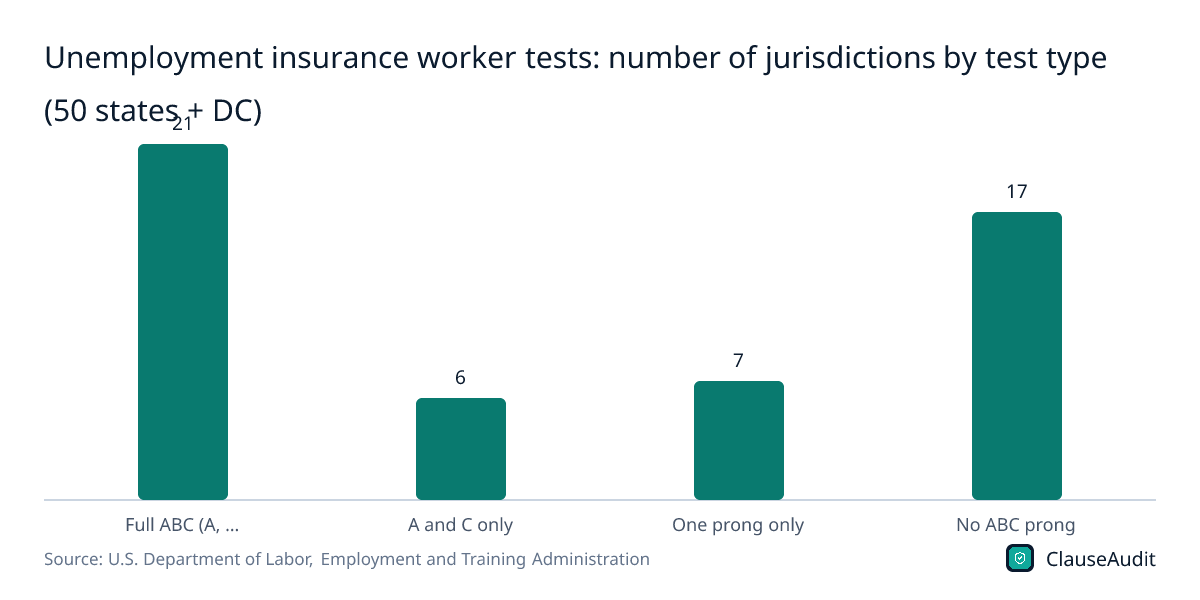
Unemployment insurance worker tests: number of jurisdictions by test type (50 states + DC)
Chart data
| Label | Value |
|---|---|
| Full ABC (A, B, C) | 21 |
| A and C only | 6 |
| One prong only | 7 |
| No ABC prong | 17 |
The full ABC test is the single most common approach, with 21 jurisdictions, but it is not a majority. Add the 6 A and C states and the 7 one-prong states, and most of the country uses at least part of the test.
Download this chart (PNG)How many jurisdictions use each ABC prong for unemployment insurance
Chart data
| Label | Value |
|---|---|
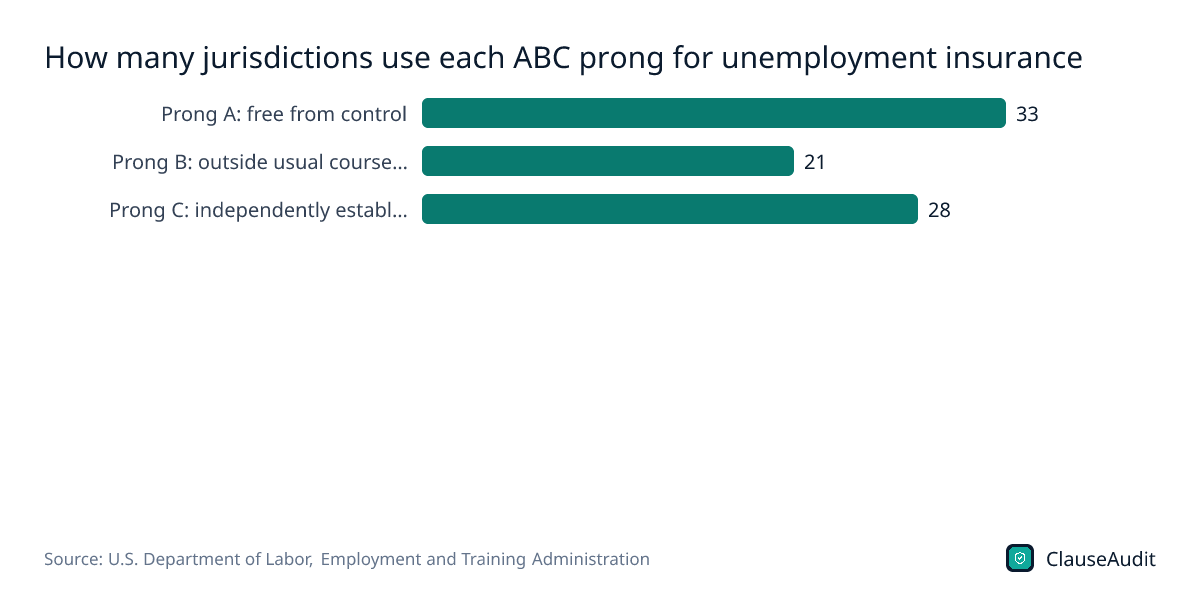
| Prong A: free from control | 33 |
| Prong B: outside usual course or place of business | 21 |
| Prong C: independently established business | 28 |
Prong A, freedom from control, is the most widely used piece at 33 jurisdictions. Prong B is the rarest at 21, and it is often the hardest one for a freelancer to meet, because it asks whether your work is part of the client's normal business.
Download this chart (PNG)Worker classification tests compared
| Test | Where it applies | How it works | Source |
|---|---|---|---|
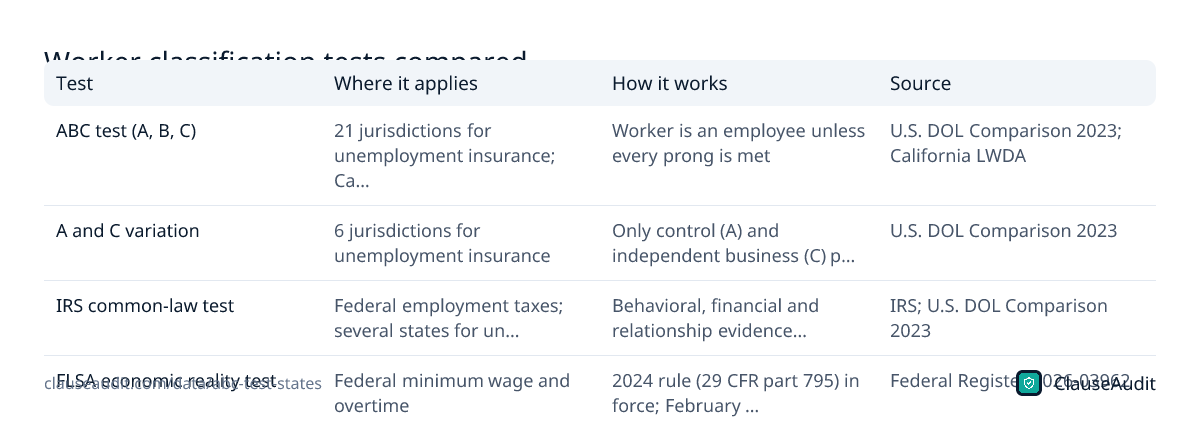
| ABC test (A, B, C) | 21 jurisdictions for unemployment insurance; California also for Labor Code and wage orders | Worker is an employee unless every prong is met | U.S. DOL Comparison 2023; California LWDA |
| A and C variation | 6 jurisdictions for unemployment insurance | Only control (A) and independent business (C) prongs apply | U.S. DOL Comparison 2023 |
| IRS common-law test | Federal employment taxes; several states for unemployment insurance | Behavioral, financial and relationship evidence weighed together | IRS; U.S. DOL Comparison 2023 |
| FLSA economic reality test | Federal minimum wage and overtime | 2024 rule (29 CFR part 795) in force; February 2026 proposal would restore the 2021 analysis with changes | Federal Register 2026-03962 |
Source: U.S. Department of Labor, Employment and Training Administration, Comparison of State Unemployment Insurance Laws 2023, Chapter 1: Coverage (Table 1-4); California Labor and Workforce Development Agency, Frequently Asked Questions on AB 5; Internal Revenue Service, Independent contractor (self-employed) or employee?; U.S. Department of Labor, Wage and Hour Division (Federal Register), Employee or Independent Contractor Status Under the FLSA, FMLA, and MSPA (Proposed Rule). Download as image
Worker classification test for unemployment insurance (state law as of January 1, 2023) by state
- 21Full ABC test (A, B and C)
- 6A and C prongs only
- 7One ABC prong only (some also use other tests)
- 17No ABC prong (IRS, common-law or other test)
- Full ABC test (A, B and C)21
- A and C prongs only6
- One ABC prong only (some also use other tests)7
- No ABC prong (IRS, common-law or other test)17
What is the ABC test, in plain terms?
Most tests weigh a pile of factors and let a judge decide which way the scale tips. The ABC test works differently. You are an employee unless the hiring business proves all three of these:
- A: You are free from the company's control and direction, both under the contract and in practice.
- B: The work is outside the usual course of the company's business, or (in some states) done away from all of its places of business.
- C: You are customarily engaged in an independently established trade, occupation or business of the same kind.
Which states use the ABC test?
For unemployment insurance, 21 jurisdictions use all three prongs, according to our count of the U.S. Department of Labor's state law comparison, which reflects law as of January 1, 2023. That group includes California, Connecticut, Illinois, Massachusetts, New Jersey, Washington and Vermont, among others. Florida, Indiana, Nebraska and West Virginia mark all three prongs but also list other tests, so treat those four with a little more caution.
Another 6 states, Colorado, Georgia, Idaho, Oregon, South Dakota and Utah, apply only the A and C prongs. That matters because without prong B, a client can bring in a contractor to do core work, as long as that person is not controlled and runs a real business.
The remaining 17 jurisdictions use no ABC prong. Texas relies on the common law. Michigan, Tennessee and Virginia point to the IRS test. New York and DC use a contract of hire approach.
One caution: these tests are scoped. A state can use the ABC test for unemployment claims and a looser test for income tax or workers' compensation. California is the big exception that went further, which is the next question.
How is California different under AB 5?
California's AB 5 took effect on January 1, 2020. It wrote the ABC test into the Labor Code, the Unemployment Insurance Code and the state's wage orders, which together cover minimum wage, overtime, meal breaks and expense reimbursement. The rules now sit in Labor Code sections 2775-2787.
Those sections also list exemptions, and many working freelancers fall into one. Some professional services, certain business to business arrangements and referral agencies can be judged under an older multi-factor test instead. The catch is that each exemption comes with its own conditions, often about who sets the rate, whether you have your own business location and whether you can work for other clients. Your contract can quietly break those conditions.
Picture a designer in Los Angeles who works only for one agency, uses its laptop, attends its daily standups and bills by the hour on its timesheet system. Her contract says independent contractor on page one. Under AB 5, the rest of the arrangement says something else.
Why is prong B the hardest part to pass?
Prongs A and C are mostly within your control. You can work on your own schedule, use your own equipment, market yourself and take other clients. Prong B is different, because it depends on what the client does, not on what you do.
Take a freelance copywriter. If she writes product pages for a furniture maker, the work sits outside the maker's usual business, and prong B is easy. If she writes articles for a content marketing agency, writing is the agency's business. Same skills, same rate, very different answer.
This is why full ABC states hit some industries harder than others. Agencies that resell freelance work, media companies and staffing style setups feel it most. A client in one of those fields who operates in a full ABC state may simply not be able to hire you as a contractor for core work, however carefully the contract is written.
If you see a client suddenly ask you to form an LLC, go through a third party payroll firm or sign a new agreement, this is often why. Ask them directly which state's test they are worried about.
How does the ABC test compare to the IRS and federal tests?
The IRS uses a common-law test that sorts evidence into 3 categories: behavioral control, financial control and the relationship of the parties. No single factor wins. That flexibility is why the same freelancer can be a contractor for federal tax purposes and an employee for a state unemployment claim.
Federal wage and hour law uses yet another approach, the economic reality test under the Fair Labor Standards Act. The 2024 rule is still in force. The Labor Department proposed on February 27, 2026 to rescind it and return to the 2021 analysis with changes, and comments closed April 28, 2026. As of our last check, no final rule had been published.
The practical takeaway: when a client says you are a contractor, ask which test they mean. The strictest one that applies to your work is the one that counts.
What should freelancers and businesses do about it?
Start with where the work happens and where the worker lives. Then match the contract to reality, because every one of these tests looks at how the work is done, not just what the paper calls it.
- Freelancers: keep proof of your own business, such as a website, other clients, your own tools and your own insurance. That is the heart of prong C.
- Freelancers: push back on clauses that let the client set your hours, require daily check-ins or bar you from other clients. Those hurt prong A and prong C at once.
- Businesses: if a contractor does the same work your employees do, prong B is hard to pass in a full ABC state. Consider a staffing agency or a payroll hire instead.
- Businesses: make sure the contract says the contractor controls the method, timing and location of the work, and then actually let them.
- Both sides: check the state entry on this page against the current statute. The federal data reflects law as of January 1, 2023, and states have changed rules since.
How ClauseAudit helps
A contractor label on page one does not protect anyone if the clauses that follow describe a job. ClauseAudit's automated review of your freelance or service agreement flags terms that look like employee control, so you can fix them before you sign.
It reads the whole agreement and explains each risky clause in plain English, with a suggested change you can send back.
- Control clauses that set your hours, location or required meetings
- Exclusivity or non-compete terms that bar you from other clients
- Payment terms: hourly timesheets versus project or milestone rates you set
- Who supplies tools, equipment and software
- Classification and indemnity clauses that push misclassification costs onto you
- Termination at will with no notice, which reads like employment
Frequently asked questions
How many states use the ABC test?
For unemployment insurance, 21 of the 50 states and DC use all three prongs, based on state law as of January 1, 2023. Six more use only the A and C prongs, and 7 use just one prong. That leaves 17 jurisdictions that use no part of the ABC test, relying instead on common-law, IRS or contract of hire tests.
What does prong B of the ABC test mean?
Prong B asks whether your work falls outside the usual course of the hiring company's business. A bakery hiring a plumber passes easily. A software company hiring a freelance developer to build its product usually fails. Some states let a business pass prong B another way, by showing the work happens outside all of its places of business.
Does the ABC test apply to taxes?
Usually not to federal taxes. The IRS uses its own common-law test, which weighs evidence in 3 categories: behavioral, financial and relationship. States mostly apply the ABC test to unemployment insurance. California goes further and applies it to the Labor Code and wage orders too. Check your state agency for income tax and workers' compensation rules.
Can a contract make me an independent contractor?
No contract can do that on its own. Every test, including the ABC test, looks at how the work actually happens. A contract still matters, though, because clauses on control, exclusivity, tools and payment are evidence. A well drafted agreement that matches reality helps. One that describes a job works against the label it uses.
Is the ABC test the law in New York or Texas?
Not for unemployment insurance, based on the federal comparison of state law as of January 1, 2023. New York uses a contract of hire approach and Texas uses the common law test. Both still look closely at control. Industry specific rules can be stricter, so check the state labor department for your line of work.
What happens if a worker is misclassified under the ABC test?
The worker can claim unemployment benefits, and the business may owe back contributions on the wages it paid. In California, the ABC test also reaches minimum wage, overtime and expense rules, so a single misclassified role can create claims on several fronts. Penalties and interest vary by state.
Did the federal government adopt the ABC test?
No. Federal wage and hour law uses the economic reality test. The 2024 rule remains in force, and the Labor Department proposed on February 27, 2026 to rescind it and return to the 2021 approach with changes. Comments closed April 28, 2026. We found no final rule as of our last check.
How current is this state list?
The state data comes from the U.S. Department of Labor's comparison of state unemployment insurance laws, reflecting law as of January 1, 2023. That is the most recent edition the agency lists. Changes made after that date are not shown, so confirm your state's current statute before relying on an entry.
Use this data
Every chart and card below is free to reuse under CC BY 4.0. Download what you need and link back to this page.
 Stat cards
 Key findings card
 Infographic
 Unemployment insurance worker tests: number of jurisdictions by test type (50 states + DC)
 How many jurisdictions use each ABC prong for unemployment insurance
 Worker classification tests compared
Embed the infographic
Free to share on your site, blog or slides under CC BY 4.0. Please keep the credit link.
Sources and method
Every number on this page comes from the sources below, each opened and read on or before October 18, 2026. A second, independent review checked every figure against its source and corrected anything that did not match. 51 of 51 state entries were confirmed; any that could not be are marked "Not yet confirmed" and left out of every count and chart.
- U.S. Department of Labor, Employment and Training Administration, Comparison of State Unemployment Insurance Laws 2023, Chapter 1: Coverage (Table 1-4) (2023 edition (state law as of January 1, 2023); most recent edition listed on oui.doleta.gov as of 2026-10-18)
- California Labor and Workforce Development Agency, Frequently Asked Questions on AB 5 (Undated web page, accessed 2026-10-18)
- New Jersey Department of Labor and Workforce Development, Independent Contractors (My Work Rights) (Undated web page, accessed 2026-10-18)
- Internal Revenue Service, Independent contractor (self-employed) or employee? (Last reviewed or updated May 19, 2026)
- U.S. Department of Labor, Wage and Hour Division (Federal Register), Employee or Independent Contractor Status Under the FLSA, FMLA, and MSPA (Proposed Rule) (February 27, 2026)
Cite this page
ClauseAudit, “ABC Test States: Worker Classification Tests by State (2026)”, updated October 18, 2026, https://clauseaudit.com/data/abc-test-states. Free to reuse with a link back (CC BY 4.0).
This page summarises published data and law as checked on October 18, 2026. Figures are updated as new editions are released, and your own situation may differ. It is general information, not legal, tax or financial advice.