Portable Benefits Laws by State: Which States Let Gig Companies Fund Contractor Benefits
By ClauseAudit Research · 7 sources ·
Which states offer portable benefits for gig workers?
Only a handful of states have acted. Alabama's Act 2025-119 lets any hiring party pay into a contractor-owned benefit account, and both sides can deduct 100% of contributions starting with the 2026 tax year. California and Washington instead require app companies to give drivers set benefits, such as Prop 22's health subsidy.

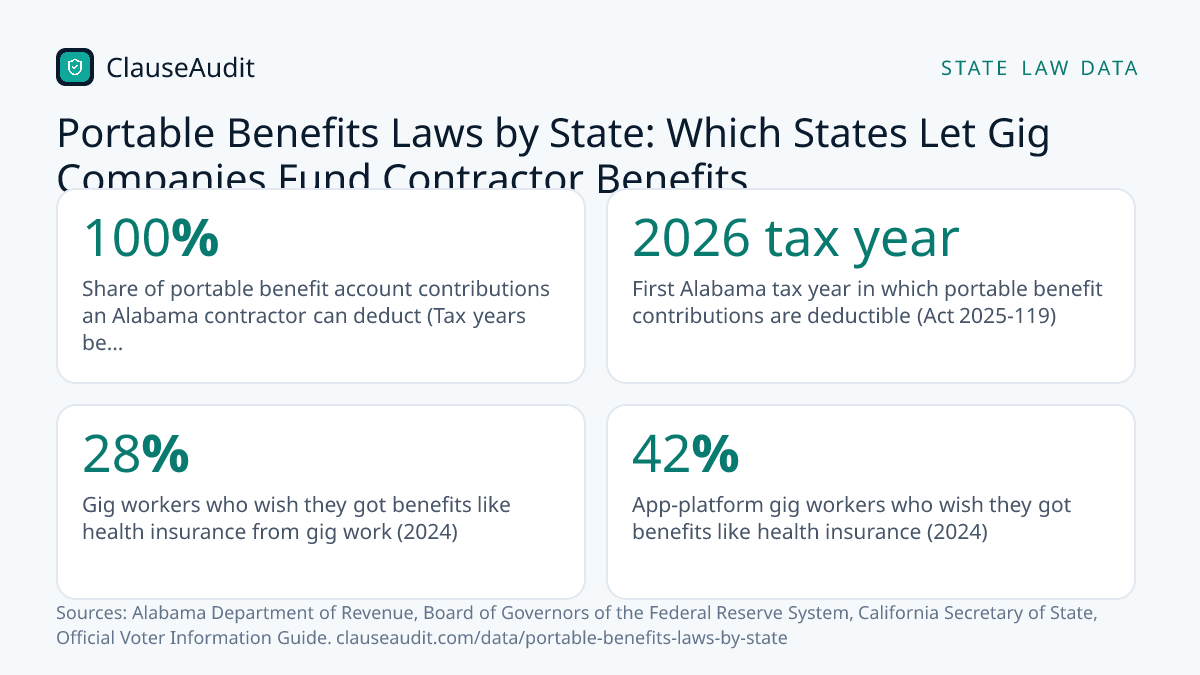
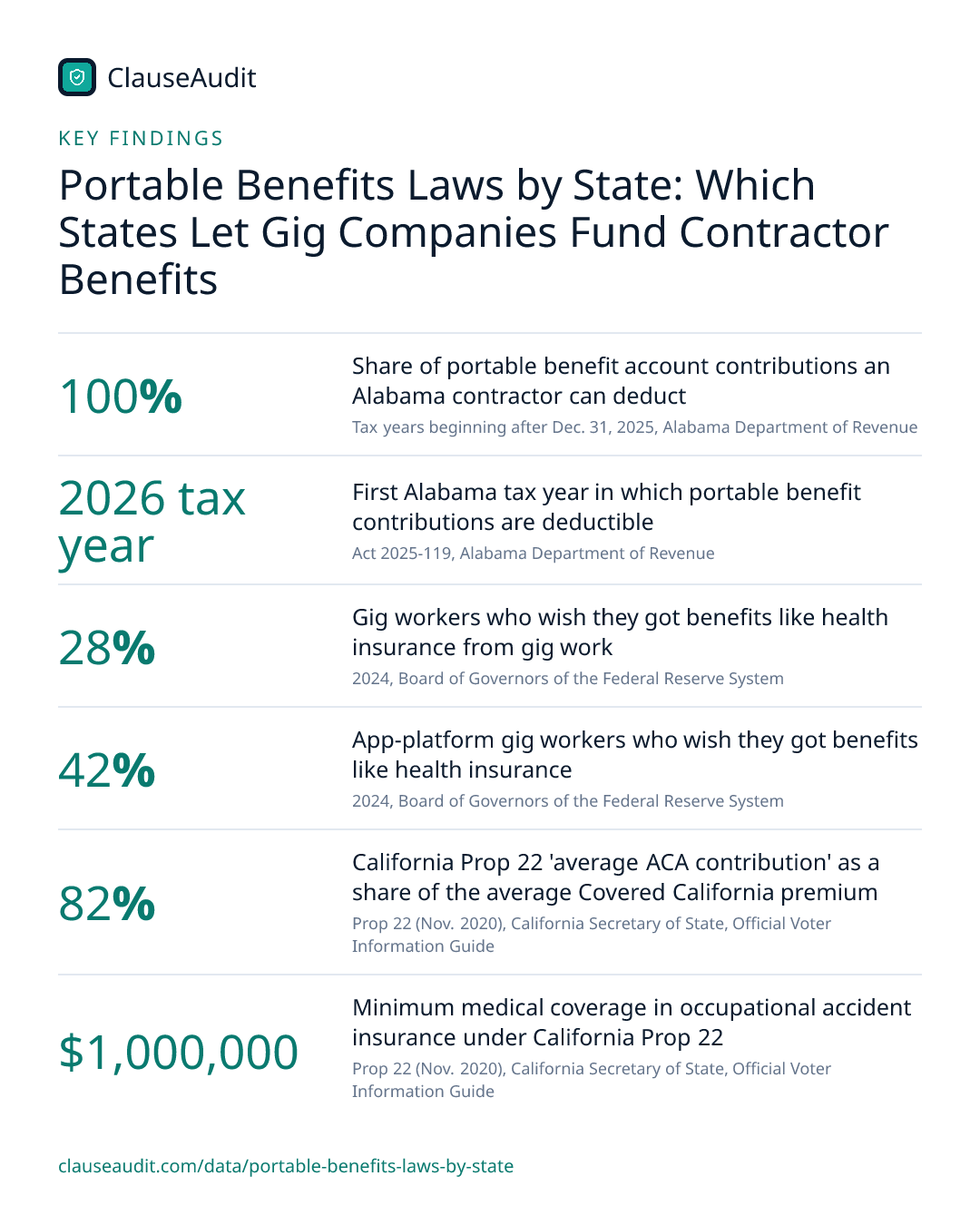
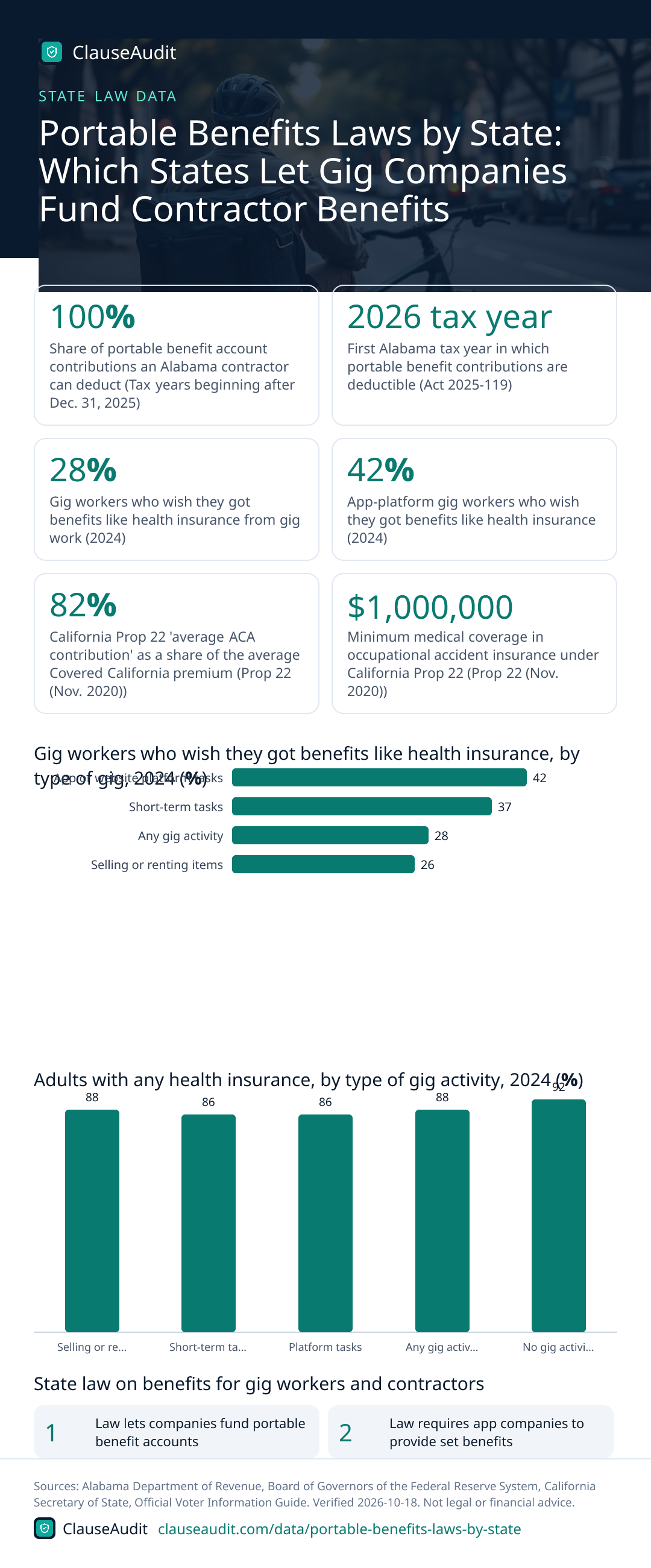
- Share of portable benefit account contributions an Alabama contractor can deduct (Tax years beginning after Dec. 31, 2025, Alabama Department of Revenue)
- 100%
- First Alabama tax year in which portable benefit contributions are deductible (Act 2025-119, Alabama Department of Revenue)
- 2026 tax year
- Gig workers who wish they got benefits like health insurance from gig work (2024, Board of Governors of the Federal Reserve System)
- 28%
- App-platform gig workers who wish they got benefits like health insurance (2024, Board of Governors of the Federal Reserve System)
- 42%
- California Prop 22 'average ACA contribution' as a share of the average Covered California premium (Prop 22 (Nov. 2020), California Secretary of State, Official Voter Information Guide)
- 82%
- Minimum medical coverage in occupational accident insurance under California Prop 22 (Prop 22 (Nov. 2020), California Secretary of State, Official Voter Information Guide)
- $1,000,000
- Paid sick time Washington rideshare drivers earn per passenger platform hours (Since Jan. 1, 2023, Washington State Legislature)
- 1 hour per 40 hours
- Gig platform workers who say companies have been unfair about their benefits (2021, Pew Research Center)
- 46%
Portable benefits are a simple idea. A company that hires you as a contractor puts money into an account that belongs to you, and you keep it when the gig ends. You use it for health coverage, disability or life insurance, or retirement. The catch has always been that paying for a contractor's benefits can look like evidence that the contractor is really an employee.
A few states have started to deal with that problem, in two very different ways. Alabama built a voluntary account system with a tax break. California and Washington skipped the accounts and told app companies which benefits drivers must get. Most states have done neither, or we could not confirm a law. Here is what each approach means for you and what to look for in your contract.
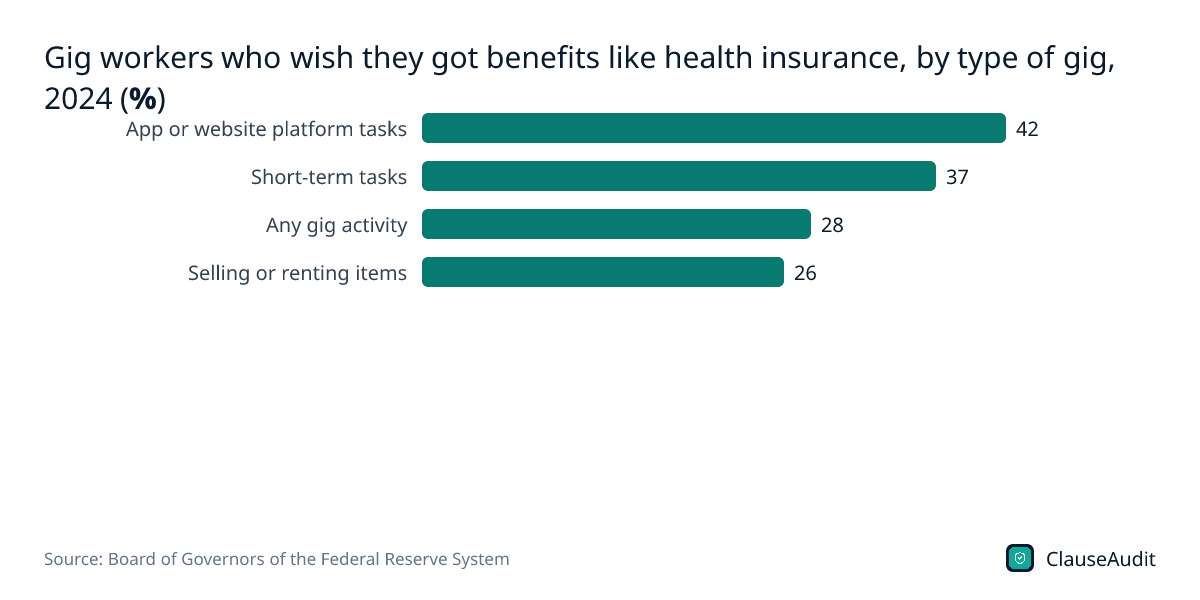
Gig workers who wish they got benefits like health insurance, by type of gig, 2024 (%)
Chart data
| Label | Value |
|---|---|
| App or website platform tasks | 42 |
| Short-term tasks | 37 |
| Any gig activity | 28 |
| Selling or renting items | 26 |
Workers who find gigs through an app feel the gap most: 42% wish they got benefits, compared with 28% across all gig work. People selling or renting items care least, at 26%.
Download this chart (PNG)Adults with any health insurance, by type of gig activity, 2024 (%)
Chart data
| Label | Value (%) |
|---|---|
| Selling or renting | 88 |
| Short-term tasks | 86 |
| Platform tasks | 86 |
| Any gig activity | 88 |
| No gig activity | 92 |
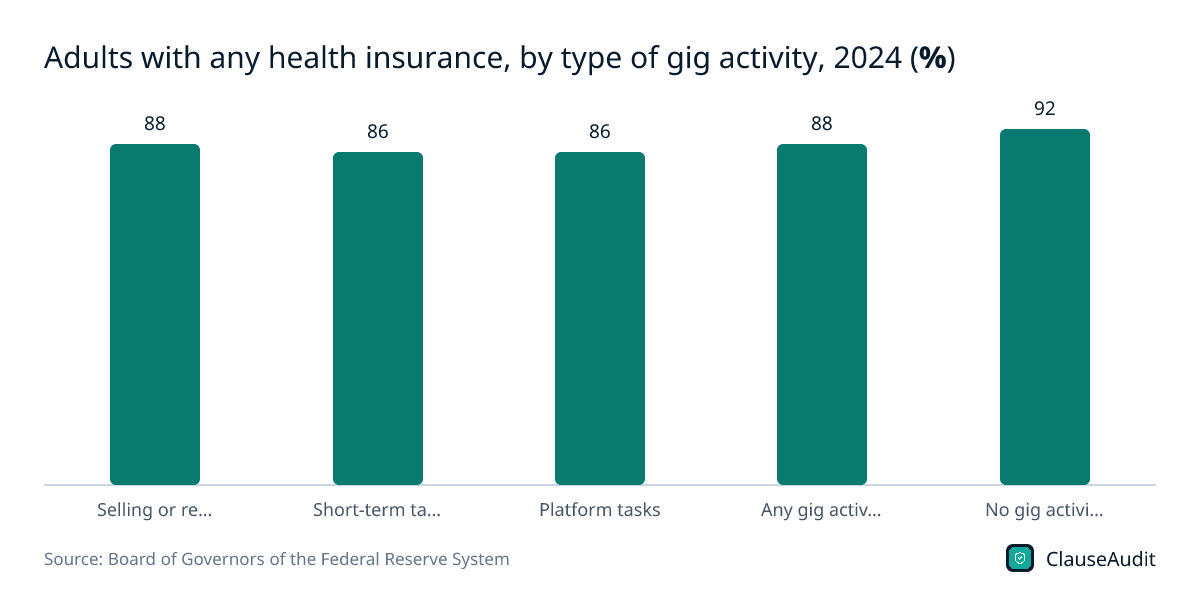
Most gig workers do have some health coverage. Among platform workers it is 86%, against 92% for adults who did no gig work, so the gap is real but smaller than many people assume.
Download this chart (PNG)Adults with employer-provided health insurance, by type of gig activity, 2024 (%)
Chart data
| Label | Value (%) |
|---|---|
| Selling or renting | 54 |
| Short-term tasks | 47 |
| Platform tasks | 45 |
| Any gig activity | 53 |
| No gig activity | 56 |
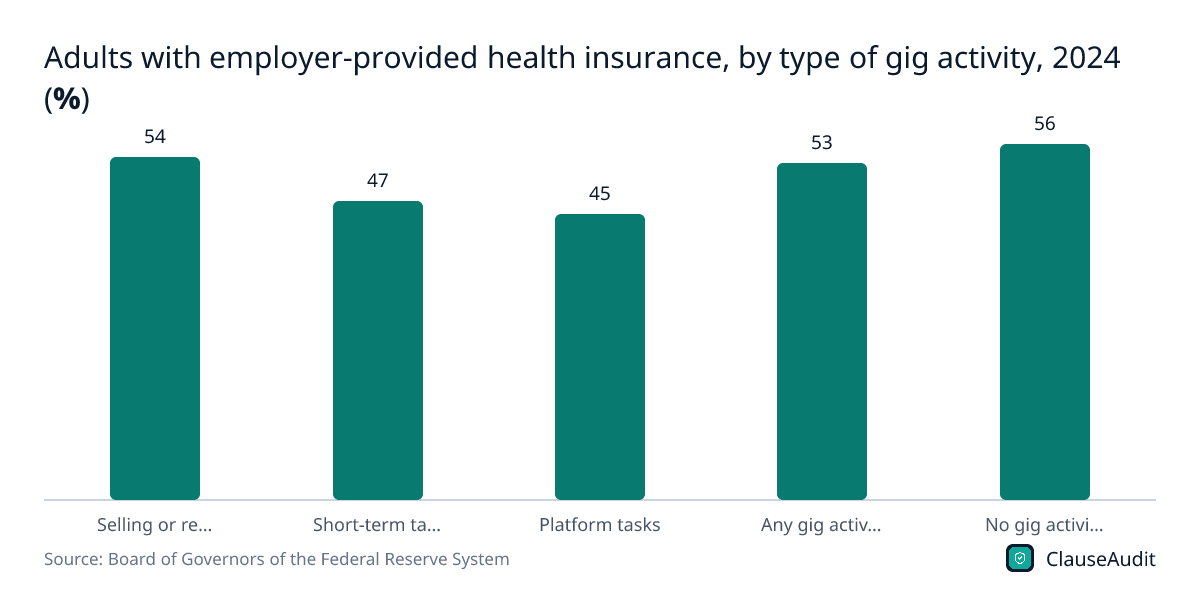
The bigger difference is where coverage comes from. Only 45% of platform workers have employer-provided insurance, compared with 56% of adults with no gig work, which leaves more of them finding coverage some other way.
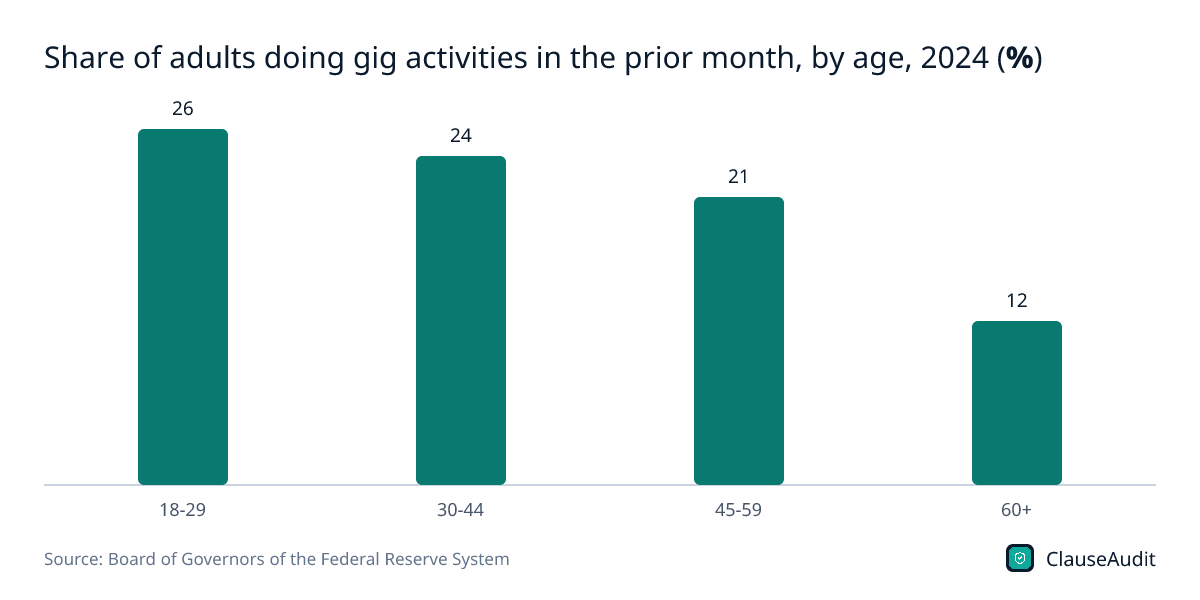
Download this chart (PNG)Gig work skews young: 26% of adults aged 18-29 did some in the prior month, against 12% of those 60 and older.
Download this chart (PNG)Gig platform workers who say companies have been at least somewhat fair, 2021 (%)
Chart data
| Label | Value (%) |
|---|---|
| How jobs are assigned | 72 |
| Pay | 64 |
| Benefits | About half |
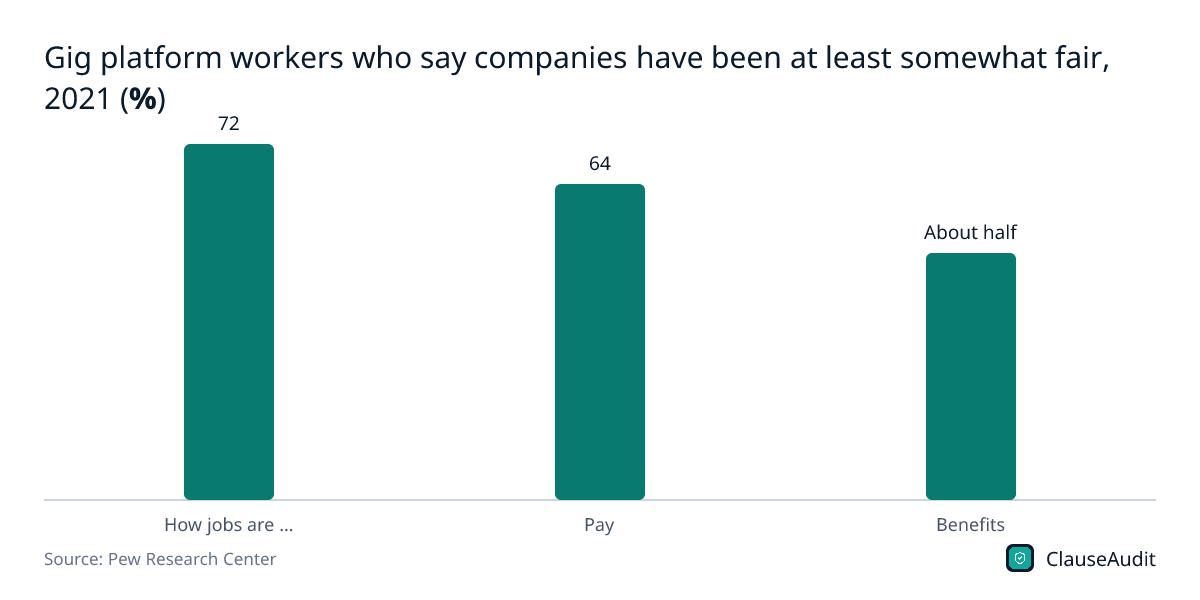
Gig platform workers rate companies better on job assignment (72%) and pay (64%) than on benefits. In the same survey, 46% said companies had been unfair about benefits.
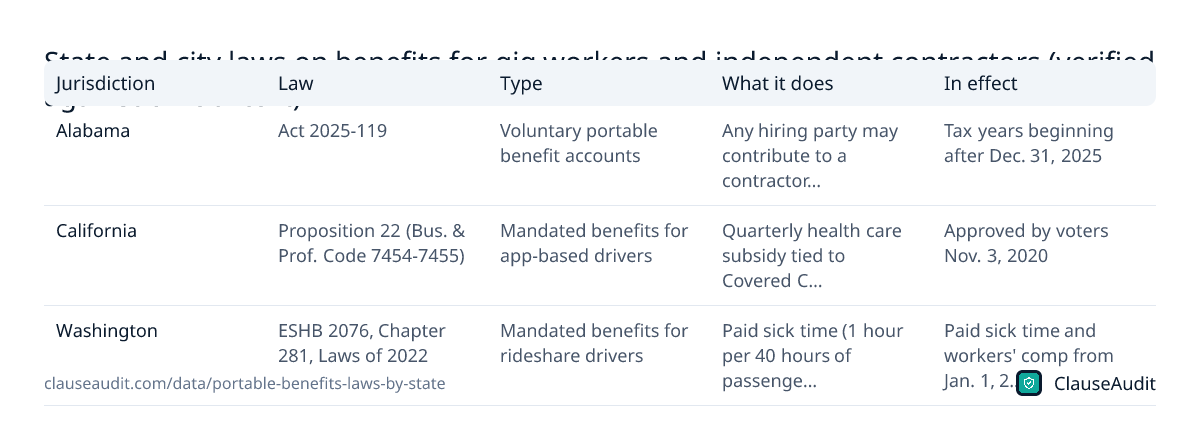
Download this chart (PNG)State and city laws on benefits for gig workers and independent contractors (verified against official text)
| Jurisdiction | Law | Type | What it does | In effect |
|---|---|---|---|---|
| Alabama | Act 2025-119 | Voluntary portable benefit accounts | Any hiring party may contribute to a contractor-owned account for health, disability, life or retirement benefits; 100% state tax deduction for contractor and hiring party | Tax years beginning after Dec. 31, 2025 |
| California | Proposition 22 (Bus. & Prof. Code 7454-7455) | Mandated benefits for app-based drivers | Quarterly health care subsidy tied to Covered California premiums; occupational accident insurance with at least $1,000,000 medical coverage | Approved by voters Nov. 3, 2020 |
| Washington | ESHB 2076, Chapter 281, Laws of 2022 | Mandated benefits for rideshare drivers | Paid sick time (1 hour per 40 hours of passenger platform time) and workers' compensation coverage for TNC drivers; Driver Resource Center | Paid sick time and workers' comp from Jan. 1, 2023 |
| Seattle, WA (city) | SMC 8.39 App-Based Worker Paid Sick and Safe Time | Mandated paid sick and safe time | One day of paid sick and safe time for every 30 days with at least one work-related stop in Seattle, at network companies with more than 250 workers | Food delivery from May 1, 2023; all app-based workers from Jan. 13, 2024 |
Source: Alabama Department of Revenue, Portable Benefit Accounts (Act 2025-119); California Secretary of State, Official Voter Information Guide, Proposition 22, Text of Proposed Laws (adds Bus. & Prof. Code sections 7448 and following); Washington State Legislature, Engrossed Substitute House Bill 2076, Chapter 281, Laws of 2022 (Transportation Network Companies); Seattle Office of Labor Standards, App-Based Worker Paid Sick and Safe Time Ordinance (SMC 8.39). Download as image
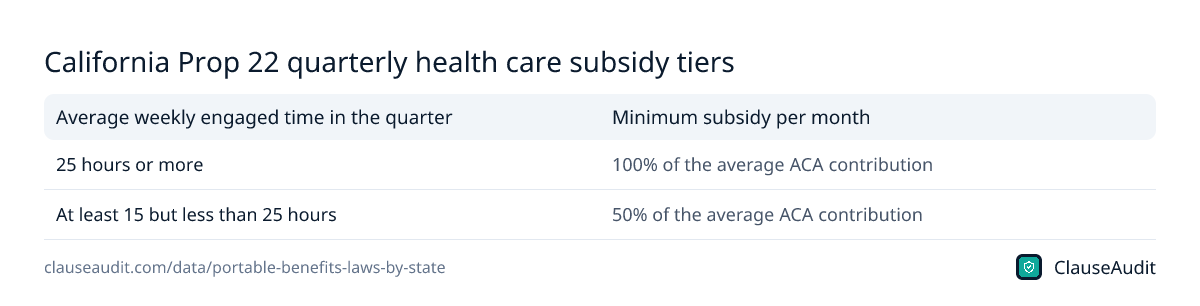
California Prop 22 quarterly health care subsidy tiers
| Average weekly engaged time in the quarter | Minimum subsidy per month |
|---|---|
| 25 hours or more | 100% of the average ACA contribution |
| At least 15 but less than 25 hours | 50% of the average ACA contribution |
Source: California Secretary of State, Official Voter Information Guide, Proposition 22, Text of Proposed Laws (adds Bus. & Prof. Code sections 7448 and following). Download as image
State law on benefits for gig workers and contractors by state
- 1Law lets companies fund portable benefit accounts
- 2Law requires app companies to provide set benefits
- 0No statewide law confirmed
- Law lets companies fund portable benefit accounts1
- Law requires app companies to provide set benefits2
- No statewide law confirmed0
- Not yet confirmed48
What are portable benefits for gig workers?
A portable benefit is one that follows you, not the job. Instead of a health plan tied to one employer, money goes into an account in your name. Several companies can pay into it over a year, and nothing is lost when you stop working with one of them.
For a delivery driver who works three apps, or a designer with six clients, that matters. Today each client pays you a rate and you fund everything yourself. A portable benefits law gives clients a clear, safe way to add to that pot without turning you into their employee on paper.
The demand is there. In the Federal Reserve's 2024 survey, 28% of people doing any gig work said they wish they got benefits like health insurance from it. Among those working through app platforms, it was 42%.
The gap is less about having coverage and more about who pays for it. In the same survey, 86% of platform workers had some health insurance, but only 45% had it through an employer, compared with 56% of adults who did no gig work. So more of them have to find coverage somewhere other than a job.
That is the problem portable benefits aim at. They do not create new insurance. They give clients a way to share the cost without the legal risk that has kept most of them from trying.
Which states have portable benefits laws?
Alabama is the clearest example we could verify against official text. Act 2025-119 lets any hiring party contribute to a contractor-owned account for health, disability, life insurance or retirement benefits. The contractor can also contribute. The program is voluntary on both sides.
California and Washington took a different route. California's Proposition 22, approved by voters on Nov. 3, 2020, makes app-based rideshare and delivery companies pay a quarterly health care subsidy and carry occupational accident insurance. Washington's ESHB 2076 gives rideshare drivers paid sick time and workers' compensation coverage from Jan. 1, 2023. Seattle adds its own paid sick and safe time rule for app-based workers.
Tennessee and Utah are often reported to have passed voluntary portable benefits laws, but we could not reach their legislature sites to confirm the text, so we list them as not yet confirmed. For every other state, treat the absence of a law as unknown rather than a firm no, and check your state's official site.
The split matters for you. An account law like Alabama's covers any contractor, from a bookkeeper to a welder, but nobody has to pay in. A mandate like Prop 22 forces payment, but only for a narrow group of app drivers. Most freelancers fall outside the mandates, which means any benefit you get will come from what you negotiate.
How does the Alabama portable benefits deduction work?
For tax years beginning after Dec. 31, 2025, a contractor can deduct 100% of contributions to the account on an Alabama return. That covers both your own deposits and money a hiring party puts in as part of your pay. The hiring party can also deduct 100% of its own contributions as a business expense.
Two details protect you. First, Alabama courts cannot use these contributions to decide if you are an employee, which removes the main reason companies have avoided paying in. Second, a company can only take money out of your pay for the account under a written, opt-in agreement, and you can leave at any time.
Say a client offers to add a set amount per invoice to your account. In Alabama, you both get a state deduction, the money is yours, and the offer by itself does not change your status. In a state without a law like this, the same offer comes with none of those guarantees, so the details in the contract carry more weight.
What benefits do California and Washington require for app drivers?
Under Prop 22, the health subsidy depends on hours. Drivers averaging 25 or more engaged hours a week in a quarter get at least 100% of the average ACA contribution. Those averaging at least 15 but under 25 hours get at least 50%. The average ACA contribution itself is set at 82% of the average Covered California premium.
Prop 22 also requires occupational accident insurance with at least $1,000,000 in medical coverage. If you are hurt on the job, it must pay disability of 66% of your average weekly earnings for up to the first 104 weeks. Keep in mind that engaged time is narrower than time logged in, so waiting between rides may not count toward those hour tiers.
In Washington, rideshare drivers earn 1 hour of paid sick time for every 40 hours of passenger platform time. In Seattle, app-based workers at network companies with more than 250 workers earn one day of paid sick and safe time for every 30 days with at least one work-related stop in the city. Both rules cover only certain app work, not freelancers in general.
What should freelancers and businesses do now?
- Check which rule applies to the work, not just where you live. Prop 22 and the Washington and Seattle rules turn on the type of app work, and Alabama's deduction depends on Alabama income tax.
- If a client offers benefit contributions, get the amount, timing and account owner in writing. You want the account in your name, not the company's.
- Ask what happens to contributions when the contract ends. Money already paid in should stay with you, with no clawback.
- Read any clause that lets the client deduct benefit costs from your pay. Outside Alabama's opt-in rule, that can quietly cut your rate.
- For businesses hiring contractors: in states without a law like Alabama's, talk to an advisor before funding benefits, because it can feed into a misclassification claim.
- Track your hours if you drive in California or Washington. Your benefits depend on them, and your own records help if the company's numbers look wrong.
How ClauseAudit helps
A benefits promise is only as good as the contract language behind it. Our automated review reads your freelance or contractor agreement and flags the clauses that decide whether contributions reach you, stay yours and leave your rate intact.
Upload the agreement and you get a plain-English summary of each risky term, with a suggested change you can send back to the client.
- Benefit contribution terms: the amount, how often it is paid and whose name the account is in
- Pay deductions: any right to take benefit or insurance costs out of your rate without your written opt-in
- Termination and clawback: whether contributions already made can be taken back when the work ends
- Classification language: wording that calls you a contractor while giving the client employee-style control
- Insurance and liability: who covers injuries on the job, and if you must carry your own policy
- Payment terms and rate changes: whether the client can cut your rate or delay payment on its own say
Frequently asked questions
Can a company give benefits to an independent contractor?
Yes, but in most states it carries a risk. Paying for a contractor's benefits can be cited as a sign the worker is really an employee. Alabama's Act 2025-119 addresses this directly: contributions to a portable benefit account cannot be used by Alabama courts to decide worker classification. Elsewhere, the company and the contractor should spell out the arrangement carefully in writing.
When does the Alabama portable benefits deduction start?
It applies to tax years beginning after Dec. 31, 2025, so the 2026 tax year is the first one. Contractors can deduct 100% of contributions, including money a hiring party adds as compensation. Hiring parties can also deduct 100% of their own contributions as a business expense on their Alabama return.
What can an Alabama portable benefit account pay for?
The account can fund health, disability and life insurance, plus retirement benefits. It belongs to the contractor, and any hiring party can contribute. If money comes out of your pay to fund it, that needs a written agreement you opted into, and you can leave whenever you want.
Does Prop 22 give drivers health insurance?
Not directly. It gives a quarterly health care subsidy. Drivers averaging 25 or more engaged hours a week get at least 100% of the average ACA contribution, and those at 15 to under 25 hours get at least 50%. You still choose and buy the plan yourself, so the subsidy helps with cost rather than providing coverage.
Do rideshare drivers get paid sick leave in Washington?
Yes. Since Jan. 1, 2023, Washington rideshare drivers earn 1 hour of paid sick time for every 40 hours of passenger platform time. The same law extended workers' compensation coverage to these drivers. Seattle has a separate rule for app-based workers, including delivery workers, at larger network companies.
Are Tennessee and Utah portable benefits states?
Both are widely reported to have voluntary portable benefits laws. We could not reach the Tennessee or Utah legislature sites to confirm the official text, so we list them as not yet confirmed. If you work in either state, check the statute on the legislature's site before relying on any tax treatment.
How many gig workers want benefits?
In the Federal Reserve's 2024 household survey, 28% of people doing any gig work said they wish they got benefits like health insurance. The share rose to 42% for people working through app platforms and 37% for short-term tasks. Pew's 2021 survey found 46% of platform workers said companies had been unfair about benefits.
Should I accept a lower rate in exchange for benefit contributions?
Do the math first. Compare the rate cut with the yearly contribution, and confirm the money lands in an account you own. Make sure contributions already paid stay yours if the contract ends. In Alabama the state deduction adds value; in states without a law, the trade may only move money around.
Use this data
Every chart and card below is free to reuse under CC BY 4.0. Download what you need and link back to this page.
 Stat cards
 Key findings card
 Infographic
 Gig workers who wish they got benefits like health insurance, by type of gig, 2024 (%)
 Adults with any health insurance, by type of gig activity, 2024 (%)
 Adults with employer-provided health insurance, by type of gig activity, 2024 (%)
 Share of adults doing gig activities in the prior month, by age, 2024 (%)
 Gig platform workers who say companies have been at least somewhat fair, 2021 (%)
 State and city laws on benefits for gig workers and independent contractors (verified against official text)
 California Prop 22 quarterly health care subsidy tiers
Embed the infographic
Free to share on your site, blog or slides under CC BY 4.0. Please keep the credit link.
Sources and method
Every number on this page comes from the sources below, each opened and read on or before October 18, 2026. A second, independent review checked every figure against its source and corrected anything that did not match. 3 of 51 state entries were confirmed; any that could not be are marked "Not yet confirmed" and left out of every count and chart.
- Alabama Department of Revenue, Portable Benefit Accounts (Act 2025-119) (Accessed October 2026 (page undated))
- California Secretary of State, Official Voter Information Guide, Proposition 22, Text of Proposed Laws (adds Bus. & Prof. Code sections 7448 and following) (November 3, 2020 General Election)
- Washington State Legislature, Engrossed Substitute House Bill 2076, Chapter 281, Laws of 2022 (Transportation Network Companies) (Approved March 31, 2022)
- Seattle Office of Labor Standards, App-Based Worker Paid Sick and Safe Time Ordinance (SMC 8.39) (Accessed October 2026 (page undated))
- Board of Governors of the Federal Reserve System, Economic Well-Being of U.S. Households in 2024: Employment and Gig Work (May 2025 (latest edition with a gig work section; the May 2026 edition has none))
- Pew Research Center, The State of Gig Work in 2021 (December 8, 2021)
- USA.gov, State governments directory (no state portable benefits source checked) (Accessed October 2026)
Cite this page
ClauseAudit, “Portable Benefits Laws by State: Which States Let Gig Companies Fund Contractor Benefits”, updated October 18, 2026, https://clauseaudit.com/data/portable-benefits-laws-by-state. Free to reuse with a link back (CC BY 4.0).
This page summarises published data and law as checked on October 18, 2026. Figures are updated as new editions are released, and your own situation may differ. It is general information, not legal, tax or financial advice.