Paid Sick Leave Laws by State (2026)
By ClauseAudit Research · 23 sources ·
What are the paid sick leave laws by state in 2026?
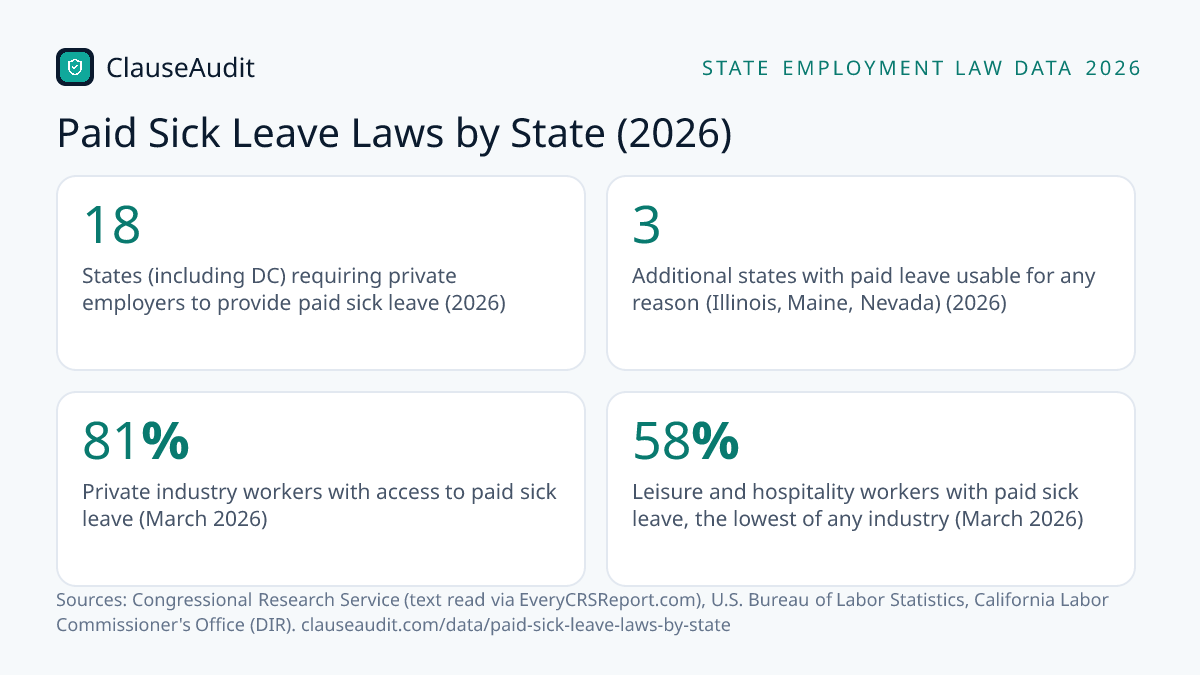
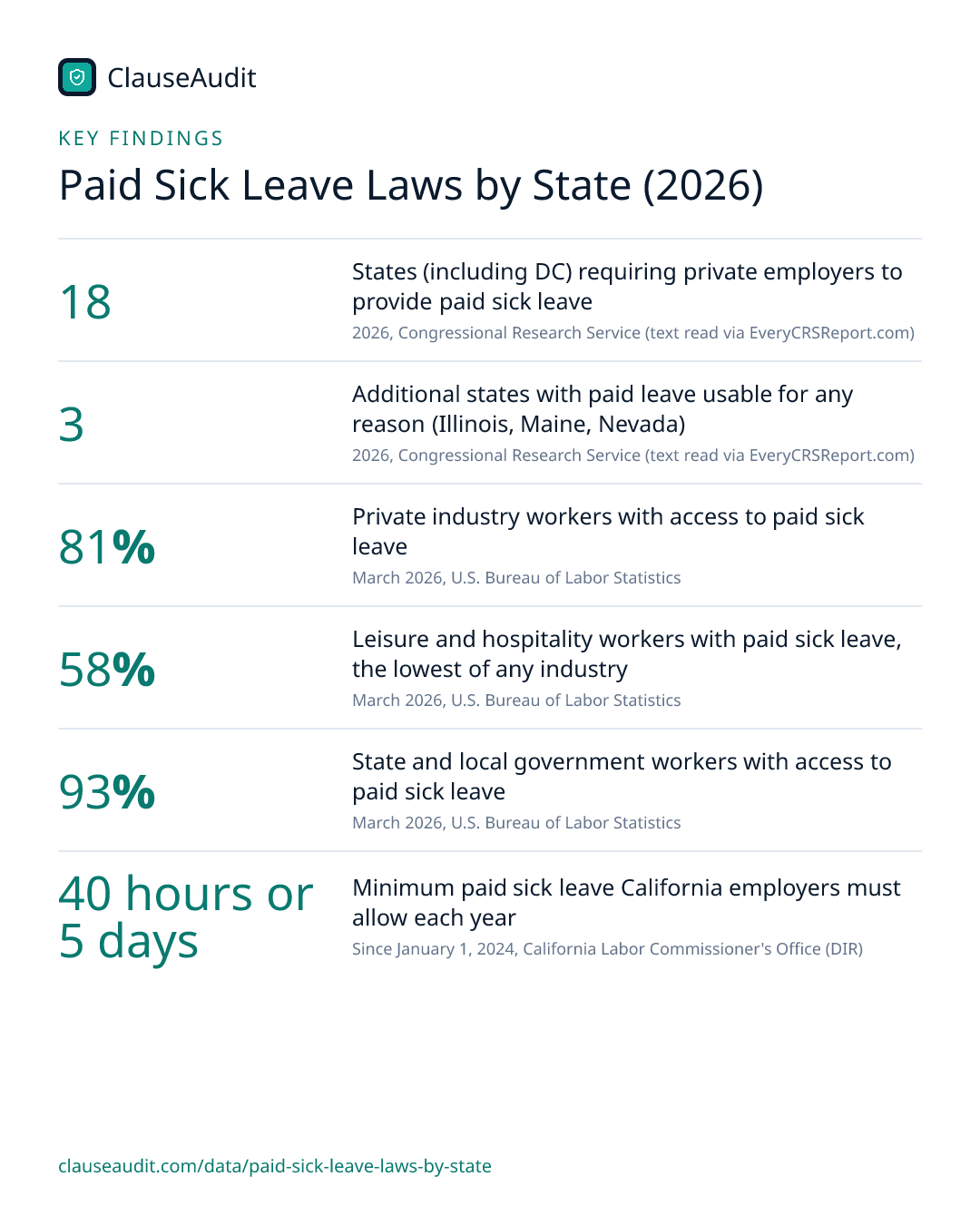
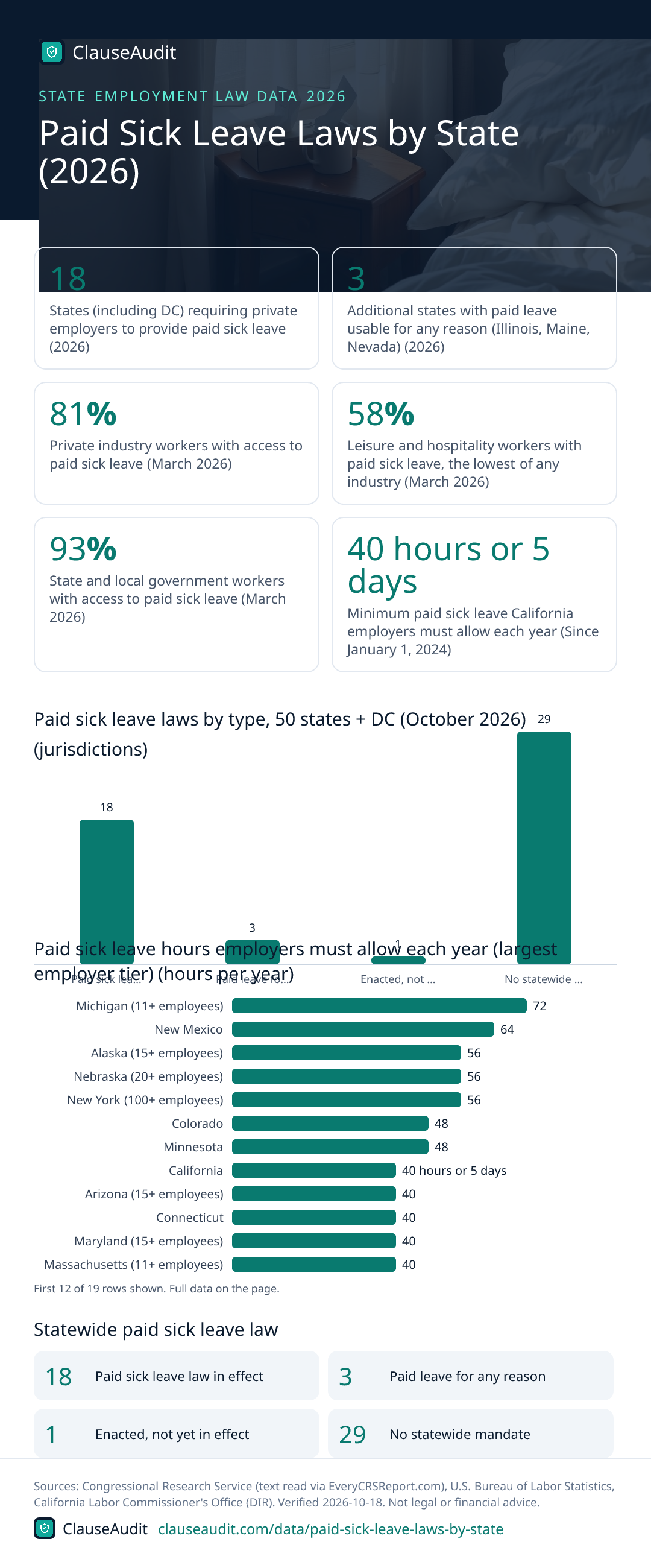
Most US workers have no federal right to paid sick leave, so your state decides. In 2026, 18 states including DC require private employers to provide it, and 3 more (Illinois, Maine and Nevada) require paid leave you can use for any reason. Virginia's new law starts July 1, 2027. Everywhere else, it comes down to your contract.

- States (including DC) requiring private employers to provide paid sick leave (2026, Congressional Research Service (text read via EveryCRSReport.com))
- 18
- Additional states with paid leave usable for any reason (Illinois, Maine, Nevada) (2026, Congressional Research Service (text read via EveryCRSReport.com))
- 3
- Private industry workers with access to paid sick leave (March 2026, U.S. Bureau of Labor Statistics)
- 81%
- Leisure and hospitality workers with paid sick leave, the lowest of any industry (March 2026, U.S. Bureau of Labor Statistics)
- 58%
- State and local government workers with access to paid sick leave (March 2026, U.S. Bureau of Labor Statistics)
- 93%
- Minimum paid sick leave California employers must allow each year (Since January 1, 2024, California Labor Commissioner's Office (DIR))
- 40 hours or 5 days
- Michigan's annual paid sick time use cap for employers with 11+ employees (2026, Michigan Department of Labor and Economic Opportunity)
- 72 hours
- Effective date of Virginia's new statewide paid sick leave law (Enacted May 20, 2026, Virginia Legislative Information System)
- July 1, 2027
If you get sick and stay home, your paycheck that week depends mostly on where you work. There is no federal paid sick leave law for private employers, so the rules come from states, a handful of cities, and whatever your employer chose to offer.
This page maps every state's rule for 2026: how fast you earn leave, how much you can use, and which employers are covered. Below the map and tables you will find what the numbers mean in practice and what to check in an offer letter or handbook before you count on those hours.
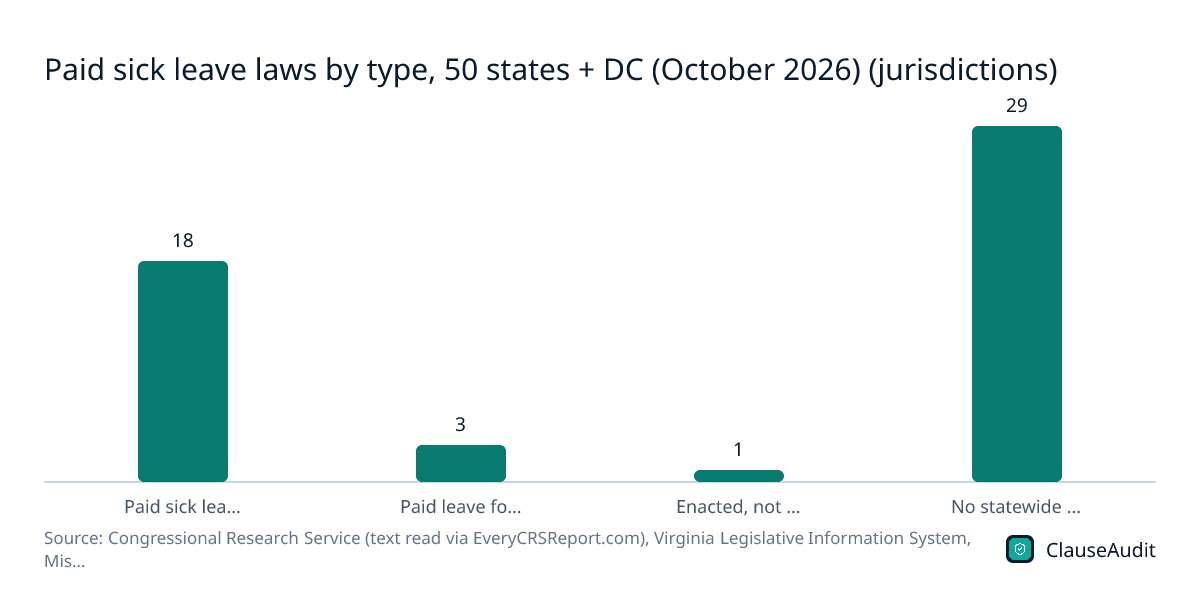
Paid sick leave laws by type, 50 states + DC (October 2026) (jurisdictions)
Chart data
| Label | Value (jurisdictions) |
|---|---|
| Paid sick leave law in effect | 18 |
| Paid leave for any reason | 3 |
| Enacted, not yet in effect | 1 |
| No statewide mandate | 29 |
29 of the 51 jurisdictions still have no statewide mandate, and Missouri moved back into that group when lawmakers repealed its voter-approved law in 2025.
Download this chart (PNG)Paid sick leave hours employers must allow each year (largest employer tier) (hours per year)
Chart data
| Label | Value |
|---|---|
| Michigan (11+ employees) | 72 |
| New Mexico | 64 |
| Alaska (15+ employees) | 56 |
| Nebraska (20+ employees) | 56 |
| New York (100+ employees) | 56 |
| Colorado | 48 |
| Minnesota | 48 |
| California | 40 hours or 5 days |
| Arizona (15+ employees) | 40 |
| Connecticut | 40 |
| Maryland (15+ employees) | 40 |
| Massachusetts (11+ employees) | 40 |
| New Jersey | 40 |
| Oregon | 40 |
| Rhode Island | 40 |
| Vermont | 40 |
| Illinois (any reason) | 40 |
| Maine (any reason) | 40 |
| Nevada (50+ employees, any reason) | 40 |
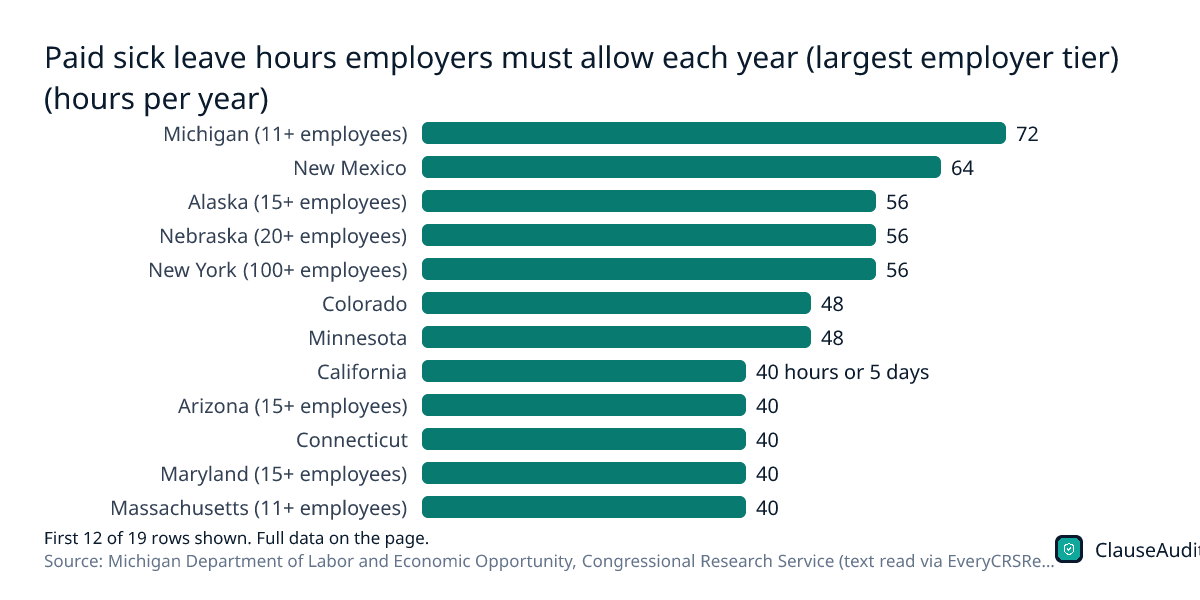
40 hours a year is the most common floor, about one standard work week. Michigan sits at the top with a 72-hour use cap for employers with 11 or more employees, though that figure limits use rather than guaranteeing a bank on day one.
Download this chart (PNG)Hours an employee must work to earn 1 hour of paid sick leave (hours worked per hour of leave)
Chart data
| Label | Value |
|---|---|
| Vermont | 52 |
| Washington | 40 |
| Illinois | 40 |
| Maine | 40 |
| D.C. (100+ employees) | 37 |
| Rhode Island | 35 |
| 14 states incl. California and New York | 30 |
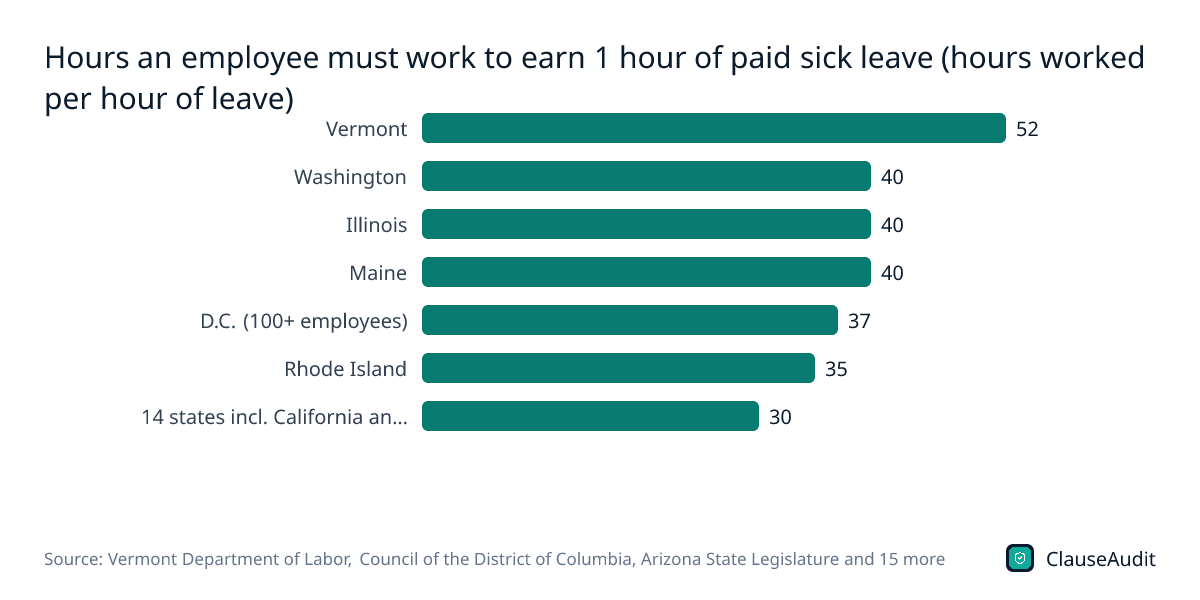
1 hour per 30 hours worked is the norm, used by 14 states including California and New York. Vermont is the slowest on the chart at 1 hour per 52, so a part-time worker there builds a balance much more slowly.
Download this chart (PNG)Private industry workers with paid sick leave by wage level, March 2026 (%)
Chart data
| Label | Value (%) |
|---|---|
| Lowest 25% | 61 |
| Second 25% | 84 |
| Third 25% | 89 |
| Highest 25% | 95 |
| Highest 10% | 97 |
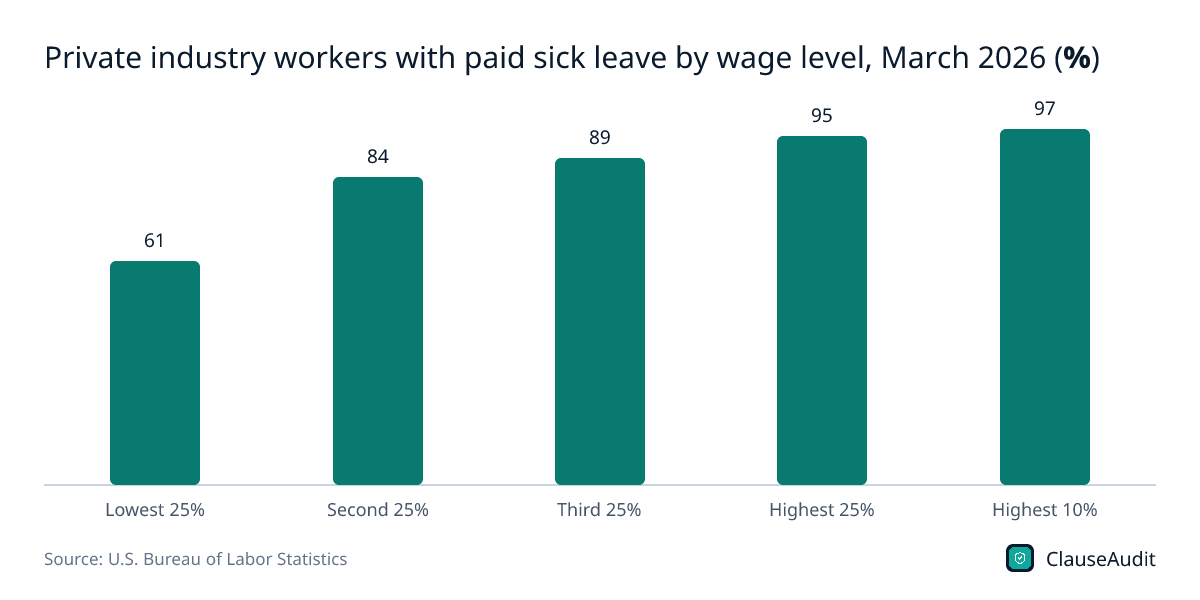
The workers who can least afford an unpaid day are the least likely to have paid sick leave. Only 61% of the lowest-paid quarter of private workers have it, against 95% of the highest-paid quarter.
Download this chart (PNG)Private industry workers with paid sick leave by Census division, March 2026 (%)
Chart data
| Label | Value |
|---|---|
| Pacific | 97 |
| New England | 90 |
| Middle Atlantic | 90 |
| Mountain | 88 |
| West North Central | 80 |
| East North Central | 78 |
| South Atlantic | 71 |
| West South Central | 71 |
| East South Central | 59 |
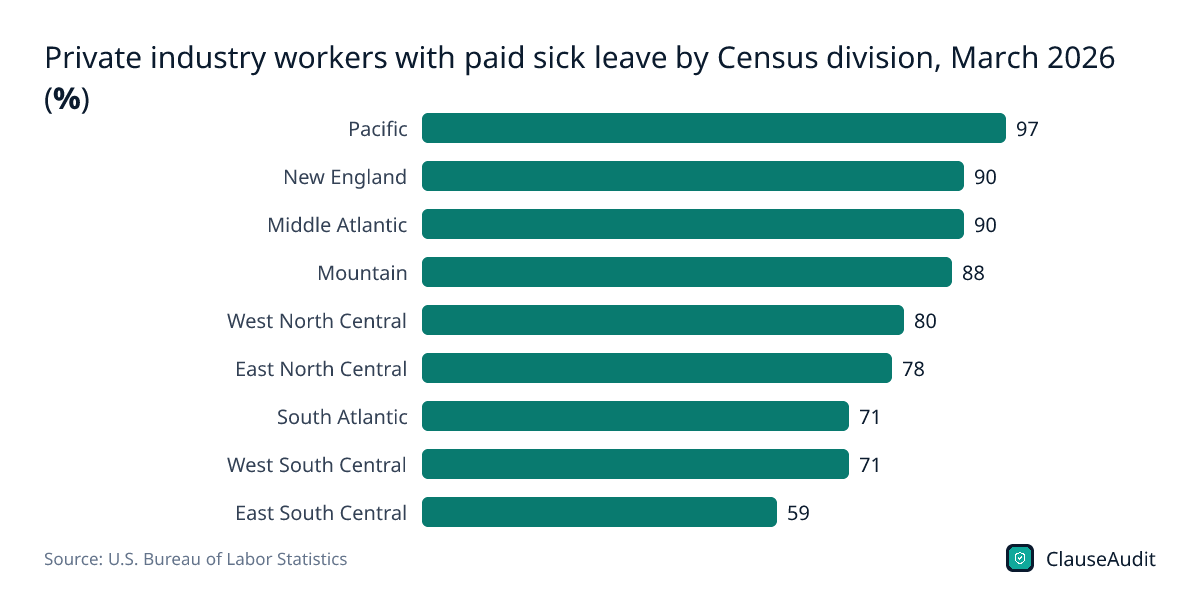
Geography tracks the law closely. The Pacific division, where 4 of 5 states have a mandate, reaches 97%, while East South Central, which has none, sits at 59%.
Download this chart (PNG)Private industry workers with paid sick leave by employer size, March 2026 (%)
Chart data
| Label | Value (%) |
|---|---|
| 1 to 49 workers | 75 |
| 50 to 99 workers | 73 |
| 100 to 499 workers | 87 |
| 500 or more workers | 91 |
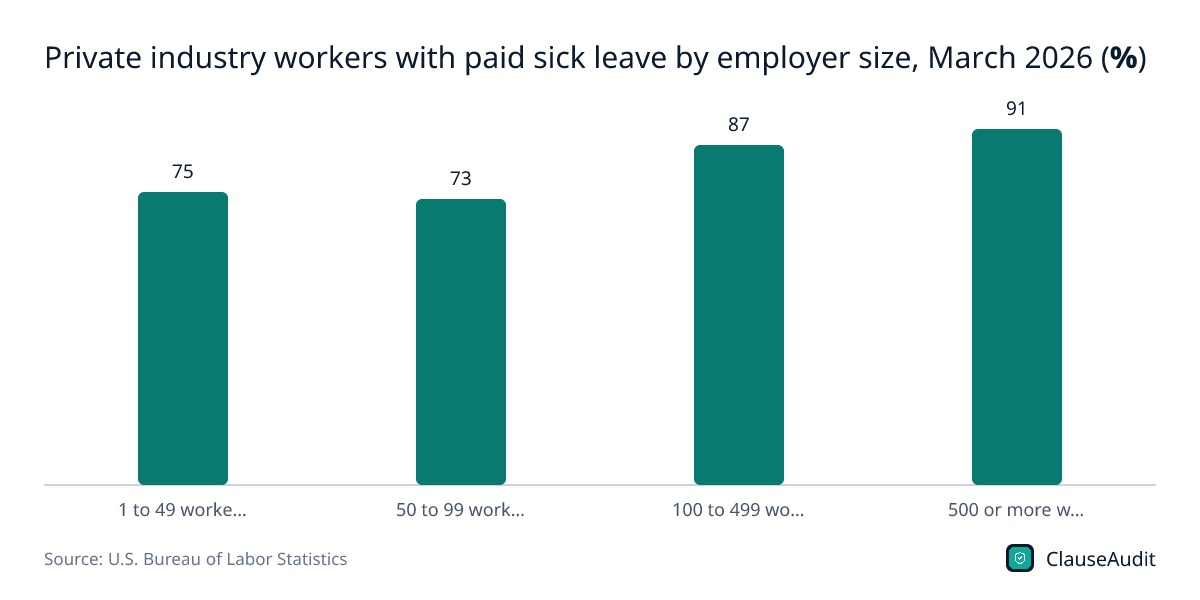
Small and midsize employers lag. Places with 1 to 49 workers cover 75% of staff and those with 50 to 99 cover 73%, compared with 91% at employers with 500 or more.
Download this chart (PNG)Access to paid sick leave by worker group, March 2026 (percent of workers)
| Worker group | Civilian | Private industry | State and local government |
|---|---|---|---|
| All workers | 83% | 81% | 93% |
| Full time | 90% | 88% | 99% |
| Part time | 59% | 59% | 54% |
| Union | 93% | 88% | 98% |
| Nonunion | 81% | 80% | 89% |
| Service occupations | 70% | 67% | 89% |
| Management, professional, and related | 94% | 93% | 94% |
| Sales and office | 83% | 82% | 93% |
| Natural resources, construction, and maintenance | 78% | 76% | 99% |
| Production, transportation, and material moving | 80% | 80% | 92% |
Source: U.S. Bureau of Labor Statistics, Table 6. Selected paid leave benefits: Access, March 2026. Download as image
Where paid sick leave depends on employer size (2026)
| State | Paid leave required for | Smaller employers |
|---|---|---|
| Connecticut | 11 or more employees | No requirement until January 1, 2027 |
| Maine (any reason) | More than 10 employees | No requirement |
| Maryland | 15 or more employees | Unpaid leave |
| Massachusetts | 11 or more employees | Unpaid leave |
| Nebraska | 11 or more employees | No requirement |
| Nevada (any reason) | 50 or more employees | No requirement |
| New York | 5 or more employees, or 4 or fewer with net income over $1 million | Unpaid leave |
| Oregon | 10 or more Oregon employees (6 or more with a Portland location) | Unpaid leave |
| Rhode Island | 18 or more employees | Unpaid leave |
Source: Connecticut Department of Labor, Paid Sick Leave Notice, C.G.S. §§ 31-57r to 31-57w (effective 1/1/2026); Maine Legislature, 26 M.R.S. § 637, Earned paid leave; Maryland Department of Labor, Maryland Healthy Working Families Act FAQs; Commonwealth of Massachusetts (Mass.gov), Massachusetts law about sick leave; New York State, Paid Sick Leave Eligibility and Information; Oregon Bureau of Labor and Industries, Sick Time; Congressional Research Service (text read via EveryCRSReport.com), Paid Sick Leave in the United States (R48921). Download as image
Statewide paid sick leave law by state
- 18Paid sick leave law in effect
- 3Paid leave for any reason
- 1Enacted, not yet in effect
- 29No statewide mandate
- Paid sick leave law in effect18
- Paid leave for any reason3
- Enacted, not yet in effect1
- No statewide mandate29
Which states require paid sick leave in 2026?
18 jurisdictions, counting DC, require private employers to give paid sick leave in 2026. That group includes Alaska and Nebraska, whose voter-approved laws are now in force, and Connecticut, which widened its law at the start of 2026. Another 3 states, Illinois, Maine and Nevada, take a different approach: they require paid leave that you can use for any reason, sick or not.
Virginia is the one to watch. Its statewide law was approved on May 20, 2026, and it takes effect July 1, 2027, phased in by employer size. Until then, Virginia's existing rule covers only certain home health workers.
Missouri went the other way. Voters passed a paid sick time law in 2024, and the legislature repealed it in 2025. If you work there, any sick pay you get now comes from your employer's policy, not the state.
One more wrinkle: a state with no mandate can still have a city or county that requires paid sick time. If you live in a no-mandate state, check your local rules before assuming you have nothing.
How much paid sick leave do you get per year?
Most laws give you two numbers: how fast you earn leave and how much you can use or carry in a year. The most common pattern is 1 hour earned for every 30 hours worked, with a yearly floor of 40 hours. Michigan lets larger employers cap use at 72 hours. Colorado and Minnesota set 48. New York gives 56 hours at employers with 100 or more staff and 40 at smaller ones.
California works a little differently. Employers must allow at least 40 hours or 5 days of use each year, whichever is more for you, and they may cap the total you can accrue at 80 hours or 10 days. DC counts in days, not hours, and gives 7 days a year at employers with 100 or more workers.
Accrual speed matters most if you work part time. In Vermont, you earn 1 hour for every 52 worked. In Washington, Illinois and Maine, it is 1 per 40. A part-time worker in a slower state may need most of the year to reach the floor, so the yearly number on the chart is a ceiling for many people, not a starting balance.
Does my employer have to give me paid sick leave if it is a small business?
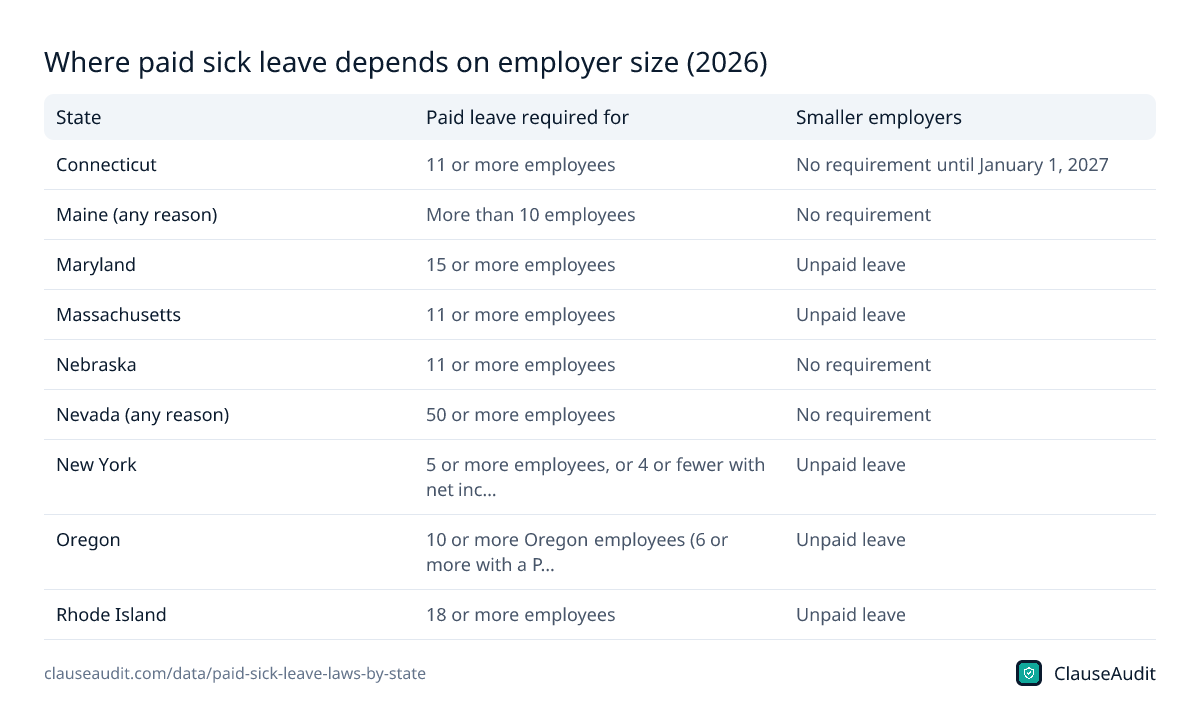
It depends on the state, and this is where a lot of people get caught out. Several laws only require paid leave above a headcount. Maryland's line is 15 employees, Massachusetts and Nebraska use 11, Rhode Island uses 18, and Nevada's any-reason law applies only at 50 or more.
Below those lines, some states still require unpaid, job-protected leave, while others require nothing at all. Connecticut covers employers with 11 or more workers now and expands to all employers from January 1, 2027.
The national numbers show why size matters. Among private workers, 75% at employers with 1 to 49 people have paid sick leave, compared with 91% at employers with 500 or more. If you are joining a small company, ask directly instead of assuming.
Who is most likely to go without paid sick leave?
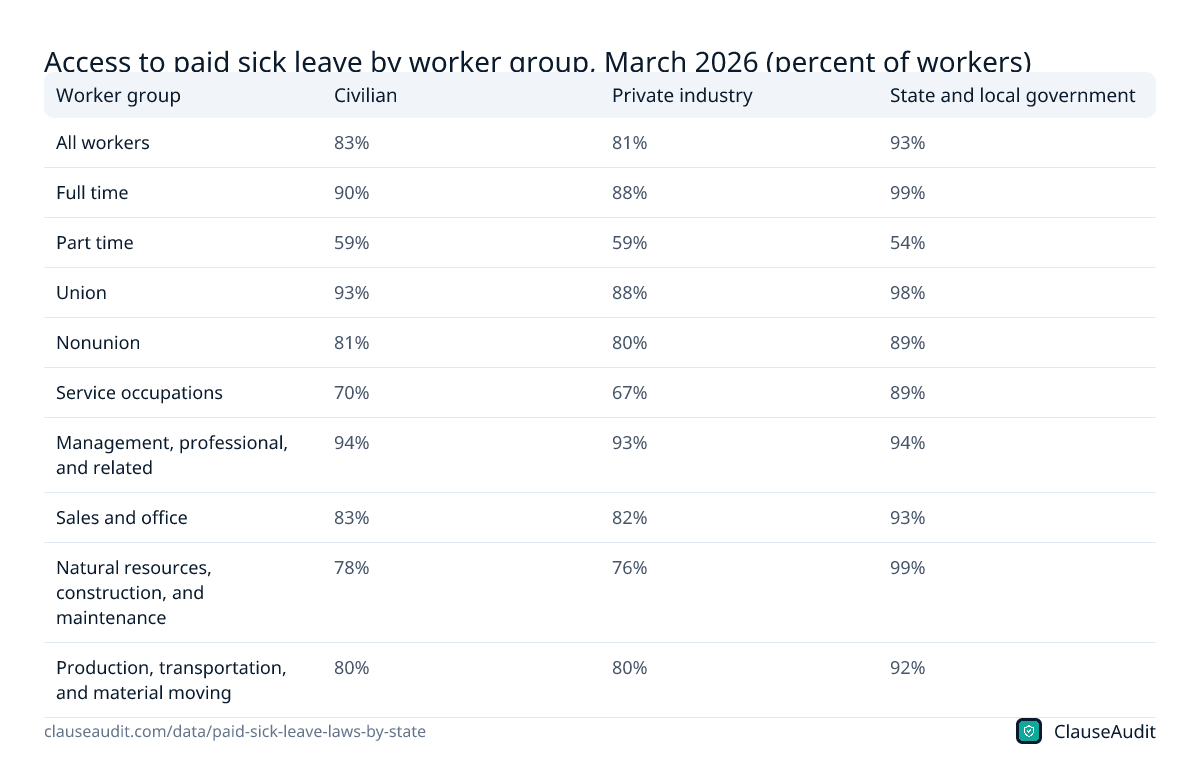
Across private industry, 81% of workers had paid sick leave in March 2026. That headline hides big gaps. Full-time private workers sit at 88%, but part-time workers are at 59%. Leisure and hospitality is the lowest industry at 58%, so restaurant, hotel and venue staff are the most exposed. State and local government workers do far better at 93%.
Pay level is the other big divide. The lowest-paid quarter of private workers are at 61%. For a line cook or a hotel housekeeper, one unpaid week of flu can mean a missed rent payment, which is exactly the situation these laws were written for.
Is paid sick leave the same as PTO or paid family leave?
Not quite, and mixing them up is how people end up short. Paid sick leave is short-term time off, usually for your own illness, a family member's illness or a medical appointment. Many state laws also allow it for related needs, such as dealing with domestic violence or a school closure, though the list varies by state.
PTO is whatever your employer decides to bundle together: vacation, personal days and sometimes sick time. If your employer runs one PTO bank, it can usually count toward the sick leave law, but only if it accrues at least as fast and you can use it for the same reasons. Spend it all on a beach trip in June and you may have nothing left for a fever in November.
Paid family leave is a separate program in many states, often funded through payroll deductions and paid by the state rather than your employer. It covers longer absences, like a new baby or a serious illness. Your offer letter may mention all three, so read each one on its own terms.
What this means for workers, employers and freelancers
- Workers: find your state on the map, then read your handbook. Many employers offer more than the minimum, and a combined PTO bank can satisfy the law if it meets the same accrual and use rules.
- Workers in no-mandate states: your sick pay lives entirely in your offer letter or policy. Get the number of days, the accrual rule and any waiting period in writing.
- Employers with staff in several states: the strictest rule usually wins for each employee, so a single national policy should meet the highest floor you face, such as 72 hours in Michigan or 56 in New York.
- Small businesses near a threshold: track headcount. Crossing 11, 15 or 50 employees can bring you under a paid leave requirement in some states.
- Freelancers and independent contractors: state sick leave laws generally cover employees, not people you hire on a 1099. If a client treats you like staff but calls you a contractor, that gap is worth questioning.
- Everyone: keep records of hours worked and leave used. Disputes over accrual are much easier to settle with your own log.
How ClauseAudit helps
State law sets a floor, but your offer letter, employment agreement and handbook decide how your leave actually works day to day. Wording like "sick time at manager discretion" or a policy the employer can change at any time can leave you with less than you expected, or less than the law requires.
Upload your contract and our automated review flags the leave terms in plain English, so you know what to ask about before you sign.
- Sick leave amount and accrual rate: is it stated, and does it meet your state's floor?
- Waiting periods before new hires can use leave
- Whether sick time sits inside a combined PTO bank, and what that does to carryover and payout
- Doctor's note or notice requirements that make leave hard to use in practice
- Unilateral change clauses that let the employer cut benefits without your consent
- Contractor labels on a role that looks like employment, which can strip you of leave rights
Frequently asked questions
Is paid sick leave required by federal law?
No. There is no federal law requiring private employers to provide paid sick leave. Your rights come from your state, sometimes your city, and your employer's own policy. In 2026, 18 jurisdictions including DC have a paid sick leave mandate, and Illinois, Maine and Nevada require paid leave usable for any reason.
How is paid sick leave usually earned?
Most state laws use an accrual rate of 1 hour of leave for every 30 hours you work. A few are slower: Washington, Illinois and Maine use 1 hour per 40, and Vermont uses 1 hour per 52. Some employers skip accrual and front-load a full year's balance on day one, which many state laws allow.
What is California's paid sick leave minimum in 2026?
California employers must let you use at least 40 hours or 5 days of paid sick leave each year, whichever gives you more. You earn it at 1 hour per 30 hours worked. Employers may cap total accrual at 80 hours or 10 days, so your balance will not grow forever.
How much sick time do Michigan workers get?
Michigan's law covers all employers, including small businesses since October 1, 2025. Workers earn 1 hour per 30 hours worked. Employers with 11 or more employees may cap use at 72 hours a year, and those with 10 or fewer may cap it at 40 hours.
When does Virginia's paid sick leave law start?
Virginia's statewide law was approved on May 20, 2026 and takes effect July 1, 2027. It is phased in by employer size and provides up to 5 days a year, earned at 1 hour per 30 hours worked. Until then, the current law covers only certain home health workers.
Do part-time workers get paid sick leave?
In states with a mandate, part-time employees usually earn leave the same way full-time staff do, just at a pace tied to the hours they actually work. In practice, access is much lower: only 59% of part-time private workers had paid sick leave in March 2026, compared with 88% of full-time workers.
Can my employer replace sick leave with general PTO?
Often, yes. Many state laws accept a combined PTO policy as long as it gives at least as much time, accrues at least as fast and can be used for the same reasons. Read your policy closely, because using PTO for a vacation can leave nothing for a sick day later in the year.
Do freelancers get paid sick leave?
State paid sick leave laws generally cover employees, not independent contractors. If you freelance, any sick pay has to come from your own rates and savings. If a client controls your schedule and treats you like staff, you may be misclassified, which can affect your rights to leave and other protections.
What should I do if my employer denies sick leave I have earned?
Write down the dates, hours worked and what you were told. Then contact your state labor department, which handles most sick leave complaints. Many state laws also bar retaliation for using leave. If your state has no mandate, your claim depends on what your contract or written policy promises.
Use this data
Every chart and card below is free to reuse under CC BY 4.0. Download what you need and link back to this page.
 Stat cards
 Key findings card
 Infographic
 Paid sick leave laws by type, 50 states + DC (October 2026) (jurisdictions)
 Paid sick leave hours employers must allow each year (largest employer tier) (hours per year)
 Hours an employee must work to earn 1 hour of paid sick leave (hours worked per hour of leave)
 Private industry workers with paid sick leave by wage level, March 2026 (%)
 Private industry workers with paid sick leave by Census division, March 2026 (%)
 Private industry workers with paid sick leave by employer size, March 2026 (%)
 Access to paid sick leave by worker group, March 2026 (percent of workers)
 Where paid sick leave depends on employer size (2026)
Embed the infographic
Free to share on your site, blog or slides under CC BY 4.0. Please keep the credit link.
Sources and method
Every number on this page comes from the sources below, each opened and read on or before October 18, 2026. A second, independent review checked every figure against its source and corrected anything that did not match. 51 of 51 state entries were confirmed; any that could not be are marked "Not yet confirmed" and left out of every count and chart.
- U.S. Bureau of Labor Statistics, Employee Benefits in the United States, March 2026 (USDL-26-1534) (September 25, 2026 (March 2026 reference period))
- U.S. Bureau of Labor Statistics, Table 6. Selected paid leave benefits: Access, March 2026 (September 25, 2026 (March 2026 reference period))
- Congressional Research Service (text read via EveryCRSReport.com), Paid Sick Leave in the United States (R48921) (April 28, 2026 (state data as of March 2026))
- Alaska Department of Labor and Workforce Development, Ballot Measure 1 FAQ (2025)
- Arizona State Legislature, A.R.S. § 23-372, Accrual of earned paid sick time (Current statute, read October 2026)
- California Labor Commissioner's Office (DIR), California Paid Sick Leave: Frequently Asked Questions (Current page, read October 2026)
- Colorado Department of Labor and Employment, Wage and Hour Laws (including Paid Sick Leave) (Current page, read October 2026)
- Connecticut Department of Labor, Paid Sick Leave Notice, C.G.S. §§ 31-57r to 31-57w (effective 1/1/2026) (Effective January 1, 2026)
- Council of the District of Columbia, D.C. Code § 32-531.02, Provision of paid leave (Current code, read October 2026)
- Illinois Department of Labor, Paid Leave for All Workers Act (PLAWA) Fact Sheet (Current fact sheet, read October 2026)
- Maine Legislature, 26 M.R.S. § 637, Earned paid leave (Current statute, read October 2026)
- Maryland Department of Labor, Maryland Healthy Working Families Act FAQs (Current page, read October 2026)
- Commonwealth of Massachusetts (Mass.gov), Massachusetts law about sick leave (Current page, read October 2026)
- Michigan Department of Labor and Economic Opportunity, Earned Sick Time (ESTA) FAQ (Current page, read October 2026)
- Minnesota Department of Labor and Industry, Earned sick and safe time (ESST) (Current page, read October 2026)
- New Jersey Department of Labor and Workforce Development, Earned Sick Leave (My Work Rights) (Current page, read October 2026)
- New York State, Paid Sick Leave Eligibility and Information (Current page, read October 2026)
- Oregon Bureau of Labor and Industries, Sick Time (Current page, read October 2026)
- Vermont Department of Labor, Earned Sick Time Act Notice of Employee Rights (Current notice, read October 2026)
- Washington State Department of Labor & Industries, Paid Sick Leave (Current page, read October 2026)
- Virginia Legislative Information System, HB 5 (2026 Regular Session), Employment; paid sick leave, civil penalties (Approved May 20, 2026 (Chapter 1128))
- Office of the Governor of Virginia, Governor Spanberger signs paid sick leave bill (news release) (May 20, 2026)
- Missouri House of Representatives, HCS#2 HBs 567, 546, 758 & 958 (Truly Agreed), Employee compensation (Approved by Governor July 10, 2025)
Cite this page
ClauseAudit, “Paid Sick Leave Laws by State (2026)”, updated October 18, 2026, https://clauseaudit.com/data/paid-sick-leave-laws-by-state. Free to reuse with a link back (CC BY 4.0).
This page summarises published data and law as checked on October 18, 2026. Figures are updated as new editions are released, and your own situation may differ. It is general information, not legal, tax or financial advice.