PTO Payout Laws by State (2026): Is Your Employer Required to Pay Unused Vacation?
By ClauseAudit Research · 40 sources ·
What are the PTO payout laws by state?
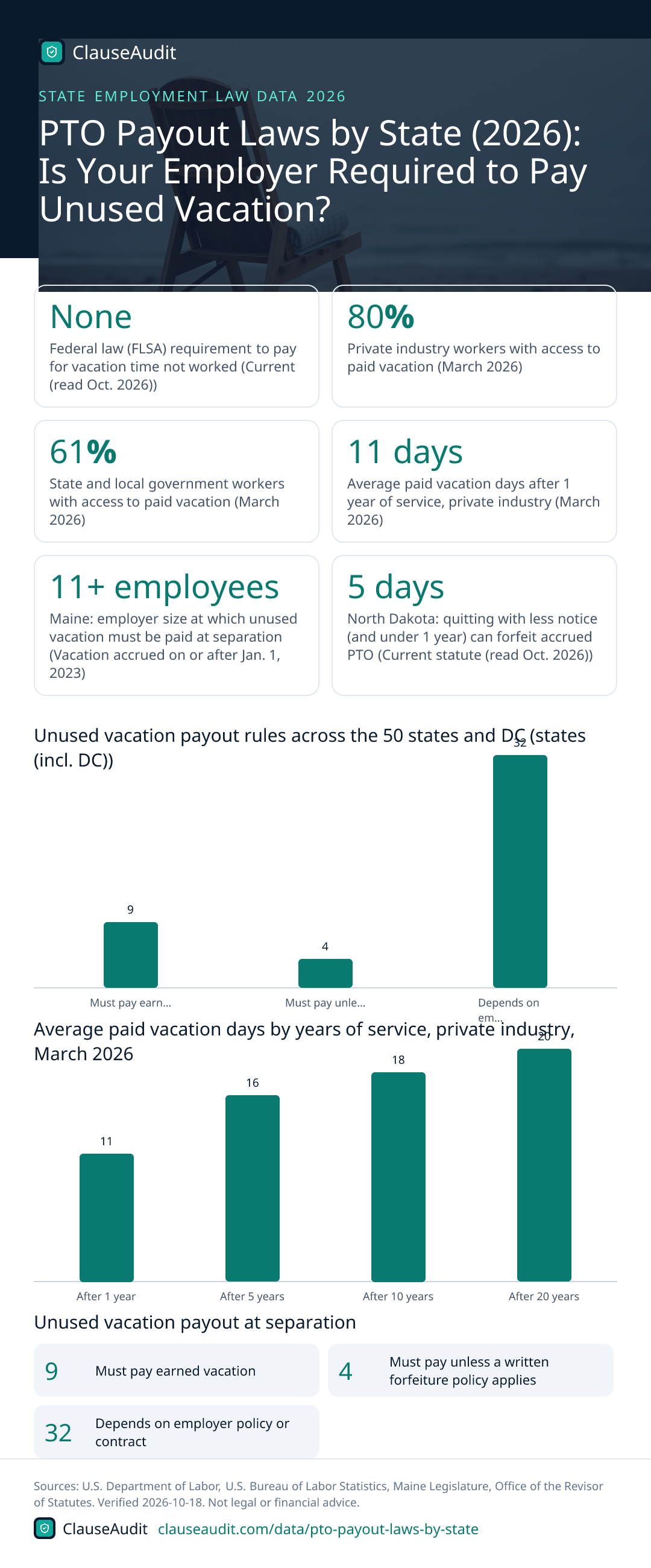
No federal law makes your employer pay out unused vacation, so state law and your employer's policy decide. Our count finds 9 states that require payout of earned vacation, 4 that require it unless a written forfeiture policy applies, and 32 jurisdictions, including D.C., where the employer's policy controls.

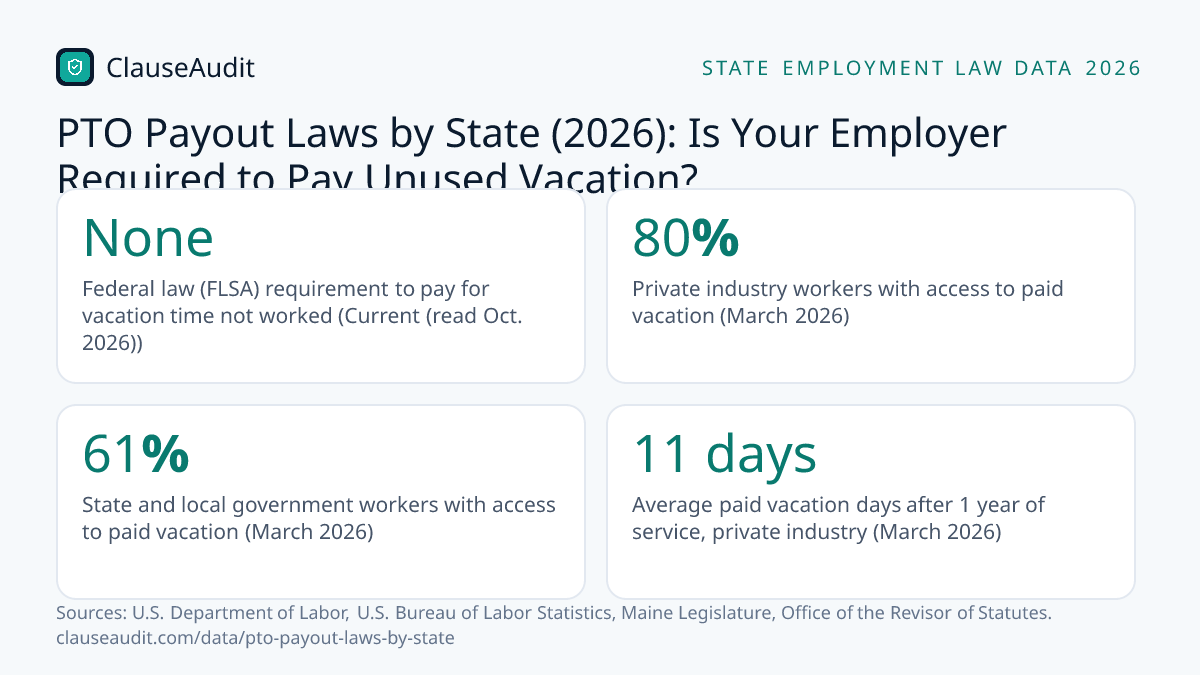
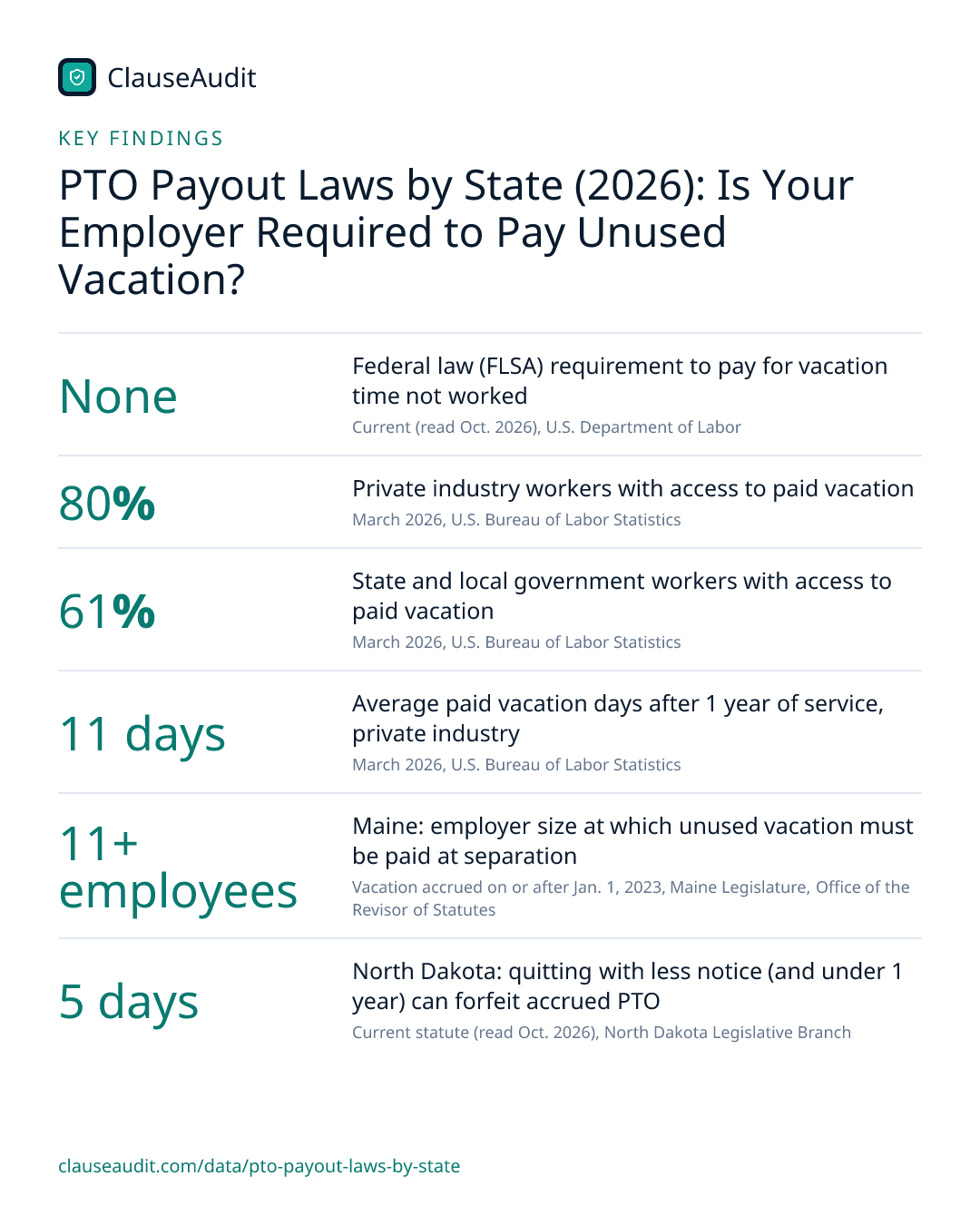
- Federal law (FLSA) requirement to pay for vacation time not worked (Current (read Oct. 2026), U.S. Department of Labor)
- None
- Private industry workers with access to paid vacation (March 2026, U.S. Bureau of Labor Statistics)
- 80%
- State and local government workers with access to paid vacation (March 2026, U.S. Bureau of Labor Statistics)
- 61%
- Average paid vacation days after 1 year of service, private industry (March 2026, U.S. Bureau of Labor Statistics)
- 11 days
- Maine: employer size at which unused vacation must be paid at separation (Vacation accrued on or after Jan. 1, 2023, Maine Legislature, Office of the Revisor of Statutes)
- 11+ employees
- North Dakota: quitting with less notice (and under 1 year) can forfeit accrued PTO (Current statute (read Oct. 2026), North Dakota Legislative Branch)
- 5 days
- Colorado: furlough length beyond which all earned vacation must be paid out (INFO #3E, May 29, 2024, Colorado Department of Labor and Employment, Division of Labor Standards and Statistics)
- 30 days
- Delaware: deadline to pay promised vacation pay after it becomes due (Current statute (read Oct. 2026), Delaware General Assembly)
- 30 days
You give notice, you have vacation days saved up, and you want to know if that time turns into a check. The answer depends almost entirely on where you work. Federal wage law stays out of it, so each state sets its own rule, and many states simply defer to whatever your employer wrote down.
That makes the policy itself the document that matters most. In a state like California, earned vacation is owed no matter what the handbook says. In most of the country, a single sentence in an offer letter or PTO policy decides whether you walk away with that pay or lose it. This page shows where your state lands and what to look for in the paperwork.
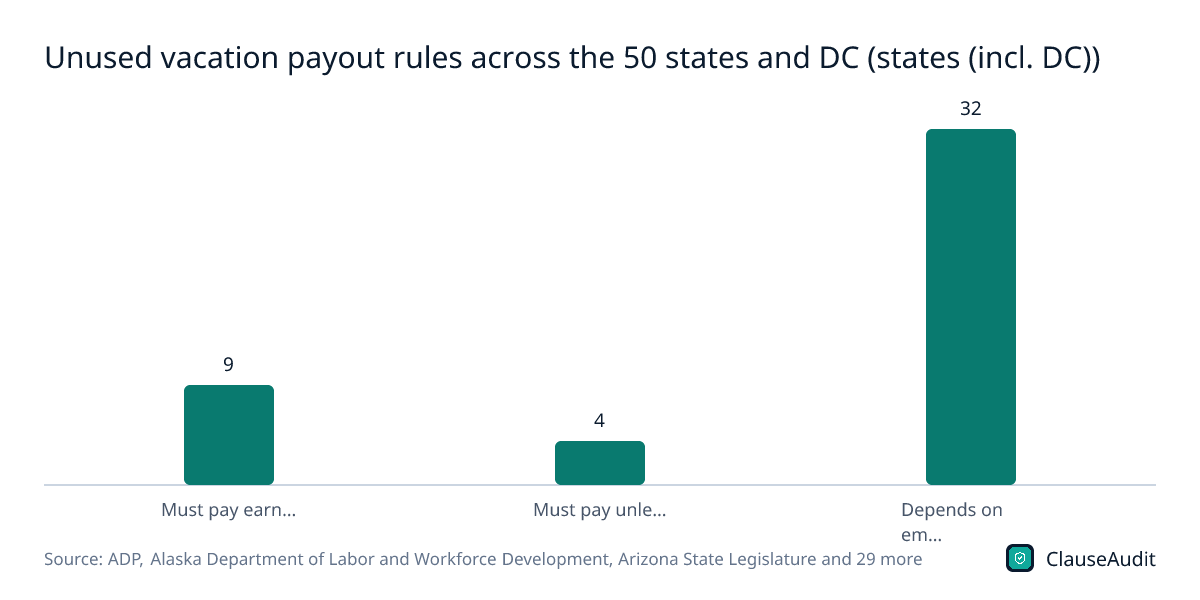
Unused vacation payout rules across the 50 states and DC (states (incl. DC))
Chart data
| Label | Value (states (incl. DC)) |
|---|---|
| Must pay earned vacation | 9 |
| Must pay unless written forfeiture policy | 4 |
| Depends on employer policy | 32 |
Most states leave payout to the employer's policy, with 32 jurisdictions (D.C. included) in that group. Only 9 force payout of earned vacation outright, and 4 more require it unless a written forfeiture policy was given to employees. Six jurisdictions where sources conflict or could not be confirmed are left out of the count.
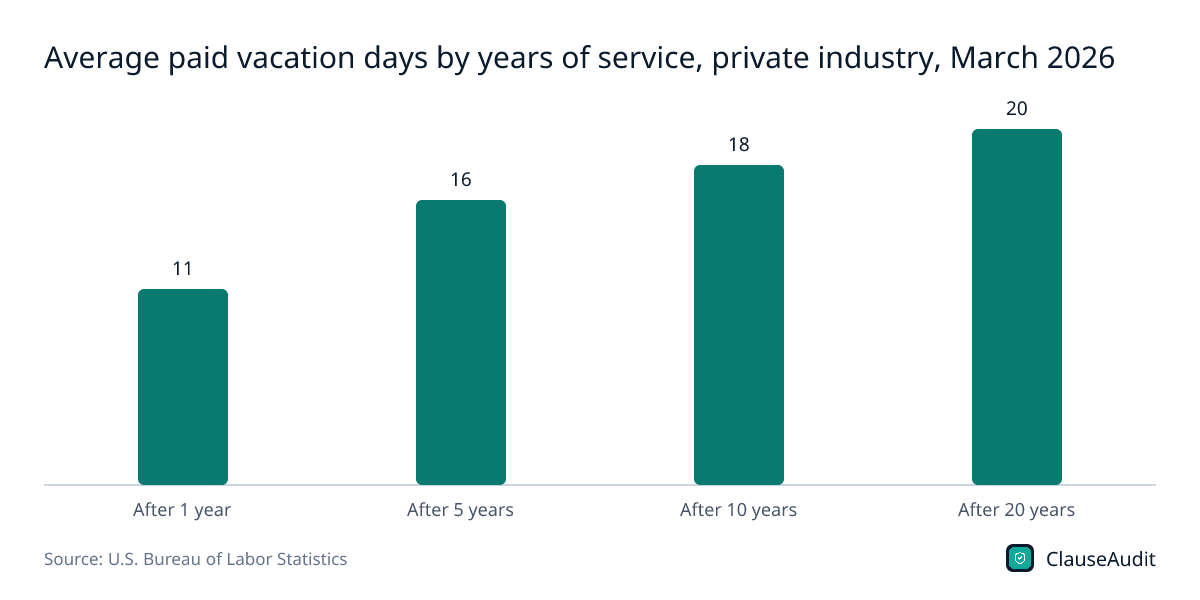
Download this chart (PNG)Average paid vacation days by years of service, private industry, March 2026
Chart data
| Label | Value |
|---|---|
| After 1 year | 11 |
| After 5 years | 16 |
| After 10 years | 18 |
| After 20 years | 20 |
Vacation grows with tenure, from 11 days after 1 year to 20 days after 20 years in private industry. The longer you stay, the bigger the balance that a payout rule puts at stake.
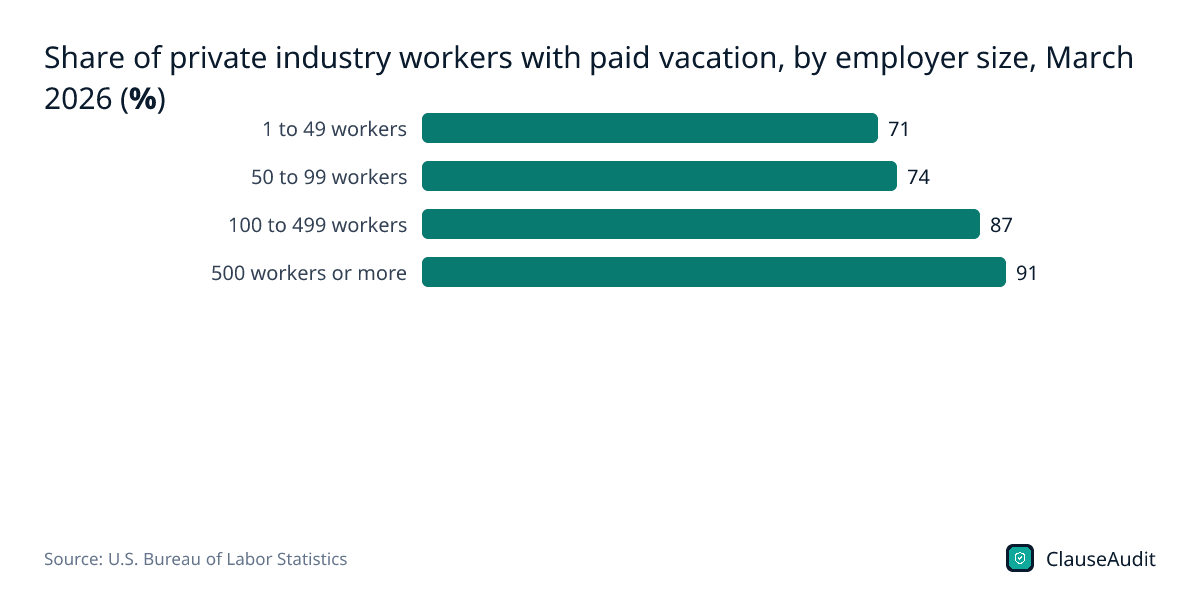
Download this chart (PNG)Share of private industry workers with paid vacation, by employer size, March 2026 (%)
Chart data
| Label | Value |
|---|---|
| 1 to 49 workers | 71 |
| 50 to 99 workers | 74 |
| 100 to 499 workers | 87 |
| 500 workers or more | 91 |
Small employers are the least likely to offer paid vacation, at 71% for firms with 1 to 49 workers against 91% at firms with 500 or more. If you work for a small company, check whether vacation is offered at all before you plan around a payout.
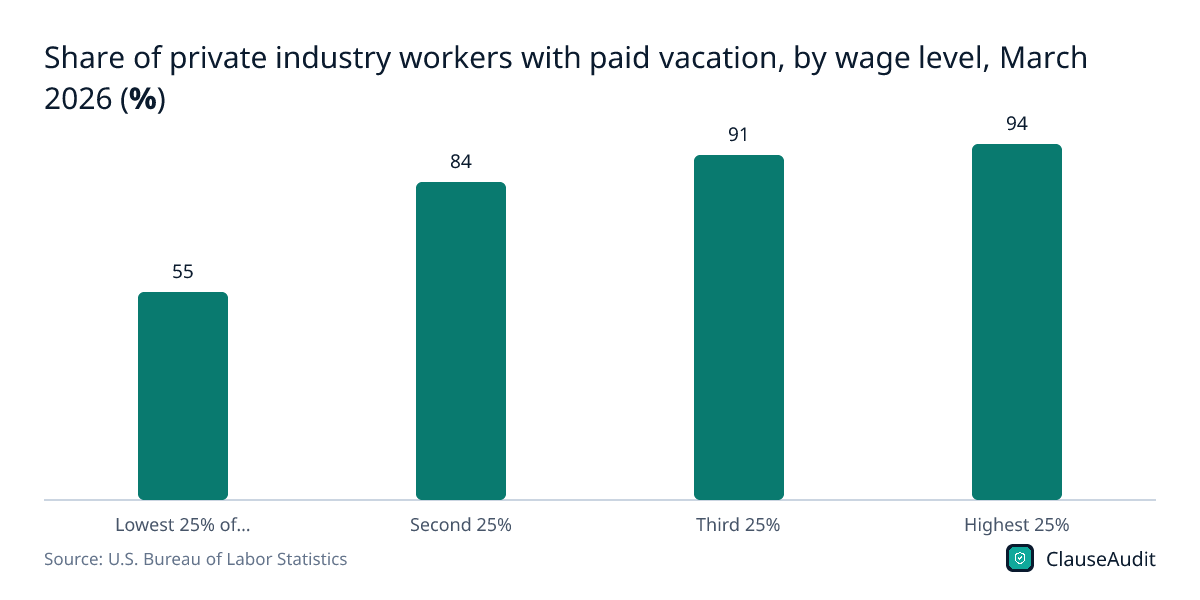
Download this chart (PNG)Share of private industry workers with paid vacation, by wage level, March 2026 (%)
Chart data
| Label | Value (%) |
|---|---|
| Lowest 25% of wages | 55 |
| Second 25% | 84 |
| Third 25% | 91 |
| Highest 25% | 94 |
Only 55% of workers in the lowest wage quarter have paid vacation, compared with 94% at the top. The workers with the least cushion are the ones most likely to have no vacation to cash out at all.
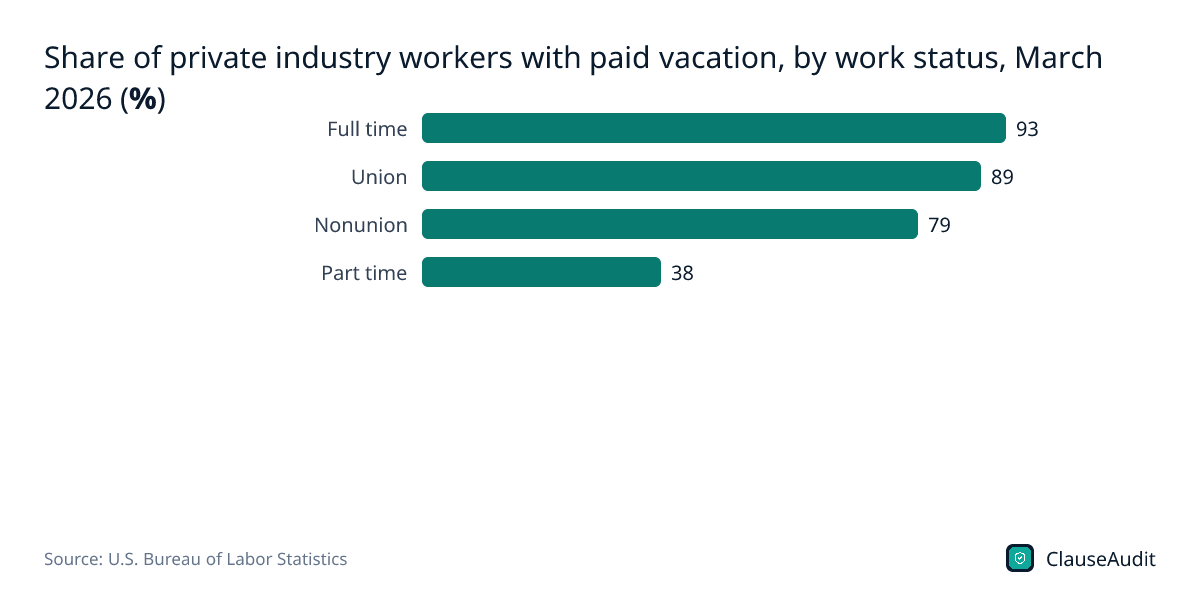
Download this chart (PNG)Share of private industry workers with paid vacation, by work status, March 2026 (%)
Chart data
| Label | Value |
|---|---|
| Full time | 93 |
| Union | 89 |
| Nonunion | 79 |
| Part time | 38 |
Part-time work is the big gap: 38% of part-time private workers have paid vacation, against 93% of full-time workers. If you work part time, check whether your role earns vacation before you count on a payout.
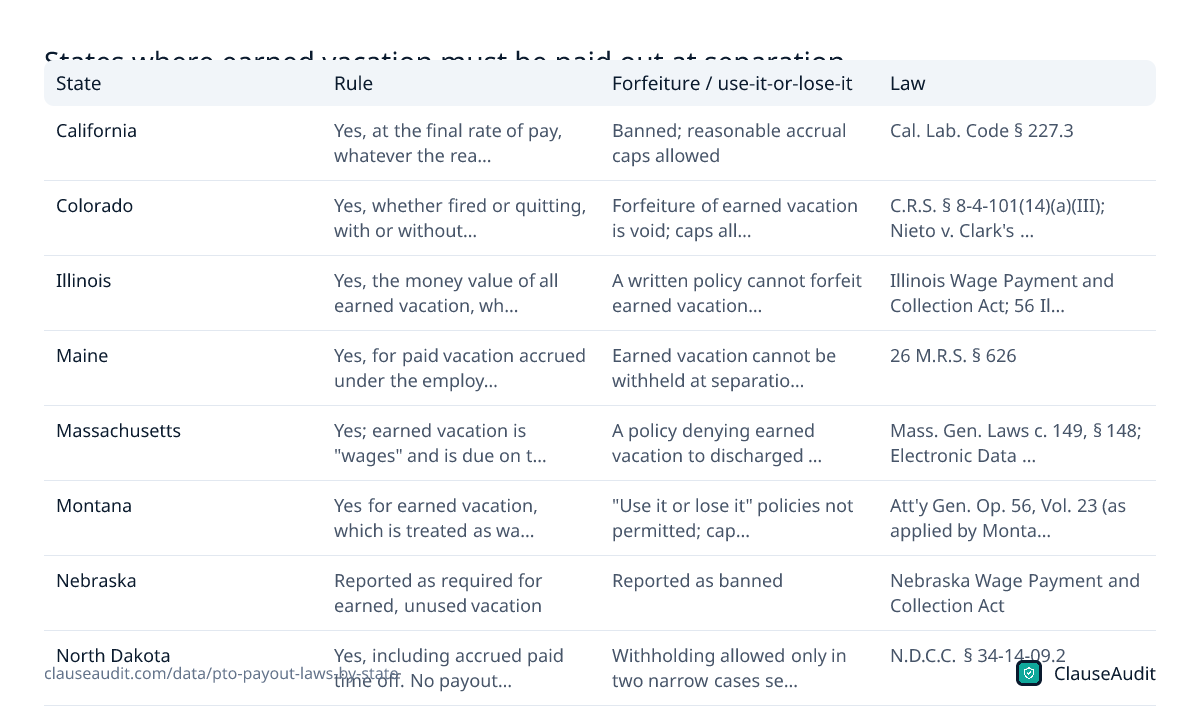
Download this chart (PNG)States where earned vacation must be paid out at separation
| State | Rule | Forfeiture / use-it-or-lose-it | Law |
|---|---|---|---|
| California | Yes, at the final rate of pay, whatever the reason for leaving. PTO plans follow the same rules as vacation; no law requires offering vacation | Banned; reasonable accrual caps allowed | Cal. Lab. Code § 227.3 |
| Colorado | Yes, whether fired or quitting, with or without notice. A bona fide furlough of up to 30 days is not a separation | Forfeiture of earned vacation is void; caps allowed | C.R.S. § 8-4-101(14)(a)(III); Nieto v. Clark's Market, 2021 CO 48; 7 CCR 1103-7 Rule 2.17 |
| Illinois | Yes, the money value of all earned vacation, whether the employee quits or is fired. Pro rata vacation earned in the current year is owed | A written policy cannot forfeit earned vacation; use-it-or-lose-it is allowed during employment with notice and a reasonable chance to use it | Illinois Wage Payment and Collection Act; 56 Ill. Adm. Code 300.520 |
| Maine | Yes, for paid vacation accrued under the employer's policy on or after Jan. 1, 2023. Employers with 10 or fewer employees and public employers are exempt; a collective bargaining agreement can supersede | Earned vacation cannot be withheld at separation by covered employers; statute silent on year-end resets | 26 M.R.S. § 626 |
| Massachusetts | Yes; earned vacation is "wages" and is due on the day of discharge. Whether the same applies to voluntary resignations was left open by the court | A policy denying earned vacation to discharged employees violates the Wage Act (EDS, 2009) | Mass. Gen. Laws c. 149, § 148; Electronic Data Systems Corp. v. Attorney General (SJC 2009) |
| Montana | Yes for earned vacation, which is treated as wages (Attorney General Opinion 56, Vol. 23). PTO, sick leave and severance payout follow employer policy (McConkey v. Flathead Electric Cooperative) | "Use it or lose it" policies not permitted; caps allowed | Att'y Gen. Op. 56, Vol. 23 (as applied by Montana DLI) |
| Nebraska | Reported as required for earned, unused vacation | Reported as banned | Nebraska Wage Payment and Collection Act |
| North Dakota | Yes, including accrued paid time off. No payout if the employee quit with under 5 days' notice, worked under 1 year and was told in writing at hire; unearned awarded PTO can also be withheld with prior written notice | Withholding allowed only in two narrow cases set by statute | N.D.C.C. § 34-14-09.2 |
| Rhode Island | Reported as required after one year of service | Reported as not allowed after one year of service | See source |
Source: ADP, Final pay and PTO payout: When are they required?; California Labor Commissioner (DLSE), Department of Industrial Relations, Vacation (Frequently Asked Questions), citing Labor Code § 227.3; Colorado Department of Labor and Employment, Division of Labor Standards and Statistics, INFO #3E: Payment of Earned Vacation upon Separation of Employment; Illinois Department of Labor, Vacation FAQ (Illinois Wage Payment and Collection Act; 56 Ill. Adm. Code 300.520); Indeavor, Paid Time Off (PTO) Payout Compliance Laws by State; Littler Mendelson P.C., Massachusetts High Court Rules Terminated Employees Must Be Paid for Unused Vacation (Electronic Data Systems Corp. v. Attorney General); Onecle (reproduction of Massachusetts General Laws; official malegislature.gov site was unreachable), Massachusetts General Laws c. 149, § 148 (Wage Act), text as reproduced by Onecle; Maine Legislature, Office of the Revisor of Statutes, 26 M.R.S. § 626, Cessation of employment; Montana Department of Labor & Industry, Employment Relations Division, Wage and Hour FAQ: Holiday, Vacation, Sick and Severance Pay; North Dakota Legislative Branch, N.D. Century Code chapter 34-14 (§ 34-14-09.2, Limitations on accrued paid time off); Paycor, PTO Payout Laws by State. Download as image
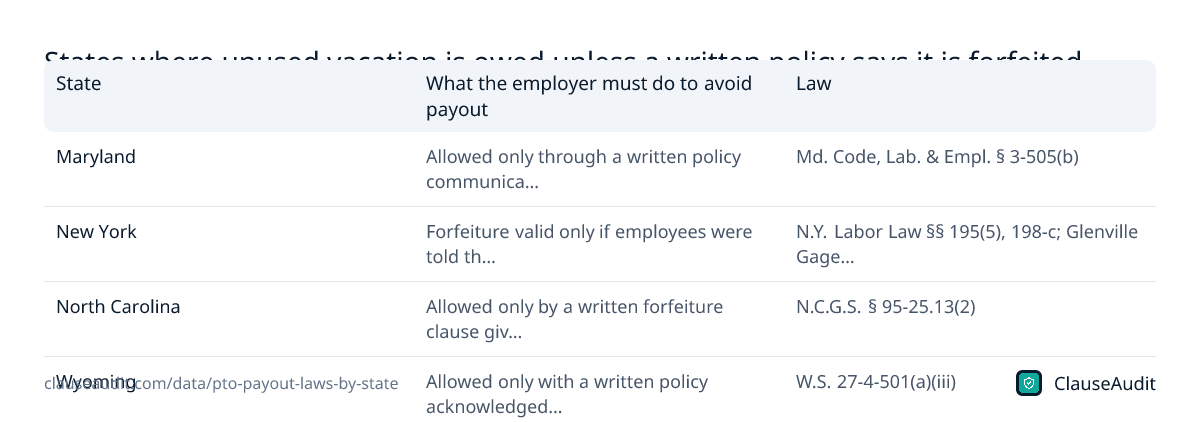
States where unused vacation is owed unless a written policy says it is forfeited
| State | What the employer must do to avoid payout | Law |
|---|---|---|
| Maryland | Allowed only through a written policy communicated to employees | Md. Code, Lab. & Empl. § 3-505(b) |
| New York | Forfeiture valid only if employees were told the conditions in writing | N.Y. Labor Law §§ 195(5), 198-c; Glenville Gage Co. v. Industrial Bd. of Appeals (1979) |
| North Carolina | Allowed only by a written forfeiture clause given to employees | N.C.G.S. § 95-25.13(2) |
| Wyoming | Allowed only with a written policy acknowledged in writing by the employee | W.S. 27-4-501(a)(iii) |
Source: Maryland General Assembly, Maryland Code, Labor and Employment § 3-505; North Carolina Department of Labor, Promised Wages Including Wage Benefits; New York State Department of Labor, Wages and Hours Frequently Asked Questions; Wyoming Legislature, Wyoming Statutes Title 27, Labor and Employment (W.S. 27-4-501). Download as image
Unused vacation payout at separation by state
- 9Must pay earned vacation
- 4Must pay unless a written forfeiture policy applies
- 32Depends on employer policy or contract
- Must pay earned vacation9
- Must pay unless a written forfeiture policy applies4
- Depends on employer policy or contract32
- Not yet confirmed6
| State | Paid out at separation? | Forfeiture / use-it-or-lose-it | Key condition | Source |
|---|---|---|---|---|
| Alabama | Only if the employer policy, contract or practice promises it | Not addressed by a state statute | No state wage-payment rules; U.S. DOL lists Alabama as "No regulations or not specified" for paydays | U.S. Department of Labor, Wage and Hour Division, State Payday Requirements |
| Alaska | Only if the employer policy, contract or practice promises it | Not addressed by a state statute | Wage claims may include vacation pay; accrued vacation counts in the "rate of pay" only where it is a contractual condition of employment | AS 23.05 (wage and hour statutes as reprinted by DOLWD) |
| Arizona | Only if the employer policy, contract or practice promises it | Not addressed by a state statute | Final pay covers "wages"; the statutory definition does not mention vacation | A.R.S. § 23-350 |
| Arkansas | Only if the employer policy, contract or practice promises it | Not addressed by a state statute | No state statute on vacation payout found | Paycor, PTO Payout Laws by State |
| California | Yes, at the final rate of pay, whatever the reason for leaving | Banned; reasonable accrual caps allowed | PTO plans follow the same rules as vacation; no law requires offering vacation | Cal. Lab. Code § 227.3 |
| Colorado | Yes, whether fired or quitting, with or without notice | Forfeiture of earned vacation is void; caps allowed | A bona fide furlough of up to 30 days is not a separation | C.R.S. § 8-4-101(14)(a)(III); Nieto v. Clark's Market, 2021 CO 48; 7 CCR 1103-7 Rule 2.17 |
| Connecticut | Only if the employer policy, contract or practice promises it | Not addressed by a state statute | Employers must make vacation pay policies available to employees in writing or by posted notice | Conn. Gen. Stat. § 31-71f |
| Delaware | Only if the employer policy, contract or practice promises it | Not addressed by a state statute | If an employer agrees to provide vacation pay, it must be paid within 30 days after it becomes due | 19 Del. C. § 1109 |
| District of Columbia | Only if the employer policy, contract or practice promises it | Not addressed by a state statute | "Wages" include fringe benefits paid in cash and pay promised under an employment contract | D.C. Code § 32-1301(3) |
| Florida | Only if the employer policy, contract or practice promises it | Not addressed by a state statute | No state wage-payment rules; U.S. DOL lists Florida as "No regulations or not specified" for paydays | U.S. Department of Labor, Wage and Hour Division, State Payday Requirements |
| Georgia | Only if the employer policy, contract or practice promises it | Not addressed by a state statute | No state statute on vacation payout found | Paycor, PTO Payout Laws by State |
| Hawaii | Only if the employer policy, contract or practice promises it | Not addressed by a state statute | No state statute on vacation payout found | Paycor, PTO Payout Laws by State |
| Idaho | Only if the employer policy, contract or practice promises it | Not addressed by a state statute | Idaho Department of Labor: state law does not require vacation, holiday, severance or sick pay | Idaho Department of Labor, Guide to Idaho Labor Laws |
| Illinois | Yes, the money value of all earned vacation, whether the employee quits or is fired | A written policy cannot forfeit earned vacation; use-it-or-lose-it is allowed during employment with notice and a reasonable chance to use it | Pro rata vacation earned in the current year is owed | Illinois Wage Payment and Collection Act; 56 Ill. Adm. Code 300.520 |
| Indiana | Not yet confirmed: check the source | Paycor, PTO Payout Laws by State | ||
| Iowa | Owed if due under the employer's agreement or policy; pro rata if the policy provides pro rata accrual | Not addressed by statute | Vacation due under an agreement or policy is "wages" | Iowa Code §§ 91A.2(7)(b), 91A.4 |
| Kansas | Only if the employer policy, contract or practice promises it | Not addressed by a state statute | Kansas courts: absent agreement, nothing requires converting vacation to a lump-sum payment (Mid America Aerospace, 1985) | K.S.A. 44-313(c) |
| Kentucky | Only if the employer policy, contract or practice promises it | Not addressed by a state statute | All wages earned are due by the next pay period or 14 days after leaving, whichever is later | KRS 337.055 |
| Louisiana | Not yet confirmed: check the source | ADP, Final pay and PTO payout: When are they required? | ||
| Maine | Yes, for paid vacation accrued under the employer's policy on or after Jan. 1, 2023 | Earned vacation cannot be withheld at separation by covered employers; statute silent on year-end resets | Employers with 10 or fewer employees and public employers are exempt; a collective bargaining agreement can supersede | 26 M.R.S. § 626 |
| Maryland | Yes, unless a written policy limits payout and the employee was told of it at hiring | Allowed only through a written policy communicated to employees | All three conditions in § 3-505(b) must be met to withhold accrued leave | Md. Code, Lab. & Empl. § 3-505(b) |
| Massachusetts | Yes; earned vacation is "wages" and is due on the day of discharge | A policy denying earned vacation to discharged employees violates the Wage Act (EDS, 2009) | Whether the same applies to voluntary resignations was left open by the court | Mass. Gen. Laws c. 149, § 148; Electronic Data Systems Corp. v. Attorney General (SJC 2009) |
| Michigan | Only if the employer policy, contract or practice promises it | Not addressed by a state statute | Fringe benefits are paid per written contract or policy (secondary summaries) | Paycor, PTO Payout Laws by State |
| Minnesota | Only if the employer policy, contract or practice promises it | Not addressed by a state statute | Final wages due on demand after discharge; statute does not mention vacation | Minn. Stat. § 181.13 |
| Mississippi | Only if the employer policy, contract or practice promises it | Not addressed by a state statute | No state statute on vacation payout found | Paycor, PTO Payout Laws by State |
| Missouri | Only if the employer policy, contract or practice promises it | Not addressed by a state statute | No state statute on vacation payout found | Paycor, PTO Payout Laws by State |
| Montana | Yes for earned vacation, which is treated as wages (Attorney General Opinion 56, Vol. 23) | "Use it or lose it" policies not permitted; caps allowed | PTO, sick leave and severance payout follow employer policy (McConkey v. Flathead Electric Cooperative) | Att'y Gen. Op. 56, Vol. 23 (as applied by Montana DLI) |
| Nebraska | Reported as required for earned, unused vacation | Reported as banned | Vacation is treated as wages under the Wage Payment and Collection Act | Nebraska Wage Payment and Collection Act |
| Nevada | Only if the employer policy, contract or practice promises it | Not addressed by a state statute | No state statute on vacation payout found | Paycor, PTO Payout Laws by State |
| New Hampshire | Only if the employer policy, contract or practice promises it | Not addressed by a state statute | No state statute requiring payout found | Paycor, PTO Payout Laws by State |
| New Jersey | Only if the employer policy, contract or practice promises it | Not addressed by a state statute | Vacation is not wages unless a policy, agreement or union contract says so (secondary summaries) | Paycor, PTO Payout Laws by State |
| New Mexico | Not yet confirmed: check the source | Paycor, PTO Payout Laws by State | ||
| New York | Yes, unless a written policy told employees the vacation is forfeited | Forfeiture valid only if employees were told the conditions in writing | Vacation pay is a "wage supplement"; an unwritten policy or past practice can be enforced | N.Y. Labor Law §§ 195(5), 198-c; Glenville Gage Co. v. Industrial Bd. of Appeals (1979) |
| North Carolina | Yes, unless a written forfeiture clause applies to the reason employment ended | Allowed only by a written forfeiture clause given to employees | NCDOL treats PTO as vacation pay; sick leave need not be paid unless the policy says so | N.C.G.S. § 95-25.13(2) |
| North Dakota | Yes, including accrued paid time off | Withholding allowed only in two narrow cases set by statute | No payout if the employee quit with under 5 days' notice, worked under 1 year and was told in writing at hire; unearned awarded PTO can also be withheld with prior written notice | N.D.C.C. § 34-14-09.2 |
| Ohio | Not yet confirmed: check the source | Paycor, PTO Payout Laws by State | ||
| Oklahoma | Only if the employer policy, contract or practice promises it | Not addressed by a state statute | "Wages" include vacation pay agreed between employer and employee, or provided in an established policy, when earned and due | 40 O.S. § 165.1(7) |
| Oregon | Only if the employer's established policy or agreement provides payout | Not addressed by BOLI guidance | Employers must honor any established policy on paying accrued vacation at termination | Oregon Bureau of Labor and Industries, Benefits, holiday and vacation pay |
| Pennsylvania | Only if the employer policy, contract or practice promises it | Not addressed by a state statute | No state statute requiring payout found | Paycor, PTO Payout Laws by State |
| Rhode Island | Reported as required after one year of service | Reported as not allowed after one year of service | Earned vacation reportedly becomes wages after 1 year with the employer | ADP, Final pay and PTO payout: When are they required? |
| South Carolina | Owed if due under the employer policy or employment contract | Not addressed by statute | "Wages" include vacation payments due under any employer policy or employment contract | S.C. Code § 41-10-10(2) |
| South Dakota | Only if the employer policy, contract or practice promises it | Not addressed by a state statute | Unpaid wages due by the next regular payday after separation; statute does not mention vacation | SDCL 60-11-10 |
| Tennessee | No, unless the employer's policy or labor agreement specifically requires it | Not addressed by state law | No Tennessee law regulates fringe benefits such as PTO or vacation | Tenn. Code Ann. § 50-2-103(a)(3) |
| Texas | Only if the employer policy, contract or practice promises it | Not addressed by a state statute | No state statute requiring payout found | Paycor, PTO Payout Laws by State |
| Utah | Not yet confirmed: check the source | Paycor, PTO Payout Laws by State | ||
| Vermont | Only if the employer policy, contract or practice promises it | Not addressed by a state statute | No state statute requiring payout found | Paycor, PTO Payout Laws by State |
| Virginia | Only if the employer policy, contract or practice promises it | Not addressed by a state statute | Wage payment statute does not mention vacation | Va. Code § 40.1-29 |
| Washington | Only if agreed; vacation is a voluntary benefit | Not addressed by L&I guidance | Paid sick leave balances follow separate rules | Washington State Department of Labor & Industries, Getting Paid: Final paychecks |
| West Virginia | Accrued vacation is part of final "wages", calculated per the employer's agreement | Not addressed by statute | Fringe benefits payable at a future date or on conditions under the agreement are paid per its terms | W. Va. Code §§ 21-5-1(c), (l); 21-5-4 |
| Wisconsin | Not yet confirmed: check the source | Paycor, PTO Payout Laws by State | ||
| Wyoming | Yes, unless a written policy says accrued vacation is forfeited and the employee acknowledged it in writing | Allowed only with a written policy acknowledged in writing by the employee | Wage collection law counts accrued vacation as wages by default | W.S. 27-4-501(a)(iii) |
Does my employer have to pay out unused PTO when I quit?
Not under federal law. The Fair Labor Standards Act does not require pay for time not worked, so the federal requirement here is none. Everything comes down to two things: your state's wage law and the promise your employer made.
In the 9 states that require payout, earned vacation is treated as wages you already earned. Your employer owes it whether you quit or were fired, the same way it owes your last week of salary. In the 4 states that require payout unless a written forfeiture policy applies, the default protects you, but a clear written rule can take it away.
Everywhere else, the policy is the contract. If your handbook says accrued vacation is paid at separation, your employer has to honor that. If it says unused time is forfeited, you usually have no claim. Read the policy before you set your last day, not after.
Which states require PTO payout?
The 9 states that require payout of earned vacation are California, Colorado, Illinois, Maine, Massachusetts, Montana, Nebraska, North Dakota and Rhode Island. They share a principle but differ on the details, and the details are where people get caught.
California pays earned vacation at your final rate of pay, whatever the reason you left, and treats PTO plans the same way. Colorado and Illinois pay whether you quit or are fired, and Illinois counts pro rata vacation you earned in the current year. Maine covers only employers with 11+ employees and vacation accrued on or after Jan. 1, 2023. North Dakota lets an employer withhold payout only if you quit with less than 5 days' notice, worked there under 1 year, and were told about the limit in writing when you were hired.
Massachusetts is the odd one. Earned vacation is due on the day you are discharged, but the court in the 2009 EDS case left open whether the same applies when you resign. Nebraska and Rhode Island are classified from secondary summaries, so confirm with the state labor department if a large balance is at stake.
Maryland, New York, North Carolina and Wyoming make up the written-policy group. In each, unused vacation is owed unless the employer put the forfeiture rule in writing. Wyoming goes further and wants the employee's written acknowledgment. In New York, even an unwritten policy or past practice of paying out can be enforced.
Can my employer have a use-it-or-lose-it policy?
It depends on what the policy takes away and when. There is a real difference between a year-end reset and a forfeiture at the door.
California bans use-it-or-lose-it outright, and Colorado voids any forfeiture of earned vacation. Montana does not allow it either. Both California and Colorado do allow a reasonable cap on accrual, so your employer can stop you from earning more once you hit a ceiling. What it cannot do is erase time you already earned.
Illinois splits the two. A written policy cannot forfeit earned vacation when you leave, but a use-it-or-lose-it rule during employment is allowed if you got notice and a reasonable chance to use the time. So if you work in Illinois and your balance resets every January, plan your time off before the reset, not before your resignation.
In states that defer to policy, a use-it-or-lose-it rule is generally enforceable if it is written clearly. That is why the exact wording of your PTO policy matters more than any general rule you read online.
What if my state leaves PTO payout to the employer?
That covers 32 jurisdictions in our count, D.C. included, along with states like Texas, Florida, Georgia, Pennsylvania and Washington. In these places the employer decides, but the decision has to be honored once made.
Several states treat a promised payout as wages, which gives you the same tools as an unpaid paycheck. Oklahoma counts vacation pay agreed between you and your employer, or set in an established policy, as wages once earned and due. South Carolina and Iowa do the same for vacation owed under a policy or agreement. Oregon requires employers to honor any established policy on paying accrued vacation at termination. Delaware requires promised vacation pay within 30 days after it becomes due.
Kansas shows the other side. Courts there have said that without an agreement, nothing requires turning vacation into a lump-sum payment. If your policy is silent, you have little to argue with. Silence is the worst outcome for you in these states, so get the payout rule in writing.
Is PTO treated the same as vacation?
Not always, and this trips up a lot of people. Many employers combine vacation and sick days into one PTO bank, and states handle that blend differently.
California and North Carolina treat a PTO plan like vacation, so the whole balance follows the vacation rules. Montana is the opposite: its mandate covers vacation, while PTO, sick leave and severance follow the employer's policy. Washington handles paid sick leave balances under separate rules. If your employer calls everything PTO, find out how your state classifies it before you assume the full balance will be paid.
What to do before you quit or write a PTO policy
- Find the written policy. Check your offer letter, employment agreement and handbook for the words accrued, forfeit, payout and separation.
- Match it to your state. A policy that forfeits earned vacation is void in California or Colorado but likely binding in Texas.
- Use the time if payout is doubtful. In a policy state with a forfeiture clause, taking days off before your last day is often the only way to get their value.
- Give the notice your policy asks for. In North Dakota, quitting with less than 5 days' notice in your first year can cost you the payout if you were told about the limit in writing when you were hired.
- Request payment in writing. If a promised payout does not show up with your final check, send a dated written request and keep a copy before filing a wage claim.
- If you run a business, write it down. In Maryland, New York, North Carolina and Wyoming, an unwritten forfeiture rule means you owe the payout. Everywhere, a clear policy prevents disputes.
How ClauseAudit helps
Your vacation often turns into a check, or doesn't, because of a few lines in your offer letter or employment agreement. Upload it and our automated review flags the terms that decide what you are owed when you leave, in plain English.
You get a clear read on what the document promises, what it takes away, and which points are worth raising before you sign or give notice.
- PTO and vacation accrual terms, including caps and year-end resets
- Forfeiture language that cancels unused time at separation
- Notice requirements tied to payout or final pay
- Whether vacation and sick leave are pooled into one PTO bank
- Final pay and deduction clauses that could offset what you are owed
- Clauses letting the employer change the policy without notice
Frequently asked questions
Does federal law require PTO payout?
No. The Fair Labor Standards Act does not require payment for time not worked, including vacation. Whether you get paid for unused time is set by your state's wage law and your employer's policy or contract. That is why two coworkers in different states, under the same company, can get different results when they leave.
Do I get my PTO paid out if I am fired?
In states that require payout, such as California, Colorado and Illinois, yes, the reason you left does not matter. In Massachusetts, earned vacation is due on the day of discharge. In states that leave it to policy, being fired does not change anything; what counts is whether the policy promises payout at separation.
Is Texas a PTO payout state?
No. Texas has no state statute requiring payout of unused vacation, so it falls in the group where the employer's policy or contract decides. If your Texas employer's written policy promises payout, it has to pay. If the policy says unused time is forfeited, you generally have no claim to it.
How does California handle unused vacation?
California requires your employer to pay all earned vacation at your final rate of pay, whatever the reason you leave. PTO plans follow the same rules. Use-it-or-lose-it policies are banned, though a reasonable cap on accrual is allowed. No law requires a California employer to offer vacation in the first place.
Can my employer take away accrued PTO with a policy change?
In states that treat earned vacation as wages, an employer cannot erase time you already earned, though it can change how future time accrues. In policy states, changes generally apply going forward, but taking back time already earned can be disputed. Keep copies of the policy that was in force when you earned the time.
What happens in New York if the policy is silent?
New York treats vacation pay as a wage supplement. Forfeiture is valid only if employees were told the conditions in writing. An unwritten policy or past practice of paying out can also be enforced. So if your employer never wrote a forfeiture rule, you have a good argument that your unused vacation is owed.
How many vacation days do most workers get?
Private industry workers average 11 paid vacation days after 1 year of service, rising to 16 after 5 years, 18 after 10 and 20 after 20, as of March 2026. State and local government workers average 13 days after 1 year. A longer tenure means more is riding on your state's payout rule.
Does Maine's payout law apply to every employer?
No. Maine requires payout of paid vacation accrued on or after Jan. 1, 2023, but only for employers with 11+ employees. Smaller employers and public employers are exempt, and a collective bargaining agreement can supersede the rule. Check your employer's headcount before you count on a payout.
Use this data
Every chart and card below is free to reuse under CC BY 4.0. Download what you need and link back to this page.
 Stat cards
 Key findings card
 Infographic
 Unused vacation payout rules across the 50 states and DC (states (incl. DC))
 Average paid vacation days by years of service, private industry, March 2026
 Share of private industry workers with paid vacation, by employer size, March 2026 (%)
 Share of private industry workers with paid vacation, by wage level, March 2026 (%)
 Share of private industry workers with paid vacation, by work status, March 2026 (%)
 States where earned vacation must be paid out at separation
 States where unused vacation is owed unless a written policy says it is forfeited
Embed the infographic
Free to share on your site, blog or slides under CC BY 4.0. Please keep the credit link.
Sources and method
Every number on this page comes from the sources below, each opened and read on or before October 18, 2026. A second, independent review checked every figure against its source and corrected anything that did not match. 45 of 51 state entries were confirmed; any that could not be are marked "Not yet confirmed" and left out of every count and chart.
- U.S. Department of Labor, Vacation Leave (Undated page, read 2026-10-18)
- U.S. Department of Labor, Wage and Hour Division, State Payday Requirements (Last updated January 1, 2023 (read 2026-10-18))
- U.S. Bureau of Labor Statistics, Employee Benefits in the United States, March 2026 (USDL-26-1534) (September 25, 2026 (March 2026 reference period))
- U.S. Bureau of Labor Statistics, Table 6. Selected paid leave benefits: Access, March 2026 (September 25, 2026 (March 2026 reference period))
- U.S. Bureau of Labor Statistics, Paid leave benefits: Average number of sick and vacation days by length of service requirement, March 2026 (March 2026 estimates (released September 2026))
- California Labor Commissioner (DLSE), Department of Industrial Relations, Vacation (Frequently Asked Questions), citing Labor Code § 227.3 (Undated page, read 2026-10-18)
- Colorado Department of Labor and Employment, Division of Labor Standards and Statistics, INFO #3E: Payment of Earned Vacation upon Separation of Employment (May 29, 2024 edition (latest found))
- Illinois Department of Labor, Vacation FAQ (Illinois Wage Payment and Collection Act; 56 Ill. Adm. Code 300.520) (Undated page, read 2026-10-18)
- Maine Legislature, Office of the Revisor of Statutes, 26 M.R.S. § 626, Cessation of employment (Current through PL 2021, c. 561 amendments; page data extracted 10/05/2026)
- Maryland General Assembly, Maryland Code, Labor and Employment § 3-505 (Current statute text, read 2026-10-18)
- Onecle (reproduction of Massachusetts General Laws; official malegislature.gov site was unreachable), Massachusetts General Laws c. 149, § 148 (Wage Act), text as reproduced by Onecle (Undated reproduction, read 2026-10-18)
- Littler Mendelson P.C., Massachusetts High Court Rules Terminated Employees Must Be Paid for Unused Vacation (Electronic Data Systems Corp. v. Attorney General) (June 22, 2009 (decision June 11, 2009))
- Montana Department of Labor & Industry, Employment Relations Division, Wage and Hour FAQ: Holiday, Vacation, Sick and Severance Pay (Undated page, read 2026-10-18)
- North Dakota Legislative Branch, N.D. Century Code chapter 34-14 (§ 34-14-09.2, Limitations on accrued paid time off) (Current chapter PDF, read 2026-10-18)
- New York State Department of Labor, Wages and Hours Frequently Asked Questions (Undated page, read 2026-10-18)
- New York State Senate, New York Labor Law § 198-c, Benefits or wage supplements (Current statute text, read 2026-10-18)
- North Carolina Department of Labor, Promised Wages Including Wage Benefits (Undated page, read 2026-10-18)
- Wyoming Legislature, Wyoming Statutes Title 27, Labor and Employment (W.S. 27-4-501) (Current title PDF, read 2026-10-18)
- Oregon Bureau of Labor and Industries, Benefits, holiday and vacation pay (Undated page, read 2026-10-18)
- Washington State Department of Labor & Industries, Getting Paid: Final paychecks (Undated page, read 2026-10-18)
- Tennessee Department of Labor and Workforce Development, Wages and Breaks (Fringe Benefits) (Undated page, read 2026-10-18)
- Iowa Legislature, Iowa Code § 91A.2, Definitions (Current Iowa Code, read 2026-10-18)
- Iowa Legislature, Iowa Code § 91A.4, Payment upon suspension or termination (Current Iowa Code, read 2026-10-18)
- South Carolina Legislature, S.C. Code Title 41, Chapter 10 (§ 41-10-10, Definitions) (Current code, read 2026-10-18)
- Kansas Office of Revisor of Statutes, K.S.A. 44-313 and Revisor case annotations (Current statute page, read 2026-10-18)
- Delaware General Assembly, 19 Del. C. chapter 11 (§ 1109, Benefits and wage supplements) (Current code, read 2026-10-18)
- Council of the District of Columbia, D.C. Code § 32-1301, Definitions (Current code, read 2026-10-18)
- West Virginia Division of Labor, W. Va. Code chapter 21, article 5, Wage Payment and Collection (Current reprint, read 2026-10-18)
- Alaska Department of Labor and Workforce Development, Wage and Hour Pamphlet 100 (Alaska wage and hour statutes and regulations) (October 2025)
- Idaho Department of Labor, Guide to Idaho Labor Laws (2026 edition (uploaded August 2026))
- Connecticut Department of Labor, Wage and Hour (Wage Payment Requirements) (Undated page, read 2026-10-18)
- Arizona State Legislature, A.R.S. § 23-350, Definitions (Current statute, read 2026-10-18)
- Virginia General Assembly, Va. Code § 40.1-29, Time and medium of payment of wages (Current statute, read 2026-10-18)
- Kentucky General Assembly, KRS 337.055, Payment of all wages or salary upon dismissal or voluntary leaving (Current statute, read 2026-10-18)
- Minnesota Office of the Revisor of Statutes, Minn. Stat. § 181.13, Penalty for failure to pay wages promptly (Current statute, read 2026-10-18)
- South Dakota Legislature, SDCL 60-11-10, Prompt payment of wages due on separation (Current statute, read 2026-10-18)
- Oklahoma Legislature, Oklahoma Statutes Title 40 (40 O.S. § 165.1, Definitions) (Current title PDF, read 2026-10-18)
- Paycor, PTO Payout Laws by State (Last updated November 7, 2025)
- Indeavor, Paid Time Off (PTO) Payout Compliance Laws by State (Last updated October 8, 2026)
- ADP, Final pay and PTO payout: When are they required? (August 2026)
Cite this page
ClauseAudit, “PTO Payout Laws by State (2026): Is Your Employer Required to Pay Unused Vacation?”, updated October 18, 2026, https://clauseaudit.com/data/pto-payout-laws-by-state. Free to reuse with a link back (CC BY 4.0).
This page summarises published data and law as checked on October 18, 2026. Figures are updated as new editions are released, and your own situation may differ. It is general information, not legal, tax or financial advice.