Gross Receipts Taxes by State: Which States Tax Freelancers' Revenue, Not Profit
By ClauseAudit Research · 21 sources ·
Which states have a gross receipts tax?
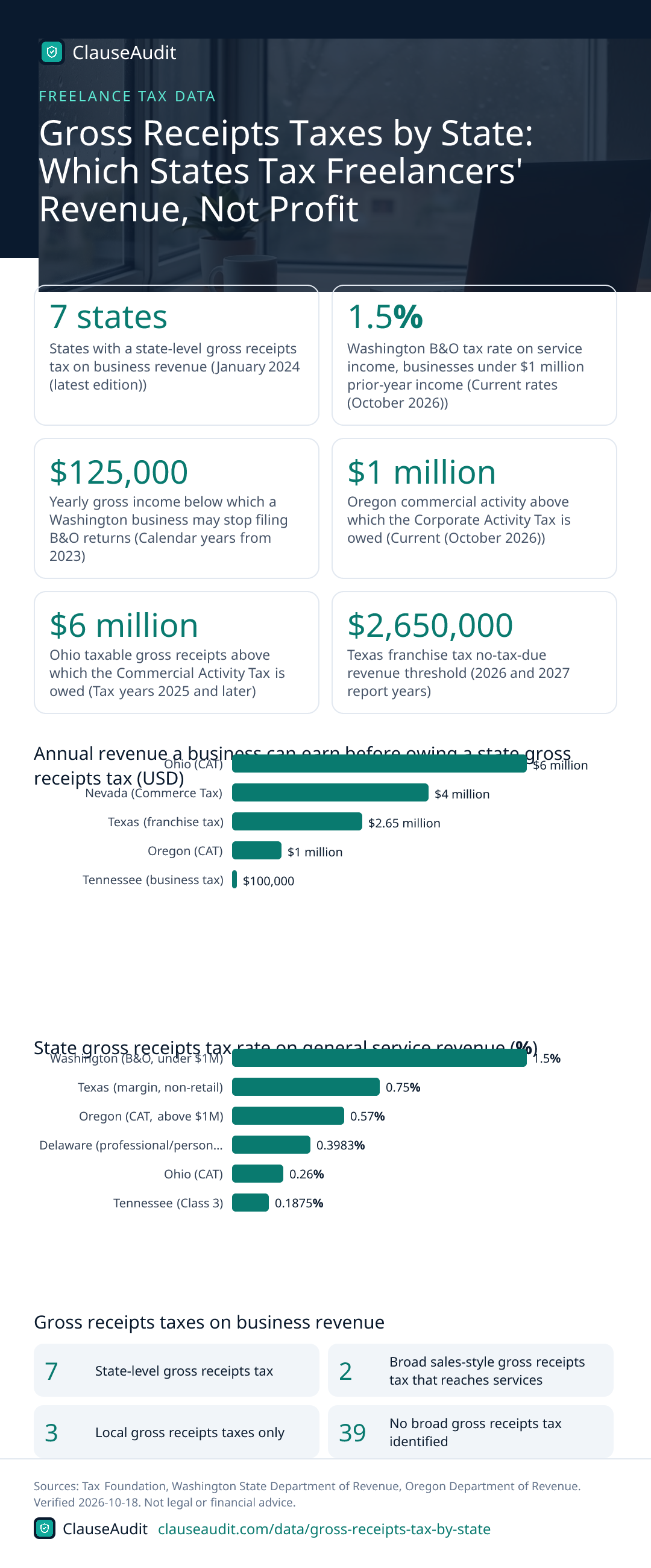
7 states tax business revenue directly: Delaware, Nevada, Ohio, Oregon, Tennessee, Texas and Washington. Washington is the one most freelancers feel, because its B&O tax takes 1.5% of service income with no annual exclusion. The others start higher, from $100,000 in Tennessee to $6 million in Ohio. Pennsylvania, Virginia and West Virginia allow local versions.

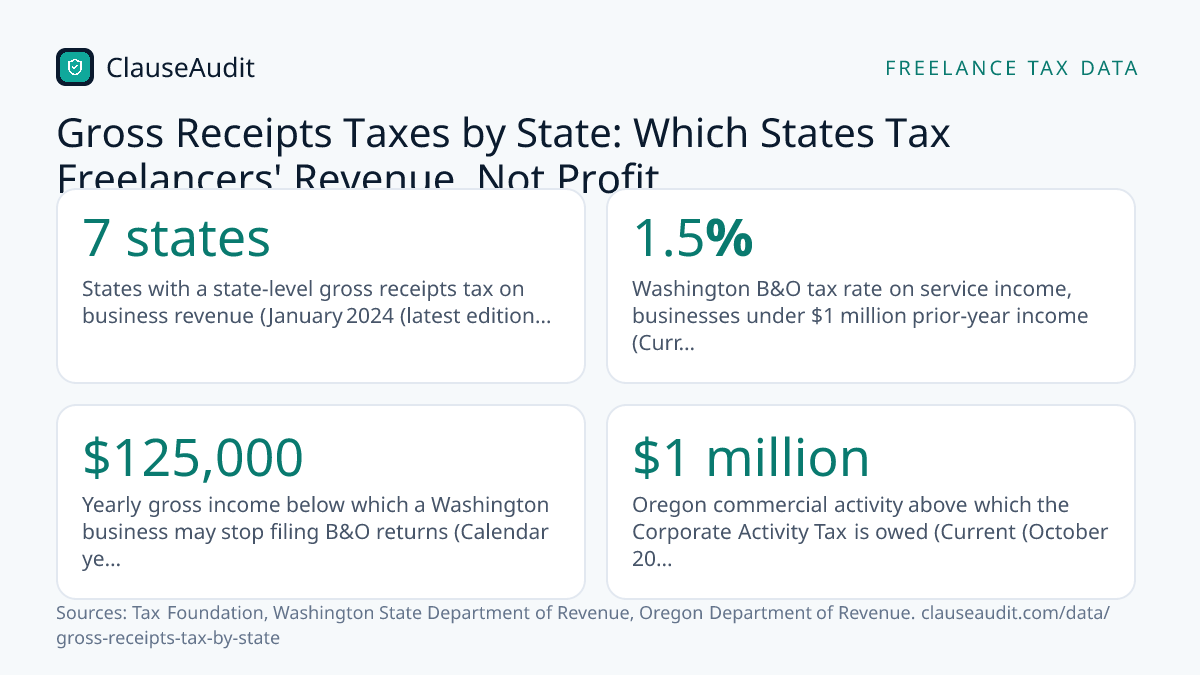
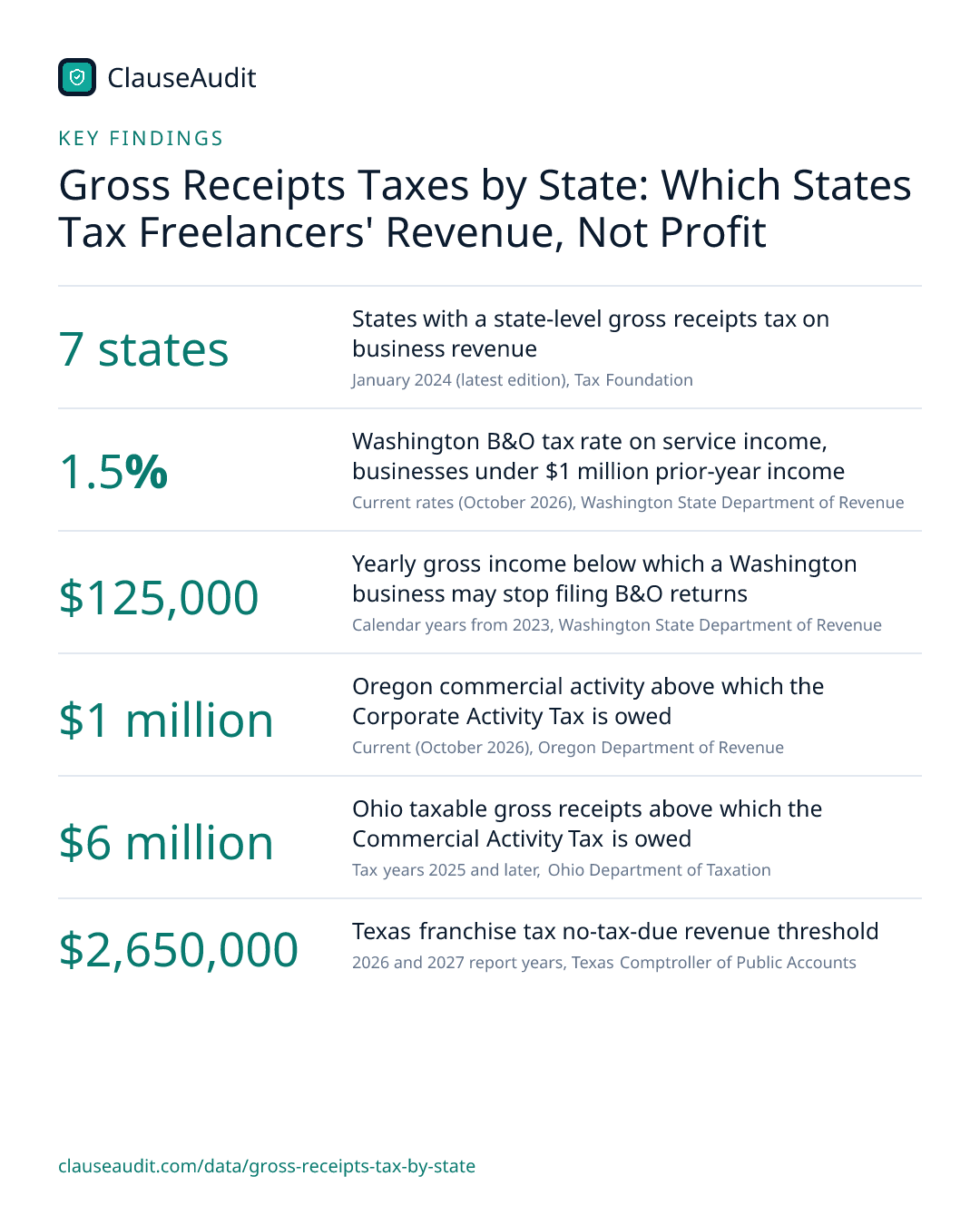
- States with a state-level gross receipts tax on business revenue (January 2024 (latest edition), Tax Foundation)
- 7 states
- Washington B&O tax rate on service income, businesses under $1 million prior-year income (Current rates (October 2026), Washington State Department of Revenue)
- 1.5%
- Yearly gross income below which a Washington business may stop filing B&O returns (Calendar years from 2023, Washington State Department of Revenue)
- $125,000
- Oregon commercial activity above which the Corporate Activity Tax is owed (Current (October 2026), Oregon Department of Revenue)
- $1 million
- Ohio taxable gross receipts above which the Commercial Activity Tax is owed (Tax years 2025 and later, Ohio Department of Taxation)
- $6 million
- Texas franchise tax no-tax-due revenue threshold (2026 and 2027 report years, Texas Comptroller of Public Accounts)
- $2,650,000
- Delaware gross receipts excluded each month for professional and personal service providers (Current law (October 2026), State of Delaware, Delaware Code Online)
- $100,000 a month
- Tennessee gross receipts at which a business should register and pay business tax (Tax years ending on or after Dec. 31, 2023, Tennessee Department of Revenue)
- $100,000
Most taxes you think about as a freelancer start with profit. You add up what clients paid you, take off your costs, and pay on what is left. A gross receipts tax skips the second step. It is charged on the money coming in, whether that month left you ahead or not.
Only 7 states run one at the state level, and most of them set a revenue floor high enough that a solo freelancer never reaches it. The exceptions are where the trouble sits. Washington taxes service income from the first dollar, Tennessee starts at $100,000, and a few cities and counties in other states add their own. This page shows where each tax starts, what it costs, and what to put in your contracts so it does not quietly eat your margin.
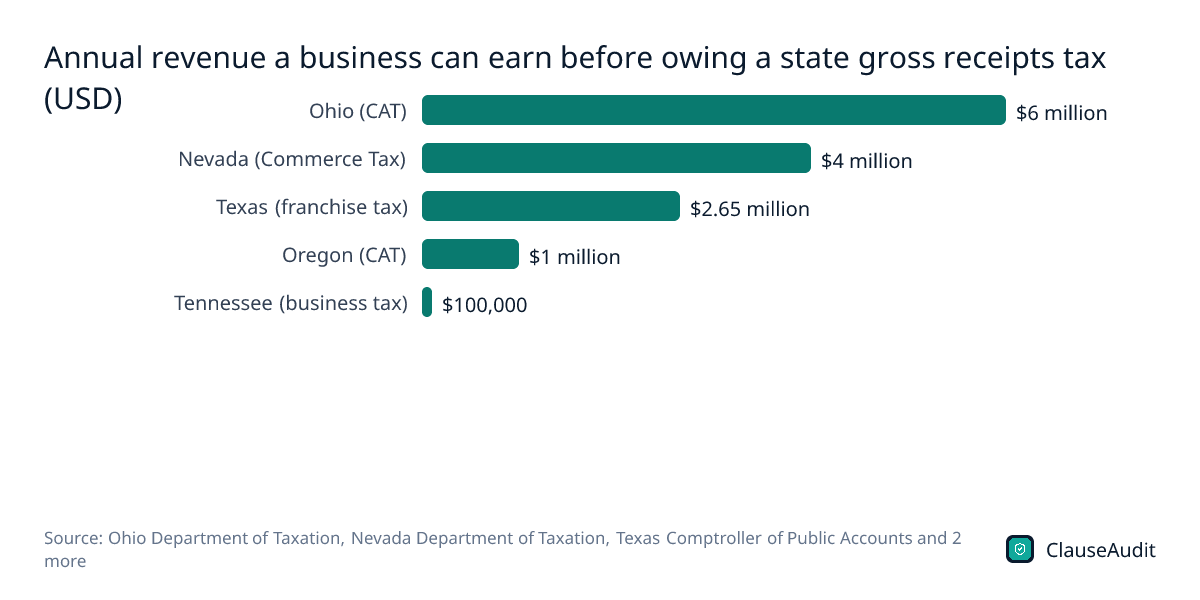
Annual revenue a business can earn before owing a state gross receipts tax (USD)
Chart data
| Label | Value |
|---|---|
| Ohio (CAT) | $6 million |
| Nevada (Commerce Tax) | $4 million |
| Texas (franchise tax) | $2.65 million |
| Oregon (CAT) | $1 million |
| Tennessee (business tax) | $100,000 |
Ohio's $6 million floor means almost no freelancer there owes the CAT anymore. Tennessee is the outlier on the low end. Washington and Delaware are missing because neither uses an annual floor.
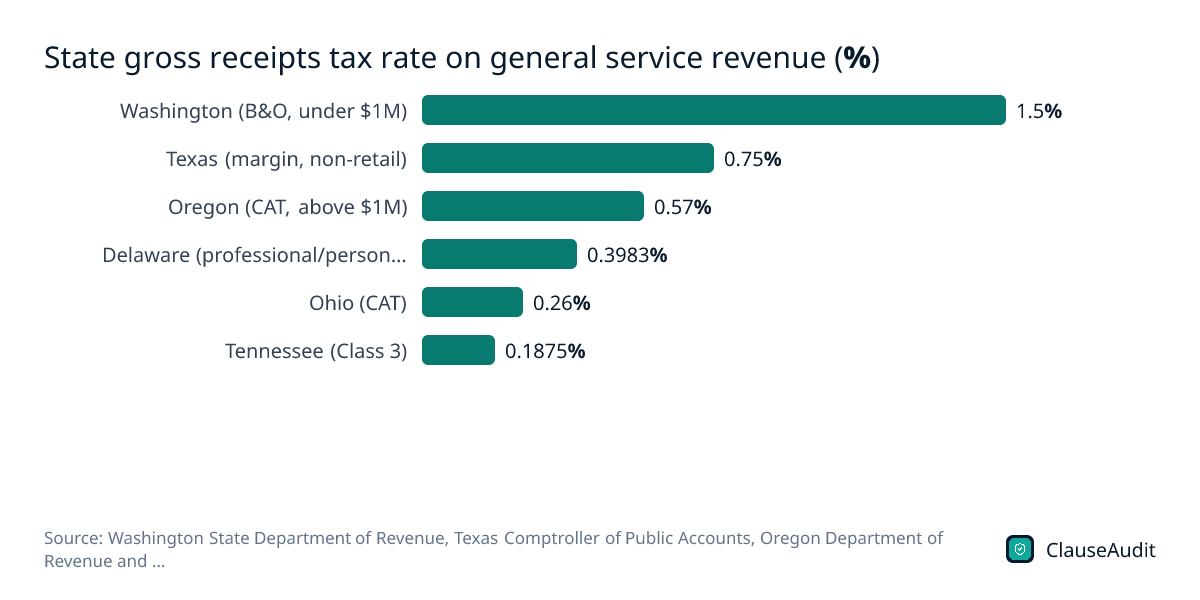
Download this chart (PNG)State gross receipts tax rate on general service revenue (%)
Chart data
| Label | Value |
|---|---|
| Washington (B&O, under $1M) | 1.5% |
| Texas (margin, non-retail) | 0.75% |
| Oregon (CAT, above $1M) | 0.57% |
| Delaware (professional/personal services) | 0.3983% |
| Ohio (CAT) | 0.26% |
| Tennessee (Class 3) | 0.1875% |
A higher rate does not always mean a bigger bill. Washington's 1.5% applies from the first dollar, while Oregon's 0.57% only touches activity above $1 million.
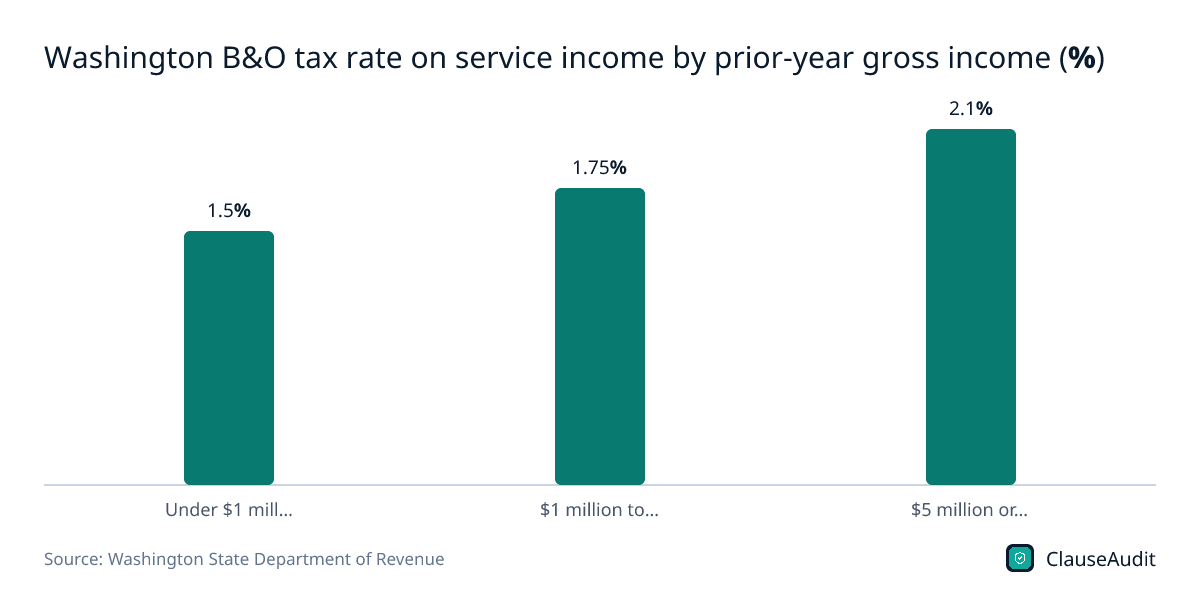
Download this chart (PNG)Washington B&O tax rate on service income by prior-year gross income (%)
Chart data
| Label | Value (%) |
|---|---|
| Under $1 million | 1.5% |
| $1 million to $4,999,999 | 1.75% |
| $5 million or more | 2.1% |
Your tier depends on last year's gross income, not this year's. A strong year can move you into the 1.75% bracket for the year after.
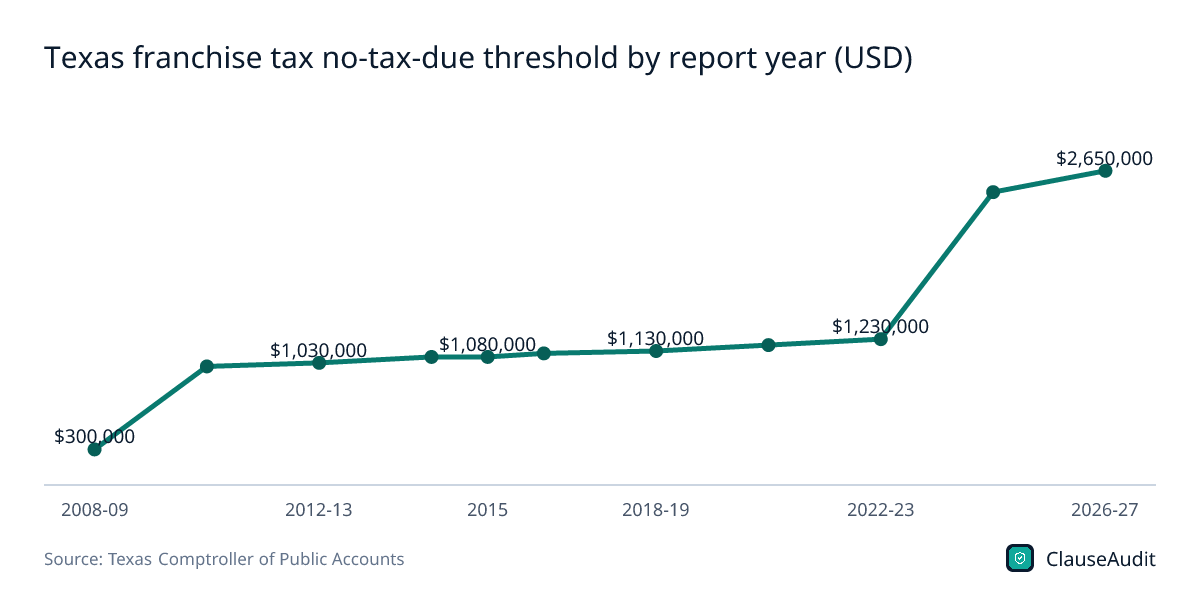
Download this chart (PNG)Texas franchise tax no-tax-due threshold by report year (USD)
Chart data
| Label | Value (USD) |
|---|---|
| 2008-09 | $300,000 |
| 2010-11 | $1,000,000 |
| 2012-13 | $1,030,000 |
| 2014 | $1,080,000 |
| 2015 | $1,080,000 |
| 2016-17 | $1,110,000 |
| 2018-19 | $1,130,000 |
| 2020-21 | $1,180,000 |
| 2022-23 | $1,230,000 |
| 2024-25 | $2,470,000 |
| 2026-27 | $2,650,000 |
The floor sat near $1 million for over a decade, then jumped to $2,470,000 for 2024-25 reports and $2,650,000 for 2026-27.
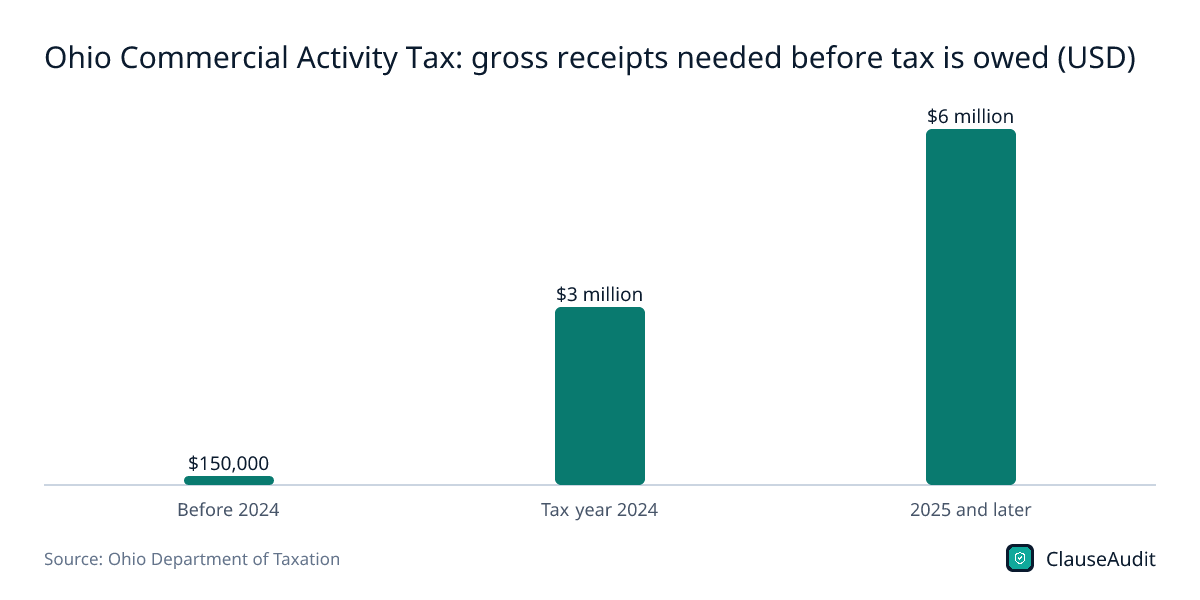
Download this chart (PNG)Ohio Commercial Activity Tax: gross receipts needed before tax is owed (USD)
Chart data
| Label | Value (USD) |
|---|---|
| Before 2024 | $150,000 |
| Tax year 2024 | $3 million |
| 2025 and later | $6 million |
Ohio went from $150,000 to $6 million in two steps. If you registered under the old rule, check if you still need to file.
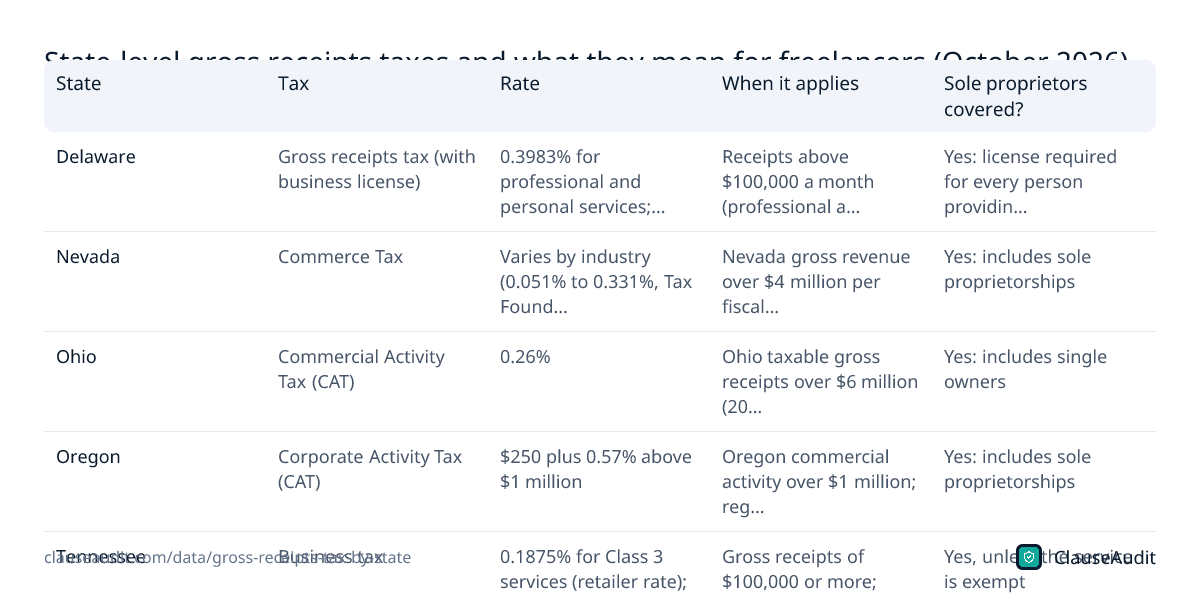
Download this chart (PNG)State-level gross receipts taxes and what they mean for freelancers (October 2026)
| State | Tax | Rate | When it applies | Sole proprietors covered? |
|---|---|---|---|---|
| Delaware | Gross receipts tax (with business license) | 0.3983% for professional and personal services; .0945% to 1.9914% overall | Receipts above $100,000 a month (professional and personal services) | Yes: license required for every person providing services |
| Nevada | Commerce Tax | Varies by industry (0.051% to 0.331%, Tax Foundation) | Nevada gross revenue over $4 million per fiscal year | Yes: includes sole proprietorships |
| Ohio | Commercial Activity Tax (CAT) | 0.26% | Ohio taxable gross receipts over $6 million (2025 onward) | Yes: includes single owners |
| Oregon | Corporate Activity Tax (CAT) | $250 plus 0.57% above $1 million | Oregon commercial activity over $1 million; register at $750,000 | Yes: includes sole proprietorships |
| Tennessee | Business tax | 0.1875% for Class 3 services (retailer rate); $22 minimum | Gross receipts of $100,000 or more; many professions exempt | Yes, unless the service is exempt |
| Texas | Franchise (margin) tax | 0.75% of margin (0.331% EZ computation) | Revenue over $2,650,000 (2026-27 reports) | No: sole proprietorships do not file or pay (single-member LLCs do) |
| Washington | Business & occupation (B&O) tax | 1.5% services under $1M; 1.75%; 2.1% at $5M+ | No annual exclusion; small business credit; no filing under $125,000 if eligible | Yes: paid by the individual or business |
Source: State of Delaware, Delaware Code Online, Delaware Code Title 30, Chapter 23 (§ 2301, occupational license and gross receipts fee); Delaware Division of Revenue, Gross Receipts Tax FAQs; Delaware Division of Revenue, Tax Tips for Occupations / General Service Conducting Business in Delaware; Nevada Department of Taxation, Commerce Tax; Tax Foundation, Gross Receipts Taxes by State, 2024; Ohio Department of Taxation, Commercial Activity Tax (CAT); Oregon Department of Revenue, Corporate Activity Tax; Tennessee Department of Revenue, Business Tax overview; Tennessee Department of Revenue, Business Tax: Due Dates and Tax Rates; Tennessee Department of Revenue, Business Tax: Classifications; Texas Comptroller of Public Accounts, Franchise Tax: Tax Rates, Thresholds and Deduction Limits; Texas Comptroller of Public Accounts, Franchise Tax Overview (Publication 98-806); Washington State Department of Revenue, Business & occupation tax; Washington State Department of Revenue, Business & occupation tax classifications (rates); Washington State Department of Revenue, Filing frequencies & due dates (active non-reporting status). Download as image
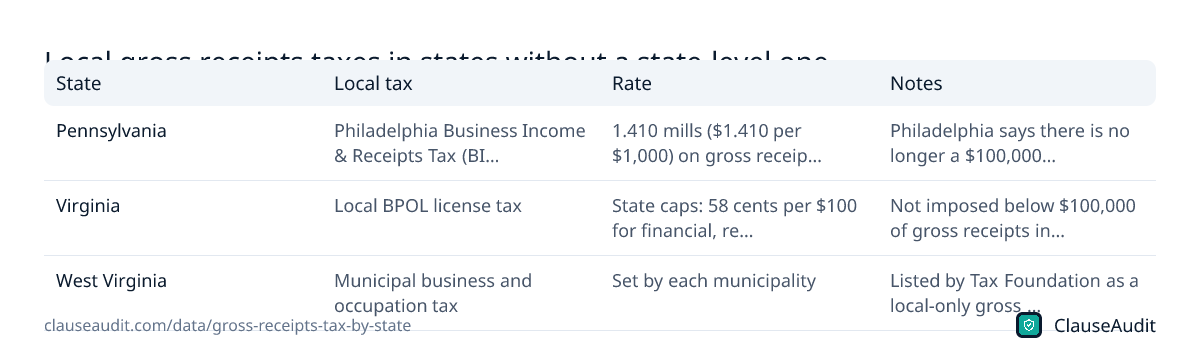
Local gross receipts taxes in states without a state-level one
| State | Local tax | Rate | Notes |
|---|---|---|---|
| Pennsylvania | Philadelphia Business Income & Receipts Tax (BIRT) | 1.410 mills ($1.410 per $1,000) on gross receipts plus 5.71% on taxable net income (tax year 2025) | Philadelphia says there is no longer a $100,000 BIRT exemption; BIRT is separate from the Net Profits Tax |
| Virginia | Local BPOL license tax | State caps: 58 cents per $100 for financial, real estate and professional services; 36 cents per $100 for repair, personal and business services | Not imposed below $100,000 of gross receipts in localities over 50,000 people, or $50,000 in localities of 25,000 to 50,000 |
| West Virginia | Municipal business and occupation tax | Set by each municipality | Listed by Tax Foundation as a local-only gross receipts tax state |
Source: City of Philadelphia, Department of Revenue, Business Income & Receipts Tax (BIRT); Virginia General Assembly, Legislative Information System, Code of Virginia § 58.1-3706, Limitation on rate of license taxes; Tax Foundation, Gross Receipts Taxes by State, 2024. Download as image
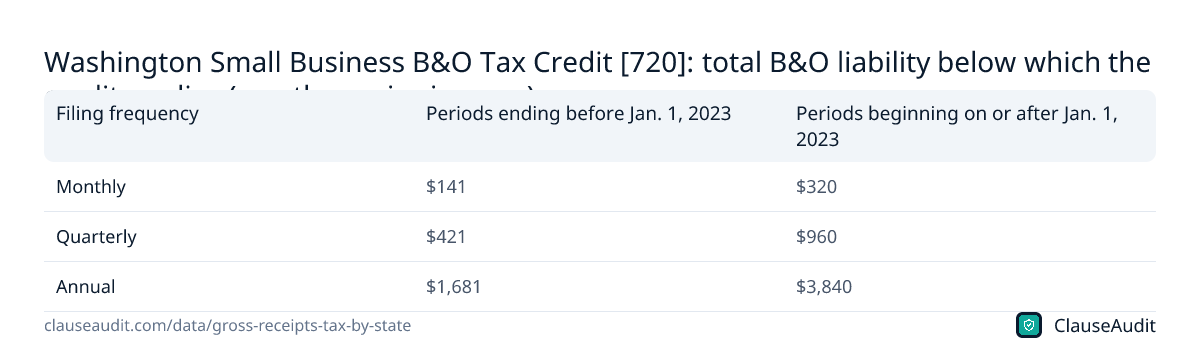
Washington Small Business B&O Tax Credit [720]: total B&O liability below which the credit applies (mostly service income)
| Filing frequency | Periods ending before Jan. 1, 2023 | Periods beginning on or after Jan. 1, 2023 |
|---|---|---|
| Monthly | $141 | $320 |
| Quarterly | $421 | $960 |
| Annual | $1,681 | $3,840 |
Source: Washington State Department of Revenue, Tax credits (Small Business B&O Tax Credit). Download as image
Gross receipts taxes on business revenue by state
- 7State-level gross receipts tax
- 2Broad sales-style gross receipts tax that reaches services
- 3Local gross receipts taxes only
- 39No broad gross receipts tax identified
- State-level gross receipts tax7
- Broad sales-style gross receipts tax that reaches services2
- Local gross receipts taxes only3
- No broad gross receipts tax identified39
Which states have a gross receipts tax?
Seven states tax business revenue at the state level: Delaware, Nevada, Ohio, Oregon, Tennessee, Texas and Washington. That count comes from the Tax Foundation, and each state's rules were checked against its own revenue agency in October 2026.
Three more states leave it to local government. Pennsylvania, Virginia and West Virginia have no statewide version, but cities or counties can charge one. Philadelphia's BIRT is the best known.
Then there are Hawaii and New Mexico. Both tax a broad base of business receipts, services included, but the Tax Foundation treats them as sales taxes and leaves them out of the seven. For you the label matters less than the effect. New Mexico's gross receipts tax runs at a 4.875% state rate plus local rates, and businesses there commonly show it as a separate line on the invoice. Hawaii's general excise tax is 4.00% at the state level plus a 0.50% county surcharge.
How is a gross receipts tax different from income tax?
Income tax follows profit. A gross receipts tax follows revenue. That difference hits hardest when a lot of your invoice passes straight through to someone else.
Picture a freelance web developer in Washington who lands a big build, hires a designer to handle half of it, and buys hosting and plugins for the project, then bills all of it to the client. Income tax only sees what the developer keeps. Washington's B&O tax sees the whole invoice, because it allows no deduction for labor, materials or other costs.
So the question is not just what the rate is. It is how thin your margin runs. A copywriter with almost no costs barely notices the difference. An agency-style freelancer who subcontracts most of the work can end up paying tax on money that was never really theirs.
Oregon softens this a little. Its Corporate Activity Tax lets you subtract 35 percent of certain business expenses, so it is not a pure tax on receipts. Texas goes further and taxes margin rather than revenue.
Do freelancers have to pay Washington B&O tax?
Usually yes, if you do business in Washington, and it applies to the individual, not just to companies. Service income is taxed at 1.5% for businesses with under $1 million of prior-year gross income. The rate rises to 1.75% from $1 million to $4,999,999, and to 2.1% at $5 million or more.
There is no annual exclusion, but two rules keep most small freelancers out of the bill. First, the Small Business B&O Tax Credit wipes out small liabilities. For periods beginning on or after Jan. 1, 2023, it applies when your total B&O liability is under $3,840 for an annual filer, $960 for a quarterly filer or $320 for a monthly one. Second, if your gross income is under $125,000 a year and you meet the other conditions, you may not have to file at all. Those conditions include not collecting retail sales tax and owing no other tax or fee to the Department of Revenue.
Two more things to watch. Cities can charge their own B&O tax on top of the state one. And from Oct. 1, 2025, some services, including IT and custom website development, also became subject to retail sales tax. If that is your line of work, you may now need to collect sales tax from clients, which can end your active non-reporting status.
When does a gross receipts tax start for a small business?
Outside Washington, the floors are high enough that most solo freelancers never cross them. Here is how they work in practice.
- Tennessee: register and pay once gross receipts reach $100,000. Service businesses fall in Classification 3 at 0.1875%, with a $22 minimum. Accounting, architecture, engineering, legal and medical services are exempt.
- Delaware: every person providing services needs a $75 business license. Professional and personal service providers exclude the first $100,000 of receipts each month and pay 0.3983% above that. Delaware has no sales tax.
- Oregon: register within 30 days of reaching $750,000 of Oregon commercial activity, and owe the tax once you pass $1 million. The bill is $250 plus 0.57% of activity above $1 million. Sole proprietorships are covered.
- Texas: the no-tax-due threshold is $2,650,000 for 2026 and 2027 reports. Sole proprietors do not file or pay at all, but a single-member LLC does, and entities at or below the threshold still file an information report.
- Nevada: the Commerce Tax starts at $4 million of Nevada gross revenue per fiscal year.
- Ohio: the Commercial Activity Tax applies only above $6 million of Ohio taxable gross receipts for tax years 2025 and later, at 0.26%.
Do cities charge a gross receipts tax on freelancers?
Some do, and these are easy to miss because the state itself has no such tax. Philadelphia's Business Income and Receipts Tax charges 1.410 mills, which is $1.410 per $1,000 of gross receipts, plus 5.71% of taxable net income for tax year 2025. The city says there is no longer a $100,000 exemption, so a small freelancer there should not assume they are below the line.
Virginia lets each locality set a BPOL license tax within state caps: 58 cents per $100 of gross receipts for professional services and 36 cents per $100 for personal and business services. It is not imposed below $100,000 of receipts in localities over 50,000 people, or below $50,000 in localities of 25,000 to 50,000. West Virginia municipalities set their own business and occupation tax.
If you work from one of these places, check your city or county website before your first full year of invoicing, not after.
What should you do before you send the next invoice?
- Work out which states can tax your receipts. It is usually where you are based, but some states look at where the customer is. Oregon and Ohio both measure activity in their state.
- Price on revenue, not profit, if you work in Washington or Philadelphia. Pass-through costs like subcontractors and software are usually taxed with the rest of the invoice.
- Think twice about switching from sole proprietor to LLC in Texas. The LLC has to file franchise tax reports even when no tax is due.
- Track prior-year gross income in Washington. It sets your B&O rate and helps decide if you can stop filing under the $125,000 rule.
- Write the tax into your contract. A clause saying who pays which taxes, and whether your rate includes them, settles the question before a client pushes back.
- Set a calendar reminder for Oregon's $750,000 registration point if you are growing fast. The 30-day clock starts when you cross it, not at year end.
How ClauseAudit helps
A gross receipts tax comes out of the top line, so the way your contract sets the price decides who really pays it. If the agreement says your fee includes all taxes, the bill is yours. If it is silent, you will be arguing about it after the work is done.
Upload your freelance or client contract for an automated review. It flags the payment and pricing terms that decide how much of each invoice you keep after state taxes.
- Tax clause: whether your fee is inclusive of all taxes or the client pays taxes on top
- Rate and pricing: whether you can adjust your rate if a new tax or a higher tax tier applies
- Expenses and pass-through costs: how subcontractors, software and travel are billed and reimbursed
- Payment terms and late fees: how long you wait to get paid on revenue you may already owe tax on
- Governing law and place of performance: which state the work and the client are tied to
- Entity and signature block: whether you sign as yourself or as an LLC, which can change your filing duties
Frequently asked questions
What is a gross receipts tax?
It is a tax on a business's total revenue, before costs. Income tax looks at what you keep after expenses. A gross receipts tax looks at what clients paid you, full stop. That makes it hit low-margin work hardest, especially if you pay subcontractors or buy materials and bill them through to the client.
How many states have a gross receipts tax?
7 states have one at the state level: Delaware, Nevada, Ohio, Oregon, Tennessee, Texas and Washington. Pennsylvania, Virginia and West Virginia allow local ones only. Hawaii and New Mexico have broad taxes on business receipts too, but the Tax Foundation counts those as sales taxes rather than gross receipts taxes.
What is the Washington B&O tax rate for freelancers?
For service income, it is 1.5% if your prior-year gross income was under $1 million. It rises to 1.75% from $1 million to $4,999,999 and 2.1% at $5 million or more. There is no deduction for labor, materials or other costs, but the Small Business B&O Tax Credit cancels out small bills.
Do I have to file Washington B&O returns if I make under $125,000?
Maybe not. Washington allows active non-reporting status if your yearly gross income is under $125,000 and you meet a few other conditions. You must not collect retail sales tax, must have under $24,000 of public utility tax income, and must owe no other tax or fee to the Department of Revenue.
Does a sole proprietor pay Texas franchise tax?
No. Sole proprietorships, and general partnerships owned entirely by natural persons, do not file or pay Texas franchise tax. A single-member LLC does, though. If its revenue is at or below the $2,650,000 no-tax-due threshold for 2026 and 2027, it owes no tax but still files an information report.
Do I owe the Ohio Commercial Activity Tax as a freelancer?
Almost certainly not anymore. For tax years 2025 and later, the CAT applies only above $6 million of Ohio taxable gross receipts. The floor was $150,000 before 2024 and $3 million in 2024. Your business income can still fall under Ohio's personal income tax, so check that separately.
When do freelancers in Oregon owe the Corporate Activity Tax?
You must register within 30 days of reaching $750,000 of Oregon commercial activity, and the tax is owed above $1 million. The bill is $250 plus 0.57% of activity over $1 million, after a 35 percent subtraction for certain business expenses. Sole proprietorships are covered, so the name is misleading.
Can I pass a gross receipts tax on to my client?
It depends on the state and on your contract. In New Mexico, businesses commonly show the gross receipts tax as a separate line on the invoice. Washington's B&O tax is charged to the business itself. Either way, your contract should say whether your rate includes taxes, so the cost lands where you planned.
Does Philadelphia tax freelancers' gross receipts?
Yes. Philadelphia's BIRT charges 1.410 mills on gross receipts, which is $1.410 per $1,000, plus 5.71% of taxable net income for tax year 2025. The city says there is no longer a $100,000 exemption. It is separate from the Net Profits Tax, so check both if you work there.
Use this data
Every chart and card below is free to reuse under CC BY 4.0. Download what you need and link back to this page.
 Stat cards
 Key findings card
 Infographic
 Annual revenue a business can earn before owing a state gross receipts tax (USD)
 State gross receipts tax rate on general service revenue (%)
 Washington B&O tax rate on service income by prior-year gross income (%)
 Texas franchise tax no-tax-due threshold by report year (USD)
 Ohio Commercial Activity Tax: gross receipts needed before tax is owed (USD)
 State-level gross receipts taxes and what they mean for freelancers (October 2026)
 Local gross receipts taxes in states without a state-level one
 Washington Small Business B&O Tax Credit [720]: total B&O liability below which the credit applies (mostly service income)
Embed the infographic
Free to share on your site, blog or slides under CC BY 4.0. Please keep the credit link.
Sources and method
Every number on this page comes from the sources below, each opened and read on or before October 18, 2026. A second, independent review checked every figure against its source and corrected anything that did not match. 51 of 51 state entries were confirmed; any that could not be are marked "Not yet confirmed" and left out of every count and chart.
- Tax Foundation, Gross Receipts Taxes by State, 2024 (May 14, 2024 (updated March 25, 2025); table as of January 2024; latest edition)
- Washington State Department of Revenue, Business & occupation tax (Current page, accessed October 2026)
- Washington State Department of Revenue, Business & occupation tax classifications (rates) (Current page, accessed October 2026)
- Washington State Department of Revenue, Filing frequencies & due dates (active non-reporting status) (Current page, accessed October 2026)
- Washington State Department of Revenue, Tax credits (Small Business B&O Tax Credit) (Current page, accessed October 2026)
- Oregon Department of Revenue, Corporate Activity Tax (Current page, accessed October 2026)
- Ohio Department of Taxation, Commercial Activity Tax (CAT) (Current page, accessed October 2026)
- Texas Comptroller of Public Accounts, Franchise Tax: Tax Rates, Thresholds and Deduction Limits (Current page, accessed October 2026 (2026 and 2027 report years))
- Texas Comptroller of Public Accounts, Franchise Tax Overview (Publication 98-806) (12/2023)
- Delaware Division of Revenue, Gross Receipts Tax FAQs (Current page, accessed October 2026)
- State of Delaware, Delaware Code Online, Delaware Code Title 30, Chapter 23 (§ 2301, occupational license and gross receipts fee) (Current code, accessed October 2026)
- Delaware Division of Revenue, Tax Tips for Occupations / General Service Conducting Business in Delaware (2018 edition)
- Nevada Department of Taxation, Commerce Tax (Current page, accessed October 2026 (2025-2026 tax year))
- Tennessee Department of Revenue, Business Tax overview (Current page, accessed October 2026)
- Tennessee Department of Revenue, Business Tax: Due Dates and Tax Rates (Current page, accessed October 2026)
- Tennessee Department of Revenue, Business Tax: Classifications (Current page, accessed October 2026)
- Tennessee Department of Revenue, Business Tax: Registration and Licensing (Current page, accessed October 2026)
- Tax Foundation, State and Local Sales Tax Rates, Midyear 2026 (July 6, 2026)
- New Mexico Taxation and Revenue Department, Gross Receipts Tax Overview (Current page, accessed October 2026)
- Virginia General Assembly, Legislative Information System, Code of Virginia § 58.1-3706, Limitation on rate of license taxes (Current code, accessed October 19, 2026)
- City of Philadelphia, Department of Revenue, Business Income & Receipts Tax (BIRT) (Current page, accessed October 2026 (tax year 2025 rates))
Cite this page
ClauseAudit, “Gross Receipts Taxes by State: Which States Tax Freelancers' Revenue, Not Profit”, updated October 18, 2026, https://clauseaudit.com/data/gross-receipts-tax-by-state. Free to reuse with a link back (CC BY 4.0).
This page summarises published data and law as checked on October 18, 2026. Figures are updated as new editions are released, and your own situation may differ. It is general information, not legal, tax or financial advice.