Sales Tax Economic Nexus Thresholds by State (2026)
By ClauseAudit Research · 51 sources ·
What is the economic nexus threshold by state?
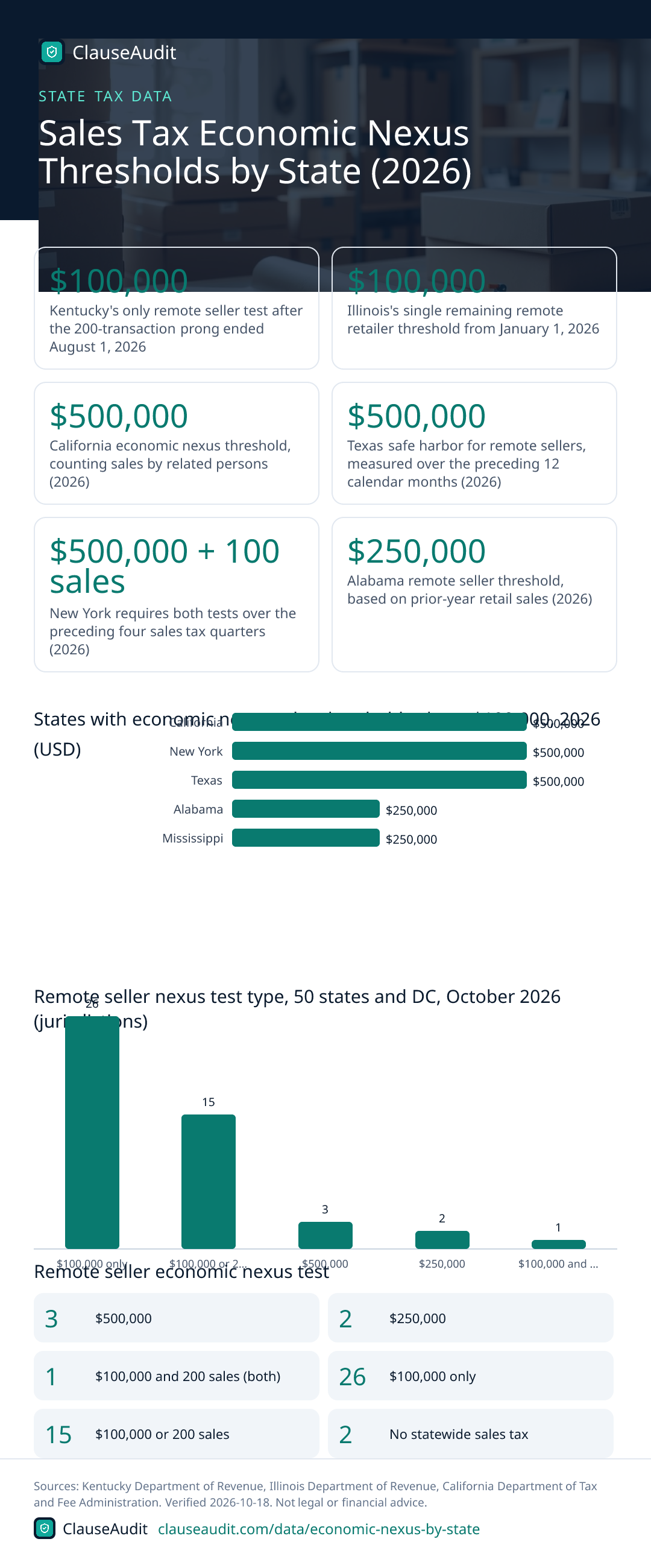
Most states use a $100,000 sales threshold. Cross it in a state over the measuring period and you generally have to register and collect that state's sales tax. California, New York and Texas set the bar at $500,000, Alabama and Mississippi at $250,000, and a shrinking group still counts 200 sales as a second trigger.

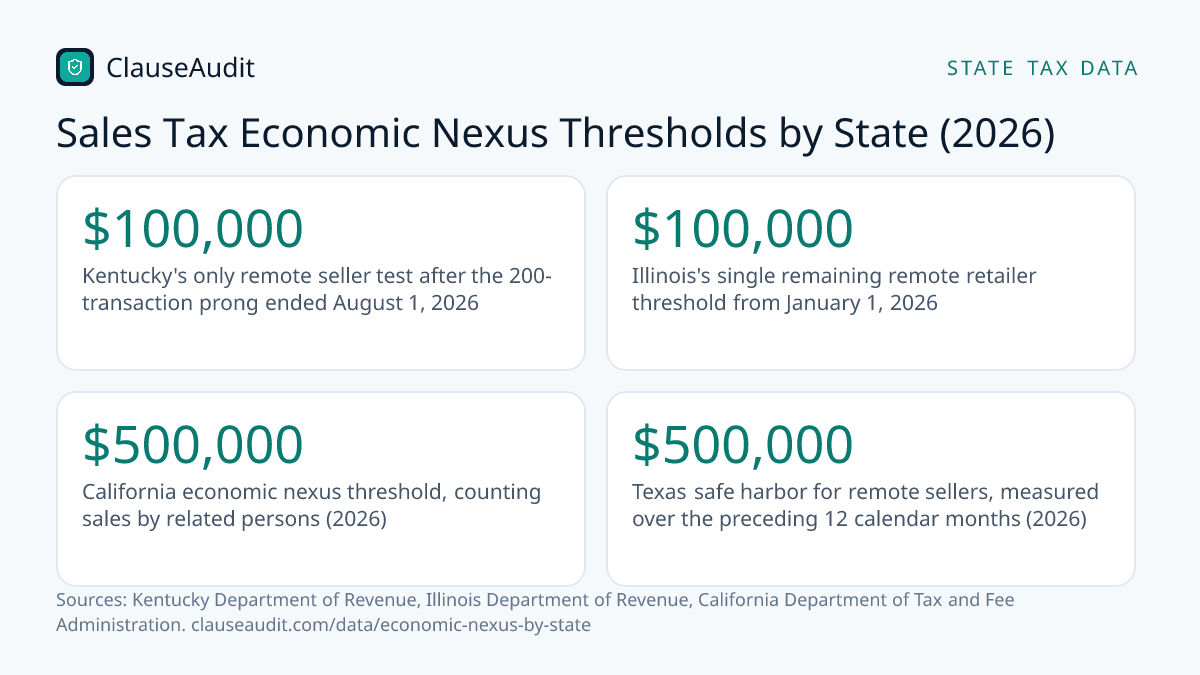
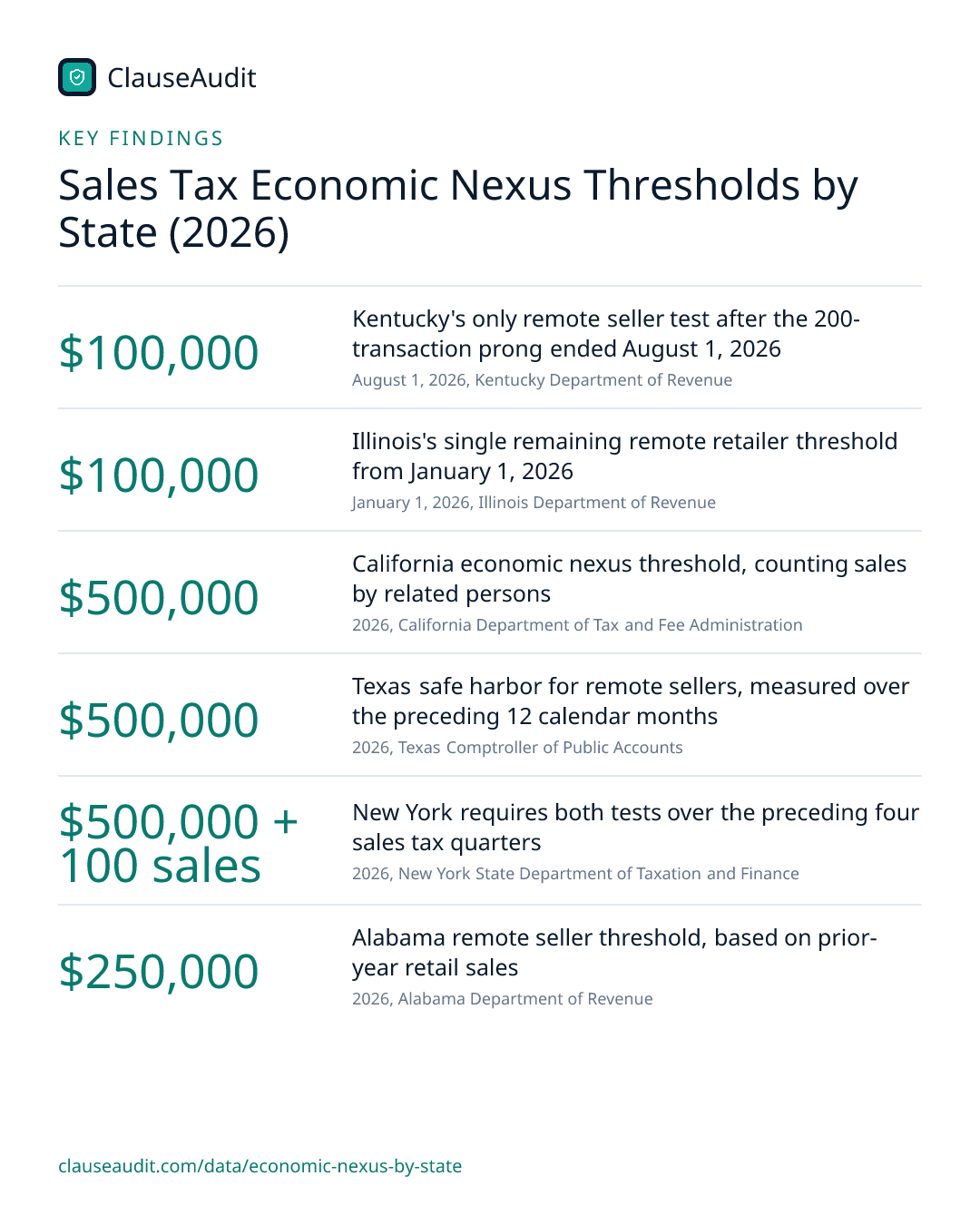
- Kentucky's only remote seller test after the 200-transaction prong ended August 1, 2026 (August 1, 2026, Kentucky Department of Revenue)
- $100,000
- Illinois's single remaining remote retailer threshold from January 1, 2026 (January 1, 2026, Illinois Department of Revenue)
- $100,000
- California economic nexus threshold, counting sales by related persons (2026, California Department of Tax and Fee Administration)
- $500,000
- Texas safe harbor for remote sellers, measured over the preceding 12 calendar months (2026, Texas Comptroller of Public Accounts)
- $500,000
- New York requires both tests over the preceding four sales tax quarters (2026, New York State Department of Taxation and Finance)
- $500,000 + 100 sales
- Alabama remote seller threshold, based on prior-year retail sales (2026, Alabama Department of Revenue)
- $250,000
- Mississippi remote seller threshold over any 12-month period (2026, Mississippi Department of Revenue)
- $250,000
- Connecticut requires both tests, measured over 12 months ending September 30 (2026, Connecticut Department of Revenue Services)
- $100,000 + 200 sales
Selling into a state you have never set foot in can still make you that state's tax collector. The trigger is economic nexus: once your sales into a state pass its threshold, you are expected to register, charge sales tax and file returns there.
The good news for small sellers is that the rules have been getting simpler. Illinois dropped its 200-transaction test on January 1, 2026 and Kentucky followed on August 1, 2026, so more states now look only at dollars. This page explains what the thresholds mean in practice and what to do before you cross one.
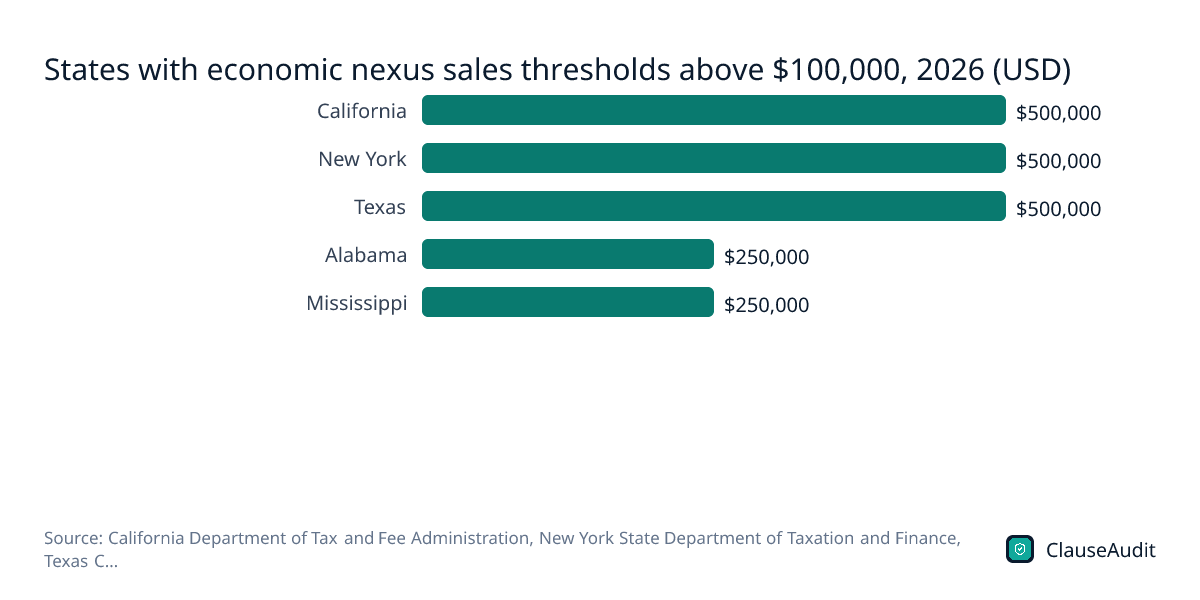
States with economic nexus sales thresholds above $100,000, 2026 (USD)
Chart data
| Label | Value |
|---|---|
| California | $500,000 |
| New York | $500,000 |
| Texas | $500,000 |
| Alabama | $250,000 |
| Mississippi | $250,000 |
Just a handful of states set the bar above $100,000. Even here, read the fine print: California counts sales by related companies together, and New York needs more than 100 sales on top of the dollar figure.
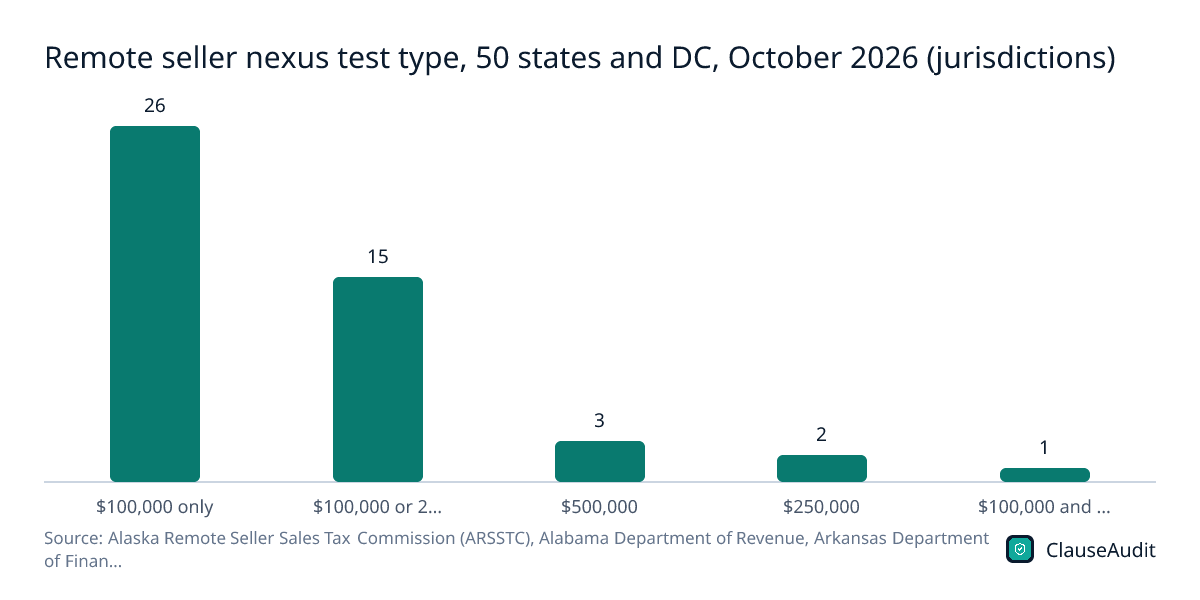
Download this chart (PNG)Remote seller nexus test type, 50 states and DC, October 2026 (jurisdictions)
Chart data
| Label | Value (jurisdictions) |
|---|---|
| $100,000 only | 26 |
| $100,000 or 200 sales | 15 |
| $500,000 | 3 |
| $250,000 | 2 |
| $100,000 and 200 sales | 1 |
A dollar-only test is now the most common rule, used by 26 jurisdictions. The 15 that still accept 200 sales as an alternative are the ones most likely to catch a seller with many small orders.
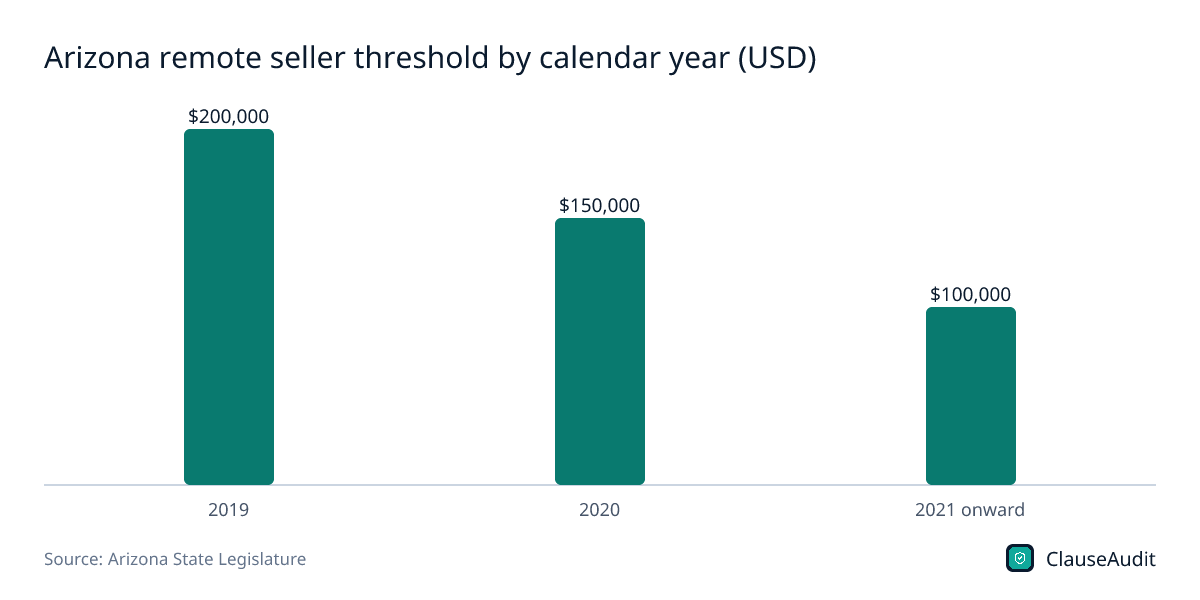
Download this chart (PNG)Arizona remote seller threshold by calendar year (USD)
Chart data
| Label | Value (USD) |
|---|---|
| 2019 | $200,000 |
| 2020 | $150,000 |
| 2021 onward | $100,000 |
Arizona eased in, starting at $200,000 in 2019 and dropping to $150,000 in 2020 before settling at $100,000 from 2021 onward. A seller who was safely under the line in 2019 could have crossed it later without selling a dollar more.
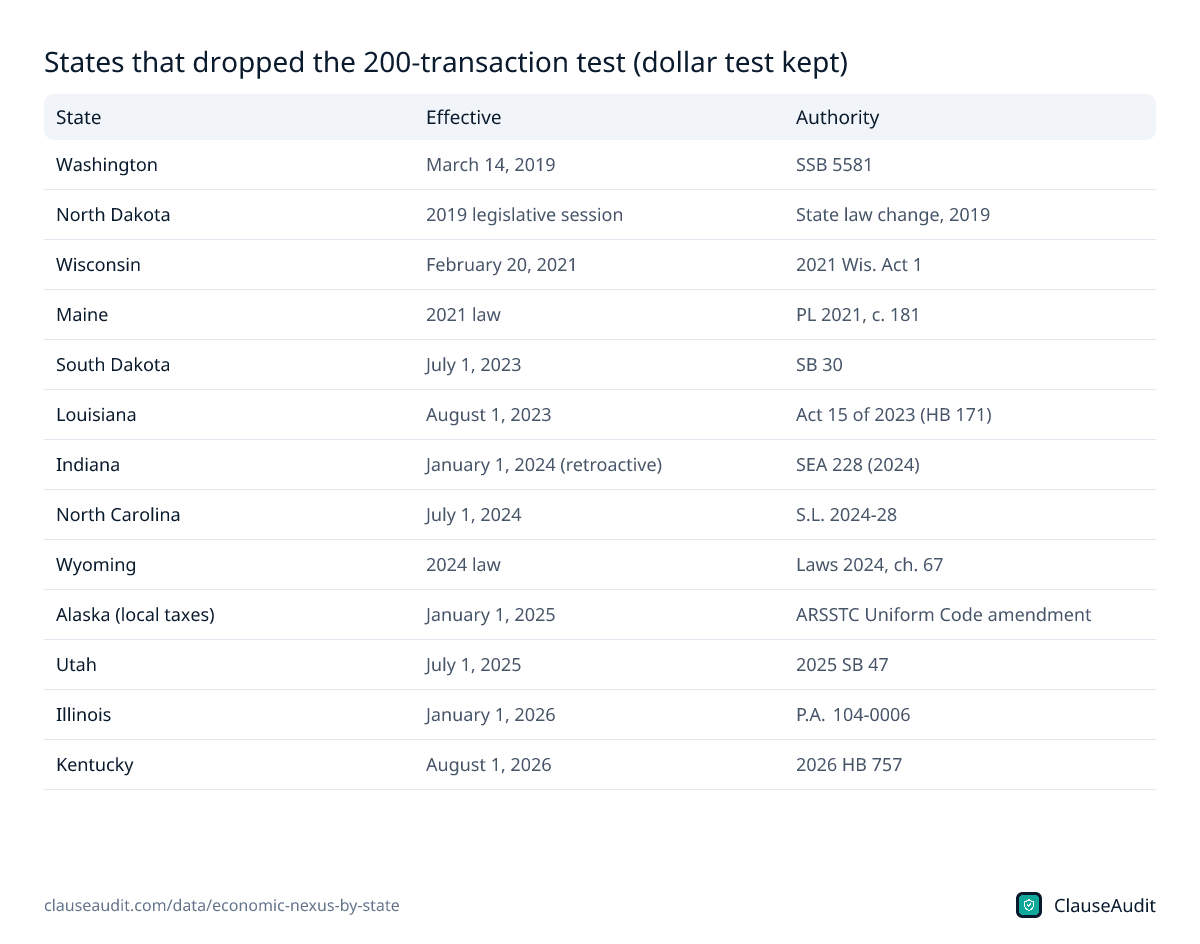
Download this chart (PNG)States that dropped the 200-transaction test (dollar test kept)
| State | Effective | Authority |
|---|---|---|
| Washington | March 14, 2019 | SSB 5581 |
| North Dakota | 2019 legislative session | State law change, 2019 |
| Wisconsin | February 20, 2021 | 2021 Wis. Act 1 |
| Maine | 2021 law | PL 2021, c. 181 |
| South Dakota | July 1, 2023 | SB 30 |
| Louisiana | August 1, 2023 | Act 15 of 2023 (HB 171) |
| Indiana | January 1, 2024 (retroactive) | SEA 228 (2024) |
| North Carolina | July 1, 2024 | S.L. 2024-28 |
| Wyoming | 2024 law | Laws 2024, ch. 67 |
| Alaska (local taxes) | January 1, 2025 | ARSSTC Uniform Code amendment |
| Utah | July 1, 2025 | 2025 SB 47 |
| Illinois | January 1, 2026 | P.A. 104-0006 |
| Kentucky | August 1, 2026 | 2026 HB 757 |
Source: Washington State Department of Revenue, Bill implementation timeline: Substitute Senate Bill (SSB) 5581; North Dakota Office of State Tax Commissioner, Sales and Use Tax History; Wisconsin Department of Revenue, Remote Sellers Common Questions; Maine Legislature, Office of the Revisor of Statutes, 36 M.R.S. § 1754-B, Registration of sellers; South Dakota Department of Revenue, 2023 Legislative Updates; Louisiana State Legislature, HB 171 (2023 Regular Session) digest; Indiana Department of Revenue, Remote Sellers; North Carolina Department of Revenue, Sales and Use Tax Directive SD-24-1, Remote Sales - Repeal of Transaction Thresholds; Wyoming Legislature, W.S. 39-15-501, Sales from remote sellers (Wyoming Statutes Title 39); Alaska Remote Seller Sales Tax Commission (ARSSTC), Business/Sellers; Utah State Tax Commission, Out-of-State (Remote) Sellers; Illinois Department of Revenue, Bulletin FY 2026-12, Destination-Based Retailers' Occupation Tax Changes; Kentucky Department of Revenue, Kentucky SSUTA Annual Recertification letter. Download as image
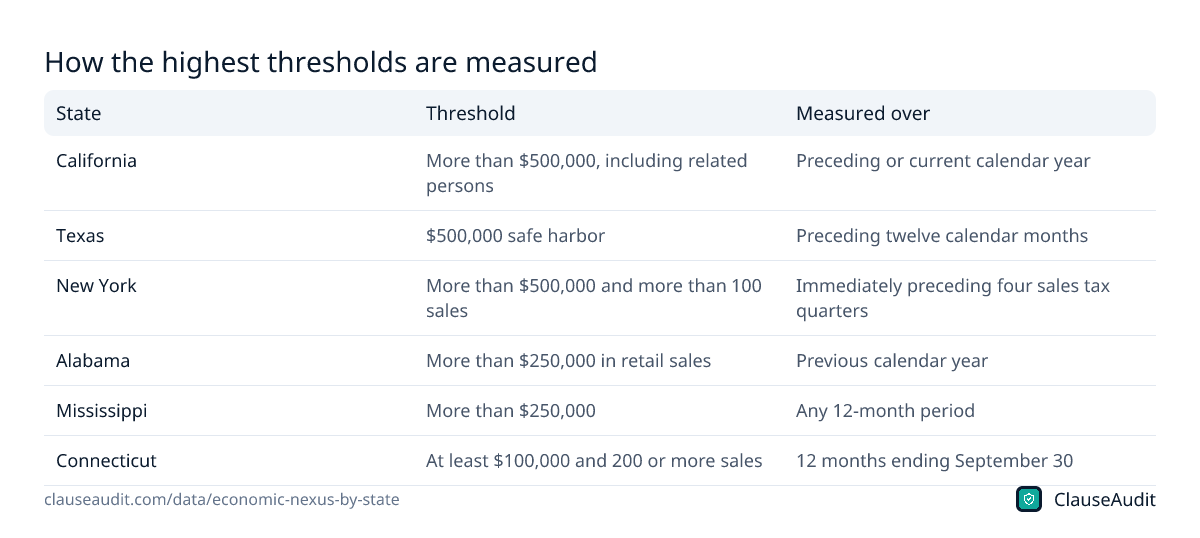
How the highest thresholds are measured
| State | Threshold | Measured over |
|---|---|---|
| California | More than $500,000, including related persons | Preceding or current calendar year |
| Texas | $500,000 safe harbor | Preceding twelve calendar months |
| New York | More than $500,000 and more than 100 sales | Immediately preceding four sales tax quarters |
| Alabama | More than $250,000 in retail sales | Previous calendar year |
| Mississippi | More than $250,000 | Any 12-month period |
| Connecticut | At least $100,000 and 200 or more sales | 12 months ending September 30 |
Source: California Department of Tax and Fee Administration, Use Tax Collection Requirements Based on Sales into California Due to the Wayfair Decision; Texas Comptroller of Public Accounts, Remote Sellers; New York State Department of Taxation and Finance, Registration requirement for businesses with no physical presence in New York State; Alabama Department of Revenue, Are all remote sellers required to register in Alabama? (FAQ); Mississippi Department of Revenue, Business Tax Frequently Asked Questions; Connecticut Department of Revenue Services, Registering Your Business with DRS. Download as image
Remote seller economic nexus test by state
- 3$500,000
- 2$250,000
- 1$100,000 and 200 sales (both)
- 26$100,000 only
- 15$100,000 or 200 sales
- 2No statewide sales tax
- $500,0003
- $250,0002
- $100,000 and 200 sales (both)1
- $100,000 only26
- $100,000 or 200 sales15
- No statewide sales tax2
- Not yet confirmed2
| State | Sales threshold | Transaction test | Measured over | Source |
|---|---|---|---|---|
| Alabama | More than $250,000 in retail sales | None | Previous calendar year | Ala. Admin. Code r. 810-6-2-.90.03 |
| Alaska | $100,000 statewide gross sales (local taxes only) | None (removed January 1, 2025) | Previous or current calendar year | Alaska Remote Seller Sales Tax Commission (ARSSTC), Business/Sellers |
| Arizona | More than $100,000 | None | Previous or current calendar year | A.R.S. § 42-5044(A) |
| Arkansas | More than $100,000 | Or 200 taxable transactions | Previous or current calendar year | Act 822 of 2019 |
| California | More than $500,000 (combined with related persons) | None | Preceding or current calendar year | California Department of Tax and Fee Administration, Use Tax Collection Requirements Based on Sales into California Due to the Wayfair Decision |
| Colorado | $100,000 in retail sales | None | Previous or current calendar year | Colorado Department of Revenue, Out-of-State Businesses |
| Connecticut | At least $100,000 in gross receipts | And 200 or more retail sales (both required) | 12 months ending September 30 | Connecticut Department of Revenue Services, Registering Your Business with DRS |
| Delaware | Not yet confirmed: check the source | Delaware Division of Revenue, Gross Receipts Tax FAQs | ||
| District of Columbia | More than $100,000 | Or more than 200 separate retail sales | Previous or current calendar year | DC Office of Tax and Revenue, Sales and Use Tax FAQs |
| Florida | More than $100,000 in taxable remote sales | None | Previous calendar year | Florida Department of Revenue, Tax Information Publication 21A01-03, Remote Sales and Marketplace Sales |
| Georgia | More than $100,000 | Or 200 or more separate retail sales | Previous or current calendar year | Georgia Department of Revenue, Policy Bulletin SUT-2019-02, Remote Sellers - Sales and Use Tax Obligations |
| Hawaii | $100,000 or more (general excise tax) | Or 200 or more transactions | Current or preceding calendar year | Hawaii Department of Taxation, Hawaii General Excise Tax (GET) |
| Idaho | More than $100,000 | None | Previous or current calendar year | Idaho State Tax Commission, Online Sellers Guide |
| Illinois | $100,000 or more in cumulative gross receipts | None (removed January 1, 2026) | 12-month lookback period | P.A. 104-0006 |
| Indiana | More than $100,000 in gross revenue | None (removed effective January 1, 2024) | Previous or current calendar year | SEA 228 (2024) |
| Iowa | $100,000 or more in gross revenue | None | Previous or current calendar year | Iowa Department of Revenue, Remote Sellers & Marketplace Facilitators |
| Kansas | More than $100,000 in cumulative gross receipts | None | Current or preceding calendar year | Kansas Department of Revenue, Notice 21-17, Remote Sellers |
| Kentucky | More than $100,000 in gross receipts | None (removed August 1, 2026) | Previous or current calendar year | KRS 139.340 (as amended by 2026 HB 757) |
| Louisiana | More than $100,000 | None (removed August 1, 2023) | Previous or current calendar year | Act 15 of 2023 (HB 171) |
| Maine | More than $100,000 in gross sales | None | Previous or current calendar year | 36 M.R.S. § 1754-B(1-B)(B) |
| Maryland | More than $100,000 in gross revenue | Or 200 or more separate transactions | Previous or current calendar year | COMAR 03.06.01.33(B)(5) |
| Massachusetts | More than $100,000 | None | Prior or current calendar year | G.L. c. 64H, § 34 |
| Michigan | More than $100,000 in gross sales | Or 200 or more separate transactions | Previous calendar year | Michigan Department of Treasury, Remote Seller FAQ |
| Minnesota | More than $100,000 | Or 200 or more retail sales | Prior 12 consecutive months | Minnesota Department of Revenue, Sales Tax for Remote Sellers |
| Mississippi | More than $250,000 | None | Any 12-month period | Mississippi Department of Revenue, Business Tax Frequently Asked Questions |
| Missouri | More than $100,000 | None | Previous 12 months, checked quarterly | 2021 SB 153 (effective January 1, 2023) |
| Montana | No statewide sales tax | Not applicable | Not applicable | Montana Department of Revenue, Sales Tax Guidance for Montana Business and Residents |
| Nebraska | More than $100,000 in retail sales | Or 200 or more sales transactions | Prior or current calendar year | LB 284 (2019) |
| Nevada | More than $100,000 in retail sales | Or 200 or more separate retail transactions | Previous or current calendar year | Nevada Department of Taxation, Remote Sellers (Wayfair decision) FAQs |
| New Hampshire | Not yet confirmed: check the source | New Hampshire Department of Revenue Administration | ||
| New Jersey | More than $100,000 in gross revenue | Or 200 or more separate transactions | Current or prior calendar year | New Jersey Division of Taxation, Remote Sellers |
| New Mexico | At least $100,000 in taxable gross receipts | None | Previous calendar year | New Mexico Taxation and Revenue Department, Determining Nexus |
| New York | More than $500,000 in gross receipts | And more than 100 sales (both required) | Immediately preceding four sales tax quarters | New York State Department of Taxation and Finance, Registration requirement for businesses with no physical presence in New York State |
| North Carolina | More than $100,000 in gross sales | None (removed July 1, 2024) | Previous or current calendar year | S.L. 2024-28, § 2.1 |
| North Dakota | More than $100,000 in taxable sales | None | Current or prior calendar year | North Dakota Office of State Tax Commissioner, Local Taxes by Location Guideline |
| Ohio | More than $100,000 | Or 200 or more separate sales | Current or preceding calendar year | Ohio Department of Taxation, Out-of-State Sellers |
| Oklahoma | More than $100,000 in taxable sales | None | Preceding or current calendar year | 68 O.S. § 1392 |
| Oregon | No general sales tax | Not applicable | Not applicable | Oregon Department of Revenue, Sales Tax in Oregon |
| Pennsylvania | More than $100,000 in gross sales | None | Calendar year | Act 13 of 2019 |
| Rhode Island | $100,000 or more in gross revenue | Or 200 or more separate transactions | Previous calendar year | R.I. Gen. Laws § 44-18.2-3 |
| South Carolina | More than $100,000 in gross revenue | None | Previous or current calendar year | South Carolina Department of Revenue, Remote Sellers |
| South Dakota | More than $100,000 in gross sales | None (removed July 1, 2023) | Previous or current calendar year | SB 30 (2023) |
| Tennessee | $100,000 or more in sales | None | Previous 12-month period | Tennessee Department of Revenue, Out of State Dealers & Marketplace Facilitators |
| Texas | $500,000 or more in total Texas revenue | None | Preceding twelve calendar months | Texas Comptroller of Public Accounts, Remote Sellers |
| Utah | More than $100,000 in gross revenue | None (removed July 1, 2025) | Previous or current calendar year | 2025 SB 47 |
| Vermont | At least $100,000 | Or at least 200 sales transactions | Any preceding 12-month period | 32 V.S.A. § 9701(9)(F) |
| Virginia | More than $100,000 in gross retail sales | Or 200 or more transactions | Previous or current calendar year | Virginia Tax, Remote Sellers, Marketplace Facilitators, Economic Nexus |
| Washington | More than $100,000 in combined gross receipts | None | Current or prior year | Washington State Department of Revenue, Remote sellers |
| West Virginia | More than $100,000 | Or 200 or more separate transactions | Previous or current calendar year | Administrative Notice 2018-18 |
| Wisconsin | More than $100,000 in gross sales | None (removed February 20, 2021) | Previous or current calendar year | 2021 Wis. Act 1 |
| Wyoming | More than $100,000 in gross revenue | None (repealed by Laws 2024, ch. 67) | Current or immediately preceding calendar year | W.S. 39-15-501(a) |
What does economic nexus mean for a small seller?
Nexus is the connection that lets a state make you collect its tax. It used to require a physical presence, such as an office, a warehouse or staff. Economic nexus replaced that with a sales test. If you sell enough into a state, you are treated as doing business there.
In practice, crossing a threshold usually means taking on a set of jobs: register for a sales tax permit, start charging the right rate on taxable sales, and file returns on the schedule the state assigns. Miss the moment you crossed and the state can come back for tax you never collected, plus penalties and interest. That money comes out of your margin, not your customer's pocket.
Two details trip people up. Each state is measured on its own, so being just under the line in several states does not add up to nexus anywhere that uses a $100,000 test. And many states measure over the previous or current calendar year, which means you can cross mid-year and have to start collecting before the year is out. Each state sets its own start date.
Which states have the highest economic nexus thresholds?
California, New York and Texas use $500,000. Alabama and Mississippi use $250,000. Every other state with a sales tax uses $100,000, either alone or paired with a transaction count.
High does not always mean easy. California adds up sales by you and all related persons, so a group of affiliated companies cannot split revenue to stay under. New York requires both more than $500,000 and more than 100 sales over the immediately preceding four sales tax quarters. Texas treats $500,000 as a safe harbor and counts total Texas revenue, including nontaxable sales and sales for resale. Mississippi looks at any 12-month period, not a tidy calendar year.
Does the 200-transaction test still apply?
In fewer places every year. The table on this page lists the states that dropped it while keeping the dollar test, from Washington in 2019 through Utah on July 1, 2025, Illinois on January 1, 2026 and Kentucky on August 1, 2026.
Where it survives, it matters most to sellers with lots of cheap orders. Think of a digital download shop selling low-priced templates. Two hundred sales in Georgia or Ohio is a modest month, and it can create nexus long before revenue gets near $100,000. Connecticut is the odd one out: it requires both $100,000 and 200 sales, measured over the 12 months ending September 30.
Subscription businesses should pay attention here too. If you bill monthly, each renewal may count as a separate sale, so a modest customer base in one state can reach 200 transactions over a year.
If you checked your exposure in 2025 and wrote off Illinois or Kentucky because you were under 200 orders, look again. Only the dollar test matters there now. For most small sellers that is a relief, and it may mean a registration you made for the count alone is worth reviewing with your accountant.
What counts toward the threshold?
This is where states differ most, and where sellers most often guess wrong. Some count only retail or taxable sales. Others count everything.
Iowa and South Carolina include exempt, wholesale and marketplace sales. Washington counts combined gross receipts, including wholesaling and services. Colorado counts all retail sales, taxable or not. On the other side, Alabama counts only retail sales you make directly, and Arizona and Florida leave out sales made through a marketplace that collects the tax for you. New Mexico ignores receipts that qualify for an exemption or deduction.
So the same revenue can put you over the line in one state and leave you under it in another. Pull your sales by state, then apply each state's own definition rather than one number across the board.
What should you do before you cross a threshold?
The sellers who get caught are rarely the ones growing fast in a single market. They are the ones spread thin across many states, each total quietly creeping upward while nobody is watching.
Growth from one big customer is the other trap. A SaaS company that lands a single large account in Washington or Iowa can cross the line on one invoice, since those states count gross receipts broadly. The state's clock starts when you cross, not the next time you happen to check.
The fix is boring and it works. Put a recurring reminder on your calendar, export sales by ship-to or billing state, and compare each total against that state's rule on this page. Then work through the steps below.
- Run a sales-by-state report every quarter, not once a year, since many tests use the current calendar year and several use rolling 12-month windows.
- Flag any state where you are within reach of the threshold, and any state with a 200-sale test if your average order is small.
- Check whether your sales platform or marketplace already collects in states where you sell through it, and whether that state still counts those sales toward your total.
- Register as soon as you cross, and check that state's start date. Some expect you to collect right away, others from a set later date.
- Price your contracts and invoices so tax can be added on top, rather than coming out of a fixed fee.
- Keep exemption certificates from business buyers who claim an exemption, so a later audit does not land on you.
How does nexus show up in your contracts?
Tax rules set what you owe. Your contracts decide who pays it. A software vendor that crosses a threshold in your state may start adding tax to renewals, and a fixed-price client agreement can leave you absorbing tax you did not plan for.
Look for a clause that says prices exclude taxes and who bears them, how new taxes are handled mid-term, and whether either side has to indemnify the other for unpaid tax. If you buy software, check whether the vendor can pass through tax increases at renewal. If you sell, make sure your terms let you add tax that becomes due later.
How ClauseAudit helps
Most sales tax surprises in a contract come from a single sentence about who pays taxes, buried near the payment terms. An automated review of your SaaS or service agreement pulls that sentence out and tells you in plain English whether the price you agreed to is really the price you pay.
Upload the agreement and check these points before you sign or renew.
- Whether prices are stated exclusive of sales and use taxes, and who bears them
- Whether the vendor can add new taxes or pass through tax changes mid-term or at renewal
- Whether a tax indemnity makes you cover tax the other side failed to collect
- Price increase and auto-renewal terms that stack on top of new tax charges
- Payment terms and late fees that could apply to a disputed tax line
- Liability caps that exclude tax claims or penalties
Frequently asked questions
What is the most common economic nexus threshold?
$100,000 in sales into the state. Most states with a sales tax use it, either as the only test or alongside a 200-transaction alternative. The exceptions are California, New York and Texas at $500,000, and Alabama and Mississippi at $250,000. Always check how a state measures the period, because calendar-year and rolling 12-month tests give different answers.
Which states removed the 200-transaction threshold?
The list on this page covers states that dropped the count but kept the dollar test. Recent changes include Utah on July 1, 2025, Illinois on January 1, 2026 and Kentucky on August 1, 2026. Earlier repeals include Washington, Wisconsin, South Dakota, Louisiana, Indiana, North Carolina and Wyoming. Alaska's local tax commission dropped its count on January 1, 2025.
Do I have nexus if I only sell through a marketplace?
It depends on the state. Marketplace facilitators usually collect tax on sales they process, and several states, including Arizona, Florida and Alabama, exclude those sales from your own threshold count. Others, such as Iowa and South Carolina, still count marketplace sales toward your total. If you also sell direct, add both channels before deciding you are under the line.
Does economic nexus apply to SaaS and services?
The threshold decides whether you must register. Whether a particular sale is taxable is a separate question, and states treat software and services very differently. Some states count all gross receipts, including nontaxable ones, toward the threshold. So a SaaS company can cross a threshold based on revenue that is not itself taxable. Check both the nexus rule and the taxability rule.
How is the threshold measured?
Most states look at the previous or current calendar year. Others use a rolling window: Texas uses the preceding twelve calendar months, Mississippi any 12-month period, New York the preceding four sales tax quarters and Connecticut the 12 months ending September 30. A rolling test means you need to watch your numbers continuously, not just at year end.
Which states have no sales tax threshold to worry about?
Oregon and Montana have no general statewide sales tax, so there is no remote seller threshold to meet. Alaska has no statewide sales tax, but its local taxes use a $100,000 test through the state's remote seller commission. Delaware and New Hampshire are marked not yet confirmed on this page, so check their official sites directly.
What happens if I crossed a threshold and did not register?
The state can assess the tax you should have collected from the date you should have started collecting, along with penalties and interest. Since you never charged customers, that tax comes out of your own revenue. Many states offer voluntary disclosure programs that can limit how far back they look. Talk to a tax professional before contacting the state.
Does California really count my sister company's sales?
Yes. California's test looks at total combined sales of tangible personal property for delivery in California by the retailer and all related persons. Two affiliated businesses that each sit comfortably under $500,000 can be over the line together, even though neither would be alone.
Use this data
Every chart and card below is free to reuse under CC BY 4.0. Download what you need and link back to this page.
 Stat cards
 Key findings card
 Infographic
 States with economic nexus sales thresholds above $100,000, 2026 (USD)
 Remote seller nexus test type, 50 states and DC, October 2026 (jurisdictions)
 Arizona remote seller threshold by calendar year (USD)
 States that dropped the 200-transaction test (dollar test kept)
 How the highest thresholds are measured
Embed the infographic
Free to share on your site, blog or slides under CC BY 4.0. Please keep the credit link.
Sources and method
Every number on this page comes from the sources below, each opened and read on or before October 18, 2026. A second, independent review checked every figure against its source and corrected anything that did not match. 49 of 51 state entries were confirmed; any that could not be are marked "Not yet confirmed" and left out of every count and chart.
- Alabama Department of Revenue, Are all remote sellers required to register in Alabama? (FAQ) (Undated web page, read October 2026)
- Alaska Remote Seller Sales Tax Commission (ARSSTC), Business/Sellers (Undated web page, read October 2026)
- Arizona State Legislature, A.R.S. § 42-5044, Nexus; out-of-state businesses; threshold (Current statute text, read October 2026)
- Arkansas Department of Finance and Administration, Remote Sellers and Marketplace Facilitators (Undated web page, read October 2026)
- California Department of Tax and Fee Administration, Use Tax Collection Requirements Based on Sales into California Due to the Wayfair Decision (Undated web page, read October 2026)
- Colorado Department of Revenue, Out-of-State Businesses (Undated web page, read October 2026)
- Connecticut Department of Revenue Services, Registering Your Business with DRS (Undated web page, read October 2026)
- DC Office of Tax and Revenue, Sales and Use Tax FAQs (Undated web page, read October 2026)
- Florida Department of Revenue, Tax Information Publication 21A01-03, Remote Sales and Marketplace Sales (May 14, 2021)
- Georgia Department of Revenue, Policy Bulletin SUT-2019-02, Remote Sellers - Sales and Use Tax Obligations (2019)
- Hawaii Department of Taxation, Hawaii General Excise Tax (GET) (Undated web page, read October 2026)
- Idaho State Tax Commission, Online Sellers Guide (Undated web page, read October 2026)
- Illinois Department of Revenue, Bulletin FY 2026-12, Destination-Based Retailers' Occupation Tax Changes (December 2025)
- Indiana Department of Revenue, Remote Sellers (Undated web page, read October 2026)
- Iowa Department of Revenue, Remote Sellers & Marketplace Facilitators (Undated web page, read October 2026)
- Kansas Department of Revenue, Notice 21-17, Remote Sellers (2021)
- Kentucky Department of Revenue, Kentucky SSUTA Annual Recertification letter (July 29, 2026)
- Louisiana State Legislature, HB 171 (2023 Regular Session) digest (2023)
- Maine Legislature, Office of the Revisor of Statutes, 36 M.R.S. § 1754-B, Registration of sellers (Generated 10.05.2026)
- Comptroller of Maryland, 2025 Tax Updates Webinar presentation (2025)
- Massachusetts Department of Revenue, Remote Seller and Marketplace Facilitator FAQs (Undated web page, read October 2026)
- Michigan Department of Treasury, Remote Seller FAQ (Undated web page, read October 2026)
- Minnesota Department of Revenue, Sales Tax for Remote Sellers (Undated web page, read October 2026)
- Mississippi Department of Revenue, Business Tax Frequently Asked Questions (Undated web page, read October 2026)
- Missouri Department of Revenue, FAQs - Remote Seller and Marketplace Facilitator (Undated web page, read October 2026)
- Montana Department of Revenue, Sales Tax Guidance for Montana Business and Residents (Undated web page, read October 2026)
- Nebraska Department of Revenue, Remote Seller and Marketplace Facilitator FAQs (Undated web page, read October 2026)
- Nevada Department of Taxation, Remote Sellers (Wayfair decision) FAQs (Undated web page, read October 2026)
- New Jersey Division of Taxation, Remote Sellers (Undated web page, read October 2026)
- New Mexico Taxation and Revenue Department, Determining Nexus (Undated web page, read October 2026)
- New York State Department of Taxation and Finance, Registration requirement for businesses with no physical presence in New York State (Updated July 29, 2026)
- North Carolina Department of Revenue, Sales and Use Tax Directive SD-24-1, Remote Sales - Repeal of Transaction Thresholds (July 1, 2024)
- North Dakota Office of State Tax Commissioner, Local Taxes by Location Guideline (October 1, 2026)
- North Dakota Office of State Tax Commissioner, Sales and Use Tax History (Undated web page, read October 2026)
- Ohio Department of Taxation, Out-of-State Sellers (Undated web page, read October 2026)
- Oklahoma Tax Commission, Help Center: Businesses (Undated web page, read October 2026)
- Oregon Department of Revenue, Sales Tax in Oregon (Undated web page, read October 2026)
- Pennsylvania Department of Revenue, Online Retailers (Undated web page, read October 2026)
- Rhode Island Division of Taxation, Non-Collecting Retailers (Undated web page, read October 2026)
- South Carolina Department of Revenue, Remote Sellers (Undated web page, read October 2026)
- South Dakota Department of Revenue, 2023 Legislative Updates (2023)
- Tennessee Department of Revenue, Out of State Dealers & Marketplace Facilitators (Undated web page, read October 2026)
- Texas Comptroller of Public Accounts, Remote Sellers (Undated web page, read October 2026)
- Utah State Tax Commission, Out-of-State (Remote) Sellers (Undated web page, read October 2026)
- Vermont Department of Taxes, Sales Tax and Wayfair FAQs (Undated web page, read October 2026)
- Virginia Tax, Remote Sellers, Marketplace Facilitators, Economic Nexus (Undated web page, read October 2026)
- Washington State Department of Revenue, Remote sellers (Undated web page, read October 2026)
- Washington State Department of Revenue, Bill implementation timeline: Substitute Senate Bill (SSB) 5581 (Undated web page, read October 2026)
- West Virginia Tax Division, Remote Sellers and West Virginia Sales and Use Tax (Undated web page, read October 2026)
- Wisconsin Department of Revenue, Remote Sellers Common Questions (Undated web page, read October 2026)
- Wyoming Legislature, W.S. 39-15-501, Sales from remote sellers (Wyoming Statutes Title 39) (Current compiled Title 39, read October 2026)
Cite this page
ClauseAudit, “Sales Tax Economic Nexus Thresholds by State (2026)”, updated October 18, 2026, https://clauseaudit.com/data/economic-nexus-by-state. Free to reuse with a link back (CC BY 4.0).
This page summarises published data and law as checked on October 18, 2026. Figures are updated as new editions are released, and your own situation may differ. It is general information, not legal, tax or financial advice.