State Privacy Law Applicability Thresholds: Does Your Business Have to Comply?
By ClauseAudit Research · 29 sources ·
What are the state privacy law thresholds?
Most state privacy laws apply once you handle personal data on 100,000 consumers in that state: 11 of 23 signed laws use that trigger. The bar is falling, though. Connecticut dropped to 35,000 on 1 July 2026, Delaware falls to 10,000 in 2027, and Texas and Nebraska have no count, exempting only SBA small businesses.

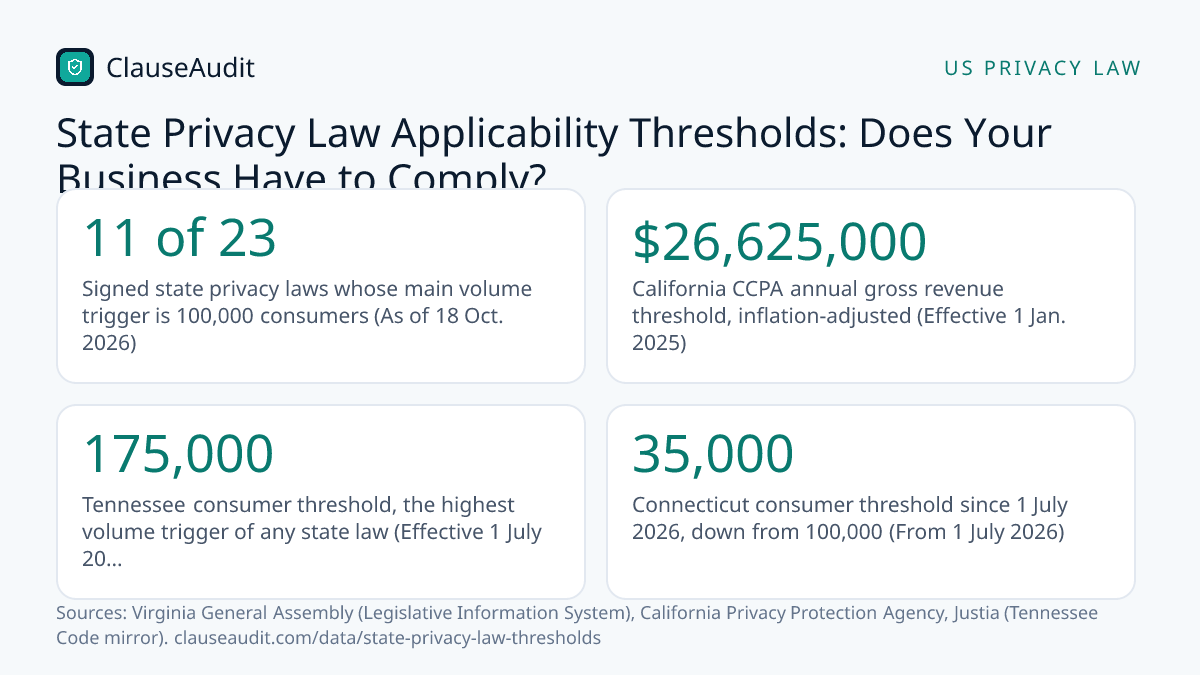
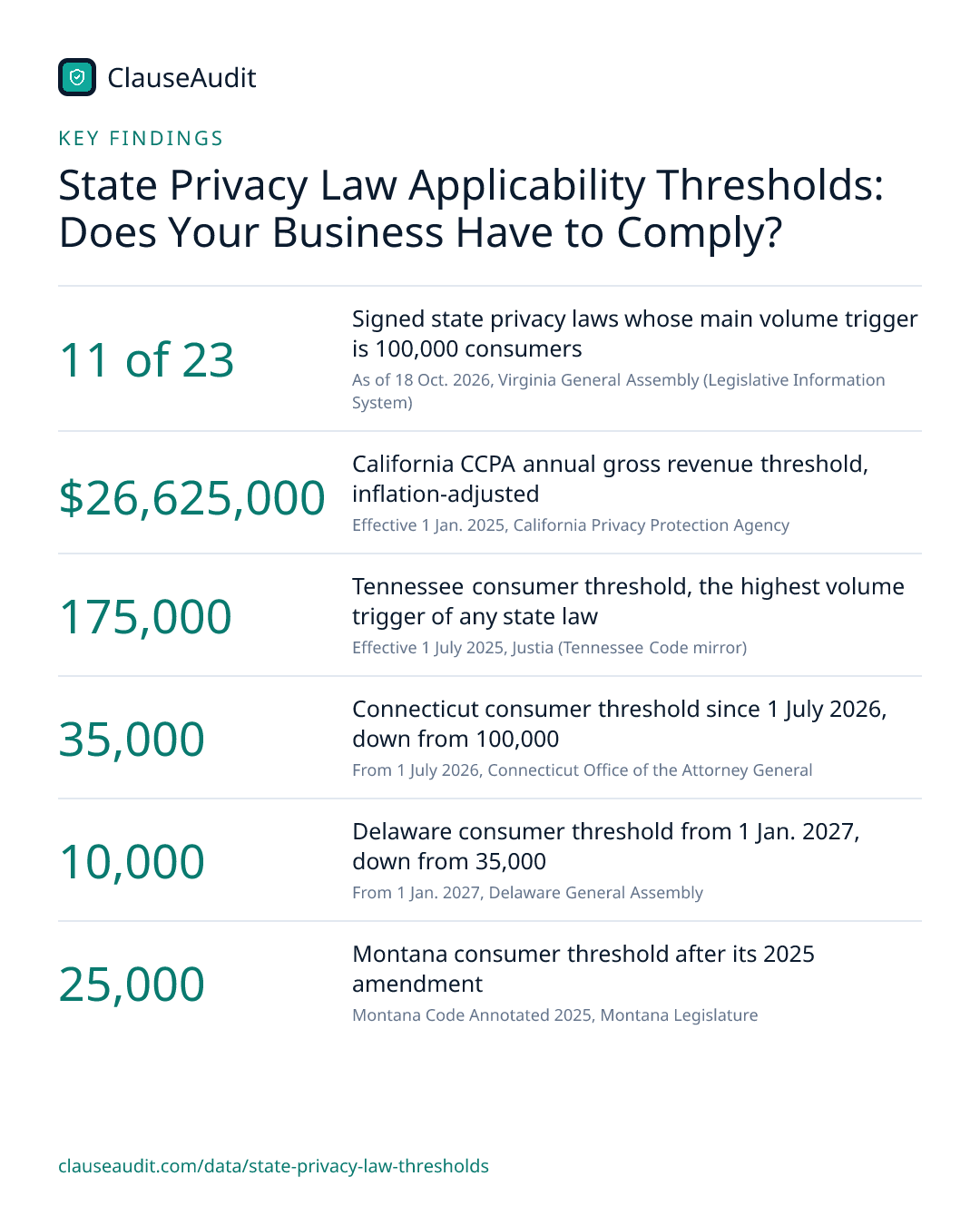
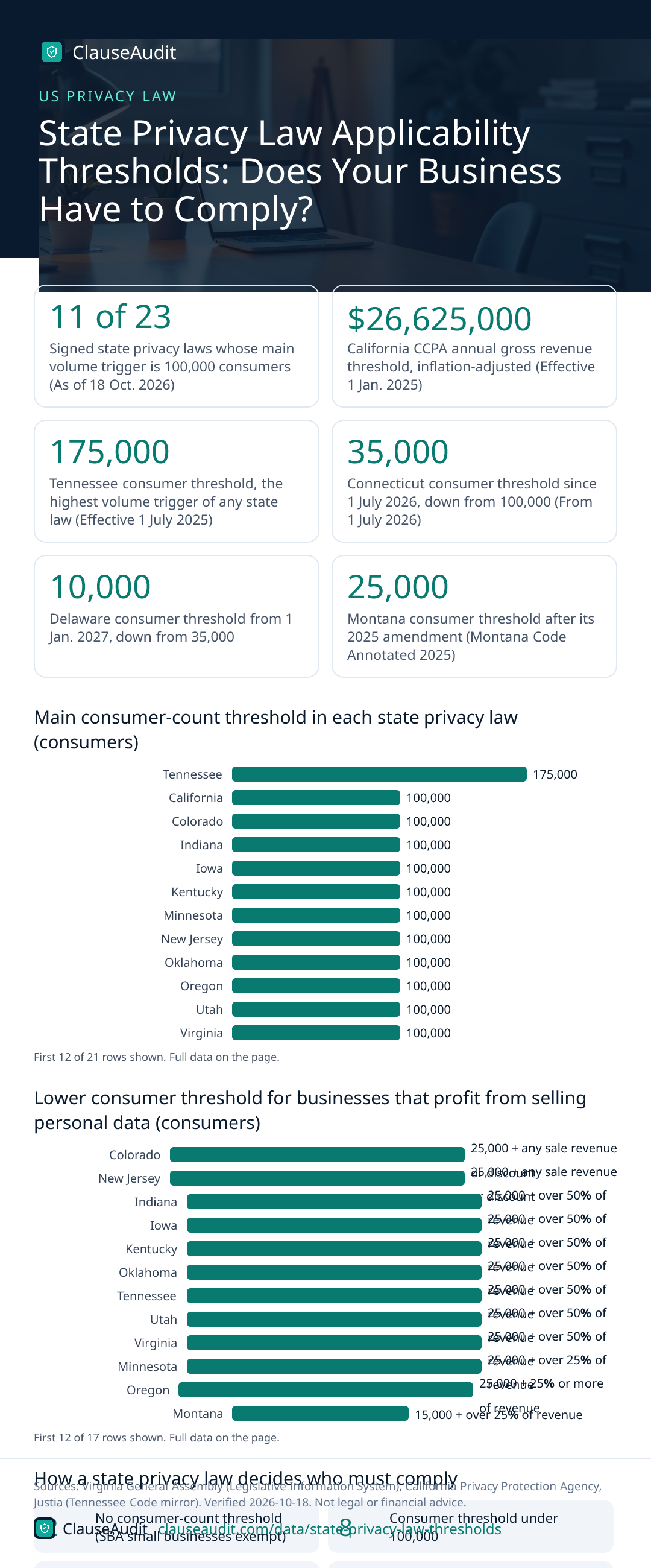
- Signed state privacy laws whose main volume trigger is 100,000 consumers (As of 18 Oct. 2026, Virginia General Assembly (Legislative Information System))
- 11 of 23
- California CCPA annual gross revenue threshold, inflation-adjusted (Effective 1 Jan. 2025, California Privacy Protection Agency)
- $26,625,000
- Tennessee consumer threshold, the highest volume trigger of any state law (Effective 1 July 2025, Justia (Tennessee Code mirror))
- 175,000
- Connecticut consumer threshold since 1 July 2026, down from 100,000 (From 1 July 2026, Connecticut Office of the Attorney General)
- 35,000
- Delaware consumer threshold from 1 Jan. 2027, down from 35,000 (From 1 Jan. 2027, Delaware General Assembly)
- 10,000
- Montana consumer threshold after its 2025 amendment (Montana Code Annotated 2025, Montana Legislature)
- 25,000
- States with no consumer-count threshold: Texas and Nebraska exempt only SBA small businesses (As of 18 Oct. 2026, Office of the Texas Attorney General)
- 2
- Florida Digital Bill of Rights revenue floor, the highest of any state (2026 Florida Statutes, Florida Legislature)
- $1 billion
Every state privacy law has a gate. Below it, the law mostly leaves you alone. Above it, you owe privacy notices, opt-out links, data request handling and contracts with every vendor that touches customer data. The hard part is that each state draws the gate in a different place, and Connecticut and Delaware both moved theirs this year.
This page shows where the lines sit as of 18 October 2026: the consumer counts, the lower counts for businesses that sell data, and the few states that use revenue instead. Use it to work out which laws reach you now, which ones will reach you in 2027, and what that means for the contracts you sign.
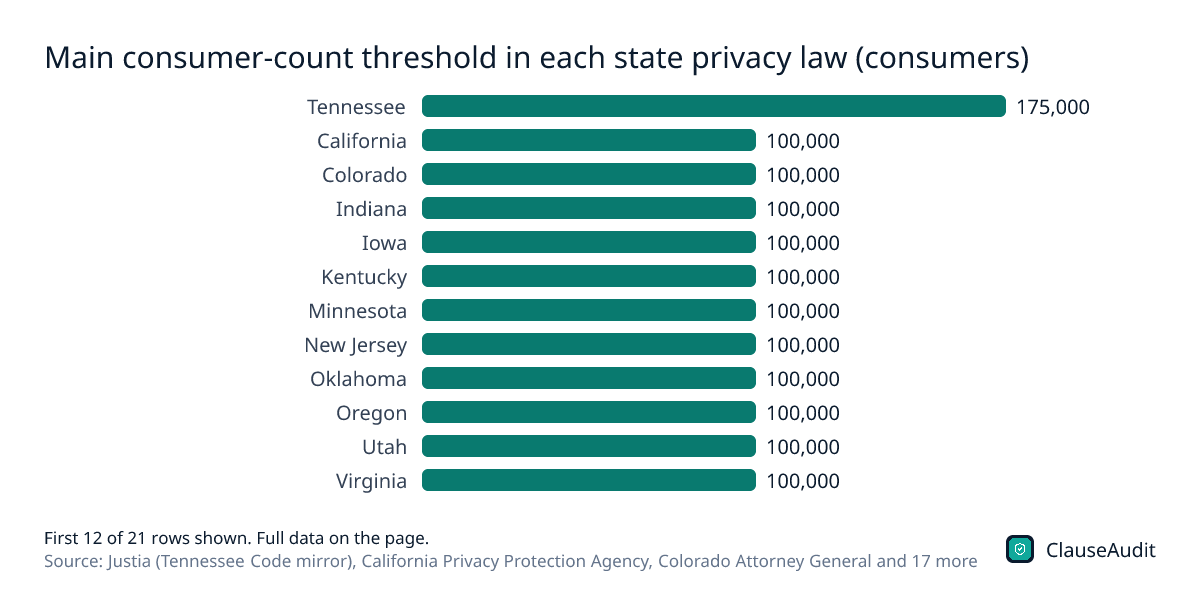
Main consumer-count threshold in each state privacy law (consumers)
Chart data
| Label | Value |
|---|---|
| Tennessee | 175,000 |
| California | 100,000 |
| Colorado | 100,000 |
| Indiana | 100,000 |
| Iowa | 100,000 |
| Kentucky | 100,000 |
| Minnesota | 100,000 |
| New Jersey | 100,000 |
| Oklahoma | 100,000 |
| Oregon | 100,000 |
| Utah | 100,000 |
| Virginia | 100,000 |
| Louisiana | 75,000 |
| Connecticut | 35,000 |
| Delaware | 35,000 (10,000 from 2027) |
| Maryland | 35,000 |
| New Hampshire | 35,000 |
| Rhode Island | 35,000 |
| Vermont | 35,000 |
| Alabama | More than 25,000 |
| Montana | 25,000 |
The tall bars are the old standard. The newer laws in New England and the mid-Atlantic cluster at 35,000, and Montana and Alabama sit lower still, so a business that cleared every bar in 2023 can be covered in 2026 without growing at all.
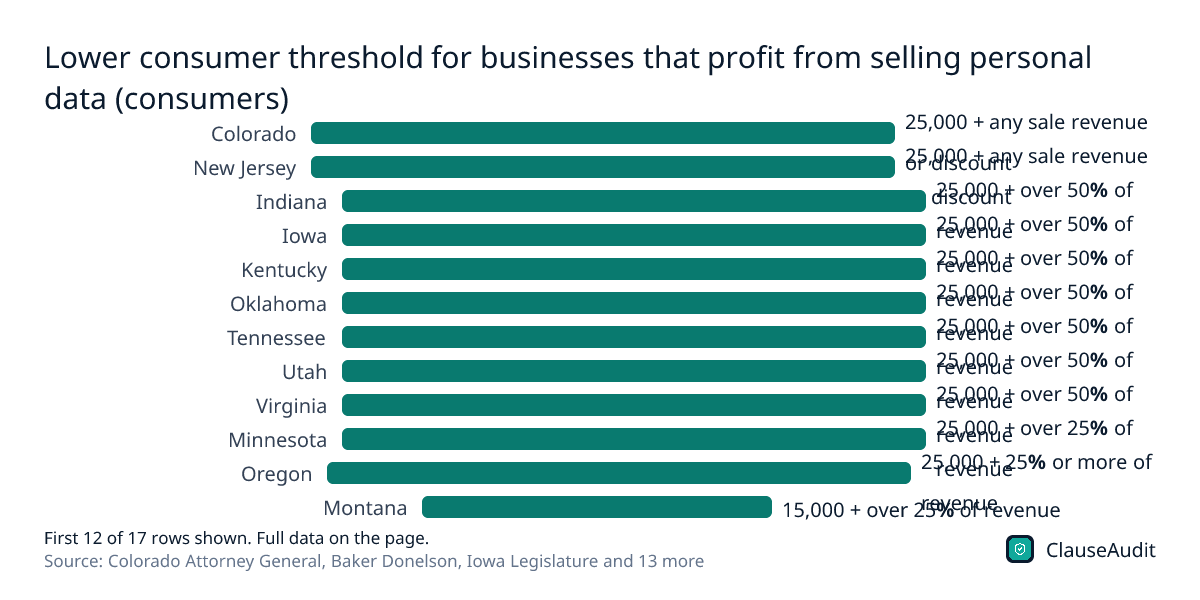
Download this chart (PNG)Lower consumer threshold for businesses that profit from selling personal data (consumers)
Chart data
| Label | Value |
|---|---|
| Colorado | 25,000 + any sale revenue or discount |
| New Jersey | 25,000 + any sale revenue or discount |
| Indiana | 25,000 + over 50% of revenue |
| Iowa | 25,000 + over 50% of revenue |
| Kentucky | 25,000 + over 50% of revenue |
| Oklahoma | 25,000 + over 50% of revenue |
| Tennessee | 25,000 + over 50% of revenue |
| Utah | 25,000 + over 50% of revenue |
| Virginia | 25,000 + over 50% of revenue |
| Minnesota | 25,000 + over 25% of revenue |
| Oregon | 25,000 + 25% or more of revenue |
| Montana | 15,000 + over 25% of revenue |
| New Hampshire | 10,000 + over 25% of revenue |
| Delaware | 10,000 + over 20% (5,000 from 2027) |
| Maryland | 10,000 + over 20% of revenue |
| Rhode Island | 10,000 + over 20% of revenue |
| Vermont | 3,000 consumers' data offered for sale |
If you earn money from selling personal data, ignore the first chart and look here. Vermont's law, starting in 2028, reaches a business that offers data on just 3,000 consumers for sale.
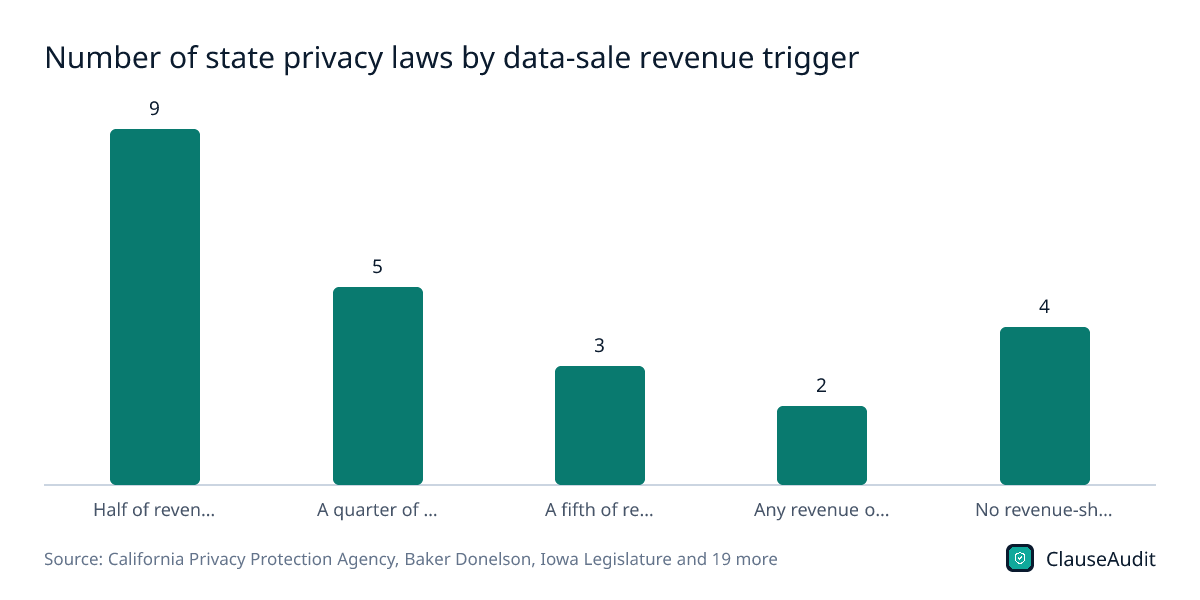
Download this chart (PNG)Number of state privacy laws by data-sale revenue trigger
Chart data
| Label | Value |
|---|---|
| Half of revenue (50%) | 9 |
| A quarter of revenue (25%) | 5 |
| A fifth of revenue (20%) | 3 |
| Any revenue or discount | 2 |
| No revenue-share test | 4 |
Nine laws set their data-seller test at half of revenue from selling data, which few ordinary companies reach. Colorado and New Jersey count any sale revenue or discount, so a single list rental can matter there.
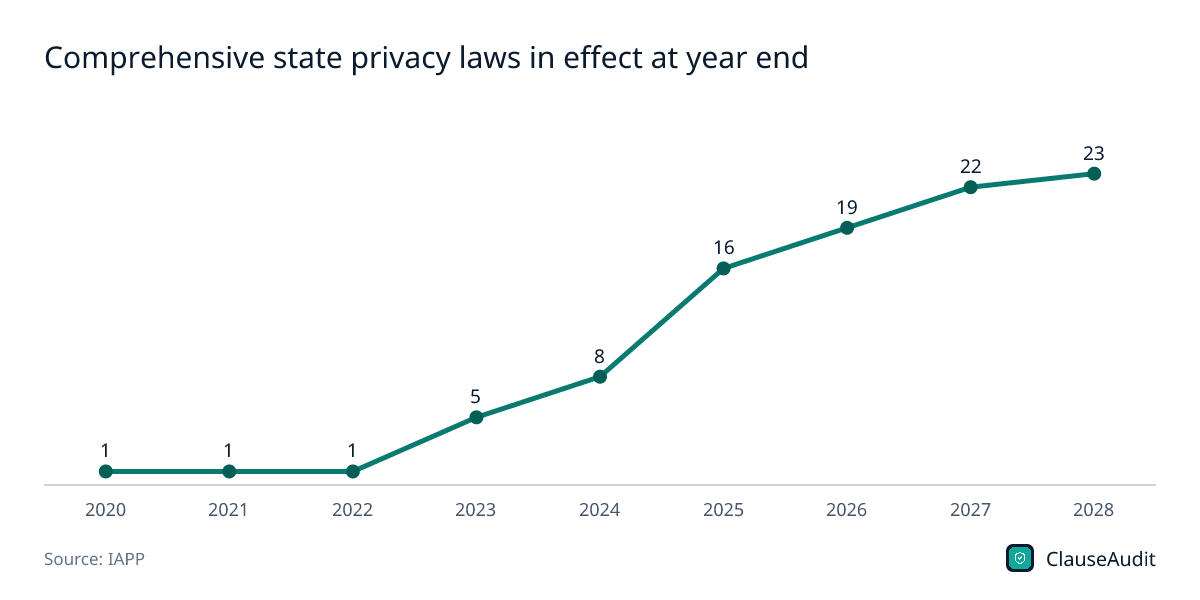
Download this chart (PNG)Comprehensive state privacy laws in effect at year end
Chart data
| Label | Value |
|---|---|
| 2020 | 1 |
| 2021 | 1 |
| 2022 | 1 |
| 2023 | 5 |
| 2024 | 8 |
| 2025 | 16 |
| 2026 | 19 |
| 2027 | 22 |
| 2028 | 23 |
The count went from 8 laws at the end of 2024 to 16 a year later. With Louisiana, Oklahoma, Alabama and Vermont scheduled, 23 will be in force by the end of 2028.
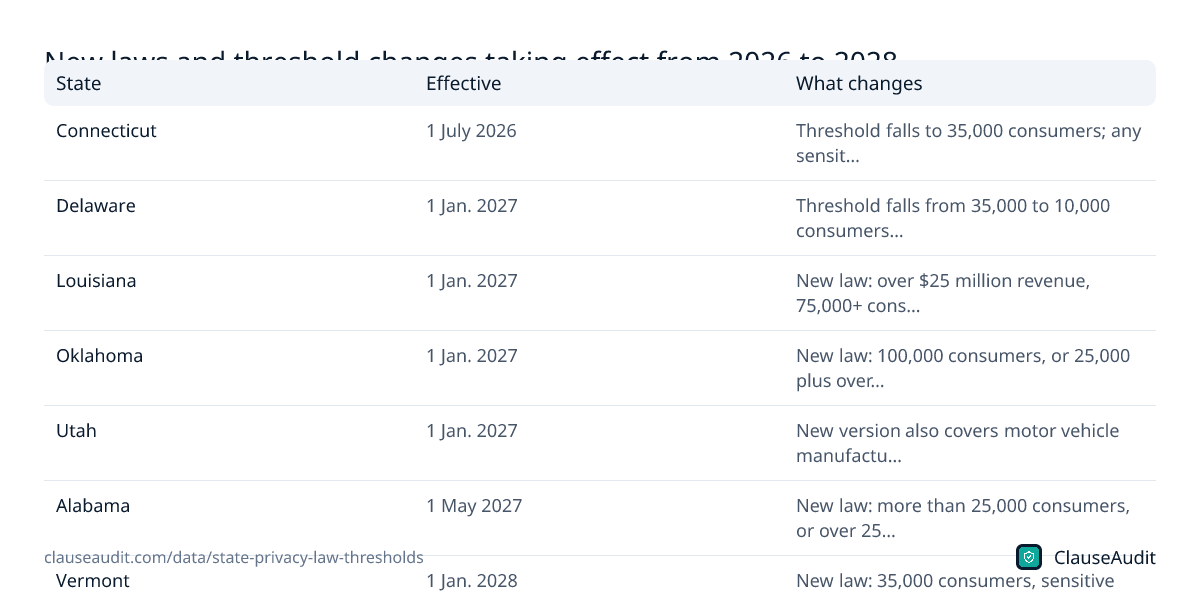
Download this chart (PNG)New laws and threshold changes taking effect from 2026 to 2028
| State | Effective | What changes |
|---|---|---|
| Connecticut | 1 July 2026 | Threshold falls to 35,000 consumers; any sensitive-data processing or offer to sell personal data also triggers the law |
| Delaware | 1 Jan. 2027 | Threshold falls from 35,000 to 10,000 consumers; seller threshold from 10,000 to 5,000 (over 20% of revenue); third parties that acquire personal data from a controller are also covered, with no consumer count |
| Louisiana | 1 Jan. 2027 | New law: over $25 million revenue, 75,000+ consumers, households or devices, or 50%+ of revenue from selling data |
| Oklahoma | 1 Jan. 2027 | New law: 100,000 consumers, or 25,000 plus over 50% of revenue from selling data |
| Utah | 1 Jan. 2027 | New version also covers motor vehicle manufacturers that collect data through vehicle systems |
| Alabama | 1 May 2027 | New law: more than 25,000 consumers, or over 25% of revenue from selling data; firms under 500 employees that do not sell data exempt |
| Vermont | 1 Jan. 2028 | New law: 35,000 consumers, sensitive data of 3,000, or personal data of 3,000 offered for sale |
Source: Connecticut Office of the Attorney General, The Connecticut Data Privacy Act; Delaware General Assembly, Delaware Code Title 6, Chapter 12D (Delaware Personal Data Privacy Act), § 12D-103; Privacy World (Squire Patton Boggs), Amendments to Delaware's Consumer Privacy Law Deepen the Morass of State Privacy Regulation; Louisiana State Legislature, Résumé Digest, Act 502 (SB 386), Louisiana Data Privacy Act; Oklahoma Legislature, Enrolled Senate Bill No. 546 (Oklahoma data privacy act), Section 15; Utah State Legislature, Utah Code § 13-61-102 Applicability (version effective 1 Jan. 2027); Alabama Legislature, HB351 Enrolled (Alabama Personal Data Protection Act), Sections 3 and 4; Vermont General Assembly, Act No. 145 (S.71), Vermont Data Privacy and Online Surveillance Act, as enacted; IAPP, US State Privacy Legislation Tracker 2026: Comprehensive Consumer Privacy Bills (chart). Download as image
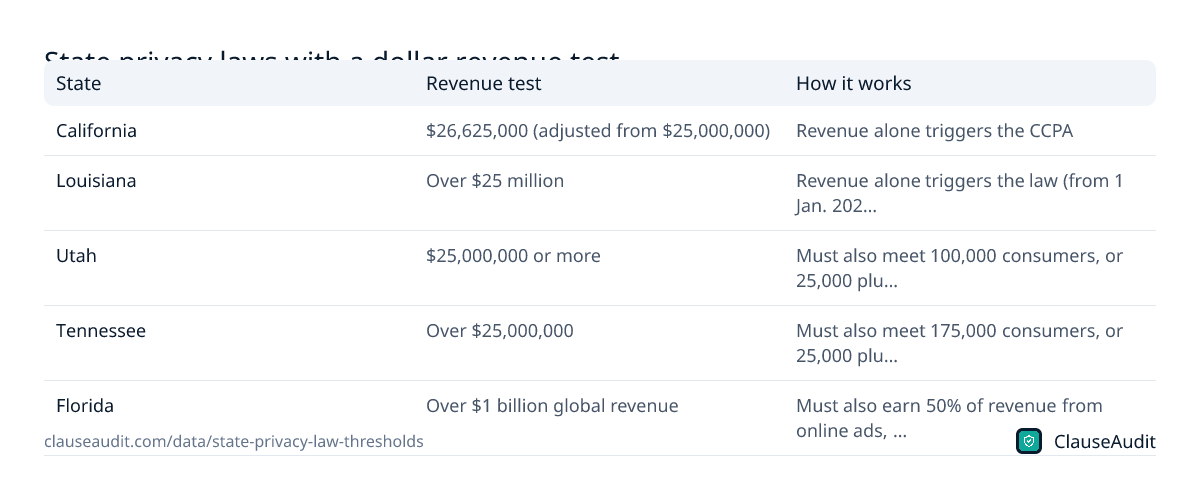
State privacy laws with a dollar revenue test
| State | Revenue test | How it works |
|---|---|---|
| California | $26,625,000 (adjusted from $25,000,000) | Revenue alone triggers the CCPA |
| Louisiana | Over $25 million | Revenue alone triggers the law (from 1 Jan. 2027) |
| Utah | $25,000,000 or more | Must also meet 100,000 consumers, or 25,000 plus over 50% of revenue from selling data |
| Tennessee | Over $25,000,000 | Must also meet 175,000 consumers, or 25,000 plus over 50% of revenue from selling data |
| Florida | Over $1 billion global revenue | Must also earn 50% of revenue from online ads, run a smart speaker service, or run an app store with 250,000+ apps |
Source: California Privacy Protection Agency, Updated Monetary Thresholds in CCPA; Louisiana State Legislature, Résumé Digest, Act 502 (SB 386), Louisiana Data Privacy Act; Utah State Legislature, Utah Code § 13-61-102 Applicability (version effective 1 Jan. 2027); Justia (Tennessee Code mirror), Tenn. Code § 47-18-3303 (Tennessee Information Protection Act applicability); Florida Legislature, 2026 Florida Statutes, s. 501.702 Definitions ("Controller"). Download as image
How a state privacy law decides who must comply by state
- 2No consumer-count threshold (SBA small businesses exempt)
- 8Consumer threshold under 100,000
- 2$25M+ revenue alone, or a consumer count
- 9100,000 consumers
- 3Revenue floor plus another test
- 27No comprehensive privacy law
- No consumer-count threshold (SBA small businesses exempt)2
- Consumer threshold under 100,0008
- $25M+ revenue alone, or a consumer count2
- 100,000 consumers9
- Revenue floor plus another test3
- No comprehensive privacy law27
| State | Law | Effective | Consumer threshold | Data-seller threshold | Revenue test | Source |
|---|---|---|---|---|---|---|
| Alabama | Alabama Personal Data Protection Act (HB 351) | 1 May 2027 | More than 25,000 | Over 25% of revenue from selling data (any count) | None | 2026 Ala. HB 351, §§ 3-4 |
| Alaska | No comprehensive privacy law | n/a | n/a | n/a | n/a | IAPP, US State Privacy Legislation Tracker 2026 (last updated 8 Sept. 2026) |
| Arizona | No comprehensive privacy law | n/a | n/a | n/a | n/a | IAPP, US State Privacy Legislation Tracker 2026 (last updated 8 Sept. 2026) |
| Arkansas | No comprehensive privacy law | n/a | n/a | n/a | n/a | IAPP, US State Privacy Legislation Tracker 2026 (last updated 8 Sept. 2026) |
| California | California Consumer Privacy Act | 1 Jan. 2020 | 100,000 consumers or households (bought, sold or shared) | 50% or more of revenue from selling or sharing (any count) | Over $26,625,000 (alone triggers) | Cal. Civ. Code § 1798.140(d)(1) |
| Colorado | Colorado Privacy Act | 1 July 2023 | 100,000 | 25,000 + any revenue or discount from selling data | None | C.R.S. § 6-1-1304 |
| Connecticut | Connecticut Data Privacy Act | 1 July 2023 (new thresholds 1 July 2026) | 35,000 | Any offer to sell personal data (no count) | None | Connecticut SB 6 (2022), as amended effective 1 July 2026 |
| Delaware | Delaware Personal Data Privacy Act | 1 Jan. 2025 | 35,000 (10,000 from 1 Jan. 2027) | 10,000 + over 20% of revenue (5,000 from 1 Jan. 2027) | None | 6 Del. C. § 12D-103 |
| District of Columbia | No comprehensive privacy law | n/a | n/a | n/a | n/a | IAPP, US State Privacy Legislation Tracker 2026 (last updated 8 Sept. 2026) |
| Florida | Florida Digital Bill of Rights (narrow law) | In force (not counted by IAPP) | None | None | Over $1 billion global revenue plus a business-type test | Fla. Stat. § 501.702 |
| Georgia | No comprehensive privacy law | n/a | n/a | n/a | n/a | IAPP, US State Privacy Legislation Tracker 2026 (last updated 8 Sept. 2026) |
| Hawaii | No comprehensive privacy law | n/a | n/a | n/a | n/a | IAPP, US State Privacy Legislation Tracker 2026 (last updated 8 Sept. 2026) |
| Idaho | No comprehensive privacy law | n/a | n/a | n/a | n/a | IAPP, US State Privacy Legislation Tracker 2026 (last updated 8 Sept. 2026) |
| Illinois | No comprehensive privacy law | n/a | n/a | n/a | n/a | IAPP, US State Privacy Legislation Tracker 2026 (last updated 8 Sept. 2026) |
| Indiana | Indiana Consumer Data Protection Act | 1 Jan. 2026 | 100,000 | 25,000 + over 50% of revenue | None | Indiana SB 5 (2023) |
| Iowa | Iowa Consumer Data Protection Act | 1 Jan. 2025 | 100,000 | 25,000 + over 50% of revenue | None | Iowa Code § 715D.2 |
| Kansas | No comprehensive privacy law | n/a | n/a | n/a | n/a | IAPP, US State Privacy Legislation Tracker 2026 (last updated 8 Sept. 2026) |
| Kentucky | Kentucky Consumer Data Protection Act | 1 Jan. 2026 | 100,000 | 25,000 + over 50% of revenue | None | KRS 367.3613 |
| Louisiana | Louisiana Data Privacy Act (SB 386, Act 502) | 1 Jan. 2027 | 75,000 consumers, households or devices | 50% or more of revenue from selling data (any count) | Over $25 million (alone triggers) | 2026 La. Acts No. 502 (SB 386) |
| Maine | No comprehensive privacy law | n/a | n/a | n/a | n/a | IAPP, US State Privacy Legislation Tracker 2026 (last updated 8 Sept. 2026) |
| Maryland | Maryland Online Data Privacy Act | 1 Oct. 2025 | 35,000 | 10,000 + over 20% of revenue | None | 2024 Md. SB 541 |
| Massachusetts | No comprehensive privacy law | n/a | n/a | n/a | n/a | IAPP, US State Privacy Legislation Tracker 2026 (last updated 8 Sept. 2026) |
| Michigan | No comprehensive privacy law | n/a | n/a | n/a | n/a | IAPP, US State Privacy Legislation Tracker 2026 (last updated 8 Sept. 2026) |
| Minnesota | Minnesota Consumer Data Privacy Act | 31 July 2025 | 100,000 | 25,000 + over 25% of revenue | None | Minn. Stat. § 325M.12 |
| Mississippi | No comprehensive privacy law | n/a | n/a | n/a | n/a | IAPP, US State Privacy Legislation Tracker 2026 (last updated 8 Sept. 2026) |
| Missouri | No comprehensive privacy law | n/a | n/a | n/a | n/a | IAPP, US State Privacy Legislation Tracker 2026 (last updated 8 Sept. 2026) |
| Montana | Montana Consumer Data Privacy Act | 1 Oct. 2024 (amended 2025) | 25,000 | 15,000 + over 25% of revenue | None | Mont. Code Ann. § 30-14-2803 |
| Nebraska | Nebraska Data Privacy Act | 1 Jan. 2025 | None | None | None (exempts SBA small businesses) | Neb. Rev. Stat. § 87-1103 |
| Nevada | No comprehensive privacy law | n/a | n/a | n/a | n/a | IAPP, US State Privacy Legislation Tracker 2026 (last updated 8 Sept. 2026) |
| New Hampshire | New Hampshire SB 255 | 1 Jan. 2025 | 35,000 unique consumers | 10,000 + over 25% of revenue | None | N.H. RSA 507-H:2 |
| New Jersey | New Jersey SB 332 | 15 Jan. 2025 | 100,000 | 25,000 + any revenue or discount from selling data | None | N.J. SB 332 (2024) |
| New Mexico | No comprehensive privacy law | n/a | n/a | n/a | n/a | IAPP, US State Privacy Legislation Tracker 2026 (last updated 8 Sept. 2026) |
| New York | No comprehensive privacy law | n/a | n/a | n/a | n/a | IAPP, US State Privacy Legislation Tracker 2026 (last updated 8 Sept. 2026) |
| North Carolina | No comprehensive privacy law | n/a | n/a | n/a | n/a | IAPP, US State Privacy Legislation Tracker 2026 (last updated 8 Sept. 2026) |
| North Dakota | No comprehensive privacy law | n/a | n/a | n/a | n/a | IAPP, US State Privacy Legislation Tracker 2026 (last updated 8 Sept. 2026) |
| Ohio | No comprehensive privacy law | n/a | n/a | n/a | n/a | IAPP, US State Privacy Legislation Tracker 2026 (last updated 8 Sept. 2026) |
| Oklahoma | Oklahoma SB 546 | 1 Jan. 2027 | 100,000 | 25,000 + over 50% of revenue | None | 75A O.S. § 314 (as codified by SB 546) |
| Oregon | Oregon Consumer Privacy Act | 1 July 2024 | 100,000 | 25,000 + 25% or more of revenue | None | ORS 646A.572 |
| Pennsylvania | No comprehensive privacy law | n/a | n/a | n/a | n/a | IAPP, US State Privacy Legislation Tracker 2026 (last updated 8 Sept. 2026) |
| Rhode Island | Rhode Island Data Transparency and Privacy Protection Act | 1 Jan. 2026 | 35,000 customers | 10,000 + over 20% of revenue | None | R.I. Gen. Laws § 6-48.1-4 |
| South Carolina | No comprehensive privacy law | n/a | n/a | n/a | n/a | IAPP, US State Privacy Legislation Tracker 2026 (last updated 8 Sept. 2026) |
| South Dakota | No comprehensive privacy law | n/a | n/a | n/a | n/a | IAPP, US State Privacy Legislation Tracker 2026 (last updated 8 Sept. 2026) |
| Tennessee | Tennessee Information Protection Act | 1 July 2025 | 175,000 | 25,000 + over 50% of revenue | Over $25,000,000 (required) | Tenn. Code § 47-18-3303 |
| Texas | Texas Data Privacy and Security Act | 1 July 2024 | None | None | None (exempts SBA small businesses) | Tex. Bus. & Com. Code § 541.002 |
| Utah | Utah Consumer Privacy Act | 31 Dec. 2023 | 100,000 | 25,000 + over 50% of revenue | $25,000,000 or more (required) | Utah Code § 13-61-102 |
| Vermont | Vermont Data Privacy and Online Surveillance Act (Act 145) | 1 Jan. 2028 | 35,000 | Personal data of 3,000 offered for sale | None | 9 V.S.A. § 2415b |
| Virginia | Virginia Consumer Data Protection Act | 1 Jan. 2023 | 100,000 | 25,000 + over 50% of revenue | None | Va. Code § 59.1-576 |
| Washington | No comprehensive privacy law | n/a | n/a | n/a | n/a | IAPP, US State Privacy Legislation Tracker 2026 (last updated 8 Sept. 2026) |
| West Virginia | No comprehensive privacy law | n/a | n/a | n/a | n/a | IAPP, US State Privacy Legislation Tracker 2026 (last updated 8 Sept. 2026) |
| Wisconsin | No comprehensive privacy law | n/a | n/a | n/a | n/a | IAPP, US State Privacy Legislation Tracker 2026 (last updated 8 Sept. 2026) |
| Wyoming | No comprehensive privacy law | n/a | n/a | n/a | n/a | IAPP, US State Privacy Legislation Tracker 2026 (last updated 8 Sept. 2026) |
What does a privacy law threshold actually measure?
Most thresholds count consumers: residents of that state whose personal data you control or process in a year. It does not matter where your company is based. A Florida business with a big Oregon customer list is measured against Oregon's law.
A consumer is usually a person acting for themselves, not as an employee or a business contact, so your B2B lead list often does not count. California is the big exception. Its law also covers employee and business contact data, and it counts households as well as people for the data you buy, sell or share.
Some details trip people up. Connecticut, Delaware and Maryland leave out data you hold only to finish a payment, so a checkout that never builds a customer profile may not count toward their numbers. Louisiana counts devices as well as people and households, which can inflate the tally fast for an app or ad-supported site. Delaware measures the preceding calendar year, so this year's growth shows up in next year's obligations.
Which states have the lowest thresholds in 2026?
The old rule of thumb was 100,000 consumers per state. That still holds for 11 of the 23 laws, including Virginia, Colorado, Oregon and Minnesota. But a cluster of states now sits at 35,000: Connecticut, Delaware, Maryland, New Hampshire, Rhode Island and Vermont. Montana sits at 25,000 after its 2025 amendment, and Alabama's law starts at more than 25,000 when it takes effect on 1 May 2027.
Connecticut is the one most businesses missed. Since 1 July 2026 it applies at 35,000 consumers, down from 100,000, and any processing of sensitive data or any offer to sell personal data triggers it with no minimum at all. Health details, precise location and biometric data all count as sensitive. Delaware goes further on 1 January 2027, when its bar drops to 10,000 consumers.
Then there are Texas and Nebraska, which skip the count entirely. Their laws apply to any business that processes personal data unless it qualifies as a small business under the federal Small Business Act. Even then, Texas still requires consent before a small business sells sensitive data.
Can revenue alone make you comply?
In two states, yes. California's law reaches any business with annual gross revenue over $26,625,000, the inflation-adjusted figure in effect since 1 January 2025, even if almost none of that revenue comes from California residents. Louisiana's new law, effective 1 January 2027, does the same for revenue over $25 million.
Tennessee and Utah use revenue the other way, as an extra gate. You need over $25,000,000 in Tennessee, or $25,000,000 or more in Utah, plus a consumer count, so a small company with a large audience can stay outside both. Tennessee's count is also the highest of any state at 175,000.
Florida's law is in its own category. It applies only to companies with over $1 billion in global revenue that also earn half their revenue from online ads, run a smart speaker service, or run an app store with 250,000 or more apps. If you are reading this page to check your own exposure, Florida's law is almost certainly not your problem.
Do privacy laws apply to small businesses and freelancers?
Directly, often not. A freelance designer, a local agency or a small software shop rarely reaches 35,000 consumers in one state, let alone 100,000. Alabama even exempts businesses with fewer than 500 employees that do not sell personal data.
Indirectly, almost always. When a covered client hires you to build its email flows, host its site or analyze its customer list, the law requires the client to bind you by contract. That is the data processing addendum you get asked to sign. It can require you to delete data on request, help with consumer requests, notify the client of a breach and pass the same terms down to your own subcontractors. You take on those duties because of your client's size, not yours.
Watch for one new wrinkle. From 1 January 2027, Delaware also covers third parties that acquire personal data from a controller, with no consumer count. If you buy or receive lists, the size test no longer protects you there.
How to check whether you have to comply
- Pull customer, subscriber and visitor counts by state for the last full calendar year. Use identifiable people, not raw page views, unless you collect device IDs.
- Compare each state's count to the map above, starting with the lowest bars: Montana, Connecticut, Delaware, Maryland, New Hampshire and Rhode Island.
- Check your revenue against California's $26,625,000 line and Louisiana's $25 million line for 2027.
- List every way you earn money from personal data, including list rentals, data shares with ad partners and discounts traded for data. In Colorado and New Jersey, any of these can lower your bar to 25,000.
- Flag sensitive data. In Connecticut, processing it at all brings you under the law.
- Look now at what changes in 2027 and 2028: Delaware's lower bar, plus new laws in Louisiana, Oklahoma, Alabama and Vermont.
- Review the contracts that move data in and out of your business, since that is where most of the obligations end up.
What to do if you cross a threshold
Start with the basics nearly every law asks for: a privacy notice that says what you collect and why, a way for people to access and delete their data (and correct it, in most states), and an opt-out for data sales and, in most states, targeted ads. Many of the newer laws, including Colorado, Connecticut, Oregon and Texas, also expect you to honor a browser-based opt-out signal.
Then go to your vendor list. Each law requires a written contract with every processor that handles personal data for you, covering confidentiality, deletion at the end of service, audits and subcontractors. Your email platform, CRM, payment processor and analytics tools all count. Many vendors bury these terms in a linked addendum or reserve the right to use your customer data for their own products. If the regulator asks, the gap is yours, not theirs. Tighten those contracts before you sign the next renewal.
How ClauseAudit helps
Once a privacy law reaches you, the vendors that hold your customer data become part of your compliance. Upload a software or service agreement and our automated review flags the clauses that decide whether that vendor helps you meet the law or quietly works against it.
It also works in reverse. If a client sends you a data processing addendum, you can see what you are agreeing to carry before you sign.
- Data use: whether the vendor can use your customer data for its own purposes, including product improvement or model training
- Processor terms: whether a data processing addendum exists and covers deletion, audits and subcontractors
- Breach notice: how fast the vendor must tell you about an incident and what help it owes you
- Liability cap: whether a data loss is capped at a small slice of fees or carved out
- Deletion and export: whether you can get your data back and confirm it is erased when the contract ends
- Terms changes: whether the vendor can rewrite privacy terms on short notice with continued use counting as consent
Frequently asked questions
Does the CCPA apply to my business?
It applies if you do business in California and meet any one of these tests: annual gross revenue over $26,625,000, buying, selling or sharing the personal data of 100,000 or more consumers or households, or earning 50% or more of revenue from selling or sharing personal data. The revenue test counts your total revenue, not just California sales.
What is the most common state privacy law threshold?
100,000 consumers. It is the main trigger in 11 of the 23 signed state laws, including California, Colorado, Virginia, Oregon, Minnesota and Utah. The newer laws trend lower, and 35,000 is now common in the Northeast and mid-Atlantic, so check the states where your customers actually live rather than assuming the old number still holds.
Which state has the lowest privacy law threshold?
Texas and Nebraska, in a sense, because they have no consumer count and exempt only small businesses as defined by the SBA. Among states with a count, Montana is at 25,000, Alabama will start above 25,000 in 2027, and Delaware drops to 10,000 consumers on 1 January 2027.
Did Connecticut change its privacy law threshold?
Yes. From 1 July 2026 the Connecticut Data Privacy Act applies at 35,000 consumers, down from 100,000. Any processing of sensitive data, or any offer to sell personal data, now triggers the law with no minimum count. Data kept only to complete a payment is excluded.
Are small businesses exempt from the Texas privacy law?
Mostly. The Texas Data Privacy and Security Act exempts businesses that qualify as small under the federal Small Business Act. The exception is sensitive data: even a small business must get consumer consent before selling it. Nebraska uses the same small business test.
Do I count customers from every state or just one?
Each law counts only residents of its own state. You compare your Oregon count to Oregon's bar, your Maryland count to Maryland's, and so on. A business can be covered in Montana at 25,000 residents while staying well under the line in Virginia.
Does selling data lower the threshold?
Yes, in most states. Colorado and New Jersey apply at 25,000 consumers if you get any revenue or discount from selling data. Maryland and Rhode Island apply at 10,000 with over 20% of revenue from sales, and Vermont, from 2028, reaches anyone offering data on 3,000 consumers for sale.
I am below every threshold. Can I ignore privacy rules?
Not quite. Covered clients will still make you sign processing terms that carry their obligations. Breach notification laws, which apply regardless of size, still bind you. And Delaware will cover third parties that acquire data from a controller from 2027 with no count at all.
How many states have a full consumer privacy law?
IAPP's tracker lists 23 signed laws. 19 are in force by the end of 2026, and the rest take effect in 2027 and 2028 as Louisiana, Oklahoma, Alabama and Vermont come online. Florida also has a narrow law aimed at very large tech companies, which IAPP does not count.
Use this data
Every chart and card below is free to reuse under CC BY 4.0. Download what you need and link back to this page.
 Stat cards
 Key findings card
 Infographic
 Main consumer-count threshold in each state privacy law (consumers)
 Lower consumer threshold for businesses that profit from selling personal data (consumers)
 Number of state privacy laws by data-sale revenue trigger
 Comprehensive state privacy laws in effect at year end
 New laws and threshold changes taking effect from 2026 to 2028
 State privacy laws with a dollar revenue test
Embed the infographic
Free to share on your site, blog or slides under CC BY 4.0. Please keep the credit link.
Sources and method
Every number on this page comes from the sources below, each opened and read on or before October 18, 2026. A second, independent review checked every figure against its source and corrected anything that did not match. 51 of 51 state entries were confirmed; any that could not be are marked "Not yet confirmed" and left out of every count and chart.
- IAPP, US State Privacy Legislation Tracker 2026: Comprehensive Consumer Privacy Bills (chart) (Tracker last updated 8 Sept. 2026)
- California Privacy Protection Agency, Updated Monetary Thresholds in CCPA (Posted 17 Dec. 2024; effective 1 Jan. 2025)
- California Privacy Protection Agency, California Consumer Privacy Act of 2018 (statute text), Civil Code § 1798.140(d) (Effective 1 Jan. 2025 text, posted January 2025)
- Colorado Attorney General, Colorado Privacy Act (resource page and FAQ), C.R.S. § 6-1-1304 (Undated page, read October 2026)
- Connecticut Office of the Attorney General, The Connecticut Data Privacy Act (Undated page reflecting thresholds effective 1 July 2026, read October 2026)
- Morgan Lewis, US State Consumer Privacy Law Update: Notable Changes Across Existing Frameworks (30 July 2026)
- Delaware General Assembly, Delaware Code Title 6, Chapter 12D (Delaware Personal Data Privacy Act), § 12D-103 (Current code, showing § 12D-103 versions effective until and from 1 Jan. 2027)
- Privacy World (Squire Patton Boggs), Amendments to Delaware's Consumer Privacy Law Deepen the Morass of State Privacy Regulation (16 Sept. 2026)
- Florida Legislature, 2026 Florida Statutes, s. 501.702 Definitions ("Controller") (2026 Florida Statutes)
- Baker Donelson, Consumer Data Privacy Law Guide: Indiana (Last updated May 2025)
- Iowa Legislature, Iowa Code § 715D.2 Scope and exemptions (Current Iowa Code, read October 2026)
- Kentucky General Assembly, 2025 Ky. Acts Chapter 13 (HB 473), amending KRS 367.3613 (2025 Regular Session)
- Louisiana State Legislature, Résumé Digest, Act 502 (SB 386), Louisiana Data Privacy Act (2026 Regular Session (read via Internet Archive snapshot of 12 Oct. 2026))
- Maryland Department of Legislative Services, Fiscal and Policy Note, SB 541 Maryland Online Data Privacy Act of 2024 (Enrolled - Revised) (2024 Session)
- Minnesota Office of the Revisor of Statutes, Minn. Stat. § 325M.12 Scope; exclusions (2025 Minnesota Statutes)
- Montana Legislature, Mont. Code Ann. § 30-14-2803 Applicability (Montana Code Annotated 2025 (amended by Ch. 567, L. 2025))
- Nebraska Legislature, Neb. Rev. Stat. § 87-1103 Applicability of act to persons or entities (Current statute (read via Internet Archive snapshot of 18 Oct. 2026))
- New Hampshire General Court, N.H. RSA 507-H:2 Application (Current RSA (read via Internet Archive snapshot of 28 Feb. 2026))
- Baker Donelson, Consumer Data Privacy Law Guide: New Jersey (Last updated May 2025)
- Oklahoma Legislature, Enrolled Senate Bill No. 546 (Oklahoma data privacy act), Section 15 (Enrolled 2026)
- Oregon State Legislature, ORS 646A.572 Scope and application; exclusions (ORS 2025 edition)
- State of Rhode Island General Assembly, R.I. Gen. Laws § 6-48.1-4 (Rhode Island Data Transparency and Privacy Protection Act) (Effective 1 Jan. 2026 (read via Internet Archive snapshot, 2026))
- Justia (Tennessee Code mirror), Tenn. Code § 47-18-3303 (Tennessee Information Protection Act applicability) (2024 Tennessee Code)
- Texas.Public.Law (text of the official Texas statutes), Tex. Bus. & Com. Code § 541.002 Applicability of Chapter (Statute text as of 26 May 2025)
- Office of the Texas Attorney General, Texas Data Privacy and Security Act (Undated page, read October 2026)
- Utah State Legislature, Utah Code § 13-61-102 Applicability (version effective 1 Jan. 2027) (Version effective 1 Jan. 2027 (read via Internet Archive snapshot, 2026))
- Virginia General Assembly (Legislative Information System), Code of Virginia § 59.1-576 Scope; exemptions (Page dated 19 Oct. 2026)
- Alabama Legislature, HB351 Enrolled (Alabama Personal Data Protection Act), Sections 3 and 4 (2026 Regular Session, enrolled)
- Vermont General Assembly, Act No. 145 (S.71), Vermont Data Privacy and Online Surveillance Act, as enacted (Signed 16 June 2026 (read via Internet Archive snapshot of 13 Oct. 2026))
Cite this page
ClauseAudit, “State Privacy Law Applicability Thresholds: Does Your Business Have to Comply?”, updated October 18, 2026, https://clauseaudit.com/data/state-privacy-law-thresholds. Free to reuse with a link back (CC BY 4.0).
This page summarises published data and law as checked on October 18, 2026. Figures are updated as new editions are released, and your own situation may differ. It is general information, not legal, tax or financial advice.