State Privacy Laws 2026: Every Consumer Privacy Law, Tracked
By ClauseAudit Research · 8 sources ·
Which states have privacy laws in 2026?
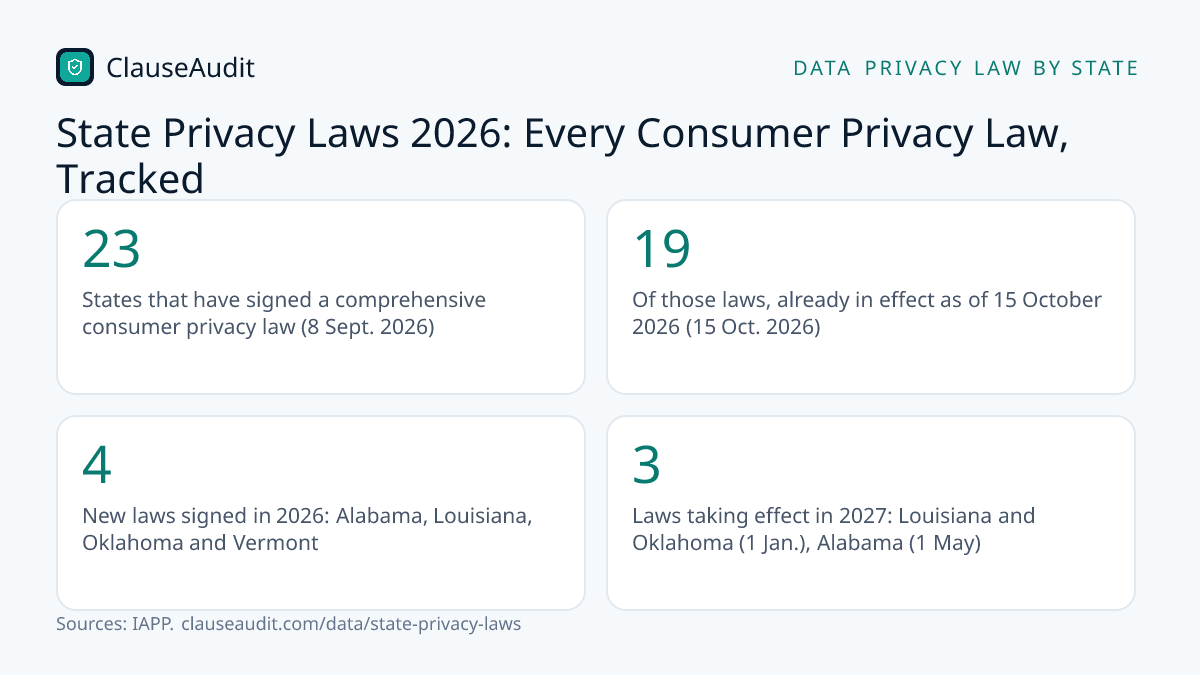
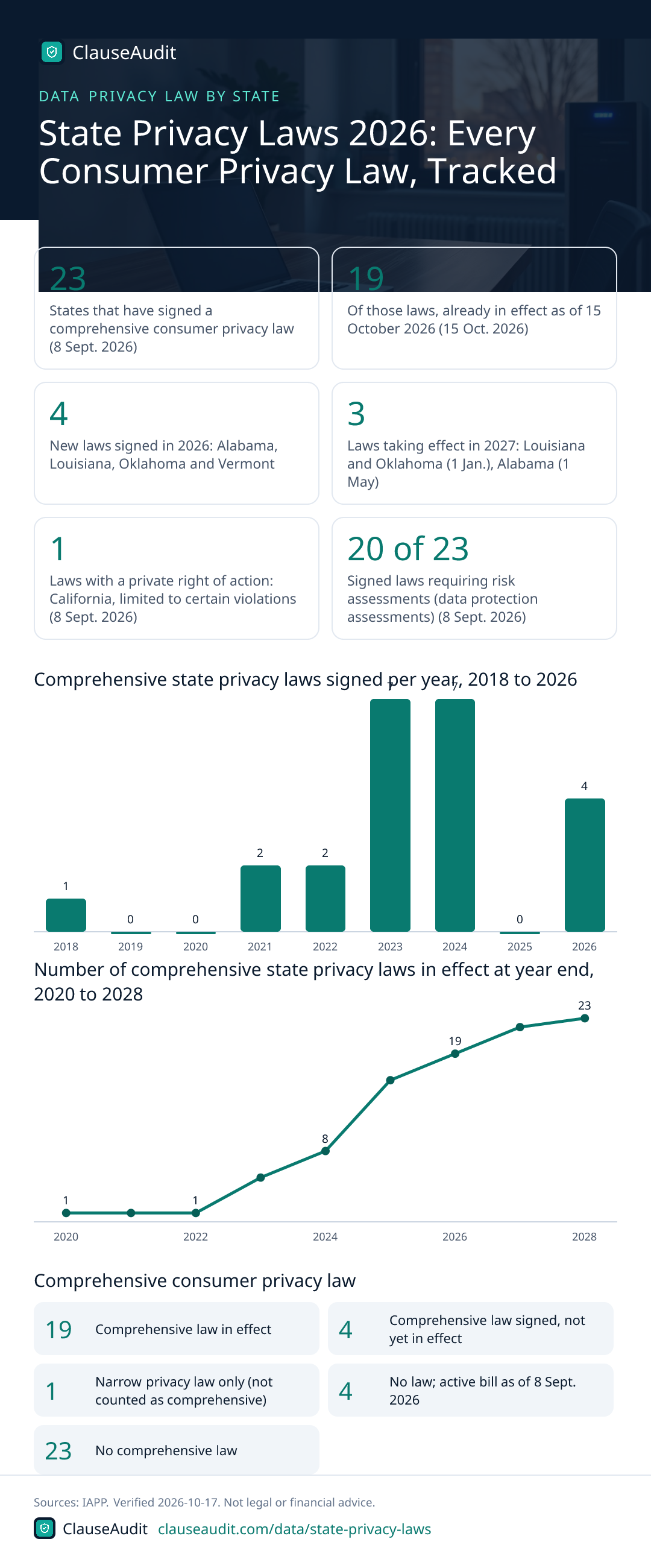
23 states have signed a consumer privacy law as of IAPP's 8 Sept. 2026 count, and 19 of them are in effect as of 15 Oct. 2026. Alabama, Louisiana, Oklahoma and Vermont signed theirs in 2026. Only California's law lets consumers sue, and only for certain violations. In every other state, the state enforces it.

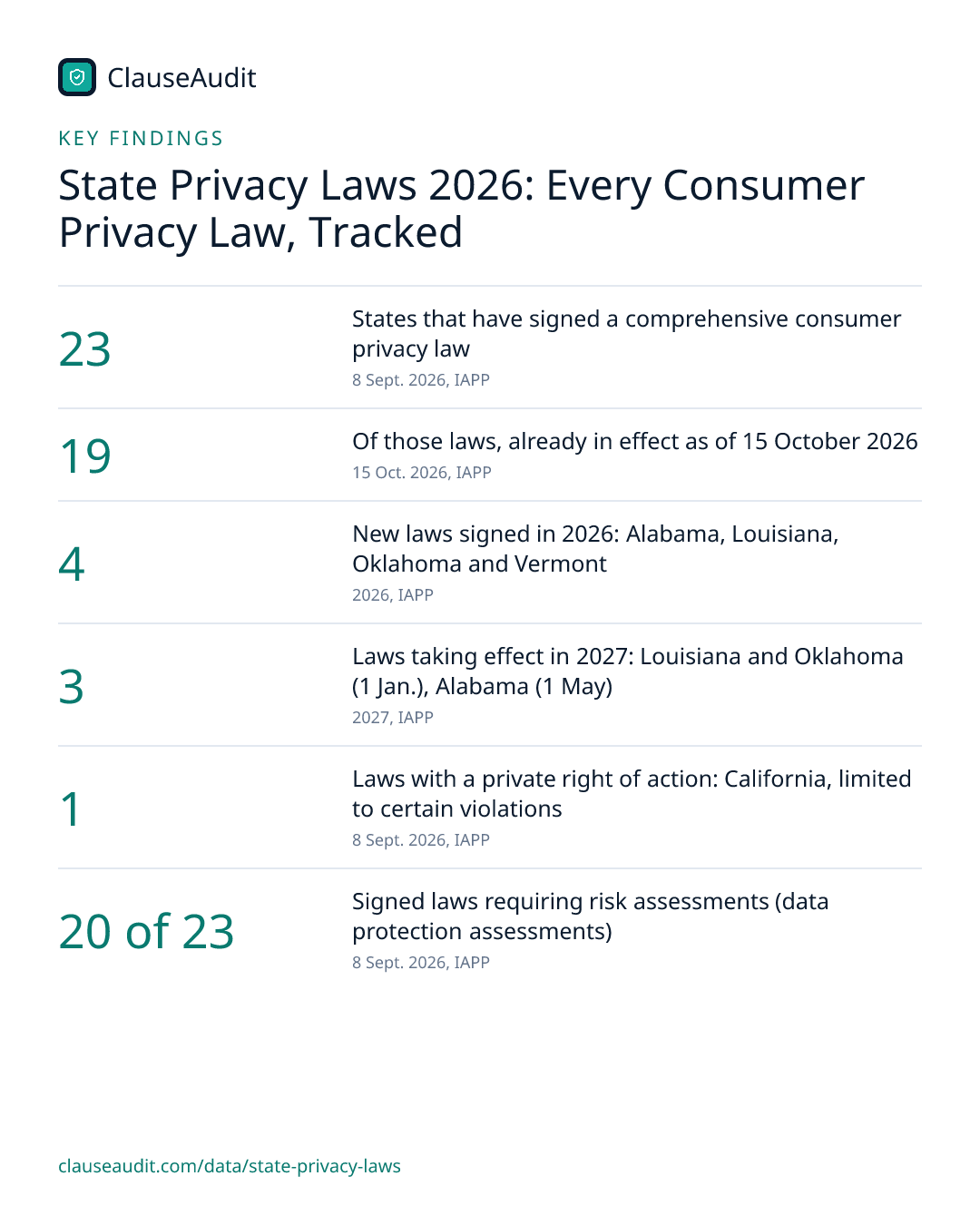
- States that have signed a comprehensive consumer privacy law (8 Sept. 2026, IAPP)
- 23
- Of those laws, already in effect as of 15 October 2026 (15 Oct. 2026, IAPP)
- 19
- New laws signed in 2026: Alabama, Louisiana, Oklahoma and Vermont (2026, IAPP)
- 4
- Laws taking effect in 2027: Louisiana and Oklahoma (1 Jan.), Alabama (1 May) (2027, IAPP)
- 3
- Laws with a private right of action: California, limited to certain violations (8 Sept. 2026, IAPP)
- 1
- Signed laws requiring risk assessments (data protection assessments) (8 Sept. 2026, IAPP)
- 20 of 23
- States, plus DC, with no comprehensive consumer privacy law on IAPP's list (15 Oct. 2026, IAPP)
- 27 + DC
If you run an online store, sell software or handle customer lists for clients, state privacy law now reaches you in more places than it did a year ago. As of 8 Sept. 2026, 23 states have signed a consumer privacy law. 19 of them were in effect as of 15 Oct. 2026, and the rest switch on between 1 Jan. 2027 and 1 Jan. 2028.
There is still no single federal privacy law, so what you owe depends on where your customers live, not where your office is. This page tracks each state law and its start date. Below the data, we cover what it means for freelancers, small companies and anyone signing a software or services contract.
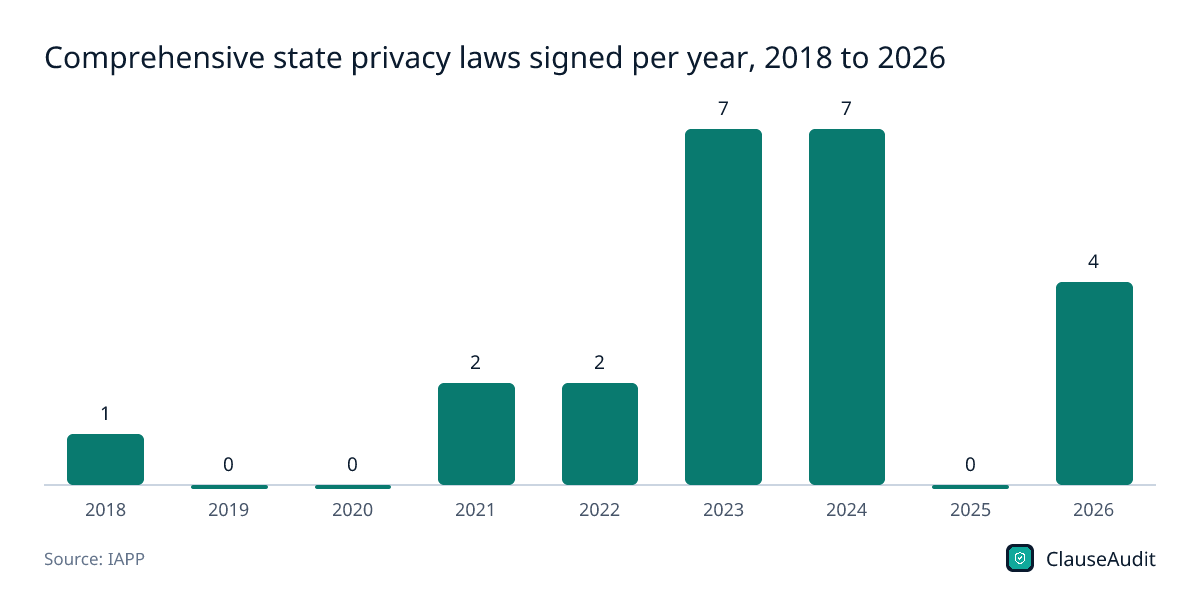
Comprehensive state privacy laws signed per year, 2018 to 2026
Chart data
| Label | Value |
|---|---|
| 2018 | 1 |
| 2019 | 0 |
| 2020 | 0 |
| 2021 | 2 |
| 2022 | 2 |
| 2023 | 7 |
| 2024 | 7 |
| 2025 | 0 |
| 2026 | 4 |
States passed these laws in bursts. 2023 and 2024 brought 7 new laws each, 2025 brought none, and 2026 added 4.
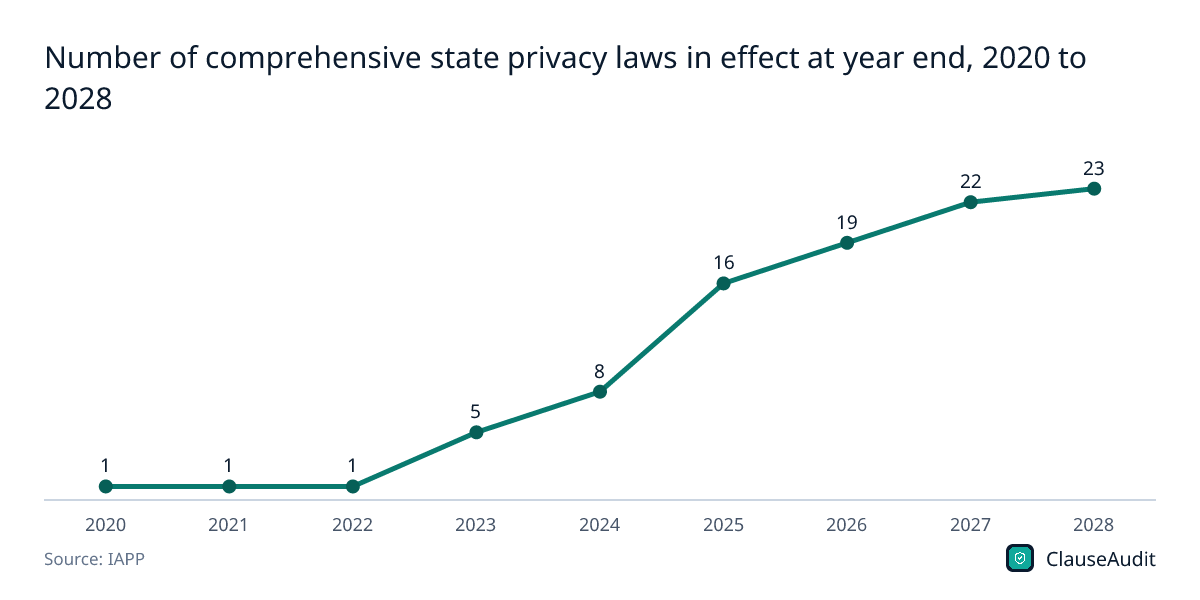
Download this chart (PNG)Number of comprehensive state privacy laws in effect at year end, 2020 to 2028
Chart data
| Label | Value |
|---|---|
| 2020 | 1 |
| 2021 | 1 |
| 2022 | 1 |
| 2023 | 5 |
| 2024 | 8 |
| 2025 | 16 |
| 2026 | 19 |
| 2027 | 22 |
| 2028 | 23 |
A law usually starts applying a year or more after it is signed. Laws already on the books take the count to 22 by the end of 2027 and 23 by the end of 2028.
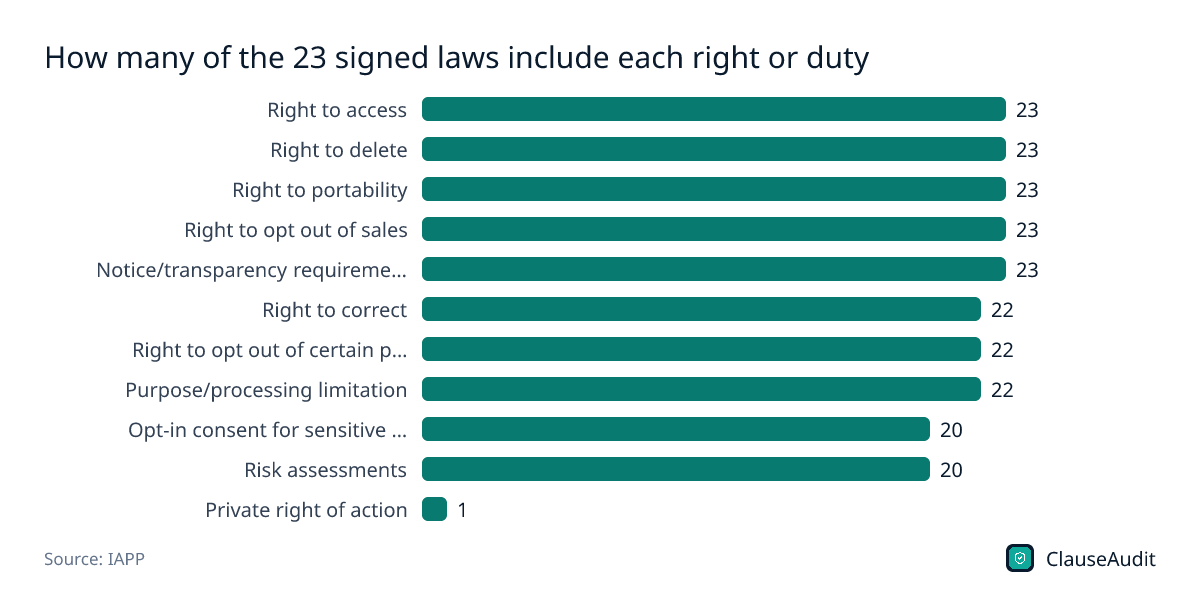
Download this chart (PNG)How many of the 23 signed laws include each right or duty
Chart data
| Label | Value |
|---|---|
| Right to access | 23 |
| Right to delete | 23 |
| Right to portability | 23 |
| Right to opt out of sales | 23 |
| Notice/transparency requirement | 23 |
| Right to correct | 22 |
| Right to opt out of certain processing (e.g., targeted ads, profiling) | 22 |
| Purpose/processing limitation | 22 |
| Opt-in consent for sensitive data | 20 |
| Risk assessments | 20 |
| Private right of action | 1 |
The core rights show up everywhere: all 23 laws give people access, deletion, portability and a sales opt-out. Opt-in consent for sensitive data and risk assessments are common, at 20 laws each, but not universal.
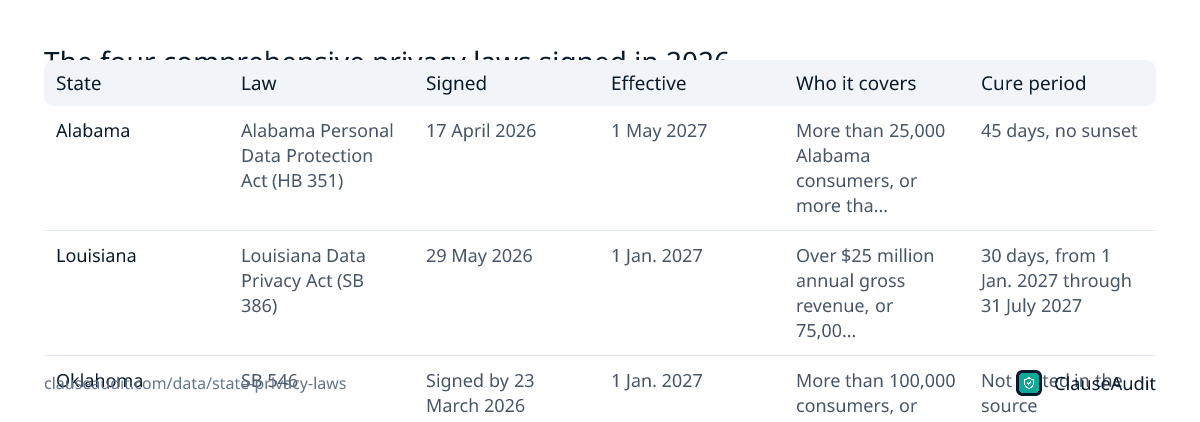
Download this chart (PNG)The four comprehensive privacy laws signed in 2026
| State | Law | Signed | Effective | Who it covers | Cure period |
|---|---|---|---|---|---|
| Alabama | Alabama Personal Data Protection Act (HB 351) | 17 April 2026 | 1 May 2027 | More than 25,000 Alabama consumers, or more than 25% of gross revenue from selling personal data | 45 days, no sunset |
| Louisiana | Louisiana Data Privacy Act (SB 386) | 29 May 2026 | 1 Jan. 2027 | Over $25 million annual gross revenue, or 75,000+ consumers, households or devices, or 50%+ of revenue from selling personal information | 30 days, from 1 Jan. 2027 through 31 July 2027 |
| Oklahoma | SB 546 | Signed by 23 March 2026 | 1 Jan. 2027 | More than 100,000 consumers, or 25,000 consumers if most revenue comes from selling data | Not stated in the source |
| Vermont | Vermont Data Privacy and Online Surveillance Act (S.71) | 16 June 2026 | 1 Jan. 2028 | 35,000+ Vermont residents, or sensitive data of 3,000+, or offering for sale data of 3,000+ | 60 days, 1 Jan. 2028 to 30 June 2029, then at AG discretion |
Source: Mayer Brown, Alabama Enacts Comprehensive Consumer Data Privacy Law; Davis Wright Tremaine, Louisiana Data Privacy Act (SB 386); Oklahoma House of Representatives, Major Data Privacy Bill Signed into Law (SB 546); Mayer Brown, Vermont Enacts Comprehensive Consumer Privacy Law; IAPP, US State Privacy Legislation Tracker 2026: Comprehensive Consumer Privacy Bills (chart). Download as image
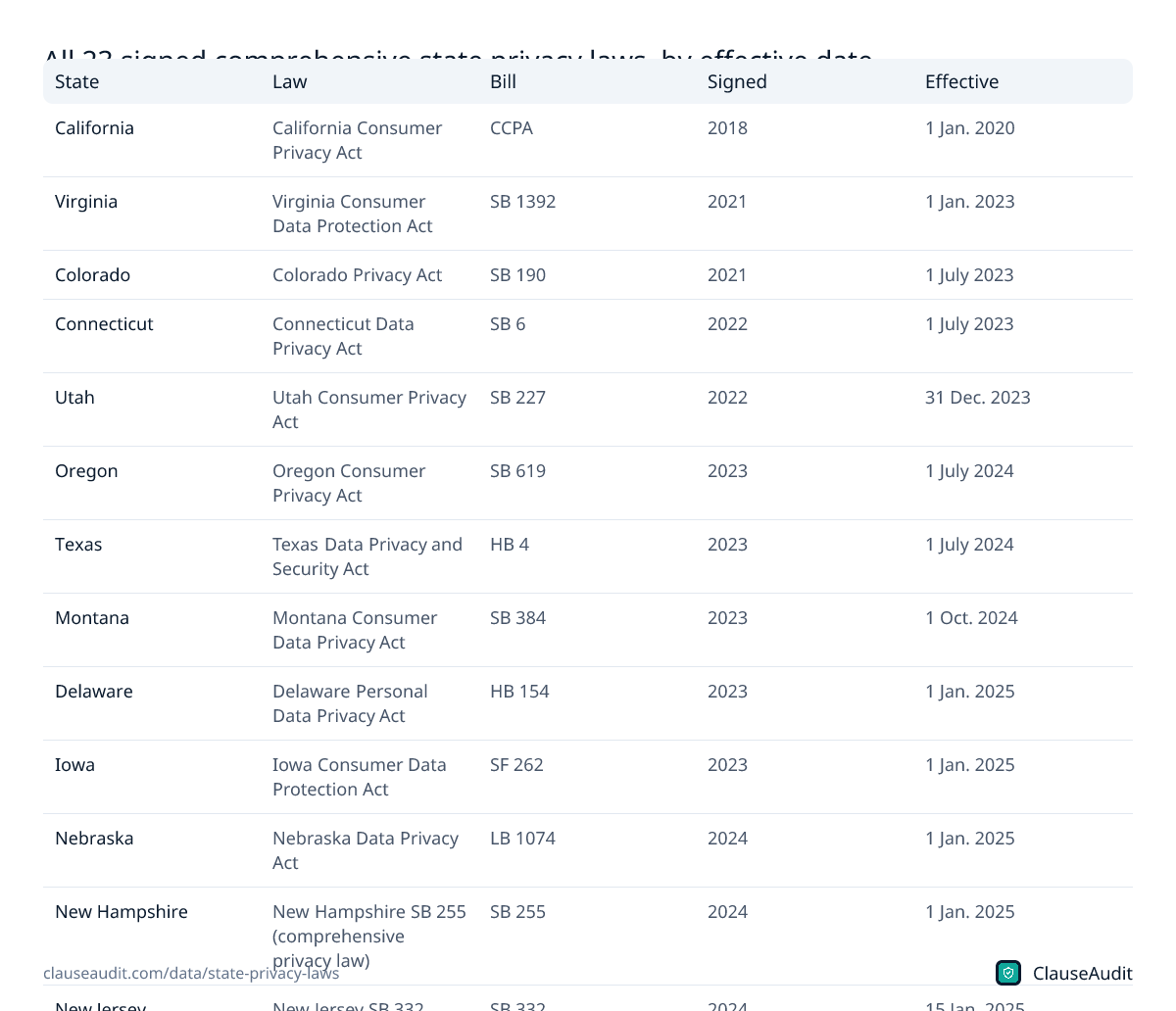
All 23 signed comprehensive state privacy laws, by effective date
| State | Law | Bill | Signed | Effective |
|---|---|---|---|---|
| California | California Consumer Privacy Act | CCPA | 2018 | 1 Jan. 2020 |
| Virginia | Virginia Consumer Data Protection Act | SB 1392 | 2021 | 1 Jan. 2023 |
| Colorado | Colorado Privacy Act | SB 190 | 2021 | 1 July 2023 |
| Connecticut | Connecticut Data Privacy Act | SB 6 | 2022 | 1 July 2023 |
| Utah | Utah Consumer Privacy Act | SB 227 | 2022 | 31 Dec. 2023 |
| Oregon | Oregon Consumer Privacy Act | SB 619 | 2023 | 1 July 2024 |
| Texas | Texas Data Privacy and Security Act | HB 4 | 2023 | 1 July 2024 |
| Montana | Montana Consumer Data Privacy Act | SB 384 | 2023 | 1 Oct. 2024 |
| Delaware | Delaware Personal Data Privacy Act | HB 154 | 2023 | 1 Jan. 2025 |
| Iowa | Iowa Consumer Data Protection Act | SF 262 | 2023 | 1 Jan. 2025 |
| Nebraska | Nebraska Data Privacy Act | LB 1074 | 2024 | 1 Jan. 2025 |
| New Hampshire | New Hampshire SB 255 (comprehensive privacy law) | SB 255 | 2024 | 1 Jan. 2025 |
| New Jersey | New Jersey SB 332 (comprehensive privacy law) | SB 332 | 2024 | 15 Jan. 2025 |
| Tennessee | Tennessee Information Protection Act | HB 1181 | 2023 | 1 July 2025 |
| Minnesota | Minnesota Consumer Data Privacy Act | HF 4757 | 2024 | 31 July 2025 |
| Maryland | Maryland Online Data Privacy Act | SB 541 | 2024 | 1 Oct. 2025 |
| Indiana | Indiana Consumer Data Protection Act | SB 5 | 2023 | 1 Jan. 2026 |
| Kentucky | Kentucky Consumer Data Protection Act | HB 15 | 2024 | 1 Jan. 2026 |
| Rhode Island | Rhode Island Data Transparency and Privacy Protection Act | H 7787 | 2024 | 1 Jan. 2026 |
| Louisiana | Louisiana Data Privacy Act | SB 386 | 2026 | 1 Jan. 2027 |
| Oklahoma | Oklahoma SB 546 (comprehensive privacy law) | SB 546 | 2026 | 1 Jan. 2027 |
| Alabama | Alabama Personal Data Protection Act | HB 351 | 2026 | 1 May 2027 |
| Vermont | Vermont Data Privacy and Online Surveillance Act | S 0071 (S.71) | 2026 | 1 Jan. 2028 |
Source: IAPP, US State Privacy Legislation Tracker 2026: Comprehensive Consumer Privacy Bills (chart). Download as image
Comprehensive consumer privacy law by state
- 19Comprehensive law in effect
- 4Comprehensive law signed, not yet in effect
- 1Narrow privacy law only (not counted as comprehensive)
- 4No law; active bill as of 8 Sept. 2026
- 23No comprehensive law
- Comprehensive law in effect19
- Comprehensive law signed, not yet in effect4
- Narrow privacy law only (not counted as comprehensive)1
- No law; active bill as of 8 Sept. 20264
- No comprehensive law23
| State | Law | Signed | Effective | Sensitive data | Risk assessments | Private right of action | Source |
|---|---|---|---|---|---|---|---|
| Alabama | Alabama Personal Data Protection Act | 2026 | 1 May 2027 | Opt-in consent | Not required (per IAPP) | No | Alabama HB 351 |
| Alaska | None | - | - | - | - | - | IAPP, US State Privacy Legislation Tracker 2026 chart (tracker last updated 8 Sept. 2026) |
| Arizona | None | - | - | - | - | - | IAPP, US State Privacy Legislation Tracker 2026 chart (tracker last updated 8 Sept. 2026) |
| Arkansas | None | - | - | - | - | - | IAPP, US State Privacy Legislation Tracker 2026 chart (tracker last updated 8 Sept. 2026) |
| California | California Consumer Privacy Act | 2018 | 1 Jan. 2020 | No opt-in requirement (per IAPP) | Required | Limited to certain violations | California CCPA |
| Colorado | Colorado Privacy Act | 2021 | 1 July 2023 | Opt-in consent | Required | No | Colorado SB 190 |
| Connecticut | Connecticut Data Privacy Act | 2022 | 1 July 2023 | Opt-in consent | Required | No | Connecticut SB 6 |
| Delaware | Delaware Personal Data Privacy Act | 2023 | 1 Jan. 2025 | Opt-in consent | Required | No | Delaware HB 154 |
| District of Columbia | None | - | - | - | - | - | IAPP, US State Privacy Legislation Tracker 2026 chart (tracker last updated 8 Sept. 2026) |
| Florida | Narrow law: Fla. Stat. Part V, ch. 501 (not counted by IAPP) | - | - | - | - | - | Fla. Stat. 501.701-501.722 (ch. 2023-201, Laws of Fla.) |
| Georgia | None | - | - | - | - | - | IAPP, US State Privacy Legislation Tracker 2026 chart (tracker last updated 8 Sept. 2026) |
| Hawaii | None | - | - | - | - | - | IAPP, US State Privacy Legislation Tracker 2026 chart (tracker last updated 8 Sept. 2026) |
| Idaho | None | - | - | - | - | - | IAPP, US State Privacy Legislation Tracker 2026 chart (tracker last updated 8 Sept. 2026) |
| Illinois | None | - | - | - | - | - | IAPP, US State Privacy Legislation Tracker 2026 chart (tracker last updated 8 Sept. 2026) |
| Indiana | Indiana Consumer Data Protection Act | 2023 | 1 Jan. 2026 | Opt-in consent | Required | No | Indiana SB 5 |
| Iowa | Iowa Consumer Data Protection Act | 2023 | 1 Jan. 2025 | No opt-in requirement (per IAPP) | Not required (per IAPP) | No | Iowa SF 262 |
| Kansas | None | - | - | - | - | - | IAPP, US State Privacy Legislation Tracker 2026 chart (tracker last updated 8 Sept. 2026) |
| Kentucky | Kentucky Consumer Data Protection Act | 2024 | 1 Jan. 2026 | Opt-in consent | Required | No | Kentucky HB 15 |
| Louisiana | Louisiana Data Privacy Act | 2026 | 1 Jan. 2027 | Opt-in consent | Required | No | Louisiana SB 386, La. R.S. 51:1780.1-1780.5 |
| Maine | None | - | - | - | - | - | IAPP, US State Privacy Legislation Tracker 2026 chart (tracker last updated 8 Sept. 2026) |
| Maryland | Maryland Online Data Privacy Act | 2024 | 1 Oct. 2025 | Opt-in consent | Required | No | Maryland SB 541 |
| Massachusetts | None enacted; active bill(s) as of 8 Sept. 2026 | - | - | - | - | - | IAPP, US State Privacy Legislation Tracker 2026 chart (tracker last updated 8 Sept. 2026) |
| Michigan | None enacted; active bill(s) as of 8 Sept. 2026 | - | - | - | - | - | IAPP, US State Privacy Legislation Tracker 2026 chart (tracker last updated 8 Sept. 2026) |
| Minnesota | Minnesota Consumer Data Privacy Act | 2024 | 31 July 2025 | Opt-in consent | Required | No | Minnesota HF 4757 |
| Mississippi | None | - | - | - | - | - | IAPP, US State Privacy Legislation Tracker 2026 chart (tracker last updated 8 Sept. 2026) |
| Missouri | None | - | - | - | - | - | IAPP, US State Privacy Legislation Tracker 2026 chart (tracker last updated 8 Sept. 2026) |
| Montana | Montana Consumer Data Privacy Act | 2023 | 1 Oct. 2024 | Opt-in consent | Required | No | Montana SB 384 |
| Nebraska | Nebraska Data Privacy Act | 2024 | 1 Jan. 2025 | Opt-in consent | Required | No | Nebraska LB 1074 |
| Nevada | None | - | - | - | - | - | IAPP, US State Privacy Legislation Tracker 2026 chart (tracker last updated 8 Sept. 2026) |
| New Hampshire | New Hampshire SB 255 (comprehensive privacy law) | 2024 | 1 Jan. 2025 | Opt-in consent | Required | No | New Hampshire SB 255 |
| New Jersey | New Jersey SB 332 (comprehensive privacy law) | 2024 | 15 Jan. 2025 | Opt-in consent | Required | No | New Jersey SB 332 |
| New Mexico | None | - | - | - | - | - | IAPP, US State Privacy Legislation Tracker 2026 chart (tracker last updated 8 Sept. 2026) |
| New York | None | - | - | - | - | - | IAPP, US State Privacy Legislation Tracker 2026 chart (tracker last updated 8 Sept. 2026) |
| North Carolina | None enacted; active bill(s) as of 8 Sept. 2026 | - | - | - | - | - | IAPP, US State Privacy Legislation Tracker 2026 chart (tracker last updated 8 Sept. 2026) |
| North Dakota | None | - | - | - | - | - | IAPP, US State Privacy Legislation Tracker 2026 chart (tracker last updated 8 Sept. 2026) |
| Ohio | None | - | - | - | - | - | IAPP, US State Privacy Legislation Tracker 2026 chart (tracker last updated 8 Sept. 2026) |
| Oklahoma | Oklahoma SB 546 (comprehensive privacy law) | 2026 | 1 Jan. 2027 | Opt-in consent | Required | No | Oklahoma SB 546 |
| Oregon | Oregon Consumer Privacy Act | 2023 | 1 July 2024 | Opt-in consent | Required | No | Oregon SB 619 |
| Pennsylvania | None enacted; active bill(s) as of 8 Sept. 2026 | - | - | - | - | - | IAPP, US State Privacy Legislation Tracker 2026 chart (tracker last updated 8 Sept. 2026) |
| Rhode Island | Rhode Island Data Transparency and Privacy Protection Act | 2024 | 1 Jan. 2026 | Opt-in consent | Required | No | Rhode Island H 7787 |
| South Carolina | None | - | - | - | - | - | IAPP, US State Privacy Legislation Tracker 2026 chart (tracker last updated 8 Sept. 2026) |
| South Dakota | None | - | - | - | - | - | IAPP, US State Privacy Legislation Tracker 2026 chart (tracker last updated 8 Sept. 2026) |
| Tennessee | Tennessee Information Protection Act | 2023 | 1 July 2025 | Opt-in consent | Required | No | Tennessee HB 1181 |
| Texas | Texas Data Privacy and Security Act | 2023 | 1 July 2024 | Opt-in consent | Required | No | Texas HB 4 |
| Utah | Utah Consumer Privacy Act | 2022 | 31 Dec. 2023 | No opt-in requirement (per IAPP) | Not required (per IAPP) | No | Utah SB 227 |
| Vermont | Vermont Data Privacy and Online Surveillance Act | 2026 | 1 Jan. 2028 | Opt-in consent | Required | No | Vermont S 0071 (S.71) |
| Virginia | Virginia Consumer Data Protection Act | 2021 | 1 Jan. 2023 | Opt-in consent | Required | No | Virginia SB 1392 |
| Washington | None | - | - | - | - | - | IAPP, US State Privacy Legislation Tracker 2026 chart (tracker last updated 8 Sept. 2026) |
| West Virginia | None | - | - | - | - | - | IAPP, US State Privacy Legislation Tracker 2026 chart (tracker last updated 8 Sept. 2026) |
| Wisconsin | None | - | - | - | - | - | IAPP, US State Privacy Legislation Tracker 2026 chart (tracker last updated 8 Sept. 2026) |
| Wyoming | None | - | - | - | - | - | IAPP, US State Privacy Legislation Tracker 2026 chart (tracker last updated 8 Sept. 2026) |
Which states have privacy laws in 2026?
IAPP counts 23 states with a signed consumer privacy law. 19 are already in force. California went first: it signed in 2018 and its law took effect on 1 Jan. 2020. The newest to switch on were Indiana, Kentucky and Rhode Island, all on 1 Jan. 2026.
Florida is a special case. It has a privacy law, but it only reaches companies with more than $1 billion in revenue, so IAPP leaves it off the list. Trackers that count Florida report 24. For a small business, the narrower count of 23 is the more useful one.
That leaves 27 states plus DC with no broad consumer privacy law on IAPP's list. Four of them, Massachusetts, Michigan, North Carolina and Pennsylvania, had active bills as of 8 Sept. 2026. Expect the map to keep filling in.
Do state privacy laws apply to small businesses and freelancers?
Often not directly, and that surprises people. Most of these laws only kick in once you handle data on a set number of state residents or earn a share of revenue from selling data. The bar varies a lot from state to state.
Look at the four laws signed in 2026. Oklahoma covers businesses with data on more than 100,000 consumers, or 25,000 if most of their revenue comes from selling data. Alabama starts at more than 25,000 Alabama consumers. Louisiana adds a revenue test of over $25 million a year. Vermont starts at 35,000 residents, but drops to just 3,000 if you handle their sensitive data.
Here is the catch for freelancers and agencies. Even if no law covers you, your clients may be covered, and they have to push privacy duties down to their vendors through a contract. Say you build email campaigns for a regional retailer. The retailer is the business that decides how data is used. You are the vendor that handles it. Most of these laws require a written contract between the two, so a data processing addendum lands in your inbox whether or not you hit any threshold yourself.
Your customer mix matters more than your size. A two-person shop selling to people across many states can cross a line that a larger local business never reaches.
What changes in 2027 and 2028?
Three laws take effect in 2027: Louisiana and Oklahoma on 1 Jan. 2027, and Alabama on 1 May 2027. Vermont follows on 1 Jan. 2028. Once Vermont applies, all 23 signed laws will be live.
Vermont deserves a close look if you touch health data. Its consumer health data rules have no applicability threshold at all, so even a tiny wellness app can fall under them.
Startup grace periods also differ. Alabama gives businesses 45 days to fix a violation after notice, with no end date. Louisiana offers 30 days, but only from 1 Jan. 2027 through 31 July 2027. Vermont allows 60 days from 1 Jan. 2028 to 30 June 2029, then leaves it to the attorney general. Don't plan around a cure period that is about to expire.
Can you sue a company for breaking a state privacy law?
Almost never. Only 1 of the 23 laws gives consumers a private right of action, and that is California's, which is limited to certain violations. Everywhere else, the state attorney general or a state agency does the enforcing.
For a business, that cuts both ways. You are unlikely to face a wave of private lawsuits under these statutes. But a state investigation can still arrive, and your customers can still sue you under your contract with them. That is why the privacy terms in your service agreements matter as much as the statute does.
What should your vendor and client contracts say about privacy?
Statutes set the floor. Your contracts decide who pays when something goes wrong. Even a small company can have several tools holding customer data: a CRM, an email platform, a help desk, a payments app. Each one has terms you clicked through, and those terms often favor the vendor.
Read three things first. What the vendor may do with your data, how fast it must tell you about a breach, and what happens to the data when you cancel. Some agreements let the vendor use customer data to improve its own products, or keep it for an open-ended period after you leave. Neither fits well with laws that give your customers a right to delete.
If you are the freelancer or agency, flip it around. A client's privacy addendum may ask you to cover all of its losses from any data incident, with no cap. That can be far larger than the fee you earn. Ask for a cap tied to the contract value, limit your promises to data you actually touch, and make sure you can meet any deadline it sets for reporting an incident.
What should a small business do now?
You don't need a full compliance program to make real progress. Start with a few practical steps.
- Count your customers by state. Thresholds are set per state, so a rough number for each one tells you where you might be covered.
- List what you collect. Sensitive data, such as health details, needs opt-in consent in 20 of the 23 laws.
- Write down how a customer asks to see or delete their data, and who answers. All 23 laws give people those rights.
- Check every vendor that touches customer data, from your email tool to your payment processor, and confirm you have a signed data processing addendum.
- If you use data for targeted ads, profiling or other high-risk purposes, plan for a written risk assessment. 20 of the 23 laws require one.
- Put 1 Jan. 2027 and 1 Jan. 2028 on your calendar so new state rules don't catch you off guard.
How ClauseAudit helps
Most privacy risk for a small company sits in its contracts, not in the statute. Your software vendors decide what happens to your customer data, and your clients decide what privacy duties they pass to you.
Upload a SaaS agreement, data processing addendum or client contract and our automated review flags the privacy terms that need a second look, in plain English.
- Data ownership: the contract says you own your customer data, not the vendor.
- Use of your data: no right for the vendor to sell it, share it or reuse it for its own products without your consent.
- Deletion and return: a set deadline to export and delete your data when the contract ends.
- Breach notice: a fixed number of days for the vendor to tell you about a security incident.
- Liability cap: whether privacy and data breach losses sit under a cap so low it would not cover a real incident.
- Help with consumer requests: the vendor must help you answer access and deletion requests on time.
Frequently asked questions
How many states have privacy laws in 2026?
IAPP counts 23 states with a signed consumer privacy law as of 8 Sept. 2026, and 19 of them are in effect as of 15 Oct. 2026. Florida has a narrow law for companies with more than $1 billion in revenue, which IAPP does not count. Trackers that include it report 24.
Which states passed new privacy laws in 2026?
Four states signed laws in 2026: Alabama, Louisiana, Oklahoma and Vermont. None of them is in effect yet. Louisiana and Oklahoma start on 1 Jan. 2027, Alabama on 1 May 2027 and Vermont on 1 Jan. 2028. No other new law was found through 15 Oct. 2026.
Is there a federal privacy law in the US?
There is no single federal consumer privacy law like the ones these states have passed. Federal rules exist for specific areas, such as health records and children's data, but general consumer privacy is handled state by state. That is why a business selling nationwide has to track each state where its customers live.
Does my small business have to comply with state privacy laws?
It depends on how many residents of each state you have data on and how you make money. Oklahoma's law starts at more than 100,000 consumers, while Vermont's starts at 35,000 residents, or 3,000 for sensitive data. Even if you fall below every threshold, your larger clients may require privacy terms in your contract.
Can I sue a company under a state privacy law?
In most states, no. Only California's law gives consumers a private right of action, and it is limited to certain violations. Every other signed law is enforced by the state. You can still complain to your state attorney general, and you may have contract claims if a company breaks promises it made to you.
What is a data protection assessment?
It is a written review a business does before processing data in risky ways, such as targeted advertising, selling data, profiling or handling sensitive data. It weighs the benefits against the risks to consumers. 20 of the 23 signed laws require one. Alabama, Iowa and Utah do not, per IAPP.
What rights do consumers get under state privacy laws?
All 23 signed laws give consumers the right to access their data, delete it, get a portable copy and opt out of its sale. 22 of them add a right to correct data and a right to opt out of certain processing such as targeted ads. Opt-in consent for sensitive data appears in 20.
What is a cure period in a privacy law?
A cure period gives a business time to fix a violation after the state gives notice, before penalties apply. They vary. Alabama allows 45 days with no end date. Louisiana's 30-day period runs only from 1 Jan. 2027 to 31 July 2027. Vermont's 60-day period lasts from 1 Jan. 2028 to 30 June 2029.
Use this data
Every chart and card below is free to reuse under CC BY 4.0. Download what you need and link back to this page.
 Stat cards
 Key findings card
 Infographic
 Comprehensive state privacy laws signed per year, 2018 to 2026
 Number of comprehensive state privacy laws in effect at year end, 2020 to 2028
 How many of the 23 signed laws include each right or duty
 The four comprehensive privacy laws signed in 2026
 All 23 signed comprehensive state privacy laws, by effective date
Embed the infographic
Free to share on your site, blog or slides under CC BY 4.0. Please keep the credit link.
Sources and method
Every number on this page comes from the sources below, each opened and read on or before October 17, 2026. A second, independent review checked every figure against its source and corrected anything that did not match. 51 of 51 state entries were confirmed; any that could not be are marked "Not yet confirmed" and left out of every count and chart.
- IAPP, US State Privacy Legislation Tracker 2026: Comprehensive Consumer Privacy Bills (chart) (Tracker last updated 8 Sept. 2026)
- IAPP, US State Privacy Legislation Tracker (landing page) (Last updated 8 Sept. 2026)
- Florida Legislature, 2026 Florida Statutes, s. 501.702 Definitions (Part V, ch. 501, Data Privacy and Security) (2026 Florida Statutes)
- Oklahoma House of Representatives, Major Data Privacy Bill Signed into Law (SB 546) (23 March 2026)
- Mayer Brown, Alabama Enacts Comprehensive Consumer Data Privacy Law (28 April 2026)
- Davis Wright Tremaine, Louisiana Data Privacy Act (SB 386) (25 June 2026)
- Mayer Brown, Vermont Enacts Comprehensive Consumer Privacy Law (22 June 2026)
- ACLU of Massachusetts, Data Privacy Now! campaign page (Massachusetts bill status) (Last updated 30 July 2026)
Cite this page
ClauseAudit, “State Privacy Laws 2026: Every Consumer Privacy Law, Tracked”, updated October 17, 2026, https://clauseaudit.com/data/state-privacy-laws. Free to reuse with a link back (CC BY 4.0).
This page summarises published data and law as checked on October 17, 2026. Figures are updated as new editions are released, and your own situation may differ. It is general information, not legal, tax or financial advice.