Data Breach Notification Laws by State: Deadlines, Triggers and Attorney General Reporting
By ClauseAudit Research · 15 sources ·
What are the data breach notification laws by state?
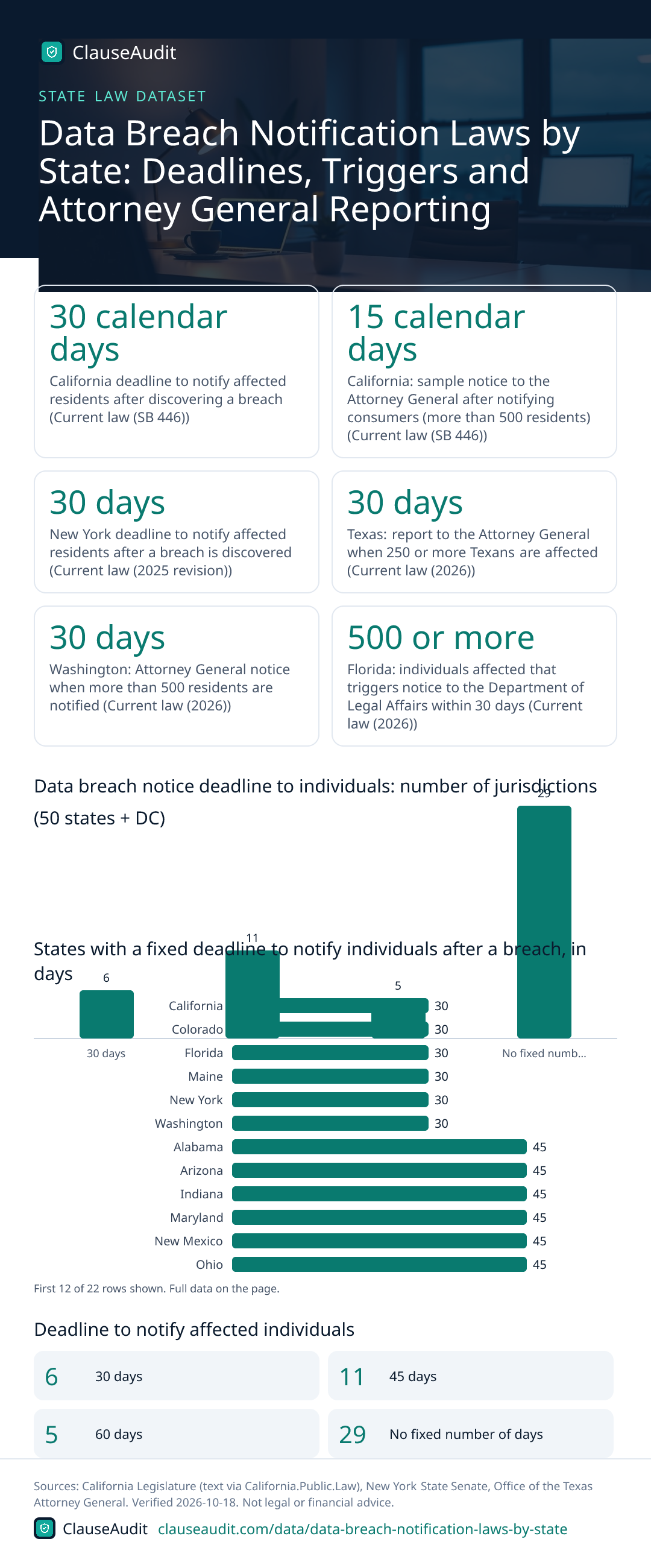
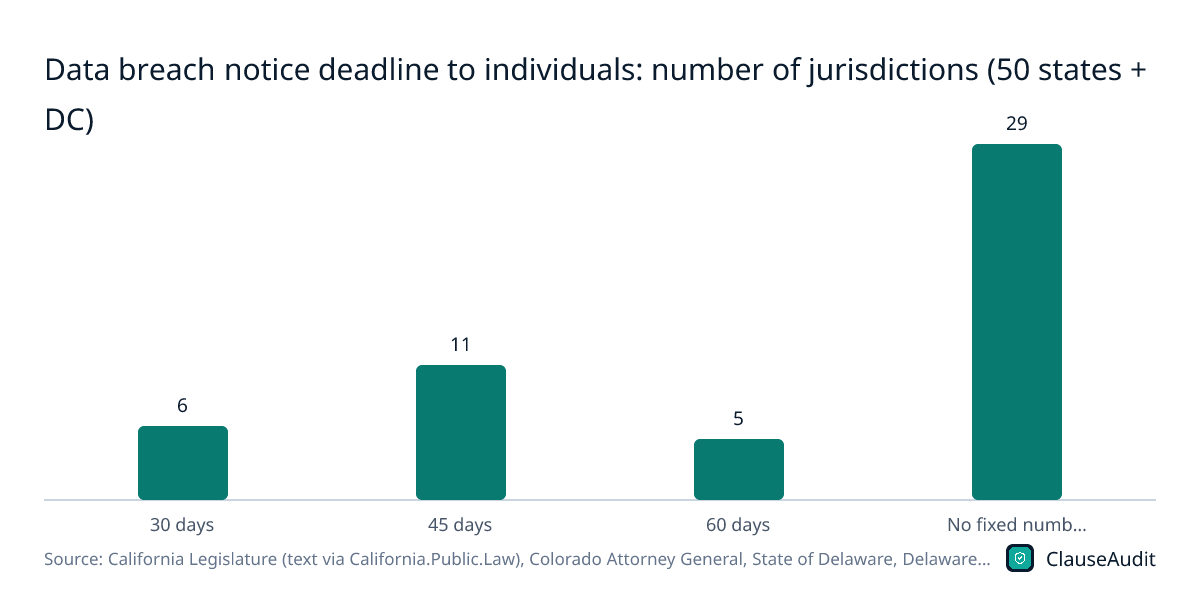
Every state has a breach notification law, but the deadlines differ. Only 6 jurisdictions require notice to affected people within 30 days, 11 within 45 days and 5 within 60 days. The other 29 say "without unreasonable delay" with no day count. On top of that, 36 states require a report to the Attorney General or another state agency.

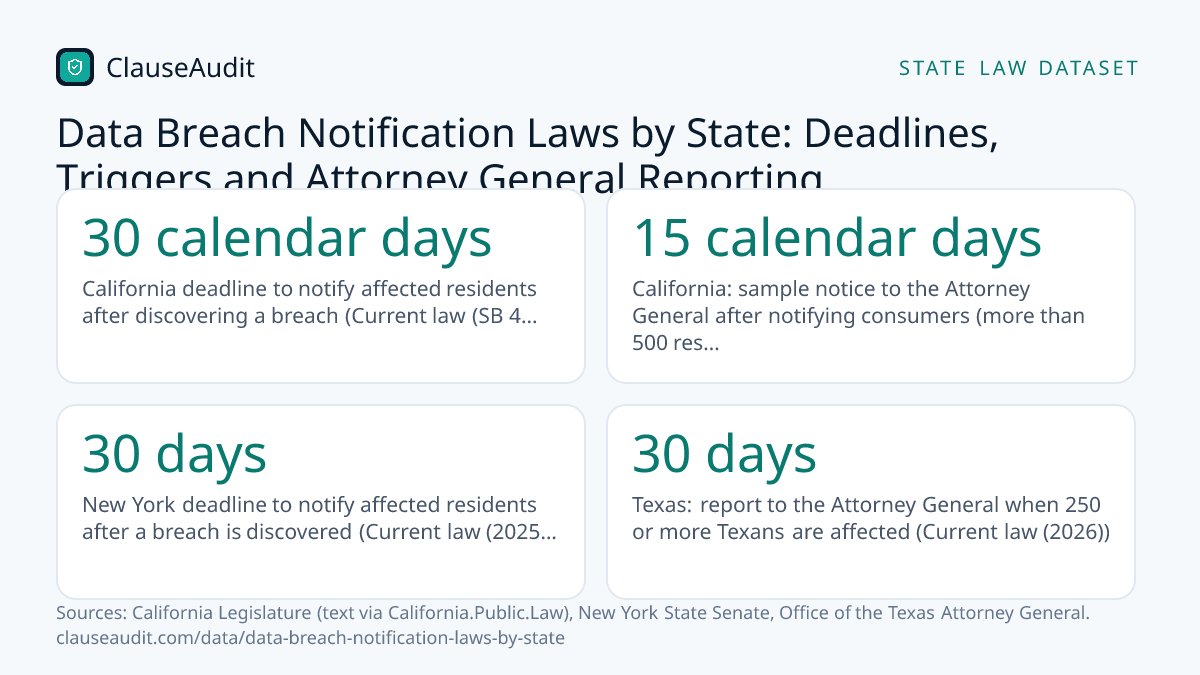
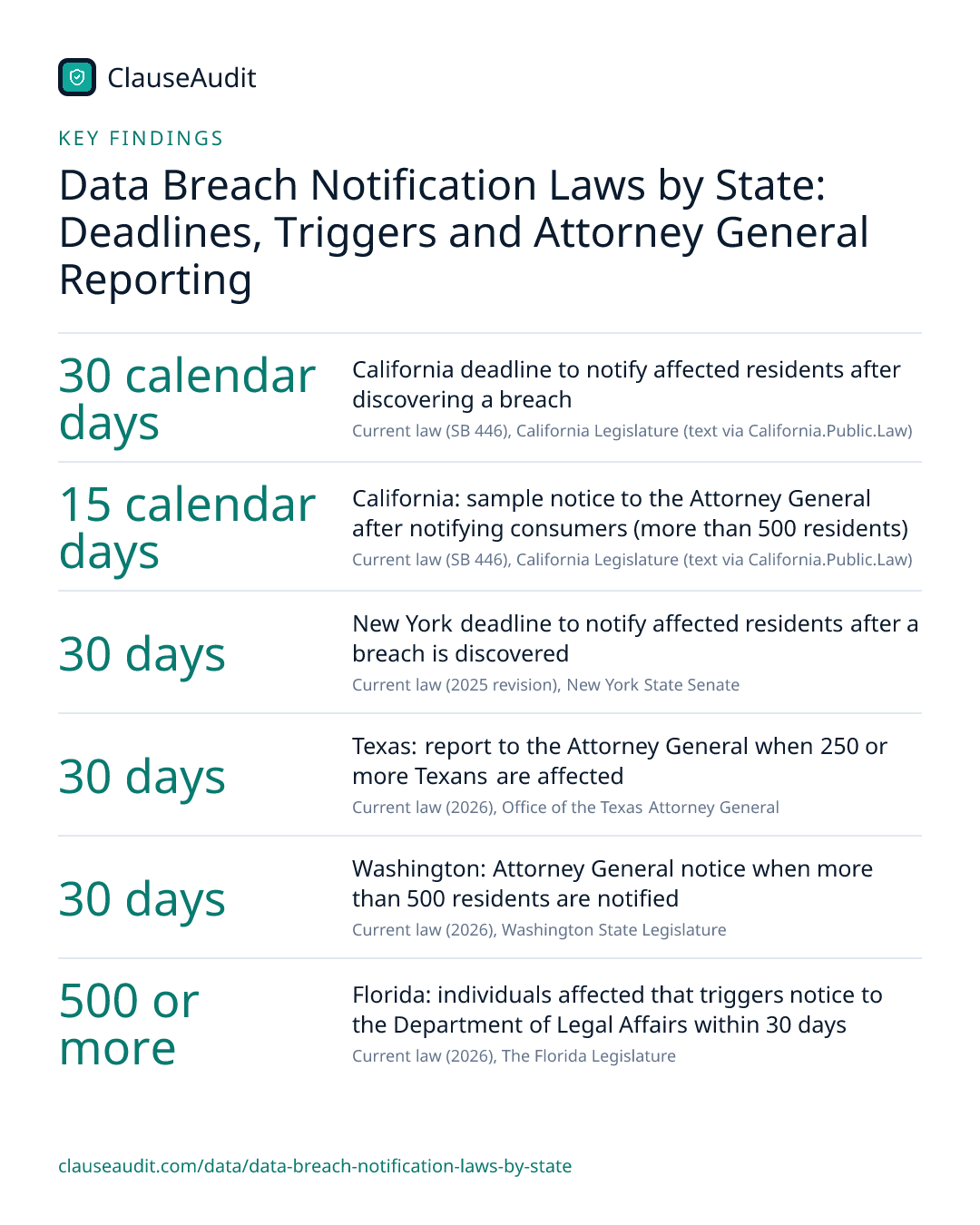
- California deadline to notify affected residents after discovering a breach (Current law (SB 446), California Legislature (text via California.Public.Law))
- 30 calendar days
- California: sample notice to the Attorney General after notifying consumers (more than 500 residents) (Current law (SB 446), California Legislature (text via California.Public.Law))
- 15 calendar days
- New York deadline to notify affected residents after a breach is discovered (Current law (2025 revision), New York State Senate)
- 30 days
- Texas: report to the Attorney General when 250 or more Texans are affected (Current law (2026), Office of the Texas Attorney General)
- 30 days
- Washington: Attorney General notice when more than 500 residents are notified (Current law (2026), Washington State Legislature)
- 30 days
- Florida: individuals affected that triggers notice to the Department of Legal Affairs within 30 days (Current law (2026), The Florida Legislature)
- 500 or more
- States requiring breach reports to the Attorney General or another state agency (Laws as of January 1, 2026, Privacy Rights Clearinghouse)
- 36 states
- Maryland deadline to notify individuals; the Attorney General must be told first (Current law (2026), Maryland General Assembly)
- 45 days
If your business holds names paired with Social Security numbers, account numbers or login details, a breach turns into a legal deadline. The catch is that the deadline depends on where the affected people live, not where your company is based. One incident with customers in several states can mean several different clocks running at once.
This page maps those rules: how fast each state wants individuals told, when a regulator has to hear about it, and the headcount that triggers that report. Below the data you will find what this means in practice and the contract terms that decide who pays when the breach happens at a vendor.
Data breach notice deadline to individuals: number of jurisdictions (50 states + DC)
Chart data
| Label | Value |
|---|---|
| 30 days | 6 |
| 45 days | 11 |
| 60 days | 5 |
| No fixed number of days | 29 |
Most jurisdictions still use a flexible standard, but that is not a free pass. A regulator can look at a slow response and decide the delay was unreasonable.
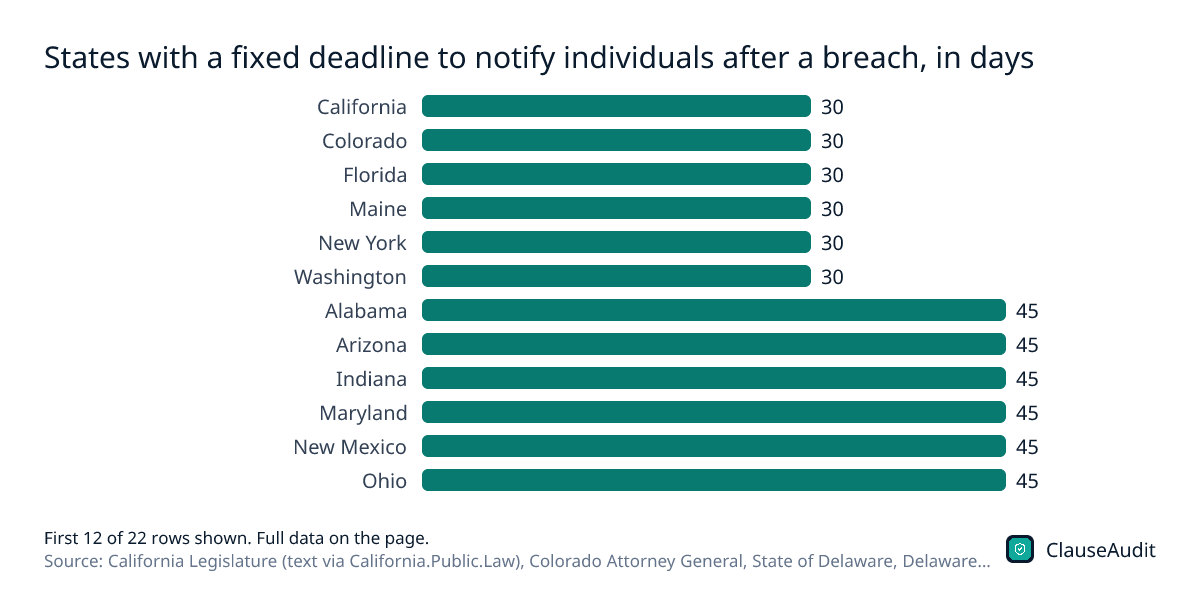
Download this chart (PNG)States with a fixed deadline to notify individuals after a breach, in days
Chart data
| Label | Value |
|---|---|
| California | 30 |
| Colorado | 30 |
| Florida | 30 |
| Maine | 30 |
| New York | 30 |
| Washington | 30 |
| Alabama | 45 |
| Arizona | 45 |
| Indiana | 45 |
| Maryland | 45 |
| New Mexico | 45 |
| Ohio | 45 |
| Oregon | 45 |
| Rhode Island | 45 |
| Tennessee | 45 |
| Vermont | 45 |
| Wisconsin | 45 |
| Connecticut | 60 |
| Delaware | 60 |
| Louisiana | 60 |
| South Dakota | 60 |
| Texas | 60 |
Read the start of each clock carefully. Some states count from discovery, others from the point you determine a breach happened or is likely to cause harm.
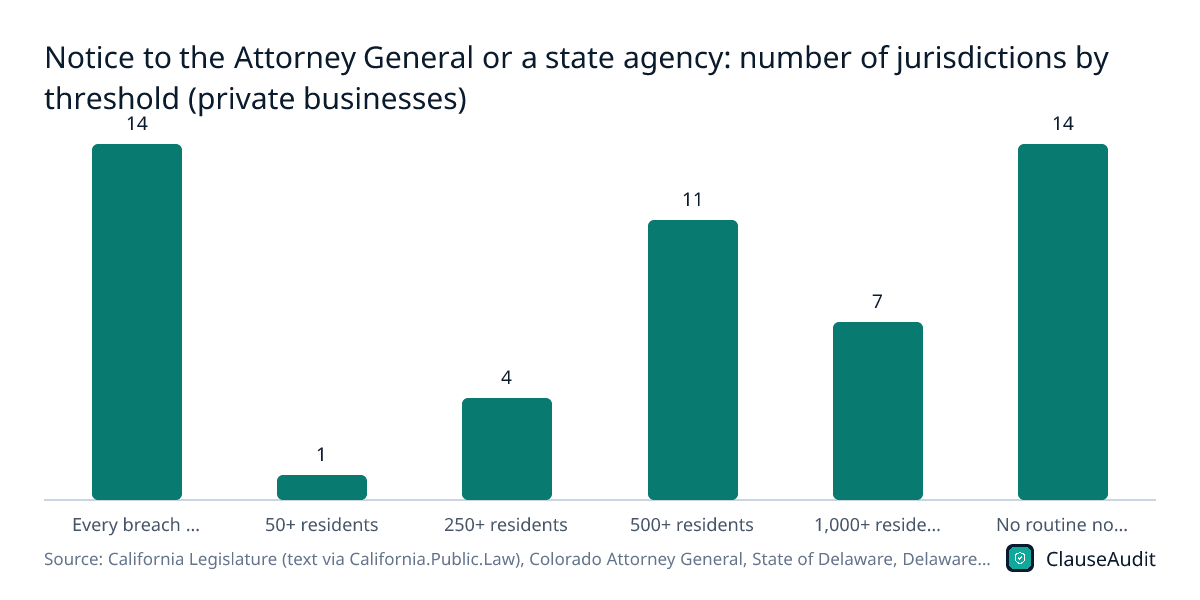
Download this chart (PNG)Notice to the Attorney General or a state agency: number of jurisdictions by threshold (private businesses)
Chart data
| Label | Value |
|---|---|
| Every breach requiring notice | 14 |
| 50+ residents | 1 |
| 250+ residents | 4 |
| 500+ residents | 11 |
| 1,000+ residents | 7 |
| No routine notice | 14 |
Fourteen jurisdictions want a regulator told about every breach that requires notice, so a small incident in the wrong state still means a filing.
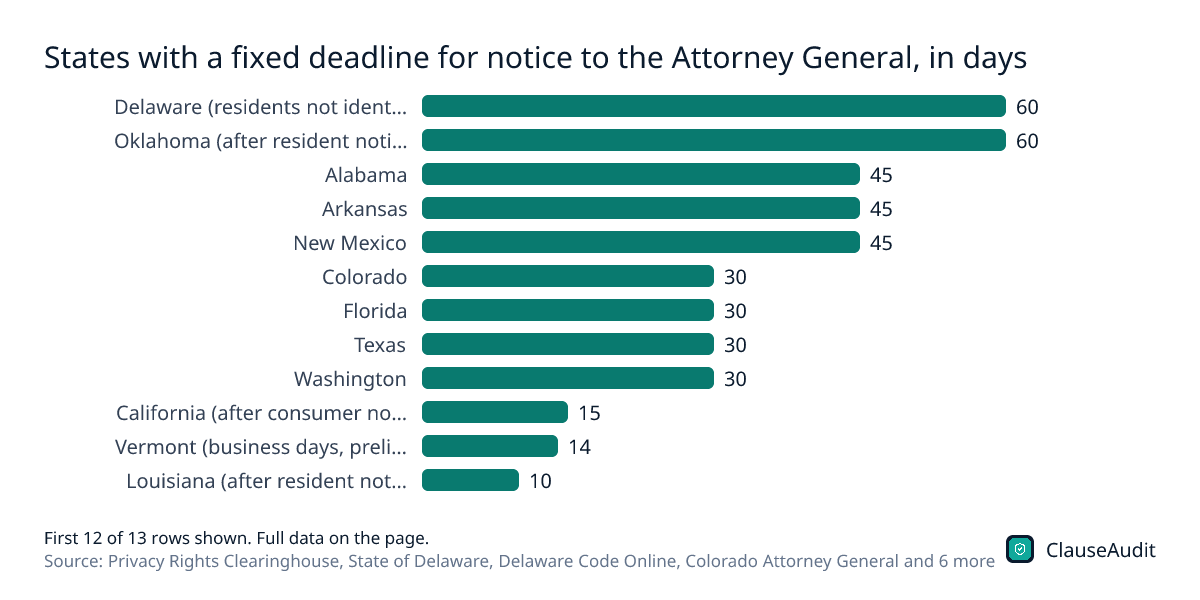
Download this chart (PNG)States with a fixed deadline for notice to the Attorney General, in days
Chart data
| Label | Value |
|---|---|
| Delaware (residents not identified) | 60 |
| Oklahoma (after resident notice) | 60 |
| Alabama | 45 |
| Arkansas | 45 |
| New Mexico | 45 |
| Colorado | 30 |
| Florida | 30 |
| Texas | 30 |
| Washington | 30 |
| California (after consumer notice) | 15 |
| Vermont (business days, preliminary) | 14 |
| Louisiana (after resident notice) | 10 |
| Iowa (business days after consumer notice) | 5 |
Regulator deadlines can be shorter than the consumer one. Iowa counts 5 business days after consumer notice, and Louisiana 10 days after resident notice.
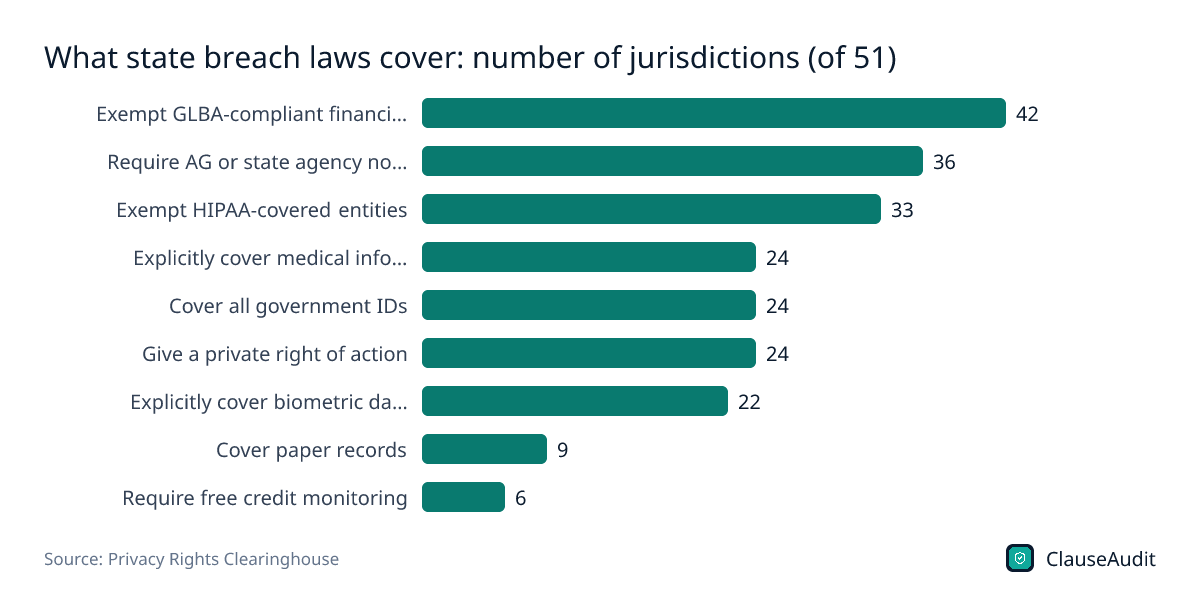
Download this chart (PNG)What state breach laws cover: number of jurisdictions (of 51)
Chart data
| Label | Value |
|---|---|
| Exempt GLBA-compliant financial institutions | 42 |
| Require AG or state agency notice | 36 |
| Exempt HIPAA-covered entities | 33 |
| Explicitly cover medical information | 24 |
| Cover all government IDs | 24 |
| Give a private right of action | 24 |
| Explicitly cover biometric data | 22 |
| Cover paper records | 9 |
| Require free credit monitoring | 6 |
The exemptions matter as much as the rules. Many states treat a bank that follows federal GLBA rules, or a HIPAA-covered health provider, as already compliant.
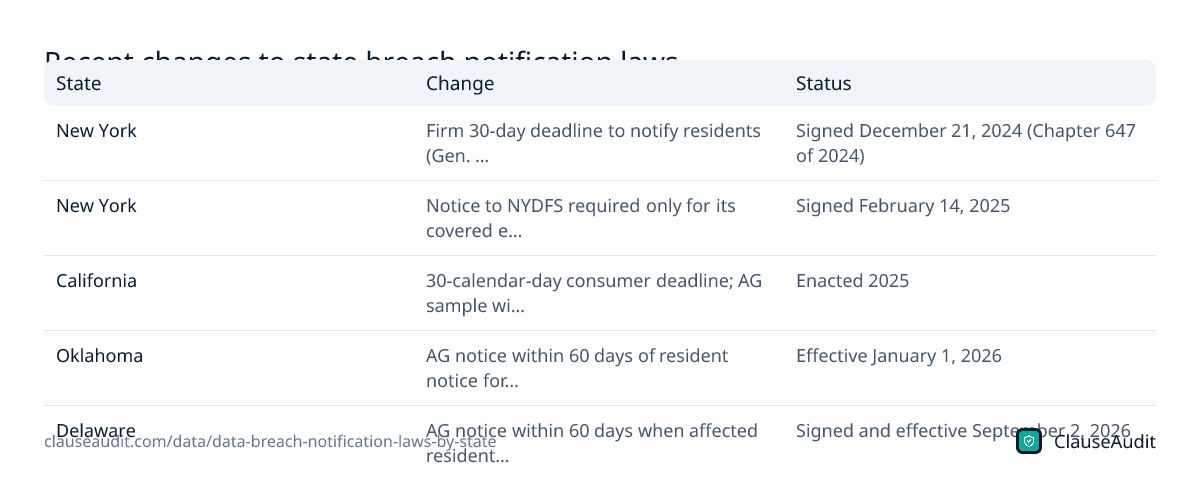
Download this chart (PNG)Recent changes to state breach notification laws
| State | Change | Status |
|---|---|---|
| New York | Firm 30-day deadline to notify residents (Gen. Bus. Law § 899-aa) | Signed December 21, 2024 (Chapter 647 of 2024) |
| New York | Notice to NYDFS required only for its covered entities (S804) | Signed February 14, 2025 |
| California | 30-calendar-day consumer deadline; AG sample within 15 calendar days for more than 500 residents (SB 446) | Enacted 2025 |
| Oklahoma | AG notice within 60 days of resident notice for 500+ residents; broader personal information definition (SB 626) | Effective January 1, 2026 |
| Delaware | AG notice within 60 days when affected residents cannot be identified; AG notice with substitute notice (HB 381) | Signed and effective September 2, 2026 |
Source: Perkins Coie, 2025 breach notification law update; Privacy Rights Clearinghouse, Data Breach Notification Laws: 50 States + DC Survey, 2026 Edition; State of Delaware, Delaware Code Online, Delaware Code Title 6, Chapter 12B Computer Security Breaches; McDonald Hopkins, Delaware raises the bar: Significant amendments to its Personal Data Privacy Act; New York State Senate, New York Senate Bill S2659-B (2023-2024), bill actions. Download as image
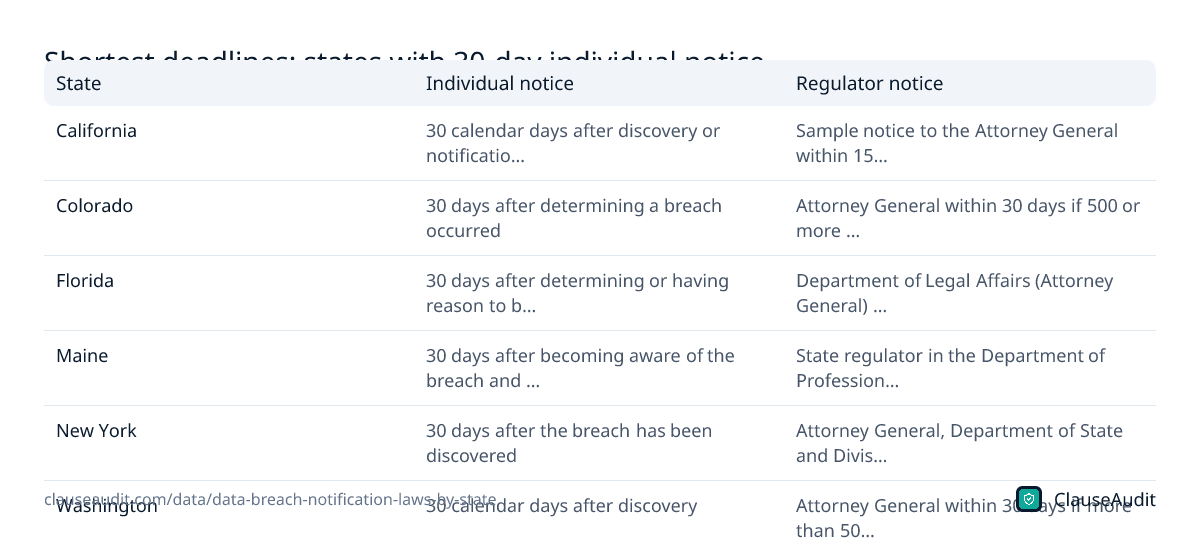
Shortest deadlines: states with 30-day individual notice
| State | Individual notice | Regulator notice |
|---|---|---|
| California | 30 calendar days after discovery or notification of the breach (delays allowed for law enforcement or to determine scope) | Sample notice to the Attorney General within 15 calendar days of notifying consumers, if more than 500 residents |
| Colorado | 30 days after determining a breach occurred | Attorney General within 30 days if 500 or more residents |
| Florida | 30 days after determining or having reason to believe a breach occurred (15-day extension for good cause) | Department of Legal Affairs (Attorney General) within 30 days if 500 or more individuals in Florida |
| Maine | 30 days after becoming aware of the breach and identifying its scope | State regulator in the Department of Professional and Financial Regulation, or the Attorney General if unregulated, whenever residents must be notified |
| New York | 30 days after the breach has been discovered | Attorney General, Department of State and Division of State Police (and DFS for its covered entities) for any breach affecting residents |
| Washington | 30 calendar days after discovery | Attorney General within 30 days if more than 500 residents |
Source: California Legislature (text via California.Public.Law), Cal. Civ. Code § 1798.82; Colorado Attorney General, Data Protection Laws (Colorado breach notification FAQ); The Florida Legislature, Fla. Stat. § 501.171 Security of confidential personal information; Maine Legislature, Office of the Revisor of Statutes, 10 M.R.S. § 1348 Security breach notification; New York State Senate, N.Y. General Business Law § 899-aa; Washington State Legislature, RCW 19.255.010 Disclosure, notice. Download as image
Deadline to notify affected individuals by state
- 630 days
- 1145 days
- 560 days
- 29No fixed number of days
- 30 days6
- 45 days11
- 60 days5
- No fixed number of days29
| State | Notice to individuals | Attorney General / state agency notice | Source |
|---|---|---|---|
| Alabama | 45 days after determining a breach is reasonably likely to cause substantial harm | Attorney General within 45 days if more than 1,000 individuals are notified | Ala. Code §§ 8-38-1 to 8-38-12 |
| Alaska | Most expeditious time possible, without unreasonable delay | Only when a business decides notice is not required (no-harm determination); written notice to the Attorney General | Alaska Stat. §§ 45.48.010 to 45.48.090 |
| Arizona | 45 days after determining a breach occurred | Attorney General and Arizona Department of Homeland Security if more than 1,000 individuals are notified | Ariz. Rev. Stat. §§ 18-551 to 18-552 |
| Arkansas | Most expedient time possible, without unreasonable delay | Attorney General if more than 1,000 individuals affected: within 45 days or at the time of individual notice, whichever is first | Ark. Code Ann. §§ 4-110-101 to 4-110-108 |
| California | 30 calendar days after discovery or notification of the breach (delays allowed for law enforcement or to determine scope) | Sample notice to the Attorney General within 15 calendar days of notifying consumers, if more than 500 residents | Cal. Civ. Code § 1798.82 (amended by SB 446, 2025) |
| Colorado | 30 days after determining a breach occurred | Attorney General within 30 days if 500 or more residents | Colo. Rev. Stat. § 6-1-716 |
| Connecticut | 60 days after discovery | Attorney General no later than notice to residents (all breaches requiring notice) | Conn. Gen. Stat. § 36a-701b |
| Delaware | 60 days after determination of the breach | Attorney General no later than resident notice if more than 500 residents; also within 60 days when affected residents cannot be identified in that time | 6 Del. C. §§ 12B-101 to 12B-104 (amended 85 Del. Laws c. 464, 2026) |
| District of Columbia | Most expedient time possible, without unreasonable delay | Attorney General no later than consumer notice if 50 or more residents | D.C. Code §§ 28-3851 to 28-3853 |
| Florida | 30 days after determining or having reason to believe a breach occurred (15-day extension for good cause) | Department of Legal Affairs (Attorney General) within 30 days if 500 or more individuals in Florida | Fla. Stat. § 501.171 |
| Georgia | Most expedient time possible, without unreasonable delay | None required (consumer reporting agencies for large breaches) | O.C.G.A. §§ 10-1-910 to 10-1-915 |
| Hawaii | Without unreasonable delay | Office of Consumer Protection if more than 1,000 persons notified at one time | Haw. Rev. Stat. ch. 487N |
| Idaho | Most expedient time possible, without unreasonable delay | None for businesses (state agencies must notify the Attorney General within 24 hours) | Idaho Code §§ 28-51-104 to 28-51-107 |
| Illinois | Most expedient time possible, without unreasonable delay | Attorney General if more than 500 residents | 815 ILCS 530 |
| Indiana | 45 days after discovery | Attorney General for every breach that requires notice to individuals | Ind. Code 24-4.9 |
| Iowa | Most expeditious manner possible, without unreasonable delay | Attorney General (Consumer Protection Division) within 5 business days after consumer notice if more than 500 residents | Iowa Code ch. 715C |
| Kansas | Most expedient time possible, without unreasonable delay | None required | K.S.A. 50-7a01 to 50-7a04 |
| Kentucky | Most expedient time possible, without unreasonable delay | None for businesses (state agencies must notify the Attorney General and others within 72 hours) | KRS 365.732 |
| Louisiana | 60 days after discovery | Attorney General (Consumer Protection Section) whenever residents must be notified, with names of affected residents; timely if received within 10 days of resident notice (La. Admin. Code tit. 16, pt. III, § 701) | La. R.S. 51:3074; La. Admin. Code tit. 16, pt. III, § 701 |
| Maine | 30 days after becoming aware of the breach and identifying its scope | State regulator in the Department of Professional and Financial Regulation, or the Attorney General if unregulated, whenever residents must be notified | 10 M.R.S. §§ 1346 to 1350-B |
| Maryland | 45 days after discovering or being notified of the breach | Attorney General before notifying individuals (all breaches requiring notice) | Md. Code, Com. Law §§ 14-3501 to 14-3508 |
| Massachusetts | As soon as practicable, without unreasonable delay | Attorney General and Director of Consumer Affairs and Business Regulation (all breaches) | Mass. Gen. Laws ch. 93H |
| Michigan | Without unreasonable delay | None required (consumer reporting agencies when thresholds are met) | Mich. Comp. Laws §§ 445.61 to 445.79d |
| Minnesota | Most expedient time possible, without unreasonable delay | None required | Minn. Stat. § 325E.61 |
| Mississippi | Without unreasonable delay | None required | Miss. Code Ann. § 75-24-29 |
| Missouri | Without unreasonable delay | Attorney General if more than 1,000 consumers notified at one time | Mo. Rev. Stat. § 407.1500 |
| Montana | Without unreasonable delay | Attorney General at the same time as individual notice (all breaches) | Mont. Code Ann. §§ 30-14-1701 to 30-14-1704 |
| Nebraska | As soon as possible, without unreasonable delay | Attorney General at the same time as resident notice (all breaches) | Neb. Rev. Stat. §§ 87-801 to 87-808 |
| Nevada | Most expedient time possible, without unreasonable delay | None required | Nev. Rev. Stat. §§ 603A.010 to 603A.290 |
| New Hampshire | As soon as possible | Primary regulator or the Attorney General (all breaches) | N.H. Rev. Stat. Ann. §§ 359-C:19 to 359-C:21 |
| New Jersey | Most expedient time possible, without unreasonable delay | Division of State Police before notifying customers (all breaches) | N.J. Stat. Ann. §§ 56:8-161 to 56:8-166 |
| New Mexico | 45 calendar days after discovery | Attorney General within 45 calendar days if more than 1,000 residents | N.M. Stat. Ann. §§ 57-12C-1 to 57-12C-12 |
| New York | 30 days after the breach has been discovered | Attorney General, Department of State and Division of State Police (and DFS for its covered entities) for any breach affecting residents | N.Y. Gen. Bus. Law § 899-aa |
| North Carolina | Without unreasonable delay | Consumer Protection Division of the Attorney General's Office (all breaches) | N.C. Gen. Stat. §§ 75-60 to 75-66 |
| North Dakota | Most expedient time possible, without unreasonable delay | Attorney General if more than 250 individuals | N.D. Cent. Code §§ 51-30-01 to 51-30-07 |
| Ohio | 45 days after discovery | None required | Ohio Rev. Code § 1349.19 |
| Oklahoma | Without unreasonable delay | Attorney General within 60 days of resident notice if 500 or more residents (from Jan. 1, 2026) | 24 Okla. Stat. §§ 161 to 166 (amended by SB 626, 2025) |
| Oregon | 45 days after discovery or notification | Attorney General if more than 250 consumers | Or. Rev. Stat. §§ 646A.600 to 646A.628 |
| Pennsylvania | Without unreasonable delay | Attorney General if more than 500 residents | 73 P.S. §§ 2301 to 2330 |
| Rhode Island | 45 calendar days after confirmation of the breach | Attorney General if more than 500 residents | R.I. Gen. Laws §§ 11-49.3-1 to 11-49.3-7 |
| South Carolina | Most expedient time possible, without unreasonable delay | Department of Consumer Affairs (Consumer Protection Division) if more than 1,000 persons notified at one time | S.C. Code Ann. § 39-1-90 |
| South Dakota | 60 days after discovery or notification | Attorney General if more than 250 residents | S.D. Codified Laws §§ 22-40-19 to 22-40-26 |
| Tennessee | 45 days after discovery or notification | None required | Tenn. Code Ann. § 47-18-2107 |
| Texas | 60 days after determining the breach occurred | Attorney General within 30 days if 250 or more residents (electronic form) | Tex. Bus. & Com. Code § 521.053 |
| Utah | Most expedient time possible, without unreasonable delay | Attorney General and Utah Cyber Center if 500 or more residents | Utah Code §§ 13-44-201 to 13-44-202 |
| Vermont | 45 days after discovery or notification | Attorney General (or Department of Financial Regulation) preliminary notice within 14 business days (all breaches) | 9 V.S.A. § 2435 |
| Virginia | Without unreasonable delay | Office of the Attorney General (all breaches); more detail if more than 1,000 persons | Va. Code Ann. § 18.2-186.6 |
| Washington | 30 calendar days after discovery | Attorney General within 30 days if more than 500 residents | RCW 19.255.010 |
| West Virginia | Without unreasonable delay | None required | W. Va. Code §§ 46A-2A-101 to 46A-2A-105 |
| Wisconsin | Reasonable time, not more than 45 days after learning of the breach | None required | Wis. Stat. § 134.98 |
| Wyoming | Most expedient time possible, without unreasonable delay | None required | Wyo. Stat. Ann. §§ 40-12-501 to 40-12-509 |
How long do you have to report a data breach?
The honest answer is: it depends on the state of each affected person. California, Colorado, Florida, Maine, New York and Washington are the fastest, at 30 days. Eleven states, including Maryland, Ohio and Arizona, allow 45 days. Connecticut, Delaware, Louisiana, South Dakota and Texas allow 60.
Everywhere else, the statute says something like "most expedient time possible, without unreasonable delay." That sounds relaxed. In practice, if a breach list includes even one New Yorker, you are working to New York's 30 days for that person. It is usually simpler to send every notice on the shortest timeline that applies.
Notice the starting gun, too. California's 30 calendar days run from discovery or notification of the breach. Texas runs 60 days from determining the breach occurred. Alabama counts 45 days from determining the breach is reasonably likely to cause substantial harm. Two companies with the same incident can face different dates depending on how quickly they confirm what happened.
When do you have to tell the Attorney General?
36 states require a report to the Attorney General or another state agency. The trigger is usually a headcount. Texas wants a report within 30 days once 250 or more Texans are affected. Colorado uses 500 or more residents and Washington more than 500, both with 30 days. Florida's Department of Legal Affairs wants notice within 30 days when 500 or more people in Florida are affected. Alabama and Arizona switch on at more than 1,000 individuals notified.
Some states skip the headcount and want every reportable breach. Massachusetts requires notice to the Attorney General and its consumer affairs office for all breaches. New Jersey goes further and wants the Division of State Police told before customers are. Maryland requires the Attorney General to be told first, before individuals get their 45-day notice.
So the order of steps matters. A business that emails customers first and then calls the New Jersey State Police has already broken the sequence.
Which states changed their breach laws recently?
Several states tightened the rules in the last two years, and the trend is toward hard numbers. New York added a firm 30-day deadline. California moved to 30 calendar days for consumers and a sample notice to the Attorney General within 15 calendar days of notifying consumers, when more than 500 residents are involved. Oklahoma now requires Attorney General notice within 60 days of resident notice for 500 or more residents, effective January 1, 2026. Delaware added Attorney General notice within 60 days when affected residents cannot be identified.
If your incident response plan was written a few years ago and says "notify without unreasonable delay," it is out of date for some of the biggest states. Check the recent changes table on this page and update the plan before you need it.
What kind of data triggers a breach notice?
Every state law starts with a definition of personal information, and that definition decides whether you have a reportable breach at all. The classic version is a first name or initial plus a last name, combined with a Social Security number, a driver's license number, or a financial account number with the code needed to use it. A leaked email list on its own often falls outside that definition.
The definitions keep getting wider, though. 24 jurisdictions explicitly cover medical information, 24 cover all government ID numbers and 22 explicitly cover biometric data such as fingerprints or face scans. Many also include a username or email address paired with a password. If your business collects any of that, a breach is more likely to count.
Two details trip people up. First, encryption usually helps: most states exempt encrypted data, though many drop that exemption if the key was also taken. Second, many states let you skip notice after a documented decision that the breach is unlikely to cause harm, but some, like Alaska, want that decision sent to the Attorney General in writing. Keep notes either way. If a regulator asks later why you did not notify, you want a dated record of what you checked and why.
What this means for a small business, freelancer or employee
For a small business, the legal duty usually sits with whoever owns or licenses the data. If you keep a customer list in a SaaS tool and that vendor is breached, the vendor must tell you, but you are often the one who has to notify customers and regulators. Your deadline can start running the day the vendor tells you. A vendor that sits on the news for weeks leaves your customers exposed and leaves you explaining the delay.
For a freelancer who handles client data, such as a bookkeeper or a developer with production access, a breach on your laptop can put your client on the clock. Expect clients to ask for prompt notice in your contract, and expect them to try to push the notification costs onto you.
For employees, your own HR file counts. Payroll and benefits systems hold exactly the data these laws protect. In 24 jurisdictions you may also have a private right of action, meaning you can sue the business directly rather than waiting for the state to act. Only 6 require free credit monitoring, so do not assume you will get it.
What should you do before a breach happens?
- Make a short list of the states where your customers, employees and contractors live. That list sets your real deadline.
- Write the shortest deadline that applies at the top of your response plan. For many businesses that will be 30 days.
- Note which states need a regulator told first, such as New Jersey and Maryland, and which use a headcount trigger.
- Ask every vendor that stores personal data how fast it will tell you about a breach, in hours, and get that number into the contract.
- Check who pays for notice letters, call centers and credit monitoring if the breach happens on the vendor's side.
- Review your cyber insurance for notification costs and whether it requires you to use the insurer's chosen lawyers.
How ClauseAudit helps
State law tells you how fast you must notify people. Your contracts decide how fast you find out, and who pays. Our automated review of SaaS and vendor agreements flags the clauses that leave you holding the bill for someone else's breach.
Upload the agreement or paste the text, and you get a plain-English report with a risk score and suggested wording to request.
- Security incident notice: a fixed number of hours, not "promptly" or "without undue delay"
- Who pays for notification letters, call centers, credit monitoring and regulator filings
- Liability caps that exclude or limit data breach losses, sometimes to one month of fees
- Indemnification for third-party claims and fines caused by the vendor's security failure
- Data processing terms: subcontractors, data location and deletion when the contract ends
- Cooperation duties: access to logs and forensic findings you need to meet your own deadline
Frequently asked questions
Is there a federal data breach notification law?
Not one general law that covers every business. Federal rules apply to certain sectors, such as health care under HIPAA and financial institutions under GLBA. For most businesses, the state laws on this page decide the deadlines. Many states exempt companies that already comply with those federal rules: 42 jurisdictions exempt GLBA-compliant financial institutions and 33 exempt HIPAA-covered entities.
Which states have the shortest breach notification deadline?
California, Colorado, Florida, Maine, New York and Washington require notice to affected residents within 30 days. Regulator deadlines can be even tighter. California wants a sample notice to the Attorney General within 15 calendar days of notifying consumers when more than 500 residents are involved, and Iowa counts 5 business days after consumer notice.
Whose state law applies, mine or my customer's?
The law of the state where each affected person lives. A small business in Ohio that loses data on customers in New York and Texas has to meet New York's 30-day rule for New Yorkers and Texas rules for Texans, including the Attorney General report if 250 or more Texans are affected. It is usually simpler to send all notices on the shortest timeline.
Does "without unreasonable delay" mean I can take as long as I want?
No. 29 jurisdictions use that kind of wording instead of a day count, but regulators and courts judge the delay against the facts. Waiting for law enforcement or taking time to work out the scope of the breach is usually accepted. Sitting on a confirmed breach for months while you deal with other things is the sort of delay that draws enforcement.
Does a breach at my vendor count as my breach?
Often, yes. Most state laws require a vendor that maintains data for you to notify you, and then the business that owns the data notifies individuals and regulators. That is why the vendor's notice window in your contract matters. If it allows weeks before you hear anything, your own state deadline may already be close.
Do paper records count?
Mostly no. Only 9 jurisdictions cover paper records. The rest focus on computerized data. Even so, a lost box of employee files can create other legal problems and certainly a trust problem, so treat paper records with the same care and check your state's definition before deciding no notice is needed.
Can affected people sue a business over a late breach notice?
In 24 jurisdictions, the breach law gives individuals a private right of action. Elsewhere, enforcement usually rests with the Attorney General. Class actions after breaches often rely on other claims, such as negligence or breach of contract, so a late notice can add to the risk even in states without a direct right to sue.
Do I have to offer free credit monitoring after a breach?
Only 6 jurisdictions require free credit monitoring by law. Many businesses offer it anyway because customers expect it and it can reduce complaints. If a vendor caused the breach, your contract decides whether the vendor reimburses that cost, so check the indemnity and liability cap.
Use this data
Every chart and card below is free to reuse under CC BY 4.0. Download what you need and link back to this page.
 Stat cards
 Key findings card
 Infographic
 Data breach notice deadline to individuals: number of jurisdictions (50 states + DC)
 States with a fixed deadline to notify individuals after a breach, in days
 Notice to the Attorney General or a state agency: number of jurisdictions by threshold (private businesses)
 States with a fixed deadline for notice to the Attorney General, in days
 What state breach laws cover: number of jurisdictions (of 51)
 Recent changes to state breach notification laws
 Shortest deadlines: states with 30-day individual notice
Embed the infographic
Free to share on your site, blog or slides under CC BY 4.0. Please keep the credit link.
Sources and method
Every number on this page comes from the sources below, each opened and read on or before October 18, 2026. A second, independent review checked every figure against its source and corrected anything that did not match. 51 of 51 state entries were confirmed; any that could not be are marked "Not yet confirmed" and left out of every count and chart.
- Privacy Rights Clearinghouse, Data Breach Notification Laws: 50 States + DC Survey, 2026 Edition (2026 Edition (laws enacted as of January 1, 2026))
- California Legislature (text via California.Public.Law), Cal. Civ. Code § 1798.82 (Current text as amended by SB 446 (2025))
- New York State Senate, N.Y. General Business Law § 899-aa (Most recent revision 2025-03-28)
- Washington State Legislature, RCW 19.255.010 Disclosure, notice (Current (2019 c 241, effective March 1, 2020))
- The Florida Legislature, Fla. Stat. § 501.171 Security of confidential personal information (2026 Florida Statutes)
- Maine Legislature, Office of the Revisor of Statutes, 10 M.R.S. § 1348 Security breach notification (Current (PL 2019, c. 512))
- Maryland General Assembly, Md. Code, Commercial Law § 14-3504 (Current statute text)
- State of Delaware, Delaware Code Online, Delaware Code Title 6, Chapter 12B Computer Security Breaches (Current, including 85 Del. Laws c. 464 (2026))
- McDonald Hopkins, Delaware raises the bar: Significant amendments to its Personal Data Privacy Act (September 11, 2026)
- Colorado Attorney General, Data Protection Laws (Colorado breach notification FAQ) (Accessed 2026-10-18)
- Office of the Texas Attorney General, Data Breach Reporting (Accessed 2026-10-18)
- California Department of Justice, Office of the Attorney General, Data Security Breach Reporting (Accessed 2026-10-18)
- Perkins Coie, 2025 breach notification law update (October 15, 2025)
- Legal Information Institute, Cornell Law School (Louisiana Administrative Code), La. Admin. Code tit. 16, pt. III, § 701 (Notice to the Attorney General of database security breach) (Current rule text, accessed 2026-10-18)
- New York State Senate, New York Senate Bill S2659-B (2023-2024), bill actions (Signed chap.647, December 21, 2024)
Cite this page
ClauseAudit, “Data Breach Notification Laws by State: Deadlines, Triggers and Attorney General Reporting”, updated October 18, 2026, https://clauseaudit.com/data/data-breach-notification-laws-by-state. Free to reuse with a link back (CC BY 4.0).
This page summarises published data and law as checked on October 18, 2026. Figures are updated as new editions are released, and your own situation may differ. It is general information, not legal, tax or financial advice.