Third-Party and Vendor Data Breach Statistics
By ClauseAudit Research · 6 sources ·
What do the latest third party data breach statistics show?
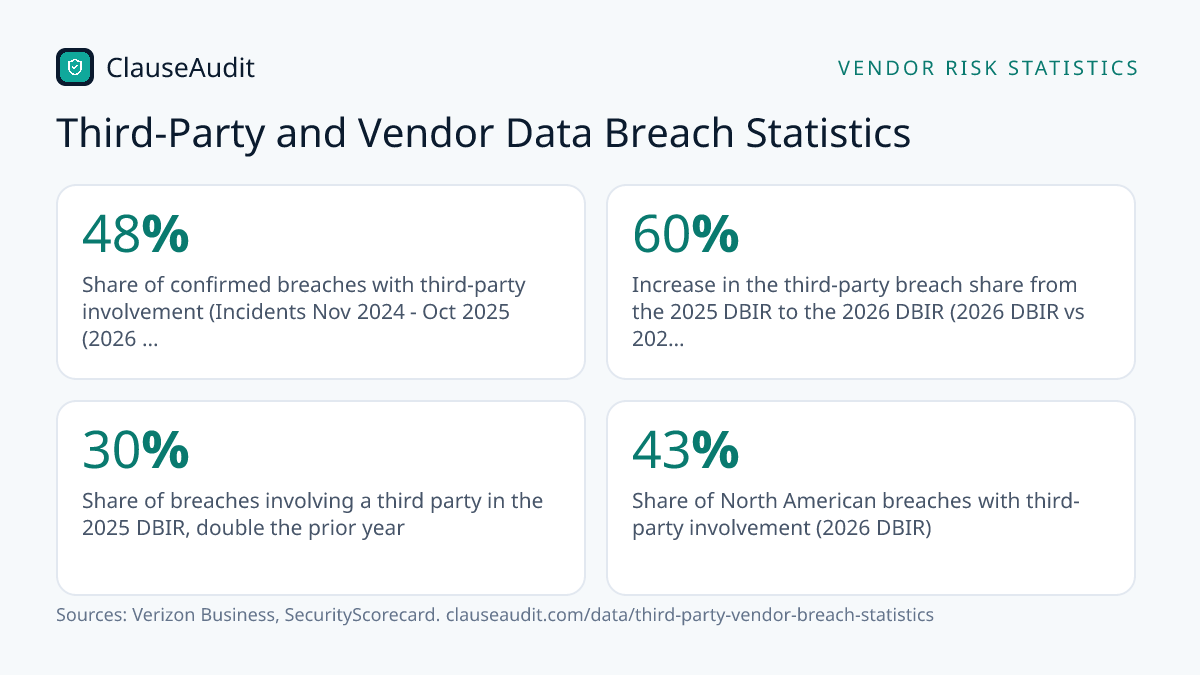
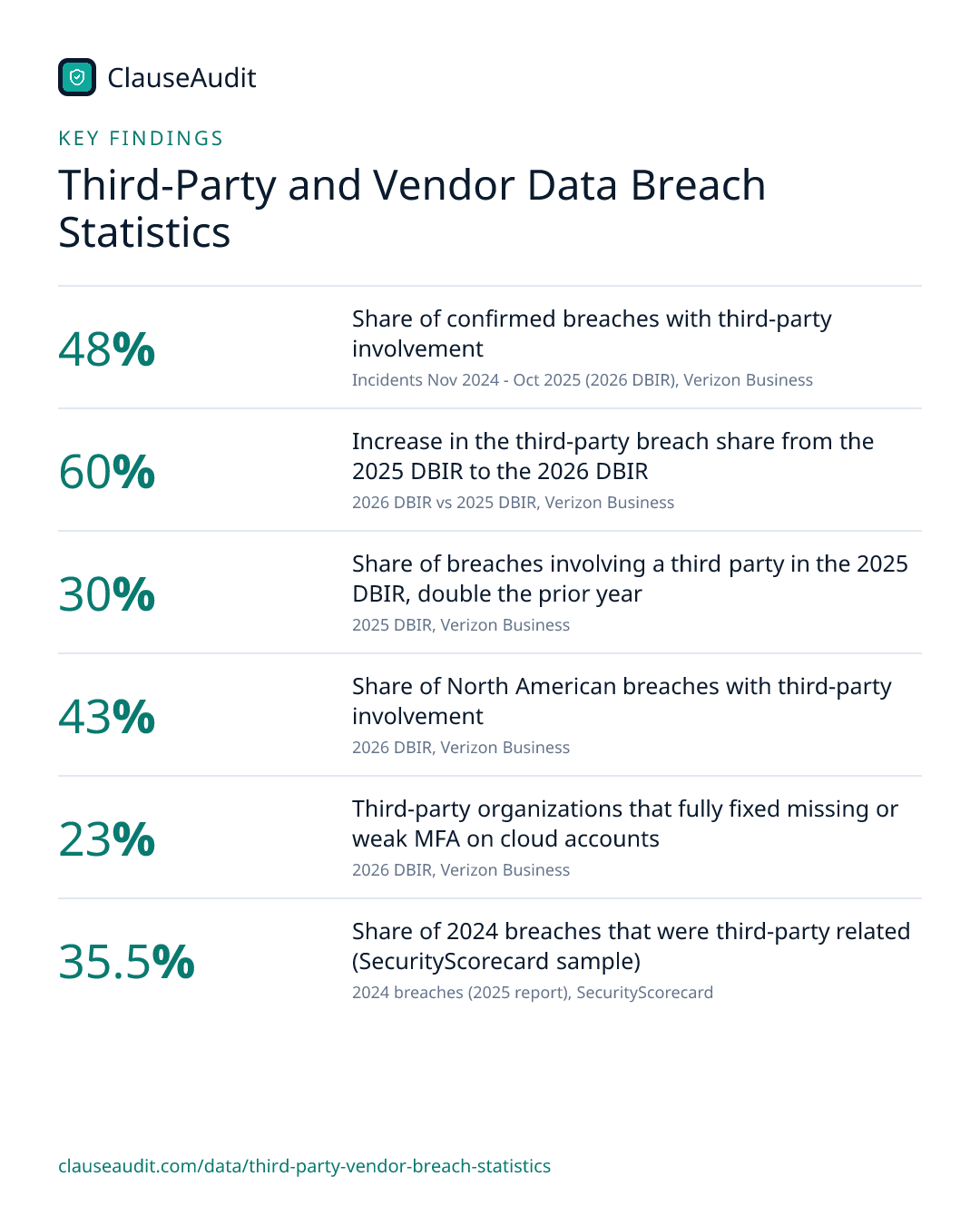
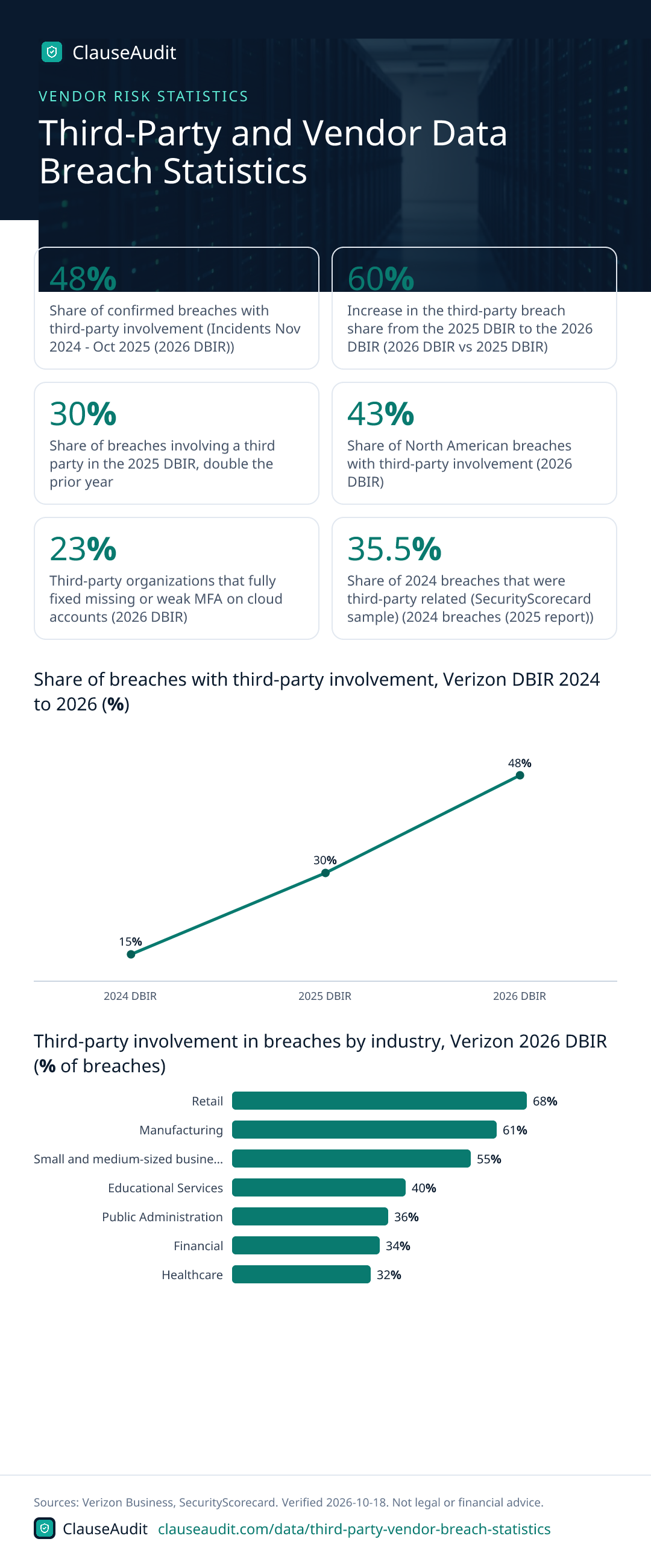
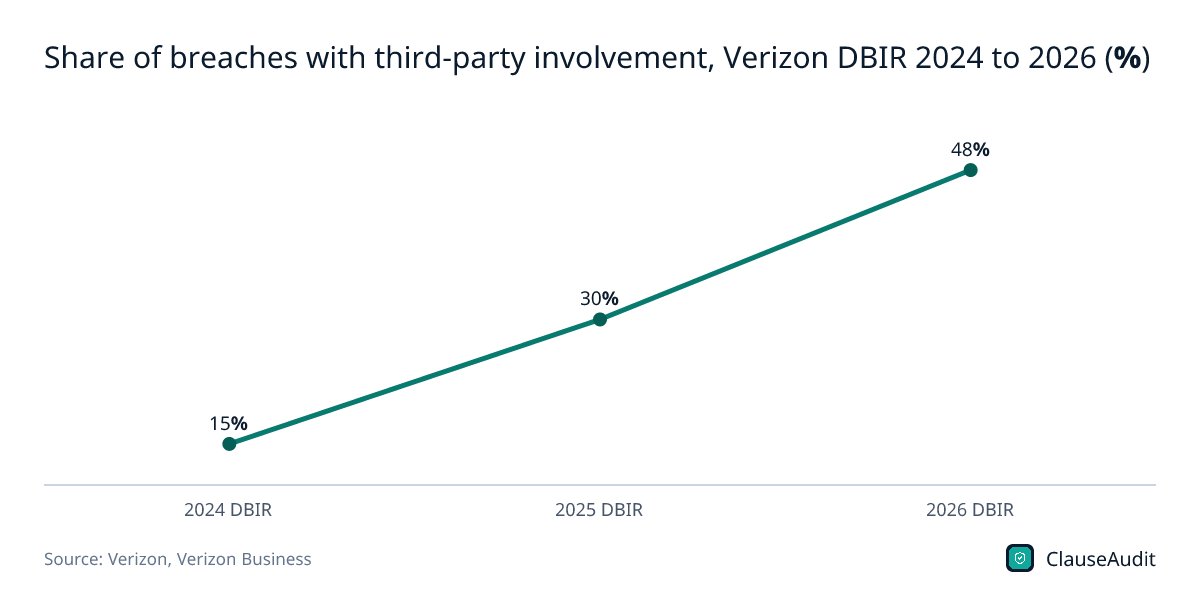
Third-party breaches are now close to half of all confirmed breaches. Verizon's 2026 DBIR found a vendor or partner involved in 48% of breaches, up from 30% the year before and 15% in the 2024 edition. In North America the share was 43%. SecurityScorecard put the US rate at 30.9% for 2024 breaches.

- Share of confirmed breaches with third-party involvement (Incidents Nov 2024 - Oct 2025 (2026 DBIR), Verizon Business)
- 48%
- Increase in the third-party breach share from the 2025 DBIR to the 2026 DBIR (2026 DBIR vs 2025 DBIR, Verizon Business)
- 60%
- Share of breaches involving a third party in the 2025 DBIR, double the prior year (2025 DBIR, Verizon Business)
- 30%
- Share of North American breaches with third-party involvement (2026 DBIR, Verizon Business)
- 43%
- Third-party organizations that fully fixed missing or weak MFA on cloud accounts (2026 DBIR, Verizon Business)
- 23%
- Share of 2024 breaches that were third-party related (SecurityScorecard sample) (2024 breaches (2025 report), SecurityScorecard)
- 35.5%
- US third-party breach rate in SecurityScorecard's 2024 breach sample (2024 breaches (2025 report), SecurityScorecard)
- 30.9%
- Ransomware attacks that start through third parties (2024 breaches (2025 report), SecurityScorecard)
- 41.4%
You can lock down your own systems and still lose your customers' data through someone else's. A payroll provider, a cloud host, a software tool with a back door, a contractor with a login to your network. When one of them is breached, the damage lands on you.
That path is now one of the most common ways a breach happens. The figures below come from Verizon's Data Breach Investigations Report and SecurityScorecard's third-party breach research. The charts show the trend and the spread by industry and region. The text explains what it means for the contracts you sign with vendors.
The share went from 15% to 30% to 48% in three editions. That last step is a 60% relative increase, not a 60-point jump, but the direction is hard to miss.
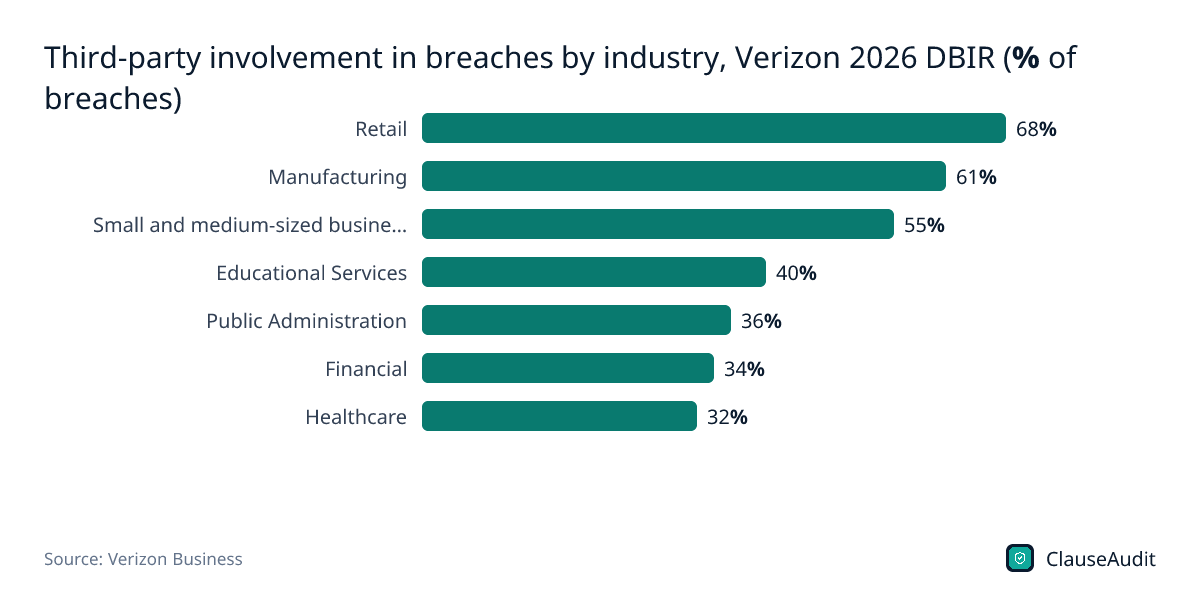
Download this chart (PNG)Third-party involvement in breaches by industry, Verizon 2026 DBIR (% of breaches)
Chart data
| Label | Value |
|---|---|
| Retail | 68% |
| Manufacturing | 61% |
| Small and medium-sized businesses | 55% |
| Educational Services | 40% |
| Public Administration | 36% |
| Financial | 34% |
| Healthcare | 32% |
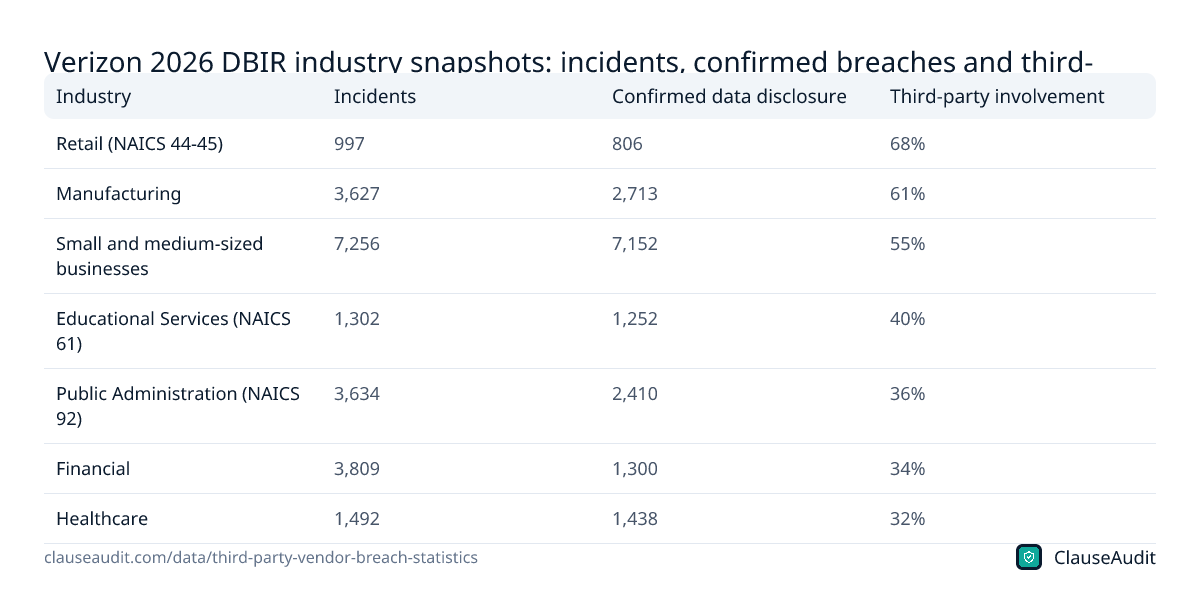
Retail at 68% and manufacturing at 61% had the highest third-party shares. Small and medium-sized businesses came in at 55%, above the overall figure of 48%.
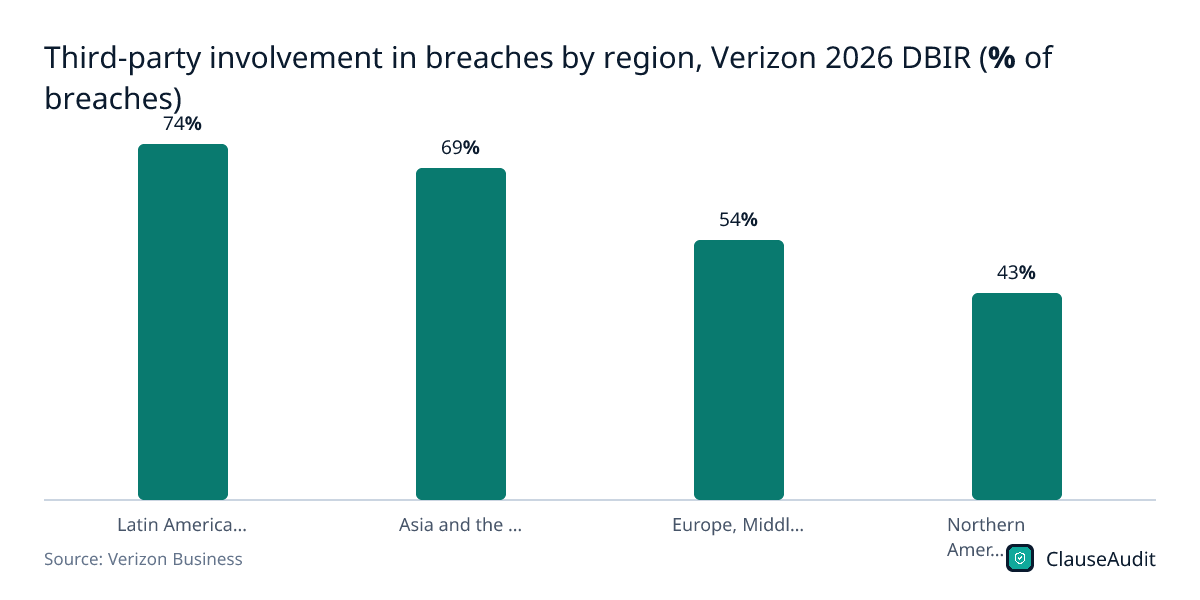
Download this chart (PNG)Third-party involvement in breaches by region, Verizon 2026 DBIR (% of breaches)
Chart data
| Label | Value (% of breaches) |
|---|---|
| Latin America and Caribbean | 74% |
| Asia and the Pacific | 69% |
| Europe, Middle East and Africa | 54% |
| Northern America | 43% |
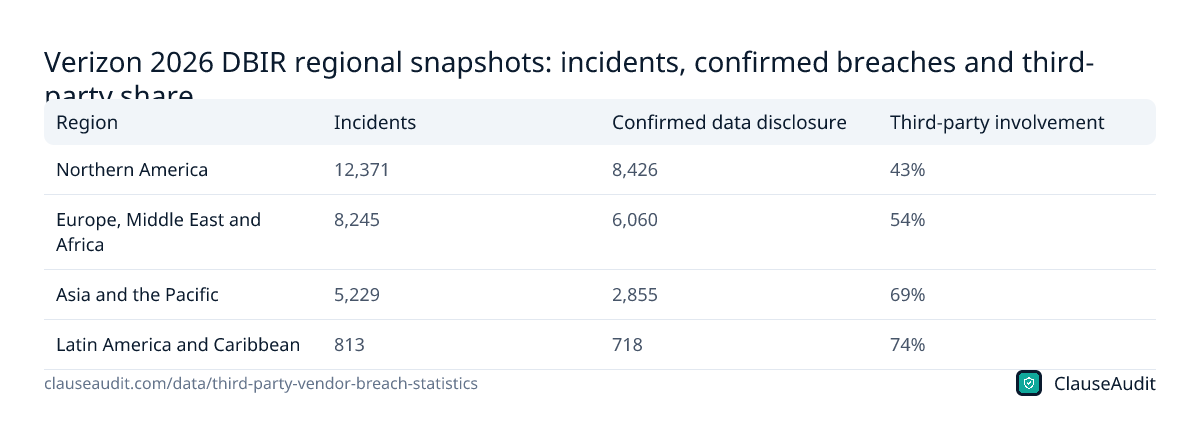
Northern America had the lowest third-party share at 43%, while Latin America and the Caribbean reached 74%. Lower here still means a vendor was involved in a large share of breaches.
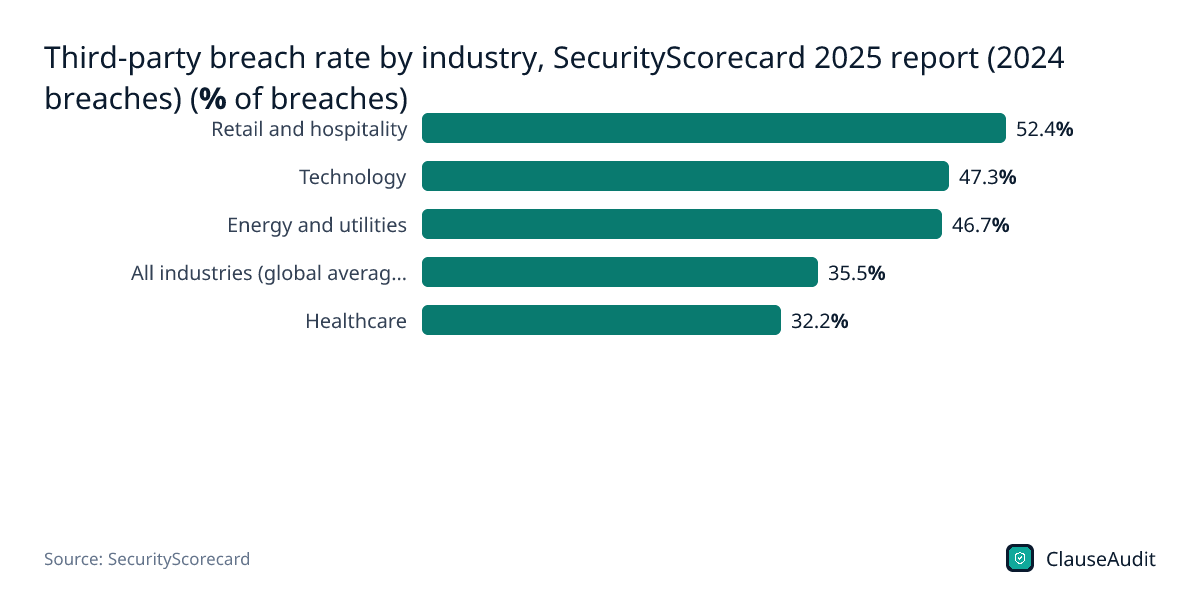
Download this chart (PNG)Third-party breach rate by industry, SecurityScorecard 2025 report (2024 breaches) (% of breaches)
Chart data
| Label | Value |
|---|---|
| Retail and hospitality | 52.4% |
| Technology | 47.3% |
| Energy and utilities | 46.7% |
| All industries (global average) | 35.5% |
| Healthcare | 32.2% |
SecurityScorecard found retail and hospitality highest at 52.4%. Healthcare's rate was below the 35.5% average, yet it had the most third-party breaches by count, at 78.
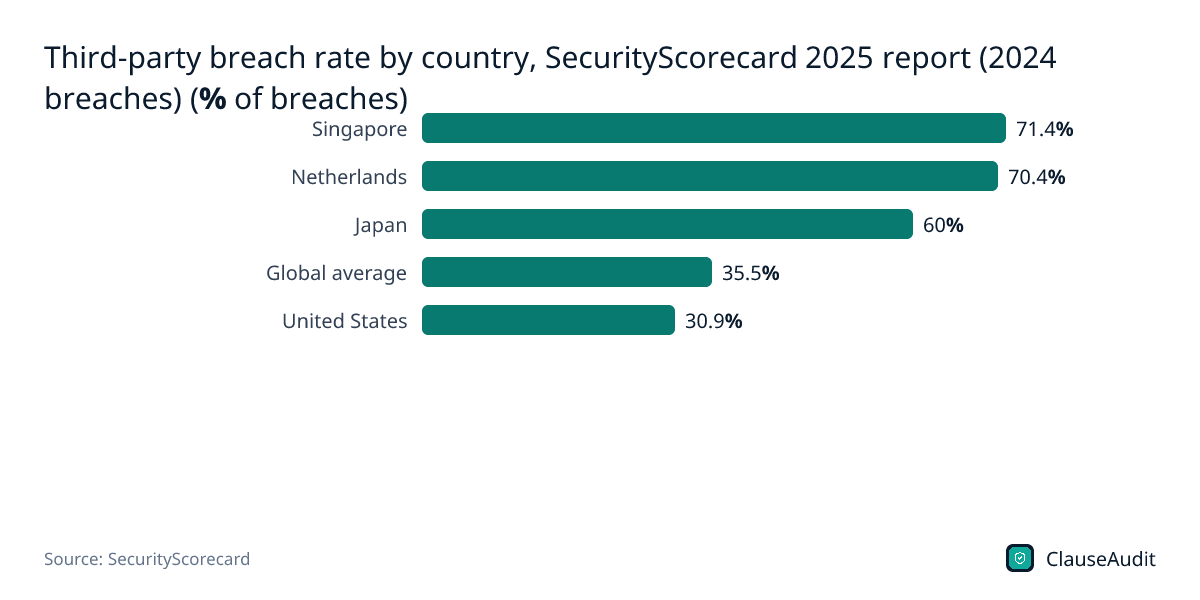
Download this chart (PNG)Third-party breach rate by country, SecurityScorecard 2025 report (2024 breaches) (% of breaches)
Chart data
| Label | Value |
|---|---|
| Singapore | 71.4% |
| Netherlands | 70.4% |
| Japan | 60% |
| Global average | 35.5% |
| United States | 30.9% |
The US rate of 30.9% sat below the 35.5% global average in this sample. Singapore at 71.4% and the Netherlands at 70.4% topped the list.
Download this chart (PNG)Verizon 2026 DBIR industry snapshots: incidents, confirmed breaches and third-party share
| Industry | Incidents | Confirmed data disclosure | Third-party involvement |
|---|---|---|---|
| Retail (NAICS 44-45) | 997 | 806 | 68% |
| Manufacturing | 3,627 | 2,713 | 61% |
| Small and medium-sized businesses | 7,256 | 7,152 | 55% |
| Educational Services (NAICS 61) | 1,302 | 1,252 | 40% |
| Public Administration (NAICS 92) | 3,634 | 2,410 | 36% |
| Financial | 3,809 | 1,300 | 34% |
| Healthcare | 1,492 | 1,438 | 32% |
Source: Verizon Business, 2026 Data Breach Investigations Report: Executive Summary. Download as image
Verizon 2026 DBIR regional snapshots: incidents, confirmed breaches and third-party share
| Region | Incidents | Confirmed data disclosure | Third-party involvement |
|---|---|---|---|
| Northern America | 12,371 | 8,426 | 43% |
| Europe, Middle East and Africa | 8,245 | 6,060 | 54% |
| Asia and the Pacific | 5,229 | 2,855 | 69% |
| Latin America and Caribbean | 813 | 718 | 74% |
Source: Verizon Business, 2026 Data Breach Investigations Report: Executive Summary. Download as image
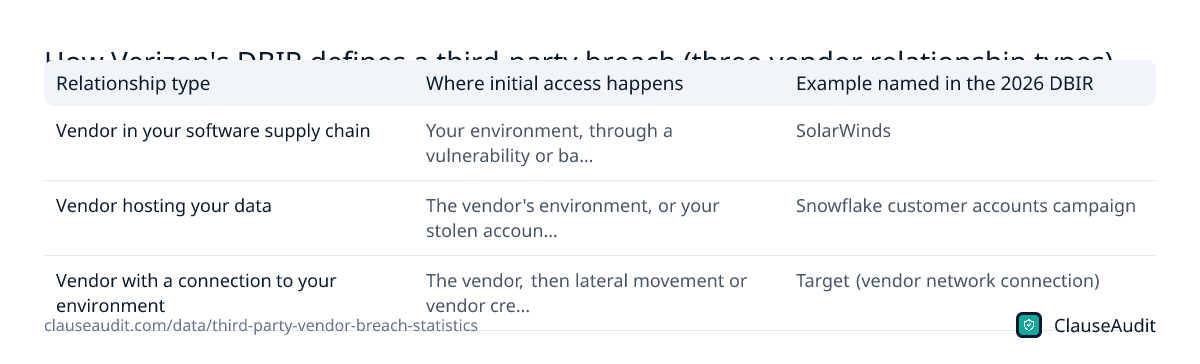
How Verizon's DBIR defines a third-party breach (three vendor relationship types)
| Relationship type | Where initial access happens | Example named in the 2026 DBIR |
|---|---|---|
| Vendor in your software supply chain | Your environment, through a vulnerability or back door in a vendor product | SolarWinds |
| Vendor hosting your data | The vendor's environment, or your stolen account to it | Snowflake customer accounts campaign |
| Vendor with a connection to your environment | The vendor, then lateral movement or vendor credentials into your systems | Target (vendor network connection) |
Source: Verizon Business, 2026 Data Breach Investigations Report. Download as image
What counts as a third-party data breach?
Verizon counts a breach as third-party when a vendor or partner played a part, even if the attacker ended up inside your own systems. It groups these into three types, shown in the table above.
The first is your software supply chain. A product you installed had a flaw or a planted back door, the way SolarWinds did. The second is a vendor that holds your data, like the campaign against Snowflake customer accounts, where stolen logins opened up data stored with the vendor. The third is a vendor with a connection into your network. The Target breach is the textbook case: attackers got in through a vendor's access and moved from there.
For a small business, all three are familiar. Your bookkeeping app, your file-sharing service and the IT contractor who has remote access to your laptops each fit one of these boxes.
For a freelancer, the list is shorter but the same idea holds. Your invoicing tool, cloud storage and email provider hold client files and payment details. If one of them leaks, your client may ask what your contract with them promised about protecting their data.
How common are third-party breaches in 2026?
Very. In the 2026 DBIR, which looked at more than 22,000 confirmed breaches in 145 countries, 48% involved a third party. The 2025 edition put it at 30%, and the 2024 edition at 15%. The share roughly tripled in two years.
Two caveats keep the number honest. Verizon's data is global, and the North American figure is lower at 43%. SecurityScorecard, using a different sample of 1,000 breaches from 2024, found a third-party share of 35.5% worldwide and 30.9% in the US. The methods differ, so don't compare the two figures directly. Both point the same way, though: roughly three to five in ten breaches now run through a vendor.
Ransomware follows the same route. SecurityScorecard found that 41.4% of ransomware attacks in its sample started through a third party. One compromised vendor can mean dozens of customers locked out at once, which is why attackers like these targets.
Why are small businesses hit so often through vendors?
In the 2026 DBIR, 55% of breaches at small and medium-sized businesses involved a third party. That is above the overall rate, and it makes sense. A small company rarely runs its own email servers, payroll engine or customer database. It rents them. Every one of those subscriptions is a door someone else holds the key to.
The fix is often slow on the vendor side too. Verizon tracked third-party cloud accounts with missing or weak multi-factor login protection, and only 23% of those organizations fully fixed the problem. You can't force a vendor to patch faster, but your contract can make the cost of not doing so theirs rather than yours.
Employees feel this too. When the HR or payroll platform your employer uses is breached, your Social Security number and bank details may be in the leaked files, even though you never signed anything with that vendor.
Which industries carry the most vendor risk?
Retail tops both studies. In the 2026 DBIR, 68% of retail breaches involved a third party, and SecurityScorecard put retail and hospitality at 52.4%. Think about how a shop runs: payment processors, ecommerce platforms, loyalty apps, shipping integrations, marketing tools. Each one touches customer data.
Manufacturing was next at 61%. Plants depend on equipment makers, logistics partners and outside IT support, many with remote access to keep machines running.
Healthcare is the odd one. Its share was 32% in the DBIR, the lowest of the industries shown, and its SecurityScorecard rate of 32.2% was below average. Yet healthcare had the most third-party breaches by count in that sample, 78 of them. A lower rate in a big, busy sector can still mean a lot of breaches.
If you work in one of the high-share industries, assume your vendors are a main way in. If you are in a lower-share one, don't relax. The overall figure is still close to half.
Who pays when a vendor leaks your data?
Usually you do, unless the contract says otherwise. Your customers and regulators will look to the company they gave their data to. Breach notice laws put the duty to notify on the business that owns the data, and that duty doesn't go away because a vendor caused the leak.
Then you turn to the vendor and find the liability cap. Many standard software terms limit what the vendor owes you to the fees you paid over a short window, sometimes just a month or a year. If you pay a small monthly fee and the breach costs you thousands in notification letters, credit monitoring and lost clients, that cap covers almost none of it.
This is where the numbers above become practical. If close to half of breaches involve a vendor, the vendor's contract is part of your security plan, whether or not you read it.
What to do before you sign a vendor contract
- Make a short list of every vendor that stores your data or can log into your systems. Most small businesses find more than they expected.
- For each one, find the security section of the terms. Look for named standards, such as a SOC 2 report, rather than vague promises of reasonable care.
- Check how fast the vendor must tell you about a breach. A fixed window in hours or days beats "promptly" or "without undue delay."
- Read the liability cap and see whether data breaches are carved out with a higher limit.
- Ask if the vendor carries cyber insurance and if you can see proof of it.
- Turn on multi-factor login for every vendor account you control. In the Snowflake case, attackers used stolen logins to customer accounts that had no multi-factor protection.
- Know how to get your data back and have it deleted when you leave. Data a vendor keeps after you cancel is still your exposure.
How ClauseAudit helps
Most vendor breaches turn into contract questions the day after: who has to tell whom, who pays for the cleanup, and how much the vendor owes you. The answers are already written into the terms you clicked through.
Upload a SaaS or vendor agreement and the automated review flags the clauses that decide those answers, explains them in plain English and suggests what to ask for before you sign.
- Breach notice window: a fixed number of hours or days for the vendor to tell you, not just "promptly"
- Liability cap: whether data breaches are carved out of a cap set at one month or one year of fees
- Indemnity: whether the vendor covers your notification, legal and credit monitoring costs when its security fails
- Security standards: named certifications, audit reports and your right to see them
- Subprocessors: whether the vendor must tell you which other companies touch your data
- Data return and deletion: how you get your data back and when the vendor must delete it after you cancel
Frequently asked questions
What percentage of data breaches involve third parties?
Verizon's 2026 DBIR found third-party involvement in 48% of confirmed breaches, covering incidents from November 2024 to October 2025. The prior edition put it at 30%. SecurityScorecard's separate study of 2024 breaches found 35.5% globally. The two use different samples and definitions, so treat them as a range rather than one number.
Is the US third-party breach rate lower than the global rate?
In both datasets, yes. Verizon's 2026 DBIR shows 43% for Northern America against 48% overall. SecurityScorecard found a US rate of 30.9% against a global average of 35.5%. Even the lower figures mean about three in ten breaches, or more, involved a vendor or partner.
Why did third-party breaches rise so fast?
The reports don't name a single cause. Common patterns include stolen logins to vendor-hosted accounts, flaws in widely used software and slow fixes on the vendor side. Verizon found only 23% of third-party organizations fully fixed missing or weak multi-factor protection on cloud accounts.
Which industries have the most third-party breaches?
In the 2026 DBIR, retail had the highest third-party share at 68%, followed by manufacturing at 61%. Small and medium-sized businesses, counted separately, came in at 55%. Healthcare was lowest of the industries shown at 32%. SecurityScorecard also ranked retail and hospitality highest, at 52.4% of 2024 breaches.
Am I responsible if my vendor is breached?
Often, yes. Data breach notice laws generally place the duty to notify affected people on the business that owns the data, even when a vendor caused the breach. Getting your costs back from the vendor depends on the contract, mainly the indemnity clause and the liability cap.
How do ransomware attacks use third parties?
Attackers get in through a vendor's access, a compromised software update or a shared service, then encrypt or steal data from the businesses connected to it. SecurityScorecard found 41.4% of ransomware attacks in its 2024 sample started through a third party.
What should a vendor contract say about data breaches?
Look for a fixed breach notice deadline, named security standards, a duty to cooperate with your investigation, and an indemnity for costs caused by the vendor's security failure. Check that the liability cap has a separate, higher limit for data breaches. Also confirm how your data is returned and deleted when you leave.
Can a small business negotiate a SaaS vendor's terms?
Sometimes. Large vendors rarely edit click-through terms for small accounts, but many offer a data processing addendum, security documentation or a higher tier with better terms. Smaller vendors and annual contracts are more open to changes. Even when you can't negotiate, reading the terms tells you what risk you are taking on.
Use this data
Every chart and card below is free to reuse under CC BY 4.0. Download what you need and link back to this page.
 Stat cards
 Key findings card
 Infographic
 Share of breaches with third-party involvement, Verizon DBIR 2024 to 2026 (%)
 Third-party involvement in breaches by industry, Verizon 2026 DBIR (% of breaches)
 Third-party involvement in breaches by region, Verizon 2026 DBIR (% of breaches)
 Third-party breach rate by industry, SecurityScorecard 2025 report (2024 breaches) (% of breaches)
 Third-party breach rate by country, SecurityScorecard 2025 report (2024 breaches) (% of breaches)
 Verizon 2026 DBIR industry snapshots: incidents, confirmed breaches and third-party share
 Verizon 2026 DBIR regional snapshots: incidents, confirmed breaches and third-party share
 How Verizon's DBIR defines a third-party breach (three vendor relationship types)
Embed the infographic
Free to share on your site, blog or slides under CC BY 4.0. Please keep the credit link.
Sources and method
Every number on this page comes from the sources below, each opened and read on or before October 18, 2026. A second, independent review checked every figure against its source and corrected anything that did not match. Figures that could not be confirmed were left out.
- Verizon Business, 2026 Data Breach Investigations Report: Executive Summary (2026 edition (19th DBIR), May 2026; incidents November 1, 2024 to October 31, 2025)
- Verizon Business, 2026 Data Breach Investigations Report (2026 edition (19th DBIR), May 2026)
- Verizon Business, 2025 Data Breach Investigations Report: Executive Summary (2025 edition (18th DBIR), April 23, 2025)
- Verizon, Verizon's 2025 Data Breach Investigations Report: Alarming surge in cyberattacks through third-parties (April 23, 2025)
- Verizon, 2024 Data Breach Investigations Report: Vulnerability exploitation boom threatens cybersecurity (May 1, 2024)
- SecurityScorecard, SecurityScorecard 2025 Global Third-Party Breach Report Reveals Surge in Vendor-Driven Attacks (March 26, 2025 (2025 Global Third-Party Breach Report))
Cite this page
ClauseAudit, “Third-Party and Vendor Data Breach Statistics”, updated October 18, 2026, https://clauseaudit.com/data/third-party-vendor-breach-statistics. Free to reuse with a link back (CC BY 4.0).
This page summarises published data and law as checked on October 18, 2026. Figures are updated as new editions are released, and your own situation may differ. It is general information, not legal, tax or financial advice.