Small Business Cybersecurity Statistics 2026: Losses, Ransomware and Vendor Risk
By ClauseAudit Research · 3 sources ·
What do the latest small business cybersecurity statistics show?
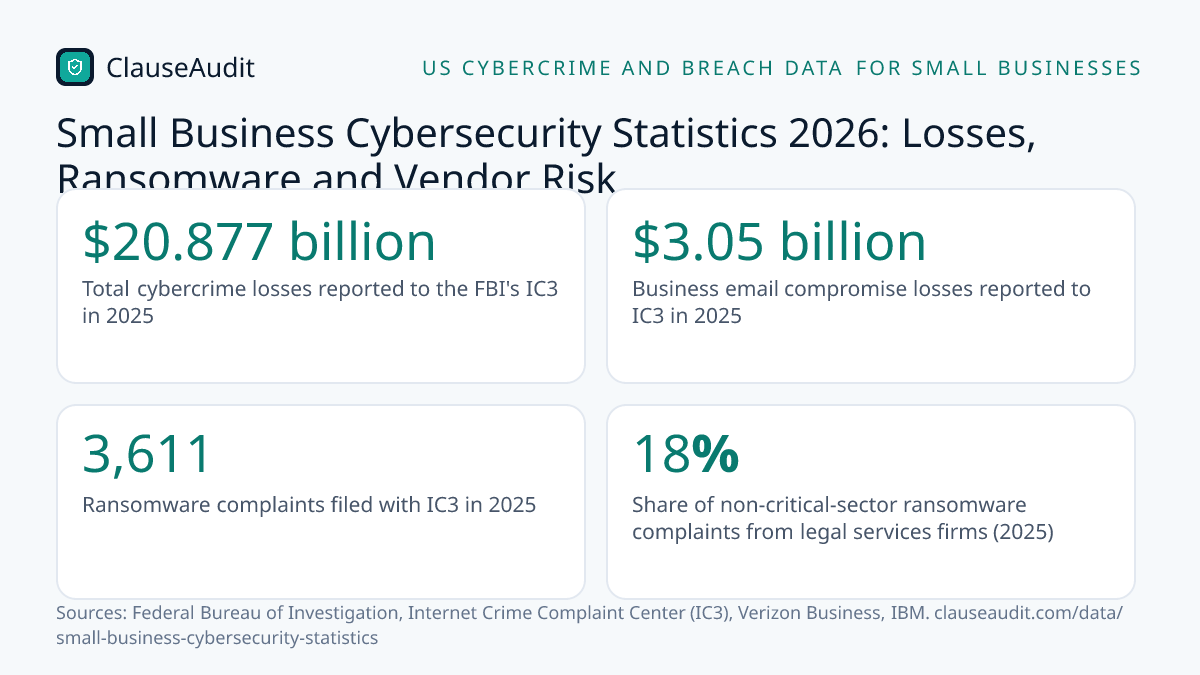
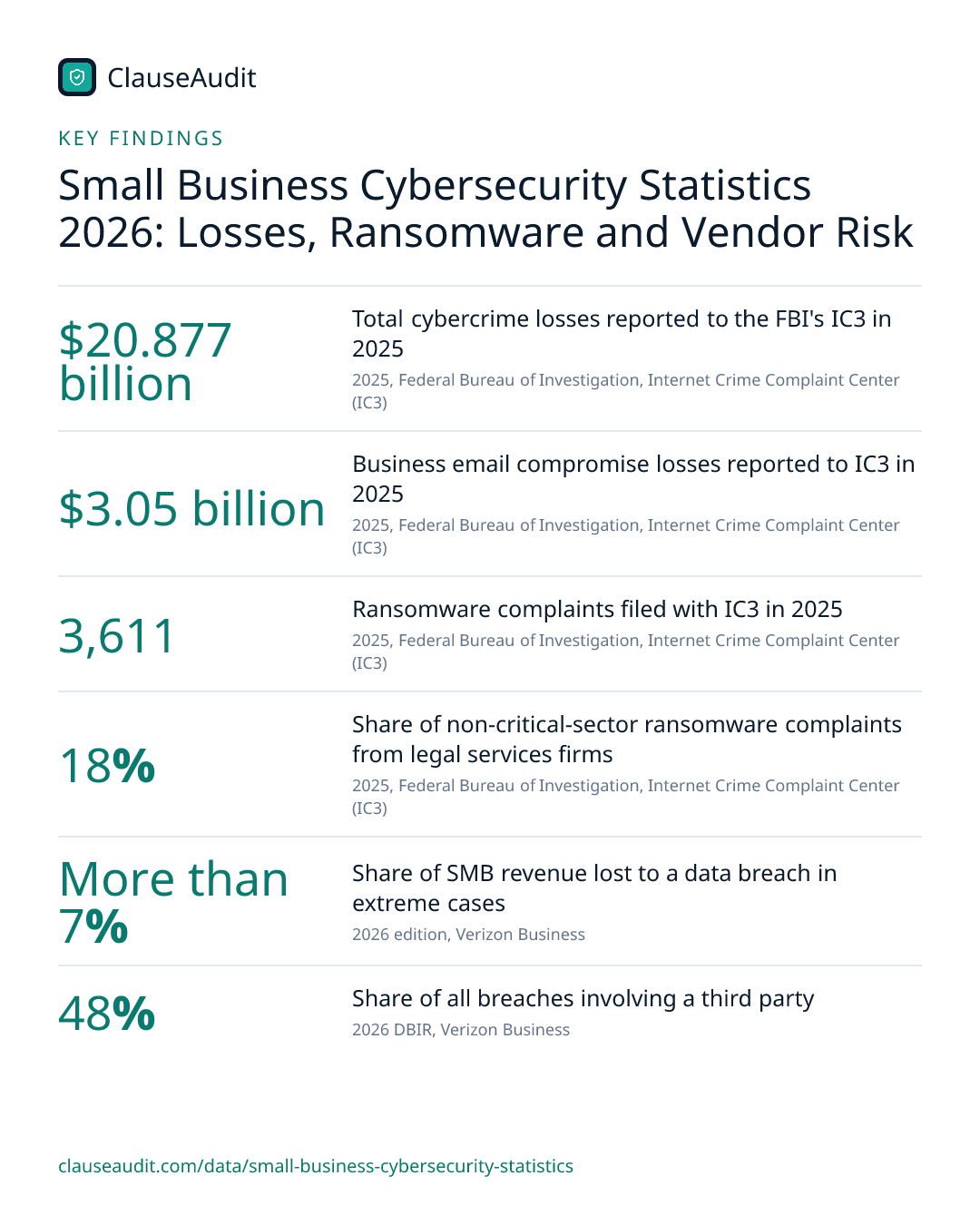
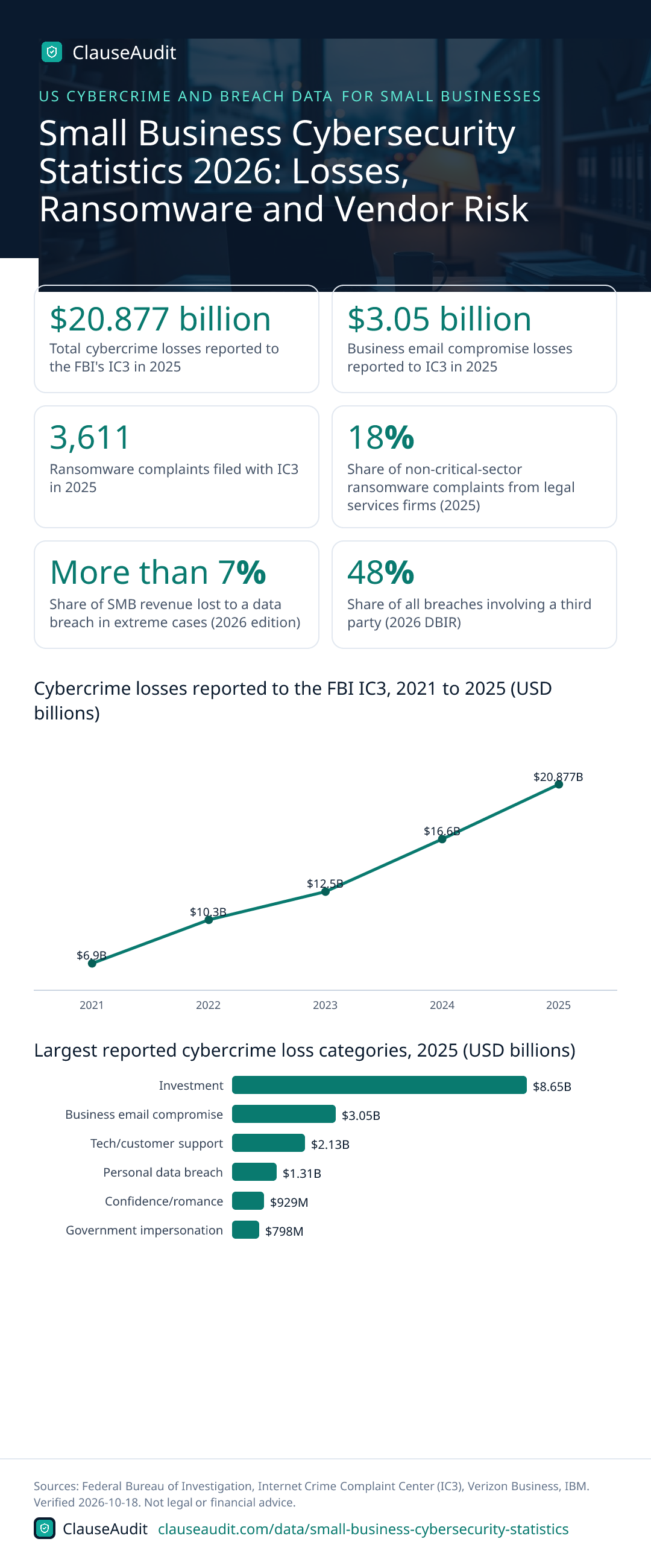
Cyber risk for small firms keeps climbing. Americans reported $20.877 billion in cybercrime losses to the FBI in 2025, with $3.05 billion from business email compromise alone. Verizon finds 48% of breaches involve a third party, and in extreme cases a breach costs a small business more than 7% of its revenue.

- Total cybercrime losses reported to the FBI's IC3 in 2025 (2025, Federal Bureau of Investigation, Internet Crime Complaint Center (IC3))
- $20.877 billion
- Business email compromise losses reported to IC3 in 2025 (2025, Federal Bureau of Investigation, Internet Crime Complaint Center (IC3))
- $3.05 billion
- Ransomware complaints filed with IC3 in 2025 (2025, Federal Bureau of Investigation, Internet Crime Complaint Center (IC3))
- 3,611
- Share of non-critical-sector ransomware complaints from legal services firms (2025, Federal Bureau of Investigation, Internet Crime Complaint Center (IC3))
- 18%
- Share of SMB revenue lost to a data breach in extreme cases (2026 edition, Verizon Business)
- More than 7%
- Share of all breaches involving a third party (2026 DBIR, Verizon Business)
- 48%
- Share of breaches where vulnerability exploitation was the initial access vector (2026 DBIR, Verizon Business)
- 31%
- Global average cost of a data breach (2026 edition, IBM)
- $4.99 million
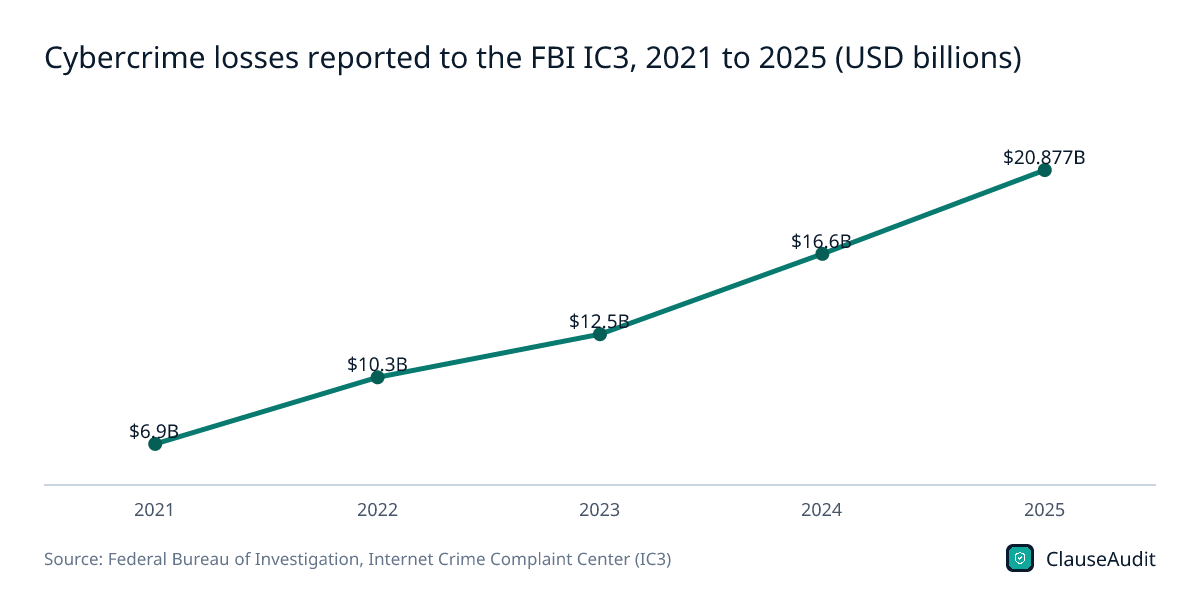
The money lost to online crime has tripled in a few years. Losses reported to the FBI's Internet Crime Complaint Center went from $6.9 billion in 2021 to $20.877 billion in 2025. That total covers individuals and businesses together, but the crime types aimed at firms count for real money. Fake invoice and payment scams alone, known as business email compromise, made up $3.05 billion of it.
The other pattern is where breaches start. Verizon's 2026 data shows 48% of breaches involve a third party, and 31% begin with an attacker exploiting a software flaw. For a small business that runs on outside software, payroll tools and contractors, your vendors' security is your security. Your contracts decide who pays when it fails.
Cybercrime losses reported to the FBI IC3, 2021 to 2025 (USD billions)
Chart data
| Label | Value (USD billions) |
|---|---|
| 2021 | $6.9B |
| 2022 | $10.3B |
| 2023 | $12.5B |
| 2024 | $16.6B |
| 2025 | $20.877B |
Reported losses rose every year from 2021 to 2025, reaching $20.877 billion. Many victims never file a complaint, so treat these as a floor, not the full picture.
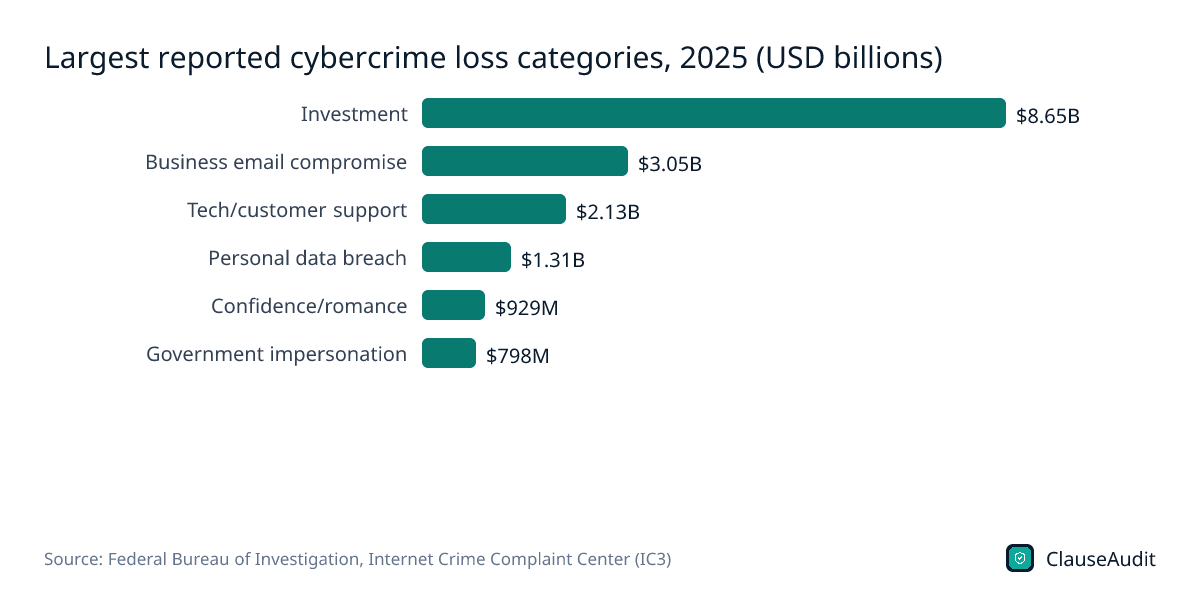
Download this chart (PNG)Largest reported cybercrime loss categories, 2025 (USD billions)
Chart data
| Label | Value |
|---|---|
| Investment | $8.65B |
| Business email compromise | $3.05B |
| Tech/customer support | $2.13B |
| Personal data breach | $1.31B |
| Confidence/romance | $929M |
| Government impersonation | $798M |
Business email compromise was the second-largest loss category at $3.05 billion. It is the one built to target companies: a spoofed vendor or boss asks for a wire, and someone sends it.
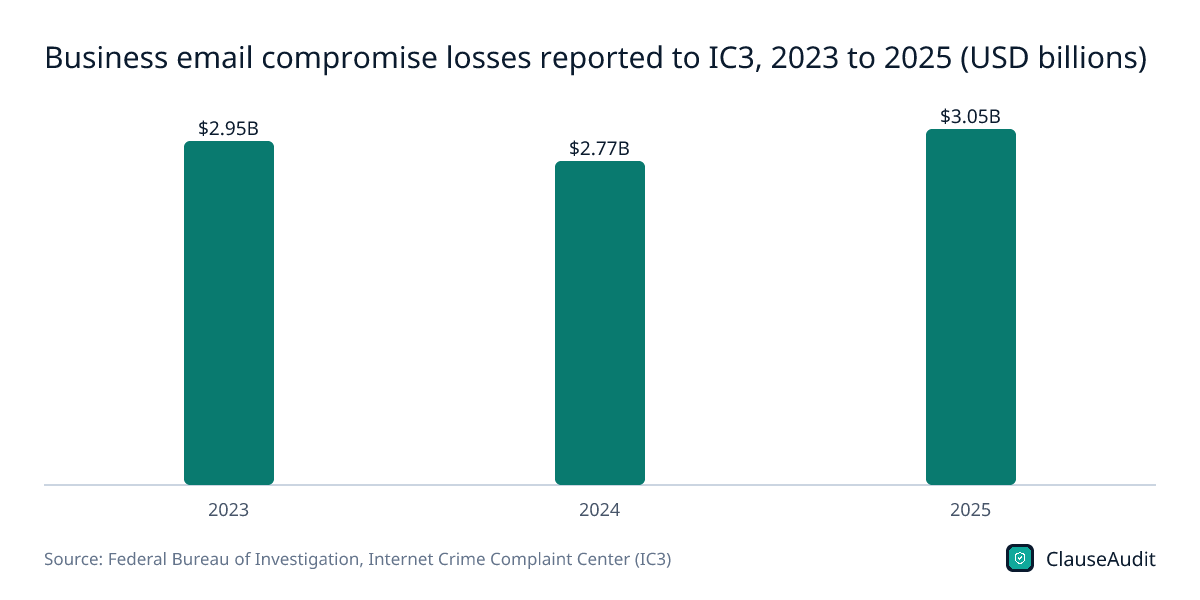
Download this chart (PNG)Business email compromise losses reported to IC3, 2023 to 2025 (USD billions)
Chart data
| Label | Value (USD billions) |
|---|---|
| 2023 | $2.95B |
| 2024 | $2.77B |
| 2025 | $3.05B |
BEC losses dipped to $2.77 billion in 2024, then climbed back to $3.05 billion in 2025. This scam is not going away.
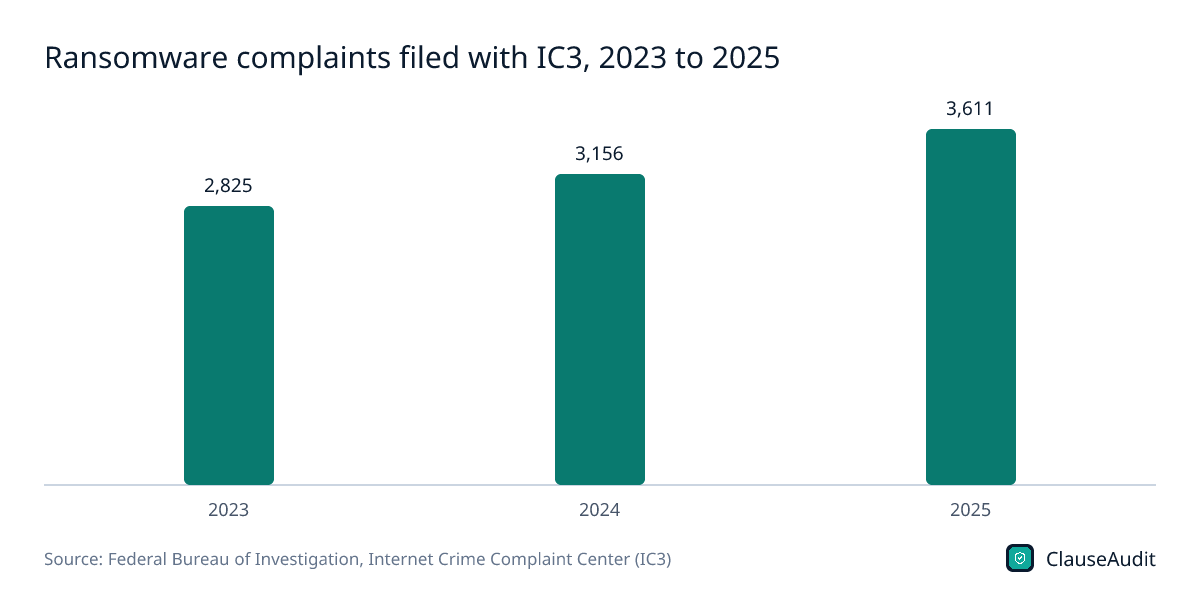
Download this chart (PNG)Ransomware complaints filed with IC3, 2023 to 2025
Chart data
| Label | Value |
|---|---|
| 2023 | 2,825 |
| 2024 | 3,156 |
| 2025 | 3,611 |
Ransomware complaints rose from 2,825 in 2023 to 3,611 in 2025. Reported dollar losses stay small because they usually leave out downtime, lost work and cleanup costs.
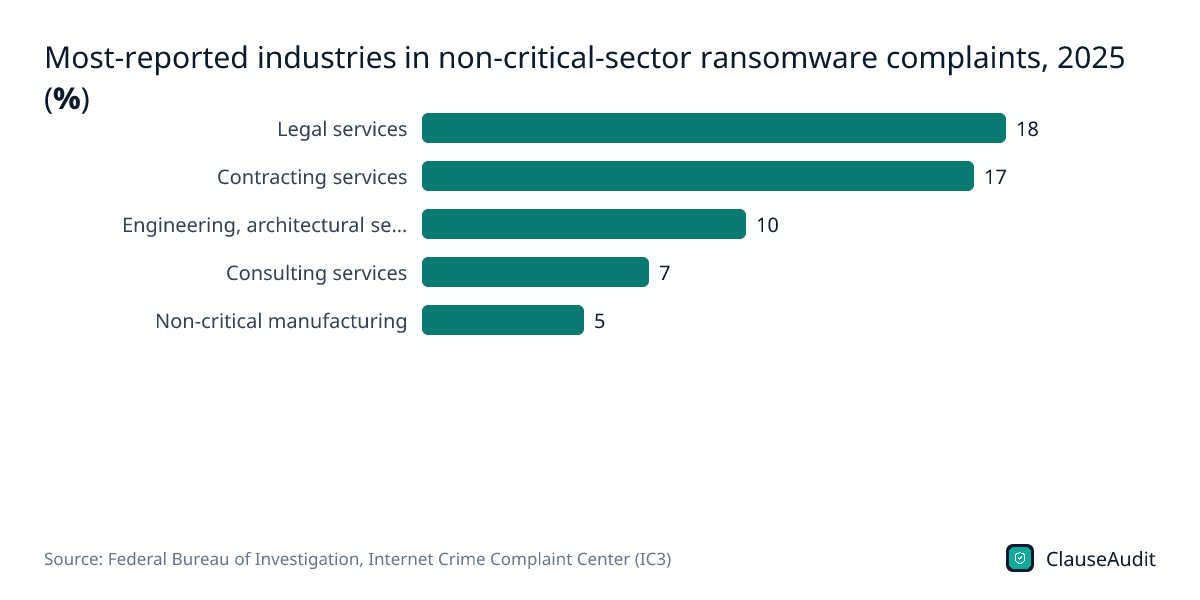
Download this chart (PNG)Most-reported industries in non-critical-sector ransomware complaints, 2025 (%)
Chart data
| Label | Value |
|---|---|
| Legal services | 18 |
| Contracting services | 17 |
| Engineering, architectural services | 10 |
| Consulting services | 7 |
| Non-critical manufacturing | 5 |
Law firms (18%) and contractors (17%) topped the list outside critical infrastructure. These are often small, busy offices holding client files and approving payments all day.
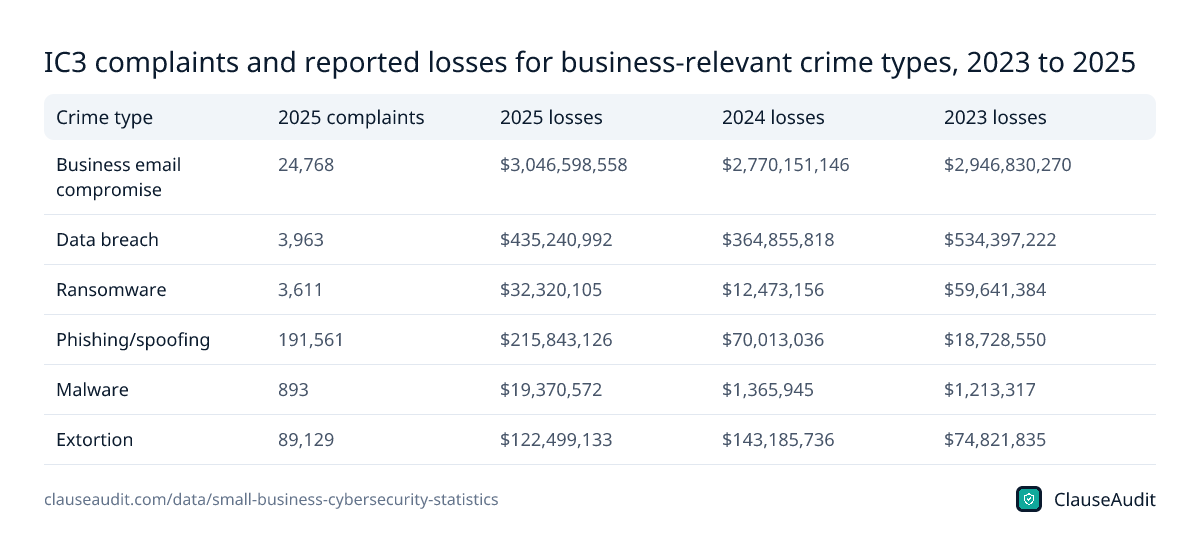
Download this chart (PNG)IC3 complaints and reported losses for business-relevant crime types, 2023 to 2025
| Crime type | 2025 complaints | 2025 losses | 2024 losses | 2023 losses |
|---|---|---|---|---|
| Business email compromise | 24,768 | $3,046,598,558 | $2,770,151,146 | $2,946,830,270 |
| Data breach | 3,963 | $435,240,992 | $364,855,818 | $534,397,222 |
| Ransomware | 3,611 | $32,320,105 | $12,473,156 | $59,641,384 |
| Phishing/spoofing | 191,561 | $215,843,126 | $70,013,036 | $18,728,550 |
| Malware | 893 | $19,370,572 | $1,365,945 | $1,213,317 |
| Extortion | 89,129 | $122,499,133 | $143,185,736 | $74,821,835 |
Source: Federal Bureau of Investigation, Internet Crime Complaint Center (IC3), 2025 IC3 Annual Report (Internet Crime Report). Download as image
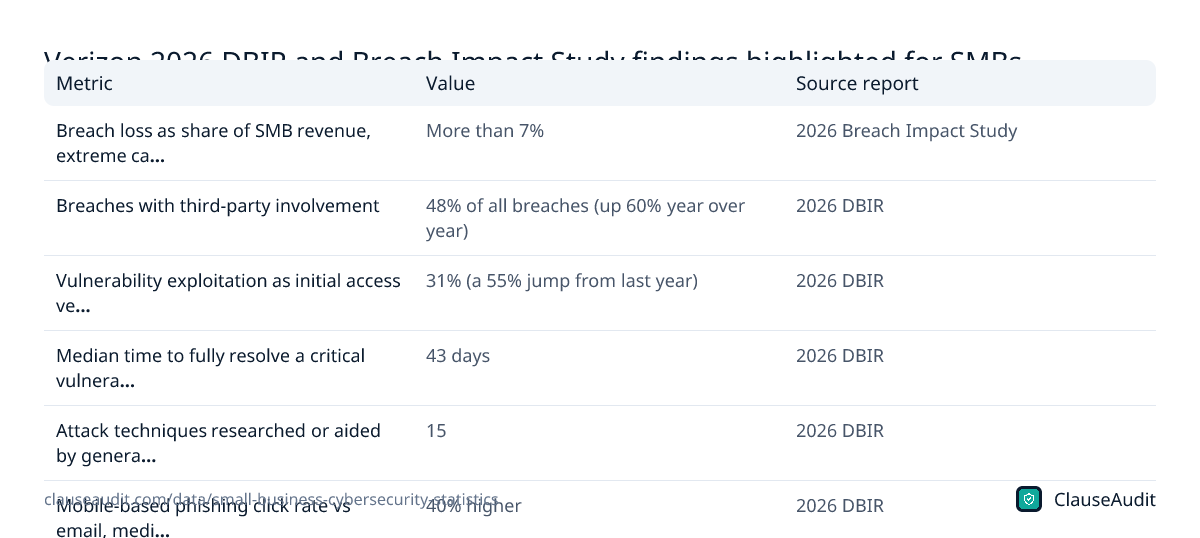
Verizon 2026 DBIR and Breach Impact Study findings highlighted for SMBs
| Metric | Value | Source report |
|---|---|---|
| Breach loss as share of SMB revenue, extreme cases (top 2.5%) | More than 7% | 2026 Breach Impact Study |
| Breaches with third-party involvement | 48% of all breaches (up 60% year over year) | 2026 DBIR |
| Vulnerability exploitation as initial access vector | 31% (a 55% jump from last year) | 2026 DBIR |
| Median time to fully resolve a critical vulnerability | 43 days | 2026 DBIR |
| Attack techniques researched or aided by generative AI, median case | 15 | 2026 DBIR |
| Mobile-based phishing click rate vs email, median | 40% higher | 2026 DBIR |
Source: Verizon Business, Cybersecurity insights for SMBs (2026 DBIR and 2026 Breach Impact Study infographic). Download as image
How often are small businesses hit by cyberattacks?
No single federal count tracks attacks on small businesses alone. What you get instead is complaint data, and it points one way. The FBI's IC3 logged 191,561 phishing and spoofing complaints in 2025, 24,768 business email compromise complaints, and 3,611 ransomware complaints.
Those are reports, not attacks. Plenty of owners clean up quietly, eat the loss and never file. So the real numbers are higher, and the trend lines matter more than any single figure. Ransomware complaints rose each year from 2023 to 2025. Reported phishing losses went from $70,013,036 in 2024 to $215,843,126 in 2025.
If you run a small agency or a contracting firm, assume someone will try. The question is whether one click turns into a wire transfer or a locked server. Most of these losses start with an ordinary task, like paying an invoice or opening a shared file, done in a hurry by someone who trusted the sender.
What does a data breach cost a small business?
IBM puts the global average cost of a data breach at $4.99 million in its 2026 report. That average leans on large companies, so don't read it as your number. A more useful view for small firms comes from Verizon's 2026 Breach Impact Study, built on cyber insurance claims: in extreme cases, a breach took more than 7% of a small business's revenue.
Think about what that share of revenue means for a firm with thin margins. It can erase most of a year's profit in a single event. And that is before the slower costs: clients who leave, a cyber policy that costs more at renewal, and weeks of staff time spent on notices, forensics and cleanup. Every state has a breach notification law that can require you to tell affected customers, which brings mailing costs, call center work and sometimes credit monitoring.
Reported ransomware losses to the FBI were $32,320,105 in 2025, which looks small. The FBI notes that figure usually excludes lost business, wages, files, equipment and repair costs. For most small shops, the downtime is the real bill.
Your contracts shape this bill more than most owners realize. If the breach happened at a vendor, the question of who pays for those notices and lost days comes down to the liability and indemnity clauses you signed. If you hold client data under a services agreement, your own contract may promise security you can't back up.
Why is business email compromise the biggest threat to small firms?
BEC losses hit $3.05 billion in 2025, second only to investment fraud. The scam is simple. Someone breaks into or spoofs a vendor's email, then sends your bookkeeper new bank details for an invoice that looks normal. Or a fake message from the owner asks for an urgent wire before the weekend.
Small businesses are a good target because the person who reads the email is often the person who pays it. There's no second approver, and the vendor relationship is informal enough that a sudden change of bank details doesn't raise eyebrows.
The fix is mostly process, not software:
A real example of how it plays out: a small plumbing firm's supplier gets its email hacked. The attacker replies inside an existing thread about a spring order, attaches a real-looking invoice and mentions the supplier switched banks. The owner pays. The supplier still wants its money. Without a written rule about payment changes, both sides argue over who carries the loss.
- Confirm any change in payment details by phone, using a number you already had, never one from the email.
- Require two people to approve wires above a set amount.
- Turn on multi-factor authentication for every email account, including the owner's.
- Put the payment-change procedure in writing with your key vendors and clients.
Are your vendors your biggest cyber risk?
For many small businesses, yes. Verizon's 2026 DBIR found 48% of breaches involved a third party, up 60% from the year before. That covers your SaaS tools, your IT contractor, your payment processor and anyone else with access to your systems or data.
Patching is part of it. Vulnerability exploitation was the way in for 31% of breaches, and the median time to fully fix a critical flaw was 43 days. If your vendor is that slow, your customer data sits exposed for all of those 43 days, and you probably won't hear about it until much later.
You can't audit every vendor. You can read what they promise. Many small business software contracts cap the vendor's liability at a small slice of fees, leave out any duty to tell you quickly about a breach, and say nothing about who pays for customer notices. That is where the money question gets answered, long before an incident.
When you renew a tool, ask for three things in writing: a breach notice deadline, a security standard the vendor must keep, and a higher liability cap for data incidents. Plenty of vendors have a security addendum ready. They just don't offer it unless you ask.
Which small businesses are most at risk?
Among ransomware complaints from businesses outside critical infrastructure, legal services made up 18% and contracting services 17%. Engineering and architecture firms followed at 10%, then consulting at 7%. What these businesses share: sensitive client files, frequent payments to and from third parties, and lean IT.
Phones are a growing gap too. Verizon found the median click rate on mobile phishing runs 40% higher than on email. Staff who approve invoices or reset passwords from their phones are the people attackers want.
Size alone doesn't protect you. Attackers use automated tools that scan for the same unpatched software in a dental office as in a bank. Smaller firms just have fewer people watching, so an intrusion can run for weeks before anyone notices.
What to do this quarter
- List every vendor that touches your data or money, and note what each contract says about breaches and liability.
- Set up a call-back rule for any change in bank details, from vendors or clients.
- Turn on multi-factor authentication for email, banking and cloud storage.
- Ask your IT provider how fast they patch critical flaws, and get the answer in writing.
- Check whether your cyber insurance requires specific controls, and whether you meet them.
- Keep offline or separate backups and test a restore at least once.
How ClauseAudit helps
With 48% of breaches tied to a third party, the contracts you sign with software vendors and IT providers decide who pays when something goes wrong. These terms are easy to click through without a close read.
Upload a SaaS or vendor agreement and our automated review flags the clauses that shift breach costs onto you, in plain English, with suggested changes to ask for.
- Liability cap: is it limited to a month of fees, and does it exclude data loss and breach costs?
- Breach notice: does the vendor have to tell you within a set number of hours or days?
- Indemnification: who covers customer notices, regulatory fines and legal claims after a breach?
- Security commitments: are patching, encryption or SOC 2 obligations actually written into the contract?
- Data use and deletion: can the vendor use your data for other purposes, and must it delete it when you leave?
- Terms changes: can the vendor change security or liability terms with short notice and continued use?
Frequently asked questions
How much did businesses lose to cybercrime in 2025?
The FBI's IC3 recorded $20.877 billion in total cybercrime losses in 2025. That figure includes individuals and businesses, so it isn't a small business total. Business email compromise, the crime most aimed at companies, accounted for $3.05 billion across 24,768 complaints.
What is business email compromise?
It's a scam where a criminal spoofs or takes over an email account belonging to a vendor, client or executive, then asks for a payment or a change of bank details. Your money goes to the criminal's account. It caused $3.05 billion in reported losses in 2025, second only to investment fraud.
How many ransomware attacks were reported in 2025?
The FBI's IC3 received 3,611 ransomware complaints in 2025, up from 3,156 in 2024 and 2,825 in 2023. Many attacks go unreported, so the true number is higher. Reported losses were $32,320,105, but that usually leaves out downtime, lost wages and recovery costs.
Can a data breach put a small business out of business?
It can do serious damage. Verizon's 2026 Breach Impact Study, based on cyber insurance claims, found that in extreme cases a breach cost a small business more than 7% of its revenue. For a firm with thin margins, that can wipe out a year's profit, before counting lost clients.
What is the average cost of a data breach?
IBM's 2026 report puts the global average at $4.99 million. That average spans companies of every size and is pulled up by large enterprises, so most small businesses will see a smaller dollar figure. As a share of revenue, though, the hit can be heavier for a small firm.
How many data breaches involve vendors or third parties?
Verizon's 2026 Data Breach Investigations Report found that 48% of breaches involved a third party, up 60% year over year. That includes software providers, IT contractors and other partners with access to your systems. It is a strong reason to read your vendor contracts closely.
Which industries get hit by ransomware most?
Outside the critical infrastructure sectors, legal services firms filed 18% of ransomware complaints to the FBI in 2025, and contracting services filed 17%. Engineering and architecture firms came next at 10%. Small professional offices with client files and frequent payments are frequent targets.
What should a small business check in a software contract for cyber risk?
Look at the liability cap, any breach notification deadline, who pays for customer notices and legal claims, written security commitments, and what happens to your data when you cancel. Many SaaS contracts cap the vendor's liability at the fees you paid over the past year or less, which can fall far short of breach costs.
Use this data
Every chart and card below is free to reuse under CC BY 4.0. Download what you need and link back to this page.
 Stat cards
 Key findings card
 Infographic
 Cybercrime losses reported to the FBI IC3, 2021 to 2025 (USD billions)
 Largest reported cybercrime loss categories, 2025 (USD billions)
 Business email compromise losses reported to IC3, 2023 to 2025 (USD billions)
 Ransomware complaints filed with IC3, 2023 to 2025
 Most-reported industries in non-critical-sector ransomware complaints, 2025 (%)
 IC3 complaints and reported losses for business-relevant crime types, 2023 to 2025
 Verizon 2026 DBIR and Breach Impact Study findings highlighted for SMBs
Embed the infographic
Free to share on your site, blog or slides under CC BY 4.0. Please keep the credit link.
Sources and method
Every number on this page comes from the sources below, each opened and read on or before October 18, 2026. A second, independent review checked every figure against its source and corrected anything that did not match. Figures that could not be confirmed were left out.
- Federal Bureau of Investigation, Internet Crime Complaint Center (IC3), 2025 IC3 Annual Report (Internet Crime Report) (2025 edition (calendar year 2025 data))
- Verizon Business, Cybersecurity insights for SMBs (2026 DBIR and 2026 Breach Impact Study infographic) (2026 DBIR dated May 19, 2026; 2026 Breach Impact Study dated Jun 16, 2026)
- IBM, Cost of a Data Breach Report 2026 (2026 edition)
Cite this page
ClauseAudit, “Small Business Cybersecurity Statistics 2026: Losses, Ransomware and Vendor Risk”, updated October 18, 2026, https://clauseaudit.com/data/small-business-cybersecurity-statistics. Free to reuse with a link back (CC BY 4.0).
This page summarises published data and law as checked on October 18, 2026. Figures are updated as new editions are released, and your own situation may differ. It is general information, not legal, tax or financial advice.