State Privacy Law Penalties and Cure Periods by State
By ClauseAudit Research · 44 sources ·
What are the privacy law penalties by state?
Most state privacy laws cap fines at $7,500 per violation, the limit in 12 of the 23 states with a broad consumer privacy law. Colorado is highest at $20,000. Fines are counted per violation, so totals climb fast. Cure periods are shrinking: Iowa still gives 90 days, while California and Rhode Island give none.

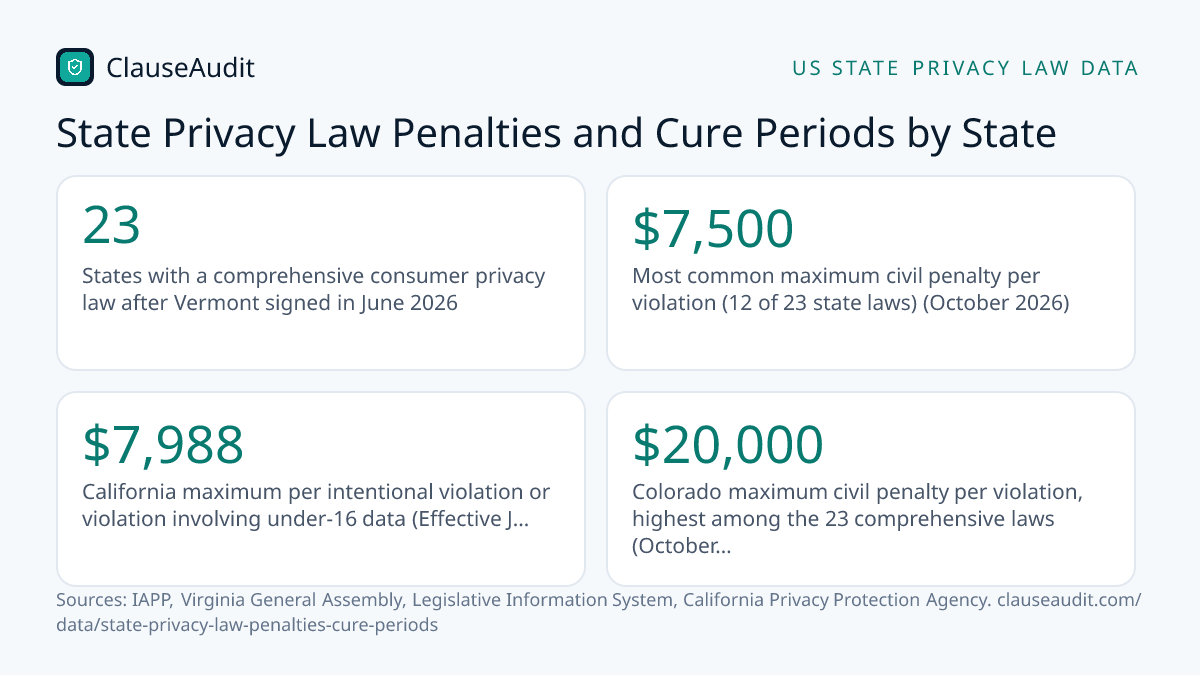
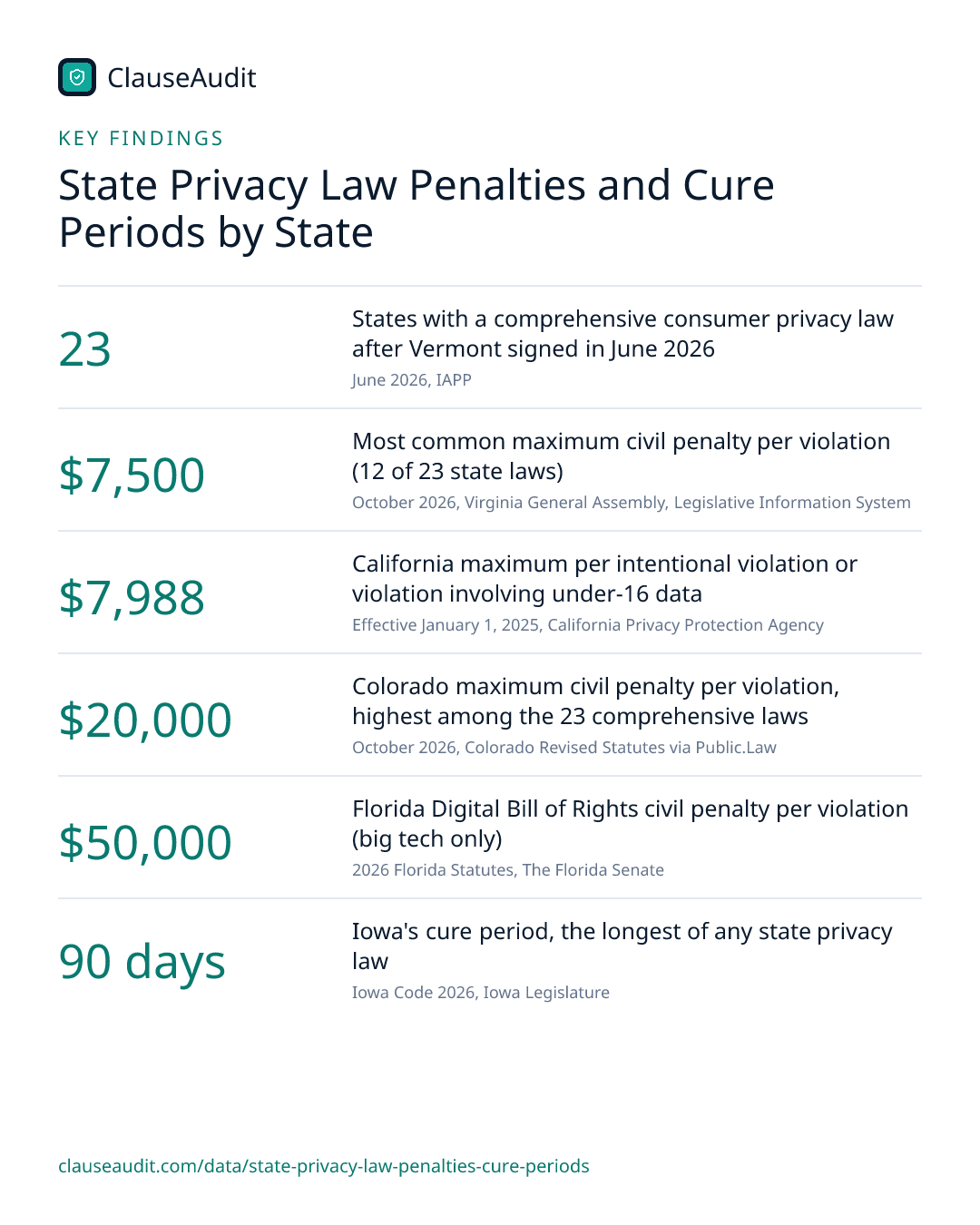
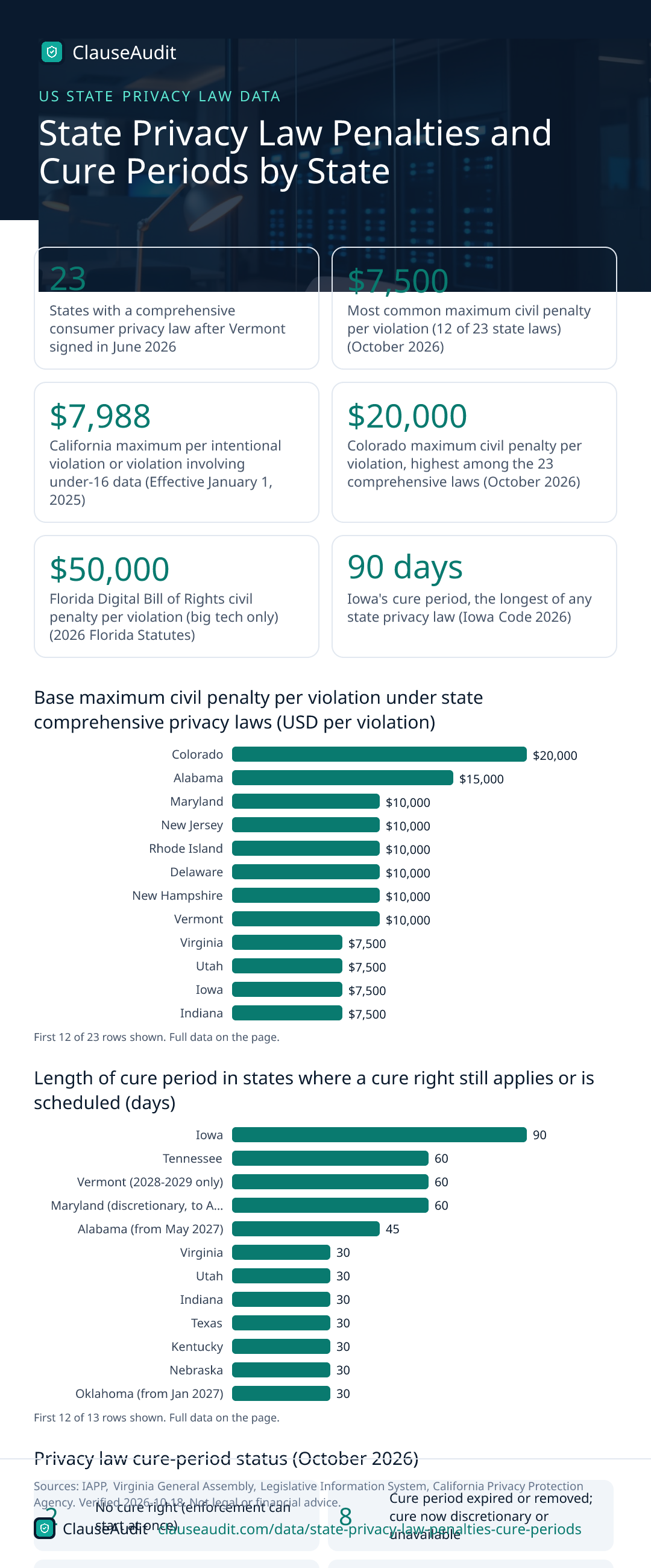
- States with a comprehensive consumer privacy law after Vermont signed in June 2026 (June 2026, IAPP)
- 23
- Most common maximum civil penalty per violation (12 of 23 state laws) (October 2026, Virginia General Assembly, Legislative Information System)
- $7,500
- California maximum per intentional violation or violation involving under-16 data (Effective January 1, 2025, California Privacy Protection Agency)
- $7,988
- Colorado maximum civil penalty per violation, highest among the 23 comprehensive laws (October 2026, Colorado Revised Statutes via Public.Law)
- $20,000
- Florida Digital Bill of Rights civil penalty per violation (big tech only) (2026 Florida Statutes, The Florida Senate)
- $50,000
- Iowa's cure period, the longest of any state privacy law (Iowa Code 2026, Iowa Legislature)
- 90 days
- Alabama's penalty per violation, the highest of the four 2026 laws (Enacted April 2026; effective May 1, 2027, Jackson Lewis P.C. (Workplace Privacy Report))
- $15,000
- States where the mandatory cure period has expired or been removed (October 2026) (As of October 18, 2026, Minnesota Office of the Revisor of Statutes)
- 8
A privacy fine is quoted per violation, and that small phrase does most of the work. A state attorney general can treat each affected consumer, each unanswered request or each improper sale as its own count. A cap that looks modest on paper turns into a serious number once it is multiplied across a customer list.
The other half of the picture is the cure period: the written warning and the window to fix the problem before a lawsuit is filed. Many states offered one when their laws were new, and several have already let it lapse. Below is what the caps and cure windows mean for a small business, a software buyer or a freelancer who handles client data, and what to do about it.
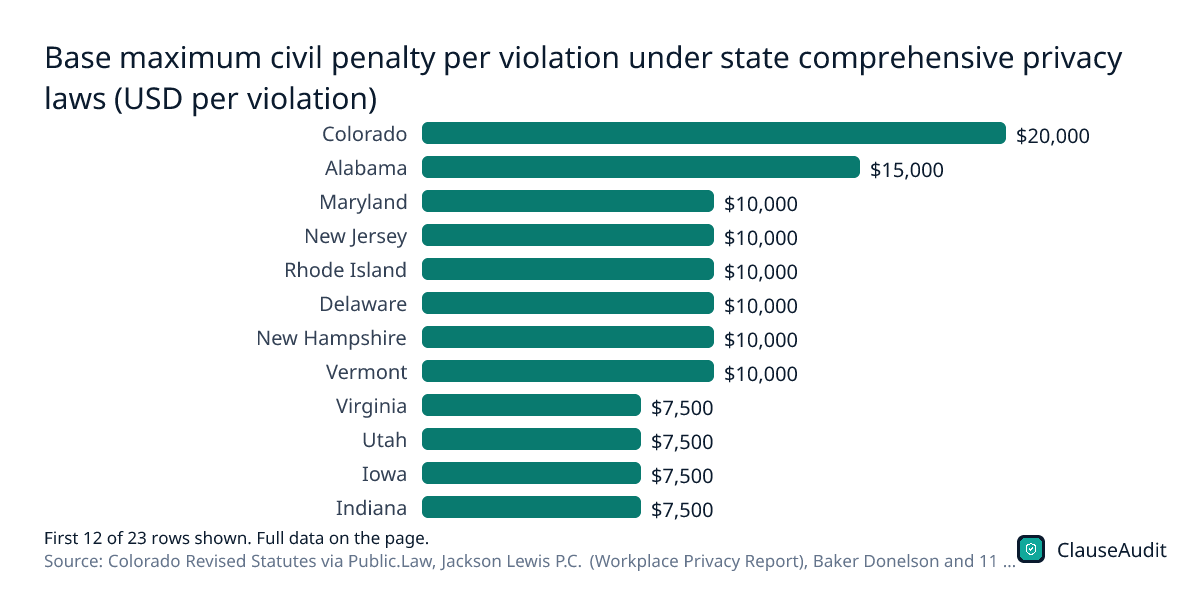
Base maximum civil penalty per violation under state comprehensive privacy laws (USD per violation)
Chart data
| Label | Value |
|---|---|
| Colorado | $20,000 |
| Alabama | $15,000 |
| Maryland | $10,000 |
| New Jersey | $10,000 |
| Rhode Island | $10,000 |
| Delaware | $10,000 |
| New Hampshire | $10,000 |
| Vermont | $10,000 |
| Virginia | $7,500 |
| Utah | $7,500 |
| Iowa | $7,500 |
| Indiana | $7,500 |
| Tennessee | $7,500 |
| Texas | $7,500 |
| Oregon | $7,500 |
| Montana | $7,500 |
| Minnesota | $7,500 |
| Kentucky | $7,500 |
| Nebraska | $7,500 |
| Oklahoma | $7,500 |
| Connecticut | $5,000 |
| Louisiana | $5,000 |
| California | $2,663 |
California looks lowest here only because this is its base figure; intentional violations and anything involving under-16 data reach $7,988. Colorado's $20,000 cap sits well above the $7,500 most states chose.
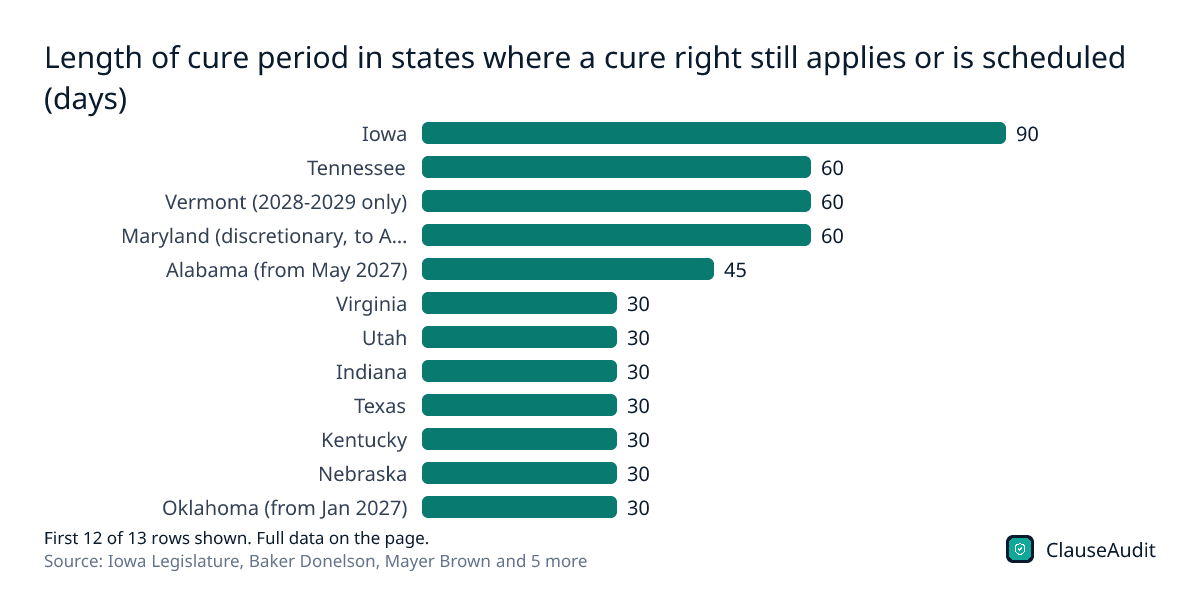
Download this chart (PNG)Length of cure period in states where a cure right still applies or is scheduled (days)
Chart data
| Label | Value |
|---|---|
| Iowa | 90 |
| Tennessee | 60 |
| Vermont (2028-2029 only) | 60 |
| Maryland (discretionary, to April 2027) | 60 |
| Alabama (from May 2027) | 45 |
| Virginia | 30 |
| Utah | 30 |
| Indiana | 30 |
| Texas | 30 |
| Kentucky | 30 |
| Nebraska | 30 |
| Oklahoma (from Jan 2027) | 30 |
| Louisiana (Jan-Jul 2027 only) | 30 |
Iowa's 90 days is the outlier and does not expire. Several bars on this chart are temporary or not yet in force, so check the label before you count on that window.
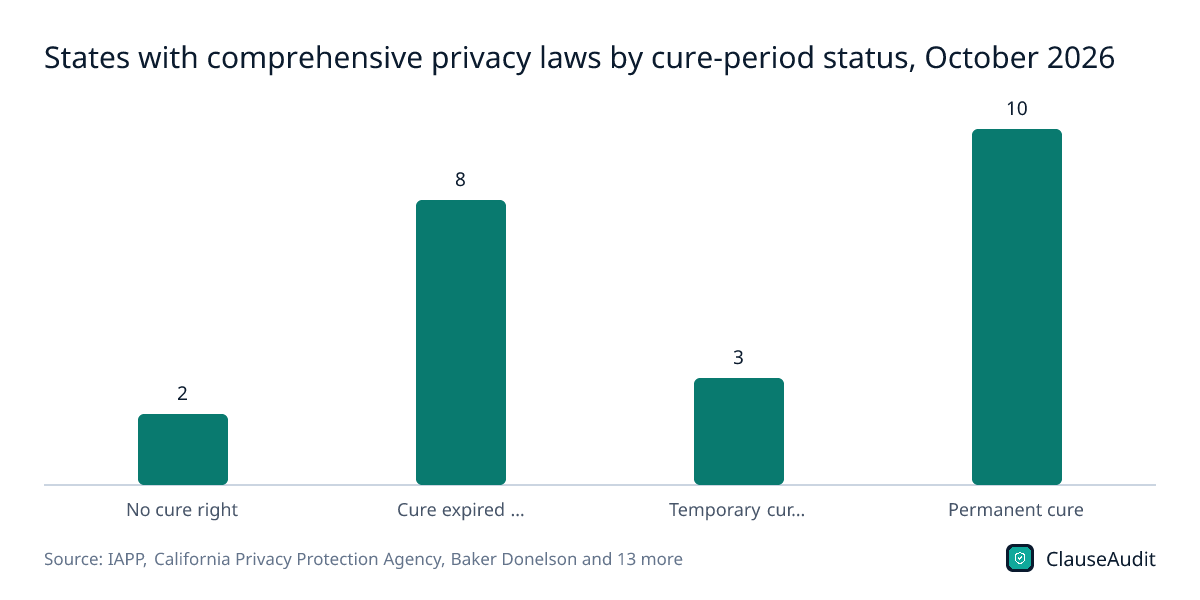
Download this chart (PNG)States with comprehensive privacy laws by cure-period status, October 2026
Chart data
| Label | Value |
|---|---|
| No cure right | 2 |
| Cure expired or removed | 8 |
| Temporary cure in force or scheduled | 3 |
| Permanent cure | 10 |
Permanent cure rights are now the largest group, but the states that once offered a cure and dropped it are close behind. Among the older laws, the trend runs one way: toward less warning, not more.
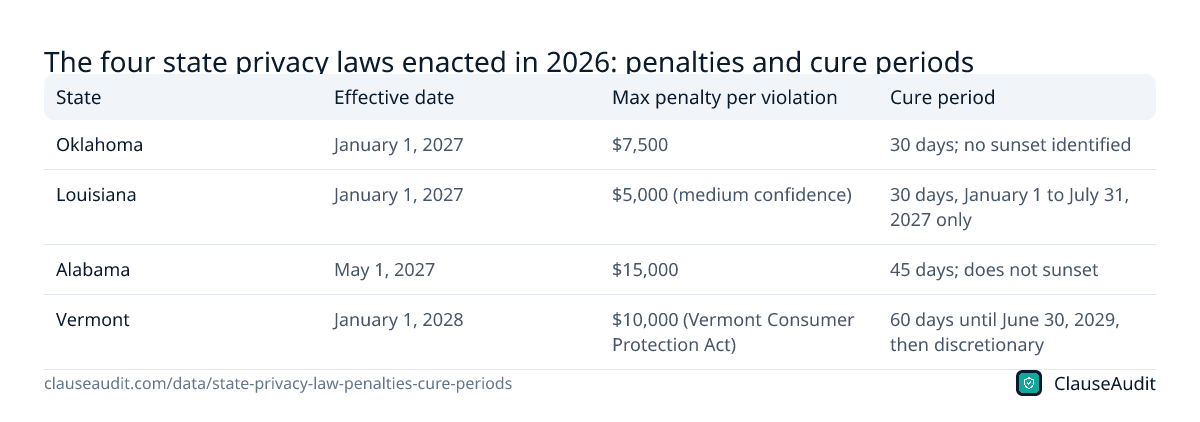
Download this chart (PNG)The four state privacy laws enacted in 2026: penalties and cure periods
| State | Effective date | Max penalty per violation | Cure period |
|---|---|---|---|
| Oklahoma | January 1, 2027 | $7,500 | 30 days; no sunset identified |
| Louisiana | January 1, 2027 | $5,000 (medium confidence) | 30 days, January 1 to July 31, 2027 only |
| Alabama | May 1, 2027 | $15,000 | 45 days; does not sunset |
| Vermont | January 1, 2028 | $10,000 (Vermont Consumer Protection Act) | 60 days until June 30, 2029, then discretionary |
Source: Morgan Lewis, New US State Consumer Privacy Laws: What Businesses Should Know; Troutman Pepper Locke (Troutman Privacy), Oklahoma Enacts Consumer Data Privacy Law; Troutman Pepper Locke (Troutman Privacy), Alabama Enacts Consumer Data Privacy Law; Troutman Pepper Locke (Troutman Privacy), Louisiana Enacts Consumer Data Privacy Law; Jackson Lewis P.C. (Workplace Privacy Report), Consumer Privacy Protections Come to the Heart of Dixie; Mayer Brown, Vermont Enacts Comprehensive Consumer Privacy Law; Baker Donelson, Consumer Data Privacy Law Guide: Louisiana; Baker Donelson, Consumer Data Privacy Law Guide: Vermont; Baker Donelson, Consumer Data Privacy Law Guide: Oklahoma; Hunton Andrews Kurth (Privacy & Cybersecurity Law Blog), Vermont Becomes 23rd State with Comprehensive Consumer Privacy Law. Download as image
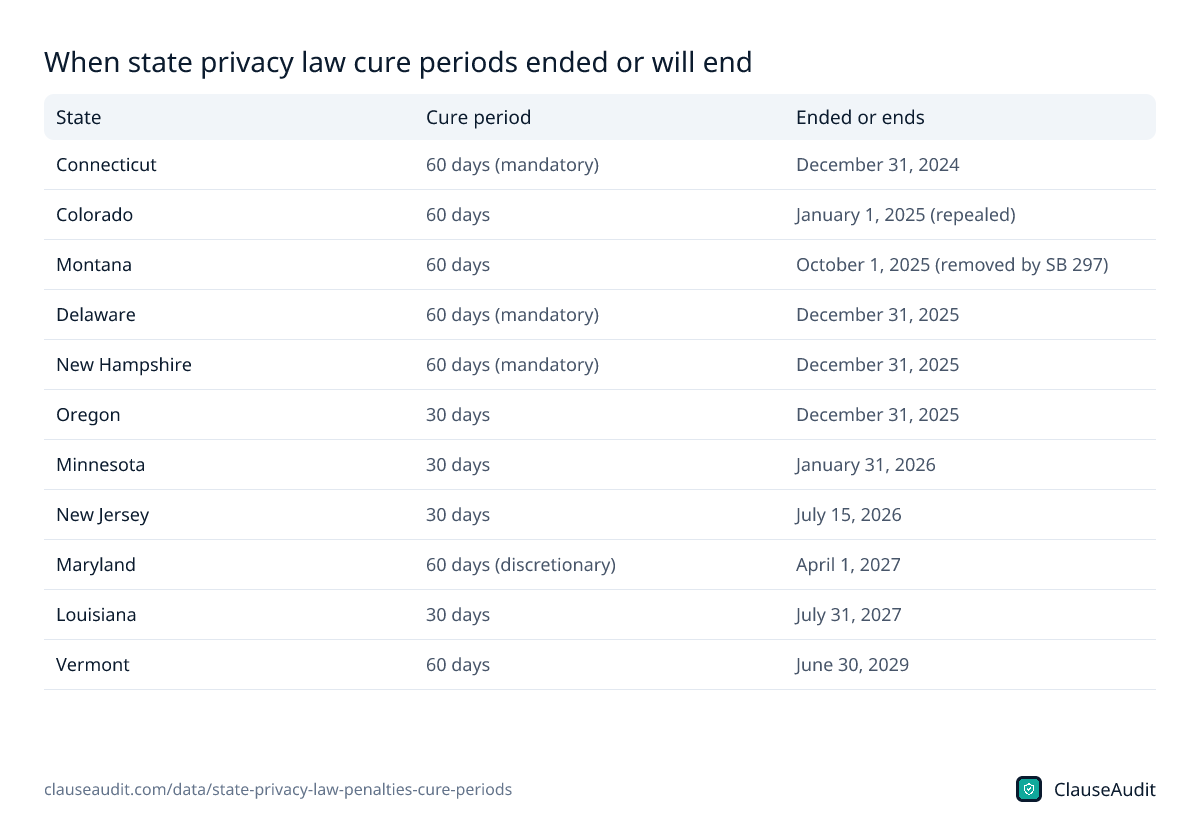
When state privacy law cure periods ended or will end
| State | Cure period | Ended or ends |
|---|---|---|
| Connecticut | 60 days (mandatory) | December 31, 2024 |
| Colorado | 60 days | January 1, 2025 (repealed) |
| Montana | 60 days | October 1, 2025 (removed by SB 297) |
| Delaware | 60 days (mandatory) | December 31, 2025 |
| New Hampshire | 60 days (mandatory) | December 31, 2025 |
| Oregon | 30 days | December 31, 2025 |
| Minnesota | 30 days | January 31, 2026 |
| New Jersey | 30 days | July 15, 2026 |
| Maryland | 60 days (discretionary) | April 1, 2027 |
| Louisiana | 30 days | July 31, 2027 |
| Vermont | 60 days | June 30, 2029 |
Source: Baker Donelson, Consumer Data Privacy Law Guide: Connecticut; Colorado Revised Statutes via Public.Law, C.R.S. § 6-1-1311 (Colorado Privacy Act, enforcement); Hunton Andrews Kurth (Privacy & Cybersecurity Law Blog), Montana Amends Consumer Data Privacy Act; Baker Donelson, Consumer Data Privacy Law Guide: Montana; Delaware Code Online, 6 Del. C. § 12D-111 (Delaware Personal Data Privacy Act, enforcement); Sidley Austin (Data Matters), New Hampshire's Comprehensive Data Privacy Legislation; Baker Donelson, Consumer Data Privacy Law Guide: Oregon; Minnesota Office of the Revisor of Statutes, Minn. Stat. § 325M.20 (Attorney general enforcement); Baker Donelson, Consumer Data Privacy Law Guide: New Jersey; Baker Donelson, Consumer Data Privacy Law Guide: Maryland; Troutman Pepper Locke (Troutman Privacy), Louisiana Enacts Consumer Data Privacy Law; Mayer Brown, Vermont Enacts Comprehensive Consumer Privacy Law. Download as image
Privacy law cure-period status (October 2026) by state
- 2No cure right (enforcement can start at once)
- 8Cure period expired or removed; cure now discretionary or unavailable
- 3Temporary cure period still in force or not yet started
- 10Permanent mandatory cure period
- 1Narrow law covering only very large companies
- 27No comprehensive consumer privacy law
- No cure right (enforcement can start at once)2
- Cure period expired or removed; cure now discretionary or unavailable8
- Temporary cure period still in force or not yet started3
- Permanent mandatory cure period10
- Narrow law covering only very large companies1
- No comprehensive consumer privacy law27
| State | Law | Max civil penalty | Cure period | Cure status | Source |
|---|---|---|---|---|---|
| Alabama | Alabama Personal Data Protection Act (HB 351) | Up to $15,000 per violation | 45 days | Does not sunset; law takes effect May 1, 2027 | Ala. HB 351 (2026) |
| Alaska | No comprehensive consumer privacy law identified | n/a | n/a | n/a | None identified |
| Arizona | No comprehensive consumer privacy law identified | n/a | n/a | n/a | None identified |
| Arkansas | No comprehensive consumer privacy law identified | n/a | n/a | n/a | None identified |
| California | California Consumer Privacy Act (as amended by CPRA) | $2,663 per violation; $7,988 per intentional violation or violation involving under-16 data | None in statute; cure is at the CPPA's discretion | Fully enforceable; no cure right | Cal. Civ. Code §§ 1798.155(a), 1798.199.90(a) |
| Colorado | Colorado Privacy Act | Up to $20,000 per violation ($50,000 if the victim is elderly), via the Colorado Consumer Protection Act | 60 days (repealed) | Cure provision repealed effective January 1, 2025 | C.R.S. §§ 6-1-1311, 6-1-112(1)(a) |
| Connecticut | Connecticut Data Privacy Act | Up to $5,000 per violation under the Connecticut Unfair Trade Practices Act | Mandatory 60-day cure ended December 31, 2024 | Since January 1, 2025 the attorney general may grant a cure at its discretion | Connecticut Data Privacy Act; Connecticut Unfair Trade Practices Act |
| Delaware | Delaware Personal Data Privacy Act | Up to $10,000 per violation (consumer fraud law) | Mandatory 60-day cure ran January 1 to December 31, 2025 | From January 1, 2026 the Department of Justice may grant a cure at its discretion | 6 Del. C. § 12D-111 |
| District of Columbia | No comprehensive consumer privacy law identified | n/a | n/a | n/a | None identified |
| Florida | Florida Digital Bill of Rights | Up to $50,000 per violation; may be tripled in some cases | Up to 45 days, at the state's discretion | Applies only to controllers with over $1 billion in global gross annual revenue that also meet another test | Fla. Stat. §§ 501.72, 501.702 |
| Georgia | No comprehensive consumer privacy law identified | n/a | n/a | n/a | None identified |
| Hawaii | No comprehensive consumer privacy law identified | n/a | n/a | n/a | None identified |
| Idaho | No comprehensive consumer privacy law identified | n/a | n/a | n/a | None identified |
| Illinois | No comprehensive consumer privacy law identified | n/a | n/a | n/a | None identified |
| Indiana | Indiana Consumer Data Protection Act | Up to $7,500 per violation | 30 days | Permanent | Indiana Consumer Data Protection Act |
| Iowa | Iowa consumer data protection law | Up to $7,500 per violation | 90 days | Permanent | Iowa Code § 715D.8 |
| Kansas | No comprehensive consumer privacy law identified | n/a | n/a | n/a | None identified |
| Kentucky | Kentucky Consumer Data Protection Act | Up to $7,500 for each continued violation | 30 days | Permanent | KRS 367.3627 |
| Louisiana | Louisiana consumer data privacy law (signed 2026) | Up to $5,000 per violation | 30 days | Cure available only January 1 to July 31, 2027; law takes effect January 1, 2027 | Louisiana consumer data privacy law (2026) |
| Maine | No comprehensive consumer privacy law identified | n/a | n/a | n/a | None identified |
| Maryland | Maryland Online Data Privacy Act | Up to $10,000 per violation; up to $25,000 for each subsequent violation | 60-day cure period at the attorney general's discretion | Cure may sunset after April 1, 2027 | Maryland Online Data Privacy Act |
| Massachusetts | No comprehensive consumer privacy law identified | n/a | n/a | n/a | None identified |
| Michigan | No comprehensive consumer privacy law identified | n/a | n/a | n/a | None identified |
| Minnesota | Minnesota Consumer Data Privacy Act | Up to $7,500 per violation | 30-day warning letter and cure (expired) | Cure provision expired January 31, 2026 | Minn. Stat. § 325M.20 |
| Mississippi | No comprehensive consumer privacy law identified | n/a | n/a | n/a | None identified |
| Missouri | No comprehensive consumer privacy law identified | n/a | n/a | n/a | None identified |
| Montana | Montana Consumer Data Privacy Act | Up to $7,500 per violation | 60-day cure removed by SB 297 | No cure period effective October 1, 2025 | MCA 30-14-2820 |
| Nebraska | Nebraska Data Privacy Act | Up to $7,500 per violation | 30 days | Permanent | Nebraska Data Privacy Act |
| Nevada | No comprehensive consumer privacy law identified | n/a | n/a | n/a | None identified |
| New Hampshire | New Hampshire comprehensive privacy law (RSA 507-H) | Up to $10,000 per violation | Mandatory 60-day cure ran January 1 to December 31, 2025 | From January 1, 2026 the attorney general may offer a cure at its discretion | RSA 507-H |
| New Jersey | New Jersey Data Privacy Act | Up to $10,000 for a first violation; up to $20,000 for subsequent violations | 30-day cure available until July 15, 2026 (18 months after the January 15, 2025 effective date) | Cure period has ended | New Jersey Data Privacy Act |
| New Mexico | No comprehensive consumer privacy law identified | n/a | n/a | n/a | None identified |
| New York | No comprehensive consumer privacy law identified | n/a | n/a | n/a | None identified |
| North Carolina | No comprehensive consumer privacy law identified | n/a | n/a | n/a | None identified |
| North Dakota | No comprehensive consumer privacy law identified | n/a | n/a | n/a | None identified |
| Ohio | No comprehensive consumer privacy law identified | n/a | n/a | n/a | None identified |
| Oklahoma | Oklahoma consumer data privacy law (SB 546) | Up to $7,500 per violation | 30 days | No sunset identified; law takes effect January 1, 2027 | Okla. SB 546 (2026) |
| Oregon | Oregon Consumer Privacy Act | Up to $7,500 per violation | 30 days (ended) | No cure period after December 31, 2025 | ORS 646A.589 |
| Pennsylvania | No comprehensive consumer privacy law identified | n/a | n/a | n/a | None identified |
| Rhode Island | Rhode Island Data Transparency and Privacy Protection Act | Up to $10,000 per violation | None | Fully enforceable; no cure period | Rhode Island Data Transparency and Privacy Protection Act |
| South Carolina | No comprehensive consumer privacy law identified | n/a | n/a | n/a | None identified |
| South Dakota | No comprehensive consumer privacy law identified | n/a | n/a | n/a | None identified |
| Tennessee | Tennessee Information Protection Act | Up to $7,500 per violation; court may award treble damages for willful or knowing violations | 60 days | Permanent | Tennessee Information Protection Act |
| Texas | Texas Data Privacy and Security Act | Up to $7,500 per violation | 30 days | Permanent | Tex. Bus. & Com. Code §§ 541.154, 541.155 |
| Utah | Utah Consumer Privacy Act | Up to $7,500 per violation | 30 days | Permanent | Utah Code § 13-61-402 |
| Vermont | Vermont Data Privacy and Online Surveillance Act (S.71) | Up to $10,000 per violation under the Vermont Consumer Protection Act | 60 days | Cure applies January 1, 2028 through June 30, 2029, then becomes discretionary; law takes effect January 1, 2028 | Vermont S.71 (2026) |
| Virginia | Virginia Consumer Data Protection Act | Up to $7,500 per violation | 30 days | Permanent | Va. Code § 59.1-584 |
| Washington | No comprehensive consumer privacy law identified | n/a | n/a | n/a | None identified |
| West Virginia | No comprehensive consumer privacy law identified | n/a | n/a | n/a | None identified |
| Wisconsin | No comprehensive consumer privacy law identified | n/a | n/a | n/a | None identified |
| Wyoming | No comprehensive consumer privacy law identified | n/a | n/a | n/a | None identified |
How much can a state fine a business for a privacy violation?
Twelve of the 23 state laws stop at $7,500 per violation, so that is the figure to keep in mind when a client asks what a privacy mistake could cost. That group includes Virginia, Texas, Utah, Oregon and Minnesota. A second cluster sits at $10,000, among them Rhode Island, Delaware and New Hampshire. Colorado tops the list at $20,000, and that rises to $50,000 when the victim is elderly.
California works differently. The base amount is $2,663, but an intentional violation, or one involving data from a consumer under 16, costs up to $7,988. Those figures are adjusted for inflation every odd-numbered year, so they will move again.
Florida's Digital Bill of Rights allows $50,000 per violation and sometimes triple that, but it only reaches companies with more than $1 billion in global revenue. If you run a small agency, Florida's big number is not your problem. Your exposure comes from the ordinary state laws, and from the contracts that pass their costs to you.
How do states count a privacy violation?
The statutes rarely say. That silence favors the state. A regulator may try to count each consumer whose data was sold without a working opt-out, each deletion request that went unanswered, or each day a broken privacy notice stayed live. Kentucky's law, for example, speaks of a penalty for each continued violation.
So the cap tells you less than it seems. A $7,500 maximum applied to a single complaint is a nuisance. The same cap applied to every record in a marketing database can threaten a small company. Settlements usually land well below the theoretical maximum, but the maximum is what the state brings to the negotiating table.
Tennessee adds another lever: a court can award treble damages for willful or knowing violations. Maryland raises its cap to $25,000 for each repeat violation, and New Jersey goes to $20,000 for repeat offenses. Repeat problems cost more almost everywhere.
What is a cure period, and which states still have one?
A cure period is a grace window. Before suing, the attorney general sends notice of the violation and gives you a set number of days to fix it and confirm in writing. Fix it in time and, in most of these states, the case goes no further.
Iowa gives the most room at 90 days, and that right does not expire. Tennessee gives 60. Virginia, Texas, Utah, Indiana, Kentucky and Nebraska give 30. Alabama's new law will give 45 days once it takes effect on May 1, 2027.
California and Rhode Island give no statutory cure at all. In California, whether you get a chance to fix things is up to the regulator.
Which states ended their cure periods, and what comes next?
Connecticut's mandatory 60-day cure ended on December 31, 2024. Colorado repealed its cure as of January 1, 2025. Montana removed its cure through SB 297, effective October 1, 2025. Oregon, Delaware and New Hampshire closed theirs at the end of 2025, Minnesota followed on January 31, 2026, and New Jersey's 30-day cure ran out on July 15, 2026.
In some of those states the attorney general can still offer a cure as a courtesy. That is not the same thing as a right. A business that built its compliance plan around getting a warning letter first needs a new plan, because in these states the first letter you get may be the complaint.
Vermont shows where this is heading. Its new law takes effect January 1, 2028, offers a 60-day cure only until June 30, 2029, and then leaves it to the state's discretion.
Four states passed laws in 2026, and none of them is enforceable yet. Oklahoma's takes effect January 1, 2027, with a $7,500 cap and a 30-day cure. Louisiana's law starts the same day, but its 30-day cure lasts only until July 31, 2027. Alabama follows on May 1, 2027, with the highest penalty of the new group at $15,000 per violation and a 45-day cure that does not sunset. Vermont starts January 1, 2028, with a $10,000 cap.
If you sell into these states, use the lead time. Update privacy notices, test opt-out links and fix vendor contracts before the effective date, not after the first warning letter.
What this means if you are not a big tech company
Most small firms never meet a state privacy law's threshold on their own. They still feel these penalties, through contracts. A larger client that is covered will push its obligations down to you with a data processing addendum, an indemnity clause and audit rights. If the client is fined in Colorado because your systems leaked its customer data, the indemnity decides who pays.
Software buyers face the reverse risk. Your SaaS vendor processes your customers' data. As the controller, you still answer to regulators for how that data is handled. A vendor contract that caps liability at a single month of fees leaves you holding almost all of a per-violation penalty.
Freelancers sit in the middle. A developer or marketer with database access can be named as a processor, and a broad indemnity in a client contract can make you answer for fines you had no power to prevent.
What to do now
- List the states where your customers live, not just where you are based. The penalty and cure rules follow the consumer.
- Assume no warning letter. Plan as if the state can sue the day it finds a problem, since most of the expired-cure states now allow exactly that.
- Read every data processing addendum you sign for who pays regulatory fines, and whether that cost sits inside or outside the liability cap.
- Ask vendors for a breach notice deadline in days, not a promise to notify promptly. A cure window is useless if you learn about the problem after it closes.
- Keep records of opt-out and deletion requests and how fast you answered them. Missed requests are among the easiest violations for a regulator to count.
How ClauseAudit helps
State fines land on whoever controls the data, but contracts decide who ends up paying. Upload a SaaS agreement, vendor contract or data processing addendum and the automated review flags the clauses that move privacy risk between the parties.
You get each risky clause in plain English, why it matters under state privacy law, and wording to ask for instead.
- Liability caps that exclude, or quietly include, regulatory fines and data breach costs
- Indemnity clauses that make you pay for a vendor's or client's privacy violation
- Breach notification deadlines, or the lack of one
- Data use rights that let a vendor sell or share your customers' data
- Data deletion and return obligations when the contract ends
- Audit and cooperation duties if a state attorney general opens an inquiry
Frequently asked questions
What is the most common privacy fine per violation?
$7,500. Twelve of the 23 state consumer privacy laws use that cap, including Virginia, Texas, Oregon, Minnesota and Kentucky. It is a maximum, not a set fee, and it applies per violation, so the total depends on how many violations the state counts.
Which state has the highest privacy penalty?
Among the 23 state consumer privacy laws, Colorado, at up to $20,000 per violation, or $50,000 when the victim is elderly. Florida's Digital Bill of Rights allows $50,000 per violation, but it only covers companies with more than $1 billion in global revenue, so most businesses never fall under it.
How much is a CCPA fine?
Up to $2,663 per violation, or $7,988 for an intentional violation or one involving data from a consumer under 16. These amounts took effect January 1, 2025, and California adjusts them for inflation every odd-numbered year. There is no statutory right to cure.
Which state has the longest cure period?
Iowa, with 90 days, and the right does not expire. Tennessee follows with 60 days. Most other states that still offer a cure give 30 days, including Virginia, Texas, Utah, Indiana, Kentucky and Nebraska. Alabama will give 45 days once its law takes effect on May 1, 2027.
Did Texas get rid of its cure period?
No. The Texas Data Privacy and Security Act still gives a 30-day cure period, and it is permanent. The attorney general must give notice and time to fix the problem before suing. The maximum penalty is $7,500 per violation, the most common cap, also used by Virginia, Utah and nine other states.
Does a cure period mean I will never be fined?
Not quite. It means you get notice and a fixed number of days to correct the violation and confirm that in writing. If you miss the deadline, or the same problem returns, the state can sue. In states where the cure has expired, you may get no notice at all.
Do these laws apply to a small business?
Usually only if you pass the state's threshold, which in most states depends on how many consumers' data you handle or how much revenue you earn from selling data. Small firms are more often exposed through contracts, where a covered client or vendor shifts fines to them through indemnity clauses.
Can a contract make me pay someone else's privacy fine?
Yes. An indemnity clause can require you to cover a client's losses, including regulatory penalties, caused by your breach. Check whether fines are named, whether your share is capped, and whether the duty applies only when you were at fault.
Use this data
Every chart and card below is free to reuse under CC BY 4.0. Download what you need and link back to this page.
 Stat cards
 Key findings card
 Infographic
 Base maximum civil penalty per violation under state comprehensive privacy laws (USD per violation)
 Length of cure period in states where a cure right still applies or is scheduled (days)
 States with comprehensive privacy laws by cure-period status, October 2026
 The four state privacy laws enacted in 2026: penalties and cure periods
 When state privacy law cure periods ended or will end
Embed the infographic
Free to share on your site, blog or slides under CC BY 4.0. Please keep the credit link.
Sources and method
Every number on this page comes from the sources below, each opened and read on or before October 18, 2026. A second, independent review checked every figure against its source and corrected anything that did not match. 51 of 51 state entries were confirmed; any that could not be are marked "Not yet confirmed" and left out of every count and chart.
- IAPP, Vermont becomes 23rd state to enact consumer privacy law (17 June 2026)
- Hunton Andrews Kurth (Privacy & Cybersecurity Law Blog), Vermont Becomes 23rd State with Comprehensive Consumer Privacy Law (June 17, 2026)
- Morgan Lewis, New US State Consumer Privacy Laws: What Businesses Should Know (July 28, 2026)
- California Privacy Protection Agency, Updated Monetary Thresholds in CCPA (Posted 12/17/2024; effective 1/1/2025)
- Virginia General Assembly, Legislative Information System, Code of Virginia § 59.1-584 (Virginia Consumer Data Protection Act, enforcement) (Current Code of Virginia (accessed October 2026))
- Colorado Revised Statutes via Public.Law, C.R.S. § 6-1-1311 (Colorado Privacy Act, enforcement) (Current C.R.S. (accessed October 2026))
- Colorado Revised Statutes via Public.Law, C.R.S. § 6-1-112 (Colorado Consumer Protection Act, civil penalties) (Current C.R.S. (accessed October 2026))
- Iowa Legislature, Iowa Code § 715D.8 (Enforcement, penalties) (Iowa Code 2026)
- Texas statutes via Public.Law, Tex. Bus. & Com. Code § 541.154 (Notice of violation; opportunity to cure) (Current code (accessed October 2026))
- Texas statutes via Public.Law, Tex. Bus. & Com. Code § 541.155 (Civil penalty; injunction) (Current code (accessed October 2026))
- Oregon Revised Statutes via Public.Law, ORS 646A.589 (Oregon Consumer Privacy Act, enforcement) (Current through early 2026, text operative January 1, 2026)
- Delaware Code Online, 6 Del. C. § 12D-111 (Delaware Personal Data Privacy Act, enforcement) (Current Delaware Code (accessed October 2026))
- Minnesota Office of the Revisor of Statutes, Minn. Stat. § 325M.20 (Attorney general enforcement) (2025 Minnesota Statutes)
- Kentucky General Assembly, KRS 367.3627 (Enforcement authority of Attorney General) (Effective January 1, 2026)
- Montana Legislature, MCA 30-14-2820 (Montana Consumer Data Privacy Act, civil penalty) (Montana Code Annotated 2025)
- Hunton Andrews Kurth (Privacy & Cybersecurity Law Blog), Montana Amends Consumer Data Privacy Act (May 1, 2025)
- The Florida Senate, Fla. Stat. § 501.72 (Florida Digital Bill of Rights, enforcement) (2026 Florida Statutes)
- The Florida Senate, Fla. Stat. § 501.702 (Definitions, "controller") (2026 Florida Statutes)
- Connecticut Office of the Attorney General, The Connecticut Data Privacy Act (Undated web page (accessed October 2026))
- Sidley Austin (Data Matters), New Hampshire's Comprehensive Data Privacy Legislation (March 25, 2024)
- Davis Wright Tremaine, Nebraska Data Privacy Act Signed Into Law (June 13, 2024)
- Constangy, Brooks, Smith & Prophete, Tennessee becomes 8th state to enact comprehensive privacy law (May 22, 2023)
- Troutman Pepper Locke (Troutman Privacy), Oklahoma Enacts Consumer Data Privacy Law (March 23, 2026)
- Troutman Pepper Locke (Troutman Privacy), Alabama Enacts Consumer Data Privacy Law (April 16, 2026)
- Troutman Pepper Locke (Troutman Privacy), Louisiana Enacts Consumer Data Privacy Law (June 3, 2026)
- Jackson Lewis P.C. (Workplace Privacy Report), Consumer Privacy Protections Come to the Heart of Dixie (May 19, 2026)
- Mayer Brown, Vermont Enacts Comprehensive Consumer Privacy Law (June 22, 2026)
- Baker Donelson, Consumer Data Privacy Law Guide: California (Last updated December 2025)
- Baker Donelson, Consumer Data Privacy Law Guide: Connecticut (Last updated December 2025)
- Baker Donelson, Consumer Data Privacy Law Guide: Utah (Last updated December 2025)
- Baker Donelson, Consumer Data Privacy Law Guide: Indiana (Last updated May 2025)
- Baker Donelson, Consumer Data Privacy Law Guide: Tennessee (Last updated May 2025)
- Baker Donelson, Consumer Data Privacy Law Guide: Oregon (Last updated December 2025)
- Baker Donelson, Consumer Data Privacy Law Guide: Delaware (Last updated May 2025)
- Baker Donelson, Consumer Data Privacy Law Guide: New Hampshire (Last updated May 2025)
- Baker Donelson, Consumer Data Privacy Law Guide: New Jersey (Last updated May 2025)
- Baker Donelson, Consumer Data Privacy Law Guide: Maryland (Last updated May 2025)
- Baker Donelson, Consumer Data Privacy Law Guide: Rhode Island (Last updated May 2025)
- Baker Donelson, Consumer Data Privacy Law Guide: Montana (Last updated December 2025)
- Baker Donelson, Consumer Data Privacy Law Guide: Oklahoma (Last updated August 2026)
- Baker Donelson, Consumer Data Privacy Law Guide: Alabama (Last updated August 2026)
- Baker Donelson, Consumer Data Privacy Law Guide: Louisiana (Last updated August 2026)
- Baker Donelson, Consumer Data Privacy Law Guide: Vermont (Last updated August 2026)
- Baker Donelson, Consumer Data Privacy Law Guide: Colorado (Last updated December 2025)
Cite this page
ClauseAudit, “State Privacy Law Penalties and Cure Periods by State”, updated October 18, 2026, https://clauseaudit.com/data/state-privacy-law-penalties-cure-periods. Free to reuse with a link back (CC BY 4.0).
This page summarises published data and law as checked on October 18, 2026. Figures are updated as new editions are released, and your own situation may differ. It is general information, not legal, tax or financial advice.