SaaS Sales Tax by State (2026, With 2027 California and Colorado Changes)
By ClauseAudit Research · 59 sources ·
Which states charge sales tax on SaaS?
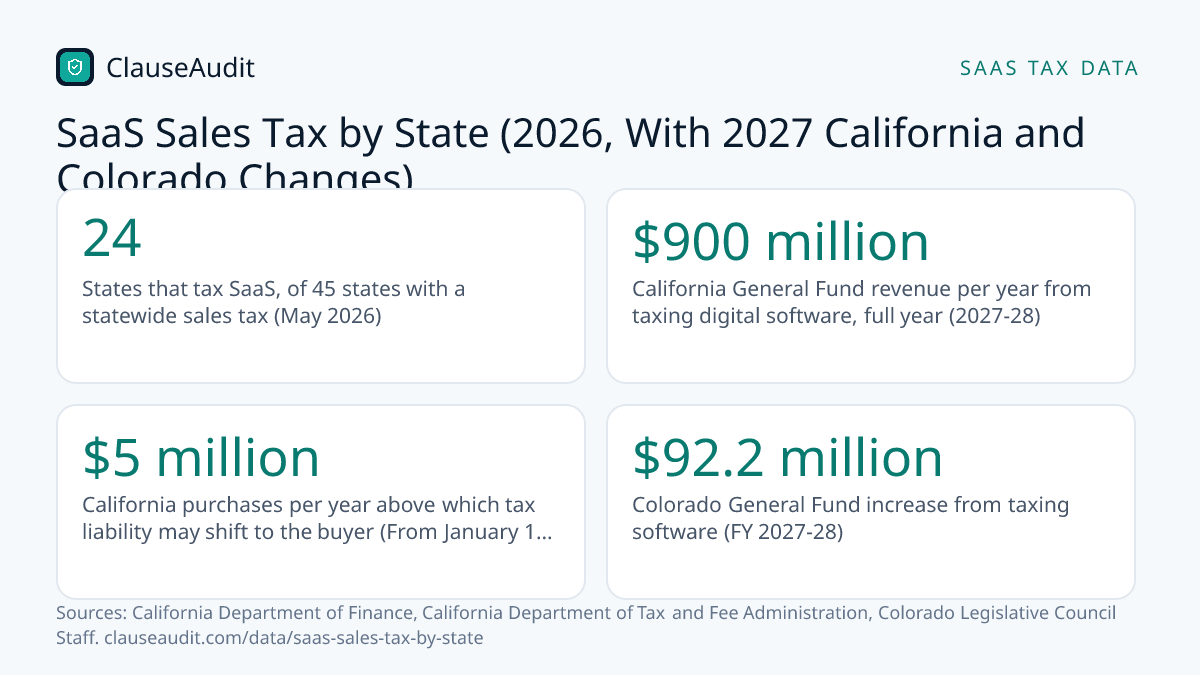
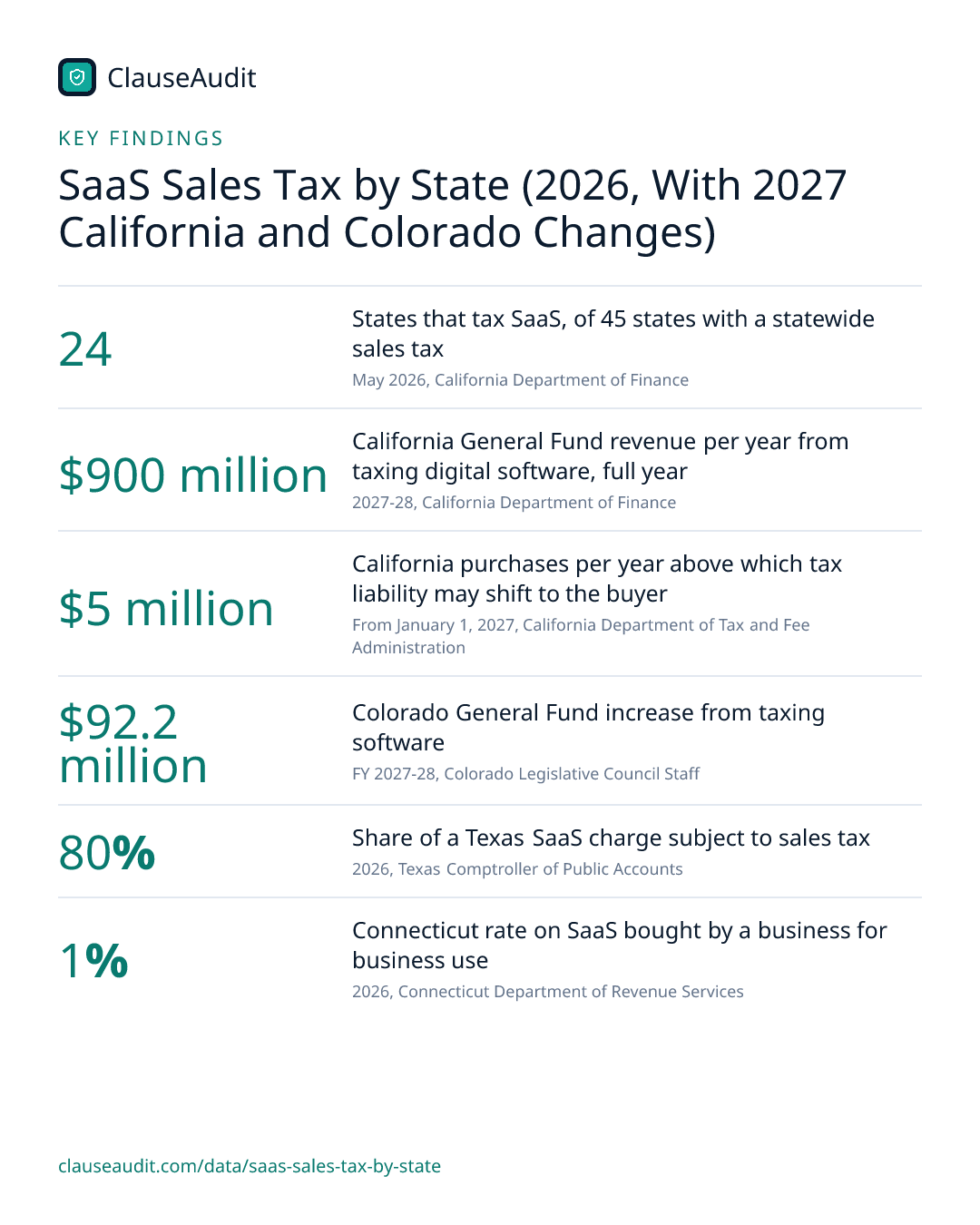
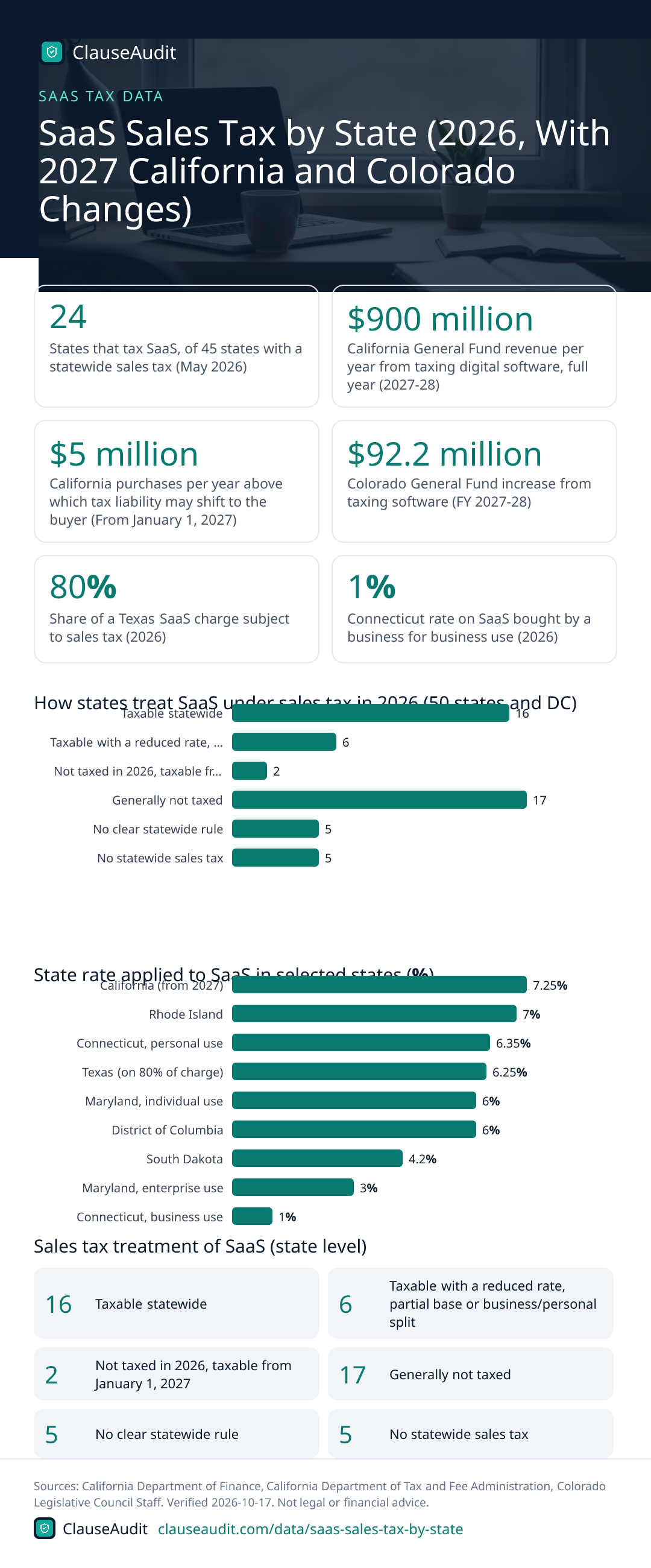
Just over half of sales tax states tax SaaS. A May 2026 California Department of Finance count found 24 of the 45 states with a statewide sales tax apply it to SaaS. The details vary: Texas taxes 80% of the charge, Connecticut charges 1% for business use, and California and Colorado start taxing SaaS on January 1, 2027.

- States that tax SaaS, of 45 states with a statewide sales tax (May 2026, California Department of Finance)
- 24
- California General Fund revenue per year from taxing digital software, full year (2027-28, California Department of Finance)
- $900 million
- California purchases per year above which tax liability may shift to the buyer (From January 1, 2027, California Department of Tax and Fee Administration)
- $5 million
- Colorado General Fund increase from taxing software (FY 2027-28, Colorado Legislative Council Staff)
- $92.2 million
- Share of a Texas SaaS charge subject to sales tax (2026, Texas Comptroller of Public Accounts)
- 80%
- Connecticut rate on SaaS bought by a business for business use (2026, Connecticut Department of Revenue Services)
- 1%
- Maryland rate on SaaS used in an enterprise computer system (Since July 1, 2025, Comptroller of Maryland)
- 3%
Sales tax on software subscriptions is a patchwork. The same project management tool can be fully taxable in Washington, taxed on part of the bill in Texas, taxed at a business discount in Connecticut, and generally not taxed in Florida. What decides it is usually where your users sit, not where the vendor is based.
The map is about to shift. California and Colorado both signed laws in June 2026 that make SaaS taxable from January 1, 2027. If you buy or sell software in either state, your 2027 invoices will look different, and the contract you sign this year decides how that tax shows up on the bill.
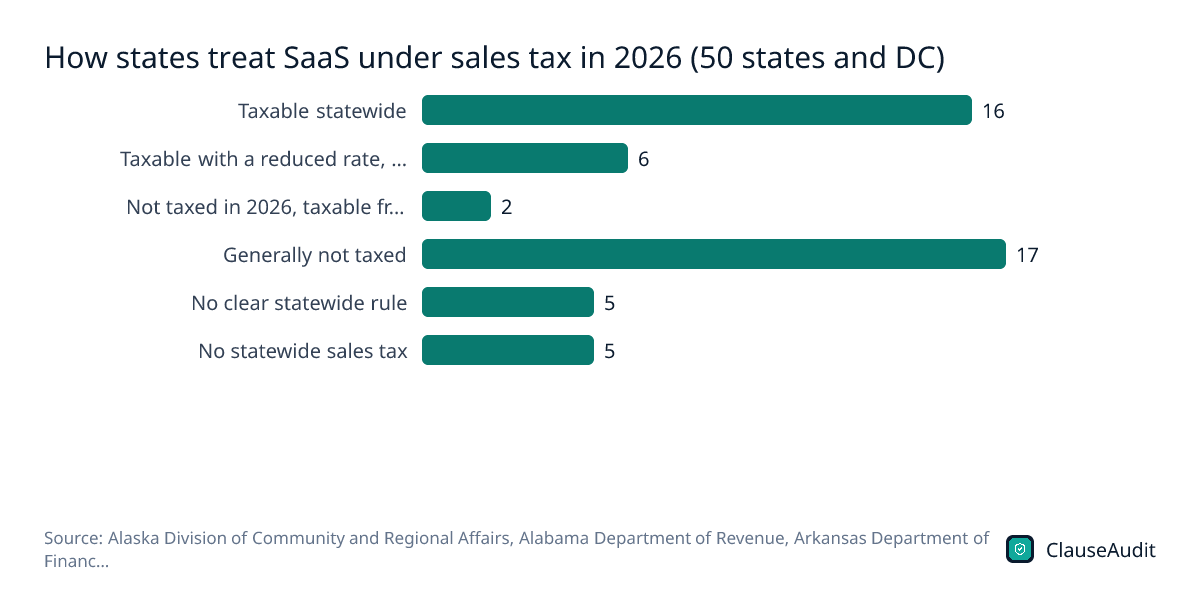
How states treat SaaS under sales tax in 2026 (50 states and DC)
Chart data
| Label | Value |
|---|---|
| Taxable statewide | 16 |
| Taxable with a reduced rate, partial base or business/personal split | 6 |
| Not taxed in 2026, taxable from January 1, 2027 | 2 |
| Generally not taxed | 17 |
| No clear statewide rule | 5 |
| No statewide sales tax | 5 |
Only 15 states and DC tax SaaS in a clean, statewide way. Another 6 states tax it with a twist, like a lower business rate or a partial base, so read the state row before assuming a flat answer.
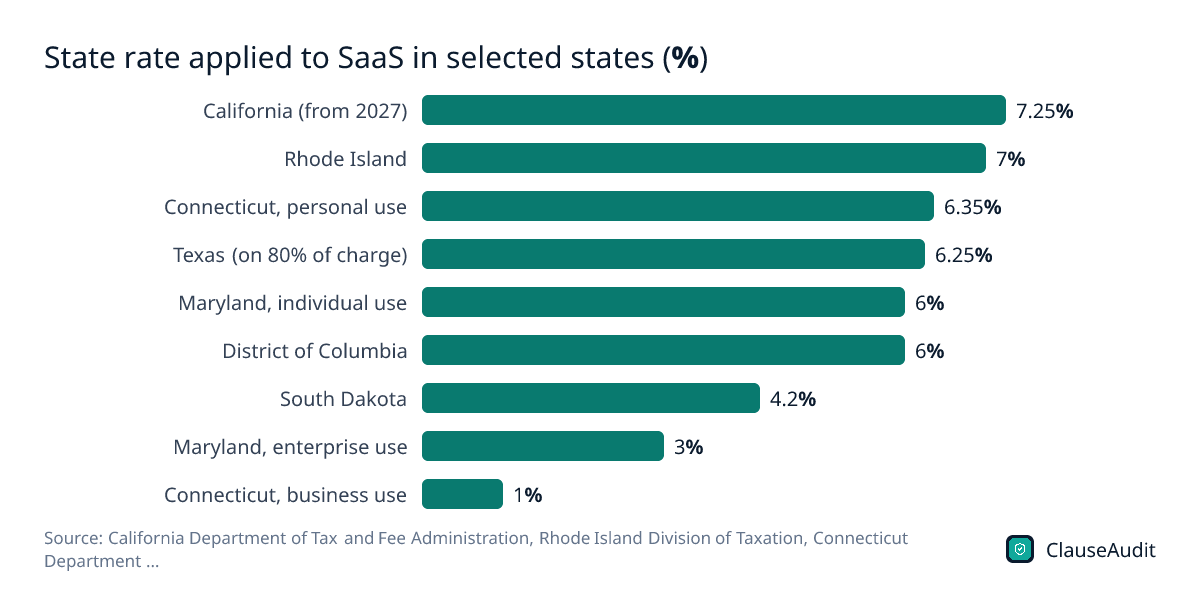
Download this chart (PNG)State rate applied to SaaS in selected states (%)
Chart data
| Label | Value |
|---|---|
| California (from 2027) | 7.25% |
| Rhode Island | 7% |
| Connecticut, personal use | 6.35% |
| Texas (on 80% of charge) | 6.25% |
| Maryland, individual use | 6% |
| District of Columbia | 6% |
| South Dakota | 4.2% |
| Maryland, enterprise use | 3% |
| Connecticut, business use | 1% |
These are state rates only, so your real bill can run higher once local and district taxes are added. The spread between Connecticut business use at 1% and personal use at 6.35% shows how much the buyer's purpose matters.
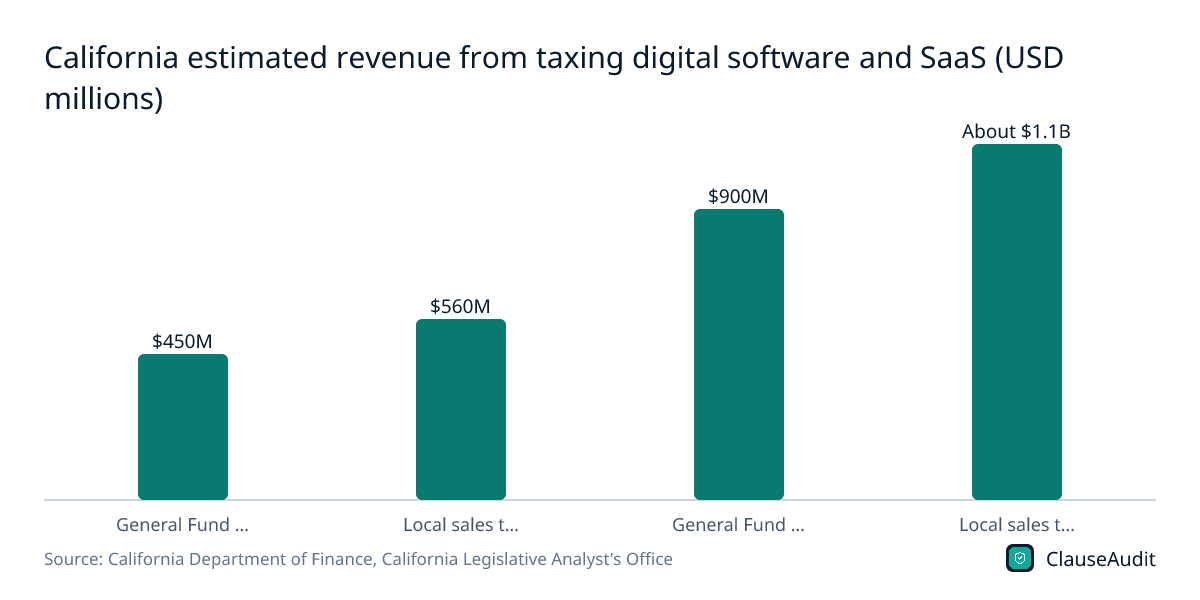
Download this chart (PNG)California estimated revenue from taxing digital software and SaaS (USD millions)
Chart data
| Label | Value (USD millions) |
|---|---|
| General Fund 2026-27 (half year) | $450M |
| Local sales tax 2026-27 (half year) | $560M |
| General Fund 2027-28 | $900M |
| Local sales tax 2027-28 | About $1.1B |
California expects about $900 million for its General Fund in 2027-28, the first full year, plus about $1.1 billion in local sales tax. Those are May Revision estimates made before SB 122 was final, and the LAO said the real figure could be hundreds of millions higher or lower.
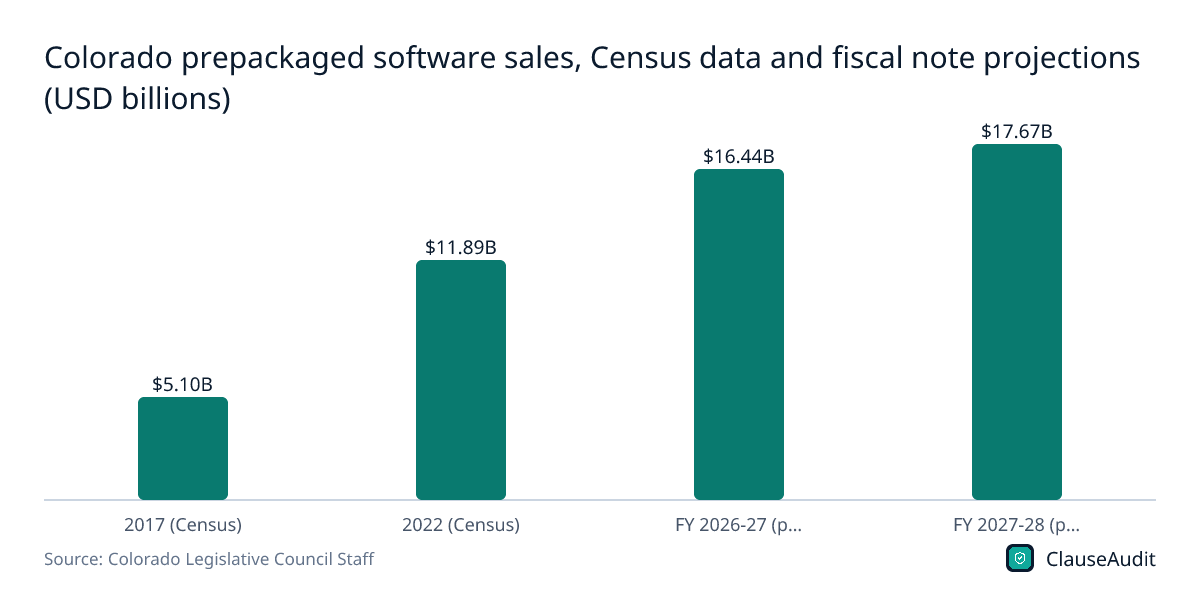
Download this chart (PNG)Colorado prepackaged software sales, Census data and fiscal note projections (USD billions)
Chart data
| Label | Value (USD billions) |
|---|---|
| 2017 (Census) | $5.10B |
| 2022 (Census) | $11.89B |
| FY 2026-27 (projected) | $16.44B |
| FY 2027-28 (projected) | $17.67B |
Colorado's fiscal note projects software sales of $16.44 billion in FY 2026-27, and for its revenue estimate it assumes only 20% of downloadable software sales become taxable. The note itself warns the numbers are highly uncertain.
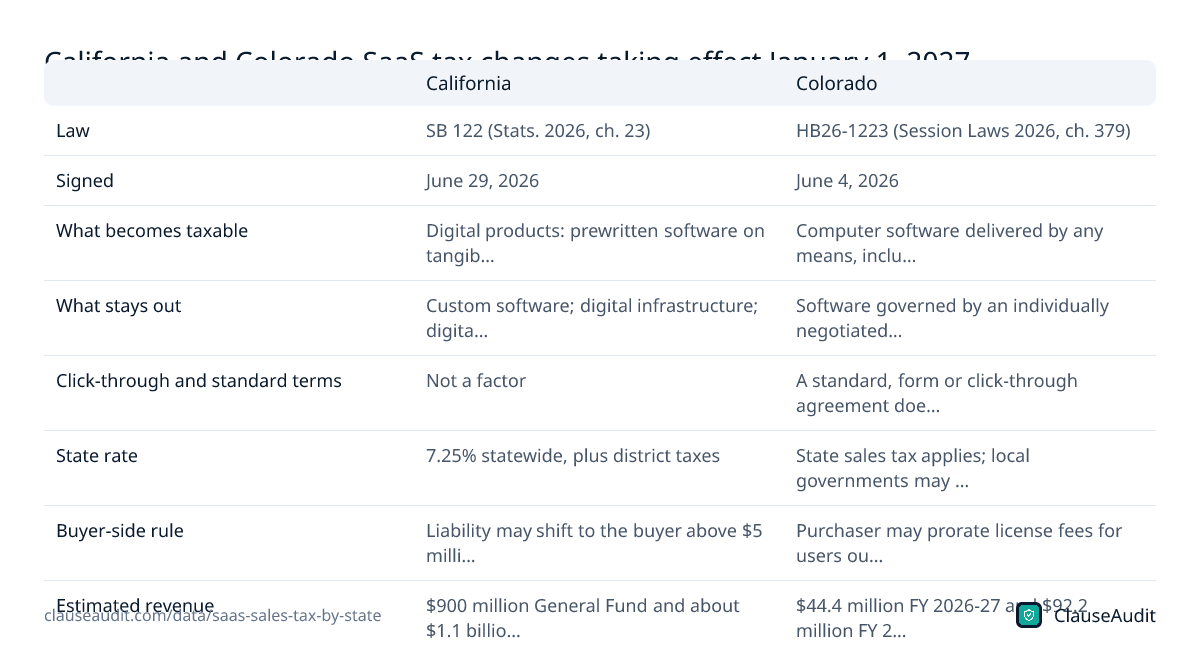
Download this chart (PNG)California and Colorado SaaS tax changes taking effect January 1, 2027
| California | Colorado | |
|---|---|---|
| Law | SB 122 (Stats. 2026, ch. 23) | HB26-1223 (Session Laws 2026, ch. 379) |
| Signed | June 29, 2026 | June 4, 2026 |
| What becomes taxable | Digital products: prewritten software on tangible media, transferred electronically or accessed remotely, including SaaS | Computer software delivered by any means, including download or remote access through the internet, and mobile apps |
| What stays out | Custom software; digital infrastructure; digital audio, video, books, games and visual works; products with reproduction and distribution rights; products bought solely for use outside California | Software governed by an individually negotiated license signed by both parties; software developed for a particular user |
| Click-through and standard terms | Not a factor | A standard, form or click-through agreement does not count as a negotiated license |
| State rate | 7.25% statewide, plus district taxes | State sales tax applies; local governments may adopt the change only by voter approval |
| Buyer-side rule | Liability may shift to the buyer above $5 million a year from one retailer | Purchaser may prorate license fees for users outside Colorado with a written statement |
| Estimated revenue | $900 million General Fund and about $1.1 billion local, full year (May Revision estimate) | $44.4 million FY 2026-27 and $92.2 million FY 2027-28 (General Fund) |
Source: California Department of Tax and Fee Administration, Special Notice L-1036: Sales and Use Tax Applies to Digital Products Beginning January 1, 2027; California Department of Tax and Fee Administration, California City and County Sales and Use Tax Rates; California Department of Finance, Governor's Budget May Revision 2026-27, Budget Summary; Colorado General Assembly, HB26-1223, Modifying Certain Tax Expenditures (Session Laws 2026, Chapter 379); Colorado Legislative Council Staff, HB 26-1223 Final Fiscal Note. Download as image
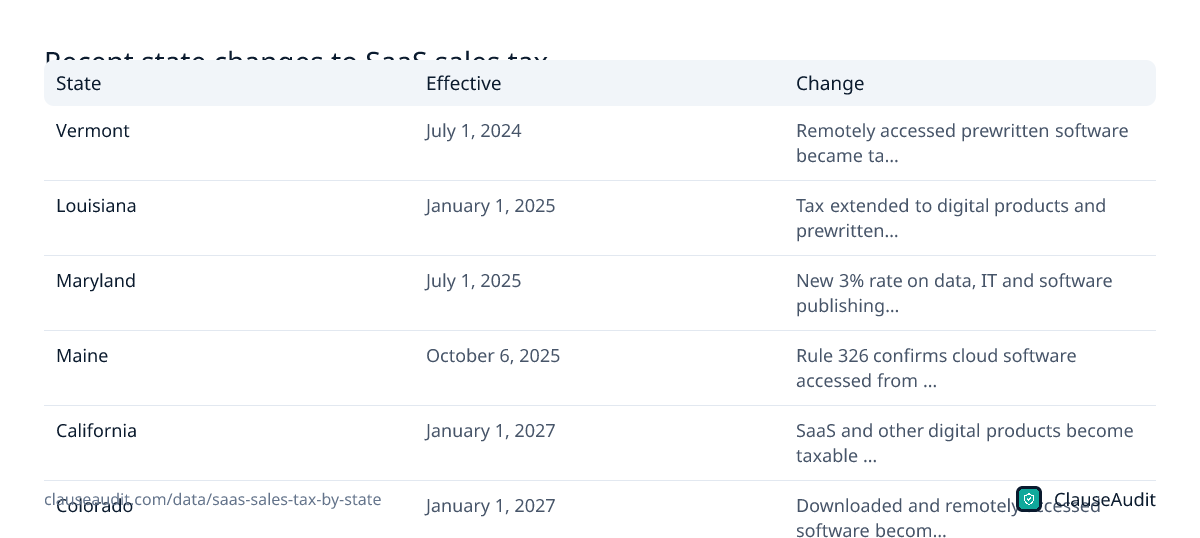
Recent state changes to SaaS sales tax
| State | Effective | Change |
|---|---|---|
| Vermont | July 1, 2024 | Remotely accessed prewritten software became taxable (Act 183 of 2024) |
| Louisiana | January 1, 2025 | Tax extended to digital products and prewritten computer software access services |
| Maryland | July 1, 2025 | New 3% rate on data, IT and software publishing services; SaaS for enterprise use taxed at 3%, individual use at 6% |
| Maine | October 6, 2025 | Rule 326 confirms cloud software accessed from an out-of-state server with nothing downloadable is not taxable |
| California | January 1, 2027 | SaaS and other digital products become taxable (SB 122) |
| Colorado | January 1, 2027 | Downloaded and remotely accessed software become taxable unless under a negotiated license or custom (HB26-1223) |
Source: Vermont Department of Taxes, Prewritten Computer Software; Louisiana Department of Revenue, Are digital products subject to sales and use tax? (Sales Tax Reform FAQ); Comptroller of Maryland, Technical Bulletin No. 56: Sales and Use Tax on Data or Information Technology Services and Software Publishing Services; Maine Revenue Services, Rule 326 (18-125 C.M.R. ch. 326), filing 2025-188; California Department of Tax and Fee Administration, Special Notice L-1036: Sales and Use Tax Applies to Digital Products Beginning January 1, 2027; Colorado General Assembly, HB26-1223, Modifying Certain Tax Expenditures (Session Laws 2026, Chapter 379). Download as image
Sales tax treatment of SaaS (state level) by state
- 16Taxable statewide
- 6Taxable with a reduced rate, partial base or business/personal split
- 2Not taxed in 2026, taxable from January 1, 2027
- 17Generally not taxed
- 5No clear statewide rule
- 5No statewide sales tax
- Taxable statewide16
- Taxable with a reduced rate, partial base or business/personal split6
- Not taxed in 2026, taxable from January 1, 20272
- Generally not taxed17
- No clear statewide rule5
- No statewide sales tax5
| State | SaaS in 2026 | Details | Source |
|---|---|---|---|
| Alabama | No published rule addresses hosted SaaS | Rule treats licensing of software as taxable "regardless of its function or form of transmission," but does not mention remote access | Ala. Admin. Code r. 810-6-1-.37 |
| Alaska | No statewide sales tax | About 110 of 162 local governments levy a sales tax; local rules decide what is taxable | Alaska Division of Community and Regional Affairs: Sales Tax (Local Government Resource Desk) |
| Arizona | Taxable (transaction privilege tax) | Court of Appeals upheld TPT on a subscription to hosted software as a rental of tangible personal property | A.R.S. 42-5071 |
| Arkansas | Generally not taxable | Software delivered electronically is not taxable; tax applies only when delivered on a tangible medium. The rule does not name SaaS | Ark. Gross Receipts Tax Rule GR-25 |
| California | Not taxable in 2026; taxable from January 1, 2027 | SB 122 adds digital products, including SaaS, to the tax base at the 7.25% statewide rate plus district taxes. Custom software and "digital infrastructure" stay out | SB 122 (Stats. 2026, ch. 23) |
| Colorado | State tax does not reach SaaS in 2026; taxable from January 1, 2027 | HB26-1223 taxes software delivered by download or remote access. Software under an individually negotiated, signed license, and custom software, stay exempt | C.R.S. 39-26-102(15)(c), 39-26-713(3), as amended by HB26-1223 |
| Connecticut | Taxable at a reduced rate for business use | 1% when bought by a business for business use; 6.35% when electronically accessed canned software is for personal use | Connecticut Department of Revenue Services: Sales and Use Tax Information |
| Delaware | No sales tax | Delaware levies a gross receipts tax on sellers instead of a sales tax on buyers | Delaware Division of Revenue: Step 4: Learn About Gross Receipts Taxes |
| District of Columbia | Taxable as data processing services | OTR lists application software and computer time sharing as taxable data processing services; general rate 6% through September 30, 2027 | D.C. Code 47-2001(n); 9 DCMR 474 |
| Florida | Generally not taxable | A Department advisement found subscriptions to remotely accessed software and cloud services not subject to sales tax | Florida Department of Revenue: Technical Assistance Advisement 16A-014 |
| Georgia | Not taxable | Letter ruling found SaaS charges not taxable because no tangible personal property is sold | Georgia Department of Revenue: Letter Ruling LR SUT-2019-04 |
| Hawaii | Subject to general excise tax | The Department treats a license to use prewritten software as a sale of tangible personal property, whether or not delivered on a tangible medium, subject to GET at the 4% retail rate | HRS ch. 237 |
| Idaho | Not taxable | Remotely accessed software is not tangible personal property by statute; exceptions for entertainment software and software also sold by download or on media | Idaho Code 63-3616 |
| Illinois | Not taxable at the state level | Software provided through a cloud-based system that is never downloaded is not subject to tax; a downloaded agent or applet can make it taxable | 86 Ill. Adm. Code 130.1935 |
| Indiana | Not taxable | Remotely accessed prewritten software is not a retail transaction (since July 1, 2018); downloaded software is taxable | IC 6-2.5-4-16.7 |
| Iowa | Taxable, with a business-use exemption | SaaS is a taxable enumerated service, but exempt when bought by a commercial enterprise for its exclusive use | Iowa Code 423.3(104) |
| Kansas | Generally not taxable | Remote access to software, where the customer has no control or possessory rights, is not a taxable lease; downloaded prewritten software is taxable | Kansas Department of Revenue: EDU-71R: Revised Sales Tax Guidelines, Taxing Charges for Computer Software and Services |
| Kentucky | Taxable | Prewritten software is taxable whether delivered as a download or accessed remotely as SaaS; prewritten computer software access services are an enumerated taxable service | KRS 139.010(33); KRS 139.200 |
| Louisiana | Taxable since January 1, 2025 | State and local sales tax applies to digital products, prewritten computer software access services and information services | 2024 Third Extraordinary Session, Acts 10 and 11 |
| Maine | Not taxable | Prewritten software remotely accessed from an out-of-state server, with nothing downloadable, is not a taxable retail sale | 18-125 C.M.R. ch. 326, sec. 9(3)(B) |
| Maryland | Taxable at two rates | 6% when bought for individual use (digital product); 3% when bought for commercial use in an enterprise computer system (since July 1, 2025) | Chapter 604 of the Acts of 2025 |
| Massachusetts | Taxable | Charges for access to or use of prewritten software on a remote server are taxable, unless the software is incidental to a non-taxable service | 830 CMR 64H.1.3 |
| Michigan | Generally not taxable | Software the customer cannot download or store locally is not a taxable sale of tangible personal property; a downloaded agent may change the result | Michigan Department of Treasury: Revenue Administrative Bulletin 2023-10 |
| Minnesota | Not taxable | Subscriptions to use online-hosted software are not taxable; prewritten software that is downloaded or installed is taxable | Minnesota Department of Revenue: Computer Software and Digital Products |
| Mississippi | Taxable unless hosted outside Mississippi | Since July 1, 2023, remotely accessed software hosted on servers outside the state is exempt; platform and infrastructure as a service are excluded from "computer software" | SB 2449 (2023 Regular Session) |
| Missouri | Generally not taxable | Department letter ruling found a SaaS agreement not subject to state sales tax | Missouri Department of Revenue: Letter Ruling LR 8250 |
| Montana | No general sales tax | Montana has no general sales, use or transaction tax | Montana Department of Revenue: Sales Tax Guidance for Montana Business and Residents |
| Nebraska | No published rule addresses hosted SaaS | Regulation taxes gross receipts from furnishing software "regardless of the manner in which it is conveyed" but does not mention remote access | Neb. Admin. Code tit. 316, ch. 1, Reg-1-088 |
| Nevada | Generally not taxable | Products delivered electronically, including software, are not subject to sales or use tax; software on a disk is taxable. SaaS is not named | Nevada Department of Taxation: Sales Tax FAQs |
| New Hampshire | No general sales tax | New Hampshire has no general sales tax | New Hampshire Department of Revenue Administration: Does New Hampshire have a sales tax? |
| New Jersey | Generally not taxable | Most SaaS charges are not taxable; SaaS that is an "information service" is taxable | N.J.S.A. 54:32B-3(b)(12) |
| New Mexico | Generally subject to gross receipts tax | Receipts from licensing the use of software in New Mexico are taxable under the gross receipts tax, which also reaches most services | New Mexico Taxation and Revenue Department: Hearing decision: PST Services Inc. |
| New York | Taxable | A license to remotely access prewritten software is a taxable sale; local tax follows where users are | New York State Department of Taxation and Finance: Tax Bulletin TB-ST-128: Computer Software |
| North Carolina | Not taxable | Access to cloud-based software over the internet is not subject to sales or use tax | North Carolina Department of Revenue: Private Letter Ruling SUPLR 2018-0005: SaaS cloud-based software access |
| North Dakota | No published rule addresses hosted SaaS | Guideline taxes off-the-shelf software even when transferred by remote telecommunications, but does not address subscription access to hosted software | North Dakota Office of State Tax Commissioner: Sales Tax: Computers Guideline |
| Ohio | Taxable for business use only | Automatic data processing, computer services and electronic information services are taxable when provided for use in business | Ohio Adm. Code 5703-9-46 |
| Oklahoma | Not taxed | A September 2026 House interim study examined taxing SaaS; the Tax Commission estimated about $40 million a year from taxing digital products | Oklahoma House of Representatives: Lepak Study Examines Taxation of Digital Services (Interim Study 26-068) |
| Oregon | No general sales tax | Oregon has no general sales or use/transaction tax | Oregon Department of Revenue: Sales Tax in Oregon |
| Pennsylvania | Taxable | A license to canned software is taxable whether delivered digitally, streamed or accessed by other means; taxed when the user is in Pennsylvania | Act 84 of 2016 |
| Rhode Island | Taxable since October 1, 2018 | Vendor-hosted prewritten software is subject to the 7% sales and use tax | R.I. Gen. Laws 44-18-7.1(g)(vii) |
| South Carolina | Taxable as a communications service | The Department has concluded SaaS (an application service provider) is taxable as a communications service; IaaS was found not taxable | South Carolina Department of Revenue: South Carolina Sales and Use Tax Manual, Chapter 17: Communications |
| South Dakota | Taxable | Sales tax applies to all retail sales of products transferred electronically and of services; state rate 4.2% | South Dakota Department of Revenue: Sales and Use Tax Guide |
| Tennessee | Taxable since July 1, 2015 | Access to software kept by the dealer or a third party is treated as a sale of the software when the customer is in Tennessee | Tenn. Code Ann. 67-6-231 |
| Texas | Taxable on 80% of the charge | SaaS is a data processing service; 20% of the charge is exempt, and the 6.25% state rate plus local tax applies to the rest | Texas Comptroller of Public Accounts: Taxable Services (Publication 96-259) |
| Utah | Taxable | Charges for using prewritten software in Utah are taxable regardless of delivery method, including hosted | Utah State Tax Commission: Publication 64: Sales Tax Information for Computer Service Providers |
| Vermont | Taxable since July 1, 2024 | All prewritten software, including software accessed remotely over the internet, is taxable; it had been exempt from 2015 to June 30, 2024 | Act 183 (H.887) of 2024 |
| Virginia | Not taxable | Cloud-based services are treated like electronically delivered software and are not subject to sales and use tax | Va. Code 58.1-609.5(1) |
| Washington | Taxable | Remote access software is subject to retail sales and use tax whether the right of use is permanent or not | RCW 82.04.050(6) |
| West Virginia | No published rule addresses hosted SaaS | Statute treats prewritten computer software as tangible personal property but does not address remote access | W. Va. Code 11-15A-2 |
| Wisconsin | Generally not taxable | Hosted access is not taxable when users do not control the equipment, any software sent is incidental, and no taxable service is bundled | Wisconsin Department of Revenue: Sales and Use Tax Treatment: Computer Hardware, Software, Services (October 1, 2009 and thereafter) |
| Wyoming | No published rule addresses hosted SaaS | No Department of Revenue rule or ruling on remotely accessed software was found | Wyoming Department of Revenue: Rules and Regulations (Chapter 2, Sales and Use Tax) |
Is SaaS taxable in my state?
Start with the state where the software is used, not where the vendor is. Many states that tax SaaS follow the user. New York says local tax follows where users are, and Pennsylvania taxes canned software when the user is in Pennsylvania. A vendor based in Oregon, which has no general sales tax, can still have to collect Washington tax on seats used there once it sells enough into Washington.
Then look at how your state frames the product. Many state rules never use the word "SaaS." Texas calls it a data processing service. South Carolina treats it as a communications service. The District of Columbia lists application software under data processing. Arizona's Court of Appeals called a hosted software subscription a rental of tangible property. Different label, same result: tax.
In the states that don't tax it, small facts can flip the answer. Illinois and Michigan both say a downloaded agent or applet can make an otherwise exempt cloud product taxable. If your tool ships a desktop app alongside the browser version, ask the vendor how they classify it.
What changes in California and Colorado on January 1, 2027?
California's SB 122 adds digital products, including SaaS, to the sales tax base at the 7.25% statewide rate plus district taxes. Custom software and what the law calls digital infrastructure stay out, as do digital audio, video, books and games. Big buyers get a new wrinkle: once purchases from one retailer pass $5 million a year, liability may shift to the buyer, who may need a Use Tax Direct Payment Permit.
Colorado's HB26-1223 taxes software delivered by download or remote access, including mobile apps. The key exception is software under an individually negotiated license signed by both parties. A click-through or standard form agreement does not count. That means the way you paper the deal can change the tax. Local governments in Colorado can only adopt the new base with voter approval, so state tax comes first.
For a California or Colorado customer renewing an annual plan in late 2026, the timing matters. A plan billed upfront in December may land on the other side of the line from one that renews in February. Check your renewal date now, and if you are close to the line, ask the vendor in writing how they will bill the first 2027 invoice.
Sellers have their own homework. A small SaaS company with California or Colorado customers will need to register, collect and file once the change takes effect, and update its standard terms so the tax line is clearly separate from the subscription price.
How do Texas, Connecticut and Maryland tax SaaS differently?
Texas taxes SaaS as a data processing service and exempts 20% of the charge. The 6.25% state rate plus local tax applies only to the other 80%. If your vendor's invoice shows tax on the full subscription price, you are being taxed on money the state says is exempt, and that is worth a short email to their billing team.
Connecticut cuts the rate to 1% when a business buys the software for business use. The same tool bought for personal use is taxed at 6.35%. Maryland splits the same way: 3% for software used in an enterprise computer system since July 1, 2025, and 6% for individual use. In both states, telling the vendor how you use the product, in writing, is how you get the lower rate.
Iowa and Ohio draw the business line in opposite directions. Iowa exempts SaaS a commercial enterprise buys for its own exclusive use. Ohio taxes data processing, computer and electronic information services only when they are used in business, and whether a given SaaS product fits those labels depends on what it does.
Why do different sources count different numbers of states?
You will see different totals depending on who is counting. The California Department of Finance put the figure at 24 of 45 sales tax states in May 2026, before California and Colorado passed their changes. The same count found 35 states tax prewritten software delivered electronically, which is a different question from SaaS.
Our state table, checked as of October 17, 2026, puts 15 states and DC in the plain taxable group and 6 states in a partial group. Another 5 have no clear statewide rule at all. Alabama, Nebraska, North Dakota and West Virginia tax software in general terms but have not said how hosted access fits, and Wyoming has no published rule on it. In those states, vendors make their own call, and two competing tools can end up treating the same customer differently.
The practical point: don't rely on a single headline number. Look up the row for each state where you have users, and read the detail column. A state that says it taxes software "regardless of its function or form of transmission," as Alabama's rule does, may still be silent on whether a browser login counts.
Who pays the tax, the vendor or the customer?
In most states the buyer bears sales tax and the seller collects it. A few, like Arizona, Hawaii and New Mexico, levy their tax on the seller, who usually passes it on. Either way, the contract decides how it shows up. Many SaaS order forms say prices exclude taxes and the customer pays all of them. Some say the price is tax inclusive. A few say nothing at all, and that silence is where disputes start.
If a vendor fails to collect and a state audits you, you may owe use tax on the past bills anyway. That is why a clear tax clause protects both sides. Buyers want to know the tax is only what the law requires. Sellers want the right to add it if a state like California or Colorado changes the rules midway through a multi-year deal.
What freelancers, small sellers and buyers should do now
- List where your users or seats actually are. Multi-state teams can split tax across several states on one invoice.
- If you resell or white-label software, check whether your state taxes your bundle. Massachusetts, for example, does not tax remote software that is only incidental to a non-taxable service.
- Give your vendor an exemption or business-use statement where one applies, such as Connecticut, Maryland or Iowa.
- In Colorado, if you have users outside the state, ask about the written statement that lets you prorate license fees.
- Before you renew a California or Colorado contract, read the tax clause and the price-change clause together. A new tax should not also trigger a fee increase.
- Keep copies of invoices showing tax charged. If a vendor never charged tax in a taxable state, talk to your accountant about use tax.
How ClauseAudit helps
Sales tax rarely shows up in the price you negotiate. It lives in a short clause near the payment terms, and it can quietly add several percent to every invoice once a state changes its rules. An automated review of your SaaS agreement pulls those clauses out and explains them in plain English before you sign or renew.
Upload the order form and the terms together, since the tax language is often in one and the renewal language in the other.
- Tax clause: are prices exclusive of tax, and does the customer pay only taxes the law requires?
- Pass-through of new taxes: can the vendor add California or Colorado tax mid-term, and is that separate from a price increase?
- Renewal and price-change terms: does a renewal in 2027 reset pricing or open a cancellation window?
- Billing location and user location: does the contract say where the service is used, which drives the rate?
- License type: in Colorado, is this a negotiated license signed by both parties or a click-through form?
- Indemnity for tax errors: who covers penalties and interest if the vendor collects the wrong amount?
Frequently asked questions
How many states tax SaaS in 2026?
A May 2026 count by the California Department of Finance found 24 of the 45 states with a statewide sales tax apply it to SaaS. Our state table, as of October 17, 2026, shows 15 states and DC taxing it statewide and 6 more states taxing it with a reduced rate, partial base or business and personal split. Counts differ because states define SaaS differently.
Is SaaS taxable in California?
Not in 2026. Starting January 1, 2027, SB 122 makes digital products taxable in California, including SaaS, at the 7.25% statewide rate plus district taxes. Custom software, digital infrastructure and products bought solely for use outside California stay exempt. Buyers spending more than $5 million a year with one retailer may have to pay the tax directly.
Is SaaS taxable in Texas?
Yes, in part. Texas treats SaaS as a data processing service and exempts 20% of the charge. The 6.25% state rate plus any local tax applies to the remaining 80%. Check that your invoice applies the 20% exemption rather than taxing the full charge.
Does Colorado tax SaaS in 2027?
Yes. HB26-1223 makes software delivered by download or remote access taxable in Colorado from January 1, 2027. Software under an individually negotiated license signed by both parties, and software built for a particular user, stay exempt. A standard click-through agreement does not count as negotiated. Local governments can only adopt the change with voter approval.
Is SaaS taxable in New York?
Yes. New York treats a license to remotely access prewritten software as a taxable sale. Local tax follows where the users are, so a company with staff in several New York localities may see different local rates applied to the same subscription.
Why is my business rate lower than the personal rate?
Some states tax business software more lightly. Connecticut charges 1% when a business buys SaaS for business use, versus 6.35% for personal use. Maryland charges 3% for software used in an enterprise computer system and 6% for individual use. You usually need to tell the vendor how you use the product to get the lower rate.
Which states have no sales tax on SaaS at all?
Five states have no statewide sales tax: Alaska, Delaware, Montana, New Hampshire and Oregon. Some Alaska local governments levy their own sales taxes, and Delaware has a gross receipts tax on sellers. Beyond those, 17 states generally do not tax SaaS, including Florida, Georgia, Illinois, North Carolina and Virginia.
If my vendor didn't charge sales tax, am I off the hook?
Not always. In a state where SaaS is taxable, a buyer who was not charged sales tax may owe use tax on the same purchase. Auditors look at both sides. Keep invoices and ask your accountant if you need to self-report.
Use this data
Every chart and card below is free to reuse under CC BY 4.0. Download what you need and link back to this page.
 Stat cards
 Key findings card
 Infographic
 How states treat SaaS under sales tax in 2026 (50 states and DC)
 State rate applied to SaaS in selected states (%)
 California estimated revenue from taxing digital software and SaaS (USD millions)
 Colorado prepackaged software sales, Census data and fiscal note projections (USD billions)
 California and Colorado SaaS tax changes taking effect January 1, 2027
 Recent state changes to SaaS sales tax
Embed the infographic
Free to share on your site, blog or slides under CC BY 4.0. Please keep the credit link.
Sources and method
Every number on this page comes from the sources below, each opened and read on or before October 17, 2026. A second, independent review checked every figure against its source and corrected anything that did not match. 51 of 51 state entries were confirmed; any that could not be are marked "Not yet confirmed" and left out of every count and chart.
- California Department of Finance, Governor's Budget May Revision 2026-27, Budget Summary (May 2026)
- California Legislative Analyst's Office, The 2026-27 Budget: Sales Tax on Prewritten Software (May 16, 2026)
- California Department of Tax and Fee Administration, Special Notice L-1036: Sales and Use Tax Applies to Digital Products Beginning January 1, 2027 (September 2026)
- California Department of Tax and Fee Administration, Tax Guide for Retailers and Purchasers of Digital Products: Definitions (Current page, read October 2026)
- California Department of Tax and Fee Administration, California City and County Sales and Use Tax Rates (Current page, read October 2026)
- Colorado General Assembly, HB26-1223, Modifying Certain Tax Expenditures (Session Laws 2026, Chapter 379) (Signed June 4, 2026)
- Colorado Legislative Council Staff, HB 26-1223 Final Fiscal Note (September 3, 2026)
- Connecticut Department of Revenue Services, Sales and Use Tax Information (Last reviewed September 25, 2026)
- Comptroller of Maryland, Technical Bulletin No. 56: Sales and Use Tax on Data or Information Technology Services and Software Publishing Services (Revised June 30, 2025)
- Texas Comptroller of Public Accounts, Taxable Services (Publication 96-259) (Current page, read October 2026)
- Texas Comptroller of Public Accounts, Data Processing Services are Taxable (Publication 94-127) (Current page, read October 2026)
- Rhode Island Division of Taxation, Advisory ADV 2018-38: Vendor-hosted prewritten software (2018)
- District of Columbia Office of Tax and Revenue, Sales & Use Tax (Current page, read October 2026)
- District of Columbia Office of Tax and Revenue, Sales Tax on Data Processing Services (Current page, read October 2026)
- Hawaii Department of Taxation, Tax Information Release No. 2021-06: General Excise Tax Treatment of Software (August 10, 2021)
- South Dakota Department of Revenue, Sales and Use Tax Guide (July 2026)
- Oklahoma House of Representatives, Lepak Study Examines Taxation of Digital Services (Interim Study 26-068) (September 30, 2026)
- Arizona Court of Appeals, Division One, ADP LLC v. Arizona Department of Revenue / City of Phoenix, No. 1 CA-TX 21-0009 (2023)
- Alabama Department of Revenue, Ala. Admin. Code r. 810-6-1-.37, Computer Hardware and Software (Effective January 13, 2020)
- Arkansas Department of Finance and Administration (via Cornell LII), Arkansas Gross Receipts Tax Rule GR-25 (006.05.06 Ark. Code R. 25) (Current text, read October 2026)
- Florida Department of Revenue, Technical Assistance Advisement 16A-014 (August 8, 2016)
- Georgia Department of Revenue, Letter Ruling LR SUT-2019-04 (June 20, 2019)
- Idaho Legislature, Idaho Code 63-3616 (remotely accessed computer software, added by 2014 H.B. 598) (2014)
- Illinois Department of Revenue, Illinois Sales & Use Tax Matrix (PIO-101, R-01/26) (Effective January 1, 2026)
- Indiana Department of Revenue, Sales Tax Information Bulletin #8: Computer Software (Current edition, read October 2026)
- Iowa Department of Revenue, Taxation of Specified Digital Products, Software, and Related Services (Current page, read October 2026)
- Kansas Department of Revenue, EDU-71R: Revised Sales Tax Guidelines, Taxing Charges for Computer Software and Services (July 2010)
- Kentucky Department of Revenue, Kentucky Sales Tax Facts (Winter 2025/2026)
- Louisiana Department of Revenue, Are digital products subject to sales and use tax? (Sales Tax Reform FAQ) (Current page, read October 2026)
- Maine Revenue Services, Rule 326 (18-125 C.M.R. ch. 326), filing 2025-188 (Effective October 6, 2025)
- Massachusetts Department of Revenue, 830 CMR 64H.1.3: Computer Industry Services and Products (Current regulation, read October 2026)
- Michigan Department of Treasury, Revenue Administrative Bulletin 2023-10 (2023)
- Minnesota Department of Revenue, Computer Software and Digital Products (Current page, read October 2026)
- Mississippi Department of Revenue, Notice 72-23-12: Notice to Purchasers of Computer Software and/or Computer Software Services (July 6, 2023)
- Missouri Department of Revenue, Letter Ruling LR 8250 (June 28, 2023)
- Nebraska Department of Revenue, Nebraska Sales and Use Tax Regulations, Chapter 1, Reg-1-088 Computer Software (Current regulation, read October 2026)
- Nevada Department of Taxation, Sales Tax FAQs (Current page, read October 2026)
- New Jersey Division of Taxation, Technical Bulletin TB-72: Cloud Computing (SaaS, PaaS, IaaS) (July 3, 2013)
- New Mexico Taxation and Revenue Department, Hearing decision: PST Services Inc. (May 12, 2020)
- New York State Department of Taxation and Finance, Tax Bulletin TB-ST-128: Computer Software (Current bulletin, read October 2026)
- North Carolina Department of Revenue, Private Letter Ruling SUPLR 2018-0005: SaaS cloud-based software access (January 24, 2018)
- North Dakota Office of State Tax Commissioner, Sales Tax: Computers Guideline (Current guideline, read October 2026)
- Ohio Department of Taxation, Ohio Adm. Code 5703-9-46: Automatic data processing, computer services, electronic information services (Effective April 15, 2024)
- Pennsylvania Department of Revenue, Taxability of Canned Computer Software, Digital Goods, and Related Services (Current page, read October 2026)
- South Carolina Department of Revenue, South Carolina Sales and Use Tax Manual, Chapter 17: Communications (September 2025)
- Tennessee Department of Revenue, Letter Ruling 16-01: Remotely accessed software (2016)
- Utah State Tax Commission, Publication 64: Sales Tax Information for Computer Service Providers (Current edition, read October 2026)
- Utah Legislature, S.B. 162 Online Sales Tax Amendments (enrolled copy) (2026 General Session)
- Vermont Department of Taxes, Prewritten Computer Software (Current page, read October 2026)
- Virginia Department of Taxation, Ruling of the Tax Commissioner 24-109 (November 6, 2024)
- Washington Department of Revenue, Digital products including digital goods (Current page, read October 2026)
- West Virginia Legislature, W. Va. Code 11-15A-2 (definitions, prewritten computer software) (Current code, read October 2026)
- Wisconsin Department of Revenue, Sales and Use Tax Treatment: Computer Hardware, Software, Services (October 1, 2009 and thereafter) (Current page, read October 2026)
- Wyoming Department of Revenue, Rules and Regulations (Chapter 2, Sales and Use Tax) (Chapter 2 effective May 20, 2026)
- Alaska Division of Community and Regional Affairs, Sales Tax (Local Government Resource Desk) (Current page, read October 2026)
- Delaware Division of Revenue, Step 4: Learn About Gross Receipts Taxes (Current page, read October 2026)
- Montana Department of Revenue, Sales Tax Guidance for Montana Business and Residents (Current page, read October 2026)
- New Hampshire Department of Revenue Administration, Does New Hampshire have a sales tax? (Current page, read October 2026)
- Oregon Department of Revenue, Sales Tax in Oregon (Current page, read October 2026)
Cite this page
ClauseAudit, “SaaS Sales Tax by State (2026, With 2027 California and Colorado Changes)”, updated October 17, 2026, https://clauseaudit.com/data/saas-sales-tax-by-state. Free to reuse with a link back (CC BY 4.0).
This page summarises published data and law as checked on October 17, 2026. Figures are updated as new editions are released, and your own situation may differ. It is general information, not legal, tax or financial advice.