SaaS Price Increase Statistics 2026: How Fast Software Prices Are Rising
By ClauseAudit Research · 4 sources ·
How much are SaaS prices increasing in 2026?
SaaS prices are still climbing faster than general inflation. Vertice's 2026 SaaS Inflation Index puts the rate at 13.2%, nearly 5x the G7 market rate, and Microsoft raised several Microsoft 365 plans on July 1, 2026. Your best defense is a renewal price cap written into the contract before you sign.

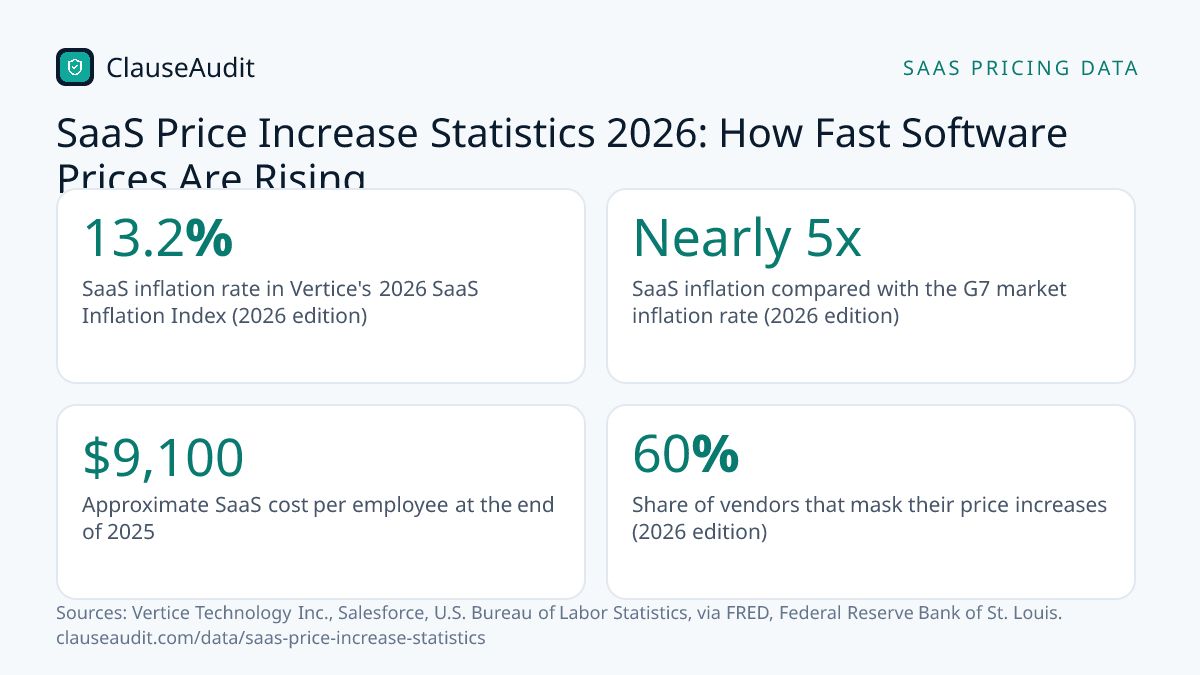
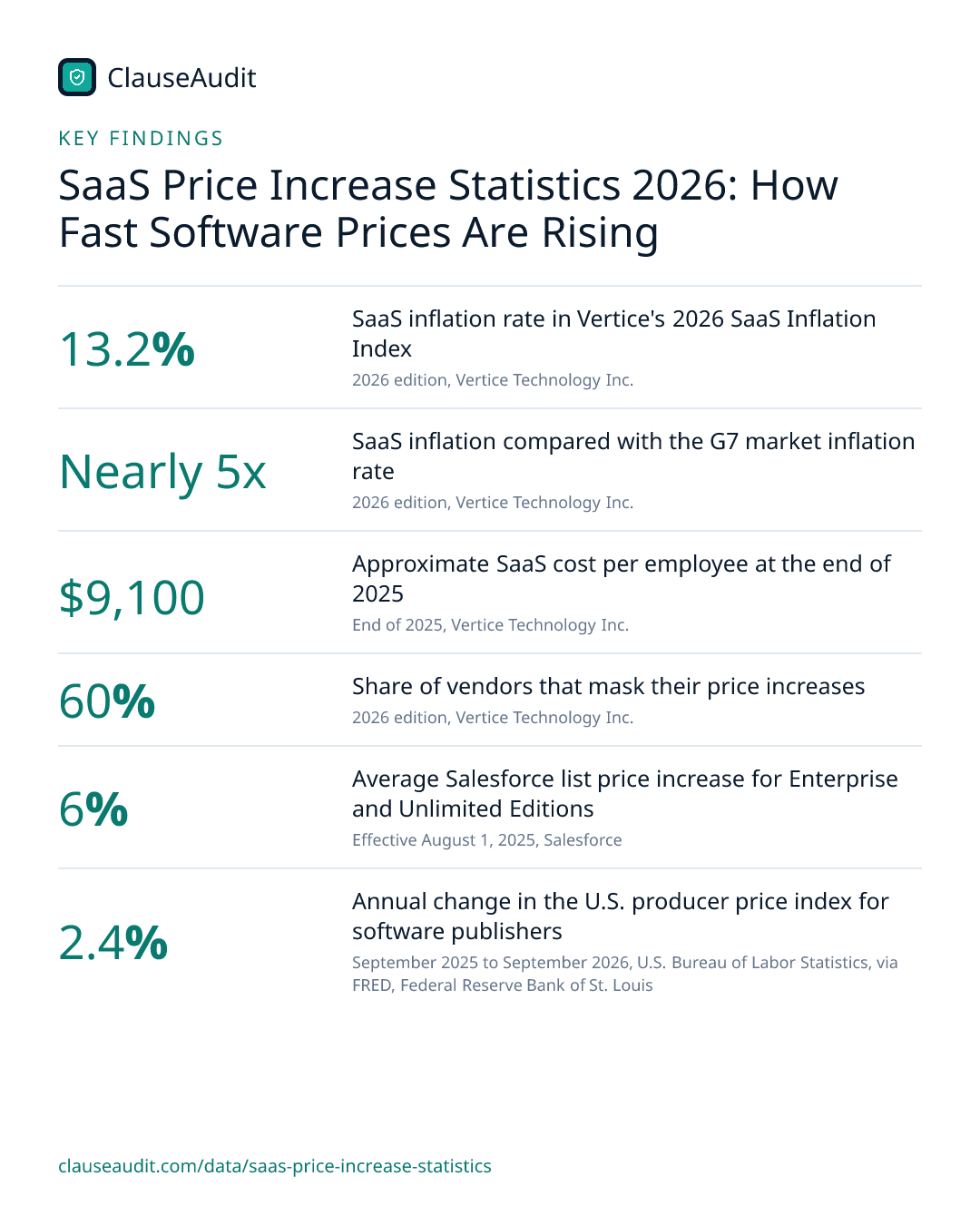
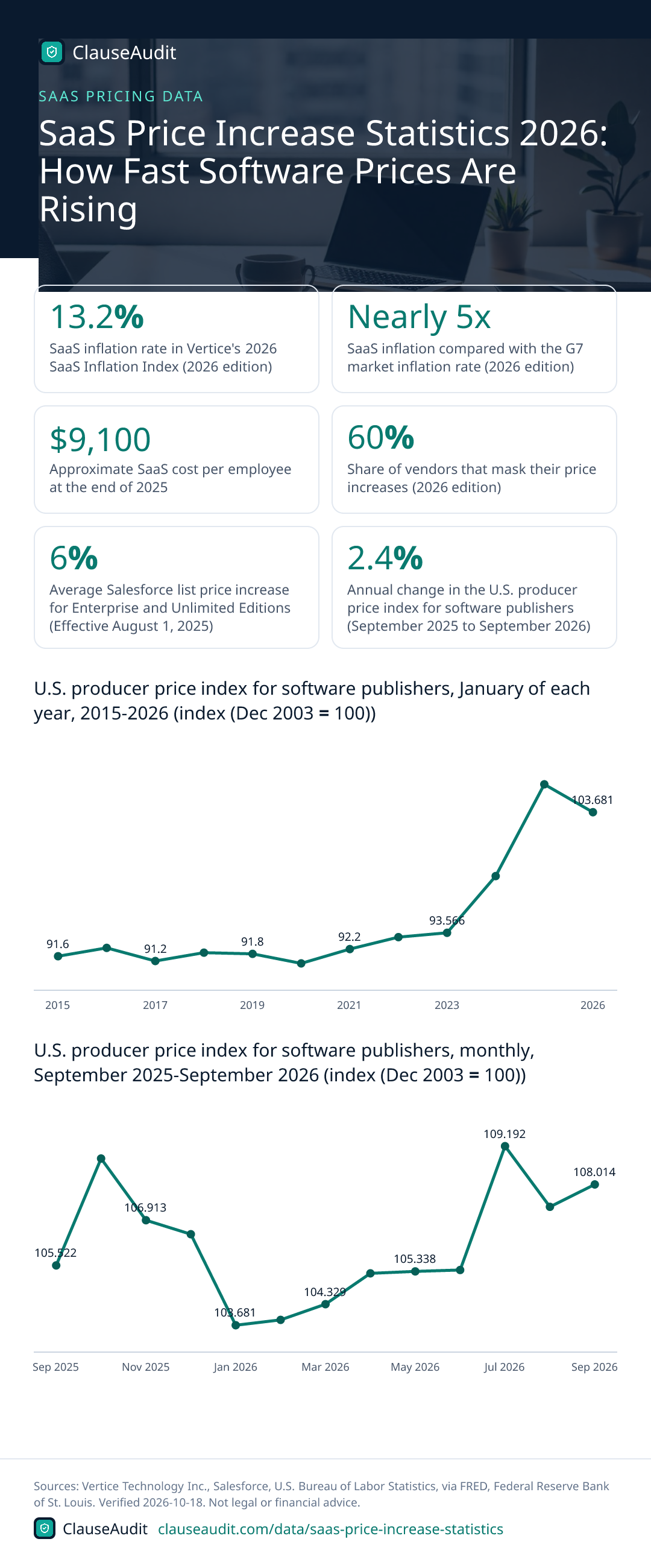
- SaaS inflation rate in Vertice's 2026 SaaS Inflation Index (2026 edition, Vertice Technology Inc.)
- 13.2%
- SaaS inflation compared with the G7 market inflation rate (2026 edition, Vertice Technology Inc.)
- Nearly 5x
- Approximate SaaS cost per employee at the end of 2025 (End of 2025, Vertice Technology Inc.)
- $9,100
- Share of vendors that mask their price increases (2026 edition, Vertice Technology Inc.)
- 60%
- Average Salesforce list price increase for Enterprise and Unlimited Editions (Effective August 1, 2025, Salesforce)
- 6%
- Annual change in the U.S. producer price index for software publishers (September 2025 to September 2026, U.S. Bureau of Labor Statistics, via FRED, Federal Reserve Bank of St. Louis)
- 2.4%
Software bills keep going up, and usually not because you added anything. Vertice's 2026 SaaS Inflation Index puts SaaS inflation at 13.2%, and the same report says 60% of vendors mask their increases. Big names moved too: Salesforce raised Enterprise and Unlimited list prices by an average of 6% on August 1, 2025, and Microsoft lifted several Microsoft 365 plans on July 1, 2026.
This page pulls together the vendor index, government price data and the announced list changes, then explains what they mean for your next renewal. The short version: the price on your order form is a starting point unless your contract says otherwise.
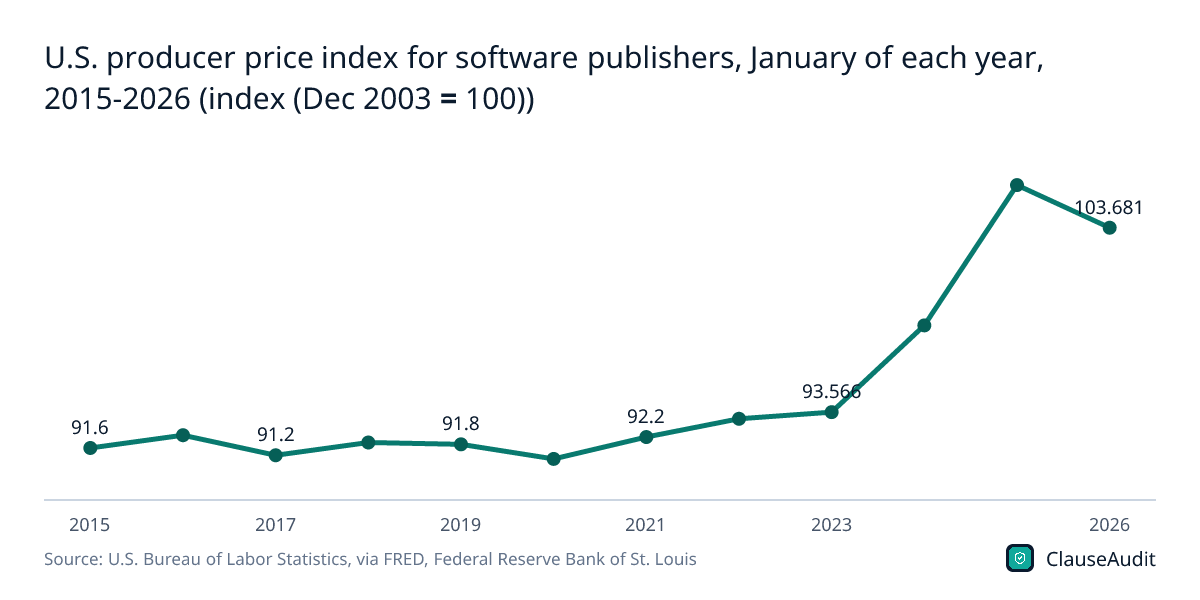
U.S. producer price index for software publishers, January of each year, 2015-2026 (index (Dec 2003 = 100))
Chart data
| Label | Value (index (Dec 2003 = 100)) |
|---|---|
| 2015 | 91.6 |
| 2016 | 92.3 |
| 2017 | 91.2 |
| 2018 | 91.9 |
| 2019 | 91.8 |
| 2020 | 91 |
| 2021 | 92.2 |
| 2022 | 93.202 |
| 2023 | 93.566 |
| 2024 | 98.323 |
| 2025 | 106.02 |
| 2026 | 103.681 |
The federal producer price index for software publishers sat in a narrow band for years, then jumped from 98.323 in January 2024 to 106.02 in January 2025. It measures what publishers receive, so it can move quite differently from the list prices buyers see.
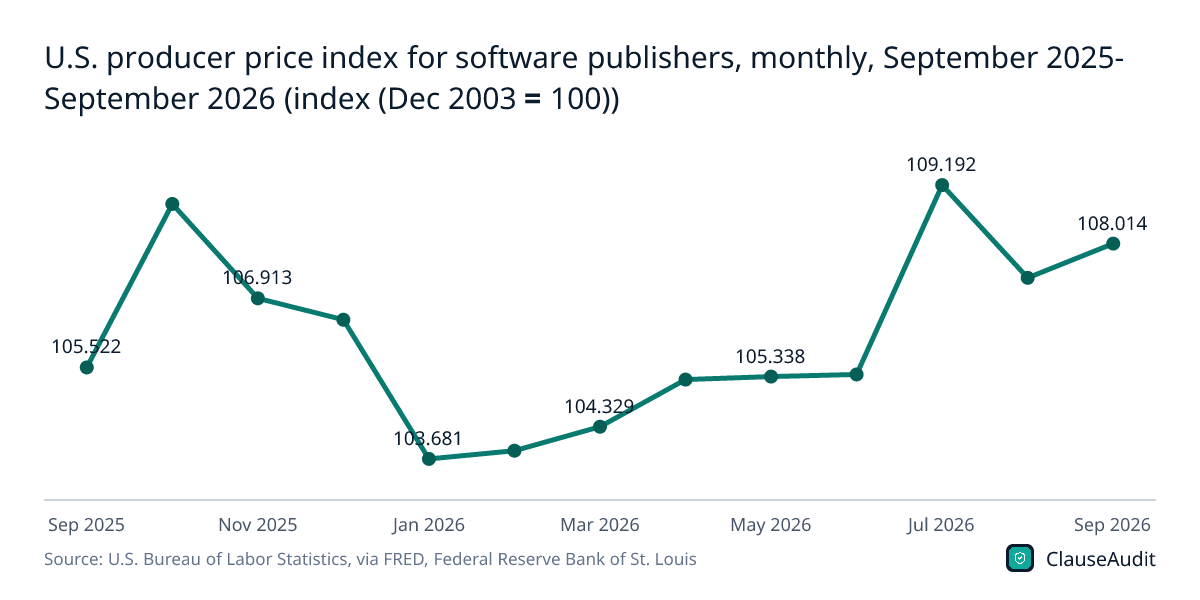
Download this chart (PNG)U.S. producer price index for software publishers, monthly, September 2025-September 2026 (index (Dec 2003 = 100))
Chart data
| Label | Value (index (Dec 2003 = 100)) |
|---|---|
| Sep 2025 | 105.522 |
| Oct 2025 | 108.812 |
| Nov 2025 | 106.913 |
| Dec 2025 | 106.482 |
| Jan 2026 | 103.681 |
| Feb 2026 | 103.846 |
| Mar 2026 | 104.329 |
| Apr 2026 | 105.278 |
| May 2026 | 105.338 |
| Jun 2026 | 105.381 |
| Jul 2026 | 109.192 |
| Aug 2026 | 107.325 |
| Sep 2026 | 108.014 |
Month to month the index is noisy, from 103.681 in January 2026 to 109.192 in July 2026. Across the full year it rose 2.4%, from September 2025 to September 2026.
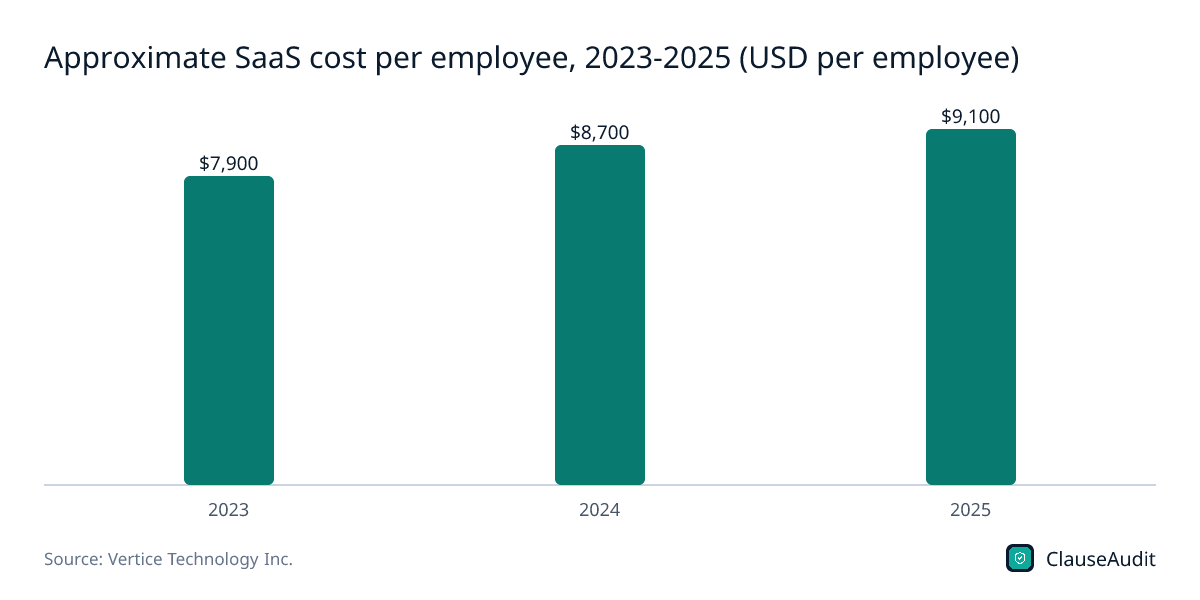
Download this chart (PNG)Approximate SaaS cost per employee, 2023-2025 (USD per employee)
Chart data
| Label | Value (USD per employee) |
|---|---|
| 2023 | $7,900 |
| 2024 | $8,700 |
| 2025 | $9,100 |
Vertice estimates SaaS spend per employee went from about $7,900 in 2023 to $8,700 in 2024 and roughly $9,100 by the end of 2025. Some of that is more tools, some is higher prices on the same tools.
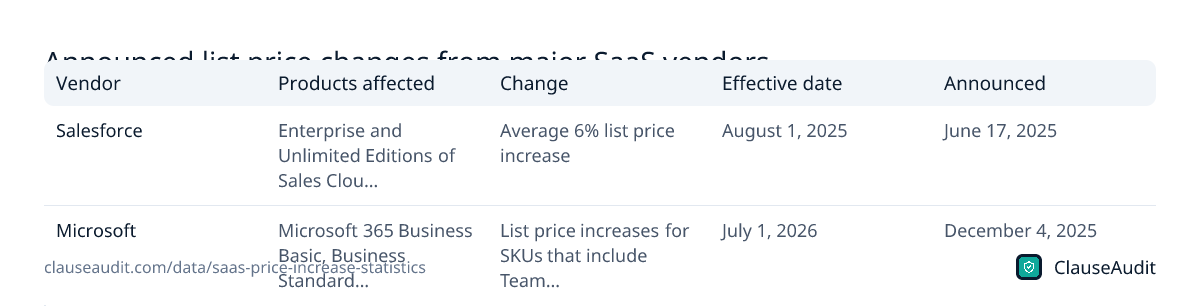
Download this chart (PNG)Announced list price changes from major SaaS vendors
| Vendor | Products affected | Change | Effective date | Announced |
|---|---|---|---|---|
| Salesforce | Enterprise and Unlimited Editions of Sales Cloud, Service Cloud, Field Service and select Industries Clouds | Average 6% list price increase | August 1, 2025 | June 17, 2025 |
| Microsoft | Microsoft 365 Business Basic, Business Standard, Office 365 E3, Microsoft 365 E3, E5, F1 and F3 (Business Premium and Office 365 E1 unchanged) | List price increases for SKUs that include Teams, e.g. Business Basic $6 to $7, Business Standard $12.50 to $14, Microsoft 365 E3 $36 to $39, Microsoft 365 F3 $8 to $10 | July 1, 2026 | December 4, 2025 |
Source: Salesforce, Salesforce pricing update; Microsoft, Advancing Microsoft 365: New capabilities and pricing update. Download as image
How much are SaaS prices going up in 2026?
It depends on who you ask, and the gap between the sources tells you something. Vertice, a software purchasing platform that negotiates deals for its customers, measures SaaS inflation at 13.2% in its 2026 index and says that is nearly 5x the standard market inflation rate of G7 countries.
The government number is much lower. The Bureau of Labor Statistics producer price index for software publishers rose 2.4% from September 2025 to September 2026. That index tracks what publishers receive across all their sales, so it smooths out the sharp jumps that individual buyers feel at renewal.
So treat 13.2% as a realistic warning for a typical renewal and 2.4% as the broad industry backdrop. If a vendor quotes you a hike well above both, ask why.
One more caveat. Vertice is a vendor with a product to sell, and its page does not print a publication date. The number is still useful, because it reflects real purchase data, but it is one company's view. The federal index is slower and broader. Read them side by side.
Which software vendors raised prices?
Two of the biggest business software vendors have announced list price increases. Salesforce raised Enterprise and Unlimited Editions of Sales Cloud, Service Cloud, Field Service and some Industries Clouds by an average of 6%, effective August 1, 2025.
Microsoft announced on December 4, 2025 that several Microsoft 365 and Office 365 plans that include Teams would cost more from July 1, 2026. Business Basic went from $6 to $7 per user per month, Business Standard from $12.50 to $14, Microsoft 365 E3 from $36 to $39 and F3 from $8 to $10. Business Premium and Office 365 E1 stayed the same.
A dollar or two per seat sounds small. Multiply it by every seat and every month of a multi-year term and it becomes a real line in your budget.
These announcements also set the tone for smaller vendors. When the market leaders raise list prices, a niche tool asking for more at renewal looks less unusual, and sales teams may point to the big names to justify it. Knowing the actual figures helps you push back with something concrete.
Why do SaaS price increases feel bigger than the headline number?
Because a lot of them are not labeled as price increases. Vertice reports that 60% of vendors deliberately mask rising prices. In practice that looks like a feature you relied on moving to a higher tier, a discount that quietly expires at renewal, a new minimum seat count, or usage limits that tighten so you pay overages.
Your contract decides which of those moves the vendor can make. Look for phrases like "then-current list price", "vendor may modify pricing" or "continued use constitutes acceptance". Each one hands the vendor the pen.
Spend per employee shows the cumulative effect. Vertice puts it at roughly $9,100 at the end of 2025, up from $7,900 in 2023.
What a price increase means for a small business or freelancer
If you run a small team, you rarely get a sales rep willing to negotiate. You click through the vendor's standard terms, and those terms usually let the vendor change prices with notice by email or a banner in the app.
Picture a five-person agency on a project tool, a CRM and an email suite. None of the bills doubles. Each one creeps up at renewal, a feature moves to a paid add-on, and by the end of the year the software line is noticeably higher with nothing new to show for it.
Freelancers feel it in a different way. Your tools get more expensive while your client rates stay fixed for the length of a project. If a project runs past a renewal date, the increase comes out of your margin.
Workers feel it too, just less directly. When a company's software line grows, it often looks for savings elsewhere, and cutting tools people depend on or freezing budgets is a common first move. If you manage a team's tools, a short list of what each subscription costs and when it renews is worth more than any forecast.
Should you switch vendors when prices go up?
Sometimes, but switching costs are real. Moving a CRM or an email platform means exporting data, retraining people and rebuilding integrations. Vendors know this, which is why renewal is when they ask for more.
Before you decide, ask three questions. Can you get your data out in a usable format, and for how long after you cancel? Does the contract charge an early exit fee? And is there a competitor you could credibly name in a negotiation?
Often the best outcome is not leaving at all. It is telling the vendor you are ready to leave, with a dated quote from a rival in hand, and getting the increase reduced or the price locked for another term. That only works if you start the conversation well before the cancellation notice deadline, not the week the invoice lands.
How can you limit SaaS price increases at renewal?
- Ask for a renewal cap in writing. A fixed percentage or a link to CPI beats "then-current list price" every time.
- Lock pricing for the full term, not just the first year, and confirm that the per-seat price also applies to seats you add later.
- Put the renewal date and the cancellation notice deadline in your calendar the day you sign. Miss the window and a surprise hike often sticks for another full term.
- Get the vendor to agree that price changes need written notice to a named contact, not an in-app banner or a blog post.
- Check what happens if you refuse a change. You want the right to leave without penalty and take your data with you.
- Count your seats before renewal. Paying for licenses nobody uses is a price increase you set yourself.
How ClauseAudit helps
Most SaaS price increases are allowed by a clause you agreed to long before the invoice arrived. Upload a SaaS agreement or order form and ClauseAudit's automated review flags the terms that let the vendor raise prices, renew you automatically or change the deal without asking.
You get each clause in plain English, a severity rating and a suggested edit to bring to the vendor before you sign or renew.
- Renewal pricing: is there a cap, or can the vendor charge the then-current list price?
- Auto-renewal and notice: how long the cancellation window is and how you have to give notice
- Unilateral changes: whether the vendor can change prices or terms by posting an update online
- Seat and usage terms: minimum commitments, true-ups and overage charges
- Exit rights: whether you can terminate if prices rise, and how you get your data out
- Liability cap: whether the vendor's exposure is tied to a small slice of what you pay
Frequently asked questions
What is the SaaS inflation rate in 2026?
Vertice's 2026 SaaS Inflation Index puts it at 13.2%, which the company says is nearly 5x the standard market inflation rate of G7 countries. That figure comes from Vertice's own purchasing data, so treat it as a strong signal from the buyer side rather than an official statistic.
Is there an official government measure of software price inflation?
The closest is the Bureau of Labor Statistics producer price index for software publishers. It rose 2.4% from September 2025 to September 2026. It measures what publishers receive across all sales, so it runs well below the increases individual customers often see at renewal.
How much did Microsoft 365 prices go up in July 2026?
From July 1, 2026, Business Basic went from $6 to $7 per user per month, Business Standard from $12.50 to $14, Microsoft 365 E3 from $36 to $39 and F3 from $8 to $10. Business Premium and Office 365 E1 did not change.
How much did Salesforce raise prices?
Salesforce raised list prices by an average of 6% on August 1, 2025, for Enterprise and Unlimited Editions of Sales Cloud, Service Cloud, Field Service and select Industries Clouds. It announced the change on June 17, 2025. For existing customers, a list price change typically shows up at renewal unless the contract locks the price.
Can a SaaS vendor raise prices in the middle of my contract?
Only if your contract allows it. Many standard terms let the vendor change pricing with notice, sometimes just an email or a posted update. A signed order form with a fixed price for the term usually protects you until renewal. Read the pricing, modification and renewal sections together.
What is a reasonable renewal price cap to ask for?
There is no single standard. Many buyers ask for a fixed percentage or an increase tied to CPI. Use the data as an anchor: if broad software producer prices rose 2.4% over the past year, a much larger hike deserves an explanation and room for negotiation.
Why does my software bill keep rising when the list price did not change?
Vertice reports that 60% of vendors mask price increases. Common methods include moving features into higher tiers, ending first-year discounts, raising minimum seat counts and tightening usage limits so you pay overages. Your contract decides which of these the vendor can do without your agreement.
How much does SaaS cost per employee?
Vertice estimates roughly $9,100 per employee at the end of 2025, up from $8,700 in 2024 and $7,900 in 2023. Your number will vary with headcount and tools, but the trend shows that software is a growing cost line worth reviewing every renewal cycle.
Use this data
Every chart and card below is free to reuse under CC BY 4.0. Download what you need and link back to this page.
 Stat cards
 Key findings card
 Infographic
 U.S. producer price index for software publishers, January of each year, 2015-2026 (index (Dec 2003 = 100))
 U.S. producer price index for software publishers, monthly, September 2025-September 2026 (index (Dec 2003 = 100))
 Approximate SaaS cost per employee, 2023-2025 (USD per employee)
 Announced list price changes from major SaaS vendors
Embed the infographic
Free to share on your site, blog or slides under CC BY 4.0. Please keep the credit link.
Sources and method
Every number on this page comes from the sources below, each opened and read on or before October 18, 2026. A second, independent review checked every figure against its source and corrected anything that did not match. Figures that could not be confirmed were left out.
- Vertice Technology Inc., 2026 SaaS Inflation Index (2026 edition (no publication date printed))
- U.S. Bureau of Labor Statistics, via FRED, Federal Reserve Bank of St. Louis, Producer Price Index by Industry: Software Publishers (PCU51125112) (Updated October 15, 2026 (data through September 2026))
- Salesforce, Salesforce pricing update (June 17, 2025)
- Microsoft, Advancing Microsoft 365: New capabilities and pricing update (December 4, 2025 (updated March 18, 2026))
Cite this page
ClauseAudit, “SaaS Price Increase Statistics 2026: How Fast Software Prices Are Rising”, updated October 18, 2026, https://clauseaudit.com/data/saas-price-increase-statistics. Free to reuse with a link back (CC BY 4.0).
This page summarises published data and law as checked on October 18, 2026. Figures are updated as new editions are released, and your own situation may differ. It is general information, not legal, tax or financial advice.