Unused SaaS License Statistics: How Much Software Goes to Waste
By ClauseAudit Research · 14 sources ·
How much do unused software licenses cost companies?
Unused software licenses are a large and steady cost. Zylo's 2026 SaaS Management Index puts average waste at $19.8M a year per organization, and average license utilization was only 54% in 2025. Much of that waste is locked in by contract terms: seat minimums, auto-renewal at the same quantity, and short notice windows.

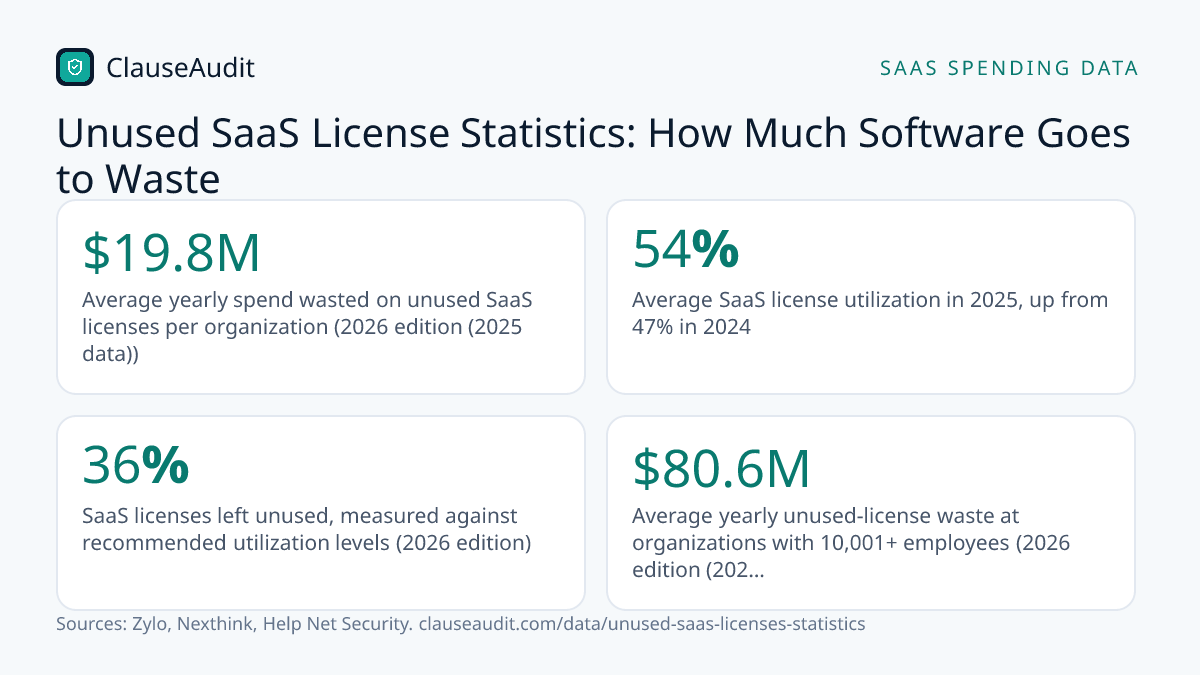
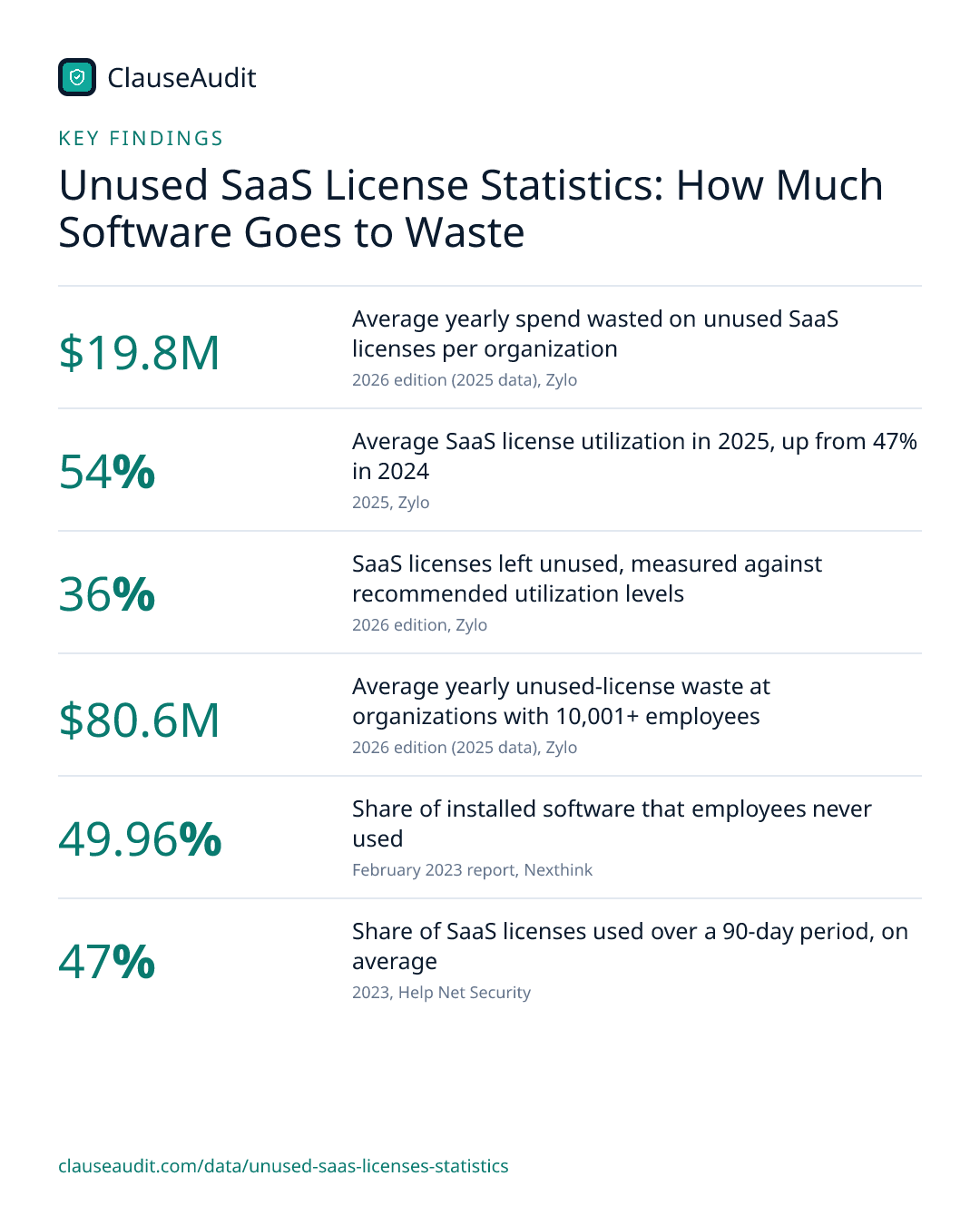
- Average yearly spend wasted on unused SaaS licenses per organization (2026 edition (2025 data), Zylo)
- $19.8M
- Average SaaS license utilization in 2025, up from 47% in 2024 (2025, Zylo)
- 54%
- SaaS licenses left unused, measured against recommended utilization levels (2026 edition, Zylo)
- 36%
- Average yearly unused-license waste at organizations with 10,001+ employees (2026 edition (2025 data), Zylo)
- $80.6M
- Share of installed software that employees never used (February 2023 report, Nexthink)
- 49.96%
- Share of SaaS licenses used over a 90-day period, on average (2023, Help Net Security)
- 47%
- SaaS spend IT teams estimate is underused or wasted (2023 report, Flexera)
- 32%
- Large federal agencies that fully checked whether top licenses were over- or under-bought (January 2024, U.S. Government Accountability Office)
- 0 of 9
Most companies pay for more software seats than people use. The gap shows up in every major study on this page, from usage tracking across millions of licenses to surveys of the people who manage software budgets.
The numbers below explain how big that gap is and who it hits hardest. The sections after them explain why the waste keeps coming back each year, and which contract terms decide how much of it you can claw back.
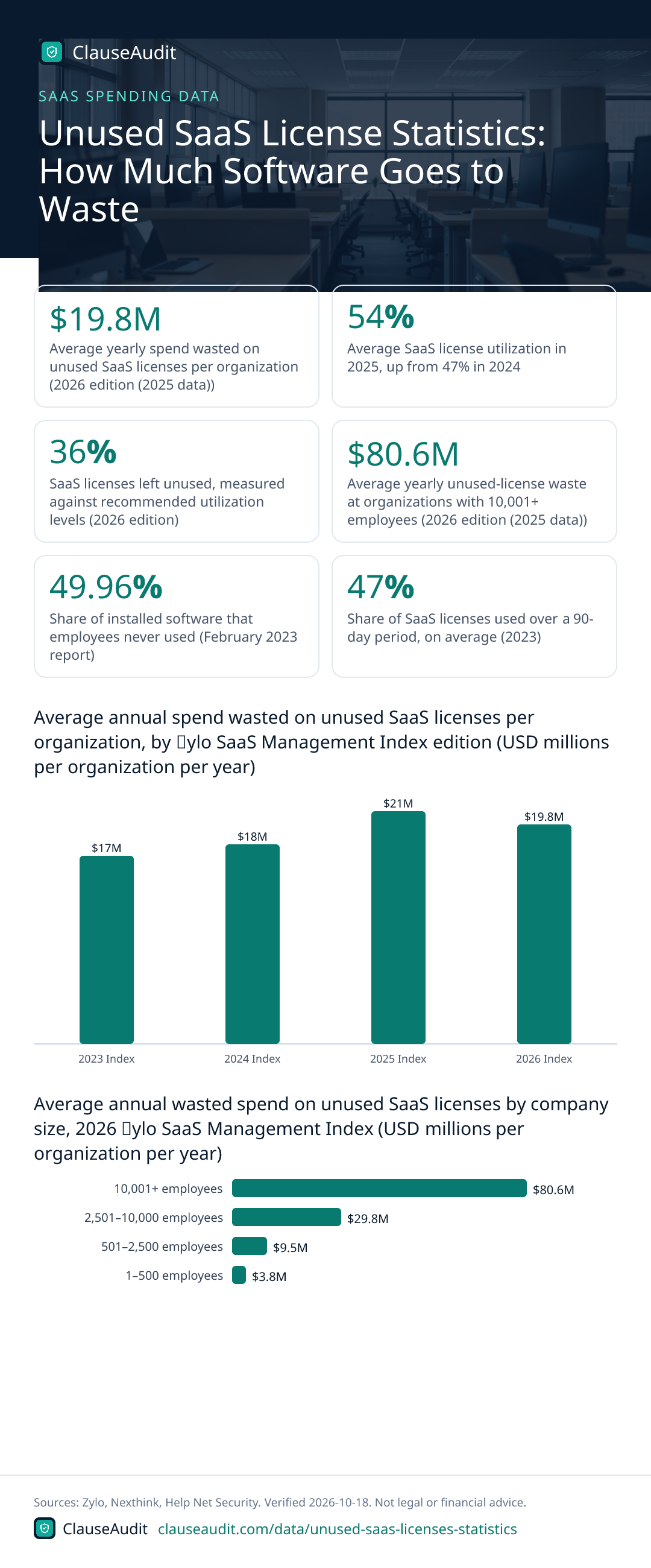
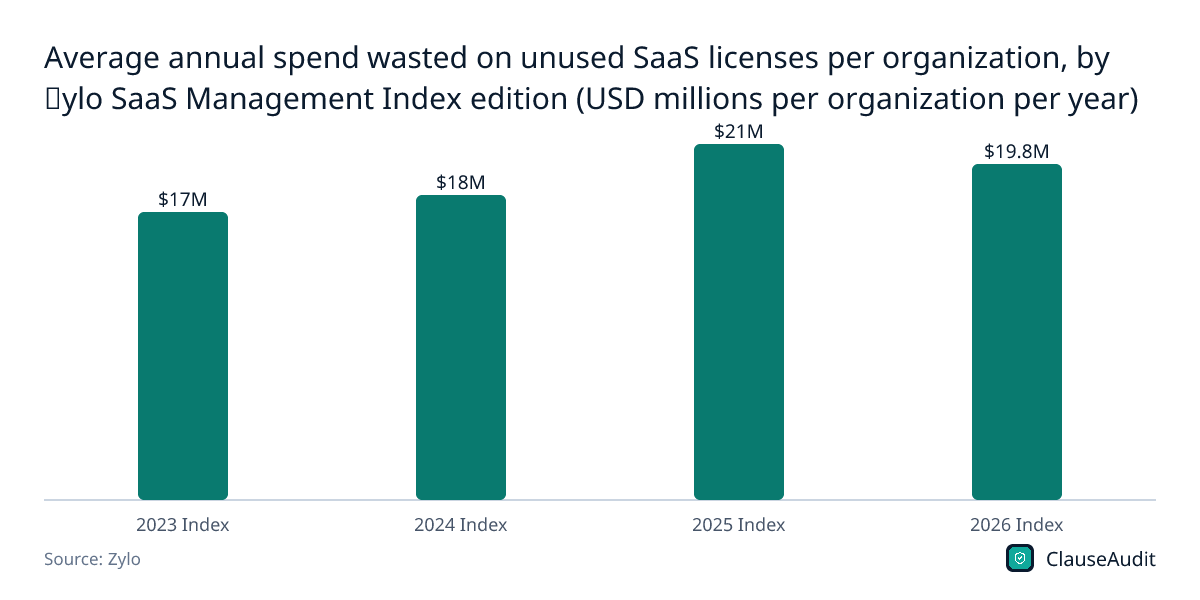
Average annual spend wasted on unused SaaS licenses per organization, by Zylo SaaS Management Index edition (USD millions per organization per year)
Chart data
| Label | Value (USD millions per organization per year) |
|---|---|
| 2023 Index | $17M |
| 2024 Index | $18M |
| 2025 Index | $21M |
| 2026 Index | $19.8M |
Waste per organization climbed for three editions before dipping to $19.8M in the 2026 Index. Each edition draws on a different customer sample, so read this as a direction, not a precise series.
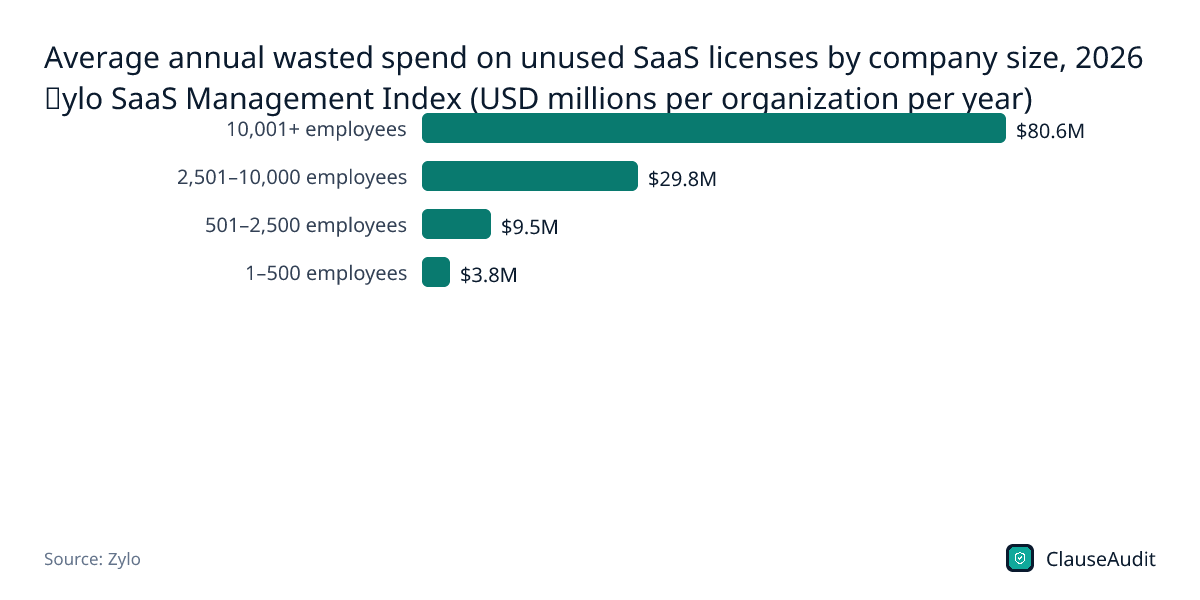
Download this chart (PNG)Average annual wasted spend on unused SaaS licenses by company size, 2026 Zylo SaaS Management Index (USD millions per organization per year)
Chart data
| Label | Value |
|---|---|
| 10,001+ employees | $80.6M |
| 2,501–10,000 employees | $29.8M |
| 501–2,500 employees | $9.5M |
| 1–500 employees | $3.8M |
Waste scales with headcount. Organizations with 10,001+ employees average $80.6M a year, but even companies with 1 to 500 employees average $3.8M.
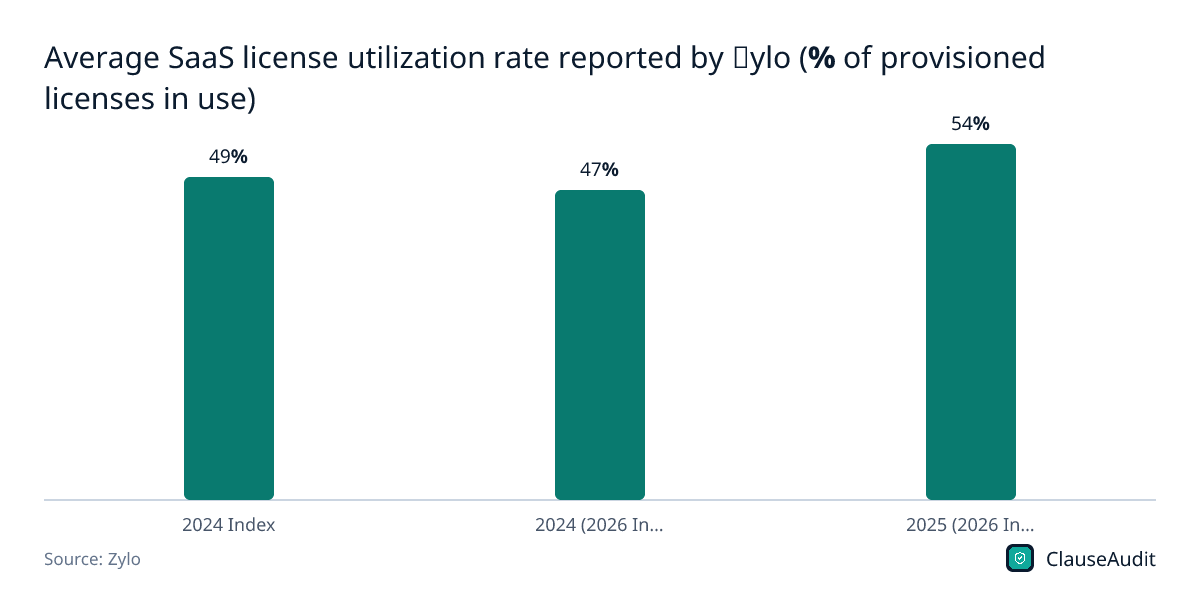
Download this chart (PNG)Average SaaS license utilization rate reported by Zylo (% of provisioned licenses in use)
Chart data
| Label | Value (% of provisioned licenses in use) |
|---|---|
| 2024 Index | 49% |
| 2024 (2026 Index) | 47% |
| 2025 (2026 Index) | 54% |
Utilization improved from 47% in 2024 to 54% in 2025 in the 2026 Index. That still means close to half of provisioned licenses went unused.
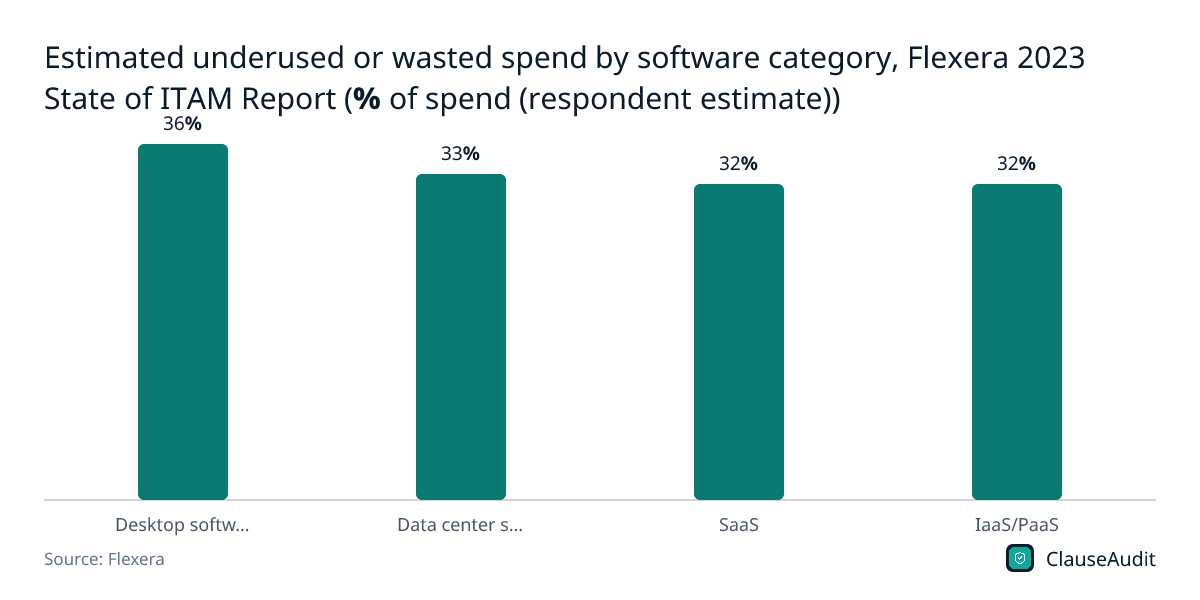
Download this chart (PNG)Estimated underused or wasted spend by software category, Flexera 2023 State of ITAM Report (% of spend (respondent estimate))
Chart data
| Label | Value (% of spend (respondent estimate)) |
|---|---|
| Desktop software | 36% |
| Data center software | 33% |
| SaaS | 32% |
| IaaS/PaaS | 32% |
These are estimates from IT asset managers, not measured usage. SaaS waste at 32% sits close to every other category, so the problem is not unique to cloud subscriptions.
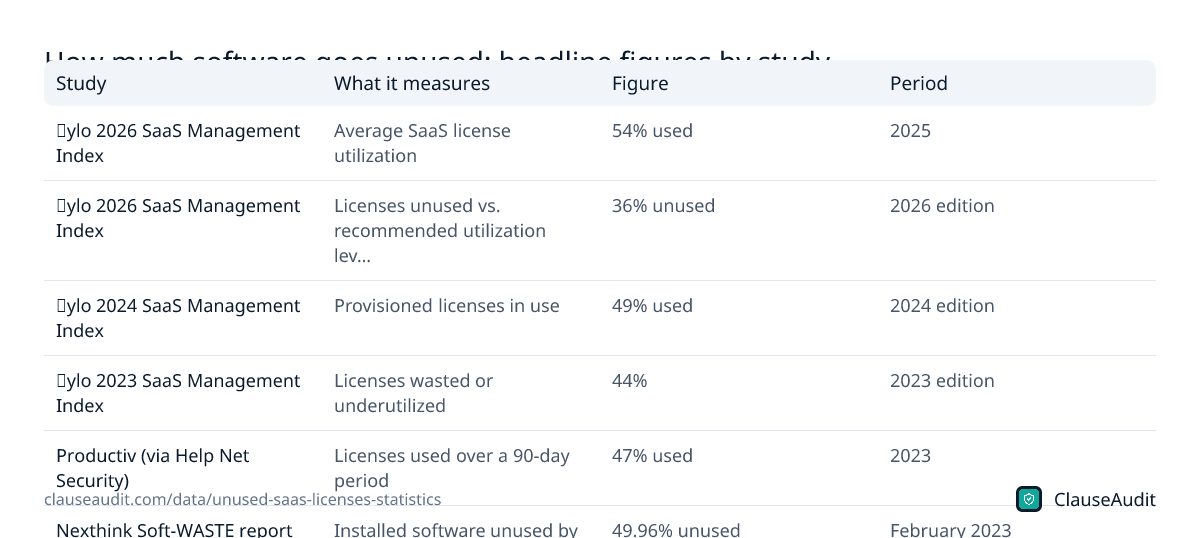
Download this chart (PNG)How much software goes unused: headline figures by study
| Study | What it measures | Figure | Period |
|---|---|---|---|
| Zylo 2026 SaaS Management Index | Average SaaS license utilization | 54% used | 2025 |
| Zylo 2026 SaaS Management Index | Licenses unused vs. recommended utilization levels | 36% unused | 2026 edition |
| Zylo 2024 SaaS Management Index | Provisioned licenses in use | 49% used | 2024 edition |
| Zylo 2023 SaaS Management Index | Licenses wasted or underutilized | 44% | 2023 edition |
| Productiv (via Help Net Security) | Licenses used over a 90-day period | 47% used | 2023 |
| Nexthink Soft-WASTE report | Installed software unused by employees | 49.96% unused | February 2023 |
Source: Zylo, 70+ SaaS Statistics for 2026 (Spend, Usage & Waste), citing the 2026 SaaS Management Index; Zylo, 2026 SaaS Management Index (press release); Zylo, 2024 SaaS Management Index Reveals an Average of $18M in Annual License Waste (press release); Zylo, Companies Waste over $17M on SaaS Every Year (2023 SaaS Management Index press release); Help Net Security, 53% of SaaS licenses remain unused (reporting Productiv 2023 State of SaaS data); Nexthink, Half of Software Licenses Goes Unused by Employees, Wasting Businesses Billions (press release). Download as image
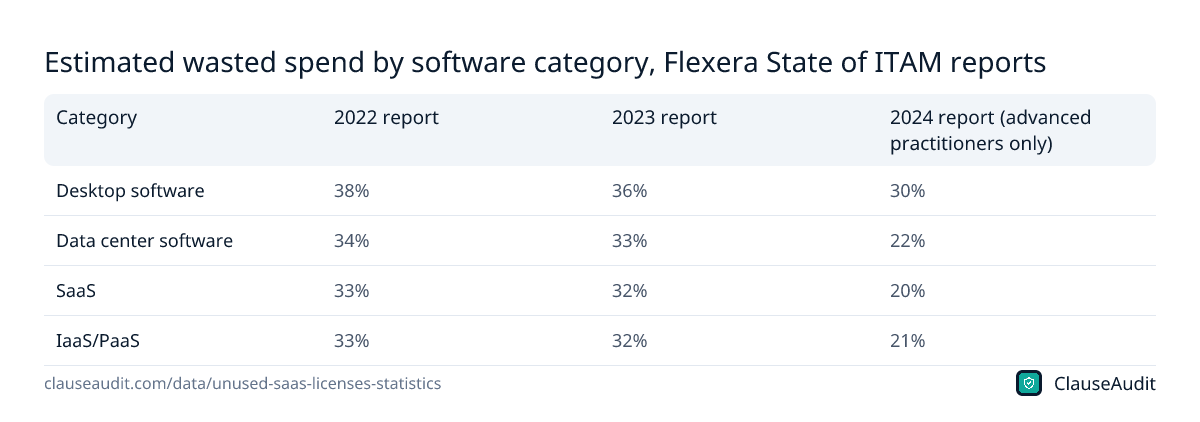
Estimated wasted spend by software category, Flexera State of ITAM reports
| Category | 2022 report | 2023 report | 2024 report (advanced practitioners only) |
|---|---|---|---|
| Desktop software | 38% | 36% | 30% |
| Data center software | 34% | 33% | 22% |
| SaaS | 33% | 32% | 20% |
| IaaS/PaaS | 33% | 32% | 21% |
Source: Flexera, Flexera State of ITAM Report Shows Wasted Spend Remains High Across the IT Estate (press release, 2022 report); Flexera, Flexera 2023 State of IT Asset Management Report Highlights Cost Savings as Top Enterprise Priority (press release); Flexera, Flexera 2024 State of ITAM Report Finds that IT Teams Face Increasing Audit Fines (press release); Flexera, Flexera 2026 State of IT Asset Management Report. Download as image
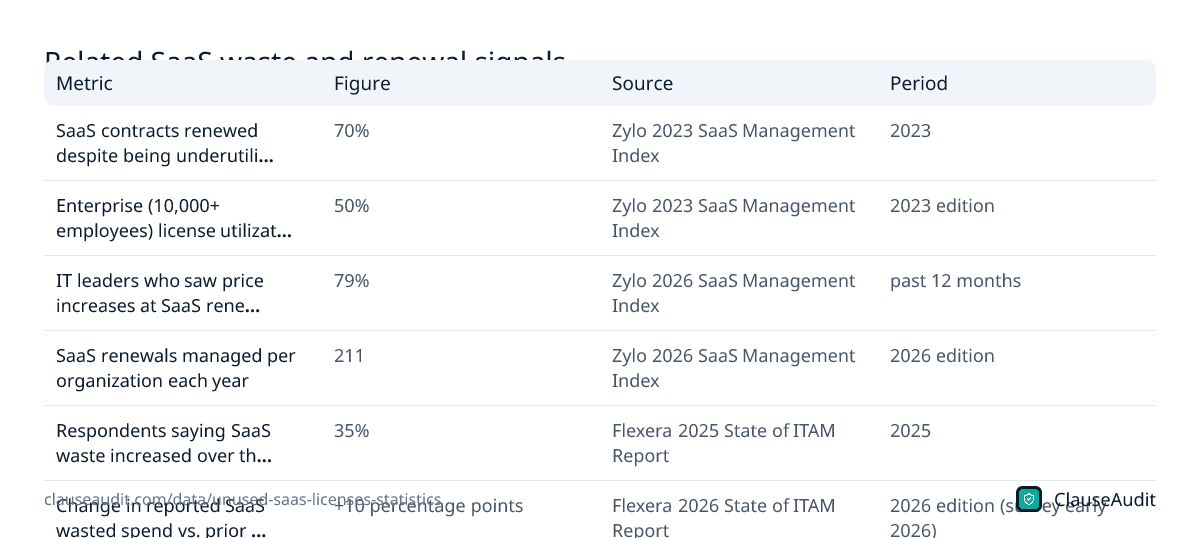
Related SaaS waste and renewal signals
| Metric | Figure | Source | Period |
|---|---|---|---|
| SaaS contracts renewed despite being underutilized | 70% | Zylo 2023 SaaS Management Index | 2023 |
| Enterprise (10,000+ employees) license utilization | 50% | Zylo 2023 SaaS Management Index | 2023 edition |
| IT leaders who saw price increases at SaaS renewal | 79% | Zylo 2026 SaaS Management Index | past 12 months |
| SaaS renewals managed per organization each year | 211 | Zylo 2026 SaaS Management Index | 2026 edition |
| Respondents saying SaaS waste increased over the past year (2025 edition; a 2026 edition exists) | 35% | Flexera 2025 State of ITAM Report | 2025 |
| Change in reported SaaS wasted spend vs. prior year | +10 percentage points | Flexera 2026 State of ITAM Report | 2026 edition (survey early 2026) |
Source: Zylo, Companies Waste over $17M on SaaS Every Year (2023 SaaS Management Index press release); Zylo, 70+ SaaS Statistics for 2026 (Spend, Usage & Waste), citing the 2026 SaaS Management Index; Flexera, IT Teams are Losing Visibility as Tech Cost Pressures Mount, According to Flexera 2025 State of ITAM Report (press release); Flexera, Flexera 2026 State of IT Asset Management Report. Download as image
How many software licenses actually go unused?
Roughly half, depending on how you count. Zylo measured average utilization at 54% in 2025. Productiv found that 47% of licenses were used over a 90-day window in 2023. Nexthink's February 2023 report found that 49.96% of installed software was never used by employees.
Those studies measure different things, which is why the figures don't line up perfectly. Zylo's separate 36% unused figure, from its 2026 Index, compares usage against a recommended utilization target rather than against every seat you bought. It is the more forgiving view, and it still means about a third of licenses are surplus.
The pattern holds across methods. When you buy software by the seat, a big share of those seats sit empty.
For budgeting, the practical takeaway is simple. If you have never audited a tool, assume a meaningful share of its seats are idle until a usage report proves otherwise. That assumption is usually cheaper than being surprised at renewal.
Why do companies keep paying for software nobody uses?
Because buying a seat is easy and giving one back is hard. Someone requests access for a project, the project ends, and the seat stays on the invoice. Employees leave and nobody reclaims their logins. A team trials a tool, buys the annual plan, and drifts back to the old one.
The contract usually makes this worse. Many SaaS agreements renew automatically at the same seat count. Some let you add seats any time but only remove them at renewal, and only if you send written notice weeks or months ahead. Miss that window and you are locked in for another full term at the old quantity.
Zylo's 2023 Index found that 70% of SaaS contracts were renewed despite being underutilized. Its 2026 Index reports the average organization handles 211 renewals a year. With that many dates to track, it's easy for some to slip by without anyone checking the seat count.
There is also a quiet incentive problem. The person who requests a tool is rarely the person who pays the invoice, and nobody gets credit for cancelling seats. Unless someone owns the renewal calendar, the default outcome is that every contract renews as is.
Is wasted software spend a problem for small businesses too?
Yes. The dollar figures shrink with company size, but they don't disappear. Zylo's 2026 Index puts average waste at $3.8M a year for organizations with 1 to 500 employees and $9.5M for those with 501 to 2,500.
For a small company, the bigger risk is often a single contract. Picture a project tool bought for a full team on an annual plan with a seat minimum and auto-renewal. Then the team shrinks by half after a client leaves. You still pay for the minimum until the term ends, and if you miss the notice date you pay for another year.
Freelancers and solo operators see the same thing on a smaller scale: annual plans bought for a discount, tools kept "just in case," and renewals that hit the card while you're busy with client work.
Small teams also tend to buy on a company card with a click-through agreement, so the seat and renewal terms never get read. That makes the first renewal the moment most of the waste locks in.
Renewals are where waste and price increases meet
Unused seats get more expensive at renewal. In Zylo's 2026 Index, 79% of IT leaders said they saw price increases at SaaS renewal over the past 12 months. If you renew far more seats than you need, and the price per seat goes up, you are paying more for software that nobody opens.
Even government buyers struggle here. A January 2024 GAO review found that 0 of 9 large federal agencies had fully checked whether their top software licenses were over- or under-bought. GAO made 18 recommendations to fix it. If agencies with dedicated procurement staff miss this, a small company with no software manager probably will too, unless the contract gives it room to adjust.
Flexera's survey data points the same way. Its 2026 State of ITAM Report found reported SaaS wasted spend rose 10 percentage points year over year, even as Zylo's measured utilization improved. Better tracking helps, but it can't undo a contract that has already renewed at the wrong size.
What should a worker or freelancer take from this?
If you work inside a company, unused licenses are a budget line someone will eventually cut. Flag the tools you no longer use when your manager asks, and hand back access when a project ends. It makes the next renewal easier for whoever owns it.
If you sell software or services billed per seat, expect buyers to push harder on seat minimums, true-ups and renewal terms. Clear terms that let a customer scale down without a fight can win deals, because buyers have been burned by contracts that only move one way.
And if you buy tools for your own freelance business, treat every annual plan like a small contract. Note the renewal date, the cancellation method and any price change clause before you click accept.
How to cut unused SaaS licenses
- Pull a usage report from each tool's admin panel well before renewal. Count active users over the last month and the last quarter, not total accounts.
- Build one renewal calendar with the notice deadline for every contract, not just the renewal date. The notice date is the one that matters.
- Remove departed employees and finished-project users every month. Make seat removal part of offboarding.
- Before you sign, ask for the right to reduce seats at renewal, or mid-term, without a penalty.
- Push back on seat minimums that are higher than your current headcount. Buy for today and add later.
- Ask for a cap on renewal price increases in writing, tied to a fixed percentage.
- Turn off auto-renewal where the contract allows it, or calendar the notice window the day you sign.
How ClauseAudit helps
Most license waste comes down to a handful of terms in your SaaS agreement. Upload the contract and our automated review flags the clauses that lock in seat counts, push renewals through quietly, or let the vendor raise prices.
You get each risky clause in plain English, with a suggested change to bring to the vendor before you sign or renew.
- Auto-renewal terms and the notice deadline to cancel or reduce seats
- Minimum seat commitments and any right to lower them at renewal
- True-up clauses that bill you for extra users after the fact
- Price increase rights on renewal and any cap on them
- Termination for convenience and any early-exit fees
- Data export rights if you drop the tool
Frequently asked questions
What percentage of SaaS licenses go unused?
It depends on the study. Zylo measured average utilization at 54% in 2025, meaning close to half of licenses were idle. Productiv found 47% of licenses used over a 90-day window in 2023. Zylo's 2026 Index also reports 36% of licenses unused when measured against recommended utilization levels rather than every seat purchased.
How much money do companies waste on unused SaaS licenses?
Zylo's 2026 SaaS Management Index puts the average at $19.8M a year per organization, down 5.3% from $20.9M the year before. Large enterprises with 10,001+ employees average $80.6M, while organizations with 1 to 500 employees average $3.8M. That figure counts unused licenses alone, not other software overspend.
What is shelfware?
Shelfware is software you pay for but don't use. With SaaS it usually means seats assigned to people who never log in, left the company, or switched tools. Nexthink found that 49.96% of installed software was never used by employees in its February 2023 report.
Can I reduce the number of seats on my SaaS contract mid-term?
Only if the contract allows it. Many SaaS agreements let you add seats any time but only reduce them at renewal, and often only with written notice sent well ahead of the renewal date. Check the order form and the renewal clause, since the seat terms are often split between the two documents.
What is a true-up in a software license agreement?
A true-up is a periodic count of how many users or licenses you actually used, followed by a bill for any overage. True-ups usually only go one way: you pay for extra users, but you rarely get a credit for seats you didn't use. Look for a matching right to true down.
Do SaaS prices go up at renewal?
Often, yes. In Zylo's 2026 Index, 79% of IT leaders said they saw price increases at SaaS renewal in the past 12 months. If you renew unused seats, you pay that higher price on licenses nobody uses. A written cap on renewal increases helps limit the damage.
Is unused software only a large-company problem?
No. Large enterprises waste the most in dollars, but Zylo's 2026 Index puts average waste at $3.8M a year even for organizations with 1 to 500 employees. Smaller teams also have less staff to track renewal dates, which makes missed notice windows more common.
How do I find unused software licenses in my company?
Start with each tool's admin panel and export active users for the last month and the last quarter. Compare that with your billed seat count and your current employee list. Then line up each contract's notice deadline so you can cut seats before the next renewal locks them in.
Use this data
Every chart and card below is free to reuse under CC BY 4.0. Download what you need and link back to this page.
 Stat cards
 Key findings card
 Infographic
 Average annual spend wasted on unused SaaS licenses per organization, by Zylo SaaS Management Index edition (USD millions per organization per year)
 Average annual wasted spend on unused SaaS licenses by company size, 2026 Zylo SaaS Management Index (USD millions per organization per year)
 Average SaaS license utilization rate reported by Zylo (% of provisioned licenses in use)
 Estimated underused or wasted spend by software category, Flexera 2023 State of ITAM Report (% of spend (respondent estimate))
 How much software goes unused: headline figures by study
 Estimated wasted spend by software category, Flexera State of ITAM reports
 Related SaaS waste and renewal signals
Embed the infographic
Free to share on your site, blog or slides under CC BY 4.0. Please keep the credit link.
Sources and method
Every number on this page comes from the sources below, each opened and read on or before October 18, 2026. A second, independent review checked every figure against its source and corrected anything that did not match. Figures that could not be confirmed were left out.
- Zylo, 2026 SaaS Management Index (press release) (January 29, 2026)
- Zylo, How Much Is Wasted Every Year on SaaS (citing the 2026 SaaS Management Index) (May 11, 2023 (updated March 19, 2026 with 2026 Index data))
- Zylo, 70+ SaaS Statistics for 2026 (Spend, Usage & Waste), citing the 2026 SaaS Management Index (December 26, 2024 (updated February 8, 2026))
- Zylo, 2025 SaaS Management Index (press release) (January 16, 2025)
- Zylo, 2024 SaaS Management Index Reveals an Average of $18M in Annual License Waste (press release) (February 27, 2024)
- Zylo, Companies Waste over $17M on SaaS Every Year (2023 SaaS Management Index press release) (April 4, 2023)
- Nexthink, Half of Software Licenses Goes Unused by Employees, Wasting Businesses Billions (press release) (February 6, 2023)
- Help Net Security, 53% of SaaS licenses remain unused (reporting Productiv 2023 State of SaaS data) (July 4, 2023)
- Flexera, Flexera State of ITAM Report Shows Wasted Spend Remains High Across the IT Estate (press release, 2022 report) (October 26, 2022)
- Flexera, Flexera 2023 State of IT Asset Management Report Highlights Cost Savings as Top Enterprise Priority (press release) (June 13, 2023)
- Flexera, Flexera 2024 State of ITAM Report Finds that IT Teams Face Increasing Audit Fines (press release) (June 12, 2024)
- Flexera, IT Teams are Losing Visibility as Tech Cost Pressures Mount, According to Flexera 2025 State of ITAM Report (press release) (June 18, 2025)
- U.S. Government Accountability Office, Federal Software Licenses: Agencies Need to Take Action to Achieve Additional Savings (GAO-24-105717) (January 29, 2024)
- Flexera, Flexera 2026 State of IT Asset Management Report (2026 (survey conducted early 2026; exact publication date not stated))
Cite this page
ClauseAudit, “Unused SaaS License Statistics: How Much Software Goes to Waste”, updated October 18, 2026, https://clauseaudit.com/data/unused-saas-licenses-statistics. Free to reuse with a link back (CC BY 4.0).
This page summarises published data and law as checked on October 18, 2026. Figures are updated as new editions are released, and your own situation may differ. It is general information, not legal, tax or financial advice.