How Long a Judgment Lasts and Wage Garnishment Limits by State
By ClauseAudit Research · 14 sources ·
What are the wage garnishment limits by state?
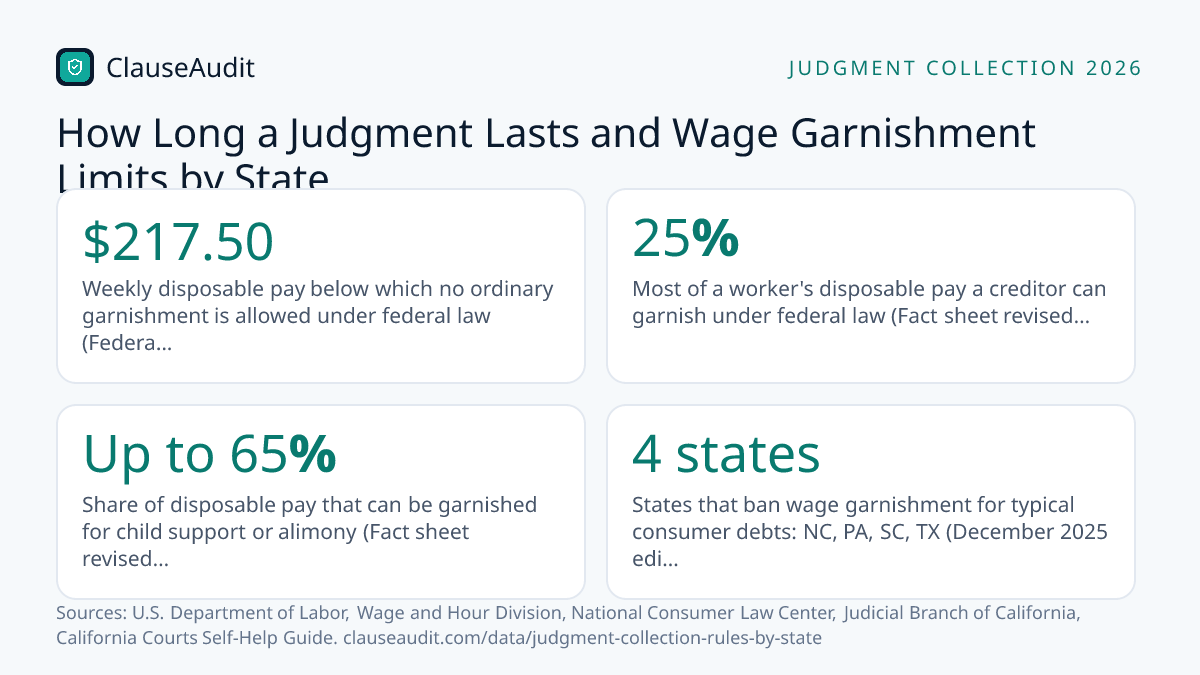
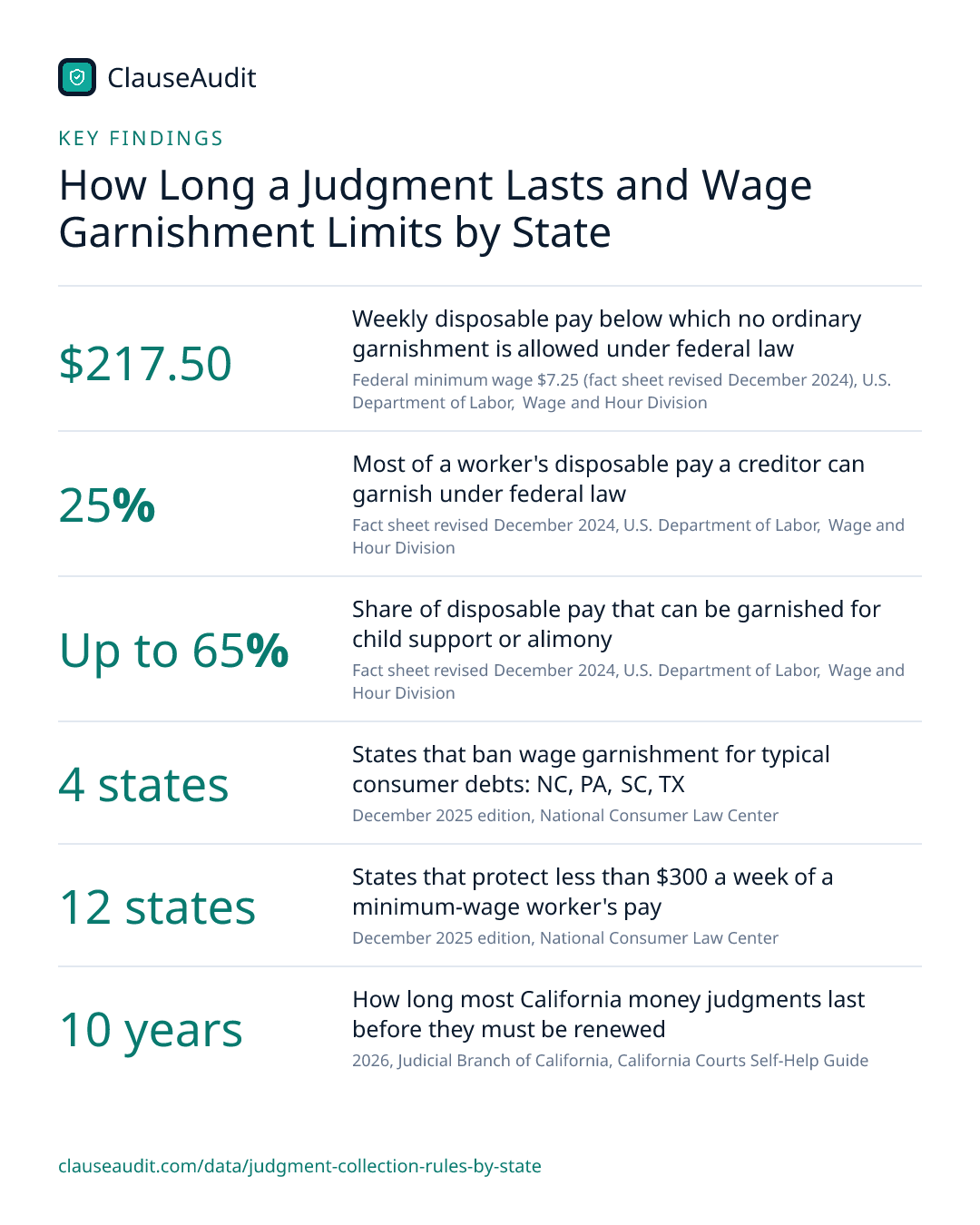
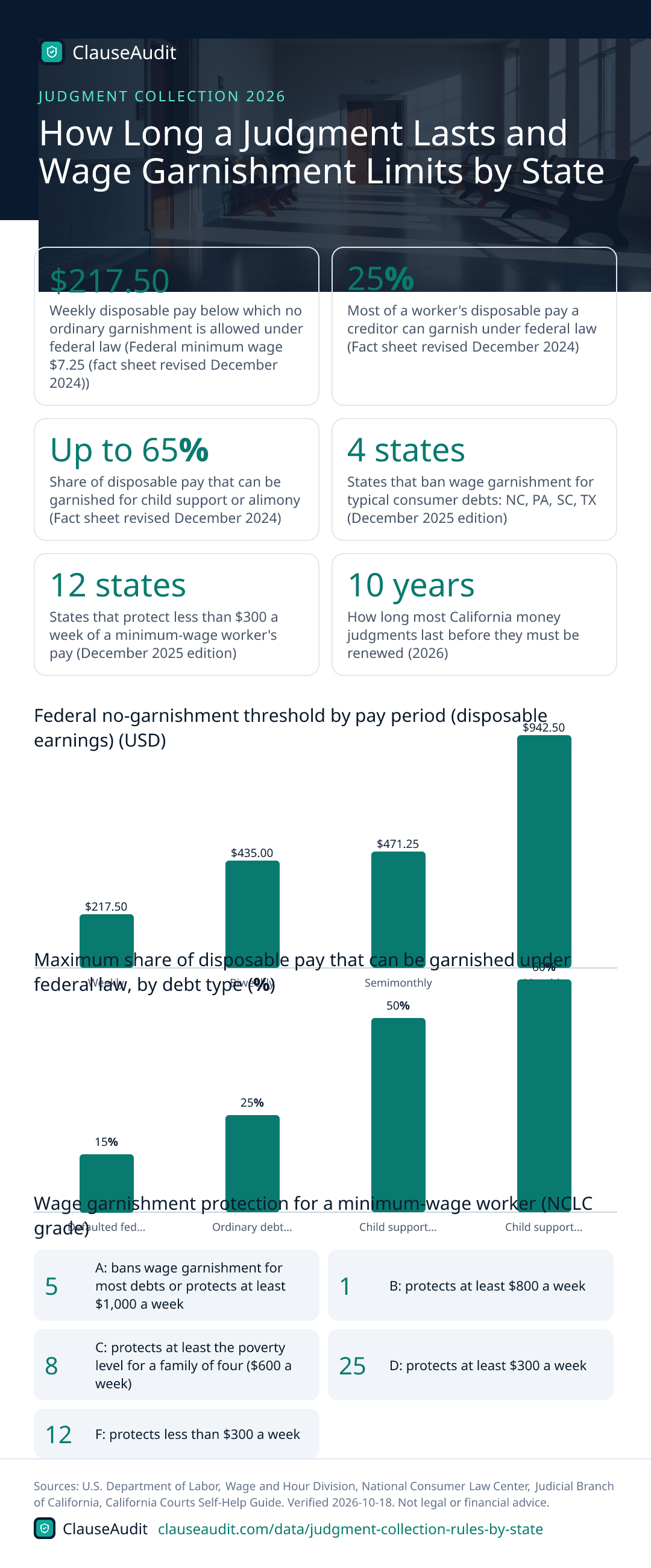
Federal law caps garnishment for ordinary debts at 25% of disposable pay, and nothing can be taken if weekly disposable pay is $217.50 or less. States can protect more. Four states, North Carolina, Pennsylvania, South Carolina and Texas, bar wage garnishment for most consumer debts, while 12 states protect less than $300 a week for a minimum-wage worker.

- Weekly disposable pay below which no ordinary garnishment is allowed under federal law (Federal minimum wage $7.25 (fact sheet revised December 2024), U.S. Department of Labor, Wage and Hour Division)
- $217.50
- Most of a worker's disposable pay a creditor can garnish under federal law (Fact sheet revised December 2024, U.S. Department of Labor, Wage and Hour Division)
- 25%
- Share of disposable pay that can be garnished for child support or alimony (Fact sheet revised December 2024, U.S. Department of Labor, Wage and Hour Division)
- Up to 65%
- States that ban wage garnishment for typical consumer debts: NC, PA, SC, TX (December 2025 edition, National Consumer Law Center)
- 4 states
- States that protect less than $300 a week of a minimum-wage worker's pay (December 2025 edition, National Consumer Law Center)
- 12 states
- How long most California money judgments last before they must be renewed (2026, Judicial Branch of California, California Courts Self-Help Guide)
- 10 years
- When a New York money judgment is presumed paid (CPLR § 211(b), revision of 2020-04-17, New York State Senate (Open Legislation))
- 20 years
- Monthly wage garnishment rate in ADP payroll data, January 2024 (January 2024, ADP Research)
- 2.8%
Winning in court and getting paid are two separate jobs. A judgment says someone owes you money. It does not move a dollar. To collect, you usually go after wages, bank accounts or property, and each state sets its own limits on what you can reach and for how long.
This page pulls those rules together from both sides. If you are owed money, it shows what a judgment is worth in practice. If a creditor is coming after your paycheck, it shows how much of that check the law keeps safe for you.
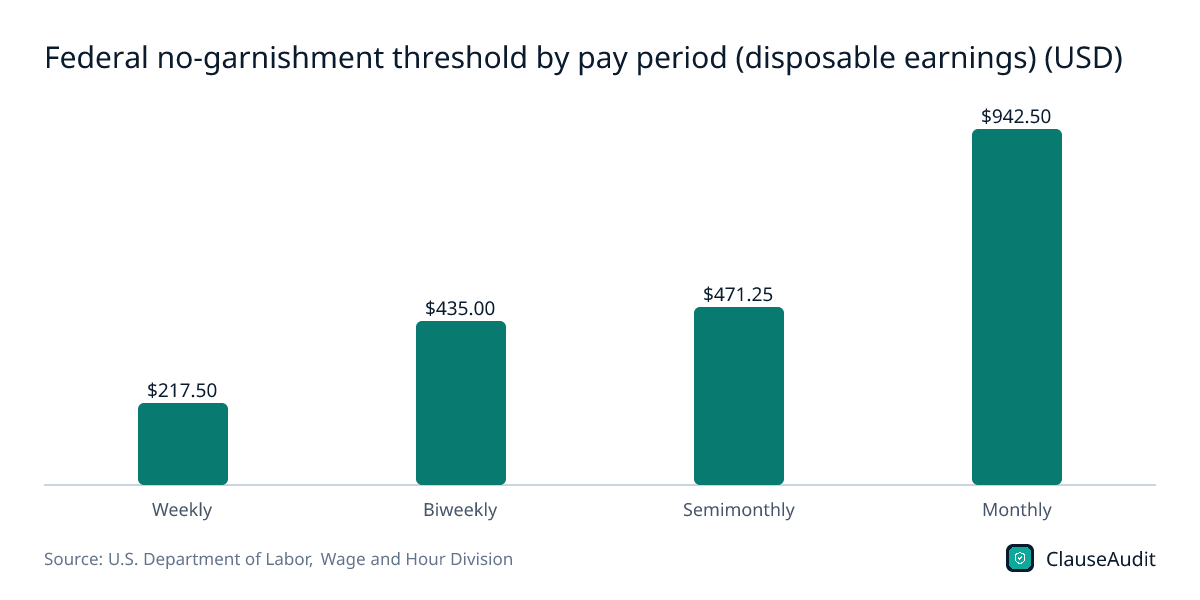
Federal no-garnishment threshold by pay period (disposable earnings) (USD)
Chart data
| Label | Value (USD) |
|---|---|
| Weekly | $217.50 |
| Biweekly | $435.00 |
| Semimonthly | $471.25 |
| Monthly | $942.50 |
These floors are 30 times the $7.25 federal minimum wage, scaled to each pay period. If your take-home after required deductions sits at or under the line for your pay schedule, an ordinary creditor gets nothing from that check.
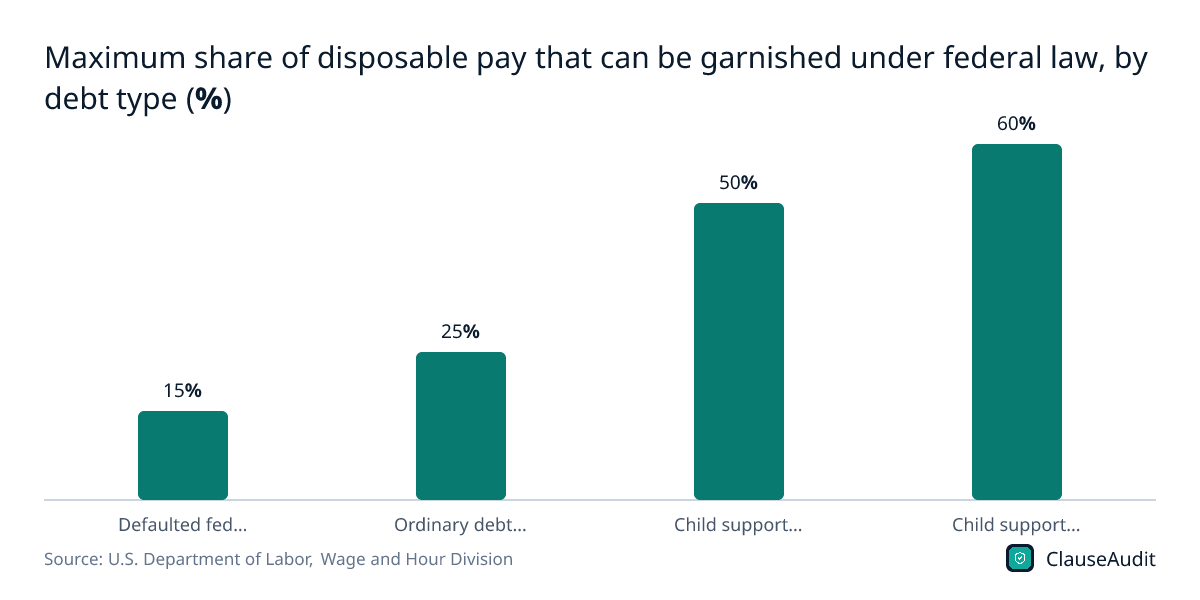
Download this chart (PNG)Maximum share of disposable pay that can be garnished under federal law, by debt type (%)
Chart data
| Label | Value (%) |
|---|---|
| Defaulted federal student loans | 15% |
| Ordinary debts (credit cards, medical bills) | 25% |
| Child support, worker supports another family | 50% |
| Child support, worker does not | 60% |
The cap depends on who is collecting. A credit card lender is held to 25%, while support orders can reach 50% or 60%, and tax levies sit outside these limits entirely.
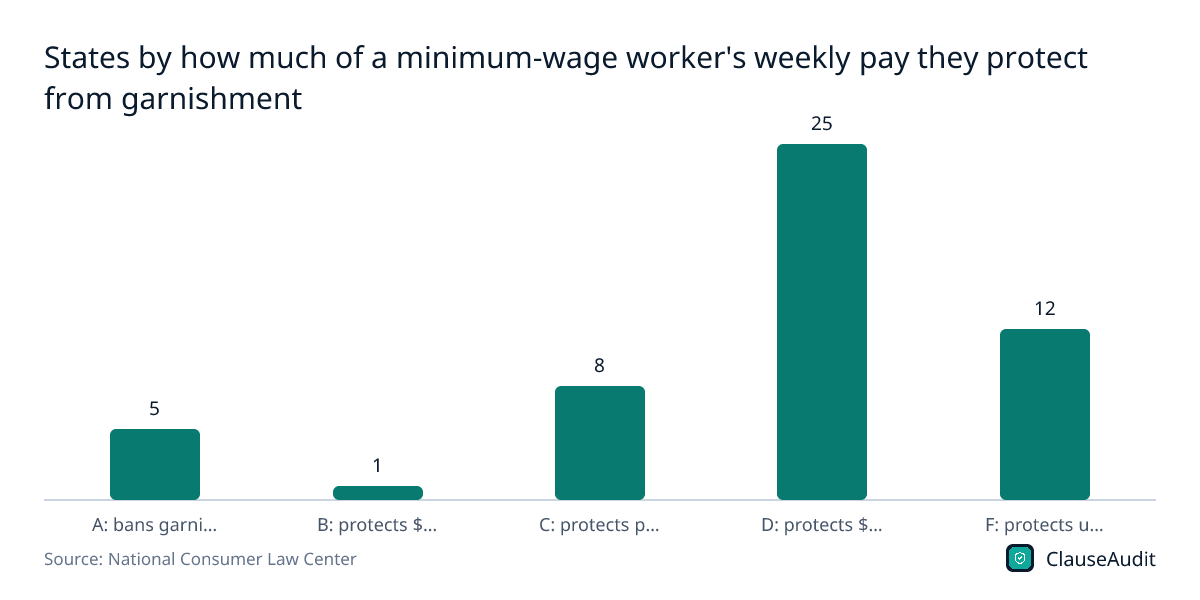
Download this chart (PNG)States by how much of a minimum-wage worker's weekly pay they protect from garnishment
Chart data
| Label | Value |
|---|---|
| A: bans garnishment or protects $1,000+ | 5 |
| B: protects $800+ | 1 |
| C: protects poverty level ($600+) | 8 |
| D: protects $300+ | 25 |
| F: protects under $300 | 12 |
The D group is the largest, at 25 states. Those protect at least $300 a week but less than the $600 poverty line for a family of four. Only 5 states earn an A.
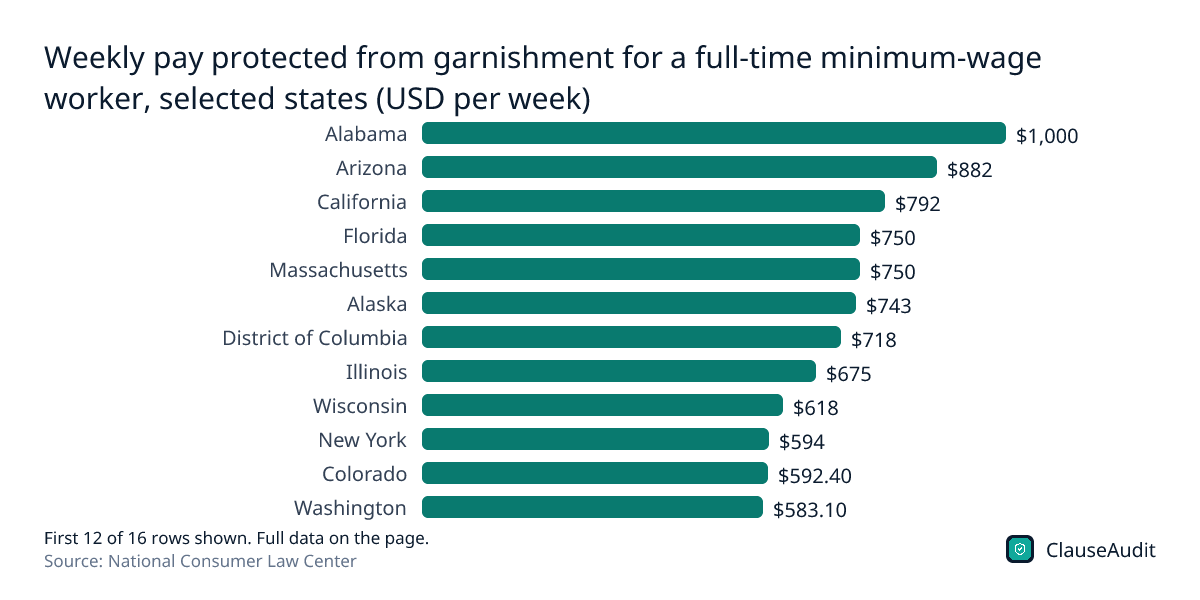
Download this chart (PNG)Weekly pay protected from garnishment for a full-time minimum-wage worker, selected states (USD per week)
Chart data
| Label | Value |
|---|---|
| Alabama | $1,000 |
| Arizona | $882 |
| California | $792 |
| Florida | $750 |
| Massachusetts | $750 |
| Alaska | $743 |
| District of Columbia | $718 |
| Illinois | $675 |
| Wisconsin | $618 |
| New York | $594 |
| Colorado | $592.40 |
| Washington | $583.10 |
| New Jersey | $557.64 |
| Michigan | $374.40 |
| Ohio | $321 |
| Georgia | $217.50 |
The spread is wide. Alabama protects up to $1,000 a week for a full-time minimum-wage worker. Georgia protects just $217.50.
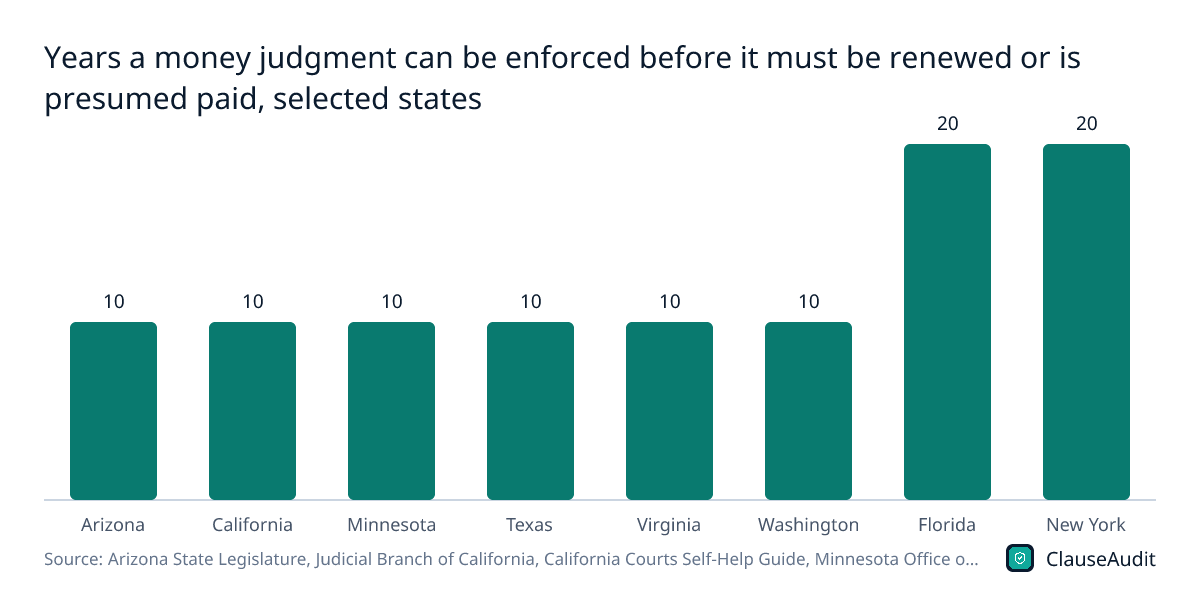
Download this chart (PNG)Years a money judgment can be enforced before it must be renewed or is presumed paid, selected states
Chart data
| Label | Value |
|---|---|
| Arizona | 10 |
| California | 10 |
| Minnesota | 10 |
| Texas | 10 |
| Virginia | 10 |
| Washington | 10 |
| Florida | 20 |
| New York | 20 |
Ten years is the common starting point. Missing a renewal deadline can end your right to collect, so put the date on a calendar the day the judgment is entered.
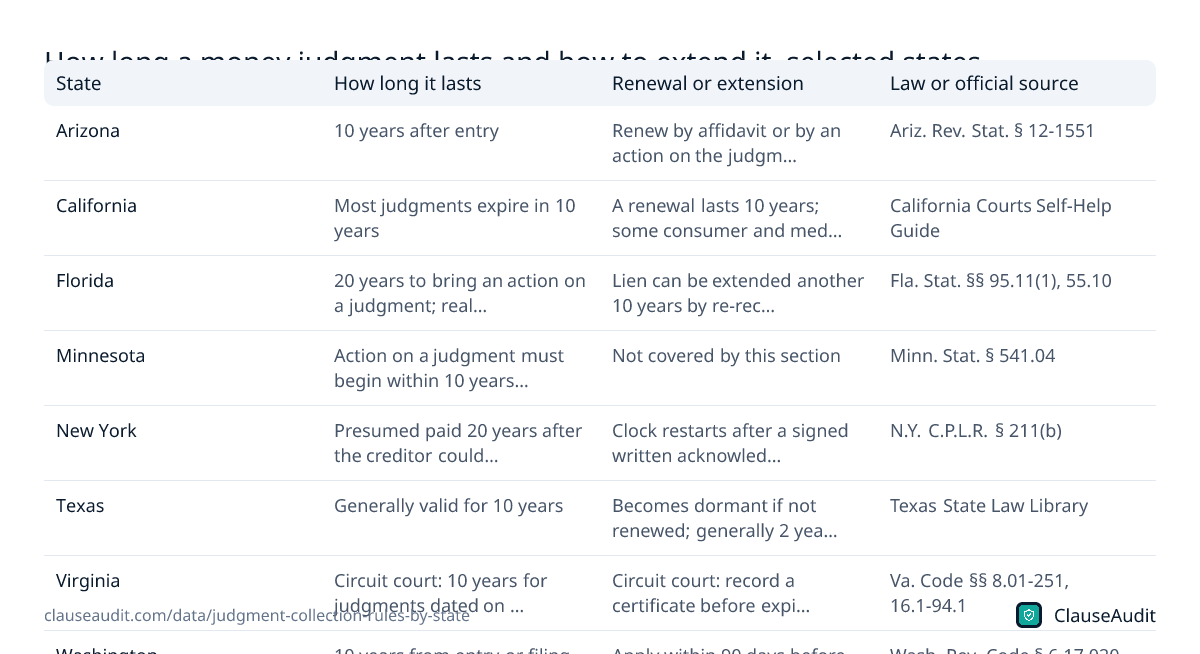
Download this chart (PNG)How long a money judgment lasts and how to extend it, selected states
| State | How long it lasts | Renewal or extension | Law or official source |
|---|---|---|---|
| Arizona | 10 years after entry | Renew by affidavit or by an action on the judgment within 10 years of entry or of the last renewal | Ariz. Rev. Stat. § 12-1551 |
| California | Most judgments expire in 10 years | A renewal lasts 10 years; some consumer and medical debt judgments against individuals can be renewed only once, for 5 years | California Courts Self-Help Guide |
| Florida | 20 years to bring an action on a judgment; real property lien lasts 10 years | Lien can be extended another 10 years by re-recording with an address affidavit before it expires | Fla. Stat. §§ 95.11(1), 55.10 |
| Minnesota | Action on a judgment must begin within 10 years after entry | Not covered by this section | Minn. Stat. § 541.04 |
| New York | Presumed paid 20 years after the creditor could first enforce it | Clock restarts after a signed written acknowledgment or a payment | N.Y. C.P.L.R. § 211(b) |
| Texas | Generally valid for 10 years | Becomes dormant if not renewed; generally 2 years to revive a dormant judgment | Texas State Law Library |
| Virginia | Circuit court: 10 years for judgments dated on or after July 1, 2021 (20 years for child support judgments); 20 years for older judgments. General district court: 10 years from the judgment date (Va. Code § 16.1-94.1) | Circuit court: record a certificate before expiry for 10 more years; one additional 10-year extension allowed. General district court judgments entered before July 1, 2026 can be extended by docketing in circuit court; for those entered on or after July 1, 2026, a debt buyer is held to the 10-year period even if docketed (2026 Va. Acts c. 848) | Va. Code §§ 8.01-251, 16.1-94.1 |
| Washington | 10 years from entry or filing in the state | Apply within 90 days before the 10 years end for an additional 10 years | Wash. Rev. Code § 6.17.020 |
Source: Arizona State Legislature, A.R.S. § 12-1551, Issuance of writ of execution; limitation; renewal; Judicial Branch of California, California Courts Self-Help Guide, Renew a civil judgment; The Florida Legislature, Florida Statutes § 95.11, Limitations other than for the recovery of real property; The Florida Legislature, Florida Statutes § 55.10, Judgments, orders, and decrees; lien of all, generally; extension of liens; Minnesota Office of the Revisor of Statutes, Minnesota Statutes § 541.04, Judgments, ten years; New York State Senate (Open Legislation), N.Y. Civil Practice Law and Rules § 211, Actions to be commenced within twenty years; Texas State Law Library, Small Claims Cases: Collecting a Judgment; Virginia General Assembly (Legislative Information System), Code of Virginia § 8.01-251, Limitations on enforcement of judgments; Washington State Legislature, RCW 6.17.020, Execution authorized within 10 years; Virginia General Assembly (Legislative Information System), Code of Virginia § 16.1-94.1, Limitations on enforcement of general district court judgments. Download as image
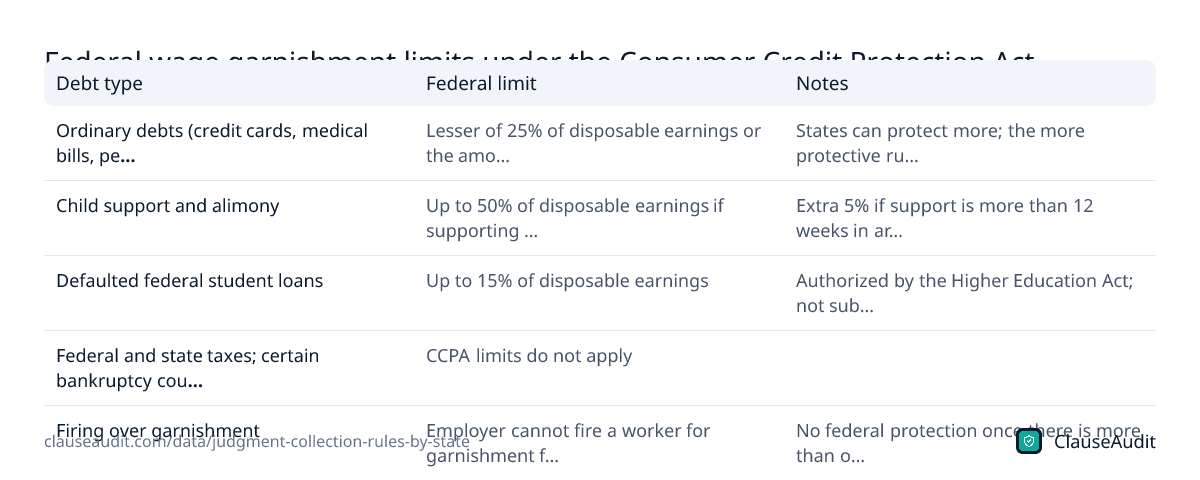
Federal wage garnishment limits under the Consumer Credit Protection Act
| Debt type | Federal limit | Notes |
|---|---|---|
| Ordinary debts (credit cards, medical bills, personal loans) | Lesser of 25% of disposable earnings or the amount above 30 times the federal minimum wage ($217.50 a week) | States can protect more; the more protective rule applies |
| Child support and alimony | Up to 50% of disposable earnings if supporting another spouse or child; up to 60% if not | Extra 5% if support is more than 12 weeks in arrears |
| Defaulted federal student loans | Up to 15% of disposable earnings | Authorized by the Higher Education Act; not subject to state garnishment laws |
| Federal and state taxes; certain bankruptcy court orders | CCPA limits do not apply | |
| Firing over garnishment | Employer cannot fire a worker for garnishment for any one debt | No federal protection once there is more than one debt |
Source: U.S. Department of Labor, Wage and Hour Division, Fact Sheet #30: Wage Garnishment Protections of the Consumer Credit Protection Act (CCPA). Download as image
Wage garnishment protection for a minimum-wage worker (NCLC grade) by state
- 5A: bans wage garnishment for most debts or protects at least $1,000 a week
- 1B: protects at least $800 a week
- 8C: protects at least the poverty level for a family of four ($600 a week)
- 25D: protects at least $300 a week
- 12F: protects less than $300 a week
- A: bans wage garnishment for most debts or protects at least $1,000 a week5
- B: protects at least $800 a week1
- C: protects at least the poverty level for a family of four ($600 a week)8
- D: protects at least $300 a week25
- F: protects less than $300 a week12
| State | What state law protects | Weekly pay protected (full-time minimum-wage worker) | Source |
|---|---|---|---|
| Alabama | Statute protects only the federal minimum (75% of wages or 30 times the federal minimum wage), but a $1,000 state constitutional wildcard has been applied to wages (Renter's Realty v. Smith) | $1,000 | Ala. Const. Art. X, § 204 |
| Alaska | $743 protected (adjusted biennially for inflation) if the debtor is the sole support of a household | $743 | Alaska Stat. §§ 09.38.030, 09.38.050; Alaska Admin. Code tit. 8, § 95.030 |
| Arizona | 60 times the applicable minimum wage (federal, state or local, whichever is highest) or 90% of wages; can rise to 95% for extreme economic hardship | $882 | Ariz. Rev. Stat. Ann. §§ 12-1598.10(F), 33-1131 |
| Arkansas | Federal minimum only: 75% of wages or 30 times the federal minimum wage | $330 | Ark. Code Ann. § 16-66-208 |
| California | 80% of disposable earnings or 48 times the state minimum wage; above that, 40% of the excess over 48 times the state minimum wage can be taken | $792 | Cal. Civ. Proc. Code § 706.050 |
| Colorado | 40 times the state minimum wage or 80% of disposable income, whichever is greater | $592.40 | Colo. Rev. Stat. § 13-54-104 |
| Connecticut | 75% of wages or 40 times the state minimum wage | $654 | Conn. Gen. Stat. § 52-361a(f) |
| Delaware | 85% of wages | $450.50 (as printed in NCLC table) | Del. Code Ann. tit. 10, § 4913 |
| District of Columbia | 40 times the D.C. minimum wage; above that, the creditor can garnish 25% of wages over that amount; more can be exempted for undue hardship | $718 | D.C. Code §§ 16-572, 16-572a |
| Florida | For a head of household, the first $750 a week is exempt; amounts over $750 can be garnished only if the debtor agreed in writing | $750 | Fla. Stat. § 222.11 |
| Georgia | Federal minimum only: 75% of wages or 30 times the federal minimum wage | $217.50 | Ga. Code Ann. § 18-4-5 |
| Hawaii | All but 5% of the first $100 of wages, all but 10% of the next $100, and all but 20% of the rest | $473 | Haw. Rev. Stat. § 652-1(a)(4) |
| Idaho | Federal minimum only: 75% of wages or 30 times the federal minimum wage | $217.50 | Idaho Code Ann. §§ 11-207, 11-712 |
| Illinois | 85% of gross wages or 45 times the federal or state minimum wage | $675 | 735 Ill. Comp. Stat. § 5/12-803; 740 Ill. Comp. Stat. § 170/4 |
| Indiana | Federal minimum (75% of wages or 30 times the federal minimum wage); garnishment can be cut to as low as 10% of wages for good cause | $217.50 | Ind. Code § 24-4.5-5-105 |
| Iowa | For consumer contract debts, 75% of disposable earnings or 40 times the federal minimum wage, plus an annual cap ($1,500 a year for a debtor at the poverty level); can be reduced for hardship | $290 | Iowa Code §§ 537.5105, 642.21 |
| Kansas | Federal minimum only: 75% of wages or 30 times the federal minimum wage | $217.50 | Kan. Stat. Ann. § 60-2310 |
| Kentucky | Federal minimum only: 75% of wages or 30 times the federal minimum wage | $217.50 | Ky. Rev. Stat. Ann. § 427.010 |
| Louisiana | Federal minimum only: 75% of wages or 30 times the federal minimum wage | $217.50 | La. Rev. Stat. Ann. § 13:3881 |
| Maine | 75% of wages or 40 times the state or federal minimum wage, whichever is higher | $586 | Me. Rev. Stat. Ann. tit. 9-A, § 5-105(2) |
| Maryland | 75% of wages or 30 times the state minimum wage | $450 | Md. Code Ann., Com. Law § 15-601.1 |
| Massachusetts | 85% of gross wages or 50 times the greater of the federal or state minimum wage | $750 | Mass. Gen. Laws ch. 246, § 28 |
| Michigan | Federal minimum only: 75% of wages or 30 times the federal minimum wage | $374.40 | Mich. Comp. Laws § 600.5311 |
| Minnesota | 40 times the state minimum wage, with the garnishable share rising as income rises | $445 | Minn. Stat. §§ 550.37(13), 571.922 |
| Mississippi | Federal minimum only: 75% of wages or 30 times the federal minimum wage | $217.50 | Miss. Code Ann. § 85-3-4 |
| Missouri | 90% of wages for a head of family | $495 | Mo. Rev. Stat. § 525.030 |
| Montana | Federal minimum only: 75% of wages or 30 times the federal minimum wage | $317 | Mont. Code Ann. § 25-13-614 |
| Nebraska | 85% of wages for a head of household | $459 | Neb. Rev. Stat. § 25-1558 |
| Nevada | 82% of wages or 50 times the federal minimum wage | $393.60 | Nev. Rev. Stat. §§ 22.090(1)(g), 31.295 |
| New Hampshire | 50 times the federal minimum wage | $362.50 | N.H. Rev. Stat. Ann. § 512:21 |
| New Jersey | 90% of wages if income is under 250% of the poverty level | $557.64 | N.J. Stat. Ann. § 2A:17-56 |
| New Mexico | 75% of wages or 40 times the highest applicable minimum wage | $480 | N.M. Stat. Ann. § 35-12-7 |
| New York | 90% of gross wages or 30 times the federal or state minimum wage; no wage seizure from people on (or who would qualify for) public assistance | $594 | N.Y. C.P.L.R. § 5231; N.Y. Soc. Serv. Law § 137-a |
| North Carolina | Wages earned in the previous 60 days are exempt if needed to support the debtor's family | All wages exempt | N.C. Gen. Stat. § 1-362 |
| North Dakota | 75% of wages or 40 times the federal minimum wage, plus $20 per dependent | $330 | N.D. Cent. Code § 32-09.1-03 |
| Ohio | Federal minimum only: 75% of wages or 30 times the federal minimum wage | $321 | Ohio Rev. Code Ann. § 2329.66(A)(13) |
| Oklahoma | Federal minimum (75% of wages or 30 times the federal minimum wage); a court can protect more for hardship | $217.50 | Okla. Stat. Ann. tit. 12, § 1171.1; tit. 31, §§ 1(18), 1.1 |
| Oregon | The greater of 75% of wages or a minimum weekly floor that rises each July 1 ($400 a week for wages payable July 1, 2026 to June 30, 2027, for most debts) | $489 | Or. Rev. Stat. § 18.385 |
| Pennsylvania | All wages exempt for most debts, with an exception for residential lease debts (up to 10% of net wages, not below the poverty line) | All wages exempt for most debts | 42 Pa. Cons. Stat. Ann. § 8127 |
| Rhode Island | Federal minimum (75% of wages or 30 times the federal minimum wage); no wage seizure for one year after receiving public assistance | $450 | R.I. Gen. Laws § 9-26-4 |
| South Carolina | Earnings for personal services cannot be applied to a judgment debt | All wages exempt | S.C. Code Ann. §§ 15-39-410, 15-39-420 |
| South Dakota | 80% of wages, or 40 times the federal or state minimum wage, plus $25 per dependent | $510 | S.D. Codified Laws § 21-18-51 |
| Tennessee | 75% of wages or 30 times the federal minimum wage, plus $2.50 a week for each dependent child under 16 | $222.50 | Tenn. Code Ann. §§ 26-2-106, 26-2-107 |
| Texas | Current wages are exempt from seizure except for child support | All wages exempt | Tex. Prop. Code Ann. § 42.001 |
| Utah | Federal minimum only: 75% of wages or 30 times the federal minimum wage | $217.50 | Utah Code Ann. § 70C-7-103(2) |
| Vermont | For consumer credit debts, 85% of wages or 40 times the federal minimum wage; more if the debtor shows need | $476.34 | Vt. Stat. Ann. tit. 12, § 3170 |
| Virginia | 75% of wages or 40 times the federal or state minimum wage, plus $34 to $66 a week for dependent children if household income is $1,750 a month or less | $496 | Va. Code Ann. §§ 34-29(a), 34-4.2 |
| Washington | For consumer debts, 80% of disposable earnings or 35 times the state minimum wage; otherwise 75% of wages or 35 times the state minimum wage | $583.10 | Wash. Rev. Code § 6.27.150 |
| West Virginia | 80% of wages or 50 times the federal minimum wage; more for hardship on consumer credit sale, lease or loan debts | $362.50 | W. Va. Code §§ 38-5A-3, 38-5A-6, 46A-2-130 |
| Wisconsin | The federal poverty amount for the family's size is exempt; wage seizure can also be reduced for hardship | $618 | Wis. Stat. §§ 812.34, 812.38 |
| Wyoming | Federal minimum only: 75% of wages or 30 times the federal minimum wage | $217.50 | Wyo. Stat. Ann. §§ 1-15-408, 1-15-511 |
How much of my paycheck can be garnished?
Start with disposable earnings: your pay after legally required deductions like taxes and Social Security. Voluntary deductions such as health premiums or retirement contributions do not come off first.
For ordinary debts like credit cards and medical bills, federal law lets a creditor take the lesser of two amounts: 25% of disposable earnings, or whatever you earn above $217.50 a week. For most full-time workers, the 25% figure is the smaller one, so that is what gets taken.
The second test matters for people with low pay. If your weekly disposable earnings sit only a little above $217.50, the creditor can take just the slice above that line, which may be far less than a quarter of your check. At $217.50 or below, the answer is zero. Paid every two weeks? The floor doubles to $435.
Your state can only make this kinder to you, never harsher. When the state and federal rules differ, the one that protects more of your pay wins. Child support, defaulted federal student loans and tax debts follow their own rules, covered below.
Which states do not allow wage garnishment?
North Carolina, Pennsylvania, South Carolina and Texas bar wage garnishment for most consumer debts. In Texas, current wages are exempt except for court-ordered child support and spousal maintenance. Pennsylvania carves out residential lease debts, so a landlord there can still reach part of a tenant's pay.
At the other end, 12 states protect less than $300 a week for a minimum-wage worker, and 8 of those protect only the federal floor of $217.50. Georgia, Idaho, Kansas and Utah are in that group.
A few states sit in between with generous but conditional rules. Florida protects the first $750 a week for a head of household, and amounts above that can be taken only if the worker agreed in writing. That written-consent piece matters. Florida requires that waiver to be a separate signed document attached to the contract, in large type. If a lender hands you one, know that signing it lets a creditor take more of your pay later.
How long does a judgment last?
In most states the answer starts at 10 years. Arizona, California, Minnesota, Texas and Washington all use 10 years as the first period. New York presumes a judgment paid after 20 years, and Florida gives you 20 years to bring an action on one, though its lien on real property lasts 10.
The renewal steps are where creditors lose money. California lets you renew for another 10 years, but some consumer and medical debt judgments against individuals can be renewed only once, for 5 years. Washington wants your application within 90 days before the 10 years run out. A Texas judgment that goes unrenewed becomes dormant, and you generally have 2 years to revive it.
In New York, a payment or a signed written acknowledgment restarts the 20-year clock. If you are the debtor, know that sending even a small payment can extend how long the judgment hangs over you.
What this means if a client owes you money, and what to do
Picture a designer in Texas who wins a judgment against a client who stopped paying. If that client is an individual, the designer cannot touch the client's wages for this kind of debt. Collection has to come from bank accounts or other assets, and some of those are protected too.
Now flip it. The same designer wins against a client who lives in Georgia and earns a steady paycheck. Garnishment there can reach the full federal limit, which makes the judgment far easier to turn into cash.
So where your client lives, and whether they are a person or a company, shapes what a win is worth. A judgment against a business with a bank account is usually easier to collect than one against a person whose income is shielded. That is a good reason to sign with the business entity, check who is actually on the contract and ask for a deposit before work starts.
- Before signing, confirm the legal name of the party paying you. A judgment against the wrong entity is worth nothing.
- Ask for a deposit or milestone payments so less money is ever at risk.
- Put a clear late fee and payment deadline in writing, so you have a dated breach to point to in court.
- After judgment, find out which state's rules apply where the debtor works and banks, since that state's exemptions usually control.
- Calendar the renewal deadline right away. Missing it can wipe out years of collection rights.
What should you do if your wages are being garnished?
First, read the notice from the court or your employer closely. It will usually say who the creditor is, how much is owed and how to claim an exemption. Deadlines for asking for a hearing can be short, so do not set it aside.
Next, check the math on your pay stub. Your employer has to apply the federal limit or your state's limit, whichever leaves you with more. Payroll mistakes happen, especially when someone moves between states or changes pay schedules.
Then look at your state's hardship rules. Iowa, Vermont and West Virginia, for example, let a debtor show need and keep more pay in some cases. A local legal aid office can often help you file the claim for free.
Finally, check whether the judgment is still alive. If the creditor let the renewal deadline pass, they may have lost the right to collect.
Child support, student loans and taxes play by different rules
The federal caps change with the type of debt. Child support and alimony can take up to 50% of disposable pay if you support another spouse or child, or 60% if you do not. Add another 5% when support is more than 12 weeks behind, which brings the ceiling to 55% or 65%.
Defaulted federal student loans can be collected at up to 15% under the Higher Education Act, and state garnishment laws do not limit them. Federal and state tax levies are not bound by these caps at all.
One more protection people miss: your employer cannot fire you because your wages are garnished for any one debt. That federal protection ends once there is a second debt.
How ClauseAudit helps you get paid without a fight
A judgment is the last resort, and as these rules show, it can be slow and hard to collect. The cheaper fix is a contract that makes nonpayment unlikely and easy to prove.
Upload your client agreement and the automated review flags weak payment language, explains it in plain English and suggests stronger wording before you sign.
- Who the paying party is, including the exact legal entity name
- Payment terms, due dates and whether payment depends on vague approval
- Deposit, milestone and kill fee terms that limit how much you have at risk
- Late fee and interest language, and whether it is spelled out
- Governing law and venue, which decide where you would have to sue
- Attorney's fees and collection cost clauses that shift the cost of chasing payment
Frequently asked questions
What is the maximum wage garnishment under federal law?
For ordinary debts like credit cards and medical bills, the most a creditor can take is the lesser of 25% of your disposable earnings or the amount you earn above $217.50 a week. If your weekly disposable pay is $217.50 or less, nothing can be taken. States can set lower limits, and the more protective rule applies.
Can my whole paycheck be garnished?
Not for ordinary consumer debts. Federal law always protects at least 75% of your disposable pay, and more if you earn little. Child support is the big exception, where up to 65% can be taken in the worst case. Tax levies are also outside the usual caps, so they can reach more.
Does a judgment ever expire?
Yes, but often not quickly. Many states start with 10 years, and New York presumes a judgment paid after 20. Many states let the creditor renew before the deadline, so a judgment can stay alive for decades if the creditor keeps up with the paperwork. If they miss the window, the right to collect can end.
How long is a judgment good for in California?
Most California money judgments last 10 years and can be renewed for another 10. Some consumer and medical debt judgments against individuals are treated differently: they can be renewed only once, and that renewal lasts 5 years. The creditor has to file the renewal before the original period runs out.
Can I garnish wages in Texas to collect an unpaid invoice?
Generally no. Texas exempts current wages from seizure except for court-ordered child support and spousal maintenance, so a freelancer or small business with a judgment against an individual has to look at bank accounts or other non-exempt assets instead. A judgment against a company is often easier to collect because a business has no wage exemption to claim.
Does making a payment restart the clock on a judgment?
In some states, yes. In New York, a payment or a signed written acknowledgment of the debt restarts the 20-year period before a judgment is presumed paid. If you owe on an old judgment, ask a lawyer or legal aid office before sending money or signing anything that admits the debt.
Can I be fired because my wages are being garnished?
Federal law says your employer cannot fire you because your pay is garnished for one debt. That protection stops once there is garnishment for more than one debt. If you think you were let go because of a garnishment, contact the U.S. Labor Department's Wage and Hour Division or your state labor office.
How common is wage garnishment?
In ADP payroll data covering more than 57 million people, the monthly garnishment rate was 2.8% in January 2024. It peaked at 3.9% in March 2020. The data covers November 2018 through February 2024.
Use this data
Every chart and card below is free to reuse under CC BY 4.0. Download what you need and link back to this page.
 Stat cards
 Key findings card
 Infographic
 Federal no-garnishment threshold by pay period (disposable earnings) (USD)
 Maximum share of disposable pay that can be garnished under federal law, by debt type (%)
 States by how much of a minimum-wage worker's weekly pay they protect from garnishment
 Weekly pay protected from garnishment for a full-time minimum-wage worker, selected states (USD per week)
 Years a money judgment can be enforced before it must be renewed or is presumed paid, selected states
 How long a money judgment lasts and how to extend it, selected states
 Federal wage garnishment limits under the Consumer Credit Protection Act
Embed the infographic
Free to share on your site, blog or slides under CC BY 4.0. Please keep the credit link.
Sources and method
Every number on this page comes from the sources below, each opened and read on or before October 18, 2026. A second, independent review checked every figure against its source and corrected anything that did not match. 51 of 51 state entries were confirmed; any that could not be are marked "Not yet confirmed" and left out of every count and chart.
- U.S. Department of Labor, Wage and Hour Division, Fact Sheet #30: Wage Garnishment Protections of the Consumer Credit Protection Act (CCPA) (Revised December 2024)
- National Consumer Law Center, No Fresh Start: Will States Protect Families from Wage and Asset Seizures as Debt Levels Soar? (2025) (December 2025)
- ADP Research, Wage garnishments were on the rise. Then the pandemic hit. (September 10, 2024)
- Judicial Branch of California, California Courts Self-Help Guide, Renew a civil judgment (Current page as read 2026-10-18 (no revision date shown))
- Texas State Law Library, Small Claims Cases: Collecting a Judgment (Last updated October 5, 2026)
- The Florida Legislature, Florida Statutes § 95.11, Limitations other than for the recovery of real property (2026 Florida Statutes)
- The Florida Legislature, Florida Statutes § 55.10, Judgments, orders, and decrees; lien of all, generally; extension of liens (2026 Florida Statutes)
- New York State Senate (Open Legislation), N.Y. Civil Practice Law and Rules § 211, Actions to be commenced within twenty years (Most recent revision 2020-04-17)
- Washington State Legislature, RCW 6.17.020, Execution authorized within 10 years (Current code as read 2026-10-18)
- Arizona State Legislature, A.R.S. § 12-1551, Issuance of writ of execution; limitation; renewal (Current code as read 2026-10-18)
- Virginia General Assembly (Legislative Information System), Code of Virginia § 8.01-251, Limitations on enforcement of judgments (Current code as read 2026-10-18)
- Minnesota Office of the Revisor of Statutes, Minnesota Statutes § 541.04, Judgments, ten years (Current statutes as read 2026-10-18 (last amended 2012))
- Virginia General Assembly (Legislative Information System), Code of Virginia § 16.1-94.1, Limitations on enforcement of general district court judgments (Current code as read 2026-10-18 (amended by 2026 Va. Acts c. 848))
- Oregon Department of Revenue, Garnishee information (minimum wage exemption amounts) (Amounts for wages payable July 1, 2026 through June 30, 2027, as read 2026-10-18)
Cite this page
ClauseAudit, “How Long a Judgment Lasts and Wage Garnishment Limits by State”, updated October 18, 2026, https://clauseaudit.com/data/judgment-collection-rules-by-state. Free to reuse with a link back (CC BY 4.0).
This page summarises published data and law as checked on October 18, 2026. Figures are updated as new editions are released, and your own situation may differ. It is general information, not legal, tax or financial advice.