Statute of Limitations for Breach of Contract by State: How Long You Have to Collect an Unpaid Invoice
By ClauseAudit Research · 32 sources ·
What is the breach of contract statute of limitations by state?
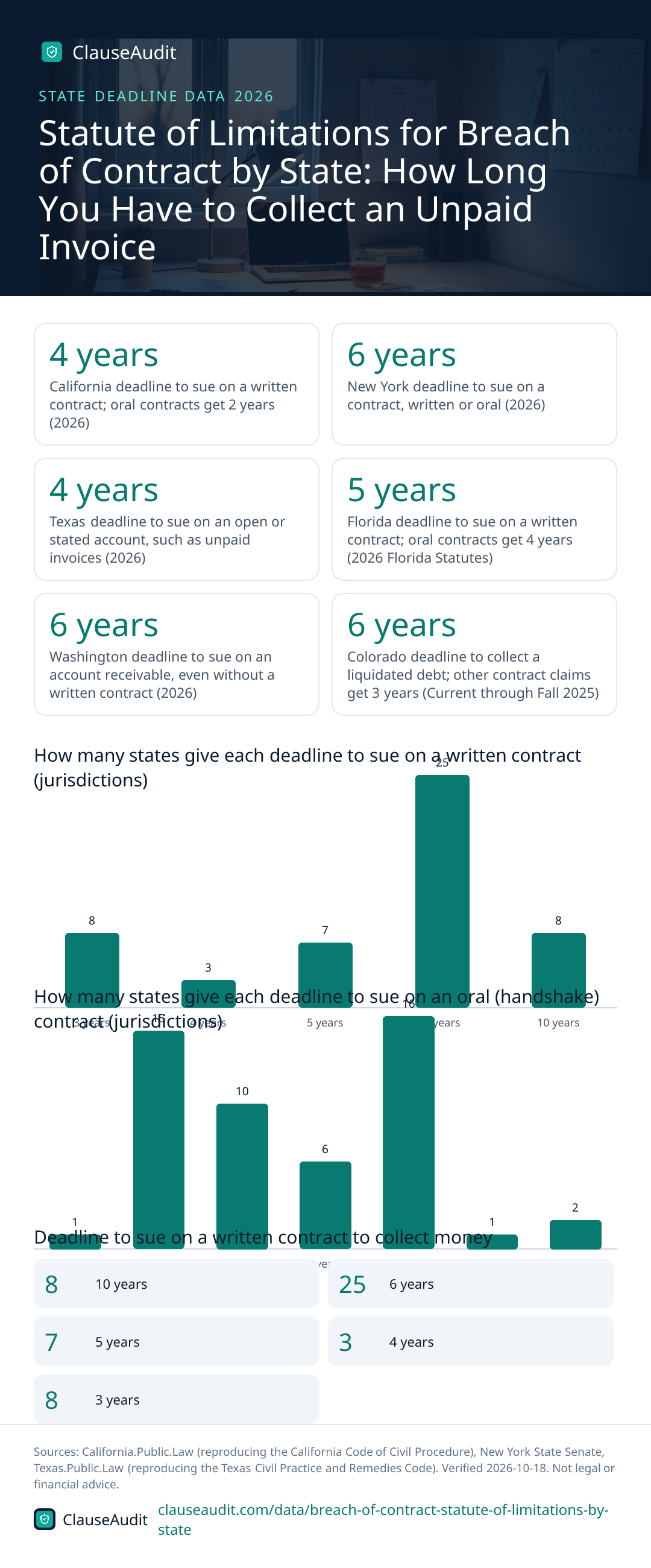
Six years is the most common deadline to sue on a written contract. It applies in 25 of 51 jurisdictions (the 50 states plus DC). Eight jurisdictions, including Delaware, allow only 3 years, and eight allow 10. Oral deals often get less time, as little as 2 years in California, so put payment terms in writing.

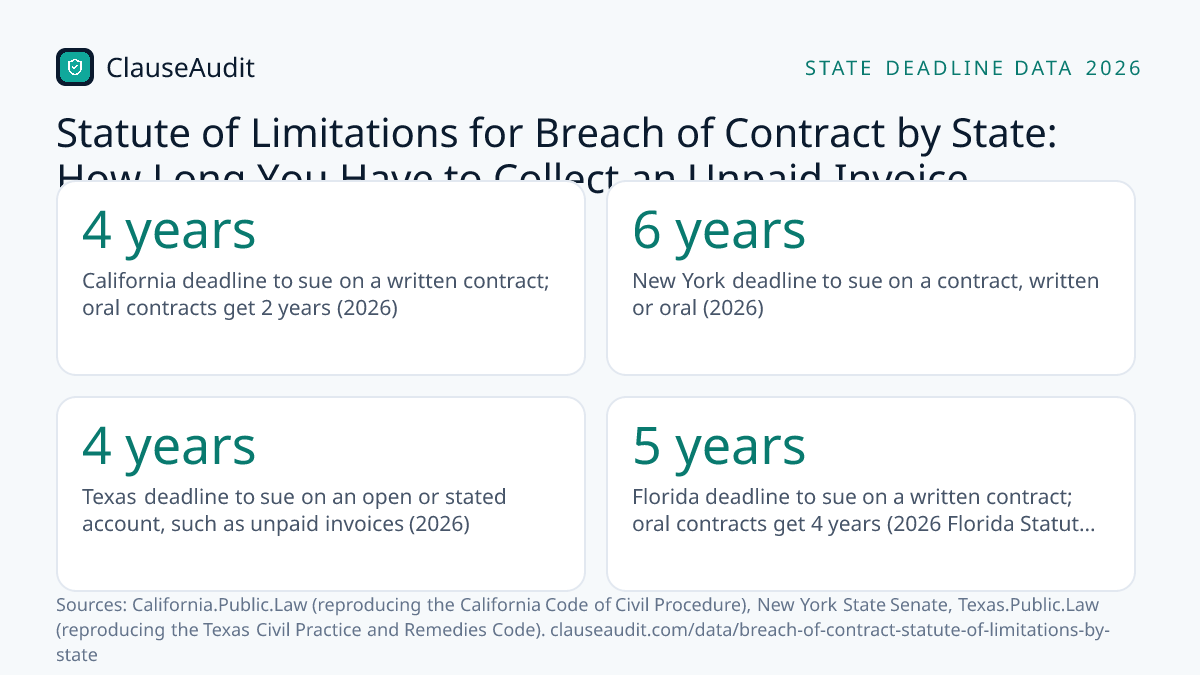
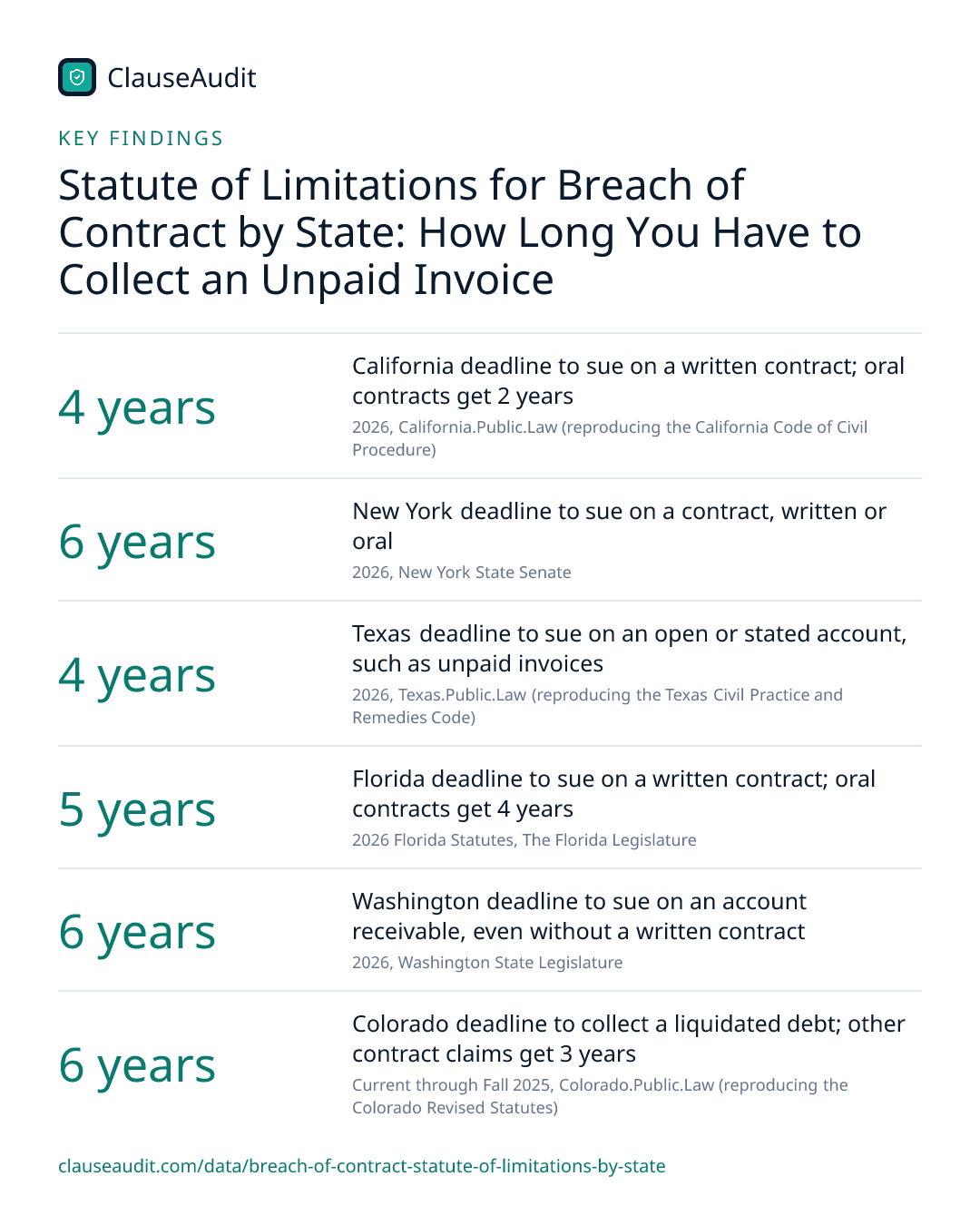
- California deadline to sue on a written contract; oral contracts get 2 years (2026, California.Public.Law (reproducing the California Code of Civil Procedure))
- 4 years
- New York deadline to sue on a contract, written or oral (2026, New York State Senate)
- 6 years
- Texas deadline to sue on an open or stated account, such as unpaid invoices (2026, Texas.Public.Law (reproducing the Texas Civil Practice and Remedies Code))
- 4 years
- Florida deadline to sue on a written contract; oral contracts get 4 years (2026 Florida Statutes, The Florida Legislature)
- 5 years
- Washington deadline to sue on an account receivable, even without a written contract (2026, Washington State Legislature)
- 6 years
- Colorado deadline to collect a liquidated debt; other contract claims get 3 years (Current through Fall 2025, Colorado.Public.Law (reproducing the Colorado Revised Statutes))
- 6 years
- Kentucky deadline to sue on a written contract signed after July 15, 2014 (Effective July 15, 2014, Kentucky General Assembly)
- 10 years
- Delaware deadline to sue on a promise or an unpaid debt, among the shortest (2026, State of Delaware, Delaware Code Online)
- 3 years
A client who stops answering your emails has not erased the debt. But the law does put a clock on it. Once the statute of limitations runs out, you can still ask for the money, but you can no longer make a court order anyone to pay it.
How long that clock runs depends on your state, whether the deal was in writing, and sometimes on whether the money is owed on an open account. The map and tables below show every deadline. This page explains how to read them and what to do before your time runs short.
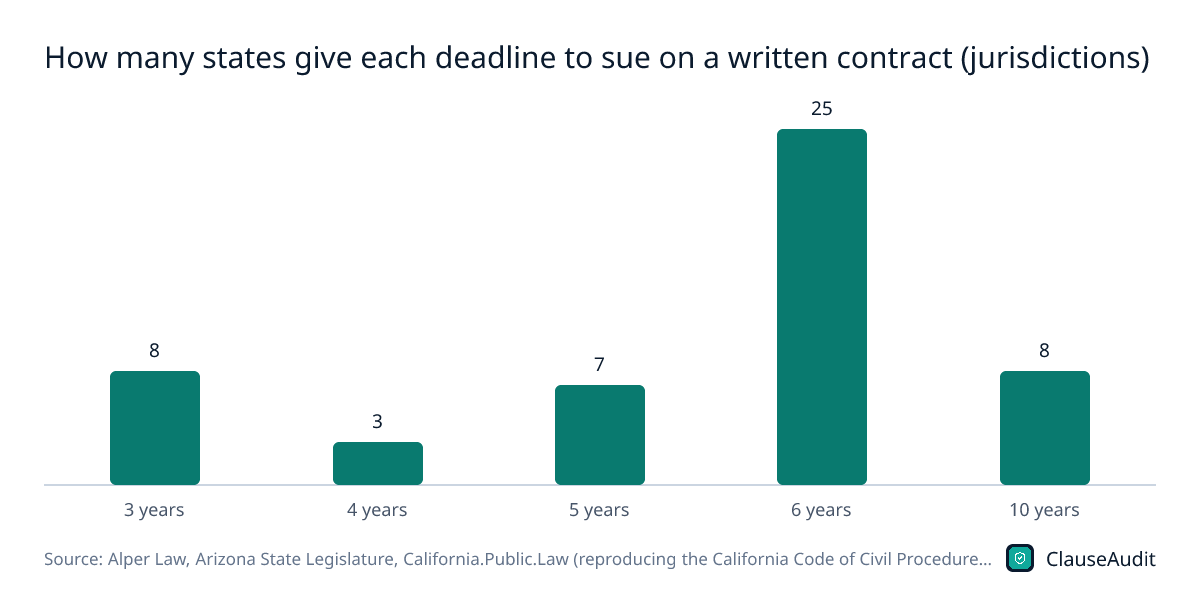
How many states give each deadline to sue on a written contract (jurisdictions)
Chart data
| Label | Value (jurisdictions) |
|---|---|
| 3 years | 8 |
| 4 years | 3 |
| 5 years | 7 |
| 6 years | 25 |
| 10 years | 8 |
Six years is the common answer, used by 25 jurisdictions. The two ends of the range are the ones that trip people up: 8 places give you only 3 years, while 8 others give you 10.
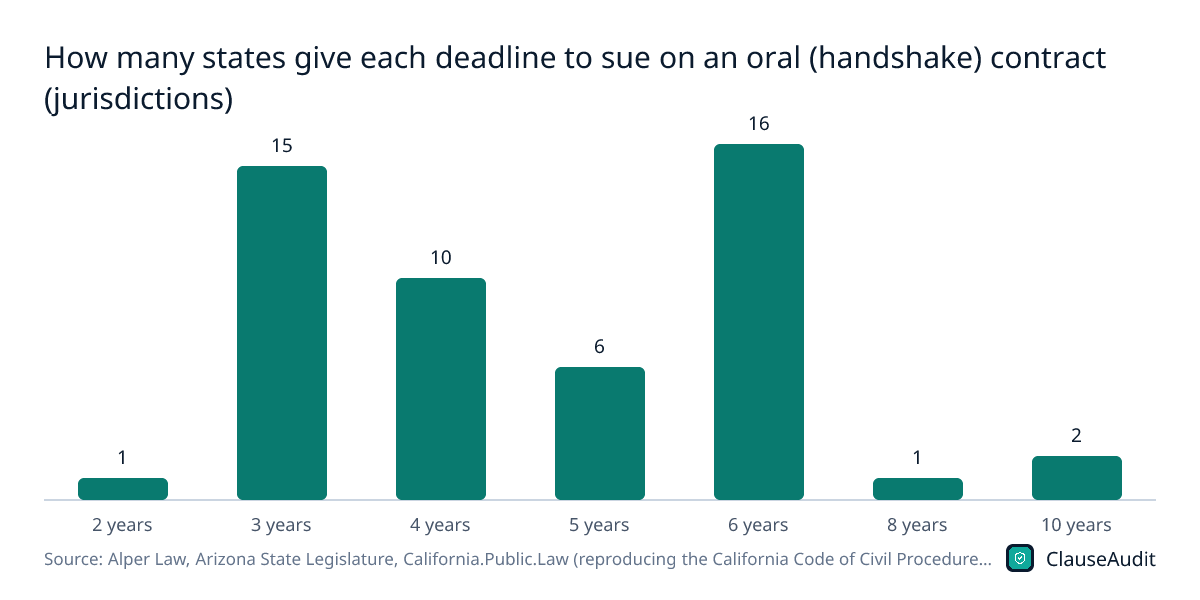
Download this chart (PNG)How many states give each deadline to sue on an oral (handshake) contract (jurisdictions)
Chart data
| Label | Value (jurisdictions) |
|---|---|
| 2 years | 1 |
| 3 years | 15 |
| 4 years | 10 |
| 5 years | 6 |
| 6 years | 16 |
| 8 years | 1 |
| 10 years | 2 |
Handshake deals spread out more widely. Fifteen jurisdictions use 3 years for an oral contract, and California sits alone at 2 years.
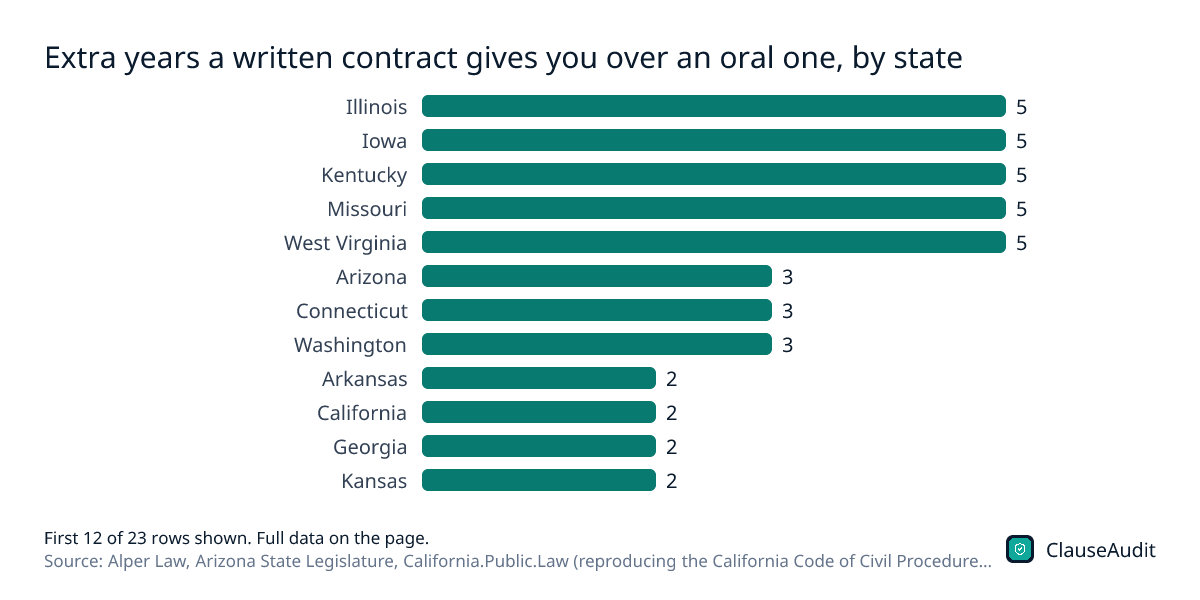
Download this chart (PNG)Extra years a written contract gives you over an oral one, by state
Chart data
| Label | Value |
|---|---|
| Illinois | 5 |
| Iowa | 5 |
| Kentucky | 5 |
| Missouri | 5 |
| West Virginia | 5 |
| Arizona | 3 |
| Connecticut | 3 |
| Washington | 3 |
| Arkansas | 2 |
| California | 2 |
| Georgia | 2 |
| Kansas | 2 |
| Nevada | 2 |
| New Mexico | 2 |
| Ohio | 2 |
| Oklahoma | 2 |
| Utah | 2 |
| Virginia | 2 |
| Wyoming | 2 |
| Florida | 1 |
| Idaho | 1 |
| Montana | 1 |
| Nebraska | 1 |
In Illinois, Iowa, Kentucky, Missouri and West Virginia, a signed contract buys you 5 extra years to sue. If you work in these states without paperwork, you give up the most time.
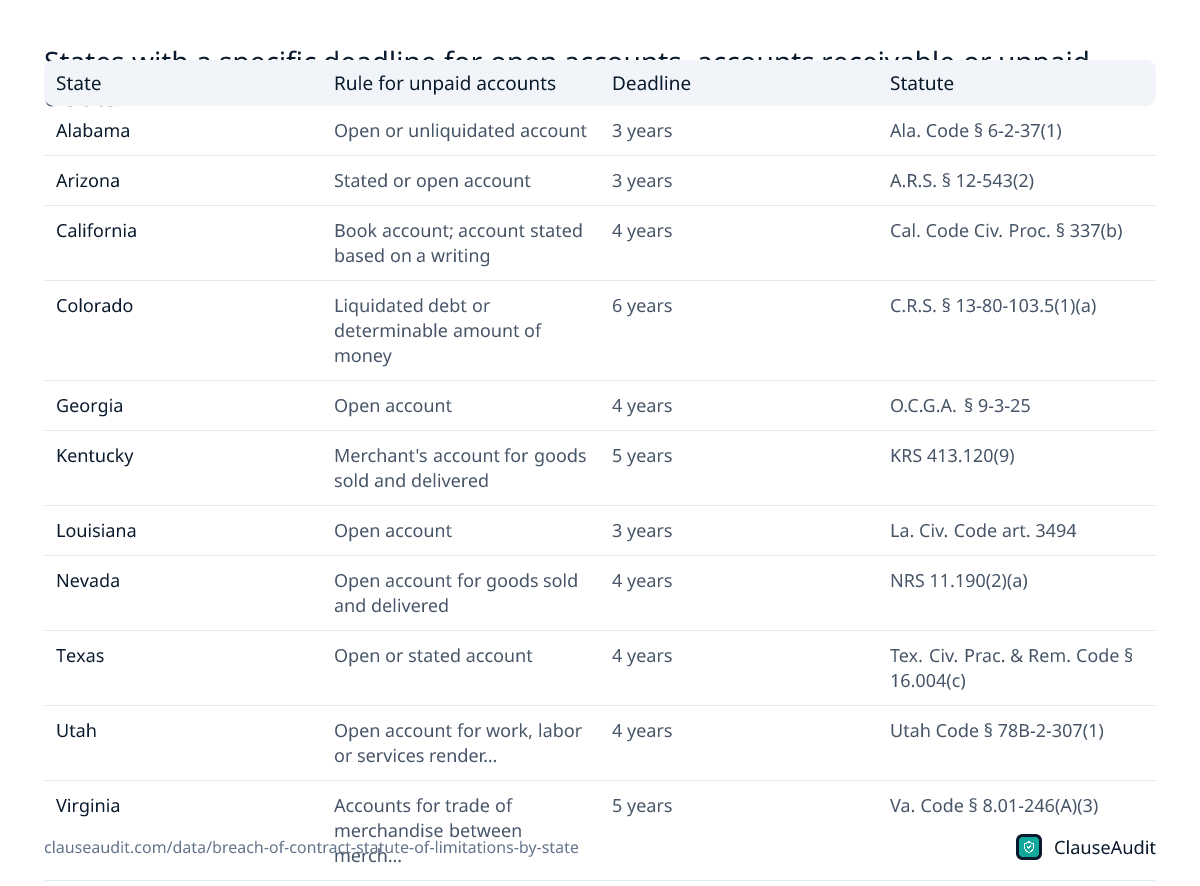
Download this chart (PNG)States with a specific deadline for open accounts, accounts receivable or unpaid debts
| State | Rule for unpaid accounts | Deadline | Statute |
|---|---|---|---|
| Alabama | Open or unliquidated account | 3 years | Ala. Code § 6-2-37(1) |
| Arizona | Stated or open account | 3 years | A.R.S. § 12-543(2) |
| California | Book account; account stated based on a writing | 4 years | Cal. Code Civ. Proc. § 337(b) |
| Colorado | Liquidated debt or determinable amount of money | 6 years | C.R.S. § 13-80-103.5(1)(a) |
| Georgia | Open account | 4 years | O.C.G.A. § 9-3-25 |
| Kentucky | Merchant's account for goods sold and delivered | 5 years | KRS 413.120(9) |
| Louisiana | Open account | 3 years | La. Civ. Code art. 3494 |
| Nevada | Open account for goods sold and delivered | 4 years | NRS 11.190(2)(a) |
| Texas | Open or stated account | 4 years | Tex. Civ. Prac. & Rem. Code § 16.004(c) |
| Utah | Open account for work, labor or services rendered | 4 years | Utah Code § 78B-2-307(1) |
| Virginia | Accounts for trade of merchandise between merchants | 5 years | Va. Code § 8.01-246(A)(3) |
| Washington | Account receivable incurred in the ordinary course of business | 6 years | RCW 4.16.040(2) |
Source: Alper Law, Statute of Limitations on Debt by State: 2026 State-by-State Chart; Arizona State Legislature, A.R.S. § 12-543 Oral debt; stated or open account; three year limitation; California.Public.Law (reproducing the California Code of Civil Procedure), California Code of Civil Procedure § 337; Colorado.Public.Law (reproducing the Colorado Revised Statutes), C.R.S. § 13-80-103.5 General limitation of actions, six years; Kentucky General Assembly, KRS 413.120 Actions to be brought within five years; Nevada.Public.Law (reproducing the Nevada Revised Statutes), NRS 11.190 Periods of limitation; Texas.Public.Law (reproducing the Texas Civil Practice and Remedies Code), Tex. Civ. Prac. & Rem. Code § 16.004 Four-year limitations period; Virginia General Assembly, Legislative Information System, Va. Code § 8.01-246 Personal actions based on contracts; Washington State Legislature, RCW 4.16.040 Actions limited to six years. Download as image
Deadline to sue on a written contract to collect money by state
- 810 years
- 256 years
- 75 years
- 34 years
- 83 years
- 10 years8
- 6 years25
- 5 years7
- 4 years3
- 3 years8
| State | Written contract | Oral contract | Open account or unpaid invoice rule | Source |
|---|---|---|---|---|
| Alabama | 6 years | 6 years | Open or unliquidated account: 3 years; stated or liquidated account: 6 years | Ala. Code §§ 6-2-34, 6-2-37 |
| Alaska | 3 years | 3 years | Same 3 years (one period for all contract claims) | Alaska Stat. § 09.10.053 |
| Arizona | 6 years (debt on a written contract executed in Arizona) | 3 years | Open or stated account: 3 years | A.R.S. §§ 12-548, 12-543 |
| Arkansas | 5 years | 3 years | Open account: 3 years unless it rests on a signed writing | Ark. Code Ann. §§ 16-56-111, 16-56-105 |
| California | 4 years | 2 years | Book account or account stated based on a writing: 4 years | Cal. Code Civ. Proc. §§ 337, 339 |
| Colorado | 6 years to recover a liquidated debt or determinable amount of money; 3 years for other contract actions | Same as written (6 years for a liquidated debt, 3 years otherwise) | Unpaid invoice for a fixed amount: 6 years (liquidated debt) | C.R.S. §§ 13-80-103.5(1)(a), 13-80-101(1)(a) |
| Connecticut | 6 years | 3 years | 6 years once your side of the deal is fully performed (court decisions limit the 3-year oral rule to executory contracts) | Conn. Gen. Stat. §§ 52-576, 52-581 |
| Delaware | 3 years | 3 years | Same 3 years | 10 Del. C. § 8106 |
| District of Columbia | 3 years | 3 years | Same 3 years (simple contract, express or implied) | D.C. Code § 12-301(7) |
| Florida | 5 years | 4 years | Oral contracts, goods sold and store accounts: 4 years | Fla. Stat. § 95.11(2)(b), (3)(j) |
| Georgia | 6 years | 4 years | Open account: 4 years | O.C.G.A. §§ 9-3-24, 9-3-25 |
| Hawaii | 6 years | 6 years | Same 6 years (any debt founded on a contract) | Haw. Rev. Stat. § 657-1(1) |
| Idaho | 5 years | 4 years | Not founded on a written instrument: 4 years | Idaho Code §§ 5-216, 5-217 |
| Illinois | 10 years | 5 years | Unwritten contracts: 5 years | 735 ILCS 5/13-206, 5/13-205 |
| Indiana | 6 years (written contract for the payment of money) | 6 years | Accounts and contracts not in writing: 6 years | Ind. Code §§ 34-11-2-9, 34-11-2-7 |
| Iowa | 10 years | 5 years | Unwritten contracts: 5 years | Iowa Code § 614.1(4), (5) |
| Kansas | 5 years | 3 years | Contracts not in writing: 3 years | K.S.A. 60-511(1), 60-512(1) |
| Kentucky | 10 years (written contracts executed after July 15, 2014) | 5 years | Merchant's account for goods sold and delivered: 5 years | KRS 413.160, 413.090(2), 413.120 |
| Louisiana | 10 years (personal action, art. 3499); no written/oral split | 10 years (same as written) | Open account, money lent, or compensation for services: 3 years (art. 3494) | La. Civ. Code arts. 3499, 3494 |
| Maine | 6 years | 6 years | Same 6 years (all civil actions) | 14 M.R.S. § 752 |
| Maryland | 3 years | 3 years | Same 3 years (general civil period) | Md. Code, Cts. & Jud. Proc. § 5-101 |
| Massachusetts | 6 years | 6 years | Same 6 years | Mass. Gen. Laws ch. 260, § 2 |
| Michigan | 6 years | 6 years | Same 6 years | Mich. Comp. Laws § 600.5807(9) |
| Minnesota | 6 years | 6 years | Same 6 years (contract, express or implied) | Minn. Stat. § 541.05, subd. 1(1) |
| Mississippi | 3 years | 3 years | Open account or account stated: 3 years | Miss. Code Ann. §§ 15-1-49, 15-1-29 |
| Missouri | 10 years (writing for the payment of money or property) | 5 years | All other contracts: 5 years | Mo. Rev. Stat. §§ 516.110(1), 516.120(1) |
| Montana | 6 years | 5 years | Contract, account or promise not in writing: 5 years | MCA § 27-2-202 |
| Nebraska | 5 years | 4 years | Contracts not in writing: 4 years | Neb. Rev. Stat. §§ 25-205, 25-206 |
| Nevada | 6 years | 4 years | Open account for goods sold and delivered: 4 years | NRS 11.190(1)(b), (2) |
| New Hampshire | 3 years | 3 years | Same 3 years (all personal actions) | N.H. Rev. Stat. § 508:4, I |
| New Jersey | 6 years | 6 years | Accounts (other than merchant-to-merchant trade): 6 years | N.J. Stat. Ann. § 2A:14-1 |
| New Mexico | 6 years | 4 years | Open account: 4 years | N.M. Stat. §§ 37-1-3, 37-1-4 |
| New York | 6 years | 6 years | Same 6 years for business claims | N.Y. C.P.L.R. § 213(2) |
| North Carolina | 3 years | 3 years | Same 3 years | N.C. Gen. Stat. § 1-52(1) |
| North Dakota | 6 years | 6 years | Same 6 years (contract, express or implied) | N.D.C.C. § 28-01-16(1) |
| Ohio | 6 years | 4 years | Contracts not in writing (non-consumer): 4 years | Ohio Rev. Code §§ 2305.06, 2305.07 |
| Oklahoma | 5 years | 3 years | Contracts not in writing: 3 years | Okla. Stat. tit. 12, § 95(A)(1), (2) |
| Oregon | 6 years | 6 years | Same 6 years (contract, express or implied) | ORS 12.080(1) |
| Pennsylvania | 4 years | 4 years | Same 4 years | 42 Pa. Cons. Stat. § 5525(a)(3), (8) |
| Rhode Island | 10 years | 10 years | Same 10 years (general civil period) | R.I. Gen. Laws § 9-1-13(a) |
| South Carolina | 3 years | 3 years | Same 3 years (contract, express or implied) | S.C. Code Ann. § 15-3-530(1) |
| South Dakota | 6 years | 6 years | Same 6 years (contract, express or implied) | SDCL 15-2-13(1) |
| Tennessee | 6 years | 6 years | Same 6 years | Tenn. Code Ann. § 28-3-109(a)(3) |
| Texas | 4 years | 4 years | Open or stated account: 4 years | Tex. Civ. Prac. & Rem. Code §§ 16.004, 16.051 |
| Utah | 6 years | 4 years | Open account for work, labor or services rendered: 4 years | Utah Code §§ 78B-2-309, 78B-2-307 |
| Vermont | 6 years | 6 years | Same 6 years | 12 V.S.A. § 511 |
| Virginia | 5 years (written and signed by the party charged) | 3 years | Unsigned writing or unwritten contract: 3 years; merchant-to-merchant accounts: 5 years | Va. Code § 8.01-246(A)(2), (A)(3), (A)(4) |
| Washington | 6 years | 3 years | Account receivable: 6 years, written or not | RCW 4.16.040(1), (2); 4.16.080(3) |
| West Virginia | 10 years | 5 years | Other contracts, express or implied: 5 years | W. Va. Code § 55-2-6 |
| Wisconsin | 6 years | 6 years | Same 6 years | Wis. Stat. § 893.43(1) |
| Wyoming | 10 years | 8 years | Contract not in writing: 8 years | W.S. 1-3-105(a)(i), (a)(ii)(A) |
How long do you have to sue for breach of contract?
The most common answer for a written contract is 6 years. Twenty-five of the 51 jurisdictions use that period, including New York, Washington and Minnesota. The rest split between shorter and longer rules, and the short end is where people get caught.
Delaware, Maryland, North Carolina, South Carolina, New Hampshire, Alaska, Mississippi and DC all give you 3 years. If your client is a Delaware company and your contract says Delaware law governs, a late invoice can go stale faster than you expect.
At the long end, Illinois, Iowa, Rhode Island, West Virginia and Wyoming give you 10 years on a written contract. Missouri does too for a writing to pay money, Louisiana for ordinary contract claims, and Kentucky for written contracts signed after July 15, 2014. That sounds generous, but evidence fades. Emails get deleted, contacts change jobs and companies dissolve long before the legal deadline passes.
Does an oral contract or an unpaid invoice get less time?
Often, yes. A handshake deal is still a contract, but many states give it a shorter deadline. California allows 4 years on a written contract and 2 on an oral one. Kansas drops from 5 years to 3. Washington drops from 6 to 3 for most oral deals. Florida, Idaho, Montana and Nebraska cut just a single year.
Not every state penalizes a handshake. New York, Texas, Minnesota, Oregon and Tennessee use the same deadline for written and oral contracts. Wyoming still gives an oral deal 8 years.
Unpaid invoices can follow their own rules. Several states have a separate deadline for an open account, the running tab of work billed but not paid. Texas gives you 4 years on an open or stated account. Utah gives 4 years on an open account for work, labor or services. Arizona and Louisiana give only 3 years on an open account, even though Louisiana gives 10 years on an ordinary contract claim.
Washington is the friendly exception for small businesses. An account receivable incurred in the ordinary course of your business gets 6 years, written contract or not. Colorado does something similar: a fixed, liquidated amount of money gets 6 years, while other contract claims get 3.
When does the clock start on an unpaid invoice?
In general, the clock starts when the contract is breached, not when you started the work. For an invoice, that is usually the day payment was due and did not arrive. That is one reason clear payment terms matter. If your contract never states a due date, you and the client may argue later about when the breach happened.
Some states treat a partial payment or a written promise to pay as a fresh start for the clock. The rules vary, so do not count on it. Treat the first missed due date as day one and plan from there.
Two other details change the math. A choice-of-law clause can make another state's deadline apply. And some contracts try to shorten the time to sue by agreement, sometimes to a fraction of the state default. Read both clauses before you assume the default state rule protects you.
What the numbers mean for freelancers and small businesses
Say you are a designer in California and a client owes you for a project agreed over email and a phone call. Whether those emails count as a written contract is a real question. If they do not, you may have 2 years, not 4. Waiting a year to chase payment uses half your window.
Now say you invoice a business client in Washington for consulting. Your account receivable gets 6 years, signed contract or not. Same work, very different deadlines.
Workers should note a separate track. Unpaid wages owed by an employer usually fall under wage claim laws with their own deadlines, which can be shorter than the contract rules here. Check the wage claim data before you rely on a contract deadline.
Businesses face the same clock from the other side. If a vendor or customer owes you money, your accounts team should track the oldest unpaid balances against the deadline in each customer's state. A Florida customer on a signed contract gives you 5 years. The same customer on an informal account gives you 4. Write-off decisions are easier when you know which debts can still be collected in court.
What to do if a client still has not paid
- Find the due date on the invoice or contract and write down the deadline for your state, using the shorter rule if you are unsure whether the deal counts as written.
- Check the contract for a governing law clause and any clause that shortens the time to sue.
- Send a written demand that states the amount, the work delivered and a firm date to pay. Keep copies.
- Save the paper trail now: the contract, scope emails, delivery confirmations, invoices and any message where the client admits the debt.
- Compare the amount to your state's small claims limit. Small claims is often the cheapest way to get a judgment without a lawyer.
- File well before the deadline, not in the last month. Courts do not stretch a missed statute of limitations because you were negotiating.
How to protect your next contract before anything goes wrong
The best time to deal with a statute of limitations is before you start the work. Get the deal in writing, even a short signed scope with a price and due date. In the states with the biggest gap, that alone can add 5 years to your window.
Spell out when payment is due, what counts as acceptance of the work, and what happens if payment is late. A vague approval clause lets a client argue the invoice never came due. A late fee clause gives you something to point to long before you ever think about court.
Last, look at where a dispute would be heard. A venue clause that sends every claim to the client's home county can turn a small invoice into a trip you will never make. Small claims court works best when you can file close to home.
How ClauseAudit helps you get paid on time
Most collection fights start with a gap in the contract: no due date, a fuzzy approval step, or a clause that moves the dispute to another state. Those details decide how strong your claim is and how long you have to bring it.
Upload a client agreement and the automated review flags the payment terms that leave you exposed, explains them in plain English, and suggests fixes you can send back before you sign.
- Payment terms: a clear due date, invoice schedule and deposit, so the clock has a firm start
- Late fees and interest on overdue invoices
- Acceptance and approval clauses that let a client delay payment indefinitely
- Governing law and venue clauses that could apply a shorter state deadline or force you to sue far away
- Clauses that shorten the time you have to file a claim
- Kill fee and termination terms that decide what you are owed if the project stops
Frequently asked questions
What is the most common statute of limitations for breach of contract?
Six years for a written contract. Twenty-five of the 51 jurisdictions (the 50 states plus DC) use that period. The rest range from 3 years, in places like Delaware and North Carolina, to 10 years in states such as Illinois, Iowa and Wyoming. Always check the rule in the state whose law governs your contract.
How long do I have to sue for breach of contract in California?
California gives you 4 years on a written contract and 2 years on an oral one. A book account or an account stated based on a writing also gets 4 years. If your deal was mostly verbal, assume the shorter 2-year deadline and act early.
What is the statute of limitations for breach of contract in Texas?
Texas gives you 4 years. That applies to written and oral contracts alike, and to open or stated accounts such as unpaid invoices. The clock generally runs from the day the claim accrues, which for an invoice is usually when payment was due.
How long do I have to sue on a contract in New York?
New York allows 6 years for business contract claims, written or oral. Consumer credit debts sued against a consumer have a separate 3-year period, but that rule does not cover an ordinary freelance or business invoice. Keep in mind that a choice-of-law clause can point your contract to another state's rules.
Is an email agreement a written contract?
Often it can be, but not always. Courts look at whether the emails show the key terms and both sides' agreement. Because the answer is uncertain, plan around your state's oral contract deadline if your only record is a chat or email thread. In California that means 2 years, not 4.
Can I still collect an invoice after the statute of limitations runs out?
You can still ask, and the client can still choose to pay. What you lose is the ability to win in court if the client raises the deadline as a defense. In some states a partial payment or written acknowledgment can restart the clock, so get legal advice before you give up.
Can a contract shorten the statute of limitations?
Many contracts try. A clause may say any claim must be brought within a set period after the work ends, and courts in many states enforce reasonable limits between businesses. Search your contract for phrases like 'any claim must be brought within' before relying on the state default.
Which state gives the least time to sue on an oral contract?
California, at 2 years. Fifteen other jurisdictions use 3 years for oral deals, including Kansas, Virginia and Washington for most oral contracts. Washington makes an exception for business accounts receivable, which get 6 years written or not. Check which state's law your contract names before you count.
Use this data
Every chart and card below is free to reuse under CC BY 4.0. Download what you need and link back to this page.
 Stat cards
 Key findings card
 Infographic
 How many states give each deadline to sue on a written contract (jurisdictions)
 How many states give each deadline to sue on an oral (handshake) contract (jurisdictions)
 Extra years a written contract gives you over an oral one, by state
 States with a specific deadline for open accounts, accounts receivable or unpaid debts
Embed the infographic
Free to share on your site, blog or slides under CC BY 4.0. Please keep the credit link.
Sources and method
Every number on this page comes from the sources below, each opened and read on or before October 18, 2026. A second, independent review checked every figure against its source and corrected anything that did not match. 51 of 51 state entries were confirmed; any that could not be are marked "Not yet confirmed" and left out of every count and chart.
- Alper Law, Statute of Limitations on Debt by State: 2026 State-by-State Chart (2026 edition (PDF dated September 17, 2026))
- Arizona State Legislature, A.R.S. § 12-548 Contract in writing for debt; six year limitation (Current online edition, read 2026-10-18)
- Arizona State Legislature, A.R.S. § 12-543 Oral debt; stated or open account; three year limitation (Current online edition, read 2026-10-18)
- California.Public.Law (reproducing the California Code of Civil Procedure), California Code of Civil Procedure § 337 (Current online edition, read 2026-10-18)
- California.Public.Law (reproducing the California Code of Civil Procedure), California Code of Civil Procedure § 339 (Current online edition, read 2026-10-18)
- Colorado.Public.Law (reproducing the Colorado Revised Statutes), C.R.S. § 13-80-103.5 General limitation of actions, six years (Current through Fall 2025)
- Colorado.Public.Law (reproducing the Colorado Revised Statutes), C.R.S. § 13-80-101 General limitation of actions, three years (Current through Fall 2025)
- State of Delaware, Delaware Code Online, 10 Del. C. § 8106 Actions subject to 3-year limitation (Current online edition, read 2026-10-18)
- Council of the District of Columbia, D.C. Code § 12-301 Limitation of time for bringing actions (Current online edition, read 2026-10-18)
- The Florida Legislature, Florida Statutes § 95.11 Limitations other than for the recovery of real property (The 2026 Florida Statutes)
- Iowa Legislature, Iowa Code § 614.1 Limitations of actions (Iowa Code 2026)
- Kansas Office of Revisor of Statutes, K.S.A. 60-511 Actions limited to five years (Current online edition, read 2026-10-18)
- Kansas Office of Revisor of Statutes, K.S.A. 60-512 Actions limited to three years (Current online edition, read 2026-10-18)
- Kentucky General Assembly, KRS 413.160 Actions upon written contract or not provided for by statute, ten-year limitation (Effective July 15, 2014)
- Kentucky General Assembly, KRS 413.090 Action upon judgment, contract, or bond, fifteen-year limitation (Effective July 15, 2014)
- Kentucky General Assembly, KRS 413.120 Actions to be brought within five years (Effective June 24, 2015)
- Maine Legislature, Office of the Revisor of Statutes, 14 M.R.S. § 752 Six years (Current online edition, read 2026-10-18)
- Maryland General Assembly, Md. Code, Courts and Judicial Proceedings § 5-101 (Current online edition, read 2026-10-18)
- Minnesota Office of the Revisor of Statutes, Minn. Stat. § 541.05 Various cases, six years (2025 Minnesota Statutes)
- Montana Legislature, MCA § 27-2-202 Actions based on contract or other obligation (Montana Code Annotated 2025)
- Nevada.Public.Law (reproducing the Nevada Revised Statutes), NRS 11.190 Periods of limitation (Current online edition, read 2026-10-18)
- New York State Senate, N.Y. CPLR § 213 Actions to be commenced within six years (Current online edition, read 2026-10-18)
- North Dakota Legislative Branch, N.D.C.C. Chapter 28-01 Limitation of actions (§ 28-01-16) (Current online edition, read 2026-10-18)
- Oregon.Public.Law (reproducing the Oregon Revised Statutes), ORS 12.080 Action on certain contracts or liabilities (Current through early 2026)
- South Carolina Legislature, S.C. Code § 15-3-530 Three years (Current online edition, read 2026-10-18)
- South Dakota Legislature, SDCL 15-2-13 Contract obligation or liability (six years) (Current online edition, read 2026-10-18)
- Texas.Public.Law (reproducing the Texas Civil Practice and Remedies Code), Tex. Civ. Prac. & Rem. Code § 16.004 Four-year limitations period (Current online edition, read 2026-10-18)
- Texas.Public.Law (reproducing the Texas Civil Practice and Remedies Code), Tex. Civ. Prac. & Rem. Code § 16.051 Residual limitations period (Current online edition, read 2026-10-18)
- Virginia General Assembly, Legislative Information System, Va. Code § 8.01-246 Personal actions based on contracts (Current online edition, read 2026-10-18)
- Washington State Legislature, RCW 4.16.040 Actions limited to six years (Current online edition, read 2026-10-18)
- Washington State Legislature, RCW 4.16.080 Actions limited to three years (Current online edition, read 2026-10-18)
- Wyoming Legislature, W.S. 1-3-105 Actions other than recovery of real property (Title 1 compressed statutes) (Current online edition, read 2026-10-18)
Cite this page
ClauseAudit, “Statute of Limitations for Breach of Contract by State: How Long You Have to Collect an Unpaid Invoice”, updated October 18, 2026, https://clauseaudit.com/data/breach-of-contract-statute-of-limitations-by-state. Free to reuse with a link back (CC BY 4.0).
This page summarises published data and law as checked on October 18, 2026. Figures are updated as new editions are released, and your own situation may differ. It is general information, not legal, tax or financial advice.