Statute of Frauds by State: Which Contracts Must Be in Writing
By ClauseAudit Research · 53 sources ·
What is the statute of frauds in each state?
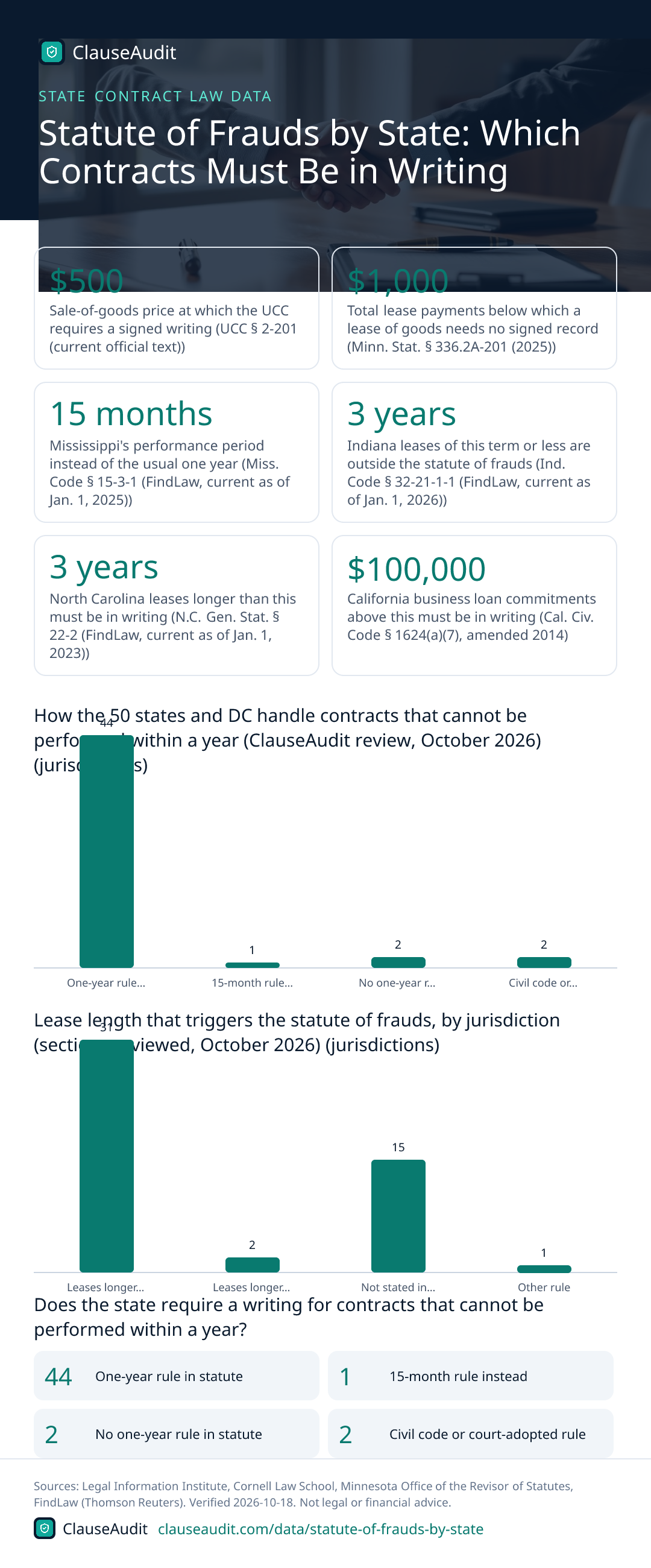
Every state has some writing requirement, but the details differ. In our October 2026 review, 44 jurisdictions put the classic one-year rule in a statute, Mississippi uses 15 months instead, and New Jersey and North Carolina have no one-year rule at all. Sales of goods for $500 or more need a signed writing under the UCC.

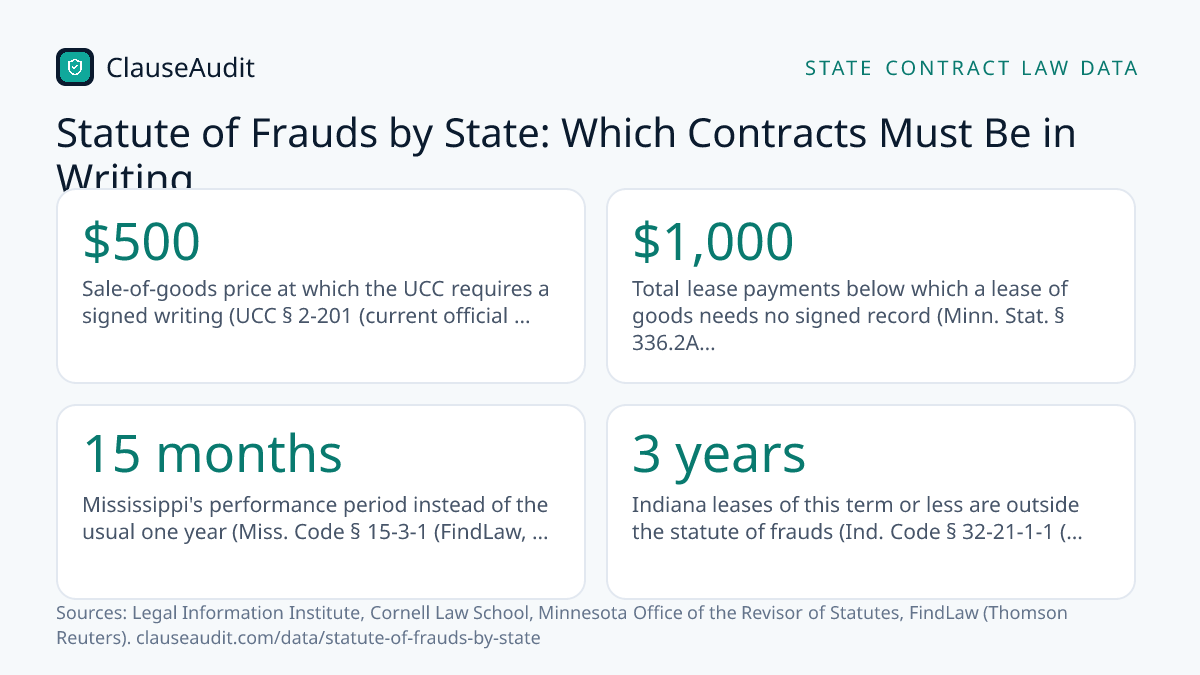
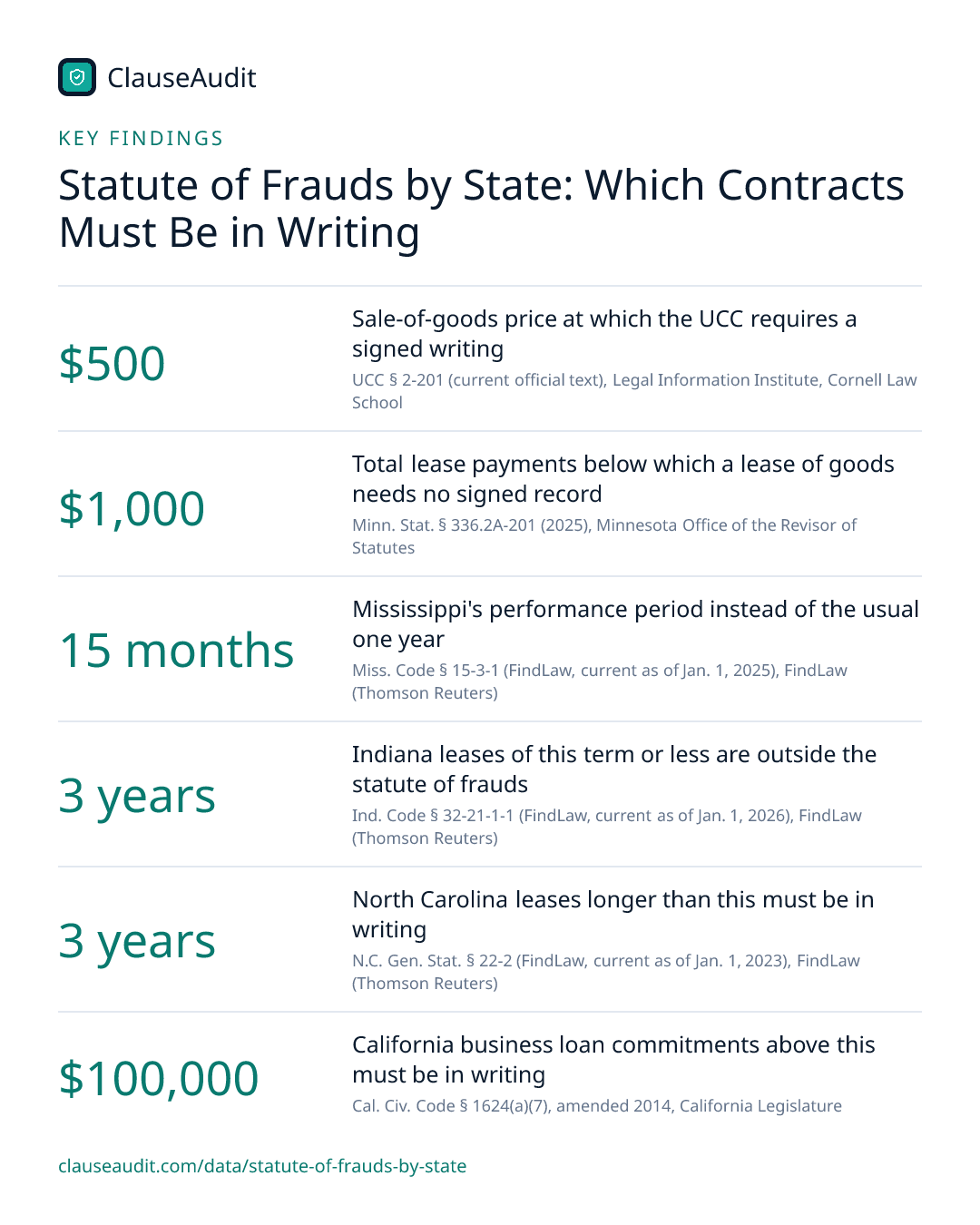
- Sale-of-goods price at which the UCC requires a signed writing (UCC § 2-201 (current official text), Legal Information Institute, Cornell Law School)
- $500
- Total lease payments below which a lease of goods needs no signed record (Minn. Stat. § 336.2A-201 (2025), Minnesota Office of the Revisor of Statutes)
- $1,000
- Mississippi's performance period instead of the usual one year (Miss. Code § 15-3-1 (FindLaw, current as of Jan. 1, 2025), FindLaw (Thomson Reuters))
- 15 months
- Indiana leases of this term or less are outside the statute of frauds (Ind. Code § 32-21-1-1 (FindLaw, current as of Jan. 1, 2026), FindLaw (Thomson Reuters))
- 3 years
- North Carolina leases longer than this must be in writing (N.C. Gen. Stat. § 22-2 (FindLaw, current as of Jan. 1, 2023), FindLaw (Thomson Reuters))
- 3 years
- California business loan commitments above this must be in writing (Cal. Civ. Code § 1624(a)(7), amended 2014, California Legislature)
- $100,000
- Year New Jersey deleted four categories from its statute of frauds (N.J.S.A. § 25:1-5 (FindLaw, current as of Jan. 1, 2024), FindLaw (Thomson Reuters))
- 1995
Most handshake deals are perfectly legal. The statute of frauds is the short list of exceptions: contracts a court will refuse to enforce unless something in writing, signed by the person you are suing, backs them up. Land sales, long leases, promises to pay someone else's debt and deals that cannot be finished within a year are the usual suspects.
The list is not the same everywhere. Mississippi stretches the time limit, New Jersey dropped it, several states add business loans above a dollar figure, and Maine adds non-competes. Use the map and table to find your state, then read on for what the rules mean when a deal goes sideways.
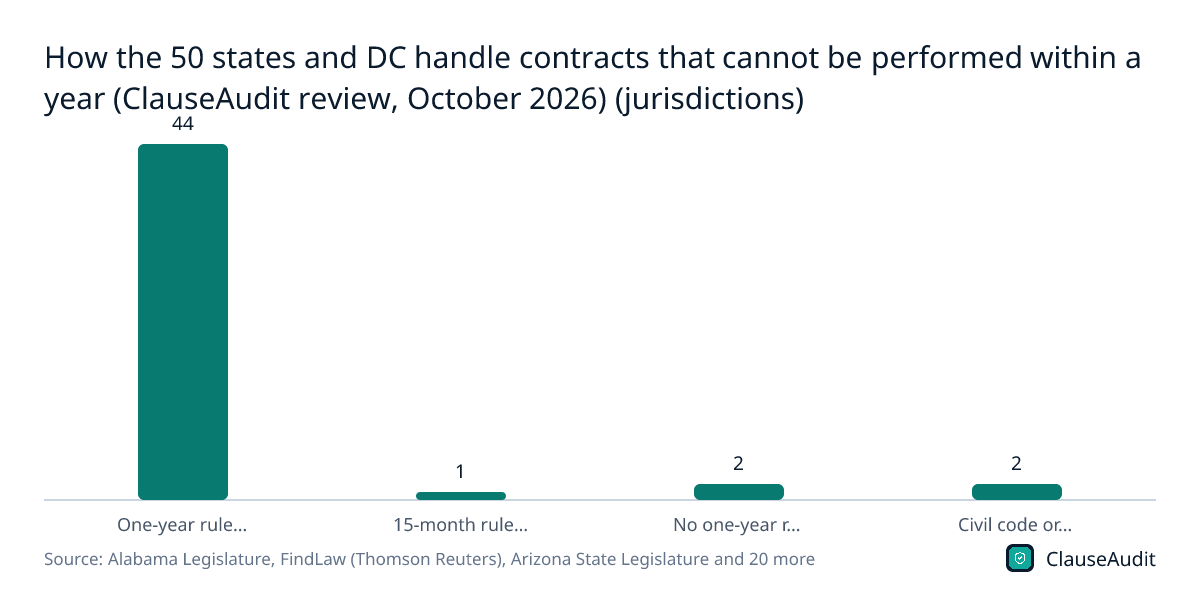
How the 50 states and DC handle contracts that cannot be performed within a year (ClauseAudit review, October 2026) (jurisdictions)
Chart data
| Label | Value (jurisdictions) |
|---|---|
| One-year rule in statute | 44 |
| 15-month rule instead | 1 |
| No one-year rule in statute | 2 |
| Civil code or court-adopted rule | 2 |
The one-year rule is close to universal: 44 jurisdictions write it into a statute. The exceptions matter if your deal is long or open-ended, because in New Jersey and North Carolina an oral multi-year agreement is not barred on timing grounds alone.
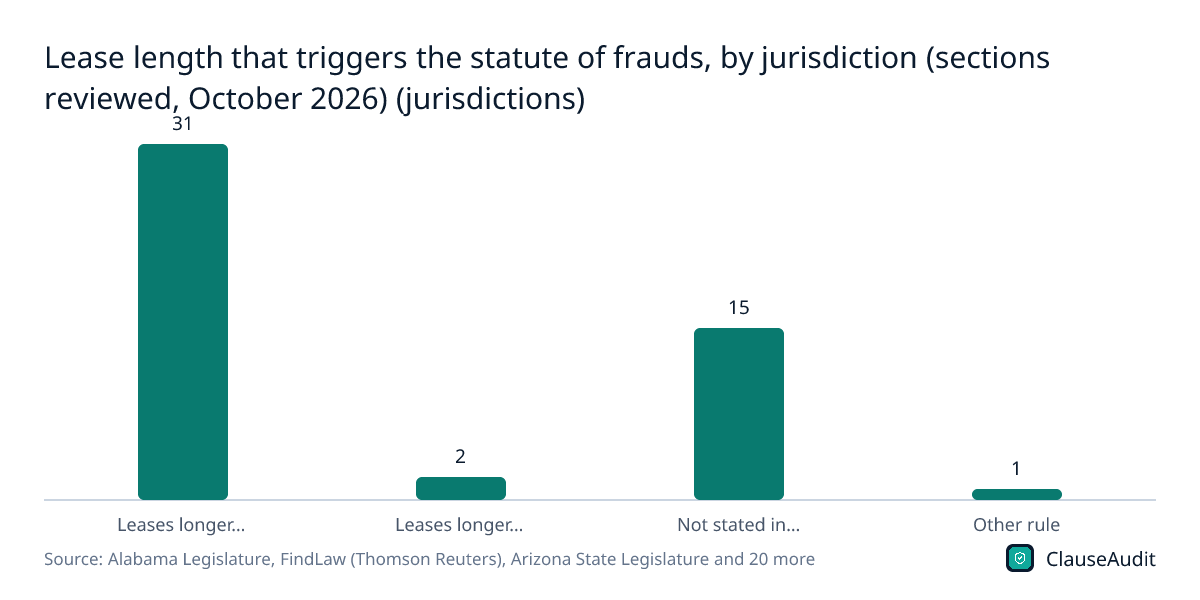
Download this chart (PNG)Lease length that triggers the statute of frauds, by jurisdiction (sections reviewed, October 2026) (jurisdictions)
Chart data
| Label | Value (jurisdictions) |
|---|---|
| Leases longer than 1 year | 31 |
| Leases longer than 3 years | 2 |
| Not stated in sections reviewed | 15 |
| Other rule | 1 |
31 jurisdictions require a writing for leases longer than 1 year in their statute of frauds. Where the chart says not stated, check the state's landlord-tenant code before assuming an oral lease is safe.
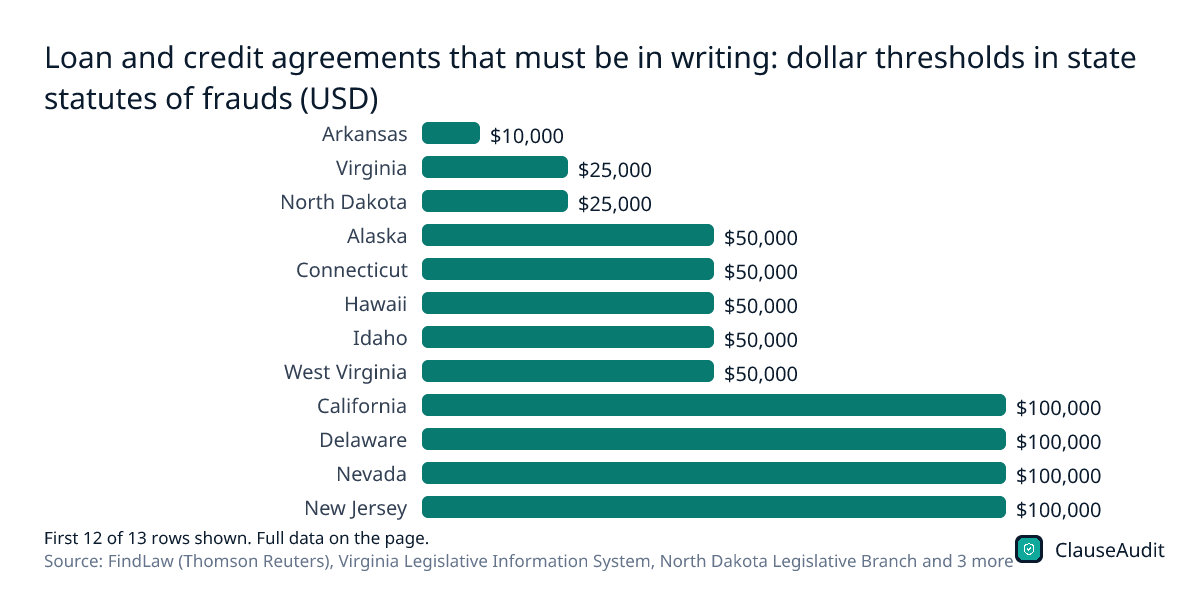
Download this chart (PNG)Loan and credit agreements that must be in writing: dollar thresholds in state statutes of frauds (USD)
Chart data
| Label | Value |
|---|---|
| Arkansas | $10,000 |
| Virginia | $25,000 |
| North Dakota | $25,000 |
| Alaska | $50,000 |
| Connecticut | $50,000 |
| Hawaii | $50,000 |
| Idaho | $50,000 |
| West Virginia | $50,000 |
| California | $100,000 |
| Delaware | $100,000 |
| Nevada | $100,000 |
| New Jersey | $100,000 |
| Arizona | $250,000 |
These rules mainly protect lenders. A loan officer's spoken promise to extend or restructure credit above the figure, from $10,000 in Arkansas to $250,000 in Arizona, is usually unenforceable unless it is in a signed writing.
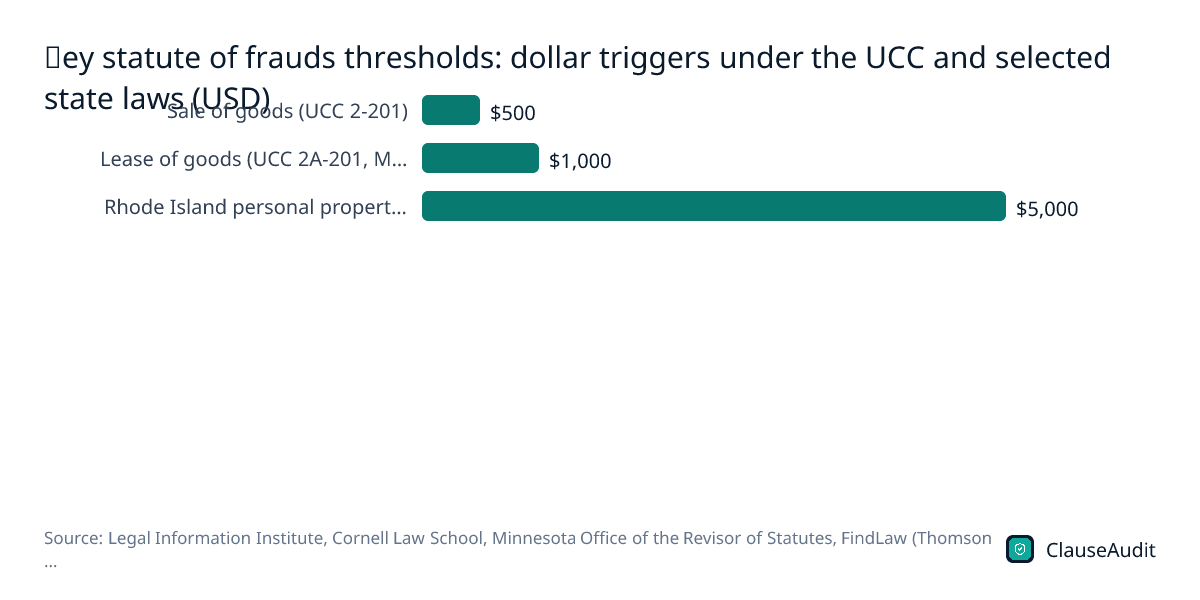
Download this chart (PNG)Key statute of frauds thresholds: dollar triggers under the UCC and selected state laws (USD)
Chart data
| Label | Value |
|---|---|
| Sale of goods (UCC 2-201) | $500 |
| Lease of goods (UCC 2A-201, Minnesota text) | $1,000 |
| Rhode Island personal property sales outside the UCC | $5,000 |
The $500 goods rule comes from the UCC and applies across states that adopted Article 2. Leases of goods get more room: no signed record is needed when total payments are under $1,000.
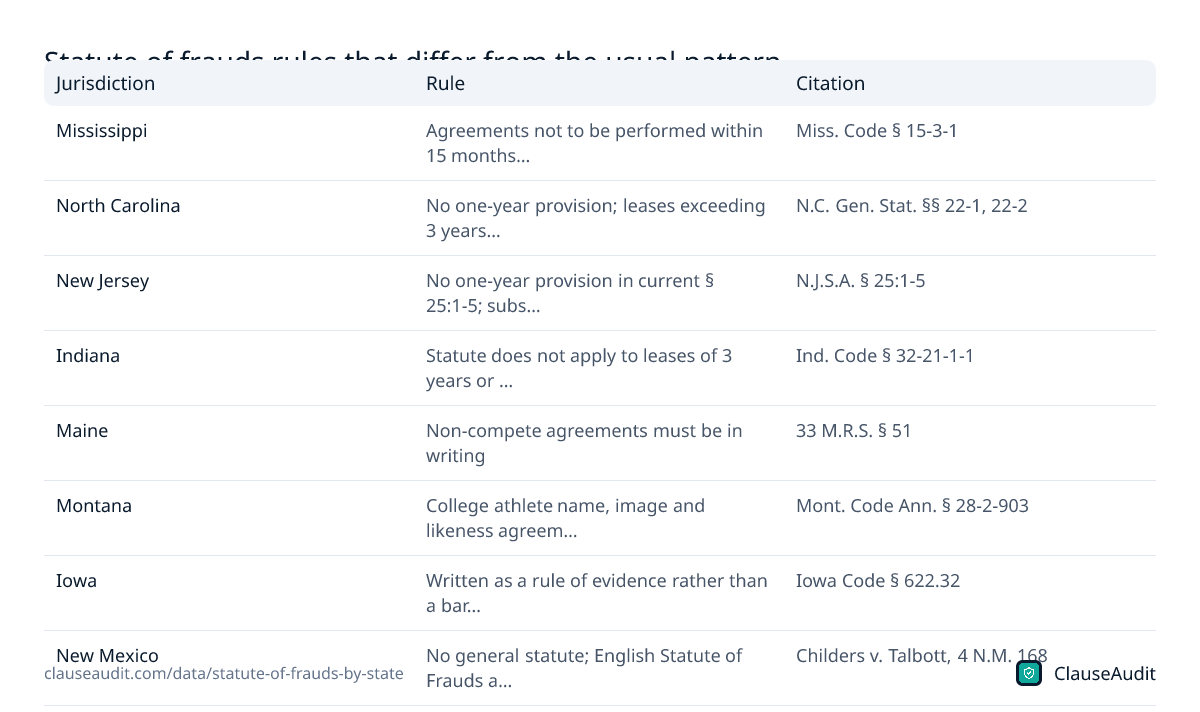
Download this chart (PNG)Statute of frauds rules that differ from the usual pattern
| Jurisdiction | Rule | Citation |
|---|---|---|
| Mississippi | Agreements not to be performed within 15 months (not 1 year) must be in writing | Miss. Code § 15-3-1 |
| North Carolina | No one-year provision; leases exceeding 3 years must be in writing | N.C. Gen. Stat. §§ 22-1, 22-2 |
| New Jersey | No one-year provision in current § 25:1-5; subsections a, b, d and e deleted in 1995 | N.J.S.A. § 25:1-5 |
| Indiana | Statute does not apply to leases of 3 years or less | Ind. Code § 32-21-1-1 |
| Maine | Non-compete agreements must be in writing | 33 M.R.S. § 51 |
| Montana | College athlete name, image and likeness agreements must be in writing | Mont. Code Ann. § 28-2-903 |
| Iowa | Written as a rule of evidence rather than a bar on enforcement | Iowa Code § 622.32 |
| New Mexico | No general statute; English Statute of Frauds applied by court decision (1888) | Childers v. Talbott, 4 N.M. 168 |
| Louisiana | Civil-law state; transfers of immovable property need an authentic act or act under private signature | La. Civ. Code art. 1839 |
Source: FindLaw (Thomson Reuters), FindLaw, Miss. Code § 15-3-1 (current as of Jan. 1, 2025); FindLaw (Thomson Reuters), FindLaw, N.C.G.S. §§ 22-1 and 22-2 (current as of Jan. 1, 2023); FindLaw (Thomson Reuters), FindLaw, N.J.S.A. 25:1-5 (current as of Jan. 1, 2024); FindLaw (Thomson Reuters), FindLaw, Ind. Code § 32-21-1-1 (current as of Jan. 1, 2026); Maine Legislature, Office of the Revisor of Statutes, Maine Revised Statutes, Title 33, § 51; Montana Legislature, Montana Code Annotated 2025, § 28-2-903; Iowa Legislature, Iowa Code 2026, § 622.32; Harvard Law School Caselaw Access Project, Childers v. Talbott, 4 N.M. 168 (N.M. 1888), Caselaw Access Project; FindLaw (Thomson Reuters), FindLaw, La. Civ. Code art. 1839 (current as of Jan. 1, 2023). Download as image
Does the state require a writing for contracts that cannot be performed within a year? by state
- 44One-year rule in statute
- 115-month rule instead
- 2No one-year rule in statute
- 2Civil code or court-adopted rule
- One-year rule in statute44
- 15-month rule instead1
- No one-year rule in statute2
- Civil code or court-adopted rule2
- Not yet confirmed2
| State | Statute | One-year rule | Sale of land | Leases | Other contracts covered | Source |
|---|---|---|---|---|---|---|
| Alabama | Ala. Code § 8-9-2 | Yes | Yes | Leases of 1 year or less are excepted | Loan commitments (consumer loans under $25,000 excepted); agreements to make a will; securities sales outside national exchanges and OTC markets | Ala. Code § 8-9-2 |
| Alaska | Alaska Stat. § 09.25.010 | Yes | Yes | Leases longer than 1 year | Real estate broker commission agreements; commercial loans over $50,000 | Alaska Stat. § 09.25.010 |
| Arizona | A.R.S. § 44-101 | Yes | Yes | Leases longer than 1 year | Real estate broker commission agreements; non-consumer loan or credit commitments over $250,000; promises to bequeath property | A.R.S. § 44-101 |
| Arkansas | Ark. Code § 4-59-101 | Yes | Yes | Leases longer than 1 year | Credit agreements over $10,000; promises to pay debts discharged in bankruptcy | Ark. Code § 4-59-101 |
| California | Cal. Civ. Code § 1624 | Yes | Yes | Leases longer than 1 year | Real estate broker commission agreements; non-consumer loan commitments over $100,000 by lenders; agreements not to be performed in the promisor's lifetime | Cal. Civ. Code § 1624 |
| Colorado | C.R.S. §§ 38-10-112, 38-10-108 | Yes | Yes | Leases longer than 1 year (38-10-108) | , | C.R.S. §§ 38-10-112, 38-10-108 |
| Connecticut | Conn. Gen. Stat. § 52-550 | Yes | Yes | Oral leases of 1 year or less are exempt if the tenant has occupied the premises | Loans over $50,000 | Conn. Gen. Stat. § 52-550 |
| Delaware | 6 Del. C. § 2714 | Yes | Yes | Not stated in § 2714 | Guaranties of another's debt of $25 and up; non-consumer loan commitments over $100,000 by lenders | 6 Del. C. § 2714 |
| District of Columbia | D.C. Code § 28-3502 | Yes | Yes | Not stated in § 28-3502 | , | D.C. Code § 28-3502 |
| Florida | Fla. Stat. § 725.01 | Yes | Yes | Leases longer than 1 year | Health care provider guarantees of medical results | Fla. Stat. § 725.01 |
| Georgia | O.C.G.A. § 13-5-30 | Yes | Yes | Not stated in § 13-5-30 | Commitments to lend money; promises to revive debts barred by the statute of limitations | O.C.G.A. § 13-5-30 |
| Hawaii | Haw. Rev. Stat. § 656-1 | Yes | Yes | Not stated in § 656-1 | Real estate broker commission agreements; loans or credit over $50,000 from financial institutions | Haw. Rev. Stat. § 656-1 |
| Idaho | Idaho Code § 9-505 | Yes | Yes | Leases longer than 1 year | Loans or credit of $50,000 or more from lenders | Idaho Code § 9-505 |
| Illinois | 740 ILCS 80/1, 80/2 | Yes | Yes | Leases longer than 1 year (80/2) | , | 740 ILCS 80/1, 80/2 |
| Indiana | Ind. Code § 32-21-1-1 | Yes | Yes | Leases of 3 years or less are excluded | Medical warranties of cure | Ind. Code § 32-21-1-1 |
| Iowa | Iowa Code § 622.32 | Yes | Yes | Leases longer than 1 year (shorter leases excepted) | Written in Iowa as a rule of evidence: oral proof of these contracts is not competent | Iowa Code § 622.32 |
| Kansas | K.S.A. § 33-106 | Yes | Yes | Not stated in § 33-106 | , | K.S.A. § 33-106 |
| Kentucky | Ky. Rev. Stat. § 371.010 | Yes | Yes | Leases longer than 1 year | Real estate sale or lease commissions; loans to establish or assist a business; promises to pay debts made during infancy | Ky. Rev. Stat. § 371.010 |
| Louisiana | La. Civ. Code art. 1839 | Not in art. 1839 | Yes: authentic act or act under private signature | Not stated in art. 1839 | An oral transfer of immovable property is valid between the parties only if the property was delivered and the transferor admits it under oath | La. Civ. Code art. 1839 |
| Maine | 33 M.R.S. § 51 | Yes | Yes | Not stated in § 51 | Non-compete agreements (made on or after Aug. 13, 1947); promises to pay debts discharged in bankruptcy; agreements to leave property by will | 33 M.R.S. § 51 |
| Maryland | Md. Code, Cts. & Jud. Proc. § 5-901; Real Prop. § 5-104 | Yes | Yes (Real Prop. § 5-104) | Not stated in the sections reviewed | , | Md. Code, Cts. & Jud. Proc. § 5-901; Real Prop. § 5-104 |
| Massachusetts | Mass. Gen. Laws ch. 259, § 1 | Yes | Yes | Not stated in ch. 259, § 1 | , | Mass. Gen. Laws ch. 259, § 1 |
| Michigan | Mich. Comp. Laws §§ 566.132, 566.108 | Yes | Yes (566.108) | Leases longer than 1 year (566.108) | Real estate commission agreements; financial institution loan promises; assignments of things in action; medical warranties of cure | Mich. Comp. Laws §§ 566.132, 566.108 |
| Minnesota | Minn. Stat. §§ 513.01, 513.05 | Yes | Yes | Leases longer than 1 year (513.05) | Promises to pay debts discharged in bankruptcy | Minn. Stat. §§ 513.01, 513.05 |
| Mississippi | Miss. Code § 15-3-1 | No (15-month rule instead) | Yes | Leases longer than 1 year | Agreements not to be performed within 15 months | Miss. Code § 15-3-1 |
| Missouri | Mo. Rev. Stat. § 432.010 | Yes | Yes | Leases longer than 1 year | , | Mo. Rev. Stat. § 432.010 |
| Montana | Mont. Code Ann. § 28-2-903 | Yes | Yes | Leases longer than 1 year | Real estate broker commission agreements; college athletes' name, image and likeness agreements | Mont. Code Ann. § 28-2-903 |
| Nebraska | Neb. Rev. Stat. §§ 36-202, 36-105 | Yes | Yes (36-105) | Leases longer than 1 year (36-105) | Agreements to repurchase corporate stocks, bonds or other securities | Neb. Rev. Stat. §§ 36-202, 36-105 |
| Nevada | Nev. Rev. Stat. §§ 111.220, 111.210 | Yes | Yes | Leases longer than 1 year (111.210) | Lender credit promises of at least $100,000; loan-procurement fees of $1,000 or more | Nev. Rev. Stat. §§ 111.220, 111.210 |
| New Hampshire | Not yet confirmed: check the source | New Hampshire General Court RSA 506:2 page could not be opened in this review | ||||
| New Jersey | N.J.S.A. § 25:1-5 | No (deleted 1995) | See N.J.S.A. 25:1-13 | Not stated in § 25:1-5 | Non-consumer loan commitments over $100,000; creditor forbearance agreements; support promises between unmarried partners | N.J.S.A. § 25:1-5 |
| New Mexico | No general statute; English Statute of Frauds (29 Chas. II c. 3) applied by courts | Yes (English statute, section 4) | Yes (English statute, section 4) | Court applied the English rule that parol leases of up to 3 years can be valid | Childers v. Talbott, 4 N.M. 168 (1888) | No general statute; English Statute of Frauds (29 Chas. II c. 3) applied by courts |
| New York | N.Y. Gen. Oblig. Law §§ 5-701, 5-703 | Yes | Yes (5-703) | Leases longer than 1 year (5-703) | Agreements to pay compensation for negotiating a loan; promises to pay debts discharged in bankruptcy | N.Y. Gen. Oblig. Law §§ 5-701, 5-703 |
| North Carolina | N.C. Gen. Stat. §§ 22-1, 22-2 | No (22-1 covers only executor promises and promises to pay another's debt) | Yes (22-2) | Leases exceeding 3 years (22-2) | , | N.C. Gen. Stat. §§ 22-1, 22-2 |
| North Dakota | N.D. Cent. Code § 9-06-04 | Yes | Yes | Leases longer than 1 year | Loans or credit of $25,000 or more; changes to repayment or forgiveness of debts of $25,000 or more | N.D. Cent. Code § 9-06-04 |
| Ohio | Ohio Rev. Code § 1335.05 | Yes | Yes | Not stated in § 1335.05 | Physician promises about a medical prognosis | Ohio Rev. Code § 1335.05 |
| Oklahoma | 15 Okla. Stat. § 136 | Yes | Yes | Leases longer than 1 year | , | 15 Okla. Stat. § 136 |
| Oregon | Or. Rev. Stat. § 41.580 | Yes | Yes | Leases longer than 1 year | Real estate broker agreements; agreements to lend money or extend credit | Or. Rev. Stat. § 41.580 |
| Pennsylvania | Not yet confirmed: check the source | Pennsylvania General Assembly site (Landlord and Tenant Act of 1951) could not be opened in this review | ||||
| Rhode Island | R.I. Gen. Laws § 9-1-4 | Yes | Yes | Leases longer than 1 year | Real estate commissions; personal property sales over $5,000 not governed by the UCC | R.I. Gen. Laws § 9-1-4 |
| South Carolina | S.C. Code § 32-3-10 | Yes | Yes | Not stated in § 32-3-10 | , | S.C. Code § 32-3-10 |
| South Dakota | S.D. Codified Laws § 53-8-2 | Yes | Yes | Leases longer than 1 year | Loans and extensions of credit | S.D. Codified Laws § 53-8-2 |
| Tennessee | Tenn. Code § 29-2-101 | Yes | Yes | Leases longer than 1 year | Lender and creditor loan commitments | Tenn. Code § 29-2-101 |
| Texas | Tex. Bus. & Com. Code § 26.01 | Yes | Yes | Leases longer than 1 year | Commissions on oil, gas and mineral sales; medical warranties of cure | Tex. Bus. & Com. Code § 26.01 |
| Utah | Utah Code §§ 25-5-4, 25-5-3 | Yes | Yes (25-5-3) | Leases longer than 1 year (25-5-3) | Real estate broker agreements; credit agreements | Utah Code §§ 25-5-4, 25-5-3 |
| Vermont | 12 V.S.A. § 181 | Yes | Yes | Not stated in § 181 | Medical warranties of cure | 12 V.S.A. § 181 |
| Virginia | Va. Code § 11-2 | Yes | Yes | Leases of more than a year | Real estate broker services; loans or credit of $25,000 or more; representations about another's credit | Va. Code § 11-2 |
| Washington | RCW 19.36.010 | Yes | Not stated in 19.36.010 | Not stated in 19.36.010 | Real estate broker commission agreements | RCW 19.36.010 |
| West Virginia | W. Va. Code § 55-1-1 | Yes | Not stated in § 55-1-1 | Not stated in § 55-1-1 | Bank and credit union business loans over $50,000; representations about another's credit | W. Va. Code § 55-1-1 |
| Wisconsin | Wis. Stat. §§ 241.02, 704.03 | Yes | Not stated in § 241.02 | Leases for more than a year (704.03) | Financial institution loan and credit commitments | Wis. Stat. §§ 241.02, 704.03 |
| Wyoming | Wyo. Stat. § 1-23-105 | Yes | Yes | Leases of more than 1 year | Representations about another's credit | Wyo. Stat. § 1-23-105 |
What is the statute of frauds, and which contracts must be in writing?
It is a rule about proof, not about fairness. If a contract falls into a covered category and nobody signed anything, the other side can usually defeat your claim just by pointing at the statute. It does not matter how clearly everyone remembers the deal.
The writing does not have to be a formal contract. Courts have accepted letters, invoices, memos and, under federal and state e-signature laws, emails and electronic records. What it needs is the essential terms and a signature, or its electronic equivalent, from the party you want to hold to it.
That last point trips people up. Your own signed copy proves nothing against the client who never signed. If you are the one who will need to enforce the deal, get their signature, not just yours.
The core categories come from an old English law and still show up in nearly every state code. Each state then adds its own extras, which is why the table above is worth a look:
- Contracts that cannot be fully performed within one year of being made (15 months in Mississippi)
- Sales of land or any interest in land, including easements
- Leases longer than 1 year in most states that address leases (Indiana and North Carolina use 3 years)
- Promises to pay or guarantee someone else's debt, like a personal guarantee
- Sales of goods for $500 or more under UCC Article 2
- Promises made in consideration of marriage, and an executor's promise to pay estate debts personally
Does the one-year rule cover my freelance retainer or job offer?
Probably not, and this surprises people. Courts read the rule narrowly. It only applies when the contract cannot possibly be completed within a year. A website build that will probably run past a year could, in theory, be finished sooner, so many courts say it falls outside the rule. The question is whether a year is impossible, not whether it is likely.
Open-ended arrangements are similar. An oral at-will job or a monthly retainer that either side can end at any time can be performed within a year, so the statute usually does not bar it. A fixed multi-year engagement with no early exit, on the other hand, is squarely covered almost everywhere.
Here is a concrete example. A designer agrees by phone to a multi-year brand contract at a set monthly fee, with no right for either side to cancel early. A few months in, the client walks away. In most states the designer cannot sue for the rest of the term without a signed writing, though she can usually still collect for work already delivered. In New Jersey, which deleted its one-year provision in 1995, that defense is gone, though the designer still has to prove the deal existed.
Why do loan promises and guarantees need special care?
Business owners get hurt here more than anywhere else. A banker tells you the line of credit will be renewed or that the bank will hold off on a default. You rely on it. Then the bank calls the loan. In many states that spoken promise is worthless once the amount crosses the state threshold.
California covers non-consumer loan commitments over $100,000 by lenders. Arkansas covers credit agreements over $10,000, Virginia and North Dakota $25,000 or more, and Arizona anything over $250,000. Several other states, including Georgia, Michigan and Tennessee, cover lender commitments with no dollar figure at all.
Guarantees work the same way in the other direction. A promise to answer for another person's debt has to be in writing almost everywhere, which is why landlords and lenders ask for a separate signed personal guarantee. Read that page as carefully as the main agreement.
Can you still win without a signed writing?
Sometimes. Courts have built exceptions that soften the rule, and most of them reward people who acted on the deal:
- Full performance: if you finished your side, many courts let you collect
- Part performance in land deals: paying, moving in and making improvements can take a sale out of the statute
- Promissory estoppel: reasonable, costly reliance on a clear promise
- Admission: under the UCC, a party who admits in court that a goods contract was made cannot then hide behind the statute
- Merchant confirmations: between businesses, a written confirmation that the recipient fails to object to in time can bind them under UCC 2-201
Which state rules are easy to miss?
A few states depart from the usual pattern in ways that matter for real deals. Mississippi gives you 15 months instead of a year before a writing is needed. Indiana's statute does not reach leases of 3 years or less, while North Carolina only requires a writing for leases longer than 3 years.
Some states add categories you might not expect. Maine lists non-compete agreements. Montana covers name, image and likeness deals for college athletes. Florida, Indiana, Michigan, Texas and Vermont cover a doctor's promise to cure. Rhode Island covers sales of personal property over $5,000 that fall outside the UCC, and many states, including California, Arizona and Michigan, require real estate broker commission agreements to be in writing.
Then there are the outliers in form. Louisiana is a civil-law state with its own rules for transferring immovable property. New Mexico has no general statute and applies the English rule through court decisions. Iowa frames its rule as a limit on evidence rather than a bar on enforcement. If your deal crosses state lines, check the governing law clause first, since it often decides which list applies.
What should you do before you rely on a spoken deal?
Send a follow-up email the same day that states the price, scope, start date, length and payment terms, and ask the other side to reply confirming. A typed name in a reply can count as a signature in many situations, and even when it does not, it is strong evidence.
For anything in the covered categories, get a real signature. That means multi-year engagements, real estate, leases over a year, guarantees and large business loans. If an amendment changes one of these deals, put the amendment in writing too, since a spoken change to a covered contract can be unenforceable on its own.
Finally, check what the written contract already says about changes. Many agreements require every amendment to be in a signed writing, which makes later spoken promises from a manager or account rep easy to disown.
How ClauseAudit helps
Getting it in writing only helps if the writing says what you think it says. A signed contract with a vague scope or a loose amendment clause can leave you in the same spot as a handshake.
Upload the agreement and the automated review flags the clauses that decide if your deal holds up, with plain-English notes on what to tighten before you sign.
- Term length, renewal and termination notice, so you know whether the deal runs past a year
- Entire agreement clauses that wipe out earlier emails and spoken promises
- Amendment terms that require changes to be signed in writing
- Personal guarantees and who is on the hook for another party's debt
- Payment terms, rate, late fees and what triggers payment
- Signature blocks and e-signature consent, so the right party actually signs
Frequently asked questions
Is a verbal agreement legally binding?
Usually, yes. Most oral contracts are enforceable if you can prove the terms. The statute of frauds carves out specific types, such as land sales, long leases, guarantees, goods sales of $500 or more and deals that cannot be performed within a year, that need a signed writing. The hard part with any oral deal is proof, so confirm terms by email.
Does an email count as a writing under the statute of frauds?
Often it does. Federal and state e-signature laws let electronic records and signatures satisfy writing requirements in many transactions. Courts look at whether the email contains the essential terms and whether the sender signed it, which can include a typed name. Some documents, like wills and certain eviction or foreclosure notices, are excluded from those laws.
Which states do not have a one-year rule?
In our review, New Jersey and North Carolina have no one-year provision in their statutes of frauds. New Jersey deleted it in 1995. North Carolina's statute focuses on guarantees, executor promises, land sales and leases over 3 years. Mississippi uses a 15-month period instead of one year.
Does a lease have to be in writing?
In 31 jurisdictions, the statute of frauds requires a writing for leases longer than 1 year. Indiana excludes leases of 3 years or less, and North Carolina covers leases exceeding 3 years. Month-to-month and one-year residential leases can generally be oral, though landlord-tenant laws may add disclosure rules.
What is the $500 rule for sales of goods?
Under UCC 2-201, a contract to sell goods for $500 or more is not enforceable without a writing signed by the party being sued. The writing can be short, but it must show a quantity. Leases of goods have a separate rule: no signed record is needed if total payments are under $1,000.
Does the one-year rule apply to employment?
Only to employment that cannot end within a year. At-will jobs can end any day, so courts usually say they fall outside the rule. A promise of a guaranteed multi-year term, or a promise of employment for a fixed period starting months away, is more likely to need a signed writing.
Is a non-compete enforceable if it was only agreed verbally?
In Maine, non-compete agreements are expressly listed in the statute of frauds and must be in writing. Elsewhere, an oral non-compete is hard to prove and enforce, and some state non-compete laws, such as those in Massachusetts and Colorado, require a signed agreement or signed written notice. Separate state laws also limit who can be bound.
Can a lender's spoken promise to extend my loan be enforced?
Often not. Many states require loan and credit commitments to be in writing above a threshold, such as $100,000 in California and $25,000 in Virginia. Some states cover lender promises at any amount. Get any extension, forbearance or new terms in a signed document before you rely on them.
Use this data
Every chart and card below is free to reuse under CC BY 4.0. Download what you need and link back to this page.
 Stat cards
 Key findings card
 Infographic
 How the 50 states and DC handle contracts that cannot be performed within a year (ClauseAudit review, October 2026) (jurisdictions)
 Lease length that triggers the statute of frauds, by jurisdiction (sections reviewed, October 2026) (jurisdictions)
 Loan and credit agreements that must be in writing: dollar thresholds in state statutes of frauds (USD)
 Key statute of frauds thresholds: dollar triggers under the UCC and selected state laws (USD)
 Statute of frauds rules that differ from the usual pattern
Embed the infographic
Free to share on your site, blog or slides under CC BY 4.0. Please keep the credit link.
Sources and method
Every number on this page comes from the sources below, each opened and read on or before October 18, 2026. A second, independent review checked every figure against its source and corrected anything that did not match. 49 of 51 state entries were confirmed; any that could not be are marked "Not yet confirmed" and left out of every count and chart.
- Alabama Legislature, Alabama Legislature (ALISON), Code of Alabama § 8-9-2 (Current online code, read 2026-10-18)
- FindLaw (Thomson Reuters), FindLaw, AS 09.25.010 (current as of Jan. 1, 2025) (Current as of Jan. 1, 2025)
- Arizona State Legislature, Arizona State Legislature, A.R.S. § 44-101 (Current online edition, read 2026-10-18)
- FindLaw (Thomson Reuters), FindLaw, Ark. Code § 4-59-101 (current as of Mar. 28, 2024) (Current as of Mar. 28, 2024)
- California Legislature, California Legislative Information, Civil Code § 1624 (amended Stats. 2014, Ch. 107) (Amended by Stats. 2014, Ch. 107 (effective Jan. 1, 2015); read 2026-10-18)
- Colorado.Public.Law, Colorado.Public.Law, C.R.S. §§ 38-10-112 and 38-10-108 (text from official 2024 C.R.S. Title 38 PDF) (Text from 2024 C.R.S. Title 38 PDF, accessed by publisher May 26, 2025)
- FindLaw (Thomson Reuters), FindLaw, Conn. Gen. Stat. § 52-550 (current as of Jan. 1, 2025) (Current as of Jan. 1, 2025)
- Delaware Code Online (Delaware Legislative Council), Delaware Code Online, Title 6, Chapter 27, Subchapter II (Current online edition, read 2026-10-18)
- Council of the District of Columbia, Code of the District of Columbia § 28-3502 (D.C. Council Law Library) (Current online edition, read 2026-10-18)
- The Florida Legislature, The 2026 Florida Statutes, § 725.01 (The 2026 Florida Statutes)
- FindLaw (Thomson Reuters), FindLaw, O.C.G.A. § 13-5-30 (current as of Mar. 28, 2024) (Current as of Mar. 28, 2024)
- FindLaw (Thomson Reuters), FindLaw, HRS § 656-1 (current as of Jan. 1, 2025) (Current as of Jan. 1, 2025)
- FindLaw (Thomson Reuters), FindLaw, Idaho Code § 9-505 (current as of Jan. 1, 2024) (Current as of Jan. 1, 2024)
- FindLaw (Thomson Reuters), FindLaw, 740 ILCS 80/1 and 80/2 (current as of Jan. 1, 2025) (Current as of Jan. 1, 2025)
- FindLaw (Thomson Reuters), FindLaw, Ind. Code § 32-21-1-1 (current as of Jan. 1, 2026) (Current as of Jan. 1, 2026)
- Iowa Legislature, Iowa Code 2026, § 622.32 (Iowa Code 2026)
- Kansas Office of Revisor of Statutes, Kansas Office of Revisor of Statutes, K.S.A. 33-106 (Current online edition, read 2026-10-18)
- FindLaw (Thomson Reuters), FindLaw, KRS 371.010 (current as of Jan. 1, 2025) (Current as of Jan. 1, 2025)
- FindLaw (Thomson Reuters), FindLaw, La. Civ. Code art. 1839 (current as of Jan. 1, 2023) (Current as of Jan. 1, 2023)
- Maine Legislature, Office of the Revisor of Statutes, Maine Revised Statutes, Title 33, § 51 (Data extracted 10/05/2026)
- Maryland General Assembly, Maryland General Assembly, Courts & Judicial Proceedings § 5-901 and Real Property § 5-104 (Current online edition, read 2026-10-18)
- FindLaw (Thomson Reuters), FindLaw, M.G.L. c. 259, § 1 (current as of Jan. 1, 2025) (Current as of Jan. 1, 2025)
- FindLaw (Thomson Reuters), FindLaw, MCL 566.132 and 566.108 (current as of Jan. 1, 2025) (Current as of Jan. 1, 2025)
- Minnesota Office of the Revisor of Statutes, Minnesota Statutes §§ 513.01 and 513.05 (Office of the Revisor of Statutes) (Current online edition, read 2026-10-18)
- FindLaw (Thomson Reuters), FindLaw, Miss. Code § 15-3-1 (current as of Jan. 1, 2025) (Current as of Jan. 1, 2025)
- FindLaw (Thomson Reuters), FindLaw, RSMo 432.010 (current as of Jan. 1, 2025) (Current as of Jan. 1, 2025)
- Montana Legislature, Montana Code Annotated 2025, § 28-2-903 (Montana Code Annotated 2025)
- FindLaw (Thomson Reuters), FindLaw, Neb. Rev. Stat. §§ 36-202 and 36-105 (current as of Jan. 1, 2024) (Current as of Jan. 1, 2024)
- FindLaw (Thomson Reuters), FindLaw, NRS 111.220 and 111.210 (current as of Jan. 1, 2025) (Current as of Jan. 1, 2025)
- New Hampshire General Court, New Hampshire General Court RSA 506:2 page could not be opened in this review (Not opened (HTTP 403))
- FindLaw (Thomson Reuters), FindLaw, N.J.S.A. 25:1-5 (current as of Jan. 1, 2024) (Current as of Jan. 1, 2024)
- Harvard Law School Caselaw Access Project, Childers v. Talbott, 4 N.M. 168 (N.M. 1888), Caselaw Access Project (Decided January 1888)
- New York State Senate, New York State Senate, General Obligations Law § 5-701 (revision of 2014-09-22); FindLaw, GOL § 5-703 (current as of Jan. 1, 2026) (Revision of 2014-09-22 (5-701); FindLaw current as of Jan. 1, 2026 (5-703))
- FindLaw (Thomson Reuters), FindLaw, N.C.G.S. §§ 22-1 and 22-2 (current as of Jan. 1, 2023) (Current as of Jan. 1, 2023)
- North Dakota Legislative Branch, North Dakota Century Code, Chapter 9-06 (Current online edition, read 2026-10-18)
- FindLaw (Thomson Reuters), FindLaw, ORC 1335.05 (current as of Jan. 1, 2026) (Current as of Jan. 1, 2026)
- Oklahoma Legislature, Oklahoma Legislature, Oklahoma Statutes Title 15 (complete title file), § 136 (amended 2013) (Current complete title file; § 136 last amended 2013)
- FindLaw (Thomson Reuters), FindLaw, ORS 41.580 (current as of Jan. 1, 2023) (Current as of Jan. 1, 2023)
- Pennsylvania General Assembly, Pennsylvania General Assembly site (Landlord and Tenant Act of 1951) could not be opened in this review (Not opened (connection refused))
- FindLaw (Thomson Reuters), FindLaw, R.I. Gen. Laws § 9-1-4 (current as of Jan. 1, 2026) (Current as of Jan. 1, 2026)
- South Carolina Legislature, South Carolina Code of Laws, Title 32, Chapter 3 (Current online edition, read 2026-10-18)
- South Dakota Legislature, South Dakota Codified Laws § 53-8-2 (Current online edition, read 2026-10-18)
- FindLaw (Thomson Reuters), FindLaw, Tenn. Code § 29-2-101 (current as of Jan. 2, 2024) (Current as of Jan. 2, 2024)
- FindLaw (Thomson Reuters), FindLaw, Tex. Bus. & Com. Code § 26.01 (current as of Jan. 1, 2026) (Current as of Jan. 1, 2026)
- FindLaw (Thomson Reuters), FindLaw, Utah Code §§ 25-5-4 and 25-5-3 (current as of Jan. 1, 2025) (Current as of Jan. 1, 2025)
- FindLaw (Thomson Reuters), FindLaw, 12 V.S.A. § 181 (current as of Jan. 1, 2024) (Current as of Jan. 1, 2024)
- Virginia Legislative Information System, Code of Virginia § 11-2 (amended 2024) (Code of Virginia, amended 2024; read 2026-10-18)
- Washington State Legislature, Revised Code of Washington 19.36.010 (Current online edition, read 2026-10-18)
- FindLaw (Thomson Reuters), FindLaw, W. Va. Code § 55-1-1 (current as of Jan. 1, 2024) (Current as of Jan. 1, 2024)
- FindLaw (Thomson Reuters), FindLaw, Wis. Stat. §§ 241.02 and 704.03 (current as of Jan. 1, 2025) (Current as of Jan. 1, 2025)
- Wyoming Legislature, Wyoming Statutes, Title 1 (official compressed PDF) (Current online edition, read 2026-10-18)
- Legal Information Institute, Cornell Law School, Uniform Commercial Code § 2-201. Formal Requirements; Statute of Frauds (Official text of the UCC as published by LII; read 2026-10-18)
- Minnesota Office of the Revisor of Statutes, Minnesota Statutes § 336.2A-201 Statute of Frauds (UCC Article 2A, leases of goods) (2025 Minnesota Statutes; amended 2024 c 93 art 3 s 4)
Cite this page
ClauseAudit, “Statute of Frauds by State: Which Contracts Must Be in Writing”, updated October 18, 2026, https://clauseaudit.com/data/statute-of-frauds-by-state. Free to reuse with a link back (CC BY 4.0).
This page summarises published data and law as checked on October 18, 2026. Figures are updated as new editions are released, and your own situation may differ. It is general information, not legal, tax or financial advice.