Electronic Signature Laws by State: UETA Adoption, E-SIGN and What Cannot Be E-Signed
By ClauseAudit Research · 6 sources ·
What are the electronic signature laws by state?
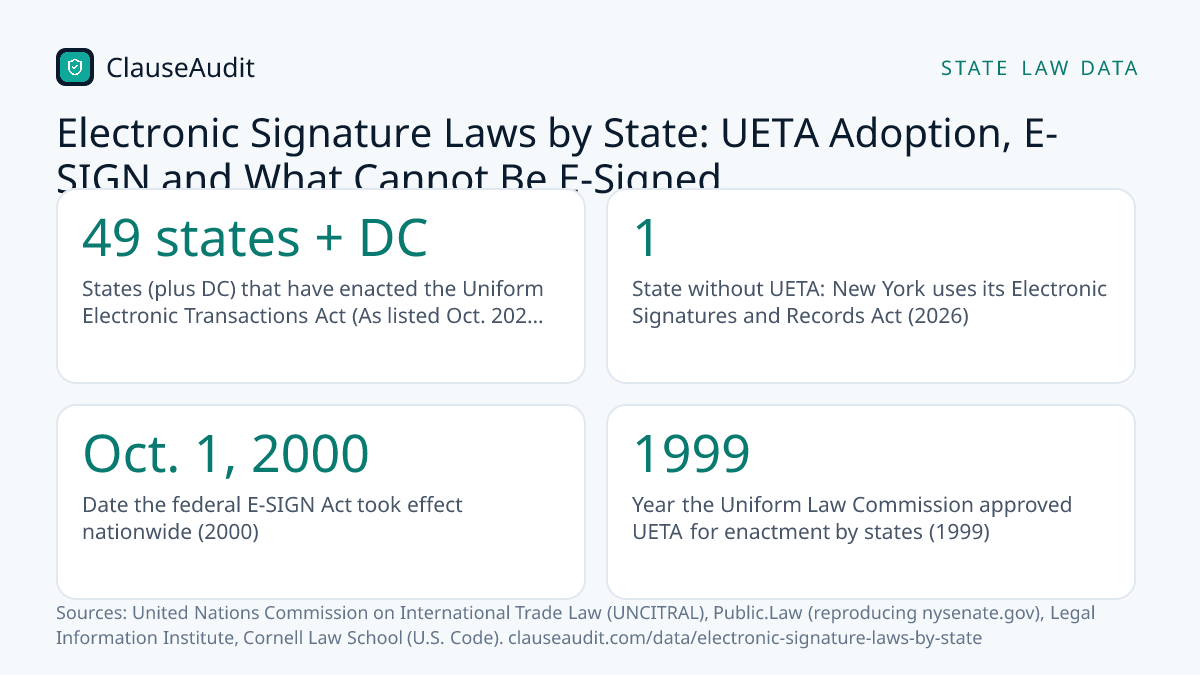
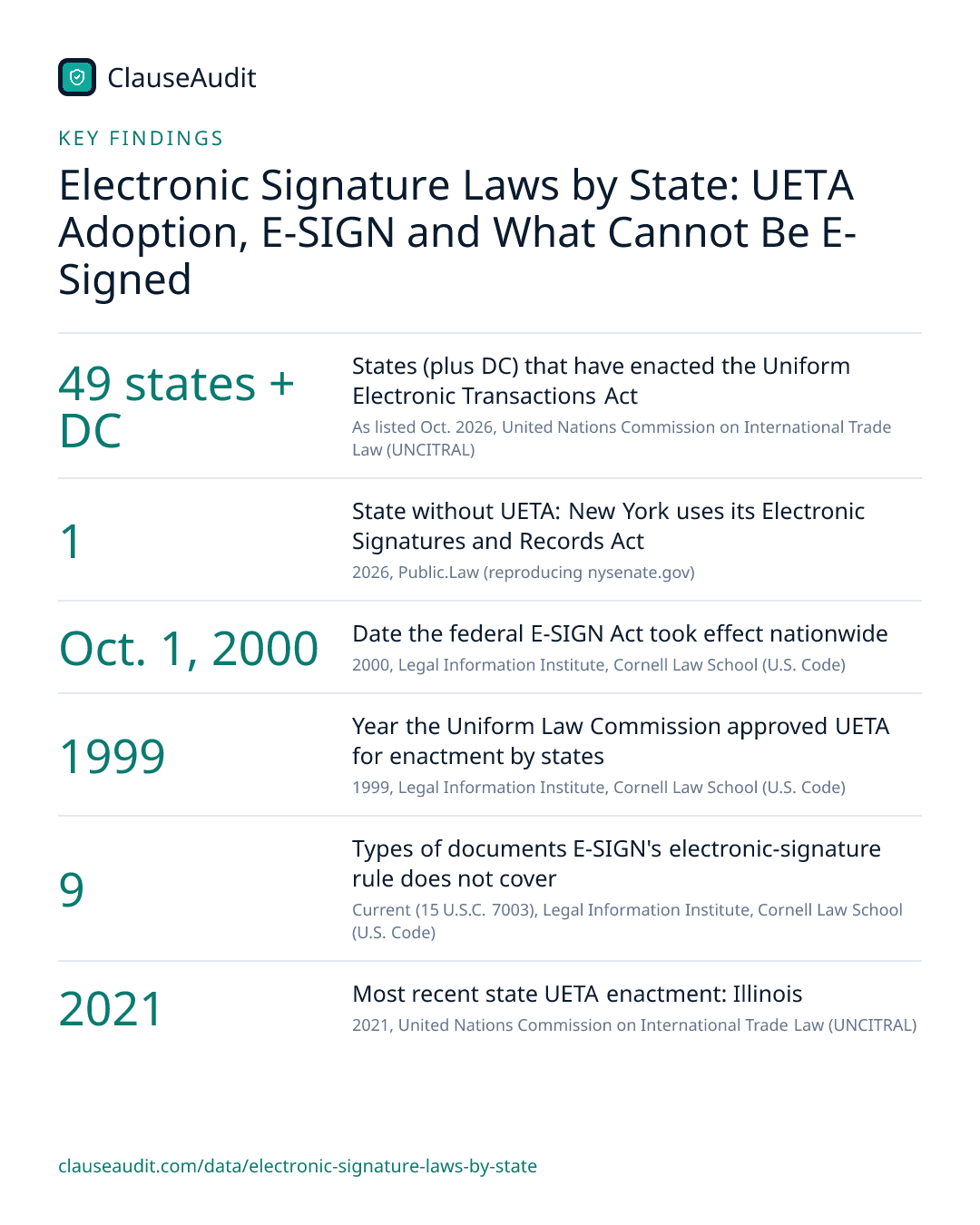
Electronic signatures are legal in every state. 49 states plus DC have enacted the Uniform Electronic Transactions Act, and New York uses its own Electronic Signatures and Records Act instead. The federal E-SIGN Act, in force since Oct. 1, 2000, backs them nationwide but leaves out 9 document types, including wills, family law papers and court filings.

- States (plus DC) that have enacted the Uniform Electronic Transactions Act (As listed Oct. 2026, United Nations Commission on International Trade Law (UNCITRAL))
- 49 states + DC
- State without UETA: New York uses its Electronic Signatures and Records Act (2026, Public.Law (reproducing nysenate.gov))
- 1
- Date the federal E-SIGN Act took effect nationwide (2000, Legal Information Institute, Cornell Law School (U.S. Code))
- Oct. 1, 2000
- Year the Uniform Law Commission approved UETA for enactment by states (1999, Legal Information Institute, Cornell Law School (U.S. Code))
- 1999
- Types of documents E-SIGN's electronic-signature rule does not cover (Current (15 U.S.C. 7003), Legal Information Institute, Cornell Law School (U.S. Code))
- 9
- Most recent state UETA enactment: Illinois (2021, United Nations Commission on International Trade Law (UNCITRAL))
- 2021
- Date New York's e-signature law starts allowing certain electronically executed wills (Effective Dec. 12, 2027, New York State Senate)
- Dec. 12, 2027
If you have signed a job offer, a client contract or an apartment lease by clicking a box or typing your name, you have relied on electronic signature law. The good news is that the rules are settled. Every state gives an e-signature the same legal weight as ink for ordinary contracts.
The details still matter. States got there through different statutes, New York wrote its own, and federal law carves out 9 kinds of documents where electronic signing does not get automatic protection. Below we explain how the pieces fit, which papers still need extra care, and what to check before you click Sign.
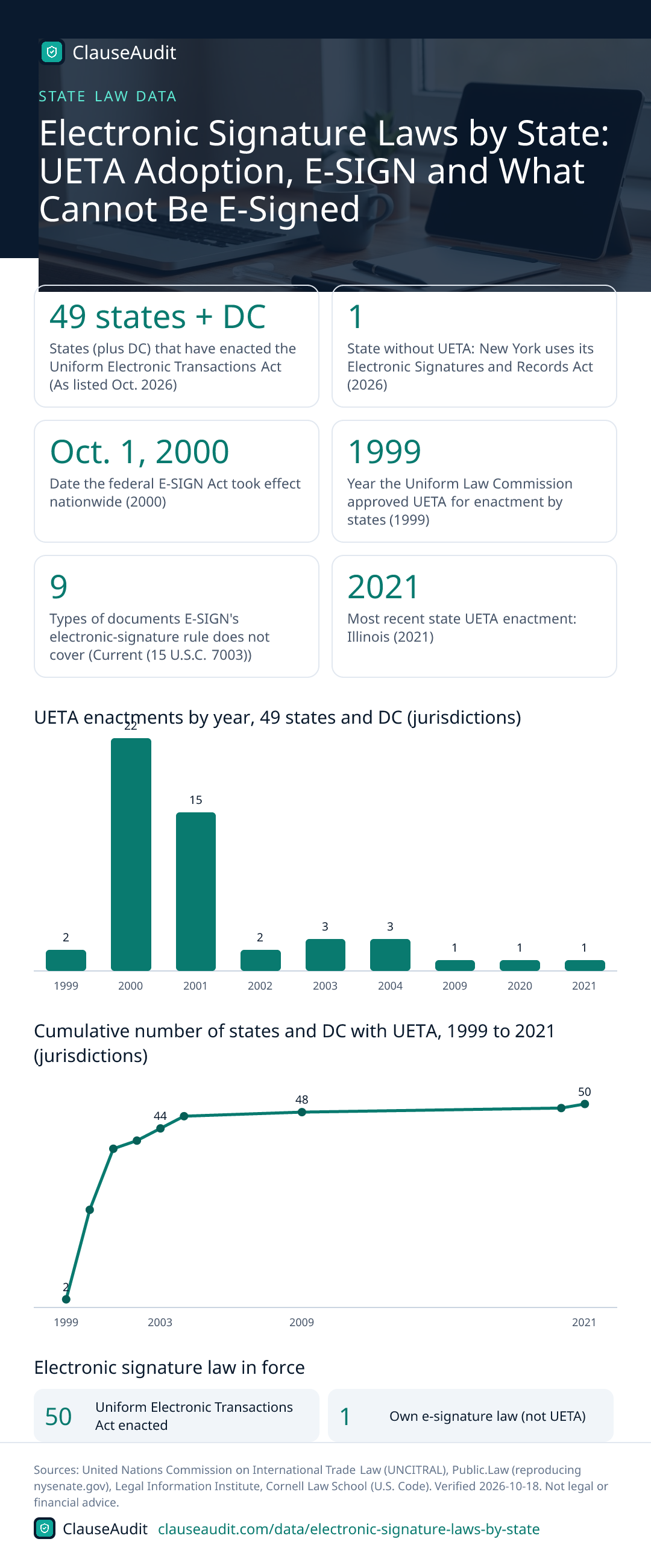
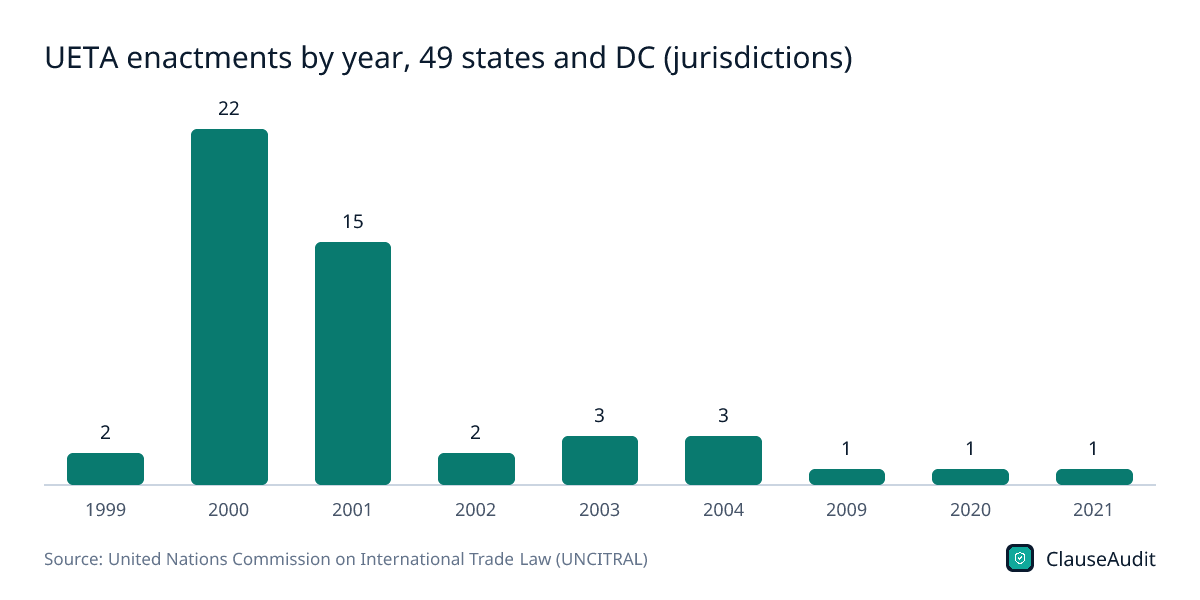
UETA enactments by year, 49 states and DC (jurisdictions)
Chart data
| Label | Value (jurisdictions) |
|---|---|
| 1999 | 2 |
| 2000 | 22 |
| 2001 | 15 |
| 2002 | 2 |
| 2003 | 3 |
| 2004 | 3 |
| 2009 | 1 |
| 2020 | 1 |
| 2021 | 1 |
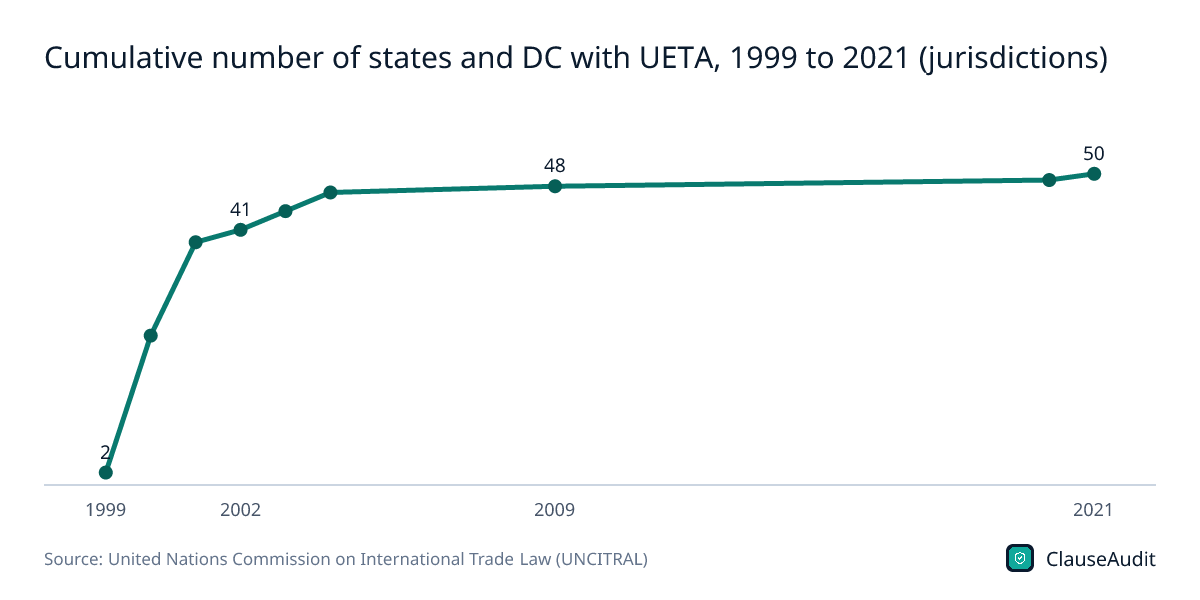
Most states moved fast. 22 jurisdictions passed UETA in 2000 and 15 more in 2001, right as the federal E-SIGN Act took effect. The late entries are Georgia in 2009, Washington in 2020 and Illinois in 2021.
Download this chart (PNG)Cumulative number of states and DC with UETA, 1999 to 2021 (jurisdictions)
Chart data
| Label | Value (jurisdictions) |
|---|---|
| 1999 | 2 |
| 2000 | 24 |
| 2001 | 39 |
| 2002 | 41 |
| 2003 | 44 |
| 2004 | 47 |
| 2009 | 48 |
| 2020 | 49 |
| 2021 | 50 |
Adoption hit 50 jurisdictions in 2021, which is every state except New York, plus DC. The flat stretch after 2004 shows how little has changed since. For most people the question is no longer whether e-signing is legal but whether a given signature can be proved.
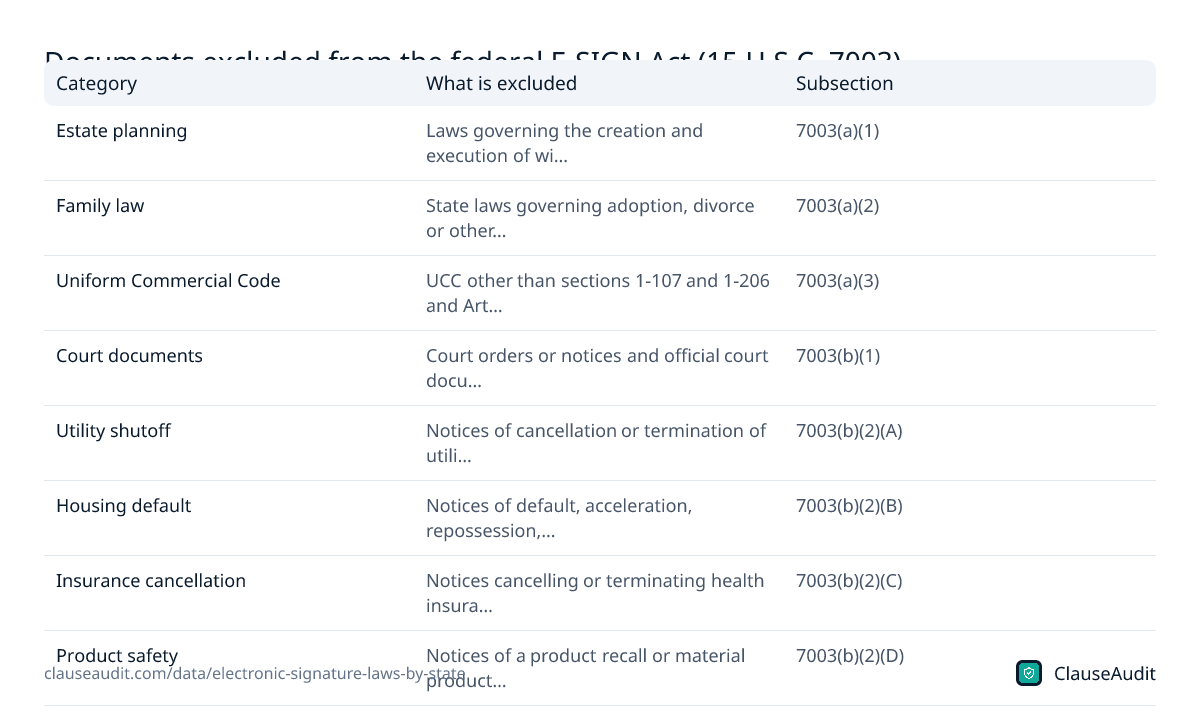
Download this chart (PNG)Documents excluded from the federal E-SIGN Act (15 U.S.C. 7003)
| Category | What is excluded | Subsection |
|---|---|---|
| Estate planning | Laws governing the creation and execution of wills, codicils or testamentary trusts | 7003(a)(1) |
| Family law | State laws governing adoption, divorce or other family-law matters | 7003(a)(2) |
| Uniform Commercial Code | UCC other than sections 1-107 and 1-206 and Articles 2 (sales) and 2A (leases) | 7003(a)(3) |
| Court documents | Court orders or notices and official court documents, including briefs and pleadings | 7003(b)(1) |
| Utility shutoff | Notices of cancellation or termination of utility services (water, heat, power) | 7003(b)(2)(A) |
| Housing default | Notices of default, acceleration, repossession, foreclosure, eviction or right to cure for a primary residence | 7003(b)(2)(B) |
| Insurance cancellation | Notices cancelling or terminating health insurance or benefits, or life insurance benefits (not annuities) | 7003(b)(2)(C) |
| Product safety | Notices of a product recall or material product failure that risks health or safety | 7003(b)(2)(D) |
| Hazardous materials | Documents required to accompany transport or handling of hazardous materials, pesticides or other toxic materials | 7003(b)(3) |
Source: Legal Information Institute, Cornell Law School (U.S. Code), 15 U.S.C. § 7003, Specific exceptions. Download as image
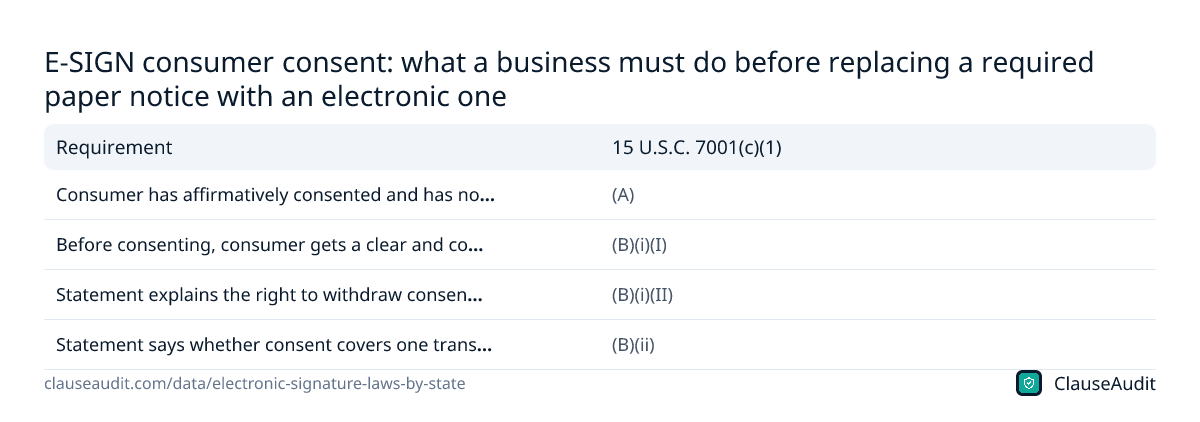
E-SIGN consumer consent: what a business must do before replacing a required paper notice with an electronic one
| Requirement | 15 U.S.C. 7001(c)(1) |
|---|---|
| Consumer has affirmatively consented and has not withdrawn consent | (A) |
| Before consenting, consumer gets a clear and conspicuous statement of any right to paper copies | (B)(i)(I) |
| Statement explains the right to withdraw consent and any conditions, consequences or fees | (B)(i)(II) |
| Statement says whether consent covers one transaction or identified categories of records | (B)(ii) |
Source: Legal Information Institute, Cornell Law School (U.S. Code), 15 U.S.C. § 7001, General rule of validity (E-SIGN Act), with effective-date note (Pub. L. 106-229, § 107). Download as image
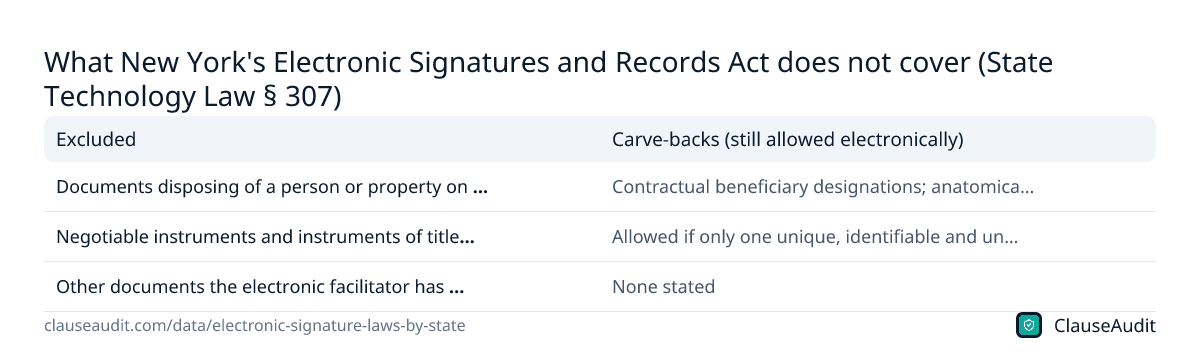
What New York's Electronic Signatures and Records Act does not cover (State Technology Law § 307)
| Excluded | Carve-backs (still allowed electronically) |
|---|---|
| Documents disposing of a person or property on death or incompetence, or appointing a fiduciary: wills, trusts, DNR consents, powers of attorney | Contractual beneficiary designations; anatomical gift registrations; funeral, cemetery and cremation forms; certain salvage-title powers of attorney |
| Negotiable instruments and instruments of title where possession confers title | Allowed if only one unique, identifiable and unalterable electronic version exists |
| Other documents the electronic facilitator has specifically excepted by rule | None stated |
Source: New York State Senate, N.Y. State Technology Law § 307, Exceptions. Download as image
Electronic signature law in force by state
- 50Uniform Electronic Transactions Act enacted
- 1Own e-signature law (not UETA)
- Uniform Electronic Transactions Act enacted50
- Own e-signature law (not UETA)1
| State | Law type | Statute | Name in statute | Year passed (UNCITRAL) | Source |
|---|---|---|---|---|---|
| Alabama | UETA enacted | Ala. Code § 8-1A-1 et seq. | Not confirmed | 2001 | Ala. Code § 8-1A-1 et seq. |
| Alaska | UETA enacted | Alaska Stat. § 09.80.010 et seq. | Not confirmed | 2004 | Alaska Stat. § 09.80.010 et seq. |
| Arizona | UETA enacted | A.R.S. § 44-7001 et seq. | Arizona electronic transactions act | 2000 | A.R.S. § 44-7001 et seq. |
| Arkansas | UETA enacted | Ark. Code § 25-32-101 et seq. | Uniform Electronic Transactions Act | 2001 | Ark. Code § 25-32-101 et seq. |
| California | UETA enacted | Cal. Civ. Code § 1633.1 et seq. | Uniform Electronic Transactions Act | 1999 | Cal. Civ. Code § 1633.1 et seq. |
| Colorado | UETA enacted | C.R.S. § 24-71.3-101 et seq. | Uniform Electronic Transactions Act | 2002 | C.R.S. § 24-71.3-101 et seq. |
| Connecticut | UETA enacted | Conn. Gen. Stat. §§ 1-266 to 1-286 | Connecticut Uniform Electronic Transactions Act | 2002 | Conn. Gen. Stat. §§ 1-266 to 1-286 |
| Delaware | UETA enacted | 6 Del. C. § 12A-101 et seq. | Uniform Electronic Transactions Act | 2000 | 6 Del. C. § 12A-101 et seq. |
| District of Columbia | UETA enacted | D.C. Code § 28-4901 et seq. (Chapter 49) | Uniform Electronic Transactions | 2001 | D.C. Code § 28-4901 et seq. (Chapter 49) |
| Florida | UETA enacted | Fla. Stat. § 668.50 | Uniform Electronic Transaction Act | 2000 | Fla. Stat. § 668.50 |
| Georgia | UETA enacted | O.C.G.A. § 10-12-1 et seq. | Uniform Electronic Transactions Act | 2009 | O.C.G.A. § 10-12-1 et seq. |
| Hawaii | UETA enacted | Haw. Rev. Stat. ch. 489E | Uniform Electronic Transactions Act | 2000 | Haw. Rev. Stat. ch. 489E |
| Idaho | UETA enacted | Idaho Code § 28-50-101 et seq. | Uniform Electronic Transactions Act | 2000 | Idaho Code § 28-50-101 et seq. |
| Illinois | UETA enacted | 815 ILCS 333 | Not confirmed | 2021 | 815 ILCS 333 |
| Indiana | UETA enacted | Ind. Code 26-2-8 | Uniform Electronic Transactions Act | 2000 | Ind. Code 26-2-8 |
| Iowa | UETA enacted | Iowa Code ch. 554D | Uniform Electronic Transactions Act | 2000 | Iowa Code ch. 554D |
| Kansas | UETA enacted | K.S.A. 16-1601 et seq. | Uniform electronic transactions act | 2000 | K.S.A. 16-1601 et seq. |
| Kentucky | UETA enacted | KRS 369.101 to 369.120 | Uniform Electronic Transactions Act | 2000 | KRS 369.101 to 369.120 |
| Louisiana | UETA enacted | La. R.S. 9:2601 et seq. | Louisiana Uniform Electronic Transactions Act | 2001 | La. R.S. 9:2601 et seq. |
| Maine | UETA enacted | 10 M.R.S. § 9401 et seq. | Uniform Electronic Transactions Act | 2000 | 10 M.R.S. § 9401 et seq. |
| Maryland | UETA enacted | Md. Code, Com. Law § 21-101 et seq. (Title 21) | The Maryland Uniform Electronic Transactions Act | 2000 | Md. Code, Com. Law § 21-101 et seq. (Title 21) |
| Massachusetts | UETA enacted | Mass. Gen. Laws ch. 110G | The Uniform Electronic Transactions Act | 2003 | Mass. Gen. Laws ch. 110G |
| Michigan | UETA enacted | MCL 450.831 et seq. | uniform electronic transactions act | 2000 | MCL 450.831 et seq. |
| Minnesota | UETA enacted | Minn. Stat. ch. 325L | Uniform Electronic Transactions Act | 2000 | Minn. Stat. ch. 325L |
| Mississippi | UETA enacted | Miss. Code § 75-12-1 et seq. | Uniform Electronic Transactions Act | 2001 | Miss. Code § 75-12-1 et seq. |
| Missouri | UETA enacted | RSMo §§ 432.200 to 432.295 | Uniform Electronic Transactions Act | 2003 | RSMo §§ 432.200 to 432.295 |
| Montana | UETA enacted | Mont. Code Ann. § 30-18-101 et seq. (Title 30, ch. 18, part 1) | Uniform Electronic Transactions Act | 2001 | Mont. Code Ann. § 30-18-101 et seq. (Title 30, ch. 18, part 1) |
| Nebraska | UETA enacted | Neb. Rev. Stat. §§ 86-612 to 86-643 | Uniform Electronic Transactions Act | 2000 | Neb. Rev. Stat. §§ 86-612 to 86-643 |
| Nevada | UETA enacted | NRS ch. 719 | Uniform Electronic Transactions Act | 2001 | NRS ch. 719 |
| New Hampshire | UETA enacted | RSA ch. 294-E | Not confirmed | 2001 | RSA ch. 294-E |
| New Jersey | UETA enacted | N.J.S.A. 12A:12-1 et seq. | Uniform Electronic Transactions Act | 2000 | N.J.S.A. 12A:12-1 et seq. |
| New Mexico | UETA enacted | NMSA 1978 ch. 14, art. 16 (§ 14-16-1 et seq.) | Uniform Electronic Transactions Act | 2001 | NMSA 1978 ch. 14, art. 16 (§ 14-16-1 et seq.) |
| New York | Own law (ESRA), not UETA | N.Y. State Technology Law §§ 301-309 (Article 3) | Electronic signatures and records act | Not listed | N.Y. State Technology Law §§ 301-309 (Article 3) |
| North Carolina | UETA enacted | N.C. Gen. Stat. § 66-311 et seq. (Ch. 66, Art. 40) | Uniform Electronic Transactions Act | 2000 | N.C. Gen. Stat. § 66-311 et seq. (Ch. 66, Art. 40) |
| North Dakota | UETA enacted | N.D.C.C. ch. 9-16 | Electronic Transactions (chapter title) | 2001 | N.D.C.C. ch. 9-16 |
| Ohio | UETA enacted | Ohio Rev. Code §§ 1306.01 to 1306.23 | Not confirmed | 2000 | Ohio Rev. Code §§ 1306.01 to 1306.23 |
| Oklahoma | UETA enacted | 12A O.S. § 15-101 et seq. | Uniform Electronic Transactions Act | 2000 | 12A O.S. § 15-101 et seq. |
| Oregon | UETA enacted | ORS 84.001 to 84.061 | Uniform Electronic Transactions Act | 2001 | ORS 84.001 to 84.061 |
| Pennsylvania | UETA enacted | 73 P.S. § 2260.101 et seq. | Electronic Transactions Act (Chs. 1, 3 and 5 = Uniform Electronic Transactions Act) | 1999 | 73 P.S. § 2260.101 et seq. |
| Rhode Island | UETA enacted | R.I. Gen. Laws § 42-127.1-1 et seq. | Uniform Electronic Transactions Act | 2000 | R.I. Gen. Laws § 42-127.1-1 et seq. |
| South Carolina | UETA enacted | S.C. Code § 26-6-10 et seq. | Uniform Electronic Transactions Act | 2004 | S.C. Code § 26-6-10 et seq. |
| South Dakota | UETA enacted | SDCL ch. 53-12 | Electronic Transactions (chapter title) | 2000 | SDCL ch. 53-12 |
| Tennessee | UETA enacted | Tenn. Code § 47-10-101 et seq. | Uniform Electronic Transactions Act | 2001 | Tenn. Code § 47-10-101 et seq. |
| Texas | UETA enacted | Tex. Bus. & Com. Code ch. 322 | Uniform Electronic Transactions Act | 2001 | Tex. Bus. & Com. Code ch. 322 |
| Utah | UETA enacted | Utah Code § 46-4-101 et seq. | Uniform Electronic Transactions Act | 2000 | Utah Code § 46-4-101 et seq. |
| Vermont | UETA enacted | 9 V.S.A. § 270 et seq. | Uniform Electronic Transactions Act | 2003 | 9 V.S.A. § 270 et seq. |
| Virginia | UETA enacted | Va. Code § 59.1-479 et seq. (ch. 42.1) | Uniform Electronic Transactions Act | 2000 | Va. Code § 59.1-479 et seq. (ch. 42.1) |
| Washington | UETA enacted | RCW ch. 1.80 | Uniform Electronic Transactions Act | 2020 | RCW ch. 1.80 |
| West Virginia | UETA enacted | W. Va. Code § 39A-1-1 et seq. | uniform electronic transactions act | 2001 | W. Va. Code § 39A-1-1 et seq. |
| Wisconsin | UETA enacted | Wis. Stat. ch. 137 (§ 137.11 et seq.) | Not confirmed | 2004 | Wis. Stat. ch. 137 (§ 137.11 et seq.) |
| Wyoming | UETA enacted | Wyo. Stat. §§ 40-21-101 to 40-21-119 | Uniform Electronic Transactions Act | 2001 | Wyo. Stat. §§ 40-21-101 to 40-21-119 |
Is an electronic signature legally binding in every state?
Yes, for the vast majority of contracts. UETA, the model law the Uniform Law Commission approved in 1999, says a signature or record cannot be denied legal effect just because it is electronic. 49 states plus DC have passed it. The federal E-SIGN Act says much the same thing and covers any deal in or affecting interstate commerce, which in practice means almost everything.
An electronic signature is broader than people expect. A typed name at the bottom of an email, a drawn squiggle on a phone screen, a click on an I Agree button: each can count, as long as the person meant to sign and the action can be tied to them.
What these laws do not do is make a bad contract good. You still need an offer, acceptance and the other basics of a binding deal. And under UETA, both sides have to agree to do business electronically, though that agreement can be inferred from how you behave. If a client sends a contract through a signing platform and you sign it there, you have agreed.
UETA or E-SIGN: which law applies to your contract?
Most of the time you do not need to pick. E-SIGN lets a state replace the federal rule only by enacting UETA as approved in 1999, or another law consistent with E-SIGN. So in the 49 states plus DC that use UETA, the state statute usually governs and E-SIGN sits in the background. In New York, the state act and E-SIGN run side by side.
Where it matters is the fine print. Some states tweaked their version, and the state table above shows each citation so you can read your own. If a contract picks a governing law, that state's version is the one a court will look at first.
A practical example: a Texas designer signs a services agreement with a Chicago agency through a signing app. Texas and Illinois have both enacted UETA, the deal crosses state lines so E-SIGN applies too, and the signature is valid under all three. The fight, if there is one, will be over what the contract says.
Why does New York have its own electronic signature law?
New York is the only state that never adopted UETA. It relies on its Electronic Signatures and Records Act, found in the State Technology Law. For day-to-day business the result is close to the same: an electronic signature on a New York services agreement, lease or offer letter carries the same weight as a handwritten one. E-SIGN also still applies to transactions that cross state lines.
The differences show up at the edges. New York's law does not cover wills, trusts, powers of attorney or do-not-resuscitate consents, and it limits electronic negotiable instruments to cases where a single unique, unalterable electronic version exists. That is changing in part. An amended version effective Dec. 12, 2027 will allow certain electronically executed wills. Until then, New Yorkers should plan on signing estate documents on paper.
What documents cannot be signed electronically?
E-SIGN lists 9 types of documents its signature rule does not cover. The table above has the full text. In plain terms, they fall into two groups.
The first group is paperwork where the law already has its own formalities: wills, codicils and testamentary trusts; adoption, divorce and other family law matters; most of the Uniform Commercial Code; and court orders, notices, briefs and pleadings. Courts run their own e-filing rules, so a court filing follows those rules, not E-SIGN.
The second group is serious notices that must reach a person reliably. That includes utility shutoff notices, default, foreclosure or eviction notices for a primary residence, cancellation of health or life insurance, product recall warnings and documents that travel with hazardous materials. If your landlord sends an eviction notice only by email, E-SIGN does not make that delivery valid. Check your state's notice rules before you assume a deadline has started.
Being outside E-SIGN does not always mean paper is required. Some states have separate laws on electronic wills or court filing. It means you cannot count on the general e-signature rule and need to look at the specific law.
What must a business do before sending you notices electronically?
When a law says a consumer must get a notice in writing, a business can only switch you to electronic delivery after meeting E-SIGN's consent rules. You have to say yes affirmatively. Before you do, you must get a clear statement of any right to paper copies, how to withdraw consent and what that costs, and whether the consent covers one transaction or whole categories of records.
This is why your bank, insurer or landlord asks you to tick a box agreeing to e-delivery. If they skip that step for a legally required notice, the electronic version may not count. Keep a screenshot of what you agreed to.
For freelancers and small businesses, deals between companies are not covered by these consumer consent rules. Your contract's notice clause does the work instead, so read it. If it says notices must go to a specific address and you have been emailing a project manager, a termination or late-payment notice could be challenged.
How to make sure an e-signed contract holds up
- Sign through a platform that records who signed, when and from what email or device. That audit trail is your proof if the other side later says it never agreed.
- Download and keep the fully signed copy. Both UETA and E-SIGN expect records to be kept in a form that can be accurately reproduced later. A link that expires in a month is not a record.
- Confirm the person signing for a company has authority to bind it. An e-signature from an intern is still an intern's signature.
- Make sure the version you sign is the final version. Compare it against the last draft you negotiated before you click.
- Read the counterparts and electronic signatures clause. Many contracts say signatures delivered by email or PDF count as originals. If yours is silent, add that line.
- Check how the contract can be changed. A clause letting the other party update terms by posting them online, with your continued use counting as acceptance, is a bigger risk than any signing method.
How ClauseAudit helps
The way you sign rarely causes the problem. What you agreed to does. Once you click, the payment terms, renewal rules and liability limits bind you exactly as if you had signed in ink.
Upload or paste the contract before you sign and the automated review flags the clauses that decide how changes, notices and disputes work, with plain-English notes on what to push back on.
- Electronic signature and counterparts clause: confirms e-signed and PDF copies count as originals
- Notice clause: whether email counts and which address legal notices must go to
- Amendment clause: whether terms can change by email, website posting or continued use
- Auto-renewal and cancellation: how and when you must give notice to get out
- Payment terms and late fees: due dates, invoice approval and interest on late payments
- Limitation of liability and governing law: which state's rules apply if something goes wrong
Frequently asked questions
Is a typed name a legal signature?
Usually, yes. Under UETA and E-SIGN, a signature can be any electronic sound, symbol or process a person adopts with intent to sign. A typed name at the end of an email can bind you if the context shows you meant to agree. The harder question is proof, so for anything important use a signing platform that logs who signed and when.
Can a lease be signed electronically?
Generally, yes. Residential and commercial leases can be signed electronically in every state. What E-SIGN excludes is certain notices about a primary residence, such as default, foreclosure and eviction notices, not the lease itself. Your landlord may still need to deliver those notices by the method state law requires, so do not assume an email alone starts the clock.
Can a will be signed electronically?
Not under the general e-signature rules. E-SIGN excludes wills, codicils and testamentary trusts, and New York's law currently excludes them too. New York's amended law effective Dec. 12, 2027 will allow certain electronically executed wills. Some other states have separate electronic wills laws, so check your state's probate rules or ask an estate lawyer.
What is the difference between UETA and E-SIGN?
UETA is a model state law approved in 1999 and adopted by 49 states plus DC. E-SIGN is the federal law that took effect Oct. 1, 2000. They say largely the same thing. Where a state has enacted UETA as approved, the state version governs. E-SIGN fills gaps and covers transactions in interstate commerce, including in New York.
Is clicking I Agree the same as signing?
It can be. Courts regularly enforce clickwrap terms where you had to tick a box or press a button to accept, and the terms were clearly shown. Browsewrap, where terms sit behind a link you never had to open, is much weaker. Either way, the click binds you to whatever was in the terms, so read the renewal and cancellation sections first.
Does an electronic signature need to be notarized?
Only if the document itself requires notarization, such as some deeds or affidavits. Most contracts do not. Where a notary is required, an ordinary e-signature is not enough on its own. Many states allow remote online notarization, where the notary verifies you over video and applies an electronic seal.
Can I cancel a contract because I signed it electronically?
No. An e-signature is as binding as ink, so the method of signing is not a way out. You have the same exit routes as with paper: a cancellation or termination clause, a cooling-off right under consumer law for certain sales, or a defense such as fraud or a signature someone else made without your permission.
Can my employer make me sign documents electronically?
Offer letters, handbook acknowledgments and most employment contracts can be signed electronically, and accepting the employer's signing system usually counts as agreeing to do business that way. If a law requires a written notice to you as a consumer, the E-SIGN consent rules apply. Always download a copy of anything you sign so you are not relying on access to the company's systems.
Use this data
Every chart and card below is free to reuse under CC BY 4.0. Download what you need and link back to this page.
 Stat cards
 Key findings card
 Infographic
 UETA enactments by year, 49 states and DC (jurisdictions)
 Cumulative number of states and DC with UETA, 1999 to 2021 (jurisdictions)
 Documents excluded from the federal E-SIGN Act (15 U.S.C. 7003)
 E-SIGN consumer consent: what a business must do before replacing a required paper notice with an electronic one
 What New York's Electronic Signatures and Records Act does not cover (State Technology Law § 307)
Embed the infographic
Free to share on your site, blog or slides under CC BY 4.0. Please keep the credit link.
Sources and method
Every number on this page comes from the sources below, each opened and read on or before October 18, 2026. A second, independent review checked every figure against its source and corrected anything that did not match. 51 of 51 state entries were confirmed; any that could not be are marked "Not yet confirmed" and left out of every count and chart.
- United Nations Commission on International Trade Law (UNCITRAL), Status: UNCITRAL Model Law on Electronic Commerce (1996), United States of America (UETA enactments) (Status page as accessed Oct. 2026)
- Legal Information Institute, Cornell Law School (U.S. Code), 15 U.S.C. § 7001, General rule of validity (E-SIGN Act), with effective-date note (Pub. L. 106-229, § 107) (Pub. L. 106-229, June 30, 2000)
- Legal Information Institute, Cornell Law School (U.S. Code), 15 U.S.C. § 7002, Exemption to preemption (Pub. L. 106-229, § 102, June 30, 2000)
- Legal Information Institute, Cornell Law School (U.S. Code), 15 U.S.C. § 7003, Specific exceptions (Pub. L. 106-229, § 103, June 30, 2000)
- Public.Law (reproducing nysenate.gov), N.Y. State Technology Law § 301, Short title (Electronic Signatures and Records Act) (Last modified Sep. 22, 2014; verified Oct. 17, 2026)
- New York State Senate, N.Y. State Technology Law § 307, Exceptions (Versions effective until and from Dec. 12, 2027)
Cite this page
ClauseAudit, “Electronic Signature Laws by State: UETA Adoption, E-SIGN and What Cannot Be E-Signed”, updated October 18, 2026, https://clauseaudit.com/data/electronic-signature-laws-by-state. Free to reuse with a link back (CC BY 4.0).
This page summarises published data and law as checked on October 18, 2026. Figures are updated as new editions are released, and your own situation may differ. It is general information, not legal, tax or financial advice.