Confession of Judgment Laws by State: Where Lenders Can Still Use Them
By ClauseAudit Research · 38 sources ·
Which states allow a confession of judgment?
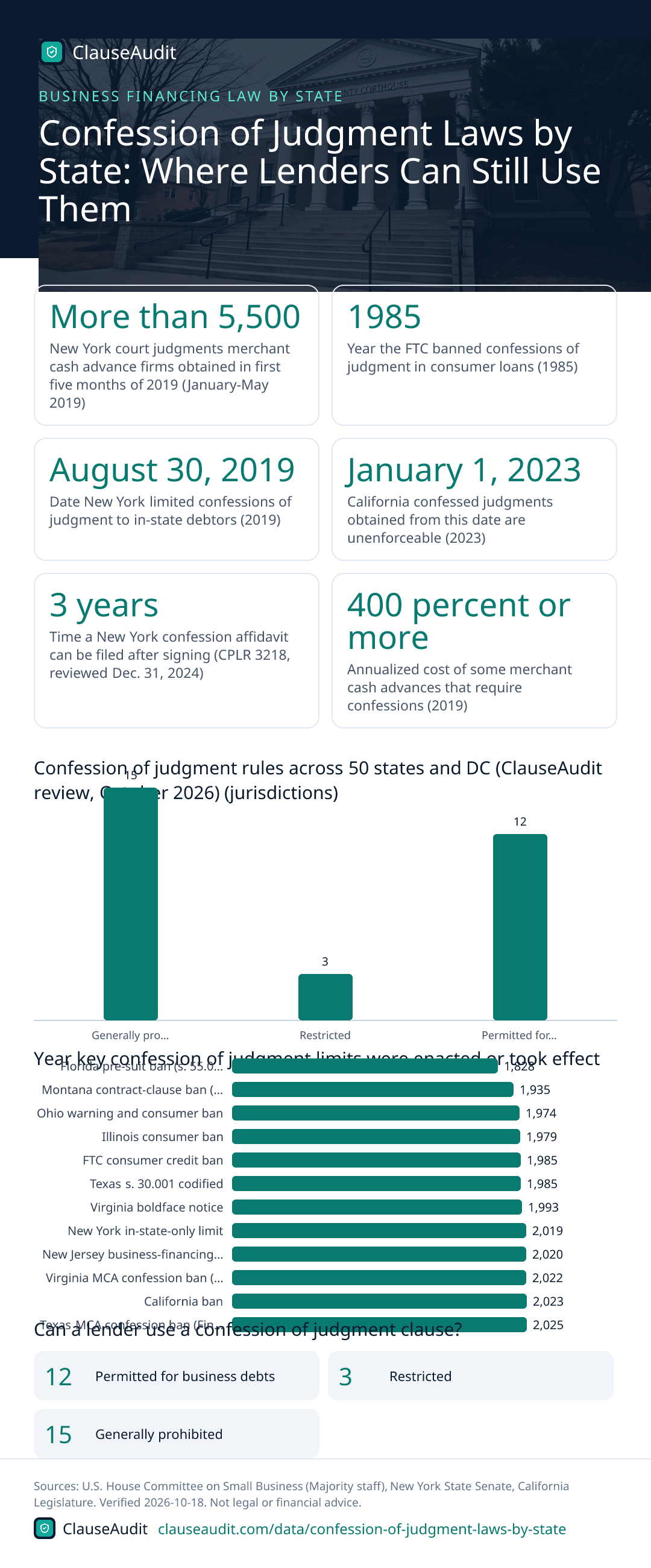
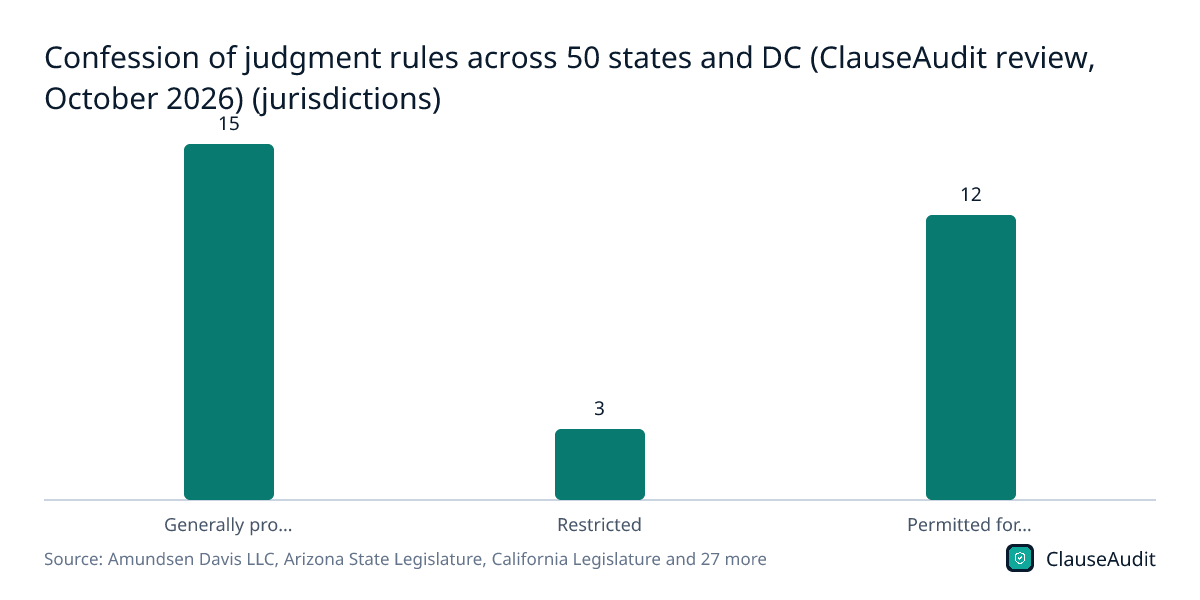
Confessions of judgment are still allowed for business debts in 12 states in our October 2026 review, restricted in 3, and generally prohibited in 15 jurisdictions, including California, Florida, Texas and New Jersey. New York, the old hub, has allowed them only against its own residents since August 30, 2019. Federal rules have barred them in consumer loans since 1985.
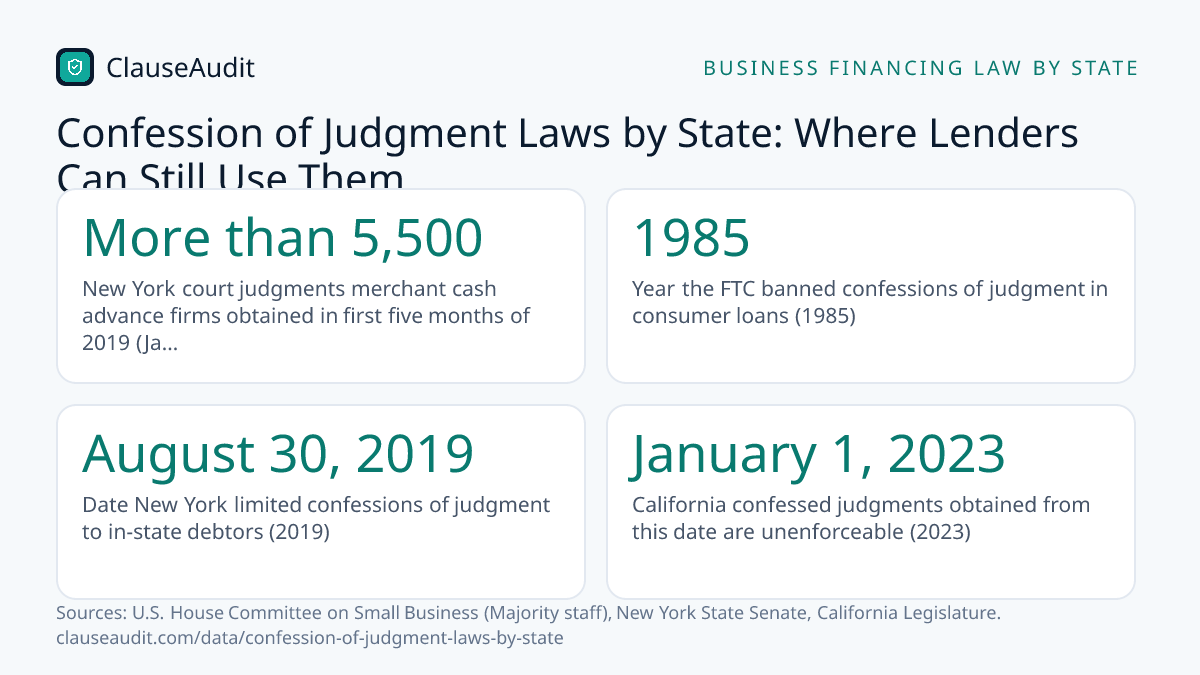
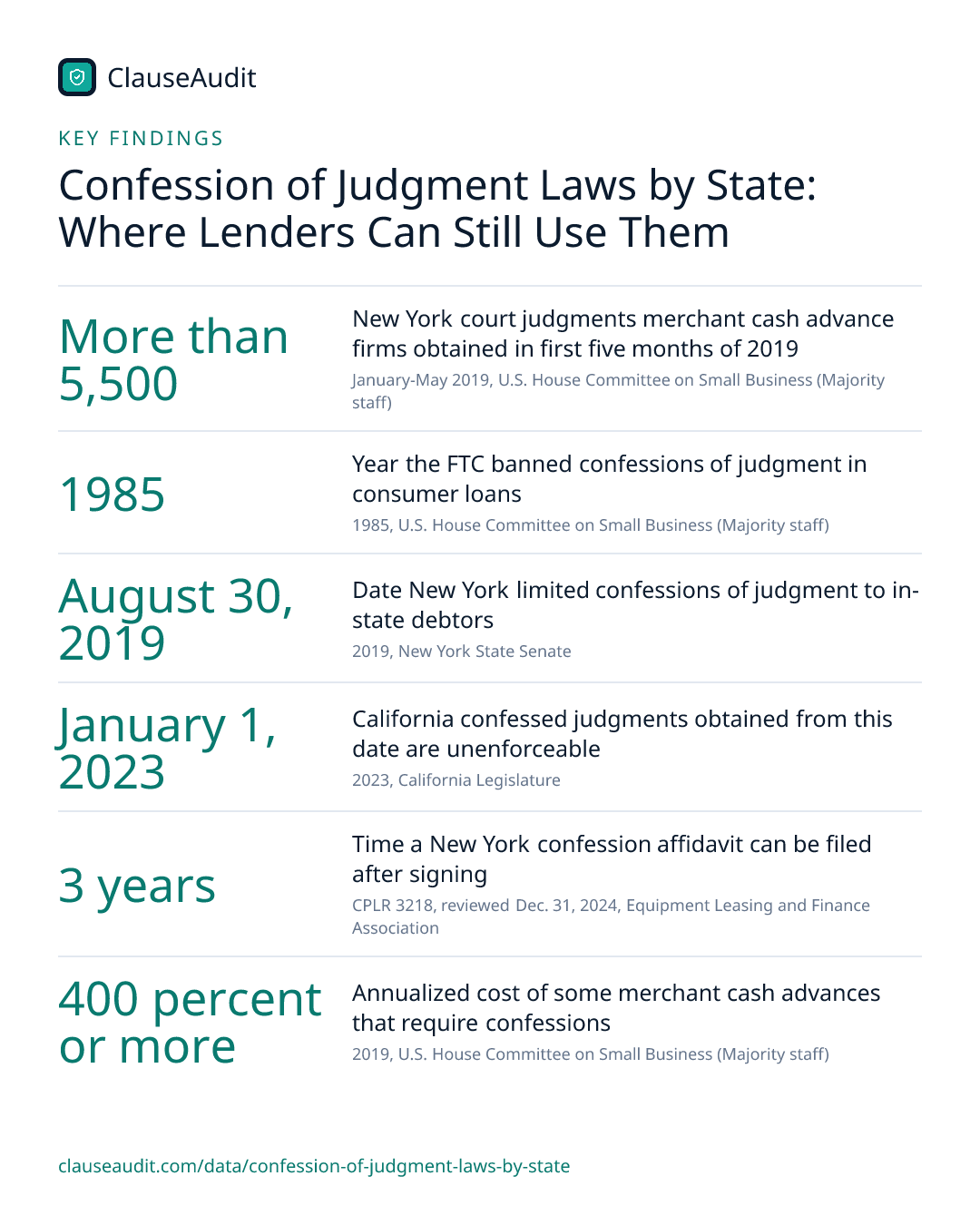
- New York court judgments merchant cash advance firms obtained in first five months of 2019 (January-May 2019, U.S. House Committee on Small Business (Majority staff))
- More than 5,500
- Year the FTC banned confessions of judgment in consumer loans (1985, U.S. House Committee on Small Business (Majority staff))
- 1985
- Date New York limited confessions of judgment to in-state debtors (2019, New York State Senate)
- August 30, 2019
- California confessed judgments obtained from this date are unenforceable (2023, California Legislature)
- January 1, 2023
- Time a New York confession affidavit can be filed after signing (CPLR 3218, reviewed Dec. 31, 2024, Equipment Leasing and Finance Association)
- 3 years
- Annualized cost of some merchant cash advances that require confessions (2019, U.S. House Committee on Small Business (Majority staff))
- 400 percent or more
- Ohio cognovit notes signed since this date need the statutory warning (Ohio Rev. Code 2323.13(D), Ohio Legislative Service Commission)
- January 1, 1974
A confession of judgment is a clause where you agree, in advance, that if the lender says you defaulted, it can get a court judgment against you without suing you first. No hearing, no chance to argue the numbers. By the time you hear about it, your bank account may already be frozen.
The rules depend heavily on where you are and what kind of debt it is. The map and table below show each state's position for business loans and merchant cash advances. This page explains what those categories really mean, where the gaps are, and what to do if one of these clauses lands in front of you.
Confession of judgment rules across 50 states and DC (ClauseAudit review, October 2026) (jurisdictions)
Chart data
| Label | Value (jurisdictions) |
|---|---|
| Generally prohibited | 15 |
| Restricted | 3 |
| Permitted for business debts | 12 |
The confirmed split leans toward limits: 15 jurisdictions generally prohibit these clauses and 3 more restrict them, against 12 that still allow them for business debts. Several of the prohibited entries rest on 2019 congressional testimony rather than a fresh read of the statute, so check your state's row before relying on it.
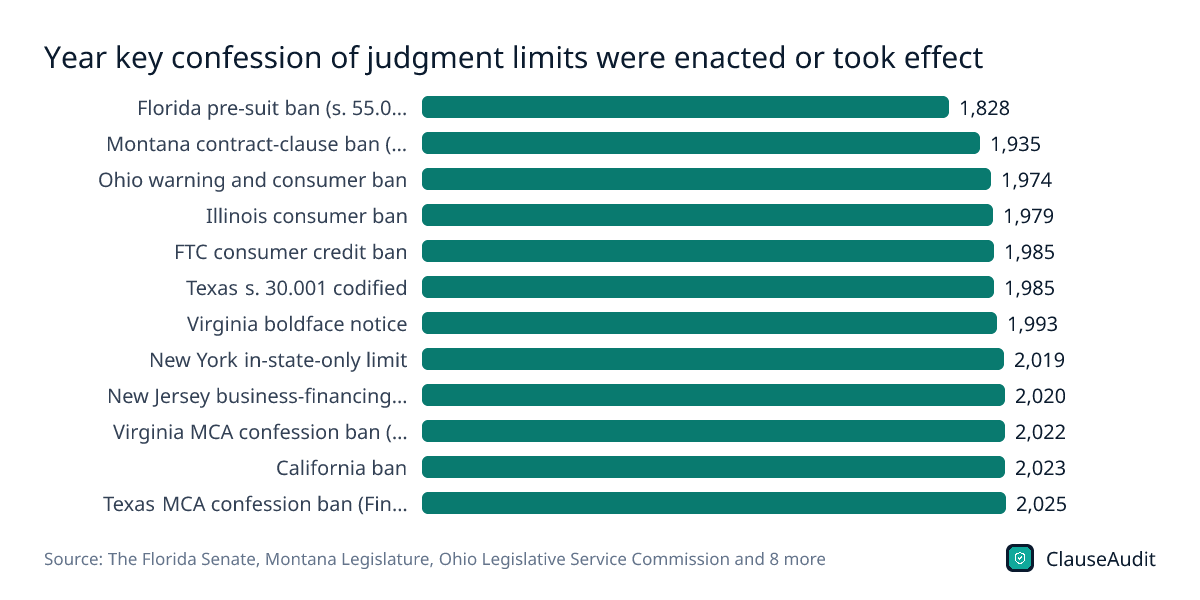
Download this chart (PNG)Year key confession of judgment limits were enacted or took effect
Chart data
| Label | Value |
|---|---|
| Florida pre-suit ban (s. 55.05) | 1828 |
| Montana contract-clause ban (28-2-709) | 1935 |
| Ohio warning and consumer ban | 1974 |
| Illinois consumer ban | 1979 |
| FTC consumer credit ban | 1985 |
| Texas s. 30.001 codified | 1985 |
| Virginia boldface notice | 1993 |
| New York in-state-only limit | 2019 |
| New Jersey business-financing ban (P.L.2019, c.430, approved) | 2020 |
| Virginia MCA confession ban (6.2-2234) | 2022 |
| California ban | 2023 |
| Texas MCA confession ban (Fin. Code 398.055) | 2025 |
Florida voided pre-suit confessions as early as 1828, but most of the action is recent. New York, New Jersey, Virginia, California and Texas all moved between 2019 and 2025, and Virginia and Texas aimed their newest rules squarely at merchant cash advance contracts.
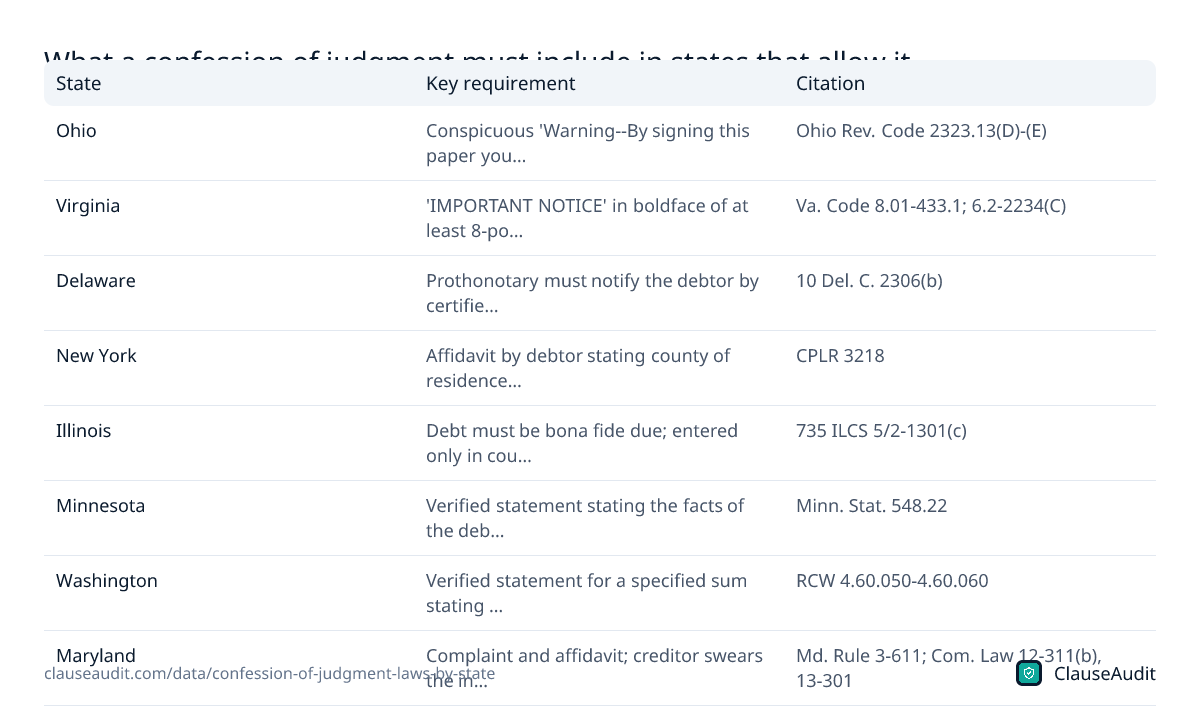
Download this chart (PNG)What a confession of judgment must include in states that allow it
| State | Key requirement | Citation |
|---|---|---|
| Ohio | Conspicuous 'Warning--By signing this paper you give up your right to notice and court trial' text next to signatures; invalid in consumer loans | Ohio Rev. Code 2323.13(D)-(E) |
| Virginia | 'IMPORTANT NOTICE' in boldface of at least 8-point type on the face of the note (instruments after Jan. 1, 1993); barred in sales-based financing (MCA) contracts since 2022 | Va. Code 8.01-433.1; 6.2-2234(C) |
| Delaware | Prothonotary must notify the debtor by certified mail of a chance for a hearing before judgment is final | 10 Del. C. 2306(b) |
| New York | Affidavit by debtor stating county of residence; filed only in that county, within 3 years | CPLR 3218 |
| Illinois | Debt must be bona fide due; entered only in county of signing, residence or property; void in consumer transactions | 735 ILCS 5/2-1301(c) |
| Minnesota | Verified statement stating the facts of the debt and that the sum is justly due | Minn. Stat. 548.22 |
| Washington | Verified statement for a specified sum stating the facts of the debt | RCW 4.60.050-4.60.060 |
| Maryland | Complaint and affidavit; creditor swears the instrument is not a consumer loan or consumer transaction | Md. Rule 3-611; Com. Law 12-311(b), 13-301 |
| Pennsylvania | Complaint with copy of the signed instrument; leave of court if instrument is over 20 years old | Pa.R.C.P. 2951 |
Source: Ohio Legislative Service Commission, Ohio Revised Code 2323.13: Confession of judgment (Internet Archive copy of codes.ohio.gov); Virginia General Assembly (Virginia Law Library), Code of Virginia s. 8.01-433.1: Notice of confession of judgment provision; Delaware General Assembly, Delaware Code Online, 10 Del. C. s. 2306: Entry of judgment by confession; Equipment Leasing and Finance Association, State Law Compendium: New York, Confession of Judgment (CPLR 3218, 3201); Illinois General Assembly, 735 ILCS 5/2-1301: Judgments - Default - Confession (Internet Archive copy of ilga.gov); Minnesota Office of the Revisor of Statutes, Minnesota Statutes 548.22: Confession of judgment; Washington State Legislature, RCW 4.60.050 and 4.60.060: Judgment by confession without suit; statement in writing; Maryland Judiciary, District Court of Maryland, Form DC-CV-104: Complaint for Judgment by Confession (Md. Rule 3-611); Maryland General Assembly, Maryland Code, Commercial Law s. 12-311; Pennsylvania Code and Bulletin, Pa.R.C.P. 2951: Method of Proceeding (Confession of Judgment for Money); Virginia General Assembly (Virginia Law Library), Code of Virginia s. 6.2-2234: Sales-based financing; venue, fees, confession of judgment. Download as image
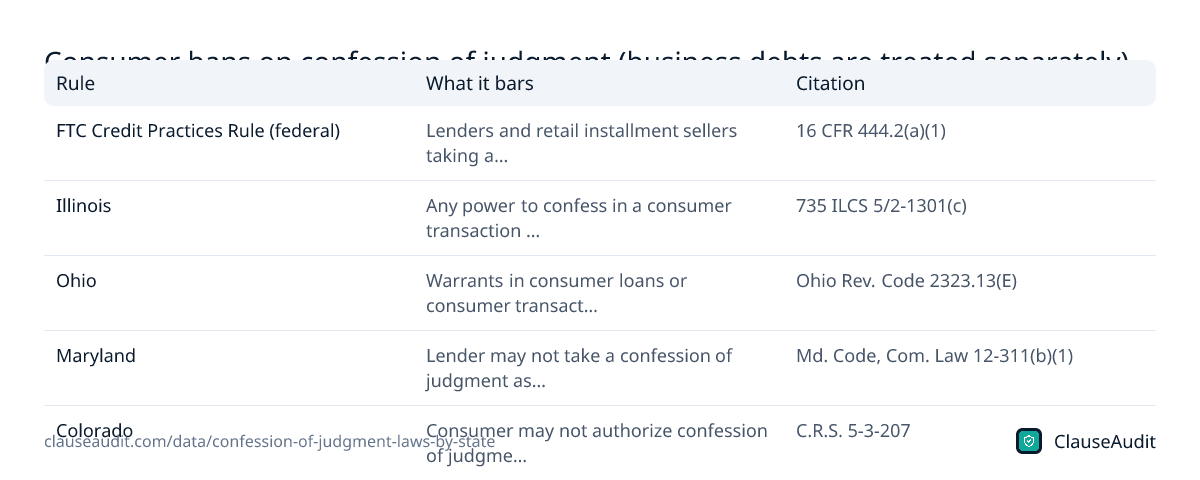
Consumer bans on confession of judgment (business debts are treated separately)
| Rule | What it bars | Citation |
|---|---|---|
| FTC Credit Practices Rule (federal) | Lenders and retail installment sellers taking a cognovit or confession of judgment from a consumer (except Louisiana executory process) | 16 CFR 444.2(a)(1) |
| Illinois | Any power to confess in a consumer transaction instrument after Sept. 24, 1979 is void | 735 ILCS 5/2-1301(c) |
| Ohio | Warrants in consumer loans or consumer transactions executed on or after Jan. 1, 1974 are invalid | Ohio Rev. Code 2323.13(E) |
| Maryland | Lender may not take a confession of judgment as security for a consumer loan | Md. Code, Com. Law 12-311(b)(1) |
| Colorado | Consumer may not authorize confession of judgment in a consumer credit transaction | C.R.S. 5-3-207 |
Source: Legal Information Institute, Cornell Law School (Code of Federal Regulations text), 16 CFR 444.2 Unfair credit practices (FTC Credit Practices Rule); Illinois General Assembly, 735 ILCS 5/2-1301: Judgments - Default - Confession (Internet Archive copy of ilga.gov); Ohio Legislative Service Commission, Ohio Revised Code 2323.13: Confession of judgment (Internet Archive copy of codes.ohio.gov); Maryland General Assembly, Maryland Code, Commercial Law s. 12-311; Colorado.Public.Law (reproducing Colorado Revised Statutes 2024), C.R.S. 5-3-207: Authorization to confess judgment prohibited. Download as image
Can a lender use a confession of judgment clause? by state
- 12Permitted for business debts
- 3Restricted
- 15Generally prohibited
- Permitted for business debts12
- Restricted3
- Generally prohibited15
- Not yet confirmed21
| State | Rule | Business loans and MCAs | Consumer debts | Source |
|---|---|---|---|---|
| Alabama | Generally prohibited (per 2019 congressional testimony) | Generally not available | Barred | Prepared Statement of Hosea H. Harvey, Ph.D., "Crushed by Confessions of Judgement: The Small Business Story" |
| Alaska | Not yet confirmed: check the source | No state source checked yet; federal consumer rule only | ||
| Arizona | Power to confess must be signed after the debt is due | Pre-default clauses not usable; post-default workouts only | Barred | A.R.S. 44-143 |
| Arkansas | Not yet confirmed: check the source | No state source checked yet; federal consumer rule only | ||
| California | Unenforceable; may not be entered in any superior court | Not available for judgments obtained on or after Jan 1, 2023 | Barred | Cal. Code Civ. Proc. 1132 (as amended by SB 688, 2022) |
| Colorado | Not yet confirmed: check the source | C.R.S. 5-3-207 (consumer only) | ||
| Connecticut | Not yet confirmed: check the source | C.G.S.A. 52-605 (foreign judgments) | ||
| Delaware | Allowed on a warrant of attorney, with notice and hearing opportunity | Available | Federal FTC rule applies | 10 Del. C. 2306 |
| District of Columbia | Generally prohibited (per 2019 congressional testimony) | Generally not available | Barred | Prepared Statement of Hosea H. Harvey, Ph.D., "Crushed by Confessions of Judgement: The Small Business Story" |
| Florida | Pre-suit powers to confess judgment are void | Not available | Barred | Fla. Stat. 55.05 |
| Georgia | Generally prohibited (per 2019 congressional testimony) | Generally not available | Barred | Prepared Statement of Hosea H. Harvey, Ph.D., "Crushed by Confessions of Judgement: The Small Business Story" |
| Hawaii | Not yet confirmed: check the source | No state source checked yet; federal consumer rule only | ||
| Idaho | Generally prohibited (per 2019 congressional testimony) | Generally not available | Barred | Prepared Statement of Hosea H. Harvey, Ph.D., "Crushed by Confessions of Judgement: The Small Business Story" |
| Illinois | Allowed for a debt bona fide due; venue limited | Available | Void in consumer transactions after Sept. 24, 1979 | 735 ILCS 5/2-1301(c) |
| Indiana | Prohibited; knowingly obtaining one is a Class B misdemeanor | Not available | Barred | Ind. Code 34-54-4-1 |
| Iowa | Judgment by confession without action may be entered by the clerk | Available | Federal FTC rule applies | Iowa Code 676.1 |
| Kansas | Not yet confirmed: check the source | No state source checked yet; federal consumer rule only | ||
| Kentucky | Generally prohibited (per 2019 congressional testimony) | Generally not available | Barred | Prepared Statement of Hosea H. Harvey, Ph.D., "Crushed by Confessions of Judgement: The Small Business Story" |
| Louisiana | Used in executory process (foreclosure on an authentic act) | Limited to executory process | Federal rule allows only for executory process | 16 CFR 444.2 Unfair credit practices (FTC Credit Practices Rule) |
| Maine | Not yet confirmed: check the source | No state source checked yet; federal consumer rule only | ||
| Maryland | Allowed by complaint and affidavit under Md. Rule 3-611 | Available | Barred for consumer loans, consumer transactions and retail installment sales | Md. Rule 3-611 (District Court); Md. Code, Com. Law 12-311(b), 13-301 |
| Massachusetts | Agreements to confess judgment are void | Not available | Barred | M.G.L. c. 231, s. 13A |
| Michigan | Not yet confirmed: check the source | No state source checked yet; federal consumer rule only | ||
| Minnesota | Allowed by verified statement signed by the debtor | Available | Federal FTC rule applies | Minn. Stat. 548.22 |
| Mississippi | Not yet confirmed: check the source | No state source checked yet; federal consumer rule only | ||
| Missouri | Judgment by confession may be entered without action | Available | Federal FTC rule applies | RSMo 511.070 |
| Montana | Contract clauses empowering confession are illegal and void | Pre-dispute clauses not usable | Barred | MCA 28-2-709; MCA 27-9-101 |
| Nebraska | Not yet confirmed: check the source | No state source checked yet; federal consumer rule only | ||
| Nevada | Allowed by sworn written statement of the debtor | Available | Federal FTC rule applies | NRS 17.090-17.110 |
| New Hampshire | Not yet confirmed: check the source | No state source checked yet; federal consumer rule only | ||
| New Jersey | Barred in business financing to New Jersey businesses | Not available (provision invalid and unenforceable) | Federal FTC rule applies | N.J.S.A. 2A:16-9.1 and 2A:16-9.2 (P.L.2019, c.430) |
| New Mexico | Confession before the cause of action accrues is prohibited | Pre-default clauses not usable; post-accrual confessions allowed | Barred | NMSA 39-1-10 to 39-1-20 (39-1-16) |
| New York | Allowed only against New York residents; file in debtor's county | Available against in-state debtors only | Barred for small consumer installment purchases before default | CPLR 3218 (amended by L. 2019, ch. 214); CPLR 3201 |
| North Carolina | Allowed by verified statement filed with the clerk | Available | Federal FTC rule applies | N.C. Gen. Stat. 1A-1, Rule 68.1 |
| North Dakota | Not yet confirmed: check the source | No state source checked yet; federal consumer rule only | ||
| Ohio | Allowed with a mandatory conspicuous warning by the signature | Available | Invalid for consumer loans and transactions | Ohio Rev. Code 2323.13 |
| Oklahoma | Not yet confirmed: check the source | No state source checked yet; federal consumer rule only | ||
| Oregon | Not yet confirmed: check the source | No state source checked yet; federal consumer rule only | ||
| Pennsylvania | Allowed by complaint under Pa.R.C.P. 2950-2967 | Available | Federal FTC rule applies | Pa.R.C.P. 2950-2967 |
| Rhode Island | Generally prohibited (per 2019 congressional testimony) | Generally not available | Barred | Prepared Statement of Hosea H. Harvey, Ph.D., "Crushed by Confessions of Judgement: The Small Business Story" |
| South Carolina | Allowed without action by sworn written statement | Available | Federal FTC rule applies | S.C. Code 15-35-350 to 15-35-370 |
| South Dakota | Not yet confirmed: check the source | No state source checked yet; federal consumer rule only | ||
| Tennessee | Not yet confirmed: check the source | No state source checked yet; federal consumer rule only | ||
| Texas | A pre-suit instrument may not confess judgment | Not available | Barred | Tex. Civ. Prac. & Rem. Code 30.001; Tex. Fin. Code 398.055 |
| Utah | Not yet confirmed: check the source | No state source checked yet; federal consumer rule only | ||
| Vermont | Not yet confirmed: check the source | No state source checked yet; federal consumer rule only | ||
| Virginia | Allowed for business notes with a mandatory boldface notice; barred in sales-based financing (MCA) contracts | Business notes: available with notice. MCAs (sales-based financing): provision unenforceable | Federal FTC rule applies | Va. Code 8.01-431 to 8.01-433.1; Va. Code 6.2-2234(C) |
| Washington | Allowed without suit by verified written statement | Available | Federal FTC rule applies | RCW 4.60.050-4.60.070 |
| West Virginia | Not yet confirmed: check the source | No state source checked yet; federal consumer rule only | ||
| Wisconsin | Not yet confirmed: check the source | Prepared Statement of Hosea H. Harvey, Ph.D., "Crushed by Confessions of Judgement: The Small Business Story" | ||
| Wyoming | Not yet confirmed: check the source | No state source checked yet; federal consumer rule only |
What is a confession of judgment, and why do lenders want one?
Normally a creditor who says you owe money has to file a lawsuit, serve you, and win. That takes months and gives you a chance to dispute the balance, the fees or the claim that you defaulted at all. A confession of judgment skips all of that. You sign a document up front admitting you owe a stated amount, and the lender files it the moment it decides you are in default.
For the lender, it turns collection into paperwork. For you, it means the fight happens after the judgment is entered, usually while your accounts are already being levied. Older documents call the same thing a cognovit note or a warrant of attorney to confess judgment. The labels change. The effect does not.
The clause shows up most often in merchant cash advances, where some products carry an annualized cost of 400 percent or more, according to the House Small Business Committee. It also appears in equipment finance, commercial leases and some small business loans, often buried near the default section.
Which states ban confessions of judgment?
In our October 2026 review, 15 jurisdictions generally prohibit them. Some of these are flat bans. Massachusetts treats agreements to confess judgment as void, and Florida voids any power to confess given before a lawsuit is filed. California made judgments by confession unenforceable and barred superior courts from entering them, for any judgment obtained on or after January 1, 2023.
Others are narrower than the word "prohibited" suggests. Arizona and New Mexico void clauses signed before the debt is due, but still allow a confession signed after default, for example as part of a workout. Texas bars a pre-suit confession, and since 2025 its Finance Code also voids them in merchant cash advance contracts. New Jersey bars them in business financing extended to New Jersey businesses, a law approved in 2020.
The 3 restricted states each draw a different line. New York allows them only against its own residents. Virginia still permits them on business notes that carry a boldface notice, but since 2022 they are unenforceable in sales-based financing contracts. Louisiana uses them mainly in its executory process for foreclosures.
Where can lenders still use a confession of judgment?
For business debts, 12 states still allow them: Delaware, Illinois, Iowa, Maryland, Minnesota, Missouri, Nevada, North Carolina, Ohio, Pennsylvania, South Carolina and Washington. Most attach formalities, and those formalities are where a defective judgment can be challenged.
Ohio requires a conspicuous warning next to the signature on instruments signed since January 1, 1974, or the warrant is invalid. Delaware will not treat the judgment as final until the debtor gets notice of a chance for a hearing. Illinois limits where the judgment can be entered. Minnesota and Washington want a verified statement setting out the facts of the debt.
Watch the choice of law clause, too. A lender in a permitting state may write its contract under that state's law and pick its courts. Your home state's ban does not automatically stop that, and courts in some states have been asked to enforce confessed judgments entered elsewhere.
Why New York changed everything
For years, New York was the place to file. Its courts accepted affidavits from debtors anywhere in the country, and merchant cash advance firms used that heavily. In the first five months of 2019 alone, they obtained more than 5,500 New York court judgments against borrowers, according to a House Small Business Committee memo citing Bloomberg.
On August 30, 2019, New York changed its rule so the affidavit can be filed only in the county where the debtor lives in New York. An out-of-state bakery owner can no longer be hit with a New York confessed judgment that way. The affidavit also has to be filed within 3 years of signing.
That did not end the practice. Lenders can still look to states that allow these clauses, and to other tools like personal guarantees and automatic debit authorizations.
Do these rules protect consumers and individuals?
Mostly, yes. The FTC banned confessions of judgment in consumer loans in 1985 through its Credit Practices Rule, and states such as Illinois, Ohio, Maryland and Colorado add their own consumer bans. The gap is business debt. If you are a freelancer or sole owner who signs a business loan or cash advance, the federal consumer rule does not cover you, even though the money will come out of your pocket.
That gap matters most when a personal guarantee sits next to the confession clause. Then the judgment can reach your personal accounts as well as the business's. Picture a designer with a two-person studio who takes a cash advance to cover a slow quarter. The studio misses a few daily debits. Without a confession clause, the funder has to sue and prove the default. With one, it can file and freeze her personal checking account within days.
What to do if your contract has one
- Find your state's row on the map and note whether it says permitted, restricted or prohibited. Then read the note, because the exceptions matter.
- Check the governing law and venue clauses. If they point to a permitting state you have no tie to, ask to change them to your home state.
- Ask to strike the confession clause entirely. The worst answer is no, and in a state that already voids it, the clause may not hold up anyway.
- If it stays, narrow it: a fixed maximum amount, a written default notice, and a cure period of real business days before anything is filed.
- Do not sign a blank or open-ended affidavit, and keep a copy of everything you sign.
- If a judgment has already been entered, talk to a lawyer quickly. Defects in the required warning, notice or filing county can be grounds to vacate it, but the deadlines can be short.
How ClauseAudit helps
Confession clauses rarely sit under a clear heading. They hide in default sections, guarantee pages and attached affidavits. ClauseAudit's automated review of business financing contracts flags them and the clauses around them that decide how much damage a default can do.
Upload your loan, cash advance or equipment finance agreement and you get a plain English list of what to push back on before you sign.
- Confession of judgment, cognovit or warrant of attorney language, including separate affidavits
- Governing law and venue clauses that point to a state where these clauses are still allowed
- Default triggers, notice requirements and any cure period before the lender can act
- Personal guarantees that let a judgment reach your own assets
- Repayment terms, factor rate and fees that set the amount you would be confessing to
- Automatic debit authorizations and stacking restrictions in cash advance contracts
Frequently asked questions
Is a confession of judgment legal?
It depends on the state and the debt. For consumer loans, the FTC has banned them since 1985. For business debts, 12 states in our review still allow them, 3 restrict them and 15 jurisdictions generally prohibit them. Even in permitting states, the lender usually has to follow strict formalities, such as a required warning or verified statement.
Can a New York lender still use a confession of judgment against me if I live elsewhere?
Not in New York courts. Since August 30, 2019, New York only accepts the affidavit in the county where the debtor lives in New York. A lender could still try a different permitting state through its choice of law and venue clauses, so read those carefully.
Is California's ban retroactive?
No. California's rule makes confessed judgments obtained on or after January 1, 2023 unenforceable. A judgment by confession obtained or entered before that date is not covered by the new section, so older judgments may still stand. If you signed a confession clause years ago, it is worth checking whether anything was filed before that date.
Does the FTC rule protect my small business?
No. The FTC Credit Practices Rule, in effect since 1985, covers consumer credit only. Business loans and merchant cash advances fall outside it, which is why state law decides whether a confession clause in your business contract can be used. Sole owners who sign personally get no federal help here either.
What is a cognovit note?
It is a promissory note that contains a confession of judgment. Ohio still uses the term. There, a cognovit note signed since January 1, 1974 must carry a conspicuous warning near the signature saying you give up your right to notice and a court trial, or the warrant is invalid.
How long does a lender have to file a New York confession of judgment?
Under New York's CPLR 3218, the affidavit can be filed within 3 years of signing. It must also be filed in the county where the debtor lived when signing, under the 2019 amendment. Government enforcement agencies are the exception and may file in any county. If a filing misses either rule, that is a strong reason to challenge it.
Why do merchant cash advances use confessions of judgment so often?
They let the funder collect quickly without a lawsuit. A House Small Business Committee memo, citing Bloomberg, reported that merchant cash advance firms obtained more than 5,500 New York court judgments in the first five months of 2019. Virginia since 2022 and Texas since 2025 have voided these clauses in cash advance contracts.
Can I get a confessed judgment thrown out?
Sometimes. Courts look at whether the lender followed the state's formalities, such as the required warning in Ohio, the hearing notice in Delaware or the filing county in New York. Fraud, an inflated balance or no real default can also be grounds. Move fast and get a lawyer involved.
Use this data
Every chart and card below is free to reuse under CC BY 4.0. Download what you need and link back to this page.
 Stat cards
 Key findings card
 Infographic
 Confession of judgment rules across 50 states and DC (ClauseAudit review, October 2026) (jurisdictions)
 Year key confession of judgment limits were enacted or took effect
 What a confession of judgment must include in states that allow it
 Consumer bans on confession of judgment (business debts are treated separately)
Embed the infographic
Free to share on your site, blog or slides under CC BY 4.0. Please keep the credit link.
Sources and method
Every number on this page comes from the sources below, each opened and read on or before October 18, 2026. A second, independent review checked every figure against its source and corrected anything that did not match. 30 of 51 state entries were confirmed; any that could not be are marked "Not yet confirmed" and left out of every count and chart.
- U.S. House Committee on Small Business (Majority staff), Hearing memorandum: "Crushed by Confessions of Judgment: The Small Business Story" (June 25, 2019)
- U.S. House Committee on Small Business, Prepared Statement of Hosea H. Harvey, Ph.D., "Crushed by Confessions of Judgement: The Small Business Story" (June 26, 2019)
- New York State Senate, Senate Bill S6395 (2019-2020): Relates to judgment by confession (signed chap. 214) (Signed August 30, 2019)
- Equipment Leasing and Finance Association, State Law Compendium: New York, Confession of Judgment (CPLR 3218, 3201) (Last review December 31, 2024)
- California Legislature, SB 688 (Wieckowski), Chapter 851, Statutes of 2022: Civil actions: judgments by confession (Approved by Governor September 29, 2022)
- Legal Information Institute, Cornell Law School (Code of Federal Regulations text), 16 CFR 444.2 Unfair credit practices (FTC Credit Practices Rule) (Current CFR text, read October 2026)
- eCFR, Office of the Federal Register, 16 CFR 444.2 Unfair credit practices (Current as of October 2026)
- The Florida Senate, Florida Statutes s. 55.05: Judgments; power of attorney to confess invalid (2026 Florida Statutes)
- Arizona State Legislature, A.R.S. 44-143: Formal requirements for and limitations upon confession of judgment under power of attorney (Current Arizona Revised Statutes, read October 2026)
- Equipment Leasing and Finance Association, State Law Compendium: Confession of Judgment in Arizona (Last update January 1, 2025)
- The 194th General Court of the Commonwealth of Massachusetts, Massachusetts General Laws c. 231, s. 13A (Internet Archive copy of malegislature.gov) (Archived 2025 copy)
- Texas.Public.Law (reproducing statutes.capitol.texas.gov), Texas Civil Practice and Remedies Code s. 30.001: Instrument to Waive Service or Confess Judgment (Verified May 26, 2025)
- Ohio Legislative Service Commission, Ohio Revised Code 2323.13: Confession of judgment (Internet Archive copy of codes.ohio.gov) (Effective January 1, 1974; page last updated November 3, 2021)
- Illinois General Assembly, 735 ILCS 5/2-1301: Judgments - Default - Confession (Internet Archive copy of ilga.gov) (Archived 2024 copy)
- Virginia General Assembly (Virginia Law Library), Code of Virginia s. 8.01-432: Confession of judgment irrespective of suit pending (Page dated 10/18/2026)
- Virginia General Assembly (Virginia Law Library), Code of Virginia s. 8.01-433.1: Notice of confession of judgment provision (Page dated 10/18/2026)
- Minnesota Office of the Revisor of Statutes, Minnesota Statutes 548.22: Confession of judgment (Current Minnesota Statutes, read October 2026)
- Delaware General Assembly, Delaware Code Online, 10 Del. C. s. 2306: Entry of judgment by confession (Current Delaware Code, read October 2026)
- Missouri Revisor of Statutes, RSMo 511.070: Confession of judgment entered, when (Internet Archive copy of revisor.mo.gov) (Effective August 28, 1939; archived 2026 copy)
- Nevada Legislature, NRS 17.090: Judgment by confession for debt due or contingent liability (Internet Archive copy of leg.state.nv.us) (Archived 2026 copy)
- Equipment Leasing and Finance Association, State Law Compendium: Nevada, Confessions of Judgment (Last review January 1, 2025)
- Iowa Legislature, Iowa Code 676.1: Judgment by confession - how entered (Iowa Code 2026)
- North Carolina General Assembly, N.C. Gen. Stat. 1A-1, Rule 68.1: Confession of judgment (Internet Archive copy of ncleg.gov) (Archived 2026 copy)
- South Carolina Legislature, South Carolina Code Title 15, Chapter 35, Article 3: Judgment by Default or Confession (Current South Carolina Code, read October 2026)
- Washington State Legislature, RCW 4.60.050 and 4.60.060: Judgment by confession without suit; statement in writing (Current RCW, read October 2026)
- Montana Legislature, MCA 28-2-709: Illegality of agreement to allow another person to confess judgment (Montana Code Annotated 2025)
- Montana Legislature, MCA 27-9-101: When and in what courts judgment may be confessed (Montana Code Annotated 2025)
- Pennsylvania Code and Bulletin, Pa.R.C.P. 2951: Method of Proceeding (Confession of Judgment for Money) (Reflects changes through 56 Pa.B. 5370 (August 8, 2026))
- Maryland Judiciary, District Court of Maryland, Form DC-CV-104: Complaint for Judgment by Confession (Md. Rule 3-611) (Current form, read October 2026)
- Maryland General Assembly, Maryland Code, Commercial Law s. 12-311 (Current Maryland Code, read October 2026)
- Equipment Leasing and Finance Association, State Law Compendium: New Mexico, Confessions of Judgment (Last review January 1, 2025)
- Equipment Leasing and Finance Association, State Law Compendium: Idaho, Confession of Judgment (Last review January 1, 2025)
- Equipment Leasing and Finance Association, State Law Compendium: Connecticut, Enforcement of Foreign Judgments (Last Review January 1, 2025; Last Update January 1, 2025)
- Colorado.Public.Law (reproducing Colorado Revised Statutes 2024), C.R.S. 5-3-207: Authorization to confess judgment prohibited (CRS 2024, accessed by publisher May 26, 2025)
- Amundsen Davis LLC, Confessions of Judgment - Indiana Style (May 25, 2018)
- Virginia General Assembly (Virginia Law Library), Code of Virginia s. 6.2-2234: Sales-based financing; venue, fees, confession of judgment (Code of Virginia, read October 2026 (history: 2022, c. 516))
- New Jersey State Library, Legislative history: P.L.2019, c.430 (S3581), N.J.S.A. 2A:16-9.1 and 2A:16-9.2 (P.L.2019, c.430, approved January 21, 2020)
- Texas Legislature Online, Texas H.B. 700, 89th Legislature (enrolled text) (Enrolled 2025; effective September 1, 2025)
Cite this page
ClauseAudit, “Confession of Judgment Laws by State: Where Lenders Can Still Use Them”, updated October 18, 2026, https://clauseaudit.com/data/confession-of-judgment-laws-by-state. Free to reuse with a link back (CC BY 4.0).
This page summarises published data and law as checked on October 18, 2026. Figures are updated as new editions are released, and your own situation may differ. It is general information, not legal, tax or financial advice.