Merchant Cash Advance Statistics 2026: Usage, Costs, Defaults and Regulation
By ClauseAudit Research · 20 sources ·
What do the latest merchant cash advance statistics show?
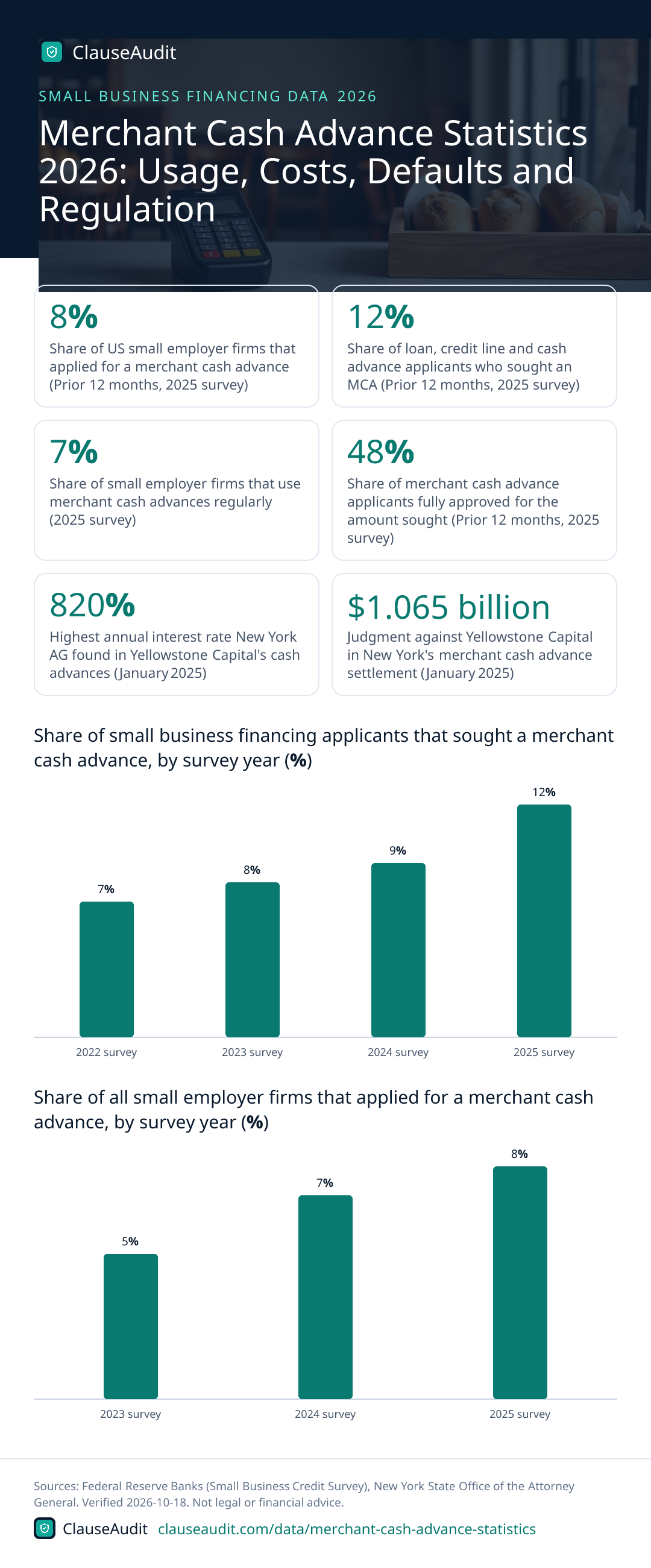
Merchant cash advances are still a minority product, but use is rising. In the Federal Reserve's 2025 survey, 8% of small employer firms applied for one, and 12% of financing applicants sought one, up from 9% a year earlier. Costs can be extreme: New York found rates as high as 820% at one provider network.

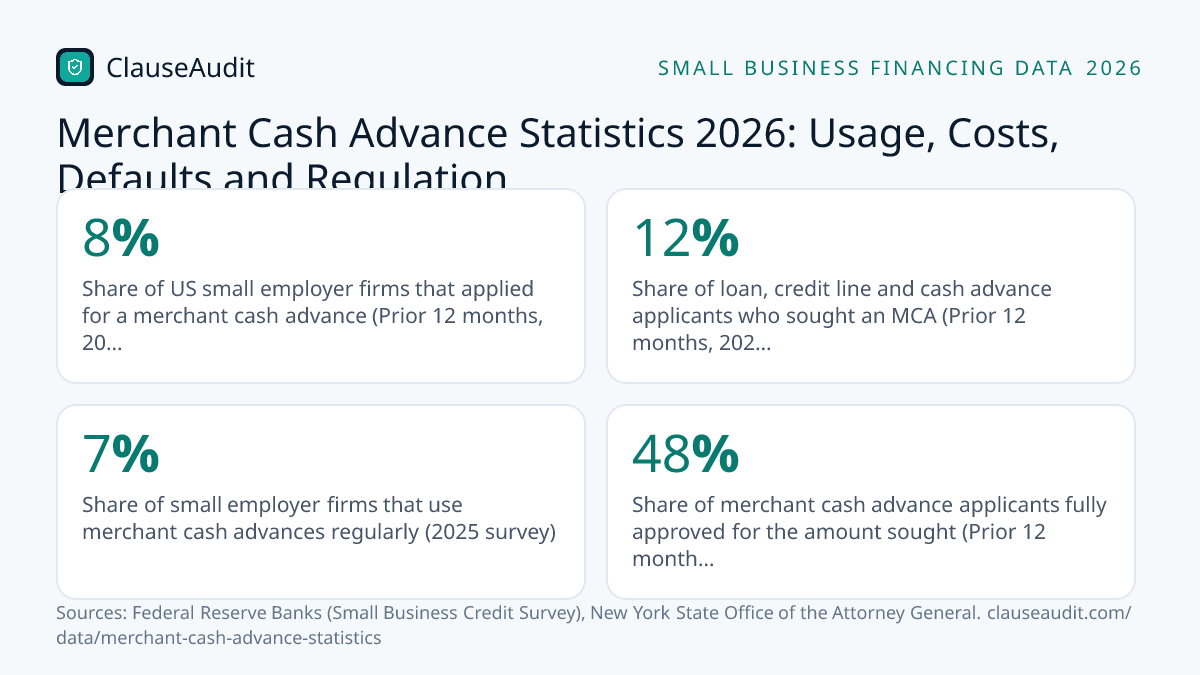
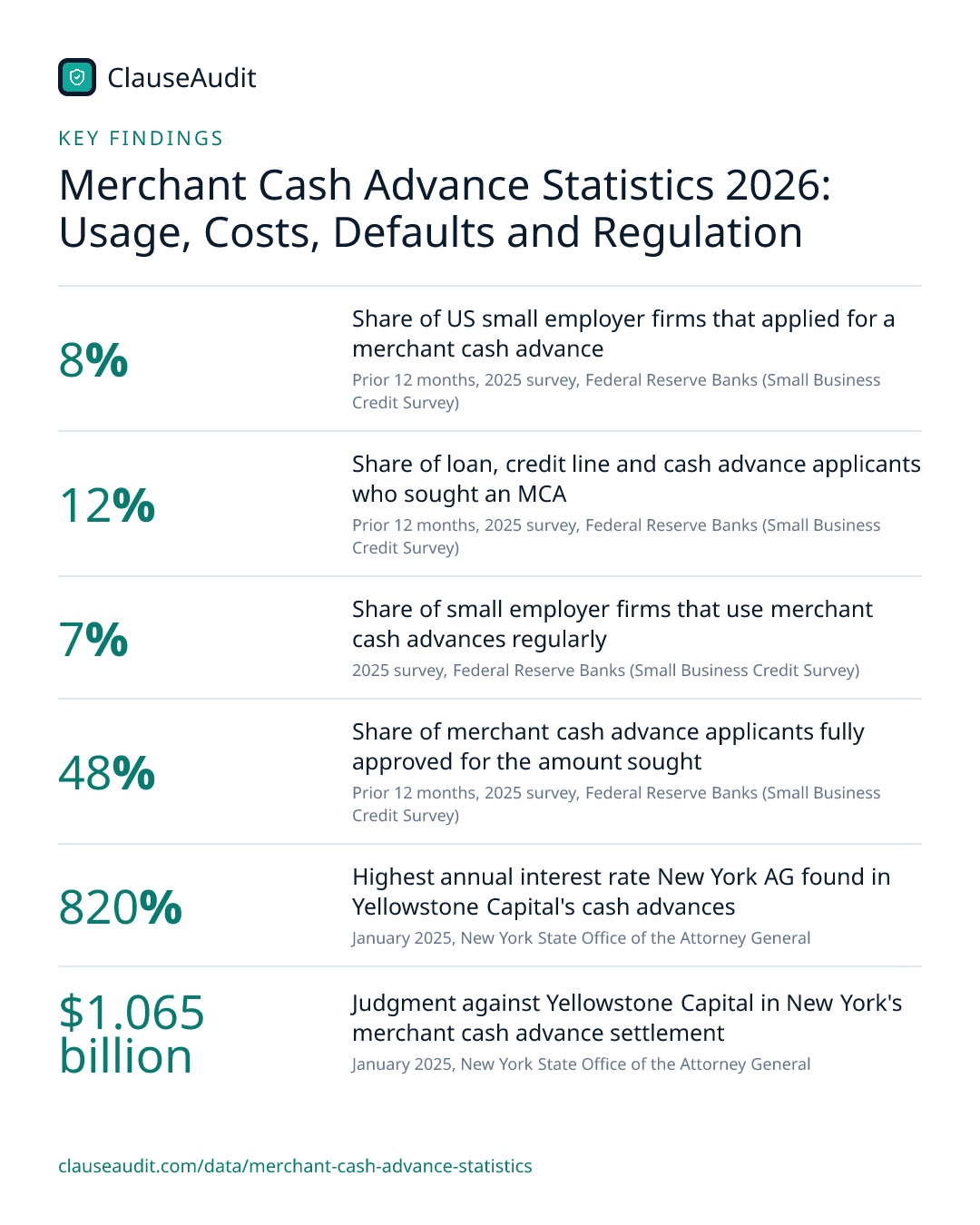
- Share of US small employer firms that applied for a merchant cash advance (Prior 12 months, 2025 survey, Federal Reserve Banks (Small Business Credit Survey))
- 8%
- Share of loan, credit line and cash advance applicants who sought an MCA (Prior 12 months, 2025 survey, Federal Reserve Banks (Small Business Credit Survey))
- 12%
- Share of small employer firms that use merchant cash advances regularly (2025 survey, Federal Reserve Banks (Small Business Credit Survey))
- 7%
- Share of merchant cash advance applicants fully approved for the amount sought (Prior 12 months, 2025 survey, Federal Reserve Banks (Small Business Credit Survey))
- 48%
- Highest annual interest rate New York AG found in Yellowstone Capital's cash advances (January 2025, New York State Office of the Attorney General)
- 820%
- Judgment against Yellowstone Capital in New York's merchant cash advance settlement (January 2025, New York State Office of the Attorney General)
- $1.065 billion
- Share of about 3,000 MCA arbitrations held with no small business appearing (First three years of operation (from 2019), New York State Office of the Attorney General)
- 97%
A merchant cash advance is sold as a purchase of your future sales, not a loan. You get a lump sum now and the funder takes a slice of your deposits, often every business day, until a fixed amount is repaid. Because it is not legally a loan in most states, it has long dodged the interest rate caps and disclosures that apply to bank credit.
This page gathers the most recent Federal Reserve survey data on who applies and who gets approved, the largest enforcement cases against funders, and the state laws that now force price disclosure. Then it covers what those numbers mean for your business and which contract terms to read before you sign.
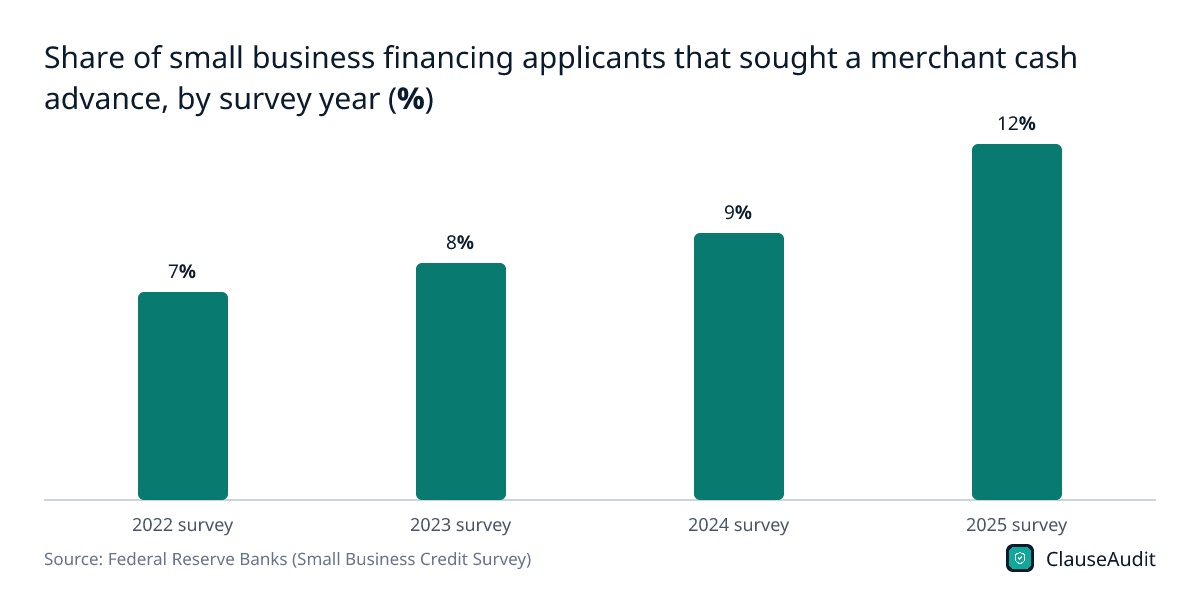
Among firms that sought a loan, credit line or cash advance, the share asking for an MCA climbed every year, from 7% in the 2022 survey to 12% in the 2025 survey. The 2025 jump was the largest in the series.
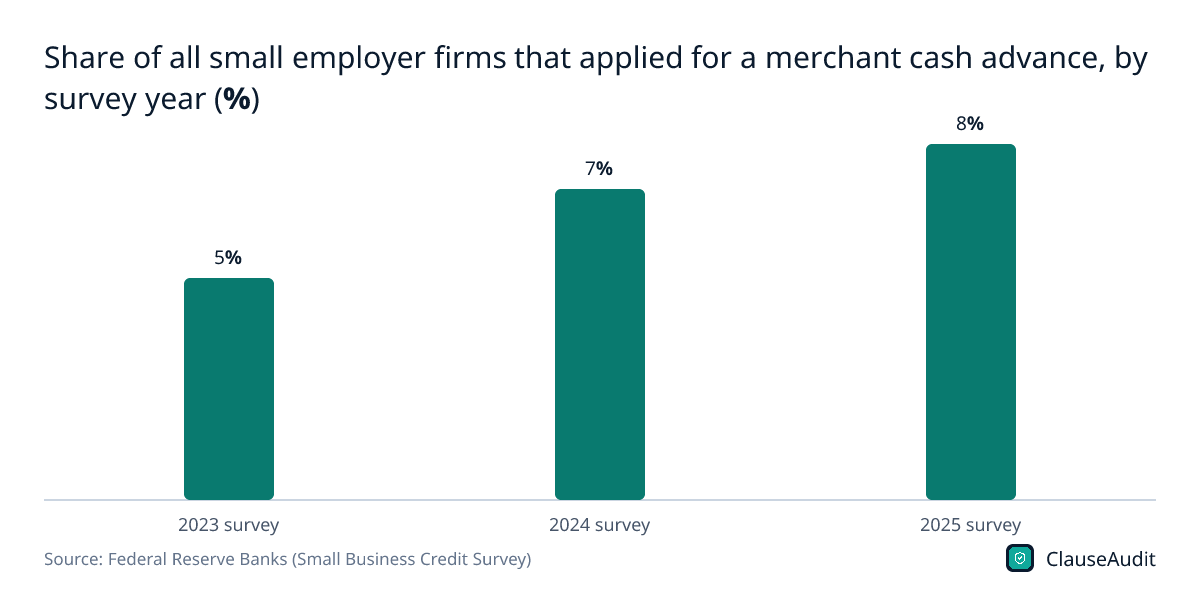
Download this chart (PNG)Share of all small employer firms that applied for a merchant cash advance, by survey year (%)
Chart data
| Label | Value (%) |
|---|---|
| 2023 survey | 5% |
| 2024 survey | 7% |
| 2025 survey | 8% |
Measured against all small employer firms, applications rose from 5% to 8% over three surveys. Small numbers, but a steady climb for a product that is usually a last resort.
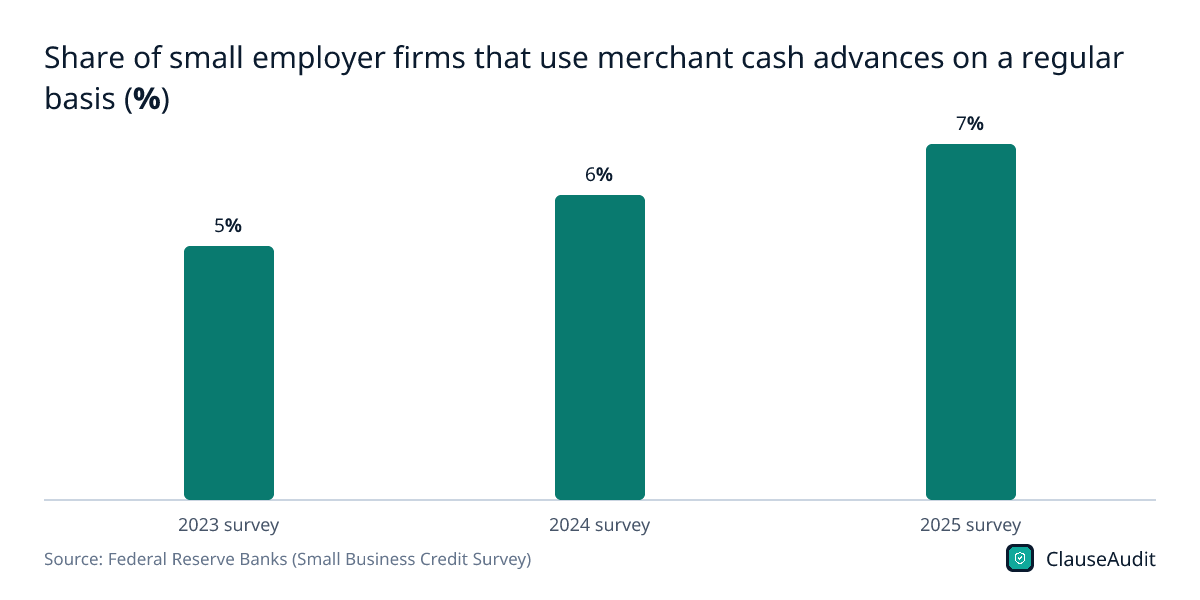
Download this chart (PNG)Share of small employer firms that use merchant cash advances on a regular basis (%)
Chart data
| Label | Value (%) |
|---|---|
| 2023 survey | 5% |
| 2024 survey | 6% |
| 2025 survey | 7% |
Regular use tracks applications closely, rising from 5% to 7%. Regular use sitting that close to the application rate fits a familiar pattern: firms that take one advance often take another, which is how stacking and renewal cycles start.
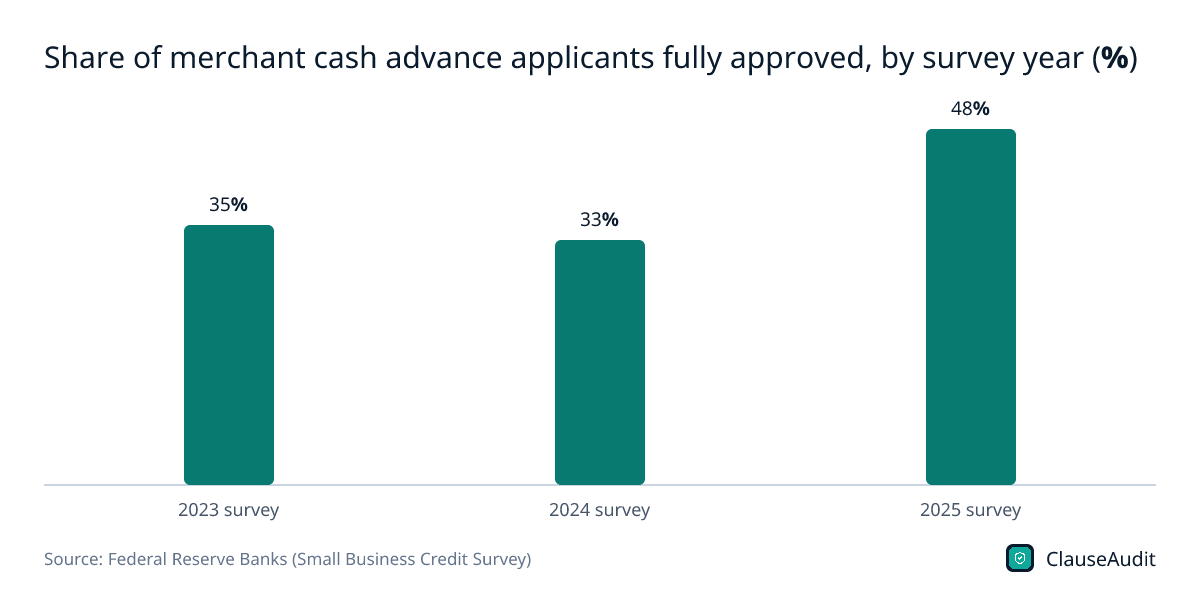
Download this chart (PNG)Share of merchant cash advance applicants fully approved, by survey year (%)
Chart data
| Label | Value (%) |
|---|---|
| 2023 survey | 35% |
| 2024 survey | 33% |
| 2025 survey | 48% |
Full approval jumped to 48% in the 2025 survey after sitting at 35% and 33%. Sample sizes are small, a few hundred firms each year, so treat the year-to-year swing with some caution.
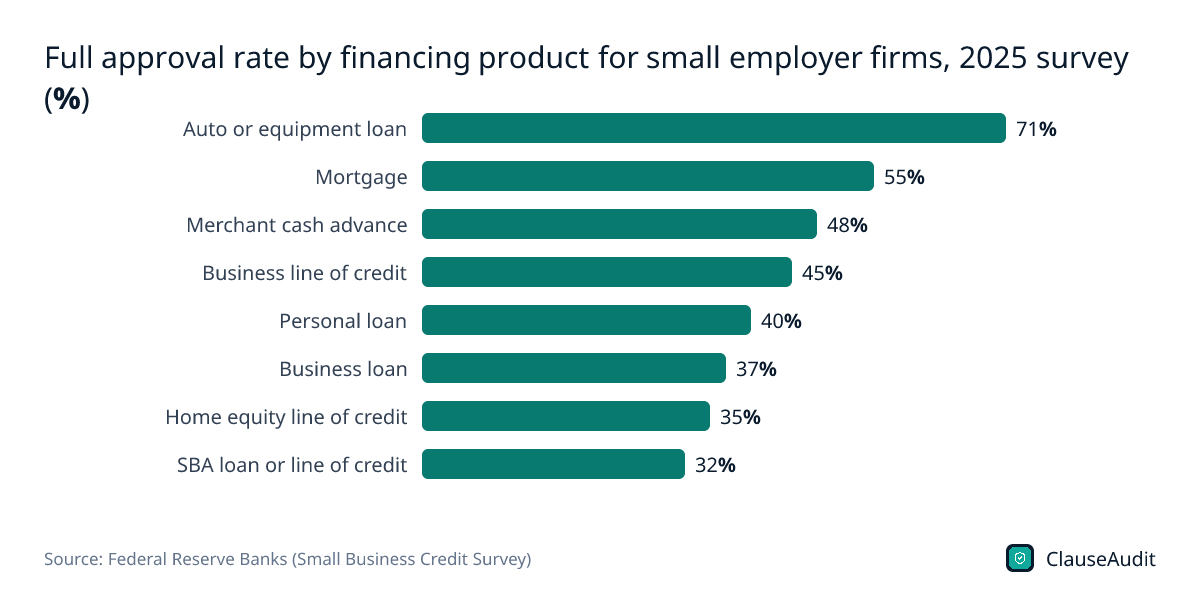
Download this chart (PNG)Full approval rate by financing product for small employer firms, 2025 survey (%)
Chart data
| Label | Value |
|---|---|
| Auto or equipment loan | 71% |
| Mortgage | 55% |
| Merchant cash advance | 48% |
| Business line of credit | 45% |
| Personal loan | 40% |
| Business loan | 37% |
| Home equity line of credit | 35% |
| SBA loan or line of credit | 32% |
Cash advances were easier to get in full than a business loan (37%) or an SBA loan or line of credit (32%). Easy approval is part of the pitch, and it is priced in.
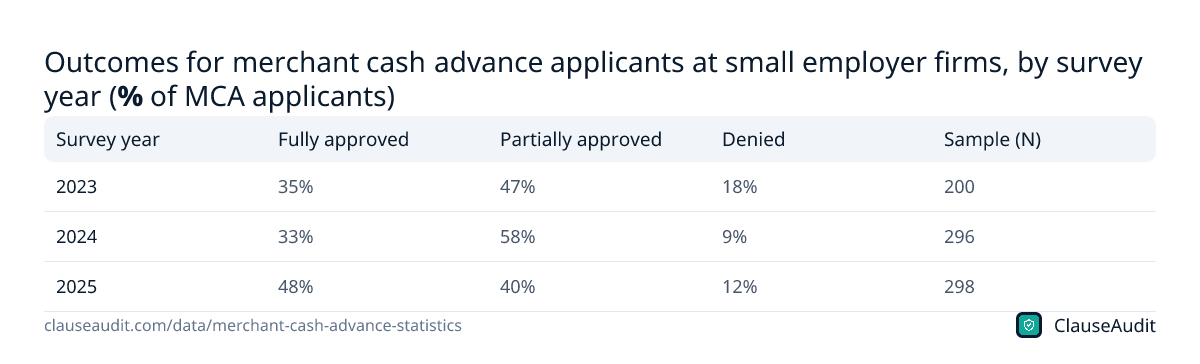
Download this chart (PNG)Outcomes for merchant cash advance applicants at small employer firms, by survey year (% of MCA applicants)
| Survey year | Fully approved | Partially approved | Denied | Sample (N) |
|---|---|---|---|---|
| 2023 | 35% | 47% | 18% | 200 |
| 2024 | 33% | 58% | 9% | 296 |
| 2025 | 48% | 40% | 12% | 298 |
Source: Federal Reserve Banks (Small Business Credit Survey), 2024 Report on Employer Firms: Findings from the 2023 Small Business Credit Survey; Federal Reserve Banks (Small Business Credit Survey), 2025 Report on Employer Firms: Findings from the 2024 Small Business Credit Survey; Federal Reserve Banks (Small Business Credit Survey), 2026 Report on Employer Firms: Findings from the 2025 Small Business Credit Survey. Download as image
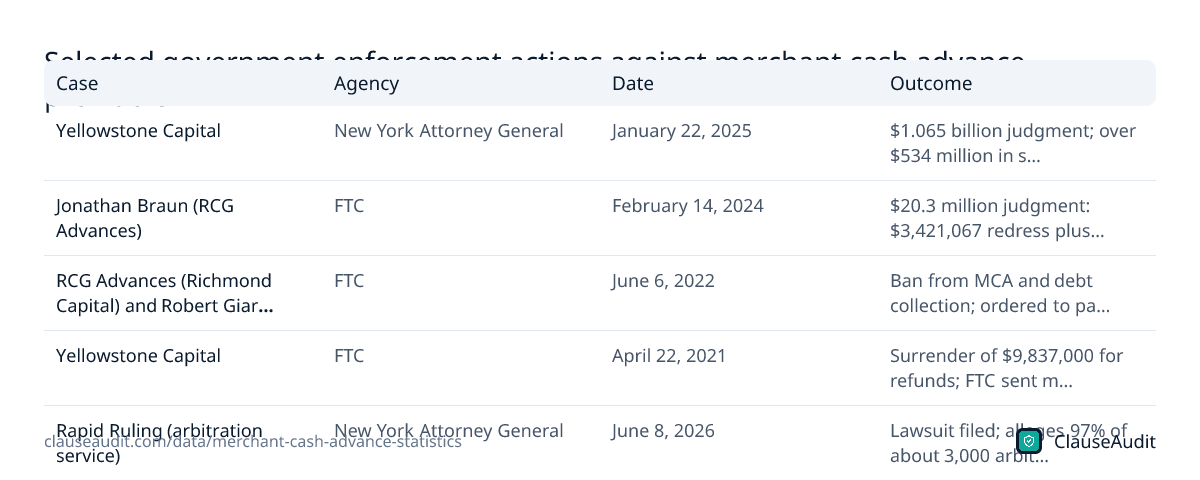
Selected government enforcement actions against merchant cash advance providers
| Case | Agency | Date | Outcome |
|---|---|---|---|
| Yellowstone Capital | New York Attorney General | January 22, 2025 | $1.065 billion judgment; over $534 million in small-business debt cancelled; $16.1 million paid immediately; permanent industry ban |
| Jonathan Braun (RCG Advances) | FTC | February 14, 2024 | $20.3 million judgment: $3,421,067 redress plus $16,956,000 civil penalties |
| RCG Advances (Richmond Capital) and Robert Giardina | FTC | June 6, 2022 | Ban from MCA and debt collection; ordered to pay more than $2.7 million |
| Yellowstone Capital | FTC | April 22, 2021 | Surrender of $9,837,000 for refunds; FTC sent more than $9.1 million in refunds in two rounds (June 2022, August 2024), plus a third round (June 2026) of 3,759 checks totaling over $549,000 |
| Rapid Ruling (arbitration service) | New York Attorney General | June 8, 2026 | Lawsuit filed; alleges 97% of about 3,000 arbitrations had no small-business appearance |
Source: New York State Office of the Attorney General, Attorney General James Announces $1 Billion Settlement with Predatory Lender Yellowstone Capital for Harming Small Businesses; Federal Trade Commission, Court Enters $20.3 Million Judgment in FTC Case Against Merchant Cash Advance Operator Jonathan Braun for Deceiving Small Businesses and Unlawfully Seizing Assets; Federal Trade Commission, FTC Action Results in Ban for Richmond Capital and Owner From Merchant Cash Advance and Debt Collection Industries and Return of More Than $2.7M to Consumers; Federal Trade Commission, Cash Advance Firm to Pay $9.8M to Settle FTC Complaint It Overcharged Small Businesses; Federal Trade Commission, Yellowstone Capital Refunds; New York State Office of the Attorney General, Attorney General James Sues Sham Arbitration Service Created to Help Predatory Merchant Cash Advance Industry. Download as image
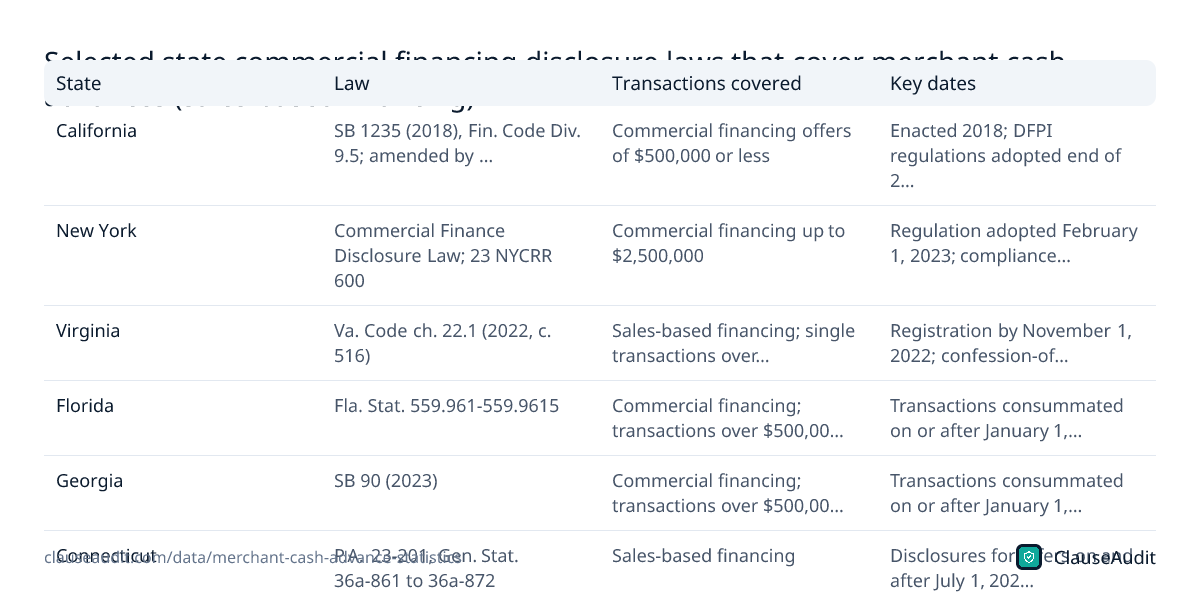
Selected state commercial financing disclosure laws that cover merchant cash advances (sales-based financing)
| State | Law | Transactions covered | Key dates |
|---|---|---|---|
| California | SB 1235 (2018), Fin. Code Div. 9.5; amended by SB 362 (Ch. 352, Stats. 2025) | Commercial financing offers of $500,000 or less | Enacted 2018; DFPI regulations adopted end of 2022; SB 362 chaptered October 6, 2025 (bars deceptive use of 'interest' or 'rate'; requires 'APR' in specified cases) |
| New York | Commercial Finance Disclosure Law; 23 NYCRR 600 | Commercial financing up to $2,500,000 | Regulation adopted February 1, 2023; compliance six months after publication; sales-based APR reports due April 30 yearly from 2025 |
| Virginia | Va. Code ch. 22.1 (2022, c. 516) | Sales-based financing; single transactions over $500,000 exempt | Registration by November 1, 2022; confession-of-judgment clauses unenforceable |
| Florida | Fla. Stat. 559.961-559.9615 | Commercial financing; transactions over $500,000 exempt | Transactions consummated on or after January 1, 2024 |
| Georgia | SB 90 (2023) | Commercial financing; transactions over $500,000 exempt | Transactions consummated on or after January 1, 2024 |
| Connecticut | P.A. 23-201, Gen. Stat. 36a-861 to 36a-872 | Sales-based financing | Disclosures for offers on and after July 1, 2024; registration by October 1, 2024 |
| Texas | HB 700 (2025), Finance Code ch. 398; 7 TAC ch. 86 | Commercial sales-based financing | Law effective September 1, 2025; registration with OCCC by December 31, 2026; limits on automatic debits |
Source: California Senate Judiciary Committee, SB 362 (Grayson) Commercial financing: disclosures, bill analysis; CalMatters Digital Democracy, SB 362 Commercial financing: disclosures (bill status); New York State Department of Financial Services, Superintendent Adrienne A. Harris Adopts Updated Regulation For Disclosure Requirements For Commercial Financing; New York State Department of Financial Services, 23 NYCRR 600 (Commercial Finance Disclosure Law regulation), final text; New York State Department of Financial Services, Small Business Financing Providers; Virginia General Assembly (Legislative Information System), Code of Virginia, Title 6.2, Chapter 22.1: Sales-Based Financing Providers; The Florida Legislature, Florida Statutes 559.9612 (Scope) and 559.9613 (Disclosures), Florida Commercial Financing Disclosure Law; Georgia General Assembly, SB 90 (2023), House Committee on Banks and Banking substitute (LC 50 0572S); Connecticut Department of Banking, Department of Banking Issues Guidance Regarding Public Act 23-201; Texas Office of Consumer Credit Commissioner / Finance Commission of Texas, Adopted New Rules, 7 TAC Chapter 86, Subchapter C: Commercial Sales-Based Financing. Download as image
How many small businesses use merchant cash advances?
Not many, but more each year. In the Federal Reserve Banks' 2025 Small Business Credit Survey, 8% of small employer firms applied for a merchant cash advance and 7% said they use one on a regular basis. Both figures have risen in every survey shown here.
The more telling number is the share of financing applicants. Among firms that went looking for a loan, a credit line or a cash advance, 12% asked for an MCA in the 2025 survey, up from 9% the year before. When credit gets tight, the businesses that can't wait for a bank decision are the ones that turn to fast money.
Keep in mind that the survey is a weighted convenience sample of employer firms, not a random sample of every business. Businesses with no employees are covered in a separate Fed report, so solo operators are not counted in these numbers.
Why are merchant cash advance approval rates so high?
In the 2025 survey, 48% of MCA applicants were fully approved, compared with 37% for business loans and 32% for SBA loans or lines of credit. Another 40% of MCA applicants were partially approved, and 12% were denied.
That gap is the product working as designed. A funder buying your future receivables cares mostly about your daily card and bank deposits, not your credit history or collateral. It covers its risk through price and through aggressive collection terms in the contract.
Partial approval deserves a closer look. If you get less money than you asked for, the daily or weekly payment may not shrink in proportion. Before you accept a smaller offer, run the math on what you will repay against what actually lands in your account, after any origination or underwriting fees are taken out.
How much does a merchant cash advance really cost?
There is no reliable industry-wide average, which is part of the problem. MCAs are usually priced with a factor rate, a single multiplier on the amount advanced. It looks small and tidy. But because repayment comes out of your deposits over a short window, the annualized cost can be several times what the factor rate suggests.
The extreme end shows up in enforcement records. New York's attorney general found annual interest rates as high as 820% in cash advances made by the Yellowstone Capital network. That is an allegation about one group of funders, not a typical price, but it shows how far the numbers can run when nobody has to state an APR.
That is changing in some states. California now requires an APR in specified cases and bars deceptive use of the words interest or rate, and New York's disclosure rules cover commercial financing up to $2,500,000. If you are in a covered state and the offer has no APR, ask for it in writing before you sign.
What happens if you can't pay back a merchant cash advance?
No public dataset tracks MCA default rates the way regulators track bank loan losses, so be wary of any figure you see quoted with confidence. What the records do show is how funders collect when payments stop.
The main tools are a personal guarantee from the owner, a confession of judgment that lets the funder skip a trial, and a mandatory arbitration clause. The New York attorney general's June 2026 lawsuit against Rapid Ruling, an arbitration service, alleges that 97% of the roughly 3,000 arbitrations it handled in its first three years went ahead with no small business appearing.
The Yellowstone case shows the scale when those tactics are challenged. The January 2025 settlement included a $1.065 billion judgment, more than $534 million of it paid by cancelling debts owed by over 18,000 small businesses nationwide. If you are already behind, read the reconciliation clause first. A true sales-based advance should let you ask for lower payments when your revenue drops. Send that request in writing, attach your recent bank statements, and keep a copy of everything. A funder that ignores a valid reconciliation request can weaken its own claim that the deal was a sale and not a loan.
Which states regulate merchant cash advances?
There is no federal MCA statute. The FTC has acted against individual funders for deceptive practices, including a $20.3 million judgment against Jonathan Braun in 2024, but the rules on disclosure come from the states.
California, New York, Virginia, Florida, Georgia, Connecticut and Texas all have commercial financing or sales-based financing laws that reach MCAs. Most require a disclosure of the total cost before you sign, and several cover only deals of $500,000 or less. Virginia goes further and makes confession-of-judgment clauses unenforceable. Texas, effective September 1, 2025, limits automatic debits and requires funders to register with the state by December 31, 2026.
If your state is not on the list, you still have contract law. A deal that is called a sale but works like a loan, with fixed payments and no real reconciliation, can be challenged as a disguised loan under state usury rules.
What to check before you sign a merchant cash advance
- Get the total repayment amount, the net funds you will receive and the APR in writing, even if your state does not require it.
- Read the reconciliation clause. It should give you a clear right to lower payments when sales fall, with a deadline for the funder to respond.
- Look for a confession of judgment and strike it if you can. Then check if your state still enforces them.
- Check the personal guarantee. Some guarantees only cover fraud or breach of specific promises; others make you liable for the whole balance.
- Find the arbitration and venue terms. Know who picks the arbitrator, where you would have to show up and which address the funder will use for notices.
- Read the anti-stacking clause before taking a second advance. Breaking it can trigger default on the first one.
How ClauseAudit helps
The numbers on this page come down to a few lines in your agreement. An MCA that looks affordable on the first page can carry a confession of judgment, a broad personal guarantee and a reconciliation clause with no teeth further in.
Upload your offer and the automated review flags the terms that decide your real cost and your risk if sales dip, with plain-English notes on what to push back on.
- Total repayment, factor rate, fees and any disclosed APR
- Reconciliation rights and how fast the funder must adjust payments
- Confession of judgment and personal guarantee scope
- Default triggers, including anti-stacking and account-change clauses
- Arbitration, venue and governing law
- Daily or weekly debit terms and early payoff discounts
Frequently asked questions
How many small businesses use merchant cash advances?
In the Federal Reserve's 2025 Small Business Credit Survey, 8% of small employer firms applied for a merchant cash advance in the prior year and 7% said they use one regularly. Among firms that sought a loan, credit line or cash advance, 12% applied for an MCA, up from 9% in the previous survey.
What is the approval rate for a merchant cash advance?
In the 2025 survey, 48% of MCA applicants were fully approved, 40% were partially approved and 12% were denied. That full approval rate beat business loans at 37% and SBA loans or lines of credit at 32%. Easy approval reflects how MCAs are priced and collected, not that they are a better deal.
What is the typical APR on a merchant cash advance?
No reliable industry average exists, because funders have long quoted factor rates instead of APRs. Enforcement cases show how high costs can go: New York's attorney general found rates as high as 820% in cash advances from the Yellowstone Capital network. California and New York now require cost disclosures, including APR, on many offers.
Is a merchant cash advance a loan?
Legally, a true MCA is a purchase of future receivables, which is why it often escapes state usury caps. Courts look at substance, though. If payments are fixed, there is no working reconciliation and the funder can collect no matter how your sales do, a judge may treat it as a loan and apply usury law.
What happened in the Yellowstone Capital case?
In January 2025, New York's attorney general secured a settlement that included a $1.065 billion judgment against Yellowstone Capital and related parties. Debts were cancelled for over 18,000 small businesses nationwide, including over 1,100 in New York, and the defendants were permanently banned from the industry. The FTC had separately reached a settlement with Yellowstone in 2021.
Can an MCA funder take me to arbitration without my knowing?
Many MCA contracts require arbitration, and notice can be easy to miss. New York's attorney general sued the arbitration service Rapid Ruling in June 2026, alleging that 97% of the roughly 3,000 arbitrations it handled in its first three years went ahead with no small business appearing. Read the arbitration clause and make sure notices go to an address you actually check.
Which states require merchant cash advance disclosures?
California, New York, Virginia, Florida, Georgia, Connecticut and Texas have laws that cover MCAs or sales-based financing. Coverage limits differ: New York reaches deals up to $2,500,000, while several states exempt transactions over $500,000. Texas also requires funders to register with the state by December 31, 2026 and limits automatic debits.
What should I do if I can't make my MCA payments?
Start with the reconciliation clause and request an adjustment in writing, with your recent bank statements attached. Don't take a second advance to cover the first without reading the anti-stacking terms. If the contract has a confession of judgment or personal guarantee, talk to a lawyer before you stop payments or change bank accounts.
Use this data
Every chart and card below is free to reuse under CC BY 4.0. Download what you need and link back to this page.
 Stat cards
 Key findings card
 Infographic
 Share of small business financing applicants that sought a merchant cash advance, by survey year (%)
 Share of all small employer firms that applied for a merchant cash advance, by survey year (%)
 Share of small employer firms that use merchant cash advances on a regular basis (%)
 Share of merchant cash advance applicants fully approved, by survey year (%)
 Full approval rate by financing product for small employer firms, 2025 survey (%)
 Outcomes for merchant cash advance applicants at small employer firms, by survey year (% of MCA applicants)
 Selected government enforcement actions against merchant cash advance providers
 Selected state commercial financing disclosure laws that cover merchant cash advances (sales-based financing)
Embed the infographic
Free to share on your site, blog or slides under CC BY 4.0. Please keep the credit link.
Sources and method
Every number on this page comes from the sources below, each opened and read on or before October 18, 2026. A second, independent review checked every figure against its source and corrected anything that did not match. Figures that could not be confirmed were left out.
- Federal Reserve Banks (Small Business Credit Survey), 2026 Report on Employer Firms: Findings from the 2025 Small Business Credit Survey (March 2026)
- Federal Reserve Banks (Small Business Credit Survey), 2025 Report on Employer Firms: Findings from the 2024 Small Business Credit Survey (March 2025)
- Federal Reserve Banks (Small Business Credit Survey), 2024 Report on Employer Firms: Findings from the 2023 Small Business Credit Survey (March 2024)
- Federal Reserve Banks (Small Business Credit Survey), 2023 Report on Employer Firms: Findings from the 2022 Small Business Credit Survey (March 2023)
- New York State Office of the Attorney General, Attorney General James Announces $1 Billion Settlement with Predatory Lender Yellowstone Capital for Harming Small Businesses (January 22, 2025)
- New York State Office of the Attorney General, Attorney General James Sues Sham Arbitration Service Created to Help Predatory Merchant Cash Advance Industry (June 8, 2026)
- Federal Trade Commission, Court Enters $20.3 Million Judgment in FTC Case Against Merchant Cash Advance Operator Jonathan Braun for Deceiving Small Businesses and Unlawfully Seizing Assets (February 14, 2024)
- Federal Trade Commission, FTC Action Results in Ban for Richmond Capital and Owner From Merchant Cash Advance and Debt Collection Industries and Return of More Than $2.7M to Consumers (June 6, 2022)
- Federal Trade Commission, Cash Advance Firm to Pay $9.8M to Settle FTC Complaint It Overcharged Small Businesses (April 22, 2021)
- Federal Trade Commission, Yellowstone Capital Refunds (June 2026)
- California Senate Judiciary Committee, SB 362 (Grayson) Commercial financing: disclosures, bill analysis (Hearing date April 22, 2025)
- New York State Department of Financial Services, Superintendent Adrienne A. Harris Adopts Updated Regulation For Disclosure Requirements For Commercial Financing (February 1, 2023)
- New York State Department of Financial Services, 23 NYCRR 600 (Commercial Finance Disclosure Law regulation), final text (2023 (final regulation))
- New York State Department of Financial Services, Small Business Financing Providers (Undated web page, read October 2026)
- Virginia General Assembly (Legislative Information System), Code of Virginia, Title 6.2, Chapter 22.1: Sales-Based Financing Providers (2022, c. 516 (current code, read October 2026))
- The Florida Legislature, Florida Statutes 559.9612 (Scope) and 559.9613 (Disclosures), Florida Commercial Financing Disclosure Law (s. 1, ch. 2023-290 (2026 Florida Statutes))
- Georgia General Assembly, SB 90 (2023), House Committee on Banks and Banking substitute (LC 50 0572S) (2023-2024 Regular Session)
- Connecticut Department of Banking, Department of Banking Issues Guidance Regarding Public Act 23-201 (June 10, 2024 (updated August 1, 2024))
- Texas Office of Consumer Credit Commissioner / Finance Commission of Texas, Adopted New Rules, 7 TAC Chapter 86, Subchapter C: Commercial Sales-Based Financing (2026 (adoption of rules proposed in the March 6, 2026 Texas Register))
- CalMatters Digital Democracy, SB 362 Commercial financing: disclosures (bill status) (Chaptered October 6, 2025)
Cite this page
ClauseAudit, “Merchant Cash Advance Statistics 2026: Usage, Costs, Defaults and Regulation”, updated October 18, 2026, https://clauseaudit.com/data/merchant-cash-advance-statistics. Free to reuse with a link back (CC BY 4.0).
This page summarises published data and law as checked on October 18, 2026. Figures are updated as new editions are released, and your own situation may differ. It is general information, not legal, tax or financial advice.