Usury Laws by State: Maximum Interest Rates and Commercial Loan Exemptions (2026)
By ClauseAudit Research · 43 sources ·
What are the usury laws by state?
Every state sets its own usury rules, and most of them stop protecting business borrowers at some point. New York caps most loans under $250,000 at 16% and makes anything above 25% a felony, while Colorado allows up to 45%. Many states exempt loans to companies or loans above a dollar amount.

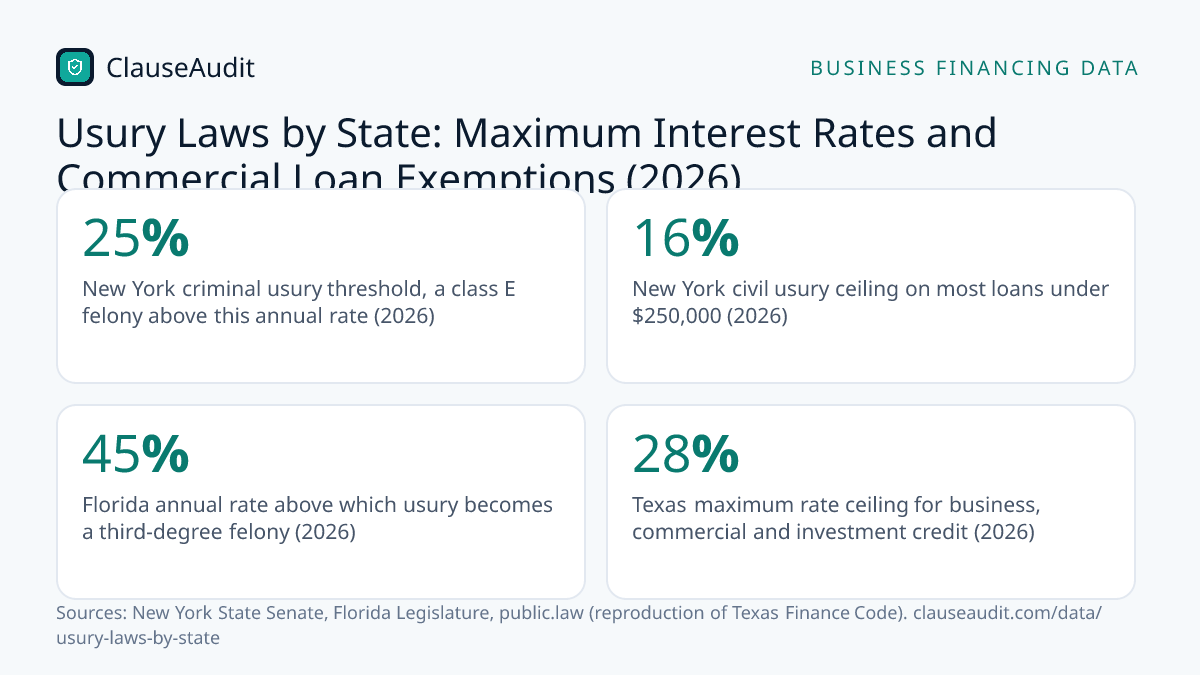
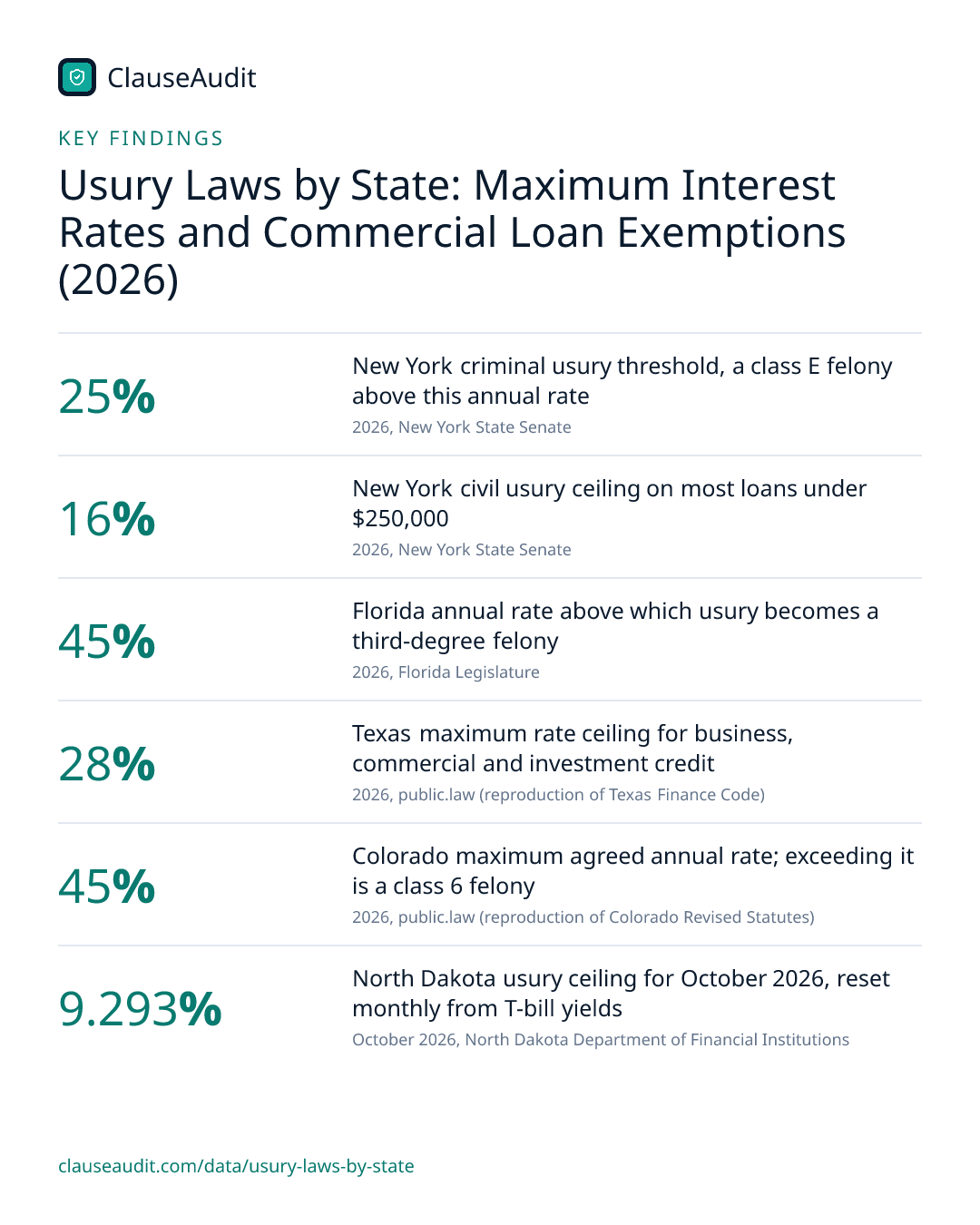
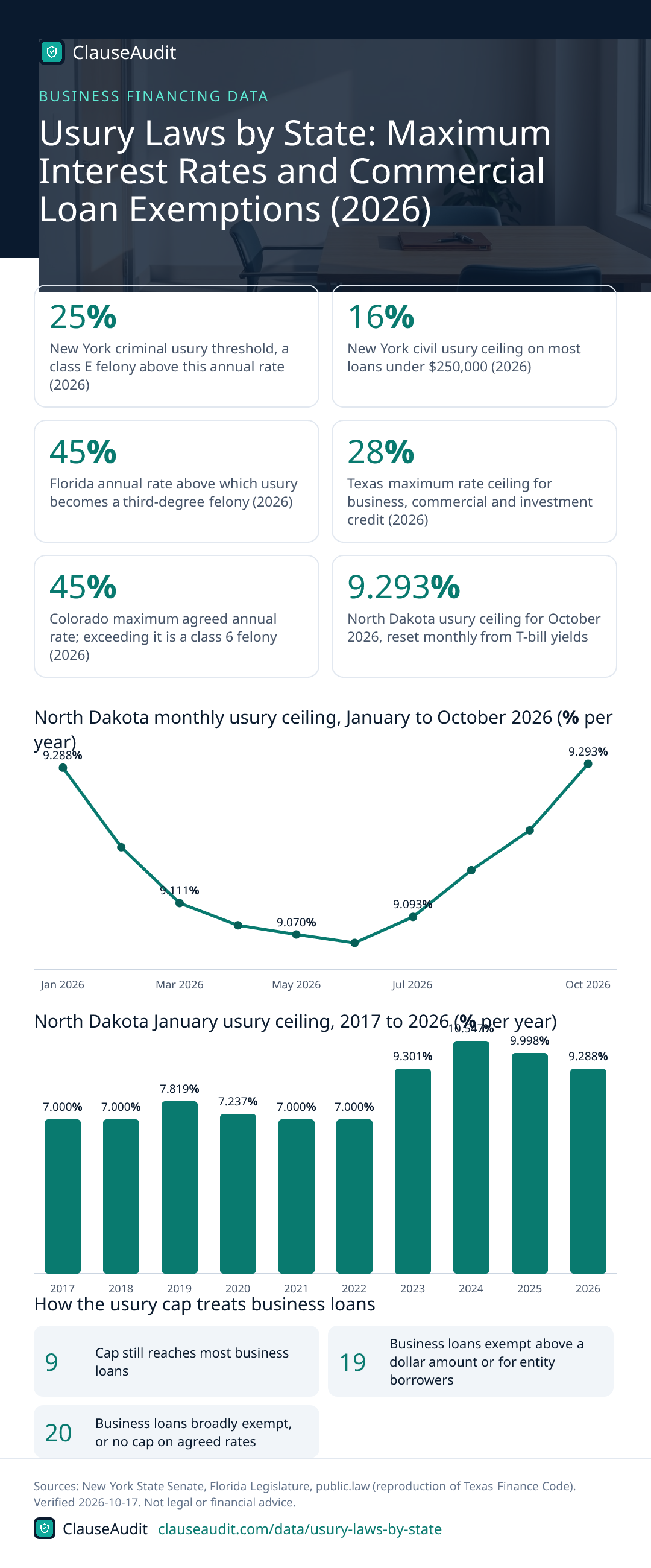
- New York criminal usury threshold, a class E felony above this annual rate (2026, New York State Senate)
- 25%
- New York civil usury ceiling on most loans under $250,000 (2026, New York State Senate)
- 16%
- Florida annual rate above which usury becomes a third-degree felony (2026, Florida Legislature)
- 45%
- Texas maximum rate ceiling for business, commercial and investment credit (2026, public.law (reproduction of Texas Finance Code))
- 28%
- Colorado maximum agreed annual rate; exceeding it is a class 6 felony (2026, public.law (reproduction of Colorado Revised Statutes))
- 45%
- North Dakota usury ceiling for October 2026, reset monthly from T-bill yields (October 2026, North Dakota Department of Financial Institutions)
- 9.293%
- Tennessee formula rate cap for signed written contracts (Oct 14, 2026 weekly announcement, Tennessee Department of Financial Institutions)
- 11.00%
- New York loan size at which civil and criminal usury caps stop applying (2026, New York State Senate)
- $2.5 million
A usury law is a ceiling on the interest a lender can charge. Sounds simple. In practice each state draws the line differently, and the line you hit as a consumer is often not the one that applies to your business loan.
This page puts the 2026 caps side by side, shows where criminal usury starts, and flags the exemptions that let lenders charge business borrowers almost any rate they can get you to sign. Below the data, we explain what to check in your own loan papers.
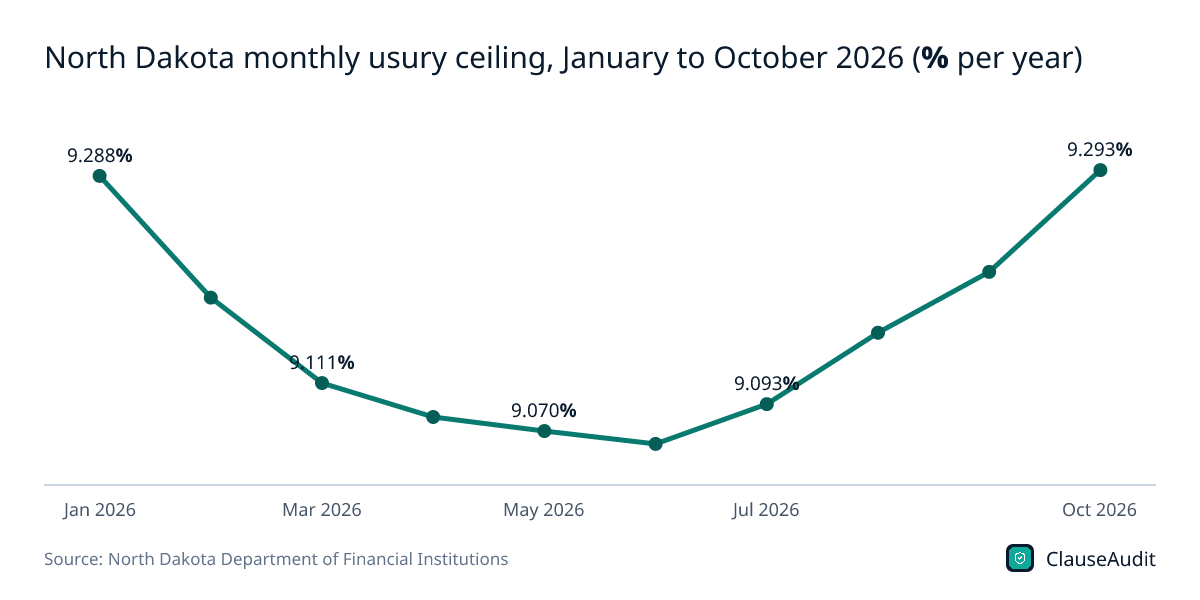
North Dakota monthly usury ceiling, January to October 2026 (% per year)
Chart data
| Label | Value (% per year) |
|---|---|
| Jan 2026 | 9.288% |
| Feb 2026 | 9.184% |
| Mar 2026 | 9.111% |
| Apr 2026 | 9.082% |
| May 2026 | 9.070% |
| Jun 2026 | 9.059% |
| Jul 2026 | 9.093% |
| Aug 2026 | 9.154% |
| Sep 2026 | 9.206% |
| Oct 2026 | 9.293% |
North Dakota's ceiling stayed in a narrow band this year, dipping from 9.288% in January to 9.059% in June before climbing to 9.293% in October 2026. The cap that applies is the one in effect when you sign.
Download this chart (PNG)North Dakota January usury ceiling, 2017 to 2026 (% per year)
Chart data
| Label | Value (% per year) |
|---|---|
| 2017 | 7.000% |
| 2018 | 7.000% |
| 2019 | 7.819% |
| 2020 | 7.237% |
| 2021 | 7.000% |
| 2022 | 7.000% |
| 2023 | 9.301% |
| 2024 | 10.547% |
| 2025 | 9.998% |
| 2026 | 9.288% |
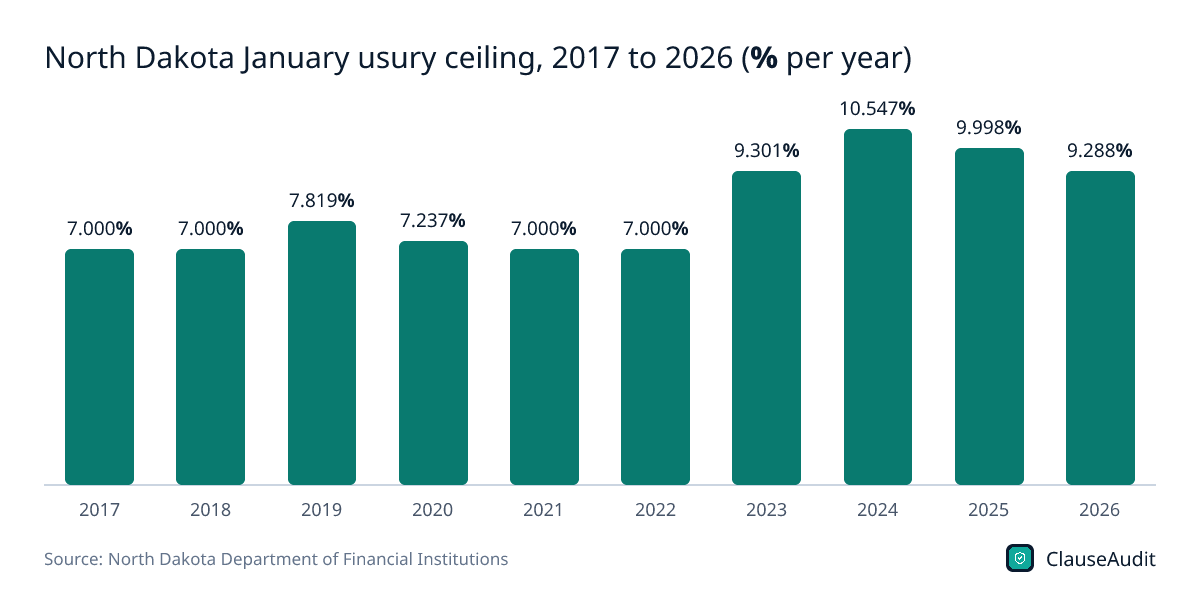
For four of these Januarys the ceiling sat on its 7% floor. It peaked at 10.547% in January 2024 as Treasury yields rose, which shows how much an index-linked cap can swing.
Download this chart (PNG)Annual rate that triggers criminal usury, selected states (% per year)
Chart data
| Label | Value |
|---|---|
| Massachusetts | 20% |
| New York | 25% |
| Florida | 25% |
| Michigan | 25% |
| New Jersey | 30% |
| Colorado | 45% |
| Indiana | 72% |
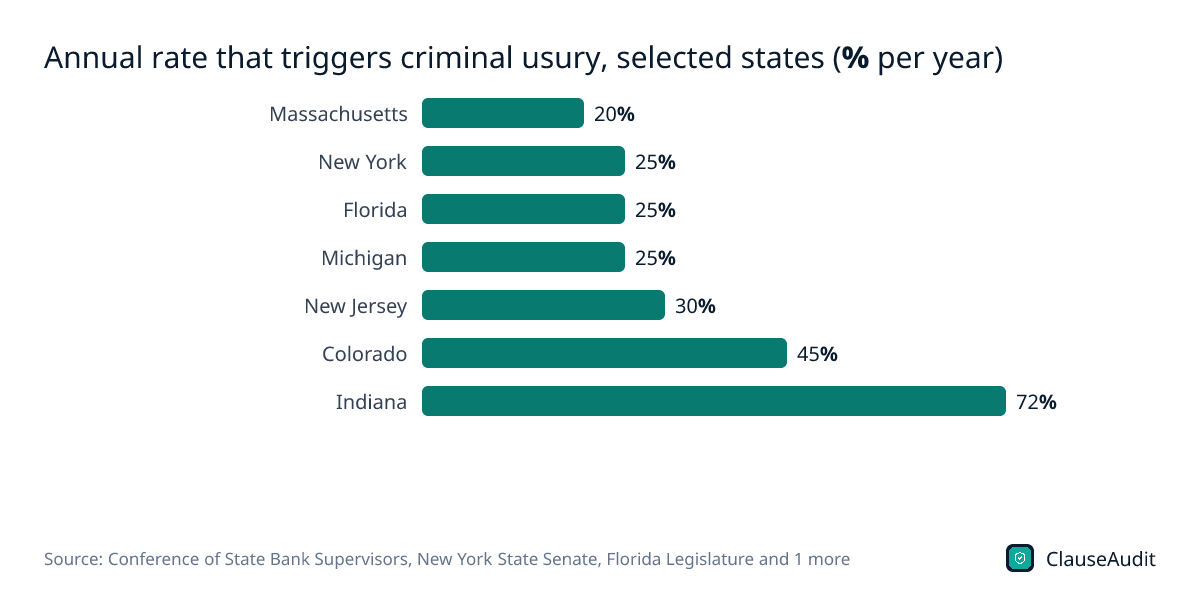
Criminal limits sit well above civil caps and often survive the business exemptions. New Jersey's line, for example, moves from 30% to 50% when the borrower is a corporation, LLC or LLP.
Download this chart (PNG)Fixed general usury caps on written loans, selected states (% per year)
Chart data
| Label | Value |
|---|---|
| Colorado | 45% |
| District of Columbia | 24% |
| Florida | 18% |
| Arkansas | 17% |
| New York | 16% |
| New Jersey | 16% |
| Nebraska | 16% |
| Kansas | 15% |
| Connecticut | 12% |
| Louisiana | 12% |
| Virginia | 12% |
| Vermont | 12% |
| California (consumer) | 10% |
| Alabama | 8% |
| Maryland | 8% |
| Minnesota | 8% |
| Ohio | 8% |
| West Virginia | 8% |
| Michigan | 7% |
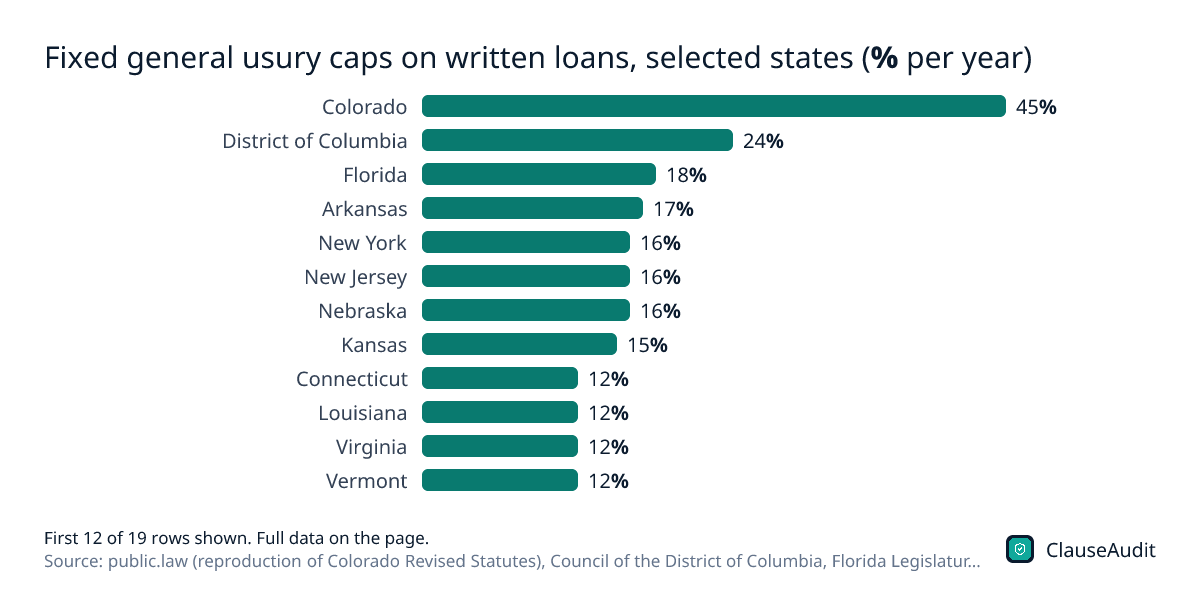
These headline numbers mostly describe what an individual pays. Read them together with the exemption chart, because a low cap can disappear entirely for a business borrower.
Download this chart (PNG)Loan size at which general usury caps stop applying, selected states (USD)
Chart data
| Label | Value |
|---|---|
| Alabama | $2,000+ |
| Mississippi | Over $2,000 |
| Georgia | Over $3,000 |
| Virginia (business) | $5,000+ |
| Missouri (business) | $5,000+ |
| Kentucky | Over $15,000 |
| Maryland (commercial) | Over $15,000 |
| Alaska | Over $25,000 |
| North Carolina | Over $25,000 |
| North Dakota | Over $35,000 |
| New Jersey | $50,000+ |
| Oregon | Over $50,000 |
| Minnesota | $100,000+ |
| Delaware | Over $100,000 |
| Ohio | Over $100,000 |
| Connecticut (non-consumer) | Over $250,000 |
| New Mexico (business) | $500,000+ |
| Rhode Island (commercial entity) | Over $1,000,000 |
| New York (all caps) | $2,500,000+ |
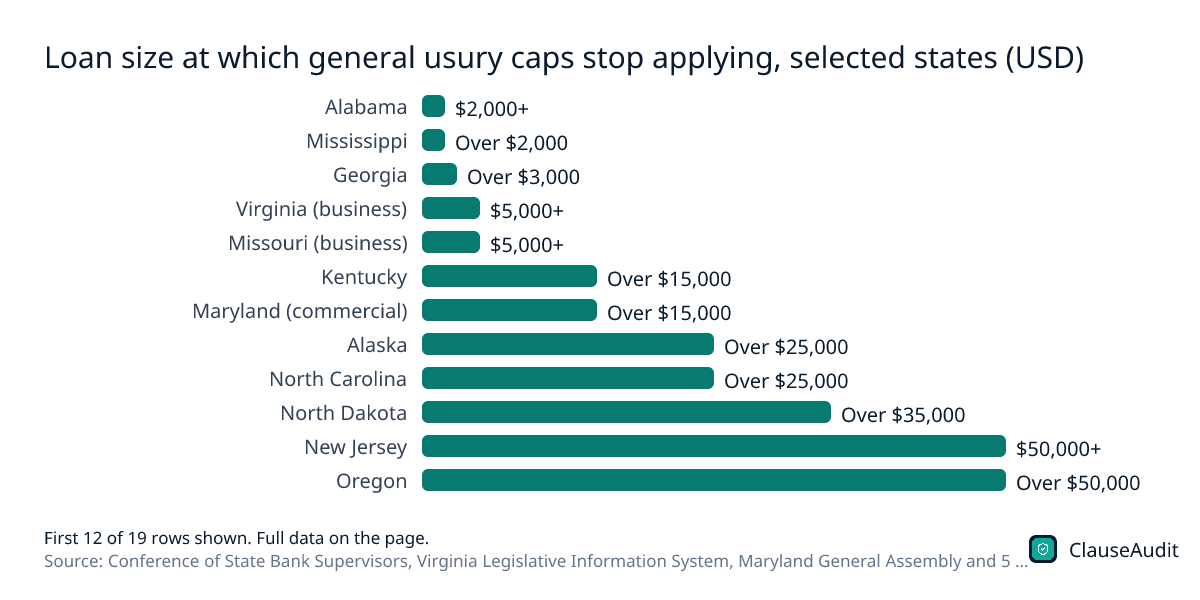
The spread is wide. In Alabama the cap stops applying at $2,000 of principal, while New York keeps its criminal limit in place until a loan reaches $2.5 million.
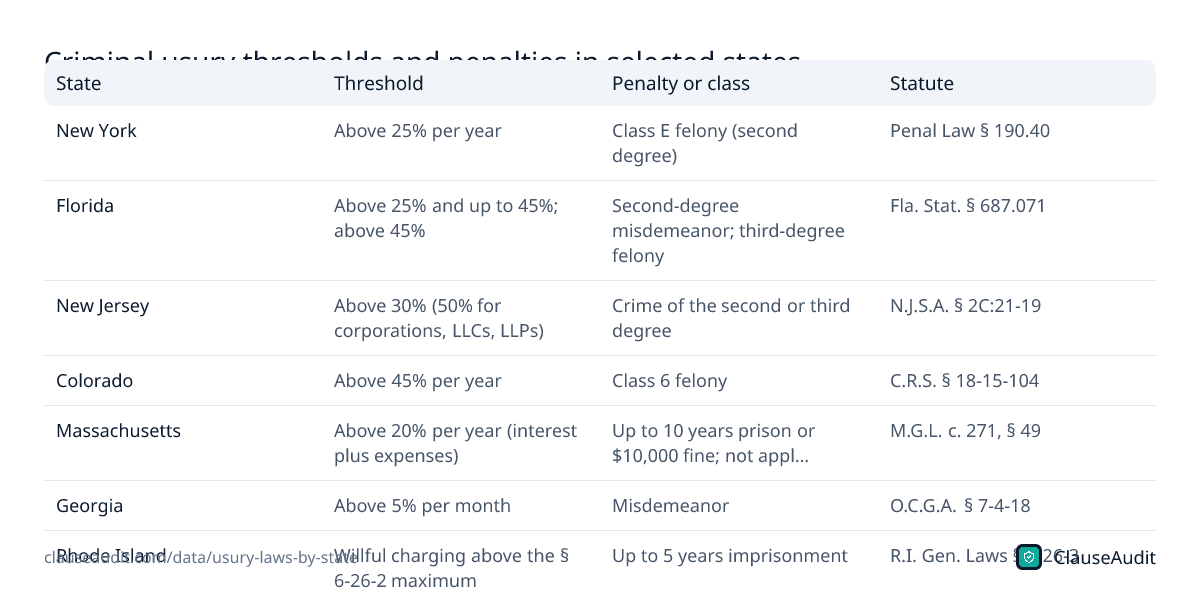
Download this chart (PNG)Criminal usury thresholds and penalties in selected states
| State | Threshold | Penalty or class | Statute |
|---|---|---|---|
| New York | Above 25% per year | Class E felony (second degree) | Penal Law § 190.40 |
| Florida | Above 25% and up to 45%; above 45% | Second-degree misdemeanor; third-degree felony | Fla. Stat. § 687.071 |
| New Jersey | Above 30% (50% for corporations, LLCs, LLPs) | Crime of the second or third degree | N.J.S.A. § 2C:21-19 |
| Colorado | Above 45% per year | Class 6 felony | C.R.S. § 18-15-104 |
| Massachusetts | Above 20% per year (interest plus expenses) | Up to 10 years prison or $10,000 fine; not applicable if the Attorney General is notified in advance, to loans whose rate is regulated under another law, or to lenders subject to state or federal regulatory control or examination | M.G.L. c. 271, § 49 |
| Georgia | Above 5% per month | Misdemeanor | O.C.G.A. § 7-4-18 |
| Rhode Island | Willful charging above the § 6-26-2 maximum | Up to 5 years imprisonment | R.I. Gen. Laws § 6-26-3 |
Source: New York State Senate, N.Y. Penal Law § 190.40, Criminal usury in the second degree; Florida Legislature, Florida Statutes Chapter 687, Interest and Usury; Conference of State Bank Supervisors, New Jersey usury statutes (CSBS compilation); public.law (reproduction of Colorado Revised Statutes), C.R.S. § 18-15-104, Criminal usury; Conference of State Bank Supervisors, Massachusetts usury statutes (CSBS compilation); Conference of State Bank Supervisors, Georgia usury statutes (CSBS compilation); Conference of State Bank Supervisors, Rhode Island usury statutes (CSBS compilation). Download as image
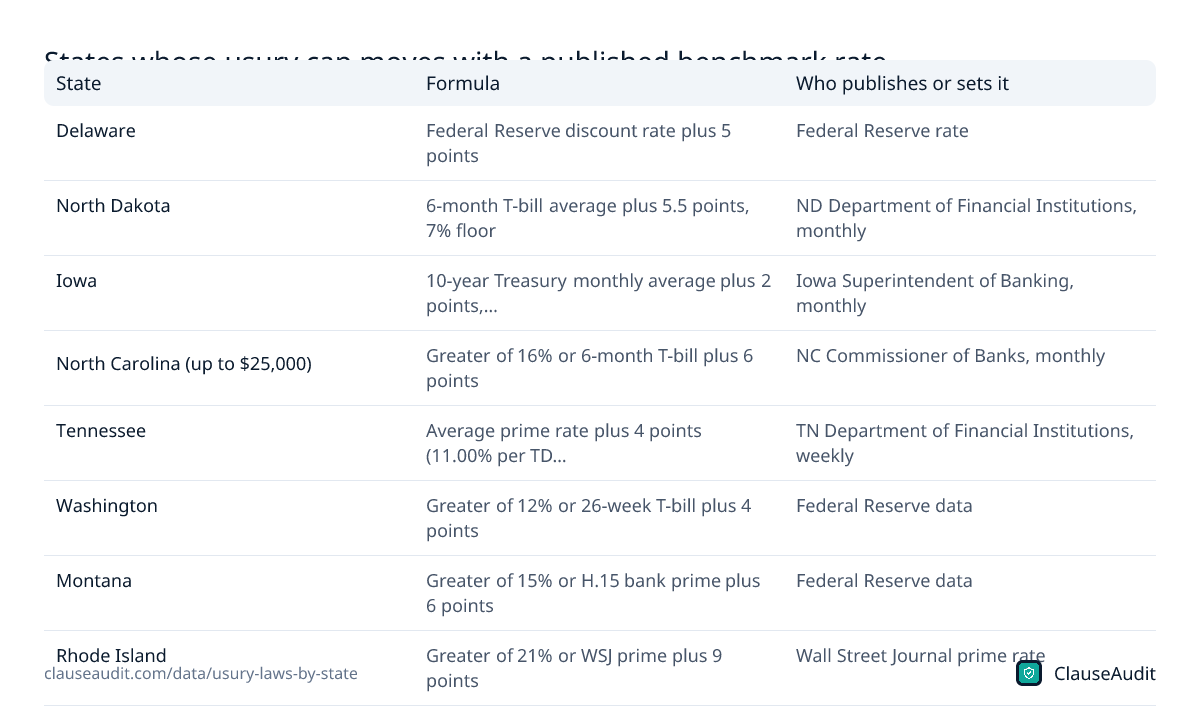
States whose usury cap moves with a published benchmark rate
| State | Formula | Who publishes or sets it |
|---|---|---|
| Delaware | Federal Reserve discount rate plus 5 points | Federal Reserve rate |
| North Dakota | 6-month T-bill average plus 5.5 points, 7% floor | ND Department of Financial Institutions, monthly |
| Iowa | 10-year Treasury monthly average plus 2 points, rounded to 0.25% | Iowa Superintendent of Banking, monthly |
| North Carolina (up to $25,000) | Greater of 16% or 6-month T-bill plus 6 points | NC Commissioner of Banks, monthly |
| Tennessee | Average prime rate plus 4 points (11.00% per TDFI on Oct 14, 2026) | TN Department of Financial Institutions, weekly |
| Washington | Greater of 12% or 26-week T-bill plus 4 points | Federal Reserve data |
| Montana | Greater of 15% or H.15 bank prime plus 6 points | Federal Reserve data |
| Rhode Island | Greater of 21% or WSJ prime plus 9 points | Wall Street Journal prime rate |
| Texas (optional ceilings) | Computed ceiling held between 18% and 24% (28% business) | Texas OCCC, weekly |
Source: Delaware General Assembly, Delaware Code Title 6, § 2301; North Dakota Legislative Branch, N.D. Century Code chapter 47-14; Conference of State Bank Supervisors, 50-State Survey of Consumer Finance Laws: usury rate data; Conference of State Bank Supervisors, North Carolina usury statutes (CSBS compilation); Tennessee Department of Financial Institutions, Commissioner Gonzales Announces Weekly Formula Rate October 14, 2026; Washington State Legislature, RCW 19.52.020 and 19.52.080; Conference of State Bank Supervisors, Rhode Island usury statutes (CSBS compilation); public.law (reproduction of Texas Finance Code), Tex. Fin. Code § 303.009; Texas Office of Consumer Credit Commissioner, Interest Rates (weekly and monthly ceilings). Download as image
How the usury cap treats business loans by state
- 9Cap still reaches most business loans
- 19Business loans exempt above a dollar amount or for entity borrowers
- 20Business loans broadly exempt, or no cap on agreed rates
- Cap still reaches most business loans9
- Business loans exempt above a dollar amount or for entity borrowers19
- Business loans broadly exempt, or no cap on agreed rates20
- Not yet confirmed3
| State | General cap | Business and commercial loans | Source |
|---|---|---|---|
| Alabama | 8% by written contract; 6% without one | Any agreed rate when the original principal is $2,000 or more (unconscionability laws still apply) | Ala. Code §§ 8-8-1, 8-8-5 |
| Alaska | 10.5% legal rate; by express agreement, the greater of 10% or 5 points above the Federal Reserve advance rate (12th District) | No limit when the principal exceeds $25,000 | Alaska Stat. § 45.45.010 |
| Arizona | Any rate agreed in writing; 10% if no written rate (medical debt has a separate lower cap) | No general cap on written business loans | A.R.S. § 44-1201(A) |
| Arkansas | 17% per year for loans not covered by the bank provisions | The 17% cap applies to business loans from non-bank lenders; federally insured banks may charge the rate allowed under federal law | Ark. Const. amend. 89, §§ 2, 3, 6 |
| California | 10% for personal, family or household loans; for other loans, the higher of 10% or 5% plus the San Francisco Fed advance rate | Business loans from non-exempt lenders fall under the second cap; banks, licensed finance lenders, licensed real estate brokers and other exempt classes are outside it | Cal. Const. art. XV, § 1; Cal. Civ. Code § 1916.1 |
| Colorado | Up to 45% per year by agreement; 8% if no rate is agreed | The 45% ceiling reaches business loans; commercial credit plans are outside § 5-12-103 unless the documents opt in | C.R.S. §§ 5-12-101, 5-12-103, 18-15-104 |
| Connecticut | 12% per year | Non-consumer loans over $10,000 up to $250,000 are exempt if the rate is no more than the deposit index plus 17%; non-consumer loans over $250,000 are exempt; bank loans (other than consumer loans by bank subsidiaries) are exempt | Conn. Gen. Stat. §§ 37-4, 37-9 |
| Delaware | 5% over the Federal Reserve discount rate, including any surcharge | No limit on loans over $100,000 that are not secured by a mortgage on the borrower's principal residence | 6 Del. C. § 2301(a), (c) |
| District of Columbia | 24% per year by written contract; 6% per year when no rate is expressed in a contract | The 24% limit does not apply to loans of more than $2,500 for business, professional, commercial or investment purposes, except loans secured by a mortgage or deed of trust on residential real property (or a cooperative interest) that is the borrower's residence; business loans of $2,500 or less stay under the cap | D.C. Code §§ 28-3301, 28-3302, 28-3303 |
| Florida | 18% simple interest | Loans over $500,000 are not usurious unless the rate exceeds 25%; charging over 25% is a misdemeanor and over 45% is a third-degree felony | Fla. Stat. §§ 687.02, 687.071 |
| Georgia | 16% on loans of $3,000 or less; 7% if no written rate | Any written rate (in simple-interest terms) above $3,000 and below $250,000; any written rate at $250,000 or more; charging over 5% per month is a misdemeanor | O.C.G.A. §§ 7-4-2, 7-4-18 |
| Hawaii | 12% per year (24% for financial institutions regulated under chapter 412) on consumer credit and home business loans | The § 478-4 cap is written for consumer credit transactions and home business loans; other business loans are not listed under it | HRS §§ 478-2, 478-4 |
| Idaho | 12% applies only when no written contract fixes a different rate | The legal-rate statute sets no ceiling on rates fixed in a written contract | Idaho Code § 28-22-104 |
| Illinois | 9% by written contract (5% without one) | Any rate on loans to corporations and on business loans to business associations, partnerships and sole proprietors (with limited exceptions for wage or household-goods security) | 815 ILCS 205/4 |
| Indiana | No general civil cap on non-consumer loans; consumer loans follow the Uniform Consumer Credit Code | Loansharking applies above twice the rate in IC 24-4.5-3-508(2)(a)(i), which the Indiana regulator describes as generally an APR above 72% | IC 35-45-7; IC 24-4.5-3-508 |
| Iowa | Written rate capped at 2 points above the monthly average 10-year Treasury yield, rounded to the nearest 0.25%, published monthly by the Superintendent of Banking; 5% without a written rate | Borrowers for business or agricultural purposes may agree in writing to any rate and cannot plead usury | Iowa Code § 535.2 |
| Kansas | 15% per year on notes and other written instruments; 10% legal rate | Business and agricultural transactions are excluded from the 15% limit | K.S.A. §§ 16-201, 16-207 |
| Kentucky | For $15,000 or less: the lesser of 19% or 4 points above the Fed discount rate on 90-day commercial paper; 8% legal rate | Any written rate when the original principal exceeds $15,000 | KRS § 360.010 |
| Louisiana | 12% per year conventional interest, fixed in writing | Entity borrowers and anyone borrowing for commercial, business or agricultural purposes may agree to a higher rate and cannot claim usury | La. R.S. §§ 9:3500, 9:3509 |
| Maine | 6% for financial-institution loans absent a written rate; consumer loans follow Title 9-A | Section 432 sets no ceiling for written commercial loans | 9-B M.R.S. § 432 |
| Maryland | 8% by signed written agreement; up to 24% for certain unsecured or non-savings-secured loans under § 12-103(a)(3) | Any rate on loans to corporations, commercial loans over $15,000 not secured by residential real property, and commercial loans over $75,000 secured by residential real property | Md. Code, Com. Law § 12-103 |
| Massachusetts | Any rate agreed in writing for civil purposes; 6% if none agreed | Criminal usury above 20% per year (interest plus expenses) applies to business loans, except where the lender notifies the Attorney General in advance, the loan's rate is regulated under another law, or the lender is subject to state or federal regulatory control or examination (such as banks) | M.G.L. c. 107, § 3; c. 271, § 49 |
| Michigan | 7% by written agreement; 5% legal rate | Business entities may agree to higher rates under MCL 438.61, but non-bank lenders remain subject to the 25% criminal usury limit in MCL 438.41 | MCL §§ 438.31, 438.41, 438.61 |
| Minnesota | 8% by written contract; 6% legal rate | Business or agricultural loans under $100,000: up to 4.5 points over the Fed discount rate on 90-day commercial paper; no limit on written credit of $100,000 or more | Minn. Stat. §§ 334.01, 334.011 |
| Mississippi | Greater of 10% or 5 points above the Fed discount rate (contract rate); 8% legal rate | Any agreed rate when the original principal exceeds $2,000 | Miss. Code Ann. § 75-17-1 |
| Missouri | 9% when no rate is agreed (§ 408.020); the state regulator lists 10% for written agreements, or the market rate if higher | Any written rate on loans to corporations, partnerships and LLCs, and on business loans of $5,000 or more | Mo. Rev. Stat. §§ 408.020, 408.030, 408.035 |
| Montana | Greater of 15% or 6 points above the H.15 bank prime rate | No general business-loan exemption in § 31-1-107; regulated lenders are exempt | MCA §§ 31-1-106, 31-1-107 |
| Nebraska | 16% per year | Loans to corporations, partnerships, LLCs and trusts are exempt, as are certain larger loans and business or agricultural loans by licensed or FDIC-insured lenders | Neb. Rev. Stat. §§ 45-101.03, 45-101.04 |
| Nevada | Any rate agreed in writing | No general cap; a 36% APR limit protects covered service members and dependents | NRS § 99.050 |
| New Hampshire | 10% in business transactions unless another rate is agreed in writing | Business transactions may carry any written rate; consumer credit is governed separately | RSA 336:1 |
| New Jersey | 16% by written contract; 6% without one | Any agreed rate on loans of $50,000 or more (except first liens on 1 to 6 family dwellings); criminal usury above 30%, or above 50% for corporations, LLCs and LLPs | N.J.S.A. §§ 31:1-1, 2C:21-19 |
| New Mexico | 15% applies when no written contract fixes a rate | No maximum rate applies when a corporation, LLC or other business entity is the debtor; business loans of $500,000 or more may carry any agreed rate | NMSA §§ 56-8-3, 56-8-9 |
| New York | 16% civil usury limit; 25% criminal usury | Corporations cannot raise civil usury (criminal usury still applies); civil caps lift at $250,000 (except 1 to 2 family residential loans); all caps, including criminal, lift at $2,500,000 | N.Y. Gen. Oblig. Law §§ 5-501, 5-521; Banking Law § 14-a; Penal Law § 190.40 |
| North Carolina | For $25,000 or less: the greater of 16% or the 6-month T-bill rate plus 6%, published monthly by the Commissioner of Banks | Any agreed rate when the principal exceeds $25,000 | N.C. Gen. Stat. § 24-1.1 |
| North Dakota | 5.5 points above the 6-month T-bill average, never below 7%; 9.293% for October 2026 | Loans to corporations, LLCs, cooperatives, trusts and tax-filing partnerships, and loans over $35,000, are exempt | N.D. Cent. Code § 47-14-09 |
| Ohio | 8% per year on written instruments | Exempt when principal exceeds $100,000, and for business loans to business associations, partnerships, sole proprietors and similar operators | Ohio Rev. Code § 1343.01 |
| Oklahoma | Not yet confirmed: check the source | 15 O.S. § 266; 14A O.S. § 3-605 | |
| Oregon | Loans of $50,000 or less: the greater of 12% or 5 points above the Fed discount rate on 90-day commercial paper | All loans over $50,000, business or agricultural or otherwise, are outside the § 82.010 limit | ORS § 82.010 |
| Pennsylvania | 6% on loans of $50,000 or less | The 6% limit does not apply to business loans of any amount, loans over $50,000, or unsecured loans over $35,000 | 41 P.S. § 201 |
| Rhode Island | Greater of 21% or the WSJ prime rate plus 9 points | No limit on loans over $1,000,000 to a commercial entity not secured by the principal residence; willful violation is criminal usury | R.I. Gen. Laws §§ 6-26-2, 6-26-3 |
| South Carolina | Not yet confirmed: check the source | S.C. Code §§ 34-31-20, 37-3-201 | |
| South Dakota | No maximum rate when set by written agreement, unless another statute sets one | No general cap; licensed consumer lenders face a separate 36% cap | SDCL § 54-3-1.1 |
| Tennessee | Applicable formula rate for signed written contracts: prime plus 4 points, 11.00% per TDFI on Oct 14, 2026; 10% for other transactions | No general business-loan exemption in § 47-14-103 | Tenn. Code Ann. § 47-14-103 |
| Texas | 10% base; optional rate ceilings float between 18% and 24% (weekly ceiling 18% for Oct 12 to 18, 2026) | Business, commercial and investment credit: ceiling capped at 28% | Tex. Fin. Code §§ 302.001, 303.009 |
| Utah | Any rate agreed by written, verbal or implied contract; 10% if none specified | No general cap | Utah Code § 15-1-1 |
| Vermont | 12% per year, with higher category caps (18% to 24%) for listed loan types | No business-loan exemption appears in § 41a | 9 V.S.A. § 41a |
| Virginia | 12% per year | Usury defenses barred on business or investment loans of $5,000 or more | Va. Code §§ 6.2-303, 6.2-317 |
| Washington | Greater of 12% or 4 points above the 26-week T-bill rate | Entities, and individuals borrowing primarily for commercial, investment or business purposes, cannot plead usury (consumer transactions excluded) | RCW §§ 19.52.020, 19.52.080 |
| West Virginia | 8% by written contract; 6% legal rate | Rate limits do not apply to debts incurred primarily for a business purpose (natural persons: $20,000 or more) | W. Va. Code §§ 47-6-5, 47-6-11 |
| Wisconsin | Not yet confirmed: check the source | Wis. Stat. §§ 138.04, 138.05 | |
| Wyoming | 7% applies only when no rate is agreed | Rate sections for non-consumer loans were repealed in 2021; consumer credit stays capped by the UCCC | Wyo. Stat. §§ 40-14-106(e), 40-14-354 |
What does a usury law actually limit?
Many states have two layers. The civil cap decides if you can get out of paying some or all of the interest. The criminal cap decides whether the lender has committed a crime. They are set at different rates and they come with different consequences.
Take New York. The civil limit on most loans under $250,000 is 16%. A separate criminal line sits at 25%, and charging above it is a class E felony. Florida works in a similar way: 18% is the general civil cap, more than 25% is a misdemeanor and more than 45% is a third-degree felony.
The penalty for crossing a civil cap also varies a lot. In Arkansas, a usurious contract under the state constitution is void as to principal and interest, which means the lender can lose everything. Other states take away only the interest, or only the part above the cap. So the same overcharge can be a minor dispute in one state and a wiped-out debt in another.
Is there a maximum interest rate on business loans?
Often, no. Or at least not the one you would expect. States carve business lending out of their usury rules in three common ways.
First, by borrower type. In Illinois, loans to corporations and most business loans to partnerships and sole proprietors can carry any rate. In New York, a corporation cannot raise civil usury at all, though the 25% criminal limit still applies. North Dakota exempts corporations, LLCs, cooperatives, trusts and tax-filing partnerships.
Second, by loan size. Ohio's 8% cap on written instruments falls away once principal tops $100,000. Pennsylvania's 6% limit does not reach business loans of any amount. Virginia bars usury defenses on business or investment loans of $5,000 or more.
Third, by a separate business ceiling. Texas lets its floating ceiling rise to 28% for business, commercial and investment credit, above the 24% top for other loans, but no further.
The practical upshot: if you borrow through an LLC, you may have no civil usury protection at all once you sign as the entity. That is not always bad. It just means the rate you agreed to is the rate you owe, and the fight shifts to fees, defaults and personal guarantees.
What is the criminal usury rate in my state?
Only some states set one, and the numbers are spread out. Massachusetts starts at 20% per year counting interest plus expenses. New York and Florida start at 25%. New Jersey uses 30%, or 50% for corporations, LLCs and LLPs. Colorado treats anything above 45% as a class 6 felony. Georgia makes charging more than 5% per month a misdemeanor.
Criminal limits matter to business owners because they tend to outlast the civil exemptions. A New York company that cannot claim civil usury can still point to the 25% line, at least until the loan reaches $2.5 million, where every cap lifts. Massachusetts is the opposite case: its 20% rule does not apply if the lender notified the Attorney General in advance, if another law already regulates the loan's rate, or if the lender is under state or federal regulatory oversight, as banks are.
If your all-in cost looks close to one of these lines, count everything the lender calls a fee. Some statutes, like the one in Massachusetts, measure interest plus expenses, not the stated rate alone.
Do usury laws apply to private loans and merchant cash advances?
Private loans are where usury caps bite hardest. Banks often sit outside state limits. In California, banks, licensed finance lenders and licensed real estate brokers are exempt classes, and in Arkansas federally insured banks may charge what federal law allows. That leaves the friend, the relative, the investor and the small private lender as the parties most likely to be held to the state number. If you lend to or borrow from someone you know, write the rate down. Several states, such as Alabama and New Jersey, apply a lower default rate when there is no written agreement.
Merchant cash advances are a harder question. They are usually written as a purchase of future receivables, not a loan, and if a court agrees, usury law does not apply at all. Courts tend to look at substance over labels: whether payments truly adjust when your sales drop, whether the funder can demand the full amount if you close or file for bankruptcy, and whether the term is fixed in practice. A contract that guarantees repayment no matter what starts to look like a loan, and that is when the state caps on this page come back into play.
Why do some caps change every month?
A handful of states tie their cap to a published benchmark instead of a fixed number. North Dakota uses the 6-month Treasury bill average plus 5.5 points, with a 7% floor, and resets monthly. For October 2026 the ceiling is 9.293%. Tennessee uses the average prime rate plus 4 points, which the state put at 11.00% in its October 14, 2026 announcement.
For you this means two things. Check the cap in force on the date you sign, not the date you got the quote. And if your loan has a variable rate, ask whether the contract has a savings clause that holds the rate at the legal maximum if the index pushes it over.
What to do before you sign a loan or note
- Find the governing-law clause first. The state named there usually decides which cap applies, and lenders often pick a state with no cap on agreed rates.
- Be clear on who the borrower is: you as a person, or your company. Signing as an LLC can switch off the civil cap in many states.
- Add up the full cost, including origination fees, monthly charges and required balances, and compare it to the criminal threshold in your state.
- Look for a default interest rate. A rate that jumps after one late payment can cross a cap the base rate never touched.
- Read any savings clause. It can protect the lender as much as you, but it also shows the lender expects the rate to run close to the legal limit.
- If the deal is close to a line, get a lawyer licensed in that state to look at it before the money moves.
How ClauseAudit helps
Whether a loan crosses a usury line rarely comes down to the headline rate. It turns on the governing-law clause, who the borrower is, how fees are counted and what happens after a missed payment.
Upload your loan agreement, promissory note or advance contract and our automated review points out the clauses that decide your real cost and your protection under state law, in plain English, before you sign.
- Stated interest rate, default rate and how a variable rate is calculated
- Fees, charges and required payments that count toward the true cost
- Governing-law and venue clauses that pick which state's cap applies
- Borrower identity and personal guarantees that can switch off consumer protection
- Savings clauses that cap interest at the legal maximum
- Reconciliation and recourse terms that decide whether an advance is really a loan
Frequently asked questions
Which state has the highest usury rate?
Several states have no cap at all on rates agreed in writing, including Utah, Nevada, Arizona and South Dakota. Among states with a fixed number, Colorado is one of the highest, allowing up to 45% per year by agreement. Going above 45% there is a class 6 felony.
What happens if a lender charges more than the usury limit?
It depends on the state. Some only let you recover or refuse the excess interest. Others are much harsher: in Arkansas a usurious contract is void as to principal and interest. Where a criminal limit is crossed, the lender can also face prosecution, such as a felony charge in New York above 25%.
Can my LLC claim usury?
Often not. Many states block entity borrowers from raising usury, including North Dakota, Illinois, Louisiana and Washington. In New York a corporation cannot claim civil usury but can still rely on the 25% criminal limit. Check your state row before assuming your company has protection.
Does the usury cap apply to banks?
Usually not in the same way. Federally insured banks can generally charge what federal law allows, and states such as California list banks and licensed finance lenders as exempt. Usury caps tend to matter most for private lenders, individuals and non-bank funders who are not covered by another licensing law.
What is the usury rate in New York in 2026?
The civil ceiling on most loans under $250,000 is 16%. Criminal usury starts above 25% and is a class E felony. Corporations cannot raise the civil defense, and once a loan reaches $2.5 million neither the civil nor the criminal cap applies.
Is a merchant cash advance subject to usury laws?
Only if a court treats it as a loan. Funders write these deals as purchases of future sales, which normally falls outside usury law. If the contract makes repayment certain regardless of how your business performs, for example through a fixed term or full recourse on closing, a court may call it a loan and apply the state cap.
Do usury laws apply to personal loans between friends or family?
Yes, in states that have a cap. Private individuals are rarely exempt, so the general cap applies to them. Put the rate in a signed note, because several states set a lower default rate when nothing is written down. Alabama, for example, allows 8% by written contract but only 6% without one.
Which state's usury law applies if the lender is in another state?
Usually the state named in the governing-law clause, as long as that state has a reasonable connection to the deal. That is why lenders often choose a state with no cap on agreed rates. Courts can refuse a choice that is used only to dodge a strong local rule, but you should not count on it.
Use this data
Every chart and card below is free to reuse under CC BY 4.0. Download what you need and link back to this page.
 Stat cards
 Key findings card
 Infographic
 North Dakota monthly usury ceiling, January to October 2026 (% per year)
 North Dakota January usury ceiling, 2017 to 2026 (% per year)
 Annual rate that triggers criminal usury, selected states (% per year)
 Fixed general usury caps on written loans, selected states (% per year)
 Loan size at which general usury caps stop applying, selected states (USD)
 Criminal usury thresholds and penalties in selected states
 States whose usury cap moves with a published benchmark rate
Embed the infographic
Free to share on your site, blog or slides under CC BY 4.0. Please keep the credit link.
Sources and method
Every number on this page comes from the sources below, each opened and read on or before October 17, 2026. A second, independent review checked every figure against its source and corrected anything that did not match. 48 of 51 state entries were confirmed; any that could not be are marked "Not yet confirmed" and left out of every count and chart.
- Conference of State Bank Supervisors, 50-State Survey of Consumer Finance Laws: usury rate data (Current page as viewed Oct 15, 2026 (no last-updated date shown; CSBS states information is updated annually))
- New York State Senate, N.Y. General Obligations Law § 5-501 (Current text as viewed Oct 15, 2026)
- New York State Senate, N.Y. Banking Law § 14-a (Current text as viewed Oct 15, 2026)
- New York State Senate, N.Y. Penal Law § 190.40, Criminal usury in the second degree (Current text as viewed Oct 15, 2026)
- New York State Senate, N.Y. General Obligations Law § 5-521 (Current text as viewed Oct 15, 2026)
- Florida Legislature, Florida Statutes Chapter 687, Interest and Usury (2026 Florida Statutes)
- Conference of State Bank Supervisors, California Constitution art. XV, § 1 (CSBS compilation) (CSBS statute compilation (2020 file folder), part of the CSBS 50-State Survey)
- public.law (reproduction of Texas Finance Code), Tex. Fin. Code § 303.009 (As amended 2011, viewed Oct 15, 2026)
- Texas Office of Consumer Credit Commissioner, Interest Rates (weekly and monthly ceilings) (Weekly ceiling for Oct 12 to Oct 18, 2026; October 2026 monthly ceiling, viewed Oct 15, 2026)
- North Dakota Department of Financial Institutions, Usury Rate (2026 monthly rates through October 2026)
- North Dakota Department of Financial Institutions, Usury Rate Archive, July 1981 to December 2025 (Archive through December 2025)
- North Dakota Legislative Branch, N.D. Century Code chapter 47-14 (Current text as viewed Oct 15, 2026)
- Tennessee Department of Financial Institutions, Commissioner Gonzales Announces Weekly Formula Rate October 14, 2026 (Oct 14, 2026 (based on weekly average prime rate of 7.00% published by the Federal Reserve Oct 13, 2026))
- public.law (reproduction of Colorado Revised Statutes), C.R.S. § 5-12-103 (Viewed Oct 15, 2026)
- public.law (reproduction of Colorado Revised Statutes), C.R.S. § 18-15-104, Criminal usury (Viewed Oct 15, 2026)
- Delaware General Assembly, Delaware Code Title 6, § 2301 (Current text as viewed Oct 15, 2026)
- Council of the District of Columbia, D.C. Code § 28-3301 (Current text as viewed Oct 15, 2026)
- Maryland General Assembly, Md. Code, Commercial Law § 12-103 (Current text as viewed Oct 15, 2026)
- Minnesota Office of the Revisor of Statutes, Minn. Stat. §§ 334.01 and 334.011 (Current text as viewed Oct 15, 2026)
- Virginia Legislative Information System, Va. Code § 6.2-303 (Current text as viewed Oct 15, 2026)
- Virginia Legislative Information System, Va. Code § 6.2-317 (Current text as viewed Oct 15, 2026)
- Washington State Legislature, RCW 19.52.020 and 19.52.080 (Current text as viewed Oct 15, 2026)
- Kansas Office of Revisor of Statutes, K.S.A. 16-207 (Current text as viewed Oct 15, 2026)
- vLex (reproduction of Connecticut General Statutes), Conn. Gen. Stat. § 37-9 (2023 edition as reproduced)
- Conference of State Bank Supervisors, Alabama usury statutes (CSBS compilation) (CSBS statute compilation (2020 file folder), part of the CSBS 50-State Survey)
- Conference of State Bank Supervisors, Alaska usury statutes (CSBS compilation) (CSBS statute compilation (2020 file folder), part of the CSBS 50-State Survey)
- Conference of State Bank Supervisors, Arkansas usury statutes (CSBS compilation) (CSBS statute compilation (2020 file folder), part of the CSBS 50-State Survey)
- Conference of State Bank Supervisors, Georgia usury statutes (CSBS compilation) (CSBS statute compilation (2020 file folder), part of the CSBS 50-State Survey)
- Conference of State Bank Supervisors, Kentucky usury statutes (CSBS compilation) (CSBS statute compilation (2020 file folder), part of the CSBS 50-State Survey)
- Conference of State Bank Supervisors, Massachusetts usury statutes (CSBS compilation) (CSBS statute compilation (2020 file folder), part of the CSBS 50-State Survey)
- Conference of State Bank Supervisors, Mississippi usury statutes (CSBS compilation) (CSBS statute compilation (2020 file folder), part of the CSBS 50-State Survey)
- Conference of State Bank Supervisors, Missouri usury statutes (CSBS compilation) (CSBS statute compilation (2020 file folder), part of the CSBS 50-State Survey)
- Conference of State Bank Supervisors, Nebraska usury statutes (CSBS compilation) (CSBS statute compilation (2020 file folder), part of the CSBS 50-State Survey)
- Conference of State Bank Supervisors, New Jersey usury statutes (CSBS compilation) (CSBS statute compilation (2020 file folder), part of the CSBS 50-State Survey)
- Conference of State Bank Supervisors, New Mexico usury statutes (CSBS compilation) (CSBS statute compilation (2020 file folder), part of the CSBS 50-State Survey)
- Conference of State Bank Supervisors, North Carolina usury statutes (CSBS compilation) (CSBS statute compilation (2020 file folder), part of the CSBS 50-State Survey)
- Conference of State Bank Supervisors, Ohio usury statutes (CSBS compilation) (CSBS statute compilation (2020 file folder), part of the CSBS 50-State Survey)
- Conference of State Bank Supervisors, Oregon usury statutes (CSBS compilation) (CSBS statute compilation (2020 file folder), part of the CSBS 50-State Survey)
- Conference of State Bank Supervisors, Pennsylvania usury statutes (CSBS compilation) (CSBS statute compilation (2020 file folder), part of the CSBS 50-State Survey)
- Conference of State Bank Supervisors, Rhode Island usury statutes (CSBS compilation) (CSBS statute compilation (2020 file folder), part of the CSBS 50-State Survey)
- Conference of State Bank Supervisors, Vermont usury statutes (CSBS compilation) (CSBS statute compilation (2020 file folder), part of the CSBS 50-State Survey)
- Conference of State Bank Supervisors, Louisiana usury statutes (CSBS compilation) (CSBS statute compilation (2020 file folder), part of the CSBS 50-State Survey)
- Council of the District of Columbia, D.C. Code § 28-3302, Rate of interest not expressed and on judgments (Current text as viewed Oct 17, 2026)
Cite this page
ClauseAudit, “Usury Laws by State: Maximum Interest Rates and Commercial Loan Exemptions (2026)”, updated October 17, 2026, https://clauseaudit.com/data/usury-laws-by-state. Free to reuse with a link back (CC BY 4.0).
This page summarises published data and law as checked on October 17, 2026. Figures are updated as new editions are released, and your own situation may differ. It is general information, not legal, tax or financial advice.