Average Business Loan Interest Rates in 2026 by Loan Type and Lender
By ClauseAudit Research · 8 sources ·
What is the average business loan interest rate?
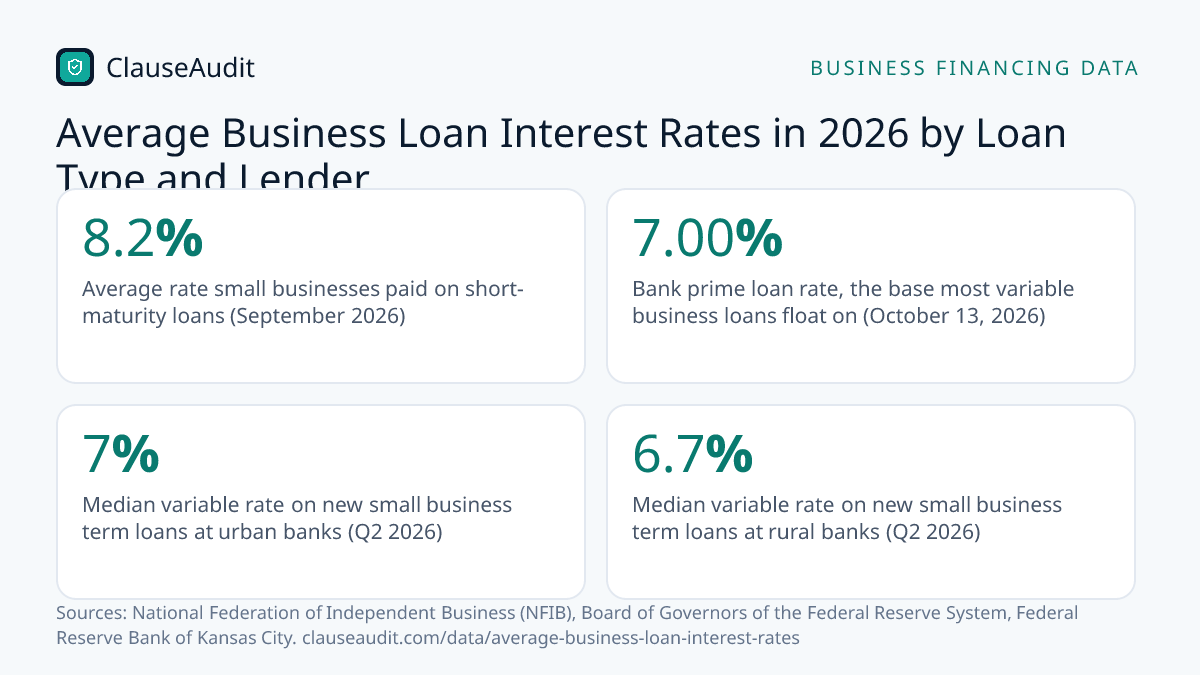
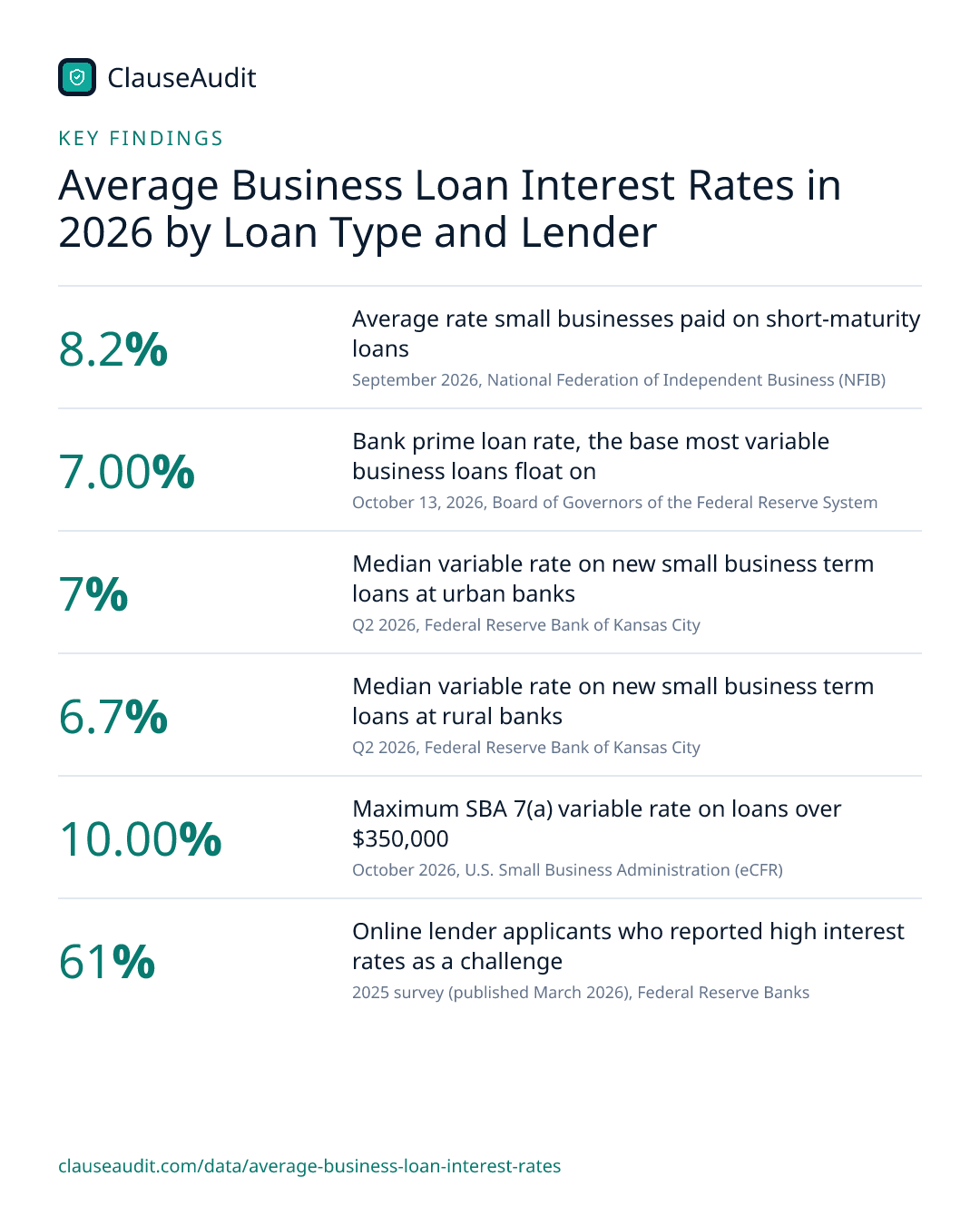
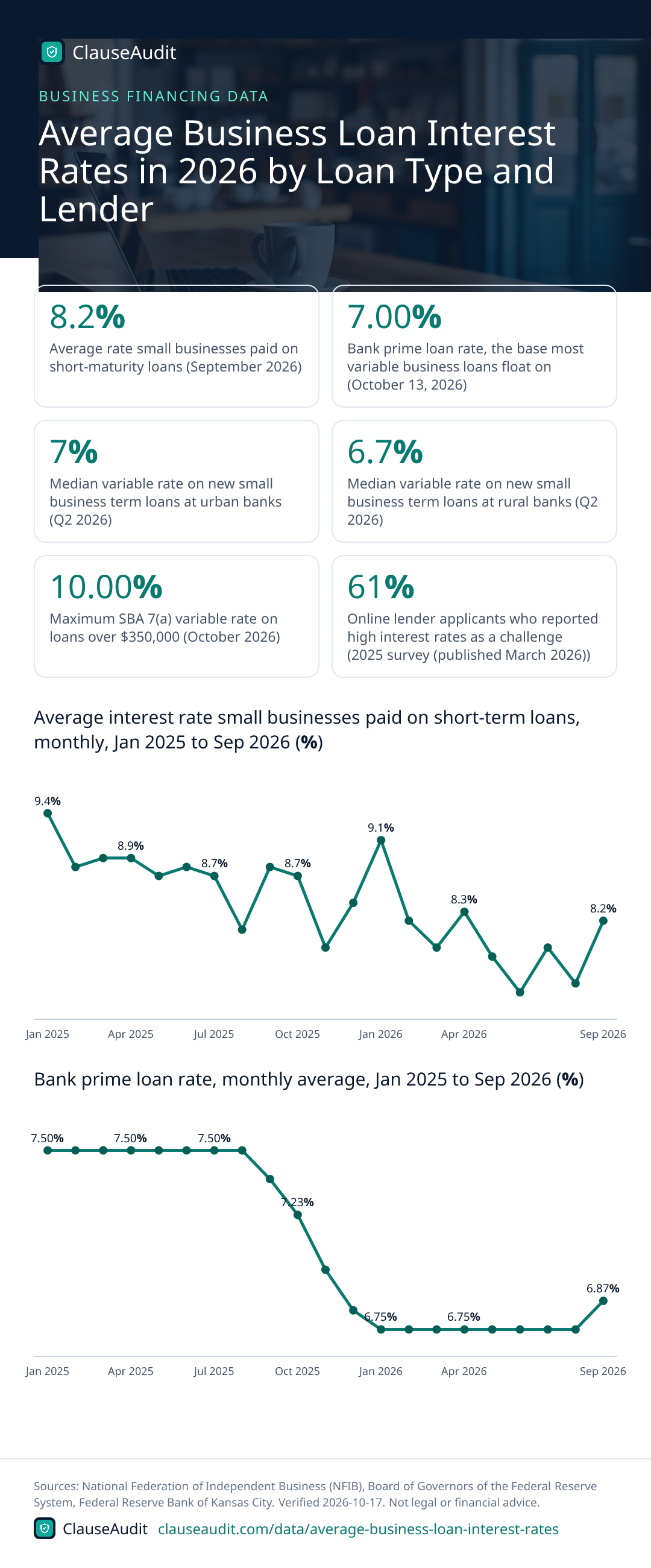
Small businesses paid an average of 8.2% on short-term loans in September 2026, according to NFIB. Bank term loans came in lower, with median variable rates of 6.7% at rural banks and 7% at urban banks in Q2 2026. Variable-rate SBA 7(a) loans over $350,000 are capped at 10.00% in October 2026, and online lenders often cost more.

- Average rate small businesses paid on short-maturity loans (September 2026, National Federation of Independent Business (NFIB))
- 8.2%
- Bank prime loan rate, the base most variable business loans float on (October 13, 2026, Board of Governors of the Federal Reserve System)
- 7.00%
- Median variable rate on new small business term loans at urban banks (Q2 2026, Federal Reserve Bank of Kansas City)
- 7%
- Median variable rate on new small business term loans at rural banks (Q2 2026, Federal Reserve Bank of Kansas City)
- 6.7%
- Maximum SBA 7(a) variable rate on loans over $350,000 (October 2026, U.S. Small Business Administration (eCFR))
- 10.00%
- Online lender applicants who reported high interest rates as a challenge (2025 survey (published March 2026), Federal Reserve Banks)
- 61%
- Online lender borrowers whose actual borrowing cost was higher than expected (2025 survey (published March 2026), Federal Reserve Banks)
- 60%
There is no single business loan rate. What you pay depends on who lends to you, how long you borrow for, whether the rate floats, and how big the loan is. The cleanest public benchmark is NFIB's monthly survey of owners who actually borrowed: 8.2% in September 2026, close to its long-run average of 8.3%.
That number is a starting point, not a quote. Banks priced new term loans a bit lower in Q2 2026, SBA caps set a ceiling on 7(a) loans, and owners who used online lenders were the most likely to say the rate was high and the final cost was worse than they expected. Below, we explain what each figure means for your next loan and what to look for in the agreement.
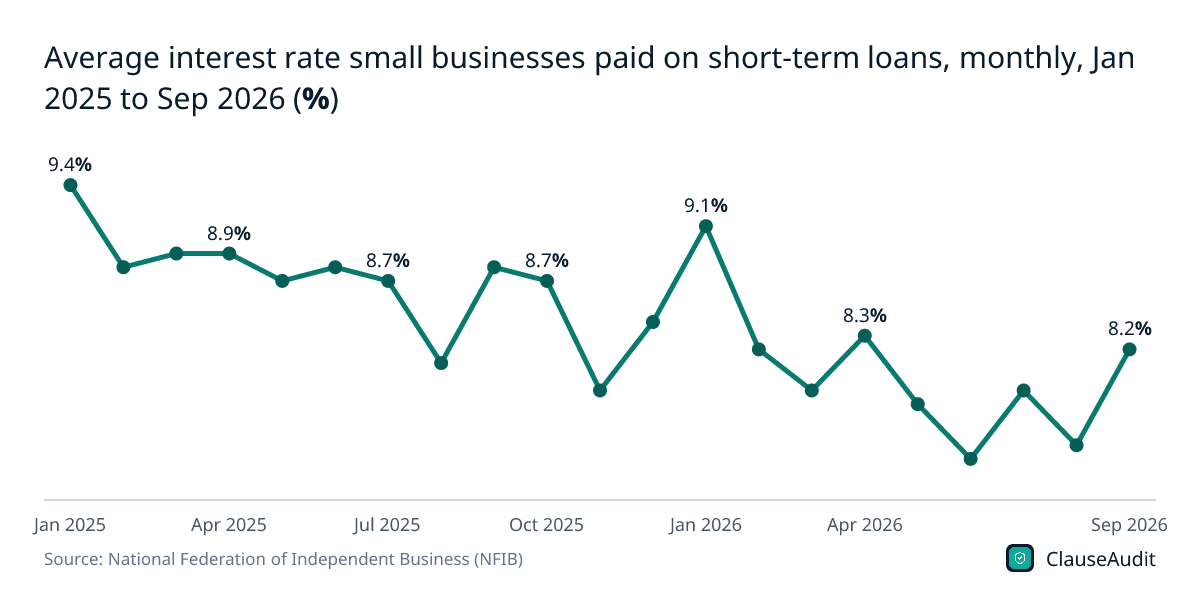
Average interest rate small businesses paid on short-term loans, monthly, Jan 2025 to Sep 2026 (%)
Chart data
| Label | Value (%) |
|---|---|
| Jan 2025 | 9.4% |
| Feb 2025 | 8.8% |
| Mar 2025 | 8.9% |
| Apr 2025 | 8.9% |
| May 2025 | 8.7% |
| Jun 2025 | 8.8% |
| Jul 2025 | 8.7% |
| Aug 2025 | 8.1% |
| Sep 2025 | 8.8% |
| Oct 2025 | 8.7% |
| Nov 2025 | 7.9% |
| Dec 2025 | 8.4% |
| Jan 2026 | 9.1% |
| Feb 2026 | 8.2% |
| Mar 2026 | 7.9% |
| Apr 2026 | 8.3% |
| May 2026 | 7.8% |
| Jun 2026 | 7.4% |
| Jul 2026 | 7.9% |
| Aug 2026 | 7.5% |
| Sep 2026 | 8.2% |
The average bounces around from month to month because a different group of owners borrows each time. Read the trend, not a single month: rates drifted down from 9.4% in January 2025 to 7.4% in June 2026, then rose to 8.2% in September 2026.
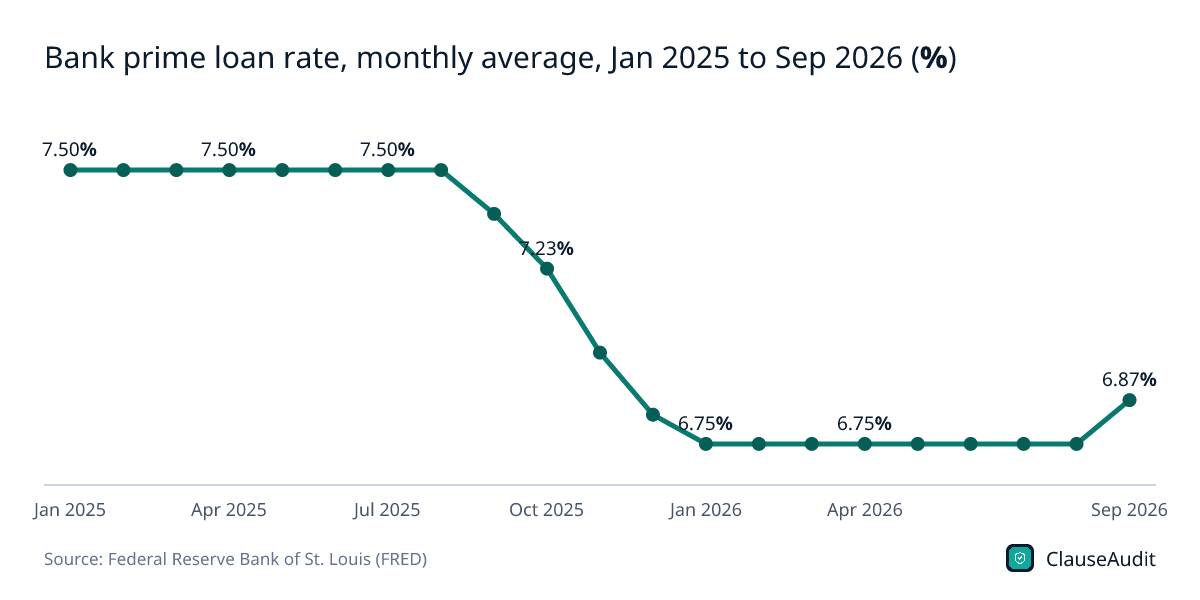
Download this chart (PNG)Bank prime loan rate, monthly average, Jan 2025 to Sep 2026 (%)
Chart data
| Label | Value (%) |
|---|---|
| Jan 2025 | 7.50% |
| Feb 2025 | 7.50% |
| Mar 2025 | 7.50% |
| Apr 2025 | 7.50% |
| May 2025 | 7.50% |
| Jun 2025 | 7.50% |
| Jul 2025 | 7.50% |
| Aug 2025 | 7.50% |
| Sep 2025 | 7.38% |
| Oct 2025 | 7.23% |
| Nov 2025 | 7.00% |
| Dec 2025 | 6.83% |
| Jan 2026 | 6.75% |
| Feb 2026 | 6.75% |
| Mar 2026 | 6.75% |
| Apr 2026 | 6.75% |
| May 2026 | 6.75% |
| Jun 2026 | 6.75% |
| Jul 2026 | 6.75% |
| Aug 2026 | 6.75% |
| Sep 2026 | 6.87% |
Prime is the base most variable business loans float on. It sat at 6.75% for most of 2026 before moving to 7.00% on September 17, 2026, so a variable loan tied to prime got more expensive at its next rate adjustment.
Download this chart (PNG)Average short-term loan rate paid by small businesses, each September, 2021 to 2026 (%)
Chart data
| Label | Value (%) |
|---|---|
| Sep 2021 | 5.6% |
| Sep 2022 | 6.7% |
| Sep 2023 | 9.8% |
| Sep 2024 | 10.1% |
| Sep 2025 | 8.8% |
| Sep 2026 | 8.2% |
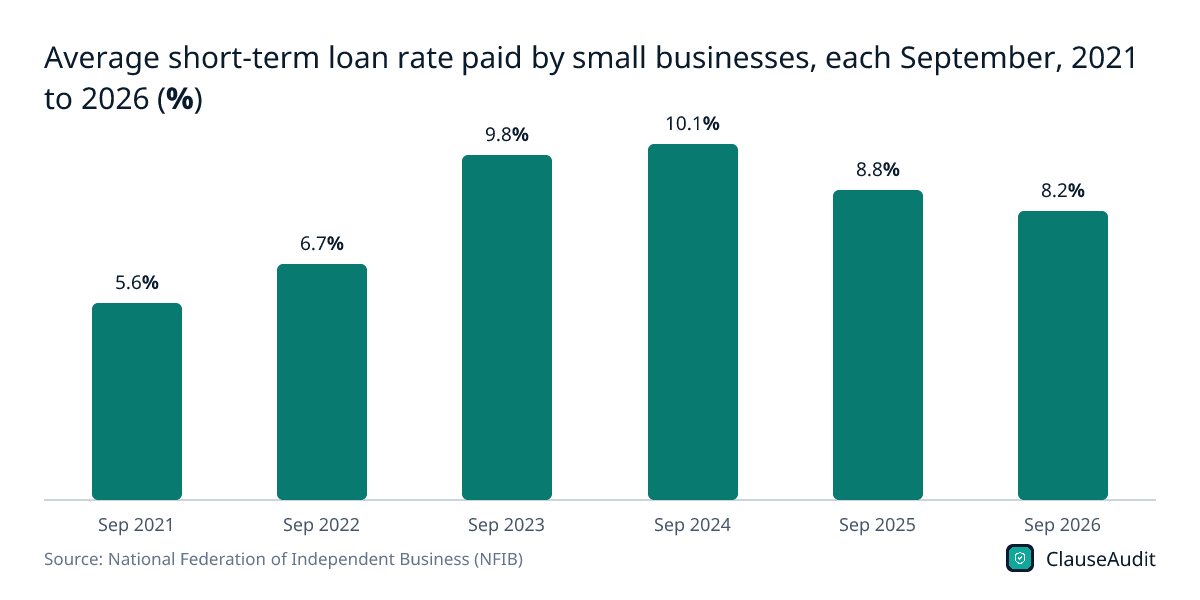
September rates climbed from 5.6% in 2021 to 10.1% in 2024. The 8.2% in 2026 is lower than the peak but still well above where loans were priced a few years ago.
Download this chart (PNG)Maximum SBA 7(a) variable interest rate by loan size, October 2026 (%)
Chart data
| Label | Value (%) |
|---|---|
| $50,000 or less | 13.50% |
| $50,001 to $250,000 | 13.00% |
| $250,001 to $350,000 | 11.50% |
| Over $350,000 | 10.00% |
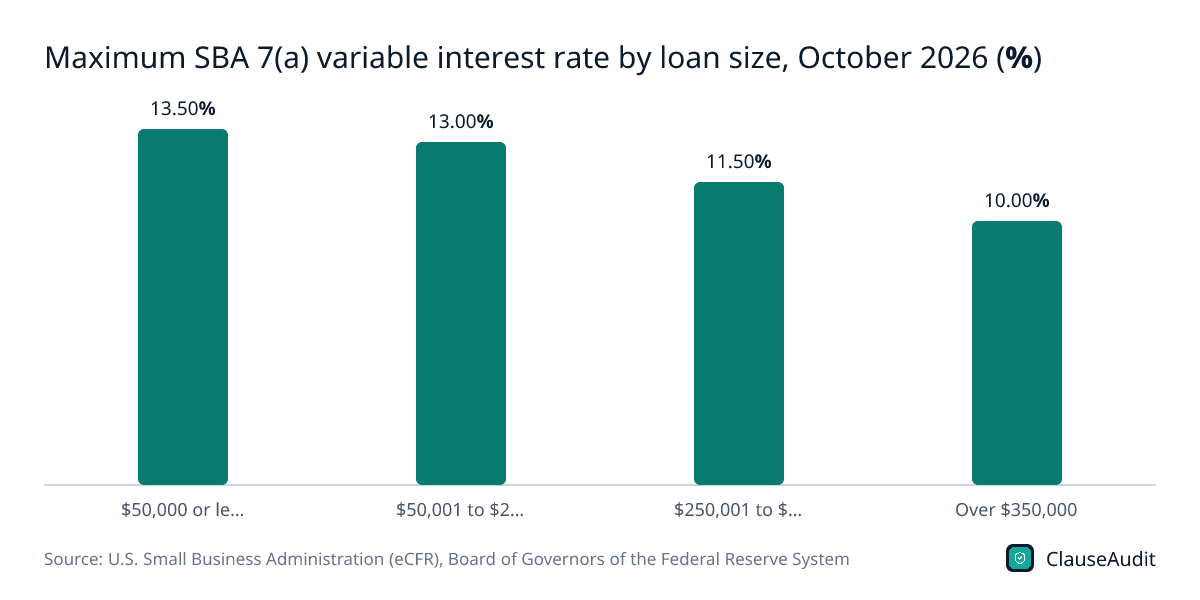
These are legal ceilings, not what most borrowers pay. Smaller SBA loans are allowed a wider spread over prime, which is why a loan of $50,000 or less can be priced up to 13.50%.
Download this chart (PNG)Share of small business applicants citing high interest rates as a lender challenge, by lender type (%)
Chart data
| Label | Value |
|---|---|
| Online lender | 61% |
| Finance company | 39% |
| Small bank | 30% |
| Large bank | 28% |
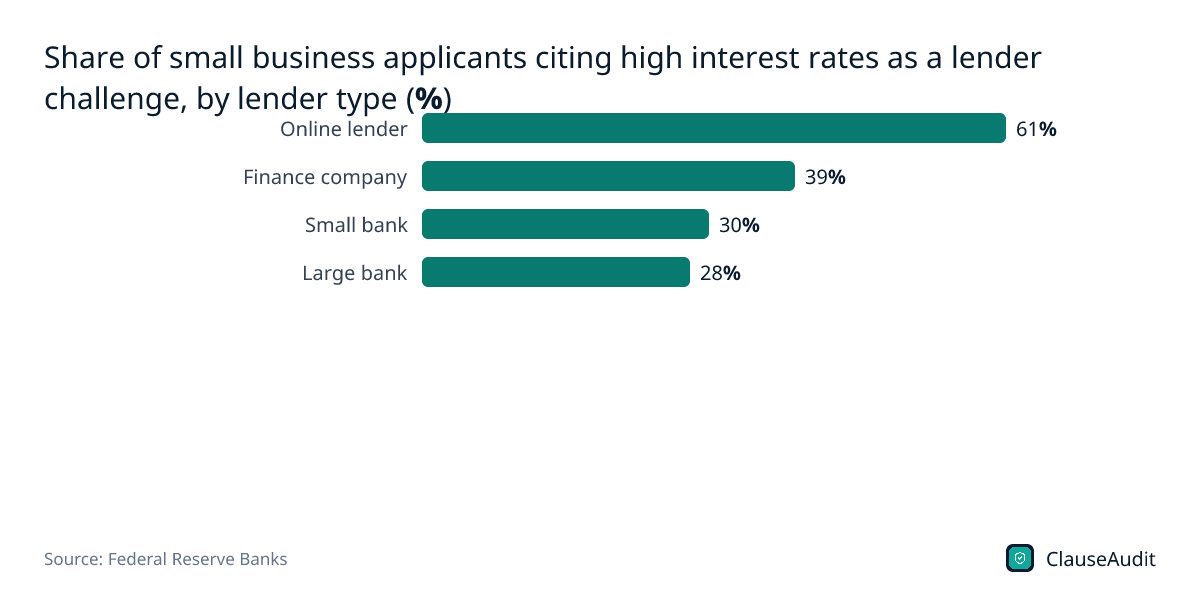
Owners who went to online lenders were far more likely than bank applicants to name high interest rates as a problem: 61% versus 28% at large banks.
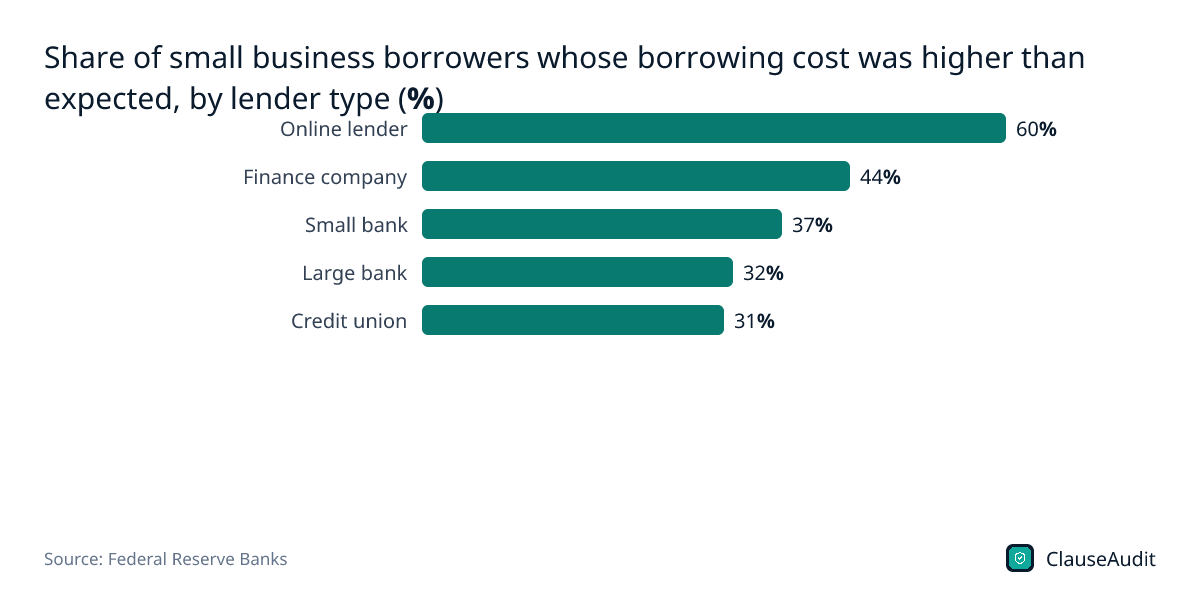
Download this chart (PNG)Share of small business borrowers whose borrowing cost was higher than expected, by lender type (%)
Chart data
| Label | Value |
|---|---|
| Online lender | 60% |
| Finance company | 44% |
| Small bank | 37% |
| Large bank | 32% |
| Credit union | 31% |
This measures surprise, not just price. 60% of online lender borrowers said the total cost, including fees and penalties, came in higher than they expected, compared with 31% at credit unions.
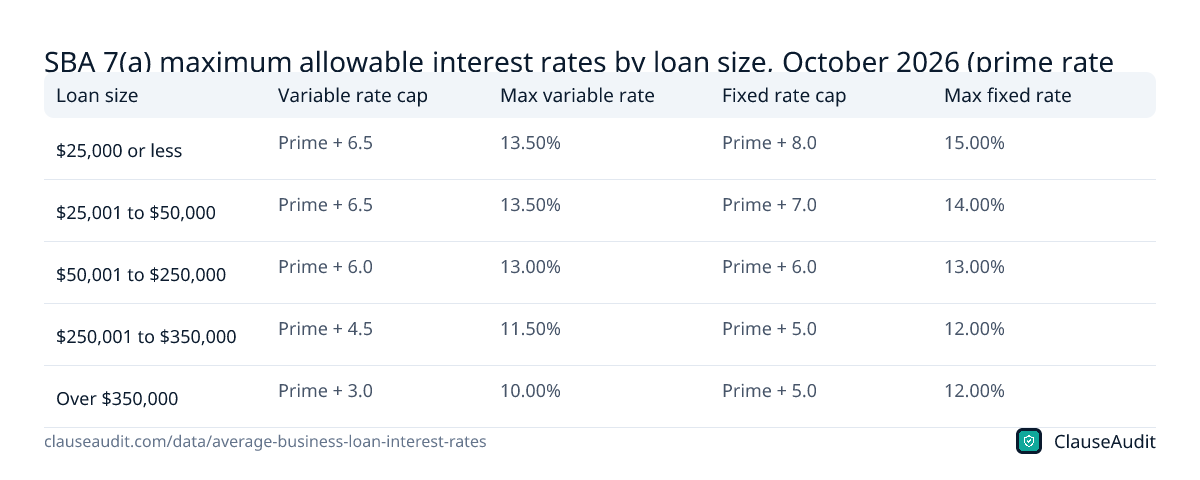
Download this chart (PNG)SBA 7(a) maximum allowable interest rates by loan size, October 2026 (prime rate 7.00%)
| Loan size | Variable rate cap | Max variable rate | Fixed rate cap | Max fixed rate |
|---|---|---|---|---|
| $25,000 or less | Prime + 6.5 | 13.50% | Prime + 8.0 | 15.00% |
| $25,001 to $50,000 | Prime + 6.5 | 13.50% | Prime + 7.0 | 14.00% |
| $50,001 to $250,000 | Prime + 6.0 | 13.00% | Prime + 6.0 | 13.00% |
| $250,001 to $350,000 | Prime + 4.5 | 11.50% | Prime + 5.0 | 12.00% |
| Over $350,000 | Prime + 3.0 | 10.00% | Prime + 5.0 | 12.00% |
Source: U.S. Small Business Administration (eCFR), 13 CFR 120.214, What conditions apply for variable interest rates?; U.S. Small Business Administration, Maximum Allowable 7(a) Fixed Interest Rates (Federal Register notice 2022-16162); Board of Governors of the Federal Reserve System, H.15 Selected Interest Rates (Daily). Download as image
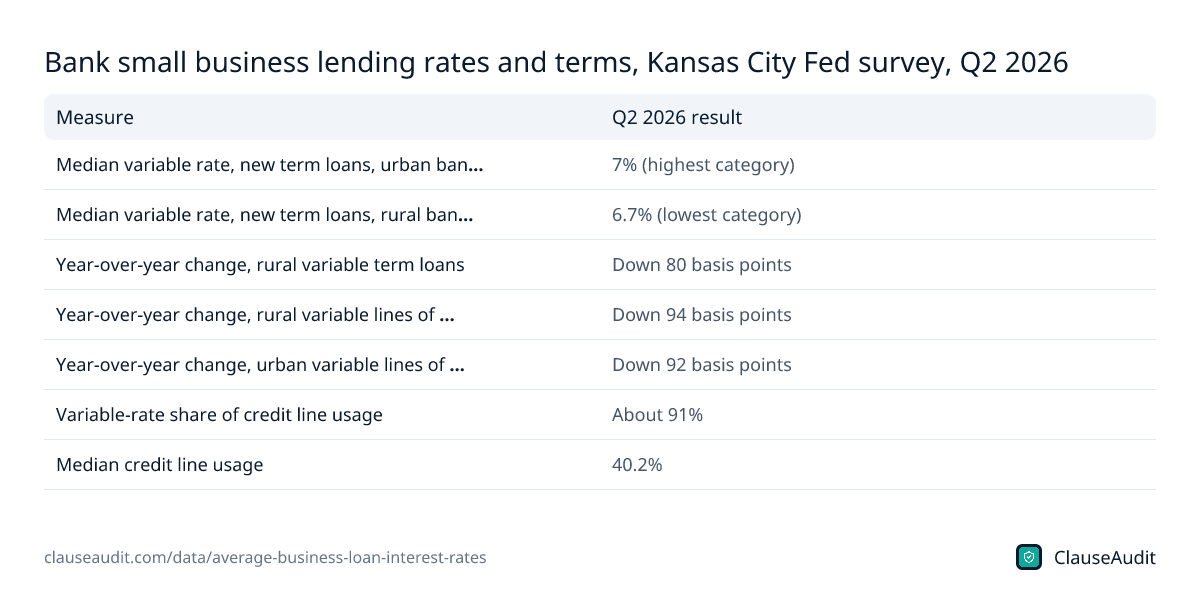
Bank small business lending rates and terms, Kansas City Fed survey, Q2 2026
| Measure | Q2 2026 result |
|---|---|
| Median variable rate, new term loans, urban banks | 7% (highest category) |
| Median variable rate, new term loans, rural banks | 6.7% (lowest category) |
| Year-over-year change, rural variable term loans | Down 80 basis points |
| Year-over-year change, rural variable lines of credit | Down 94 basis points |
| Year-over-year change, urban variable lines of credit | Down 92 basis points |
| Variable-rate share of credit line usage | About 91% |
| Median credit line usage | 40.2% |
Source: Federal Reserve Bank of Kansas City, Small Business Lending Survey: Inflation Expected to Impact Loan Demand (Q2 2026). Download as image
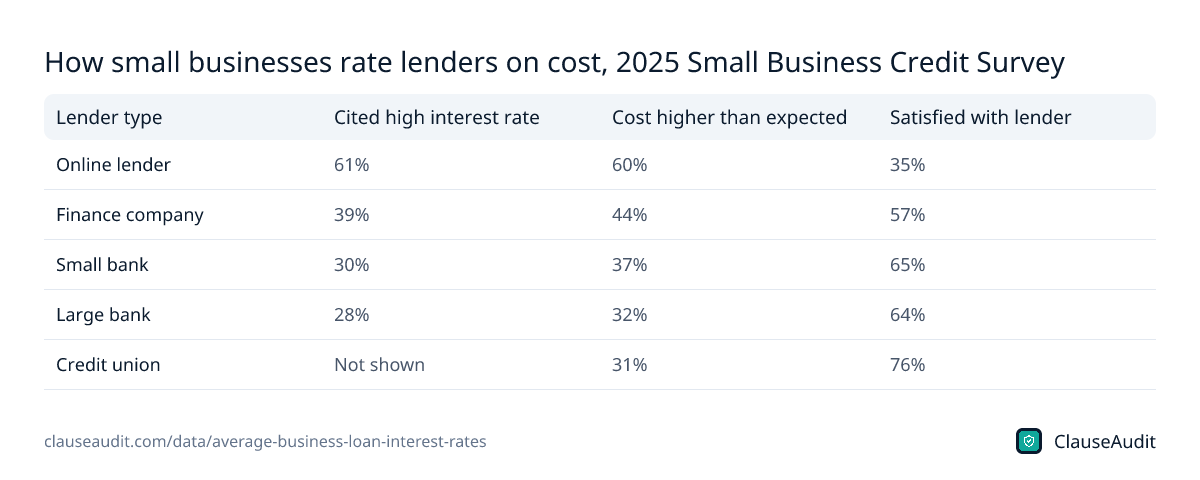
How small businesses rate lenders on cost, 2025 Small Business Credit Survey
| Lender type | Cited high interest rate | Cost higher than expected | Satisfied with lender |
|---|---|---|---|
| Online lender | 61% | 60% | 35% |
| Finance company | 39% | 44% | 57% |
| Small bank | 30% | 37% | 65% |
| Large bank | 28% | 32% | 64% |
| Credit union | Not shown | 31% | 76% |
Source: Federal Reserve Banks, Small Business Credit Survey: 2026 Report on Employer Firms. Download as image
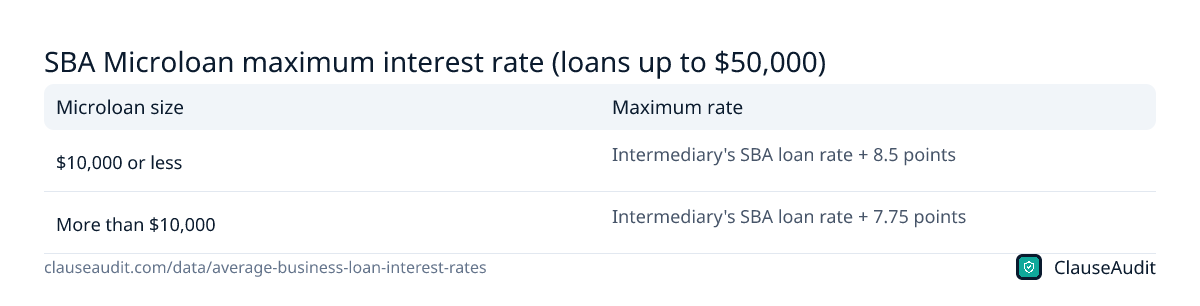
SBA Microloan maximum interest rate (loans up to $50,000)
| Microloan size | Maximum rate |
|---|---|
| $10,000 or less | Intermediary's SBA loan rate + 8.5 points |
| More than $10,000 | Intermediary's SBA loan rate + 7.75 points |
Source: U.S. Small Business Administration (eCFR), 13 CFR 120.707, What conditions apply to loans by Intermediaries to Microloan borrowers?. Download as image
What is the average business loan interest rate in 2026?
If you want one number, use 8.2%. That is the average rate NFIB members reported paying in September 2026 on loans that must be paid back within a year. It rose 0.7 points from August, when it was 7.5%.
Bank term loans were a little cheaper. The Kansas City Fed's survey of banks put the median variable rate on new small business term loans at 7% for urban banks and 6.7% for rural banks in Q2 2026. The rural rate was down 80 basis points from a year earlier, and variable credit line rates fell even more, by 94 basis points at rural banks and 92 at urban banks.
So a well-qualified borrower at a bank may see a quote near prime, which was 7.00% on October 13, 2026. A newer business, a smaller loan or a lender outside the banking system will usually price higher.
Keep the time frame in mind too. NFIB's history shows how fast this moves: the September average was 5.6% in 2021 and 10.1% in 2024. A rate that looked high when you signed may look cheap a few years later, or the other way around. That is one reason the fixed versus variable choice below deserves a close look.
Why do rates vary so much by lender?
Banks can often lend at lower rates because they fund loans with deposits and screen applicants closely. Online lenders and finance companies approve faster and with less paperwork, and they charge for that speed and risk.
The Fed's Small Business Credit Survey shows the gap from the borrower's side. 61% of online lender applicants cited high interest rates as a challenge, against 39% at finance companies, 30% at small banks and 28% at large banks. Satisfaction told a similar story: 76% of credit union borrowers were satisfied with their lender, compared with 35% for online lenders.
If you are a freelancer or a small shop that needs cash quickly, an online offer may still be the right call. Just treat its rate as a reason to compare, not a reason to sign.
Picture a designer with a slow-paying client who needs to cover rent and software bills for a few weeks. An online lender can fund in days, while the local credit union wants tax returns and a meeting. The faster money is real value. But if the credit union can say yes, even a week later, the savings on interest and fees can outweigh the cost of waiting. Apply to both at once if you can, then decide.
Fixed vs variable business loan rates: which should you pick?
A variable rate moves with an index, which for most small business loans is prime. When prime moved from 6.75% to 7.00% in September 2026, a loan priced at prime plus a spread went up by the same 0.25 points once it reset. A fixed rate often costs more on day one but stays put.
Variable pricing is the norm for revolving credit. About 91% of credit line usage at the banks the Kansas City Fed surveys was variable-rate. If you carry a balance on your line most of the year, a rate change hits your monthly cash flow directly.
A simple test: if a rate increase would squeeze your payroll or your margin, ask for a fixed rate or a cap on how high the variable rate can go. If the loan is short and you plan to pay it off fast, variable usually makes sense.
How do SBA loan rate caps work?
SBA 7(a) lenders set their own rates, but federal rules limit the spread they can add to prime. For a variable-rate loan over $350,000 the cap is prime plus 3.0 points, which works out to 10.00% in October 2026. Smaller loans get wider caps, up to 13.50% for loans of $50,000 or less. Fixed-rate caps are the same or higher, up to 15.00% for loans of $25,000 or less.
SBA Microloans, which top out at $50,000, have their own limits tied to the rate the intermediary pays on its SBA loan: that rate plus 8.5 points for loans of $10,000 or less, and plus 7.75 points above $10,000. Many lenders price below these ceilings, so ask what spread you qualify for instead of assuming the cap is the offer.
What the quoted rate leaves out
The rate on the term sheet is not your full cost. Origination fees, packaging fees, prepayment penalties and a higher default rate that kicks in after a missed payment can all sit in the loan agreement. Some variable loans also set a rate floor, so your rate never drops even if prime does.
The Fed survey counts all of these in the cost of borrowing, and 60% of online lender borrowers, and 32% even at large banks, said that cost was higher than expected. Often the surprise is not the headline rate. It is a clause the owner skimmed.
Watch for products that are not priced as interest at all. A merchant cash advance quotes a factor rate, and some short-term loans quote a flat fee. Neither can be compared to an annual rate until you convert it. Ask the lender for the APR or the total dollar cost to repay, and put that number side by side with your other offers.
How to get a better rate on your next business loan
- Start with a credit union or a bank. Credit union and large bank borrowers reported the fewest cost surprises, at 31% and 32%.
- Get at least two written offers and compare them on total cost, not just the rate.
- Ask whether the rate is fixed or variable, what index it follows and whether there is a floor or cap.
- For an SBA loan, check the offer against the cap for your loan size.
- Ask for the fee schedule and the prepayment terms in writing before you apply.
- Read the default and late payment sections. A higher default rate can cost more than the base rate difference between two lenders.
How ClauseAudit helps
Two loans with the same quoted rate can cost very different amounts once fees, penalties and rate adjustments are counted. Those terms live in the loan agreement or promissory note, not the offer email.
Upload your agreement and our automated review flags the clauses that change what you will actually pay, in plain English, so you can push back before you sign.
- Interest rate type, index, spread, and any floor or cap on a variable rate
- Origination, closing and other fees added to the balance or taken from the proceeds
- Prepayment penalties or minimum interest owed if you pay early
- Default rate increases and late fees after a missed payment
- Personal guarantees and liens on business or personal assets
- Cross-default and acceleration clauses that make the full balance due at once
Frequently asked questions
What is a good interest rate for a small business loan?
A rate near or below the averages here is good. Bank term loans had median variable rates of 6.7% to 7% in Q2 2026, and NFIB borrowers paid an average 8.2% on short-term loans in September 2026. If your quote is well above those, ask why and compare at least one bank or credit union offer.
How is a business loan rate tied to the prime rate?
Most variable business loans are priced as prime plus a spread. Prime was 7.00% on October 13, 2026. If your loan is prime plus a margin, your rate rises and falls with prime, usually at the next adjustment date your agreement names.
What is the maximum interest rate on an SBA 7(a) loan?
It depends on the loan size and whether the rate is fixed or variable. In October 2026, the variable cap ranged from 10.00% for loans over $350,000 to 13.50% for loans of $50,000 or less. Fixed caps went as high as 15.00% for the smallest loans.
Are online business loans more expensive than bank loans?
Usually, yes. In the Fed's Small Business Credit Survey, 61% of online lender applicants named high interest rates as a challenge, compared with 28% at large banks. Online lenders also had the highest share of borrowers whose total cost came in higher than expected, at 60%.
Do business loan rates depend on my credit score?
Yes. Lenders price for risk, and both your personal and business credit affect the spread they add to their base rate. A stronger score, more time in business and steady revenue usually get you closer to the bank medians. Weaker credit often pushes owners toward online lenders, where rates run higher.
Should I choose a fixed or variable rate business loan?
Pick fixed if a rate increase would hurt your cash flow or the loan runs for years. Pick variable if the loan is short, you expect to repay early, or the variable rate is clearly lower. If you go variable, ask for a cap and check whether the agreement sets a floor.
Why did my loan cost more than the quoted rate?
Fees, prepayment penalties and default interest add to the cost on top of the rate. The Fed survey counts all of these, and between 31% and 60% of borrowers, depending on lender type, said the final cost was higher than they expected. Read the fee and default sections before you sign.
Are business line of credit rates higher than term loan rates?
It depends on the lender, but lines are usually variable. About 91% of credit line usage at banks in the Kansas City Fed survey was variable-rate. Those line rates fell year over year in Q2 2026, by 94 basis points at rural banks and 92 at urban banks, so compare a current quote against a term loan offer.
Use this data
Every chart and card below is free to reuse under CC BY 4.0. Download what you need and link back to this page.
 Stat cards
 Key findings card
 Infographic
 Average interest rate small businesses paid on short-term loans, monthly, Jan 2025 to Sep 2026 (%)
 Bank prime loan rate, monthly average, Jan 2025 to Sep 2026 (%)
 Average short-term loan rate paid by small businesses, each September, 2021 to 2026 (%)
 Maximum SBA 7(a) variable interest rate by loan size, October 2026 (%)
 Share of small business applicants citing high interest rates as a lender challenge, by lender type (%)
 Share of small business borrowers whose borrowing cost was higher than expected, by lender type (%)
 SBA 7(a) maximum allowable interest rates by loan size, October 2026 (prime rate 7.00%)
 Bank small business lending rates and terms, Kansas City Fed survey, Q2 2026
 How small businesses rate lenders on cost, 2025 Small Business Credit Survey
 SBA Microloan maximum interest rate (loans up to $50,000)
Embed the infographic
Free to share on your site, blog or slides under CC BY 4.0. Please keep the credit link.
Sources and method
Every number on this page comes from the sources below, each opened and read on or before October 17, 2026. A second, independent review checked every figure against its source and corrected anything that did not match. Figures that could not be confirmed were left out.
- National Federation of Independent Business (NFIB), Small Business Economic Trends, September 2026 (September 2026 report (released October 2026))
- Board of Governors of the Federal Reserve System, H.15 Selected Interest Rates (Daily) (October 14, 2026)
- Federal Reserve Bank of St. Louis (FRED), Bank Prime Loan Rate (MPRIME), monthly, from Federal Reserve H.15 (Data through September 2026)
- Federal Reserve Bank of Kansas City, Small Business Lending Survey: Inflation Expected to Impact Loan Demand (Q2 2026) (September 24, 2026)
- Federal Reserve Banks, Small Business Credit Survey: 2026 Report on Employer Firms (March 2026 (2025 survey data))
- U.S. Small Business Administration (eCFR), 13 CFR 120.214, What conditions apply for variable interest rates? (Current as of October 2026 (last amended 87 FR 38908, June 30, 2022))
- U.S. Small Business Administration, Maximum Allowable 7(a) Fixed Interest Rates (Federal Register notice 2022-16162) (August 1, 2022 (effective August 1, 2022))
- U.S. Small Business Administration (eCFR), 13 CFR 120.707, What conditions apply to loans by Intermediaries to Microloan borrowers? (Current as of October 2026 (last amended 89 FR 34101, April 30, 2024))
Cite this page
ClauseAudit, “Average Business Loan Interest Rates in 2026 by Loan Type and Lender”, updated October 17, 2026, https://clauseaudit.com/data/average-business-loan-interest-rates. Free to reuse with a link back (CC BY 4.0).
This page summarises published data and law as checked on October 17, 2026. Figures are updated as new editions are released, and your own situation may differ. It is general information, not legal, tax or financial advice.