Prime Rate History 2000-2026 and What It Means for Variable-Rate Business Loans
By ClauseAudit Research · 5 sources ·
What is the prime rate history and current rate?
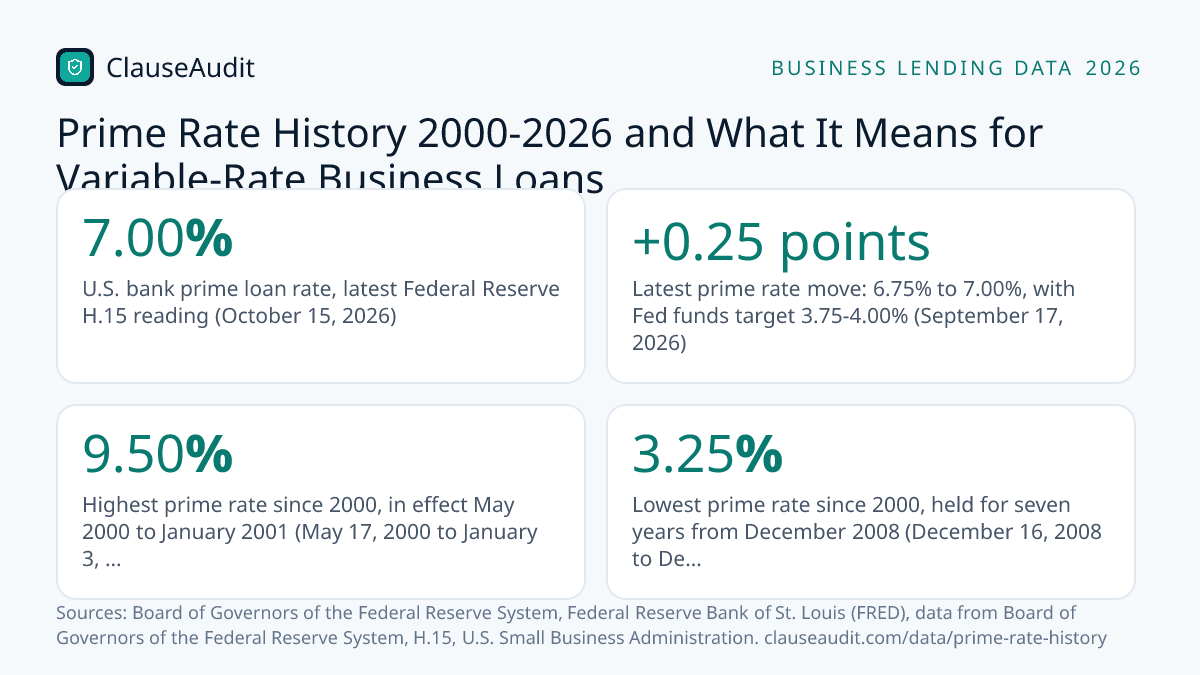
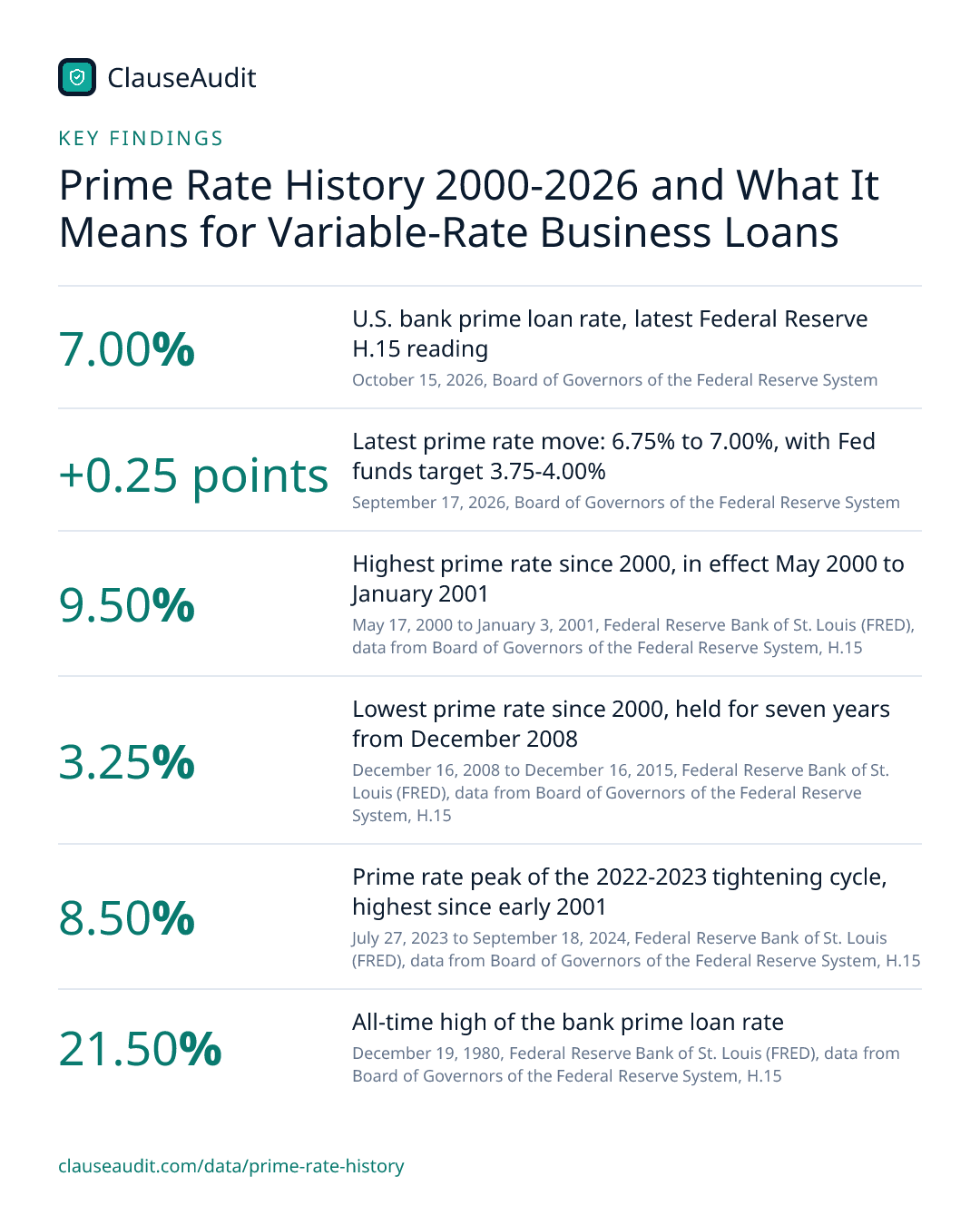
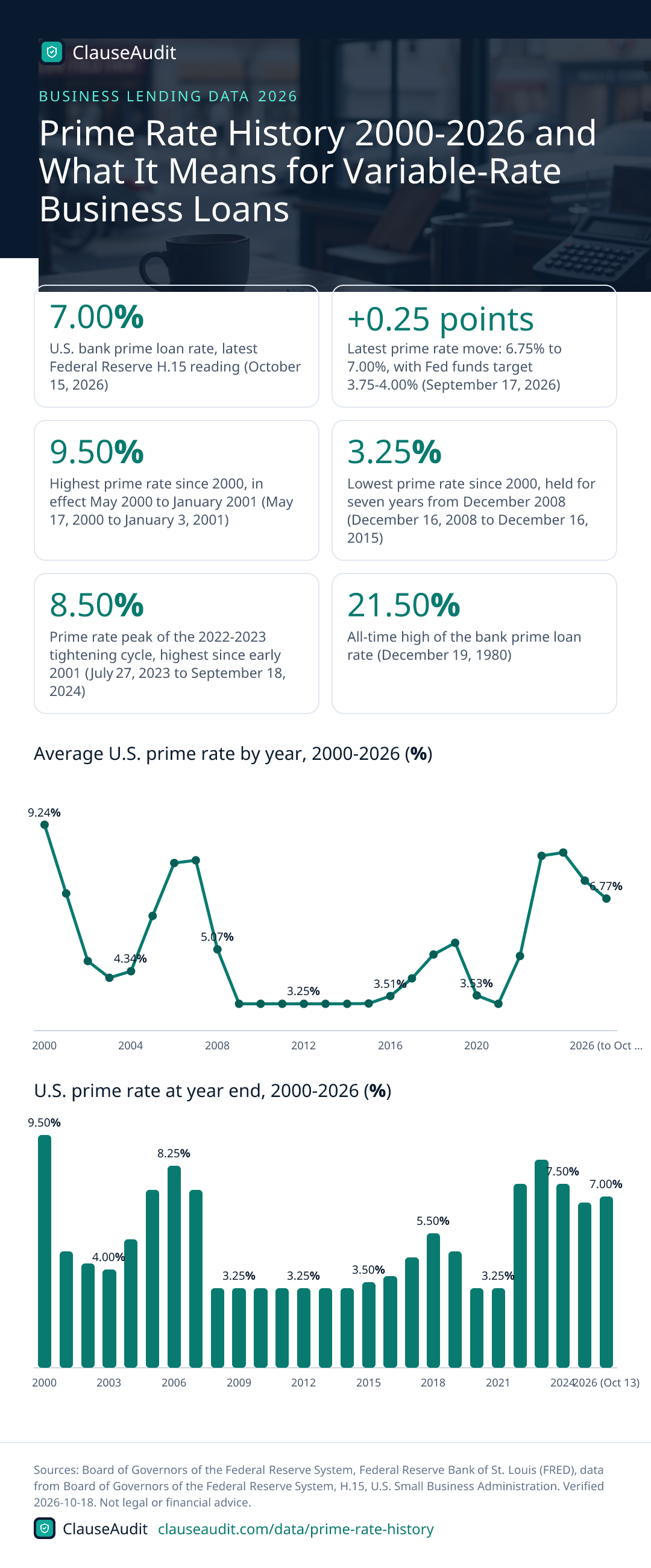
The U.S. prime rate is 7.00% as of October 15, 2026, after a +0.25 point move on September 17, 2026. Since 2000 it has run from a low of 3.25%, held from December 2008 to December 2015, to a high of 9.50% in 2000. The latest cycle topped out at 8.50% from July 2023 to September 2024.

- U.S. bank prime loan rate, latest Federal Reserve H.15 reading (October 15, 2026, Board of Governors of the Federal Reserve System)
- 7.00%
- Latest prime rate move: 6.75% to 7.00%, with Fed funds target 3.75-4.00% (September 17, 2026, Board of Governors of the Federal Reserve System)
- +0.25 points
- Highest prime rate since 2000, in effect May 2000 to January 2001 (May 17, 2000 to January 3, 2001, Federal Reserve Bank of St. Louis (FRED), data from Board of Governors of the Federal Reserve System, H.15)
- 9.50%
- Lowest prime rate since 2000, held for seven years from December 2008 (December 16, 2008 to December 16, 2015, Federal Reserve Bank of St. Louis (FRED), data from Board of Governors of the Federal Reserve System, H.15)
- 3.25%
- Prime rate peak of the 2022-2023 tightening cycle, highest since early 2001 (July 27, 2023 to September 18, 2024, Federal Reserve Bank of St. Louis (FRED), data from Board of Governors of the Federal Reserve System, H.15)
- 8.50%
- All-time high of the bank prime loan rate (December 19, 1980, Federal Reserve Bank of St. Louis (FRED), data from Board of Governors of the Federal Reserve System, H.15)
- 21.50%
- SBA maximum rate on variable 7(a) loans over $350,000 (2026, U.S. Small Business Administration)
- Base rate + 3.0%
- Median variable rate on new small business term loans at urban banks (Q2 2026, Federal Reserve Bank of Kansas City)
- 7%
If your business loan or credit line says "prime plus" anywhere in it, this number helps set your payment. When prime moves, your rate usually moves with it, often on the next billing cycle and without a new signature from you.
This page tracks every prime rate change from 2000 through October 2026, using Federal Reserve data. Below the charts, we explain what those swings did to real borrowing costs, how to read the rate terms in a variable-rate loan, and which clauses decide how much a rate rise can hurt you.
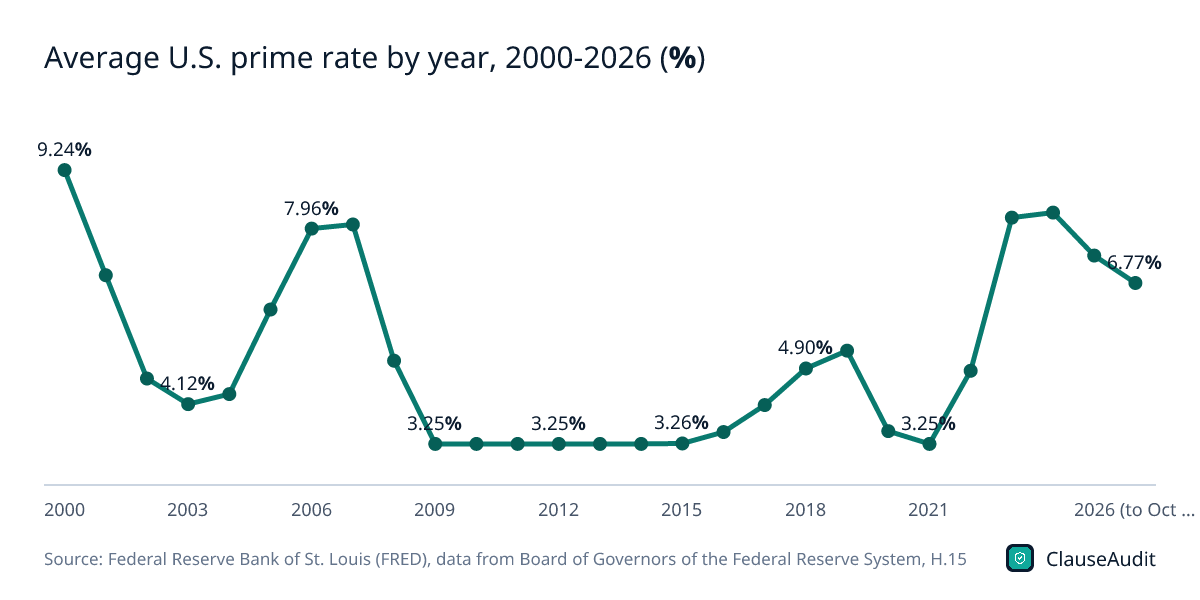
Average U.S. prime rate by year, 2000-2026 (%)
Chart data
| Label | Value (%) |
|---|---|
| 2000 | 9.24% |
| 2001 | 6.94% |
| 2002 | 4.68% |
| 2003 | 4.12% |
| 2004 | 4.34% |
| 2005 | 6.19% |
| 2006 | 7.96% |
| 2007 | 8.05% |
| 2008 | 5.07% |
| 2009 | 3.25% |
| 2010 | 3.25% |
| 2011 | 3.25% |
| 2012 | 3.25% |
| 2013 | 3.25% |
| 2014 | 3.25% |
| 2015 | 3.26% |
| 2016 | 3.51% |
| 2017 | 4.10% |
| 2018 | 4.90% |
| 2019 | 5.29% |
| 2020 | 3.53% |
| 2021 | 3.25% |
| 2022 | 4.85% |
| 2023 | 8.20% |
| 2024 | 8.31% |
| 2025 | 7.37% |
| 2026 (to Oct 13) | 6.77% |
The yearly average shows the long flat stretch at 3.25% from 2009 through 2014, then the jump from 4.85% in 2022 to 8.20% in 2023. The 2026 figure of 6.77% runs only through October 13.
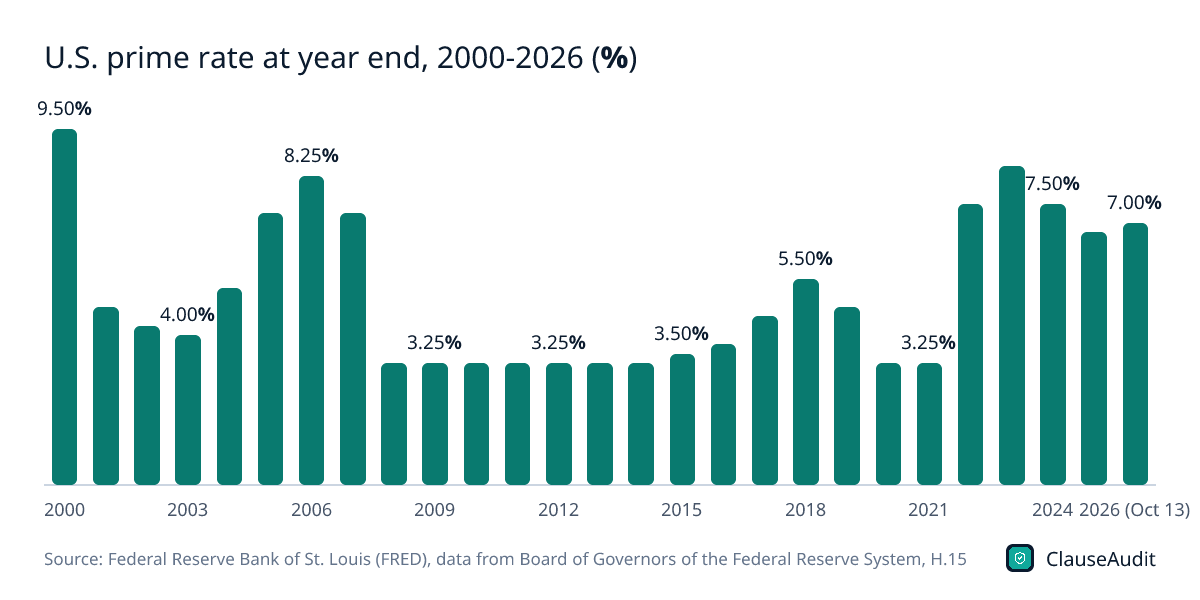
Download this chart (PNG)U.S. prime rate at year end, 2000-2026 (%)
Chart data
| Label | Value (%) |
|---|---|
| 2000 | 9.50% |
| 2001 | 4.75% |
| 2002 | 4.25% |
| 2003 | 4.00% |
| 2004 | 5.25% |
| 2005 | 7.25% |
| 2006 | 8.25% |
| 2007 | 7.25% |
| 2008 | 3.25% |
| 2009 | 3.25% |
| 2010 | 3.25% |
| 2011 | 3.25% |
| 2012 | 3.25% |
| 2013 | 3.25% |
| 2014 | 3.25% |
| 2015 | 3.50% |
| 2016 | 3.75% |
| 2017 | 4.50% |
| 2018 | 5.50% |
| 2019 | 4.75% |
| 2020 | 3.25% |
| 2021 | 3.25% |
| 2022 | 7.50% |
| 2023 | 8.50% |
| 2024 | 7.50% |
| 2025 | 6.75% |
| 2026 (Oct 13) | 7.00% |
Year-end readings show how fast a borrower's rate could change: prime closed 2021 at 3.25% and closed 2022 at 7.50%.
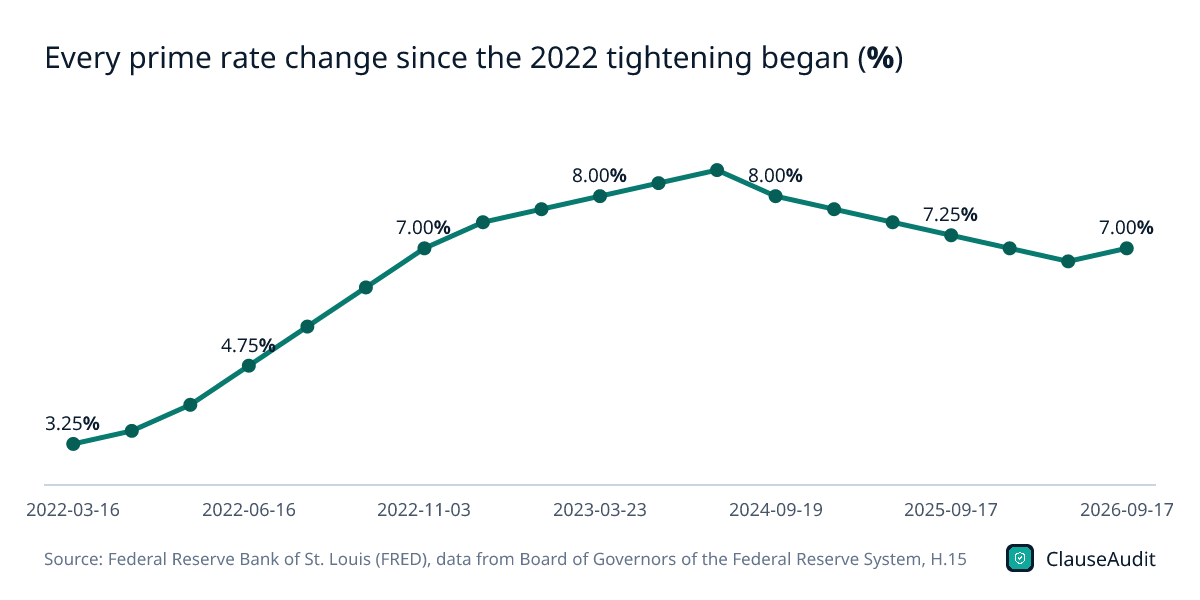
Download this chart (PNG)Every prime rate change since the 2022 tightening began (%)
Chart data
| Label | Value (%) |
|---|---|
| 2022-03-16 | 3.25% |
| 2022-03-17 | 3.50% |
| 2022-05-05 | 4.00% |
| 2022-06-16 | 4.75% |
| 2022-07-28 | 5.50% |
| 2022-09-22 | 6.25% |
| 2022-11-03 | 7.00% |
| 2022-12-15 | 7.50% |
| 2023-02-02 | 7.75% |
| 2023-03-23 | 8.00% |
| 2023-05-04 | 8.25% |
| 2023-07-27 | 8.50% |
| 2024-09-19 | 8.00% |
| 2024-11-08 | 7.75% |
| 2024-12-19 | 7.50% |
| 2025-09-17 | 7.25% |
| 2025-10-30 | 7.00% |
| 2025-12-11 | 6.75% |
| 2026-09-17 | 7.00% |
Prime climbed from 3.25% to 8.50% between March 2022 and July 2023, then came down in small steps to 6.75% before the September 17, 2026 increase to 7.00%.
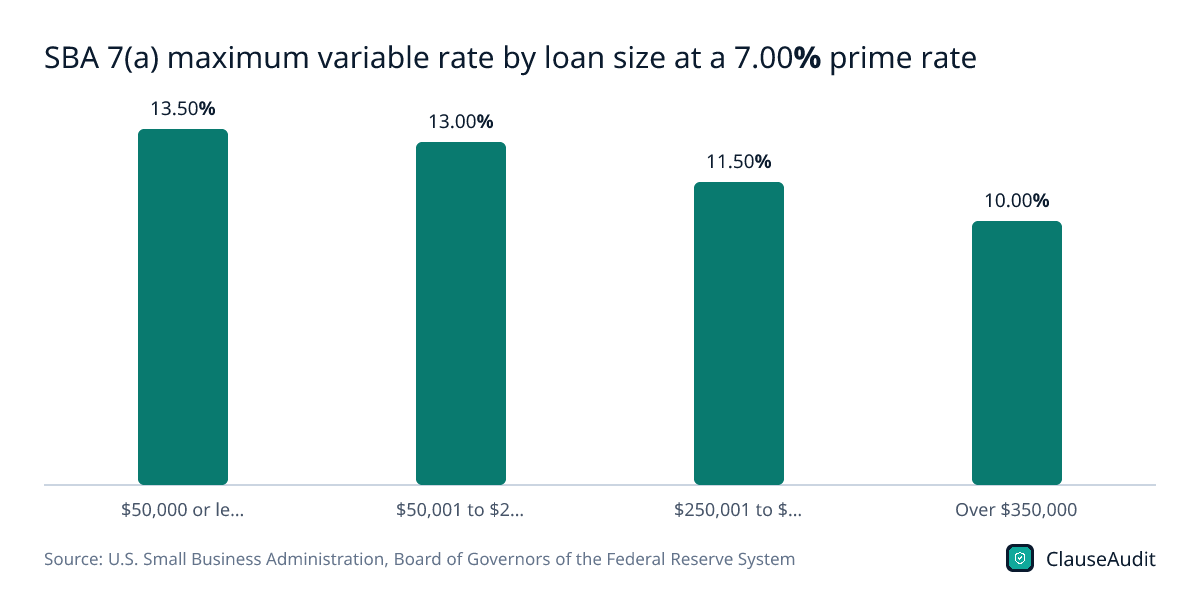
Download this chart (PNG)SBA 7(a) maximum variable rate by loan size at a 7.00% prime rate
Chart data
| Label | Value |
|---|---|
| $50,000 or less | 13.50% |
| $50,001 to $250,000 | 13.00% |
| $250,001 to $350,000 | 11.50% |
| Over $350,000 | 10.00% |
These are ceilings, not quotes. At a 7.00% prime, the SBA cap on a variable 7(a) loan over $350,000 works out to 10.00%, while loans of $50,000 or less can be priced up to 13.50%.
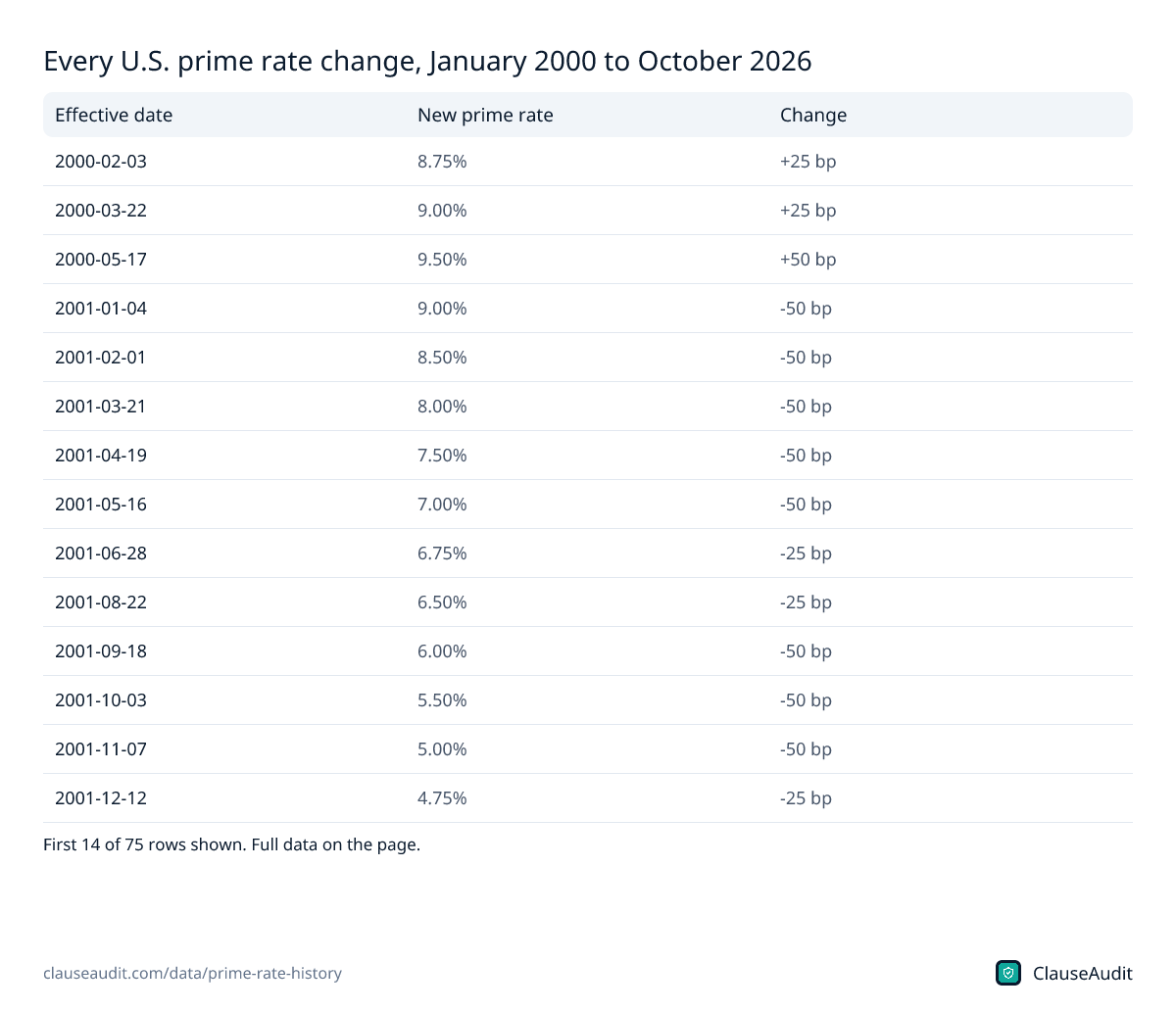
Download this chart (PNG)Every U.S. prime rate change, January 2000 to October 2026
| Effective date | New prime rate | Change |
|---|---|---|
| 2000-02-03 | 8.75% | +25 bp |
| 2000-03-22 | 9.00% | +25 bp |
| 2000-05-17 | 9.50% | +50 bp |
| 2001-01-04 | 9.00% | -50 bp |
| 2001-02-01 | 8.50% | -50 bp |
| 2001-03-21 | 8.00% | -50 bp |
| 2001-04-19 | 7.50% | -50 bp |
| 2001-05-16 | 7.00% | -50 bp |
| 2001-06-28 | 6.75% | -25 bp |
| 2001-08-22 | 6.50% | -25 bp |
| 2001-09-18 | 6.00% | -50 bp |
| 2001-10-03 | 5.50% | -50 bp |
| 2001-11-07 | 5.00% | -50 bp |
| 2001-12-12 | 4.75% | -25 bp |
| 2002-11-07 | 4.25% | -50 bp |
| 2003-06-27 | 4.00% | -25 bp |
| 2004-06-30 | 4.25% | +25 bp |
| 2004-08-10 | 4.50% | +25 bp |
| 2004-09-21 | 4.75% | +25 bp |
| 2004-11-10 | 5.00% | +25 bp |
| 2004-12-14 | 5.25% | +25 bp |
| 2005-02-02 | 5.50% | +25 bp |
| 2005-03-22 | 5.75% | +25 bp |
| 2005-05-03 | 6.00% | +25 bp |
| 2005-06-30 | 6.25% | +25 bp |
| 2005-08-09 | 6.50% | +25 bp |
| 2005-09-20 | 6.75% | +25 bp |
| 2005-11-01 | 7.00% | +25 bp |
| 2005-12-13 | 7.25% | +25 bp |
| 2006-01-31 | 7.50% | +25 bp |
| 2006-03-28 | 7.75% | +25 bp |
| 2006-05-10 | 8.00% | +25 bp |
| 2006-06-29 | 8.25% | +25 bp |
| 2007-09-18 | 7.75% | -50 bp |
| 2007-10-31 | 7.50% | -25 bp |
| 2007-12-11 | 7.25% | -25 bp |
| 2008-01-22 | 6.50% | -75 bp |
| 2008-01-30 | 6.00% | -50 bp |
| 2008-03-18 | 5.25% | -75 bp |
| 2008-04-30 | 5.00% | -25 bp |
| 2008-10-08 | 4.50% | -50 bp |
| 2008-10-29 | 4.00% | -50 bp |
| 2008-12-16 | 3.25% | -75 bp |
| 2015-12-17 | 3.50% | +25 bp |
| 2016-12-15 | 3.75% | +25 bp |
| 2017-03-16 | 4.00% | +25 bp |
| 2017-06-15 | 4.25% | +25 bp |
| 2017-12-14 | 4.50% | +25 bp |
| 2018-03-22 | 4.75% | +25 bp |
| 2018-06-14 | 5.00% | +25 bp |
| 2018-09-27 | 5.25% | +25 bp |
| 2018-12-20 | 5.50% | +25 bp |
| 2019-08-01 | 5.25% | -25 bp |
| 2019-09-19 | 5.00% | -25 bp |
| 2019-10-31 | 4.75% | -25 bp |
| 2020-03-04 | 4.25% | -50 bp |
| 2020-03-16 | 3.25% | -100 bp |
| 2022-03-17 | 3.50% | +25 bp |
| 2022-05-05 | 4.00% | +50 bp |
| 2022-06-16 | 4.75% | +75 bp |
| 2022-07-28 | 5.50% | +75 bp |
| 2022-09-22 | 6.25% | +75 bp |
| 2022-11-03 | 7.00% | +75 bp |
| 2022-12-15 | 7.50% | +50 bp |
| 2023-02-02 | 7.75% | +25 bp |
| 2023-03-23 | 8.00% | +25 bp |
| 2023-05-04 | 8.25% | +25 bp |
| 2023-07-27 | 8.50% | +25 bp |
| 2024-09-19 | 8.00% | -50 bp |
| 2024-11-08 | 7.75% | -25 bp |
| 2024-12-19 | 7.50% | -25 bp |
| 2025-09-17 | 7.25% | -25 bp |
| 2025-10-30 | 7.00% | -25 bp |
| 2025-12-11 | 6.75% | -25 bp |
| 2026-09-17 | 7.00% | +25 bp |
Source: Federal Reserve Bank of St. Louis (FRED), data from Board of Governors of the Federal Reserve System, H.15, Bank Prime Loan Rate (DPRIME), daily. Download as image
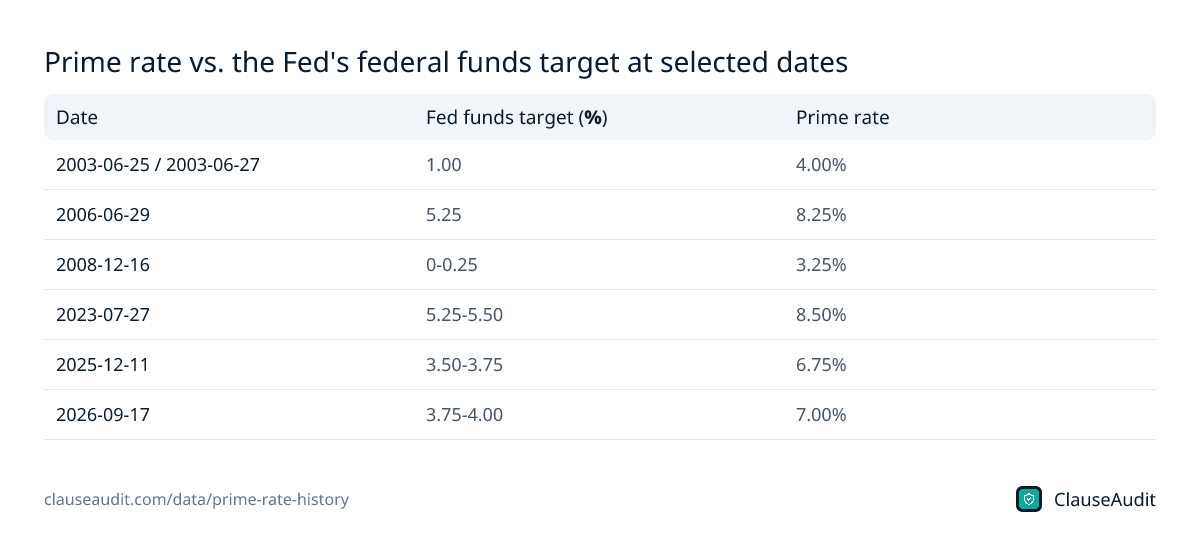
Prime rate vs. the Fed's federal funds target at selected dates
| Date | Fed funds target (%) | Prime rate |
|---|---|---|
| 2003-06-25 / 2003-06-27 | 1.00 | 4.00% |
| 2006-06-29 | 5.25 | 8.25% |
| 2008-12-16 | 0-0.25 | 3.25% |
| 2023-07-27 | 5.25-5.50 | 8.50% |
| 2025-12-11 | 3.50-3.75 | 6.75% |
| 2026-09-17 | 3.75-4.00 | 7.00% |
Source: Board of Governors of the Federal Reserve System, Open Market Operations: FOMC's target federal funds rate or range, change and level; Federal Reserve Bank of St. Louis (FRED), data from Board of Governors of the Federal Reserve System, H.15, Bank Prime Loan Rate (DPRIME), daily. Download as image
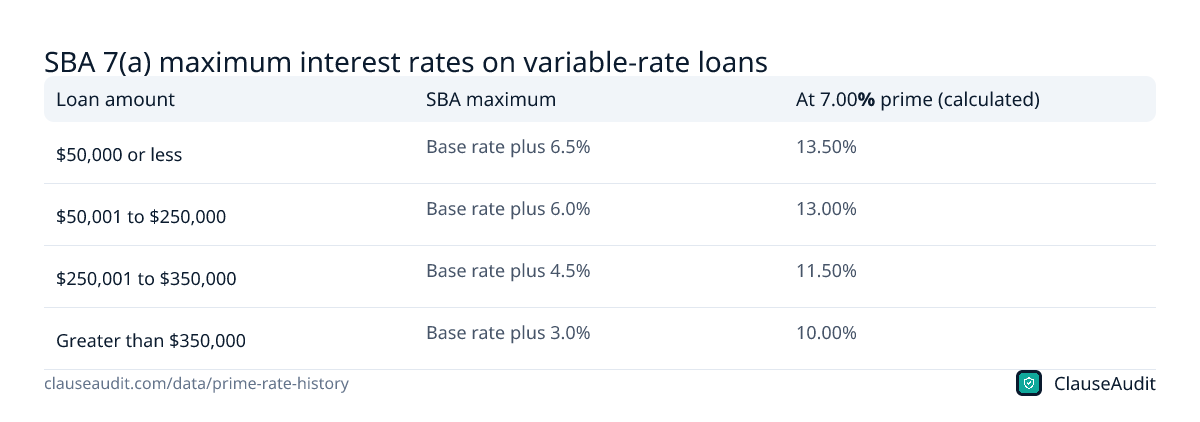
SBA 7(a) maximum interest rates on variable-rate loans
| Loan amount | SBA maximum | At 7.00% prime (calculated) |
|---|---|---|
| $50,000 or less | Base rate plus 6.5% | 13.50% |
| $50,001 to $250,000 | Base rate plus 6.0% | 13.00% |
| $250,001 to $350,000 | Base rate plus 4.5% | 11.50% |
| Greater than $350,000 | Base rate plus 3.0% | 10.00% |
Source: U.S. Small Business Administration, 7(a) loan program: Terms, conditions, and eligibility; Board of Governors of the Federal Reserve System, H.15 Selected Interest Rates. Download as image
What is the prime rate, and who sets it?
The prime rate is the base rate banks use to price a lot of business and consumer credit. No law fixes it. Each bank sets its own, but nearly all large U.S. banks move in step, and the Federal Reserve publishes the common figure in its H.15 release. Most loan agreements point to that common figure, either as the Fed reports it or as the "WSJ Prime Rate" printed by The Wall Street Journal. In practice the two match.
In practice, prime follows the Federal Reserve. When the Fed changes its federal funds target, banks change prime the same day or the next. On September 17, 2026, the Fed moved its target to 3.75-4.00%, and prime moved from 6.75% to 7.00%. Look at the comparison table and you will see the gap between the two has stayed fixed for decades, which is why prime is so predictable once you know what the Fed did.
So the question for a borrower is never really "what will my bank do." It is "what will the Fed do, and how tightly is my loan tied to it."
How has the prime rate changed since 2000?
The record breaks into a few clear stretches. Prime started the period high, at 9.50% from May 2000 to January 2001. A long run of cuts after the dot-com bust took it down to 4.00% by mid-2003. It then climbed steadily to 8.25% by June 2006.
The financial crisis changed everything. Prime fell to 3.25% on December 16, 2008, and stayed there for seven years. Seven years is long enough to forget that a floating rate can float up. After a slow climb to 5.50% at the end of 2018, prime dropped back to 3.25% in March 2020 and sat there until March 2022.
Then came the fastest rise in this data. Between March 2022 and July 2023, prime went from 3.25% to 8.50%, its highest level since early 2001. It held at 8.50% until September 2024, eased to 6.75% by December 2025, and ticked up to 7.00% in September 2026.
For perspective, none of this comes close to the all-time high of 21.50%, set on December 19, 1980. That number matters less as a forecast and more as a reminder that a rate with no ceiling really has no ceiling.
What does a prime rate change do to a variable-rate business loan?
Most variable-rate business loans are written as prime plus a margin. The margin is usually fixed for the life of the loan. Prime is not. When prime rises, your rate rises by the same amount, and your payment goes up with it.
Think about a business that took out a prime-based line of credit in early 2022. Its base rate was 3.25%. By July 2023 the base was 8.50%, with the margin stacked on top. Nothing about the business changed. The contract simply did what it said it would.
SBA 7(a) loans show how this works with limits. The SBA lets lenders charge prime plus a capped spread that depends on loan size. On a variable loan over $350,000, the cap is base rate + 3.0%, which at today's 7.00% prime means a rate of no more than 10.00%. Smaller loans allow wider spreads, up to 13.50% at current prime for loans of $50,000 or less. Your lender can charge less than the cap, so the cap is a starting point for negotiation, not the price.
Bank pricing in the field sits close to prime right now. In the Kansas City Fed's survey for Q2 2026, the median variable rate on new small business term loans at urban banks was 7%, and rural banks came in lowest at 6.7%.
Should you choose a fixed or variable rate right now?
Nobody can tell you where prime goes next, and you should be wary of anyone who claims to. What history can tell you is how wide the range can be over the life of an ordinary loan. Someone who borrowed at the end of 2021, with prime at 3.25%, was paying on a base of 8.50% by July 2023. Someone who borrowed at the 2023 peak saw prime drift down to 6.75% by the end of 2025.
A variable rate makes sense when you expect to pay the loan off early, when the variable rate starts well below the fixed offer, or when your cash flow can absorb a higher payment. A fixed rate makes sense when your margins are thin or when you are borrowing for many years. Ask the lender for both quotes side by side, and work out your payment at the current rate and at the 8.50% peak from 2023. If the second number would sink you, the variable loan is a bet you cannot afford to lose.
One more point people miss. A fixed rate is not free insurance. Lenders often price it above the starting variable rate, and many fixed loans carry prepayment penalties that make it costly to refinance if rates fall. Read those terms before you treat the fixed offer as the safe choice.
What to check before you sign a prime-based loan
A variable-rate loan is only as fair as the clauses around the rate. Two loans can both say "prime plus" and behave very differently when prime moves. Before you sign, find these answers in the agreement itself, not in the sales pitch:
- Which prime rate the loan uses: the published H.15 or WSJ figure, or the lender's own internal rate, which it can change on its own.
- How often your rate resets, and how soon after a prime change your payment goes up.
- Whether there is a rate floor. Many loans say your rate can never drop below the starting rate, so you take every increase but miss the cuts.
- Whether there is a rate cap. If there is none, ask the lender what adding one would cost.
- Whether a rate rise changes your payment or only the share of it going to interest. The second can stretch out the loan instead of raising the bill.
- Whether a default or late payment adds a higher default rate on top of prime, and how much it adds.
How ClauseAudit helps
The prime rate itself is public. What changes your cost is the fine print around it. Upload your loan or credit agreement and the automated review pulls out the rate terms and flags the ones that tilt the deal toward the lender.
You get each clause in plain English, why it matters, and what to ask for before you sign.
- The index the rate is tied to, and whether the lender can set it on its own
- Rate floors that block you from benefiting when prime falls
- Missing rate caps or adjustment limits on a variable loan
- Default interest and late fee terms that stack on top of prime
- Prepayment penalties that make refinancing into a fixed rate expensive
- Personal guarantee and cross-default language that widens your exposure
Frequently asked questions
What is the prime rate today?
The U.S. bank prime loan rate is 7.00%, based on the Federal Reserve's H.15 data for October 15, 2026. It rose from 6.75% to 7.00% on September 17, 2026, when the Fed raised its federal funds target to 3.75-4.00%. Prime usually only changes when the Fed changes its target, so it can stay put for months.
What was the lowest prime rate since 2000?
The lowest was 3.25%. Prime first hit that level on December 16, 2008, and stayed there until December 16, 2015. It returned to 3.25% from March 16, 2020 to March 16, 2022. If you borrowed during either stretch, your starting base rate was as low as prime has gone in this century.
What is the highest the prime rate has ever been?
The all-time high was 21.50%, reached on December 19, 1980. Since 2000, the high was 9.50%, in effect from May 17, 2000 to January 3, 2001. The most recent peak was 8.50%, which held from July 27, 2023 to September 18, 2024.
Is the WSJ prime rate the same as the Fed's prime rate?
In practice, yes. The Wall Street Journal publishes a prime rate based on what the largest U.S. banks charge, and the Federal Reserve's H.15 release reports the bank prime loan rate. The two figures normally match. Your loan agreement should say which source it uses. Be careful if it instead points to the lender's own "prime" or base rate, since the lender controls that number.
How does the prime rate affect an SBA loan?
Variable SBA 7(a) loans are usually priced at prime plus a spread, and the SBA caps that spread by loan size. For loans over $350,000 the cap is base rate + 3.0%, or 10.00% at a 7.00% prime. For loans of $50,000 or less the cap works out to 13.50%. When prime moves, your rate moves with it.
How fast can a variable business loan rate go up?
Faster than most people expect. Prime went from 3.25% in March 2022 to 8.50% by July 2023. Many prime-based loans adjust monthly or quarterly, so borrowers felt each step within weeks or a few months. If your contract has no cap, there is no contract limit on how far the rate can climb.
What is a rate floor, and why does it matter?
A rate floor sets a minimum interest rate no matter how low prime falls. Lenders like floors because they protect income when rates drop. For you, a floor means you absorb every rise in prime but may get none of the cuts. If a lender insists on a floor, ask for a matching cap in return.
Should I refinance a variable-rate loan into a fixed rate?
It depends on your payment, your timeline and the cost of switching. Check your current loan for prepayment penalties first, since they can wipe out the savings. Then compare the fixed offer against what you would pay if prime returned to its 8.50% peak. If that payment would strain your cash flow, locking in may be worth it.
Use this data
Every chart and card below is free to reuse under CC BY 4.0. Download what you need and link back to this page.
 Stat cards
 Key findings card
 Infographic
 Average U.S. prime rate by year, 2000-2026 (%)
 U.S. prime rate at year end, 2000-2026 (%)
 Every prime rate change since the 2022 tightening began (%)
 SBA 7(a) maximum variable rate by loan size at a 7.00% prime rate
 Every U.S. prime rate change, January 2000 to October 2026
 Prime rate vs. the Fed's federal funds target at selected dates
 SBA 7(a) maximum interest rates on variable-rate loans
Embed the infographic
Free to share on your site, blog or slides under CC BY 4.0. Please keep the credit link.
Sources and method
Every number on this page comes from the sources below, each opened and read on or before October 18, 2026. A second, independent review checked every figure against its source and corrected anything that did not match. Figures that could not be confirmed were left out.
- Federal Reserve Bank of St. Louis (FRED), data from Board of Governors of the Federal Reserve System, H.15, Bank Prime Loan Rate (DPRIME), daily (Daily series, observations through October 13, 2026 (downloaded October 18, 2026))
- Board of Governors of the Federal Reserve System, H.15 Selected Interest Rates (Release date: October 16, 2026)
- Board of Governors of the Federal Reserve System, Open Market Operations: FOMC's target federal funds rate or range, change and level (Last Update: September 16, 2026)
- U.S. Small Business Administration, 7(a) loan program: Terms, conditions, and eligibility (Page modified September 16, 2026)
- Federal Reserve Bank of Kansas City, Small Business Lending Survey, Second Quarter 2026: Inflation Expected to Impact Loan Demand (September 24, 2026)
Cite this page
ClauseAudit, “Prime Rate History 2000-2026 and What It Means for Variable-Rate Business Loans”, updated October 18, 2026, https://clauseaudit.com/data/prime-rate-history. Free to reuse with a link back (CC BY 4.0).
This page summarises published data and law as checked on October 18, 2026. Figures are updated as new editions are released, and your own situation may differ. It is general information, not legal, tax or financial advice.